Naso, Bemidabar, & Vayakheil: Reconstructing

(It is a pleasure to type effortlessly and comfortably again! I am glad return to my favorite work: writing about Torah.)

Model of Tent of Meeting in Timna Valley Park, Israel

The Tent of Meeting that the Israelites make as a dwelling for God in the book of Exodus is 10 cubits wide, 10 cubits high, and 30 cubits long. (Ten cubits equals about 15½ feet, or 4¾ meters.) This boxy tent stands in the back half of an open courtyard, slightly smaller than an Olympic-sized swimming pool, with a linen wall stretched between acacia wood posts around its periphery.

Neither the tent nor the courtyard is a permanent structure.

In the first two Torah portions of the book of Numbers, we learn how everything is dismantled, transported, and reassembled at the next campsite on the Israelites’ long journey north from Mount Sinai—and who is responsible for the wood, the fabric, and the holy furnishings.

Exodus: Vayakheil

Neither the inside cloth nor the outside cloth of the Tent of Meeting is sewn into a continuous shell.

And all the wise of mind among the makers of the work, the mishkan, made ten cloths of fine twisted linen threads and blue, purple, and red [dyes]; they were made with a design of keruvim.  (Exodus 36:8)

mishkan (מִשְׁכָּן) = (literally) dwelling place. (In the books of Exodus through Numbers, mishkan always refers to the portable tent-sanctuary where God dwells, at least part-time, in the tent’s back chamber, the Holy of Holies. After its first assembly, in Exodus 40:17-33, it is also called the Tent of Meeting and the Tent of Testimony. One common English translation for mishkan is “tabernacle”.)

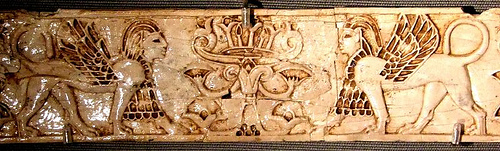
Keruv, ivory from Samaria, 9th-8th century BCE

keruvim (כְּרֻבִים or כְּרוּבִים) = hybrid creatures with wings. Singular keruv. (Two gold keruvim rise from either end of the gold lid of the ark in the Holy of Holies, the back chamber of the mishkan, and keruvim are woven or embroidered into some of the fabrics of the mishkan as well.)1

Each of these ten tapestries is 4 cubits wide (about 2 yards or meters) by 28 cubits long (about 14 yards or meters), long enough to drape across the ceiling frame and hang down on both sides just short of the ground. Fifty loops of blue wool are sewn down both side edges of each cloth, and the loops are connected with gold clasps.

And fifty gold clasps were made, and the cloths were joined, each one to the other, with the clasps. And the mishkan became one [piece]. (Exodus 36:13)

Someone has to fasten a row of 50 clasps nine times, every time the Tent of Meeting is assembled; and unfasten them all when the tent is dismantled again. (The open end of the mishkan is covered with a free-hanging curtain, so it serves at the entrance. A hanging curtain also separates the Holy of Holies from the main chamber inside the tent.)

The outside of the framework is covered with similar cloths woven from goat-hair, joined together by bronze clasps. Two layers of leather lie on top of the goat-hair cloth over the roof.

The frame of the tent roof is made from acacia wood bars, but the three walls are solid acacia wood: wide upright planks stabilized with cross-bars. Two tenons at the bottom of each plank fit into silver sockets in wood bases. And even though these wooden elements are hidden by linen inside and goat-hair fabric outside, they are covered with gold!2 Each of the 48 upright planks is over 15 feet tall and 3 feet wide, so erecting and dismantling the underlying wooden structure means a lot of heavy labor.

Numbers: Bemidbar

The book of Numbers opens after the Israelites have made the Tent of Meeting and all its furnishings (in Exodus), and ordained new priests for the revised religion (in Leviticus). Before the people leave Mount Sinai and head north, God organizes them for the coming conquest of Canaan.

The first Torah portion, Bemidbar, opens with God calling for a census of soldiers for future combat: the men age 20 and older in every tribe except Levi. The Levites are exempt from battle because they are assigned their own “army” duty: transporting and guarding the Tent of Meeting.

And they will be in charge of all the gear of the Tent of Meeting, and the Israelites’ charge to serve the service of the mishkan. (Numbers 3:8)
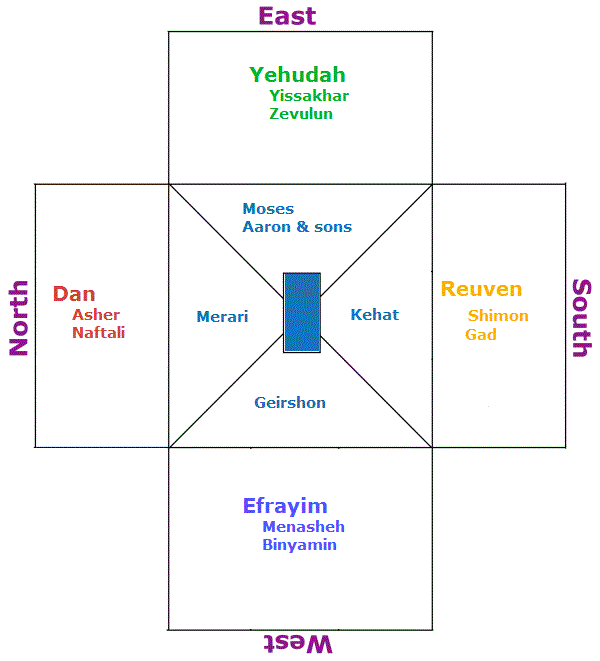
Campsites of 12 tribes and 3 clans of Levites

When God signals that the people must pull up stakes, the Levites dismantle the Tent of Meeting. They carry the furnishings, the fabric, and the wood on every journey. When the Israelites pitch camp again, the Levites erect God’s tent in the middle and the courtyard wall around it. They pitch their own tents immediately around the courtyard, and serve as guards to prevent any unauthorized persons from encroaching on the sacred space.

There are three clans of Levites, named after the three sons of Levi listed in Genesis 46:11: Gershon, Kohat (or Kehat), and Merari. Sons in a biblical genealogy are list by birth order, so Gershon was born first, then Kohat, then Merari last.

And the charge of the Gershonites at the Tent of Meeting was the mishkan and the tent: its coverings, and the curtain of the entrance to the Tent of Meeting, and the cloths of the courtyard, and the curtain of the entrance of the gate of the coutyard, which is near the mishkan and near the altar—all around; and their cords, and all its service. (Numbers 3:25-26)

The descendants of Levi’s middle son, Kohat, are responsible for transporting the holy items inside the mishkan, and the bronze altar in the courtyard.

Their charge was the ark, the table, and lampstand, and the altars, and the holy utensils for ministering to them, and the curtain, and all their service. (Numbers 3:31)

The only curtain that this clan is responsible for is the one inside the tent that divides the main chamber from the Holy of Holies.

But why are the descendants of Levi’s middle son responsible for the holiest items of the mishkan? In the book of Genesis, the firstborn son of each extended family becomes responsible for making burnt offerings to God. If the people followed this precedent, the descendants of Levi’s oldest son, Gershon, would be in charge of the holiest things.

However, in Exodus and Numbers, the job of burning offerings for God is transferred to the priests, with assistance from Levites. All priests are descended from the first high priest, Moses’ brother Aaron. Moses and Aaron’s father, Amram, is a descendant of Kohat, the middle son of Levi.3 That means the rest of the Kohatites are Moses’ and Aaron’s closest relatives. No wonder they become responsible for transporting the holiest items in the mishkan.

As for the descendants of Levi’s youngest son:

The Merarites are appointed for the charge of the beams of the mishkan and its bars, and its uprights, and its sockets, and all its gear, and all its service; and the uprights of the courtyard, all around, and their sockets, and their tent-pegs, and their cords. (Numbers 3:36-37)

While the men in the other tribes of Israel are mustered into the army at age 20, the work of disassembling, carrying, reassembling , and guarding the Tent of Meeting is restricted to Levite men between the ages of 30 and 50. (See my post Bemidbar: Two Kinds of Troops.)

When God’s cloud lifts from above the mishkan, indicating that it is time for the Israelites to journey on, the priests enter the tent first. Aaron and his sons Elazar and Itamar wrap up the ark, bread table, lampstand, and gold incense altar inside, and the bronze altar in the courtyard. (See my post Bemidbar: Covering the Sacred.) The embroidered curtain that divides the Holy of Holies from the main chamber of the mishkan becomes the first of three layers covering the ark.

Only after these holy objects are completely covered, so they cannot be seen or touched, may the other Kohatite men pick them up by their carrying poles. And only after the Tent of Meeting is empty may the Gershonites and Merarites begin dismantling it.

Numbers: Naso

This week’s Torah portion, Naso, opens with God’s instructions regarding the Gershonites and Merarites between the ages of 30 and 50—

—everyone who enters to do military service of the military, to serve the service at the Tent of Meeting. (Numbers 4:23 for Gershonites, Numbers 4:30 for Merarites)

They are non-combatants in any future battle because they must be continuously responsible for all the elements of the tent itself, as well as its unroofed courtyard.

Once the sacred objects have been removed, the Gershonites take down all the lengths of fabric and leather, carefully undoing 950 clasps. They handle the lightest objects, so their work requires the least physical strength. But it requires the most patience and delicacy.

The Merarites do heavy physical labor. Furthermore, disassembling and reassembly the wooden structure with its upright plants, cross-bars, and bases, is a team effort requiring coordination between the men so that nothing collapses.

Once the wooden structure is stable, the fabric layers have all been fastened to make continuous walls and roofs, and the holy objects are all in place, only the priests may enter the mishkan. But the Levites remain on duty, assisting in the courtyard, and guarding the sacred space they have rebuilt.


Some people excel at fine detail work, like the Gershonites. Others are good at team projects on a grand scale, like the Merarites, whether they help organize the team or do the heavy lifting. We need both kinds of people to build a community.

And although everyone who has contributed tries to guard their community and keep it going, no congregation, association, institute, or enterprise continues forever unchanged. At some point, it will fall apart—unless the Gershonites and Merarites in the group pitch in to carefully dismantle the old structure, help everyone move to a place that meets the people’s new needs, and then use the elements of the old structure to build a new one. And we need people like the Kohatites to carry the most sacred goals and values of the community into the next stage.

Never underestimate a Levite.


  1. For more on keruvim, see my post Terumah: Cherubs are Not for Valentine’s Day.
  2. Exodus 36:34.
  3. Exodus 6:20.
  4. Numbers 4:5-6. See my post Bemidbar: Covering the Sacred.
Vayakheil: Shadow Creator

The first time Moses spends 40 days and 40 nights on the summit of Mount Sinai, God tells him everything the Israelites should make to create a portable sanctuary for God and vestments for God’s new priests. Moses also learns who should supervise the craftsmanship.

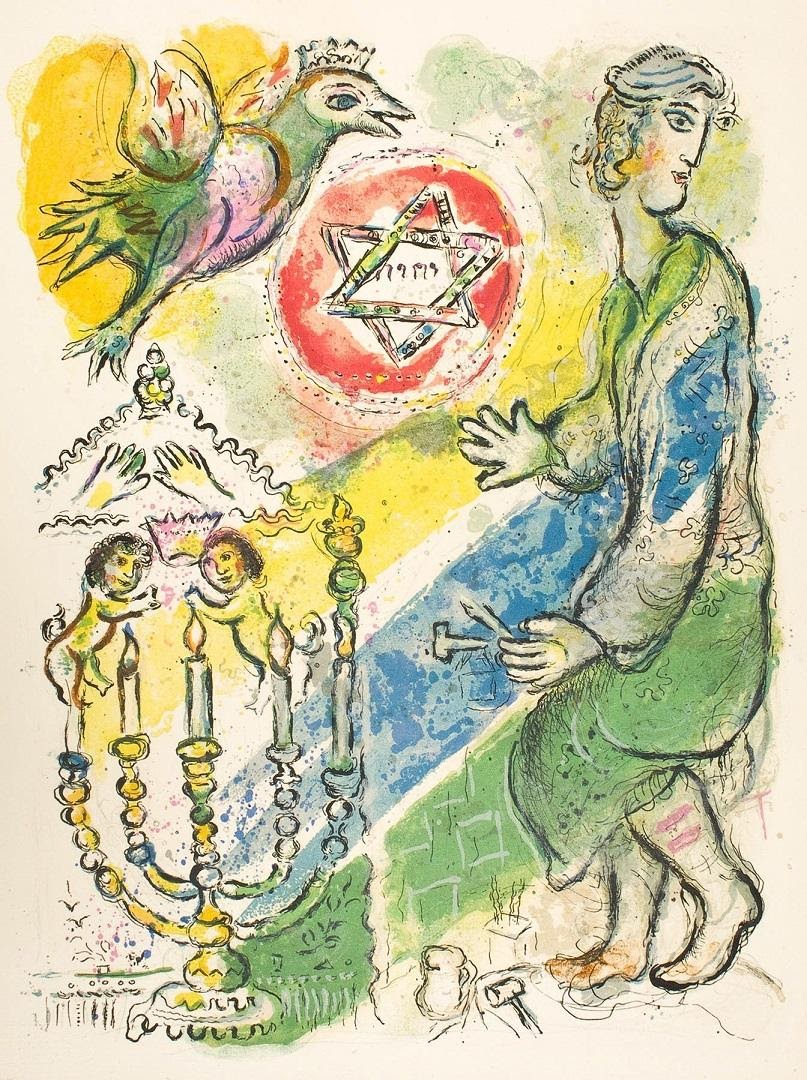
Betzalel, by Marc Chagall, 1966

And God spoke to Moses, saying: “See, I have called by name Betzaleil son of Uri son of Chur of the tribe of Yehudah. And I have filled him with the spirit of God in wisdom and in insight and in knowledge, and in every craft.” (Exodus/Shemot 31:1-3)

Betzaleil (בְּצַלְאֵל) = In the shadow of God. (Be-, בְּ = in, at, by, with + tzeil,צֵל = shadow, shade + eil, אֵל = God, a god.)

When Moses comes back down from the mountaintop in last week’s Torah portion, Ki Tisa, he has to deal with the Golden Calf. Then he returns to the summit for another 40 days. This time he learns more about God’s character and gets replacement stone tablets.1 After he comes back down from this second stint, he finally gets to communicate God’s instructions for the sanctuary and the priests’ vestments to the people in this week’s Torah portion, Vayakheil (Exodus 35:1-38:20).

Moses calls for donations of the materials, and for artisans who are skilled in woodworking, metalworking, weaving, and jewelry-making. The donations pour in, and plenty of male and female artisans volunteer to do the work. Before they begin, Moses appoints the supervisor and master craftsman that God had named.

And Moses said to the Israelites: “See, God has called by name Betzaleil son of Uri son of Chur of the tribe of Yehudah, and has filled him with the spirit of God in wisdom, in insight, and in knowledge, and in every craft—to invent designs to make in gold and in silver and in copper; and in preparing stones for setting and in preparing wood for making; and in every craft of designing. And to give instructions …” (Exodus 35:30-34)

Both God and Moses begin talking about Betzaleil by using the imperative “See!” Everyone can see that Betzaleil is an inspired artist and designer, so it is easy to believe God has singled him out or “called him by name”.

And his name is appropriate for his mission. The name Betzaleil means “In the shadow of God”, but what does it mean to be, or to create, in God’s shadow?

Shadows in English and Hebrew

The Hebrew word tzeil (and its variant tzeilel, צֵלֶל) and the English word “shadow” have the same literal meaning: the dark area cast on a surface by an object between a light source (such as the sun) and that surface. Tzeil can also mean “shade”, which is another description of shadow in English

But when these words are used metaphorically, they have a different sense in English than in Biblical Hebrew. A shadow is usually attached to the spot where the person or thing that casts it touches the ground. (Shadows of birds and other airborne objects are the exception.) So in English, shadowing a person is following their every move.

In English, a shadow is also less noticeable or less significant than the person casting it. Being in someone’s shadow means going unnoticed. The shadow side of a person or institution is the unacknowledged, unconscious, or repressed side. People who have lost status, size, or ability are called shadows of their former selves.

In the Hebrew Bible, the word tzeil or tzeilel appears 51 times. It is used literally 17 times, as a metaphor for concealment and refuge 7 times (perhaps because it is harder to spot someone in dark shade), and as a metaphor for time stretching out like a shadow 3 times.

The word is also used in two ways that relate to Betzaleil’s name: 19 times as a metaphor for protection, and 5 times as a metaphor for transience.

Shade as protection

Those of us who live in more moderate climates might not think of shade or a shadow as protection, but in the deserts of the Ancient Near East shade meant protection from the burning sun and the risk of dehydration.

The first time tzeil appears is in Genesis, when Lot begs the men of Sodom not to sexually molest his two visitors:

“Hey, please, I have two daughters who have not known a man. Please let me bring them out to you, and you may do to them whatever is good in your eyes. Only don’t do a thing to these men, because they came into the tzeil of my roof!” (Genesis 19:8)

Here “the tzeil of my roof”, literally “the shade of my roof”, really means “under my protection”. Once Lot has offered the visitors the hospitality of his house, he feels honor-bound to protect them from the mob as long as they stay with him.

The word tzeil also indicates protection by a king, government, city, or nation. And it is used for protection by God. For example:

          God is your guardian;
God is your tzeil at your right hand. (Psalm 121:5)

Since Betzaleil is “in the shadow of God”, God protects and shelters him. His inspiration for designing all the holy objects and his ability to instruct others come from the spirit of God, and therefore everything will come out right.

Shadow as transience

When the Hebrew Bible comments on the brevity of human life, it often compares humans with grass that sprouts up and then withers. But comparing humans with shadows is even more telling, since shadows outside vanish daily at nightfall, and shadows inside disappear into darkness the moment a lamp is snuffed out. Here is one example:

          A human, like a puff of air, comes to an end;
His days, like a tzeil, pass by. (Psalm 144:4)

Since Betzaleil is human, his life is very short compared to God’s. By extension, Betzeleil’s creations, however beautiful and holy, are mere passing shadows compared to God’s creations.

Shadows and images

A literal shadow is like a silhouette; you see the outline of the original, but none of the details or colors. Similarly, the Hebrew word tzelem, which usually means image but can also mean “shadow”, has less reality than the original object. The word tzelem may well be related to the word tzeil. It appears in the first account of God’s creation of the universe:

And God said: Let us make humankind betzalmeinu, in our likeness, and they will rule over the fish of the sea and over the birds of the heavens and over the beasts, and over all the land, and over all creepers that creep on the land. (Genesis 1:26)

betzalmeinu (בְּצַלְמֵנוּ) = in our image. (Be-, בְּ = in, at, by, with + tzelem, צֶלֶם, = image, model, statute, shadow, something shadowy (without substance) + einu, ֵנוּ  = our.)

One of the ways humans are shadows or images of God is that we have secondary creative powers. We cannot create a universe, but we can recombine existing elements to create new things within our universe. We cannot create life, but we can create beauty. When we humans are at our best, when we are inspired to create, like Betzaleil, we imitate or shadow the divine.

The entire work of art that served as the portable sanctuary, expanded later into the temple,  inspired the children of Israel to keep returning to their God over the centuries. It kept their religion alive until it could metamorphose and survive without a temple.

We humans have more creative power than we think, for good and for ill. May we use it wisely.


  1. See my post Vayakheil & Ki Tisa: Second Chance.

Vayakheil+4: Not on Shabbat

“Hurry up and wait” describes a lot of life. Two weeks ago I was frantically getting ready to move my mother into assisted living. Now my effort to fulfill the Fifth Commandment and honor my mother is on hold until I get a moving date from the center—and wouldn’t you know it, she had another fall while she was alone in her house …

Talmud Readers, by Adolf Behrman, 1876-1943. What could be more absorbing?

I wish this period of waiting instead of doing labor were like the day of shabbat, the sabbath day of rest, but these days my soul is too heavy to rise to either refreshment or holiness. So this week I took my mind off my troubles by researching the commandment about shabbat. Here is a new post for this week’s Torah portion, Vayakheil—and four other portions in the book of Exodus, Beshallach, Yitro, Mishpatim, and Ki Tisa, that include variations on the command to desist from labor on the seventh day.

*

The first three of the Ten Commandments order us not to underestimate God.1 The last six are ethical precepts for human relations with other humans.2 In between, the fourth commandment combines holiness and ethics. It opens:

Remember the day of the shabbat, to treat it as holy. (Exodus 20:8) 3

shabbat (שַׁבַּת) = sabbath, day of rest. (From the same root as shavat, שָׁבַת = cease, stop, desist; stop working.)

This command is followed by explanatory notes in the Torah portion Yitro. More details are added every time the observance of shabbat is commanded in the book of Exodus—from the first time, in the portion Beshallach, when the Israelites are collecting manna, to the sixth time, in this week’s portion, Vayakheil, after God has given Moses a second set of tablets with the Ten Commandments carved in stone.

1) Don’t move

Manna Raining from Heaven, Maciejowski Bible, c. 1250 C.E.

Moses first mentions shabbat in the Torah portion Beshallach, when God provides manna for the hungry Israelites to gather up from the ground six, and only six, days a week. Moses says:

“See that God has given you the shabbat. Therefore on the sixth day [God] is giving you food for two days. Everyone in his place! No one go out from his spot on the seventh day!” (Exodus 16:29—Beshallach)

This introduces shabbat as a day of rest, at least in terms of going out and gathering food.

2) Holy break

The next order regarding shabbat is the one in the Ten Commandments in Yitro. The full fourth commandment states:

The Creation, by Lucas Cranach, 1534, Luther Bible

Remember the day of the shabbat, to make it holy. Six days you may work and you may do all your labor. But the seventh day is a shabbat for God, your God; you must not do any labor, you or your son or your daughter, your male slave or your female slave or your livestock or your immigrant within your gates. Because in six days God made the heavens and the earth and the sea and everything that is in them, and [God] took a break on the seventh day. Therefore God blessed the day of the shabbat and made it holy. (Exodus 20:8-11)

The emphasis in this commandment is on the holiness of shabbat. Since the day itself is holy, it must be set aside from mundane labor by all humans and animals in an Israelite’s household, and even by God.

3) Ethical refreshment

The third injunction about shabbat is in the portion Mishpatim:

Six days you may do your doings, but on the seventh day tishbot so that your ox and your donkey can take a break, veyinafeish, your slave and the immigrant. (Exodus 23:12)

tishbot (תּשְׁבֺּת) = you must cease, stop, stop working. (A form of the verb shavat.)

veyinafeish (וְיִנָּפֵשׁ) = and he can refresh himself, reanimate himself, catch his breath. (From the same root as nefesh, נֶפֶשׁ = throat, breath, appetite, mood, animating soul.)

This time Moses, speaking for God, gives a reason why even slaves, immigrants, and beasts must be given a day off from work on shabbat: so that draft animals can rest their muscles, and human laborers can rest their souls, becoming refreshed and revitalized.

Providing a day of rest is an ethical mandate; the moral principle of kindness calls for helping others to have a better life, and the moral principle of fairness supports giving everyone a day off when the landowner has a day off. Shabbat is the opposite of Pharaoh’s unethical subjection of the Israelite slaves to unremitting labor.4

4) Be holy or die

The fourth command about shabbat appears in the Torah portion Ki Tisa, after God finishes telling Moses what the Israelites must make to set up the sanctuary and the priests of their new religion. God warns that all of this construction must pause on the day of shabbat.

Nevertheless, you must observe shabtotai, because it is a sign between me and you for your generations, for knowledge that I, God, have made you holy. And you must observe the shabbat because it is holy for you. Whoever profanes it must definitely be put to death, because whoever does labor on it, his life will be cut off from among his people. (Exodus 31:12-14)

shabtotai (שַׁבְּתֺתַי) = my shabbats.

This order not only reiterates that shabbat is holy, but adds that observing it is a reminder that the Israelite people themselves are holy, i.e. set aside for God.

In addition, profaning shabbat by doing labor on that day is such a serious transgression that God assigns it the death penalty.

This rule about observing shabbat is the source text for the Talmud’s list of 39 categories of labor forbidden on the seventh day. The rabbis assume that since God warns that the work of building the sanctuary and fabricating the priests’ clothing must cease on shabbat, the labors involved in doing those tasks are the labors forbidden on shabbat from then on.5

This injunction in Ki Tisa continues:

The Israelites must observe the shabbat, doing the shabbat throughout their generations as a covenant forever. Between me and the Israelites it will be a sign forever, because for six days God make the heavens and the earth, and on the seventh day [God] shavat vayinafash. (Exodus 31:16-17)

vayinafash (וַיִּנָּפַשׁ) = and he refreshed himself, reanimated himself, caught his breath.   (A variant of veyinafeish.)

Since the divine life of the universe pauses every seven “days” for refreshment and redirection, so must our own souls. (See my earlier post,  Mishpatim, Ki Tisa, & 2 Samuel: Soul Recovery.)

5) No farming

Shabbat comes up again later in the portion Ki Tisa when God gives Moses additional instructions for the Israelites.

Six days you may work, but on the seventh day tishbot; at plowing and at grain-cutting tishbot. (Exodus 34:21)

The book of Exodus gives no reason why agricultural labor in particular is prohibited on shabbat. One possibility is that this sentence refers to the ethical law about shabbat in Mishpatim, since landowners used draft animals (oxen and donkeys) to plow, and teams of underlings including slaves and immigrants to scythe down ripe grain.

Sheaves of grain

On the other hand, the list in the Talmud of activities prohibited on shabbat includes farming chores that eventually lead to the bread that must be displayed on the gold-plated table in the sanctuary.6 The first eleven of the 39 prohibited labors in the Talmud are sowing grain, plowing, reaping, gathering sheaves, threshing, winnowing, selecting the edible kernels, grinding them into flour, sifting the flour, kneading dough, and baking bread. By this interpretation, the ban on plowing and reaping on shabbat might mean the holiness of the day surpasses the holiness of the sanctuary.

6) Light no fires

The sixth and final shabbat instruction in the book of Exodus occurs in this week’s Torah portion, Vayakheil. Again the seventh day is called holy, and doing labor on that day is punishable by death.

Six days you may do labor, but the seventh day must be holy for you, a shabbat shabbaton for God. Anyone who does labor on it must be put to death. You must not kindle a fire in any of your settlements on the day of shabbat. (Exodus 35:2-3)

shabbaton (שַׁבָּתוֹן) = most solemn shabbat, feast day of shabbat, day of absolute stopping.

Here Moses repeats God’s commands that the day of shabbat must be treated as holy and that anyone who does not desist from labor on that day must be executed.

The new information in Vayakheil is that lighting a fire is prohibited on shabbat. Before this, the only specific examples of labor forbidden on shabbat are agricultural: gathering manna, using draft animals, sowing and reaping . Now, in Vayakheil, Moses gives another example of labor: lighting a fire.

The purpose of this prohibition cannot be ethical, since lighting a fire is not in itself a heavy labor, and it benefits other humans by giving them heat, light, and a way to cook food.

Since the previous verse reminds us that the seventh day must be holy, refraining from kindling a fire must be another religious rule associated with holiness.

Kindling a fire is number 37 in the Talmud’s list of 39 labors banned on shabbat, right after extinguishing a fire. It may allude to the fire on the altar. Although burnt offerings continue during shabbat according to the Torah, the fire is not rekindled. In fact, it must never go out.7 The altar fire is holy because it is dedicated to God, and because God kindled it.8

*

Thus the book of Exodus presents the law against working on shabbat as a religious rule (guarding what is holy) three to five times.9 It presents the law as an ethical rule (promoting kindness and fairness) only twice.10

Yet when we observe the day of shabbat we can remember that it is not solely a religious requirement reminding us of holiness. We will not be put to death for doing forbidden work on shabbat, since that part of the order in this week’s Torah portion is no longer followed. But when we try to set aside mundane concerns in order to elevate our souls on the seventh day, we can also remember the ethical values in the last six commandments, which address kindness, fairness, and respect for other human beings.

And I can pray that soon I will be able to obey the fifth commandment, and treat my mother with kindness and respect by moving her into a safe place.

  1. See my upcoming post, Pekudei, Yitro, & Ki Tisa: Not Like Other Gods.
  2. See my posts Yitro, Mishpatin, & Va-etchanan: Relative or Relevant? Part 1, Part 2, and Part 3 on the last six commandments.
  3. This is the opening in Exodus. When Moses repeats the Ten Commandments in Deuteronomy, the fourth commandment opens: Observe the day of the shabbat and treat it as holy. (Deuteronomy 5:12)
  4. Exodus 5:1-9, 6:9.
  5. Talmud Bavli, Shabbat 73a, Mishna.
  6. Exodus 25:23-30.
  7. Leviticus 6:5-6.
  8. Leviticus 9:24 for the portable sanctuary in the wilderness.
  9. Exodus 16:29, 20:8 and 11, 31:12-13 at a minimum. According to the Talmud Exodus 34:21 and 35:2-3 are also rules for religious purposes.
  10. Exodus 20:9-10, 23:12.

Repost: Vayakheil

Every part of the portable tent-sanctuary that God describes in the earlier Torah portion Terumah, the Israelites make exactly as specified in this week’s Torah portion, Vayakheil (“And he assembled”).  Here is a link to my 2018 post on God’s description of the menorah or lampstand: Terumah: Tree of Light.  The portion Vayakheil uses an almost identical description for the menorah the artist Betzaleil makes.1

Both descriptions leave room for argument about the actual appearance of the menorah.  We know it is made in one piece out of pure hammered gold.  A central shaft rises from a base and has three branches on each side. The shafts and each of its branches ends in a bowl for oil, so there are seven lamps across the top.  But are the branches curved or straight?  Smooth or knobby?  Neither Torah portion makes these details clear.

Here is what this week’s Torah portion says about the shaft and branches:

Three bowls meshukadim on one side, on each a kaftor and a blossom, and three bowls meshukadim on the other side, on each a kaftor and a blossom; the same way for all six of the branches going out from the menorah.  And on [the central shaft of] the menorah, four bowls meshukadim, [each with] its kaftor and its blossom: a kaftor under a pair of branches from it and a kaftor under a pair of branches from it and a kaftor under a pair of branches from it—for the six branches going out from it.  (Exodus/Shemot 37:21-22)

Almond tree in Jerusalem (photo by M.C.)

meshukadim (מְשֻׁקָּדִים) = made like part of an almond tree.

kaftor (כַּפְתֺּר) = a drupe (a fruit with a pit, such as a peach, plum, or almond), a knob, a capital of a column resembling an almond drupe; a native of Crete.

We arrived in Jerusalem when the almond trees were blooming, and I took a picture of one that still had last year’s dried-up almond drupes as well as this year’s flowers.  Inside those dark fruits are almonds.

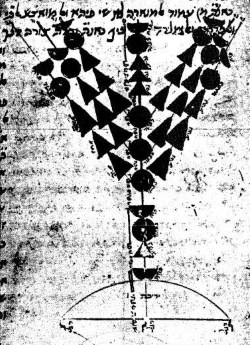
Menorah drawing by Maimonides, Commentary to the Mishneh

So the two shapes used to ornament the stems under the lamps are the flattened oval of the almond drupe, and a flower with five oval petals.  But do the branches curve?  And are there smooth tubes of gold between these decorations?

12th-century C.E. Rabbi Moshe ben Maimon, a.k.a. Maimonides or Rambam, drew this interpretation of the menorah’s shape in his “Commentary to the Mishneh”.  His son, Rabbi Abraham ben HaRambam, wrote that the branches of the menorah were straight lines, like his father drew, not arcs.  Rambam’s abstract geometric drawing also shows the ornaments on the branches as continuous, the top bowls for oil at different heights, and the base as a potentially sturdy slice off the top of a sphere. But obviously the line of the central shaft in the drawing is not intended to represent an actual shaft of gold that could support the structure.

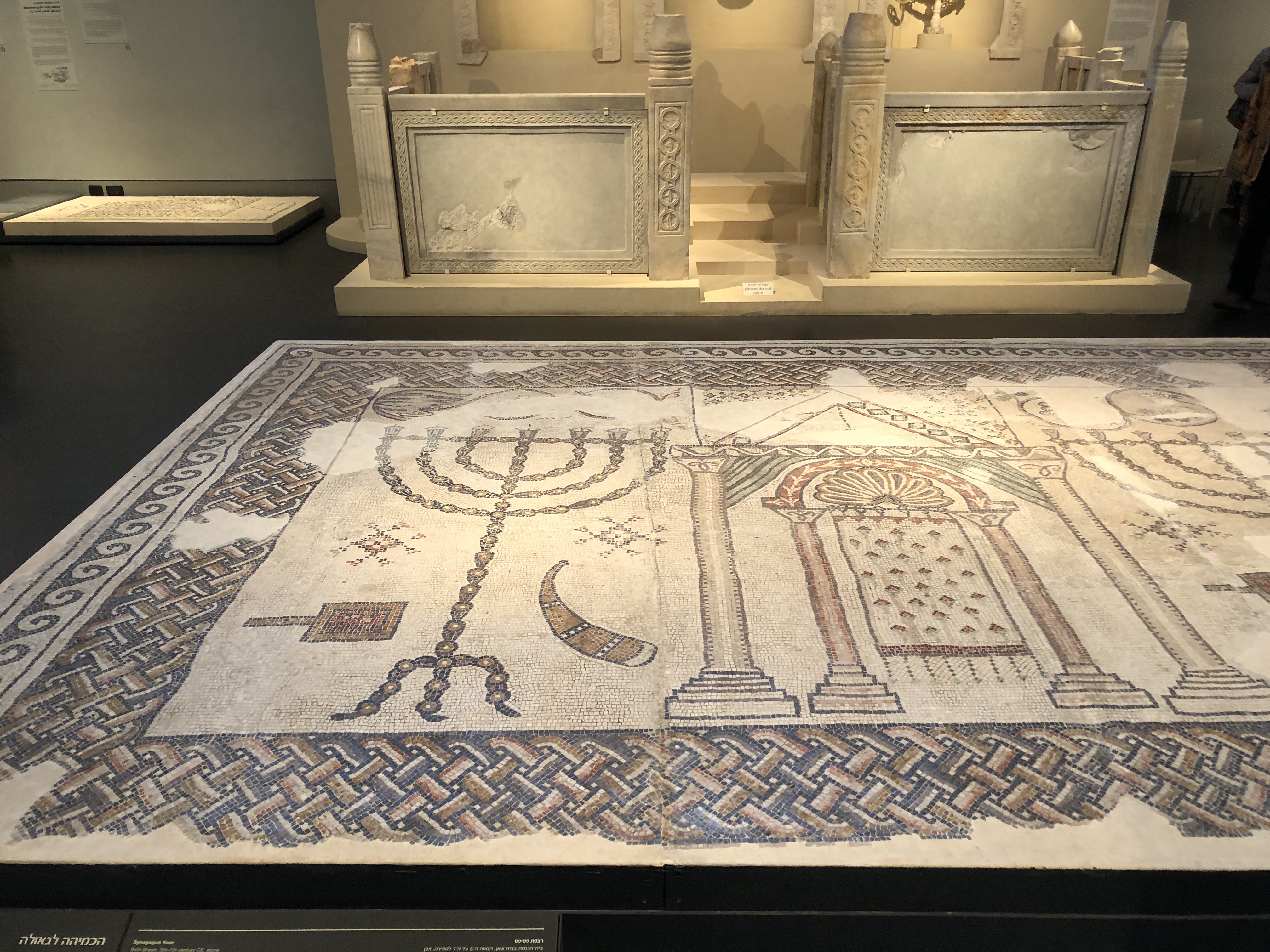
A mosaic in a 5-7th century synagogue in northern Israel depicts a menorah with long smooth curved branches.  But it also shows a graceful base with thin legs that could not support the weight of the necessary gold.  (See my photo below.)

Mosaic from Bet Shean synagogue, 5-7th century C.E., Israel Museum

How much further can we go back in history for evidence?  If only there were another clue about the shape of the menorah later in the Torah!  But all we have is this:

And thus Aaron did: toward the front of the menorah Aaron brought up its lamps, as God commanded Moses.  And this was the making of the menorah: hammered-work of gold from its base to its fruit is was hammered-work; like the form that God had shown Moses, thus he made the menorah.  (Numbers/Bemidbar 8:3-4)

Then the original menorah Betzaleil made disappears from the bible.

When King Solomon builds a temple in Jerusalem to replace the portable tent-sanctuary, he replaces most of the holy items and adds more.  (See my post: Haftarat Pekudei—1 Kings: More, Bigger, Better.)  Instead of the original single menorah, he sets up ten new ones inside the middle chamber of the temple, five on each side.2  Their shapes are not described.

According to Jeremiah 52:19, these ten gold lamp-stands are among the holy objects the Babylonian army carries away when it loots and destroys Solomon’s temple in 597 B.C.E.  In 538 B.C.E. the new Persian empire lets Jews in exile in Babylonia return to Jerusalem and build a second temple.  The book of Ezra says they even get to bring back thousands of gold and silver vessels and utensils that the Babylonians had taken with them, but the only gold items the book specifically mentions by type are 30 basins and 30 bowls—no lamp-stands, no bread table, no incense altar, and no ark.3

So the second temple in Jerusalem had to be furnished with another new menorah, if only so the priests serving inside the windowless room would have light.  Its designer may have tried to follow the same instructions as Betzaleil did in this week’s Torah portion.

But this menorah, too, was replaced.  In 169 B.C.E. the soldiers of Antiochus Epiphanes looted the temple, and after the Maccabean Revolt (167-160 B.C.E.) Judas Maccabeus had new utensils made for the re-consecrated temple, everything except the irreplaceable ark.4

Herod built the Temple Mount platform and rebuilt the second temple between 25 and 10 B.C.E., while the priests continued making offerings on the altar, and carried out the rebuilding of the temple interior.  A gold menorah, bread table, and incense altar remained in the sanctuary, and the Holy of Holies behind the curtain in back remained empty.

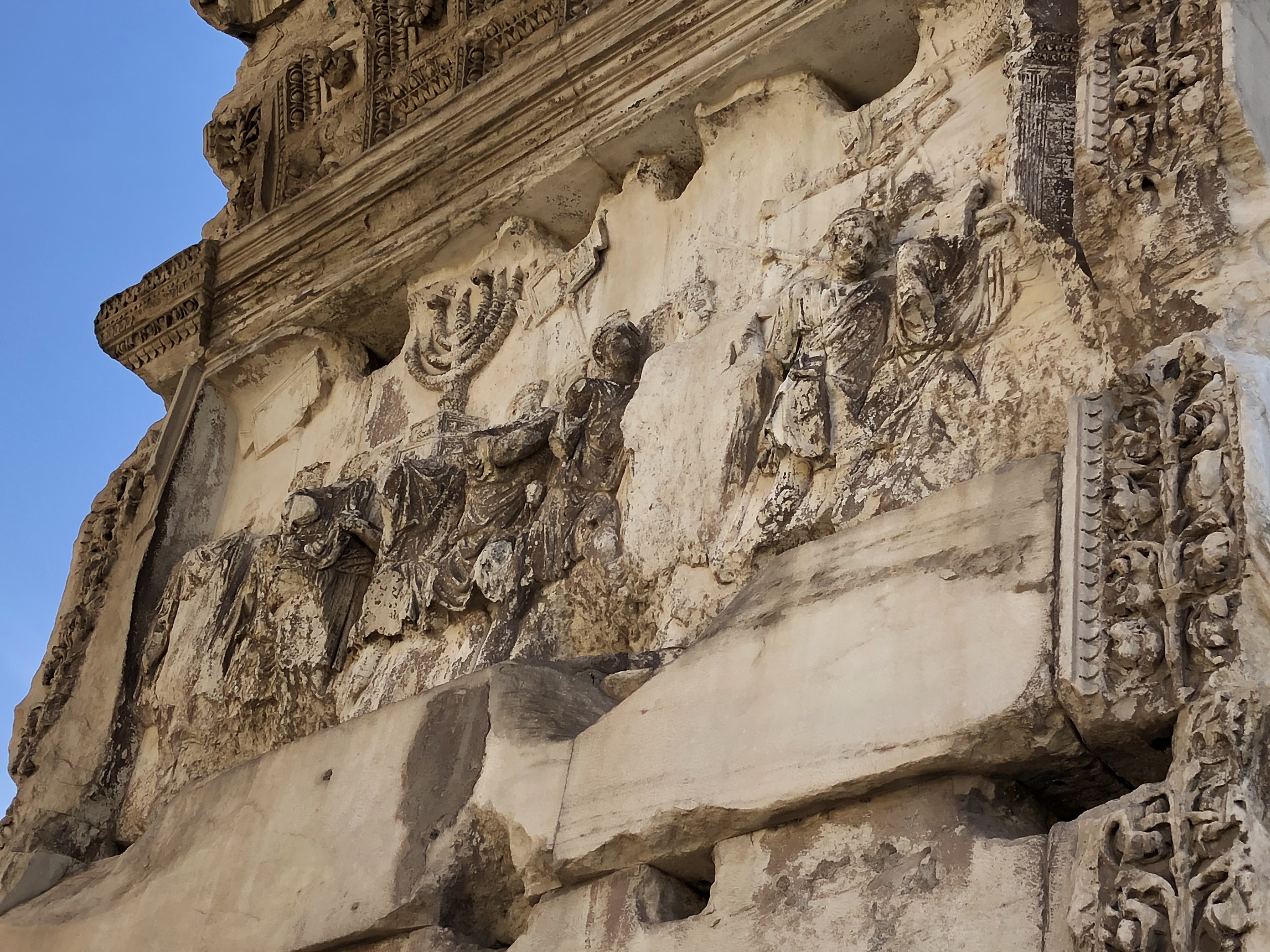
Roman soldiers putting down a Jewish rebellion sacked and destroyed this final temple in 70 A.D.  Eleven years later a stone relief was carved on the Arch of Titus depicting soldiers carrying away the menorah and other trophies.  The real menorah was on display in a temple in Rome—until that city was sacked by Vandals in 455 C.E.  Nobody knows what happened to it after that.

Arch of Titus (photo by M.C., 2019)

For many centuries the relief on the inside of the Arch of Titus at was the oldest depiction of the second temple menorah.  Old photographs of this relief show clearly that the menorah’s branches are rounded.  Thanks to the air pollution in Rome, the menorah looked this when I saw it in December:

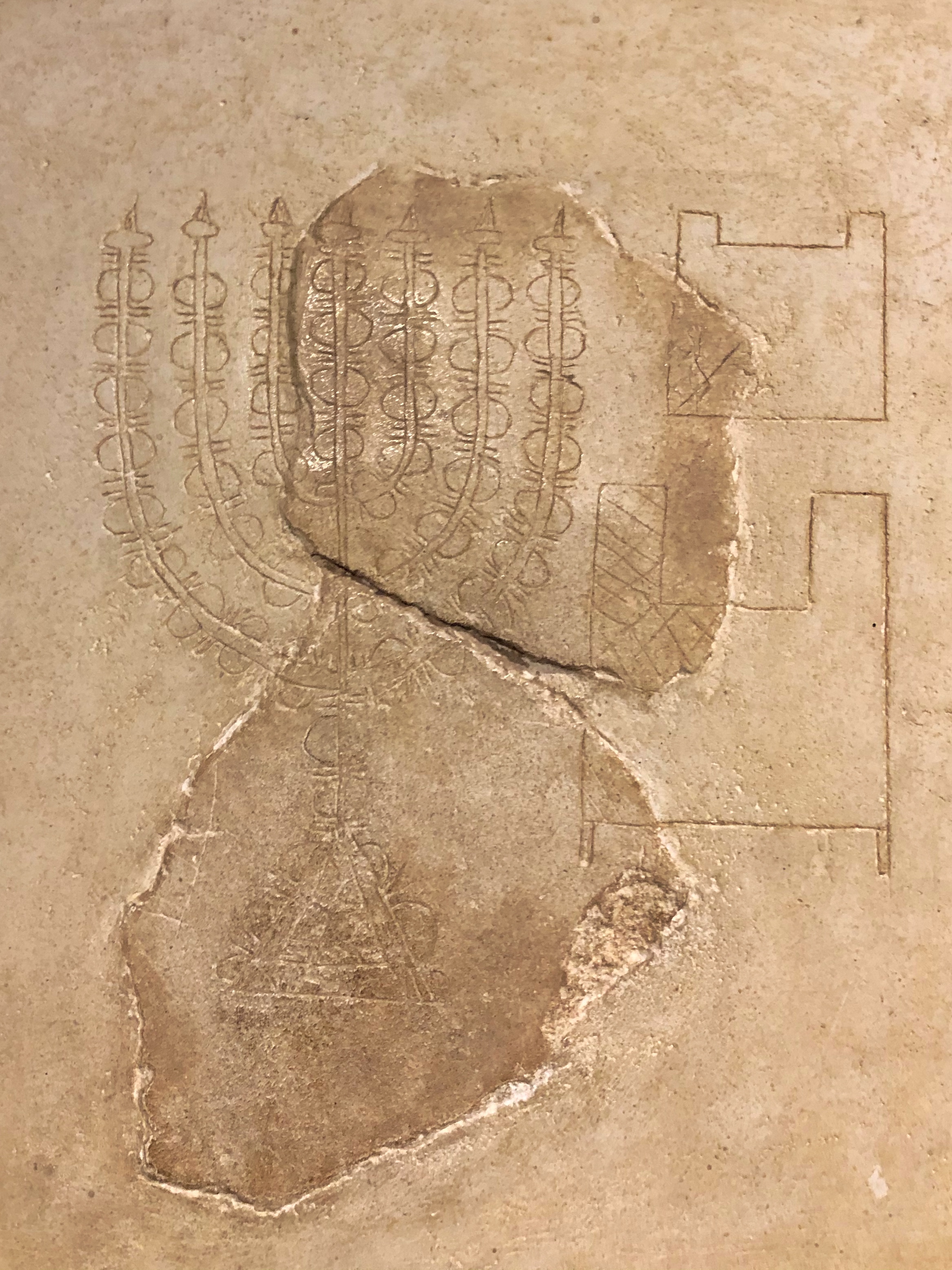
Commentators have questioned whether the menorah on the arch is an accurate likeness or an artist’s fantasy.  Now we have a more authoritative drawing, discovered scratched into a plaster wall in an archaeological excavation of an upper-class house on the hill right next to the Temple Mount.This house, like the three adjacent houses or mansions, had mikvot (ritual baths) in the basement indicating that it belonged to a family in the caste of priests.  Priests, and only priests, served inside the temple.  They saw the menorah; some of them lit and tended its lamps.

Menorah at Wohl Archaeological Museum, Jerusalem (photo by M.C.)

This is a drawing of the Second Temple menorah by an eyewitness who lived during the time of King Herod.  (The incised drawing to the right might be a view of the bread table.)  This menorah has a base that is either a cone or a pyramid, and curved branches.  The branches and shaft have no smooth sections; they are made with a continuous ornamentation, alternating flat round shapes like drupes with flat shapes that might even be derived from petals.

I wonder if the homeowner drew it as an object of meditation before immersion in the mikveh, or as an object of instruction for his sons.  Either way, it is our closest connection with the sacred object that once lit the temple in Jerusalem.  And that menorah was a recreation of the sacred object that Betzaleil creates in this week’s Torah portion to light up a new sanctuary for God, the creator of light.

*

I write this today on a hill in Jerusalem that is too far from the Temple Mount to walk.  It does not matter, since now everyone in Israel is ordered to stay home except to get essential groceries and medicines.  I hope no new measures to fight the Coronavirus pandemic will prevent me and my husband from flying back to Oregon in a few days.

The current situation seems dim for all the world’s people.  I pray not only for healing, but for a new cooperation among all people, bringing new light into the world.

  1. Exodus 37:17-24.
  2. 1 Kings 7:48-49.
  3. Ezra 1:7-11.
  4. 1 Maccabbes 1:21.
  5. Wohl Archaeological Museum, Ha Kara’im Street, Jerusalem.


Vayakheil & Psalm 13: Waiting in Contentment

detail of “Moses on Mt. Sinai” by Jean-Leon Gerome, ca. 1900

The Israelites are overcome with anxiety the first time Moses spends 40 days on Mount Sinai.  In last week’s Torah portion, Ki Tisa:

The people saw that Moses was long delayed in coming down from the mountain, and they assembled against Aaron, and they said to him: “Get up, make for us a god who will go in front of us, since this Moses, the man who brought us up from the land of Egypt, we don’t know what has happened to him!”  (Exodus/Shemot 32:1)

Aaron asks them to donate their gold earrings to melt down.  They do, but Aaron does the work of making the golden calf.  Even though he says the new idol represents the God of Israel, not another god, it turns out to be a bad solution to the people’s anxiety.  Between them, Moses and God destroy thousands of Israelites and chasten the survivors.  After a while God forgives them.  (See last week’s post, Ki Tisa: Stiff-Necked People.)

Then Moses tells the Israelites what God does want them to make: a portable tent-sanctuary, where God will speak from the empty space above the ark inside the inner chamber.  In in this week’s Torah portion, Vayakheil (“And he assembled”), they gladly pitch in.

Every man and woman whose heart prompted them to bring anything for the work that God had commanded to do through Moses, the Israelites brought as a nedavah for God.  (Exodus 35:29)

nedavah (נְדָבָה) = spontaneous voluntary offering.

Betzaleil and Oholiav, Anton Koberger, Nuremberg Bible, 1483

Then Moses called on Betzaleil and on Ohaliav and on everyone with a skilled mind, to whom God had given a skilled mind; everyone whose heart lifted at approaching the work to do it.  (Exodus 36:2)

Moses appoints the most skilled craftsman, Betzaleil, to make the most holy objects.  But everyone with skill in weaving, sewing, metal-smithing, and woodworking gets to make some part of the new Tent of Meeting and its courtyard enclosure.  And the people with materials keep on donating them, until Moses has to tell them to stop because the artisans have more than enough.1

For the rest of the book of Exodus (five chapters), nobody complains and nobody worries.  The people are content, fulfilled by using their gifts to make something important, secure in their knowledge that God will be with them.

Yet in the book of Numbers, three days after they set out from Mount Sinai, the Israelites start complaining again—this time about the food.2  Even though both the ark and a divine cloud are leading them, even though the Levites are carrying all the pieces of the portable sanctuary, the people are discontented.  Perhaps the problem is that they no longer have anything to do but march to the border of Canaan.

The Israelite ex-slaves in the books of Exodus through Deuteronomy are like children, who enjoy doing things on their own but depend on an adult to straighten out anything that goes wrong.  When they are hungry or afraid, they complain and wait for God to relieve their suffering.

The book of Psalms includes pleas by suffering individuals as well as pleas for all the Israelites.  Psalm 44 is the first of a series of psalms complaining that God is neglecting and hiding from the Israelites as a whole, letting them be defeated in battle and subjugated by enemies.  Individuals feel abandoned and ask how long God will make them wait for rescue from diseases or personal enemies in Psalms 6, 10, 13, 22, and 35.  Only Psalm 13 hints at a solution to God’s abandonment.

Psalm 13

by John Constable

How long, God, will you endlessly forget me?

How long will you hide your face from me?

How long must I make schemes inside myself,

My heart in torment all day?

How long will my enemy loom over me?

Look!  Answer me, God, my God!

Light up my eyes, lest I sleep death!

Lest my enemy say he has prevailed over me,

My adversaries rejoice when I am made to stumble.  (Psalm 13:2-5)

The speaker has two problems:

1) God is hiding God’s face; i.e. the speaker is no longer aware of God’s presence, and so feels abandoned.

2) The enemy seems to be winning, despite the schemes the speaker devises.  In this life-and-death struggle, only God’s intervention can turn the tables.  But the speaker has already been waiting an unbearably long time for God to manifest and act.  Where is the responsible adult in charge?3

Unlike the Israelites who wait 40 days for Moses to return, only to give up and demand an idol, the speaker in Psalm 13 finds a better response.

by James Tissot

Yet I will trust in your loyal-kindness.

My heart will rejoice in your rescue.

I will sing to God,

Because [God] gamal me.  (Psalm 13:6)

gamal (גָמַל) = ripened, weaned, rewarded, made mature.

Even if God seems to have abandoned the speaker, the speaker decides not to abandon God.  A more mature approach is to sing to God while waiting for God to act.


In this week’s Torah portion, Vayakheil, God makes a request, and the Israelites create beautiful items for God’s sanctuary.  As long as they are doing that work, they are content to wait for God to rejoin them.

In Psalm 13, God neither makes a request nor acts to rescue the speaker.  After waiting a long time, the speaker takes initiative and creates a song for God.  They are still waiting for God to rescue them, but at least they are mature enough to sing, which leads to a hopeful frame of mind.

I think there is a third possibility, not mentioned in the Hebrew Bible.  If you are miserable and God does not tell you what to do, then act on your own initiative.  Even when you cannot figure out a scheme for improving your situation, you can make something beautiful for God.  Sing, write, paint.  Smile and speak humbly to a fellow human being.  Whenever you do something beautiful, God is inside you.


  1. Exodus 36:4-7.
  2. Numbers 10:33, 11:1-6.
  3. Breuggemann’s interpretation goes farther: “The speaker does not for a moment entertain the thought that the trouble comes from guilt or failure. It is because of Yahweh’s irresponsible absence, which is regarded as not only unfortunate, but unfaithful to covenant.” (Walter Breuggemann, The Message of the Psalms, Augsburg Publishing House, 1984, p. 59)

Vayakheil & Ki Tisa: Second Chance

Moses’ first forty-day stint on Mt. Sinai results in the disaster of the golden calf, which brings out the worst in both Moses and the people.  (See my post Ki Tisa: Making an Idol Out of Fear.)  But then Moses goes back up the mountain for another forty days, and gives the people a second chance.

Two 40-day vigils

During the first forty days and forty nights, God gives Moses the plans for building a holy sanctuary, its furnishings, and the vestments and accoutrements of its priests.  Meanwhile, the people below are afraid that Moses has died in the fire on top of the mountain.  In last week’s Torah portion, Ki Tisa, they tell Aaron, the deputy leader:

“Get up!  Make for us a god that will go in front of us, because this man Moses who brought us up from the land of Egypt, we don’t know what happened to him!”  (Exodus/Shemot 32:1)

During his second forty days on the mountaintop, Moses persuades the God-character to forgive the people for making the golden calf idol, and to reveal more of the divine personality to him. Meanwhile, the people below wait patiently for Moses to return.

When he does, they are afraid of what happened to him.

And Aaron and all the Israelites saw Moses, and hey!—the skin of his face was radiating light!  And they were afraid to come near him.  (Exodus 34:30)

But Moses calls to them, and gradually the people come close enough to listen to his report from God.

Two kinds of assembling

As Moses’ first forty days on the mountain draw to a close, the people assemble themselves and confront Aaron with their demand for an idol.

Vayikaheil, the people, against Aaron, and they said to him: “Get up!  Make for us a god …” (Exodus 32:1)

vayikaheil (וַיִּקָּהֵל) = and they assembled, and they gathered together.

When Moses returns from his second forty days, the people wait until he assembles them.  This week’s Torah portion, Vayakheil, begins:

Vayakheil, Moses, the whole community of the Israelites, and he said to them: “These are the things that God commanded you to do …” (Exodus 35:1)

vayakheil (וַיַּקְהֵל) = and he assembled.  (From the same root as vayikaheil.)

Two things for the divine to inhabit

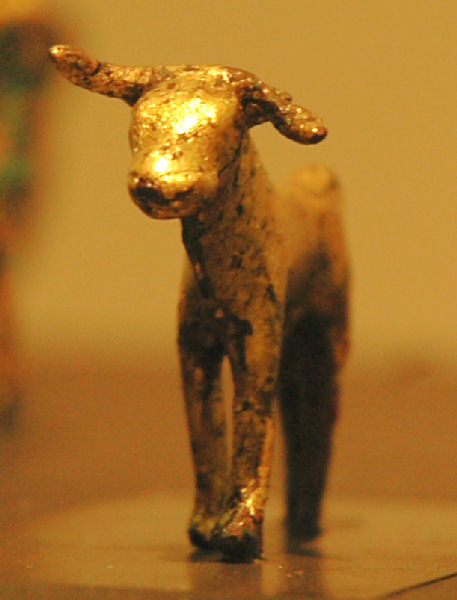
Gold calf from Temple of Baalat, Byblos

The first time, the people demand an idol, a statue for God to inhabit, and Aaron makes a golden calf.  Nobody remembers God’s prohibition against worshiping idols, i.e. images or statues for gods to inhabit.

Then they said: “This is your god, Israel, the one who brought you up from the land of Egypt!”  (Exodus 32:4)

Aaron confirms their identification of the golden calf by declaring a festival for God, using God’s personal four-letter name.1

The second time, they make the tent-sanctuary God requested and sanctioned, confident that God will dwell in it.  Moses has time now to repeat what God said during the first forty days on the mountaintop:

“They shall make a holy place for me, and I will dwell among them. Like everything that I show you, the pattern of the dwelling-place and the pattern of all its furnishings, that is how you shall make it.”  (Exodus 25:8-9)

Two uses for donations

The first time, the people donate their gold earrings so Aaron can make them an idol.

And all the people took the gold rings that were in their ears, and they brought them to Aaron.  And he took from their hands, and he shaped [the gold] with a metal-working tool, and he made it [into] a calf.  (Exodus 32:3-4)

The second time, in the Torah portion Vayakheil, the people donate precious metals and gems, expensive dyes, linen and goat hair and leather, wood, oil, and spices—everything needed to make an elaborate portable sanctuary and its furnishings.

Then they came, every man whose heart lifted and everyone whose spirit nadevah him.  They came with the donation of God for the works of the Tent of Meeting and for all its service and for the clothing of the holy.  And they came, the men in addition to the women, everyone nediv of heart … (Exodus 35:21-22)

nadevah (נָדְבָה) = it prompted, urged on.

nediv (נְדִיב) = willing, generous, noble.  (From the same root as nadevah.)

Moses also calls for skilled workers, male and female, to volunteer to make all the sacred objects.

And they took from in front of Moses all the donations that the Israelites had brought for the work of making [the items for] the service of the holy.  But [the people] brought to him more nedevah, morning after morning.  (Exodus 36:3)

nedevah (נְדֶבָה) = voluntary gift, spontaneous generous offering.  (Also from the same root as nediv.)

The people donate so many materials that Moses has to tell them to stop.  Their hearts overflow with the desire to give, and the craftspeople among them are eager to donate their time and skills to make a sanctuary for the God of Moses.

Two pairs of tablets

Moses Breaking the Tablets, by Rembrandt

The first time Moses comes down with a pair of stone tablets engraved by God, he sees the people dancing in front of the golden calf.

And it happened as he drew near the camp: he saw the calf and the circle-dances, and Moses got angry, and he hurled the tablets down from his hands and shattered them at the bottom of the mountain.  (Exodus 32:19)

But when he comes down with a second pair of engraved tablets, the stones remain whole.


What the people want all along is a leader to guide them, and a visible sign of God to reassure them.  They fail to get what they want the first time because, in their fear, they assume Moses is dead and they forget that their God hates idols.

The second time around the people succeed in getting what they want.  They trust Moses to return and he does, more impressive than ever.  Then they eagerly create a new and more impressive visible reminder of the presence of their invisible God.

Furthermore, they now have something they can do to please God, a project that gives their lives meaning and purpose.

All of these rewards result from the people’s change in attitude.  The second time around, they wait patiently for Moses to return from the mountaintop.  They are careful to follow God’s rules and obey God’s prophet.  Relieved that both God and Moses have forgiven them, they become eager to make their relationship with God better than ever.  This leads to an outpouring of generosity.

What causes the people’s change of heart?

After Moses smashes the first pair of tablets, he has a few thousand Israelites killed, and God strikes more of them with a plague.  After that, I suspect, the people are more terrified of Moses and God than they are of being leaderless.

But then Moses forgives them.  The next day, having recovered from his anger and fear, Moses announces that he will beg God to forgive them, and he climbs back up Mt. Sinai.2

Moses also asks God for a different vision of the divine, and the God-character shows him another side of the divine personality: the thirteen attributes of God, which include compassion, tenderness, patience, forbearance, and kindness.3  Finally, God lets the people build the sanctuary for him despite their two-day relapse into idol worship.

After a disaster or a misunderstanding, it takes compassion and kindness from leaders for their followers to respond with trust and generosity.

May we all develop these attributes.


  1. Exodus 32:5.
  2. Exodus 32:30.
  3. Exodus 34:6-7

Vaykheil & Psalm 18: Wings for Chariots

(This is the last of a series of posts comparing ideas in the book of Exodus/Shemot with related ideas in the book of Psalms. Next week I will begin revisiting some sparks in the ancient priestly religion described in the book of Leviticus/Vayikra.)

Skilled artisans among the Israelites make all the items for the portable tent that is to be a dwelling-place1 for God in the Torah portion Vayakheil. Moses then assembles the new Tent of Meeting, the divine fiery cloud covers it, and the glory of God fills the inside in the next Torah portion, Pekudei. The golden calf was a mistake, but this time the Israelites got it right! The success in this week’s double portion, Vayakheil-Pekudei, completes the book of Exodus/Shemot.

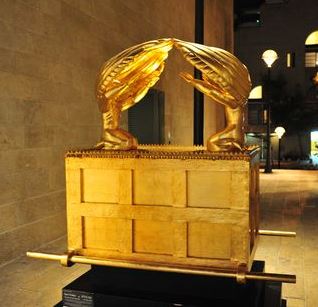
One replica of the ark, Jerusalem

The focal point for God’s presence is the empty space above the ark inside the inner chamber of the tent.  The ark is a gold-plated wooden box holding the second pair of tablets Moses brought down from Mount Sinai. The master-artisan Betzaleil hammers out a solid gold lid for the ark—not just a slab of gold but a sculpture, with two winged creatures rising from the lid in one continuous piece of gold.

And he made two keruvim; of gold hammered work he made them, from two edges of the lid: one keruv from this edges and one keruv from that edges. From the lid he made the keruvim, from its edges. And the keruvim were spreading out wings above, shielding the lid with their wings. And each one faced its brother, and the faces of the keruvim were toward the lid.  (Exodus/Shemot 37:76-9)

keruv (כּרוּב) = a hybrid creature with wings and a human face. Plural: keruvim (כְּרוֻבִים  or  כְּרוּוִים). (The English word “cherub” is derived from the Hebrew keruv, but a keruv in the Bible does not look like a chubby baby with stubby white wings.)

Keruvim and ark in First Temple (one interpretation)

When King Solomon builds the first temple in Jerusalem, its back room, the Holy of Holies, contains two free-standing gold-plated sculptures representing keruvim. Each is 10 cubits tall (15 to 20 feet) and has a 10-cubit wingspan. Solomon has the ark carried in and placed under their wings. (See my post Pekudei & 1 Kings: A Throne for the Divine.)

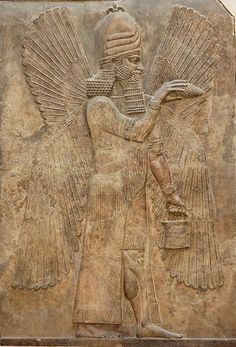
The Hebrew word keruv may come from the Akkadian word kuribu, “blessed ones”, their name for the colossal statues of hybrid winged beasts guarding doorways and gates. Commentators have speculated that keruvim might have the bodies of bulls (like Assyrian shedu) or lions (like Egyptian sphinxes or Phoenician lammasu) or humans. Raanan Eichler has made a good argument that the keruvim spreading their wings over the ark must have stood upright on two legs, and therefore probably had human bodies.

Hybrid beings with wings and human faces appear in many Ancient Near Eastern sculptures. When they are not demons battling heroes, they are either guardians of gates, or servants transporting a god. Keruvim in the Hebrew Bible are never demons, but they do appear as both guardians and transportation.

Guardians

Kusarikku from palace of Sargon II

Assyrians placed sculptures of shedu, winged bulls, as guardians at either side of a gateway into a city or palace. Another guardian figure, called Gud-alim by Sumerians and Kusarikku by later Mesopotamians, represented a door-keeper who protected a house from intruders. He stood upright and looked fairly human, except that he often had wings, horns, or a bull’s legs. In some depictions he carries a bucket.

Phoenician artworks from coastal cities west of ancient Israel and Judah also feature a pair of hybrid winged creatures on either side of a tree of life. Their tree of life is a composite of a lotus and a papyrus (borrowed from Egyptian art) and sometimes a palm tree.

Phoenician sphinxes and tree of life

Similarly, the decorations carved in the walls of King Solomon’s temple—by artisans from the Phoenician city-state of Tyre—featured keruvim and palm trees.2

In the book of Genesis/Bereishit, two keruvim serve as guardians of the way back into the Garden of Eden, where the Tree of Life remains untasted.3

One of Ezekiel’s prophesies compares the king of Tyre with a keruv that is supposed to protect its city.4  In an earlier post, Terumah: Cherubs Are Not for Valentine’s Day, I suggested that since God speaks to Moses from the empty space above the ark,5 the two keruvim are also guardians of an entrance: a portal to the invisible God.

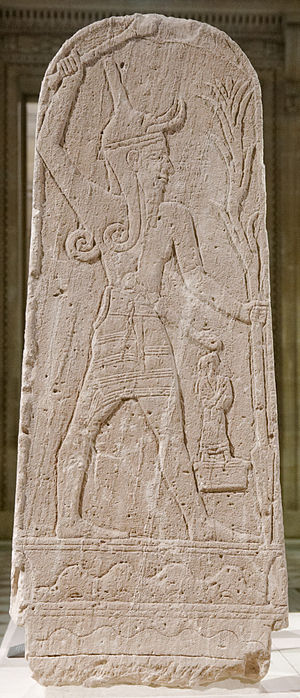
Baal Hadad with thunderbolt, Ugarit

Divine Transportation

Tarhunz from Arslantepe, Turkey

The gods of other religions in the ancient Near East rarely rode on the backs of winged creatures; instead they used these creatures to pull their chariots. Tarhunz, the high god of the Luwian people living north of Canaan, was in charge of weather and war. He used lightning as a weapon, and rode in a chariot pulled by winged horses. South of the Luwians and north of Israel, the Canaanites of Ugarit worshiped Baal Hadad (“Master of Thunder”), a weather and war god who also wielded lightning. The Ugarit writings call this Baal “Rider of Clouds”.

The God of Israel also seems to have a chariot of clouds, in the poetry of Jeremiah and Psalm 104.6

God’s cloud chariot is pulled by keruvim in a poem that appears twice in the Bible, once as chapter 22 in the second book of Samuel, and later (with only slight changes) as Psalm 18. The speaker, King David, faces death at the hands of an enemy army, and calls on God for help. God descends from the heavens.

            Smoke went up from His nostrils

                        And fire from His mouth devours.

                        Embers blazed from Him.

            He tilted the heavens and descended,

                        And a thundercloud was beneath His feet.

            And He drove a keruv and flew,

                        And He soared on the wings of the wind. (Psalm 18:9-11)

I use the pronoun “He” in this translation because God is presented as if “He” were Baal Hadad from the Canaanite pantheon of male and female gods. Psalm 18 continues with imagery of dark clouds, hail, thunder, and arrows of lightning. God then stages a dramatic rescue, and David wins the battle.

A Chariot Throne

The ark with its two keruvim is often considered God’s throne in the Bible—the authoritative location where God sits like a king. But sometimes this throne is movable, like a chariot.

Before David conquers Jerusalem, when the ark is housed in a temple at Shiloh, the Israelite army decides to carry it with them into battle against the Philistines, hoping that God will fight for them.

And they took away from there the ark of the covenant of God of Armies Sitting on the Keruvim … (1 Samuel 4:4)

Although the Israelite forces carry God’s throne, they lose the battle. The Philistines capture the ark, then later abandon it in Israelite territory. When King David retrieves it for his new capital in Jerusalem, it is called

the ark of the god whose name was invoked, the name of God of Armies Sitting upon the Keruvim.  (2 Samuel 6:2)

The title is also used in psalms 80 and 99.

            Listen, Shepherd of Israel, You who lead Joseph like a flock!

                        Sitter on the keruvim, shine forth!  (Psalm 80:2-3)

           God, King, the peoples will tremble!

                        Sitter on the keruvim, You will shake the earth!  (Psalm 99:1)

The Babylonian army razed the first temple in Jerusalem in 579 B.C.E., burning it to the ground. The army carried off some of its gold items as booty, but the ark and its keruvim disappeared from history. When some of the Israelites returned to Jerusalem under Persian rule and built a second temple, they left the Holy of Holies empty.

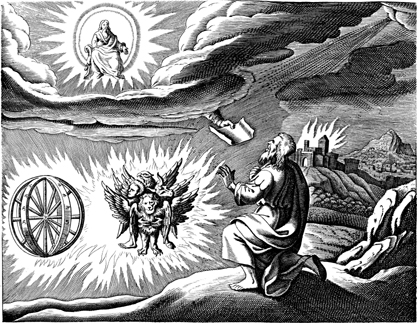
Ever since the destruction of the first temple with its ark and gold keruvim, God’s throne could only be an abstraction or a vision. The prophet Ezekiel reports two mystical visions of hybrid winged creatures during the exile in Babylon (Ezekiel 1:4-28; Ezekiel 10:1-22 and 11:22-23). In his second vision he identifies these creatures as keruvim.

Ezekiel’s Vision, by Matthuas Merian 1670 (some assembly required)

In both visions, the glory of God (not God Itself) appears as a fiery figure on a throne that looks like sapphire, suspended above four keruvim, each of which is accompanied by an interlocking wheel covered with eyes.  Each keruv has a single leg ending in a calf’s hoof, a human body, four wings, a human hand below each wing, and a head with four faces: one human, one lion, one eagle, and one that is called the face of an ox in the first vision and the face of a keruv in the second vision.

The keruvim and their wheels move up and down as well as in all four directions, and the throne suspended above them moves along with them. Although Ezekiel does not call this arrangement a chariot, subsequent Jewish writers developed a school of mysticism based on the merkavah (מֶרְכָּבָה = chariot) in the book of Ezekiel.

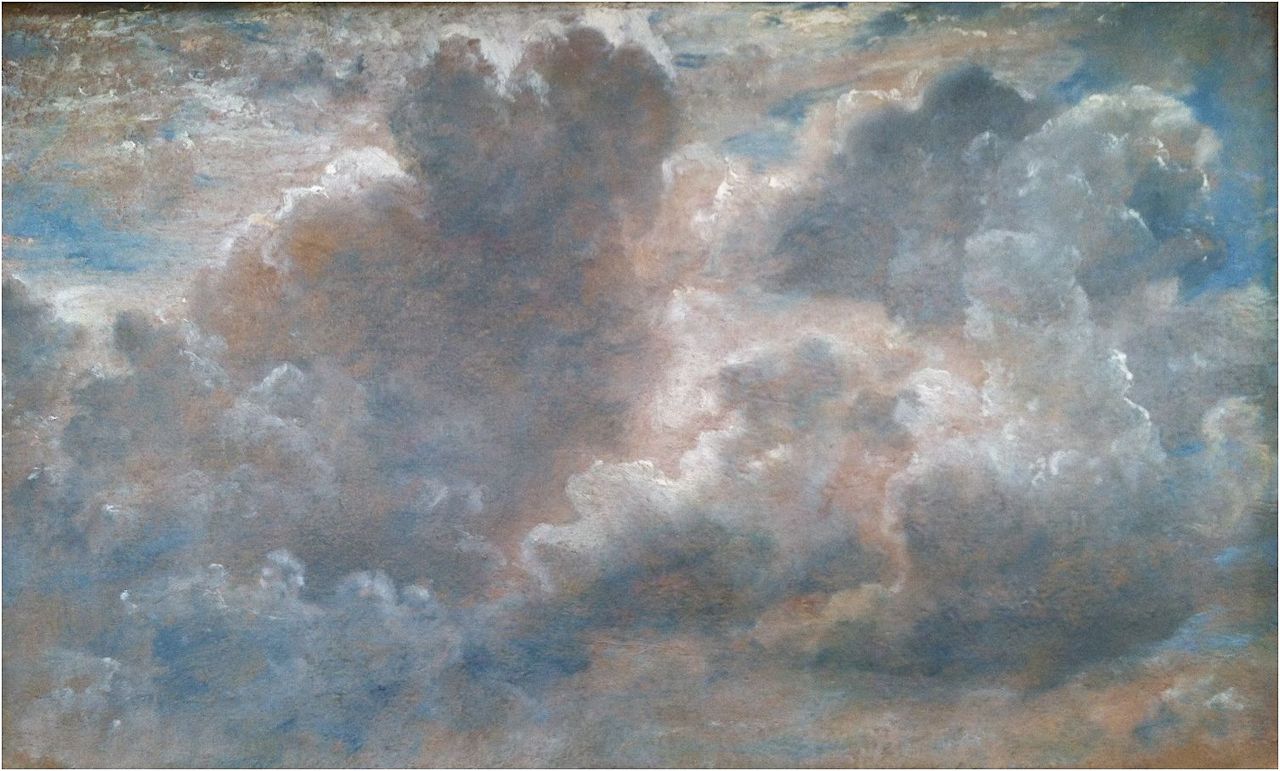
Clouds by John Constable

Even without a temple, even without keruvim, the human mind needs poetic images to think about God. Today many of us no longer need to assign God a face, a hand, or a body in robes; we can handle the paradox of God as both invisible and manifest in everything we see. Yet poetic images still well up around the notion of God:  clouds, beams of light, opalescent radiance, perhaps even wings. They are not God, yet God is in the imagery.

When God Itself seems too abstract, perhaps we can think of something like a keruv, a creation that pulls the presence of God toward us when we need rescue, and that stands at our gateways when we need a guardian.

1  (See my post Terumah & Psalm 74: Second Home.)

2  In the first (Israelite) temple in Jerusalem, keruvim and palms  are carved in relief on the wooden walls and two sets of double doors (1 Kings 6:29, 32, 34). Keruvim, palms, and lions are engraved on the stands for ten bronze wash-basins (1 Kings 7:36).

3  Genesis 3:24.

4  Ezekiel 28:14, 16.

5  Exodus 25:22, Numbers 7:89.

6           Hey! Like clouds it ascends;

            Like a whirlwind is [God’s] chariot;

            Lighter than eagles are His horses.  (Jeremiah 4:13)

In Psalm 104, God’s cloud chariot is pulled by the wind:

            Setting beams for [God’s] roof chambers in the waters [above the sky],

                        Making the clouds His chariot,

                        He goes on the wings of the wind.  (Psalm 104:3)


Haftarat Vayekheil—1 Kings: Symbolic Impressions

Every week of the year has its own Torah portion (a reading from the first five books of the Bible) and its own haftarah (an accompanying reading from the books of the prophets). This week the Torah portion is Vayakheil (Exodus 35:1-40:38). The haftarah in the Sefardi tradition is 1 Kings 7:13-26. (The haftarah in the Ashkenazi tradition is 1 Kings 7:40-50.)

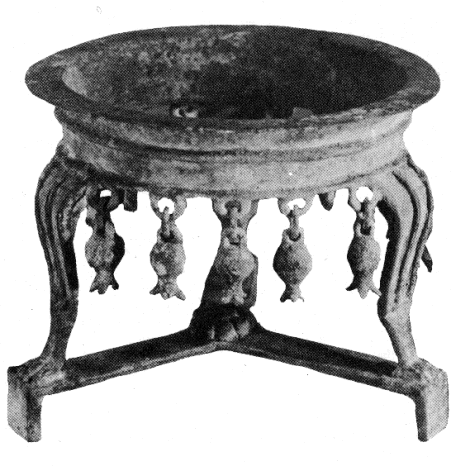
Both Moses’ tent sanctuary and Solomon’s temple have a place for priests to wash their hands and feet before they enter the holy building. In this week’s Torah portion, Vayakheil, the master craftsman Betzaleil makes a simple but symbolic wash-basin. (See my blog post Pekudei: Basin of Mirrors.)

Kiyor on stand, stone, Megiddo
Kiyor on stone stand, Megiddo

And he made the kiyor of bronze and its stand of bronze from the mirrors of the army of women who mobilized at the entrance of the Tent of Meeting. (Exodus 38:8)

kiyor (כִּיִוֹר) = basin, laver.

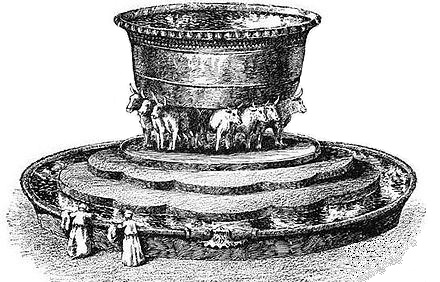
Solomon’s temple has ten such basins, cast out of regular molten bronze rather than mirrors, perched on elaborate wheeled stands. But King Solomon also has his master bronze artisan cast a water container so huge it is called a sea.

Then he made the yam of cast metal, ten cubits from its [lower] rim up to its circular rim, five cubits high, and a measuring-line of thirty cubits around its circumference. (1 Kings 7:23)

yam (יָם) = sea; in Canaanite religion, the name of the god of the sea.

This tub of water would be more than 14 feet (4 meters) across and more than 7 feet (2 meters) high. Since it would be impossible to climb into for bathing, commentators have concluded it had an outlet like a spigot at the bottom, to pour water into a shallower container for washing.

Bronze "Sea", artist's rendering from Encyclopedia Judaica
Bronze “Sea”, artist’s rendering from Encyclopedia Judaica

And gourd ornaments were below its rim all around the circle, ten per cubit, encompassing the yam all around; two rows of the gourd ornaments, cast in one piece with it. It was standing on twelve oxen: three facing north and three facing west and three facing south and three facing east. And the yam was on top of them, and all of their hind parts were inward. (I Kings 7:24-25)

The most striking difference between the yam in front of Solomon’s temple and the kiyor in front of Moses’ tent sanctuary is that the yam rests on twelve bronze cows—probably life-size—instead of on an ordinary framework.

Moses discourages the molding of any real animals (as opposed to the keruvim, the composite fantasy animals whose wings are spread over the ark). He smashes and grinds up the golden calf that Aaron makes in the book of Exodus. In a passage after this week’s hafatarah, the first book of Kings criticizes King Jereboam of Israel for putting golden calves in temples at Dan and Bethel.

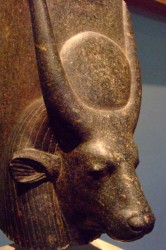
Hathor
Hathor

This may have been a reaction to cow-worship in other religions. The religion of the Hittites to the north included a pair of bulls who carried the weather god Teshub on their backs. To the south, Egyptians worshipped the bull as Apis, the avatar of the gods Ptah and Osiris, and the cow as the goddess Hathor.

Yet throughout the bible, the twelve bronze oxen supporting the yam in front of Solomon’s temple are treated as perfectly acceptable.

Is the huge tub of water in front of Solomon’s temple called the yam simply because it is so large, or does it evoke the Canaanite god named Yam? Are the twelve oxen simply decorative, or do they inspire awareness of bull and cow worship?

Throughout history, people have viewed symbols of the divine in two ways.  Some people consider a symbolic object or building as a way to evoke the ineffable. Its beauty and impressiveness are like an arrow pointing to the divine, and its specific details (such as fruit, water, architecture that reaches toward the sky) allude to ideas about the divine.

Other people see symbolic things in a more concrete way.  A god visits a building or enters a statue. Carrying out rituals in sacred buildings with sacred objects is essential for pleasing the god.

Either way, symbols are important—and often enduring. Even today, Mormons conduct baptisms and sealings in copies of the yam perched on twelve oxen.

One question remains, for King Solomon and for us today:  Which symbols from other cultures and from the history of our own culture or religion can enhance our lives, and which symbols should be discarded?

Anyone want a bronze ox?

Vayakheil: Holy Time

by Melissa Carpenter, maggidah

Holy time is more important than holy space. Jewish commentary through the millennia has drawn this conclusion from several key passages in the Torah, including the opening of this week’s Torah portion, Vayakheil (“And he assembled”):

matchAnd Moses assembled the whole community of the Children of Israel, and he said to them: Six days you shall do melakhah, and the seventh day there shall be holiness for you: a shabbat shabbaton for God. Anyone who does melakhah on it shall be put to death. You shall not kindle a fire in any of your settlements on the day of the shabbat. (Exodus/Shemot 35:1-3)

melakhah (מְלָאכָה) = tasks, labors; crafts; creative work, productive work; a project, an enterprise.

Shabbat (שַׁבָּת) = day of rest, day of stopping. (From the root verb shavat, שָׁבַת = stop, cease, desist.)

shabbat shabbaton (שַׁבַּת שַׁבָּתוֹן) = day of absolute stopping.

Immediately after this, Moses hands down God’s directions for making the portable sanctuary—the most holy type of melakhah humans can do. According to most of commentary, Moses first makes it clear that the work of making the sanctuary must be confined to six days a week, then tells the people what to make.  The holy day of Shabbat trumps the holy sanctuary.

As confirming evidence, the commentary points to the first mention of any form of the root shavat in the Torah—after God spends six “days” creating the heavens and the earth and everything in them.

God finished on the seventh day Its melakhah that It had done, vayishbot on the seventh day from all Its work that It had done. God blessed the seventh day and made it holy… (Genesis/Bereishit 2:2-3)

vayishbot (וַיִּשְׁבֹּת) = and he/it stopped, ceased, desisted.

God made the seventh day holy long before making the sanctuary (or any other place) holy.

In between the beginning of Genesis and the ending of Exodus, the Torah gives us more information about Shabbat and melakhah in the fourth of the Ten Commandments.

Remember the day of the Shabbat to make it holy. Six days you shall serve and you shall do all your melakhah. And the seventh day is Shabbat for God, your god; you shall not do any melakhah—you or your son or your daughter, your male slave or your female slave or your livestock or your resident alien who is within your gates.  Because [for] six days God made the heavens and the earth, the sea and everything that is in them, vayanach on the seventh day; therefore God blessed the seventh day and made it holy. (Exodus 20:8-11)

vayanach  (וַיָּנָח) = and he/it rested.

Here the Torah introduces the idea of stopping as resting. People, animals, and even God must periodically stop and rest. We know that our physical bodies need rest to rebuild energy. Do our souls also need rest to re-energize? During Moses’ first 40 days on Mount Sinai, God says:

The Children of Israel shall guard the Shabbat, to make the Shabbat for their generations, a covenant forever. Between Me and the Children of Israel it is a sign forever, because for six days God made the heavens and the earth, and on the seventh day shavat, vayinafash. (Exodus 31:16-17)

shavat (שָׁבַת) = he/it stopped, ceased, desisted.

vayinafash (וַיִּנָּפַשׁ) = and refreshed his/its soul, and recovered himself/itself, and re-animated himself/itself. (From the same root as nefesh = soul, the soul that animates the body, inclination, appetite.)

Since the divine life of the universe pauses periodically for refreshment and redirection, so must our own souls. (See my earlier post, Shabbat in Yitro, Mishpatim and Ki Tissa: Soul Recovery.)

One divine inspiration can trigger human beings to engage in a lifetime of holy work; but if we do not stop regularly to rest and listen with our souls, our work will never be animated by new inspirations.

When Shabbat comes up again in this week’s Torah portion, the Torah adds a new detail:

You shall not kindle a fire in any of your settlements on the day of the shabbat. (Exodus 35:3)

Kindling a fire is the archetype of a human activity that is creative and useful, and enables further creative and useful work. Many ancient cultures considered kindling fire the beginning of civilization.

fireI would add that God manifests in the Torah as a sound, a cloud, or a fire. So fire can stand for our own holy work, as well as for God’s presence. And fire represents change and activity; flames are always moving, never stopping, until the fire has burned down to an ember.

I learned a hard lesson from preparing this blog post: as I suspected, I have been cheating myself.

It is a pleasure to refrain from doing drudgery on Shabbat. And during the years I worked at a job that was not my calling, I was always glad to take Saturday off.

But now I love my melakhah, my creative work of learning, pondering, and teaching Torah through my adult education classes, my Torah monologues, the services I lead, and this weekly blog. I love the work so much that it is hard to make myself take a vacation. I know I should rest on Shabbat, but after all, studying Torah is an approved Shabbat activity.  So what if I put sticky tags next to passages I want to copy onto my computer the next day? So what if I take notes on Shabbat afternoon, even though the Talmud (in Shabbat 73a) includes writing in its list of melakhah forbidden on Shabbat?  I decided long ago that I never wanted to be so strict in my observance that Shabbat became a punishment.  Why not write down any ideas about the Torah that come to me?  After all, studying Torah is holy work.

So was making the items for the sanctuary.

Rereading the portion Vayakheil this year, I can understand the value of stopping even holy work, once a week. My work makes me feel happy, but also driven. Every day that I have the blessing of time to work on Torah, I quickly kindle my inner fire. So far I have not run out of insights and observations—perhaps because I have 60 years of life to reflect upon. But I do run out of energy. I am starting to worry that my fuel supply is dwindling, and if I go on this way, I will burn out.

I need to rest more. I need to re-animate my soul. I need a regular day of shabbat shabbaton, absolute stopping. The Torah is right.

So I am going to start obeying the fourth commandment. I will still lead a Shabbat service now and then, having prepared the week before. But I will rest every Shabbat, and refrain from working on my next holy project. It will not be easy for me.


Vayakheil and Ki Tissa: How to Be a Holy Artist

What does it take to create something that will help people feel the presence of God?

Aaron tries to do this when he makes the Golden Calf in last week’s Torah portion, Ki Tissa. At first, the people are ecstatic over the idol, bowing down to it and singing and dancing. But this simple and undisciplined religious outlet does not last. When Moses returns and grinds the calf into gold dust, nobody protests. Moses stirs the gold dust into water, and they all meekly swallow it. Aaron’s creation turns out to be a failure.

In this week’s Torah portion, Vayakheil (“And he assembled”), the master craftsman Betzaleil begins making the holy objects for the new sanctuary. The completed creation is so successful that it sustains the religion of the Israelites for several centuries, until King Solomon replaces it with the temple in Jerusalem.

The key difference between Aaron and Betzaleil as creators of religious objects appears in the Torah twice, repeated word for word. In the portion Ki Tissa, God says it to Moses. In this week’s portion, Moses says it to the Israelites:

See? God has called by name Betzaleil, son of Uri, son of Chur, of the tribe of Yehudah. And [God] has filled him with ruach of God, with chokhmah, with tevunah, and with da-at, and with every craft. (Exodus/Shemot 35:30-31)

ruach (רוּחַ) = wind; spirit, motivation, overwhelming state of mind.

(Usually when the ruach of God comes over someone in the Hebrew Bible, that person speaks as a prophet or leads people into battle. Exceptions are Samson, who is gripped by a murderous rage and supernatural strength; and Betzaleil the artist, who is filled with a divine motivation to create.)

chokhmah (חָכְמָה) = wisdom; inspiration.

tevunah (תְבוּנָה) = insight, rational understanding, analytic ability.

da-at (דַעַת) = knowledge.

In later Kabbalistic writings, chokhmah and binah (another form of the word tevunah) are two of the sefirot or divine powers.  Chokhmah is the sefirah associated with the left side of the head, i.e. the left brain that popular science now associates with non-rational, intuitive, holistic consciousness. Binah (tevunah) is the sefirah associated with the right side of the head, i.e. the right brain that we now associate with rational, logical, analytic thinking. In the Kabbalist system, da-at is the product of chokhmah combined with binah.

Aaron, although he will serve as the high priest, lacks the four qualities with which God fills Betzaleil. When the Israelites are waiting at the foot of Mount Sinai in Ki Tissa, Aaron feels no ruach of God, no divine urge to create a holy object. The people decide Moses will never return and order Aaron: Get up, make for us gods that will go before us! (Exodus 32:1). Then Aaron acts, but only to satisfy the crowd.

He has no chokhmah, no inspiration nor wisdom about what to make; he merely calls for gold earrings to melt down, since the finest idols are made of gold.

He took it from their hands and he shaped it with the engraving tool, and he made it into an image of a calf. (Exodus 32:4)

Afterward, when Aaron explains to Moses what happened, he says: I said to them, “Who has gold? Pull it off yourselves.” And they gave it to me and I threw it into the fire and out came this calf.” (Exodus 32:24)

Aaron admits that he acted without any of the insight or discrimination of tevunah, and also without any da-at, any knowledge of what would emerge from the fire.

Betzaleil, on the other hand, is born betzalmeinu—in God’s shadow or image—when it comes to creativity. (See my earlier post, Vayakheil: Shadow Power.) **** He creates under the protection of God’s shadow. God “fills” him with the qualities he already has the potential and experience to develop.

Even as Moses comes down with God’s basic design for a portable sanctuary, Betzaleil is filled with a divine desire to create it. He has the chokhmah to visualize the whole thing, and to imagine beautiful and inspiring objects—from the gold keruvim (hybrid winged beasts) on top of the ark to the design embroidered in brilliant colors on the curtain at the entrance to the Tent of Meeting. He has the tevunah to analyze and understand how each part can be made well and assembled into the whole. And he has da-at, knowledge, of every craft: metal-working, jewelry, wood-working, weaving, and embroidery.

Betzaleil is so filled with chokhmah, tevunah, and da-at that he and his assistant can teach other craftsmen and craftswomen among the people.

And [God] put teaching into his heart, him and Ahaliyav son of Achisamakh of the tribe of Dan. (Exodus 35:34)

And Betzaleil and Ahaliyav and everyone wise of heart to whom God gave chokhmah and tevunah for da-at and for doing all the work for the service of the Holy, they shall do everything that God commanded. (Exodus 36:1)

The sanctuary that is completed in next week’s Torah portion, Pekudei, is the product of the grand design Moses heard from God; the divine spirit, inspiration, understanding, and know-how of the master artist, Betaleil; and the enthusiasm and wisdom of the contributors in the community. No wonder it becomes a place where people feel God’s presence.

I think that the qualities God gives Betzaleil are necessary for anyone to produce truly moving art, whether its explicit goal is religious or not. I know that when I do “creative writing”, especially of Torah monologues and fiction, both my motivation (ruach) and my inspiration (chokhmah) seem to come from a mysterious place outside myself, or perhaps from some inner place so deep my conscious mind can never penetrate it. I might as well say they come from God, the great mystery.

But the most burning motivation and inspiration leads nowhere without the application of rational insight and analysis (tevunah). My own ability in this area is a talent I was born with, a gift of God, that I have developed over many years of practice. And as in Kabbalah, I have found that the combination of left-brained inspiration (chokhmah) and right-brained analysis (binah or tevunah) does indeed result in knowledge (da-at).

The final requirement for creating art is to actually do all the labor. I am grateful that the ruach that blows through me from the unknown source I call God is strong enough to motivate me to keep on working, with enthusiasm—like the Israelites in this week’s Torah portion.

May the divine spirit be strong in all artists.