Terumah & 1 Kings: Tent versus Temple

A 2,000-year-old tradition pairs every weekly Torah portion with a haftarah, a reading from the Prophets/Neviim. In this week’s Torah reading, Terumah (“Donations”), God gives Moses instructions for building a sanctuary. This week’s haftarah is a passage from the first book of Kings about how King Solomon begins building the temple in Jerusalem.

The sanctuary and the temple both contain the ark, menorah, bread table, and incense altar. Both are places where priests perform the rituals prescribed in the Torah. But there are dramatic differences between the two structures.

For one thing, the building materials dictate whether each holy structure is portable or stationary. The Torah portion Terumah specifies that the walls of the mishkan will be made out of woven pieces of cloth hung on a framework of gilded acacia planks and beams.

The Tabernacle that the Israelites
Built, Charles Foster Bible, 1897

And you shall make the mishkan of ten panels of fabric, made of fine twisted linen, and sky-blue dye and red-violet dye and scarlet dye …(Exodus/Shemot 26:1)

mishkan (מִשְׁכָּן) = sanctuary, dwelling-place for God. (The word is used for the portable tent-like sanctuary created in the book of Exodus and used until the second book of Samuel.)

Next God tells Moses to make the roof out of woven goat-hair, and cover it with tanned hides. The mishkan would look like a huge tent of vividly-colored cloth, its framework resting directly on the earth. After it has been built, the Torah often calls this sanctuary the “Tent of Appointed Meeting”.

The courtyard in front of it, containing the altar for burning animal offerings, is to be enclosed by another wall of linen cloth, this one roofless. I can imagine the cloth walls of both the courtyard and the tent glowing in the sunlight, and the gold, silver, and bronze fittings gleaming. The structure would be beautiful, but also obviously portable, easy to disassemble and move to the next location.

While the mishkan is temporary, Solomon’s temple is built to last.

The king commanded, and they quarried huge stones, valuable stones, to lay the foundation of the house with hewn stones. (1 Kings 5:31)

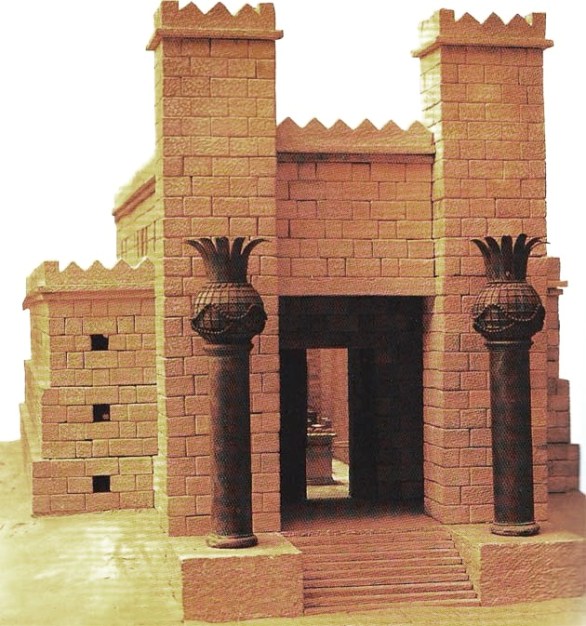
First Temple reconstruction,
Bible Museum, Amsterdam

On this foundation, the “house” is built out of more large squared stones, then paneled inside with cedar wood, and roofed with cedar planks. Additional rooms are built against the outside walls, all the way around. The temple is three stories high, with stairs and narrow latticed windows. This sanctuary could never be disassembled and moved. It is supposed to be permanent. According to the Hebrew bible, it lasted for four centuries, until the Babylonian invaders destroyed it. During that time, the central place of worship for the southern kingdom remained fixed in its capital, Jerusalem.

Another important difference between the tent and the temple is how the materials and labor to build them were obtained. The materials for the tenttextiles, hides, wood, and metals—are all gifts volunteered by the Israelites. This week’s Torah portion opens with God asking for only voluntary donations.

God spoke to Moses, saying: Speak to the children of Israel, and they shall take for me a donation from every man whose heart urges him; [from him] you shall take My donation. And this is the donation that you shall take from them: gold or silver or bronze, or sky-blue or red-violet or scarlet dyes, or linen or goat hair, or hides… (Exodus/Shemot 25:1-5)

But the stone and cedar for Solomon’s temple are purchased from a foreign king, Chiram of Lebanon. This week’s haftarah opens:

God had given wisdom to Solomon, as [God] promised him; and there was peace between Chiram and Solomon, and the two of them cut a treaty. (1 Kings/Malchim 5:26)

Just before this verse, the first book of Kings describes the deal between Chiram and Solomon: Hiram will provide timber and stone for Jerusalem, and in exchange Solomon will pay Hiram in annual shipments of wheat and olive oil—shipments that would require a heavy tax on Israel’s farmers.

In the book of Exodus, both women and men enthusiastically volunteer to do the weaving, carpentry, and metal-working for the tent sanctuary. In the first book of Kings, Solomon imposes forced labor on the Israelite men to do the logging and quarrying.

And King Solomon raised a mas from all of Israel, and the mas was 30,000 men. He sent them to Lebanon, 10,000 a month in turns; they were in Lebanon for a month, two months at home. And Solomon loaned 70,000 burden-carriers and 80,000 stone-cutters on the mountain. (1 Kings 5:28-29)

mas (מַס) = compulsory labor, corvée labor, levy

Compulsory labor, mas, is what the pharaoh imposed on the Israelites in Egypt—the slavery that God and Moses freed them from. King Solomon gets away with his temporary mas, but later in Kings, his son Rechavam imposes an even heavier “yoke” on his people, and they revolt against him.

So while the mishkan is constructed with voluntary gifts and voluntary labor, the temple is built through agricultural taxes and forced labor.

In the Torah portion, Moses gets instructions for making a sanctuary from God Itself. In the haftarah, Solomon remembers his father David’s desire to build a temple, and after he has built a palace for himself, he starts the temple on his own initiative.

In both cases, God makes a conditional promise to dwell among the Israelites. In the Torah portion, God will stay with them if they make a place for God:

And they shall make for me a holy place, and I will dwell in their midst. (Exodus 25:8)

But in the haftarah, God will stay with the Israelites if King Solomon follows the rules:

And the word of God came to Solomon, saying: This house that you are building—if you follow my decrees and you do my laws and you observe all my commandments, to go by them, then I will establish my word with you that I spoke to David, your father: then I will dwell in the midst of the children of Israel, and I will not desert my people Israel. (1 Kings 6:12-13)

The differences between the mishkan and the temple imply two different approaches to religion. The sanctuary God describes to Moses belongs to the people; they make it voluntarily, they move it with them wherever they go, and God dwells among them because they make a holy place for God.

The temple of Solomon belongs to the king; he oppresses his own people in order to procure the materials and labor, he fixes it permanently in Jerusalem, and God dwells among his people because King Solomon obeys God’s rules.

I believe the tent-sanctuary described in the Torah portion represents the ideal approach to communal religion, in which everyone in the community contributes enthusiasm, support, or creativity; in which textual interpretations and rituals are flexible enough to move and change along with the people; and in which everyone makes a holy place for God.

Yet this ideal cannot always be realized. There are times everyone, including me, is too exhausted or too stuck to manage creative communal worship. Sometimes we just need a place to go where the rituals will be fixed and familiar, and where a trusted authority figure is taking care of everything and telling us what to do.

We need both tents and temples.

Terumah: Bread of Faces

Why does God need a dinner table?

In this week’s Torah portion, Terumah (Donations), God orders a Moses to make a table, and tells him how to set it. The table is just one piece of furniture God requests during Moses’s first 40-day stay at the top of Mount Sinai. God also wants the children of Israel to make a lamp, an incense burner, and an ark, and a tent to put them in.

They shall make a mikdash for me, and I will dwell among them. Like everything that I show you, the pattern of the mishkan and the pattern of all its furnishings, that is how you shall make it.  (Exodus/Shemot 25:8-9)

mikdash (מִקְדָּשׁ) = sanctuary, holy-place

mishkan (מִשְׁכָּן) = sanctuary, dwelling-place

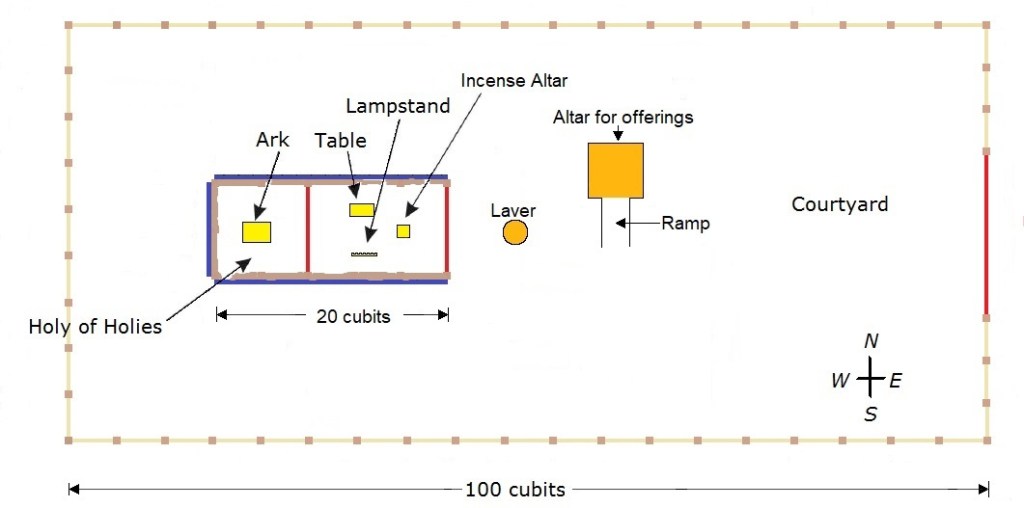
God calls for the sanctuary to be divided into three zones of holiness. All Israelite men can enter the outer courtyard, which will be  unroofed but enclosed by curtains. This is where animal sacrifices will be burned at the altar. Inside this courtyard Moses will erect a tent divided into two rooms. The main room, called the Holy, is reserved for the priests. The innermost room, screened off by a curtain, is the Holy of Holies, a small enclosure for the ark (see my post Terumah: Cherubs Are Not for Valentine’s Day). Only Moses, and the high priest once a year, can enter the Holy of Holies.

But priests will be walking into the room of intermediate holiness every day. God requests three pieces of furniture for this room: a gold incense altar, a  gold lampstand or menorah, and a small gold-plated table.

You shall make a table of acacia wood, its length a pair of cubits, its width a cubit, and its height a cubit and a half. And you shall overlay it with pure gold, and you shall make a molding of gold for it, all around. (Exodus/Shemot 25:23-28)

The flames of the lamps and the smoke of the incense are intangible, so they make natural reminders of intangibles such as enlightenment, the soul, God.  But the table does not produce anything intangible. After giving more specifications for the design of the table, God orders Moses to lay out a place setting and some bread—as if God were going to sit down and eat.

And you shall make its bowls and its scoops and its jars and its chalices for pouring out [libations]; of pure gold you shall make them. And you shall place upon the table bread of panim, lefanai continually. (Exodus 25:30)

panim (פָּנִים) = faces, face, expression of feelings, surface, front, presence

lefanai (לְפָנַי) = facing me, in front of me, before my presence

Although some translations still call this bread “shewbread”, following the King James Bible, a more accurate translation would be “Bread of Faces”. We learn in the next book of the Torah, Vayikra/Leviticus, that twelve loaves of bread (actually flat rounds of bread, like pita or naan) are stacked on this table at all times. The priests replace them once a week on Shabbat with newly baked loaves.

The Israelites knew that other religious cults in the region set food in front of an idol so that the essence of the god inhabiting the idol could eat the essence of the food in front of it. But the Torah clearly states that when the old loaves are removed once a week in the God of Israel’s sanctuary, the priests eat them (Leviticus 24:9). So why does God need a dinner table?

I believe the point of the table appears in the sentence I would translate as “And you shall place upon the table Bread of Faces, facing Me continually”. In the Torah, bread represents all food, which is a gift from God. Yet since humans need to actively intervene to change grain into bread, I  think bread can also symbolize the creative effort humanity puts into the material world. Twelve loaves of bread represent everyone in the twelve tribes of Israel. Symbolically, the Israelites are faces of bread, facing God continually.

No wonder God orders a table set with bread.  It is not enough to approach God through the mysterious dazzlement of flames and smoke, the overwhelming feeling of mystical experience. We must also approach God through our everyday, solid, material lives, setting ourselves out on the table and facing God continually.

This is a difficult goal to achieve. How can we face a god we cannot see?

In ancient times the mishkan, and later the temples, provided holy rooms to serve as God’s “dwelling place”, and the place for human priests to enact rituals to orient the people toward God. Today, we build sanctuaries where everyone can come and pray and enact rituals in order to orient themselves toward the divine.

The ritual space, with its furniture, helps. Nevertheless, I am sometimes so distracted during a service in a sanctuary that I forget to try to face God.  It is even harder to keep trying to face God during the week, as I deal with all the material things in my life. It is a tall order, but a good one, when the Torah says:

You shall place upon the table bread of faces, facing Me continually.

Terumah: Heavy Metals

The Torah portion Terumah (“raised donations”) begins with God telling Moses to ask everyone whose heart is so moved to donate materials to make a sanctuary:  three kinds of metals, three colors of expensive dye, linen, wool, two kinds of hides, wood, oil, incense spices, and gems.  Then God says:

They shall make for me a sanctuary, and I will dwell among them.  (Exodus/Shemot 25:8)

God has already promised to be the god of the Israelites and their fellow-travelers.  But, as we see in the golden calf incident two Torah portions later, the Israelites cannot believe God is still with them without some visual aid.  God refuses to inhabit a golden statue of a calf.  Instead, the people will be reassured by the sight of the sanctuary.

The list of materials for this sanctuary begins:

And this is the raised donation that you will take from them:  zahav, and kesef, and nechoshet …  (Exodus 25:3)

zahav (זָהָב) = gold.

kesef (כֶּסֶף) = silver; the common currency in the Middle East.

nechoshet (נְחֺשֶׁת) = copper, brass, bronze.  (From the root verb nicheish, נִחֵשׁ = practiced divination.)

Gold and Silver

We know why the Israelites had gold and silver to donate.  After the final plague in Egypt, they followed God’s order to “ask” their Egyptian neighbors for silver items, gold items, and clothing.  The Egyptians complied.

Besides using silver and gold for ornamental vessels and jewelry, Egyptians and other peoples in the Middle East made idols (statues for gods to inhabit) out of precious metals.  That is why, after the revelation at Mount Sinai, God says:

With me, do not make gods of silver or gods of gold; you shall not make them for yourselves.  (Exodus/Shemot 20:20)

Accustomed to thinking of gold as the metal of highest status, the Israelites would feel reassured that their donated gold would go into all the holy objects in the inner chamber of the sanctuary:  the lamp-stand, the table, the incense altar, and the ark itself.  Silver was less precious, so it is not surprising that God tells Moses to use silver for the sockets in the framework around the inner chamber.  This framework supports the curtains and tent-roof, and is made of wood planks plated with gold.

The use of gold and silver reinforces the high status and the holiness of the sanctuary’s inner chamber of the sanctuary.  I believe the requirement that these two metals be donated also has a psychological value.  After all, the people know that the gold and silver objects do not really belong to them; the Egyptians handed over the objects when they were desperate to end the plagues.  And the gold is also a reminder of the golden calf.  Donating their gold and silver for God’s sanctuary would relieve the people’s guilt on both counts.

Once the inner chamber of the sanctuary is assembled, the people see only its outer walls—the gorgeous curtains fastened to the gold-plated planks that are fitted into silver sockets.  Only priests are allowed into the area with the incense altar, table, and lamp-stand, and only Moses and the high priest, Aaron, can enter the innermost Holy of Holies, where the ark is concealed.  But everyone knows that God manifests and speaks in the empty space above the gold-plated ark.

Bronze

Another area of the sanctuary is open to every Israelite: the outer courtyard, which contains the altar for animal sacrifices.  This altar, and all its tools, are made out of copper or bronze.

Where does the copper come from?  The Israelites only took silver, gold, and clothing from the Egyptians.  The word for copper, nechoshet, appears only once before this in the Torah: the list of Cain’s descendants includes Tuval-Kayin, who made cutting tools out of nechoshet and iron.1

The book of Exodus is set in a historical period when the Bronze Age is ending, and iron is just beginning to come into use.  Bronze, an alloy of copper and zinc, was the most common metal for tools and blades.  It was also the most common metal for making mirrors, since bronze reflects well when it is polished.  And mirror-like surfaces were used for divination, the type of magic practiced by people who want to see the future.

The snake in the garden of Eden is a nachash, נָחָשׁ, another word from the root nicheish.  The role of the snake is to arouse a desire in Eve for a different kind of knowledge, the knowledge that God has.  Only after her conversation with the snake does she taste the fruit of the Tree of Knowledge of Good and Evil.2

When Moses first demonstrates God’s power to Pharaoh, his staff turns into a nachash.  He is trying to give Pharaoh knowledge about God, though Pharaoh is too defensive to pay attention. Pharaoh’s magicians turn their own staffs into crocodiles, but Moses’ snake eats them.3   (Later, in the book of Numbers/Bemidbar, Moses halts a plague of poisonous snakes, nechashim, with a bronze snake on a pole, a nechash nechoshet.4)

In the book of Genesis, both Lavan and Joseph claim to practice divination when they are trying to impress their troublesome relatives.5  But in  Deuteronomy/Devarim, God warns the Israelites not to practice divination, or any other kind of magic.  One must not try to force information out of God.6

Traditional Jewish commentary explains that the altar in the courtyard of God’s sanctuary is made of copper or bronze because it is a third-rate metal, less valuable than gold or silver but good enough for the area that is merely holy, not the Holy of Holies.  Another explanation might be that the tools for the altar had to be bronze so they would hold an edge, and it seemed appropriate to make the altar itself out of the same metal.

Or maybe the Israelites needed to surrender not only the silver and gold they took from the Egyptians, but also their own snakiness, their own desire for divination and divine knowledge.

Maybe even today, we need to give up the idea that we can predict and control the future.  Can we accept that we are not gods, and we cannot make our own gods?  Can we resist the promise of magic?  Can we donate what knowledge we have, all our copper and all our serpentine wisdom, to building a sanctuary for the whole world?  If we can, then maybe God will dwell among us.

  1. Genesis 4:22.
  2. Genesis 3:1-6.
  3. Exodus 7:8-13.
  4. Numbers 21:9.
  5. Lavan in Genesis 30:27, Joseph in Genesis 44:15.
  6. Deuteronomy 18:10.

Terumah: Cherubs Are Not for Valentine’s Day

“And they shall make me a holy place, and I shall dwell among them.”  (Exodus/Shemot 25:8)

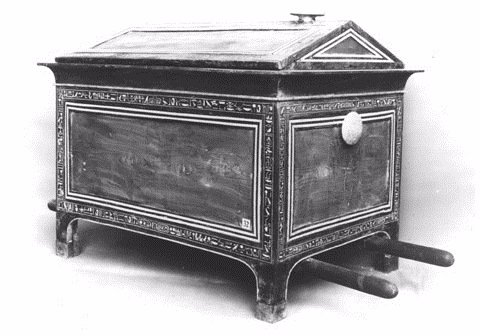
Ark from Tutankhamun’s tomb with poles, but a different lid

With this promise, God begins telling Moses how to make the portable tent-sanctuary.  In this week’s Torah portion, Terumah (“Donation”), God begins by describing the ark to be placed inside the Holy of Holies, the innermost room of the sanctuary.  The ark will be a box or coffer made of gold-plated wood, with gold rings for permanent carrying-poles.  Inside the ark will be the testimony, e.g. the stone tablets with the commandments.  The lid of the ark will be made out of pure gold.  The Torah calls this lid the kaporet (כַּפֹּרֱת) = atonement-cover; reconciliation, atonement.

And you will make two keruvim of gold; you will make them hammered out of the two ends of the atonement-cover.  You will make one keruv at one end, and one keruv at the other end; from the atonement-cover you will make the keruvim, on both of its ends.  And the keruvim will be spreading their wings upward, sheltering the atonement-cover with their wings; and their faces will be turned one another; the faces of the keruvim will be turned toward the atonement-cover.  (Exodus/Shemot 25:18-20)

keruv (כְרוּב), plural keruvim (כְרוּבִים) = a winged hybrid beast, usually with a human head and an animal body.  (Cherub in English.)


Two stone lions crouch on either side of the main entrance to a library, a civic building, or a mansion.  Usually they face the person who approaches, looking stern and regal, but sometimes they face one another.  Architects have used flanking statues for centuries, the world over, to make entrances more impressive.

Door guardians from palace of Ashurnasirpal II, Metropolitan Museum of Art, NY (photo by MC)

In ancient Mesopotamia, the colossal statues on either side of an entrance  were hybrid winged beasts with human heads, called lamassu in Sumerian and shedu or kuribu in Akkadian.  Scholars say the word kuribu is related both to the Akkadian word karabu, “to pronounce formulas of blessing”, and to the Hebrew word keruv.

Now imagine two winged beasts facing one another, guarding neither a city gate nor a door into a building, but a portal into another world, another reality.  Science fiction?  No, Torah.

The Torah portion Terumah explains that when the sanctuary is finished, God will speak to Moses from the empty space between the two keruvim.

“And I will speak to you from above the atonement-cover, from between the two keruvim that are upon the Ark of the Testimony, everything that I am commanding you and the Israelites.”  (Exodus 22)

This is neither the first nor the last place where the Torah mentions winged figures called keruvim.  The first reference is when the first two human beings are banished from the Garden of Eden.

And [God] drove out the human, and stationed at the east of the garden of Eden the keruvim and the flame of the sword of the continually-transforming, to guard the way to the Tree of Life.(Genesis/Bereishit 3:24)

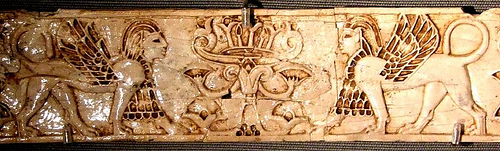
An image of keruvim flanking a tree of life is not unusual in the Ancient Near East.  But in the Torah, the keruvim are also guarding the entrance to a world called the garden of Eden.

Phoenician sphinxes and the tree of life

When the ark is carried into battle against the Philistines, it is referred to as: “the ark of the covenant of the God of Armies Sitting on the Keruvim.”  (I Samuel 4:4)  Here the keruvim are not guarding an entrance, but are flanking an invisible God.  The army hopes, in vain, that the ark with its keruvim will guard the soldiers from their enemies.

When King Solomon builds a permanent temple, he places two colossal gilded keruvim in the innermost chamber.  Their anatomy is not described, but their wings touch in the center of the room.  (I Kings 6:23-27)  Keruvim are also used as a decorative motif in the temple walls, as they are in the woven curtains around the inner chamber of the portable sanctuary.

The four mysterious hybrid creatures in vision of the prophet Ezekiel are also called keruvim.  Ezekiel’s keruvim have four wings each, human hands, calves’ hoofs, and four faces each (human, lion, ox, and eagle).  The throne where God’s glory appears hovers above them.  (Ezekiel 1:4-12 and 10:1-21)

Psalm 18 paints a metaphorical picture of God descending from the heavens to rescue King David from his enemies, and borrows a Canaanite image of the sky god riding on a winged steed.

          And [God] rode on a keruv and flew,

          And swooped on the wings of the wind.  (Psalm 18:11).

What do these references to keruvim mean?  If we look behind the descriptive details borrowed from neighboring cultures, keruvim seem to define a location for the appearance of God’s glory or presence.  The location might be between the keruvim, as in this week’s Torah portion, or above them, as in Ezekiel and Psalm 18, or behind them, as in Genesis.

Keruvim combine the traits of many animals, including humans.  Yet they are supernatural, existing somewhere between our reality and the transcendence of God.  Therefore they mark the dividing line between our world and a divine world we can neither enter nor understand.

Yet in Torah this dividing line is not a wall, but a gateway.  As long as we live in this world we cannot pass through the gate.  But we can imagine the entrance to the Garden of Eden.  And we can imagine God speaking to Moshe through the empty space between the keruvim above the ark, even if we can never enter the Holy of Holies ourselves.


One effect of this invisible portal to another reality, this gap in our universe, is that human beings feel a yearning that can never be satisfied by the things of this world.  The yearning keeps us searching—for love, for beauty, for the good, for the divine.  That is what it means to be human.

Maybe Adam and his counterpart Eve are not really human until they are expelled from the Garden of Eden.  Only then can they feel yearning.

Today we human beings still yearn for the ineffable.  And we are still responsible for using the passion of our yearning to fix the world we live in and make it more like the world we yearn for.

(This blog was first posted on February 7, 2010.)