Va-eira: Snake Staff, Part 2

The first time God changed Moses’ staff into a snake was on Mount Sinai, when God was giving him the signs he would use to convince the Israelites in Egypt that he was a genuine prophet. (See last week’s post, Shemot: Snake Staff, Part 1.)

The second time God transformed the staff was at the meeting Aaron set up between his brother Moses and elders of the Israelites in Egypt.

And Aaron spoke all the words that God had spoken to Moses, and he performed the signs in the sight of the people. And the people trusted him, and they heard that God had taken up the cause of the Israelites and had seen their misery and noticed them. And they bowed to the ground. (Exodus 4:30-31)

So far, so good. The next step was to persuade Pharaoh that God had sent them.

And afterward Moses and Aaron came and said to Pharaoh: “Thus says Y-H-V-H, the God of Israel: Let my people go so they will celebrate a festival for me in the wilderness.” But Pharaoh said: “Who is Y-H-V-H, that I should listen to his voice and let the Israelites go? I do not know Y-H-V-H, and furthermore, I will not let the Israelites go.” (Exodus 5:1-2)  

This might have been a good time for the brothers to use the magic staff to demonstrate that they are real emissaries of a real god. But God had not ordered it. Moses and Aaron merely talked a little longer, and then Pharoah decided to increase the workload of the Israelites instead.

The Israelites lost faith in Moses and in the promised rescue from Egypt. The Torah portion Shemot ends shortly after the Israelite foremen complain to Moses and Aaron:

“May God examine you and judge, since you made us smell loathsome in the eyes of Pharaoh and in the eyes of his courtiers, putting a sword in their hand to kill us!” (Exodus 5:21)

Marvel in the palace

This week’s Torah portion, Va-eria (Exodus 6:2-9:35), opens with some repetitions of the story line and a genealogy.1 Then God finally tells Moses and Aaron to demonstrate the transformation of the staff to Pharaoh.

And God said to Moses and to Aaron: “When Pharaoh speaks to you, saying: ‘Give me your marvel!’ then you will say to Aaron: ‘Take your staff and cast it down in front of Pharaoh!’ It will become a tanin.” Then Moses and Aaron came to Pharaoh, and they did just as God had commanded; Aaron cast down his staff in front of Pharaoh and his courtiers, and it became a tanin. (Exodus 7:8-10)

tanin (תַנִּין) = sea monster, crocodile, snake.2

When God transformed Moses’ staff on Mount Sinai (in a tale some scholars attribute to an E source), it became a nachash (נָחָשׁ) = snake, serpent. Now (in the tale from a P source) it becomes a tanin. Different source stories used somewhat different terminology.

And Pharaoh also summoned his wise men and his sorcerers, and they, also they, the chartumim of Egypt, did this with their spells. (Exodus 7:11)

chartumim (חַרְטֻמִּים) = literate Egyptian priests with occult knowledge.

The word chartumim is often translated as “magicians”, but these Egyptian dignitaries were not magicians in the modern sense: people who create illusions and trick their audiences. The ancient Egyptians believed that the gods created and maintained the universe with “heka”, a cosmic power that priests could also tap into and use to manipulate reality.)

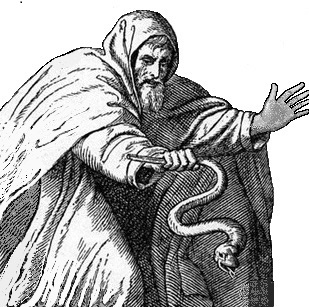
Aaron’s Road Changed into a Serpent, by Julius Schnorr von Carolsfeld, Charles Foster Bible Pictures, 1860

Each one cast down his staff, and it became a tanin. But Aaron’s staff gulped down their staffs. (Exodus 7:12)

The Egyptian priests use “heka” to produce the same marvel that God makes: a staff turning into a tanin. But the magic of the God of Israel proves superior to the magic of the Egyptian priests, since God’s staff swallows their staffs.

This is a significant coup, considering the nature of the crocodile and snake gods in Egyptian theology.

The crocodile in Egyptian theology

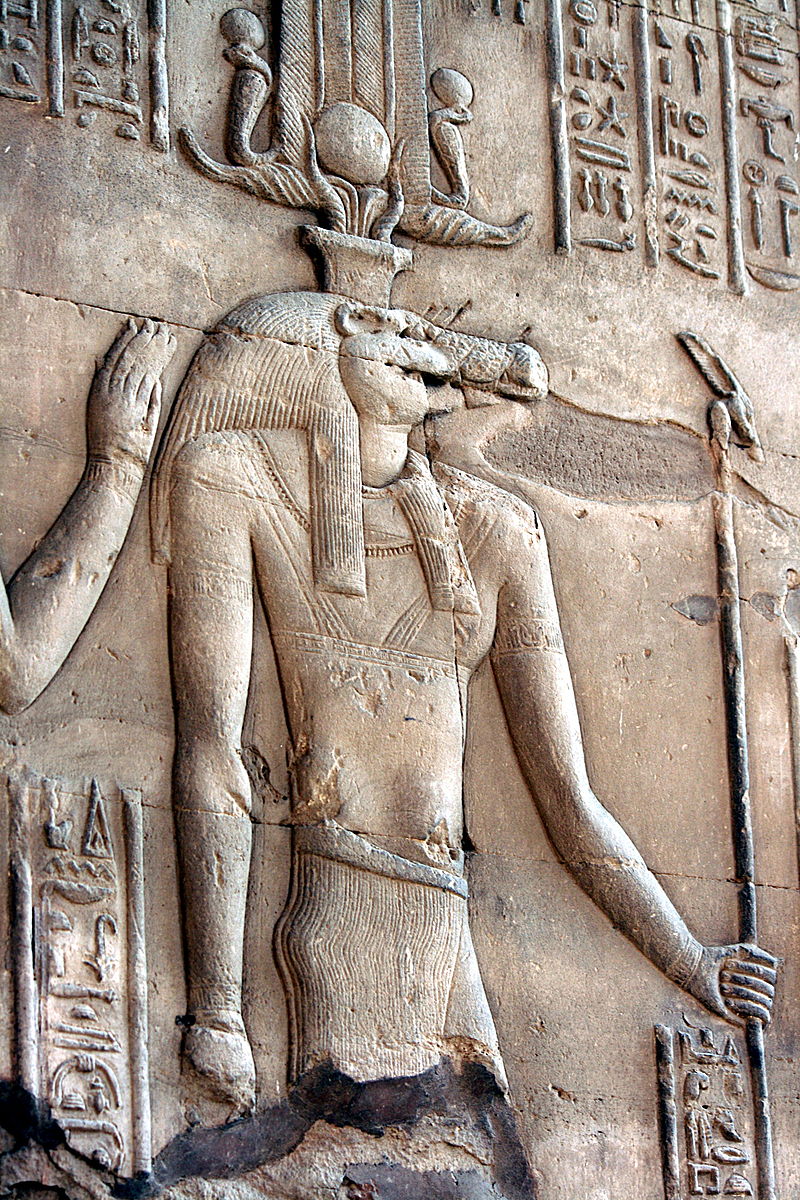
Egyptian god Sobek, Kom Ombo temple

The transformation of a staff into a crocodile would remind Egyptians of their crocodile god, Sobek, credited with both creating the Nile and giving strength to the pharaoh. If the God of Israel has power over Sobek, Pharaoh and the whole country are in danger.

The concept of a staff becoming a crocodile would not seem strange to the Egyptians. In an Egyptian tale written as early as 1600 B.C.E., the Egyptian priest Webaoner made a wax crocodile “seven fingers long”, and when his assistant threw it into a lake it became a real crocodile and swallowed up the priest’s enemy. When the king arrived, Webaoner caught the real crocodile, and it shrank and turned back into wax.3

The snake in Egyptian theology

Egyptian Priests Holding Serpent Staffs, Tomb of Sennufer, 15th c. BCE, photo by Scott B. Noegel, detail

The idea of a staff changing into a snake may have come from Egyptian rituals in which priests carried rods with heads shaped like snakes, as depicted in a 15th-century B.C.E. tomb painting.

The sudden appearance of a snake in Pharaoh’s audience chamber would remind the Egyptians of the snake god Apep. Apep was the god of chaos, evil, and darkness, the enemy of the sun god, Ra. Ra was the god of order and light, and crossed the sky from east to west every day. Every night the sun went down in the west and Ra traveled through the underworld to where the sun was due to rise again in the east. During this nightly underground crossing, Ra fought Apep, who lived in the underworld of the dead. For centuries Egyptian priests helped Ra in the battle by making wax models of Apep and spitting on them, mutilating them, or burning them while reciting spells to kill the evil god.4 

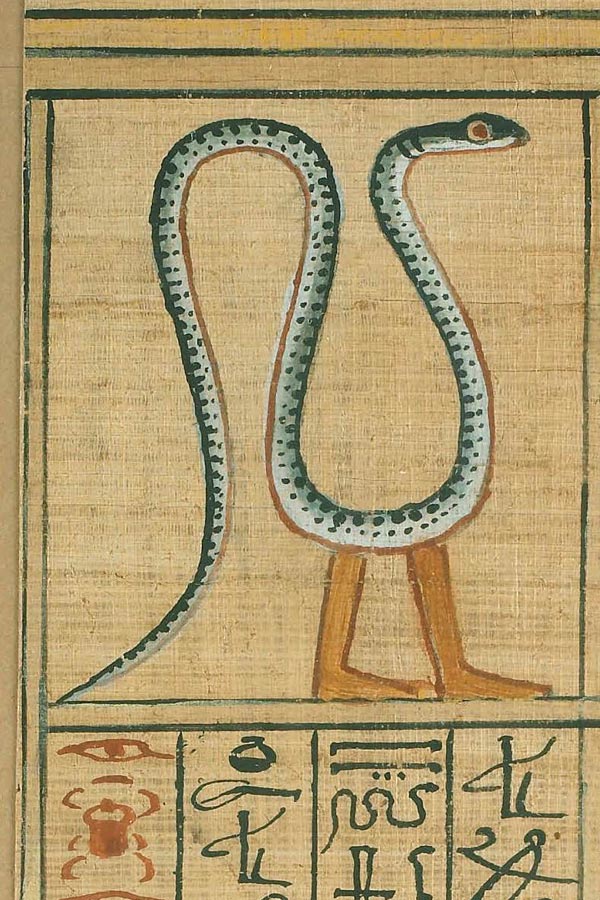
Nehebu-kau, Spell 87 of the Book of the Dead of Ani

Another Egyptian snake god was Nehebu-kau, a variant of Apep who had become a benign underworld god by the 13th century B.C.E., when the Exodus story was set. Nehebu-kau ws one of the 42 gods who judged the souls of the deceased. (Another was the crocodile god Sobek.) When souls of the dead passed the test for good behavior during life, Nehebu-kau gave them the life-force ka so they would have an afterlife. (Apep, on the other hand, was called “Eater of Souls”.)

When Aaron’s snake swallows the Egyptian priests’ snakes, it signals that the whole Egyptian cosmic order is in danger. Can Ra defeat a god even more powerful than Apep? Will there be any afterlife if Nehebu-kau is overthrown?

Pharaoh versus his priests

But Pharaoh’s mind hardened, and he did not listen to them, just as God had spoken. (Exodus 7: 13)

The next step is the first of the miraculous plagues that will destroy Egypt, just what God predicted to Moses in the Torah portion Shemot .

We can assume the Egyptian chartumim in the book of Exodus are shocked and alarmed when Aaron’s snake-staff gulps down all of theirs. It is an obvious omen that the God of Moses and Aaron will triumph over their pharaoh, and over all Egypt. But they do not want to believe this omen, so they return to do more magic for Pharaoh. They gamely use “heka” to reproduce God’s plagues of blood and frogs, at least in miniature.5 But they cannot replicate God’s third plague, lice.6 And at that point they acknowledge that the power behind the plagues is a serious danger to their world.

And the chartumim said to Pharoah: “It is a finger of a god!” But Pharaoh’s mind hardened, and did not listen to them. (Exodus 8:15)


Modern Torah readers are familiar with the idea that God is omnipotent. For us, the magic tricks that God arranges with a shepherd’s staff might seem like a sideshow before the main action of the ten plagues begins.

Yet it is necessary for Moses to prove to both the Israelites and the Egyptians that he really is speaking for a powerful god, and that his God is more powerful than any Egyptian god or Egyptian magic. Otherwise the Israelites will never follow him out of Egypt. And otherwise the pharaoh will attribute the plagues to other deities.

Some people are better than others at noticing signs and drawing long-term conclusions. Moses notices the subtle miracle of the bush that burns without being consumed, and walks right over to find out more.

The chartumim a a bit slower. They do not warn Pharaoh that Egypt is doomed right after the snake-staff demonstration; they are probably hoping to uncover an explanation consistent with their world-view. But when they cannot replicate God’s miraculous plague of lice, they give up. After that, the chartumim do not seem to be present at any other confrontational meetings between Moses and Pharaoh.7

But Pharaoh continues to assume that no matter what happens Egypt will go on, he will stay on the throne, and he must keep the Israelites as his slaves. Whenever Pharaoh’s faith is shaken, he recovers—until the final blow, the death of his own first-born son.

The longer you hold a belief, the harder it is to give up. What does it take before you admit you were wrong?

A single unexpected event, like the sight of a bush that burns but is not consumed?

Several demonstrations that the power structure you depend upon has been subverted?

The destruction of your world because of your failure to change?


  1. According to modern source criticism, a redactor of the book of Exodus patched in some material from a different account. The portion Shemot recorded mostly J and E traditions of the tale. Exodus 6:2-7:13 comes mostly from P sources, with some explanatory additions.
  2. The word tanin appears 14 timesin the Hebrew Bible. Half the time it means a sea-monster—or perhaps a crocodile (Genesis 1:21, Isaiah 27:1 and 51:9, Jeremiah 51:34,  Psalms 74:13 and 148:7, Job 7:12, and Nehemiah 2:13). Twice a tanin is a snake (Deuteronomy 32:33 and Psalm 91:13), and twice it is a misspelling of “jackals” (tanim, in Lamentations 4:3 and Nehemiah 2:13). The remaining three occurrences of the word tanin are in the P story about the meeting with Pharaoh. (The word tanim, תַּנִּים, also occurs 14 times in the Hebrew Bible. In 10 of those occurrences it means “jackals”. But it is used as an alternate spelling of tanin in Isaiah 13:22 (snakes), Ezekiel 29:3 and 32:2 (crocodiles or sea monsters), and Psalm 44:20 (sea monsters).
  3. Prof. Scott B. Noegel, “The Egyptian ‘Magicians”, www.thetorah.com.
  4. One of the rituals in The Book of Overthrowing Apep, circa 305 B.C.E.
  5. Exodus 7:22 and 8:3.
  6. Exodus 8:14.
  7. No chartumim are mentioned in the passages about the next two plagues. The story of the sixth plague, boils, says: The chartumim were not able to stand in front of Moses because of the boils. (Exodus 9:11) After that they are absent from the rest of the book of Exodus.

Shemot: Snake Staff, Part 1

Moses hears God speak out of the burning bush on Mount Sinai, and learns that he must act as God’s prophet and lead the Israelites out of Egypt. He tries four times to get out of the job in this week’s Torah portion, Shemot (Exodus 1:1-6:1), and one of his efforts leads to God making his staff magical.

First Moses hints that he is not qualified, saying:

“Who am I, that I should go to Pharaoh and that I should bring the Israelites out from Egypt?” (Exodus 3:11)

Instead of saying why Moses meets the job qualifications, God replies:

“I will be with you, and this will be your sign I myself sent you.” (Exodus 3:12)

In other words, Moses will be frequently reminded that God sent him on this mission, because God will be present for him. As the story continues, God’s presence with Moses is indeed obvious, since God continues to speak to him.

Next Moses asks what name he should call God when he speaks to the Israelites, and God answers at length, giving him more information about his mission as well as about who God is. Then Moses makes his second protest:

“And if they do not believe me, and do not listen to my voice, but say: Y-H-V-H did not appear to you?” (Exodus 4:1)

This time God responds by showing Moses three “signs” he can perform in front of the Israelites to demonstrate that Y-H-V-H1 is with him. The first sign turns out to be the most important.

God said to him: “What is this in your hand?” And he said: “A mateh.” (Exodus 4:2)

mateh (מַטֶּה) = a shepherd’s staff; a staff serving as an official symbol of authority over a tribe or country; a tribe. (Plural: mattot, מַטּוֹת.)

Moses is holding a shepherd’s staff because he has just led his father-in-law’s flock through the wilderness all the way to Mount Sinai. But this is his last undertaking as a shepherd. After he returns to Egypt, Moses will use his staff to signal divine miracles. He will also become the leader of the thousands of Israelites who follow him out Egypt.

From Charles Foster Bible, illustration by Julius Schnorr von Carolsfeld, 1860

Now God demonstrates that Moses is no longer holding a mere shepherd’s staff.

Then (God) said: “Throw it to the ground.” So he threw it to the ground, and it became a nachash, and Moses fled from it. Then God said to Moses: “Reach out your hand and grasp it by its tail.” And he reached out his hand and took hold of it, and it became a mateh in his palm. (Exodus 4:3)

nachash (נָחָשׁ)= snake, serpent. (Words from the same root include the verb nichash, נִחַשׁ = practice divination, the noun nachash, נַחַשׁ = bewitchment, magic curse, and nechoshet, נְחֺשֶׁת = copper, copper alloy.)

Then God gives Moses two more signs for the Israelites. For the second sign, is he puts his hand into the fold at the bosom of his robe, and when he pulls it out his hand looks white and scaly. When he repeats the action, his hand returns to normal.2 For the third sign, God says,  Moses will pour some water from the Nile on dry ground, and it will turn into blood.3

Once Moses has demonstrated the signs to the Israelites, God says, they will believe that God appeared to him.

Moses does perform all three signs in front of the elders of Israel when he arrives back in Egypt, and they believe he is God’s prophet.4 But the only one of these signs he uses in front of Pharaoh is the staff trick. (See next week’s post, Va-eira: Snake Staff, Part 2.)

But the three signs are not enough for Moses, who does not want to be a prophet in the first place. So he makes two more attempts to talk God out of giving him the job. He says he is a slow and clumsy speaker, but God promises to tell him what to say. Finally, Moses simply begs God to send someone else.5 God gets angry, then promises to appoint his brother Aaron to help him. And Moses resigns himself to returning to Egypt.


Moses’ staff could turn into anything surprising, and the transformation would prove that he is a channel for the miraculous power of God. So why does God choose a snake for this sign?

Snake as deceiver

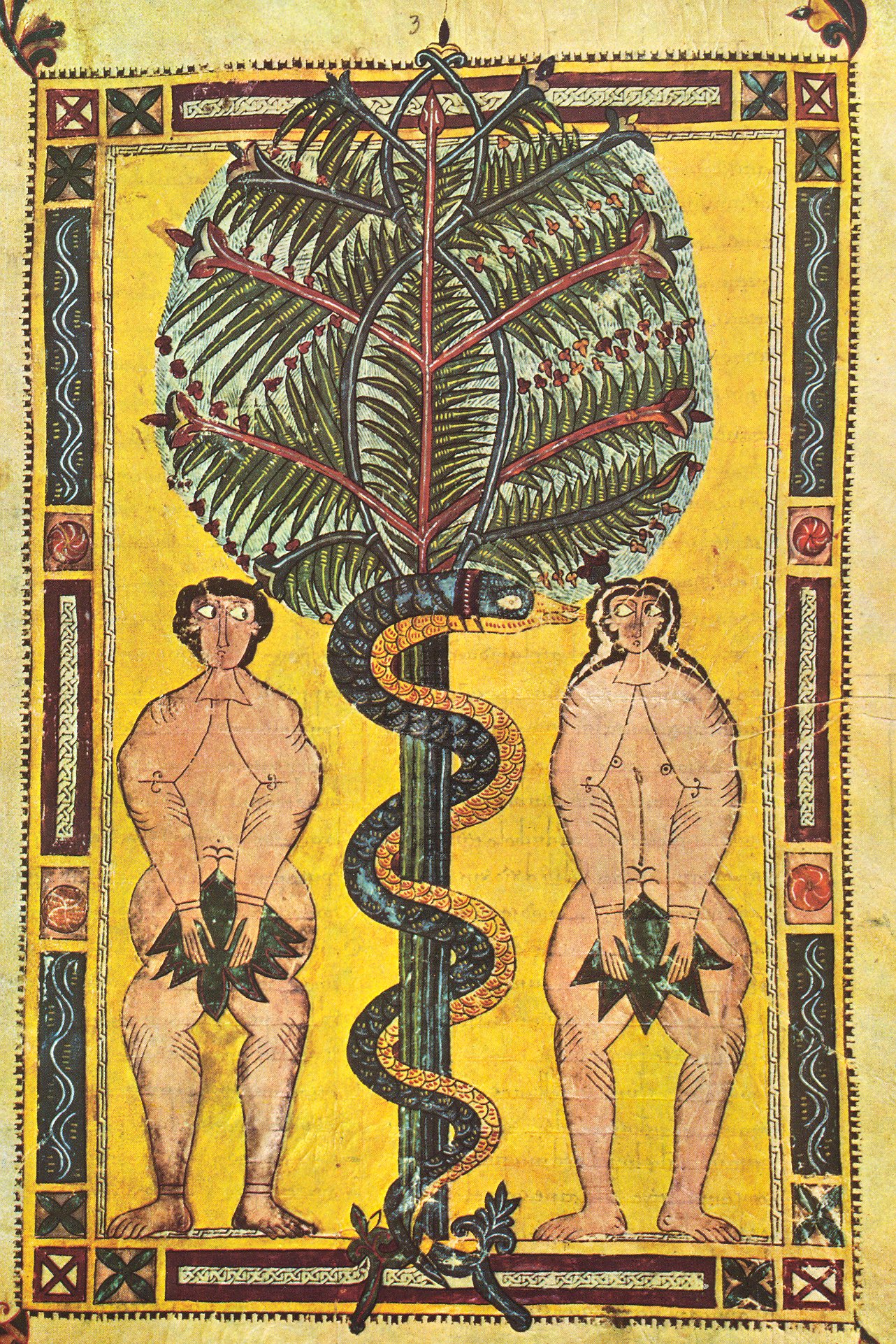
Adam, Eve, and Snake, Escorial Beatus, ca. 950

One explanation is that a snake is the opposite of a staff. A snake is a flexible animal that moves with whiplash speed. It can shed its dead skin and emerge alive. And in the story of the Garden of Eden, the snake is clever and deals in deception and half-truths.6

Some early commentators claimed that the first time God changed Moses’ staff into a snake, it was a personal message to Moses that he had slandered the Israelites when he said they would not believe him—just as the snake in the Garden of Eden had slandered God by implying that God had lied about the effects of eating fruit from the Tree of Knowledge of Good and Evil.7

A staff, on the other hand, is a long stick of dead wood, hard and inflexible. It is reliable, strong enough to lean against without breaking—and therefore a good symbol for a chieftain or a king. 19th-century Rabbi S.R. Hirsch wrote:

“… מטה [mateh] denotes (a) an extension of the hand, upon which man can lean for support as he stands on the ground; (b) an extension of man’s sphere of power; it is a symbol of his authority. This sign in Moshe’s hand will show the people that, if God so desires, the thing on which a person leans for support and with which he wields his authority can turn into the very opposite: a serpent. … Conversely, if He so desires, God can take a hostile force that is feared and shunned by man and place it into his hand as an accommodating support and tractable tool.”8

Snake as phallic symbol

Both a staff and a snake are obvious phallic symbols. I suspect that when this story was told orally, the verbal image of a snake stiffening into a staff in Moses’ hand drew snickers from the audience.

The staff and the snake represent two aspects of power. The staff stands for legitimate authority. The snake stands for creative subversion—the power of the trickster. Perhaps one way God uses the staff and snake is to demonstrate, first to Moses and then to the Israelites, that ultimate power over everything belongs to God.

Furthermore, God only makes the snake harmless enough for Moses to pick up with his bare hand when a demonstration of Moses’ status as God’s prophet is required. This demonstration happens first to Moses himself on Mount Sinai, then to the Israelites, then to Pharaoh and his court.

When Moses sets off for Egypt with his wife Tziporah and their two small sons,

Moses took the mateh of God in his hand. (Exodus 4:20)

Moses’ staff is now called the staff of God because God has imbued it with the power to miraculously turn into a snake (and to signal or initiate other miracles in the future).

An incident on Moses’ journey to Egypt shows that the snake can also be dangerous as a phallic symbol.

On the road, at a lodging-place, God confronted him and sought to kill him. Then Tziporah took a flint, and she cut the foreskin of her son, and she touched it to his raglayim, and she said: “Because a bridegroom of blood you are to me!” (Exodus 4:24-25)

raglayim (רַגְלַיִם) = a pair of feet, a pair of legs—or a euphemism for genitals.

The Torah does not say how God “sought to kill him”. But since the next sentence refers to a foreskin and genitals, the Talmud and Exodus Rabbah imagined the angel of death swallowing Moses from his head down to his genitals, where Moses’ circumcision stops the process.9 Rashi wrote:

 “The angel became a kind of serpent and swallowed him [Moses] from his head to his thigh, spewed him forth, and then again swallowed him from his legs to that place. Tziporah thus understood that this had happened on account of the delay in the circumcision of her son.”10  (For a fuller discussion of the “Bridegroom of Blood” episode, see my post Shemot: Uncircumcised, Part 1.)

The staff that turns into a snake and back is God’s phallic symbol, not Moses’. Moses is merely another of God’s tools. In next week’s Torah portion, Vayeira, God makes Moses use the staff to impress the simple-minded people in Egypt, from Israelite slave to Egyptian monarch. It would be easy for me, as a feminist, to mock these displays of male power. Yet perhaps they are necessary to get some people’s attention.

And once they are paying attention, they might consider the difference between a man with a staff of office on whom you can depend, and a man in authority who is more like a poisonous snake. Which kind of authority is Pharaoh?

What about our leaders and authority figures today?


  1. For an explanation of God’s personal name, indicated by Y-H-V-H, see my post Lekh-Lekha: New Names for God.
  2. Exodus 4:6-7.
  3. Exodus 4:9.
  4. Exodus 4:28-31.
  5. Exodus 4:13.
  6. Genesis 3:1-6.
  7. C.f. Ramban on Exodus 4:3. (Ramban is the acronym of 13th-century Rabbi Moshe ben Nachman, also called Nachmanides.) For the snake’s implication that God was lying when God said eating from the Tree of Knowledge would result in death, see Genesis 3:2-5.
  8. Samson Raphael Hirsch, The Hirsch Chumash, Sefer Shemos, translated by Daniel Haberman, Feldheim Publishers, Jerusalem, 2005, p. 50. (Hirsch was a 19th-century German rabbi and commentator.)
  9. Talmud tractate Nedarim 32a, Exodus Rabbah 5:8, both written circa 300-600 C.E.
  10. Translation from www.sefaria.org. Rashi is the acronym for 11th-century Rabbi Shlomo Yitzchaki.

Pesach: Four Questions

Question: Why do Jews celebrate Passover?

Answer: To teach children the story of the exodus from Egypt.

This answer is in both the Torah and the Talmud, along with the need for adults to recall the story of liberation in an unforgettable way.

Two rituals in Exodus

Passover/Pesach begins this Wednesday at sunset. Jews around the world will gather at dinner tables and perform an elaborate ritual that is quite different from the two observances required in the book of Exodus.

In the book of Exodus, God orders the Israelites to gather in their houses for dinner on the 14th of the month of Nisan, which begins at sunset. That night, God will afflict Egypt with the last of the ten plagues: death of the firstborn. Each Israelite household must slaughter a year-old male lamb or goat; smaller households should combine and share one.

Painting the Blood, History Bible, Paris, c. 1390

And they must take some of the blood, and they must put it on the two doorposts and on the lintel of the houses where they will be. And they must eat the meat on this night, roasted in fire, and matzot on bitter herbs they must eat. You must not eat it raw, or cooked by boiling in water, but rather roasted in fire, its head on its lower legs and on its entrails. And you must not leave any for yourselves until morning; and [any] leavings from it in the morning you must burn in the fire. And thus you must eat it: your hips girded, your sandals on, and your staffs in your hand. And you must eat it in haste. It is a pesach for God. (Exodus/Shemot 12:7-11)

matzot (מַצּוֹת) = plural of matzah (מַצָּה) = unleavened bread; dry flatbread baked quickly to avoid sourdough action.

pesach (פֶּסַח) = “Passover” offering. (From the verb pasach, פָּסַח = hop (in 1 Kings 18:21); protect (in Isaiah 31:5); skip over, spare (in Exodus 12:23).)

Presumably the Israelites were enacting this ritual on the first night of Passover when Exodus was written down.  As God’s instructions continue, the ritual about daubing blood and eating a whole lamb standing up is followed by seven days of eating matzot:

Seven days you must eat matzot; indeed, on the first day you must remove the leaven that is in your houses, since any soul eating leaven must be cut off from Israel from the first day through the seventh day. (Exodus 12:14-15)

Pilgrimage festivals ceased after the destruction of the Second Temple in Jerusalem in 70 C.E. But the seven days without leaven is still a widespread Jewish observance during the week of Passover.

The Seder Table, Ukrainian print from Lubok, 19th century

However, painting your door frame with blood, eating a whole lamb including the head and entrails, and/or eating standing up with a staff in hand are rare today. Instead, on the evening of Nissan 14 (and sometimes on subsequent evenings during the week of Passover), Jews sit around the dinner table going through a Haggadah (הַגָּדָה = telling), a guide to saying blessings, singing songs, telling traditional stories, doing show-and-tell rituals, and eating ritual foods (as well as dinner). The event is called a seder (סֵדֶר= order, arrangement) because all these ritual acts are done in a prescribed order.

The reason for doing this is not only to remind ourselves of the story about God bringing us out of slavery in Egypt, but to teach it to our children.

Children in the Torah

The section of the Haggadah called “The Four Sons” or “The Four Children” paraphrases questions and answers in the Torah, imagining a different type of child corresponding to each answer.1 Three of the four biblical instructions on what to tell children are given in Exodus on the eve of the final plague and the liberation from Egypt:

When a child asks why we paint blood on our doorframes every year on Nissan 14, say:

“It is a pesach slaughter-sacrifice for God, who pasach over the houses of the Israelites in Egypt when [God] afflicted the Egyptians, but saved our households.” (Exodus 12:26)

When everyone has to eat matzot instead of leavened bread for a week, say:

“On account of what God did for me, when I went out of Egypt.” (Exodus 13:8)

When a firstborn son is ransomed in a ritual at the beginning of Passover, say:

“With a strong hand God brought us out from Egypt, from the house of slavery …” (Exodus 13:14)

The first of the Four Children in the Haggadah is based on the book of Deuteronomy, when Moses posits a son who asks about all the rules God has given. What Moses (unlike the Haggadah)2 tells you to answer begins:

“We were slaves to Pharaoh in Egypt, and God brought us out …” (Deuteronomy 6:20)

But the biblical questions and answers are not enough. Before the Four Children section, the Haggadah makes sure children are engaged with a section called “The Four Questions”.

The Four Questions in the Talmud

Most of the traditional Haggadah3 is described in the Babylonian Talmud tractate Pesachim, including the Four Questions, which appear in the older part of the tractate, the mishnah.4  The mishnah dates to the early third century C.E. and records what the Israelites in Babylonia were already practicing; therefore the Four Questions, like the Four Sons, has been an important part of the Passover ritual for about 2,000 years.

And for about 2,000 years, the purpose of the Four Questions has been to make the children at the seder pay attention.

Asking the Four Questions, German Haggadah c. 1460

All four questions are amplifications of the basic question:

Why is this night different from all other nights?

But the content of the four amplifications has changed somewhat since Talmudic times.

The original Four Questions (or amplifications) in the Talmud are:

On all other nights, we eat leavened bread or matzah, but on this night only matzah.

On all other nights, we eat other vegetables, but on this night only bitter herbs.

On all other nights, we eat meat roasted, stewed, or boiled, but on this night only roasted.

On all other nights we dip [vegetables] once, but on this night we dip twice.

The mishnah continues: And according to the son’s understanding, his father instructs him.”5 (Perhaps this remark inspired the creation of the section traditionally called “The Four Sons”.)

By the 10th century C.E., the question about how the meat is cooked had been dropped from the list, and replaced with a different question:

            On all other nights we eat sitting up or reclining, but on this night only reclining.

Reclining instead of sitting up was already a requirement by the time the mishnah of Pesachim was written.6 The Talmudic rabbis cited in the gemara (the part of a Talmud tractate written during the 3rd through 5th centuries C.E. as commentary on the mishnah) argued about the technicalities of reclining. They agreed that:

Lying on one’s back is not called reclining. Reclining to the right is not called reclining, as free men do not recline in this manner. People prefer to recline on their left and use their right hand to eat, whereas they find it more difficult to eat the other way. (Pesachim 108a)

After some argument, they also agreed that reclining was necessary not only while eating matzah, but also while drinking each of the four cups of wine, since only free and independent people got to recline while drinking—the opposite of “We were slaves” in the retelling of Exodus. But nobody had to recline while eating the bitter herbs.

When the requirement about reclining replaced the method of cooking meat in the Four Questions, the order of the questions also changed.6 During the last 1,000 years, the most common order has been:

Why is this night different from all other nights?

  1. … but on this night we dip them twice.
  2. … but on this night only matzah.
  3. … but on this night only bitter herbs.
  4. … but on this night only reclining.

Today, after we pour the second cup of wine and come to the page in the Haggadah with the Four Questions, all the questions are sung by the youngest person at the table who can manage it. Some children relish the job; others complain. But someone has to do it.

And if even his wife is not capable of asking or if he has no wife, he asks himself. And even if two Torah scholars who know the halakhot of Passover are sitting together and there is no one else present to pose the questions, they ask each other. (Pesachim 116a)

The Talmud offers additional ways to prompt children to ask about the unusual things they see in the dining room. Following Rabbi Akiva, Pesachim recommends giving the children roasted grains and nuts, “so that they will not sleep and also so they will ask the four questions at night.” (Pesachim 109a)

Another technique was to grab the matzot and wolf them down, “so that, due to the hasty consumption of the meal, they will not sleep and they will inquire into the meaning of this unusual practice.” (Pesachim 109a)

One prompt in the Talmud is to actually remove the dinner table from the room before the main meal!

Why does one remove the table? The school of Rabbi Yannai says: So that the children will notice that something is unusual and they will ask: Why is this night different from all other nights? The Gemara relates: Abaye was sitting before Rabba when he was still a child. He saw that they were removing the table from before him, and he said to those removing it: We have not yet eaten, and you are taking the table away from us? Rabba said to him: You have exempted us from reciting the questions of: Why is this night different [ma nishtana], as you have already asked what is special about the seder night. (Pesachim 115b)

Another rabbi quoted in Pesachim, Rab Shimi bar Ashi, explained:

Matza must be placed before each and every participant at the seder. Each participant in a seder would recline on a couch at his own personal table. Likewise, bitter herbs must be placed before each and every participant, and ḥaroset must be placed before each and every participant. And during the seder, before the meal, one shall remove the table only from before the one reciting the Haggadah. The other tables, which correspond to the seder plates used nowadays, are left in their place. (Pesachim 115b)


I have never been to a Passover seder in which each person reclines on a couch at a separate table, as at an ancient Greek symposium. And since we are all sitting at one big table (leaning to the left uncomfortably at the appropriate times), I have never seen the table removed.

But I have witnessed other devices to keep children—and even adults—awake and asking questions. If you were leading a seder, what would you do?


  1. See my post Pesach: Changing Four Sons.
  2. The reply to the first son (or child) in the Haggadah is to summarize only the rabbinic rulings (halakhah) about Passover, up to the ban on eating anything after the afikomen, the final piece of matzah.
  3. Modern Jews have added new ritual elements to the seder, and therefore new pages of text and songs in the Haggadah, while retaining all the important elements of the traditional Haggadah that is still used by more orthodox Jews.
  4. Pesachim 116a. (All translations from tractate Pesachim in this post are from The William Davidson Talmud on www.sefaria.org.) The mishnah in each tractate of the Talmud is the oral law collected by Yehudah HaNasi at the beginning of the third century CE.  Later rabbinic commentary on the mishnah, the gemara, was added over the next few centuries.
  5. Pesachim 116a.
  6. Pesachim 108a. The question about reclining is added to the Four Questions in the writings of both Saadiah Gaon  (10th-century rabbi Saadiah ben Yosef Gaon) and Rambam (12th-century philosopher Moshe ben Maimon, a.k.a. Maimonides).
  7. This is the order of the four questions according to Saadiah Gaon, Rambam, and the first extant printed haggadah (Soncino, 1485).

Pekudei & 1 Kings: Is the Ark an Idol?

The ark and the curtain in front of it are the last two things Moses puts into the new Tent of Meeting in this week’s Torah portion, Pekudei (Exodus 38:21-40:38). Then the portable sanctuary that will be God’s new dwelling place is complete.

Then Moses finished the work. And the cloud covered the Tent of Meeting, and the kavod of God filled the Dwelling Place. And Moses was not able to enter the Tent of Meeting, because the cloud rested on it and the kavod of God filled the Dwelling Place.  (Exodus/Shemot 40:33-35)

kavod (כָּבוֹד) = weight, magnificence, honor, glory.

Thus all the Israelites who made things for the portable sanctuary, from the golden ark to the woven walls, did it right. God approved, and manifested inside.

The last thing King Solomon puts into the new permanent temple for God in this week’s haftarah (the reading from the Prophets that accompanies the Torah portion) is the ark. Then the first permanent temple for God in Jerusalem is complete.

And it was when the priests went out of the holy place, and the cloud filled the house of God. And the priests were not able to stand and serve in the presence of the cloud, because the kavod of God filled the house of God. (1 Kings 8:10-11)

Thus all the people who built and furnished the temple for King Solomonalso did it right; God approved, and manifested inside.

In both the tent and the temple, the ark is brought into the Holy of Holies, the innermost chamber in back. In both Exodus and 1 Kings, the ark is a box or chest with a lid and four feet. In both stories, it is carried by means of two poles that run through the rings attached to its feet. And in both stories, the ark contains the two stone tablets Moses brought down from his second forty-day stint on Mount Sinai.

Yet the two stories do not seem to be talking about the same ark.

The ark in Exodus

The master artist Betzaleil makes the lid of the ark in last week’s Torah portion in the book of Exodus, Vayakheil:

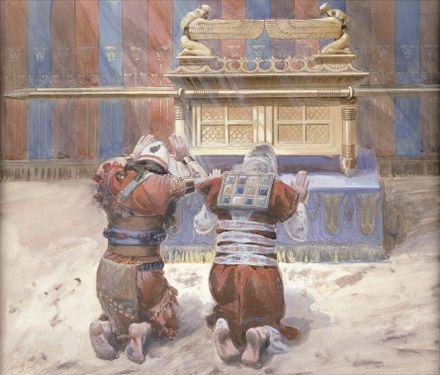
Then he made a kaporet of pure gold, two and a half cubits long and a cubit and a half wide. And he made two keruvim of gold; he made them hammered out from the two ends of the kaporet. One keruv out of this end and one keruv out of that end; from the kaporet he made the keruvim, from its two ends. And the keruvim were spreading wings above, screening off [the area] over the kaporet with their wings. And they faced each other, and the faces of the keruvim were toward the kaporet.(Exodus 37:6-9)

kaporet (כַּפֺּרֶת) = the lid of the ark in Exodus and Numbers; the lid of the ark as the seat of reconciliation or atonement with God in Leviticus. (From the root verb kafar, כָּפַר = covered; atoned, made amends.)1

keruvim (כְּרוּבִים) = plural of  kervuv (כְּרוּב) = “cherub” in English; a hybrid supernatural creature with wings and a human face. (Elsewhere in the Hebrew Bible, keruvim are guardians, steeds, or part of God’s heavenly entourage.)2

Moses and Aaron Bowing Before
the Ark, by James Tissot, ca. 1900

The bodies of the gold keruvim in Exodus are never described. Since each keruv sculpture has only one face, which gazes at the lid of the ark, it represents a different sort of hybrid creature from those in Ezekiel’s visions. The book of Ezekiel describes a keruv as having four faces, four wings with human hands under them, a single leg like a calf’s hoof, and eyes covering its whole body.3

The two gold keruvim on the ark in Exodus face one another, but they are looking down at the center of the lid. They might be guarding the stone tablets inside, or they might be guarding the empty space above the lid and below their wings. Earlier in the book of Exodus, God tells Moses:

And I will meet with you there and I will speak with you from above the lid, from between the two  keruvim (Exodus 25:22)

That means the gold keruvim in Exodus are not idols. In the Ancient Near East, an idol was a sculpture of a god that the god sometimes entered and inhabited. At those times, worshiping the idol was the same as worshiping the god.

But Exodus is careful to explain that God will not enter the ark or the keruvim sculptures on top of it; God will only manifest in the empty space between kaporet and the wings of the keruvim.

The ark and its lid are only two and a half cubits long—just under four feet (just over a meter)—so the empty space for God is not large. According to Exodus, God manifests there as a voice, but according to Leviticus 16:2, God appears there as a cloud.

The two small keruvim that Betzaleil hammers out of the extra gold on the ends of the lid of the ark are not mentioned again anywhere in the Hebrew Bible except once in the book of Numbers:

And when Moses came to the Tent of Meeting to speak with [God], then he heard the voice speaking to him from above the kaporet that was on the Ark of the Testimony, from between the two keruvim; thus [God] spoke to him. (Numbers/Bemidbar 7:89)

Here, too, the Torah clarifies that neither the keruvim nor the kaporet nor the ark are idols.

The ark in 1 Kings

Many generations pass before David creates the first kingdom of Israel, and his son Solomon builds the first permanent temple for God.  By the time King Solomon brings the ark into his new temple, there do not appear to be any keruvim on its lid. The first book of Kings reports the two large statues of keruvim in the Holy of Holies, and small keruvim decorations carved into the walls of the rest of the temple, but no keruvim on the ark.

Solomon has two colossal wood statues of keruvim brought into the Holy of Holies before the ark is carried in. Each keruv is ten cubits, about 15 feet (four and a half meters) tall, with a ten-cubit span from wingtip to wingtip.4

Then he placed the keruvim inside the House, in the innermost [chamber]. And the wings of the keruvim spread out so the wing of one keruv touched the wall, and the wing of the second keruv was touching the second wall, and in the middle of the chamber their wings touched. And he overlaid the keruvim with gold. (1 Kings 6:27-28)

Meanwhile the ark remains in King David’s tent of meeting, in another part of town, until the rest of the temple and its furnishings are completed.

That was when Solomon assembled the elders of Israel—all the heads of the tribes, chiefs of the fathers of the Children of Israel—before King Solomon in Jerusalem, to bring up the Ark of the Covenant from the City of David … And all the elders of Israel came, and the priests lifted the ark. (1 Kings 5:1-3)

Solomon Dedicates the Temple,
by James Tissot, 1902

King Solomon leads the sacrifice of livestock on the altar outside the new temple.

Then the priests brought the Ark of the Covenant of God into its place, into the back chamber of the house, to the Holy of Holies, to underneath the wings of the keruvim. For [each of] the keruvim was spreading a pair of wings toward the place of the ark, so the keruvim screened off the ark and its poles from above. (1 Kings 8:6-7)

Here the empty space reserved for God is larger than in Exodus, since the gap between the lid of the ark and the wings of the colossal statues of keruvim is about 11 feet (three and a half meters). Yet the Hebrew Bible does not mention God speaking from this space. Nor does a cloud appear there after God’s inaugural cloud of kavod has faded.

The contents of the Holy of Holies in Solomon’s temple seem to be merely symbolic. There is no mention of God manifesting in the empty space between the wings of the keruvim and the ark. Neither a statue nor the ark becomes an idol that God inhabits. According to one Talmudic source, ordinary Israelites can see the ark and the keruvim without any harmful consequences.5

Perhaps 1 Kings emphasizes that God does not inhabit the ark inside the new temple when it says:There was nothing in the ark but the two stone tablets that Moses set down there at Chorev [a.k.a. Sinai] which God cut … (1 Kings 8:9)

The ark as an idol

Exodus and 1 Kings reflect two different traditions about the relationship of the ark to its guardian keruvim. Current scholarship suggests both books were written in the 6th century B.C.E., and the descriptions of the Tent of Meeting in Exodus were modeled on the descriptions of Solomon’s temple, with adjustments to make the tent-sanctuary smaller and more portable. The descriptions of the ark in Exodus through Numbers are also more awe-inspiring than the bare mention of the ark in 1 Kings.

Both descriptions of the ark and the pair of keruvim make it clear that these furnishings are not idols. Yet other stories in the Hebrew Bible do treat the ark like an idol inhabited by God.

In the book of Joshua the priests carry the ark across the Jordan River, as the Levites had carried the ark (always covered from view by three layers of fabric)6 from Mount Sinai to the eastern bank of the Jordan. But then the priests carry it in a military parade around the walls of Jericho until God destroys the city.7

After the Israelites are unexpectedly defeated in a battle later in the book of Joshua, the ark apparently sits on the ground out in the open, rather than inside the tent-sanctuary:

And he fell on his face on the ground in front of the ark of God until evening, he and the elders of Israel, and they put dust on their heads. (Joshua 7:6)

In the first book of Samuel the ark is inside a sanctuary again: the temple at Shiloh, which has solid walls and doors, but a tent roof. However, the sons of the priest Eli take the ark out of the temple and onto the battlefield, where it is captured by the Philistines. In Philistine territory, the ark initiates two plagues and smashes an idol of the Philistine god Dagon.8  The God of Israel is working magic through the ark, which functions as an idol.

Ark Sent Away by the Philistines,
by James Tissot, 1902

The Philistines send the ark back into Israelite territory, where its magic power kills at least 70 Israelite men who look inside. The ark is removed to a private house where the owner’s son is consecrated as a priest to guard it.9

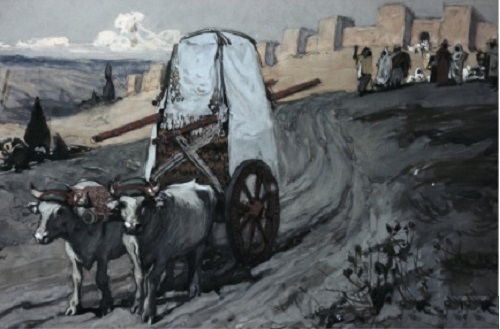
This version of the ark can be safely seen from outside, but must not be opened—or touched, except by its attached carrying poles. When King David sets out to retrieve the ark and transport it to Jerusalem, its two current priests load it on a cart. Partway to Jerusalem the oxen pulling it stumble, and the priest who touches the ark to steady it dies instantly.

And David was afraid of God that day, and he said: “How could I bring the ark of God to myself!” (2 Samuel 6:9)

Although it is possible to interpret this verse as indicating David’s fear of a remote God who chooses to kill anyone who touches the ark, it makes more sense if David conflates God and the ark, treating the ark as an idol God is inhabiting. Fear of God and fear of the ark are the same thing.

Three months later King David succeeds in bringing the ark the rest of the way to Jerusalem, and installs it in the new tent-sanctuary he has set up there for God.10 This is the ark that King Solomon brings into the Holy of Holies in his new temple, and positions under the wings of two new statues of keruvim. At that point the ark is no longer an idol, but merely a sacred object, the most sacred object in the temple.


Which version of the ark appeals to you the most:

The holy work of art in Exodus and Numbers, which only a priest is allowed to see?

The idol that travels around naked in Joshua and the two books of Samuel, zapping people right and left?

Or the piece of furniture in 1 Kings, which must be treated as sacred because it contains the two stone tablets, the way an ark in a synagogue today is treated with respect because it contains the Torah scroll?


  1. The only occurrence of the term kaporet  in the bible outside Exodus, Leviticus, and Numbers is when 1 Chronicles, written about 200 years later, says King David gave his son Solomon plans for the temple including “the shrine of the kaporet” (1 Chronicles 28:11). This is not a locution used in Exodus through Numbers.
  2. Keruvim are definitely guardians in Genesis 3:24 and Ezekiel 28:14-16. A keruv is a steed for God in 2 Samuel 22:11, Ezekiel 9:3, Psalm 18:11, and 1 Chron. 28:18. Keruvim are part of God’s large supernatural entourage in Ezekiel 1:5-14, 10:1-20, and 11:22.
  3. Ezekiel 10:1-20 and 1:5-14.
  4. 1 Kings 6:23-26.
  5. Talmud Bavli, Yoma 54a.
  6. See my post: Bemidbar: Don’t Look!
  7. Joshua 3:3-4:18, 6:4-13.
  8. 1 Samuel 4:3-6:12.
  9. 1 Samuel 6:19-7:1.
  10. 2 Samuel 6:13-17.

Beshalach & Ki Tisa: Dancing

How do you thank—or appease—the God of Israel? Burning offerings on an altar is the primary method in the Hebrew Bible. But for women, another way is to grab your tambourine and do a chain dance.

Celebrating the right way in Beshalach

As soon as the Israelites walk out of Egypt, Pharaoh pursues them with chariots in the Torah portion Beshalach (Exodus 13:17-17:16). Then a wind from God dries out a path across the Reed Sea. After the Israelites cross over, God makes the waters return and drown the Egyptian army.

Miriam, by Anselm Feuerbach, 1862

Then Miriam the prophetess, Aaron’s sister, took the tambourine in her hand, and all the women went out after her with tambourines and with mecholot. And Miriam sang call-and-response to them: “Sing to Y-H-V-H, for [God] is definitely superior! Horse and its rider [God] threw into the sea!” (Exodus 15:20-21)

mecholot (מְחֺלוֹת) = plural of mecholah (מְחֺלָה) or mechol (מְחוֹל) = chain dance or circle dance. (From the root verb chol, חול = go around in succession; do a circle dance or chain dance.)

In a mecholah, dancers form a line behind a leader, with each dancer using one hand to touch the next. The line moves in a circle, a spiral, or some other curving pattern s the dancers copy the steps of the leader.

In this first example of mecholot in the Torah, each woman on the shore of the Reed Sea is carrying her tambourine, but her other hand is free to touch the shoulder of the woman in front of her. Percussion and singing are integral to the dancing.

This first chain dance is a heartfelt celebration of a divine miracle that saved the Israelites from being killed. Even the words the women sing are a tribute to God.

Celebrating the wrong way in Ki Tisa

The Israelites also think they are celebrating God’s presence with the second mecholot in the Torah,which occur in this week’s Torah portion, Ki Tisa (Exodus 30:11-34:35). But they are deluding themselves.

A pillar of cloud and fire from God led the Israelites our of Egypt, across the Reed Sea, and all the way to Mount Sinai. But there the pillar disappeared, and God manifested as terrifying noises and volcanic fires. At least the people still had Moses as an intermediary—until after the revelation and covenants at Sinai, when Moses disappeared. From Moses’ point of view, God invited him into the cloud on top of the mountain for forty days and nights of divine instruction. But the Israelites below see only fire at the top of the mountain.2 When Moses has not returned after 40 days, they give up on ever seeing him again. How can they continue traveling to Canaan without either the pillar of cloud and fire or the prophet Moses to lead them?

And the people saw that Moses was shamefully late coming down from the mountain, and the people assembled against Aaron, and they said to him: “Get up! Make us a god that will go in front of us, since this man Moses who brought us up from the land of Egypt—we do not know what happened to him!” (Exodus 32:1)

What the Israelites are asking for is an idol: a statue that a god will magically inhabit. After all, other religions in the Ancient Near East depend on idols inhabited by gods to grant good fortune to their worshipers.

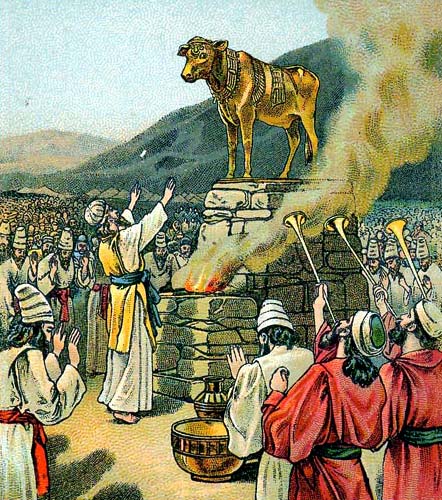
Worshipping the Golden Calf, Providence Lithograph Co. Bible card, 1901

Aaron melts down the gold earrings that the Israelites took from the Egyptians on their way out, and makes a golden calf.

… and they said: “This is your god, Israel, who brought you up from the land of Egypt!” And Aaron saw, and he built an altar in front of it, and he called out and said: “A festival for Y-H-V-H tomorrow!” And they rose early the next day, and they offered up burnt offerings and brought wholeness offerings. Then the people sat down to eat, and they drank, and they got up letzacheik. (Exodus 32:4-6)

letzacheik (לְצַחֵק) = to make merry, to have fun, to mock, to laugh, to play around.

Aaron should have known better. Yes, using the four-letter personal name of the God of Israel would at least remind the people which God brought them out of Egypt. And Aaron cannot be held accountable for knowing the second of the Ten Commandments, which forbids idols, since this list of commands is inserted into the Torah portion Yitro (Exodus 18:1-20:23) in the middle of the story of God’s frightening volcanic revelation.3

Nevertheless, right after the revelation God tells Moses:

“Thus you must say to the Israelites: You yourselves saw that I spoke to you from the heavens. With me, you must not make gods of silver or gods of gold …” (Exodus 20:19-20)

A long list of additional rules follows.

Then Moses came and reported to the people all the words of Y-H-V-H and all the laws. And all the people answered with one voice, and they said: “All the things that Y-H-V0H spoke we will do!” And Moses wrote down all the words of Y-H-V-H. (Exodus 24:3-4)

So by the time Moses disappears for forty days, everyone, including Aaron, knows that God absolutely rejects gold idols. And they make one anyway.

In this week’s Torah portion, when Moses finally hikes back down Mount Sinai carrying the two stone tablets, he hears raucous singing.4

And he came close to the camp, and he saw the calf and mecholot. And Moses’ anger burned, and he threw the tablets from his hands and shattered them at the bottom of the mountain. (Exodus 32:19)

Naturally Moses would be angry at the sight of the golden calf, which was exactly the kind of idol God prohibited. But why was he upset by the sight of chain dancing?

Rashi5 proposed that the Israelites were dancing lewdly. He cited the first description of the Israelites’ revelry in front of the golden calf, which says “they got up letzacheik (to play; see Exodus 32:6, above). The word letzachek, Rashi pointed out, has a sexual connotation in the book of Genesis, when Potifar’s wife accuses Joseph of attempted rape. She says: “… he came into our house letzachek with me!” (Genesis 39:17).

Yet the dances reported in this week’s Torah portion are mecholot, in which the only physical contact is between one person’s hand and the back of the next person’s shoulder. It is not even partner dancing. I think Moses is enraged to see the dancing simply because the people are celebrating the manufacture and worship of an idol, when they ought to feel ashamed of disobeying God.

Thousands of the dancers die in Ki Tisa6 because they convince themselves that they are celebrating the return of their God with perfectly acceptable acts of worship: burnt offerings, feasting, drinking, and innocent mecholot. They cannot bring themselves to believe what Moses told them: that their God, the God who brought them out of Egypt, is not the normal kind of god that inhabits idols.


Denial—pretending that a reality does not exist—is human nature. We often long for something we cannot have, and postpone doing what we must to make the best of it. Sometimes we get away with it for a while, and when we feel stronger we grapple with our problem again.

But some forms of denial are too extreme to get away with, even in a world without a Moses or a God to inflict direct punishment. Today we may die if we neglect clear warnings about our health. Our hopes and plans may die if we fail to face reality in our relationships, our jobs, our finances, our habits.

Before we join a dance of celebration, may we consider whether we are celebrating something real.


Next week: more dancing

I hope my Jewish readers had a happy Purim!


  1. See my blog post: Bo & Beshalach: Winds.
  2. Exodus 24:16-17.
  3. From the viewpoint of source criticism, the Ten Commandments were clearly inserted by a later editor. But even if the biblical narrative were a continuous whole with one author, there is no indication that anyone except Moses heard the Ten Commandments at that time.
  4. Exodus 32:18.
  5. Rashi is the acronym for 11th-century rabbi Shlomoh Yitzchaki.
  6. Three thousand are slain by Levites in Exodus 32:26-29, and an additional number are killed by a plague from God in Exodus 32:35.

Tetzaveh: Clothed in Three Reminders and a Warning

High priest vestments

During Moses’ first forty days and nights on the top of Mount Sinai, God expands the Israelite religion by giving Moses the plans for a portable tent-sanctuary, and calling for hereditary priests.1 Moses’ brother Aaron will become the first high priest, and his four sons will serve as priests under him. Before saying anything about the ordination or the duties of the priests, God describes the vestments of the high priest in this week’s Torah portion, Tetzaveh (Exodus 27:20-30:10).

“And you shall make sacred clothing for Aaron, your brother, for magnificence and for beauty.” (Exodus/Shemot 28: 2)

The garments God plans for Aaron are as magnificent and beautiful as the robes of an emperor. But they also contain reminders that the high priest is a holy human being, completely dedicated to God—and a device that lets everyone hear where he is.

Reminder stones on the shoulders

The first reminders God describes in this week’s Torah portion are two dark blue stones attached to the shoulder straps of the tabard the high priest will wear over his robe. (This tabard, called an eifod (אֵפֺד), consists of two rectangular pieces of cloth made with gold, deep blue, red violet, and crimson yarns. One piece covers the chest and one piece covers the back. The pieces are connected with wide straps over the shoulders, and ties at the sides.)

“And you will take two lapis lazuli stones and you will engrave on them the names of the sons of Israel: six of their names on one stone, and the names of the remaining six on the second stone … you will make them encircled with gold settings. And you will put the two stones on the shoulder straps of the eifod as stones of remembrance for the sons of Israel. And Aaron will carry their names before God on his two shoulder straps for remembrance.” (Exodus 28:9-12)

The names of the twelve “sons of Israel” are the names of the twelve tribes of Israelites. These stones will remind Aaron that he must represent all the Israelites in his service to God. According to Rashi, the stones are also a reminder to God; their purpose is: “so that the Holy One, blessed be He, will see the names of the tribes written before Him and He will remember their righteousness.”2

Reminder stones on the pocket

The next reminder is on a large square pocket called a choshen (חֺשֶׁן), which will be attached with gold rings to the front of the eifod.3 Twelve different precious stones will be set into the front panel of the choshen, one stone for each tribe.

“Aaron will carry the names of the sons of Israel on the choshen of judgment, over his heart, when he comes into the holy place, to remember them before God constantly.” (Exodus 28:29)

By keeping the twelve stones over his heart, Aaron will be symbolically keeping all twelve tribes in his thoughts and feelings. (The ancient Israelites  considered the heart the seat of the mind as well as the emotions.) According to 18th-century rabbi Levi Yitzchak of Berditchev. the twelve stones would also serve to remind all the Israelites that although God chose Aaron as the high priest, they were not rejected; God loves them, too.4

Reminder medallion on the forehead

The high priest will also wear a gold medallion on his forehead, in front of his turban.5

“You will make a flower of pure gold, and you will engrave on it [like] the engraving on a seal: Holy to God.” (Exodus 28:36)

This medallion will label the high priest as consecrated to God. The words on his forehead will also remind him of his role on behalf of the Israelites.

“And it will be on his forehead constantly, to win favor for them before God.” (Exodus 28:38)

One interpretation in the Talmud is that the words on the gold medallion propitiate God when the high priest accidentally makes an impure offering on the altar.6 It also reminds the high priest that everything he does must be dedicated to God. To make sure he remembers, he is supposed to touch the gold medallion on his forehead from time to time.7 Like the choshen, the high priest must wear the medallion “constantly”, i.e. whenever he is in the sanctuary. Without it, he cannot serve as a high priest.

Warning bells on the hem

Under his eifod and choshen, the high priest will wear a me-il (מְעִיל), a long sleeveless tunic that is reserved for priests and royalty in the Hebrew Bible.

“You will make a me-il of the eifod, entirely deep blue. …  And you will make on its hem pomegranates of deep blue and red-violet and crimson, all around its hem. And pa-amonim of gold among them, all around: a pa-amon and a pomegranate, a pa-amon and a pomegranate, all around the hem of the robe.” (Exodus 28:33-34)

pa-amon (פַּעֲמוֹן) = a small bell. (Plural: pa-amonim, פַּעֲמוֹנִים)

Gold pa-amon found in Roman sewer under Jerusalem’s old city

According to the Talmud, there were either 72 or 36 gold bells with clappers, and both these bells and the woolen pomegranates dangled down from the hem.8 Pomegranates were a common decorative motif; their many seeds made the fruits symbols of fertility. But what are the bells for?

“And Aaron will wear [the me-il] to wait on God, and its sound will be heard when he comes into to the holy place before God and when he goes out, so he will not die.” (Exodus 28: 35)

 The Torah does not specify whether the holy place is the whole sacred enclosure, or the tent-sanctuary inside it, or the Holy of Holies (the back room inside the tent). The Torah also does not specify who must hear the bells ringing.

Both Ramban (13th-century rabbi Moshe ben Nachman) and Rabbeinu Bachya (Rabbi Bachya ben Asher, 1255-1340) wrote that the sound of the bells must be heard by God and any ministering angels present inside the Holy of Holies. (After the death of Moses, only the high priest was allowed to come into the Holies of Holies, the locus of God’s presence on earth, and he would only enter once a year, on Yom Kippur. According to one Talmud tractate, the clappers were hung inside the bells only on that day.9)

The tinkling of the bells, these commentators explained, was a polite way both to ask God for entry, and to ask the angels to leave before the high priest came in. Without this courteous warning, he might be killed as an intruder by either an angel or the Torah’s anthropomorphic God.

On the other hand, Ramban and Rabbeinu Bachya noted, the high priest must wear only linen when he enters the Holy of Holies on Yom Kippur, according to the Torah portion Acharei Mot in Leviticus.10 So the gold bells between the wool pomegranate bobbles must chime their warning while he is still in the front chamber of the Tent of Meeting—as if he were standing outside a door and ringing the bell. Then the high priest changes clothes before entering.

According to this scenario, God and the ministering angels in the Holy of Holies must need a lot of advance notice. In Leviticus, after the high priest changes into his pure white linen garments on Yom Kippur, he places lots on two goats, slaughters one of the goats and his own bull at the altar, collects the blood of each, scoops glowing coals into his fire-pan, and walks back into the tent, where he picks up two handfuls of incense before he steps behind the curtain.11

The tinkling of bells on the high priest’s hem might also serve as a warning to the other priests that their boss is approaching. Even on an ordinary day, he might want to be alone inside the tent-sanctuary.

In addition, whenever the Israelites standing in the courtyard outside the tent heard the bells, they would be reassured to know that their high priest was on the job, atoning for their misdeeds and keeping God happy.

But merely wearing a robe with bells sewn around the bottom is not enough, regardless of who is listening,. After all, the bells will chime only when the high priest is walking. If his is standing still, or tiptoeing carefully in and out of the sanctuary, the sound will be too faint to hear. He has to stride in and out.


Perhaps the instruction about the bells means that in order to do the highest service to God, one must not be timid. One must enter the sacred space of prayer, or any other spiritual practice, boldly and openly. Let the sound of your practice be heard. Other people will either join you gladly, or back away to avoid confrontation—which are both good outcomes.

Besides striding into your religious practice, it is also helpful to keep reminders of how you intend to use your religion for the good. It would be impractical to wear stones with the names of all the “tribes” in your world, but you might find another way to remind yourself that you intend to be their ally and emissary.

It would also be impractical to wear a gold plate engraved “Holy to God” on your forehead, but you might find another reminder that every action you take matters, and you can make your deeds worthy of a good God. Some Jews wear a kippah (also called a yarmulke) for this purpose.

What would work for you?


  1. See last week’s post, Terumah: Insecurity.
  2. Inside the pocket the high priest keeps the urim and tumim, two objects used for determining God’s answers to simple questions. See my post Tetzaveh: Divining.
  3. 11th-century rabbi Shlomoh Yitzchaki, a.k.a. Rashi, on Exodus 28:12, translated by www.sefaria.org. This interpretation is also implied in the earlier text of Shemot Rabbah and in 16th-century commentary by Ovadiah Sforno.
  4. Levi Yitzchak of Berditchev, Kedushat Levi, on Exodus 28:29.
  5. See my post Tetzaveh: Flower on the Forehead.
  6. Talmud Bavli, Pesachim 77a-81b and Zevachim 22b-23b, 45b, and 82a.
  7. Rashi, based on Talmud Bavli, Yoma 7b.
  8. Talmud Bavli, Zevachim 88b.
  9. Talmud Bavli, Yoma 44b.
  10. Leviticus 6:2-4, 6:13-14.
  11. Leviticus 6:5-13.

Terumah: Insecurity

Moses relays a long list of rules to the Israelites and conducts two covenant ceremonies affirming the Israelites’ allegiance to God in last week’s Torah portion, Mishpatim (Exodus 21:1-24:18). The portion ends with Moses climbing farther up Mount Sinai, then waiting seven days until God summons him into the cloud on top.

Then Moses entered the midst of the cloud and went up the mountain. And Moses was on the mountain 40 days and 40 nights. (Exodus/Shemot 24:18)

During those forty days Moses listens to more instructions from God. But these instructions are not rules of conduct; they are plans for more religious ritual. This week’s Torah portion, Terumah (Exodus 25:1-27:19), begins:

And God spoke to Moses, saying: “Speak to the Israelites so they will bring me a terumah. From everyone whose heart prompts him, accept a terumah.” (Exodus 25:1)

terumah (תְּרוּמָה) = contribution; tribute (to God); something dedicated as holy by being elevated. (From the root verb ram, רום = be high, be exalted, be lifted up.)

The voluntary contributions that God calls for are gold, silver, copper, colorful yarns, fine linen, hides, acacia wood, oil, spices, and precious stones. After listing these materials, God says:

“And let them make me a sanctuary, and I will dwell among them. Like everything that I myself show you, the design of the dwelling-place and the design of all its implements, thus you shall make it.” (Exodus 25:8-9)

The rest of the Torah portion consists of God’s explicit instructions for the design of the portable tent-sanctuary and its ark, bread table, lampstand, and exterior altar.1 In next week’s portion, Tetzaveh (Exodus 27:20-30:9), God continues with instructions for the priests’ vestments, their ordination ritual, and the incense altar.

Why does God suddenly ask for all these appurtenances of a religion? Why is it no longer enough for the Israelites to follow God’s pillar of cloud and fire to Canaan, and act according to all the rules God commands through Moses?

A theory of jumbled time

One theory is that God’s instructions for a sanctuary are a response to the Golden Calf, the idol the Israelites make on Moses’ fortieth day in the cloud on Mount Sinai. The people crave a concrete object to represent God, preferably something that God will enter and be present in the way gods in other religions enter idols. So God provides a substitute for an idol: a beautiful building with precious ritual objects. And God promises to enter and inhabit this building, so God will be “dwelling among them”.

But why would God start giving Moses instructions for the sanctuary several weeks before the Israelites make the idol? Some commentators2 have responded with the declaration, “There is no before and after in the Torah”, a principle that the Talmud tractate uses to resolve discrepancies in dates within the Hebrew Bible.3 According to this Talmudic principle, the events in the book of Exodus were not written in chronological order anyway, so God actually did call for the sanctuary after the Golden Calf incident. The sanctuary was a concession to (and redirection of) the surviving Israelites after the most blatant Golden Calf worshipers were killed.

A theory of affection

Other commentators have countered that the events in the book of Exodus are arranged in chronological order. That means God wanted the Israelites to build a sanctuary all along; the making of the Golden Calf merely interrupted the divine plan for a while.

A less time-insensitive Talmudic approach states:

… God’s original intention was to build a Temple for the Jewish people after they had entered the land of Israel. … it is written “And let them make Me a Sanctuary, that I may dwell among them”, i.e. even while they were still in the desert, which indicates that due to their closeness to God, they enjoyed greater affection and He therefore advanced what would originally have come later. (Talmud Bavli, Ketubot 62b)4

Ramban (a.k.a. 13th century rabbi Moses ben Nachman or Nachminides) promoted this theory in the 13th century. Contemporary commentator Avivah Gottlieb Zornberg explained:

“In Ramban’s reading, the Israelites have been transformed by their encounter ‘face-to-face’ with God; they have received the basic commandments and committed themselves to fulfilling them; to affirm this, they have entered into a Covenant with God.  … In Ramban’s reading, the idea of a sanctuary for god in their midst is a token of transformation: after the Revelation and the Covenant, they have become fit vessels for the Presence of God.”5

A theory of second thoughts

I think God calls for a sanctuary and priests because God suspects something like the Golden Calf will happen—unless the people’s anxiety about God’s invisibility is addressed some other way.

Moses and the Ten Commandments, by James Tissot, 1896

At first the God character believes in the Israelites’ enthusiastic allegiance to God immediately after the revelation.7 That is why God invites Moses to hike back up the mountain for a permanent copy of the rules, not for a sanctuary design.

And God said to Moses: “Come up to me on the mountain, and I will be there, and I will give you stone tablets with the teachings and the commands that I have inscribed to teach them.” (Exodus 24:12)

But then, perhaps during the seven days while Moses is waiting for God to invite him into the cloud on top of Mount Sinai top receive the stone tablets, God reconsiders.

After all, the anthropomorphic God character in the first five books of the bible is not omniscient, and does not know what human beings are going to do. This God character is also moody, and sometimes has second thoughts.8

What if the people all promised to obey everything God said simply out of fear? After all, they were terrified by feeling the earthquake, seeing the lightning and smoke and fire, and hearing the thunder and the blare of horns.9 They could not even distinguish between seeing and hearing,10 and they begged to be excused from hearing God speak.11

Then the anthropomorphic God character might remember how before the Israelites and their fellow travelers arrived at Mount Sinai, any setback caused them to despair and lose faith that God would bring them safely to Canaan. Even the miraculous pillar of cloud and fire that led them to Mount Sinai was not enough to make them trust in God. They are too anxious and insecure.

When Moses and Aaron first presented their demand to Pharaoh, Pharaoh increased the workload of the Israelites who were slaving on his building projects. Moses tried to reassure that God still planned to rescue them,

… but they did not listen to Moses, out of shortness of wind and hard service. (Exodus 6:9)

After the ten plagues, a divine pillar of cloud and fire leads the Israelites out of Egypt.

And the Israelites were departing with a high hand. Then the Egyptians chased after them and overtook them [where they were] camped by the sea—all the horses of Pharaoh’s chariots and the riders and his force … And [the Israelites] were very afraid. And the Israelites cried out to God. And they said to Moses: “Was it that there were no graves in Egypt, so you took us to die in the wilderness?” (Exodus 14:8-11)

Even after the Israelites have crossed the Reed Sea and watched the Egyptian army drown, they grumble on the journey to Mount Sinai whenever they get hungry or thirsty: at Marah,12 in the wilderness of Sin,13 and at Refidim.14 Each time God provides for them, but they do not trust God to provide the next time. At Refidim,

… they tested God, saying: “Is God in our midst or not?” (Exodus 17:7)

All this grumbling reflects an inability to believe God really will bring them to Canaan and give the land to them. The miracles God performs on demand have no long-term effect on these people.

Clearly something else is needed to cause the people to become confirmed God worshippers.

By the time Moses enters the cloud at the top of Mount Sinai, the God character has decided to give Moses instructions for making the new religion more compelling. So God calls for priests wearing impressive costumes, who will sacrifice offerings on a copper altar in front of a tent-sanctuary with walls woven out of blue, purple, and red yarn in a pattern of winged beasts. The priests themselves must remain in a state of reverence, so God assigns them additional rituals involving the gold objects inside the tent, which only they can enter.

And everything must be portable, because the Israelites need visible sacredness as soon as possible; they are too insecure to wait until they can build a permanent temple in Canaan.

These instructions take a long time to deliver. And by the time Moses descends at the end of the fortieth day, carrying the stone tablets, it is too late; the Israelites are worshiping the Golden Calf. It takes a lot of deaths before both the Israelites and the God character get back on track, and the people start making the sanctuary.


Recently I led a Friday evening service on Zoom. I sang the prayers, but everyone else was muted so I could not hear them singing with me. I spoke to the faces on my laptop about the Torah portion and the meaning of Shabbat. I chatted with a few people after the closing blessings. It was better than nothing, but I felt empty as I signed off.

I needed to be with real people in a sacred space. Like the Israelites, I needed a more three-dimensional religion.


  1. See my blog posts: Terumah: Wood Inside, Terumah: Tree of Light, Terumah:Under Cover, Terumah: Bread of Faces, Terumah: Heavy Metals, and Terumah: Cherubs Are Not for Valentine’s Day.
  2. Including Shemot Rabbah and Midrash Tanchuma circa 500 C.E., Rashi (the authoratative rabbi Shlonoh Yitzchaki) in the 11th century C.E., and Obadiah Sforno in the 16th century C.E.
  3. Rav Menashiya bar Taḥlifa said in the name of Rav: That is to say that there is no earlier and later, i.e., there is no absolute chronological order, in the Torah, as events that occurred later in time can appear earlier in the Torah.” (Talmud Bavli, Pesachim 6b, translated by www.sefaria.org.)
  4. Translation by www.sefaria.org.
  5. Avivah Gottlieb Zornberg, The Particulars of Rapture: Reflections on Exodus,  Doubleday, New York, p. 316.
  6. Ibid, p. 320.
  7. Exodus 19:8, 24:7.
  8. One example is Genesis 6:5-6, when the God character regrets making the world and decides to destroy it with a flood.
  9. Exodus 19:16-20.
  10. Exodus 20:15 translated literally, says: Then all the people were seeing the thunderclaps and the flames and the sound of the ram’s horn and the mountain smoking. When the people saw, they were shaken and they stood at a distance.
  11. Exodus 20:16.
  12. Exodus 15:22-25.
  13. Exodus 16:2-12.
  14. Exodus 17:1-6.

Mishpatim, Ki Tavo, & Joshua: Writing and Reading

After Moses tells the Israelites God’s “Ten Commandments”, he goes back up Mount Sinai and listens to God proclaiming 48 or more additional rules (depending on how you count them)—four in last week’s Torah portion, Yitro, and at least 44 in this week’s Torah portion, Mishpatim (Exodus 21:1-24:18). The lengthy list includes religious observances, civil and criminal laws, and ethical guidelines.

Then Moses came and he reported to the people all the words of God and all the laws. And all the people answered with one voice, and they said: “The things that God has spoken, we will do!” (Exodus 24:3)

Apparently Moses has a phenomenal memory. And the Israelites are eager to obey all the orders he has passed on orally. But how will they remember these rules?

Moses speaks, writes, then reads

Then Moses wrote down all the words of God. And he got up early in the morning and he built an altar beneath the mountain, and twelve standing stones for the twelve tribes of Israel. (Exodus 24:4)

The Covenant Confirmed, by John Steeple Davis, 1844-1917

What are “all the words of God” that Moses writes down at that point? The Torah does not say. I think the most reasonable inference is that Moses writes down the Ten Commandments and the 48 or so rules God has just given him. But according to Rashi,1 Moses wrote down the book of Genesis and the book of Exodus up to, but not including, the account of the revelation at Mount Sinai. Apparently he brought some parchment and ink with him from Egypt.

Then he took the seifer of the covenant and he read it out loud in the ears of the people. And they said: “Everything that God has spoken we will do and we will listen!” (Exodus 24:7)

seifer (סֵפֶר) = book (in scroll form), scroll, written document.

This time the Israelites respond with even more fervor, promising not only to obey God’s rules, but to listen to them, pay attention to them. Moses prepares a burnt offering on the altar, and splashes some of the blood on the people to seal their covenant with God.

After this, Moses follows another instruction from God, taking Aaron, two of Aaron’s sons, and seventy elders halfway up Mount Sinai. They get far enough to see God’s feet on a sapphire brickwork. (See my post Mishpatim: After the Vision, Eat Something.)

Then Y-H-V-H said to Moses: “Come up to me on the mountain and be there, and I will give you the stone tablets and the torah and the commandment that I have inscribed to instruct them.” (Exodus 24:12)

torah (תּוֹרָה) = teaching, instruction; law as a whole. (The word torah later came to mean the first five books of the bible.)

Moses and Joshua Climb Mt. Sinai, by James Tissot

Even God wants to create a written record for future reference.

And Moses took Joshua, his attendant, and Moses went up the mountain of God. And to the elders he said: “Wait for us here until we return to you …” (Exodus 24:13)

Moses takes Joshua with him. But the Torah reports only Moses entering the cloud at the top of Mount Sinai and staying inside it for forty days and forty nights.2 There God gives him lengthy instructions for building a sanctuary and ordaining priests. When Moses finally hikes back down with the two stone tablets, in the portion Ki Tisa, Joshua pops into the picture again.

And the tablets were God’s doing, and the writing was written by God, engraved on the tablets. Then Joshua heard the sound of the people shouting, and he said to Moses: “A sound of war in the camp!” (Exodus 32:16-17) The Torah never says what Joshua was doing during those forty days, or exactly where he was on the mountain. God’s instructions in the cloud are addressed exclusively to Moses.

Joshua copies, then reads

Joshua remains Moses’ attendant until the end of the book of Deuteronomy, when Moses lays hands on him to make him the new leader of the Israelites, the one who will take them across the Jordan River into Canaan. Then God tells Moses:

“Here, the time draws near for [your] death. Call Joshua, and present yourselves in the Tent of Meeting, and I will give him orders.” (Deuteronomy 31:14)

There God speaks at length to Moses about the future of the Israelites, and teaches him a poem. Then God speaks to Joshua the first time:

And [God] commanded Joshua son of Nun, and said: “Be strong and resolute, because you yourself will bring the Israelites to the land that I promised to them, and I will be with you.” (Deuteronomy 31:23)

After Joshua hears this brief encouragement, Moses has more writing to do.

And Moses finished writing the words of this torah in the seifer until it was complete. (Deuteronomy 31: 24)

In the book of Joshua, God repeatedly gives Joshua instructions for the next step on his conquest of Canaan. But God does not tell him any new rules. Joshua faithfully carries out all the instructions he has received from both God and Moses.

Altar on Mt. Eyval, photo by Raymond Hawkins

When he reaches the two hills in front of Shekhem in Canaan, Eyval and Gerizim, he follows a set of orders Moses gave in the Torah portion Ki Tavo: writing on standing stones, then making offerings on an altar, then assembling the tribes on the two hills to say “Amen” after each curse or blessing the Levites call out.3 Moses started with the order to write on stones:

“Once you cross the Jordan to the land that Y-H-V-H, your God, is giving you, then you must erect large stones for yourselves and coat them with limewash. And you must write on the stones all the words of this torah …. You must erect these stones that I am commanding you about today on Mount Eyval …” (Deuteronomy 27:2-4)

All the words of which torah? The implication is that the Israelites should write down rules that Moses has passed down from God in the book of Deuteronomy—either all of them, or a subset. One logical selection would be the twelve curses that Moses then says the Levites should proclaim.

These curses are actually rules.  Each one begins “Cursed be anyone who—” and then states a deed that God forbids, such as making idols or accepting bribes. Eleven of the curses repeat rules that Moses has previously delivered. The twelfth is:

Cursed be one who does not uphold the words of this torah, to do them. And all the people shall say: Amen. (Deuteronomy 27:26)

Is “this torah” the instruction of the twelve curses, or what is written on the twelve stones?

When Joshua leads the Israelites to Mount Eyval, the priests are carrying the ark, which now contains the whole seifer Moses wrote. At first it sounds as if Joshua has the whole scroll copied onto the stones.

And [Joshua] wrote there, on the stones, a copy of the torah of Moses, that [Moses] had written in front of the Israelites. (Joshua 8:32)

But after Joshua conducts the ritual of curses and blessings, he reads out loud from Moses’ scroll.

And after that, he read aloud all the words of the torah, the blessing and the curse, out of all the writing in the seifer of the torah. There was not a word out of all that Moses commanded that Joshua did not read opposite the whole assembly of Israel, including the women and the little ones and the foreigners who went among them. (Joshua 8:34-35)

These two verses are difficult to interpret. At first it sounds as if Joshua is reading out the torah or teaching about the blessing and curse ritual they have just performed. But then it sounds as if Joshua reads the entire “seifer of the torah”, the record that Moses wrote at the foot of Mount Sinai in this week’s Torah portion, Mishpatim, and subsequent additions. That scroll might take all day to read out loud.

The tradition of public readings of scrolls continued. In 2 Kings 22:8, the priests find a “seifer of the torah” when they are repairing the temple in Jerusalem. King Josiah summons all the people of Judah to listen to him read it out loud. Then he swears that his people will observe all of the commandments and laws in it. They do not respond with “Everything that God has spoken we will do and we will listen!” the way the people did at Mount Sinai. Nor do they say “Amen” then way the people did at Mount Eyval. Their response is positive, but muted:

And all the people stood up for the covenant. (2 Kings 23:3)

For more than two thousand years, Jews have been reading out loud from a seifer torah hand-lettered on a parchment scroll. Everyone who comes to services watches the scroll being unrolled, and hears someone chant all or part of that week’s portion in Hebrew. In the course of a year, the seifer torah is chanted from the beginning of Genesis to the end of Deuteronomy.4 And those who do not know Hebrew can follow along by reading a translation.


For Moses and Joshua, the advantage of a written record is that it can be read out loud later. The assumption is that people will learn God’s rules better if they hear them—repeatedly.

I know that today some people absorb information better by listening, while others absorb it better by reading it. I hope someday to accompany my blog posts with podcasts in which I read my own writing aloud. But I am no Moses, so this project will have to wait until I finish rewriting my book on ethics in Genesis.

There are other texts that everyone should be familiar with. For example, the United States still uses an amended version of its original constitution. Many Americans refer to the authority of the constitution without knowing what it actually says. It is easy to find a written copy of this document, but I believe it should be taught in schools again, article by article, amendment by amendment, along with some of the various interpretations. And maybe we should even read it out loud in public once a year, just so everyone will know the source text that inflames such passions today.


  1. 11th-century rabbi Shlomo Yitzchaki, the most quoted classic Jewish commentator.
  2. Exodus 24:15-18.
  3. See my blog post Ki Tavo: Making It Clear.
  4. But some Jewish communities follow a tradition of reading a third of each Torah portion each week, so the five-books of the Torah are completed over the course of three years.

Yitro & Bereishit: Don’t Even Touch It

Finally, after walking through the wilderness of the Sinai Peninsula for two and a half months, the Israelites and their fellow-travelers arrive at Mount Sinai, where Moses first encountered God.1

They camp at the foot of the mountain, and Moses climbs up and down four times in this week’s Torah portion, Yitro (Exodus 18:1-20:23). On each trip, he gets instructions from God at the top, and reports them to the people below.

Mount Sinai, by Elijah Walton, 19th century

The second time Moses climbs up, God tells him:

“Here I am, coming to you in a thick canopy of cloud, so that the people will hear my words along with you, and also [so that] they will trust you forever!” (Exodus/Shemot 19:9)

No one will be able to see God, but all the people will hear God’s words—an extraordinary phenomena.

And God said to Moses: “Go to the people and consecrate them today and tomorrow. And they must wash their clothes. And they must be ready for the third day, because on the third day, God will come down on Mount Sinai before the eyes of the people. And you must set boundaries for the people all around [the mountain], saying: Guard yourselves against going up on the mountain, or negoa its outskirts.  Anyone hanogeia the mountain must definitely die.” (Exodus19:10-12)

negoa(נְגוֹעַ) = touching. (A form of the verb naga, נָגַע = touched, reached.)

hanogeia ( הַנֺּגֵעַ) = who is touching. (Another form of naga.)

One might think that if God touched the top of Mount Sinai, any human who touched the bottom of it would automatically die, as if the whole mountain were electrified. But then God clarifies that anyone (except Moses) who dares to touch the mountain while God’s presence rests on it must be executed. And the people must perform the execution without touching the offender.

“A hand lo tiga him! Because he must definitely be stoned or shot; if a beast or if a man, he must not live. When [there is] a protracted sound of a ran’s horn, they may go up on the mountain.”  (Exodus19:13)

lo tiga (לֺא תִגַּע) = it may not touch. (Another form of naga.)

All the people have to be clean and consecrated before they can safely hear God’s voice coming from the cloud that lands on Mount Sinai. But even in this condition, they cannot see God. And touching the mountain while God is on top is taboo. Like some other taboos in the bible, this one is communicable by touch.2

Don’t go up Mount Sinai, God commands. Don’t even touch it! Don’t even touch someone who touches it!

Touching the Tree of Knowledge

The order not to touch the mountain reminds me of the conversation between the snake and Eve in the garden of Eden. Both God in Exodus, and Eve in Genesis, say that death is the penalty for touching something holy.

The snake speaks first in the first Torah portion of Genesis, Bereishit (Genesis 1:1-6:8).

He said to the woman: “Did God really say you should not eat from any tree of the garden?” And the woman said to the snake: “We may eat fruit from the trees of the garden. But as for fruit from the tree that is in the middle of the garden, God said: ‘You must not eat from it, and lo tigeu, lest you die.’” (Genesis/Bereishit 3:1-3)

lo tigeu (לֺא תִגְּעוּ) = you must not touch it. (Another form of naga.)

Eve, by Lucan Cranach the Elder, 1528

In Genesis, God orders the primordial human not to eat from the Tree of the Knowledge of Good and Evil in the middle of the garden.3 But God says nothing about touching or not touching the tree. Although God delivered the original order to the one primordial human being, before it was divided into male and female, there is no reason why the female human would not remember it. Maybe she simply added “and you must not touch it” on the spur of the moment.

Why? The classic commentary suggested that she was “making a fence around the Torah”: protecting herself from accidentally violating God’s actual prohibition by avoiding doing something that could lead to the violation.4 (One of the more famous examples of a fence around the Torah is the rule in many orthodox Jewish communities that bans turning on a stove or an electric light on Shabbat. If you feel free to make heat and light, you might forget the biblical prohibition against lighting a fire on Shabbat.5)

At first glance, a rule to avoid touching the Tree of Knowledge seems like a reasonable fence. If Eve does not get close enough to that tree to touch it, she will not be able to eat its fruit. Yet after further conversation with the snake, she transgresses both her own fence and God’s order.

Bereishit Rabbah, a fifth-century collection of commentary, adds some action and dialogue to the biblical story: “Rabbi Chiyya taught: That means that you must not make the fence more than the principal thing … When the serpent saw her exaggerating in this manner, he grabbed her and pushed her against the tree. ‘So, have you died?’ he asked her. ‘Just as you were not stricken when you touched it, so will you not die when you eat from it.’”6 According to Bereishit Rabbah, if the fence seems too important (in this case because Eve claims touching the tree carries a death penalty), then once you break the fence, it feels insignificant to break the original command as well.

Touching Mount Sinai

In Exodus, on the other hand, God tells Moses that the people may not climb Mount Sinai on the day that God will descend, and God also says the people may not touch the mountain until the signal of the sound of a ram’s horn. Both prohibitions, against climbing and against touching, come from God. God makes the fence.

What is the reason for it? 16th-century rabbi Ovadiah Sforno wrote that some people might have been so eager to catch a glimpse of God, they would trample the boundary markers and run up the mountain. The death penalty was a deterrent.

19th-century rabbi Samson R. Hirsch wrote that one reason for the two prohibitions was to make the people realize they were nowhere near Moses’ spiritual level. This seems plausible to me, since God tells Moses that after the people hear God speak from the cloud on the mountaintop, they will trust Moses forever (Exodus 19:9, above). Recognizing Moses’ high spiritual level—or closeness to God—would help to foster this trust.

Another reason, Hirsch wrote, was: “The distinction between the people about to receive the Torah, and the Source from which they are to receive it, is underscored also in terms of physical separation.”7

The realm of ordinary people at the foot of the mountain is mundane. The realm of Mount Sinai is the realm of God and God’s teachings.8 Only God’s prophet, Moses, goes back and forth between the two realms.9

There is also a practical reason for prohibiting both climbing and touching Mount Sinai on the day of revelation: the mountain becomes a dangerous place.

And it was the third day, in the morning, and there was thunder and impressive lightning on the mountain, and a very loud sound of a ram’s horn … And Mount Sinai was all in smoke from the presence of God that came down on it in fire, and its smoke rose like smoke from a furnace, and the whole mountain shuddered violently. (Exodus 19:16-18)

Vesuvius in Eruption, by J.M.W. Turner, 1817-1820, detail

Thus the prohibition against getting close enough to touch the bottom of Mt. Sinai is a reasonable fence around the prohibition against climbing the mountain—which, in turn, is a fence around the prohibition against attempting to look and see God.

Nobody breaks the fence. Moses leads the people to the foot of the mountain, but they cannot bear to get any closer. They are already seeing too much, experiencing synesthesia.

Then all the people were seeing the thunderclaps and the flames and the sound of the ram’s horn and the mountain smoking. When the people saw, they were shaken and they stood at a distance. And they said to Moses: “You speak to us, and we will listen. But may God not speak to us, or else we will die!”  (Exodus 20:15-16).

The people back  away from the supernatural volcano. No fences, with or without death sentences, are needed to keep them at a distance.


I have heard people say they wish they could experience a miracle like seeing God’s voice at Mount Sinai.  Personally, I think a miracle like that would terrify me as much as it terrified the Israelites and their fellow-travelers.  I am grateful that, by the grace of God, my own numinous experiences have been only gentle intimations.

Sometimes there is no question that we will follow a rule, because we want to follow it with all our heard and soul.  But sometimes we recognize that a rule is a good idea, yet we have no emotional investment in it. That is when we need a fence around the rule to keep us on track.


  1. At the burning bush in Exodus 3:1-4:17. The “mountain of God” is called Mount Choreiv in some passages and Mount Sinai in others, since the book of Exodus was redacted from more than one original source.
  2. For example, when someone who have been in contact with a corpse is ritually purified by being sprinkled with water containing the ashes of a pure red heifer, the person who does the sprinkling has to wash his clothes and wait until nightfall to return to a state of ritual purity. While the sprinkler waits, “Anything that he touches is impure, and the person who touches him will be impure until nightfall.” (Leviticus 19:19:22)
  3. Genesis 2:17.
  4. The phrase “Make a fence around the Torah” originated in Pirkei Avot 1:1, a compendium of rabbinic advice composed around 200 C.E.
  5. Exodus 35:3.
  6. Bereishit Rabbah 19:3, translated by www.sefaria.org.
  7. Samson Raphael Hirsch, The Hirsch Chumash: Sefer Shemos, translated by Daniel Haberman, Feldheim Publishers, Jerusalem, copyright 2005, p. 322.
  8. Torah (תּוֹרָה) = instruction, teachings; divine law; the first five books of the bible; all instructions in the Hebrew Bible.
  9. In Exodus 19:24, God tells Moses to go down and bring his brother Aaron up to the top of Mount Sinai, but this request is not followed up in the text; the Ten Commandments are delivered instead. On another day, Aaron climbs partway up Mount Sinai, along with two of his sons and 70 elders (Exodus 24:9-14), but only Moses and his attendant Joshua complete the trip to the top.

Bo & Beshalach: Winds

A plague of locusts descended on Egypt in last week’s Torah portion, Bo (Exodus 10:1-13:16). A swarm of Egyptian charioteers pursues the Israelites in this week’s Torah portion, Beshalach (Exodus 13:17-17:16). Both the locusts and the charioteers are frightening in their numbers and  destructiveness—and the God character controls both hordes with winds, to spectacular effect.

Locust winds

The eighth of the ten plagues the God character creates in Egypt is a plague of locusts that eat all the vegetation remaining after the previous plagues.

And Moses held out his staff over the land of Egypt, and God guided a ruach kadim through the land all that day and all the night. And in the morning the ruach hakadim carried in the locust swarms. And the locusts went up over the whole land of Egypt and settled down very heavily throughout the territory of Egypt. There were no locust swarms just like it before, and there will be none after. (Exodus 10:13-14)

ruach (רוּחַ) = wind; spirit, disposition, mood.

ruach kadim (רוּחַ קָדִים), ruach hakadim (רוּחַ הַקָּדִים) = wind from the east; dry east wind.

Actual desert locusts in northern Africa and southwestern Asia (Schistocera gregaria) breed in areas where there has been sufficient rainfall (to moisten the ground for egg-laying) and vegetation (for the larvae to eat). The breeding grounds in the early spring, when the locust plague in Exodus occurs (see map above) are different from the breeding grounds in summer. Adult locusts congregate into swarms when there is enough vegetation. They can fly short distances, but for long distances they take advantage of winds, catching a ride only on warm, relatively humid winds. Locust swarms from winter and spring breeding grounds around the Red Sea would need to catch a warm wind from the south to southeast to reach Egypt to the north.1

So why does the Torah say the wind that carries the locusts into Egypt is a ruach kadim, a dry east wind? One theory is that the Israelite wrote down this story was thinking in terms of winds in Canaan or Judah. When a wind brings disaster there, it is a dry wind from the eastern desert.

The God character ends the plague of locusts by changing the direction of the wind.

And God turned around a very strong ruach yam, and it lifted the locusts and blew them toward the Yam Suf. Not one locust remained in all the territory of Egypt. (Exodus 10:19)

yam (יָם) = sea, Mediterranean Sea; west.

ruach yam (רוּחַ יָם) = wind from the sea; wind from the west.

suf (סוּף) = reed, reeds, water plants.

Yam Suf (יָם סוּף) = Sea of Reeds; Red Sea.

If the God character reverses the wind from the southeast, it becomes a wind from the northwest. A strong wind coming down from the Mediterranean northwest of Egypt would indeed blow locust swarms in Egypt back toward the Red Sea or the Sea of Reeds.

The important point in the book of Exodus is that God controls the locust plague, bringing the devouring swarms into Egypt with one wind, and removing them with another.

The Hebrew Bible also uses the word for wind, ruach, to refer to someone’s mental spirit, ranging from calm wisdom  to insane jealousy or rage. And in the land of Canaan, dry desert winds were dangerous because they stripped crops, dried up ponds, and made people sick. Moist winds from the Mediterranean left dew in the morning that helped keep plants alive during the summer.

So a ruach kadim could be someone’s bad attitude or a dangerous mood—which plagues any people nearby like a swarm of locusts. A ruach yam could represent someone’s pleasant and kindly spirit, which gives others comfort and relief.

Chariot winds

Pharaoh lets the Israelites leave Egypt after God’s final plague, the death of the firstborn.2 On the second day of their exodus from Egypt, just when they thought they were free, the God character makes Pharaoh change his mind. God tells Moses:

“I will strengthen Pharaoh’s heart, and he will chase after them. Then I will be honored by Pharaoh and by all his forces, and the Egyptians will know that I am God.” (Exodus 14:5)

The God character in this part of Exodus cannot resist staging one more dramatic miracle to drive the point home that the God of Israel is more powerful than any other.3

And the Egyptians chased after them and caught up with them [when they were] encamped on the yam, all of Pharaoh’s chariot horses and riders and his army … (Exodus 14:9)

The Israelites panic when they see charioteers approaching, but God halts the action for the night.  The supernatural pillar of cloud and fire that has led the Israelites to the shore of the Sea of Reeds circles around their camp and stands between them and the Egyptians, so they cannot get any closer.4

Then Moses held out his hand over the yam, and God made the yam go with a strong  ruach kadim all night, and [God] made the yam dry up, and the waters split. Then the Israelites came through the middle of the yam on dry ground (Exodus 14:21-22)

When a strong east wind blows into Egypt or Israel, the air is so dry that ponds can evaporate and shallow lakes can shrink in an afternoon. Blowing sand increases the effect. Was the biblical Yam Suf shallow enough so a strong east wind could expose part of its bed–enough for people and livestock to walk across on the mud?

Yes, if two or more of the lakes between the Sinai peninsula and Egypt proper were connected during Egypt’s Nineteenth Dynasty, as some scholars claim. No, if it was the Gulf of Suez on the Red Sea, as other scholars believe.

If Yam Suf refers to the Red Sea, the water would be too deep for an east wind to dry out a path across it. But the narrative gives two different accounts of the depth of the yam before God parted it. First it describes an east wind drying up the sea. Then the narrator says:

Then the Israelites came through the middle of the yam on dry ground, and the waters were a wall for them on their right and on their left. (Exodus 14:22)

Many of us picture walls of water rising almost vertically from the dry sea bed, as in this illustration:

The Waters Are Divided, by James J.J. Tissot, 1896-1902

An east wind drying up part of a shallow lake does not make walls of water. But after the Egyptian army has drowned, the Israelites on the other side rejoice by singing an ancient song or poem. (We know Exodus 15:1-18 dates to a much earlier time than the narrative because the Hebrew is older.) In this poem, the wind comes not from the east, but from God’s nose. And instead of exposed mud at the bottom of a shallow sea, the deep waters congeal or freeze solid.

And by a ruach from your nostrils the waters piled up;

            The watercourses stood up like a dam.

            The deeps congealed in the heart of the yam. (Exodus 15:8)

Nevertheless, whoever wrote the narrative that precedes this poem knew about harsh, dry east winds, and therefore could easily imagine walking across dry ground in the middle of a sea.

If the “Sea of Reeds” is a shallow salt lake, the miracle would lie in the inability of the Egyptians to follow the Israelites an hour or two later.

This week’s Torah portion says that the Egyptian charioteers followed the Israelites as far as the middle of the sea—on dry ground that was probably still muddy—and then were drowned by the sudden return of the water.

Then God made the wheels of their chariots fall off, and they moved laboriously. And the Egyptians said: “Let me flee from before Israel, because God is fighting for them against Egypt!” Then God said to Moses: “Hold out your hand over the yam, and the waters will come back over the Egyptians, over their chariots and over their riders!” And Moses held out his hand over the yam, and the yam came back to its normal position. And the Egyptians were fleeing from meeting it, but God shook the Egyptians off (their chariots) in the middle of the yam. The waters returned and covered the chariots and the riders and all Pharaoh’s soldiers coming in after them into the yam; not one of them remained. (Exodus 14:25-28)

The Egyptians Are Destroyed, by James J.J. Tissot, 1896-1902

The narrative does not say how God made the waters return to their normal level so quickly. But the poem that follows it says:

You blew with your ruach; the yam covered them;

            They sank like lead in the majestic waters. (Exodus 15:10)

The ancient poem tells us the wind from God’s nostrils opens a path through the sea and closes it again. The later narrative says God summons an east wind to expose the sea bed, and then makes the waters return through some unknown means.

Either way, the Yam Suf opens or closes according to God’s whim. And the word ruach can mean mood or spirit as well as wind. In the Torah portion Beshalach, the God character rescues the Israelites and drowns the Egyptians in a spirit of pride and determination to demonstrate superior power.


In the story of the plague of locusts, the God character dooms all the innocent people who stay in Egypt to a year of famine. In the story of crossing the Sea of Reeds, God dooms the army unit that pursues the Israelites to instant death.

But the God character’s objectives are achieved. The Israelites are free to march on to Canaan, and both the Egyptians and the Israelites know God is supreme.

And Israel saw the great power that God used against Egypt, and the people feared God and had faith in God and in [God’s] servant Moses. (Exodus 14:31)

Imagine you were an anthropological god and you wanted to rescue a downtrodden ethnic group from one country, motivate it to travel to another country, and make it the ruling class there. Could you formulate a proposal that killed fewer innocent people than the divine plan in Exodus?


  1. World Meteorological Organization, “Weather and Desert Locusts”, https://library.wmo.int/doc_num.php?explnum_id=3213#:~:text. In the book of Exodus, the last four plagues take place in the early spring.
  2. Exodus 12:29-32.
  3. See my post: Va-eira: Pride and Ethics.
  4. See my post: Beshalach: Pillar of Cloud and Fire.