Bechukotai, Va-eria, & Isaiah: Redeeming a Pledge

“Redeeming” can mean exchanging something less important to you for something more important. Last week’s Torah portion, Behar, prescribed redemption for Israelites who had fallen into poverty and debt. If they were forced to sell the family farm, or if they had to sell themselves as slaves, the sale was never permanent; Israelite land was “sold” as a long-term lease, and Israelite persons were “sold” as indentured servants. Both land and human beings could be redeemed if a family member paid off the remainder of the contract. (See my post: Behar: Redeeming an Identity.)

“Redeeming” can also mean making good on a pledge, through either an exchange or a rescue. When a human being pledges a donation to God, they must give the donated item to the priests at the temple—or else redeem it by exchanging the pledged item for something more valuable. But when God makes a pledge to the Israelites, God makes good on the pledge by rescuing them from a foreign power. No exchange is necessary.

Bechukotai: When an Israelite redeems a pledge to God

A pledge to God is actually a pledge to support a religion’s service to God. Today someone who wants to make an extra donation to their congregation, over and above the membership dues, might send an electronic payment. But in ancient Judah, an extra donation, over and above the mandatory tithes, offerings, and contributions of firstborn animals and first fruits, could only be made by bringing an object of value to the priests at the temple in Jerusalem. So the donor would make a verbal pledge, and redeem it later by traveling to the temple and delivering either the item pledged or its value in silver.

The item pledged could even be a human being. The Talmud tractate Arakhin explains that a person often pledged his or her own value in silver to the temple in Jerusalem. But someone could also vow to donate the value of any person belonging to him or her at the time—i.e. someone the vower owned and could legally sell.  In that era, people could sell their slaves or their own underage sons and daughters.

This week’s Torah portion, Bechukotai (Leviticus 26:3-27:34), explains the rules for redeeming a person who has been pledged as a donation to God.

When anyone explicitly vows the assessment of persons to God, the assessment will be: the assessment of the male from twenty to sixty years old will be fifty shekels of silver … (Leviticus 27:2-3)

A list follows giving the assessment in silver for male and female human beings in four age categories. (See my post: Bechukotai: Gender, Age, and Personal Value.) The persons themselves are not being given to God; they stand in as pledges until the donor pays their assessed values in silver to the temple.

But if [the donor vowed] an animal that can be brought as an offering to God, anything that he gives to God becomes consecrated. One may not replace or exchange it, either a better one for a worse one, or a worse one for a better one. And if one actually does exchange one animal for another, both it and its substitute will become consecrated. (Leviticus 27:9-10)

This means that when anyone pledges an animal that can be legally offered at the altar, it becomes temple property at that instant. The donor no longer owns it, so he has no choice but to bring it in to its rightful owner, the temple. If he tries to substitute a different animal, then both the original and the substitute must be brought and slaughtered for God. I suspect the priests knew that people who felt moved to give more to God sometimes had second thoughts later, and tried to skimp when it was time to fulfill their pledges.

If someone pledges an animal that is kosher, but unfit for the altar because of some blemish, the priest assesses its equivalent value. Then the person who pledged the animal to God must donate that amount in silver to the temple—and also leave the blemished but edible animal with the priests.

If the donor prefers to keep the unfit animal, he can redeem it by making a larger payment in silver.

But if definitely yigalenah, then he must add one-fifth to its assessment. (Leviticus 27:13)

yigalenah (יִגְאָלֶנָּה) = “he would redeem it”. (From the root verb ga-al, גָּאַל = redeem, ransom, rescue.)

The same law applies when a donor—perhaps overcome by religious ecstasy or a generous impulse—pledges his house to God, thus making it consecrated property.

And if the consecrator yigal his house, then he must add one-fifth in silver to the assessment; then it will be his. (Leviticus 27:15)

yigal (יִגְאַל) = he would redeem. (Also from the root verb ga-al.)

The donation of a field to God is more complicated, since the procedure must also meet the rules in last week’s Torah portion about land reverting to its original owner in the yoveil year. (See my post: Behar: Redeeming an Identity.) But if the current owner wants the field back before the yoveil year, he must pay silver equal to the assessment for the remaining years plus one-fifth to redeem it.

Va-eira & Second Isaiah: When God redeems a pledge to the Israelites

Israelites redeem their pledges to God by exchanging silver for whatever they pledged. But when God redeems a pledge to the Israelites, God simply rescues them by arranging their liberation from a foreign power and sending them “home” to Canaan. In the book of Exodus, God rescues the Israelites from bondage in Egypt. In the book of Isaiah, God rescues them from exile in Babylon.

In Exodus, in the Torah portion Va-eira1, God tells Moses:

“And now I myself have listened to the moaning of the Israelites because the Egyptians are enslaving them, and I have remembered my covenant. Therefore say to the Israelites: I am Y-H-V-H, and I will bring you out from under the bondage of Egypt. And I will rescue you from your servitude, vega-alti you with an outstretched arm and with great punishments. And I will take you as my people, and I will be your God. … And I will bring you to the land that I raised my hand to give to Abraham, to Isaac, and to Jacob, and I will give it to you as a possession. I am Y-H-V-H.” (Exodus 6:5-6, 6:8)

vega-alti(וְגָאַלתִּי) = and I will redeem, and I will rescue. (Also from the root ga-al.)

Leading the Israelites
with a Pillar of Fire,
by John Jacob Scheuchzer,
1731

The pledge or covenant God made in the book of Genesis to Abraham, Isaac, and Jacob by “raising a hand” was that God would give their descendants the land of Canaan. Now God affirms that God will fulfill the pledge. Just as written proclamations in the Ancient Near East ended with the king identifying himself by name, God concludes this statement with I am Y-H-V-H, confirming it as a legal pledge.

Then God makes good on the divine pledge with an elaborate rescue operation. First God stages ten miracles to liberate those descendants, the Israelites, from Egypt. Then God leads them to a new home in Canaan.

Second Isaiah2 states that God created the Israelites for a unique role, which implies a pledge to make sure they continue to exist as a people on the land God chose for them.

And now thus said God:
Who created you, Jacob?
Who formed you, Israel?
Do not fear, because ge-altikha.
I have called by name;
You are mine. (Isaiah 43:1)

ge-altikha (גְאַלְתִּיךָ) = I have redeemed you, I have rescued you. (Also from the root ga-al.)

Therefore, the prophet says, God is in the process of rescuing the Israelites from Babylon by arranging the destruction of the Babylonian Empire.

Thus said God,
Your Go-eil, the Holy One of Israel:
For your sake I send to Babylon
And I bring down the bars, all of them,
And the Babylonians sing out in lamentations. (Isaiah 43:14)

go-eil (גֺּאֵל) = redeemer, rescuer. (Also from the root ga-al.)

This is one of eleven times that second Isaiah makes go-eil part of God’s title.3

The “bars” in this verse are either the bars of the gates of the city,4 or by extension, the borders of their whole territory.5 Second Isaiah credits God with sending Cyrus, the first king of the Persian Empire, to conquer Babylon6 (a feat Cyrus I achieved quickly in 539 B.C.E.).

Next the redemption of the Israelites from Babylon is connected with their redemption from Egypt. The prophet reminds us that God parted the Red Sea to arrange the escape of the Israelites from Pharaoh’s army of chariots.

Thus said God:
Who placed a road in the sea,
And a path through powerful waters?
Who met chariots and horses,
The mighty and the strong?
Together they lay down, never to rise;
They were extinguished, quenched like a wick. (Isaiah 43:16-17)

When second Isaiah is praying to God for redemption from Babylon, he reminds the exiled Israelites again about how God redeemed the Israelites from Egypt.7

Like other biblical prophets, second Isaiah says God let the Babylonians conquer Judah and Jerusalem because its citizens were disobeying God. But now, according to the book of Isaiah, God says:

I have wiped away your rebellions like fog,
And your misdeeds like cloud.
Return to me, because ge-altikha! (Isaiah 44:22)

Once God has redeemed the Israelites from their past sins, God can rescue them from Babylon. The book of Isaiah confirms that redemption by God is a rescue, not an exchange:

For no price you were sold,
And not for silver tiga-eilu. (Isaiah 52:3)

tiga-eilu (תִּגָּאֵלוּ) = you will be redeemed.

But being rescued and liberated is not enough. The Israelites must fall in with God’s plan by taking advantage of the opportunity to leave Babylon and return to Jerusalem.

Go forth from Babylon!
Flee from Chaldea!
Declare in a loud voice,
Make this heard,
Bring it out to the ends of the earth!
Say: God ga-al [God’s] servant Jacob! (Isaiah 48:20)

The kind of exchange outlined in this week’s Torah portion, Bechukotai, is good business practice: making a pledge, posting something as security, and then redeeming the security by handing over the required monetary payment. Both the donor and the priests who receive the silver know and follow the rules.

But sometimes we humans imitate God by pledging to do something that has no monetary value. One example is the traditional marriage vow to “forsake all others”.

And sometimes we help another person voluntarily, for no reward, with no expectation of tit-for-tat—not because we have formally pledged to do so, but just out of the goodness of our hearts.

All humans make moral errors. When we do something good, above and beyond what we have promised, we redeem ourselves. So helping someone out of the goodness of our hearts is a double redemption: we rescue the other person from distress, and we also redeem ourselves.

May we all aspire to be voluntary redeemers.


  1. The portion Va-eira is Exodus 6:2-9:34.
  2. The first 39 chapters of the book of Isaiah were written in the 8th century B.C.E., and are attributed in the first verse to the prophet Yesheyahu (Isaiah) son of Amotz. Chapters 40-55 were written in the 6th century B.C.E., after the Babylonians conquered Jerusalem and deported its leading citizens to Babylon; this section is often called Second Isaiah or Deutero-Isaiah. Chapters 56-66 were written after Babylon fell to the Persian Empire in 539 B.C.E. and the exiles living there were allowed to return to their old homes. Some scholars include this last section in Second Isaiah, while others call it Third Isaiah, or Trito-Isaiah.
  3. Go-eil is part of God’s title in Isaiah 41:14, 43:14, 44:6, 44:24, 47:4, 48:17, 49:7, 49:26, 54:8, 60:16, and 63:16.
  4. Ibn Ezra (12th century), citing Lamentations 2:9: Her gates have sunk into the ground, He has shattered to bits her bars.
  5. Adin Steinsaltz, The Steinsaltz Humash: Isaiah, Koren Publishers, 2019.
  6. See Isaiah 44:1.
  7. Isaiah 51:10-11.

Haftarat Pekudei—1 Kings: A Mystery in Bronze

Ta-da! A new place to worship God, and a new dwelling for God to inhabit!

Moses makes the ta-da moment happen when he assembles the first tent sanctuary and all its appurtenances in this week’s Torah portion, Pekudei (Exodus 38:21-40:38). King Solomon completes the first Israelite temple in Jerusalem1 in this week’s hafatarah (accompanying reading) in the Sefardic tradition, 1 Kings 7:40-50.

Although both the tent sanctuary and the temple use the same  basic equipment for worship—ark, menorah, bread table, incense altar, wash basin, altar for burning offerings—the scale and the architecture are different. (See my post Haftarat Pekudei—1 Kings: More, Bigger, Better.) One outstanding difference is the entrance.

Grand entrance

The entrance of the sanctuary tent is framed in acacia wood. Instead of a door, there is a curtain embroidered with blue, purple, and crimson yarns.2

The entrance to the main hall of King Solomon’s temple has olive-wood doorposts and double doors of carved cypress wood covered with gold.3 But the most striking feature is the pair of gigantic bronze columns that Chiram casts and erects in front.

This is not King Chiram of the Phoenician city of Tyre, who provides Solomon with cedar and cypress wood for the temple. The Chiram who casts all the bronze is the son of an Israelite woman from the tribe of Naftali and a Tyrean bronzeworker.4

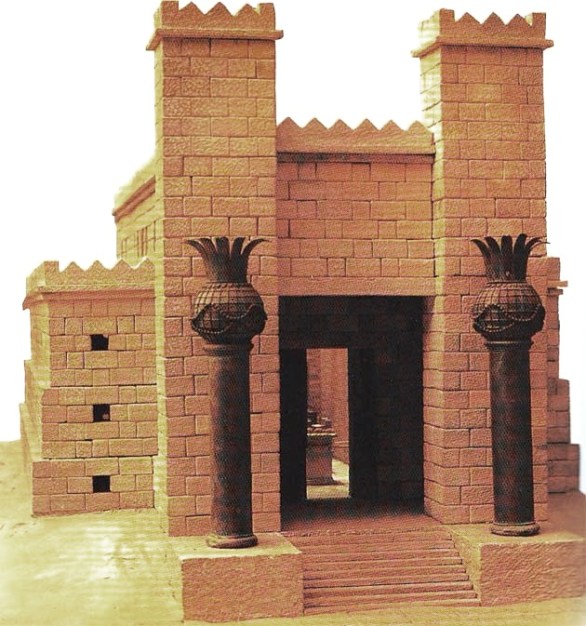
Model of First Temple,
Bible Museum, Amsterdam
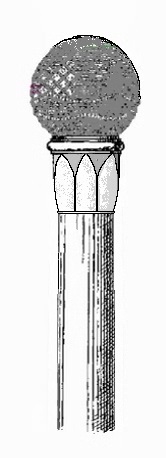
(with capitals that look like single
giant pomegranates)

And Chiram finished doing all the work that he did for King Solomon on the House of God: two amudim, and the globes of the capitals on top of the two amudim, and the two networks to cover the two globes of the capital on top of the amudim, and the four hundred pomegranates for the two networks—two rows of pomegranates for each network to cover the two globes of the capitals that were on the amudim. (1 Kings 7:40-42)

And all these things that Chiram made for King Solomon for the House of God were burnished bronze. (1 Kings 7:46)

amudim (עַמּוּדִים) = columns, pillars, posts, upright poles. (Singular amud, עַמּוּד, from the root verb amad, עָמַד = stood.)

Capital, capital

The Hebrew Bible is not averse to repetition. Shortly before this passage, the first book of Kings describes the impressive columns and their capitals in even more detail:

And he made two capitals to put on top of the amudim, cast in bronze. The one capital was five cubits high, and the second capital was five cubits high. [He made] networks of wreathes of chainwork for the capitals that were on top of the amudim, seven for one amud and seven for the second.  And he made the pomegranates, with two rows encircling the network, to cover the capital on top of the first amud, and the same for the second one. (1 Kings 7:16-18)

In other words, the capitals of the columns are globes completely covered with a bronze decorative network in a pattern of chains and pomegranates. Each capital has seven chains and two rows of pomegranates.

The next verse in 1 Kings describes shorter capitals with a different kind of decoration.

And the capitals that were on top of the amudim in the portico were in a lily pattern, four cubits. (Exodus 7:19)

A four-cubit capital in a lily pattern (the design craved into the capitals of smaller stone columns archaeologists have found in Jerusalem) is quite different from a five-cubit capital covered with a network of chains and pomegranates. And the portico would require a number of columns to support its roof, since it extends across the entire front of the main hall, 20 cubits (30 feet), and it is 10 cubits (15 feet) deep.5

Is this verse an aside about stone columns of the portico, which are quite different from the two bronze columns Chiram makes? Or does each bronze column have not one, but two capitals stacked one above the other—one in a lily pattern and one a globe covered with chains and pomegranates?

Lost in translation

The next verse should give us a clue, but it is unusually difficult to translate. Since the syntax of Biblical Hebrew is different from the syntax of English, all translations have to rearrange the word order to make the English intelligible. In 1 Kings 7:20, it is hard to know where to place the word for “also”. And although it is a standard move to change “the capital the second” into “the second capital”, what that phrase refers to is ambiguous.

It does not help that two of the Hebrew words in 1 Kings 7:20 that indicate location, milumat and le-eiver, have multiple valid translations.

Here is the verse with the words translated literally and not rearranged at all:

And capitals upon two the amudim also above milumat the belly that le-eiver the network and the pomegranates 200 rows around on the capital the second. (1 Kings 7:20)

milumat (מִלְּעֻמַת) = near, side by side with, alongside of, parallel with, corresponding to, close beside.

le-eiver (לְעֵבֶר) = to one side, across, over against.

Here is the standard 1999 Jewish Publication Society (JPS) translation:6

So also the capitals upon the two columns [amudim] extended above and next to [milumat] the bulge that was beside [le-eiver] the network. There were 200 pomegranates in rows around the top of the second capital (i.e., each of the two capitals). (1 Kings 7:20)

This translation moves “also” to the beginning of the verse, making it imply “and another thing I want to say is”. It sounds as though the capitals are simultaneously above, and next to, and beside the network on the capitals, which is hard to imagine. And a JPS footnote claims that “the second capital” means “each of the two capitals”, as if the translators could not think of any other explanation for the final phrase.

Here is a 2013 translation by Robert Alter,7 who is generally more literal than the JPS and usually provides clear translations:

And the capitals on the two pillars [amudim] above as well, opposite [milumat] the curve that was over against [le-eiver] the net, and the pomegranates were in two hundred rows around on the second capital. (1 Kings 7:20)

Alter translates the Hebrew word gam (גַּם) as “as well” instead of “also”, but it still means little in that location in the sentence. And what does the word “above” mean when it comes before “as well”? The location of the capitals in relation to the bulge or curve (literally “belly”) is phrased differently, but still obscure. Where is this curve, and what is it connected to? Furthermore, Alter’s translation sounds as though the pomegranates were in two hundred rows on the second capital, but not the first. Yet the earlier description of the two pomegranate capitals had two rows of pomegranates on each one.

Here is a 2014 translation by Everett Fox,8 who is generally even more literal than Robert Alter:

And the capitals on the two columns were also above, close to [milumat] the bulging-section that was across from [le-eiver] the netting, and the pomegranates were two hundred in rows, all around the second capital. (I Kings 7:20)

Fox’s placement of the word “also” implies that the same two columns also have capitals above the previously-mentioned lily capitals. Presumably these upper capitals are the ones decorated with pomegranates. If so, the phrase “the second capital” is no longer puzzling; it refers not to the capital on the second column, but to the second capital on the same column. But “close to the bulging-section that was across from the netting” remains hard to visualize.

Taking some tips from Fox, here is my best effort at an English translation:

And the capitals on the two columns were also above, next to the rounded molding that was on one side of the network. And two hundred pomegranates were in rows all around the top of the second capital. (Exodus 7: 20)

And here is my explanation:

Each bronze column has two capitals. At the top of each column is a four-cubit capital with a lily design. On top of the lily capital is a rounded molding referred to as a belly. And on top of the molding is a second capital, a five-cubit capital in the form of a globe covered with a network of chains and pomegranates.

In the next verse, Chiram names the two bronze capitals. Immediately after that, the text says: 

And up on top of the amudim was a lily design. And the work of the amudim was completed. (1 Kings 7:22)

This confirms that the lily capitals are part of the two gigantic bronze columns, not part of separate stone columns.

Why would anyone stack two capitals on top of a column? For the same reason the Ancient Greeks invented the Corinthian capital, which essential takes an Ionic capital and inserts two ranks of acanthus leaves in between the astragal molding at the bottom and the scrolled volutes at the top, and throws in a few acanthus flowers for good measure. Anything ornamental can be made even more ornamental.

In the case of the capitals on the bronze columns, Chiram began with the six-petalled lily that “served as the symbol of the Israelite monarchy during certain periods”9 Then he added the globes covered with bronze chains and hundreds of pomegranates, an unusual and showy design. A bronze artist that skilled could hardly resist showing off.


Chiram the bronzeworker and Solomon the king are well-matched. Every detail of the new temple is designed to look as impressive as possible. Solomon even has the stone walls of the main hall covered with cedar which is carved and then gilded.

His father, King David, fought for the kingdom of Israel and ruled from Jerusalem, but still used a tent as God’s sanctuary. King Solomon inherited his kingdom. He concentrated on building up commerce and wealth, acquiring even more wives and concubines than his father, and building an elaborate palace for himself and temple for God.

Why not erect two gigantic bronze columns in front of the temple, with ornamentation that goes over the top?


  1. The Jebusites who occupied Jerusalem before King David conquered part of it probably had their own shrine. Genesis 14:17-20 mentions a Jebusite priest-king named Malki-tzedek who blesses Abraham.
  2. Exodus 26:36.
  3. 1 Kings 6:33-35.
  4. 1 Kings 7:13.
  5. 1 Kings 6:2-3.
  6. JPS Hebrew-English Tanakh, The Jewish Publication Society, Philadelphia, 1999, p. 724.
  7. Robert Alter, Ancient Israel: The Former Prophets, W.W. Norton & Company, New York, 2013, p. 638
  8. Everett Fox, The Early Prophets, Schocken Books, New York, 2014, p. 602.
  9. Rabbi Adin Steinsaltz, Introductions to Tanakh: Prophets, on 1 Kings 7:19, reprinted in www.sefaria.org.

Vayakheil: Shadow Creator

The first time Moses spends 40 days and 40 nights on the summit of Mount Sinai, God tells him everything the Israelites should make to create a portable sanctuary for God and vestments for God’s new priests. Moses also learns who should supervise the craftsmanship.

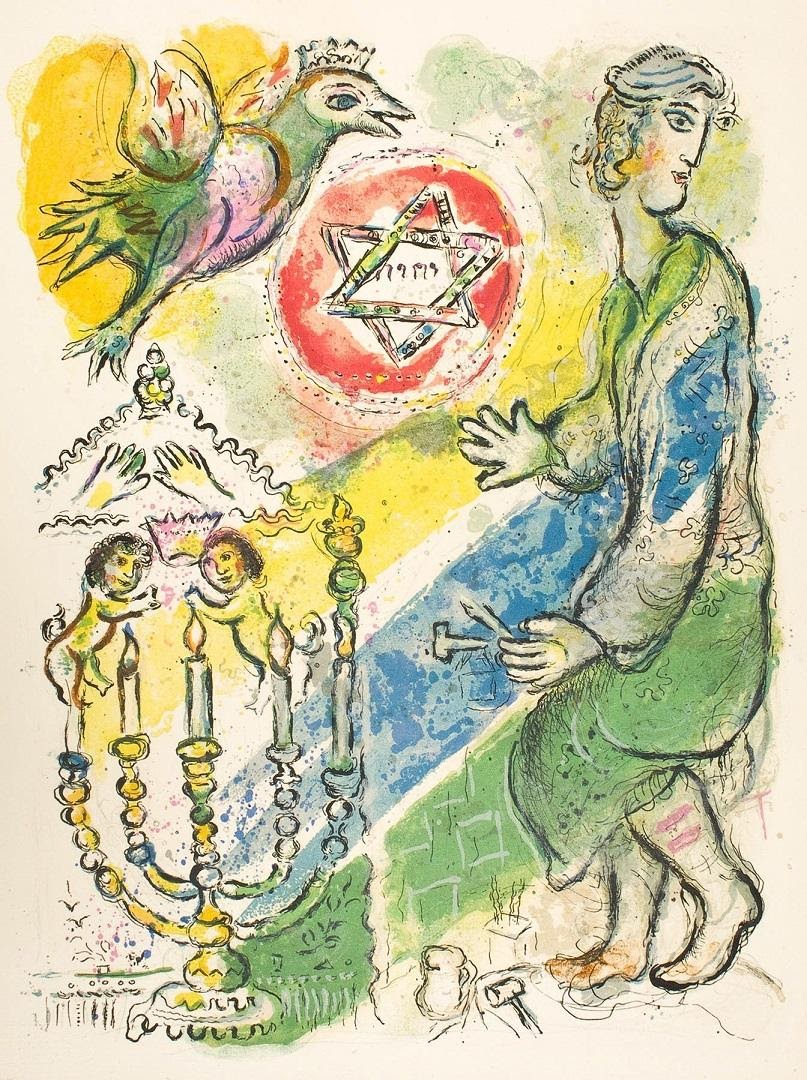
Betzalel, by Marc Chagall, 1966

And God spoke to Moses, saying: “See, I have called by name Betzaleil son of Uri son of Chur of the tribe of Yehudah. And I have filled him with the spirit of God in wisdom and in insight and in knowledge, and in every craft.” (Exodus/Shemot 31:1-3)

Betzaleil (בְּצַלְאֵל) = In the shadow of God. (Be-, בְּ = in, at, by, with + tzeil,צֵל = shadow, shade + eil, אֵל = God, a god.)

When Moses comes back down from the mountaintop in last week’s Torah portion, Ki Tisa, he has to deal with the Golden Calf. Then he returns to the summit for another 40 days. This time he learns more about God’s character and gets replacement stone tablets.1 After he comes back down from this second stint, he finally gets to communicate God’s instructions for the sanctuary and the priests’ vestments to the people in this week’s Torah portion, Vayakheil (Exodus 35:1-38:20).

Moses calls for donations of the materials, and for artisans who are skilled in woodworking, metalworking, weaving, and jewelry-making. The donations pour in, and plenty of male and female artisans volunteer to do the work. Before they begin, Moses appoints the supervisor and master craftsman that God had named.

And Moses said to the Israelites: “See, God has called by name Betzaleil son of Uri son of Chur of the tribe of Yehudah, and has filled him with the spirit of God in wisdom, in insight, and in knowledge, and in every craft—to invent designs to make in gold and in silver and in copper; and in preparing stones for setting and in preparing wood for making; and in every craft of designing. And to give instructions …” (Exodus 35:30-34)

Both God and Moses begin talking about Betzaleil by using the imperative “See!” Everyone can see that Betzaleil is an inspired artist and designer, so it is easy to believe God has singled him out or “called him by name”.

And his name is appropriate for his mission. The name Betzaleil means “In the shadow of God”, but what does it mean to be, or to create, in God’s shadow?

Shadows in English and Hebrew

The Hebrew word tzeil (and its variant tzeilel, צֵלֶל) and the English word “shadow” have the same literal meaning: the dark area cast on a surface by an object between a light source (such as the sun) and that surface. Tzeil can also mean “shade”, which is another description of shadow in English

But when these words are used metaphorically, they have a different sense in English than in Biblical Hebrew. A shadow is usually attached to the spot where the person or thing that casts it touches the ground. (Shadows of birds and other airborne objects are the exception.) So in English, shadowing a person is following their every move.

In English, a shadow is also less noticeable or less significant than the person casting it. Being in someone’s shadow means going unnoticed. The shadow side of a person or institution is the unacknowledged, unconscious, or repressed side. People who have lost status, size, or ability are called shadows of their former selves.

In the Hebrew Bible, the word tzeil or tzeilel appears 51 times. It is used literally 17 times, as a metaphor for concealment and refuge 7 times (perhaps because it is harder to spot someone in dark shade), and as a metaphor for time stretching out like a shadow 3 times.

The word is also used in two ways that relate to Betzaleil’s name: 19 times as a metaphor for protection, and 5 times as a metaphor for transience.

Shade as protection

Those of us who live in more moderate climates might not think of shade or a shadow as protection, but in the deserts of the Ancient Near East shade meant protection from the burning sun and the risk of dehydration.

The first time tzeil appears is in Genesis, when Lot begs the men of Sodom not to sexually molest his two visitors:

“Hey, please, I have two daughters who have not known a man. Please let me bring them out to you, and you may do to them whatever is good in your eyes. Only don’t do a thing to these men, because they came into the tzeil of my roof!” (Genesis 19:8)

Here “the tzeil of my roof”, literally “the shade of my roof”, really means “under my protection”. Once Lot has offered the visitors the hospitality of his house, he feels honor-bound to protect them from the mob as long as they stay with him.

The word tzeil also indicates protection by a king, government, city, or nation. And it is used for protection by God. For example:

          God is your guardian;
God is your tzeil at your right hand. (Psalm 121:5)

Since Betzaleil is “in the shadow of God”, God protects and shelters him. His inspiration for designing all the holy objects and his ability to instruct others come from the spirit of God, and therefore everything will come out right.

Shadow as transience

When the Hebrew Bible comments on the brevity of human life, it often compares humans with grass that sprouts up and then withers. But comparing humans with shadows is even more telling, since shadows outside vanish daily at nightfall, and shadows inside disappear into darkness the moment a lamp is snuffed out. Here is one example:

          A human, like a puff of air, comes to an end;
His days, like a tzeil, pass by. (Psalm 144:4)

Since Betzaleil is human, his life is very short compared to God’s. By extension, Betzeleil’s creations, however beautiful and holy, are mere passing shadows compared to God’s creations.

Shadows and images

A literal shadow is like a silhouette; you see the outline of the original, but none of the details or colors. Similarly, the Hebrew word tzelem, which usually means image but can also mean “shadow”, has less reality than the original object. The word tzelem may well be related to the word tzeil. It appears in the first account of God’s creation of the universe:

And God said: Let us make humankind betzalmeinu, in our likeness, and they will rule over the fish of the sea and over the birds of the heavens and over the beasts, and over all the land, and over all creepers that creep on the land. (Genesis 1:26)

betzalmeinu (בְּצַלְמֵנוּ) = in our image. (Be-, בְּ = in, at, by, with + tzelem, צֶלֶם, = image, model, statute, shadow, something shadowy (without substance) + einu, ֵנוּ  = our.)

One of the ways humans are shadows or images of God is that we have secondary creative powers. We cannot create a universe, but we can recombine existing elements to create new things within our universe. We cannot create life, but we can create beauty. When we humans are at our best, when we are inspired to create, like Betzaleil, we imitate or shadow the divine.

The entire work of art that served as the portable sanctuary, expanded later into the temple,  inspired the children of Israel to keep returning to their God over the centuries. It kept their religion alive until it could metamorphose and survive without a temple.

We humans have more creative power than we think, for good and for ill. May we use it wisely.


  1. See my post Vayakheil & Ki Tisa: Second Chance.

Ki Tisa & Mishpatim: Shattered

Moses and the Tablets
(strangely fused),
by James Tissot, ca. 1900

At the foot of Mount Sinai, the Israelites are worshiping the Golden Calf; at the summit, God is giving Moses a pair of stone tablets. It is a fateful day in this week’s Torah portion, Ki Tisa (Exodus 30:11-34:35).

Then [God] gave to Moses, once [God] finished speaking with him on Mount Sinai, the two tablets of the eidut, tablets of stone written by the finger of God. (Exodus 31:15)

eidut (עֵדֻת) = affidavit, pronouncement, testimony.

Why does God give Moses two engraved stone tablets to carry down from Mount Sinai?

To provide a written record of the laws?

In an earlier Torah portion, Mishpatim, God tells Moses:

“Come up to me on the mountain and be there, and I will give you tablets of stone and the instruction and the command that I have written to instruct them.” (Exodus 24:12)

What instruction and command? The book of Exodus never says what God wrote on the tablets. But in the book of Deuteronomy, Moses recites the “Ten Commandments”, then says:

These words God spoke to your whole assembly at the mountain, from the midst of the fire, the cloud, and the fog, in a great voice; and did not add more. And [God] wrote them on two tablets of stone, and gave them to me. (Deuteronomy 5:19)

However, these tablets are not the only written record of the Ten Commandments. They first appear in the book of Exodus, during God’s revelation at Mount Sinai.1 After the fireworks of the revelation are over, God adds 24 verses of rules for the people, from Exodus 20:19 in the Torah portion Yitro through Exodus 23:33 in the portion Mishpatim.

And Moses came and reported to the people all the words of God and all the laws, and all the people answered with one voice, and they said: “All the things that God has spoken, we will do!” And Moses wrote down all the words of God. (Exodus 24:3-4)

The next morning Moses sets up an altar, makes animal sacrifices, and splashes some of the blood on the altar.

Then he took the record of the covenant and he read it into the ears of the people, and they said: “All that God has spoken we will do and we will pay attention!” Then Moses took the blood and splashed it on the people, and said: “Hey! [This is] the blood of the covenant that God cut with you concerning all these words!” (Exodus 24:7-8)

So Moses writes a scroll containing the Ten Commandments and the many additional laws God communicated to him, and this scroll counts as a record of the covenant. The two stone tablets are not necessary for that purpose.

To test Moses?

The Torah portion Mishpatim ends with Moses climbing to the top of Mount Sinai alone. Moses spends forty days and forty nights in the cloud at the summit of Mount Sinai, listening to more instructions from God. This time the instructions are for making a portable tent-sanctuary, making vestments for priests, and ordaining the new priests.

Then God tells Moses that the people waiting at the foot of the mountain have made an idol.

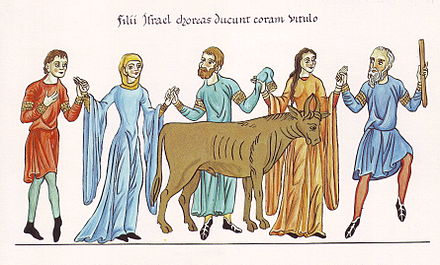
Adoration of the Golden Calf, from Hortus deliciarum
of Herrad of Landsberg, 12th cent.

And God spoke to Moses: “Go down! Because your people whom you brought up from the land of Egypt have ruined [everything]! They have been quick to turn aside from the way that I commanded them. They made themselves a cast image of a calf, and they prostrated themselves to it and they made slaughter sacrifices to it, and they said ‘This is your god, Israel, who brought you up from the land of Egypt’!” (Exodus 32:8)

After delivering the awful news, God tests Moses by making him an offer he can refuse:

“And now leave me alone, and my anger will flare up against them and I will consume them; and I will make you into a great nation.” (Exodus 32:10)

I think the God is implying: “If you leave me alone, then my anger will flare up against them and I will consume them.” It is a backhanded invitation to speak up.

Why does God add that if God “consumes” the Israelites, then Moses’ descendants will become a great nation instead? I suspect it is a temptation that God hopes Moses will reject. Moses passes the test; he argues that it would be a bad idea to destroy the Israelites, and God immediately backs off.

However, I think this is only the first part of God’s test of Moses. The second part is more subtle. By giving Moses the two stone tablets, God is handing over the responsibility for the covenant—the one that the people have just violated by making a golden idol.2 Since Moses wants the Israelites to become the people God will “make into a great nation”, let him address their flagrant violation of God’s law. God will stand by and watch what Moses does with the stone tablets.


Theoretically, Moses could leave the tablets at the top of Mount Sinai, go down and straighten out the Israelites, then fetch the tablets and present them to the people as a reward and confirmation that they are now on the right track. He rejects this option, probably because he knows he needs a strong visual aid to make the people pay attention to him.

He also needs to reinforce the idea that rewards and punishments come from God. Five times during the journey from Egypt to Mount Sinai, the Israelites blamed Moses for bringing them into the desert, and expected him, not God, to provide them with food and water.3 Each time Moses pointed out that God was the one in charge.

Moses Breaking the Tablets,
by Ephraim Moshe Lilien, 1808

So Moses carries God’s two stone tablets down the mountain.

And it happened as he came close to the camp, and he saw the calf and circle-dancing; then Moses’ anger flared up; and he threw the tablets down from his hand, and he shattered them under the mountain. (Exodus 32:19)

Moses already knows about the Golden Calf. What enrages him now is the sight of the people drinking, singing, and dancing—enjoying themselves, now that they finally have a god they can understand, a god that inhabits a gold statue.

This kind of idol was standard in Egypt. Moses has been trying to get his people to accept a god who manifests only as cloud and fire. He would be angry, but not surprised, that the Israelites feel happy and relieved now that they have an idol. (He does not know that his own brother, Aaron, confirmed that the God who brought them out of Egypt inhabits the Golden Calf.)4

I doubt Moses is so completely overcome by his anger that he hurls down the tablets without thinking. After all, he had enough presence of mind to argue with God when he was surprised and frightened by his first overwhelming encounter at the burning bush. Surely he has enough presence of mind now, in a situation he is partially prepared for, to make a deliberate decision to smash the stones.

He may even worry that they will bounce instead of shatter, and fail to achieve the effects he desires: demonstrating that the people broke their covenant with God, inducing guilt, and setting an example regarding idols.

Demonstrating that they broke the covenant

None of the literate Israelites have time to read what is carved on the stones before Moses smashes them. But Moses waits until he is close enough so everyone can see that he is holding two thin, smooth stone tablets with writing carved into them. The Israelites would conclude that God must have given him the tablets at the top of the mountain. In the Ancient Near East, as in the modern world, both parties to a covenant get a written copy. So they would also assume, correctly, that the tablets are related to the covenant they made with God 40 days before.

In other words, the people would know that the stones were “two tablets of the eidut, of God’s affidavit, pronouncement, or testimony. According to 12th-century commentator Ibn Ezra,

“He therefore broke the tablets which were in his hands and served, as it were, as a document of witness. Moses thus tore up the contract. As Scripture states, he did this in the sight of all of Israel.”5

Inducing guilt

The second effect Moses’ demonstration achieves is to make the Israelites realize they disobeyed God and did the  wrong thing. According to 15th-century commentator Abravanel,

“Had Israel not seen the Tablets intact, the awesome work of the Lord, they would not have been moved by the fragments, since the soul is more impressed by what it sees, than by what it hears. He therefore brought them down from the mountain to show them to the people, and then break them before their very eyes.”6

The Israelites, like most humans, have a stronger and more visceral response to what they see than to any words they hear. The first time in Exodus that the people trust God (at least temporarily) is when they see the Egyptian charioteers drown in the Reed Sea.7 That is also the first time they rejoice, singing and dancing. The next time they rejoice, again with dancing, is in front of the Golden Calf.

But when they see the stone tablets carved with some words from God, and then see Moses shatter them, they know in their guts that they were wrong.

Setting an example regarding idols

The third effect Moses achieves by smashing the stone tablets is to set an example regarding idols. An idol, in the Hebrew Bible, is a physical object that is treated like a god. The Golden Calf is an idol. But the two stone tablets also have the potential to become an idol. What if the Israelites are so desperate for a concrete god that they adopt the tablets in place of the calf? What if they prostrate themselves before the tablets, make sacrifices to the tablets, and carouse in front of the tablets with the same unchecked ecstasy?

21st-century commentator Zornberg concluded:

“Moses, therefore, smashes the tablets, not in pique, but in a tragic realization that a people so hungry for absolute possession may make a fetish of the tablets as well.”8 When Moses hurls down the stone tablets, they do not bounce, like magical objects. They break, like slate tiles. The people see that the tablets are only stones. God does not inhabit them.


Change is hard. Human beings enjoy a little variety, but a change in employment or a change in address is hard to get used to even when it is an improvement. The Israelites were underdogs doing forced labor in Egypt. Now they have been changed into an independent people traveling toward a new home in Canaan. These changes alone require new habits of thought. But these people must also adopt a new religion.

The Israelites in Egypt still acknowledged the God of their ancestors Abraham, Isaac, and Jacob. But now their God is demanding an active—and exclusive—form of religion. Instead of obeying their Egyptian overseers, they must obey an invisible God who manifests sometimes as cloud and fire, but speaks only to Moses. They must follow this God’s rules and do whatever God says. They promise twice that they will do it. But the new covenant is hard to obey.

I have managed big changes in my own life through a combination of stubborn determination to do the right thing and harnessing as much rational thought as I can. But I have advantages the Israelites did not have. I suffered only minor childhood trauma, I have lived safely in the American middle class, and I have an analytical personality and brain.

I want to feel sympathy, not anger, toward people whose choices seem blatantly wrong to me. But what if someday there is a moment when I could jolt people out of their habits of thought by smashing a potential metaphorical idol? If it ever happens, I hope I will recognize it.


  1. See my posts Yitro & Va-etchanan: Whose Words?, Part 1 and Part 2.
  2. The prohibition against making any idols or images of a god appears not only in the “Ten Commandments”, but also in Exodus 20:20, at the beginning of God’s long list of rules following the revelation, the list Moses has written down and read out loud to the people twice.
  3. Exodus 14:11-12, 15:22-24, 16:2-3, 16:6-8, 17:2-4.
  4. Exodus 32:4-5.
  5. Abraham ben Meir ibn Ezra, translation in www.sefaria.org.
  6. Don Isaac ben Judah Abravanel, translated by Aryeh Newman, in Nehama Leibowitz, Studies in Shemot, Part II, Maor Wallach Press, 1996, p. 610.
  7. Exodus 14:30-31, 15:19-21.
  8. Avivah Gottlieb Zornberg, The Particulars of Rapture, Doubleday, New York, 2001, p. 424.

Tetzaveh & Ki Tisa: Washing

Two kinds of rituals based on washing with water appear in God’s instructions to Moses about the new sanctuary and priesthood for the Israelites. One is immersion in water for ritual purification; the other is washing hands and feet as either an act of reverence or a form of sanctification.

Immersion in Tetzaveh

In this week’s Torah portion, Tetzaveh (Exodus 27:20-30:10), God tells Moses to purify the new priests by washing their whole bodies in water.

The instructions for consecrating Aaron and his sons as the first priests of the Israelites begin with some preparations before the ceremony begins. Moses must bring a bull, two rams, and a basket with three kinds of unleavened bread to the area in front of the new Tent of Meeting. Then, God says:

“And you will bring forward Aaron and his sons to the entrance of the Tent of Meeting, verachatzta them with water.” (Exodus 29:4)

verachatzta (וְרָחַצתָּ) = and you will wash. (Also a conjugation of the verb rachatz.)

Washing Aaron and his sons in water is the first step to prepare them for consecration as priests. The next step is to dress them in their vestments, the uniforms of priesthood that the Israelites are going to make out of precious materials.

“Then you will take the clothing, and you will dress Aaron in the tunic …” (Exodus 29:5)

The text is too polite to say so, but Aaron and his four sons must undress before Moses can wash and dress them. The implication is that their entire bodies will be washed, not just their hands and feet.

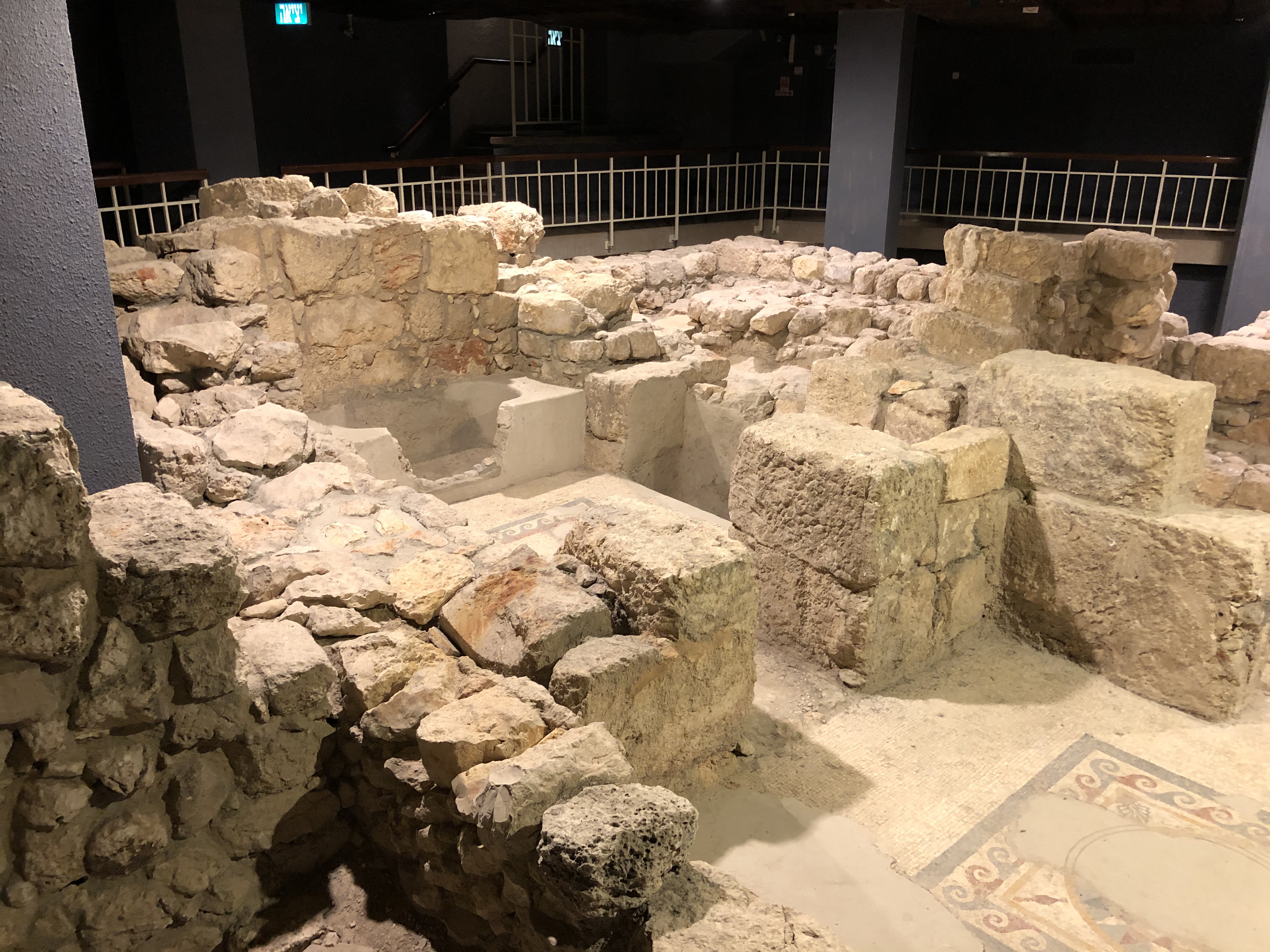
1st century mikveh under Wohl building,
Jerusalem (photo by M.C.)

As early as the 2nd century C.E.,1 the ritual washing in this week’s Torah portion was identified with immersion in a mikveh, a pool of water fed by gravity from “living water”, i.e. a spring or a cistern filled with rain. Archaeologists have found these pools throughout Judea dating to the period the second temple stood in Jerusalem, 515 B.C.E.-70 C.E.. Many Jews today still use a mikveh for certain kinds of ritual purification.

Why does immersion in living water get rid of ritual impurity? 19th-century Rabbi Samson Raphael Hirsch noted that before God created the earth, there was water.

… and darkness was over the face of the depths, and a wind of God hovered over the face of the water. (Genesis 1:2)

He added that according to the Babylonian Talmud tractate Kelim, vessels made from parts of aquatic creatures cannot become ritually impure, and combining these two concepts, he concluded:

“Thus, immersion in water symbolizes complete departure from the human realm, the realm subject to tumah, and restoration to the original condition. Immersion removes man from his past connections and opens up for his future a new life of taharah. Through this immersion, Moses—as the nation’s highest representative—elevates Aharon and his sons, who are to be consecrated as priests, and removes them from their past connections.”2

Only after Aaron and his sons have been ritually purified by water can Moses proceed with their consecration, which includes anointing Aaron as the high priest by pouring olive oil over his head,3 and dedicating him and his sons to their new positions by daubing ram’s blood on their ears, thumbs, and toes.4

Washing hands and feet in Ki Tisa

The instructions for the new sanctuary and its priests continue in next week’s Torah portion, Ki Tisa (Exodus 30:11-34:35)—until God gives Moses the pair of stone tablets, which Moses smashes when he comes down from Mount Sinai and sees the people worshiping a golden calf.

Model of temple
wash-basin by
Temple Institute

And God spoke to Moses, saying: “You will make a wash-basin of bronze lerachtzah, and its stand of bronze. And you will place it between the Tent of Meeting and the altar, and you will put water there. Verachtzu, Aaron and his sons, their hands and their feet in it. When they are coming into the Tent of Meeting, yirchatzu with water, and they will not die. Or when they come up to the altar to attend to turning a fire-offering to God into smoke, yirchatzu their hands and their feet, and they will not die.” (Exodus 30:17-21)

lerachtzah (לְרָחְצָה) = for washing. (Also from the verb rachatz.)

verachtzu (וְרָחֲצוּ) = and they will wash. (Another conjugation of the verb rachatz.)

yirchatzu (יִרְחֲצוּ) = they must wash. (Ditto.)

Why do the priests only need to wash their hands and feet before entering the sanctuary tent or serving at the altar? And why would they die if they did not perform these ablutions?

Washing in water from the basin5 is not entirely symbolic. As Ramban pointed out in the 13th century,

 “This washing was out of reverence for Him Who is on high, for whoever approaches the King’s table to serve, or to touch the portion of the king’s food, and of the wine which he drinks, washes his hands, because “hands are busy” [touching unclean things automatically]. In addition He prescribed here the washing of feet because the priests performed the Service barefooted, and there are some people who have impurities and dirt on their feet.” 6

But Ramban also noted that washing one’s hands before serving a king expresses deep respect or reverence:

“It is on the basis of the idea of this commandment that our Rabbis have instituted the washing of hands before prayer, in order that one should direct one’s thoughts to this matter.”6

Later Jewish commentators added that while immersion in water results in ritual purification (taharah), washing hands and feet before serving God is an act of sanctification—like dressing in the vestments for priests, or donning a tallit and tefillin before praying for Jews in the last two millennia.

“Purification involves the removal of a negative, impure element … whereas sanctification implies a spiritual elevation of an unworthy person or thing to the level required for the holy service of God.” (Elie Munk)7

So God’s instructions to Moses for the establishment of a religion with a sanctuary, priests, and procedures for worship include two kinds of washing in water: ritual purification through immersion before a new priest is consecrated, and sanctifying hands and feet by rinsing them before serving God.


I have not been in a mikveh for years. I used to have Shabbat dinner with observant Jewish friends, and say the whole series of blessings before eating, each one accompanied by an action. In between blessing and sipping the wine, and blessing and tasting the bread, was a ritual hand-washing: pouring water three times over each hand, then raising both hands and reciting the blessing that can be literally translated as: “Blessed are you, God, our God, Ruler of the Universe, who had sanctified us with commandments and commanded us about elevating hands.” Now I only do that on Passover.

The old reasons for water rituals no longer seem compelling to me. Yet when I have been exposed to a person shouting ugly things, I wish I could purify myself. And when I am about to teach or speak in public, I wish I could sanctify myself so my speech will be worthy.

I need new ways of performing ritual washing.


  1. Targum Jonathan, a 2nd-century translation of the Hebrew Bible into Aramaic, says Moses will wash them, and adds “in four measures of living water”.
  2. Samson Raphael Hirsch, The Hirsch Chumash: Sefer Shemos, translated by Daniel Haberman, Feldheim Publishers, Jerusalem, 2005, p. 680.
  3. Exodus 29:7.
  4. Exodus 29:19.
  5. In the second temple, the wash-basin had spigots. Since the bible does not mention a jug for dipping water out of the basin, and the basin was elevated by a stand, the basin in Exodus probably has spigots as well.
  6. Ramban (Rabbi Moshe ben Nachman) on Exodus 30:19, The William Davidson Edition translation, in www.sefaria.org.
  7. Rabbi Elie Munk, The Call of the Torah: Bereishis, Mesorah Publications, Rahway, N.J., 1994, p. 431.

Haftarat Terumah—1 Kings: From Volunteers to Conscripts

And God spoke to Moses, saying: “Speak to the Israelites, and they will take voluntary contributions for me. From everyone whose heart makes him willing, you may take my voluntary contributions.” (Exodus 25:1-2)

Hebrew Women Offering their Jewels,
by Bernardino Luini, 16th century

After that opening, this week’s Torah portion, Terumah (Exodus 25:1-27:19), lists the contributions that people can give: gold, silver, and bronze; blue, purple, and scarlet thread made of wool, linen, and goat’s hair; two kinds of tanned leather; acacia wood; olive oil; incense spices; and precious stones.

Then the text says what the materials are for:

“Let them make a holy place for me, and I will dwell among them.” (Exodus 25:8)

Later in Exodus, Moses invites anyone whose heart is moved to bring materials and donate labor to build a portable tent sanctuary for God.

And everyone whose mind was uplifted and everyone whose spirit made him willing brought voluntary gifts for God, for the work of the Tent of Meeting … (Exodus 35:21)

Then all the skilled artisans in the community volunteer to weave and embroider cloth, tan leather, shape wood, forge tools, and assist the master craftsmen Betzaleil and Oholiav in making the holiest objects. When the sanctuary is complete, God moves in.1

The haftarah (accompanying reading from the Prophets) for this week’s Torah portion is 1 Kings 5:26-6:13, which tells how King Solomon acquires wood and stone to build the first permanent temple for God in Jerusalem. This time the labor is done by conscripts instead of volunteers, but God promises to move in anyway.

The king imposes compulsory labor

And God had given Solomon chokhmah, as [God] had spoken. And there was peace between Chiram and Solomon, and the two of them cut a covenant. (1 Kings 5:26)

chokhmah (חָכְמָה) = technical skill; good sense; wisdom from accumulated knowledge.

The best translation of chokhmah here is probably “good sense”. Solomon exhibits good sense when he maintains the alliance of his father, King David, with one of his richest neighbors, King Chiram. Chiram was a 10th-century ruler of the city-state of Tyre, on the coast of a forested region called Lebanon (now a nation by the same name). During his long reign, Chiram turned Tyre into the premier Phoenician city by building a vast trade network.

The first trade agreement between Chiram and Solomon calls for Chiram to provide Solomon with all the cedar and cypress logs he can use, and Solomon to provide Chiram with annual shipments of wheat and olive oil. An exchange of labor is also involved.

And King Solomon raised a mas from all Israel. And the mas was 30,000 men. And he sent them to Lebanon, 10,000 per month; by turns [each man was] a month in Lebanon and two months at his own house. (1 Kings 5:27-28)

mas (מַס) = compulsory labor, forced labor.

Kings in the Ancient Near East often conscripted their citizens to serve in the military, like governments today. But it was also common for kings to conscript people for mas, a less prestigious form of service.

Solomon exhibits chokhmah,good sense, again in this haftarah by limiting his mas of Israelite laborers in Lebanon to every third month. This arrangement leaves the men free to return home and work on their own families’ farms and businesses the other two months, making the mas a tolerable burden.

~ 900 BCE

The Israelite conscripts working in Lebanon every third month are felling cedar and cypress trees and hauling the trunks to the coastline under the supervision of King Chiram’s men. The men of Tyre then lash the logs into rafts and sail them to a place where King Solomon’s men will pick them up and transport them to Jerusalem.2 In Jerusalem, the wood is used in the construction of God’s temple, and later in King Solomon’s palace and associated buildings.

Solomon’s building projects also require a lot of stone, but he can get good stone from the hills of Israel.

Solomon also had 70,000 porters and 80,000 quarriers in the hills …  And the king gave the order, and they moved great stones, expensive stones, for the foundation of [God’s] house: hewn stones. (1 Kings 5:29)

The haftarah does not say whether the quarriers and porters working in the hills are paid employees, or conscripted for mas. A king in that civilization was more likely to use conscripts, who would be fed, but would not be free to quit their mas until their terms of service were completed.

After the basic structure of the temple has been erected, but before there are any interior walls or furnishings, God speaks to King Solomon.

Then the word of God happened to Solomon, saying: “This house that you are building—if you follow my decrees and you act [according to] my laws, and you guard all my commands, following them—then I will fulfill with you my word that I spoke to David, your father. And I will dwell among the Israelites, and I will never forsake my people Israel.” (1 Kings 6:11-13)

Israelites as volunteers versus subjects

In this week’s portion from Exodus, God tells Moses: “Let them make a holy place for me, and I will dwell among them.” The people deserve God’s protective presence because they willingly donate their time, skills, and valuables to make a place for God. The relationship is between God and all the Israelites. But in this week’s haftarah from 1 Kings, God tells Solomon: “If you follow my decrees and you act [according to] my laws, and you guard all my commands …” God uses the singular form of “you” throughout the clause beginning with “if”; the contractual relationship is between God and the king. In return, God promises to support Solomon as king, and also to “dwell among the Israelites”. In other words, God promises to be present among the Israelites for the sake of their king’s obedience to God. Perhaps the assumption is that if the king of Israel obeys God’s rules, he will also enforce them among his people.

Who is conscripted?

Later during King Solomon’s reign, well after this week’s haftarah, he adopts the more traditional policy of favoring his own ethnic group over the people the Israelites conquered:

All the people who were not from the Israelites—those who were left from the Amorites, the Hittites, the Perizites, and Chivites, and the Jebusites, their children … whom the Israelites were not able to dedicate to destruction, Solomon laid on them a mas of slavery until this day. But Solomon made no Israelite a slave. Instead they became men of war, and his servants, and his commanders, and his captains, and the officers of his chariots and his horsemen. (1 Kings 9:20-22)

Mas hauling stones,
Palace of Sennerachib, Nineveh

According to earlier books in the bible, the Canaanite peoples that were not wiped out were subject to a permanent mas starting with the conquest of Joshua.3 Kings in the Ancient Near East normally imposed mas on defeated enemies, relocating them to wherever brute labor was needed; for example, the Neo-Assyrian King Sennerachib did this when he conquered the northern kingdom of Israel.4

The policy of giving conquered enemies either mas or death is laid out in the book of Deuteronomy:

And if [the town] answers you with peace and opens to you, then all the people you find in it will be yours for a mas, and to serve you. (Deuteronomy 20:11)

Ironically, in the book of Exodus God helps the Israelites to escape from Egypt and conquer Canaan because they are suffering so much from the mas two pharaohs in a row imposed on them.5

When mas is too much

During the first twenty years of his reign, Solomon completes the temple for God, and God fills it with a cloud of glory to prove that God is in residence.6 But during the second half of his forty-year reign, Solomon exhibits less chokhmah. He takes 700 foreign wives, far more than needed to be strategically connected by marriage with every kingdom in the Ancient Near East, and builds shrines to some of his wives’ gods.7

Apparently he also institutes harsher mas on the ethnic Israelites—at least on the ten tribes that live more than a day’s journey north of Jerusalem.

Late in his reign, King Solomon appoints a capable man named Yeravam (Jereboam in English) to be in charge of the conscripts for mas from the tribes of Efrayim and Menashe in the north. Then a prophet predicts that someday Yerevam will be the king of the ten northern tribes.8 Shortly after that Yeravam flees to Egypt, apparently because King Solomon finds out and orders his execution.9

After Solomon dies, his son Rechavam (Rehoboam in English) goes to Shekhem, a city north of Jerusalem, to be anointed king. Yerevam returns from Egypt in time for the ceremony. He and his Israelite supporters tell Solomon’s son:

“Your father made our yoke hard. And you, now, lighten the hard labor of your father and the heavy yoke he put on us, and we will serve you.” (1 Kings 12:3-4)

Rechavam tells them to come back in three days for his answer. When they do, he says:

“My father made your yoke heavy, and I will add to your yoke! My father flogged you with whips, and I will flog you will scorpions!” (1 Kings 12:14)

The northern Israelites then renounce any fealty to Solomon’s son.

And King Rechavam sent Adoram, who was over the mas. But all the Israelites pelted him with stones and he died. (1 Kings 12:18)

Rechavam flees back to Jerusalem, where he rules only the southern Kingdom of Judah: the arid territory belonging to the tribes of Judah and Benjamin. But Yeravam becomes the first king of the northern Kingdom of Israel, reigning over the more fertile land belonging to the other ten tribes of Israelites—just as God’s prophet had predicted.


When I was a teenager, most of the boys in my high school lived in the shadow of the valley of death. Though they did not admit it to girls, they were afraid of being drafted and sent to Vietnam to die.

Many of their fathers were veterans of World War II, and considered military service something to be proud of—at least during the early part of the roughly ten years when the United States was fighting on the side of South Vietnam. But a large number of younger Americans were morally opposed to sending Americans to kill people in Vietnam.

In the culture of the Hebrew Bible, and in many other times and places, being in the military was an honorable condition. Men returning from war were treated as heroes because they had risked their lives for their cause or their country—whether they were volunteers or conscripts.

But the teenage boys I knew in Massachusetts saw conscription for the war as an ignoble mas, forced labor in the jungle leading to death for no good reason. They would have preferred carrying heavy stones and logs to a construction site for a temple or palace.

The more body bags Americans saw on television, the less popular the war became.

When the pharaoh subjected Israelite men to mas for too many years in the book of Exodus, they cried out to God and God rescued them. When King Rechavam threatened the northern Israelites with a more severe mas in the first book of Kings, they renounced their allegiance and chose a king of them own. When a burden is too severe, it cannot be imposed forever.


  1. Exodus 40:33-38.
  2. 1 Kings 5:22.
  3. Joshua 16:10, 17:13; Judges 1:28-1:35.
  4. 2 Kings 17:6, 17:23-24, and 18:11 report Neo-Assyrian King Sargon II capturing the capital of the Kingdom of Israel and relocating tens of thousands of Israelites in the eastern part of its empire. Foreigners are depicted doing heavy labor for Neo-Assyrian kings on relief sculptures.
  5. Exodus 1:11-14, 3:7-10.
  6. 1 Kings 8:10-11.
  7. 1 Kings 11:1-10.
  8. 1 Kings 11:26-39.
  9. 1 Kings 11:40.

Yitro & Va-etchanan: Whose Words?—Part 2

How did the Ten Commandments get into the two accounts of the revelation at Mount Sinai?

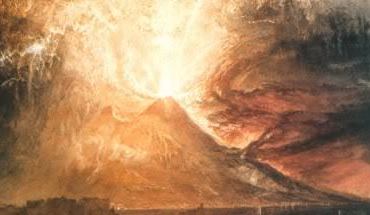
Eruption of Vesuvius,
by Pierre-Jacques Volaire, 1774,
detail

In last week’s Torah portion, Yitro (Exodus 18:1-20:23), God manifests on the mountain as fire, smoke, thunderclaps, and horn blasts. The Israelites are terrified.

The story of this epiphany is interrupted by what we call the “Ten Commandments” or Decalogue. When the narrative resumes, God’s manifestation is intensifying, and the people experience synesthesia, SEEING the sounds of thunder and horns.

And they said to Moses: “You speak to us, and we will listen. But may God not speak to us, or else we will die!” (Exodus/Shemot 20:16)

In other words, the people have not heard God delivering the words of the Decalogue. They are afraid of any communication from God, especially in words. So they beg Moses to speak for God. (See my post Yitro & Va-etchanan: Whose Words?—Part 1.)

And the people stood at a distance, and Moses approached the dark cloud where God was. And God said to Moses: “Thus you will say to the Israelites …” (Exodus 20:18-19)

Then God tells Moses a long series of civil and religious laws on a variety of specific topics, a law code that runs from Exodus 20:19 through 23:33.

So why is the story interrupted by the Decalogue?

A later insertion

According to modern source criticism, the Decalogue was written in a different style and vocabulary than the text before and after it, and therefore that section was inserted later by a redactor.

The story does read smoothly if the Decalogue section, Exodus 20:1-14, is simply deleted. Then we have:

And God said to [Moses]: “Go down! Then you may come up, you and Aaron with you; but the priests and the people may not break through to come up to God, lest [God] burst out against them.” Then Moses went down to the people, and he spoke to them. (Exodus 19:24-25)

Then all the people were SEEING the kolot and the flames and the kol of the horn and the mountain smoking. When the people saw, they were shaken and they stood at a distance. And they said to Moses: “You speak to us, and we will listen. But may God not speak to us, or else we will die!”  (Exodus 20:15-16)

kolot ( קֺלֺת or קוֹלוֹת) = thunderclaps.

kol (קֺל or קוֹל) = a noise, sound, voice.

Moses goes back up the mountain, where God gives him the law code in Exodus 20:20-23:33.

If a redactor inserted the Decalogue into Exodus, where did that text come from?

Ambiguity in Deuteronomy

The only other place in the Torah where the Decalogue appear is in Deuteronomy, the book in which Moses tells the next generation of Israelites what he remembers of the exodus from Egypt. Moses introduces the Decalogue in the Torah portion Va-ethchanan (Deuteronomy 3:23-7:11) by saying:

Face to face God spoke with you on the mountain, from the midst of the fire—I myself stood between God and you at that time to tell you the words of God, since you were afraid in the face of the fire, and you did not go up the mountain—saying: (Deuteronomy/Devarim 5:4-5)

The Decalogue follows. In this account, God speaks and Moses either repeats God’s words, or translates God’s communication into words.

The Decalogue in Deuteronomy is similar, though not identical, to the version in the book of Exodus; the biggest difference is the rationale for the commandment about Shabbat.1 After reciting the commandments, Moses says:

Moses and the Tablets,
by Ephraim Moshe Lilien, 1908

These words God spoke to the whole assembly on the mountain, from the midst of the fire, the cloud, and the dark cloud, a great kol, and did not add more. And [God] wrote them on two stone tablets, and gave them to me. (Deuteronomy 5:19-20)

This sounds as if Moses remembers God speaking all the words of the Decalogue to the Israelites, and identifies them as the text on the stone tablets. (Exodus describes Moses coming down from Mount Sinai with two stone tablets that God had inscribed, but that book never says what God wrote.2 After Moses smashes the two tablets at the sight of people celebrating the Golden Calf, God tells Moses to prepare a second pair of tablets. The commandments Moses writes down on these stones include two of the “Ten Commandments” (on idols and Chabbat), but also command observing three annual holidays, redeeming or sacrificing firstborn livestock, and not boiling a kid in its mother’s milk.3)

No matter what was written later on the stone tablets, did the Israelites really hear God speaking the whole Decalogue? After reporting that God inscribed those words on the tablets, Moses says:

And it happened that you heard the kol from the midst of the darkness, and the mountain was blazing with fire, and you came up to me, all the heads of your tribes and your elders. And you said: “Hey! God, our God, has shown us his impressiveness and greatness, and his kol we heard from the midst of the fire! This day we have seen that God spoke and humans lived. And now, why should we die because this great fire consumes us? If we ourselves listen to his lips, the kol of God, our God, any more, then we will die! … You go closer and listen to everything that God, our God, says, and then you speak to us everything that God, our God, spoke to you, and we will listen and do it.”  (Deuteronomy 5:21-24)

Moses says that God agreed, and then moves on to his next topic. In Moses’ account in Deuteronomy, the Israelites heard God’s kol, i.e. the sound or voice of God. But, as in Exodus, they begged Moses to tell them what God said, so they could avoid hearing God speak in words.

The mysterious source of the Decalogue

In the portion Yitro in Exodus, the transition to the Decalogue is ambiguous, so we do not know whether Moses pronounced them to the Israelites at Mount Sinai. In the portion Va-etchanan in Deuteronomy, the Israelites do not hear God’s words, but Moses does pass on the Decalogue at the mountain.

However, twenty-first century commentator Cynthia Edenburg argued that a redactor spliced the Decalogue into Deuteronomy as well as Exodus.

“In neither … does YHWH indicate that part of the event will be the revelation of laws to the people of Israel. And, indeed, when the day arrives, the text focuses its description on the impressive visual and auditory elements of the theophany.”4

In the first two or three commandments (including the prohibitions against “having” other gods or idols) in both Exodus and Deuteronomy, God speaks in the first person. Then starting with the third commandment (on swearing falsely by God’s name), God is referred to in the third person. The Talmud explained the switch by saying that the Israelites heard only the first two commandments before they begged Moses to be the go-between.5

But Edenberg pointed out that neither text indicates an interruption in the transmission of the Decalogue. The style of the writing in the first few commandments matches much of the book of Deuteronomy, so the redactor of Exodus could have borrowed them from Deuteronomy. But then where did the rest of the commandments come from?

Edenberg, citing the work of Erhard Gerstenberger,6 proposed:

“The basic form of the Decalogue as we now know it came into being as scribes attempted to reinterpret the essence of the Sinai/Horeb revelations in Exodus and Deuteronomy. They accomplished this by adding the YHWH commands now found at the beginning of the Decalogue to a list of moral instructions of universal validity, transforming it into a theological statement of principles for one group—Israel. The rules were now presented as a foundational agreement between Israel and their national god, established in the wilderness period.”4


Jews who insist that God dictated every word of the books of Genesis through Deuteronomy—along with everyone who insists that the entire bible is the word of God—have to either overlook the bad transitions and contradictory passages, or resort to forced explanations. I cannot help but believe that the bible has many authors. When possible, I prefer to trust the redactor of a biblical book, and read it as a complete work. But sometimes the seams show too much.

We can notice where the Decalogue is stitched into Exodus and Deuteronomy. We can agree that the first commandments, about our relationship to God, come from a different source than the remaining commandments, about our relationship with other humans.

But none of this reduces the importance of the commandments. Other lists of laws in the Torah are more specific, narrower in scope. Many were suited to ancient Israelite society, but not to our lives today. The Decalogue, on the other hand, presents basic, general rules that still deserve our attention.


  1. Exodus says “Because in six days God made the heavens and the earth and the sea and all that is in them, and [God] rested on the seventh day; therefore God blessed the day of Shabbat and made it holy” while Deuteronomy says “so that your male slave and your female slave may rest as you do; and remember that you were a slave in the land of Egypt and God, your God, brought you out from there with a strong hand and an outstretched arm; therefore God, your God, has commanded you to do the day of the Shabbat”. (Additionally, the commandment in Exodus begins “Remember the day of the Shabbat” while in Deuteronomy it begins “Observe the day of the Shabbat”.)
  2. They are called “two tablets of the eidut (pact, written witness)” in Exodus 31:18 and 32:15. Exodus 34:28 reports that “he” (either God or Moses) wrote on the second pair of tablets “the words of the covenant, the ten words”. The Torah does not say what the “ten words” are. Later commentators declared they were the commandments in the portion Yitro, and since then people have labored to turn the information in the Decalogue into exactly ten commandments.
  3. Exodus 34:17-28.
  4. Dr. Cynthia Edenberg, “The Origins of the Decalogue”, https://www.thetorah.com/article/the-origins-of-the-decalogue.
  5. Talmud Bavli, Makkot 23b-24a.
  6. Erhard S. Gerstenberger, “Covenant and Commandment,” Journal of Biblical Literature 84 (1965): 38–51.

Yitro & Va-etchanan: Whose Words?—Part 1

Moses often hears God talking to him. It begins when God speaks to him out of the burning bush on Mount Sinai:

“Moses! Moses! … Do not come closer! Remove your sandals from upon your feet, because the place where you are standing, it is holy ground.” (Exodus/Shemot 3:4-5)

The Death of Moses, Providence
Lithograph Co. 1907
(Still listening to God)

And it ends with God’s final words before Moses dies on Mount Nevo overlooking Canaan:

“This is the land that I vowed to Abraham, to Isaac, and to Jacob, saying: ‘To your descendants I will give it.’ I have let you see it with your eyes, but you will not cross over there.” (Deuteronomy 34:4)

For roughly 41 years in between,1 the private conversations between God and Moses continue, and God also uses Moses as a middleman. Over and over again, God speaks to Moses and gives him new information or instructions, and then Moses passes God’s words on to the Israelites.

Moses’ brother, Aaron, only hears God speak 18 times.2 God speaks only once to their sister, Miriam, and once to Aaron’s son Elazar.3

The other Israelites hear God once, in this week’s Torah portion, Yitro (Exodus 18:1-20:23). Following God’s instructions (and God’s pillar of cloud and fire),4 Moses leads the refugees from Egypt to Mount Sinai before heading north toward Canaan. After they reach the mountain,  God tells Moses:

“Here I am, coming to you in a thick canopy of cloud, so that the people will hear my words along with you, and also [so that] they will trust in you forever.” (Exodus 19:9)

Nevertheless, the Israelites may not hear God speaking in words, the way God speaks to Moses and his brother, sister, and nephew.

The voice of God: thunderclaps and horn blasts

And it was morning on the third day, and there were kolot and lightning flashes, and a heavy cloud over the mountain, and a very strong kol of a shofar; and all the people who were in the camp trembled. (Exodus 19:16)

kolot ( קֺלֺתor קוֹלוֹת) = thunderclaps. (Singular kol (קֺל or קוֹל) = a noise, sound, voice.)

shofar (שֺׁפָר) = a loud wind instrument made from the horn of a ram or goat.

Moses leads the people out of the camp and stations them at the foot of the small mountain, which resembles an erupting volcano.

Vesuvius in Eruption,
by Jacob More, 1780 (detail)

And Mount Sinai was smoking, all of it, from the presence of God that had come down upon it in fire. Its smoke rose like the smoke of a furnace, and the whole mountain trembled very much. And the kol of the shofar went on and was very strong. Moses would speak, and God would answer him with a kol. And God came down on Mount Sinai, to the top of the mountain, and God called Moses to the top of the mountain, and Moses went up. (Exodus 19:18-20)

So far, the people at the foot of the mountain have heard no words, only sounds like thunder and horns. When Moses climbs to the top of the mountain, he and God have a brief conversation about whether the people below are standing far enough away for safety.

An ambiguous transition

And God said to [Moses]: “Go down! Then you may come up, you and Aaron with you; but the priests and the people may not break through to come up to God, lest [God] burst out against them.” Then Moses went down to the people, vayomer to them …  (Exodus 19:24-25)

vayomer (וַיֺּמֶר) = and he said. (Less frequently, when there is no object of the verb, vayomer = and he spoke.)

Should vayomer be translated here as “and he spoke”, implying that Moses passed on God’s instructions in the previous verse about who was allowed to climb the mountain? Or should it be translated as “and he said”, implying that the next verse is what Moses said? The answer determines whether the punctuation after “to them” should be a period or a colon.

The next verse is:

Vaydabeir, God, all these words, saying: (Exodus 20:1)

vaydabeir (וַיְדַבֵּר) = and he spoke.

“All these words” turn out to be the basic rules known as the “Ten Commandments” or Decalogue.

So what is the correct punctuation at the end of “Then Moses went down to the people, vayomer to them”—a period or a colon?

The only punctuation in Biblical Hebrew is a sof passuk (which looks like a colon) at the end of a verse. These punctuation marks were added by the Masoretes about a thousand years ago—thus defining the verses, though not assigning any numbers to them. A sof passuk can be translated as a period, a colon, an exclamation point, a question mark, or even a dash.

In the 16th century, Christian bibles began dividing the text into chapters and numbering the verses in each chapter. Jewish bibles adopted their convenient system.

Exodus 19:25 could end with a colon. But since the next verse was assigned the number 20:1, starting a new chapter, most translations end Exodus 19:25 with a period. And because of the period, vayomer is translated as “and he spoke” instead of “and he said”.

The effect of translating vayomer as “and he spoke”, followed by a period and a chapter break, is to make it sound as if first Moses speaks, reminding the people not to climb the mountain, and then God speaks, telling the people the basic commandments.

But what if there were no chapter break after “Then Moses went down to the people, vayomer to them”? And what if the sof pasuk, the punctuation after this clause, were translated as a colon? Then we would have:

Then Moses went down to the people, and he said to them: “God spoke all these words, saying: I am God, your God who brought you out from the land of Egypt, the house of slavery. You will have no other gods before me.” (Exodus 19:25-20:2)

In this version, Moses tells the people the Decalogue, quoting what he heard God say at some unspecified earlier time.

I was attached to this alternative translation, until I started wondering if the Israelites at Mount Sinai heard the words of the Decalogue at all.

Back to the story

Immediately after the tenth commandment, the one about coveting, the Torah returns to the narrative:

Then all the people were seeing the kolot and the flames and the kol of the shofar and the mountain smoking. When the people saw, they were shaken and they stood at a distance. (Exodus 20:15)

In this description the Israelites are not hearing God speak words. They are experiencing synesthesia, seeing the sounds of thunderclaps and horn blasts along with the  flames and smoke.

And they said to Moses: “You speak to us, and we will listen. But may God not speak to us, or else we will die!”  (Exodus 20:16)

Here the people only know they are afraid of any communication from God, and they beg Moses to speak for God. Therefore they have not yet heard the Decalogue from either God or Moses.

And the people stood at a distance, and Moses approached the dark cloud where God was. And God said to Moses: “Thus you shall say to the Israelites: You yourselves saw that I spoke with you from the heavens. You must not make me silver gods or gold gods; you must not make them for yourselves. You must make me an altar of earth, and slaughter on it your rising-offerings …” (Exodus 20:18-19)

After a few more instructions about sacrifices at the altar, God goes on (in the next Torah portion, Mishpatim) to lay out a long series of civil and religious laws on a variety of specific topics. These are the rules God tells Moses to pass on to the Israelites.

So how did the Decalogue get into the Exodus account of the revelation at Mount Sinai?

See my next post, Yitro & Va-etchanan: Whose Words?—Part 2.


  1. The book of Exodus does not say how much time passes between Moses’ return to Egypt and the departure of all the Israelites for their 40-year journey to Canaan. If all of God’s ten plagues occur during the year preceding their departure, the story is more dramatic and the pressure on Pharaoh is more intense.
  2. To Aaron alone in Exodus 4:27, Leviticus 10:8-11, and Numbers 18:1-24; to Aaron and Miriam in Numbers 12:5-8; and to Aaron and Moses in Exodus 7:8, 9:8, 12:1-20, and 12:43-49, in  Leviticus 11:1-47, 13:1-59, 14:33-57, and 15:1-32, and in Numbers 2:1-2, 4:1-20, 14:26-38, 16:20-22, 19:1-22, and 20:12.
  3. To Miriam in Numbers 12:5-8, and to Elazar in Numbers 26:1-2.
  4. See my post Beshalach: Pillar of Cloud and Fire.

Beshalach: Who Is Like You?

Pharaoh thinks his army of charioteers has trapped the Israelites on the shore of the Reed Sea. The Israelites think they are going to die. Then God splits the water long enough for them cross over on dry ground, and for the Egyptians to follow them onto the sea bed. At that point in this week’s Torah portion, Beshalach (Exodus 13:17-17:16), the water rushes back, and all the Egyptians drown.

The Waters Are Divided, by James Tissot, circa 1900

The Israelites saw the Egyptians dead on the shore of the sea. And the Israelites saw the great power that God had used against the Egyptians, and the people feared God … and they trusted in God and in God’s servant, Moses. That was when Moses and the Israelites sang this song to God. (Exodus 14:30-15:1)

The 18-verse “Song of the Sea” that follows may be the oldest text in the bible; Hebrew scholars date it to roughly 1100 B.C.E. (The rest of the book of Exodus, judging by the language, was written well after 900 B.C.E.) The song differs from the prose account leading up to it, but it does include descriptions of God drowning an army of Egyptian chariots.

This is the first time anyone sings in the bible, as well as the first time a human character addresses God with words of praise (instead of pleading or questions).

In the first part of the “Song of the Sea”, verses 4-10 describe God drowning the Egyptian charioteers (with no mention of Moses). In the second part, verses 14-16 describe the fear of the surrounding kingdoms when they hear about it (a theme that is premature at this point in the Exodus story). In between these two themes, there is a verse that Jews still sing at every morning and evening service:

Mi khamokhah ba-eilim, Adonai!
Mi kamokhah, nedar bakodesh,
Nora tehilot, oseh feleh!

  Who is like you among the eilim, Y-H-V-H!
  Who is like you, majestic in holiness,
  Too nora for praises, doing wonders! (Exodus 15:11)

eilim (אֵלִם) = Plural of eil (אֵל) = a god; the name of the father god in Canaanite mythology; a title of the God of Israel.

nora (נוֹרָא) = feared, fearsome, awesome. (A form of the verb yareh, יָרֵא = fear, be afraid.)

The verse beginning “Mi khamokhah” (often transliterated as mi chamocha) certainly counts as praising God. But what kind of praise is this, comparing God to other gods? Or saying that God is too fearsome to praise? In the book of Exodus, the Israelites who travel from Egypt to Canaan believe that there were many gods, all inhuman and frightening, and the best they could hope for was that their own God was the most powerful, and would help them—if not for their own sake, for the sake of God’s reputation. The straightforward translations of eilim as “gods” and nora as “feared” or “fearsome” match their point of view.

Nobody is like you

The Song of the Sea is not the only biblical text that contain references to other gods—usually serving under the God of Israel, who is the supreme creator and judge. The idea appears in the books of Genesis, Exodus, Psalms, and Job. (See my posts Yitro & Psalms 29, 82, & 97: Greater Than Other Gods and Bereishit: How Many Gods?)

However, two biblical books, Deuteronomy and Isaiah, present clear statements of monotheism.1  For example, God says:

And there are no gods [elohim] except for Me.  (Isaiah 44:6)

Because I am Eil, and there is no other.  (Isaiah 45:22)

Jewish theology was almost exclusively monotheistic by the first century C.E., when Philo of Alexandria, a Jewish Platonist, analyzed the Hebrew Bible and rabbinic laws in terms of Greek philosophical categories. Philo dealt with archaic ideas in the bible, such as an anthropomorphic god and references to other gods, by explaining that they were allegorical.

But Talmudic and medieval commentators were more attached to taking the bible literally. They strained to find alternate interpretations for the scattered references to other gods, including the comparison between God and the eilim in the Song of the Sea.

One ploy was to treat the word eilim (אֵלִם) as if it were a misspelling of the Hebrew word ilam (אִלָּם) = mute, unable to speak. This was a legitimate move, since the Hebrew in the bible was written without the diacritical marks commonly called vowel pointing until the Masoretic text was fixed in the 7th-10th centuries C.E. Theoretically, the Masoretes could have misinterpreted a word spelled simply אלם in the Torah scroll.

So the Talmud, extant around 500 C.E., reports:

“The school of Rabbi Yishmael taught that the verse: “Who is like You, O Lord, among the gods” (Exodus 15:11), should be read as: ‘Who is like You among the mute’, for You conduct Yourself like a mute and remain silent in the face of Your blasphemers.” (Talmud Bavli, Gittin 56b)2

Rashi, 16th century woodcut

Rashi (11th-century Rabbi Shlomoh Yitzchaki) went farther afield when he suggested reading eilim (אֵלִם) as its homophone eilim (אֵילִים), which is the plural of ayil (אַיִל) = ram; metaphorically, a powerful man or a mighty tree.

 “באלם means ‘amongst the mighty’, just as (Ezekiel 17:13) ‘and the mighty of (אילי) the land he took away’.” (Rashi)2

Other rabbis chose to consider the eilim angels, i.e. celestial beings who have no existence apart from God. Ramban (13th-century Rabbi Moshe ben Nachman) wrote that “among the eilim” means “among those who serve before Thee in heaven”.2

An 18th-century commentator explained the events at the Sea of Reeds as a battle between the God of Israel and the guardian angel of Egypt:

“Israel describes that they had seen the guardian angel of Egypt die; hence they could say that absolutely no celestial force compares to the Lord our God.” (Or HaChayim)3

But in the 19th century, Rabbi Samson Raphel Hirsch identified the eilim as powerful natural forces:

“True, there are אֵלִם, active and effective forces in nature; but though men may worship them as gods, they are subject and bound by powerful bonds to the order You have ordained for them. You alone are free; You are not bound by the was of nature, the work of Your own hands.”4

The “Mi Khamokha” verse in modern prayerbooks is often translated so as not to raise questions about monotheism. Rashi’s proposal, “Who is like you among the mighty?” is a common translation. The traditional Artscroll Siddur goes with: “Who is like You among the heavenly powers?”

I like the approach in Rabbi David Zaslow’s prayerbook, Ivdu Et Hashem B’Simcha, which retains the literal definition of eilim as “gods” but adds a explanatory phrase: “Who is like you among the gods that are worshipped?”5

Too fearsome to praise

After the difficult question “Who is like you among the eilim?”, the rest of the verse extols God by saying:

Who is like you, majestic in holiness,

Too fearsome for praises, doing wonders! (Exodus 15:11)

A strictly literal translation of the phrase Nora tehillot” would be “fearsome praises”, but the oldest Biblical Hebrew omits many of the connecting words we rely on in English. The consensus of translators is that the sense of the phrase is “too nora for praises”. But does the word nora (a past participle used as an adjective) carry its primary meaning of “feared” or “fearsome”? Or its secondary meaning of “treated with awe” or “awesome”?

Many medieval rabbis analyzed the phrase Nora tehillot” in terms of being afraid of God.According to Rashi in the 11th century:

“Thou art an object of dread, so that people do not recount thy praises, fearing lest these may be enumerated less then they really are, just as it is written (Psalms 65:2) ‘To Thee, silence is praise’.”2

12th-century Rabbi Abraham ben Meir ibn Ezra added:

“However, they are obligated to praise Him because He alone does wonders.”2

In the 13th century, Ramban had another explanation for the use of the word nora:

“In my opinion, nora t’hilot means: “fearful with praises, for He does fearful things and He is praised for them, as when He wreaks vengeance on those who transgress His will, and thereby helps those who serve Him. Thus He is [both] feared and highly praised.” (Ramban)2

But in the 16th century, Rabbi Obadiah Sforno (who lived in Italy during the Renaissance) commented on the verse in terms of awe rather than fear.

“Anyone aware of the marvelous attributes of His cannot fail but recite these praises in awe, not because he is afraid of being punished but because the very nature of God inspires awe and reverence.”2

Yet in the 19th century, S.R. Hirsch wrote sternly:

“Songs of praise to God that do not lead to the fear of God, or that are even intended as substitutes for the fear of God, are nothing but a profanation of God’s Name.”6

Most modern prayerbooks translate nora (נוֹרָא) as “awesome”, rather than “feared” or “fearsome”, probably so as not to make God sound harsh and unloving.


I believe that literal translations of the Hebrew Bible reflect the viewpoint of the original authors, and are appropriate for everyone except readers who do not grasp concepts such as allegory or cultural history, and insist on taking every word in an English translation of the bible as a simple directive from God.

But in a Jewish prayerbook, literal translations of quotes from the bible are more problematic. Some readers are comfortable with the evolution of the religion, and can mentally adapt the ancient words—even while singing them—so that the prayer becomes worthy vehicle for their heartfelt feelings. For other readers, this approach seems unnatural, difficult, or contrary. Why should one sing or recite a prayer one does not believe in literally?

For these people, it might be better to adjust the translations of Hebrew words in prayers so as to avoid raising objections about whether there is only one God, or whether God is kind rather than frightening. Then they, too, might be able to use prayer to express gratitude for the wonders of creation.


  1. Deuteronomy 4:35, 10:14, and 32:39; Isaiah 37:16, 37:20, 41:4, 43:10-11, 44:6, 44:8, 45:5-6, 45:21-22, and 48:12. (Isaiah from chapter 40 on is called second Isaiah or Deutero-Isaiah, and was written in the 6th century C.E.)
  2. Translations from www.sefaria.org.
  3. Or HaChayim, by Rabbi Chayim ben Moshe ibn Attar, translation in www.sefaria.org.
  4. Samson Raphael Hirsch, The Hirsch Chumash: Sefer Shemot, translated by Daniel Haberman, Feldheim Publishers, Jerusalem, 2003, p. 247.
  5. Ivdu Et Hashem B’Simcha, compiled and edited by Rabbi David Zaslow, The Wisdom Exchange, 2010, pp. 81 and 82.
  6. Hirsch, ibid., p. 248.

Bo: Plague of Darkness

The days are short and dark now, for those of us who live north of 45o in the northern hemisphere. But even at night we do not experience true darkness. A single lamp, a single flame, generates a lot of light.

Pitch darkness, the complete absence of light, means blindness at first, then death. Without light, no plants can live, and no living thing can survive. No wonder the first thing God creates in the book of Genesis is light.

And no wonder darkness is such a frightening plague in this week’s Torah portion, Bo (Exodus 10:1-13:16).

The darkness plague

Plague of Darkness, Haggadah by Judah Pinhas, 1747

Pharaoh does not let the Israelites leave Egypt until God has afflicted the land with ten miraculous disasters or plagues. The ninth plague is darkness.

Darkness is the only plague that does not bring death or disease to any living thing. Yet three days of utter darkness alarm Pharaoh and all the Egyptians more than anything but the tenth and final plague: death of the firstborn children.

And God said to Moses: “Stretch out your hand toward the heavens, and choshekh will be over the land of Egypt, a choshekh one can touch.” And Moses stretched out his hand toward the heavens, and there was a dark choshekh in all the land of Egypt for three days. No one could see his brother, and no one could get up from his spot for three days. But for all the Israelites, light was in their settlements. (Exodus 10:21-23)

choshekh (חֺשֶׁךְ) = darkness. (Like the word “darkness” in English, the word choshekh is used not only for the absence of physical light, but also for the absence of enlightenment or goodness.)

What is a darkness one can touch?

Medieval commentators wrote that the darkness was thick—a thing with its own palpable substance. Ibn Ezra wrote: “The Egyptians will feel the darkness with their hands.”1 Ramban described the darkness as “a very thick cloud that came down from heaven … which would extinguish every light, just as in all deep caverns.”2

And Rabbeinu Bachya explained: “The darkness was not a kind of solar eclipse. On the contrary, the sun operated completely normally during all these days. In fact, the whole universe operated normally; the palpable darkness was as if each individual Egyptian had been imprisoned all by himself in a black box. … Once this stage had been reached, God intensified this darkness to the extent that it was felt physically, preventing people from being able to move without ‘bumping’ into darkness at every move they tried to make.”3

Faced with this kind of darkness, the Egyptians stopped moving. No one got up for three days. People in the same room might speak to each other, but they could not help each other. So each one suffered alone; “no one could see his brother” (Exodus 10:23). If the plague had continued for a few additional days, all the Egyptians would have died of thirst by darkness.

19th-century rabbi Hirsch pointed out: “This plague was the most sweeping, in that it shackled the whole person, cutting him off from all fellowship and from all possessions, so that he could move neither his hands nor his feet to obtain the necessities of life.”4

As usual, Pharaoh asks Moses to beg his God to end the plague.

Then Pharaoh summoned Moses … (Exodus 10:24)

How does he summon anyone, when neither he nor any of his servants can get up from his spot”? Perhaps the person who wrote down that verse did not think through the implications of the miraculous darkness. Or perhaps Moses has not left the palace courtyard since raising his hand to summon the darkness, and he can hear Pharaoh calling to him. Being an Israelite, Moses could still see and move, so he walks over to where Pharaoh sits. And he finds out whether Pharaoh is at last willing to let the Israelites go.

Darkness as metaphor

The Hebrew word choshekh, like the English word “darkness”, is used as a metaphor for gloominess, death, ignorance, or evil.

Since darkness means the absence of visible light, it also means ignorance, the absence of enlightenment.

Inform us of what we can say to [God]!
    We cannot lay a case before him from a position of choshekh. (Job 37:19)

And in both Biblical Hebrew and English, light is associated with goodness, while darkness is associated with evil.

They forsake the paths of the upright
    To go in the ways of choshekh. (Proverbs 2:13)

Pharaoh’s darkness

When Pharaoh’s father was on the throne (in Exodus 1:8-2:22), he conscripted all the Israelite men to do corvée labor on royal building projects.5 Corvée labor was common in the Ancient Near East, as common as governments conscripting their citizens into military service in modern times. But in the book of Exodus, the Israelites’ term of service never ends, under either the first pharaoh or his successor. Then God gets involved.

Making Bricks, tomb of Vizier Rekmire, 1459 BCE

And the Israelites groaned under the servitude and they cried out. And their plea for rescue from the servitude went up to God. And God listened to their moaning … (Exodus 2:23-24)

The solution God devises is to send Moses to act as a prophet, and the plagues to force the new pharaoh to recognize the power of God and let the Israelites leave Egypt.

With each plague, Moses asks Pharaoh to let the Israelites go for at three-day walk into the wilderness to worship their God. Each time, Pharaoh refuses to give them even a few days off. They might as well be slaves.

If being in the dark is being unenlightened, blind to reality, Pharaoh always lives in darkness. He believes he can mistreat the Israelites without any personal consequences. He believes that their God, who keeps afflicting Egypt with disastrous miracles, cannot really destroy him or his kingdom.

Earlier in this week’s Torah portion, after Moses warns the court about the eighth plague, locust swarms, Pharaoh’s courtiers urge their king to give up.

And Pharaoh’s courtiers said to him: “How long will this be a trap for us? Let the men go so they can serve Y-H-V-H, their god! Don’t you realize yet that Egypt is lost?” (Exodus 10:7) 

But Pharaoh still tries to bargain. He asks Moses which Israelites would go to worship Y-H-V-H, and Moses replies:

“With our young and with our old we will go, with our sons and with our daughters we will go, with our flocks and with our herds we will go, because it is our festival for God.” (Exodus 10:9)

Pharoah insists that he will let only the men go, so he and Moses are at an impasse again, and God sends the plague of darkness.

If darkness is a metaphor for evil, Pharaoh fits the bill. Not only does he refuse to give the Israelites even a few days off from work, he also increases their workload so it is impossible for them to meet their quotas.8 This gives his overseers a reason to whip them at any time.

Moses warns Pharaoh about each plague, but Pharaoh refuses, again and again, to let the Israelites go. This harms the native Egyptians, who suffer from thirst, vermin, agricultural collapse, and multiple diseases.

During the plague of darkness, Pharaoh summons Moses and says:

“Go, serve Y-H-V-H! Only your flocks and your herds must be left behind. Even your little ones may go with you!” (Exodus 10:24)

Pharaoh is still bargaining, but he has made a concession. Although he knows the Israelites will not come back, he is now willing to give up his free labor force—as long as they leave their livestock behind. Of course, he knows that the animals are the Israelites’ wealth and means of livelihood. And he probably doubts that they will get very far through the desert without at least the milk from their cattle, sheep, and goats.

But Pharaoh may also be considering the welfare of the native Egyptians for the first time. All of their livestock died during the fifth plague, cattle disease.5 The eighth plague, locust swarms, consumed the last green leaves in Egypt,6 so the Israelite livestock have nothing to eat (except for any hay the Egyptians might have stockpiled inside barns). But at least the Egyptians could eat the Israelites’ animals. The meat would keep them alive for a while, until Pharaoh came up with another plan.

Moses, however, refuses to make any concession to Pharaoh. He replies:

“You, even you, must place slaughter offerings and rising offerings in our hands, and we will make them for Y-H-V-H, our God. And also our property must go with us; not a hoof can remain behind …” (Exodus 10:25-26)

Then God steps in—or perhaps what steps in is Pharaoh’s pride and the power of habit.

Then Y-H-V-H strengthened Pharaoh’s mind, and he did not consent to let them go. (Exodus 10:27)

Three days of blindness and immobility are not enough to make Pharaoh completely change his mind. With the help of a little mind-hardening from God, Pharaoh holds out until his own firstborn son dies in the tenth plague, the one that God has planned all along as the finale.7

Does Pharaoh deserve the death of his firstborn son? Yes, the classic commentary answered, because Pharaoh is evil. (His son, and the other Egyptian firstborn and their parents, may be innocent. But the tales in the Torah focus on individual characters, using the reset of the people as background.)

Metaphorically speaking, Pharaoh always sits in darkness. No wonder he qualifies his permission to let the Israelites go, even after the life-threatening plague of darkness. No wonder God can easily harden his attitude so he refuses to let the Israelites take their livestock with them.

Darkness itself blinds and paralyzes him, but Pharaoh does not change his attitude. After all, he has lived in darkness his whole life.


One of the participants in a class I am teaching on Exodus pointed out that if you state a position once and get negative feedback, it is not too hard to change your mind. But if you stick with your unpopular opinion, it gets harder to change every time it is questioned. You find yourself fiercely defending your position to others—and refusing to reexamine it yourself.

Pharaoh’s mind keeps hardening because he is human. God’s assistance in hardening it is the human nature we are endowed with.

May we all pay attention to what we are doing, and seek enlightenment lest we slip into utter darkness.


  1. Abraham Ibn Ezra, 12th century, translation in www.sefaria.org.
  2. Ramban (Rabbi Moshe Nachman), 13th century, translation in www.sefaria.org.
  3. Rabbeinu Bachya ben Asher ibn Chalavah, 1255-1340, translation in www.sefaria.org.
  4. Rabbi Shimshon Rafael Hirsch, 19th century, The Hirsch Chumash: Sefer Shemot, translated by Daniel Haberman, Feldheim Publishers, Jerusalem, p. 144.
  5. The pharaoh in Exodus 1:8-2:22 also attempted to reduce the population of Israelites in Egypt by commanding the murder of male Israelite infants.
  6. Exodus 10:15.
  7. See God’s speech to Moses in Exodus 4:21-22.
  8. Exodus 1:8-22.