Mishpatim: Passionate Arson

Last week’s Torah portion, Yitro, begins with the reunion of Moses and his father-in-law, then moves into the mind-bending revelation of God at Mount Sinai.  This week’s Torah portion, Mishpatim (Laws) gives a long list of laws, then ends with a vision of God’s feet on a sapphire pavement.  (See my blog “Mishpatim:  After the Vision, Eat Something”.)

I’m always tempted to rush straight from the vision of God as fire and thunder to the vision of God’s feet.  But imagine someone who had two mystical experiences in a row, with no time in between to come down to earth.  Their mental balance would be hard to recover.  It would  actually be a blessing to spend an interval on practical matters, in between mystical experiences.  Maybe reading case law in between  the stories of visions at Mount Sinai serves an analogous purpose for Torah scholars.

So this year I paid attention to the case law, and found one law that might addresses unbalancing mental states.

If a fire goes forth, and it finds thorn-bushes, a heap of grain or the standing grain, or the field, and they are consumed, the burner who starts the burning shall certainly make complete restitution.  (Exodus/Shemot 22:5)

On a peshat (simple) level, this law refers to legal responsibility for negligence in a certain farming practice.  On the next level of traditional Torah interpretation, remez (alluded extension), the Talmud tractate Baba Kama (60a) treats this law as a paradigm for all cases in which someone deploys a fire, an animal, a tool, or anything that is not fixed in place, and then it causes damage because the person did not keep it under control.

Going up another rung, at the level of drash (investigation), I see that the law embodies two ethical principles:  that we should make every effort to avoid doing any harm through negligence; and that if it happens anyway, we must make restitution.

At the fourth level of Torah interpretation, sod (secrecy, intimacy), the verse speaks to our own psychological and spiritual condition.  In the Torah, as in colloquial English, fire and burning are often used to describe human passions such as anger, or lust, or even an overwhelming longing for God.  Any consuming passion is likely to get out of control.  Unless people in the throes of passion pay attention and take special care, their negligence can result in significant damage, both to themselves and to others.

Let’s look at the verse again, to see what the fire of passion might consume.

If a fire goes forth, and it finds thorn-bushes, a stack of grain or the standing grain, or the field, and they are consumed, the burner who starts the burning shall certainly make complete restitution.

kotzim = thorn-bushes, thorns.  (A verb with the same root is kutz = awaken; feel sick and tired of.)

gadish = a stack or heap of grain.

hakamah = the standing.  (Standing grain is implied in a simple reading of the verse.)

hasadeh = the field (cultivated or open); the plot of land owned by an individual; the domain of a city.

bo-eirah = burning, kindling or maintaining a fire; sweeping away; being stupid as a cow.

In a reading at the sod level, if a fiery passion is not guarded, it first consumes thorn-bushes.  Applied to your own soul, the burning anger or desire is at first beneficial, eating up those annoying, thorny habits of thought that you are sick and tired of.  Your passion is so strong, it sweeps aside the inner voice that keeps saying “You’re not good enough”, or the one that always says, “It’ll never work”, or—well, we each have our own mental habits.  When a passion sweeps them away, it feel as if you are waking up to a new and better self.

But your consuming passion also burns up the people around you who are thorns in our sides, the people whom you are sick and tired of.  Speaking from rage, or passionate conviction, or overwhelming desire, you impatiently mow right over the  people you find difficult.  In the long run, this is not beneficial to either you or them.

Next, your inner conflagration burns up the grain you have cut and stacked for future nourishment.  In the heat of the moment, preserving the other aspects of your life seems unimportant.  All that matters is the pursuit of the object of your anger or desire.  Yet if you are not careful, you can damage a relationship or a job or even your own body.

After that, the fire can destroy your own standing—both your reputation, and your uprightness or moral compass.  It is tempting, in the heat of passion, to cross lines you would never cross in your cooler moments.  And with uncontrolled, passionate speech, you may also destroy the reputation of others, or incite them to react in a way that they will feel guilty about later.

Finally, if your passion continues unchecked, you will cross the line in another way, failing to respect the boundary between yourself and another human being.  The whole word looks as if it is lit with fire, so it all appears to be part of the same passion that is consuming you.   Of course the person you are talking to feels the same way you do!  Of course they want the same things!  Of course they will do exactly what you want!  Of course they will be happy if you make it easier for them to do what you want by interfering with their lives!

Most of us know about the hazards of unchecked anger or lust.  Most of us do not want to be negligent when these passions seize us.  We work on paying attention and controlling ourselves.

But the Torah focuses most often on the passionate desire for God, which rises like a flame.  And the Torah’s most common metaphor for God is fire.  Sometimes God manifests as a fire that does not consume, like the one Moses saw in the burning bush (which, by the way, was not a thorn-bush).  But often God manifests in the Torah as a fire that does consume, and sometimes kills.

When we are filled with a passion that seems as if it comes from God, because we are burning for justice, or for a religious experience, that is when we are most in danger of being negligent and causing unforeseen damage to ourselves and others.

The law in this week’s Torah portion rules that the person who starts a fire and fails to control it must make complete restitution for all damages.  But some damage cannot be repaired.

May each of us be blessed with the ability to pay attention when we feel any passion, even the most righteous passion, begin to consume us; to remain aware of everything we would normally consider; and to control our speech and our actions so we do no harm.  May we burn brightly without consuming, and without being stupid as a cow.

Bo & Beshalach: Clouds and East Wind

This is the d’var Torah I delivered as part of my graduation as a maggidah:

Blood. Frogs. Lice. Beasts. Livestock disease. Boils. Hail. Locusts. Darkness. Death of the Firstborn.

Today’s Torah portion picks up with the plague of locusts, goes into darkness, and brings death to the firstborn. Then, finally, Pharaoh releases the children of Israel.

Why locusts? One morning when I was in college in California, I stepped outside and—crunch! The ground was blanketed with crickets. They covered the lawns, the sidewalks, the flowerbeds. Their bodies were so close together, you couldn’t see the ground. Every time somebody opened a door, crickets jumped inside the building.

Those crickets on campus didn’t eat a lot of vegetation before they died. They were a wonder, but not a plague. They were amateurs compared to the locusts in Egypt.

And Moses stretched out his staff over the land of Egypt, and God guided a an east wind into the land, all that day and all the night … (Exodus/Shemot, Bo, 10:13)
And the locust-swarm went up over the whole land of Egypt … (Bo, 10:14)
It covered the sight of all the land, and the land went dark. It devoured all the vegetation … and all the fruit … that remained after the hail. And there was no green left, in the trees or in the field, in all the land of Egypt. (Bo, 10:15)

Now that’s a plague.

You can watch a locust-swarm flying on YouTube. When the sun shines on it, millions of locust-wings glitter like a sea of sparks. And when the locusts swirl in front of the sun, they make a dark cloud, like a gigantic billow of smoke.

This reminds me of how God manifests as a pillar of cloud by day, and fire by night, in next week’s Torah portion. While the pillar of cloud and fire is leading the Israelites out of Egypt, Pharaoh changes his mind and sends his army after them. They meet at the Red Sea. Then the pillar of cloud and fire circles back, to stand between the Israelites and the Egyptians. And, the Torah says,

Moses stretched out his hand over the sea, and God made the sea move with a strong east wind, all the night … and split the waters. (Exodus/Shemot, Beshalach, 14:21)

Both times, God humbles the Egyptians and frees the Israelites with a moving, swirling cloud that sometimes glitters and sometimes darkens.

Both times, God also brings in a ruach-kadim. Ruach means wind—or spirit. Kedem means east—or the place of origin. So the “east wind” is also the “spirit of the beginning”.

The first east wind brings in a vast cloud of locusts that finishes off Egypt’s plant life, and dooms Pharaoh to rule over a dead land. This east wind is Pharaoh’s enemy because he cannot accept the “spirit of beginning”. He is unable to change his ways and make a fresh start.

The second east wind parts the sea so the Israelites can escape from the Egyptian army and live. The east wind is their ally because, once they get over their initial despair, they embrace the “spirit of beginning”. They leave Egypt, ready to make a fresh start.

I think the holy “spirit of beginning” touches our lives, too—whether we see the swirling cloud or not. When we are really stuck, unable to choose anything new, we risk being devoured by a cloud of locusts. But—we have the ability to cast aside that mood, and follow the pillar of cloud and fire instead.

May each one of us receive the strength to embrace the spirit of beginning, and make a fresh start.

Va-eira: Shortness of Ruach

(This blog was first posted on January 10, 2010.)

And Moses spoke thus to the children of Israel, but they did not listen to Moses, from kotzer of ruach and from avodah kashah.  (Exodus/Shemot 6:9)

Moses asks Pharaoh to give the Israelite slaves a leave of absence to spend three days in the wilderness worshiping their god.  Pharaoh responds by accusing the Israelites of laziness and giving them extra work: they must collect their own straw to mix with clay, and still make the same quota of bricks.  The slaves complain to Moses, who then complains to God that now the people are even worse off than before.  This week’s Torah portion,Va-eira (“And I appeared”), opens with God reaffirming the divine plan to rescue the children of Israel from Egypt.

Moses passes on this communication to the Israelite slaves, but they do not listen to him.  Why not?  The brief explanation ending the sentence in Exodus 6:9,  “from kotzer of ruach and from avodah kashah“, can be translated in many ways.  Below are some possibilities; pick one from each list to make your own translation.

kotzer = shortness.  being stunted.  despondency.  impatience.

ruach = wind.  spirit.  breath.  motivation.

avodah = labor.  service.  ritual.  worship.

kashah = difficult.  heavy.  stubborn.  severe.

Some translators choose a physical interpretation, writing that the Israelites did not listen to Moses out of shortness of breath and hard bondage (Robert Alter, following Rashi).  How can you listen to someone promising an unimaginable future when you’re working so hard that you’re panting?  Ramban says physical exhaustion made the people impatient and sapped them of the strength to hope.

Other translators take a psychological approach, writing that the Israelites did not listen to Moses because of a constriction of the spirit (the Zohar) and because of the heathen service which weighed heavily upon them (the Targumim, according to Elie Munk).  Their suffering was so continuous that they were reduced to animals who could only think about their daily physical needs; they did not have enough human spirit to imagine anything else.  Lacking imagination and believing themselves powerless, they paid homage to the Egyptian gods of their slave-masters.  This idol worship also prevented them from listening to any communication from their own god.

Avivah Gottlieb Zornberg, in The Particulars of Rapture, wrote:  “To hear is to open oneself up to vulnerability, change, contingency.”  Pharoah the hard-hearted cannot consider even the idea of change, so he refuses to hear out Moses.  Pharoah afflicts his Israelite slaves with the same deafness, by making their lives so hard that they cannot stop and listen to any revolutionary ideas.  Thus Egypt, which in Hebrew is called Mitzrayim, “Narrow Places”, is the place of constriction for both master and slave.  It is the place where people are stunted, cut short—“kotzer”—from the freedom of thought that make us human.

In Kabbalistic terms, the children of Israel are stunted in the ruach level of soul.  Like animals, they exist from day to day with only the nefesh, the level of soul that animates the body.  They have neither time nor energy to access their ruach and neshamah levels of soul.  (The neshamah is the soul level where one can hear one’s calling and receive inspiration.  The ruach is the level where one is seized by the drive and motivation to seek that calling, to do something new.)

In the story of creation at the beginning of Genesis, the ruach—wind or spirit—of God hovers over the face of the waters.  Throughout the Torah, certain humans are seized by the irresistible power of the ruach of God, which turns them into prophets or madmen, or perhaps both.  A human being’s own ruach may not be as enormous as God’s ruach, but it is still a motivating force that can be ignored only by rigorous denial.

Pharaoh is the king of denial.  He does not listen to the word of God because his ruach is stunted; he refuses to believe that change is unavoidable.  The children of Israel do not listen to the word of God because their ruach is imprisoned by continuous suffering; they refuse to believe that change can happen to them.

I’ve been in that constricted place, too.  I’ve cried over more than one unbearable situation in my life, unable to believe that I could do anything about it or that it would ever change.  But each situation did change.  Sometimes I heard a different inner voice, and I found a way out.  Other times the change happened without an action on my part, by the grace of God, and all I had to do was to respond, to gird my loins and go with it.

But what about when you’re still trapped in the suffering?  How do you find the voice you haven’t been hearing?  Does it take a temporary break—a deep breath, a real Shabbat, three days in the wilderness—to hear the voice of freedom?  Or do you need someone, or something, to lead you out of your Egypt whether you’re ready or not?

Bo: Serving God with Possessions

(This blog was first posted on January 17, 2010.)

And also mikanu will go with us—not a hoof will remain—because we will take from them to serve Y*h, our god; and we ourselves will not know with what we will serve Y*h  until we come there.  (Exodus/Shemot 10:26)

miknanu=our possessions, our property—usually livestock

Moses does not ask Pharaoh to let the children of Israel go free.  He only asks Pharaoh to let them go out into the wilderness for a three-day holiday to serve their god.  The implication is that then the slaves will all return to their jobs in Egypt.

Yet God has told Moshe that in the end, after the tenth and final plague, Pharaoh will drive the Israelites out of Egypt altogether.  Then God will lead them to the promised land.

In this week’s Torah portion, Bo (Come), Pharoah reacts to plague number nine, darkness, by telling Moshe that all the Israelites can go to serve God in the wilderness, even the children—but they must leave their livestock behind.  Moshe refuses with the explanation—or rationalization—that “from them we will take to serve Y*h, our god, and we ourselves will not know with what we will serve Y*h  until we come there”.

The Israelite slaves do not possess much except for the descendants of the cows, sheep, and goats their ancestors brought down from Canaan.  But Moshe insists they must take all their possessions with them for the three-day holiday.  Pharaoh rightly suspects his slaves are planning to escape, instead of return.  He also seems to suspect that worshiping their god with sacrifices is merely a pretext for leaving.

In that, I believe, he is mistaken.  Moshe makes sure that the exodus focuses on religious service, not for three days but for forty years.  And the Israelites do worship God with sacrifices.  As well as sacrificing livestock, they sacrifice their security.  Even a bad situation seems secure if it goes unchanged long enough.  Now the Israelites exchange their familiar Egyptian masters for a new and unpredictable master, a god who can create terrifying plagues, a god who might ask anything of them.

Today, many of us serve God by following ethical rules, praying at the right times, and observing other rituals.  This kind of service can be a conscious effort, even a sacrifice.  Or it can be lip service, not service of the heart.  What do we do when our inner world changes and we need to hear and follow the call of the divine, but we don’t know how anymore?

We can look over our possessions, and ask God what needs to be sacrificed.  Are we too attached to our “livestock”, our material goods?  Are we clinging to our present status—high or low?  To the security of our present life?  To something else that keeps us enslaved in a narrow place?

What do we need to sacrifice in order to free ourselves to leave our Egypts and enter a new world?

Mishpatim: After the Vision, Eat Something

In this week’s Torah portion, Mishpatim, God tells Moses:

“Come up to God, you and Aaron, Nadav, and Avihu, and seventy elders of Israel, and bow down from a distance.” (Exodus/Shemot 24:1)

Aaron is Moses’ brother, and Nadav and Avihu are Aaron’s two oldest sons, who will later be initiated as priests. The seventy elders are judges and the de facto representatives of the Israelites.

And Moses went up, and Aaron, Nadav, Avihu, and seventy of the elders of Israel.  And they saw the God of Israel, and under [God’s] feet something like brick-work of sapphire, and it was exactly like the heavens latohar.  And [God] did not stretch out {God’s] hand against those singled out from the children of Israel. And they beheld God, and they ate and they drank.  (Exodus/Shemot 24:9-11)

latohar (לָטֺהַר) = for the ritual purity, for being acceptable for sacred purposes.

Brickwork in Ishtar Gate of Babylonia (Staatliche Museum, Berlin)

Seventy-five men see God in a transcendent vision. Then, overwhelmed by this spiritual

experience—they take out their lunches and have a bite to eat?  What’s that supposed to mean?

The commentary on the portion called Mishpatim (“Laws”)  is divided.  

latohar = for the purity; for being acceptable for sacred purposes

First God tells Moses to climb at least partway up Mount Sinai with his brother Aaron, his nephews Nadav and Avihu, and 70 elders.  When they do so, they see God in a transcendent vision, and then, overwhelmed by this spiritual experience—they take out their lunches and have a bite to eat?  What’s that supposed to mean?

The commentary on the portion called Mishpatim (“Laws”)  is divided.  Some modern commentators explain that since the Israelites have just received the Torah, or at least the Ten Commandments and a number of laws, the elders are now engaged in the sort of feast that marks a covenant or treaty.They probably shlepped some meat from sacrificed animals up with them for the concluding feast.2

I find this approach disappointing, because it downgrades the vision of God’s feet to merely part of cutting a covenant, the ancient Israelite version of a signing ceremony.

Other commentary claimed that it was not actual, physical food; the elders were feasting upon their contemplation of the divine glory.  In the Talmud, Rav even said that in the “World to Come” humans will be nourished only by their appreciation of God’s glory.3  In other words, none of that nasty physical chewing will be necessary.

According to other commentary, the Torah refers to real food and drink, but the elders on Mount Sinai raise their food to a more spiritual level.  The kabbalist Isaac of Luria wrote that we raise the sparks of holiness in plants and animals by eating them with the proper devotion.  19th-century rabbi Samson R. Hirsch wrote that the sapphire brick in the elders’ vision is a metaphor showing that even a lowly brick acquires a heavenly purity when it serves the divine.4

But what if the elders are not thinking about raising sparks?  What if they really do go from seeing a mystical vision of God to enjoying a nice snack?  One way to explain their flexible outlook is to look at the previous clause, “And He did not stretch out his hand toward them”.  Ovadiah Sforno interpreted that as meaning they are already seeing like prophets; God does not need to put them into an altered state of consciousness, the way God does with Saul, or Ezekiel, or the 70 elders themselves in Numbers 11:25-26.5

Maybe the consciousness of the elders is so integrated, at that moment, that they can find God in everything—in the taste of food as much as in a numinous vision.

I know some people who shun any hint of spirituality or mysticism.  They would explain a vision of God’s feet on sapphire bricks as a mere hallucination due to some bodily malfunction.  I also know people who love mysticism and cultivate spiritual ecstasy.  They seem to view the practical details of life as inferior, and prefer not to pay much attention to what their bodies are doing (except, perhaps, when they’re engaged in ecstatic dance).

I like the middle way.  I think an ideal world is one in which we are all like the 70 elders on Mount Sinai: we calmly accept whatever mysterious vision of God arrives, and we also savor the food, drink, and other physical gifts that God’s world provides.  When we unite body and soul, we become whole.

(This post was first published on February 7, 2010.)

  1. E.g. Etz Hayim: Torah and Commentary, The Jewish Publication Society, 2001, p. 479.
  2. Cf. 12th-century rabbi Shmuel ben Meir, a.k.a. Rashbam, on Exodus 24:11, http://www.sefaria.org.
  3. Talmud Bavli, Berakhot 17a.
  4. Samson Raphael Hirsch, The Hirsch Chumah: Sefer Shemos, Feldheim Publishers, Jerusalem, 2005, p. 533.
  5. 16th-century rabbi Ovadiah Sforno on Exodus 24:11, http://www.sefaria.org.

Terumah: Cherubs Are Not for Valentine’s Day

“And they shall make me a holy place, and I shall dwell among them.”  (Exodus/Shemot 25:8)

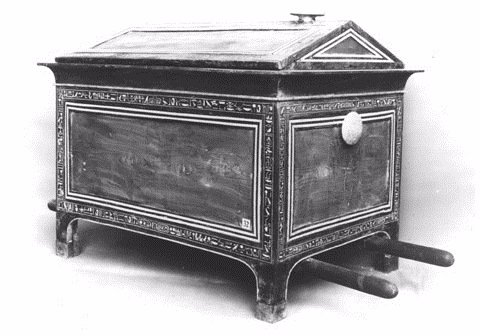
Ark from Tutankhamun’s tomb with poles, but a different lid

With this promise, God begins telling Moses how to make the portable tent-sanctuary.  In this week’s Torah portion, Terumah (“Donation”), God begins by describing the ark to be placed inside the Holy of Holies, the innermost room of the sanctuary.  The ark will be a box or coffer made of gold-plated wood, with gold rings for permanent carrying-poles.  Inside the ark will be the testimony, e.g. the stone tablets with the commandments.  The lid of the ark will be made out of pure gold.  The Torah calls this lid the kaporet (כַּפֹּרֱת) = atonement-cover; reconciliation, atonement.

And you will make two keruvim of gold; you will make them hammered out of the two ends of the atonement-cover.  You will make one keruv at one end, and one keruv at the other end; from the atonement-cover you will make the keruvim, on both of its ends.  And the keruvim will be spreading their wings upward, sheltering the atonement-cover with their wings; and their faces will be turned one another; the faces of the keruvim will be turned toward the atonement-cover.  (Exodus/Shemot 25:18-20)

keruv (כְרוּב), plural keruvim (כְרוּבִים) = a winged hybrid beast, usually with a human head and an animal body.  (Cherub in English.)


Two stone lions crouch on either side of the main entrance to a library, a civic building, or a mansion.  Usually they face the person who approaches, looking stern and regal, but sometimes they face one another.  Architects have used flanking statues for centuries, the world over, to make entrances more impressive.

Door guardians from palace of Ashurnasirpal II, Metropolitan Museum of Art, NY (photo by MC)

In ancient Mesopotamia, the colossal statues on either side of an entrance  were hybrid winged beasts with human heads, called lamassu in Sumerian and shedu or kuribu in Akkadian.  Scholars say the word kuribu is related both to the Akkadian word karabu, “to pronounce formulas of blessing”, and to the Hebrew word keruv.

Now imagine two winged beasts facing one another, guarding neither a city gate nor a door into a building, but a portal into another world, another reality.  Science fiction?  No, Torah.

The Torah portion Terumah explains that when the sanctuary is finished, God will speak to Moses from the empty space between the two keruvim.

“And I will speak to you from above the atonement-cover, from between the two keruvim that are upon the Ark of the Testimony, everything that I am commanding you and the Israelites.”  (Exodus 22)

This is neither the first nor the last place where the Torah mentions winged figures called keruvim.  The first reference is when the first two human beings are banished from the Garden of Eden.

And [God] drove out the human, and stationed at the east of the garden of Eden the keruvim and the flame of the sword of the continually-transforming, to guard the way to the Tree of Life.(Genesis/Bereishit 3:24)

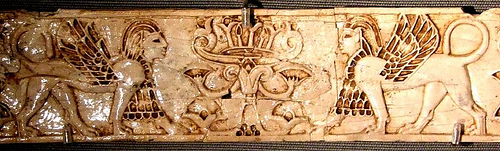
An image of keruvim flanking a tree of life is not unusual in the Ancient Near East.  But in the Torah, the keruvim are also guarding the entrance to a world called the garden of Eden.

Phoenician sphinxes and the tree of life

When the ark is carried into battle against the Philistines, it is referred to as: “the ark of the covenant of the God of Armies Sitting on the Keruvim.”  (I Samuel 4:4)  Here the keruvim are not guarding an entrance, but are flanking an invisible God.  The army hopes, in vain, that the ark with its keruvim will guard the soldiers from their enemies.

When King Solomon builds a permanent temple, he places two colossal gilded keruvim in the innermost chamber.  Their anatomy is not described, but their wings touch in the center of the room.  (I Kings 6:23-27)  Keruvim are also used as a decorative motif in the temple walls, as they are in the woven curtains around the inner chamber of the portable sanctuary.

The four mysterious hybrid creatures in vision of the prophet Ezekiel are also called keruvim.  Ezekiel’s keruvim have four wings each, human hands, calves’ hoofs, and four faces each (human, lion, ox, and eagle).  The throne where God’s glory appears hovers above them.  (Ezekiel 1:4-12 and 10:1-21)

Psalm 18 paints a metaphorical picture of God descending from the heavens to rescue King David from his enemies, and borrows a Canaanite image of the sky god riding on a winged steed.

          And [God] rode on a keruv and flew,

          And swooped on the wings of the wind.  (Psalm 18:11).

What do these references to keruvim mean?  If we look behind the descriptive details borrowed from neighboring cultures, keruvim seem to define a location for the appearance of God’s glory or presence.  The location might be between the keruvim, as in this week’s Torah portion, or above them, as in Ezekiel and Psalm 18, or behind them, as in Genesis.

Keruvim combine the traits of many animals, including humans.  Yet they are supernatural, existing somewhere between our reality and the transcendence of God.  Therefore they mark the dividing line between our world and a divine world we can neither enter nor understand.

Yet in Torah this dividing line is not a wall, but a gateway.  As long as we live in this world we cannot pass through the gate.  But we can imagine the entrance to the Garden of Eden.  And we can imagine God speaking to Moshe through the empty space between the keruvim above the ark, even if we can never enter the Holy of Holies ourselves.


One effect of this invisible portal to another reality, this gap in our universe, is that human beings feel a yearning that can never be satisfied by the things of this world.  The yearning keeps us searching—for love, for beauty, for the good, for the divine.  That is what it means to be human.

Maybe Adam and his counterpart Eve are not really human until they are expelled from the Garden of Eden.  Only then can they feel yearning.

Today we human beings still yearn for the ineffable.  And we are still responsible for using the passion of our yearning to fix the world we live in and make it more like the world we yearn for.

(This blog was first posted on February 7, 2010.)

Beshalach: Pillar of Cloud and Fire

Humans often hear God’s voice in the Torah, but there are only two verses where humans might be seeing part of God: when the elders climb Mount Sinai and behold God’s feet in Exodus 24:10, and when God lets Moses see his back in Exodus 33:23.  The rest of the time, God becomes manifest through two kinds of supernatural messengers (called angels in many English translations). One kind looks like a human being, and the other kind looks like an annatural fire.

One of these supernatural fires is the pillar of cloud and fire that leads the Israelites from the border of Egypt all the way to the Jordan River. This pillar first appears in this week’s Torah portion, Beshalach (“when he was sending out”).

After the tenth plague, Pharaoh finally sends the Israelites out of Egypt.  When they cross the border of Egypt and head into the wilderness, the Torah says that God “went before them”. Then it describes the messenger that actually went before them:

And God went before them; by day, in an amud of cloud to lead them down the road, and by night, in an amud of fire to give light for them, for walking by day and night.  The amud of cloud by day and the pillar of fire by night never withdrew from before the people.  (Exodus/Shemot 13:21-22)

amud (עַמּוּד) = pillar, column, upright support. (From the verb amad. עָמַד = stand, take a stand.)

Pillar of Cloud, by Johann Jakob Scheuchzer, 1731

The commentary is divided on whether there is one pillar or two.  But if the pillar of cloud is replaced by a separate pillar of fire for the night, what does the changing of the guard look like?  The Torah never describes it.

Pharaoh changes his mind about releasing the Israelites, and sends an army unit of charioteers after them. The Egyptians catch up with the Israelites just as they have pitched camp on the shore of the Sea of Reeds. 

Then the messenger of God pulled out, the one going before the camp of Israel, and it went behind them; thus the amud of the cloud pulled out from before them, vaya-amod behind them.  Thus it came between the camp of Egypt and the camp of Israel, and it was the cloud and the darkness, and it lit up the night, so that this one did not come near this one, all the night.  (Exodus 14:19-20)

vaya-amod (וַיַּעֲמֺד) = and it stood, and it stationed itself. (A form of the verb amad.)

Moses follows God’s instructions and raises his hand over the sea, and God uses a strong east wind to dry up a swath of the sea. The Israelites walk across, between the two walls of water. But the Egyptian charioteers are stuck behind the pillar of fire until dawn.

Rabbi Ovadiah Sforno, a 16th-century Italian commentator, wrote that the angel, the pillar of cloud, and the pillar of fire were three separate things, and the messenger or angel came down to direct the two pillars, which both circled around to stand behind the Israelites, between their camp and the camp of the Egyptian army. But the text itself contradicts his interpretation:

And it was in the morning watch when God looked down on the camp of Egypt from an amud of fire and cloud, and it put the camp of Egypt into an uproar.  (Exodus 14:24)

Here the Torah says that God is in “a pillar of fire and cloud”, which sounds like one pillar containing both elements. I picture a pillar that looks like a column of fog in the daylight. As it gets dark, people see sparks of fire in the cloud, and at night only the column of sparks is visible. When dawn comes during the “morning watch” of the night, the cloud can again be seen through the sparks. Since the pillar itself is God’s messenger, God looks down from the amud.

This pillar can only be divine.  A whirlwind can form a temporary pillar of cloud, a bonfire can make a pillar of sparks, and an erupting volcano can do both. But a continuously moving pillar of cloud and fire is a miracle.

And this pillar not only controls the movements of the Egyptians, but also communicates a message to both camps: that God stands up for the Israelites, protecting them from the Egyptians. Looking down from the pillar of cloud and fire, God puts the Egyptian army in an uproar by making their chariot wheels get stuck or fall off.  Only then, when it is too late, do the Egyptians recognize that God is waging war on them, and decide to flee.

The amud continues to serve more than one purpose in the books of Exodus and Numbers. When the Israelites are traveling, rather than camping, the pillar is a guide showing them which way to go.  It is also a reminder that God is with them—that God is “taking a stand” for them, and they must “take a stand” for their god.

Furthermore, fire naturally inspires awe and fear.  A cloud, on the other hand, is usually made of fog.  In the desert, moisture is a welcome caress on the skin, a gentle gift, a reminder of God’s kindness.  God’s kindness is confirmed later in the story by the fact that even after the Israelites do things that enrage both Moses and God, even after they make the Golden Calf, the pillar of cloud and fire returns to lead them.

No matter how visible the reminder of God’s presence in our world, people will ignore it if they are fixated on having their own way.  It’s a replay of Pharaoh’s refusal to take the miraculous plagues seriously.  When we are determined to solve a problem by eliminating it, we override any inner qualms, whether they appear as cloud, the heart-softening temptation of kindness, or as fire, the nagging fear that we are playing god or doing something wrong.

But if we try to be holy people, metaphorically taking a stand with God, we can recognize both kindness and awe as manifestations of the divine, inspiring us to take the right path.  We have a better chance of noticing when we are fixated on killing a problem.  We can look around for other solutions, other ways of dealing with the problem, even other ways of working with problematic people.

Instead of getting stuck in the muck and drowning, we can continue on our journey, guided by the pillar of cloud and fire within.

(This blog was first posted on January 9, 2011, and revised in January 2023.)

Yitro: Not in My Face

Moses, frieze on U.S. Supreme Court building, by Adolph Weinman

Terrified by a direct experience of God, the people ask Moses to be their intermediary and tell them God’s orders.  So God gives Moses the “Ten Commandments” in this week’s Torah portion, Yitro.  Both “Ten” and “Commandments” are designations invented by commentators; the Torah merely introduces the set of fundamental obligations with:

And God spoke all these words, saying—  (Exodus/Shemot 20:1)

The next sentence is:

I am God, your God who brought you from the land of Egypt, from the house of slaves.  (Exodus 20:2)

Some commentators count this as the first commandment, and Exodus 20:3-6 as the second commandment, prohibiting other gods and idols.  But the reminder that the God of Israel delivered the people from slavery in Egypt does not sound like a commandment to me.  I agree with commentators who count Exodus 20:3, prohibiting other gods, as the first commandment, and Exodus 20:4-6, prohibiting physical objects as idols, as the second commandment.

The verse prohibiting other gods reads:

You must have no elohim acheirim al panai.  (Exodus/Shemot 20:3)

elohim acheirim (אֱלֺהִים אֲחֵרִים) = other gods; gods of others.

al (עַל) = on, upon, over, above; besides, in addition to; over against; concerning; because of.  (The most common meaning of al is “on: or ”over”, but verse 5 explains that you must not worship anything else but God—so verse 3 cannot mean that it’s okay to serve other gods as long as they are below God. )

panai (פָּנָי) = my face, my presence, my surface, my visible side, my identity.

Here are five literal translations of this ambiguous commandment:

      You must not have other gods besides My presence.

      You must not have gods of others in addition to My presence.

      You must not have gods of others in addition to My visible side.

      You must not have other gods over against Me.

      You must not have other gods in My face.

First let’s look at the difference between “other gods” and “gods of others”, two phrases that are identical in Biblical Hebrew.  If the Israelites can’t have “other gods”, they are forbidden to worship not only the gods of others, but also any gods they happen to think of or notice on their own.  Therefore they must not worship any manifestations of God, such as angels or the stars or nature.  Modern commentary sometimes adds that we must not make a god out of wealth, or having a perfect body, or any other value exalted by our culture.  We may only have one God.

On the other hand, if the Israelites can’t have “gods of others”, the focus turns to the kind of gods worshiped by Egyptians, Mesopotamians, and Canaanites.  These peoples made idols in an effort to entice gods to come down out of the heavens or up from under the earth and inhabit their statues, the way humans inhabit their bodies.  A god living in a statue is easier to communicate with, and easier to appease and honor and butter up so it will act for your benefit.

Throughout the Torah, God may appear as a humanoid angel or as fire or a cloud, but what we see is God’s choice of manifestation, not the work of our own hands.  The vision may disappear at any moment; it is not solid; it cannot be set on a table or paraded through town.  Therefore God is not like the gods of others.

Reading elohim acheirim as “gods of others” leads right into the next three verses in this week’s Torah portion:

Do not make yourself a carved idol or any likeness of what is in the heavens above, or of what is in the land below, or of what is in the water beneath the land.  Do not prostrate to them and do not serve them.  Because I am God, your god, a jealous god, calling to account the wrongdoing of fathers upon children over the third and fourth (generations), for my enemies; but doing kindness to the thousandth (generation) for those who love me and who observe my commandments.  (Exodus 20:4-6)

This continuity supports the theory that Exodus 20:3 and Exodus 20:4-6 are one “commandment”, but it makes the list of what the people must do and not do add up to nine instead of ten.

The ambiguity is not over.  What about the last two words of Exodus 20:3, al panai?

If the phrase means “over against Me”, or even “in My face”, it is a warning that God would be offended if you worshiped any other gods.  After all, God is the one who rescued you from slavery (Exodus 20:2).  And God is a “jealous” god, i.e. passionately exclusive (Exodus 20:5).

However, if al-panai is translated as “in addition to My presence” or “besides My presence”, it means simply that the Israelites must worship and serve only the one god.  Some commentators who have translated the word panai as “My presence” have interpreted it as meaning that God is present everywhere and at all times, so don’t think you can get away with having another god without the One God noticing.

But since the next verse in Exodus begins “Do not make yourself a carved idol”, I think panai means both “My presence” and “My visible surface”.  The Torah contrasts the carved idols that are supposedly inhabited by the gods of others with the presence of the God of the Israelites, which is sometimes visible as a vision of an angel or a fire, and sometimes invisible, as when God speaks from the empty space above the cherubim in the Holy of Holies.

Similarly, sometimes the God of the Torah is audible to everyone, as a sound like thunder or the blowing of rams’ horns.  And sometimes God is audible only to one person, who “hears” the words that God speaks inside him or her.

*

The commandment in Exodus 20:3 not only orders us to refrain from serving other gods, but also asks us to serve our God.  How do we do that?

How can we honor the face of God, when God cannot be contained in a statue, a synagogue, a church, a mosque, or even the Holy of Holies?  What can we do when God makes its presence known unpredictably, when you never know where, when, or who will become aware of God for a moment?

And how can we serve our elusive God when even the Ten Commandments give us only a general idea of what we are supposed to do?  And when half of the more specific laws in the Torah were dropped as inapplicable more than 1,500 years ago in the Talmud?

Does anyone today have the authority to tell us how to serve God?  What actions and attitudes can we take that count as service?

I’m working on some answers to those questions.  It will take me the rest of my life.

(An earlier version of this blog was posted on January 16, 2011.)


Ki Tissa: Out Came This Calf!

(This blog was first posted on February 16, 2011.)

While Moses is having a 40-day conversation with God on top of Mount Sinai, the people down below are wondering if they’ll ever see their leader again.

Thanks to his special relationship with God, Moses got them out of Egypt and as far as Mount Sinai.  He climbed up the mountain several times to communicate with God, and finally God and the people made a formal covenant.  At the end of that ritual, the 70 elders climbed halfway up Mount Sinai, met God,  and sat down to eat.  (See my post Mishpatim: After the Vision, Eat Something.)  Then Moses climbed the rest of the way up Mount Sinai.

The 70 elders came down and reported that everyone should stay at the foot of the mountain, and whoever had matters to speak about should approach Aaron or Chur (the two lieutenants who supported Moses’ arms for the victory over Amelek).  Seven days after that, the people see the glory of God like a fire on top of Mount Sinai. (See my  post Mishpatim: Seeing the Cloud.)  But Moses does not come back down.

In this week’s Torah portion, Ki Tissa (“when you lift up”), the people despair of ever seeing their leader again.

The people saw that Moses was taking too long to come down from the mountain, and the people gathered against Aaron, and they said to him: “Get up!   Make for us gods that will go before us, because this man Moses who brought us up from the land of Egypt, we don’t know what happened to him.”  (Exodus 32:1)

They are asking for a replacement for Moses, not a replacement for God.  They need an intermediary to “go before” them, to show them both where to walk and how to behave.  The pillar of cloud and fire that led them across the Reed Sea is gone (transmuted, perhaps, into the cloud and fire that appears at the top of Mount Sinai).  Now Moses is also gone.  So they want a new guide: “gods”, elohim, idols.

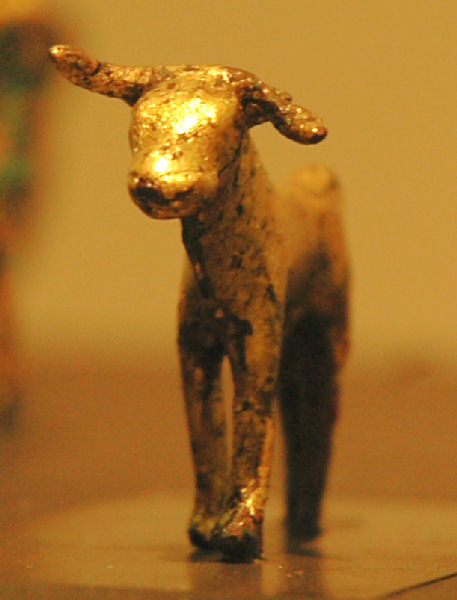
Gold calf from Temple of Baalat, Byblos

And Aaron said to them: Strip off the gold rings that are in the ears of your women, your sons, and your daughters, and bring them to me. …  And he took from their hand, and he shaped it with the chisel, and he made a bull-calf of metal-work; then they said: These are your gods, Israel, that brought you up from the land of Egypt   (Exodus 32:2, 4)

cheret = chisel, stylus, engraving tool; an item used by an Egyptian seer or magician

Alas, when Moses descends after 40 days with the stone tablets from God, the people are having an orgy in front of a golden idol.  He flings down the tablets and shatters them.  He grinds up the calf, dumps the gold dust in water, and makes the Israelites drink it.  Then he asks Aaron: “What did these people do to you, that you brought such great guilt upon them?”  Aaron’s answer is revealing.

They said to me: Make for us gods that will go before us, because this man Moses who brought us up from the land of Egypt, we don’t know what happened to him.  And I said to them: Who has gold?  They stripped it off themselves and they gave it to me.  So I flung it into the fire, and out came this bull-calf.  (Exodus 32:23-24)

Aaron’s first sentence repeats the Torah’s earlier account word for word.  But then, instead of admitting that he personally shaped the gold into a calf, Aaron gives what sounds like a child’s lame excuse.  Why doesn’t he confess?

Classic commentary, including Vayikra Rabbah and Rashi, points out that Moses put Aaron and Chur in charge while he was up in the clouds listening to God—and Chur is never mentioned again.  Therefore, the subset of the people who wanted idols must have come to Chur first, and killed him when he refused to cooperate.  Next the gang approached Aaron.  Aaron was afraid they would kill him, too, and the Israelites would incur guilt before God for a second murder.  So he cooperated, but proceeded as slowly as possible, hoping at each step that Moses would return and stop the people before they did anything worse. When Moses did return, Aaron gave him a brief, vague answer so as not to implicate anyone else in the crime.

I have an alternate explanation:     The 40 days that Moses is on top of Mount Sinai are a surreal time for Aaron.  He is still exalted by the vision of God on a sapphire pavement that he and the elders were granted halfway up Mount Sinai.  But many people lose hope and demand idols.  Chur refuses, and Aaron is shocked by his murder.  How can the glory of God and the murder of a respected elder coexist in the same world?  And how can God use Moses as his right hand, and then (apparently) let him die on Mount Sinai with the job of transforming history unfinished?

With despair, Aaron concludes that this religion of Moses’ doesn’t work.  You can’t count on God, and you can’t control anything God does.  Magic works better.  If you do magic right, you can count on the right result.  No wonder the priests of Egypt coaxed their gods into inhabiting idols!

Numbly, Aaron offers to melt gold for the rebels and see what happens. Maybe the God of Moses will manifest again.  Or maybe there will be a sign.

When the fire cools, the amorphous mass of gold looks vaguely like a calf.  If he squints, Aaron sees the four legs, the head, the body.  The second commandment forbids him from making a metal image from scratch, but this crude calf seems to have coalesced by magic.  Someone hands Aaron a stylus, a tool taken from an Egyptian magician the night before the exodus.  Aaron discovers he can easily make the mass of gold look even more like a calf.

And Aaron’s golden calf works like magic.  The people take heart again.  When Aaron uses the four-letter name of the God of Israel to call for animal sacrifices and feasting, the people rejoice; they are confident that the golden idol will replace Moses as their intermediary with God.

Later, when Moses questions Aaron, he tells the truth:  “I flung it into the fire, and out came this bull-calf.”  It was magic.

Magical thinking is still easier for us than religion.  Maybe only a small child believes that on Passover, an invisible prophet Elijah actually drinks the wine in Elijah’s cup.  But how many adults, in a desperate moment, pray to God by promising they’ll “be good”, they’ll do anything, if only God will give them what they’re asking for? And how many of us interpret mysterious events and coincidences as “signs” that something we’re reaching for is “meant to be”, intended by God?

We just fling our gold into the fire, and out comes a calf.

Pekudei & Vayakheil: Basin of Mirrors

(This blog was first posted on February 27, 2011.)

He (Moses) put the basin between the Tent of Meeting and the altar, and he placed water there for washing.  Moses and Aaron and his sons washed from it, their hands and their feet.  When they came into the Tent of Meeting, or when they came up to the altar, they washed as God had commanded Moses.  (Exodus/Shemot 40:30-32)

The last Torah portion in the book of Exodus/Shemot, Pekudei (“Inventories” or “Commissions” or even “Searches”) lists once again all the items made for the sanctuary and the priests’ garments, this time including the weight of the donated gold, silver, and bronze.  Moses assembles all the parts, and then God’s cloud appears and fills the new Tent of Meeting.  The portable dwelling-place for God is complete.

Its front half is a roofless courtyard surrounded by curtains, and contains the altar where slaughtered animals and grain are burned.  The back half is the new Tent of Meeting,  which is both curtained and roofed, and contains the holiest objects: the gold incense altar, the gold-covered bread table, the solid gold lamp-stand, and the gold-covered ark inside its own curtained alcove.  Only priests, and Moses, can enter the Tent of Meeting.

The wash-basin in front of the entrance to the Tent is critical for the transition between the public courtyard and the inner sanctum.  Washing in water symbolizes inner purification, the mental preparation necessary to enter a space where there will be closer communion with God.  In the Torah, hands stand for action and power.  By washing their hands, Moses and the priests dedicate their power and actions to divine service.  Feet are related to one’s path in life, the direction one is going psychologically as well as physically; the greatest men in the Torah are described as “walking with God”.  By washing their feet, Moses and the priests rededicate themselves to walking with God.

The wash-basin where this ritual takes place is made of bronze—but it’s not the same as the bronze donated by all the people with willing hearts and melted down to make the altar and its utensils.  Last week’s Torah portion says the basin is made out of bronze mirrors:

He (Betzaleil) made the basin of bronze, and its stand of bronze, with the mirrors of the army (of women) who mobilized at the entrance of the Tent of Meeting.  (Exodus/Shemot 38:8)

nechoshet = bronze, copper.  From the same root as nachash= snake; and nicheish = practice divination, seek omens.

marot = mirrors; apparitions.  (Mirrors in the ancient Middle East were made of highly polished bronze, and were luxuries for the rich.)

tzav-u = mobilized, went to war, served in the cult, joined in public service

The unusual donation of mirrors led to a story in Midrash Tanchuma, a 5th-century commentary, that when the Israelites were slaves in Egypt, the women used mirrors to entice their husbands into lying with them and producing more children.  Moses hesitated to make a holy object out of mirrors, which are instruments of vanity.  But God overruled him on the grounds that the women had used their mirrors for the good deed of multiplying the children of Israel.  And the master-craftsman Betzaleil used the mirrors to make the wash-basin.

This fanciful story was accepted by many subsequent commentators.  But I think it is inconsistent with the descriptions in Exodus/Shemot of the Israelite slaves as poor and oppressed.  Surely they could not afford anything as expensive as bronze mirrors!  The only time in the book of Exodus when the Israelite women could acquire mirrors is the day before they leave Egypt, when Moses tells them to take gold and silver jewelry from the Egyptians.

So why does the Torah say the wash-basin at the entrance of the Tent of Meeting is made out of bronze mirrors?

It’s always possible that an odd detail in the Torah refers to some ancient practice that occurred outside the story, perhaps in the cult of another group of people.  But what I notice is that a priest washing his hands and feet at the entrance of the Tent of Meeting would see a double reflection: a reflection on the surface of the water, and a reflection from the polished bronze basin.

Samson Raphael Hirsch, a 19th-century rabbi, wrote that the language in this verse might mean the mirrors were not even melted down, but only welded together in a form where they could still be recognized.  Perhaps the basin would even show a different reflection in the surface of each mirror.

Furthermore, the basin was made by Betzaleil, whose name means “In the Shadow of God”.  A shadow provides protection from the harsh sun of the Middle East, so some commentary notes that Betzaleil is under God’s protection.  But a shadow is also a type of reflection; the original thing casts a shadow on the ground, just as the original thing casts a reflection in a mirror.  The Hebrew word for shadow, tzeil, is the root of the word tzelem, which means “image”.

So when a priest steps up to the bronze basin, he sees multiple reflections of the sky and of his own body, and perhaps multiple reflections of the heavens, his own soul, and other aspects of God.  After all, the basin was made by “In the Shadow of God”, and the word for “bronze” comes from the same root as “divination”.  All of these reflections from the basin, besides reminding him that he is preparing to come closer to God, provide food for the priest’s inner reflections.  Has he been using his body the right way?  Has he been mired in harmful thoughts and emotions?  Or has he been acting like someone made betzelem elohim, in the image of God?

After he has reflected, the water from the basin purifies him as he washes and rededicates himself to the path of holy service.

We could all benefit from washing at a basin of mirrors before we pray, or meditate, or take a moment to reflect on our lives.