Mishpatim & Psalms 39 and 119: Foreigners

(One of a series of posts comparing ideas in the book of Exodus/Shemot with related ideas in the book of Psalms.)

Us and them.  Citizens and foreigners.  Friends and enemies.

Human nature always divides members of our species into two or more groups. But how we treat the “out” group depends on our ethical, religious, and political rules.

This week’s Torah portion, Mishpatim (“Laws”), is set at Mt. Sinai, long before the Israelites conquer part of Canaan and set up their own government. But it includes a series of laws written after the kingdoms of Israel and Judah were founded. One of the subjects these laws address is how to treat immigrants and conquered natives.

Egyptian beating a slave

A geir you shall not cheat nor oppress, since you were geirim in the land of Egypt. (Exodus/Shemot 22:20)

geir (גֵר) = foreigner, stranger, resident alien, sojourner, immigrant, non-citizen.  From the root verb gar (גָּר) = sojourned, stayed with, resided with.

geirim (גֵרִים) = Plural of geir.

(The meaning of geir shifted in Jewish writings after 100 C.E., coming to mean a proselyte or convert.)

After a few more laws, the Torah portion Mishpatim adds:

And a geir you shall not oppress, for you yourselves know the feelings of the geir, since you were geirim in the land of Egypt.  (Exodus/Shemot 23:9)

Unlike foreigners who are merely visiting another country, geirim are displaced persons who cannot call on their former clan chiefs (or national governments) for protection. They are at the mercy of the country where they now live, subject to the whims of its ruler and its wealthy citizens. Unless their new host country protects them, they are subject to deportation even when they no longer have a home to return to (like resident aliens in the United States today), or to slavery (like the Israelites in Egypt at the beginning of the book of Exodus).

This week’s Torah portion gives one example of not oppressing a geir who works for you:

Six days you shall do your doings, but on the seventh day you shall stop, so that your ox and your donkey shall rest, and the son of your slave woman and the geir shall refresh their souls.  (Exodus 23:12)

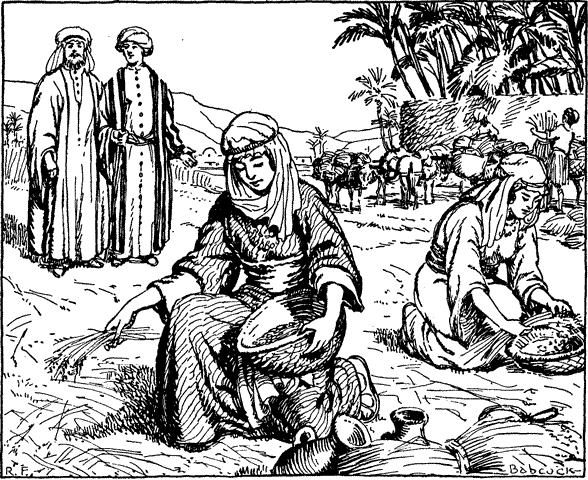
Ruth (a foreigner) Gleaning, by R.F. Babcock
Ruth (a foreigner) gleaning,
by R.F. Babcock

The Hebrew Bible includes many further injunctions to treat geirim with consideration.1  In summary, if geirim are servants of Israelites, they must get the same holiday feasts and days off as native slaves or servants.  If geirim are hired laborers, they must be paid daily, like Israelite laborers.  If geirim are not attached to an Israelite household and are impoverished, they get the same rights as impoverished citizens.  Geirim are even urged to flee to the same cities of refuge if they are unjustly accused of murder.

Since the kingdoms of Israel and Judah are theocracies, treating their geirim like citizens also means the geirim must conform at least outwardly to Israelite religious life, and suffer the same punishments for transgressions.2

However, two kinds of discrimination against geirim are sanctioned in the Torah: an Israelite may not charge interest on a loan to a kinsman, but may charge interest on a loan to a geir 3; and while an Israelite can always redeem a kinsman from slavery by paying the slave’s owner, a geir has no such right.4

Nevertheless, the Bible urges the Israelites to love the geirim living in their land.5

Mt. Gezerim left, Mt. Eival right.
Mt. Gezerim left,
Mt. Eival right.

In three books of the Bible, resident geirim are even included in the covenant with God.6  One example is when Joshua enters Canaan and enacts a ritual of covenant at Mt. Eival.

All Israel—its elders, its officials, and its judges—were standing on either side of the ark, facing the priests of the Levites, carriers of the ark of the covenant of God—the geir the same as the native.  (Joshua 8:33)

(In this case, “native” (ezrach, אֶזְרָח) means someone of Israelite ancestry, since both the Israelites and their fellow travelers are newcomers to Canaan.)

Another example is when the prophet Ezekiel predicts a new covenant with God once the Israelite deportees in Babylon move back to their old land.  In this covenant, people who were once geirim become citizens of the tribes they lived with.

You shall divide up this land for yourselves among the tribes of Israel. And you shall cast [lots] for hereditary possessions, for yourselves and for the geirim who are garim among you … And the geir will be in the tribe that gar with; there you will give him his hereditary possession—declares my Master, God.  (Ezekiel 47:21-23)

garim (גָּרִים) = sojourning, staying with, residing with as foreigners.  (From the root verb gar.)

gar (גָּר) = he sojourned, stayed with, resided with.

All these rules ensuring fairness to the geirim would not have been written unless some native Israelites were mistreating resident aliens.  The Torah correctly points out that the geirim are vulnerable outsiders, just as the Israelites were once vulnerable outsiders in Egypt.

*

Psalms 39 and 119 take the idea of the geir to the next level.  If non-citizens are vulnerable in the country where they live, then perhaps humans are vulnerable before God, whose ways are mysterious.

Psalm 39 introduces a speaker who is worried about the shortness of his life.  He alludes to a scourge from God, probably an illness.  The psalm concludes:

praying           Hear my prayer, God,

                        And listen to my cry for help!

                        Do not be silent to my tears.

            For I am a geir with You,

                        A resident alien, like all my forefathers.

            Look away from me, and I will recover,

                        Before I depart and I am not.  (Psalm 39:13-14)

Like a geir, this psalmist feels vulnerable and uncertain of God’s ultimate protection.  Instead of asking God to intervene, he begs God to ignore him so he can at least enjoy the remainder of his short life.  A geir does not dare to ask for too much.

*

Psalm 119, written during the time of the second temple, is the longest in the book of Psalms.  Its 176 verses begin with letters of the alphabet from alef to tav, the equivalent of the English A to Z.  There are eight verses for each letter, and all are variations on the theme of praying to God for help in learning and understanding God’s laws.  The verses that begin with the letter gimmel (ג) open with:

           Finish maturing (גְּמֺל) Your servant!  I will live and I will observe Your word.

            Uncover (גַּל) my eyes, and I will look upon the wonders of Your teaching.

            A geir (גֵּר) I am in the land; do not hide from me Your commands.

            My soul pines away (גָּרְסָה), longing for Your laws at all times.  (Psalm 119:17-20)

The psalmist expresses the feeling of being a vulnerable outsider who does not understand what is really going on.  Anyone who seeks to serve a God who has issued hundreds of laws yet remains inscrutable feels like a geir.  The overall theme of Psalm 119 is the longing to understand what God wants—which is like the longing of geirim to understand how things work in the strange country where they now live.                    

*

I appreciate how the Torah insists we must treat non-citizens with fairness and consideration, and reminds us that we have all been geirim at some time.  Even if we have enjoyed the rights of the innermost in-group of native citizens our whole lives, we are still geirim with God.

And even within our own social circles, we get along better if we keep working to understand what our friends are really saying, how the world really looks to them.  Ultimately, each of us is a geir with every other person, as well as with God—and perhaps even with ourselves.

1  Enjoying Shabbat and holidays:  Exodus 12:19, 12:48, 20:10, 23:12; Numbers 35:15; Deuteronomy 5:14, 16:14, 26:11-13.

Receiving wages promptly:  Deuteronomy 24:14.

Receiving assistance like the native poor:  Geirim are usually listed along with widows and fatherless children as entitled to glean produce from private fields, orchards and vineyards (Leviticus 19:10, 23:22; Deuteronomy 21:20, 24:17, 24:19, 24:20; also see Ruth ch. 2); to take home a share of the tithe for the poor (Deuteronomy 14:28-29); and to receive just redress (Deuteronomy 24:14; Jeremiah 7:6, 22:3; Zechariah 7:10; Malachi 3:5).

Using cities of refuge: Joshua 20:9.

2  Observing the native religion:  Both citizens and geirim must fast on Yom Kippur (Leviticus 16:29), bring their burnt offerings to the alter of the God of Israel (Leviticus 17:8-9, 22:18), refrain from eating blood (Leviticus 17:10, 17:13), obey Israelite laws about permitted sexual partners (Leviticus 18:26), avoid taking God’s name in vain (Leviticus 24:16), and refrain from worshiping idols (Leviticus 20:2; Numbers 15:26, 15:29, 15:30, 19:10; Ezekiel 14:7).

3  Paying interest:  Leviticus 25:35.

4  Lacking the right of redemption:  Leviticus 25:35-36.

5  Being loved: Leviticus 19:33-34; Deuteronomy 10:18-19, 24:14.

6  Being included in the covenant: Deuteronomy 29:9-11, 31:12; Joshua 8:33, 8:35; Ezekiel 47:21-23.


Haftarat Mishpatim—Jeremiah: False Freedom

Every week of the year has its own Torah portion (a reading from the first five books of the Bible) and its own haftarah (an accompanying reading from the books of the prophets). This week the Torah portion is Mishpatim (Exodus 21:1-24:18), and the haftarah is Jeremiah 34:8-22.

Town by town, city by city, the armies of King Nebuchadnezzar took over the land of Judah. The country could have remained a semi-independent vassal of Babylon, keeping its own temple and running its own internal affairs. But the last three kings of the Israelites had rebelled against their overlord. And each time Nebuchadnezzar’s retaliation had been more severe.

King Nebuchadnezzar
King Nebuchadnezzar

The prophet Jeremiah kept warning the kings of Judah to keep paying tribute to Babylon, but they never listened to him. Instead they flirted with Egypt. Only Jeremiah realized what was obvious to the Babylonians: that when Pharaoh Nekho lost the big battle with Nebuchadnezzar at Carchemish in 605 B.C.E., and lost all his vassal states to the new Babylonian Empire, Egypt was finished as a world power.

When King Yehoyakhim of Judah stopped paying tribute to Babylon in 597 B.C.E., Nebuchadnezzar besieged Jerusalem until it surrendered. When King Zedekiah stopped paying tribute eight years later, after secret negotiations with Egypt, the Babylonian army surrounded Jerusalem again.

This time Nebuchadnezzar also conquered the rest of Judah, town by town and city by city.

Trapped in Jerusalem, unable the send their slaves out to the fields to plant and harvest, the leaders of Judah were getting desperate. Soon their city would fall, and they would all be killed or, at best, deported to Babylon. Only a miracle could save them.

The god of Israel had made miracles for the Israelites before. The priests were still serving God in the temple. What more was needed? How could they win God’s favor again?

In this week’s hafatarah, it occurs to King Zedekiah that the people of Judah have been ignoring one of God’s commands:

If your brother or sister Hebrew sells himself to you, then he shall serve six years, and in the seventh year you shall let him go chafshi from you. And when you let him go chafshi from you, you shall not let him go empty-handed… (Deuteronomy/Devarim 15:12-13)

chafshi (חָפְשִׁי) = emancipated, freed. (Plural: chafshim.)

In ancient kingdoms of Israel and Judah, men who could not pay their taxes or other debts sold themselves or their children as temporary slaves. After six years of service, their owners were required to set them free, and give the men a food supply and the means to make a living.

But the slave-owners of Judah had let the years pass without emancipation.

… the king, Zedekiah, cut a covenant with all the people who were in Jerusalem, to proclaim for them a dror: for each man to let go of his male slave and his female slave, the Hebrew male and the Hebrew female, chafshim, so that no one would be enslaved by his fellow Yehudi. And they heeded [the proclamation], all the officers and all the people who had entered in the covenant … they heeded and they let them go. (Jeremiah 34:8-10)

dror (דְּרוֹר) = emancipation of slaves every seventh year and every  fiftieth year.

Yehudi (יְהוּדִי) = citizen of Judah; Jew. (From Yehudah (יְהוּדָה) = the kingdom of Judah, the tribe of Judah, or the individual Judah in the book of Genesis.)

The slave-owners in Jerusalem had more than one reason to free their slaves. Besides wooing God’s favor, the general emancipation also meant that the owners no longer had to feed their slaves. And since no one could work in the fields anyway, the government could recruit the emancipated men as soldiers to help defend the city.

The siege lifted briefly when an Egyptian army marched north, perhaps intending to honor its new alliance with the king of Judah.  Most of the Babylonian army departed to take care of the Egyptian annoyance, and for a few months life in Jerusalem could return to normal.

Unfortunately, it did.

And later they turned back, and they took back the male slaves and the female slaves whom they had let go chafshim, and they subjected them to slavery [again]. Then the word of God happened to Jeremiah… (Jeremiah 34:11-12)

Jeremiah the Prophet and King Zedekiah, 1897 illustration
Jeremiah the Prophet and King Zedekiah,
1897 illustration

Through his prophet, God reminds the people in Jerusalem that Hebrews enslaved because of debt must be freed in the seventh year. God continues:

“One day you yourselves turned around and became upright in My eyes, proclaiming a dror for each man from his fellow, and you cut a covenant before Me in the house that is called by My name. But now you have profaned My name; each of you has brought back his male slave and his female slave that he had let go chafshim to follow their desire, and subordinated them to be male slaves and female slaves for you [again].

“Therefore, thus says God: [Since] you did not listen to Me proclaiming a dror, each one for his brother and each one for his fellow, here I am, proclaiming to you a dror—declares God—to the sword, to disease, and to starvation! (Jeremiah 34:15-17)

Jeremiah’s prophecy points out the hypocrisy of the ruling class. They free their slaves only when feeding them is a burden—and when they hope to wangle an extra favor out of God. But the newly-emancipated slaves have no means to feed themselves. What kind of liberty is that?

Then as soon as it looks as though the ex-slaves can once more engage in agriculture, their former owners re-enslave them, making them responsible for feeding everyone.

So God threatens to emancipate the Yehudi the same way they emancipated their slaves—by abandoning them to death. After all, no human beings can live exclusively by their own power, without the world God provides.

Nebuchadnezzar takes Jerusalem James_Tissot_Flight_of_The_PrisonersIn fact, the Babylonians returned before the slaves of Jerusalem could bring in a harvest. In 586 B.C.E. the wall around the city was breached. Nebuchadnezzar blinded King Zedekiah, killed his sons, razed the capital, and burned down the temple. Judah became merely a district of Babylonia. The remaining ruling families were deported, and Jeremiah lingered in the ruins of Jerusalem.

(See my post Haftarah for Bo—Jeremiah: The Ruler of All Armies.)

In some parts of the world today, impoverished people are still kidnapped to become slaves (often for sex or war). Those of us who read blogs on the Internet, distant from the villages of Syria or Nigeria, might congratulate ourselves on never owning a slave or oppressing a debtor. But is that true?

Do we vote for political candidates who claim that everyone can succeed by their own efforts, even those who are not given the tools?  Do we find it acceptable that one accident, disease, or misinformed purchase can doom a person to poverty for life, with no second chance—not even after six years of suffering?

Do we treat our own children as slaves? Do we send them off, after the right number of years, with all the tools they need to make it on their own? Do we try to recapture and control them later?

Do we take advantage of someone over and over again, neglecting them when we do not need them?


Mishpatim & Ki Tissa: A Covenant in Writing

by Melissa Carpenter, maggidah

A covenant can be a comfort.  It’s reassuring to have a signed contract stating what you are required to do, and what the other party will do for you.  When we feel insecure about an arrangement, we say, “Can I have that in writing?”

This week’s Torah portion, Mishpatim (“Laws”) includes the first covenant in the Torah that is backed up in writing.  Yet it is broken sooner than any of the unwritten covenants in the book of Genesis/Bereishit—because one of the covenantal parties is God.

A classic covenant between two human beings is the compact between Jacob and his father-in-law, Lavan. Jacob heads back to Canaan with the family and livestock he acquired by serving Lavan for 20 years. Lavan, who does not want to lose his best employee, catches up with him on the heights of Gilead. They argue over who owns what, and then Lavan says:

So now, let us go and cut a brit, I and you… (Genesis/Bereishit 31:44)

brit (בְּרִית) = covenant, pact, treaty.

Standing stone at Gezer, Israel
Standing stone
at Gezer, Israel

The two men set up a standing-stone and a mound of stones to serve as a boundary marker, a “witness”, and a sign of their brit.  Lavan announces the terms: neither man will pass that boundary with hostile intent; and in addition, Jacob will neither mistreat Lavan’s daughters nor take any additional wives.

Then each man swears by a different name of the same God. Finally, Jacob slaughters animals, and the two chieftains and their men feast on the mountain.

Both leaders carry out the terms of their brit. Each party gives up something that might be in his self-interest (invading the other’s territory) in order to gain something that is definitely in his self-interest (safety from invasion by the other). The terms are reasonable, and the men do not want to violate a treaty made with an accepted ritual in front of three kinds of witnesses: boundary stones, other human beings, and God.

A brit with God is not so straightforward.

The first two times God declares a brit with human beings, it is really a unilateral promise, with no obligation stipulated for the humans. In the Covenant of the Rainbow, God promises not to destroy the earth with a flood again. In the Covenant of the Pieces, God promises to give Canaan to Abraham’s descendants.

God’s third brit repeats that God will give Abraham’s descendants, and adds that God will “be a god” to them and make them “nations” and “kings”. Then God says:

This is my brit, which you shall keep, between Me and you and your descendants after you: Let every male be circumcised. You shall all be circumcised in the flesh of your foreskins, and it will be a sign of the brit between Me and you. (Genesis 17:10-11)

Circumcision is the stipulated action for humans, the ritual, and the sign of the covenant, all in one. Jews have performed their part of the brit milah (Covenant of Circumcision) for thousands of years, with or without possession of the land of Canaan, because it is an act of dedication to God—and each infant boy or adult male convert only has to go through it once.

In the book of Exodus, when the Israelites reach Mount Sinai, God proposes a new brit, one that the commentary calls the Covenant of Blood. God gives the Israelites and their fellow-travelers the Ten Commandments, followed by a list of other laws, beginning with a second injunction against making “gods” of silver or gold, and ending (in this week’s Torah portion, Mishpatim) with: “you shall not cook a kid in its mother’s milk”. (Exodus/Shemot 23:19)

In return for obeying all these laws, God promises the people that they will never get sick, their women will be fertile and never miscarry, none of their lives will be cut short, their enemies will run away from them, and they will gradually take over not only Canaan, but all the land from the Mediterranean to the eastern wilderness and from the Euphrates in the north to the Reed Sea in the south.

This is the third time God promises to give the Israelites possession of the Promised Land.  But it is the first and only time God promises to exempt the people from natural law by making them super-human, with bodies that are invulnerable to illness, infertility, miscarriage, and even accidental death. Such a deal!

Moses makes sure this new brit is ratified with elaborate ritual, symbolic reminders, and even a written copy.

Then Moses wrote down all the words of God, and he got up early in the morning, and he built an altar at the bottom of the mountain, and twelve standing-stones for the twelve tribes of Israel.   … and they slaughtered animal-offerings of wholeness  for God … And half of the blood he sprinkled over the altar. And he took the Book of the Brit and he read it in the ears of the people, and they said: Everything that God has spoken, we will do and we will listen! Then Moses took the blood and he sprinkled it over the people, and he said: Here is the blood of the brit that God has cut with you concerning all these words! (Genesis 24:4-8)

The blood from the animal offerings is sprinkled both on the symbol of God (the altar), and on the people (or at least the elders in front). The people ratify the brit by shouting “we will do and we will listen”, indicating their willingness to obey not only these laws, but also any future laws God chooses to give them.

According to 20th-century commentator Nahum Sarna, the ritual is completed when God gives Moses an even more impressive symbolic reminder: a pair of stone tablets on which God writes the teachings and commandments.

The people violate their part of the brit only 40 days later, in the Torah portion Ki Tissa. While Moses is receiving the stone tablets on top of Mount Sinai receiving, the Israelites below lose hope that he will ever return, and revert to their old ideas of God. When Moses comes down, the people are carousing in front of the Golden Calf, in clear violation of the rule against making a god of silver or gold. So the whole elaborate brit becomes null and void, and Moses smashes the tablets.

God never makes the Israelites super-human. But Moses does persuade God to forgive them. And God declares a second, modified brit in which God commits only to driving out the peoples living in Canaan. On their side, the Israelites must obey a list of rules that begins with refraining from cutting a brit with any of the peoples they are supposed to be displacing, and ends with “do not cook a kid in its mother’s milk”. (Exodus 34:10-26)

And God said to Moses: Write down for yourself these words, because according to these words I have cut a brit with you and with Israel. (Exodus 34:27)

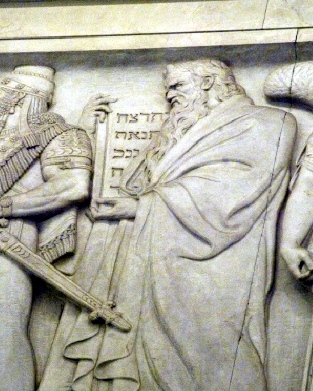
Moses on south frieze of Supreme Court building, by Adolph Weinman
Moses on south frieze of Supreme Court building,
by Adolph Weinman

The Ten Commandments are not explicitly mentioned, but most commentators assume they are included in the words Moses carves on a second pair of stone tablets.  Later the Israelites make a golden ark, following God’s instructions, and Moses places the tablets inside.

The Israelites continue to backslide on obeying God’s rules (though there is no record that they ever cook a kid in its mother’s milk).  In the book of Joshua, God does not drive their enemies away, so the Israelites conquer most of Canaan by conventional warfare. Thus the second brit between God and the Israelites is also a failure.

Yet the Torah continues to call the ark containing the stone tablets aron ha-brit, “Ark of the Covenant”, and it remains the Israelites’ most revered object until it disappears during the fall of the first temple in Jerusalem.

A contract between two humans, or a treaty between two nations, is a practical affair. The obligations of both parties are feasible and spelled out clearly. The proper ritual and witnesses help to enforce the brit.

A brit between humans and God is more like a modern marriage covenant. Both parties make lifelong promises without any practical limitations.  The ritual, witnesses, symbols, and written documents have emotional importance, but they do not prevent either party from falling short. At some point, a spouse is psychologically unable to be as loving and supportive as he or she intended. At some point, a religious human being is psychologically unable to obey every rule she or he has taken on. And God, at best, appears to operate on a non-human timeline.

Sometimes a marriage ends in divorce, and sometimes a brit with God ends in apostasy. But often, spouses pull themselves together and rededicate themselves to their marriage. And often, people seeking God rededicate themselves to the search for morality and meaning.

Each story of a brit with God remains a reminder of God’s presence. Even today, the two sets of stone tablets Moses brought down from Mount Sinai loom in our subconscious minds, reminding us that even if full compliance is impossible in a covenant with God, it is still worth dedicating ourselves to the call.

Mishpatim: Seeing the Cloud

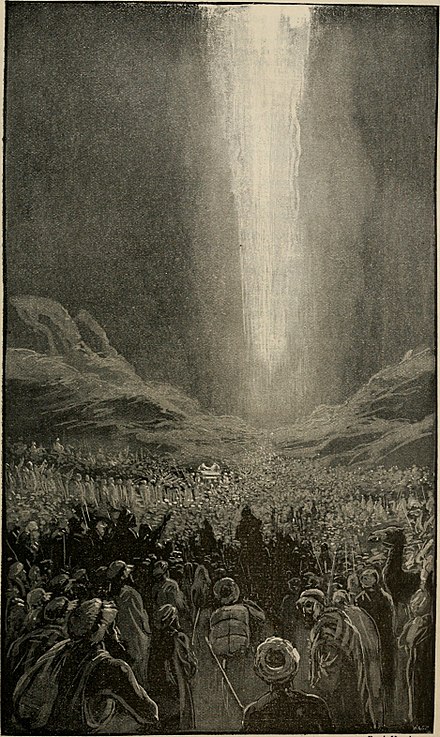
When God manifests in this world, what does God look like? In the book of Exodus/Shemot, God looks like either cloud or fire. Moses first encounters God as a voice in a burning bush. As soon as the Israelites leave Egypt, God sends a guide to lead the way: a pillar of cloud by day and fire by night. When God comes down on Mount Sinai to speak to all the people, … there was thunder and lightning and a heavy cloud on the mountain (Exodus/Shemot 19:16) … and all of Mount Sinai smoked with the presence of God that came down upon it in fire…(Exodus 19:18)

At the end of this week’s Torah portion, Mishpatim (“Laws”), God summons Moses back up the mountain to receive the stone tablets, the torah (“teaching”) and the mitzvah (“commandment”). As Moses climbs, the Torah describes more cloud and fire. But this time the Israelites below see Moses walking into fire, while Moses sees himself walking into cloud.

Then Moses went up the mountain, and the cloud covered the mountain. And the kavod of God rested on Mount Sinai; and the cloud covered it/him for six days. Then [God] called to Moses on the seventh day, from the midst of the cloud. But in the eyes of the children of Israel, the mareih of the kavod of God was like a consuming fire on the top of the mountain. (Exodus 24:15-17)

kavod (כָּבוֹד) = weight, impressiveness, magnificence, glory. (The kavod of God = a visible manifestation of God’s splendor.)

mareih (מַרְאֵה) = appearance, vision, apparition, mirror.

Moses is accustomed by now to living in close communication with a highly dangerous and powerful god. God has spoken to him at least 41 times already, and Moses often asks God questions and makes suggestions.

Yet he has not seen God directly. When God manifests in our world, Moses still sees only fire or  cloud. The nature of God is always hidden.

This time, Moses sees the cloud. But the people at the foot of the mountain do not see God’s kavod in cloud form. They see only a mareih of God’s kavod, an apparition or mirror image of it—God’s presence as reflected in their own minds. Having lived through the ten miraculous plagues in Egypt, not to mention the parting of the Reed Sea, no wonder they view God as so powerful, dangerous, and threatening that they are afraid God’s glory will eat them up. Their own feelings make the cloud look like a “consuming fire”.

They watch their leader Moses walk right into the fire, a fire nobody could survive. And they despair.

No wonder, after they have waited for 40 long days, they demand a safer manifestation of God—in the form of a golden calf rather than a fire.

Meanwhile, Moses waits inside the cloud on the mountain for six days. He can see nothing in the fog; he does not know what God is, what reality is, or what will happen. But at least he does not see fire; he is not afraid. He waits patiently for what God will give him. And on the seventh day, God calls to him.

And Moses entered into the middle of the cloud and went up the mountain. And Moses was on the mountain forty days and forty nights. (Exodus 24:18)

The Torah has already said that Moses was in the cloud, on top of the mountain. Is this verse a repetition of that information? I think not; I think it means that after Moses hears God call him, he goes even farther into the fog of unknowing, and climbs even higher and farther away from the ordinary world.

Could you leave your “real” life so far behind, for so long? Could you face an unknown and unknowable god of terrible power and remain calm, waiting for instructions?

I doubt I could. I have always been amazed by people who seek out ecstatic mystical experiences, through drugs or through other means. I never know whether to view such people as foolhardy idiots, or advanced wisdom masters.

My own mystical experiences, all mild and momentary, have all come by accident without any mountain-climbing or cloud-entering on my part. And a mild and momentary experience is enough for me. Perhaps where others see fog, I see fire. I do not want to enter the fire, because I am afraid of getting burned. I am content to watch from a distance when seriously religious people walk into the kavod of fire—or cloud.

But unlike the people at the foot of Mount Sinai, I refuse to demand an easier god to worship. In the modern Western world, the most common versions of an easier god to worship are: a) a loving parental god who looks after you personally, or b) a theological paradox (omnipotent, omniscient, omnibenevolent, personal, and yet responsible for evil in the world).  Version A is easy to worship because it is safe and feels good—rather like the golden calf to the Israelites at Sinai. Version B is easy to worship because it is an abstraction which does not require emotional engagement.

But what if we know God only as cloud or fire?

I think if the word “God” has any meaning, it must have something to do with that nagging blur at the edge of our vision, that cloud—or fire—we encounter when we move away from the outside world and deep into ourselves.

Mishpatim, Ki Tisa, & 2 Samuel: Soul Recovery

The curious verb nafash shows up only three times in the whole Hebrew Bible. The first occurrence comes in this week’s Torah portion, Mishpatim (Laws):

Six days you shall make your makings, and on the seventh day you shall shavat, in order that your ox and your donkey will rest in tranquility, veyinafeish, the son of your slave-woman and the resident foreigner. (Exodus 23:12)

shavat (שָׁבַת) = desist, cease, stop an activity. (From the same root as shabbat = day of stopping, not-doing.)

veyinafeish (וְיִּנָּפֵשׁ) = and he can refresh his soul, recovered himself, and reanimate himself. (From the same root as nefesh = soul, the soul that animates the body, inclination, appetite.)

Hebrew has several words for “soul”; nefesh means the soul at the level that animates the body.  It also means an individual person, or an inclination or appetite. The corresponding verb nafash implies resting to recover one’s personal energy and self-direction.

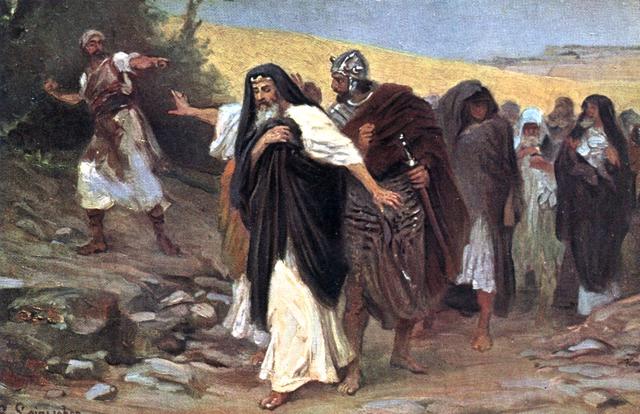
Shimi throws stones at David (artist unknown)

This definition certainly applies to the only use of the verb nafash in the Hebrew Bible excluding the book of Exodus. In the second book of Samuel/Shmuel, King David and his men have endured a long march while Shimi, a member of Saul’s clan, walked beside them hurling insults, dirt clods, and stones. Finally they leave Shimi behind, and camp at the Jordan.

The king, and all the people who were with him, arrived exhausted; and he veyinafeish there. (2 Samuel 16:14)

King David and his men are used to marching; they are not exhausted physically, but their souls are exhausted by enduring the abuse. They rest to recover their animation and their inner selves.

The drudgery and daily misfortunes of life can wear down anyone’s soul at the nefesh level. So Mishpatim orders us to share our shabbat with  humans less fortunate than we are—including those who work for us, or who are alienated in our society—get one day a week to refresh their energy and recover their individual selves.

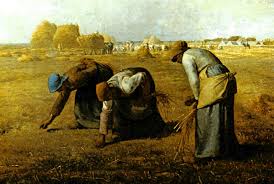
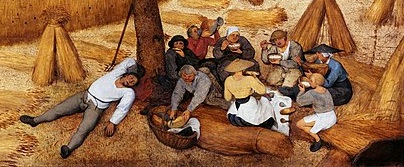
detail from The Harvesters, by Pieter Bruegel the Elder, 1565

The two elements in this shabbat process are desisting from productive work, and refreshing the spirit. The Hebrew Bible specifically prohibits lighting a fire (Exodus 35:3), gathering food or wood (Exodus 16:23-30, Numbers 16:32-36), carrying burdens outside (Jeremiah 17:21), treading in a winepress (Nehemiah 13:15), and selling or buying food (Nehemiah 13:15-18). Apparently the Israelites needed extra reminders not to do any work related to getting food to the table.

Other activities prohibited on shabbat can be inferred, but are not actually stated in the bible. Later, the Talmud multiplied rules about what a Jew cannot do on shabbat. The 312-page Talmud tractate Shabbat discusses every finicky prohibition the rabbis of the first few centuries C.E. could imagine. Although many orthodox Jews today observe  shabbat according to strict and complex rules that evolved from the Talmud, I know that if I tried to imitate them, I would spend the whole day worrying. My anxiety and resentment would make  shabbat a day to dread, and I would look forward to the six weekdays when I could relax and refresh my soul!

Fortunately, the Torah itself offers a more attractive and interesting view of Shabbat for unorthodox people like me. Desisting from creative work is connected with recovering the soul in a passage from the upcoming portion of Exodus called Ki Tisa. (It is also part of the Shabbat liturgy.)

The children of Israel shall observe the shabbat, to make the shabbat for their generations a covenant for all time. Between Me and the children of Israel it will be a sign forever, because for six days God made the heavens and the earth, and on the seventh day (God) shavat vayinafash. (Exodus 31:16-17)

vayinafash וַיִּנָּפַשׁ)= and he refreshed his soul, recovered himself, reanimated himself. (Also from the same root as nefesh.)

I am awed by this portrayal of a god that changes through time, breathing life into the universe and then stopping to catch its breath and recover the divine soul. That is how I experience life, the universe, and everything—not as a static abstraction, but as the changing rhythmic flow of heartbeats, breaths, lifespans, seasons.

The Torah says that in order to be holy to God, we humans must add another rhythm to our lives: a seven-day cycle of work and rest, creative production and cessation. For six days we may pour out our energy and creativity into productive work, but on the seventh day we desist from creative work to re-center and re-animate our inner selves. 

But wait a minute! I used to need a day off from my bookkeeping job to recover my self. But a lot of the creative work I do now—including writing this blog—re-energizes me. When I finish writing an essay or a story, I feel joy, and a sense of purpose, and the re-centering that comes from returning to my own soul. Why should I deprive myself of creative work once a week?

One answer is that I cannot keep creating endlessly without pause. Even God, in the story of creation that opens the book of Genesis/Bereishit, divides the job into six separate days, completes each day of creation before starting the next, and then takes a break at the end. I need to finish a piece of work and then stop to pay attention to where I am and where God is. I can believe that I need not only those moments of stopping every day, but also a whole day of stoppage every week. a whole day to reconnect with myself and the holy.

Alas, I still have not developed a steady practice for spending the day of shabbat in tranquility, restoring my soul. Merely refraining from certain activities doesn’t do it for me. Joining my congregation in prayer is uplifting,  and following or leading Shabbat services does remind me of what to focus on. Yet all too often, the long drive and the personal interactions disturb my ability to focus on anything.

Nevertheless, I have not given up on establishing a shabbat practice. Any suggestions, readers?

Mishpatim: Passionate Arson

Last week’s Torah portion, Yitro, begins with the reunion of Moses and his father-in-law, then moves into the mind-bending revelation of God at Mount Sinai.  This week’s Torah portion, Mishpatim (Laws) gives a long list of laws, then ends with a vision of God’s feet on a sapphire pavement.  (See my blog “Mishpatim:  After the Vision, Eat Something”.)

I’m always tempted to rush straight from the vision of God as fire and thunder to the vision of God’s feet.  But imagine someone who had two mystical experiences in a row, with no time in between to come down to earth.  Their mental balance would be hard to recover.  It would  actually be a blessing to spend an interval on practical matters, in between mystical experiences.  Maybe reading case law in between  the stories of visions at Mount Sinai serves an analogous purpose for Torah scholars.

So this year I paid attention to the case law, and found one law that might addresses unbalancing mental states.

If a fire goes forth, and it finds thorn-bushes, a heap of grain or the standing grain, or the field, and they are consumed, the burner who starts the burning shall certainly make complete restitution.  (Exodus/Shemot 22:5)

On a peshat (simple) level, this law refers to legal responsibility for negligence in a certain farming practice.  On the next level of traditional Torah interpretation, remez (alluded extension), the Talmud tractate Baba Kama (60a) treats this law as a paradigm for all cases in which someone deploys a fire, an animal, a tool, or anything that is not fixed in place, and then it causes damage because the person did not keep it under control.

Going up another rung, at the level of drash (investigation), I see that the law embodies two ethical principles:  that we should make every effort to avoid doing any harm through negligence; and that if it happens anyway, we must make restitution.

At the fourth level of Torah interpretation, sod (secrecy, intimacy), the verse speaks to our own psychological and spiritual condition.  In the Torah, as in colloquial English, fire and burning are often used to describe human passions such as anger, or lust, or even an overwhelming longing for God.  Any consuming passion is likely to get out of control.  Unless people in the throes of passion pay attention and take special care, their negligence can result in significant damage, both to themselves and to others.

Let’s look at the verse again, to see what the fire of passion might consume.

If a fire goes forth, and it finds thorn-bushes, a stack of grain or the standing grain, or the field, and they are consumed, the burner who starts the burning shall certainly make complete restitution.

kotzim = thorn-bushes, thorns.  (A verb with the same root is kutz = awaken; feel sick and tired of.)

gadish = a stack or heap of grain.

hakamah = the standing.  (Standing grain is implied in a simple reading of the verse.)

hasadeh = the field (cultivated or open); the plot of land owned by an individual; the domain of a city.

bo-eirah = burning, kindling or maintaining a fire; sweeping away; being stupid as a cow.

In a reading at the sod level, if a fiery passion is not guarded, it first consumes thorn-bushes.  Applied to your own soul, the burning anger or desire is at first beneficial, eating up those annoying, thorny habits of thought that you are sick and tired of.  Your passion is so strong, it sweeps aside the inner voice that keeps saying “You’re not good enough”, or the one that always says, “It’ll never work”, or—well, we each have our own mental habits.  When a passion sweeps them away, it feel as if you are waking up to a new and better self.

But your consuming passion also burns up the people around you who are thorns in our sides, the people whom you are sick and tired of.  Speaking from rage, or passionate conviction, or overwhelming desire, you impatiently mow right over the  people you find difficult.  In the long run, this is not beneficial to either you or them.

Next, your inner conflagration burns up the grain you have cut and stacked for future nourishment.  In the heat of the moment, preserving the other aspects of your life seems unimportant.  All that matters is the pursuit of the object of your anger or desire.  Yet if you are not careful, you can damage a relationship or a job or even your own body.

After that, the fire can destroy your own standing—both your reputation, and your uprightness or moral compass.  It is tempting, in the heat of passion, to cross lines you would never cross in your cooler moments.  And with uncontrolled, passionate speech, you may also destroy the reputation of others, or incite them to react in a way that they will feel guilty about later.

Finally, if your passion continues unchecked, you will cross the line in another way, failing to respect the boundary between yourself and another human being.  The whole word looks as if it is lit with fire, so it all appears to be part of the same passion that is consuming you.   Of course the person you are talking to feels the same way you do!  Of course they want the same things!  Of course they will do exactly what you want!  Of course they will be happy if you make it easier for them to do what you want by interfering with their lives!

Most of us know about the hazards of unchecked anger or lust.  Most of us do not want to be negligent when these passions seize us.  We work on paying attention and controlling ourselves.

But the Torah focuses most often on the passionate desire for God, which rises like a flame.  And the Torah’s most common metaphor for God is fire.  Sometimes God manifests as a fire that does not consume, like the one Moses saw in the burning bush (which, by the way, was not a thorn-bush).  But often God manifests in the Torah as a fire that does consume, and sometimes kills.

When we are filled with a passion that seems as if it comes from God, because we are burning for justice, or for a religious experience, that is when we are most in danger of being negligent and causing unforeseen damage to ourselves and others.

The law in this week’s Torah portion rules that the person who starts a fire and fails to control it must make complete restitution for all damages.  But some damage cannot be repaired.

May each of us be blessed with the ability to pay attention when we feel any passion, even the most righteous passion, begin to consume us; to remain aware of everything we would normally consider; and to control our speech and our actions so we do no harm.  May we burn brightly without consuming, and without being stupid as a cow.

Mishpatim: After the Vision, Eat Something

In this week’s Torah portion, Mishpatim, God tells Moses:

“Come up to God, you and Aaron, Nadav, and Avihu, and seventy elders of Israel, and bow down from a distance.” (Exodus/Shemot 24:1)

Aaron is Moses’ brother, and Nadav and Avihu are Aaron’s two oldest sons, who will later be initiated as priests. The seventy elders are judges and the de facto representatives of the Israelites.

And Moses went up, and Aaron, Nadav, Avihu, and seventy of the elders of Israel.  And they saw the God of Israel, and under [God’s] feet something like brick-work of sapphire, and it was exactly like the heavens latohar.  And [God] did not stretch out {God’s] hand against those singled out from the children of Israel. And they beheld God, and they ate and they drank.  (Exodus/Shemot 24:9-11)

latohar (לָטֺהַר) = for the ritual purity, for being acceptable for sacred purposes.

Brickwork in Ishtar Gate of Babylonia (Staatliche Museum, Berlin)

Seventy-five men see God in a transcendent vision. Then, overwhelmed by this spiritual

experience—they take out their lunches and have a bite to eat?  What’s that supposed to mean?

The commentary on the portion called Mishpatim (“Laws”)  is divided.  

latohar = for the purity; for being acceptable for sacred purposes

First God tells Moses to climb at least partway up Mount Sinai with his brother Aaron, his nephews Nadav and Avihu, and 70 elders.  When they do so, they see God in a transcendent vision, and then, overwhelmed by this spiritual experience—they take out their lunches and have a bite to eat?  What’s that supposed to mean?

The commentary on the portion called Mishpatim (“Laws”)  is divided.  Some modern commentators explain that since the Israelites have just received the Torah, or at least the Ten Commandments and a number of laws, the elders are now engaged in the sort of feast that marks a covenant or treaty.They probably shlepped some meat from sacrificed animals up with them for the concluding feast.2

I find this approach disappointing, because it downgrades the vision of God’s feet to merely part of cutting a covenant, the ancient Israelite version of a signing ceremony.

Other commentary claimed that it was not actual, physical food; the elders were feasting upon their contemplation of the divine glory.  In the Talmud, Rav even said that in the “World to Come” humans will be nourished only by their appreciation of God’s glory.3  In other words, none of that nasty physical chewing will be necessary.

According to other commentary, the Torah refers to real food and drink, but the elders on Mount Sinai raise their food to a more spiritual level.  The kabbalist Isaac of Luria wrote that we raise the sparks of holiness in plants and animals by eating them with the proper devotion.  19th-century rabbi Samson R. Hirsch wrote that the sapphire brick in the elders’ vision is a metaphor showing that even a lowly brick acquires a heavenly purity when it serves the divine.4

But what if the elders are not thinking about raising sparks?  What if they really do go from seeing a mystical vision of God to enjoying a nice snack?  One way to explain their flexible outlook is to look at the previous clause, “And He did not stretch out his hand toward them”.  Ovadiah Sforno interpreted that as meaning they are already seeing like prophets; God does not need to put them into an altered state of consciousness, the way God does with Saul, or Ezekiel, or the 70 elders themselves in Numbers 11:25-26.5

Maybe the consciousness of the elders is so integrated, at that moment, that they can find God in everything—in the taste of food as much as in a numinous vision.

I know some people who shun any hint of spirituality or mysticism.  They would explain a vision of God’s feet on sapphire bricks as a mere hallucination due to some bodily malfunction.  I also know people who love mysticism and cultivate spiritual ecstasy.  They seem to view the practical details of life as inferior, and prefer not to pay much attention to what their bodies are doing (except, perhaps, when they’re engaged in ecstatic dance).

I like the middle way.  I think an ideal world is one in which we are all like the 70 elders on Mount Sinai: we calmly accept whatever mysterious vision of God arrives, and we also savor the food, drink, and other physical gifts that God’s world provides.  When we unite body and soul, we become whole.

(This post was first published on February 7, 2010.)

  1. E.g. Etz Hayim: Torah and Commentary, The Jewish Publication Society, 2001, p. 479.
  2. Cf. 12th-century rabbi Shmuel ben Meir, a.k.a. Rashbam, on Exodus 24:11, http://www.sefaria.org.
  3. Talmud Bavli, Berakhot 17a.
  4. Samson Raphael Hirsch, The Hirsch Chumah: Sefer Shemos, Feldheim Publishers, Jerusalem, 2005, p. 533.
  5. 16th-century rabbi Ovadiah Sforno on Exodus 24:11, http://www.sefaria.org.