Ki Tisa: Apotheosis of Moses?

(This is my twelfth and final post in a series about the evolving relationship between Moses and God in the book of Exodus/Shemot. Next week’s post will be back in sync with the Jewish weekly readings. Meanwhile, this is Passover week! If you’d like to read one of my posts on Passover, you might try: Pesach & Vayikra: Holy Matzah.)


Moses: from fearful loner to authoritative leader

When Moses walks over to look at the bush that burns but is not consumed, he is a curious man who has compassion for the victims of bullies,1 but he also has a history of anxiety. After a problematic childhood as an Israelite who was adopted by Egyptian royalty, he fled a murder charge in Egypt, then found a home with a Midianite priest. Safe but still wary, the last thing Moses wants to do is return to Egypt.

Moses and the Burning Bush, by Domenico Zampieri, 17th century

Then God speaks to him out of the fire, and Moses hides his face. (See my post: Shemot: A Close Look at the Burning Bush.) God tells him that he will be the human leader of the victimized Israelites in Egypt; Moses must give the pharaoh ultimatums, then conduct the people from Egypt to Canaan.

Moses tries to excuse himself from the job. He is certain that he is not qualified (see my post: Shemot: Empathy, Fear, and Humility); that the Israelites will not believe or trust him (see my post: Shemot: Names and Miracles); and that he cannot speak well (see my post: Shemot: Not a Man of Words). But God patiently answers his every objection, like a parent with a resistant child. Panicked, Moses begs God to send someone else. God coaxes Moses into cooperating by promising that his long-lost brother Aaron will help him (see my post: Moses Gives Up).

Back in Egypt, Moses gradually changes. During his first few negotiations with the pharaoh, he simply parrots the words God gives him, but as his confidence grows he adds words of his own. It helps that a powerful deity backs him up with miraculous plagues, and it helps that the pharaoh and his court treat Moses with increasing respect. (See my post: Shemot to Bo: Moses Finds His Voice.)

When he leads the Israelites across the wilderness to Mount Sinai, they are the ones who behaved like wayward and frightened children. Moses behaves like a nervous new parent. He asks God, his mentor, for advice, but he also acts on his own initiative. (See my posts: Beshalach: Moses Graduates and Yitro: Moses as Middle Manager.)

At Mount Sinai, God pursues a formal covenant with the Israelite people. Between them, God and Moses arrange a covenant four times. (See my post: Yitro & Mishpatim: Four Attempts at a Lasting Covenant.) The third of the four covenants is entirely Moses’ creation, and includes all of the people in a dramatic ritual with standing stones, animal sacrifices, blood splashing, and a public reading of the laws God has told Moses so far. The fourth covenant, God’s idea, is when the elders behold God’s “feet” and hold a feast (the Ancient Near East equivalent of a signing ceremony for a treaty).

Then Moses spends 40 days on the mountaintop listening to God outline a revamped religion, which includes a sanctuary tent where God will dwell in the midst of the people. But the Israelites below think Moses will never return, and they ask Aaron for an idol to follow instead. Aaron makes the Golden Calf, and the people worship it—a clear violation of the covenant with God.

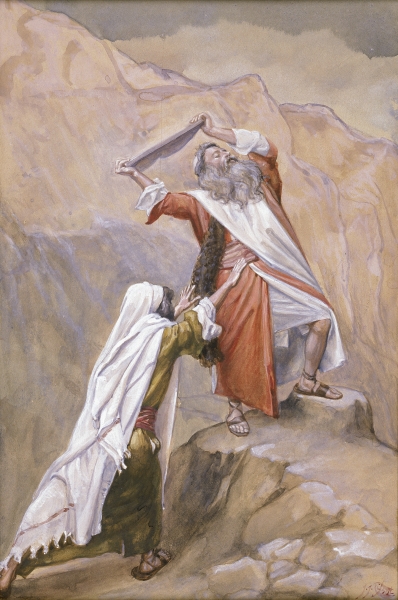
On the 40th day God offers to exterminate the people and start over with Moses’ descendants, but Moses passes God’s test and remains loyal to the Israelites. He walks down to the camp and  smashes the two stone tablets engraved by God, but God recognizes Moses’ right to make decisions and takes no action. (See my post: Ki Tisa: Taking Risks.) The co-leaders arrange a massacre and a plague that kill the worst Golden Calf worshippers.

Then God tells Moses that a messenger will lead the Israelites to Canaan, because God is too angry to go in their midst. Moses presses God to reverse that decision, and also to pardon all the surviving Israelites. God seems favorable toward both requests, but never makes an explicit commitment. (See my post: Ki Tisa: Seeking A Pardon.) A lack of openness between the two leaders of the Israelites continues through the book of Numbers, with Moses pitching arguments designed to flatter and influence God, and God making decisions that are close to what Moses requests but not exactly the same.2

The story about Moses’ second 40-day stint at the top of Mount Sinai illustrates that the working relationship between the two leaders is not the only thing that changes.

Moses and God: shifting commitments

At the burning bush, God was determined to rescue the Israelites from Egypt and give them the land of Canaan. Moses tried to get out of being personally involved, even though he was empathetic toward all victims of bullies.

By the time Moses leads the Israelites to Mount Sinai, he has unreservedly embraced the mission God gave him, and he would do anything to make sure the Israelites as a people get to Canaan, even if individual Israelites have to die along the way. So after the Golden Calf worship, he focuses on restoring good relations between God and the people.

But God views the Golden Calf as a personal rejection, and seems less committed to the Israelites after that episode. God starts calling the Israelites Moses’ people, and shies away from recommitting to God’s earlier plan to dwell among them in the sanctuary tent.3 Twice in the book of Numbers, God threatens to wipe out all the Israelites.4

The God character: a new development

Nevertheless, when Moses asks to see God’s “ways”, “glory”, and “face”,5 God shows him what Jews now call “The Thirteen Attributes of Mercy”, including compassion, patience, loyal-kindness, and a willingness to exonerate (some of) the guilty.6 Although God continues to smite people in sudden fury from time to time, this description of God indicates a change in the God character that was depicted earlier in the Torah.

And right after the revelation of the Thirteen Attributes, when Moses begs God once more to pardon the people, God says:

“Hey, I am cutting a covenant: In front of all your people I will do wonders that have not been created on all the earth and among all the nations. And all the people in whose midst you are, they will see the doing of Y-H-V-H, how awesome it is what I do with you.” (Exodus 34:10)

The only awesome deed God mentions is driving out the six peoples living in Canaan when the Israelites arrive there. This is a promise that God will “give” them the land of Canaan, even though God is still calling them “your people” (Moses’ people) instead of “my people”. In return, the Israelites must refrain from making idols or bowing down to any other god and reject the gods of Canaan by destroying their objects of worship. They must also refuse to make covenants with the natives of Canaan, and avoid intermarriage with them. Then God throws in some of the earlier rules about observing religious holidays and donating firstborn animals and first fruits to God.

Then Y-H-V-H said to Moses: “Write these words for yourself, because according to these words, I cut a covenant with you and with Israel.” (Exodus 34:27)

So even if God does not explicitly pardon the people, as Moses asked, God is now patient and loyal enough to propose another covenant.

Moses: an apotheosis?

Moses on Mount Sinai, by Jean-Léon Gérôme,
1895-1900

The experience of beholding God’s attributes also changes Moses in ways that might be considered an apotheosis: deification or elevation to divine status.

And he was there with Y-H-V-H forty days and forty nights. Bread he did not eat, and water he did not drink. And [God] engraved on the tablets the words of the covenant, the Ten Words. (Exodus 34:28)

Exodus does not say whether Moses went without food or drink the first time he spent 40 days at the top of Mount Sinai, though it is hard to imagine him trudging up to the barren volcanic mountaintop carrying enough food and water on his back to last 40 days. But Exodus does say that Moses lives without eating or drinking during his second 40-day stint.7

Shemot Rabbah explained: “What, then, did he eat? He was sustained by the aura of the Divine Presence. Do not wonder, as the heavenly beasts that bear the Throne are sustained by the aura of the Divine Presence.”8 This makes Moses like the serafim in Isaiah’s vision or the divine creatures in Ezekiel’s vision, at least temporarily.9

Rabbeinu Bachya wrote: “Moses’ nourishment during these forty days was provided by the attribute חסד and the radiation of supernatural light.”10 Chesed, חסד, is the “loyal-kindness” in God’s thirteen attributes. This commentary implies that God’s new gentle and compassionate approach sustains Moses so that he can live on the supernatural equivalent of light.

At the end of Moses’ first 40-day stint on the mountaintop, God gave him a pair of stone tablets that were already engraved. These were the tablets that Moses smashed at the foot of the mountain when he saw the ecstatic worship of the Golden Calf. For Moses’ second 40-day stint, God tells him to hew out his own stone blanks and carry them up.11 Then God engraves them after revealing the Thirteen Attributes. Moses may even see the words appearing on the stones.

And it was, when Moses came down from Mount Sinai—and the two tablets of testimony were in Moses’ hand when he came down from Mount Sinai—then Moses did not know that the skin of his face karan because of [God’s] speech with him. (Exodus 34:29)

karan (קָרַן) = shone, was radiant.

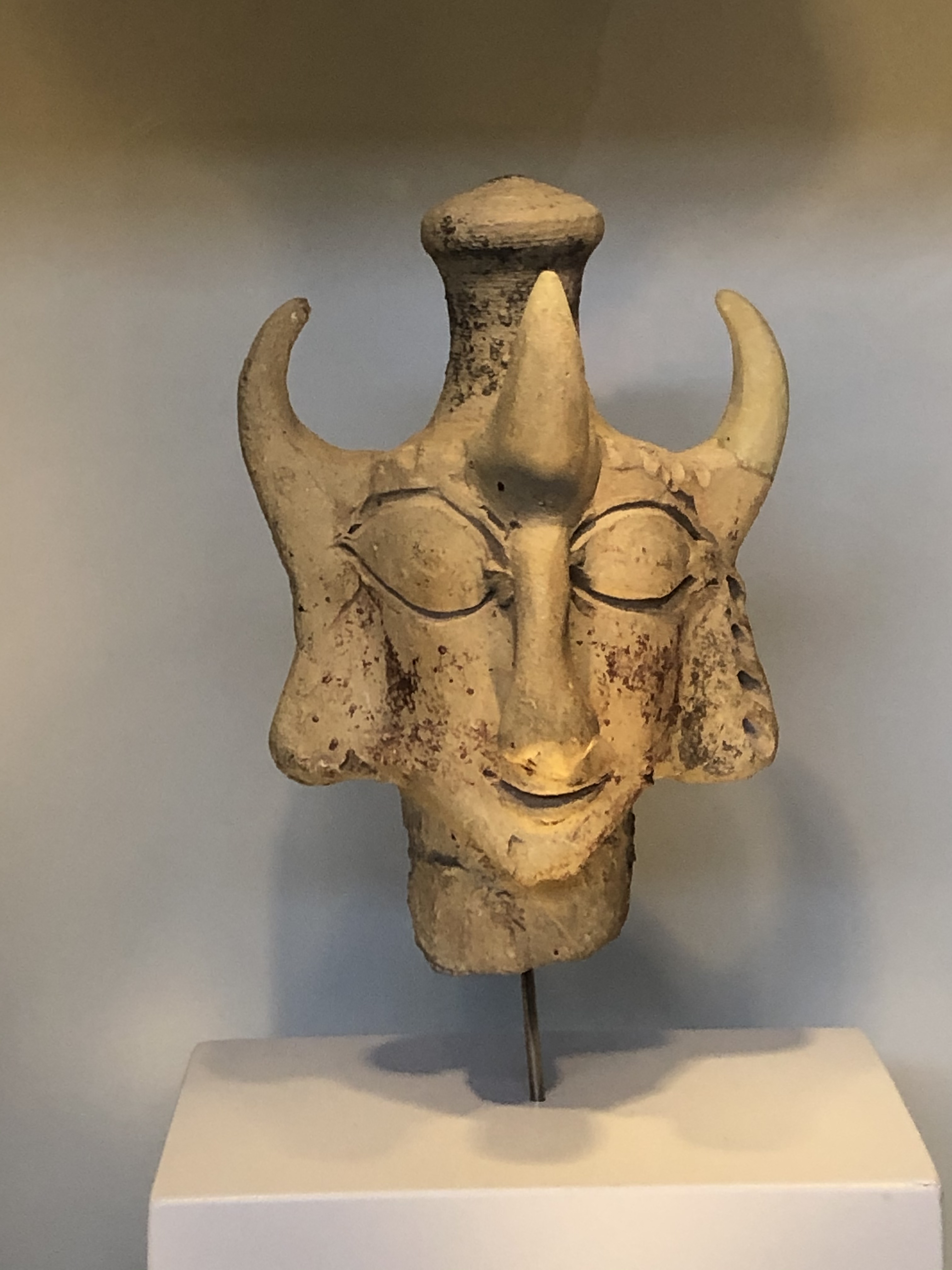
This verb has the same root as keren (קֶרֶן ) = horn, ray of light. (The Latin translation of this verse in the Vulgate said Moses “sprouted horns”, so for centuries artists depicted Moses with two horns growing from his forehead.)

What makes Moses’ formerly ordinary face start radiating beams of light? The text says it happens because of God’s “speech with him”. Many Jewish commentators wrote that it happens when God reveals the Thirteen Attributes of Mercy to Moses. God said:

“… as my glory passes by, I will place you in a crevice of the rock, and screen you with my hand until I have passed by. Then I will take away my hand, and you will see the back side of me. But my face will not be seen.” (Exodus 33:22-23)

The “back side” of God that Moses “sees” consists of the Thirteen Attributes. Either God’s supernatural hand,12 or the experience of these divine attributes,13 gives Moses an inner light so strong that it shines out through the skin of his face.

On the other hand, some commentators wrote that God gives Moses a radiant face as a strategic move to make sure the Israelites continue to accept him as their leader. The 13th-century commentary Chizkuni says:

“Seeing that prior to Moses’ return with the first set of Tablets the people had been prepared to accept another leader in Moses’ place, his emitting rays of light on his descent from the Mountain this time made a repetition of such an attempt quite unlikely.”14

And Aaron and all the Israelites saw Moses, and hey! The skin of his face karan! And they were afraid to come near him. (Exodus 34:30)

Chizkuni explained: “According to the plain meaning of the verse, when they beheld him, they thought that they were looking at an angel.”15

And Robert Alter wrote: “If, as seems likely, Moses’ face is giving off some sort of supernatural radiance, the fear of drawing near him precisely parallels the people’s fear of drawing near the fiery presence of God on the mountaintop.”16

Detail from Terra Sancta, by Willem Janszoon Blaeu and Joan Blaeu, 17th century

Moses himself is not aware that his own face was radiating light, according to the 18th-century commentary Or HaChayim, because he assumes that the extra illumination came from the second pair of stone tablets he is holding as he walks down the mountain. “As soon as he deposited the Tablets and he became aware that the light had not departed, he realised that he himself was the source of the light.”17

Then Moses called to them, and Aaron and all the chiefs in the congregation returned, and Moses spoke to them. And after that, all the Israelites approached, and he commanded them everything that Y-H-V-H had spoken to him on Mount Sinai. (Exodus 34:31-32)

According to Chizkuni, just hearing Moses’ voice calling out was enough so that “they realized that he was not an angel”. Then when Moses spoke to Aaron and the chiefs, the rest of the Israelites “noticed that no harm had come to them from his speaking to them.”18

And Moses finished speaking with them, and he put a veil over his face. And whenever Moses came before Y-H-V-H to speak with [God], he would remove the veil until he went out. And [whenever] he went out to speak with the Israelites what he had been commanded, the Israelites would see Moses’ face, that skin of his face was karan. Then Moses would put back the veil over this face, until he came in to speak with [God]. (Exodus 34:33-35)

Moses exposes his altered face to God, and he to the Israelites whenever he is telling them the latest batch of rules from God. Who would question the words of someone whose face emits supernatural light? But the rest of the time when he is with people, Moses covers his face with a light-proof veil.

According to Rashi and Ibn Ezra, Moses puts on the veil out of respect for the light God has created on his face; it is not for ordinary use, or for people to gawk at. People should only see it when he is transmitting God’s instructions. According to Kli Yakar, “Moshe, in his great humility, was embarrassed when people gaped at the radiance of his face.”19


It seems as if God has turned Moses into a semi-divine being. He lives for 40 days on the aura of God’s presence, like God’s divine attendants. When he comes down from Mount Sinai, God’s supernatural fire shines through the skin of his face. Moses might look like one of the gods of other peoples in the Ancient Near East, who radiated an unearthly light called melammu. For example, a story about the Babylonian god Marduk says “With burning flame he filled his body” and “With overpowering brightness his head was crowned.”20 The gods in Mesopotamian myths sometimes gave melammu to their favorite kings.

Or perhaps (if he took off his robe) Moses would look like the celestial being shaped like a man whom Daniel sees in a vision sent by Y-H-V-H:

His body was like yellow jasper, and his face had the appearance of lightning, and his eyes were like torches of fire, and his arms and legs were like glittering bronze, and the sound of his speech was like a roaring crowd. (Daniel 10:6)

But in the Hebrew Bible, the various angelic creatures in the bible are either mouthpieces for God or manifestations of God’s powers, without lives of their own.

Perhaps that is why Moses’ radiant face appears only in Exodus 34:29-35. The authors of the rest of the Torah chose to depict Moses as a human being—one who is especially close to God, but a mortal man with his own thoughts and personality.

In the next chapter of Exodus, Moses proceeds with God’s earlier plan for building a tent-sanctuary, as if God had never refused to dwell in the midst of the Israelites. And God does not challenge Moses’ stubborn human initiative.

Moses Sees the Promised Land from Afar, by James Tissot, circa 1900

When Moses is 120 years old and has finished speaking to the Israelites on the Moabite bank of the Jordan River, God tells him to climb up the heights of Aviram and look across the river at the land of Canaan. God says:

So, after delivering a prophecy about the tribes, Moses hikes up.

“You will die on the mountain where you are going up … because at a distance you will see the land, but you will not enter there, into the land that I am giving the Israelites.” (Deuteronomy 32:50, 52)

And Moses, the servant of Y-H-V-H, died there in the land of Moab, al-pi Y-H-V-H. And [God] buried him in the valley in the land of Moab … and no man knows his burial place to this day. (Deuteronomy 34:5-6)

al-pi (עַל־פִּי) = an idiom meaning at the order of, at the command of, according to the word of. Literally: al (עַל) = upon, over, on account of, because of, by. + pi (פִּי) = mouth of.

Some commentators translate al-pi as “by the mouth of”, and say that Moses dies by a kiss from God.21 So although Moses is not permanently transformed into a semi-divine being, he has the the most intimate human relationship with God.

And no prophet arose again in Israel like Moses, whom Y-H-V-H knew face to face. (Exodus 34:10)


  1. Moses has already taken action against an Egyptian taskmaster beating an Israelite (Exodus 2:11-12) and male shepherds bullying female shepherds (Exodus 2:16-19). See my post: Shemot: Empathy, Fear, and Humility.
  2. E.g. Numbers 14:11-35.
  3. See my post: Ki Tisa: Seeking A Pardon.
  4. Numbers 14:11-12, 17:8-9.
  5. Exodus 33:13, 33:18, 33:20. See my post: Ki Tisa: Seeking A Pardon.
  6. Exodus 34:6-7.
  7. At least this is the second time Exodus says Moses spends 40 days and 40 nights on the mountaintop. But some classic commentators claimed it was the third time, the second time being the indefinite period when God and Moses converse in Exodus 33:12-34:3.
  8. Shemot Rabbah, 12th century, translation in www.sefaria.org.
  9. Isaiah 6:2-7, Ezekiel 1:5-26 and 10:1-22.
  10. Rabbeinu Bachya (Rabbi Bachya ben Asher ibn Halawaa, 1255-1340), translation in www.sefaria.org.
  11. Exodus 34:1.
  12. E.g. Midrash Tanchuma (8th century), Rashi (11th-century Rabbi Shlomoh Yitzchaki), and Da-at Zekinim (12th-13th century).
  13. E.g. Ibn Ezra (12th century) and Rabbi Adin Steinsaltz (21st century).
  14. Chizkuni, by Chizkiah ben Manoach, 13th century, translation in www.sefaria.org.
  15. Chizkuni, ibid.
  16. Robert Alter, The Five Books of Moses, W.W. Norton & Co., New York, 2004, p. 512.
  17. Or HaChayim, by Chayim ibn Attar, 18th century, translation in www.sefaria.org.
  18. Chizkuni, ibid.
  19. Kli Yakar, by Shlomo Ephraim ben Aaron Luntschitz, 16th century; translation in www.sefaria.org.
  20. Enuma Elish IV, lines 40 and 58; translation by L.W. King.
  21. E.g. Talmud Bavli, Moed Katan 28a, Bava Batra 17a; Rashi; Da-at Zekinim.
Ki Tisa: Seeking a Pardon

(This is my eleventh post in a series about the conversations between Moses and God, and how their relationship evolves in the book of Exodus/Shemot. If you would like to read one of my posts about this week’s Torah portion, Vayikra, the first in the book of Leviticus/Vayikra, you might try: Vayikra: A Voice Calling.)

Moses Destroys the Tablets, by James Tissot, ca. 1900

On top of Mount Sinai, God gives Moses a pair of stone tablets engraved with laws, and detailed instructions for making a portable tent-sanctuary. At the foot of the mountain, the Israelites despair of seeing Moses again, and start worshiping a Golden Calf. God offers to exterminate the people and start over with Moses’ descendants, but Moses remains loyal to the Israelites. Then Moses goes down and smashes God’s stone tablets without permission, but God takes no action against him. The working relationship between the two leaders, human and divine, seems strong. (See my post: Ki Tisa: Taking Risks.)

Moses, citing an order from God, arranges the massacre of 3,000 Israelites who are presumed to be the worst of the Golden Calf worshipers.1

Then it was the next day, and Moses said to the people: “You, you are guilty of a great guilt! And now, I will go up to Y-H-V-H. Perhaps akhaprah [with God] on behalf of your guilt.” (Exodus 32:30)

akhaprah (אֲכַפְּרָה) = I may make atonement, appease, effect reconciliation.

Moses does not want the surviving Israelites to think they are in the clear, so he reminds them that they, too, bear some guilt, even those who passively stood by while others engaged in calf worship. But he also wants God to forgive the surviving Israelites, so he tries to get God to commit to a general pardon.

Forgive them or erase me

Then Moses returned to Y-H-V-H and said: “Please, this people is guilty of a great guilt; they made themselves a god of gold! And now, if you would lift their guilt— But if not, erase me, please, from the book katavta!” (Exodus 32:31-32)

katavta (כָּתָבְתָּ) = you have written, you have engraved words on.

According to Rashi, “the book you have written” means “the entire book of the Torah” and the reason Moses asked to be erased from it is “that people should not say about me that I was not worthy enough to pray effectively for them.”2

Yet in the Hebrew Bible, the only part of the Torah that God writes directly (instead of dictating to Moses) is whatever God engraves on the two stone tablets (according to Deuteronomy 5:19, the Ten Words or Ten Commandments).

Other commentators have identified “the book you have written” with “the book of life” in Psalm 69.3 Praying for the downfall of his enemies, the psalmist begs God:

“Erase them from the bookof life, and do not inscribe them among the righteous!” (Psalm 69:29)

Many psalms assume that God grants health and long life to the righteous, but Psalm 69 is the only one in which God keeps a (perhaps metaphorical) account book.4

So Moses is asking God to either pardon the Israelites, or give him death. I suspect he hopes that God will quickly opt to preserve the life of God’s favorite prophet, and issue a pardon.

According to Or HaChayim, “… it is one of God’s virtues that He cannot tolerate seeing His righteous people, His ‘friends,’ suffer pain. Accordingly, how could God inflict the pain of destroying His people on Moses? Surely God was perfectly aware of how Moses would grieve over the destruction of his people!”5

Yet God’s reply indicates that he does not fall for Moses’ either-or statement.

And Y-H-V-H said to Moses: “Whoever is guilty against me, I will erase from my book. And now go, lead the people to where I have spoken to you! Hey, my messenger will go before you. But on the day of my accounting, I will call them to account over their guilt.” (Exodus 32:33-34)

God is not about to erase Moses, who is innocent. But God refuses to declare a blanket pardon for the surviving Israelites.

When is the day of God’s accounting? Every day, according to a commentary in Yiddish: “The Holy One said: I will forgive the sin. However, I will make Israel pay for the sin a little at a time. No trouble comes upon Israel that is not related to the Golden Calf. That is to say, the Holy One repays Israel for the sin of the Golden Calf all the time.”6

Or perhaps God’s day of accounting is the day of a plague in the next verse of Exodus:

And Y-H-V-H struck the people with plague over what they did with the calf that Aaron made. (Exodus 32:35) The text does not say how many people die in this plague, but it certainly counts as a punishment.

Let me know your ways

Then Y-H-V-H spoke to Moses: “Go up from here, you and the people whom you brought up from Egypt! … I will not go up in your midst—because you are a stiff-necked people—lest I consume you on the way.” (Exodus 33:1, 3)

Now God says Moses brought up the people from Egypt, making him responsible even though it was God’s idea in the first place, and it never would have happened without God’s persistence and miracles. God also seems to be ordering an immediate departure from Mount Sinai, even though the people have not constructed the tent-sanctuary God requested so that God could “dwell among them” (Exodus 25:8).

Furthermore, God decides not to dwell among the Israelites as they travel, because God is so angry already that when the stubborn Israelites violate the rules again, God will “consume” them. (This God character is located in only one place at a time.)

The Israelites mourn over the news that God will not go with them. But Moses is determined to get God to both pardon them and travel in their midst. He tries a different tactic, saying:

“And now, please, if I have found favor in your eyes, please let me know your ways! Then I will know you—so that I can find favor in your eyes. And see that your people is this people!” (Exodus 33:13)

Moses asks to learn God’s ways so that he can continue to please God in the future. He does not mention that if he knows how to please God, he can bargain more effectively for God’s pardon and presence.

Moses on Mount Sinai, by Jean-Leon Gerome, 1895-1900
(Divine communion?)

Rabbi Steinsaltz, however, assigned Moses an additional motivation: “Moses requested a deeper relationship with God than he had attained thus far. Until this point, he had mainly received instructions. Now Moses desired the secret knowledge that would enable him to achieve communion with God, as one’s closeness to God is related to the extent of his knowledge of the Divine.”7

Moses follows up his polite request to know God’s ways with an imperative: “See that your people is this people!” God must admit ownership of the Israelites. They would not be in the wilderness of Sinai if it were not for God, and they will feel abandoned if God’s presence is not with them.8

And [God] said: “[If] my panim goes [with you], will I make you rest easy?” (Exodus 33:14)

Moses exclaims:

“If your panim is not going, don’t bring us up from here!” (Exodus 33:15)

panim (פָּנִים) = face; front surface; presence.

He adds a rationale that he hopes will sway God.

“And how is it to be known, then, that I have found favor in your eyes, I and your people? Isn’t it in your going with us? Then we are distinct, I and your people, from all the people that are on the panim of the earth.” (Exodus 33:16)

And Y-H-V-H said to Moses: “Indeed, this word that you have spoken, I will do, since you have found favor in my eyes, and I know you by name.” (Exodus 33:17)

It is not clear which “word” God is promising to do: to go in the midst of the Israelites, or to let Moses know God’s ways. At this point Moses decides to press his request to learn God’s ways.

Then [Moses] said: “Please let me see your kavod!”  (Exodus 33:18)

kavod (כָּבוֹד) = impressiveness, honor, splendor, glory.

All the Israelites have seen the kavod of God as a fire at the top of Mount Sinai, which looked like a cloud to Moses.9 But Moses is asking to see more. According to Chizkuni, “Moses asked for a visual appearance of God’s essence.”10 But according to Rabbi Hirsch, “The perception he now seeks is on a higher level, that of intuition.”11

And [God] said: “I, I will cause all my goodness to pass in front of your panim, and I will call out the name of Y-H-V-H in front of your panim. But … you will not be able to see my panim, because a human cannot see me and live.” (Exodus 33:19-20)

Here panim means “face”. Moses’ face is where his physical organs for seeing and hearing are located (if we count ears as part of a human face). God’s face is unknowable.

“… as my kavod passes by, I will place you in a crevice of the rock, and screen you with my hand until I have passed by. Then I will take away my hand, and you will see the back side of me. But my panim will not be seen.” (Exodus 33:22-23)

Next God grants an additional favor that Moses has not asked for.

And Y-H-V-H said to Moses: “Carve yourself two stone tablets like the first ones, and I will inscribe on the tablets the words that were on the first tablets, which you smashed.” (Exodus 34:1)

The first time, God provided the completed tablets. Now God tells Moses to carve stone blanks, which God will inscribe. Abarbanel explained: “For it was Moses’ obligation, since he destroyed the first set of tablets … And the reason for the word ‘yourself’ was to warn Moses that he himself, and no other, should carve the tablets.”12

Moses carries two blank stone tablets up Mount Sinai early the next morning. God comes down in a cloud, and as “the back side” of God passes Moses, Moses perceives some of God’s qualities. Either God or Moses calls out:

“Y-H-V-H! Y-H-V-H! Mighty-one, compassionate and gracious, long-nosed [slow to anger], abundant in loyal-kindness and reliability, keeping loyal-kindness to the thousandth [generation], lifting away crookedness and transgression and wrong-doing, and clearing [the guilty]!” (Exodus 34:6-7)

This list is called “The Thirteen Attributes of Mercy”, which are still chanted at services on Jewish holy days. (Most commentators reach thirteen by counting the second “Y-H-V-H” as a different attribute from the first.) Rashbam noted that each of these thirteen “is of relevance when inducing forgiveness and repentance.”13 Since Moses wants God to forgive the Israelites, this insight would be encouraging.

Is the compassionate god in this description the same deity who killed thousands of innocent Egyptians without a second thought in the tenth miraculous plague, the death of the firstborn? Is this the god who would angrily “consume” the stiff-necked Israelites along the way to Canaan?

Perhaps the God character has decided to become more compassionate and kind, and is giving an aspirational self-description. Moses seizes the moment to repeat his request.

And Moses hurried and bowed to the ground and prostrated himself. And he said: “Please, if I have found favor in your eyes, my lord, please may my lord go among us! Indeed, it is a stiff-necked people. So forgive our crookedness and our wrong-doing, and make us your possession!” (Exodus 34:8-9)

Moses identifies himself as one of the Israelites, begging God to forgive and accept “us”.

Commentator Jerome Segal detected an additional strategy in Moses’ plea. What if God’s anger overwhelms God’s compassion? “Thus, it appears that Moses prevailed upon God to be in their midst just so he would be able to argue, should the eventuality arise, that God is too closely identified with the Israelites to destroy them. In short, Moses emerges as a canny strategist, subtly manipulating the powerful but less crafty deity.”14

A year or so later, God is indeed ready to wipe out the Israelites, and Moses persuades God to refrain with an argument along those lines.15

An ambiguous answer

After Moses has asked God again to “go among us” and forgive the Israelites, God says:

“Hey, I myself will be cutting a covenant: in front of all your people I will do wonders that were not created on all the earth or among all the nations. Then they will see, all the people in whose midst you are, the deeds of Y-H-V-H—that it is awesome what I myself do with you.” (Exodus 34:10)

Once again, God calls the Israelites Moses’ people, not God’s own people. And once again, God’s response is favorable but avoids addressing Moses’ request directly. Instead, God tries to resolve the whole issue with a new covenant. The terms are that God will perform more wonders for the Israelites, through Moses. In return, the Israelites will obey the commandments on the stone tablets, along with some other rules that God dictates to Moses on the spot.

Moses has to assume that God has forgiven the Israelites, and that the new covenant means God will dwell among them after all.

Moses and God respect one another, but Moses resorts to wheedling and subterfuge—because God refuses to make definite commitments. Their relationship has become like an unhealthy marriage.

To be continued …


  1. Exodus 32:25-28. See my post: Ki Tisa: Golden Calf, Stone Commandments.
  2. Rashi (11th-century Rabbi Shlomoh Yitzchaki), translation in www.sefaria.org.
  3. E.g. Talmud Bavli, Rosh Hashanah 16b; Rashbam (12th-century Rabbi Shmuel ben Meir), Chizkuni (a 13th century collection), Tur HaArokh (14th century), Or HaChayim (by 18th century rabbi Chayim ibn Attar).
  4. In Talmud Bavli, Rosh Hashanah 16b, God writes down the names of the righteous in one book and the names of the wicked in another.  People whose deeds are partly good and partly bad are listed in a third book until Yom Kippur, ten days later, when God decides which of these intermediate people to record with the righteous in the book of life. To this day, the Rosh Hashanah and Yom Kippur liturgy includes prayers to be written in God’s “book of life” so we will not die before the next Rosh Hashanah.
  5. Or HaChayim (18th century), by Rabbi Chayim bin Attar, translation in www.sefaria.org.
  6. Tze-enah Ure-enah (17th century), translation in www.sefaria.org.
  7. Rabbi Adin Even-Israel Steinsaltz, The Steinsaltz Tanakh, Koren Publishers, Jerusalem, 2019, quoted in www.sefaria.org.
  8. This may be a misunderstanding. What if the Israelites only want the manifestation of God as the column of cloud by day and fire by night that led them from Egypt to Mount Sinai? God might consider that a divine messenger. When the Israelites leave Mount Sinai, the column appears again to lead them, and when God is dwelling among them in the tent-sanctuary, cloud and fire appear over its roof.
  9. Exodus 24:16-17.
  10. Chizkuni, a 13th-century collection of commentary, translation in www.sefaria.org.
  11. Rabbi Samon Raphael Hirsch (19th century), The Hirsch Chumash: Sefer Shemos, translated by Daniel Haberman, Feldheim Publishers, Jerusalem, 2005, p. 794.
  12. Isaac ben Judah Abarbanel (15th century commentator), translation in www.sefaria.org.
  13. Rashbam (12th-century Rabbi Shmuel ben Meier), translation in www.sefaria.org.
  14. Jerome M. Segal, Joseph’s Bones, Riverhead Books, New York, 2007, p. 134-135.
  15. Numbers 14:11-20.

Ki Tisa: Taking Risks

(This is my tenth post in a series about the evolving relationship between Moses and God in the book of Exodus/Shemot. If you would like to read one of my posts about this week’s Torah portion, Pekudei, you might try: Pekudei: Clouds of Glory.)


After Moses has orchestrated four covenants between God and the Israelites (see my post: Yitro & Mishpatim: Four Attempts at a Lasting Covenant), God tells him:

“Go up to me on the mountain and be there, and I will give you the stone tablets and the teaching and the command that I have written to teach them.” (Exodus 24:12)

Moses spends 40 days and 40 nights on top of Mount Sinai, listening to God tell him how to set up a formal religion for the Israelites, from the portable sanctuary-tent to the gold-plated ark to the ordination of Aaron and his four sons as priests.

Moses Receiving the Tablets of Law, by Marc Chagall, 1966

Only at the end of the 40-day period does God give Moses any stone tablets.

Then [God] gave to Moses, when [God] finished speaking with him on Mount Sinai, the two tablets of the Testimony, tablets of stone engraved by the finger of God. (Exodus 31:18)

Meanwhile, in the camp at the foot of the mountain, the Israelites despair of ever seeing Moses again.

… and the people assembled against Aaron and said to him: “Get up, make us a god who will go before us! Because this Moses, the man who brought us up from the land of Egypt, we do not know what has become of him!” (Exodus 32:1)

Blame game

Moses has no idea that the Israelites are worshipping a golden calf below. After giving Moses the stone tablets, God breaks the news to him.

Then Y-H-V-H said to Moses: “Go, get down! For your people whom you brought up from the land of Egypt have become corrupt! They have quickly turned away from the path that I commanded them; they made themselves a cast-metal calf, and they bowed down to it, and they sacrificed to it, and they said: ‘These are your gods, Israel, who brought you up from the land of Egypt’!” (Exodus 32:7-8)

First God says the calf-worshipers are Moses’ people whom Moses brought up from Egypt. Then God notes that they are calling the Golden Calf their gods who brought them up from Egypt.

Yet God was the one who noticed the suffering of the Israelites, recruited and trained Moses, created the ten miraculous plagues in Egypt, led the Israelites with a column of cloud and fire, split the Reed Sea, and fed them manna in the wilderness. God told Moses:

“And I will bring out my ranks, my people the Israelites, from the land of Egypt …”  (Exodus 7:4)

But now God seems to be disowning the people and the whole enterprise.

Rashi1 and earlier commentators claimed that the people whom God calls “your people” are not all the people, but only the non-Israelites who chose to leave Egypt with the Israelites. In this reading, the non-Israelites are Moses’ people because Moses converted them. And the non-Israelite converts are the ones who corrupted the “real” Israelites and persuaded them to demand an idol. (Like most humans, the classic commentators were not exempt from xenophobia.) The Torah itself does say that an erev rav—mixed multitude or riff-raff—joined the Israelites,2 but it never says Moses converted them.

To me it seems more likely that the God character says “your people” as a way to pass the buck for the people’s violation of the divine rules. Alternatively, the God character is pretending to assign the blame to Moses in order to see how he will respond.

Moses tosses the blame back at God. After God tells Moses about the Golden Calf, Moses says:

“Why, Y-H-V-H, should your nose burn against your people, whom you brought out from the land of Egypt with great power and a strong hand?” (Exodus 32:11)

(A burning nose is a biblical idiom for anger.)

Moses is confident enough to pass the buck back to God, and God lets it go and moves on to the important item on God’s agenda: making Moses an offer he can refuse.

Taking a risk with Moses

And Y-H-V-H said to Moses: “I have observed this people, and hey! It is a stiff-necked people. And now, hanichah me, and my nose will burn against them, and I will exterminate them! And I will make you into a great nation.” (Exodus 32:9-10)

hanichah (הַנִּיחָה) = allow, leave alone. (Imperative of the hifil form of nach, נעָה = rest, settle, wait.)

It sounds as if God is ready to give up on the Israelites, eliminate them, and start over with Moses’s descendants, who presumably would someday rule Canaan. But first God wants Moses’ permission.

Is God serious? One possibility is that God is asking Moses as a courtesy, but is determined to exterminate the Israelites no matter what Moses says. This is unlikely, however, since Moses has become a full partner in leadership, and would not agree with God the way a subordinate says yes to curry favor.

Another possibility is that God really is leaving the decision up to Moses. According to the Talmud, “Moses said to himself: If God is telling me to let Him be, it must be because this matter is dependent upon me. Immediately Moses stood and was strengthened in prayer, and asked that God have mercy on the nation of Israel and forgive them for their transgression.”3

But it is hard to believe that God has no strong preference. A few hundred years before, God promised Abraham, Isaac, and Jacob that their descendants would rule the land of Canaan. Recently God created ten miraculous plagues that ruined Egypt. The Israelites have become God’s people as much as Moses has become God’s prophet. It seems unlikely that God would discard them and wait another four hundred years until Moses’s descendants had multiplied enough to occupy Canaan.

A third possibility is that God intends to give the Israelites a sharp lesson without abandoning them altogether—but also wants to find out what Moses would choose. After all, God tests Abraham in the book of Genesis by ordering him to slaughter his son Isaac as an offering, and then calls him off at the last minute.4 Now God seems to be testing Moses.

Then Moses softened the face of Y-H-V-H, his god, and he said: “Why, Y-H-V-H, should your nose burn against your people, whom you brought out from the land of Egypt with great power and a strong hand?” (Exodus 32:11)

In order to “soften the face” of God, i.e. reduce the God character’s anger, Moses reminds God of how much God has invested in the Israelites. Next he gives one of the reasons that God went to all that trouble: to prove to the Egyptians that they had better not mess around with a people God chooses to deliver.

“Why should the Egyptians actually [be able to] say: ‘In evil he brought them out, to kill them in the mountains, and to exterminate them from the face of the earth’? Turn away from your burning nose, and hinacheim about the evil against your people!” (Exodus 32:12)

hinacheim (הִנָּחֵם) = have a change of heart; regret, repent, or find consolation. (From the verb nacham, נָחַם.)

Moses knows God wanted to establish a reputation as more powerful than any Egyptian god because God told Moses to pass on these words to the pharaoh before the plague of hail:

“Indeed, on account of this I let you stand: so that you would see my power, and for the sake of recounting my name throughout all the land!” (Exodus 9:16)

In case all this is not enough to persuade God to refrain from wiping out the Israelites, Moses offers a third argument:

“Remember Abraham, Isaac, and Israel, your servants, whom you yourself swore to when you spoke to them: ‘I will multiply your seed like the stars in the heavens, and all this land that I said, I will give to your seed, they will inherit it forever.” (Exodus 32:13)

Here Moses is insisting that God must keep promises. This argument is not as convincing, since Moses himself belongs to the tribe of Levi and is a “seed” of Abraham, Isaac, and Israel, a.k.a. Jacob. God’s promise could still be fulfilled through Moses’ descendants, although it would take several hundred more years.

But I suspect that the content of Moses’ arguments does not matter. God’s motivation is to test Moses and find out if he will stick up for the Israelites, instead of pursuing his own glory as the founding ancestor of a nation. And Moses passes the test without hesitating for a moment, by arguing against eliminating the Israelites.

Vayinachem, Y-H-V-H, about the evil that [God] had spoken of doing to [God’s] people. (Exodus 32:14)

vayinachem (וַיִּנָּחֶם) = and he had a change of heart; regretted, repented, consoled himself. (Also from the root verb nach.)

From Moses’ point of view, God has a change of heart and therefore rescinds the plan to wipe out the Israelites. The text does not tell us the God character’s point of view. But I think God takes a risk by tempting Moses with an easier path to fame, something he could achieve simply by going home to Midian and having more children. God knows Moses never wanted to be in charge of thousands of frightened, stubborn, and wayward ex-slaves.

Taking a risk with God

Moses turns around and walks down the mountain, carrying the two stone tablets engraved by God. The text emphasizes the divine origin of the tablets, saying:

And the tablets, they were God’s making. And the writing, it was the writing of God, engraved on the tablets. (Exodus 32:16)

What could be more precious and holy?

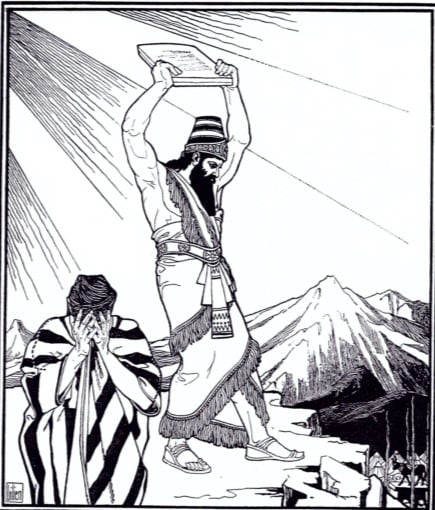
Moses Breaking the Tablets, by Ephraim Moshe Lilien, 1808

 Then it happened, as he approached the camp and he saw the calf and the dancing. And Moses’ nose burned, and he threw the tablets from his hands, and he shattered them at the bottom of the mountain. (Exodus 32:19)

The text implies that Moses acts in anger, as God had threatened to do. But much of the commentary assumes that whatever his mood, Moses is not throwing a temper tantrum, but rather acting on a flash of insight.

According to the midrash Shemot Rabbah, “he saw that Israel would not survive, and he joined himself with them and broke the tablets. He said to the Holy One blessed be He: ‘They sinned and I sinned, as I broke the tablets. … if You do not pardon them, do not pardon me …”5

According to 12th-century commentator Ibn Ezra, the stone tablets “served, as it were, as a document of witness. Moses thus tore up the contract.”6 (Ibn Ezra considered the stone tablets a contract document because according to Deuteronomy 5:19, God uttered the “Ten Commandments” and later engraved them on the stone tablets. One of these commandments prohibits making or worshiping idols. In Exodus 24:3, Moses told the people all the rules God had handed down, including the “Ten Commandments”, and the Israelites vowed: “All the words that God has spoken, we will do!” 7)

And according to 19th-century commentator Hirsch, when Moses saw the dancing, “he realized that the pagan error had already borne its usual fruit—the unleashing of sensuality. He then understood that the nation would have to be re-educated … By this act he declared in no uncertain terms that the people in its present state was unworthy of the Torah and not fit to receive it.”8

Whatever Moses’ insight is, he risks retribution from God when he shatters God’s words carved in stone. By taking this risk, he joins his fate to the fate of the people (Shemot Rabbah), shatters the evidence of the covenant so the Israelites are not technically guilty of violating it (Ibn Ezra), and sets himself the task of teaching the Israelites how to behave (Hirsch).

And the risk pays off. God never questions Moses’ dramatic action. The two leaders, Moses and God, work together to punish the Israelites for the Golden Calf.

To be continued …


  1. Rashi is the acronym of 11th-century Rabbi Shlomoh Yitzchaki.
  2. Exodus 12:38.
  3. Talmud Bavli, Berakhot 32a, William Davidson translation, from www.sefaria.org.
  4. Genesis 22.
  5. Shemot Rabbah 46:1 (10th-12th century midrash), translation in www.sefaria.org.
  6. Rabbi Abraham ibn Ezra, translation in www.sefaria.org.
  7. See my post: Yitro & Mishpatim: Four Attempts at a Lasting Covenant.
  8. Rabbi Samson Raphael Hirsch, the Hirsch Chumash: Sefer Shemos, translated by Daniel Haberman, Feldheim Publishers, Jerusalem, 2005, p. 770.

Beha-alotkha & Ki Tisa: Calf Replacement

When the Israelites arrive at Mount Sinai in the book of Exodus, they are led by God’s pillar of cloud by day and fire by night, as well as by God’s prophet Moses. When they leave in the book of Numbers, they are led by God’s cloud and fire, and Moses, and the ark.

It sounds like a net gain. But it was nearly a total loss.

Descent in Exodus

The Israelites, who spent their whole lives under Egyptian rule, are deeply insecure when they head into the wilderness. They cannot believe God will rescue them—from the Egyptian chariot army, from thirst, from hunger. After they reach Mount Sinai, God puts on an impressive revelation including fire, smoke, lightning, thunder, and shofar-blasts. The people tremble as violently as the mountain,1 and they unanimously pledge to do everything God commands.2

But all they really learn is that God is powerful, not that they can trust God to get them to Canaan and help them conquer it, as promised.

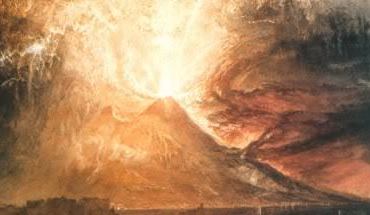
Vesuvius in Eruption, by J.M.W. Turner, 1817

When Moses climbs Mount Sinai for his first forty-day stint, the presence of God at the summit looks like a cloud to him. But it looks like a “consuming fire” to the Israelites.3 How could anyone, even a prophet of Moses’ stature, come back out of that fire alive?

The Israelites below fall into despair in the Torah portion Ki Tisa (Exodus 30:11-34:36), just as God finishes giving instructions to Moses and inscribes some words on a pair of stone tablets.

Then the people saw that Moses was delayed in coming down from the mountain, and the people assembled against Aaron and said to him: “Get up! Make us a god that will go in front of us, because this man Moses who brought us up from the land of Egypt, we do not know what has become of him!” (Exodus 32:1)

The Israelites are afraid to go any farther in the wilderness without Moses. Furthermore, God’s pillar of cloud and fire, which led the way to Mount Sinai,4 seems to have disappeared when they arrived.5 (Perhaps the divine pillar changed shape and relocated to the top of the mountain?) So, grasping at straws, they ask Aaron, Moses’ brother, to make them an idol “to go in front of us”. They would not expect a statue to walk, but they must hope that God would inhabit the idol, as the Egyptian gods inhabited statues in Egypt. Then if the idol were carried on a cart in front of them, God would, in a sense, be leading them. (See my posts Ki Tisa: Golden Calf, Stone Commandments and Ki Tisa: Making an Idol Out of Fear.)

Since the people “assembled against Aaron”, I suspect Aaron was telling them to wait a little longer for Moses to return. But now he caves in, and asks them to bring him gold earrings.

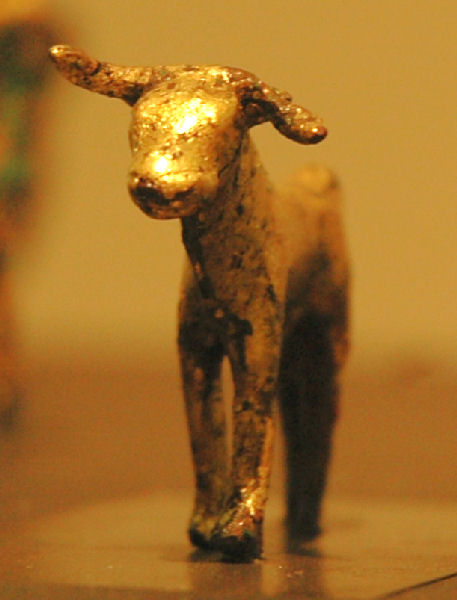
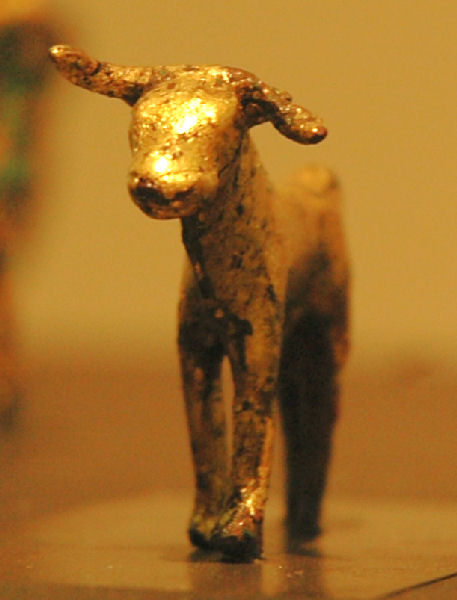
Golden calf figurine from temple of Baalat, Byblos

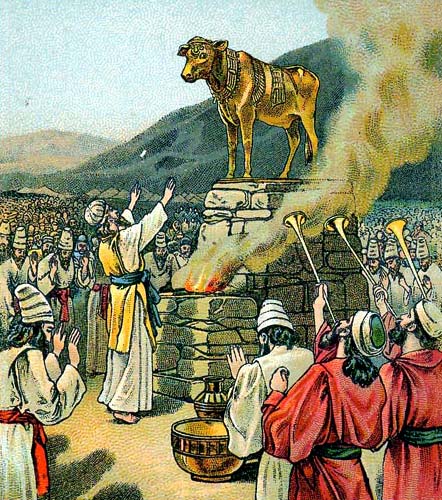
And he took [the gold] from their hands and he shaped it in a mold, and he made it into a statue of a calf. And they said: “This is your God, Israel, who brought you up from the land of Egypt!” And Aaron saw, and he built an altar in front of it. And Aaron called out and said: “A festival for Y-H-V-H tomorrow!”  (Exodus 32:4-5)

The Israelites worship the golden calf as if the God of Israel, whose personal name is Y-H-V-H, were inhabiting it. Nobody mentions that God has already prohibited making or worshiping any statue.

On the mountaintop above, God tells Moses what is happening, and threatens to wipe out all the Israelites and make a nation out of Moses’ descendants instead. Moses talks God out of it. Then he carries the stone tablets down to the camp below—and smashes them. The Levites kill 3,000 calf-worshipers at Moses’ command. And God kills additional people with a plague.

After that, God tells Moses that the Israelites should still go north and conquer Canaan.

“And I will send a malakh in front of you, and I will drive out the Canaanites …. But I will not go up in your midst, lest I destroy you on the way, because you are a stiff-necked people.” (Exodus 33:1,3)

malakh (מַלְאָךְ) = messenger. (In most English translations, a malakh from God is called an angel. A divine malakh can look like a man, or look like fire, or be a disembodied voice.)

And [when] the people heard this bad news, they mourned, and not one man put on his ornaments. (Exodus 33:4)

Their human leader is with them again, but the people want their divine leader as well. How will they know that God is with them, and they are going the right way, unless God’s pillar of cloud and fire is in front of them?

Moses knows a malakh would not be enough to reassure the Israelites, so he tells God:

“If your presence is not going, don’t you make us go up from this [mountain]!” (Exodus 33:15)

And God agrees to go with the Israelites for Moses’ sake. Only then does Moses pass on to the people the instructions God gave him for building a tent-sanctuary so God can dwell among them. The people eagerly donate materials and labor. They spend a year making everything, from the courtyard enclosure to the gold-plated ark inside the Holy of Holies. Then Moses assembles the sanctuary.

And Moses finished the work. And the cloud covered the Tent of Meeting, and the glory of Y-H-V-H filled the mishkan. (Exodus 40:33-34)

mishkan (מִשְׁכָּן) = Literally: dwelling-place (from the root verb shakhan, שָׁכַן = settle, stay, inhabit, dwell). In practice throughout the five books of the Torah: God’s dwelling-place, God’s sanctuary.

So God is willing to inhabit the tent-sanctuary, but not a gold statue. The book of Exodus ends:

For a cloud was over the mishkan by day, and fire was in it by night, in the sight of all the House of Israel on all their journeys. (Exodus 40:38)

Ascent in Numbers

The Israelites finally resume their journey to Canaan in this week’s Torah portion, Beha-alotkha (Numbers 8:1-12:16). Just before this Torah portion begins, the Torah indicates that unlike the golden calf, the two gold statues of keruvim (hybrid winged creatures) rising from the gold cover of the ark are not idols.

And when Moses came into the Tent of Meeting to speak with [God], then he heard the voice speaking to him from above the cover that was on the Ark of the Testimony, from between the two keruvim. (Numbers 7:89)

In other words, God speaks to Moses from the empty space between the two gold statues.

When the Israelites are finally ready to set out for Canaan, the Torah refers back to the end of Exodus.

The Tabernacle in the Camp, Collectie Nederland

And on the day the mishkan was erected, the cloud covered the mishkan for the Tent of the Testimony; and in the evening it was over the mishkan as an appearance of fire, until morning. Thus it was always: the cloud covered it, and appeared as fire at night. And according to when the cloud was lifted up from over the tent, after that the Israelites set out; and at the place where the cloud settled, there the Israelites camped. (Numbers 9:15-17)

The cloud by day and fire by night is not described as a pillar here; its shape is not mentioned at all. But it serves at least one of the purposes of the pillar of cloud and fire that led the Israelites from Egypt to Mount Sinai.

Whether for days or a month or a long time, when the cloud lingered over the mishkan, staying over it, the Israelites were camped, and they did not set out. But when it was lifted, they set out. (Numbers 9:22)

The other purpose of the pillar of cloud and fire was to indicate the direction of travel. This purpose is implied later in this week’s Torah portion:

And they set out from the mountain of God on a journey of three days, and the ark of the Covenant of God  traveled in front of them a journey of three days to seek out a resting place for them. (Numbers 10:33)

The ark, as we learned earlier in the book of Numbers, is covered by a curtain, a sheet of leather, a blue cloth, a crimson cloth, and another sheet of leather when the people travel6—both to honor it and to make sure nobody sees it. Levites from the clan of Geirshon carry it by the wood poles extending from the bottom of the ark.

The portion Beha-alokha contains two different descriptions of the location of the ark when the Israelites are traveling. First it describes the tribes of Judah, Yissachar, and Zevulun setting out, followed by Levites carrying the ark and other pieces of the mishkan.7  Then it says “the ark of the Covenant of God  traveled in front of them”. Either way, the ark goes wherever the Levites gripping the poles take it, so how can it “seek out a resting place”?

And the cloud of God was above them by day, when they set out from the camp. (Numbers 10:34)

If the divine cloud hovers over the marching Israelites all day, then it could indicate the direction of travel by veering off. The Israelites would respond with a course correction—just as they did when the pillar of cloud by day and fire by night led them from Egypt to Mount Sinai.

And the cloud can still take the shape of a pillar. When God orders Moses, Miriam, and Aaron rto report to the entrance of the mishkan,

Then God came down in a pillar of cloud and stood at the entrance of the tent, and called: “Aaron and Miriam!” And the two of them went forward. (Numbers 12:5)

Thus God addresses the anxious insecurity of the Israelites by traveling with them in person, so to speak, in the form of the cloud above them. They also have Moses, the man who arranged their liberation from Egypt and who communicates regularly with God. And they have the ark as a symbol of God’s presence among them even when the mishkan is disassembled and God is not currently speaking to Moses from above the ark.


I have friends who want to believe God is leading them. None of them see pillars of cloud by day and fire by night, as far as I know. But they often notice signs and omens (what I would call coincidences) that reassure them God is in charge and they are being led in the right direction.

I don’t blame them, any more than I blame the Israelites marching toward the unknown dangers of the land of Canaan. The wilderness of this world is frightening.


  1. Exodus 19:16-18, 20:15-16.
  2. Exodus 24:3, 24:7.
  3. Exodus 24:15-18.
  4. Exodus 13:21-22.
  5. So many commentators conclude, since throughout their stay at Mount Sinai no pillar is mentioned until they have finished building the sanctuary. Then God’s cloud by day and fire by night settles on the sanctuary tent, and lifts to signal that it is time for them to travel on (Exodus 40:33-34-38).
  6. Numbers 4:5-8. See my post: Bemidbar: Covering the Sacred.
  7. Numbers 10:13-17.

Ki Tisa & Mishpatim: Shattered

Moses and the Tablets
(strangely fused),
by James Tissot, ca. 1900

At the foot of Mount Sinai, the Israelites are worshiping the Golden Calf; at the summit, God is giving Moses a pair of stone tablets. It is a fateful day in this week’s Torah portion, Ki Tisa (Exodus 30:11-34:35).

Then [God] gave to Moses, once [God] finished speaking with him on Mount Sinai, the two tablets of the eidut, tablets of stone written by the finger of God. (Exodus 31:15)

eidut (עֵדֻת) = affidavit, pronouncement, testimony.

Why does God give Moses two engraved stone tablets to carry down from Mount Sinai?

To provide a written record of the laws?

In an earlier Torah portion, Mishpatim, God tells Moses:

“Come up to me on the mountain and be there, and I will give you tablets of stone and the instruction and the command that I have written to instruct them.” (Exodus 24:12)

What instruction and command? The book of Exodus never says what God wrote on the tablets. But in the book of Deuteronomy, Moses recites the “Ten Commandments”, then says:

These words God spoke to your whole assembly at the mountain, from the midst of the fire, the cloud, and the fog, in a great voice; and did not add more. And [God] wrote them on two tablets of stone, and gave them to me. (Deuteronomy 5:19)

However, these tablets are not the only written record of the Ten Commandments. They first appear in the book of Exodus, during God’s revelation at Mount Sinai.1 After the fireworks of the revelation are over, God adds 24 verses of rules for the people, from Exodus 20:19 in the Torah portion Yitro through Exodus 23:33 in the portion Mishpatim.

And Moses came and reported to the people all the words of God and all the laws, and all the people answered with one voice, and they said: “All the things that God has spoken, we will do!” And Moses wrote down all the words of God. (Exodus 24:3-4)

The next morning Moses sets up an altar, makes animal sacrifices, and splashes some of the blood on the altar.

Then he took the record of the covenant and he read it into the ears of the people, and they said: “All that God has spoken we will do and we will pay attention!” Then Moses took the blood and splashed it on the people, and said: “Hey! [This is] the blood of the covenant that God cut with you concerning all these words!” (Exodus 24:7-8)

So Moses writes a scroll containing the Ten Commandments and the many additional laws God communicated to him, and this scroll counts as a record of the covenant. The two stone tablets are not necessary for that purpose.

To test Moses?

The Torah portion Mishpatim ends with Moses climbing to the top of Mount Sinai alone. Moses spends forty days and forty nights in the cloud at the summit of Mount Sinai, listening to more instructions from God. This time the instructions are for making a portable tent-sanctuary, making vestments for priests, and ordaining the new priests.

Then God tells Moses that the people waiting at the foot of the mountain have made an idol.

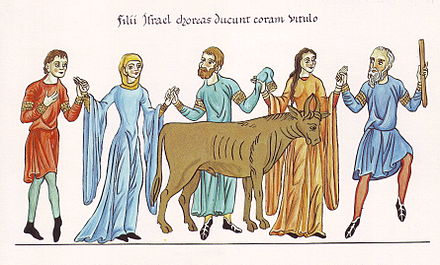
Adoration of the Golden Calf, from Hortus deliciarum
of Herrad of Landsberg, 12th cent.

And God spoke to Moses: “Go down! Because your people whom you brought up from the land of Egypt have ruined [everything]! They have been quick to turn aside from the way that I commanded them. They made themselves a cast image of a calf, and they prostrated themselves to it and they made slaughter sacrifices to it, and they said ‘This is your god, Israel, who brought you up from the land of Egypt’!” (Exodus 32:8)

After delivering the awful news, God tests Moses by making him an offer he can refuse:

“And now leave me alone, and my anger will flare up against them and I will consume them; and I will make you into a great nation.” (Exodus 32:10)

I think the God is implying: “If you leave me alone, then my anger will flare up against them and I will consume them.” It is a backhanded invitation to speak up.

Why does God add that if God “consumes” the Israelites, then Moses’ descendants will become a great nation instead? I suspect it is a temptation that God hopes Moses will reject. Moses passes the test; he argues that it would be a bad idea to destroy the Israelites, and God immediately backs off.

However, I think this is only the first part of God’s test of Moses. The second part is more subtle. By giving Moses the two stone tablets, God is handing over the responsibility for the covenant—the one that the people have just violated by making a golden idol.2 Since Moses wants the Israelites to become the people God will “make into a great nation”, let him address their flagrant violation of God’s law. God will stand by and watch what Moses does with the stone tablets.


Theoretically, Moses could leave the tablets at the top of Mount Sinai, go down and straighten out the Israelites, then fetch the tablets and present them to the people as a reward and confirmation that they are now on the right track. He rejects this option, probably because he knows he needs a strong visual aid to make the people pay attention to him.

He also needs to reinforce the idea that rewards and punishments come from God. Five times during the journey from Egypt to Mount Sinai, the Israelites blamed Moses for bringing them into the desert, and expected him, not God, to provide them with food and water.3 Each time Moses pointed out that God was the one in charge.

Moses Breaking the Tablets,
by Ephraim Moshe Lilien, 1808

So Moses carries God’s two stone tablets down the mountain.

And it happened as he came close to the camp, and he saw the calf and circle-dancing; then Moses’ anger flared up; and he threw the tablets down from his hand, and he shattered them under the mountain. (Exodus 32:19)

Moses already knows about the Golden Calf. What enrages him now is the sight of the people drinking, singing, and dancing—enjoying themselves, now that they finally have a god they can understand, a god that inhabits a gold statue.

This kind of idol was standard in Egypt. Moses has been trying to get his people to accept a god who manifests only as cloud and fire. He would be angry, but not surprised, that the Israelites feel happy and relieved now that they have an idol. (He does not know that his own brother, Aaron, confirmed that the God who brought them out of Egypt inhabits the Golden Calf.)4

I doubt Moses is so completely overcome by his anger that he hurls down the tablets without thinking. After all, he had enough presence of mind to argue with God when he was surprised and frightened by his first overwhelming encounter at the burning bush. Surely he has enough presence of mind now, in a situation he is partially prepared for, to make a deliberate decision to smash the stones.

He may even worry that they will bounce instead of shatter, and fail to achieve the effects he desires: demonstrating that the people broke their covenant with God, inducing guilt, and setting an example regarding idols.

Demonstrating that they broke the covenant

None of the literate Israelites have time to read what is carved on the stones before Moses smashes them. But Moses waits until he is close enough so everyone can see that he is holding two thin, smooth stone tablets with writing carved into them. The Israelites would conclude that God must have given him the tablets at the top of the mountain. In the Ancient Near East, as in the modern world, both parties to a covenant get a written copy. So they would also assume, correctly, that the tablets are related to the covenant they made with God 40 days before.

In other words, the people would know that the stones were “two tablets of the eidut, of God’s affidavit, pronouncement, or testimony. According to 12th-century commentator Ibn Ezra,

“He therefore broke the tablets which were in his hands and served, as it were, as a document of witness. Moses thus tore up the contract. As Scripture states, he did this in the sight of all of Israel.”5

Inducing guilt

The second effect Moses’ demonstration achieves is to make the Israelites realize they disobeyed God and did the  wrong thing. According to 15th-century commentator Abravanel,

“Had Israel not seen the Tablets intact, the awesome work of the Lord, they would not have been moved by the fragments, since the soul is more impressed by what it sees, than by what it hears. He therefore brought them down from the mountain to show them to the people, and then break them before their very eyes.”6

The Israelites, like most humans, have a stronger and more visceral response to what they see than to any words they hear. The first time in Exodus that the people trust God (at least temporarily) is when they see the Egyptian charioteers drown in the Reed Sea.7 That is also the first time they rejoice, singing and dancing. The next time they rejoice, again with dancing, is in front of the Golden Calf.

But when they see the stone tablets carved with some words from God, and then see Moses shatter them, they know in their guts that they were wrong.

Setting an example regarding idols

The third effect Moses achieves by smashing the stone tablets is to set an example regarding idols. An idol, in the Hebrew Bible, is a physical object that is treated like a god. The Golden Calf is an idol. But the two stone tablets also have the potential to become an idol. What if the Israelites are so desperate for a concrete god that they adopt the tablets in place of the calf? What if they prostrate themselves before the tablets, make sacrifices to the tablets, and carouse in front of the tablets with the same unchecked ecstasy?

21st-century commentator Zornberg concluded:

“Moses, therefore, smashes the tablets, not in pique, but in a tragic realization that a people so hungry for absolute possession may make a fetish of the tablets as well.”8 When Moses hurls down the stone tablets, they do not bounce, like magical objects. They break, like slate tiles. The people see that the tablets are only stones. God does not inhabit them.


Change is hard. Human beings enjoy a little variety, but a change in employment or a change in address is hard to get used to even when it is an improvement. The Israelites were underdogs doing forced labor in Egypt. Now they have been changed into an independent people traveling toward a new home in Canaan. These changes alone require new habits of thought. But these people must also adopt a new religion.

The Israelites in Egypt still acknowledged the God of their ancestors Abraham, Isaac, and Jacob. But now their God is demanding an active—and exclusive—form of religion. Instead of obeying their Egyptian overseers, they must obey an invisible God who manifests sometimes as cloud and fire, but speaks only to Moses. They must follow this God’s rules and do whatever God says. They promise twice that they will do it. But the new covenant is hard to obey.

I have managed big changes in my own life through a combination of stubborn determination to do the right thing and harnessing as much rational thought as I can. But I have advantages the Israelites did not have. I suffered only minor childhood trauma, I have lived safely in the American middle class, and I have an analytical personality and brain.

I want to feel sympathy, not anger, toward people whose choices seem blatantly wrong to me. But what if someday there is a moment when I could jolt people out of their habits of thought by smashing a potential metaphorical idol? If it ever happens, I hope I will recognize it.


  1. See my posts Yitro & Va-etchanan: Whose Words?, Part 1 and Part 2.
  2. The prohibition against making any idols or images of a god appears not only in the “Ten Commandments”, but also in Exodus 20:20, at the beginning of God’s long list of rules following the revelation, the list Moses has written down and read out loud to the people twice.
  3. Exodus 14:11-12, 15:22-24, 16:2-3, 16:6-8, 17:2-4.
  4. Exodus 32:4-5.
  5. Abraham ben Meir ibn Ezra, translation in www.sefaria.org.
  6. Don Isaac ben Judah Abravanel, translated by Aryeh Newman, in Nehama Leibowitz, Studies in Shemot, Part II, Maor Wallach Press, 1996, p. 610.
  7. Exodus 14:30-31, 15:19-21.
  8. Avivah Gottlieb Zornberg, The Particulars of Rapture, Doubleday, New York, 2001, p. 424.

Tetzaveh & Ki Tisa: Washing

Two kinds of rituals based on washing with water appear in God’s instructions to Moses about the new sanctuary and priesthood for the Israelites. One is immersion in water for ritual purification; the other is washing hands and feet as either an act of reverence or a form of sanctification.

Immersion in Tetzaveh

In this week’s Torah portion, Tetzaveh (Exodus 27:20-30:10), God tells Moses to purify the new priests by washing their whole bodies in water.

The instructions for consecrating Aaron and his sons as the first priests of the Israelites begin with some preparations before the ceremony begins. Moses must bring a bull, two rams, and a basket with three kinds of unleavened bread to the area in front of the new Tent of Meeting. Then, God says:

“And you will bring forward Aaron and his sons to the entrance of the Tent of Meeting, verachatzta them with water.” (Exodus 29:4)

verachatzta (וְרָחַצתָּ) = and you will wash. (Also a conjugation of the verb rachatz.)

Washing Aaron and his sons in water is the first step to prepare them for consecration as priests. The next step is to dress them in their vestments, the uniforms of priesthood that the Israelites are going to make out of precious materials.

“Then you will take the clothing, and you will dress Aaron in the tunic …” (Exodus 29:5)

The text is too polite to say so, but Aaron and his four sons must undress before Moses can wash and dress them. The implication is that their entire bodies will be washed, not just their hands and feet.

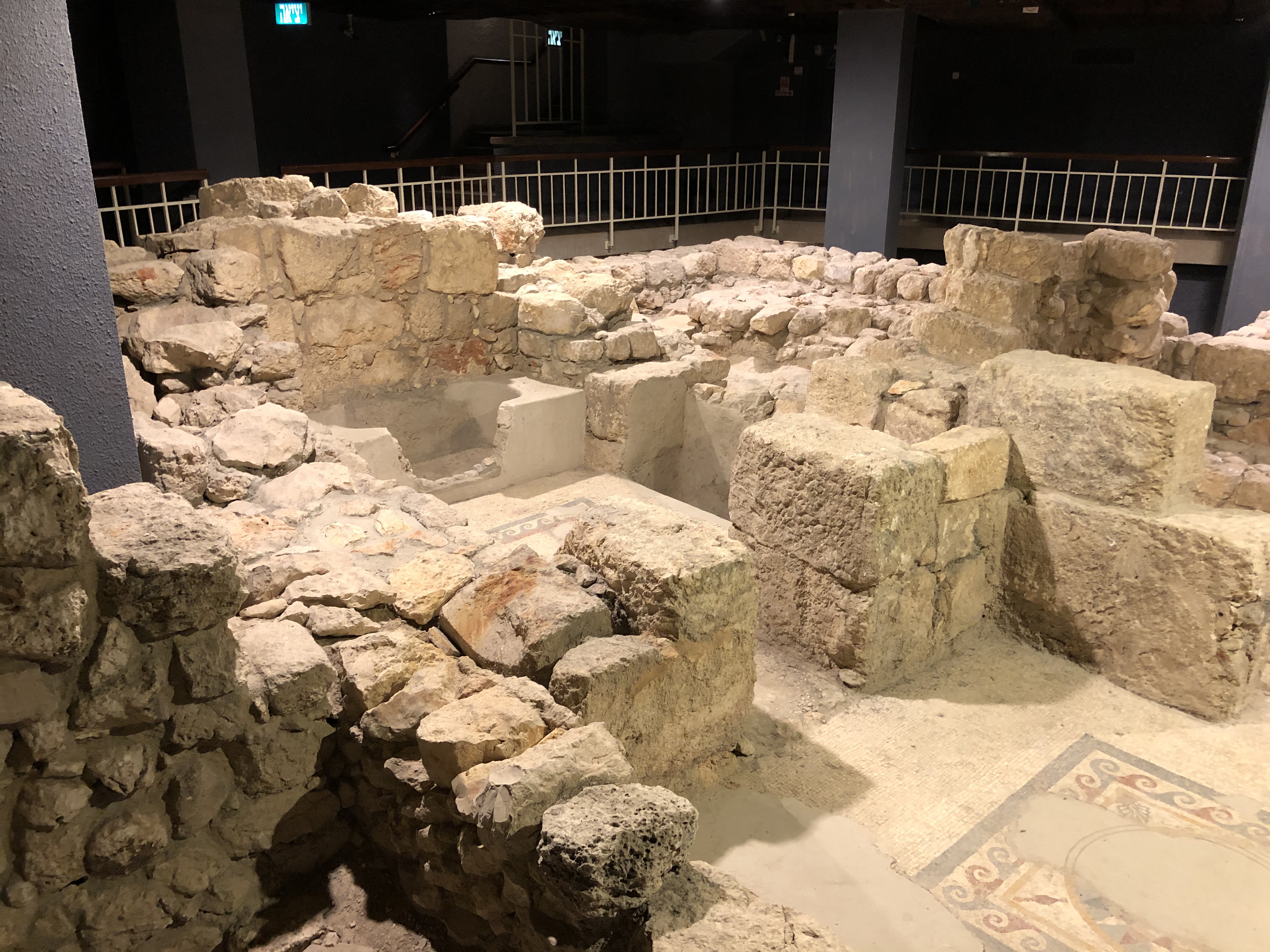
1st century mikveh under Wohl building,
Jerusalem (photo by M.C.)

As early as the 2nd century C.E.,1 the ritual washing in this week’s Torah portion was identified with immersion in a mikveh, a pool of water fed by gravity from “living water”, i.e. a spring or a cistern filled with rain. Archaeologists have found these pools throughout Judea dating to the period the second temple stood in Jerusalem, 515 B.C.E.-70 C.E.. Many Jews today still use a mikveh for certain kinds of ritual purification.

Why does immersion in living water get rid of ritual impurity? 19th-century Rabbi Samson Raphael Hirsch noted that before God created the earth, there was water.

… and darkness was over the face of the depths, and a wind of God hovered over the face of the water. (Genesis 1:2)

He added that according to the Babylonian Talmud tractate Kelim, vessels made from parts of aquatic creatures cannot become ritually impure, and combining these two concepts, he concluded:

“Thus, immersion in water symbolizes complete departure from the human realm, the realm subject to tumah, and restoration to the original condition. Immersion removes man from his past connections and opens up for his future a new life of taharah. Through this immersion, Moses—as the nation’s highest representative—elevates Aharon and his sons, who are to be consecrated as priests, and removes them from their past connections.”2

Only after Aaron and his sons have been ritually purified by water can Moses proceed with their consecration, which includes anointing Aaron as the high priest by pouring olive oil over his head,3 and dedicating him and his sons to their new positions by daubing ram’s blood on their ears, thumbs, and toes.4

Washing hands and feet in Ki Tisa

The instructions for the new sanctuary and its priests continue in next week’s Torah portion, Ki Tisa (Exodus 30:11-34:35)—until God gives Moses the pair of stone tablets, which Moses smashes when he comes down from Mount Sinai and sees the people worshiping a golden calf.

Model of temple
wash-basin by
Temple Institute

And God spoke to Moses, saying: “You will make a wash-basin of bronze lerachtzah, and its stand of bronze. And you will place it between the Tent of Meeting and the altar, and you will put water there. Verachtzu, Aaron and his sons, their hands and their feet in it. When they are coming into the Tent of Meeting, yirchatzu with water, and they will not die. Or when they come up to the altar to attend to turning a fire-offering to God into smoke, yirchatzu their hands and their feet, and they will not die.” (Exodus 30:17-21)

lerachtzah (לְרָחְצָה) = for washing. (Also from the verb rachatz.)

verachtzu (וְרָחֲצוּ) = and they will wash. (Another conjugation of the verb rachatz.)

yirchatzu (יִרְחֲצוּ) = they must wash. (Ditto.)

Why do the priests only need to wash their hands and feet before entering the sanctuary tent or serving at the altar? And why would they die if they did not perform these ablutions?

Washing in water from the basin5 is not entirely symbolic. As Ramban pointed out in the 13th century,

 “This washing was out of reverence for Him Who is on high, for whoever approaches the King’s table to serve, or to touch the portion of the king’s food, and of the wine which he drinks, washes his hands, because “hands are busy” [touching unclean things automatically]. In addition He prescribed here the washing of feet because the priests performed the Service barefooted, and there are some people who have impurities and dirt on their feet.” 6

But Ramban also noted that washing one’s hands before serving a king expresses deep respect or reverence:

“It is on the basis of the idea of this commandment that our Rabbis have instituted the washing of hands before prayer, in order that one should direct one’s thoughts to this matter.”6

Later Jewish commentators added that while immersion in water results in ritual purification (taharah), washing hands and feet before serving God is an act of sanctification—like dressing in the vestments for priests, or donning a tallit and tefillin before praying for Jews in the last two millennia.

“Purification involves the removal of a negative, impure element … whereas sanctification implies a spiritual elevation of an unworthy person or thing to the level required for the holy service of God.” (Elie Munk)7

So God’s instructions to Moses for the establishment of a religion with a sanctuary, priests, and procedures for worship include two kinds of washing in water: ritual purification through immersion before a new priest is consecrated, and sanctifying hands and feet by rinsing them before serving God.


I have not been in a mikveh for years. I used to have Shabbat dinner with observant Jewish friends, and say the whole series of blessings before eating, each one accompanied by an action. In between blessing and sipping the wine, and blessing and tasting the bread, was a ritual hand-washing: pouring water three times over each hand, then raising both hands and reciting the blessing that can be literally translated as: “Blessed are you, God, our God, Ruler of the Universe, who had sanctified us with commandments and commanded us about elevating hands.” Now I only do that on Passover.

The old reasons for water rituals no longer seem compelling to me. Yet when I have been exposed to a person shouting ugly things, I wish I could purify myself. And when I am about to teach or speak in public, I wish I could sanctify myself so my speech will be worthy.

I need new ways of performing ritual washing.


  1. Targum Jonathan, a 2nd-century translation of the Hebrew Bible into Aramaic, says Moses will wash them, and adds “in four measures of living water”.
  2. Samson Raphael Hirsch, The Hirsch Chumash: Sefer Shemos, translated by Daniel Haberman, Feldheim Publishers, Jerusalem, 2005, p. 680.
  3. Exodus 29:7.
  4. Exodus 29:19.
  5. In the second temple, the wash-basin had spigots. Since the bible does not mention a jug for dipping water out of the basin, and the basin was elevated by a stand, the basin in Exodus probably has spigots as well.
  6. Ramban (Rabbi Moshe ben Nachman) on Exodus 30:19, The William Davidson Edition translation, in www.sefaria.org.
  7. Rabbi Elie Munk, The Call of the Torah: Bereishis, Mesorah Publications, Rahway, N.J., 1994, p. 431.

Beshalach & Ki Tisa: Dancing

How do you thank—or appease—the God of Israel? Burning offerings on an altar is the primary method in the Hebrew Bible. But for women, another way is to grab your tambourine and do a chain dance.

Celebrating the right way in Beshalach

As soon as the Israelites walk out of Egypt, Pharaoh pursues them with chariots in the Torah portion Beshalach (Exodus 13:17-17:16). Then a wind from God dries out a path across the Reed Sea. After the Israelites cross over, God makes the waters return and drown the Egyptian army.

Miriam, by Anselm Feuerbach, 1862

Then Miriam the prophetess, Aaron’s sister, took the tambourine in her hand, and all the women went out after her with tambourines and with mecholot. And Miriam sang call-and-response to them: “Sing to Y-H-V-H, for [God] is definitely superior! Horse and its rider [God] threw into the sea!” (Exodus 15:20-21)

mecholot (מְחֺלוֹת) = plural of mecholah (מְחֺלָה) or mechol (מְחוֹל) = chain dance or circle dance. (From the root verb chol, חול = go around in succession; do a circle dance or chain dance.)

In a mecholah, dancers form a line behind a leader, with each dancer using one hand to touch the next. The line moves in a circle, a spiral, or some other curving pattern s the dancers copy the steps of the leader.

In this first example of mecholot in the Torah, each woman on the shore of the Reed Sea is carrying her tambourine, but her other hand is free to touch the shoulder of the woman in front of her. Percussion and singing are integral to the dancing.

This first chain dance is a heartfelt celebration of a divine miracle that saved the Israelites from being killed. Even the words the women sing are a tribute to God.

Celebrating the wrong way in Ki Tisa

The Israelites also think they are celebrating God’s presence with the second mecholot in the Torah,which occur in this week’s Torah portion, Ki Tisa (Exodus 30:11-34:35). But they are deluding themselves.

A pillar of cloud and fire from God led the Israelites our of Egypt, across the Reed Sea, and all the way to Mount Sinai. But there the pillar disappeared, and God manifested as terrifying noises and volcanic fires. At least the people still had Moses as an intermediary—until after the revelation and covenants at Sinai, when Moses disappeared. From Moses’ point of view, God invited him into the cloud on top of the mountain for forty days and nights of divine instruction. But the Israelites below see only fire at the top of the mountain.2 When Moses has not returned after 40 days, they give up on ever seeing him again. How can they continue traveling to Canaan without either the pillar of cloud and fire or the prophet Moses to lead them?

And the people saw that Moses was shamefully late coming down from the mountain, and the people assembled against Aaron, and they said to him: “Get up! Make us a god that will go in front of us, since this man Moses who brought us up from the land of Egypt—we do not know what happened to him!” (Exodus 32:1)

What the Israelites are asking for is an idol: a statue that a god will magically inhabit. After all, other religions in the Ancient Near East depend on idols inhabited by gods to grant good fortune to their worshipers.

Worshipping the Golden Calf, Providence Lithograph Co. Bible card, 1901

Aaron melts down the gold earrings that the Israelites took from the Egyptians on their way out, and makes a golden calf.

… and they said: “This is your god, Israel, who brought you up from the land of Egypt!” And Aaron saw, and he built an altar in front of it, and he called out and said: “A festival for Y-H-V-H tomorrow!” And they rose early the next day, and they offered up burnt offerings and brought wholeness offerings. Then the people sat down to eat, and they drank, and they got up letzacheik. (Exodus 32:4-6)

letzacheik (לְצַחֵק) = to make merry, to have fun, to mock, to laugh, to play around.

Aaron should have known better. Yes, using the four-letter personal name of the God of Israel would at least remind the people which God brought them out of Egypt. And Aaron cannot be held accountable for knowing the second of the Ten Commandments, which forbids idols, since this list of commands is inserted into the Torah portion Yitro (Exodus 18:1-20:23) in the middle of the story of God’s frightening volcanic revelation.3

Nevertheless, right after the revelation God tells Moses:

“Thus you must say to the Israelites: You yourselves saw that I spoke to you from the heavens. With me, you must not make gods of silver or gods of gold …” (Exodus 20:19-20)

A long list of additional rules follows.

Then Moses came and reported to the people all the words of Y-H-V-H and all the laws. And all the people answered with one voice, and they said: “All the things that Y-H-V0H spoke we will do!” And Moses wrote down all the words of Y-H-V-H. (Exodus 24:3-4)

So by the time Moses disappears for forty days, everyone, including Aaron, knows that God absolutely rejects gold idols. And they make one anyway.

In this week’s Torah portion, when Moses finally hikes back down Mount Sinai carrying the two stone tablets, he hears raucous singing.4

And he came close to the camp, and he saw the calf and mecholot. And Moses’ anger burned, and he threw the tablets from his hands and shattered them at the bottom of the mountain. (Exodus 32:19)

Naturally Moses would be angry at the sight of the golden calf, which was exactly the kind of idol God prohibited. But why was he upset by the sight of chain dancing?

Rashi5 proposed that the Israelites were dancing lewdly. He cited the first description of the Israelites’ revelry in front of the golden calf, which says “they got up letzacheik (to play; see Exodus 32:6, above). The word letzachek, Rashi pointed out, has a sexual connotation in the book of Genesis, when Potifar’s wife accuses Joseph of attempted rape. She says: “… he came into our house letzachek with me!” (Genesis 39:17).

Yet the dances reported in this week’s Torah portion are mecholot, in which the only physical contact is between one person’s hand and the back of the next person’s shoulder. It is not even partner dancing. I think Moses is enraged to see the dancing simply because the people are celebrating the manufacture and worship of an idol, when they ought to feel ashamed of disobeying God.

Thousands of the dancers die in Ki Tisa6 because they convince themselves that they are celebrating the return of their God with perfectly acceptable acts of worship: burnt offerings, feasting, drinking, and innocent mecholot. They cannot bring themselves to believe what Moses told them: that their God, the God who brought them out of Egypt, is not the normal kind of god that inhabits idols.


Denial—pretending that a reality does not exist—is human nature. We often long for something we cannot have, and postpone doing what we must to make the best of it. Sometimes we get away with it for a while, and when we feel stronger we grapple with our problem again.

But some forms of denial are too extreme to get away with, even in a world without a Moses or a God to inflict direct punishment. Today we may die if we neglect clear warnings about our health. Our hopes and plans may die if we fail to face reality in our relationships, our jobs, our finances, our habits.

Before we join a dance of celebration, may we consider whether we are celebrating something real.


Next week: more dancing

I hope my Jewish readers had a happy Purim!


  1. See my blog post: Bo & Beshalach: Winds.
  2. Exodus 24:16-17.
  3. From the viewpoint of source criticism, the Ten Commandments were clearly inserted by a later editor. But even if the biblical narrative were a continuous whole with one author, there is no indication that anyone except Moses heard the Ten Commandments at that time.
  4. Exodus 32:18.
  5. Rashi is the acronym for 11th-century rabbi Shlomoh Yitzchaki.
  6. Three thousand are slain by Levites in Exodus 32:26-29, and an additional number are killed by a plague from God in Exodus 32:35.

Pekudei, Yitro, & Ki Tisa: Not Like Other Gods

The Ten Commandments are delivered in thunder at Mount Sinai partway through the book of Exodus. As I wait to move my mother into assisted living (an example of obeying  the fifth commandment), I have been writing about how these famous directives play out in the rest of the book.

This week’s reading is the last Torah portion in Exodus, Pekudei, which confirms that the Israelites are finally on the right track about the first two commandments.  

*

The first two of the Ten Commandments in the Torah portion Yitro both warn the Israelites not to treat their God like other gods. By the end of the book of Exodus, they have succeeded—at least temporarily.

First Commandment

Edomite goddess, 7th-6th century BCE, Israel Museum (photo by M.C.)

I am Y-H-V-H, your God who brought you out of the land of Egypt, out of the house of slavery. You must have no other gods al panai. (Exodus 20:2-3)

al panai (עַל פָּּנָי) = over my face, above me, in front of me, in addition to me. (Panai is the first person singular possessive of panim, פָּּנִים = face, surface, self, presence.)

First God identifies “himself” in two ways:

  • as the god of the four-letter name that riffs on the verb for being and becoming,1 and
  • as the god who brought the Israelites out of slavery in Egypt with ten miraculous disasters.

Then God utters one of the following commands, depending on translation:

  • You must have no other gods above me.
  • You must have no other gods in addition to me.

It is not clear whether God wants to be considered the supreme god, or the only god.2 But the existence or non-existence of other gods is not the issue; the important point is that the God called Y-H-V-H is incomparable to any other god.3

Second Commandment

Idol of Hazor storm-god, 15th-13th century BCE, Israel Museum (photo by M.C.)

One way that the God of the Israelites is not like any other god is Y-H-V-H’s objection to being worshiped through an idol.

You must not make yourself a carved idol or any likeness of what is in the heavens above or what is on the earth below or what is in the waters below the earth. You must not bow down to them, and you must not serve them. Because I, Y-H-V-H, your God, am a jealous god … (Exodus 20:4-5)

Is God jealous of other gods? I think a better reading is that God is jealous of the privilege of manifesting only in sounds, earthquakes, and amorphous sights such as cloud and fire. Only other gods are willing to inhabit man-made idols.

A divine pillar of cloud by day and fire by night leads the Israelites from Egypt to Mount Sinai. Then in the Torah portion Ki Tisa the people panic about forty days after Moses has disappeared into the cloud or fire on top of the mountain. They tell Moses’ brother, Aaron:

“Get up! Make us a god that will go before us! Because this Moses, the man who brought us up from the land of Egypt, we do not know what has happened to him!” (Exodus 32:1)

So Aaron makes them an idol out of gold.4 The Israelites call the golden calf the god who brought them out of Egypt, and Aaron identifies it by God’s four-letter personal name, Y-H-V-H. They are not disobeying the first commandment and worshiping another god. Yet their God is furious.5

If the God of the Israelites were like other gods, Aaron’s only mistake would be making a golden calf instead of a golden bull. After all, a bull is more powerful than its juvenile offspring.

Gold calf from temple of Baalat in Byblos

Bulls represented Egyptian, Mesopotamian, and Canaanite gods. And 1 Kings 12:28-29 reports that golden “calves” were placed in the sanctuaries of Beit-El and Dan in the northern Kingdom of Israel. (They were probably bulls, which the southern kingdom of Judah belittled by calling them calves.)6

Most idols in the Ancient Near East were shaped like humans, animals, or fanciful hybrids. Archaeologists have found many small enough to hold in one hand. Neither Egyptians nor Mesopotamians nor Canaanites appear to have believed that the statues or figurines were gods. What they did believe was that gods could be enticed into temporarily inhabiting their idols. A god inhabiting a statue was easier to address with promises and bribes so it would act for your benefit.

The God of the Israelites, however, refuses to inhabit an idol. God cannot be represented by the shape of any physical object in the world because God has an entirely different, transcendent, kind of being.

In the first four portions of Exodus, God manifests as a voice coming from a burning bush, and as a moving pillar of cloud by day and fire by night.7 During the revelation at Mount Sinai, God manifests as thunder and shofar blasts, earthquake tremors, and lightning, fire, cloud, and smoke.8 The visible—but intangible and unbounded—manifestation of God as cloud and fire reappears in the portion Pekudei at the end of Exodus.

*

This gives the book of Exodus a happy ending. In the portion Ki Tisa, thousands of are punished with death for worshiping the golden calf. Then Moses tells the Israelites that God wants them to make a portable tent-sanctuary so God can dwell among them.9 The people eagerly donate materials and labor.

In this week’s portion, Pekudei, Moses assembles the tent and places the ark inside. Rising from the lid of the ark are two gold winged creatures called keruvim,10 but they are not considered idols, since God will speak from the empty space between the wings of the keruvim.

And Moses completed the work. Then the cloud covered the Tent of Meeting, and the kavod of God filled the dwelling-place. And Moses was not able to come into the Tent of Meeting because the cloud dwelled in it, and the kavod of God filled the dwelling-place. (Exodus 40:33-35)

kavod (כָּבוֹד, כָּבֺד) = weight, impressiveness, magnificence, glory, honor.

The cloud covering the tent looks like the pillar of cloud by day and fire by night that led the Israelites from Egypt to Mount Sinai.10  The kavod of God inside is not described.11 Nevertheless, the people can see that God is with them again.

The book of Exodus concludes with a summary the movements of the divine manifestation for the next 38 years:

Pillar of cloud over the sanctuary, Collectie Nederland

And when the cloud lifted from the dwelling-place, the Israelites pulled out on all their journeys. And if the cloud did not lift, then they did not pull out until the day it did lift. Because the cloud of God was above the dwelling-place by day, and it became fire by night, in the eyes of the whole house of Israel on all their journeys. (Exodus 40:36-38)

In other words, God’s pillar of cloud and fire returns to lead the Israelites from Mount Sinai to the land of Canaan. The people get what they need, a God who provides a visible sign to follow—without violating the second commandment.

May we all find ways to invite the divine spirit to be with us, without trying to contain and idolize that spirit through magical thinking.

  1. Also called the “tetragrammaton”. See my post Beshallach & Shemot: Knowing the Name.
  2. Jerome Segal, in his analysis of God’s psychology as presented in the Torah, wrote: “… it may be that God is happy to have the Israelites believe in multiple gods, as that makes it all the more significant that they worship only Yahweh.” (Jerome M. Segal, Joseph’s Bones, Riverhead Books/Penguin Group, New York, 2007, p. 223)
  3. 16th-century commentator Ovadiah Sforno imagined God explaining: “I cannot tolerate that someone who worships me worships also someone beside me. The reason is that there is absolutely no comparison between Me and any other phenomenon in the universe. I am therefore entitled to stand on My dignity by refusing to be compared.” (translation by http://www.sefaria.org)
  4. See my post Ki Tisa: Golden Calf, Stone Commandments.
  5. Exodus 32:4-5, 32:7-10.
  6. See Rami Arav, “The Golden Calf: Bull-El Worship”, https://www.thetorah.com/article/the-golden-calf-bull-el-worship.
  7. Exodus 32:4-5.
  8. Exodus 3:1-17, Exodus 13:20-22.
  9. Exodus 19:16-20. A shofar is a trumpet-like instrument made from the horn of a ram or goat.
  10. Exodus 35:4-38:20 (most of the Torah portion Vayakheil).
  11. See my post Terumah: Cherubs Are Not for Valentine’s Day.
  12. See my post Pekudei: Cloud of Glory.

Vayakheil+4: Not on Shabbat

“Hurry up and wait” describes a lot of life. Two weeks ago I was frantically getting ready to move my mother into assisted living. Now my effort to fulfill the Fifth Commandment and honor my mother is on hold until I get a moving date from the center—and wouldn’t you know it, she had another fall while she was alone in her house …

Talmud Readers, by Adolf Behrman, 1876-1943. What could be more absorbing?

I wish this period of waiting instead of doing labor were like the day of shabbat, the sabbath day of rest, but these days my soul is too heavy to rise to either refreshment or holiness. So this week I took my mind off my troubles by researching the commandment about shabbat. Here is a new post for this week’s Torah portion, Vayakheil—and four other portions in the book of Exodus, Beshallach, Yitro, Mishpatim, and Ki Tisa, that include variations on the command to desist from labor on the seventh day.

*

The first three of the Ten Commandments order us not to underestimate God.1 The last six are ethical precepts for human relations with other humans.2 In between, the fourth commandment combines holiness and ethics. It opens:

Remember the day of the shabbat, to treat it as holy. (Exodus 20:8) 3

shabbat (שַׁבַּת) = sabbath, day of rest. (From the same root as shavat, שָׁבַת = cease, stop, desist; stop working.)

This command is followed by explanatory notes in the Torah portion Yitro. More details are added every time the observance of shabbat is commanded in the book of Exodus—from the first time, in the portion Beshallach, when the Israelites are collecting manna, to the sixth time, in this week’s portion, Vayakheil, after God has given Moses a second set of tablets with the Ten Commandments carved in stone.

1) Don’t move

Manna Raining from Heaven, Maciejowski Bible, c. 1250 C.E.

Moses first mentions shabbat in the Torah portion Beshallach, when God provides manna for the hungry Israelites to gather up from the ground six, and only six, days a week. Moses says:

“See that God has given you the shabbat. Therefore on the sixth day [God] is giving you food for two days. Everyone in his place! No one go out from his spot on the seventh day!” (Exodus 16:29—Beshallach)

This introduces shabbat as a day of rest, at least in terms of going out and gathering food.

2) Holy break

The next order regarding shabbat is the one in the Ten Commandments in Yitro. The full fourth commandment states:

The Creation, by Lucas Cranach, 1534, Luther Bible

Remember the day of the shabbat, to make it holy. Six days you may work and you may do all your labor. But the seventh day is a shabbat for God, your God; you must not do any labor, you or your son or your daughter, your male slave or your female slave or your livestock or your immigrant within your gates. Because in six days God made the heavens and the earth and the sea and everything that is in them, and [God] took a break on the seventh day. Therefore God blessed the day of the shabbat and made it holy. (Exodus 20:8-11)

The emphasis in this commandment is on the holiness of shabbat. Since the day itself is holy, it must be set aside from mundane labor by all humans and animals in an Israelite’s household, and even by God.

3) Ethical refreshment

The third injunction about shabbat is in the portion Mishpatim:

Six days you may do your doings, but on the seventh day tishbot so that your ox and your donkey can take a break, veyinafeish, your slave and the immigrant. (Exodus 23:12)

tishbot (תּשְׁבֺּת) = you must cease, stop, stop working. (A form of the verb shavat.)

veyinafeish (וְיִנָּפֵשׁ) = and he can refresh himself, reanimate himself, catch his breath. (From the same root as nefesh, נֶפֶשׁ = throat, breath, appetite, mood, animating soul.)

This time Moses, speaking for God, gives a reason why even slaves, immigrants, and beasts must be given a day off from work on shabbat: so that draft animals can rest their muscles, and human laborers can rest their souls, becoming refreshed and revitalized.

Providing a day of rest is an ethical mandate; the moral principle of kindness calls for helping others to have a better life, and the moral principle of fairness supports giving everyone a day off when the landowner has a day off. Shabbat is the opposite of Pharaoh’s unethical subjection of the Israelite slaves to unremitting labor.4

4) Be holy or die

The fourth command about shabbat appears in the Torah portion Ki Tisa, after God finishes telling Moses what the Israelites must make to set up the sanctuary and the priests of their new religion. God warns that all of this construction must pause on the day of shabbat.

Nevertheless, you must observe shabtotai, because it is a sign between me and you for your generations, for knowledge that I, God, have made you holy. And you must observe the shabbat because it is holy for you. Whoever profanes it must definitely be put to death, because whoever does labor on it, his life will be cut off from among his people. (Exodus 31:12-14)

shabtotai (שַׁבְּתֺתַי) = my shabbats.

This order not only reiterates that shabbat is holy, but adds that observing it is a reminder that the Israelite people themselves are holy, i.e. set aside for God.

In addition, profaning shabbat by doing labor on that day is such a serious transgression that God assigns it the death penalty.

This rule about observing shabbat is the source text for the Talmud’s list of 39 categories of labor forbidden on the seventh day. The rabbis assume that since God warns that the work of building the sanctuary and fabricating the priests’ clothing must cease on shabbat, the labors involved in doing those tasks are the labors forbidden on shabbat from then on.5

This injunction in Ki Tisa continues:

The Israelites must observe the shabbat, doing the shabbat throughout their generations as a covenant forever. Between me and the Israelites it will be a sign forever, because for six days God make the heavens and the earth, and on the seventh day [God] shavat vayinafash. (Exodus 31:16-17)

vayinafash (וַיִּנָּפַשׁ) = and he refreshed himself, reanimated himself, caught his breath.   (A variant of veyinafeish.)

Since the divine life of the universe pauses every seven “days” for refreshment and redirection, so must our own souls. (See my earlier post,  Mishpatim, Ki Tisa, & 2 Samuel: Soul Recovery.)

5) No farming

Shabbat comes up again later in the portion Ki Tisa when God gives Moses additional instructions for the Israelites.

Six days you may work, but on the seventh day tishbot; at plowing and at grain-cutting tishbot. (Exodus 34:21)

The book of Exodus gives no reason why agricultural labor in particular is prohibited on shabbat. One possibility is that this sentence refers to the ethical law about shabbat in Mishpatim, since landowners used draft animals (oxen and donkeys) to plow, and teams of underlings including slaves and immigrants to scythe down ripe grain.

Sheaves of grain

On the other hand, the list in the Talmud of activities prohibited on shabbat includes farming chores that eventually lead to the bread that must be displayed on the gold-plated table in the sanctuary.6 The first eleven of the 39 prohibited labors in the Talmud are sowing grain, plowing, reaping, gathering sheaves, threshing, winnowing, selecting the edible kernels, grinding them into flour, sifting the flour, kneading dough, and baking bread. By this interpretation, the ban on plowing and reaping on shabbat might mean the holiness of the day surpasses the holiness of the sanctuary.

6) Light no fires

The sixth and final shabbat instruction in the book of Exodus occurs in this week’s Torah portion, Vayakheil. Again the seventh day is called holy, and doing labor on that day is punishable by death.

Six days you may do labor, but the seventh day must be holy for you, a shabbat shabbaton for God. Anyone who does labor on it must be put to death. You must not kindle a fire in any of your settlements on the day of shabbat. (Exodus 35:2-3)

shabbaton (שַׁבָּתוֹן) = most solemn shabbat, feast day of shabbat, day of absolute stopping.

Here Moses repeats God’s commands that the day of shabbat must be treated as holy and that anyone who does not desist from labor on that day must be executed.

The new information in Vayakheil is that lighting a fire is prohibited on shabbat. Before this, the only specific examples of labor forbidden on shabbat are agricultural: gathering manna, using draft animals, sowing and reaping . Now, in Vayakheil, Moses gives another example of labor: lighting a fire.

The purpose of this prohibition cannot be ethical, since lighting a fire is not in itself a heavy labor, and it benefits other humans by giving them heat, light, and a way to cook food.

Since the previous verse reminds us that the seventh day must be holy, refraining from kindling a fire must be another religious rule associated with holiness.

Kindling a fire is number 37 in the Talmud’s list of 39 labors banned on shabbat, right after extinguishing a fire. It may allude to the fire on the altar. Although burnt offerings continue during shabbat according to the Torah, the fire is not rekindled. In fact, it must never go out.7 The altar fire is holy because it is dedicated to God, and because God kindled it.8

*

Thus the book of Exodus presents the law against working on shabbat as a religious rule (guarding what is holy) three to five times.9 It presents the law as an ethical rule (promoting kindness and fairness) only twice.10

Yet when we observe the day of shabbat we can remember that it is not solely a religious requirement reminding us of holiness. We will not be put to death for doing forbidden work on shabbat, since that part of the order in this week’s Torah portion is no longer followed. But when we try to set aside mundane concerns in order to elevate our souls on the seventh day, we can also remember the ethical values in the last six commandments, which address kindness, fairness, and respect for other human beings.

And I can pray that soon I will be able to obey the fifth commandment, and treat my mother with kindness and respect by moving her into a safe place.

  1. See my upcoming post, Pekudei, Yitro, & Ki Tisa: Not Like Other Gods.
  2. See my posts Yitro, Mishpatin, & Va-etchanan: Relative or Relevant? Part 1, Part 2, and Part 3 on the last six commandments.
  3. This is the opening in Exodus. When Moses repeats the Ten Commandments in Deuteronomy, the fourth commandment opens: Observe the day of the shabbat and treat it as holy. (Deuteronomy 5:12)
  4. Exodus 5:1-9, 6:9.
  5. Talmud Bavli, Shabbat 73a, Mishna.
  6. Exodus 25:23-30.
  7. Leviticus 6:5-6.
  8. Leviticus 9:24 for the portable sanctuary in the wilderness.
  9. Exodus 16:29, 20:8 and 11, 31:12-13 at a minimum. According to the Talmud Exodus 34:21 and 35:2-3 are also rules for religious purposes.
  10. Exodus 20:9-10, 23:12.

Ki Tisa: Golden Calf, Stone Commandments

Mount Sinai, by Elijah Walton, 19th century

The Torah gives the Ten Commandments1 top priority out of all the rules and orders God gives to the Israelites through Moses. God utters them in the Torah portion Yitro after manifesting in smoke, fire, and thunder, and Moses tells the people what God said.

At the beginning of this week’s Torah portion, Ki Tisa, God engraves the Ten Commandments in stone.

Then [God] gave to Moses, as [God] finished speaking with him on Mount Sinai, the two tablets of the Testimony, stone tablets engraved by the finger of God. (Exodus/Shemot 31:18)

Aaron and the second commandment

While God is giving Moses the first pair of stone tablets, the Israelites at the foot of the mountain are losing hope that Moses will ever come back down. After they have waited for almost forty days, they tell Moses’ brother Aaron:

“Get up! Make us a god that will go before us! Because this Moses, the man who brought us up from the land of Egypt, we do not know what has happened to him!” (Exodus 32:1)

The people desperately want an intermediary between themselves and the invisible, remote, and terrifying God that Moses says has adopted them. Moses was a visible human being, and he could tell them what God wanted, so he was a satisfactory intermediary—until   he vanished into the cloud on top of Mount Sinai.2

Now the people demand a new intermediary. They know the “god” they ask Aaron to make could not speak, like Moses, but at least it would be visible and familiar, like the idols in Egypt.

Aaron is not only Moses’ older brother, but his second-in-command. Yet God has not yet spoken directly to him, and does not do so until Leviticus 10:8-11. The Israelites turn to Aaron as their default leader, but do not expect him to replace Moses as God’s prophet.

Aaron could ask the people to wait another day for Moses to return before taking any rash action. He could remind them of God’s second commandment, which Moses told them during the revelation at Sinai:

You must not make for yourself a statue or any likeness of what is in the heavens above or what is on the earth below or what is in the waters below the earth. You must not bow down to them, and you must not serve them … (Exodus 20:4-5)

He could frighten the people by predicting that their God would surely smite them all if they violated this commandment. But he does not.

The Adoration of the Golden Calf, by Marc Chagall, 1966

Instead, Aaron asks the people to bring him their gold earrings, and casts the gold in the shape of a calf.

And they said: “This is your God, Israel, who brought you up from the land of Egypt!” And Aaron saw, and he built an altar in front of it. And Aaron made an announcement, and said: “Tomorrow is a festival for Y-H-V-H!” (Exodus 32:4-5)

Aaron uses the four-letter proper name of the God of Israel, so he is not violating the first commandment, “You must have no other gods before me.” But he is violating the second commandment, which prohibits making or worshiping an idol.

He has not had a chance to read the commandments on the stone tablets Moses is about to bring down from Mount Sinai. But he has heard Moses declare them. He cannot claim ignorance as an excuse.

Moses and the sixth commandment

The next day the Israelites make burnt offerings in front of the golden calf. By the time Moses reached the bottom of Mount Sinai, they are eating, drinking, and enjoying themselves.

Moses Breaking the Tablets of the Law, by Gustave Dore, 19th cent.

Moses smashes God’s stone tablets.3 Then he melts down the calf, grinds the gold into powder, mixes it with water, and makes the Israelites drink it. He questions his brother Aaron, who gives a feeble excuse, and Moses lets it pass.

Then Moses saw that the people were parua, because Aaron peraoh for a non-entity … (Exodus 32:25)

parua (פָּרֻעַ) = wild, out of control.

peraoh (פְּרָעֺה) = he let [them] get out of control.

Apparently after they have watched Moses melt the calf and grind its gold into dust, some of the Israelites feel wild agitation over losing their idol.

Then Moses stood in the gate of the camp and said: “Who is for Y-H-V-H? To me!” And all the Levite men gathered around him. And he said to them: “Thus says Y-H-V-H, the God of Israel: Every man, put his sword on his hip! Cross and return from gate to gate of the camp, and every man kill his brother and his fellow and his close relatives!” And the Levite men did as Moses spoke, and about 3,000 men of the people fell on that day. (Exodus 32:26-28)

Do the Levites violate the sixth commandment?

Lo tirtzach. (Exodus 20:13)

lo tirtzach (לֺא תִרְצָח) = you must not kill without a legal sanction. (From the verb ratzach, רָצַח.)

Other uses of the verb ratzach in the Torah indicate that this commandment only covers deliberate murder of a fellow Israelite. (See my post Yitro, Mishpatim, & Va-etchanan: Relative or Relevant? Part 1.) God does not prohibit causing accidental death, executing someone who was given the death penalty, or killing the enemy in war. But the Levites deliberately kill fellow Israelites who have not been tried in court with witnesses and sentenced to death.

If each Levite man were individually choosing a fellow Israelite to kill (presumably one who is still parua after the golden calf fiasco), then he would be violating the sixth commandment. But the Levites have to sweep through the camp and back with lightning speed before the other Israelites either escape or fight back. They do not have time to pause and identify who they are killing.

Individual Levite men make one conscious choice: Moses calls out “Who is for God? To me!” and they gather around him. After that they simply obey his orders in the name of God. If Moses had not announced that God wanted them to run through the camp killing people, the Levites would not have taken up their swords.

Bronze Age Short Sword

Moses bears the primary responsibility for the massacre. Does he merely pass on God’s orders word-for-word? Not according to Rashi,4 who wrote that Moses’ order to the Levites was based on an earlier order from God:

“Whoever offers a slaughter-sacrifice to any god except Y-H-V-H alone will be dedicated to destruction.” (Exodus 22:19).

This law in the Torah portion Mishpatim is an elaboration of the second commandment.

Moses might be applying God’s ruling in Mishpatim when he says God wants the Levite men to run through the camp killing people. Or he might be speaking impulsively in a potentially dangerous moment, based on God’s outrage over the golden calf worship, and perhaps a sense that God continues to feel outrage.

What he does not do is pronounce death penalties on about 3,000 men and ask the Levites to execute them. Moses is the chief judge for all the Israelites,5 so he certainly has the legal authority to pronounce death penalties. However, in the Torah a judge rules on individual cases, and only after hearing the testimony of witnesses concerning the accused. Moses asks only Aaron for information about his role in the golden calf fiasco. He calls no witnesses, and pronounces no individual sentences.

Moses violates the sixth commandment by ordering the men of his tribe, the Levites, to murder Israelites without the proper legal sanction. Does he at least achieve what God wants?

The primary effect of the Levites’ lightning-strike massacre would be shock and fear—which might be just what Moses intends. Fear may not be the best motivator for long-term obedience, but it does work in the short run, and Moses and God use it repeatedly in the Torah. The shattering of the stone tablets and the destruction and consumption of the golden calf are not enough to frighten all the Israelites into obedience, but the massacre by the Levites does the trick.

The next day, Moses asks God to forgive the Israelites for the sin of the golden calf. But apparently God is not fully satisfied with the results of the massacre.

And Y-H-V-H said to Moses: “Whoever has offended against me, I will wipe out from my record … and on the day of my accounting, I will bring them to account for their offenses.” And God struck a blow against the people over what they did with the calf that Aaron made. (Exodus 32:33-35)

Classic commentators6 interpreted God’s blow as a plague of disease that killed a particular group of golden calf worshippers who were still alive after the massacre by the Levites.


Neither Aaron nor Moses is punished for his violation of one of the Ten Commandments. Moses says in Deuteronomy 9:20 that he prayed for his brother Aaron, and God forgave him. Moses’ good relationship with God continues; in the remainder of the portion Ki Tisa, Moses asks God to resume leading the people in person (presumably as the pillar of cloud and fire) and God agrees. Then God tells Moses:

“Carve yourself two stone tablets like the first ones, and I will engrave upon the tablets the words that were on the first tablets, which you shattered.” (Exodus 34:1)

Moses climbs Mount Sinai again, carrying blank tablets, and God engraves them with the same ten commandments. Perhaps this shows that God both forgave Moses and reaffirmed that the Ten Commandments as fundamental precepts.

Or perhaps this shows that God plays favorites, approving of the death of thousands of Israelites because they worshiped an idol, but preserving the lives of his two darlings, Moses and Aaron.


  1. What we call “the Ten Commandments” in English are ten “statements” in the bible. Exodus introduces the ten with “And God spoke all these ” (Exodus 20:1) Devarim, דְּבָרִים = words, statements, things. Moses repeats them in Deuteronomy 5:6-18, then concludes: “These devarim God spoke to your whole congregation at the mountain, in a great voice from the midst of the fire and the cloud and the gloom, and … engraved them on two stone tablets.” (Deuteronomy 5:19)
  2. Exodus 24:15-18.
  3. Exodus 32:15-19.
  4. Rashi is the acronym of 11th-century Rabbi Shlomo Yitzchaki.
  5. Exodus 18:13-26.
  6. Including Rashi, Ibn Ezra (12th-century commentator Abraham ben Meir Ibn Ezra), and Ramban (13th-century Rabbi Moses ben Nachman).
  7. In Leviticus 10:1-3.