Beshalach: High-Handed

As a child I was a natural victim, the target of any bully who needed to humiliate someone.  So I can imagine how the Israelites might feel in the book of Exodus/Shemot when they finally leave Egypt on the morning after God’s tenth and final plague:

Our god beat the pharaoh!  We asked our Egyptian neighbors for silver and gold, and they just handed it over to us!  Yesterday we were slaves, and today we are free!  We can do what we please, and we never need to be afraid of Egypt again!

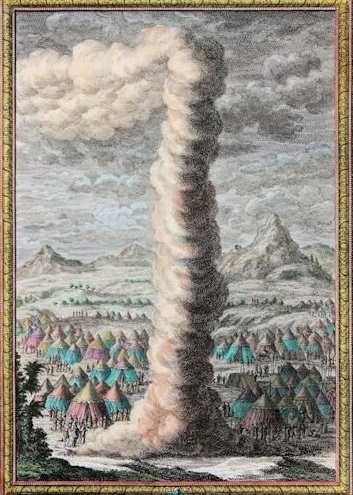
Pillar of Cloud, by Johann Jakob Scheuchzer, 1731

The Israelites leave the city of Ramses unchallenged at the beginning of this week’s Torah portion, Beshalach (“When sending out”).  They march for three days in military formation, following God’s spectacular pillar of cloud by day and fire by night.  For three days, they feel on top of the world.

God leads them to the Reed Sea, rather than by the main road to Canaan, which passes through the land of the Philistines.1  When the Israelites reach the shore of the Reed Sea, God stages one last showdown with the pharaoh.

God strengthened the heart of the pharaoh, the king of Egypt, and he chased after the children of Israel, while the children of Israel were going out beyad ramah. (Exodus 14:8)

beyad ramah (בְּיָד רָמָה) = with a high hand.  Yad (יָד) = hand; power to do something.  Ramah (רָמָה) = high, exalted.

What does it mean to march “with a high hand”?  When I first read this passage, I pictured the Israelites raising their hands as if they were trying to get the teacher’s attention.  But this image is the opposite of the spirit of beyad ramah.

In both Biblical Hebrew and English, the word yad or “hand” is used in many idioms.  After all, we accomplish things primarily with our hands.  Twice in the Torah portion Beshallach Moses raises his hands in order to channel divine energy.  At the Reed Sea, God tells Moses:

And you shall be hareim your staff and stretching out your yad over the sea and splitting it, and the Children of Israel shall come into the middle of the sea on dry land.  (Exodus 14:16)

hareim (הָרֵם) = raising, lifting up.  (From the same root as the adjective ramah.)

Battle with the Amalekites, by Julius Schnorr von Carolsfeld, 1860

Later in this week’s Torah portion the people of Amaleik attack the Israelites, and Moses influences the course of the battle by stationing himself on a hill and raising his hands.

And it happened that Moses yarim his yad, then Israel was mightier, but when he rested his yad, then Amaleik was mightier.  (Exodus 17:11)

yarim (יָרִים) = he would raise.  (From the same root as ramah.)

The Israelites win the battle because Aaron and Hur help Moses hold up his hands when he gets tired.  This confirms that holding up his hands is how Moses channels God’s power; he does not have power of his own.

But the idiom yad ramah refers to acting as if you have power to accomplish things by yourself.  It appears only four  times in the Torah, and two of these appearances refer to the way the Israelites leave Egypt (in Exodus 14:8 above, and in Numbers/Bamidbar 33:3).  The other two appearances help to clarify the idiom’s meaning.

But a person who does it beyad ramah, whether citizen or foreign resident, is reviling God; so that person will be cut off from among the people. (Numbers 15:30) 

In this passage, the Torah has just ruled that if someone inadvertently fails to obey one of God’s laws, he can atone by offering a goat as a sacrifice.  But if he does it on purpose, acting “with a high hand”, the consequence is more severe: he is banished or dies.  When someone transgresses deliberately, beyad ramah, he is acting as if he has more authority than the religious law.

The fourth occurrence of yad ramah in the Torah comes in Moses’ parting poem to the Israelites.  In his long final warning, Moses quotes God’s response to their ingratitude and idolatry:

I said: I would have cut them to pieces,

I would have made the memory of them disappear from men,

If I had not feared for the provocation of enemies—

lest their foes would misinterpret,

lest they would say: “Our yad was ramah, and it was not God Who accomplished all this!”

(Deuteronomy/Devarim 32:26-27)

Here, the “high hand” is the arrogance of Israel’s enemies, who will falsely assume that they have the power to destroy Israel on their own, without God’s collaboration.

Similarly, in English “high-handed” persons assume they have all the power, and arrogantly do something without considering the concerns of others.

So why do the newly freed slaves in the portion Beshalach leave Egypt beyad ramah?  Dazzled by their new higher status, they may well imitate the arrogance of their former masters.  If they had a chance, they might even try to bully or enslave someone less fortunate.  But God does not give them a chance.

In this week’s Torah portion, after “the children of Israel were going out beyad ramah“, the pharaoh sends a troop of charioteers after them.

And Pharaoh came closer, and the children of Israel raised their eyes, and hey!  Egyptians!  Pulling out after them!  And they were very frightened, and the Children of Israel cried out to God.  And they said to Moses: “Are there no graves in Egypt, that you take us to die in the wilderness?  What is this you have done to us, to take us out from Egypt?” (Exodus 14:10-11)

At once the Israelites are struck with fear of their old owners, the bullies who tortured and subjugated them.  They cry out to God, but there is no immediate response.  Their belief in God’s protection is too new and fragile to withstand their reflexive fear.  They cringe and despair.  They are caught between the sea and the chariots.  At that moment, they think they will always be victims.

Yet when they complain to Moses, they make a sarcastic joke: “Are there no graves in Egypt, that you take us to die in the wilderness?”  Thus Jewish humor is born.

*

Would you rather be an arrogant bully, like the pharaoh in the book of Exodus, treating people with high-handed disregard, too habitually hard-hearted to learn compassion?

Or would you rather be like an Israelite in Egypt, never certain of your status and power—but resilient enough to keep your sense of humor?  If so, then be careful about when you act with “a high hand”.

  1. Exodus 13:17-18.

Bo & Beshalach: Clouds and East Wind

This is the d’var Torah I delivered as part of my graduation as a maggidah:

Blood. Frogs. Lice. Beasts. Livestock disease. Boils. Hail. Locusts. Darkness. Death of the Firstborn.

Today’s Torah portion picks up with the plague of locusts, goes into darkness, and brings death to the firstborn. Then, finally, Pharaoh releases the children of Israel.

Why locusts? One morning when I was in college in California, I stepped outside and—crunch! The ground was blanketed with crickets. They covered the lawns, the sidewalks, the flowerbeds. Their bodies were so close together, you couldn’t see the ground. Every time somebody opened a door, crickets jumped inside the building.

Those crickets on campus didn’t eat a lot of vegetation before they died. They were a wonder, but not a plague. They were amateurs compared to the locusts in Egypt.

And Moses stretched out his staff over the land of Egypt, and God guided a an east wind into the land, all that day and all the night … (Exodus/Shemot, Bo, 10:13)
And the locust-swarm went up over the whole land of Egypt … (Bo, 10:14)
It covered the sight of all the land, and the land went dark. It devoured all the vegetation … and all the fruit … that remained after the hail. And there was no green left, in the trees or in the field, in all the land of Egypt. (Bo, 10:15)

Now that’s a plague.

You can watch a locust-swarm flying on YouTube. When the sun shines on it, millions of locust-wings glitter like a sea of sparks. And when the locusts swirl in front of the sun, they make a dark cloud, like a gigantic billow of smoke.

This reminds me of how God manifests as a pillar of cloud by day, and fire by night, in next week’s Torah portion. While the pillar of cloud and fire is leading the Israelites out of Egypt, Pharaoh changes his mind and sends his army after them. They meet at the Red Sea. Then the pillar of cloud and fire circles back, to stand between the Israelites and the Egyptians. And, the Torah says,

Moses stretched out his hand over the sea, and God made the sea move with a strong east wind, all the night … and split the waters. (Exodus/Shemot, Beshalach, 14:21)

Both times, God humbles the Egyptians and frees the Israelites with a moving, swirling cloud that sometimes glitters and sometimes darkens.

Both times, God also brings in a ruach-kadim. Ruach means wind—or spirit. Kedem means east—or the place of origin. So the “east wind” is also the “spirit of the beginning”.

The first east wind brings in a vast cloud of locusts that finishes off Egypt’s plant life, and dooms Pharaoh to rule over a dead land. This east wind is Pharaoh’s enemy because he cannot accept the “spirit of beginning”. He is unable to change his ways and make a fresh start.

The second east wind parts the sea so the Israelites can escape from the Egyptian army and live. The east wind is their ally because, once they get over their initial despair, they embrace the “spirit of beginning”. They leave Egypt, ready to make a fresh start.

I think the holy “spirit of beginning” touches our lives, too—whether we see the swirling cloud or not. When we are really stuck, unable to choose anything new, we risk being devoured by a cloud of locusts. But—we have the ability to cast aside that mood, and follow the pillar of cloud and fire instead.

May each one of us receive the strength to embrace the spirit of beginning, and make a fresh start.

Beshalach: Pillar of Cloud and Fire

Humans often hear God’s voice in the Torah, but there are only two verses where humans might be seeing part of God: when the elders climb Mount Sinai and behold God’s feet in Exodus 24:10, and when God lets Moses see his back in Exodus 33:23.  The rest of the time, God becomes manifest through two kinds of supernatural messengers (called angels in many English translations). One kind looks like a human being, and the other kind looks like an annatural fire.

One of these supernatural fires is the pillar of cloud and fire that leads the Israelites from the border of Egypt all the way to the Jordan River. This pillar first appears in this week’s Torah portion, Beshalach (“when he was sending out”).

After the tenth plague, Pharaoh finally sends the Israelites out of Egypt.  When they cross the border of Egypt and head into the wilderness, the Torah says that God “went before them”. Then it describes the messenger that actually went before them:

And God went before them; by day, in an amud of cloud to lead them down the road, and by night, in an amud of fire to give light for them, for walking by day and night.  The amud of cloud by day and the pillar of fire by night never withdrew from before the people.  (Exodus/Shemot 13:21-22)

amud (עַמּוּד) = pillar, column, upright support. (From the verb amad. עָמַד = stand, take a stand.)

Pillar of Cloud, by Johann Jakob Scheuchzer, 1731

The commentary is divided on whether there is one pillar or two.  But if the pillar of cloud is replaced by a separate pillar of fire for the night, what does the changing of the guard look like?  The Torah never describes it.

Pharaoh changes his mind about releasing the Israelites, and sends an army unit of charioteers after them. The Egyptians catch up with the Israelites just as they have pitched camp on the shore of the Sea of Reeds. 

Then the messenger of God pulled out, the one going before the camp of Israel, and it went behind them; thus the amud of the cloud pulled out from before them, vaya-amod behind them.  Thus it came between the camp of Egypt and the camp of Israel, and it was the cloud and the darkness, and it lit up the night, so that this one did not come near this one, all the night.  (Exodus 14:19-20)

vaya-amod (וַיַּעֲמֺד) = and it stood, and it stationed itself. (A form of the verb amad.)

Moses follows God’s instructions and raises his hand over the sea, and God uses a strong east wind to dry up a swath of the sea. The Israelites walk across, between the two walls of water. But the Egyptian charioteers are stuck behind the pillar of fire until dawn.

Rabbi Ovadiah Sforno, a 16th-century Italian commentator, wrote that the angel, the pillar of cloud, and the pillar of fire were three separate things, and the messenger or angel came down to direct the two pillars, which both circled around to stand behind the Israelites, between their camp and the camp of the Egyptian army. But the text itself contradicts his interpretation:

And it was in the morning watch when God looked down on the camp of Egypt from an amud of fire and cloud, and it put the camp of Egypt into an uproar.  (Exodus 14:24)

Here the Torah says that God is in “a pillar of fire and cloud”, which sounds like one pillar containing both elements. I picture a pillar that looks like a column of fog in the daylight. As it gets dark, people see sparks of fire in the cloud, and at night only the column of sparks is visible. When dawn comes during the “morning watch” of the night, the cloud can again be seen through the sparks. Since the pillar itself is God’s messenger, God looks down from the amud.

This pillar can only be divine.  A whirlwind can form a temporary pillar of cloud, a bonfire can make a pillar of sparks, and an erupting volcano can do both. But a continuously moving pillar of cloud and fire is a miracle.

And this pillar not only controls the movements of the Egyptians, but also communicates a message to both camps: that God stands up for the Israelites, protecting them from the Egyptians. Looking down from the pillar of cloud and fire, God puts the Egyptian army in an uproar by making their chariot wheels get stuck or fall off.  Only then, when it is too late, do the Egyptians recognize that God is waging war on them, and decide to flee.

The amud continues to serve more than one purpose in the books of Exodus and Numbers. When the Israelites are traveling, rather than camping, the pillar is a guide showing them which way to go.  It is also a reminder that God is with them—that God is “taking a stand” for them, and they must “take a stand” for their god.

Furthermore, fire naturally inspires awe and fear.  A cloud, on the other hand, is usually made of fog.  In the desert, moisture is a welcome caress on the skin, a gentle gift, a reminder of God’s kindness.  God’s kindness is confirmed later in the story by the fact that even after the Israelites do things that enrage both Moses and God, even after they make the Golden Calf, the pillar of cloud and fire returns to lead them.

No matter how visible the reminder of God’s presence in our world, people will ignore it if they are fixated on having their own way.  It’s a replay of Pharaoh’s refusal to take the miraculous plagues seriously.  When we are determined to solve a problem by eliminating it, we override any inner qualms, whether they appear as cloud, the heart-softening temptation of kindness, or as fire, the nagging fear that we are playing god or doing something wrong.

But if we try to be holy people, metaphorically taking a stand with God, we can recognize both kindness and awe as manifestations of the divine, inspiring us to take the right path.  We have a better chance of noticing when we are fixated on killing a problem.  We can look around for other solutions, other ways of dealing with the problem, even other ways of working with problematic people.

Instead of getting stuck in the muck and drowning, we can continue on our journey, guided by the pillar of cloud and fire within.

(This blog was first posted on January 9, 2011, and revised in January 2023.)