After all the Israelites experience the revelation at Mount Sinai,1 God dictates about 50 specific laws to Moshe (“Moses” in English) in this week’s Torah portion, Mishpatim (Exodus/Shemot 21:1-24:18).
Then [God] said to Moshe: “Go up to God, you and Aharon, Nadav and Avihu, and seventy of the elders of Israel, and bow down from afar. Then Moshe alone will draw near to God. But they must not draw near. And the people must not go up with him.” (Exodus 24:1-2)
Before Moshe carries out this instruction, he shares all the laws from God with the Israelites.
Then Moshe came and recounted to the people all of the words of God and all the laws. And all the people answered with one voice, and they said: “All the words that God has spoken, we will do.” (Exodus 24:3)
Next Moshe writes it all down. In the morning he leads an elaborate covenantal ceremony (without being told to), He builds an altar, sets up twelve standing stones, and orders young men to sacrifice bulls to God. Moshe splashes half of the bulls’ blood on the altar, then reads God’s laws out loud. This time the Israelites shout:
“All that God has spoken, we will do and we will heed!” And Moshe took the blood and splashed it on the people. And he said: “Here is the blood of the covenant that God has cut with you by means of all these words!” (Exodus 24:7-8)
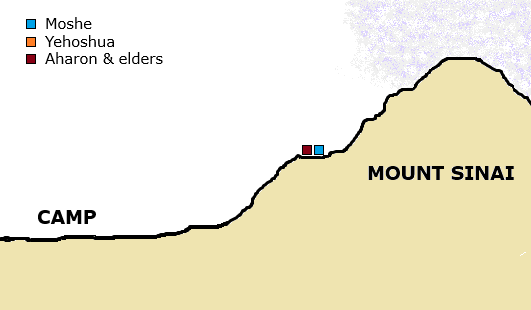
Only after he has done all he can to secure the commitment of the Israelite people does Moshe lead the elders partway up the mountain.
And they went up, Moshe and Aharon, Nadav and Avihu, and seventy of the elders of Israel. And they saw the God of Israel, and under [God’s] feet something like a brick pavement of sapphire, and like the substance of the heavens for purity. And God did not send out [God’s] hand against the eminent Israelites. And they beheld God, and they ate and they drank. (Exodus 24:9-11)
Where does Moshe go next?
Then God said to Moshe: “Come up to me on the mountain. And you will be there, and I will give you the stone tablets, and the teaching, and the commands that I have inscribed to teach them.” And Moshe and his attendant, Yehoshua, stood up, and Moshe went up the mountain of God. (Exodus 24:12-13)
If the party of 74 men is still sitting partway up Mount Sinai when God speaks to Moshe again, where did Yehoshua (“Joshua” in English) come from?
Bachya ben Asher wrote: “Joshua was one of the seventy elders mentioned previously as having had a vision of God. In fact, Joshua was the most senior of these seventy elders.”2
From the book of Judges on, elders are older men who sit in the gate of their town or village and judge disputes and legal issues the residents bring to them. In the previous Torah portion in Exodus, Moshe appointed elders as lower court judges who would refer the difficult cases to him.3
Yehoshua (Joshua) is a young man (see Exodus 33:11 below), and he has a different role. He waits on Moshe, and he also served as the commander when the Israelite men fought off the Amalekites on the way to Mount Sinai.4 So although Yehoshua has as much status as an elder, I do not believe he is one.
The next verse implies that not even the elders are still partway up the mountain when God speaks to Moshe again.
And [Moshe] said to the elders: “Wait bazeh for us until we return to you! And hey, Aharon and Chur are with you. Whoever has a lawsuit can approach them.” (Exodus 24:14)
bazeh (בָּזֶה) = here, at this place.
Moshe tells the elders to “wait here” until he and Yehoshua (Joshua) return. Where is “here”?
The rest of the Israelites, including any plaintiffs or witnesses, are forbidden to go even halfway up the mountain. So the elders cannot judge their cases from that spot. Moshe must be instructing them, along with Aharon and Chur, to wait at the foot of the mountain. (It is reasonable to assume that Chur is one of the 70 elders, since he and Aharon supported Moshe’s staff during the battle with the Amalekites.)
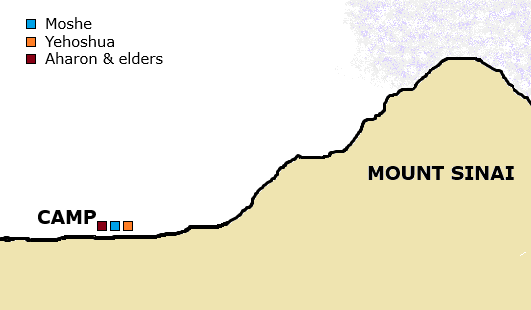
Therefore bazeh, “at this place”, means the camp at the foot of Mount Sinai. Moshe must have led everyone back down to camp before he gave the elders their orders.
Moshe’s instructions also reveal that he expects to be at the top of the mountain for some time. If he thought that receiving “the stone tablets, and the teaching” from God would take only a day or two, he would probably say that anyone with a dispute too difficult for the seventy elders could postpone the case until he gets back. Instead, he appoints Aharon and Chur as a high court while he is gone.
Where does Yehoshua go?
Moshe and Yehoshua (Joshua) stand up. Moshe tells the elders to wait “for us until we return to you”.
Then Moses went up the mountain, and the cloud covered the mountain. (Exodus 24:15)
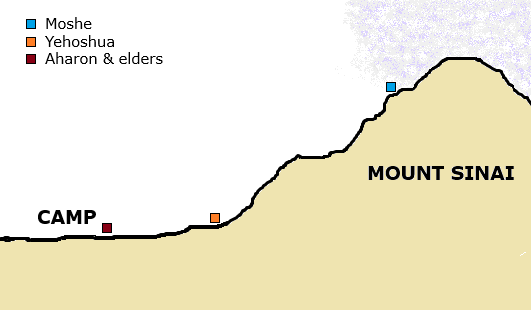
If Moshe goes up the mountain alone, where does Yehoshua go?
In the 11th century C.E., Rashi wrote: “As a disciple he was accompanying the teacher as far as the place where the bounds of the mountain were marked out, whence onward he was not permitted to proceed. … Joshua pitched his tent there and stayed there during the whole forty days which Moses spent on the mountain. For thus we find that when Moses came down from the mountain it states, ‘and Joshua heard the voice of the people that they shouted’— from which we may infer that he was not with them in the camp.”5
View at the top
The text says that Moshe went into the cloud (he-anan, הֶעָנָן),not a cloud (which would be just anan). So this must be the manifestation of God that led the Israelites from Egypt to Mount Sinai in the shape of a pillar of cloud by day and fire by night. In the next verse, the cloud is explicitly identified with God.
And the kavod of God settled on Mount Sinai, and the cloud covered it for six days. And [God] called to Moses on the seventh day from the midst of the cloud. (Exodus 24:16)
kavod (כָּבוֹד) = impressive appearance, glory, splendor, weight.
Apparently Moshe climbs up as far as God’s cloud of glory, then waits in front of the blank white fog until God calls him inside.
According to Sefer Olam Rabbah, “This was in order for Moses to purify himself.”6
According to Avot de Rabbi Natan, the six-day wait was “So that he could be emptied of all the food and drink that was in his stomach, so that when he was sanctified, he would be like the angels who serve God.”7
Bachya ben Asher wrote that during those six days, “Moses prepared himself mentally for meeting Hashem [God] …”8
View from the bottom
While Moshe is staring at the divine cloud, the Israelites below are seeing something different.
But the appearance of the kavod of God was like a consuming fire at the top of the mountain in the eyes of the Israelites. (Exodus 24:17)
Moses sees God’s kavod as a cloud, or a wall of fog; it obscures his vision but is not deadly. The Israelites below see God’s kavod as a “consuming” fire.
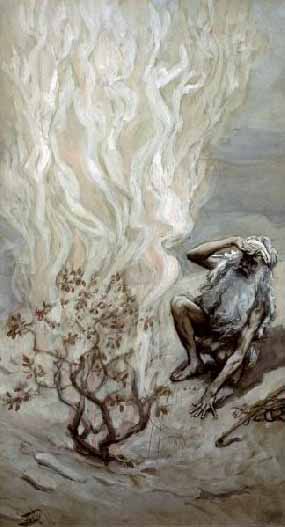
When I taught a class on this part of the Torah portion in 2024, my adult students came up with a good metaphorical explanation: The first time Moshe climbs Mount Sinai, he sees God as fire in the bush that burned but was not consumed. By the time he returns to Mount Sinai, he has developed a relationship with God, so God appears to him as mysterious, like a cloud, but not threatening. The Israelites below, however, have not been conversing with God, so God appears as a dangerous consuming fire to them.
They see their leader, Moshe, walk into the fire, and they doubt that he will ever come back. (See my post Mishpatim: Seeing the Cloud.) It amazes me that nevertheless the Israelites wait for forty days before going to Aharon and demanding an idol to lead them the rest of the way to Canaan.
Into the cloud
Then Moses entered the midst of the cloud, and he went up the mountain, and Moses was on the mountain forty days and forty nights. (Exodus 24:18)
Jewish midrash noted that later in Exodus, Moses is unable to enter the newly-constructed Tent of Meeting “because the cloud had settled on it and the kavod of God filled the dwelling-place” (Exodus 40:35). So how does Moses manage to get into the cloud of God’s kavod on Mount Sinai?
According to the Talmud, “This teaches that the Holy One, Blessed be He, grabbed Moses and brought him into the cloud, since he could not enter on his own.”9
Asher Tzvi of Ostrow wrote: “When Moses ascended on high, a cloud came up against him, and Moses our teacher did not know if one rides it or holds it. Immediately, the cloud opened its mouth and Moses entered it, and he walked into the firmament like a man walking on land.”10 This midrash continues with Moshe encountering angels in the heavens before he finally reaches God.
When I researched this blog post, I wondered if the apparent inconsistencies in the locations of Moshe (Moses), Yehoshua (Joshua), Aharon (Aaron), and the elders were due to a redactor patching together several traditional stories about the same event. But I have not found any support for this hypothesis in modern source scholarship. Friedman views the story as coming from a single source from Exodus 24:1 through “And Moses went up the mountain” (Exodus 24:15); the author does not change until the second half of Exodus 24:15, “and the cloud covered the mountain”.11
When I did a close reading of the text, I discovered that the choreography actually does work if Moshe leads Aharon and the elders back down to the Israelite camp after their vision of God’s feet, and that is where God speaks to Moshe again, and Yehoshua (Joshua) jumps up and accompanies him as far as the foot of the route back up Mount Sinai.
The story would be tidier if after Moshe’s party beheld God’s feet and ate and drank, Moshe continued up the mountainside alone. I can imagine Aharon leading his sons and the seventy elders back down to the Israelite camp, while Yehoshua waits there for forty days.
But I think that Moshe does not want to leave a large group of dazed and excited men, who have been drinking as well as eating, alone on the mountainside. What if they doze off and wake up disoriented? What if they cannot find their way down? What if it gets dark and they stumble?
After God tells Moshe: “Go up to God, you and Aharon, Nadav and Avihu, and seventy of the elders of Israel, and bow down from afar” (Exodus 24:1), Moshe postpones leaving until he has conducted an impressive covenant ceremony with all the Israelites. As their leader, he is responsible for them, and he decides that he should secure the loyalty of all of the people before doing any special ritual with the elders.
When the ritual with the elders is complete,12 Moshe once again puts his responsibility as a leader first. He makes sure everyone gets home safely before he climbs Mount Sinai again, even though retracing his steps means a lot more physical labor.
Some prophets might be tempted to rush toward God, eager for a personal revelation. But Moshe takes care of his people first.
If only all our leaders were as responsible as Moshe, our lives would be blessed.
- “The revelation at Mount Sinai” commonly refers to Exodus 19:13-20:17 in the Torah portion Yitro, which includes spectacular volcanic effects including synesthesia (see my post Yitro & Bereishit: Don’t Even Touch It) and the pronouncement of the “Ten Commandments”.
- 14th-century Rabbi Bachya ben Asher, translation in www.sefaria.org.
- Exodus 18:24-25.
- Exodus 17:8-13.
- Rashi, acronym of 11th-century Rabbi Shlomon Yitzchaki, translation in www.sefaria.org.
- Sefer Olam Rabbah, 2nd century C.E., translation in www.sefaria.org.
- Avot de Rabbi Natan, 650-950 C.E., translation in www.sefaria.org.
- Bachya ben Asher, ibid.
- Talmud Bavli, Yoma 4b, translation by Rabbi Adin Steinsaltz, William Davidson Talmud in www.sefaria.org.
- Rabbi Asher Tzvi of Ostrow, Ma’ayan HaChochmah, 1816.
- Richard Elliott Friedman, The Bible with Sources Revealed, HarperSanFrancisco, 2003, pp. 160-161.
- See my post Yitro & Mishpatim: Four Attempts at a Lasting Covenant.






 Questioning Torah