Ki Tisa: Apotheosis of Moses?

(This is my twelfth and final post in a series about the evolving relationship between Moses and God in the book of Exodus/Shemot. Next week’s post will be back in sync with the Jewish weekly readings. Meanwhile, this is Passover week! If you’d like to read one of my posts on Passover, you might try: Pesach & Vayikra: Holy Matzah.)


Moses: from fearful loner to authoritative leader

When Moses walks over to look at the bush that burns but is not consumed, he is a curious man who has compassion for the victims of bullies,1 but he also has a history of anxiety. After a problematic childhood as an Israelite who was adopted by Egyptian royalty, he fled a murder charge in Egypt, then found a home with a Midianite priest. Safe but still wary, the last thing Moses wants to do is return to Egypt.

Moses and the Burning Bush, by Domenico Zampieri, 17th century

Then God speaks to him out of the fire, and Moses hides his face. (See my post: Shemot: A Close Look at the Burning Bush.) God tells him that he will be the human leader of the victimized Israelites in Egypt; Moses must give the pharaoh ultimatums, then conduct the people from Egypt to Canaan.

Moses tries to excuse himself from the job. He is certain that he is not qualified (see my post: Shemot: Empathy, Fear, and Humility); that the Israelites will not believe or trust him (see my post: Shemot: Names and Miracles); and that he cannot speak well (see my post: Shemot: Not a Man of Words). But God patiently answers his every objection, like a parent with a resistant child. Panicked, Moses begs God to send someone else. God coaxes Moses into cooperating by promising that his long-lost brother Aaron will help him (see my post: Moses Gives Up).

Back in Egypt, Moses gradually changes. During his first few negotiations with the pharaoh, he simply parrots the words God gives him, but as his confidence grows he adds words of his own. It helps that a powerful deity backs him up with miraculous plagues, and it helps that the pharaoh and his court treat Moses with increasing respect. (See my post: Shemot to Bo: Moses Finds His Voice.)

When he leads the Israelites across the wilderness to Mount Sinai, they are the ones who behaved like wayward and frightened children. Moses behaves like a nervous new parent. He asks God, his mentor, for advice, but he also acts on his own initiative. (See my posts: Beshalach: Moses Graduates and Yitro: Moses as Middle Manager.)

At Mount Sinai, God pursues a formal covenant with the Israelite people. Between them, God and Moses arrange a covenant four times. (See my post: Yitro & Mishpatim: Four Attempts at a Lasting Covenant.) The third of the four covenants is entirely Moses’ creation, and includes all of the people in a dramatic ritual with standing stones, animal sacrifices, blood splashing, and a public reading of the laws God has told Moses so far. The fourth covenant, God’s idea, is when the elders behold God’s “feet” and hold a feast (the Ancient Near East equivalent of a signing ceremony for a treaty).

Then Moses spends 40 days on the mountaintop listening to God outline a revamped religion, which includes a sanctuary tent where God will dwell in the midst of the people. But the Israelites below think Moses will never return, and they ask Aaron for an idol to follow instead. Aaron makes the Golden Calf, and the people worship it—a clear violation of the covenant with God.

On the 40th day God offers to exterminate the people and start over with Moses’ descendants, but Moses passes God’s test and remains loyal to the Israelites. He walks down to the camp and  smashes the two stone tablets engraved by God, but God recognizes Moses’ right to make decisions and takes no action. (See my post: Ki Tisa: Taking Risks.) The co-leaders arrange a massacre and a plague that kill the worst Golden Calf worshippers.

Then God tells Moses that a messenger will lead the Israelites to Canaan, because God is too angry to go in their midst. Moses presses God to reverse that decision, and also to pardon all the surviving Israelites. God seems favorable toward both requests, but never makes an explicit commitment. (See my post: Ki Tisa: Seeking A Pardon.) A lack of openness between the two leaders of the Israelites continues through the book of Numbers, with Moses pitching arguments designed to flatter and influence God, and God making decisions that are close to what Moses requests but not exactly the same.2

The story about Moses’ second 40-day stint at the top of Mount Sinai illustrates that the working relationship between the two leaders is not the only thing that changes.

Moses and God: shifting commitments

At the burning bush, God was determined to rescue the Israelites from Egypt and give them the land of Canaan. Moses tried to get out of being personally involved, even though he was empathetic toward all victims of bullies.

By the time Moses leads the Israelites to Mount Sinai, he has unreservedly embraced the mission God gave him, and he would do anything to make sure the Israelites as a people get to Canaan, even if individual Israelites have to die along the way. So after the Golden Calf worship, he focuses on restoring good relations between God and the people.

But God views the Golden Calf as a personal rejection, and seems less committed to the Israelites after that episode. God starts calling the Israelites Moses’ people, and shies away from recommitting to God’s earlier plan to dwell among them in the sanctuary tent.3 Twice in the book of Numbers, God threatens to wipe out all the Israelites.4

The God character: a new development

Nevertheless, when Moses asks to see God’s “ways”, “glory”, and “face”,5 God shows him what Jews now call “The Thirteen Attributes of Mercy”, including compassion, patience, loyal-kindness, and a willingness to exonerate (some of) the guilty.6 Although God continues to smite people in sudden fury from time to time, this description of God indicates a change in the God character that was depicted earlier in the Torah.

And right after the revelation of the Thirteen Attributes, when Moses begs God once more to pardon the people, God says:

“Hey, I am cutting a covenant: In front of all your people I will do wonders that have not been created on all the earth and among all the nations. And all the people in whose midst you are, they will see the doing of Y-H-V-H, how awesome it is what I do with you.” (Exodus 34:10)

The only awesome deed God mentions is driving out the six peoples living in Canaan when the Israelites arrive there. This is a promise that God will “give” them the land of Canaan, even though God is still calling them “your people” (Moses’ people) instead of “my people”. In return, the Israelites must refrain from making idols or bowing down to any other god and reject the gods of Canaan by destroying their objects of worship. They must also refuse to make covenants with the natives of Canaan, and avoid intermarriage with them. Then God throws in some of the earlier rules about observing religious holidays and donating firstborn animals and first fruits to God.

Then Y-H-V-H said to Moses: “Write these words for yourself, because according to these words, I cut a covenant with you and with Israel.” (Exodus 34:27)

So even if God does not explicitly pardon the people, as Moses asked, God is now patient and loyal enough to propose another covenant.

Moses: an apotheosis?

Moses on Mount Sinai, by Jean-Léon Gérôme,
1895-1900

The experience of beholding God’s attributes also changes Moses in ways that might be considered an apotheosis: deification or elevation to divine status.

And he was there with Y-H-V-H forty days and forty nights. Bread he did not eat, and water he did not drink. And [God] engraved on the tablets the words of the covenant, the Ten Words. (Exodus 34:28)

Exodus does not say whether Moses went without food or drink the first time he spent 40 days at the top of Mount Sinai, though it is hard to imagine him trudging up to the barren volcanic mountaintop carrying enough food and water on his back to last 40 days. But Exodus does say that Moses lives without eating or drinking during his second 40-day stint.7

Shemot Rabbah explained: “What, then, did he eat? He was sustained by the aura of the Divine Presence. Do not wonder, as the heavenly beasts that bear the Throne are sustained by the aura of the Divine Presence.”8 This makes Moses like the serafim in Isaiah’s vision or the divine creatures in Ezekiel’s vision, at least temporarily.9

Rabbeinu Bachya wrote: “Moses’ nourishment during these forty days was provided by the attribute חסד and the radiation of supernatural light.”10 Chesed, חסד, is the “loyal-kindness” in God’s thirteen attributes. This commentary implies that God’s new gentle and compassionate approach sustains Moses so that he can live on the supernatural equivalent of light.

At the end of Moses’ first 40-day stint on the mountaintop, God gave him a pair of stone tablets that were already engraved. These were the tablets that Moses smashed at the foot of the mountain when he saw the ecstatic worship of the Golden Calf. For Moses’ second 40-day stint, God tells him to hew out his own stone blanks and carry them up.11 Then God engraves them after revealing the Thirteen Attributes. Moses may even see the words appearing on the stones.

And it was, when Moses came down from Mount Sinai—and the two tablets of testimony were in Moses’ hand when he came down from Mount Sinai—then Moses did not know that the skin of his face karan because of [God’s] speech with him. (Exodus 34:29)

karan (קָרַן) = shone, was radiant.

This verb has the same root as keren (קֶרֶן ) = horn, ray of light. (The Latin translation of this verse in the Vulgate said Moses “sprouted horns”, so for centuries artists depicted Moses with two horns growing from his forehead.)

What makes Moses’ formerly ordinary face start radiating beams of light? The text says it happens because of God’s “speech with him”. Many Jewish commentators wrote that it happens when God reveals the Thirteen Attributes of Mercy to Moses. God said:

“… as my glory passes by, I will place you in a crevice of the rock, and screen you with my hand until I have passed by. Then I will take away my hand, and you will see the back side of me. But my face will not be seen.” (Exodus 33:22-23)

The “back side” of God that Moses “sees” consists of the Thirteen Attributes. Either God’s supernatural hand,12 or the experience of these divine attributes,13 gives Moses an inner light so strong that it shines out through the skin of his face.

On the other hand, some commentators wrote that God gives Moses a radiant face as a strategic move to make sure the Israelites continue to accept him as their leader. The 13th-century commentary Chizkuni says:

“Seeing that prior to Moses’ return with the first set of Tablets the people had been prepared to accept another leader in Moses’ place, his emitting rays of light on his descent from the Mountain this time made a repetition of such an attempt quite unlikely.”14

And Aaron and all the Israelites saw Moses, and hey! The skin of his face karan! And they were afraid to come near him. (Exodus 34:30)

Chizkuni explained: “According to the plain meaning of the verse, when they beheld him, they thought that they were looking at an angel.”15

And Robert Alter wrote: “If, as seems likely, Moses’ face is giving off some sort of supernatural radiance, the fear of drawing near him precisely parallels the people’s fear of drawing near the fiery presence of God on the mountaintop.”16

Detail from Terra Sancta, by Willem Janszoon Blaeu and Joan Blaeu, 17th century

Moses himself is not aware that his own face was radiating light, according to the 18th-century commentary Or HaChayim, because he assumes that the extra illumination came from the second pair of stone tablets he is holding as he walks down the mountain. “As soon as he deposited the Tablets and he became aware that the light had not departed, he realised that he himself was the source of the light.”17

Then Moses called to them, and Aaron and all the chiefs in the congregation returned, and Moses spoke to them. And after that, all the Israelites approached, and he commanded them everything that Y-H-V-H had spoken to him on Mount Sinai. (Exodus 34:31-32)

According to Chizkuni, just hearing Moses’ voice calling out was enough so that “they realized that he was not an angel”. Then when Moses spoke to Aaron and the chiefs, the rest of the Israelites “noticed that no harm had come to them from his speaking to them.”18

And Moses finished speaking with them, and he put a veil over his face. And whenever Moses came before Y-H-V-H to speak with [God], he would remove the veil until he went out. And [whenever] he went out to speak with the Israelites what he had been commanded, the Israelites would see Moses’ face, that skin of his face was karan. Then Moses would put back the veil over this face, until he came in to speak with [God]. (Exodus 34:33-35)

Moses exposes his altered face to God, and he to the Israelites whenever he is telling them the latest batch of rules from God. Who would question the words of someone whose face emits supernatural light? But the rest of the time when he is with people, Moses covers his face with a light-proof veil.

According to Rashi and Ibn Ezra, Moses puts on the veil out of respect for the light God has created on his face; it is not for ordinary use, or for people to gawk at. People should only see it when he is transmitting God’s instructions. According to Kli Yakar, “Moshe, in his great humility, was embarrassed when people gaped at the radiance of his face.”19


It seems as if God has turned Moses into a semi-divine being. He lives for 40 days on the aura of God’s presence, like God’s divine attendants. When he comes down from Mount Sinai, God’s supernatural fire shines through the skin of his face. Moses might look like one of the gods of other peoples in the Ancient Near East, who radiated an unearthly light called melammu. For example, a story about the Babylonian god Marduk says “With burning flame he filled his body” and “With overpowering brightness his head was crowned.”20 The gods in Mesopotamian myths sometimes gave melammu to their favorite kings.

Or perhaps (if he took off his robe) Moses would look like the celestial being shaped like a man whom Daniel sees in a vision sent by Y-H-V-H:

His body was like yellow jasper, and his face had the appearance of lightning, and his eyes were like torches of fire, and his arms and legs were like glittering bronze, and the sound of his speech was like a roaring crowd. (Daniel 10:6)

But in the Hebrew Bible, the various angelic creatures in the bible are either mouthpieces for God or manifestations of God’s powers, without lives of their own.

Perhaps that is why Moses’ radiant face appears only in Exodus 34:29-35. The authors of the rest of the Torah chose to depict Moses as a human being—one who is especially close to God, but a mortal man with his own thoughts and personality.

In the next chapter of Exodus, Moses proceeds with God’s earlier plan for building a tent-sanctuary, as if God had never refused to dwell in the midst of the Israelites. And God does not challenge Moses’ stubborn human initiative.

Moses Sees the Promised Land from Afar, by James Tissot, circa 1900

When Moses is 120 years old and has finished speaking to the Israelites on the Moabite bank of the Jordan River, God tells him to climb up the heights of Aviram and look across the river at the land of Canaan. God says:

So, after delivering a prophecy about the tribes, Moses hikes up.

“You will die on the mountain where you are going up … because at a distance you will see the land, but you will not enter there, into the land that I am giving the Israelites.” (Deuteronomy 32:50, 52)

And Moses, the servant of Y-H-V-H, died there in the land of Moab, al-pi Y-H-V-H. And [God] buried him in the valley in the land of Moab … and no man knows his burial place to this day. (Deuteronomy 34:5-6)

al-pi (עַל־פִּי) = an idiom meaning at the order of, at the command of, according to the word of. Literally: al (עַל) = upon, over, on account of, because of, by. + pi (פִּי) = mouth of.

Some commentators translate al-pi as “by the mouth of”, and say that Moses dies by a kiss from God.21 So although Moses is not permanently transformed into a semi-divine being, he has the the most intimate human relationship with God.

And no prophet arose again in Israel like Moses, whom Y-H-V-H knew face to face. (Exodus 34:10)


  1. Moses has already taken action against an Egyptian taskmaster beating an Israelite (Exodus 2:11-12) and male shepherds bullying female shepherds (Exodus 2:16-19). See my post: Shemot: Empathy, Fear, and Humility.
  2. E.g. Numbers 14:11-35.
  3. See my post: Ki Tisa: Seeking A Pardon.
  4. Numbers 14:11-12, 17:8-9.
  5. Exodus 33:13, 33:18, 33:20. See my post: Ki Tisa: Seeking A Pardon.
  6. Exodus 34:6-7.
  7. At least this is the second time Exodus says Moses spends 40 days and 40 nights on the mountaintop. But some classic commentators claimed it was the third time, the second time being the indefinite period when God and Moses converse in Exodus 33:12-34:3.
  8. Shemot Rabbah, 12th century, translation in www.sefaria.org.
  9. Isaiah 6:2-7, Ezekiel 1:5-26 and 10:1-22.
  10. Rabbeinu Bachya (Rabbi Bachya ben Asher ibn Halawaa, 1255-1340), translation in www.sefaria.org.
  11. Exodus 34:1.
  12. E.g. Midrash Tanchuma (8th century), Rashi (11th-century Rabbi Shlomoh Yitzchaki), and Da-at Zekinim (12th-13th century).
  13. E.g. Ibn Ezra (12th century) and Rabbi Adin Steinsaltz (21st century).
  14. Chizkuni, by Chizkiah ben Manoach, 13th century, translation in www.sefaria.org.
  15. Chizkuni, ibid.
  16. Robert Alter, The Five Books of Moses, W.W. Norton & Co., New York, 2004, p. 512.
  17. Or HaChayim, by Chayim ibn Attar, 18th century, translation in www.sefaria.org.
  18. Chizkuni, ibid.
  19. Kli Yakar, by Shlomo Ephraim ben Aaron Luntschitz, 16th century; translation in www.sefaria.org.
  20. Enuma Elish IV, lines 40 and 58; translation by L.W. King.
  21. E.g. Talmud Bavli, Moed Katan 28a, Bava Batra 17a; Rashi; Da-at Zekinim.

Vezot Habrakhah: By Mouth

On Simchat Torah(“Rejoicing in Torah”) Jews read the end of the Torah scroll, where Deuteronomy/Devarim comes to a close, then roll the scroll all the way back to the beginning and read the opening of Genesis/Bereishit(We also dance with the scroll when it is rolled up and dressed in its cover.)

How does the Torah scroll end?  The final scene in the final Torah portion, Vezot Habrakhah (“And these are the blessings”) is the death of Moses.

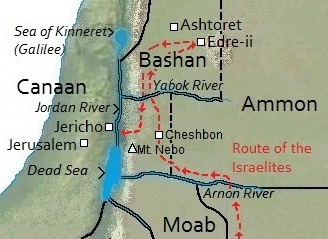
The book of Deuteronomy is set in the lowland (below sea level) at the north end of the Dead Sea, where the Israelites are encamped on the east bank of the Jordan River.  Moses speaks at length to the people he has led for 40 years.  Then at the end of the book, following God’s instructions, he climbs Mount Nebo in the Pigsah range of mountains near the border of Moab.1

Moses knows that God will not let him cross the Jordan River with the people he has shepherded all the way from Egypt.  But God does miraculously enable him to see the entire “promised land” of Canaan from the mountaintop.  (There is a good view from Mt. Nebo, but not good enough to see all the way to the Mediterranean without supernatural help.)

And Moses, the servant of God, died there in the land of Moab, al pi God.  (Deuteronomy 34:5)

al pi (עַל־פִּי) = at the bidding of, by the order of; at the peh of.  peh (פֶּה) = mouth; opening, edge; statement, command.

The Torah makes it clear that even though he is 120, Moses does not die of old age:

Moses was 120 years at his death; his eye was not dim, and his vigor was not gone.  (Deuteronomy 34:7)

He dies because it is time for the Israelites to cross the Jordan and begin conquering Canaan without him.  But what kills him?

The phrase al pi God” (always using the four-letter name of God)2 appears 25 times in the bible.  Twelve of these times Moses, or Moses and Aaron together, take action at the bidding of God.3  Ten times the Israelites act al pi God, though they do not know they are obeying the God of the Israelites.  God “sends” raiding parties from Babylon and its vassal states to exterminate the kingdom of Judah, and “indeed, al pi God it happened to Judah to clear it away from God’s presence…” (2 Kings 24:3)

One other time Aaron acts by himself at the bidding of God:  And Aaron the Priest ascended Mount Hor al pi God, and he died there… (Numbers/Bemidbar 33:38)

That leaves only one instance in which something simply happens al pi God, without any information about who did it:  when Moses dies at the end of Deuteronomy. Does this unusual use of the phrase “al pi” mean that Moses deliberately died in order to carry out God’s order?  Or does it mean that he died by the “mouth” of God?

Death with an Exhale

Most English translations imply that Moses died when God ordered him to die.5 He does not need to commit suicide; he simply knows God wants him to die now, and he releases life, exhales, and dies.

Is Moses the kind of person who would obediently die at God’s bidding?  When he first becomes God’s prophet at the burning bush, he accepts the job of being God’s mouthpiece only because God will not take no for an answer—and then he tries one last time to get out of it, on the ground that he has a defective mouth.  (See my post Va-era & Shemot: Uncircumcised, Part 2.)

While he is leading the Israelites across the wilderness for 40 years, his relationship with God is mouth-to-mouth, as God says to Miriam and Aaron:

“Listen to my words: If a prophet of God happens among you, in a vision I make myself known to him, in a dream I speak to him.  Not so my servant Moses; he is trusted in all my household.  Peh to peh I speak with him; and appearing, not in riddles; and the likeness of God he looks at.”  (Numbers 12:6-8)

Ironically, the less advanced prophets Miriam and Aaron hear God directly in this passage.  But they never speak directly to God in the Torah, so in this regard they and God are not in a peh to peh relationship.

Moses, however, often has direct conversations with God.  Sometimes God starts the conversation, sometimes Moses does.  Sometimes they argue, sometimes they negotiate.  Sometimes God threatens to do something and Moses talks God out of it.6

But in the book of Deuteronomy, Moses looks back on the 40-year adventure with resentment at how much trouble the Israelites gave him, and resignation that God will not let him cross the Jordan.  (See my post Devarim: In God We Trust?)  By the time he has retold the history, restated and elaborated on God’s laws, and finally blessed the Israelites earlier in the portion Vezot Habrakhah, perhaps he is willing to die.  Why not leave the world in a final act of obedience to God?

Death with a Kiss

On the other hand, medieval commentary interpreted the word peh literally, and wrote that God took Moses’ life with a kiss, mouth to mouth.  Here is one version:

God said: “Moses, fold your eyelids over your eyes,” and he did so. He then said: “Place your hands upon your breast,” and he did so. He then said: “Put your feet next to one another,” and he did so. Forthwith the Holy One, blessed be He, summoned the soul from the midst of the body, saying to her:7 “My daughter, I have fixed the period of your stay in the body of Moses at a hundred and twenty years; now your end has come, depart, delay not … Thereupon God kissed Moses and took away his soul with a kiss of the mouth … (Devarim Rabbah 11:10, circa 900 CE.)8

In this anthropomorphic interpretation, just as God’s mouth blows the first human’s soul into the body,9 God’s mouth inhales Moses’ soul out of the body.

This is a more intimate way of being peh to peh with God.

*

This week’s Torah portion, the book of Deuteronomy, and the Torah scroll end:

Never again did a prophet rise in Israel like Moses, whom God knew face to face, for all the signs and the omens that God sent [him] to do in the land of Egypt for Pharaoh and for all his servants and for all his land; and for all the strong power and for all the great awe that Moses achieved in the eyes of all Israel.  (Deuteronomy 34:10-12)

In other words, Moses is unique as a prophet in his tremendous effect on both Egypt and the Israelites.  And by the way, God knew Moses face to face.

And spoke with Moses mouth to mouth.  And, perhaps, took Moses’ soul, his life, with a kiss.

At the end of the Torah scroll, Moses dies al pi God, by God’s mouth or bidding.  Then, on Simchat Torah, Jews roll the scroll back to the beginning, and we read how God created the heavens and the earth through speech.

And God said: “Light will be,” and light was.  (Genesis/Bereishit 1:3)

Both the death of Moses and the creation of the world come, in one way or another, from the mouth of God.

Maybe this is another way of saying that both death and birth are too mysterious for humans to ever understand.

  1. This is the same mountain range where King Balak of Moab led the Mesopotamian prophet Bilam so he could look down on the Israelites and curse them. The king was foiled when God put words of blessing in Bilam’s mouth instead.  (See my post Balak: Three Places to Be Blessed.)
  2. See my post Lekh-Lekha: New Names for God.
  3. Moses act al pi God in Numbers 3:16, 3:39, 3:51, 4:37, 4:41, 4:45, 4:49, 10:13, 13:3, 33:2, 36:5; and Joshua 22:9.
  4. The Israelites act al pi God in Exodus 17:1, Leviticus 24:12, Numbers 9:18-23, and Joshua 19:50.
  5. E.g. “at the command of the Lord” (Jewish Publication Society), “according to the word of the Lord” (King James Version), “as the Lord had said” (New International Version), “at the order of YHWH” (Everett Fox, The Five Books of Moses, Schoken Books, New York, 1995), and “by the word of the Lord” (Robert Alter, The Five Books of Moses,W. Norton & Co., New York, 2004).
  6. For example, after the Israelites worship the golden calf, God and Moses take turns getting angry and calming one another down (Exodus 32:7-35). Then they negotiate, and God reveals some divine attributes to Moses (Exodus 33:1-34:10).
  7. All Hebrew words for “soul” are feminine.
  8. Translation of Devarim Rabbah 11:10 from Simcha Paull Raphael, Living the Dying in Ancient Times, Albion-Andalus Books, Boulder, Colorado, 2015, p. 78-79.
  9. Genesis 2:7.
  10. Talmud Bavli: Mishnah Sotah 1:9, Sotah Gemara 14:a.
  11. Rashi (11th-century CE rabbi Shlomoh Yitzchaki), commentary to Deuteronomy 34:6; explained by 16th-century CE rabbi Obadiah Sforno.
  12. Talmud Bavli Sotah 14:a, commenting on the incident in Numbers 25:1-3.

Haftarat Simchat Torah—Joshua: Strong and Resolute

The standard cycle of Torah readings ends with Moses’ death in the last Torah portion in Deuteronomy/Devarim, Vezot Habrakhah. On the holy day of Simchat Torah, most Jewish congregations read this last portion in a Torah scroll, then roll the scroll all the way back and read the beginning of Genesis/Bereishit. The accompanying haftarah (reading from the Prophets) is Joshua 1:1-18.

Have you ever tried to turn over a new leaf, and found that without a systematic process you soon slide back to your old ways?

One process for changing your life can be found in the Jewish holy days from Rosh Hashanah to Simchat Torah. I realized this year that these days are a recipe for a 23-day period of transformation.

Blowing the Shofar, from Minhagim, 1707
Blowing the Shofar,
from Minhagim, 1707

1) On the two days of Rosh Hashanah (“Head of the Year”), we declare the beginning of a new year. And we wake up when we hear the blast of the shofar, a loud wind instrument made out of a ram’s horn.

2) On Yom Kippur (“Day of Atonement”), having apologized to the people we have wronged and forgiven those who wronged us, we go on to confess our errors to God and forgive ourselves.

3) During the seven days of Sukkot (“Huts”), we eat, sleep, and study (as much as the weather permits) in temporary shelters whose roofs of branches let in some rain and starlight.  The new lives we are creating for ourselves are like these sukkot: fragile, not secure—but open to nature, to other people, and to the presence of the divine.

Hoshana Rabbah, by Bernard Picart c. 1733
Hoshana Rabbah,
by Bernard Picart c. 1733

4) On the seventh day, Hoshana Rabbah (“Great Supplication”), we circle the sanctuary seven times while beating willow branches on the floor to symbolically disperse the last traces of the previous year’s misdeeds.

5) On Shemini Atzeret (“Eighth Gathering”), we pray for rain so that the new seeds we have planted will grow during the winter.

6) On Simchat Torah (“Rejoicing in Torah”), we read the end of the Torah scroll (the last portion in Deuteronomy/Devarim, called Vezot Habrakhah, “And this is the blessing”). Then we roll it back to the beginning and read about the creation of the world in Genesis/Bereishit. In this way we acknowledge the blessings of the old year, close the book on our past mistakes, and launch into creating our new life.

The haftarah for Simchat Torah is the beginning of the book of Joshua, right after Moses has died. Everything must change now. Joshua, who has spent 40 years as Moses’ attendant, must quickly become the de facto king of the Israelites. The Israelites, who have spent 40 years wandering in the wilderness, complaining about the food, learning the rules of their new religion from Moses, and listening to the old folks’ stories about being slaves in Egypt, must now become first a conquering army, then a people who farm, trade, and live in towns—in the unfamiliar land of Canaan.

Moses Appoints Joshua, by Henry Northrop, 1894
Moses Appoints Joshua,
by Henry Northrop, 1894

Both Joshua and the Israelites are unprepared for their new lives.

Moses anticipates this toward the end of Deuteronomy. He legitimizes Joshua as his successor by laying hands on him, and God confirms it with a pillar of cloud. Then Moses tells the Israelites:

Chizku and imetzu! Do not be afraid and do not feel dread in front of them [the Canaanites], because God, your God, is going with you Itself. It will not let go of you and It will not forsake you. (Deuteronomy/Devarim 31:6)

chizku (חִזְקוּ) = (plural) Hold strong! Hold on! Be fortified! Be stalwart! Be strong!

imetzu (אִמְצוּ) = (plural) Be resolute! Be firm! Be strong!

Then Moses called Joshua and said to him, in the sight of all Israel: Chazak and ematz, because you yourself shall bring this people to the land that God swore to their fathers to give to them, and you yourself shall apportion it among them. (Deuteronomy 31:7)

chazak (חֲזָק) = (singular of chizku) Hold strong! (etc.)

ematz (אֱמָץ) = (singular of imetzu) Be resolute! (etc.)

After Moses dies, Joshua may have felt like running run away, but he accepts his new life. The book of Joshua begins with God speaking to Joshua.

It happened after the death of Moses, the servant of God; God spoke to Joshua, son of Nun, Moses’ attendant, saying: My servant Moses is dead. So now get up and cross this Jordan, you and all this people, into the land that I am giving to them, to the children of Israel. (Joshua 1:1-2)

Joshua says nothing, but I imagine him feeling fearful and doomed. He served as a general once, 40 years ago, when Amalek attacked the Israelites; but the untrained ex-slaves won the battle only when Moses raised his hands toward heaven. Joshua has never led a war of conquest or administered a country. When he was one of the scouts Moses sent to report on the land of Canaan, he could not even persuade anyone that the land was worth entering. How can he persuade the Israelites to cross the Jordan and enter it now? And how can he turn himself into a conqueror, judge, and administrator?

God tells him:

No one shall be able to stand against you, all the days of your life. As I was with Moses, I will be with you. I will not let go of you and I will not forsake you. (Joshua 1:5)

I expect it would help to know that God was on your side.  When I embark on a new phase of my life, it helps to know that I am doing the right thing. But that knowledge by itself is not enough to make me step forward.

God continues:

Chazak and ematz, because you shall apportion among this people the land that I swore to their fathers to give to them. Only chazak and ematz very much to guard and do according to all the teaching that My servant Moses commanded to you. Do not deviate from it to the right or to the left, so that you shall act with insight everywhere you go. … Did I not command you: chazak and ematz? You shall not be afraid and you shall not be dismayed, because God, your God, will be with you wherever you go.  (Joshua 1:6-7, 9)

Joshua proceeds to become the leader he never was before. He makes decisions based on the teachings of Moses, he conquers large parts of Canaan (with the help of two divine miracles), and he divides up the land among the tribes of Israel.

Chazak and ematz, he probably reminds himself; hold strong and be resolute! The Bible uses this particular pairing of words only at four times of major change: when Joshua replaces Moses as the leader of the Israelites (in Deuteronomy and Joshua), when Joshua encourages his officers to continue the conquest of Canaan (in Joshua), when Solomon replaces David as the king of Israel (in the first book of Chronicles), and when King Hezekiah encourages his people to defend Jerusalem against the Assyrians (in the second book of Chronicles).

In all four transitions, the people who were told to be resolute felt nervous and insecure. And all four times they succeeded in their new roles.

*

It takes a lot to turn over a new leaf, to embark on a new direction in your life. From the Jewish holy days at this time of year we learn to wake up, face what we did wrong, make amends, and let go; to live for a while in the insecure space of transition as we stay open to guidance and pray for growth; to acknowledge the blessings in our old lives before we begin creating our new lives; and, in this week’s haftarah, to proceed with an attitude that will keep us going on our new path. We must trust that we are doing God’s will or the right thing, and we must be determined to keep going regardless of anything frightening or discouraging along the way.

Chazak and ematz; hold strong and be resolute. Keep going.

Vezot Habrakhah: Zevulun’s Secret

This week Jews celebrate Rosh Hashanah, the beginning of the year. This Saturday is Shabbat Shuva, and the Torah portion is Ha-azinu (Use your ears). In the last few years, I have written four posts on Ha-azinu: Upright, Devious, and Struggling; The Tohu Within; Raining Insights; and Hovering. But since I will be traveling for three weeks, from Rosh Hashanah through Yom Kippur and Sukkot, this post will look at the Torah portion Vezot Habrakhah (“And this is the blessing”), the last portion in the book of Deuteronomy/Devarim.

On Simchat Torah (October 16-17 this year) a Jewish tradition is to finish Deuteronomy and start the new annual cycle of Torah readings with the opening of Genesis/Bereishit. That first Torah portion will be the subject of my first post when I get home in a few weeks!

Zevulun
Zevulun

Zevulun’s Secret

In the last Torah portion of Deuteronomy, Moses pronounces prophecies for each of the tribes of Israel, as well as blessing all the Israelites, before he climbs Mount Nevo to die. The text of the “blessings” of the tribes that has been handed down to us is somewhat corrupted by scribal error, according to modern scholars. But it still expands Jacob’s “blessings” of the tribes near the end of Genesis/Bereishit.

Jacob pronounces blessings, or prophecies, about his twelve sons before he pulls his feet up into his bed and dies. Each prophecy is really about the tribe that will bear that son’s name. (See my earlier post, Vayechi: Fierce Brothers.) But earlier in Genesis, Jacob’s sons are characters in the story.

Half of the twelve sons are the equivalent of spear-carriers; the Torah gives them neither lines nor stage business. Unlike their eponymous tribes, the only identities these six sons have are their names—Dan, Naftali, Gad, Asher, Yissakhar, and Zevulun—and the meanings their mothers or adoptive mothers assign to their names.

The youngest spear-carrier is Zevulun, Leah’s sixth and last son. When he is born, Leah says: God gave a gift to me, a good gift; [this] time my husband yizbeleini because I bore him six sons. And she called his name Zevulun. (Genesis/Bereishit 30:20)

yisbeleini (יִזְבְּלֵנִי) = he will elevate me, he will exalt me, he will honor me. (The root of this verb, זבל, is the same as the root of the name Zevulun.)

Zevulun (זְבֻלוּן) = exalted place, place of honor.

As with all the other baby-namings in the Torah, the name indicates the parent’s state of mind. We learn nothing about the character of Leah’s sixth son from his name.

But we do learn something about Zevulun’s tribe when Jacob recites his prophetic poem about the tribes from his deathbed.  He says:  Zevulun, at the shore of the sea he will dwell; and he will be a shore for ships, and his flank will be upon Tzidon. (Genesis 49:13)

Tzidon (צִידֹן) = Sidon; one of the first Phoenician port cities on the Mediterranean Sea. (Tzidon is now the city of Sayda in Lebanon).

The second prophetic poem about the tribes, spoken by Moses in the last Torah portion of Deuteronomy, combines the tribe of Zevulun with the tribe that bears the name of Leah’s fifth son, Yissakhar (often spelled Issachar in English).

And to Zevulun he said: Rejoice, Zevulun, in your going out, and Yissakhar, in your tents. They will call peoples to the mountain; there they will slaughter slaughter-offerings of righteousness; for they will suckle on the abundance of the seas, and the hidden treasures of the sand. (Deuteronomy/Devarim 33:18-20)

Canaan at Joshua's Death
Canaan at Joshua’s Death

Both poems about the tribes of Israel claim that the territory of Zevulun includes a piece of the Mediterranean coast. Jacob’s poem says Zevulun will extend as far as Tzidon, but in the book of Joshua, when the tribal territories are allocated by lot, it is Asher, Zevulun’s northern neighbor, that reaches as far as the great city of Tzidon.

The boundaries of Zevulun given in the book Joshua include many place-names we cannot identify today, and do not mention any coastline. The one identifiable place in the description of Zevulun’s land is Beit-Lechem. The coast west of Beit-Lechem of Galilee is Haifa Bay, which lies south of both Tzidon and Tzor (Sidon and Tyre ), the two major Phoenician cities at the time.  But the Phoenicians had coastal villages farther south, as far as Dor.

The coast south of Dor, from Ashdod to Gaza, was being invaded by the Plishtim (Philistines) around the time of Joshua’s conquest of Canaan, which the Bible places circa 1300 B.C.E. The Plishtim migrated from Crete and other islands across the sea, and after seizing their beachheads on the coast, they fought for centuries to conquer more of Canaan.

But the Bible does not record any hostile actions by Phoenicians against Israelites. Could Zevulun have shared the Mediterranean coast with them?

I think so.  Historically, both the Israelites and the Phoenicians spoke a Canaanite dialect in the Semetic language family, and the writings of both peoples reveal roots in Canaanite culture.

In the Bible, the people of Zevulun get along with non-Israelite neighbors. Although Moses instructs the Israelites to dispossess the Canaanites and drive all the natives out of the land, the first book of Judges lists the tribes that did not do so. Zevulun is one of the tribes that lives alongside the Canaanites.

Furthermore, even Moses’ poem about the tribes predicts that Zevulun and Yissakhar will call peoples to the mountain; there they will slaughter slaughter-offerings of righteousness. (Deuteronomy 33:19) Rather than trekking all the way to Israel’s central place of worship, they invite neighboring peoples to join them in offering animal sacrifices at a local mountain in the Galilee. And even though Deuteronomy is full of warnings to worship God at only one place, the poem Moses recites at the end of his life calls the neighborly offerings on a local mountain “righteous”.

Zevulun’s reward for friendly relations with its Phoenician neighbors is a share of Phoenician wealth, which came from maritime trade, fishing, and the sale of valuable purple dye and white (milk) glass. The dye came from mollusks found on that part of the coast, and the glass was made from the high-quality sand on the shore. The commentaries agree that these Phoenician products must be the hidden treasures of the sand mentioned in Deuteronomy 33:20.

This glimpse into the ways of Zebulun is a welcome contrast with all the times the Hebrew Bible urges the Israelites to treat other peoples as enemies. The Bible often condones vicious pre-emptive wars against Canaanites, Amorites, Midianites, and assorted other peoples in the region. (For an example, see my post Va-etchannan: Haunted by Shame.) Apparently God, Moses, and many of the prophets (at least as portrayed in the Bible) believe the Israelites are so easily tempted to abandon their own religion, they must commit genocide lest they learn about another attractive cult.

There is a better way to prevent people from discarding their God and their religion: make the religious practices more inspiring and more likely to touch the heart. The Torah illustrates this method in the book of Exodus, when the anxious people turn to the Golden Calf, but then turn back to God with joy and dedication when Moses gives them the chance to make a beautiful sanctuary for God.

Zevulun offers another illustration, by adopting the Phoenician way of making a livelihood, and inviting their foreign friends to join them in making offerings to God on a nearby mountain. They drop the rule about worshiping God only at the central sanctuary. But in exchange they gain peace with their neighbors—without abandoning their own god. And the Torah portion Vezot Habrakhah says their offerings are righteous.

I think the hidden treasures of the sand that Zevulun enjoys are not only milk glass and purple dye, but also the treasures that come from tolerance and goodwill.

May all people learn how to preserve their religions by offering friendship to strangers as they offer their hearts to their own gods.


Ha-azinu & Vezot Habrakhah: Upright, Devious, and Struggling

Would you like to belong to a group called the God-Strugglers? What about the Heel-Grabbers? Or the Upright-Ones?

Yisra-el (“Israel” in English) is the most common name in the Hebrew Bible for the people that God and Moses lead out of Egypt, instruct on God’s laws, and bring to the land of Canaan. Occasionally the bible also refers to the people as Ya-akov (“Jacob” in English), and a few times as Yeshurun (“Jeshurun” in English).

Yisra-el (יִשְׂרָאֵל) = He struggles with God. (Yisar, יִשַׂר = he struggles, he contends + eil, אֵל = god.)

Ya-akov (יַעַקֺב) = He grabs a heel; he supplants; he takes advantage. (From the root verb akav, עָקַב = grasp by the heel; cheat)

Yeshurun (יְשֻׁרוּן) = Upright ones; those on the level, straight, honest, law-abiding. (From the root verb yashar, יָשַׁר= be upright, be straight, be level.)

Jacob Wrestling with an Angel, by James Tissot, ca. 1900

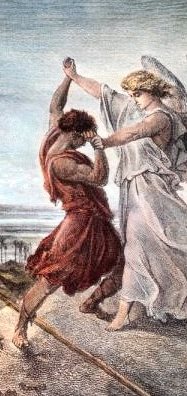
Yisrael and Ya-akov are the two names of the patriarch in the book of Genesis who fathers the twelve sons whose names become the names of the twelve tribes. His first name, Ya-akov, refers to his devious efforts to pull down his brother Esau and replace him as the “firstborn” who will inherit not only twice as much wealth, but also God’s blessing and covenant. Ya-akov wins a second name, Yisrael, after wrestling all night with an angel of God, refusing to let go until the angel blesses him.

I find it significant that the Hebrew Bible does not call the twelve tribes after Abraham, or Isaac, but after the patriarch who began his career as a deceitful heel, and had to struggle with God to become the legitimate conduit for the divine covenant. At the end of the book of Genesis, Jacob-Israel is more straightforward and law-abiding than at the beginning of his story, but still far from perfect.

The name Yeshurun appears in the Torah for the first time in the long poem of Ha-azinu (“Use your ears”), the portion we read this Saturday, between Rosh Hashanah and Yom Kippur. Purportedly a prophecy written by Moses, the poem describes how after Moses has died and the Israelites have conquered and settled Canaan, God made them prosperous, but then they forgot the source of their wealth.

…[God] suckled them with honey from a rock,

And oil from a flinty boulder,

Sour cream from cattle and cream from sheep,

With the fat of lambs, and rams from Bashan, and he-goats,

With the fat of kernels of wheat,

And the blood of the grape you drink fermented.

And Yeshurun fattened, and it kicked;

You fattened, you became thick, you became gorged,

And abandoned the god who made him,

Dismissed as foolish the Rock who rescued him. (Deuteronomy/Devarim 32:13-15)

The ingrates in this poem are anything but upright.  16th-century rabbi Obadiah Sforno explained that the Israelites kicked like an animal that kicks the person feeding it. Their love of material pleasures, indicated by the rich foods, made them too “thick” to understand subtle truths.

19th-century rabbi Samson Raphael Hirsch added that God made the Israelites prosperous in order to show the world that it is possible to enjoy material pleasures and still lead a spiritual and moral life. When you are well-fed, Hirsch wrote, the correct behavior is to be more active and accomplish more. But the people who were supposed to be the Upright-Ones got lazy and fat instead.

In the last Torah portion of Deuteronomy, Vezot Habrakhah (“This is the blessing”), Moses calls the Israelites Yeshurun two more times, just before and just after his poetic prophecies for individual tribes. Here Moses uses the name Yeshurun without irony.

First he recalls the Israelites’ peak moment, when all the tribes gathered at Mount Sinai and pledged themselves to God.

He became king among Yeshurun,

When the heads of the people gathered themselves,

All together, the tribes of Yisra-el. (Deuteronomy 33:4)

Commentators disagree on who “he” is in this verse, Moses or God. According to Rambam (12th-century rabbi Moses Maimonides), the Israelites honored Moses like a king. This would make Moses the head of the Upright Ones. But according to the Talmud, the Israelites accepted God as their king. This would make them the Upright Ones who unite to obey God’s laws (even though it is a struggle, yisra, to serve the divine king).

After giving prophecies for individual tribes, Moses makes another positive statement about the Israelites as a whole.

There is none like the god of Yeshurun,

Riding through heavens as your rescuer,

…And Yisra-el will dwell in safety,

The well of Ya-akov left alone. (Deuteronomy 33:26, 33:28)

Ultimately, God will help the people, even though sometimes they are upright, sometimes struggling for God’s blessing, and sometimes they are devious supplanters.

After these three uses of Yeshurun at the end of Deuteronomy, the name occurs only once again in the whole Hebrew Bible:

Thus says God, your maker and your shaper,

Who helps you from the womb on:

Do not fear, My servant Ya-akov,

And Yeshurun whom I have chosen. (Isaiah 44:2)

I think Isaiah means that the descendants of Ya-akov, who grabbed his brother’s heel and used devious means to supplant him, need not fear as long as they serve God. If Ya-akov had pursued only the firstborn’s double portion of wealth, God would not have helped him. But since Ya-akov also pursued the firstborn’s blessing of the covenant with God, God gave him more chances to make good.

And Yeshurun, the upright ones, need not fear as long as they live up to the role God chose for them: to be the model of a nation that obeys God’s laws.


Do you identify with the God-Struggler (Yisra-el), the Heel-Grabber (Ya-akov), or the Upright One (Yeshurun)? Or perhaps a fourth name?

Personally, my default is to be law-abiding, probably because I grew up feeling the safest when I went unnoticed. That kind of uprightness is hardly a great model. Fortunately I also have a stubborn moral sense, so when I discover I have accidentally done something that might be devious, I rush to make amends. I do not want to be a heel-grabber, even when that seems to be the only means to a good end.

I think my highest self is a god-struggler, wrestling with the question of what God is, and how I can have at least a relationship, if not a covenant, with this mystery called God.

And I pray that all humans may find the names that they need to grow into.

Vezot Habrakhah: Broad Daylight

And this is the blessing with which Moses himself, the man of God, blessed the children of Israel, before his death. (Deuteronomy/Devarim 33:1)

The book of Deuteronomy/Devarim is a series of speeches by Moses, sometimes in God’s name, sometimes in his own words, to the generation that is about to cross the Jordan without him. Moses repeatedly tells the Israelites that they have screwed up before, and God will punish them if they screw up again. The second-to-last Torah portion, Ha-Azinu, is God’s rather dark poem prophesying that they will, indeed, screw up again. But the last portion in Deuteronomy (the very last one in the Torah scroll) takes a brighter tone.

In this portion, Vezot Habrakhah (And this is the blessing), Moses blesses each tribe with prophesies of good outcomes: life, strength, religious knowledge, security, and plenty. After these unusually positive parting words, Moses climbs Mount Nevo and dies.

Before Moses blesses the first tribe, Reuben, he introduces his blessings with a few obscure poetic verses.  Modern scholars view these verses as quoted from a much older poem, with some bits lost in the transmission. One piece of evidence for this theory is that the mountain where the Israelites received the “Ten Commandments” is called Mount Sinai, just as it is in the book of Exodus/Shemot.  This is the only appearance of the name “Sinai” in the whole book of Deuteronomy; the rest of the time, Deuteronomy calls the mountain Choreiv (Horeb).

Here is the first obscure verse:  And he [Moses] said:

God entered from Sinai

and dawned from Se-ir for them;

shone out from a mountain of Paran,

and came from holy myriads;

from Its right side is אשדת for them. (Deuteronomy/Devarim 33:2)

אשדת = ?  These four Hebrew letters do not make a word anywhere else in the Hebrew bible. Commentators generally agree they indicate a compound word beginning with eish = fire.  For the second part of the word, we have only the two letters ד and ת, corresponding to “d” and “t”.   Traditional commentary assumes the two letters stand for dat = edict, a word borrowed from Persian that does not appear in Hebrew texts until  centuries later. They translate the whole word as “fiery law”.  Most modern scholars assume that d-t is a fragment of the word daleket = flaming, and translate the whole word as “fire-bolts” or “lightning”.

What does the verse mean? Se-ir is the land southeast of Canaan where, in the book of Genesis/Bereishit, Esau founds the kingdom of Edom.  The Talmud associates Se-ir with Rome. Paran is a wilderness south of Canaan where Ishmael settles in Genesis. The Talmud associates Paran with Islam.

Most commentary from the Talmud through the 19th century assumes that Moses is once again insisting that the religion of the Israelites is the only acceptable creed. The light of God, they said, is the Torah, and this verse means that God offered to Torah to the Israelites at Sinai, to the  Edomites (standing in for Romans or Christians) at Se-ir, and to the Ishmaelites (standing for Muslims) at Paran. But only the Israelites accepted the Torah. The “holy myriads” are God’s angels, who do not need the Torah to instruct them on how to live properly in the world. So God’s right hand gives Israel alone  the eish-dat, the fiery law.

I am not persuaded. Yes, Moses spends 40 years denigrating other religions and reminding the Israelites that God chose them– 40 years of warning and criticizing and yelling and laying down the law. But in Vezot Habrakhah, Moses finally drops that role and blesses the tribes with good fortune and plenty. He wants to leave the world with blessings rather than curses. In his softened mood, maybe he quotes part of an old poem not to reinforce Israelite triumphalism, but to hint that divine enlightenment can reach people who belong to other groups, other religions.

The simple meaning of the verse appears to be that God’s light shone on at least three different peoples south of Canaan. And I think the next verse continues this theme, despite traditional commentary’s insistence that it must mean God has power over all peoples, but loves only Israel.

One difficulty in translating verse 33:3 is that it seems to switch back and forth between referring to God in the second person singular and the third person singular. But this is not unusual in the Torah. To make the verse easier to read, I will use [God] instead of a confusing pronoun.

Indeed, [God] is a lover of peoples;

all of [God’s] holy ones are in [God’s] hand;

and they place themselves at [God’s] feet;

yissa from [God’s] pronouncements. (Deuteronomy 3:3)

yissa = he/it lifts; he/it carries

Traditional translations ignore the fact that the word amim means “peoples”, and change the word to “tribes” or “the people” in the singular. These translators assume that God would never be described as a lover of more than one people:  the people Israel.

But why not take the Hebrew word for “peoples” literally? What if God really is a lover of many “peoples”, many ethnicities, many religions? Then, as the next line says, all of God’s holy ones, from every population, are in God’s hand.  And they humbly position themselves at God’s feet.

In the last line of the verse, God lifts, or carries, from God’s pronouncements. Modern scholar Robert Alter, who translated the line as “he bears your utterances”, noted that its meaning is so unclear, it must have been altered in transmission from the original poem.

True, pronouncements are normally neither lifted nor carried nor borne. But I wonder if the word yissa is an abbreviation of an idiom. One common biblical Hebrew idiom is yissa rosh, “he lifts the head of”, and means “he pardons”. Maybe God pardons the holy ones at God’s feet for disregarding God’s pronouncements. Maybe, contrary to Talmudic thinking,  God pardons the more righteous members of many religions when they transgress God’s decrees.

With such obscure Hebrew, it is all guesswork.  But my guess is that the two verses together mean that the divine light is not like a laser focusing on just the children of Israel, but rather like the sun, that rises over every height where a people seeks inspiration. God offers enlightenment to everyone, in broad daylight.  Furthermore, God loves not just the Israelites, but many peoples. The Roman Christians of Se-ir and the Muslims of Paran can also count as holy. God does pronounce laws and requirements; but all holy ones who transgress them can be pardoned, if they place themselves humbly at God’s feet.

This is the poem Moses quotes before he blesses the tribes of Israel and climbs up the mountain to die. After spending 40 years of his life browbeating his people into committing themselves to God, maybe Moses feels that his great task is finished. Now, at last, he can let go of his anger and frustration and give blessings–not just to the tribes of Israel, but to all peoples.

If only we let go of our prejudices, and listen.

Vezot Habrakhah: Face to Face

And no other prophet arose in Israel like Moses, whom God knew face to face; for all the signs and the miracles that God sent him to do in the land of Egypt, to Pharaoh and to all who served him, and to all his land; and for all the strong power and all the great awe that Moses carried out before the eyes of all Israel. (Deuteronomy/Devarim 34:10-12)

That’s the ending of this week’s Torah portion, Vezot Habrachah (And this is the blessing); of the book of Deuteronomy/Devarim; and of the Torah proper (the first five books of the Jewish canon).

In one sense, this passage is a eulogy for Moses, who died at age 120 “by the mouth of God” after liberating the people from Egypt and shepherding them for forty years until they were ready to cross the Jordan River into “the promised land” of Canaan.

But the passage also tells us something about God.

panim = face; indicator of mood; identity

panim el panim = face to face, directly, without an intermediary

The first place that the Torah uses the expression “face to face”, is at the end of the mysterious account of Jacob wrestling all night with an unnamed “man” who blesses him with a new name (Israel) at dawn.

Jacob called the place there Penieil (Face of a god), ‘Because I saw Elohim face to face, and my life was saved.’  (Genesis/Bereishit 32:31)

eil = God, a god

elohim = God, gods

The next place we see the phrase “face to face” is after the golden calf incident, when Moses pitches his tent some distance from the camp.  Whenever Moses returns to the tent, now called the Tent of Meeting, everyone can see the pillar of cloud descend and stand at the tent opening.  Then, the Torah says,

God spoke to Moses face to face, as a man speaks to his neighbor.  (Exodus/Shemot 33:11)

This verse uses the personal, four-letter name of God, so there is no ambiguity about whether the speaker is a god or the God.  Moses is able to hear God’s speech “face to face”, as clearly as one man can hear his neighbor speak.   Moses is able to hear God directly at the burning bush, and according to the Torah, this straightforward communication occurs repeatedly for the rest of Moses’ life.  The ability to hear God is not unique to Moses; the Torah reports that many of the characters in Genesis, as well as all true prophets, also hear God speak.  But Moses  hears God’s voice much more often than anyone else, and only Moses can count on initiating a conversation with God.

Yet despite their close relationship, when Moses asks to see God’s kavod (glory, heaviness), God tells Moses:

You will not be able to see my face, because no human can see  Me and live.  (Exodus/Shemot 33:20)

Then what about Jacob, who said he saw God’s face and lived?  I think Jacob neither saw nor wrestled with God’s real identity, but only with a few aspects of God, which he called elohim.  He was grateful to live through the experience of beholding even one divine aspect, or angel, or god.

“Seeing” God’s face is different from having a face-to-face conversation with God.  Like English, Biblical Hebrew often uses the verb for “see” to mean “understand”.  If one’s “face” is one’s identity, then nobody can know God that intimately and live.

Two humans in an intimate relationship often watch one another’s faces for clues about what the other person is thinking and feeling inside.  Yet anyone who has had a loving partner for decades knows that we can still get it wrong.  The expressions on a well-known face indicate a fleeting mood, but the observer can only guess at the thoughts behind the face.  Experience over time makes the guesses somewhat more accurate.  Yet the innermost person is still inaccessible, unknowable.

In fact, we cannot even fully know ourselves, or even predict what choices we will make in every circumstance.  Watching our own faces in a mirror is not much help.  The face itself is an intermediary between the soul and the observer; a person’s inner identity is still hidden.

Does the conclusion of the book of Deuteronomy tell us that Moses finally saw God’s true “face” at the moment of his death?  Not really.  The Hebrew says that God knows Moses face to face, not that Moses knows God that way.

Since God knows Moses’ true “face”, his inner self, God knows that Moses has the potential to carry out all the signs and the miracles, and to demonstrate all the strong power that creates all the great awe, and moves the religion forward.

Whatever our notions about God are, if we are wise we know we can never see God’s “face”, as long as we live.  But maybe it’s more important that God can see us.