(I am flying cross-country to see my sister for the first time since 2019, so I will not be able to write new blog posts for the next three weeks. You can read some of my favorite earlier posts for this time of year at the following links: Ha-Azinu: Raining Wisdom; Rosh Hashanah & Yom Kippur: Our Father, Our King; Haftarot for Rosh Hashanah & Shabbat Shuvah—1 Samuel & Hosea: From Smoke to Words; Yom Kippur & Isaiah: Ending Slavery; and Jonah: Turning Around. You can also look under “Categories” on my home page to find all my previous posts.)
Most prophecies in the Hebrew Bible are short-term; they predict events during the lifetime of the prophet’s audience. They are also conditional; the prophet announces what will happen if the people, or their rulers, do not change their course of action. If they do change, like the Assyrians of Nineveh in the book of Jonah, God changes the decree.

But a prophecy containing the idiom be-acharit hayamim is about events in the distant future, not a warning to anyone alive at the time of the prophecy. Moses makes one of these long-term prophecies near the end of this week’s double Torah portion, Nitzavim and Vayeilekh (Deuteronomy 29:9-31:22), after God has told him what will happen many generations later, after the Israelites have conquered Canaan.
And God said to Moses: “Hey, you will be lying with your fathers, and this people will rise up and go whoring after the foreign gods of the land where they are coming into their midst. And they will abandon me and violate my covenant that I cut with them. And on that day my nose will heat up against them, and I will abandon them! And I will hide my face from them. And they will be [ripe] for devouring, and many bad things and troubles will find them. And on that day they will say: Isn’t it because our God is not in our midst that these evils found us?” (Deuteronomy 31:16-17)
Not only God, but also the writer of these verses knows that the Israelites will backslide again and be punished. According to some 21st-century biblical scholarship, much of the book of Deuteronomy was written in the 7th century, but it was rewritten and expanded in the 6th century during the Babylonian exile.1 The rewriter made two major changes: the book was recast as a series of speeches by Moses; and “predictions” were added that Judah and its capital would be destroyed someday because the Israelites would disobey God’s primary command: do not worship any other gods.
The Babylonian army razed Jerusalem in 586 BCE, and the rewriter of Deuteronomy lived through it. According to biblical reasoning, Judah could only be conquered if God stopped protecting it; and God would only stop protecting Judah if its people persistently disobeyed God. Therefore the conquest and destruction of Judah was the people’s own fault.
Moses duly transmits God’s message to the people, saying:
For I know that after my death, you will indeed act ruinously, and you will swerve away from the path that I commanded to you, and bad things will happen to you, be-acharit hayamim. For you will do what is bad in the eyes of God, offending [God] through your handiwork. (Deuteronomy 31:29)
be-acharit (בְּאַחֲרִית) = in an end, when afterward, as an aftermath, in the future. Be (בְּ) = in, at, when, through. Acharit (אַחֲרִית) = an end, outcome, future. (From achar (אַחַר)= behind, after, afterward, following.)
hayamim (הַיָּמִים) = (literally) the days; (as an idiom) a long period of time.
be-acharit hayamim (בְּאַחֲרִית הַיָּמִים) = (literally) “at the end of days”; (as an idiom) a long time afterward, in the distant future, as a long-term outcome.
A long time from now
The phrase be-acharit hayamim appears 15 times in the Hebrew Bible, and even though it could be translated as “at the end of days”, none of these verses refer to the end of the world as we know it. They usually predict the future of the people of Israel, and describe events that had actually happened by the time the second temple was built in Jerusalem in the 5th century BCE. (Prophecies about two neighboring kingdoms foretell events in the same time period.2)
The first appearance of be-acharit hayamim is in Jacob’s deathbed prophecies, supposedly about his twelve sons, but actually about what happens to the twelve tribes of Israel after the land of Canaan is settled.3
The second appearance is in Bilam’s introduction to the fourth prophecy he delivers to King Balak of Moab about the Israelites camped on the king’s border:
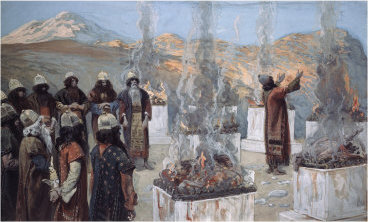
And now, here I am going [back] to my people. I will advise you what this people will do to your people be-acharit hayamim. (Numbers 24:16)
Bilam says Israel will conquer Moab and Edom; 2 Samuel 8:11-12 reports King David’s conquest of those two kingdoms. Bilam says Amalek will perish forever; 1 Samuel 7-33 reports that King Saul killed all the Amalekites (although a few of them show up later in the bible).4 Bilam says the Kenites (allies of the Israelites who are nomads in their territory) will be captured by Asshur (the Neo-Assyrian Empire); the Assyrians did take over the northern kingdom of Israel in the 8th century BCE, a conquest reported in 2 Kings 17:5-6, and they attacked Judah, the southern kingdom, so they may well have captured the Kenites. Bilam’s final prediction is that enemies on ships will destroy Asshur forever; the Medes and the Babylonians did conquer the Assyrians in 614-612 BCE, but the Tigris River was too shallow for ships to reach the capital.
Some modern scholars attribute this prophetic poem to a refugee from the Assyrian conquest of the northern kingdom of Israel.5 The only event in the prophecy that had not happened by the time the refugee recorded it was the conquest of the Assyrian Empire.
The phrase be-acharit hayamim occurs twice in the book of Deuteronomy. In this week’s portion Vayeilekh, Moses tells the Israelites:
… bad things will happen to you, be-acharit hayamim. For you will do what is bad in the eyes of God, offending [God] through your handiwork. (Deuteronomy 31:29)
Sure enough, although the Israelites toe the line in the book of Joshua, they repeatedly worship foreign gods in the book of Judges and the first and second books of Kings, as well as in most of the books of the prophets. Meanwhile, the Assyrians wipe out the northern kingdom of Israel in the 8th century BCE, and the Babylonians destroy Jerusalem in the 6th century BCE. Thus when Deuteronomy was revised and Moses’ prophecy was recorded, it had already come true.
Earlier in Deuteronomy, Moses predicts that after the Israelites have been living in Canaan for generations, they will make and worship idols, and God will get angry and drive them out of their land into other nations. In fact, the Assyrians deported many leading citizens of Israel, and the Babylonians deported many leading citizens of Judah. Moses continues:
But if you seek there, then you will find God, your God, if you inquire with all your heart and with all your soul. When you are in distress and all these things have found you, be-acharit hayamim, then you will return to God, your god, and you will listen to [God’s] voice. (Deuteronomy 4:29-30)
It may be no accident that here Moses sounds like second Isaiah, who wrote after the Persians conquered Babylon. Second Isaiah repeatedly urges the exiles in Babylon to seek God and return to their religion and to Jerusalem.
The phrase be-acharit hayamim also appears in first Isaiah, Hosea, Micah, and Jeremiah, in predictions that are so vague, they merely express optimism that someday the Israelites will return to their God. Ezekiel uses be-acharit hayamim in two expressions of pessimism over the long-term future of the Israelites, when he invents a foreign king called Gog who will overrun the land. Although none of these predictions from the Prophets refer to specific events in the future, they do all refer to a distant future in historical time, in this world.6
Not the end of the world
The phrase be-acharit hayamim appears twice in the book of Daniel, but neither time does it refer to the End of Days. First Daniel uses the Aramaic version be-acharit hayamim when he interprets King Nebuchadnezzar’s dream about a statue made of different materials, from a gold head down to feet of iron and clay.7 It is not an apocalyptic image, but merely foretells a succession of kingdoms ruling Mesopotamia. The second time the phrase appears in Daniel, an angel proceeds to tell him the future of the Persian Empire.8 In both cases, a better translation of be-acharit hayamim would be “in the distant future”.
The verse that does mean “the End of Days” comes at the end of the book of Daniel, when an angel tells him:
“But you go to the keitz. And you will rest [in the grave]; then you will stand up for your destiny at keitz hayamim.” (Daniel 12:13)
keitz (קֵץ) = end (of someone’s existence), limit, boundary, extremity.
keitz hayamim (קֵץ הַיָּמִים) = the end of days; the limit of time.
Acharit means an outcome sometime in the future, after which history will continue. But keitz is an absolute end. The verse at the end of Daniel is is the only occurrence in the Hebrew bible of the phrase keitz hayamim—and the book of Daniel is the only book that seriously proposes the resurrection of the dead at the end of the world as we know it. Although the Daniel story begins during the 6th-century CE Babylonian Exile, the book was written in the 2nd century CE, well after all the other books of the Hebrew Bible. The starting point for Jewish and Christian eschatology9 is the final chapter of Daniel, which includes not only the phrase “the end of days”, but also the concept of resurrection of the dead—the righteous to “everlasting life” and others to “everlasting shame”.
Some people hope for a life after death; others believe this world is the only one we get, and humans only live once. Some people believe the ethical level of humanity will continue to improve, rapidly enough so we will save ourselves and our polluted earth; others believe we will not get our act together in time.
Will we win the human race, or self-destruct? Will humankind learn how to manage without war? How bad will the damage be from our degradation of the planet, and when will it stabilize? And what about my own nation, my own religion, my own people? Will we ever get it right?
We might want to know the short-term future for selfish reasons: so that we can make choices that will improve our own lot, or our family’s. But we want to know long-term future because we care about the fate of human beings who come after us, even those we will never meet.
I pray that enough people find enlightenment, dedicate their lives to doing no harm, and repair what they are able to repair. I am not interested in an End of Days, but I pray for a better future for this world, be-acharit hayamim.
- See Eckart Otto, www.thetorah.com/article/deuteronomy-rewritten-to-reflect-on-the-exile-and-future-redemption.
- Jeremiah 48:47 and 49:39.
- See my post Vayechi & 1 Kings: Deathbed Prophecies.
- Amalekites appear in 1 Samuel 30:1-2 and 2 Samuel 1:5-10.
- The “E” or Elohist source.
- Isaiah 2:2; Jeremiah 23:20, 30:24, 48:47, 49:39; Hosea 3:5; Micah 4:1; Ezekiel 38:8, 38:16.
- Daniel 2:28.
- Daniel 10:14.
- The orthodox Christian tradition is that the “The End of Days” or “The End Times” will be a world-wide apocalypse, as described in the Book of Revelation, followed by the Second Coming of Jesus and the Last Judgment, when life on earth will become obsolete. Jewish eschatology is moderate by comparison. The orthodox Jewish tradition, established as a subject for argument in the Talmud before 500 CE, is that in some distant future there will be a happy olam haba (world-to-come) here on earth. There will be a new king (moshiach, מַשִׁיַח = “anointed one”) who is a descendant of King David; the Jews in the diaspora will return to the land that was once David’s kingdom; and righteous people who have died over the centuries will be resurrected bodily.


 Questioning Torah