Va-etchanan: Only One

The first definite statement of monotheism—that there are no other gods—appears in this week’s Torah portion, Va-etchanan (3:23-7:11), in the book of Deuteronomy (Devarim).

Our god is better than your god

Although the Hebrew Bible repeatedly forbids Israelites from worshiping any other gods, the texts of Genesis and Exodus assume that other, lesser gods exist.1 On the sixth day of creation, God says:

“Let us make humankind in our image, like our likeness.” (Genesis 1:26)

Neither kings nor God use the royal “we” in the Hebrew Bible. God uses the first person plural only four times in the entire canon.2 In Isaiah 6:8, God’s “we” includes the serafim, six-winged angels hovering in attendance on God. But the first three times, all in Genesis, God’s first person plural can only be addressing lesser gods who assist God in acts of creation. The second time, after the two humans have eaten fruit from the Tree of the Knowledge of Good and Evil, God says:

“Humankind is becoming like one of us, knowing good and evil!  And now, lest it stretch out its hand and take also from the Tree of Life and eat and live forever—!” (Genesis 3:22)

And the third time, after humans build the tower of Babel, God says:
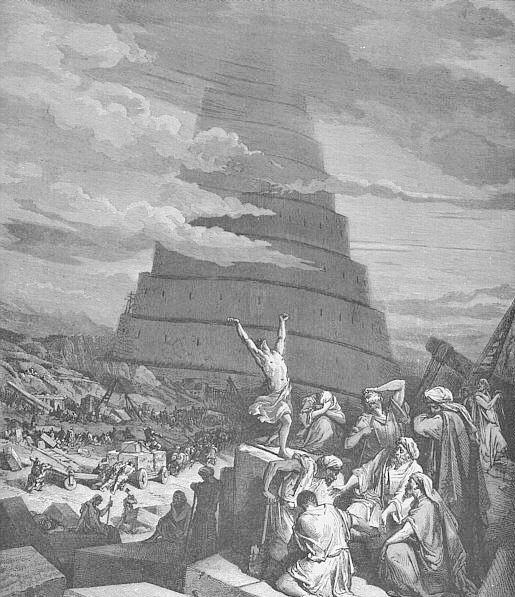
The Confusion of Tongues,
by Gustave Dore, 19th century

“Come, let us go down there and let us make their language fail, so that a man cannot understand the language of his neighbor.” (Genesis 11:6-7)

The book of Exodus also assumes the existence of other gods. For example, God tells Moses and Aaron:

“I will pass over the land of Egypt on that night, and I will strike down every first-born in the land of Egypt, from human to beast; and against all ha-elohim of Egypt I will execute judgments. I am Y-H-V-H.” (Exodus 12:12)

ha-elohim (הָאֱלֺהִים) = the gods; God.

How could God punish the gods of Egypt if they do not exist?

After Moses and the Israelites have crossed the Red Sea, they sing to God:

“Who is like you ba-eilim, Y-H-V-H?
Who is like you, majestic among the holy,
Awesome of praises, doer of wonders?” (Exodus 15:11)

ba-eilim (בָּאֵלִם) = among the gods. B- (בּ) = among, in, through + -a- (ָ ) = the + eilim (אְלִם) = gods. (Unlike elohim, eilim is never used to refer to the God of Israel.)

Here the God of Israel, addressed by God’s sacred personal name, Y-H-V-H, is compared with multiple other, less awesome gods. This verse (“Mi khamokha”) is chanted or sung at every evening and morning Jewish service to this day. Some prayerbooks translate the first line as “Who is like you among the mighty?”—perhaps so that people who cannot read the Hebrew will not ask embarrassing questions!

Our god is the only god

Providence Lithograph Co., 1907

The book of Deuteronomy was expanded and reframed as Moses’ final speech to the Israelites in the 5th century B.C.E. after the Persians had conquered Babylon and given the exiled Israelites permission to return to Jerusalem. Second Isaiah, which also includes clear statements of monotheism, was written during the same period.3

The first monotheistic declaration in the Torah appears in this week’s Torah portion, Va-etchanan. Moses reminds the Israelites that their God created the universe, made miracles to rescue them from Egypt, and spoke to them out of the fire on Mount Sinai. He concludes:

You yourself have been shown in order to know that Y-H-V-H is ha-elohim; eyn od milvado. (Deuteronomy4:35)

ha-elohim (הָאֱלֺהִים) = the gods; God. Elohim (אֱלֹהִים) is the plural of eloha ((אֱלוֹהַּ = a god (in early Hebrew), and literally means “gods”. But elohim can also mean “God”—perhaps because the God of Israel had the powers of all the gods that other people worship.

eyn od (אֵין עוֹד) = there is no other, there is nothing else. (Eyn (אֵין) = there is no, there is not, none, nothing. Od (עוֹד) = other, else.)

milvado (מִלְּבַדּוֹ) = alone, by itself.

Technically, the Israelites whom Moses is addressing are not the ones who saw the miracles in Egypt and heard God’s voice from the fire 40 years before, when all but two4 of Moses’ present audience were either children or not yet born. Yet Moses speaks as if everyone in front of him was an eye-witness.

He elaborates on God’s deeds on behalf of the Israelites, then reiterates:

And you know today, and you must [continually] put back into to your consciousness, that Y-H-V-H is ha-elohim, in the heavens above and on the earth below; eyn od.(Deuteronomy 4:39)

But does this generation of Israelites really know that their God is the only god? After they pitched camp by the Jordan in the book of Numbers, many Israelite men joined the local women in ritual animal sacrifices to their god, Baal Peor.5

And the people ate and they bowed down to their elohim. And Israel attached itself to Baal Peor, and Y-H-V-H’s nose burned against Israel. (Numbers 25:3)

The God of Israel calls for impalements, but also sends a plague that kills 24,000 people. Moses mentions this recent episode in this week’s Torah portion:

“Your eyes saw what Y-H-V-H did regarding Baal Peor: that Y-H-V-H, your Elohim, wiped out every man from your midst who went after Baal Peor. But you who stuck to Y-H-V-H, your Elohim, all of you are alive today.” (Deuteronomy 4:3-4) Perhaps the surviving Israelites do know that there is only one god, Y-H-V-H. Or perhaps they think Baal Peor is a real god, but they know their own God is “a jealous god”6, so they avoid  worshiping any other gods.

Hear this: God is one

Mezuzah

Later in the portion Va-etchanan, Moses pronounces what has become a key Jewish prayer, recited twice a day since the first century C.E., and written on the scroll inside the mezuzah attached to a Jew’s doorpost.

Shema, Israel! Y-H-V-H is Eloheinu; Y-H-V-H is echad. (Deuteronomy 6:4)

shema (שְׁמַע) = Listen! Pay attention! Hear this!

Eloheinu (אֱלֺהֵנוּ) = our elohim: our gods, our God.

echad (אֶחָד) = one as the first of a series, one as singular, unique.

This verse certainly says that Y-H-V-H is the God of the Israelites. But is it also a statement of monotheism?

Some modern commentators have held that echad here merely means “first”, or, as Daniel Zucker expressed it, “the top god”.7 If  Moses’ declaration appeared in the book of Exodus, I might agree. But since it is in the later book of Deuteronomy, in the same Torah portion that says of God eyn od (there is no other), I favor a different kind of “one”.

The word echad could also mean “unique”, i.e. that God is the only one of its kind. In the 14th century, Rabbeinu Bachya explained: “He is unique in the universe, there is no other God deserving the title. He has no partners, is not an amalgamation of different powers working in tandem.”8

18th century rabbi Chayim ben Moshe ibn Attar put it more bluntly: “Furthermore, we express our conviction that He is indeed the only God, there is no other independent power in the universe.”9

Whatever the Shema meant when Deuteronomy was rewritten in the 5th century B.C.E., Jews have long considered it a declaration of monotheism. During the First Crusade, in 1096 C.E., Christians massacred Jews in the Rhine valley as well as Muslims in the “Holy Land”. Some Jews killed themselves before the Christians reached them.

“Over and over, their rallying cry at death is the single verse of the Sh’ma. Like their Sefardic counterparts, and medieval Muslims, Ashkenazi Jews understood the Christian concept of the divine Trinity as a case of polytheism; thus their insistence on God’s unity is a vehement repudiation of Christian doctrine.” (Susan Einbinder)10


In this week’s Torah portion, Moses tells the next generation of Israelites that they know there is only one God because 40 years ago they saw God’s miracles in Egypt and heard God’s voice in the fire on Mount Sinai. Only God could make those things happen. So according to Moses, they had direct evidence that the God of Israel is the only god; there is no other.

Moses does not mention that he is speaking to the next generation of Israelites, who were either children or not even born at the time. They have to go by what their parents told them, or by what Moses is telling them now.

Anyone who reads the book of Deuteronomy is in the same position. Why should we believe that there is one and only one god?

Some people believe it because their parents or teachers told them. And some believe it because it says so in the Torah. Others have their own mystical experiences, which they interpret as manifestations of a single, universal god. And some people believe it because they find one of the philosophical arguments for the existence of one God sufficiently compelling.

But many people are atheists, unable to believe God is real according to any of the usual definitions of God. When I examine the standard medieval theologian’s definition of God as an omnipotent, omniscient, omni-benevolent, and personal being, I always conclude that such a god is impossible. According to that definition of God, I am an atheist.

I have been fumbling toward my own definition of what I mean by “God” for decades, and I might never reach it. Although some scholars claim that the name Y-H-V-H comes from an older god-name and has nothing to do with the various conjugations of the Hebrew verb “to be” or “to become” (which are made up of those four letters in Hebrew), something about God as becoming speaks to me. But I cannot turn it into a tidy definition.

Yet I can recite the Shema with conviction. I am a Jew, and Y-H-V-H is our God, and God is one.


  1. The books of Leviticus and Numbers warn the Israelites against worshiping other gods without saying whether other gods exist.
  2. See my post: Bereishit: How Many Gods?
  3. The portion Va-etchanan also promises that God is compassionate and will ultimately rescue the Israelites (Deuteronomy 4:29-31), which is a constant refrain in Second Isaiah.
  4. Caleb and Joshua, the two out of ten scouts who trusted God to help them conquer Canaan. See my post: Shelakh-Lekha: Mutual Distrust.
  5. See my post: Pinchas & Balak: Calming Zeal.
  6. You must not have other elohim in front of me … You must not bow down to them and you must not serve them, because I, Y-H-V-H, your Elohim, am a jealous god … (Deuteronomy 5:9 and Exodus 20:3-5)
  7. Rabbi Daniel M. Zucker, “Shema Yisrael: In What Way is ‘YHWH One’?”, https://www.thetorah.com/article/shema-yisrael-in-what-way-is-yhwh-one.
  8. Rabbi Bachya ben Asher, a.k.a. Rabbeinu Bachya, translated in www.sefaria.org.
  9. Chayim ben Moshe ibn Attar, Or HaChayim, translated in www.sefaria.org.
  10. Susan L. Einbinder, My People’s Prayer Book, Vol. 1: The Sh’ma and its Blessings, Jewish Lights Publishing, Woodstock, VT, p. 90.
Yitro & Va-etchanan: Whose Words?—Part 2

How did the Ten Commandments get into the two accounts of the revelation at Mount Sinai?

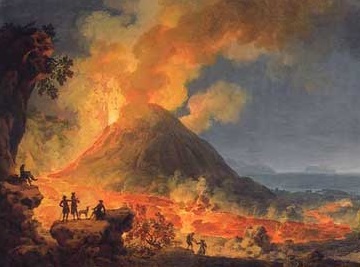
Eruption of Vesuvius,
by Pierre-Jacques Volaire, 1774,
detail

In last week’s Torah portion, Yitro (Exodus 18:1-20:23), God manifests on the mountain as fire, smoke, thunderclaps, and horn blasts. The Israelites are terrified.

The story of this epiphany is interrupted by what we call the “Ten Commandments” or Decalogue. When the narrative resumes, God’s manifestation is intensifying, and the people experience synesthesia, SEEING the sounds of thunder and horns.

And they said to Moses: “You speak to us, and we will listen. But may God not speak to us, or else we will die!” (Exodus/Shemot 20:16)

In other words, the people have not heard God delivering the words of the Decalogue. They are afraid of any communication from God, especially in words. So they beg Moses to speak for God. (See my post Yitro & Va-etchanan: Whose Words?—Part 1.)

And the people stood at a distance, and Moses approached the dark cloud where God was. And God said to Moses: “Thus you will say to the Israelites …” (Exodus 20:18-19)

Then God tells Moses a long series of civil and religious laws on a variety of specific topics, a law code that runs from Exodus 20:19 through 23:33.

So why is the story interrupted by the Decalogue?

A later insertion

According to modern source criticism, the Decalogue was written in a different style and vocabulary than the text before and after it, and therefore that section was inserted later by a redactor.

The story does read smoothly if the Decalogue section, Exodus 20:1-14, is simply deleted. Then we have:

And God said to [Moses]: “Go down! Then you may come up, you and Aaron with you; but the priests and the people may not break through to come up to God, lest [God] burst out against them.” Then Moses went down to the people, and he spoke to them. (Exodus 19:24-25)

Then all the people were SEEING the kolot and the flames and the kol of the horn and the mountain smoking. When the people saw, they were shaken and they stood at a distance. And they said to Moses: “You speak to us, and we will listen. But may God not speak to us, or else we will die!”  (Exodus 20:15-16)

kolot ( קֺלֺת or קוֹלוֹת) = thunderclaps.

kol (קֺל or קוֹל) = a noise, sound, voice.

Moses goes back up the mountain, where God gives him the law code in Exodus 20:20-23:33.

If a redactor inserted the Decalogue into Exodus, where did that text come from?

Ambiguity in Deuteronomy

The only other place in the Torah where the Decalogue appear is in Deuteronomy, the book in which Moses tells the next generation of Israelites what he remembers of the exodus from Egypt. Moses introduces the Decalogue in the Torah portion Va-ethchanan (Deuteronomy 3:23-7:11) by saying:

Face to face God spoke with you on the mountain, from the midst of the fire—I myself stood between God and you at that time to tell you the words of God, since you were afraid in the face of the fire, and you did not go up the mountain—saying: (Deuteronomy/Devarim 5:4-5)

The Decalogue follows. In this account, God speaks and Moses either repeats God’s words, or translates God’s communication into words.

The Decalogue in Deuteronomy is similar, though not identical, to the version in the book of Exodus; the biggest difference is the rationale for the commandment about Shabbat.1 After reciting the commandments, Moses says:

Moses and the Tablets,
by Ephraim Moshe Lilien, 1908

These words God spoke to the whole assembly on the mountain, from the midst of the fire, the cloud, and the dark cloud, a great kol, and did not add more. And [God] wrote them on two stone tablets, and gave them to me. (Deuteronomy 5:19-20)

This sounds as if Moses remembers God speaking all the words of the Decalogue to the Israelites, and identifies them as the text on the stone tablets. (Exodus describes Moses coming down from Mount Sinai with two stone tablets that God had inscribed, but that book never says what God wrote.2 After Moses smashes the two tablets at the sight of people celebrating the Golden Calf, God tells Moses to prepare a second pair of tablets. The commandments Moses writes down on these stones include two of the “Ten Commandments” (on idols and Chabbat), but also command observing three annual holidays, redeeming or sacrificing firstborn livestock, and not boiling a kid in its mother’s milk.3)

No matter what was written later on the stone tablets, did the Israelites really hear God speaking the whole Decalogue? After reporting that God inscribed those words on the tablets, Moses says:

And it happened that you heard the kol from the midst of the darkness, and the mountain was blazing with fire, and you came up to me, all the heads of your tribes and your elders. And you said: “Hey! God, our God, has shown us his impressiveness and greatness, and his kol we heard from the midst of the fire! This day we have seen that God spoke and humans lived. And now, why should we die because this great fire consumes us? If we ourselves listen to his lips, the kol of God, our God, any more, then we will die! … You go closer and listen to everything that God, our God, says, and then you speak to us everything that God, our God, spoke to you, and we will listen and do it.”  (Deuteronomy 5:21-24)

Moses says that God agreed, and then moves on to his next topic. In Moses’ account in Deuteronomy, the Israelites heard God’s kol, i.e. the sound or voice of God. But, as in Exodus, they begged Moses to tell them what God said, so they could avoid hearing God speak in words.

The mysterious source of the Decalogue

In the portion Yitro in Exodus, the transition to the Decalogue is ambiguous, so we do not know whether Moses pronounced them to the Israelites at Mount Sinai. In the portion Va-etchanan in Deuteronomy, the Israelites do not hear God’s words, but Moses does pass on the Decalogue at the mountain.

However, twenty-first century commentator Cynthia Edenburg argued that a redactor spliced the Decalogue into Deuteronomy as well as Exodus.

“In neither … does YHWH indicate that part of the event will be the revelation of laws to the people of Israel. And, indeed, when the day arrives, the text focuses its description on the impressive visual and auditory elements of the theophany.”4

In the first two or three commandments (including the prohibitions against “having” other gods or idols) in both Exodus and Deuteronomy, God speaks in the first person. Then starting with the third commandment (on swearing falsely by God’s name), God is referred to in the third person. The Talmud explained the switch by saying that the Israelites heard only the first two commandments before they begged Moses to be the go-between.5

But Edenberg pointed out that neither text indicates an interruption in the transmission of the Decalogue. The style of the writing in the first few commandments matches much of the book of Deuteronomy, so the redactor of Exodus could have borrowed them from Deuteronomy. But then where did the rest of the commandments come from?

Edenberg, citing the work of Erhard Gerstenberger,6 proposed:

“The basic form of the Decalogue as we now know it came into being as scribes attempted to reinterpret the essence of the Sinai/Horeb revelations in Exodus and Deuteronomy. They accomplished this by adding the YHWH commands now found at the beginning of the Decalogue to a list of moral instructions of universal validity, transforming it into a theological statement of principles for one group—Israel. The rules were now presented as a foundational agreement between Israel and their national god, established in the wilderness period.”4


Jews who insist that God dictated every word of the books of Genesis through Deuteronomy—along with everyone who insists that the entire bible is the word of God—have to either overlook the bad transitions and contradictory passages, or resort to forced explanations. I cannot help but believe that the bible has many authors. When possible, I prefer to trust the redactor of a biblical book, and read it as a complete work. But sometimes the seams show too much.

We can notice where the Decalogue is stitched into Exodus and Deuteronomy. We can agree that the first commandments, about our relationship to God, come from a different source than the remaining commandments, about our relationship with other humans.

But none of this reduces the importance of the commandments. Other lists of laws in the Torah are more specific, narrower in scope. Many were suited to ancient Israelite society, but not to our lives today. The Decalogue, on the other hand, presents basic, general rules that still deserve our attention.


  1. Exodus says “Because in six days God made the heavens and the earth and the sea and all that is in them, and [God] rested on the seventh day; therefore God blessed the day of Shabbat and made it holy” while Deuteronomy says “so that your male slave and your female slave may rest as you do; and remember that you were a slave in the land of Egypt and God, your God, brought you out from there with a strong hand and an outstretched arm; therefore God, your God, has commanded you to do the day of the Shabbat”. (Additionally, the commandment in Exodus begins “Remember the day of the Shabbat” while in Deuteronomy it begins “Observe the day of the Shabbat”.)
  2. They are called “two tablets of the eidut (pact, written witness)” in Exodus 31:18 and 32:15. Exodus 34:28 reports that “he” (either God or Moses) wrote on the second pair of tablets “the words of the covenant, the ten words”. The Torah does not say what the “ten words” are. Later commentators declared they were the commandments in the portion Yitro, and since then people have labored to turn the information in the Decalogue into exactly ten commandments.
  3. Exodus 34:17-28.
  4. Dr. Cynthia Edenberg, “The Origins of the Decalogue”, https://www.thetorah.com/article/the-origins-of-the-decalogue.
  5. Talmud Bavli, Makkot 23b-24a.
  6. Erhard S. Gerstenberger, “Covenant and Commandment,” Journal of Biblical Literature 84 (1965): 38–51.

Haftarat Va-etchanan—Isaiah: Faith in the Creator

After grief, consolation. Every year, on the day of Tisha Be-Av, Jews engage in ritual mourning for the destruction of the temple in Jerusalem in 586 B.C.E. The shabbat after Tisha Be-Av, the haftarah reading from the Prophets (Isaiah 40:1-26) begins:

“Comfort, comfort my people,”

Says your God. (Isaiah 40:1)

These are the words of “second Isaiah”, the unknown prophet whose words begin with chapter 40 in the book of Isaiah.1 He (or she) offers comfort by promising that God will rescue the Israelites deported to Babylonia, return them to their own land, and make Jerusalem glorious again.2 Then second Isaiah reminds the exiles that their God is powerful enough to do the job.

The Tent-Maker

Do you not know?

            Have you not listened?

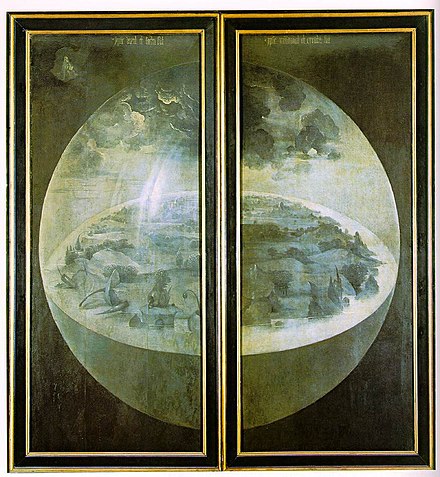
Creation, doors of The Garden of Earthly Delights, by Heironymus Bosch, 15th century

Have you not been told from the beginning?

            Have you not discerned the earth’s foundation?

[By] the one who sits enthroned above the disk of the earth,

            And its inhabitants are like grasshoppers;

The one who spreads out shamayim like gauze,

            And stretches them out like a tent to dwell in. (Isaiah 40:21-22)

shamayim (שָׁמַיִם) = heavens, skies, firmament. (Always in the plural form, indicated by the suffix -im, or perhaps in the duplex form, in which the suffix -ayim indicates a pair.)

Let us take these metaphors one line at a time.

[By] the one who sits enthroned above the disk of the earth

When God is not in the sanctuary the Israelites built for God on earth, God is often described as enthroned in the shamayim, the heavens. From a vantage point that includes most of the horizon, the earth does look like a circular disk, and the sky looks like a dome.

And its inhabitants are like grasshoppers

To someone sitting at the top of the sky, human beings down on earth would indeed look tiny. The scouts in the book of Numbers use the same word for grasshoppers, chagavim (חֲגָבִים), to describe how they thought they looked to the giant people in Canaan.3 The grasshopper simile is an exaggeration for giants, who would be no more than twice as tall as the scouts. But it is an understatement for God, who looks down from the clouds and stars.

The one who spreads out shamayim like gauze

Clouds do look like gauze. The skies cannot be made entirely out of clouds, since there are also clear days. But poetry does not have to be technically accurate.

And stretches them out like a tent to dwell in

On a cloudy day the dome of the sky might look like the inside of a gigantic tent—which is a type of home. The description of God in a tent of sky is similar to Psalm 104, which begins:

May my soul bless God!

            God, my god, you are very great.

You are clothed in majesty and splendor,

            Wrapped in light like a robe,

Spreading out shamayim like tent-fabric. (Psalm 104:1-2)

The Master Gardener

After second Isaiah shows us God enthroned high in the sky—which God created in the first place—the prophet points out that compared to God, even the most powerful human beings are less important than grasshoppers. God is:

The one who appoints princes to nothingness,

            Who makes judges of the earth tohu (Isaiah 40:24)

tohu (תֺהוּ) = unreality; emptiness; chaos, confusion; worthlessness. 

Here tohu means as insignificant as a “nothing”.

The word tohu appears 20 times in the Hebrew Bible. The most well-known appearance is in the first sentence of the first creation story in Genesis:

In a beginning, God created the shamayim and the earth, and the earth was tohu vavohu (Genesis 1:1-2)

vavohu (וָבֺהוּ) = a rhyming addition to tohu used for emphasis. (It never appears except in “tohu vavohu”, and it does not add another shade of meaning.)

Before God begins creating the world (the heavens and earth) by saying “Let light be!”, there is tohu: a confused chaos without reality. God finds the state of tohu worthless, and therefore introduces order into the world.

Although the word tohu is a synonym for “nothingness” in Isaiah 40:24: “The one who appoints princes to nothingness, Who makes judges of the earth tohu”, the prophet’s audience would also remember the word tohu in Genesis, and think of those dignitaries as confused and worthless, as well as nothing compared to God.

After saying that God makes the princes and judges of the world mere tohu, the prophet finishes verse 4:24 with a metaphor from the plant world:

Job’s Tears (millet), by Leonardo da Vinci, 15th century

Hardly are they planted,

            Hardly are they sown

Hardly have they rooted in the earth,

When [God] blows on them and they wither,

            And the gale carries them off like chaff. (Isaiah 40:24)

From God’s point of view, a century is less than a month. But when God notices that a noxious empire has sprouted on earth, God pulls it out like a weed and it vanishes, carried off in the wind like chaff.

The Shepherd

The haftarah ends by declaring that God is so powerful, God even controls the “host” in the heavens.

“Then to whom can you liken me, so I can be compared?”

            Says the Holy One.

Raise your eyes high and see:

            Who created these?

The one who is mustering tzeva-am by number,

            Who calls each by name.

Through [God’s] abundant power and might,

            Not one is missing. (Isaiah 40:25)

tzeva-am (צְבָאָם) their “host”; tzava (צָבָא) = army, host, large organized force. (The tzeva of God in the Hebrew Bible seems to be either the stars and other heavenly bodies, or a group of lesser gods under God’s command, or both.)

Surely a God powerful enough to create the stars—or subordinate gods—will have no trouble returning the exiled Israelites to Jerusalem, and making their city flourish again.

And if God keeps track of every star in the sky, so not one is missing, perhaps God also keeps track of us grasshoppers down on earth.


The purpose of second Isaiah’s exhortation in this week’s haftarah is to encourage the exiled Israelites to return to Jerusalem after the fall of the Babylonian Empire. The Persian emperor Cyrus took Babylon in 539 B.C.E., only 47 years after the fall of Jerusalem, and instituted a policy allowing deportees to return to their homelands, rebuild their temples, and engage in local self-rule.

Why would the exiles need second Isaiah’s encouragement to return to Jerusalem, in these circumstances?

One answer is that they no longer believe their God is both powerful and on their side. After all, they or their parents remember when the Babylonian Army conquered all of Judah, burned down Jerusalem and its temple, deported their leading citizens, and left the rest (except for a puppet government) to starve. And their God did not lift a finger against their enemy.

During the siege of Jerusalem, the prophet Jeremiah insisted that God was collectively punishing the Israelites because too many of them they were unethical and worshiped other gods. Probably some Israelites considered the punishment out of proportion compared to the crime.

All the prophets promised that God would rescue and reward them if they worshiped only their own God, and refrained from unethical deeds such as cheating, stealing, bribing, and oppressing the poor. But could the Israelites reform enough to satisfy God? And could they count on their neighbors and leaders to do the same?

Life in Babylonia was not that bad, especially after the reasonable Persians took over. Why risk returning to Jerusalem? Even if they believe God has the power to reward them, why depend on such a touchy God?


  1. “First Isaiah”, Isaiah son of Amotz in Isaiah chapters 1-39, lived in the 8th century B.C.E. during the Assyrian attack on Jerusalem. “Second Isaiah” lived in the 6th century B.C.E. during the Babylonian destruction of Jerusalem and the subsequent exile of its citizens in Babylonia.
  2. See my blog post: Haftarat Va-etchannan—Isaiah: How to Comfort Yourself.
  3. Numbers 13:33. See my post: Shelach Lekha: Who Is Stronger.

Haftarat Va-ethchanan—Isaiah: How to Comfort Yourself

How can people find consolation after a national disaster?

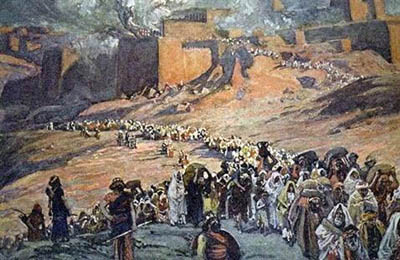
Flight of the Prisoners (from Jerusalem in 586 BCE) by James J.J. Tissot, 1896

“There are none menacheim me!” wails Jerusalem, imagined as a widow, in Lamentations 1:21.

menacheim (מְנַחֵם= comforting, consoling; one who comforts or consoles. (A piel form of the verb nacham,  נָחַם, which in the nifil form means a change of heart: either regret or consolation.)

Jerusalem is crying because the Babylonian army besieged and destroyed the city and its temple in 586 B.C.E. (See last week’s post: Lamentations: Seeking Comfort.) The leading families of the kingdom of Judah and its capital were exiled to Babylon, and the rest of the Israelites of Judah became serfs to the Babylonian conquerors.

Jews customarily read the book of Lamentations on the annual fast day of Tisha Be-Av. On the following Shabbat, called Shabbat Nachamu, we read the Torah portion Va-Etchanan in the book of Deuteronomy, and its accompanying haftarah reading from second Isaiah1, which begins:

Nachamu, nachamu my people!”

            Said your God.  (Isaiah 40:1)

nachamu (נַחֲמוּ) = Comfort! Console! (A plural imperative of the verb nacham in its piel form.)

Here God is the speaker, telling someone to comfort God’s people. These people (referred to later in the haftarah as “Jerusalem” or “Zion”) include both the exiles in Babylon and those who remained in Judah.

But who should do the comforting?

Decree by Cyrus (British Museum, photo by Ferrell Jenkins)

One candidate could be King Cyrus, whose Persian Empire swallowed the Babylonian Empire in 538 B.C.E.. Cyrus did, in fact, comfort the exiles from Judah living in Babylon, since he decreed that exiles throughout his empire could return to their own lands and enjoy modified independence.

Yet in the rest of the haftarah God never mentions Cyrus or the good news that the next generation among the exiles could go home after the Persians take over.

Instead God recommends four possible attitudes the Judahites  could adopt to console themselves:

  1. that they deserved their punishment, and it is ending;
  2. that their lives and their troubles are ephemeral, impermanent; and
  3. that God moves in mysterious ways.

An unnamed prophetess is called to deliver God’s messages of possible consolation.2

1. Just deserts

The first message begins by telling the people of Judah that have been punished enough.

Speak to the heart of Jerusalem

            And call out to her

That she has completed her term of service,

            That her crime has been expiated … (Isaiah 40:2)

Throughout the Hebrew Bible, God is considered responsible for the outcome of any war. When God wants the Israelites to win, they do. When God wants to punish the Israelites for worshiping other gods or behaving unethically, then their enemy wins.

Lamentations, Jeremiah, and second Isaiah all assume that God let the Babylonians capture the kingdom of Judah and destroy Jerusalem in order to punish the Israelites.

The Judahites would certainly be reassured if they believed that their sentence of punishment was now over. Many people also find comfort in the belief that there is a reason for their suffering. If God is punishing them for their own misdeeds, they have a reason that does not shake their faith in an omnipotent, omniscient, and omni-benevolent God.

However, verse 40:2 continues with a potentially faith-shaking statement.

            … That her crime has been expiated,

Since she took from the hand of God

            A double [punishment] for all her misdeeds. (Isaiah 40:2)

Why tell the people that they have endured twice as much punishment as they deserved?

Rashi3 pointed out that Isaiah 40:2 echoes Jeremiah 16:18: “I shall fully repay double for their crime and their misdeeds, because they profaned my land …”

Contemporary commentator Benjamin Sommer reasoned that if people believed that Jeremiah’s prophecy had come true, they were more likely to believe that second Isaiah’s would also come true.4

But the reference to a double punishment could also reflect a feeling among the exiles in Babylon or the serfs in the former land of Judah that they had not really sinned enough to warrant what happened to them.

Job, by Ivan Mestrovic, 1943 (photo by M.C.)

In the book of Job, the title character suddenly loses his wealth, his health, and all his children. Three of his friends come to the ash-heap where he sits scratching his boils.

And they agreed to meet together to come to condole with him ulenachamo. (Job 2:11)

ulenachamo (וּלְנַחֲמוֹ) = and to comfort him, and to console him. (From the same root as menacheim and nachamu.)

They take turns telling Job that all his suffering is a punishment from God, and if he would only recognize what sin he had committed and apologize to God, God might heal him. These would-be comforters utterly fail to comfort their friend, because Job knows he did nothing wrong.

Unlike Job, the Judahites in this week’s haftarah know that the people as a whole have committed some misdeeds—but they believe they are being punished twice as much as they deserve. People in this position would not be comfortable with the argument that they deserved their suffering and now it is ending. Their faith that God is just would be shaken.

Perhaps that is why God tells the prophetess:

Say unto the cities of Judah:

            Behold your God! (Isaiah 40:9)5

A description of God’s power to punish and reward follows. Then God is described as a gentle, caring shepherd.6 Anyone who believes they belong to this shepherd’s flock might be comforted.

Nevertheless, the people of Judah might be hesitant to trust God to care for them tenderly so soon after God delivered them into the hands of the Babylonians.

2. Impermanence

For a second approach at consolation, God says:

“All flesh is grass

            And all its loyalty is like the flowers of the field.

Grass dries up, and flowers wither and fall

            When the breath of God has blown on them.” (Isaiah 40:6-7)

The prophetess replies:

“Truly, the people are grass!

            Grass dries up, and flowers wither and fall.

            But the word of our God stands forever.” (Isaiah 40:7-8)

The impermanence of human life is also compared to grass or wildflowers in Psalm 90:5-6, Psalm 103:15, and Job 14:1-2. Pondering the ephemeral nature of human life might be depressing to people who are eager to have more deeds and experiences. But people who are helplessly suffering might be consoled by the reflection that their suffering is ephemeral and will soon disappear.

Later in the haftarah the metaphor of grass returns, along with a veiled reference to government dignitaries.7 This iteration points out that the Babylonian Empire is ephemeral too, not a permanent evil.

3. Mysterious ways

William Cowper wrote the Christian hymn that begins “God moves in a mysterious way” in 1773. His line became an adage, “God moves in mysterious ways”, reflecting the idea that even when we cannot explain events, God knows that God is doing. For all we know, Cowper had been studying the book of Job, where God finally answers by pointing out that God knows things Job could not even imagine.8

Or he was studying Isaiah 40, which says:

Who measured the waters in the hollow of his palm,

            And plumbed the skies with a handspan? (Isaiah 40:12)

No human being, obviously, but only God. Then the haftarah mocks humans who think they could understand God:

Who has plumbed the spirit of God?

            And [what] man informs [God] of his plan?

With whom did [God] consult, and who discerned 

            And taught [God] the measure of justice,

And taught [God] knowledge

            And informed [God] about the path of discernment? (Isaiah 40:13-14)

Obviously, according to this approach, God’s wisdom and justice are so far beyond human comprehension that for all we know, our suffering is necessary for some mysterious good result. We can console ourselves by trusting that the pain God inflicts on us is worthwhile.

*

A reader with a theological bent will have noticed that just deserts, impermanence, and trust in God’s mysterious ways are all theodicies: attempts to explain why an omnipotent, omniscient, and good God permits evil in the world. (See my post Psalm 73: When Good Things Happen.)

Some theologians excuse God from responsibility for war, on the grounds that wars are begun and conducted by human beings, and God gave humans free will because without it we could not make ethical choices at all. But the biblical assumption is that God permits war in order to punish peoples who have disobeyed or misbehaved.

Those whose worldview depends on a God who rewards and punishes desperately need to trust God to do the right thing. Then they could not only be comforted, but could also consider the evils of war acceptable, because

  1. the losers deserved their punishment, and ends when justice has been done; or
  2. both lives and their troubles are ephemeral, impermanent anyway; or
  3. God moves in mysterious ways and brings about the best possible world in the long run.

But what about people who believe that human beings, not God, are to blame for wars and other national disasters?

Perhaps we can find consolation in the thought that at least our suffering is not the will of God.

  1. Most of Isaiah 1-39 consists of the prophecies of Isaiah son of Amotz, who lived in Jerusalem when the Assyrians besieged it in 701 B.C.E. (but failed to capture the city). Isaiah 40-66, sometimes called “second Isaiah”, is a collection of writings dating from after the Babylonians succeeded in capturing Jerusalem in 586 B.C.E.. It includes prophecies that the Babylonian exile would end and the Judahites would return to Jerusalem.
  2. In Isaiah 40:9, God addresses the one who answers the call as “mevaseret of Zion”. Mevaseret (מְבַשֶּׂרֶת) = (fem.) herald, bringer of news. (The masculine form is mevaseir, מְבַשֵּׂר.)
  3. 11th-century Rabbi Shlomoh Yitzchaki.
  4. Benjamin D. Sommer, “Deutero-Isaiah Reworks Past Prophecies to Comfort Israel”, thetorah.com.
  5. I used the King James translation of this couplet from Isaiah 40:9 because it is captures the meaning of the Hebrew and it is well-known from the libretto in George Friderick Handel’s oratorio “The Messiah”.
  6. Isaiah 40:11. The King James translation contains some inaccuracies, but Charles Jennens used this verse as well in his libretto for Handel’s Messiah. For more, see my post Haftarah for Ki Tavo—Isaiah: Rise and Shine.
  7. Isaiah 40:23.
  8. Job 38:1-39:4.

Vayikra & Kedoshim: Guilty Speech

I thought that when the Jewish cycle of readings reached the book of Leviticus, I would be too busy moving my 92-year-old mother to write a post. I also thought there was nothing about the Ten Commandments in the book’s first Torah portion, Vayikra.

I was wrong on both counts. But next week the packing and moving begin!

The Third Commandment

The “Ten Commandments” appear both in Exodus (in the Torah portion Yitro) and Deuteronomy (in the portion Va-etchanan). The first commandment prohibits other gods, and the second prohibits idols. The third commandment reads:

You must not raise the name of Y-H-V-H, your God, for a worthless reason,1 since Y-H-V-H will not acquit anyone who raises [God’s] name for a worthless reason. (Exodus 20:7; Deuteronomy 5:11)

“Raising” the name of God means using God’s name in an oath, vow, or promise, according to the Talmud tractate Shevuot (“Oaths”). This tractate distinguishes two kinds of worthless oaths:

  • empty oaths that use God’s name to declare something true when it is either false or impossible;2 and
  • false oaths that use God’s name to make a promise that the speaker does not carry out.3

One Talmudic example of an empty oath is attaching God’s name to the declaration: “If I did not see a camel flying through the air!”4

Kedoshim: Any Name

Does the third commandment prohibit swearing by any of God’s names for a worthless reason, or only swearing by God’s four-letter personal name? The text is ambiguous. A command from God in the “holiness code” which appears later in the book of Leviticus in the portion Kedoshim elaborates:

Velo tishavu in my name for a falsehood; then you would profane the name of your God. (Leviticus 19:12)

velo tishavu (וְלֺא־תִשָּׁבְעוּ) = and you must not swear, vow, or pledge. (From the root verb shava.)

The author of Sifra, a commentary on Leviticus from early in the Talmudic period, wrote that the third commandment could be interpreted as forbidding a worthless use only of God’s personal name Y-H-V-H. Therefore the command in Kedoshim says “in my name” — any name that I have.5

According to this reasoning, the Torah tells us not to profane any name of God by misusing it. Yet people who are in the habit of swearing might argue that they are not demeaning God when they say something harmless.

A deceitful vow is unethical whether the speaker swears by God or not. But is it really so bad to use one of God’s names in an empty way?

Yes, according to both this week’s Torah portion, Vayikra, and the later portion Kedoshim.

Vayikra and Kedoshim: An Empty Oath

This week’s Torah portion lists the correct offerings to bring to the altar for various purposes, including two types of atonement for inadvertently disobeying God’s rules: a reparation-offering (chattat, חַטָּאת), and a guilt-offering (asham, אָשָׁם).6 The section on reparation-offerings specifically addresses a harmless or empty violation of the third commandment:

… Or a person tishava with the lips, to do evil or to do good—whatever a human [says] bishevuah—and it was hidden from him; and then he realizes that he is carrying guilt because of one of these [oaths]; then it shall be that he shall accept guilt for one of these, and he shall confess what he did wrong concerning it. (Leviticus 5:4-5)

tishava (תִשָׁבַע) = swears, vows, or pledges in God’s name. (A form of the verb shava, שׁבע = swore an oath, vowed, or pledged using God’s name.)

bishevuah (בִּשְׁבֻעָה) = in a oath or vow using God’s name. (Also from the root verb shava.)

In this case the person is guilty merely of misusing God’s name, even if the outcome is good. The text goes on to prescribe that after the person realizes what they said and confesses to using God’s name for a worthless reason, they must bring a female sheep or goat to the altar as a reparation-offering.

What needs to be repaired? Swearing a pointless or empty oath is like swearing a false oath in the portion Kedoshim; it “would profane the name of your God.” 12th-century commentator Ibn Ezra wrote:

“Now the one who is constantly swearing, although there is no need for him to do so publicly, desecrates the name of God without deriving any benefit from his act.7

This forbidden act is different from the ninth commandment, which prohibits a witness in court from affirming a falsehood. Violating the ninth commandment can harm another person. Violating the third commandment cannot harm God, but it does demean God.

Vayikra: A Compounding Oath

The section on guilt-offerings in this week’s Torah portion considers a case in which one person inadvertently takes or keeps the property of another, and then the perpetrator swears they did nothing wrong.

And it shall be when he does a misdeed and realizes his guilt, then he will restore the robbed item that he robbed, or the deposit that was deposited with him, or the lost item that he found, or anything that yishava about falsely. And he will make amends for it by its principal and a fifth of it in addition; he will give it at that time to the one whose it is, as compensation for guilt. (Leviticus 5:23-24)

yishava (יִשָּׁבַע) = he swears in God’s name. (Another form of the verb shava.)

This time the perpetrator must compensate the victim, and also bring a ram as a guilt-offering to God.

Vayikra: Forgiveness

And the priest will make atonement for him in front of God, and he will be pardoned for everything that he did to incur guilt. (Leviticus 5:26)

The third commandment says God will not acquit anyone who swears an empty or false vow in God’s name. Yet God’s instructions in Vayikra say that after making recompense and offering the appropriate animal to God, the perpetrator will be pardoned. In other words, although the person who swears falsely will not be declared innocent, that person may still be forgiven.

This week’s Torah portion sets out the requirements for forgiveness: perpetrators must realize what they did wrong, confess it, compensate their victims, and make a public offering to God.

This model for forgiveness from God can also work to get forgiveness from a human. Although some crimes seem unforgivable to us, we are generally willing to forgive people for committing lesser crimes or doing personal harm if they recognize what they did, apologize, provide whatever recompense is possible, and—if they violated a civil law—serve their sentence.

*

Although confession, apology, and forgiveness can be done all year round, Jews set aside the month of Elul (in the late summer or early fall) for searching our consciences, apologizing to our fellow humans, and accepting the apologies of others. After Elul ends, we confess our sins against God and beseech God for forgiveness on Yom Kippur.

I find that in real life, only some of the people who have harmed me apologize. I figure the others do not realize that they said anything wrong—but although I can pardon them for their ignorance, I do not fully forgive them in my heart.

This week’s Torah portion does not say what to do if someone transgresses inadvertently and does not realize it. But the portion Kedoshim, later in Leviticus, says:

You must not hate your brother in your heart; you must definitely reprove your comrade, and then  you will not carry guilt because of him. (Leviticus 19:17)

One standard interpretation of this directive is that you must alert your fellow human beings to the consequences of their bad behaviors, so they become motivated to change their ways. But perhaps it is also good to let people know what they did that hurt you, so they receive an opportunity to realize it and apologize to you.

I wonder if I will ever be both brave and thoughtful enough to provide this kind of information, gently, to someone I wish I could forgive?

  1. lashaveh (לַשָּׁוְא) = for a worthless reason; in emptiness or in falsehood. (The traditional English translation is “in vain”.)
  2. Talmud Bavli, Shevuot
  3. Talmud Bavli, Shevuot
  4. Talmud Bavli, Shevuot 29a, Mishna.
  5. Sifra is a commentary on Leviticus written in 250-350 C.E. that influenced the Talmud. This quote is from Sifra, Kedoshim, Section 2:6, translated in sefaria.org.
  6. See my post Vayikra & Tzav: Fire Offerings Without Slaughter, Part 2.
  7. Abraham ben Meir Ibn Ezra, translated in sefaria.org.

Yitro, Mishpatim, and Va-etchanan: Relative or Relevant? Part 3

Ten Commandments by Jekuthiel Sofer, 1768

Universal ethical principles are relevant in all places and times. While the first four of the Ten Commandments1 are religious injunctions rather than universal ethical rules, the last six are sometimes considered universal.

In my last two blog posts I discussed commandments five through eight,2 and suggested that the following versions would be more comprehensively relevant:

  1. Parents must respect their children, and children must respect their parents. (To replace “Honor your father and your mother.”)
  2. You must not kill except to prevent someone from being killed. (To replace “You must not kill-without-a-legal-sanction.”)
  3. You must not break a vow to another person without formally dissolving it first. (To replace “You must not commit adultery-between-a-man-and a married-woman.”)
  4. You must not covertly take what rightfully belongs to another. (To replace “You must not steal.”)

What about commandments nine and ten, on false testimony and coveting? Are they morally relative, guides to good behavior only within Ancient Israelite culture? Are they moral absolutes? Or do they, too, need some revision to become universal ethical precepts?

*

The Ninth Commandment

Witness stand, by Ida Libby Dengrove

Lo ta-aneh against your fellow [as] a witness to a falsehood. (Exodus/Shemot 20:13)

lo ta-aneh (ֺלֺא תַעֲנֶה) = you must not answer, testify; stoop.

Like the previous four commandments, the ninth is followed by more specific statutes in Mishpatim, last week’s Torah portion.

You must not take up an empty rumor. You shall not put in your hand with the wicked to become a malicious witness. (Exodus 23:1)

In other words, ethical witnesses in a court of law must testify only to what they have perceived with their own senses, discounting anything they have heard that might be a rumor, and ignoring what other witnesses say. (In Torah law, a person cannot be convicted without the testimony of at least two witnesses.3)

You must not follow rabim for evil, and lo ta-aneh on a legal dispute to turn aside [and] follow the majority4 to mislead. (Exodus 23:2)

Using that definition, this law specifies that a witness must not support popular sentiment against the defendant by making misleading statements.

Ibn Ezra pointed out that even a large number of witnesses can be wrong: “Thou shalt not follow a multitude to do evil. If you see many people testifying concerning something that you know nothing of, do not say to yourself all of these people cannot be lying.”5

The book of Exodus continues by warning witnesses not to give misleading testimony in order to help out the poor.6

And you must not favor the powerless in his legal dispute. (Exodus 23:3)

Kindness to the poor is an important moral value in the Torah,7 but when someone is being tried for a crime, honesty is more important.

Is honesty always the best policy? Many cultures consider a “white lie” harmless and even ethical when it is used to avoid hurting someone’s feelings and has no negative consequences. A “white lie” might include rejecting an invitation by falsely saying you are busy that night, or complimenting someone on a new haircut that you actually think is ugly.

The ninth commandment only addresses giving honest testimony as a witness. But is honesty always the best, most ethical policy when you are testifying to legal authorities? What if you live in a society that punishes the crime of shoplifting with death or the loss of a hand, and you hold the conviction that this punishment is unethical? Should you tell a falsehood?

Your society would consider it ethical to report everything you saw the shoplifter do. But if your own belief is morally better, complete honesty as a witness cannot be a universal ethical precept.

However, the ninth commandment only says: You must not testify against your fellow as a witness to a falsehood. It does not require full disclosure in a morally difficult situation, but only prohibits lying when a falsehood could result in conviction and punishment of an innocent person.

This strict interpretation of the ninth commandment is relevant in all cultures. It could even be rephrased to cover situations outside of court, and remain a universal principle:

You must not speak falsehood that might cause harm to another.

The Tenth Commandment

The other nine commandments all forbid or require certain actions. (Commandment five, “Honor your father and your mother”, requires certain actions rather than an internal feeling of honor or respect. See my post Yitro, Mishpatim, and Va-etchanan: Relative or Relevant? Part 1.) At first glance, the final commandment seems to be forbidding a feeling rather than an action.

Thou Shalt Not Covet Thy Neighbor’s House, postcard by The Rose Co., 1908

Lo tachmod your fellow’s house; lo tachmod your fellow’s wife, or his male slave, or his female slave, or his bull, or his donkey, or anything that belongs to your fellow. (Exodus 20:14)

lo tachmod (לֺא תַחְמֺד) = you must not covet, crave, desire to possess. (From the root verb chamad, חָמַד = desired and tried to acquire, coveted, craved.)

Although many of the other commandments are elaborated by statutes given in the Torah portion Mishpatim, no laws in Mishpatim refer to coveting or craving.8

Another way to determine the meaning of the tenth commandment is to look at how the verb chamad is used elsewhere in the Hebrew Bible.9 In ten of the twenty occurrences of the verb chamad, it is connected with taking possession of the thing coveted. Therefore some commentary has interpreted the tenth commandment as prohibiting robbery, under the assumption that coveting inevitably leads to an attempt to steal by force.10

The repetition of the tenth commandment in the book of Deuteronomy is worded slightly differently, putting another man’s wife first, and using a synonym to prohibit an unhealthy desire for any other possessions:

And lo tachmod your fellow’s wife, and lo titaveh your fellow’s house, his field, or his male slave, or his female slave or his bull, or his donkey, or anything that belongs to your fellow. (Deuteronomy/Devarim 5:18)

lo titaveh (לֺא תִתְאַוֶּה) = you must not crave. (A form of the verb aveh, אוּה = craved, longed for.)

Why does Deuteronomy use the verb chamad only for coveting someone else’s wife, and the verb aveh for everything else? The Mekhilta d’Rabbi Yishmael claims that craving leads to coveting, and coveting leads to robbing.11 Certainly the verb aveh indicates a visceral desire; out of the 27 times it appears in the Hebrew Bible, thirteen are about craving a particular food or drink.12

But why does the tenth commandment prohibit coveting rather than the action that follows it, the attempt to take by force? I suspect that the Torah is distinguishing between taking a fellow Israelite’s possessions when one is obsessed with desire, from taking foreigners’ possessions when one is authorized to do so in war. The Torah is full of commands to the Israelites to strip the Canaanites of all their possessions as they conquer the land. Other rules in the Torah discuss the correct ways of taking booty in battles with other countries. This is not the kind of robbing the Torah would include in the Ten Commandments.

Those who covet what belongs to others also harm themselves; envious obsession does not make for a happy life.  But is it possible to legislate feelings?

Yes, according to 11th-century commentator Abraham ben Meir Ibn Ezra. He wrote that just as a man does not desire to sleep with his mother, although she be beautiful, because he has been trained from his childhood to know that she is prohibited to him,” sensible people may notice that certain people or things owned by others are desirable, but they dismiss any covetous thoughts about possessions that are obviously off-limits.13

The remaining question is why the tenth commandment prohibits a feeling, when the other nine commandments prohibit or require an action.

While classic commentary claims that the tenth commandment really prohibits the act of robbery, I would argue that this final commandment caps the Decalogue by implying that obsessive thoughts about illegal deeds can lead to everything the Torah considers evil, from worshiping other gods (Commandment 1) to murder (6), adultery (7), and theft (8). Failing to honor one’s parents (5) could be the result of nursing resentment against them for their own bad deeds, and giving false testimony (9) could be the result of a consuming desire for popularity in the crowd that is accusing the defendant.

Therefore an appropriate update of the tenth commandment could be simply:

You must not covet anything that belongs to another person.

An alternative that encompasses a wider range of negative obsessions is:

You must not dwell on desires that would cause harm to others.

  1. The “Ten Commandments” is the popular English designation for the ten precepts God utters at Mount Sinai, listed in both Exodus 20:2-14 (in the Torah portion Yitro) and Deuteronomy 5:6-18 (in Va-etchanan).
  2. See Yitro, Mishpatim, and Va-etchanan: Relative or Relevant? Part 1 and Part 2.
  3. At least two witnesses are required for conviction in a legal case according to Deuteronomy 17:6, 19:15.
  4. Many English verstions of Exodus 23:2 including the standard JPS (Jewish Publication Society) translation, interpret the word rabim (רַבִּים) as the wealthy, even though its usual meaning is “the many”. But the Talmud, Rashi, and at least two careful modern translations interpret rabim as the many or the majority.4 Talmud Bavli, Bava Metzia 59b, Chullin 11a, Sanhedrin 2a. Rashi on 23:2. Robert Alter, The Five Books of Moses, W.W. Norton & Co., New York, 2004, p. 448. Everett Fox, The Five Books of Moses, Schocken Books, New York, 1983, p. 383.
  5. 17th-century commentator Abraham ben Meir Ibn Ezra, translated in sefaria.org.
  6. Exodus 23:6-8 instructs judges not to bend the truth to help or harm the poor, as well as to reject bribes—presumably from the wealthy. Also see Leviticus 19:15.
  7. g. Exodus 22:20-26 in the Torah portion Mishpatim, which also reiterates the commandment against favoring the poor in a legal case (Exodus 23:3).
  8. The laws in Mishpatim on theft (Exodus 21:37-22:3 and 22:6-8) are more closely related to the eighth commandment, “You must not steal”, and are covered in my post Yitro, Mishpatim, and Va-etchanan: Relative or Relevant? Part 2.
  9. See Leonard Greenspoon, “Do Not Covet: Is It a Feeling or an Action?”, https://www.thetorah.com/article/do-not-covet-is-it-a-feeling-or-an-action.
  10. The proof text given in Mekhilta d’Rabbi Yishmael 20:14:1-3 (2nd-3rd century C.E.) and other early commentaries is Micah 2:1-2. This line of reasoning considers the eighth commandment, “You must not steal”, a prohibition against kidnapping a man who is not the property of anyone else. (E.g. Sanhedrin 86a).
  11. Mekhilta d’Rabbi Yishmael 20:14:1-3, from sefaria.org.
  12. Numbers 11:4, 11:34, and 34:10; Deuteronomy 12:20 and 14:26; 1 Samuel 2:16; 2 Samuel 23:15 and 1 Chronicles 11:17; Micah 7:1; Psalm 106:13-14; Proverbs 23:3 and 23:6.
  13. Translation of Ibn Ezra in sefaria.org.

Yitro, Mishpatim, and Va-etchanan: Relative or Relevant? Part 2

Are the last six of the Ten Commandments universal ethical precepts, good for all places and times? Or are they morally relative, guides only to correct behavior within the ancient Israelite culture?

Last week’s post1 examined commandments five (honoring parents) and six (no killing). This week, Part 2 will assess commandments seven (no adultery) and eight (no stealing). Check in next week for the last two commandments, on false testimony and coveting.

*

The Seventh Commandment

Lo tinaf. (Exodus 20:13)

lo tinaf (לֺא תִנְאָף) = you must not commit adultery. (From the verb na-af, נַאַף = committed adultery between a man and a married or engaged woman.)

Bathsheba, by Jean-Leon Gerome, 1889. (King David, the peeping tom at the upper left, commits adultery with her.)

Adultery in the Hebrew bible is consensual sexual intercourse between a married or engaged woman and a man who is not her husband or fiancé. This type of liaison was such a serious transgression in Ancient Israel that the Torah prescribes the death penalty for both partners.

And a man who yinaf with a man’s wife, who yinaf with the wife of his fellow, he shall definitely be put to death, the no-eif and the no-afet. (Leviticus 20:10)

yinaf (יִנְאַף) = he commits adultery. (Another conjugation of the verb na-af.)

no-eif (נֺאֵף) = the male adulterer. (From the root verb na-af.)

no-afet (נֺאָפֶת) = the female adulterer. (From the root verb na-af.)

Yet it is not wrong in the Torah for a married man to have sex with a woman other than his wife, as long as she is single and not living with her father—i.e. if she is a prostitute, or perhaps an independent widow. It is also acceptable for a man to have a second wife, a concubine, or a female slave acquired for sexual purposes.

A woman, however, can belong to only one man.

Most women in the Torah are the property of their fathers, their husbands, or their owners. Therefore when a man commits adultery he is, in effect, stealing another man’s property.

What if a man has sex with a virgin who still belongs to her father? The law for this specific case is given in this week’s Torah portion, Mishpatim (“Laws”), and it applies whether the man is married or unmarried:

And if a man persuades a virgin who is not engaged, and lies down with her, he must give her a marriage contract to be his wife. [But] if her father definitely refuses to give her to him, he must weigh out the same amount of silver as in the marriage contract for virgins. (Exodus 22:15-16)

Either way, the seducer’s payment goes to the virgin’s father, since she is her father’s property.

When a society grants women equal rights and autonomy, so they are no longer property, the Hebrew Bible’s reason for condemning adultery vanishes. Does that mean it is not immoral in Western society today for a married person to have sex outside the marriage?

In that case, adultery is unethical for a different reason. When people of any gender commit themselves to fidelity in marriage, they make a vow in front of witnesses. This is a promise and a binding contract. It is unethical to violate the terms of a contract while it is still in force. Only after divorce proceedings have been filed to end that type of marriage can a person add a sexual partner without committing an immoral deed.

The seventh commandment would be universally relevant if it were phrased this way:

You must not break a vow to another person without formally dissolving it first.

This version would cover not only exclusive marriage vows but all formal vows, including employment agreements and other legal contracts. The Torah also considers vows sacred obligations whether they are made to God or to other humans.2

The Eighth Commandment

After the commandment prohibiting the theft of a man’s wife or fiancée comes a commandment prohibiting other kinds of theft.

Lo tignov. (Exodus 20:14)

lo tignov (לֺא תִגְנֺב) = you must not steal, you must not covertly take what rightfully belongs to another. (From the verb ganav, גָּנַב = stole.)

Pickpocket detail from The Fortune Teller, by Georges de La Tour, ca. 1630

The eighth commandment covers kidnapping a man or boy,3 as well as stealing livestock, silver, or other goods. This week’s portion, Mishpatim, gives the penalties for several kinds of stealing.

Vegoneiv a man and sells him, and [the man] is found in his possession, he shall definitely be put to death. If a man yignov a bull or a lamb and slaughters it or sells it, he must pay compensation with five cattle to replace the bull, or four sheep to replace the lamb. (Exodus 21:16-17)

vegoneiv (וְגֹנֵב) = and one who steals. (From the same root as ganav.)

yignov (יִגְנֺב) = he steals. (Another form of the verb ganav.)

A thief must also pay compensation for stealing an animal and keeping it:

If hagenavah is found alive in his possession, from a bull to a donkey to a lamb, he must pay compensation for double [the value]. (Exodus 22:3)

hagenavah (הַגְּנֵבָה) = the stolen item. (From the root verb ganav.)

In other words, someone who “steals” or kidnaps a male human being gets the death penalty;4 but someone who steals livestock (or an inanimate object) must pay the owner compensation worth significantly more than the stolen item.

Anyone but a sociopath would consider kidnapping a human worse than stealing an animal or object. And all human cultures consider it unethical to steal what really belongs to another. But cultures differ on what can be rightfully owned by an individual, and what is owned in common by the social group or the state.

When Pierre-Joseph Proudhon wrote “Property is theft!”,5 he expressed his opposition to private ownership of land. Karl Marx opposed the private ownership of both land and the means of production.6 Socialism approves of individual ownership of land and businesses up to a point, but reserves ownership of the largest and most indispensable industries and utilities for the state. Capitalism, which is becoming the dominant economic culture in the world, supports individual and corporate ownership of almost everything except human beings, accepting state ownership only in areas that serve the interests of corporations.

Theft certainly covers one individual stealing from another. But is it theft when a corporation or a government entity legally takes something from an individual? Who rightfully owns what?

Another issue is that stealing, goneiv (גֺּוֵב), implies taking what belongs to another by stealth, covertly. Appropriating something that belongs to another overtly, by force, is robbing, gozeil (גּוֹזֵל) in Biblical Hebrew.

I proposed rephrasing the eighth commandment slightly:

You must not covertly take what rightfully belongs to another.

We form our own opinions about what rightfully belongs to the state, to a corporation, or to an individual, and judge the morality of a particular covert appropriation of something accordingly. However, the legality of the particular appropriation is determined by the state.

  1. Yitro, Mishpatim, and Va-etchanan: Relative or Relevant? Part 1.
  2. g. Numbers 30:2-10.
  3. A woman “steals” (vatignov) an underage boy and hides him in 2 Kings 11:2.
  4. One girl is kidnapped in the Hebrew Bible in order to be seduced (Genesis 34:1-4). Women and girls are also seized as booty in war.
  5. Pierre-Joseph Proudhon, Qu’est-ce que la propriété? ou, Recherches sur le principe du droit et du gouvernement, Paris, 1840.
  6. Karl Marx, Das Kapital, Vol. III, Verlag von Otto Meisner, Publisher, 1867.


Yitro, Mishpatim, & Va-etchanan: Relative or Relevant? Part 1

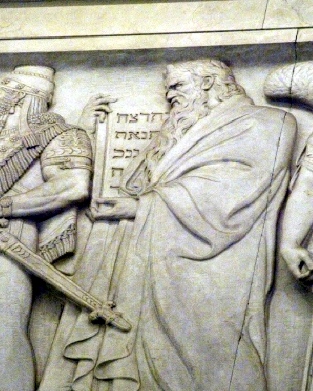
Moses on south frieze of Supreme Court building, by Adolph Weinman

The “Ten Commandments”1 are fundamental precepts, good for all time, right? Well, maybe.

The first four of the ten commandments (which appear in this week’s Torah portion, Yitro, in the book of Exodus, and again in Va-etchanan in the book of Deuteronomy) are religious injunctions. They prohibit having other gods,2 making or worshiping idols, swearing falsely in the name of God,3 and working on the holy seventh day of the week, Shabbat. These four commandments are hardly universal precepts, since they do not apply to people with other religions (including atheism).

The next six commandments, however, are about ethics, i.e. the right way to treat other people:

  1. Honor your father and your mother …
  2. You must not kill.
  3. You must not commit adultery.
  4. You must not steal.
  5. You must not testify falsely.
  6. You must not covet …

Not all of these commandments are easy to interpret outside the context of the social customs of the Ancient Near East.  Does that mean they are morally relative, guides only to correct behavior within the ancient Israelite culture? Or are they nevertheless moral absolutes, still relevant today?

This week’s post examines commandments five and six. Next week, Part 2 will assess commandments seven and eight. The week after that, Part 3 will explore the last two commandments.

*

The Fifth Commandment

Kabeid your father and your mother, so that your days will be long on the earth that God, your God, is giving to you. (Exodus/Shemot 20:12)

kabeid (כַּבֵּד) = honor, treat as important. (From the same root as the adjective kabeid, כַּבֵּד = heavy, weighty, impressive, oppressive, dull, hard.)

According to traditional commentary, if you honor your parents, your children will honor you.4 That means your adult children will make sure you are well fed and housed when you can no longer manage on your own, and therefore you will indeed live longer. (No wonder having children is a top priority in the Torah!)5

Maimonides wrote that in addition to making sure our parents have food, clothing, and shelter, we must be indulgent with them if they have dementia. When adult children can no long bear the strain of tending such a parent, they may hire others to take care of them.6

Honoring one’s parents goes beyond providing for their physical needs in the Torah. Next week’s Torah portion, Mishpatim, assigns the death penalty to the crime of hitting parents, or even speaking ill of them.

And one who strikes his father or his mother shall certainly be put to death. (Exodus 21:15)

And mekaleil his father or his mother shall certainly be put to death. (Exodus 21:17)

mekaleil (מְקַלֵּל) = one who belittles, one who curses.

There is no penalty in the Hebrew bible for a parent hitting or belittling a child. Hitting children in order to discipline them is considered a good deed in the book of Proverbs.7 Elsewhere parents are required to teach their children certain laws and traditions from the Torah,8 but the bible is silent about child abuse or neglect.9

This silence reflects the culture of the Ancient Near East, in which underage children were the property of their fathers and had no rights of their own. In other cultures, child abuse and neglect are considered criminal, and the ethical standard is for parents to treat their children with kindness and respect them as individuals, while still teaching them acceptable behavior in their society.

The fifth commandment implies that we should treat our parents with respect whether they deserve it or not.10 This may be a worthy aspiration, but when parents have seriously abused or neglected children while they were growing up, honoring and taking care of these bad parents could make the lives of their adult children unbearable.

I believe the fifth commandment should not be a universal ethical rule as it stands. I would amend it this way:

Parents must respect their children, and children must respect their parents.

The Sixth Commandment

The Servants of Absalom Killing Amnon, Heinrich Aldegrever, 1540

Lo tirtzach. (Exodus 20:13)

lo tirtzach (לֺא תִרְצָח) = you must not kill without a legal sanction. (From the verb ratzach, רָצַח.)

This commandment is sometimes translated into English as “You shall not kill” and sometimes as “You shall not murder”. Does the Torah distinguish between accidental manslaughter and deliberate murder?

The death penalty is prescribed only for pre-meditated murder in next week’s Torah portion, Mishpatim.

One who strikes down a man so that he dies, he [the one who struck] shall certainly be put to death. [However, if it was] one who did not stalk him, but God let [the one who died] fall by his hand, I will appoint a place for you where he can flee. But if someone plots against his fellow to kill him with cunning, from [even] my altar you shall take him to die. (Exodus 21:12-14)

More specifics are given in the Torah portion Masey in the book of Numbers, which also uses a form of the same verb as in the sixth commandment: ratzach.11 Here God orders the Israelites to set aside six cities of refuge once they have conquered Canaan.

… cities of refuge they shall be for you, and a rotzeiach who struck down a life inadvertently will flee there.” (Numbers 35:11)

rotzeiach (רֺצֵַח) = someone who commits either  premeditated murder or involuntary manslaughter. (The participle form of the verb ratzach).

Then God tells Moses:

But if one struck with an iron implement and [the victim] died, he is a rotzeiach and the rotzeiach must certainly be put to death. … Or [if] in enmity he struck him with his hand and [the victim] died, he shall certainly be put to death. (Numbers 35:16, 35:21)

Someone who kills accidentally can live in exile; someone who kills deliberately (either out of hatred or by using an implement well-known to cause death) gets the death penalty. The executioner, in that case, is the “redeemer of bloodshed”, a designated avenger from the family of the deceased victim. The commandment against killing does not apply to the avenger.

Nor does it apply to soldiers who kill enemies in battle. The Torah never criticizes the Israelites for starting a war, regardless of the reason. Moses only rules (in the Torah portion Shoftim in Deuteronomy) that when the Israelites attack a town outside Canaan merely in order to expand their territory or get some booty, they must first offer the option of “peaceful” surrender.

And if [the town] answers you with peace and opens itself to you, then all the people found inside it will be yours for forced labor, and they must serve you. But if it does not make peace with you, and does battle, and you besiege it, and God places it in your hand, then you shall put all its males to the edge of the sword. However, the women and the little ones and the livestock and everything that is in the town, all its plunder you shall plunder for yourself … However, in the towns of these peoples [Canaanites] which God, your God, is giving you as a hereditary possession, you shall not let a soul live. (Deuteronomy/Devarim 20:11-16)

These two approaches to conquest were considered ethical in the Ancient Near East. But today, an increasing number of people believe that even when a killing is legal, it may not be ethical.

Many people would agree with the commandment lo tirtzach, you must not kill without a legal sanction. But standards have changed for when it should be legal to kill someone. The death penalty is now banned in a majority of countries in the world, and is controversial in the United States.

War, on the other hand, is still an option for every nation. But some acts during war are now considered war crimes, and there is more interest in minimizing the deaths of non-combatants. Most people condone killing in self-defense, whether it is killing an individual who is about to kill you, or fighting a nation that has attacked yours. But is initiating a war justified if the purpose is to defend the citizens of an allied nation, or to defend a principle such as democracy?

A basic moral rule must be brief and express an ethical ideal, even if there are gray and cloudy areas in its application. The sixth commandment, which merely says “You must not ratzach” (You must not kill without a legal sanction) meets this requirement as it stands.

But I believe that too many types of killing have been legal, in both ancient Israelite and modern Western societies. An ethical ideal, in my opinion, would be more restricted. So I would like to propose this amended sixth commandment:

You must not kill except to prevent someone from being killed.

*

Next week I will address what the seventh and eighth commandments mean when they prohibit adultery and theft—then and now.

  1. Exodus 20:1 introduces what we call “the Ten Commandments” in English with “And God spoke all these devarim”. Devarim, דְּבָרִים = words, statements, things. In Deuteronomy, Moses calls the ten “commandments” the devar of God; devar is the singular of devarim.
  2. See my 2011 post Yitro: Not in My Face.
  3. See my 2014 post Yitro: The Power of the Name.
  4. E.g. the Book of Sirach, 3:1-16 (second century B.C.E.)
  5. In first-world countries today, the whole society pays various taxes to take care of its aged population through various taxes. Yet when old people can no longer manage certain tasks themselves, their adult children are still expected to meet some obligations.
  6. Maimonides (12th-century Moses ben Maimon or “Rambam”), Mishneh Torah, book 14, treatise 3, chapter 6:10, as quoted in Edward Hoffman, The Wisdom of Maimonides, Trumpeter, Boston, 2008, p. 114-115.
  7. Proverbs 13:24, 19:18, 22:15, 29:15.
  8. E.g. Exodus 13:8; Deuteronomy 6:6-7 and 11:19.
  9. One father, Jepthah/Yiptach, vows that if God gives him success in battle he will offer to God whatever comes out of his house first when he returns. He is dismayed when his daughter runs out to greet him. But this father is portrayed as foolish, not abusive. He immediately grants her request for a two-month postponement so she can “cry over her virginity”. The cautionary tale ends without clarifying whether Yiptach’s daughter was slaughtered at the altar or given to the local sanctuary. (Judges 11:30-35)
  10. See my 2015 post Yitro: The Heaviness of Honoring Parents. The Book of Sirach adds: Help your father in his old age, and do not grieve him as long as he lives; Even if he is lacking in understanding, show forbearance …”
  11. For more on the words ratzach and rotzeiach, see Marty Lockshin, “Does the Torah Differentiate between Murder and Killing?”, thetorah.com.

Eikev & Judges: Love or Kill the Stranger?

Are foreigners neighbors or enemies?  Should you befriend them or kill them? This week’s Torah portion, Eikev (“on the heels of”), appears to promote both points of view.

Love the stranger

And you must love the geir, for you were geirim in the land of Egypt.  (Deuteronomy/Devarim 10:19)

geir (גֵּר), plural geirim (גֵּרִים) = immigrant, resident alien.  (Not any “stranger”; only a foreigner who has settled down in another country.)

The command to be good to the immigrant appears many times in the Torah.1  In this week’s iteration, Moses warns his people not to act like the Egyptians, who mistreated the multiplying family of Jacob (a.k.a. Israel) when they were resident aliens in Pharaoh’s kingdom.2  He anticipates that after the Israelites have conquered Canaan and settled down, there will be individual immigrants who should be treated with the same fairness and compassion as anyone else in the land.

Kill the stranger

But this ethical rule does not apply to the Canaanites already living in the land the Israelites are about to conquer.  In last week’s Torah portion, Va-etchanan, Moses says:

You must dedicate them to destruction.  You must not cut a treaty with them, and you must not show them mercy.  You must not give them your daughters, nor give their daughters to your sons … because they would turn your children away from [God], and they would serve other gods … Instead … you must tear down their altars and smash their standing stones and cut down their goddess posts and burn their images in fire.  (Deuteronomy 7:2-5)

In the portion Eikev, Moses repeats the call for genocide of the Canaanites.

And you must eat up all the peoples that God, your God, is giving to you.  You must not look at them with compassion.  And you must not serve their gods, because it would be a trap for you.  (Deuteronomy 7:16)

Why?

Why does the God-character tell the Israelites to be kind to new immigrants, but to exterminate the existing population of Canaan?

If the Israelites had succeeded in conquering all of Canaan and killing its whole population, the injunction in Eikev could be viewed as a post-genocide justification: “We had to wipe them out because God told us to”.  But the book of Judges, which opens with an account of territories that the Israelite tribes partially conquered, reports that the original Canaanites continued to live in their midst.3

Therefore the exhortation to exterminate all the Canaanites serves a different purpose: to emphasize that nothing is more important for the Israelites than sticking to their own religion.  This agenda appears in the passages above from both Va-etchanan and Eikev.

The God-character portrayed in the books of Exodus, Numbers, Deuteronomy, Joshua, and 1 Samuel explicitly approves of genocide when the perpetrators are Israelites, and the victims worship a different god and occupy land that God has designated for the Israelites.4 No exceptions are made for infants or atheists.

In the book of Numbers, the land designated for Israelites includes not only Canaan, but also the region on the east bank of the Jordan River.  God helps the Israelites conquer the kingdoms of Cheshbon and Bashan, where two and a half of the twelve tribes will live.

War Against the Midianites, detail, by Balthasar Bernards, ca. 1720-1728

While they are camping at Peor, preparing to cross the Jordan, the Israelites accept invitations from the Midianites there to worship the god of Peor (Baal-Peor).  The God-character is enraged with jealousy, and (after wiping out 24,000 Israelites with a plague), orders the surviving men of Israel to kill all the Midianites around Peor: men, women, and male children.5

In next week’s Torah portion, Shoftim, Moses says that when the Israelites go to war to conquer a town outside the lands God has given them, they must first invite the town to surrender peacefully.  If the town accepts this offer, all its residents can continue to live there, as long as they provide labor for Israelites projects.However,

In the towns of those peoples that God, your God, is giving to you as a permanent possession, you must not let a soul live.  … so that they will not teach you to do all the taboo things that they do for their gods … (Deuteronomy 20:16, 20:18)

Thus the real issue is whether foreigners will help or hamper the Israelites in serving their God.

The Torah promotes friendly assimilation of new immigrants because they can be required to observe some basic Israelite religious practices.  The Torah rules that geirim must refrain from eating leavened bread during the week of Passover,7 refrain from working on the sabbath or Yom Kippur,8 refrain from eating an animal’s blood,9 obey the Israelite sexual prohibitions,10 refrain from giving children to the god Molekh,11 refrain using God’s name in an insult or curse,12 follow the laws of purity after exposure to a human corpse,13 and listen to a reading of the Torah every seven years.14

Immigrants who obey all these rules are not likely to worship other gods openly, or entice Israelites to join them in worship.

Israelite immigrants

But what will the Israelites do when they are the immigrants, a large population settling Canaan by force?  Since they do not wipe out the indigenous peoples, will they start worshiping the local gods the way they did in Peor?

The answer in the book of Judges is a resounding yes.

The Israelites did what was bad in the eyes of God, and they served the be-alim.  And they abandoned God, the God of their forefathers, the one who brought them out of the land of Egypt.  And they went after other gods from among the gods of the peoples who were all around them, and they bowed down to them, and [thus] they offended God.  (Judges 2:11-12)

be-alim (בְּעָלִים) = plural of baal (בַּעַל) = owner; a male Canaanite god.

Canaanite religions seemed to be so enticing that they were hard to resist.15

A different solution

From an ethical point of view, sharing the land of Canaan with its indigenous inhabitants is far better than committing genocide.  Why don’t Moses and the God-character in the Torah find a more ethical way to keep the Israelites from worshiping other gods?

Persuading the Israelites that no other gods exist is not the answer.  Moses tried this earlier in the book of Deuteronomy, saying:

You yourselves have seen for the knowledge that God is the God; there is no other than he alone.  (Deuteronomy 4:35)

But the people are not psychologically ready for monotheism.  Threats do not work either.  The portion Eikev includes two of many statements in the Torah that God will kill the Israelites if they worship other gods:

And it will be if you actually forget God, your God, and you go after other gods and serve them and bow down to them, I call witness against you this day that you will truly perish.  (Deuteronomy 8:19)

Guard yourselves lest your heart deceives you and you desert and serve other gods and bow down to them.  Then God’s anger will heat up against you and shut the heavens, and there will be no rain and the earth will not give its produce, and you will quickly perish from upon the good land that God is giving to you.  (Deuteronomy 11:16-17)

Perhaps at this stage, the Israelites need dazzling visual displays to reinforce their commitment to their religion.  The Canaanites have glittering gold and silver idols.  The Israelites have a single invisible god who only occasionally manifests as a miraculous fire.

The book of Judges points out that the sight of miracles made all the difference.

And the people served God all the days of Joshua and all the days of the elders who came after Joshua, who had seen all the great deeds of God that [God] did for Israel.  (Judges 2:7)

Elijah and King Ahab see divine fire, Zurich Bible, 1531

If the Israelites cannot yet stick to their own God without miracles, an occasional miracle might help to keep the religion going until the people become able to adopt a more sophisticated idea of God.  An example is when Elijah when Elijah sets up two altars, one for God and one for Baal, and asks the people of the northern kingdom of Israel to make their choice.  God sends down fire to consume the offerings, and the Israelites respond by attacking the priests of Baal.16

A miracle in every generation might have kept the Israelites away from Canaanite religion.  At least it would be a better solution than genocide.

Even today many people cannot relate to an invisible, abstract god.  Some people still use icons and other shiny objects to support their religious resolve.  Others still need miracles, and gladly interpret apparent coincidences as the hand of God.  If these religious practices strengthen their commitment to ethical behavior, then they are well worth it.

But a god that sanctions murder is not worth worshiping.  Killing the infidel is a practice that has continued somewhere in the world to this day.  May it cease in our own time.


  1. See my blog post Mishpatim: The Immigrant, including the footnotes.
  2. Moses also makes this point in Exodus 23:9.
  3. Judges 1:21-33.
  4. Divine commands for genocide of seven Canaanite peoples include Exodus 23:28-33, Deuteronomy 7:1-5, 7:16, 7:24, 20:16-18; and Joshua 8:2, 10:40. The God-character commands genocide of the Amalekites in 1 Samuel 15:2-3.
  5. See my posts on “How to Stop a Plague”, Part 1, Part 2, and Part 3.
  6. Deuteronomy 20:10-11.
  7. Exodus 12:19.
  8. Exodus 20:10, 23:12; Leviticus 16:29; Deuteronomy 5:14.
  9. Leviticus 17:10-13.
  10. Leviticus 18:26.
  11. Leviticus 20:3.
  12. Leviticus 24:16.
  13. Numbers 19:10.
  14. Deuteronomy 31:12.
  15. Even in the 6th century B.C.E. people were worshiping “the Queen of Heaven” (Jeremiah 7:18)
  16. 1 Kings 18:20-40.


Lamentations, Va-etchannan, & Vayeishev: The Pit

Dig a deep hole in the ground and you have a pit, a bor in Hebrew.  In the bible you can use it as a dungeon, or line it with cement and use it as a cistern to store water. A bor is also part of the underworld where the souls of the dead go.

Roman Destruction of the Temple in Jerusalem, by Francesco Hayez, 19th century

This Sunday is Tisha B’Av, the annual Jewish day of fasting that commemorates the destruction of Jerusalem and its temple—both the first temple, razed by the Babylonians in 586 B.C.E., and the second temple, razed by the Romans in 70 C.E.  On Tisha B’Av it is customary to read the book of Lamentations/Eykhah, a series of five poems which mourn the fall of Jerusalem to the Babylonian army.

The first poem opens with the word Eykhah (“How can it be?”)1 and expresses the desolation of the ruins of Jerusalem.  The second poem, which also begins Eykhah, calls the destruction “the day of God’s wrath” over the misdeeds of Jerusalem’s people.  The fourth and fifth poems combine the two themes, with emphasis on starvation and being at the mercy of the enemy.

The third poem, however, reads like one of the personal psalms in which the ancient poets feel as if they are near death, and plead with God to bring them back to life and take vengeance against their enemies.2  Only in verse 40 does the third poem of Lamentations switch from “I” to “we”, urging all the people of Jerusalem to plead with God for forgiveness and rescue.

     Let us check on our ways and cross-examine [ourselves], and turn back to God!  (Lamentations 3:40)3

The first person singular returns with:

     Streams of water go down from my eyes over the shattering of my people.  (Lamentations 3:48)

Shortly after that, the narrator, identifying with Jerusalem, claims that the Babylonians did not actually need the city.

     My enemies actually hunted me like a bird, for no reason.

     They silenced my life in the bor, and in their hand was a stone against me.

     The waters rose over my head.  I thought: “I am ended!”

     I called your name, God, from the bottom of the bor.

     May you hear my voice!  Do not shut your ear to my spirit, to my cry for help!  (Lamentations 3:52-56)

bor (בּוֹר) = a pit; a cistern, a dungeon, a synonym for Sheol.

Here the bor is not a physical cistern or dungeon, but a poetic image for Sheol, the underworld of the souls of the dead.  Bor is used at least 21 times in the Hebrew Bible to indicate either Sheol or the lowest region of Sheol, but this is the only such reference that includes water.  Souls never drown after they are dead in ancient Hebrew mythology.  Thus the narrator of this poem is not dead, but despairing of life.  The poet uses the images of both stone and water, comparing the bor of Sheol to a cistern filling up with water.

The narrator, like all the citizens of defeated Jerusalem, is trapped—unable to float to the surface and escape.

A full cistern

Next week Jews read from Va-etchanan (“And I implored”), the second Torah portion of the book of Deuteronomy/Devarim.  In this portion cisterns are listed as assets that the Israelites will enjoy once they conquer the land of Canaan:

… cities big and good that you did not build, and houses filled with everything good that you did not fill, excavated borot that you did not excavate, vineyards and olive groves that you did not plant.  And you will eat and you will be satisfied.  [Then] take heed, lest you forget God who brought you out from the land of Egypt, from the house of slavery.  (Deuteronomy 6:10-12)

borot (בֺּרוֹת) = plural of bor.

How lovely to move into a land already dotted with cisterns that collect and store water for the dry season!  Moses reminds his people not to take the cisterns for granted, since they did not excavate them.  Canaanites dug them, and the Israelites will conquer Canaan only with God’s help.4

The books of Exodus through Joshua treat the conquest of Canaan as an unmitigated good, since it results in fertile land for the Israelites, not to mention pre-existing amenities such as cities, houses, and cisterns.  The bible does not consider the Canaanite point of view.

But I can imagine poets from the various conquered peoples of Canaan writing laments after the Israelites besiege and loot their cities, destroy their temples, and kill many of their people.  The conquest of Canaan by the Israelites under Joshua is the same story as the conquest of Judah by the Babylonians under Nebuchadnezzar; only the names and dates change.

An empty cistern

Cisterns holding water are mentioned twelve times in the Hebrew Bible.  Dry cisterns and dry pits are mentioned at least 31 times.  They serve as hiding places,5 a warrior throws bodies of the slain into them,6 and large animals fall in.7  Psalm 7:16 refers to a man falling into a pit he dug himself, a fine image of being caught in your own trap.8

Since the walls of an empty cistern are covered with cement, they do not provide handholds for a human to climb out.  The only escape is for someone at the top to throw you a rope.

At least thirteen times the bible mentions a dry bor, it was  excavated to serve as a dungeon.  Five times in Genesis, in the portion Vayeishev (“And he settled”), the bor is an empty cistern that Joseph’s older brothers use as an ad-hoc prison.

They see Joseph coming up the road to check on them, and they know he will give a negative report to their father, as usual.

Joseph pulled up from the pit, by James J.J. Tissot

And they said, each man to his brother: “Hey!  Here comes the master of dreams!  And now let’s go murder him, and let’s throw him into one of the borot, and we can say a wicked beast ate him.  Then we’ll see what happens to his dreams!”    And Reuben said to them: “Don’t shed blood!  Throw him into this bor that is in the wilderness, but don’t lay a hand on him!”—in order to rescue him from their hand and return him to his father.  And it happened when Joseph came up to his brothers.  They stripped his tunic off Joseph, the fancy tunic that he had on, and they took him and threw him into the bor.  And there was no water; the bor was empty. (Genesis 37:20-24)

It would take about two weeks for a healthy adolescent like Joseph to die of dehydration at the bottom of the pit, less if there were no shade.  Before Reuben can return with a rope to rescue him, Judah sells Joseph to a caravan.  The traders pull him up out of the bor and take him to Egypt as a slave.


A deep hole in the ground is beneficial when it becomes a cistern full of water, or the basement of a building.9  But when it is used as a dungeon, the captive will die unless given food and water.  A prisoner in a dungeon can hope for a reprieve or a rescue, but if the bor is Sheol you can only be saved if God heeds your prayer as you go down.  There is no life after death in that bor; at best the disembodied souls lie in eternal sleep.10

Today, when we are depressed we feel “down”, trapped in a mysterious place without life or meaning.  In English we call it “a pit of despair”.

May everyone who sinks into a pit find a way to cry out for help and be rescued, whether the rescuer is a fellow human being or the voice of God within.


  1. See my post Devarim, Isaiah, & Lamentations: Desperation.
  2. g. Psalms 28, 30 and 88, all of which mention bor as a synonym for Sheol.
  3. Since the poem is an acrostic, verse 40 must begin with the letter nun, נ. When the prefix nun is attached to verbs in the perfect tense, it indicates the second person plural.  However, the prefix nun can also be used to indicate the simple passive (nifal) verb stem, and there are many other words that begin with a nun, so switching to the second person plural for a word beginning with nun is a deliberate choice on the part of the poet.
  4. See my post Eikev, Va-etchannan, & Noach: Who Built It?
  5. 1 Samuel 13:6, 1 Chronicles 11:17-18, and Proverbs 28:17.
  6. Jeremiah 41:7-9 and 1 Chronicles 11:17-18.
  7. Exodus 21:33-34, 2 Samuel 23:20, and 1 Chronicles 11:22.
  8. Psalm 7:16.
  9. The word bor is not used for a basement in the bible; the substructure of a building is called a yesod (יְסוֹד) = foundation, base.
  10. Unless they are disturbed by a diviner such as the witch of Endor, who summons the ghost of Samuel to speak briefly with King Saul in 1 Samuel 28:7-20.