Pesach: The Matzah of Misery

“This is the bread of affliction,” we intone during the Passover/Pesach ritual, holding up a piece of matzah. Many Jews feel that just eating this dry unleavened cracker is an affliction—especially if they eat it for the prescribed eight days and eschew real bread, or anything else made with yeast or other leavening.

matzah001

At a traditional Passover seder, we hold up the matzah and say in Aramaic: Ha lachma anya di akhalu avhatana be-ara demitzrayim!  which means: “The bread of misery that our ancestors ate in the land of Egypt!” This phrase is based on one of the Torah portions we read during the week of Passover, Deuteronomy /Devarim 14:22-16:17.

You must not eat with [the meat from the animal sacrifice] anything leavened. Seven days you shall eat with it matzot, the bread of oni, because in haste you went out from the land of Egypt. Thus you shall remember the day of your going out from the land of Egypt all the days of your life. (Deuteronomy/Devarim 16:3)

matzot (מַצּוֹת) = plural of matzah (מַצָּה) = unleavened flatbread made of flour and water only, quickly mixed and baked before any sourdough in the air can act on it.

oni (עֳנִי or עֹנִי) = misery, suffering, humiliation, plight, deprivation. (This noun comes from one of the four root verbs spelled ענה, this one meaning “to stoop down in humiliation, humility, or subjection”.)

The noun oni appears 37 times in the Hebrew Bible, although the passage above is the only one mentioning “bread of oni”. Individuals in the Bible experience oni, misery, because they are unloved, infertile, abused, or deprived of their due. The poor live in a state of oni because they are victimized by a selfish upper class. The Israelites live in oni because they have been conquered by enemy armies—or because they are abused slaves, as in the Passover story.

Kneading bowl in the Egyptian royal bakery
Kneading bowl in Egypt

Why is matzah the bread of oni? The book of Exodus claims that the enslaved Hebrews had to hurry out of Egypt before the dough in their kneading-bowls had time to rise. I find this unconvincing. (See my post Pesach: Being Unleavened, Part 2.)

I think the oni, the misery, came first, and the matzah symbolizes it. Matzah, made out of flour and water paste with nothing interesting added, not even sourdough, serves to remind us of the tedious life of slaves making bricks for Pharaoh.

Matzah, the “bread of oni”, can also remind us of times in the Bible when people live in misery and God sees their oni, stops ignoring them, and acts to improve their situation. I counted 13 occurrences of this motif, as well as additional occasions when God acts after hearing people cry out in their oni.

For example, God tells Moses at the burning bush:

I certainly see the oni of my people who are in Egypt, and I have paid attention to their cry for help in the face of their being hard-pressed, for I know their anguish. … And I have said I will lift them out from the oni of Egypt, to the land of the Canaanites…to a land flowing with milk and honey. (Exodus 3:7, 3:17)
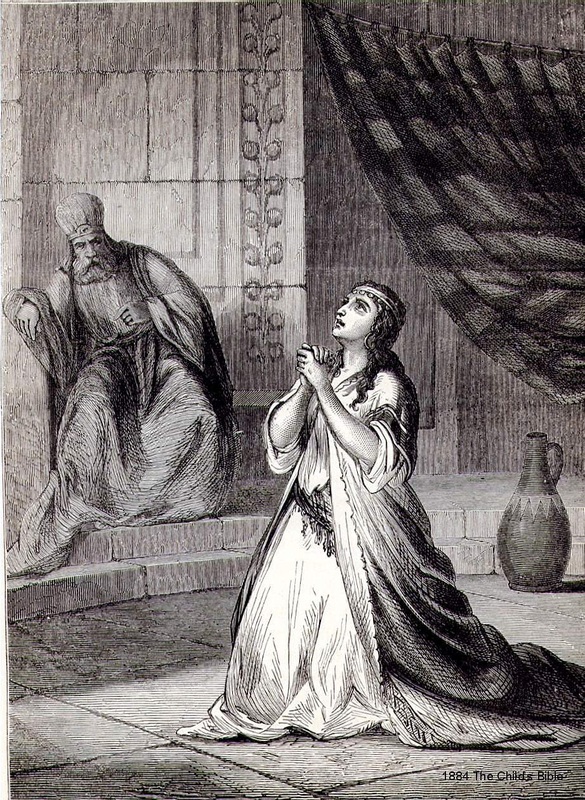
Channah in the Child's Bible 1884
Channah in the Child’s Bible 1884

Sometimes people draw God’s attention to their own oni, hoping that God will then notice it, stop ignoring them, and act. For example, Channah suffers because she is infertile and verbally abused by her husband’s other wife, who has many children.

And she vowed a vow, and she said: God of Armies, if you will really look at the oni of your female-servant, and you remember me and do not ignore me, and you give your female-servant a male child, then I will give him to God for all the days of his life… (1 Samuel 1:11)

The psalms also include pleas to God to notice the singer’s misery and act. For example,

See my oni and my misfortune

And lift off all my wrongdoing. (Psalm 25:18)

May I sing out and may I rejoice in your kindness

Because you see my oni and you know the distress of my soul. (Psalm 31:8)

See my oni and save me

Because your teaching I have not ignored. (Psalm 119:153)

matzah001

Maybe Jews began holding up matzah during the Passover ritual not just to remind themselves of times of deprivation, but also to draw God’s attention to their own oni. To make sure God gets the point, we call the matzah the “bread of oni”. If God sees our misery, pays attention to it, then maybe God will stop ignoring us and do something to improve our lives—the way God freed the slaves in Egypt.

What is your oni this year? What misery is enslaving you? Is it something that you can fix?  Or something that will lift by itself?

Or is it something that you can only be freed from by a divine intervention? If so, what would a true divine intervention be?


Re-eih: Releasing Your Hand

by Melissa Carpenter, Maggidah

Nevertheless, there should not be among you evyon; because God will truly bless you in the land that God, your god, is giving to you to possess as a hereditary holding—but only if you truly pay attention to the voice of God, your god, to be careful to do this entire commandment that I Myself command you today. (Deuteronomy/Devarim 15:4-5) 

Beggar, by Rembrandt van Rijn
Beggar,
by Rembrandt van Rijn

evyon (אֶבְיוֹן) = paupers, needy, destitute, those with no means to make a living.

This week’s Torah portion, Re-eih (“See!”) claims that the land of Canaan is fertile enough so that none of its residents need be paupers—as long as the Israelites share their wealth according to God’s instructions.

The portion gives directions for several ways to reduce poverty. First, Re-eih calls for landowners to tithe for six years out of a seven-year cycle. The tithe—a tenth of the landowner’s produce—is designated for several different purposes. A third of the annual tithe (or perhaps the whole tithe every three years) is given to the poor in the landowner’s town, specifically to landless resident aliens, orphans, and widows.

In the seventh year of the cycle, all farmland lies fallow, and whatever food grows naturally is available to everyone. This week’s Torah portion also calls  for the release of debts in the seventh year.

At the end of seven years you shall  make a shmittah. And this is the matter of the shmittah: everyone who  has  handed out a loan shamot the loan to his fellow. He  shall not press his fellow or his brother, for a shmittah has been proclaimed for the sake of God. (Deuteronomy 15:1-2)

shmittah (שְׁמִטָּה) = release;  remission of debt.

shamot (שָׁמפּט) = releases.

In other words, borrowers who are simply too poor to repay their debts on time are freed from the obligation. They are no longer dunned by their creditors or burdened by guilt.

The Torah warns people to continue to make loans to the poor, even if it is getting close to the end of the seventh year. It assumes that we feel a natural sympathy for paupers, but sometimes check that feeling with second thoughts.

When there is among you an evyon from one of your brothers within one of your gates in your land that God, your god, is giving to you, you shall not harden your heart and you shall not shut your hand to your brother the evyon. Rather, you shall truly open your hand to him, and you shall truly lend him what he lacks, so that it shall not be lacking for him. (Deuteronomy 15:7-8)

At this point, the Torah has progressed from the artificial mechanisms of tithing and the release of debt every seven years to simply giving the poor in your town what they need whenever they need it.

A token donation is not enough. “…you shall truly lend him what he lacks” had been interpreted to mean  not only food, but also anything from a kind word to the tools, training, and starter loan to take up a trade.

The passage in this week’s Torah portion  concludes:

Because the evyon will not cease from the midst of the land, therefore I myself command you, saying: Truly open your hand to your brother, to your oni, and to your  evyon in your land! (Deuteronomy 15:11)

oni (עָנִי) = the poor, the wretched, the  unfortunate, the humble.

This week’s Torah portion first says “there  should not be among you evyon”, then later acknowledges that since not everyone is generous enough, “the evyon will not cease from the midst of the land”.

giving b-w

Today we still have evyon, paupers who are unable to earn a living and depend entirely on charity, and oni, people who have become poor because of bad luck. If the products of our planet were distributed evenly, everyone would have enough food and shelter. But the governments of the world still are not generous enough. And individuals with means still are not generous enough.

How often have you had an impulse to give to an unfortunate person, and then hardened your heart by deciding that this person did not deserve your money?

How often have you passed a beggar without opening your hand—either because you were saving those dollars for a latte, or because the beggar looked, smelled, or behaved like someone who might be unpleasant or dangerous?

I am cultivating a practice of opening my hand and giving a dollar to every beggar I pass, regardless of the judgments that pop up in my mind. I also donate a dollar to the county food share program every  time I buy groceries at the store that handles donations. I pay dues to my congregation, which provides the space for many people (including me) to serve as the equivalent of Levites. I pay taxes, of which a small percentage goes to programs that help the poor.

Yet I pass up countless other opportunities to donate to charities and good causes. (Even as I was writing this, a canvasser knocked on my door and I did not answer.) I do not have the time, I tell myself, I do not have the money. And how can I tell whether responding to this particular appeal would do any real good?

This week’s Torah portion says to make loans and gifts to the poor within your gates, the ones whom you encounter in your own life. That sounds reasonable, since you are more likely to know “what they truly lack”.

Yet I wonder what I should give to the people I know who are too handicapped to earn a living and who are not supported by their families. I do not have enough emotional strength to act as their friend or substitute family member, which is “what they truly lack”. So I settle for giving a token—a cookie, a ride, a smile—until the person becomes too difficult  and demanding.  Then I harden my heart and close my hand.

I would rather pay extra taxes for social programs.

A passage in  the book of Proverbs that describes the virtues the eshet chayil or “woman of valor” includes this couplet:

Her palm spreads open to the poor

And her hands stretch  out to the evyon. (Proverbs 31:20)

I am not a “woman of valor”. I am not strong enough to open my hands to all the evyon within my gates. I do not understand how to be an eshet chayil.

If you have suggestions, please reply to this post!

Pesach:  Being Unleavened, Part 2

by Melissa Carpenter, maggidah

In the Hebrew Bible, Passover appears to be a conflation of three holidays:

* chag ha-aviv (“festival of the new ears of grain”), a one-day celebration of spring on the 15th of the month that was called Aviv until the Babylonian exile in the sixth century B.C.E, then renamed Nissan. (See Leviticus 2:14.)

lamb 2

* chag ha-matzot (“festival of the unleavened bread”), a seven-day period of refraining from eating, or owning, any leavened food.  This period fell at the beginning of the barley harvest in the spring. (See Exodus 23:15, 34:18.)

* pesach (“skipping over”), a one-day observance in Aviv, in which a lamb or goat kid was sacrificed, and the meat was roasted and eaten in one night.

Some modern scholars speculate that the Torah combines an ancient festival of matzot (when farmers cleared out their old grain products in preparation for the new grain) with an ancient festival of pesach (when shepherds celebrated the spring lambing by sacrificing a lamb and performing a skipping dance)—and then incorporates both spring holidays in the story of the exodus from Egypt.

Thus the special Torah reading for the first day of Passover, Exodus 12:21-51 (in the Torah portion Bo), begins with Moses’ instructions to the Israelites for the night of the tenth and final plague in Egypt: the death of the firstborn.  Each family must slaughter a lamb as a pesach offering, paint the blood on the lintel and doorposts of its home, and stay indoors all night, eating the roasted meat, while God “skips over” the marked houses and kills only the firstborn children of the Egyptians. The Torah adds that the Israelites shall continue to re-enact this ritual every spring.

Then, after describing the final plague and Pharaoh’s command that the Israelites leave at once, the Torah says:

The people picked up their dough before it could become chameitz, their kneading-troughs wrapped up in their cloaks upon their shoulders. …And the Children of Israel journeyed from Ramses to Sukkot… And they baked the dough that they had taken from Mitzrayim in rounds of matzot, because it was not chameitz, because they were banished from Mitzrayim and they could not delay, and they had not even prepared provisions for themselves. (Exodus 12:34, 37, 39)

chameitz (חָמֵץ) = leavened bread, leavened food.

Mitzrayim (מִצְרַיִם) = Egypt.  The dual form —ayim (ַיִם) probably refers to the combined kingdoms of Upper and Lower Egypt. The first three letters, מצר, might be related to the word meitzar (מֵצַר) = narrow strait, constriction, confinement, bondage.

Egyptian kneading trough

I have always found the above explanation of the festival of matzot unconvincing.  If the Israelites normally made leavened bread in Egypt, then they would always have a jar of sourdough starter bubbling in the house.  Why not bring that jar along with a kneading-trough and flour?  The story in the book of Exodus smacks of a post-hoc, invented rationale.

Nevertheless, one of the special Torah readings for intermediate days of the week of Passover, Exodus 13:1-16 (also in the Torah portion Bo), makes the festival of matzot an essential part of the observance of Passover:

Moses said to the people: Remember this day on which you went out from Egypt, from the house of slavery.  For with a strong hand God brought you out from this, and you shall not eat chameitz.  Today you are leaving, in the month of Aviv… and it will happen when God brings you into the land…then you shall serve this service in this month.  Seven days you shall eat matzot, and on the seventh day [will be] a festival for God. Matzot shall be eaten these seven days, and chameitz must not be seen with you, and se-or must not be seen with you in all your borders. And you shall tell your child on that day, saying:  Because of this, God acted for me when I went out from Egypt. (Exodus 13:3-8)

se-or (שְׂאֹר) = sourdough starter; any leavening agent.

Throughout history, religions have connected their new holidays to pre-existing holidays.  Sometimes the only real connection between the new and old holiday seems to be the time of year.  Spring is certainly a good time of year to celebrate both the promise of new grain and the concept of liberation.

But the connection between the festival of matzot and the story of liberation from Egypt may be deeper than that.

In last week’s post, Tzav & Pesach: Being Unleavened, Part 1, I wrote about the symbolic meanings of matzot and chameitz proposed by Philo of Alexandria in the first century C.E. and by Rabbi Raphael Samson Hirsch in the 19th century.

Philo considered how leaven makes bread rise and puff up, like an arrogant person.  He wrote that eating matzot is a reminder of our humility before God.

Hirsch wrote that chameitz is the bread of independence, and matzot the bread of dependence.  Among other arguments, he cited a verse from the special Torah reading for the eighth day of Passover, Deuteronomy 15:19-16:17 (in the Torah portion Re-eih):

Seven days you shall eat matzot, the bread of oni, because in hurried flight you went out from the land of Egypt—so that you shall remember the day of your exodus from the land of Egypt all the days of your life. (Deuteronomy/Devarim 16:3)

oni (עֹנִי) = misery, wretchedness; a state of dependence due to poverty.

By eating matzot in remembrance of our deliverance from slavery, Hirsch argued, we acknowledge that we did not escape from poverty and oppression by our own actions, but only because of God’s actions: the ten plagues or miracles, and the warnings God communicated through Moses.  We rose to the independence represented by chameitz only because God lifted us out of Egypt.

That is as far as Hirsch went.  But I wonder:  Does leaven itself represent one aspect the divine?  What if God is the fermentation in our souls, and in the world, which leads to liberation and expansion?

During Passover we might acknowledge that without the divine spark, we would be as flat as matzah.  We could not escape from Egypt, Mitzrayim, or the constrictions in our own souls. We would be slaves to our genetic predispositions and to all the psychological complexes we have acquired during our lives.

But if the divine spark in our souls bubbles up like the se-or that bubbles up and makes bread rise, and we are inspired with an insight, then we can make different decisions. With a holy insight, we can push open some of the narrow places in our psyches, and expand into a new life of more freedom and independence.

But we cannot change from matzot into chameitz through sheer willpower. It takes a touch of leavening, and that is a gift from God.

matzah001

The festival called Chag ha-Matzot, Pesach, or in English, Passover, lasts for seven days in Israel.  By Jewish tradition, Passover lasts for eight days outside of Israel (to make sure that those who live far away will be observing Passover during all of Israel’s seven days). This year in the diaspora, Passover begins on a Friday evening and ends on a Saturday evening the following week.  That means we will study the special Torah portions for Passover—including the ones in this blog post—for two weeks.

So it will be two weeks before I return to the annual cycle of Torah portions, and post my new thoughts on Shemini, the next Torah portion in the book of Leviticus.

May all my Jewish readers have a happy Passover! And may some divine insight bubble up in everyone during this change of seasons.

Re-eih: Recipe for Joy

Sometimes joy comes unexpectedly. But sometimes we plan to rejoice on a particular occasion, acting with joy and thus inducing a feeling of joy. This week’s Torah portion, Re-eih (“See!”), says that three times a year, everyone should rejoice.

Universal joy is required during the three annual pilgrimage festivals, Pesach, Shavuot, and Sukkot.  Although the Torah gives instructions for these three festivals in the earlier books of the Torah, this portion in the book of Deuteronomy/Devarim is the first one that mandates a pilgrimage to the central sanctuary even for Pesach.

Three times in the year all your males shall appear in the presence of God, your god, in the place that [God] will choose: on the festival of the matzot and on the festival of the shavuot and on the festival of the sukkot (Deuteronomy/Devarim 16:16) 

matzot (מַצּוֹת) = unleavened bread. (This spring festival is part of Pesach or Passover.)

shavuot (שָׁבֻעוֹת) = weeks. (This summer festival occurs after counting seven weeks of the barley harvest, and includes bringing the first fruits and loaves of leavened bread to the priests at the sanctuary.)

Barley
Barley

sukkot (סֻכּוֹת) = huts, temporary shelters. (In Exodus this autumn festival is called the festival of the asif, “ingathering”, and pilgrims donate products from their threshing-floors and wine-presses. Leviticus adds the rituals of dwelling in temporary huts for seven days.)

…and they shall not appear in front of God empty-handed; each man [shall give] according to the giving-capacity of his hand, according to the blessing that God, your god, has given to you. (Deuteronomy/Devarim 16:16-17)

Only Israelite men are required to make the three pilgrimages to the central sanctuary (which was in Shiloh for about 370 years, and Jerusalem for about 1,000 years).  But this week’s portion also encourages women, children, and slaves to go, while recognizing that the journey may not be possible for pregnant or nursing women. Each head of a household must bring the second tithe (a donation for the priests and the temple administration), and a sacrificial animal for God. But the donations must be in proportion to the family’s wealth, so nobody’s joy is dampened by having to give more than they can afford.

Pilgrimage for Sukkot

In the Torah’s previous instructions regarding the three festivals, rejoicing is mentioned only once, when Leviticus 23:40 says to take branches from four species of trees and rejoice for the seven days of Sukkot.

But in this week’s Torah portion, rejoicing is called for three times, once in the instructions for Shavuot and twice in the instructions for Sukkot.

(Although this Torah portion does not specifically mention rejoicing during Pesach, later passages in Ezra and Chronicles 2 mention rejoicing in Jerusalem during this festival.)

The requirement for rejoicing in the portion Re-eih includes the Levite, stranger, orphan, and widow, who were not mentioned in any of the earlier instructions on the three festivals. During Shavuot, the Torah portion says:

Rejoice in the presence of God, your god—you and your son and your daughter and your man-servant and your woman-servant, and the Levite who is within your gates, and the foreigner and the orphan and the widow … (Deuteronomy 16:11)

And during Sukkot:

Rejoice in your festival, you and your son and your daughter and your man-servant and your woman-servant, and the Levite and the foreigner and the orphan and the widow who are within your gates. Seven days you shall celebrate a festival for God, your god, in the place that [God] will choose, because God, your god, will have blessed you in all that comes to you and in all the doings of your hands, and there will be for you only joy. (16:14-15)

Feeling joy might be easy for the landowner who brings his offerings to the sanctuary, since he gives in proportion to his means, and he is celebrating that God blessed his agricultural endeavors with success.

But when the Torah addresses this landowner, it informs him that his family and his servants or slaves must also feel joy during the festivals. Furthermore, the Torah gives examples of four classes of people who are unlikely to own land or other independent means in a society built around inheritance through the male line: the Levites, whose pasture land is restricted and depend on donations; foreigners, who can lease but not inherit estates; orphans who have no fathers to provide for them; and widows, who are dependent on the mercy of relatives unless they have wealthy sons.  The Torah says that all of the disadvantaged people who live in the landowner’s town or village must also rejoice during the three festivals. Their joy becomes the landowner’s responsibility.

What can he do for them? According to the commentary of 19th-century rabbi Samson Raphael Hirsch, he must arrange for those who cannot travel to rejoice at home.  Everyone who can travel must come with him to the central sanctuary, to experience the joy of celebrating in the national community, whose people are dedicated to one god, and to one another.

Hirsch added that these festivals are also times that God appointed to meet the people at God’s sanctuary. The awareness of God’s presence, he wrote, brings the purest joy.

In the 11th century, Rashi (Rabbi Shlomo Yitzchaki) wrote that the phrase I translate above as “there will be for you only joy” means that if you bring everyone to God’s chosen place for a festival, God promises you will be happy.

I have observed this effect in my own life. Occasionally happiness lifts me when I am alone; more often it comes when I am with my beloved. But when I am singing with my congregation at services, my heart almost always rises. The only times this communal singing does not bring me joy are when someone in the group looks angry or miserable.

The unhappy people are like the poor foreigners in the Torah, alienated from the community where they live. Sometimes these “foreigners” cannot come to the place where God is; they are unable to travel spiritually. Then those of us who have greater means, like the landowners in the Torah, must make arrangements to help them rejoice in the spiritual state where they are.

Other times, the unhappy “foreigners” are able to travel, if we carry them with us. The Torah tells us not to neglect them, but to bring them to God’s place to celebrate with us.

Then “there will be only joy”. Complete joy happens only when everybody contributes, and nobody gets left out.

Re-eih: The Right Place

The first four books of the Torah describe two kinds of encounters with God. One is having a conversation with God, or God’s “angel”. The other is going through a ritual to rededicate yourself to God. The ritual of choice was the animal sacrifice.

In the book of Genesis/Bereishit, Abraham, Isaac, and Jacob built altars for animal sacrifices in several places: Shekhem, Mount Moriyah (said to be the site of Jerusalem), Beersheva, Hebron/Chevron, Beit-El, and a spot between Beit-El and Aiy (probably the site later named Shiloh). Modern scholars have established that these places were also sites for Canaanite religious ritual. Perhaps they struck people as particularly good spots for numinous experiences.

In the book of Exodus/Shemot, Moses built an altar at the site of the Israelites’ first battle, in which they defeated Amalek; and his father-in-law carried out an animal sacrifice at the foot of Mount Sinai. But when Moses spent his first 40 days at the top of  Mount Sinai, God gave him lengthy instructions for building a portable sanctuary as a dwelling place (mishkan) for God, with the ark in the innermost chamber, and the altar for animal and grain offerings in the outer enclosure. This sanctuary could be dismantled, moved, and re-erected, so once the Israelites had made all the parts, they did their ritual offerings only at its altar, no matter where they were camping in the wilderness. The priests—at this point, Aaron and his sons—became necessary for all rituals.

But what would happen after the Israelites entered Canaan and settled down in scattered villages and towns? Would the head of every household build his own altar and lead his own rituals again?

The book of Deuteronomy/Devarim says no in this week’s Torah portion, Re-eih (“See!”). The first step is to banish any possibility of worshiping the God of Israel at any Canaanite religious sites.

You must utterly obliterate every makom where the nations that you are dispossessing serve their gods: upon the mountains, the high places, and upon the hills, and under every luxuriant tree. You must break up their altars and shatter their standing-stones and burn their tree-goddesses in fire and chop down the statues of their gods; and you must obliterate their sheim from that makom. (Deuteronomy/Devarim 12:2-3)

makom (מָקוֹם) = place; sacred place; religious site.

sheim (שְׁמָם) = name, reputation, standing.

Moses has told the Israelites many times to destroy all the religious items of the natives when they conquer Canaan. Now he also tells them to obliterate the places themselves. No longer can a Canaanite site be used to make offerings to the God of Israel.

You must not do thus for God, your god. Rather, you must seek out and come to the makom which God, your god, chooses out of all your tribes [tribal territories] to set Its sheim there, for it to dwell in. (Deuteronomy 12:4-5)

It will be the makom that God, your god, will choose for the dwelling of Its sheim. There you shall bring everything that I command you: your elevation-offerings and your slaughter-offerings and your tithes and the donation of your hands and all your choice vow-offerings that you vow to God. And you shall rejoice before God, your god, you and your sons and your daughters and your manservants and your maidservants … (Deuteronomy 12:11-12)

God Itself will not dwell in the single chosen place, only God’s name. This abstraction distinguishes the Israelite religion from the Canaanite belief that gods can inhabit wood and stone images.

Deuteronomy never says which place God will choose. Judging by the rest of the Hebrew Bible,  the Children of Israel alternated between short periods when there was no single makom and people constructed other altars at will; and long periods when all offerings were brought to a central sanctuary where priests conducted the rituals.

For the first 14 years after the Israelites cross the Jordan in the book of Joshua, the portable sanctuary with its altar and ark stayed in Gilgal, and the Israelites were free to set up their own altars to God elsewhere. Then Joshua assembled everyone to erect the portable sanctuary at Shiloh (possibly on the site of one of Abraham’s altars), in the territory of the northern tribe of Efrayim. Over time the sanctuary acquired stone walls and wooden doors, though its roof remained a tent woven out of goat-hair.

For 369 years Shiloh was one and only place to bring offerings. Its last high priest was Eli, who died when the city fell to the Philistines in the first book of Samuel. The Philistine army captured the ark, then returned it to Israelite territory seven months later. While the ark was kept in a private house in the Israelite town of Kiryat-Ye-arim, there were national altars in Nov and Giveon, but for 57 years individuals are allowed to build their own altars as well. Individual altars were prohibited again only after King Solomon built the temple in Jerusalem and put the official altar and the ark in the same enclosure once more.

This week’s Torah portion describes the three pilgrimage festivals, Pesach, Shavuot, and Sukkot, when everyone must travel to the central place of worship to make offerings, pay tithes, feast, and celebrate. Since the Israelites are settled all over the former land of Canaan, the journey to Shiloh or Jerusalem takes from one to several days for most people.

Re-eih gives no instructions for what a man should do in between festivals if he wants to ritually rededicate himself to God because he has done something wrong, or because he is full of gratitude and generosity, or because he just wants to be closer to God. Should he travel all the way to the temple? Or is there another way?

The modern biblical scholar James Kugel argues that Deuteronomy promotes serving God by obeying all the laws passed down by Moses, instead of by making offerings at an altar. Being conscientious about obeying all of God’s laws will naturally lead people to be loyal to God and cling to God with love.

After the fall of the second temple in Jerusalem in 70 CE, Rabbinic Judaism substituted prayer for offerings at an altar. But they continued to emphasize the importance of following both the rules in the Torah and the additional rules determined by the rabbis in the Talmud.

Today, many Jews (including myself) pick and choose which of the rules are really important and worth following. When we want to rededicate ourselves to God, we either go through a ritual with our own congregation, or we pray passionately, hoping to make a connection. Unless we are in Jerusalem, the idea of traveling to a single holy place for all our religious rituals can seem irrelevant and outdated.

Yet the 19th-century Chassidic rabbi Yehudah Leib Alter of Ger wrote in Sefat Emet that “darash  and come to the makom” means we should seek out the places, times, and souls in which holiness is revealed. They are where we can find God, and rededicate ourselves to holiness.

I believe an important caveat to this approach is that we must not unthinkingly adopt the holy places of others. Each individual must inquire whether a place, a community, a ritual, or even a time, is truly holy enough to succeed in reconnecting them with God, rededicating themselves to God. If something is lacking, the individual must keep on seeking for the makom where God’s name dwells.

This means there are multiple holy places—but I believe individual “altars” are not enough; a human being who yearns for the divine also needs a central place of worship. A numinous spot out in the woods can be a makom for silent connection between an individual and the divine. Yet in order to sustain our dedication to God and to the path of becoming holy, we need to find a makom in a community, with set times for prayer and ritual.

It may take a long journey to get there.

Re-eih: Two Paths

Moses opens this week’s Torah portion, Re-eih (“See”), by giving a choice to the Israelites camped at the Jordan River, waiting to cross over into Canaan.

See, I am setting before you today a blessing and a curse. The blessing: asher you listen to the commandments of God, your god, that I command you today. And the curse: im you do not listen to the commandments of  God, your god, and you rebel from the path that I command you today, to walk after other gods that you did not know.  (Deuteronomy/Devarim 11:26-28)

asher (אֲשֶׁר) = that, which, whom

im (אִם) = if.

The Torah does not say here what material results will come from God’s blessing or God’s curse. But results can be inferred, either by looking at a parallel passage in the book of Leviticus/Vayikra, or by paying attention to several words in the passage above that are usually unimportant, and often mistranslated.

First let’s compare the warning in this week’s Torah portion with the two alternatives presented in Leviticus.  

Im you follow my decrees and observe my commandments and do them … (Leviticus/Vayikra 26:3)

Then God will make it rain in the right seasons, so you (plural) will have abundant crops and eat your fill; God will grant peace in your land, keeping away both vicious beasts and swords; God will give you many offspring; and God will always be present in your midst.

But im you do not listen to me and you to do not do all these commandments … (Leviticus 26:14) 

God continues, then God will afflict you with diseases, and crop failure, and wild beasts that kill your children and livestock, and enemies with swords who besiege you until you commit cannibalism and starve to death.

Words for blessing and curse are absent from the passage in Leviticus, but elsewhere in the Torah the word brakhah (“blessing”) implies an increase in fertility, health, and prosperity–as indicated in the list of results for following God’s decrees and commandments in Leviticus. The word for “curse” used in this week’s Torah portion, kelalah, implies diminishment in status and power, as well as disgrace and falling into a lower state of being. These conditions do seem to be graphically illustrated in the results given in Leviticus for disobeying God’s commandments.

Furthermore, obeying God’s commandments is what makes the difference in both the passage in Leviticus and the one in Deuteronomy this week. So it would be reasonable to assume that the two alternatives in Leviticus represent the results of God’s blessing and God’s curse.

Yet some Torah commentary draws a different conclusion, based on the words asher (“that”) and im (“if”).

In Leviticus, both the good result and the bad result are introduced by “if”; if you people obey God, then you will be collectively rewarded in life; if you people do not listen and do not obey every commandment, then you will be collectively punished in life. (Individual exceptions are not addressed, and as usual in the Torah, no reference is made to any reward or punishment after death.)

But this week, in Deuteronomy, the original Hebrew says:  The blessing: that you listen to the commandments of God, your god, that I command you today. (11:27)

Some English translations change the word asher (“that”) into an “if”. But two major 19th-century commentators, the mystical rabbi Yehudah Leib Alter of Ger (in Sefat Emet) and the scientific grammarian rabbi Meir Leibush (a.k.a. Malbim), argued that the original sentence means the blessing is listening to and obeying God’s commandments. Virtue is its own reward, because listening to God and doing good deeds elevates and expands your soul. Sefat Emet says that the choice between the path of blessing and the path of curse lies before everyone, at all times; and the reward for choosing the right path is to advance to the next choice, the next opportunity to choose good, as you climb higher on the ladder.

This interpretation speaks to me, not only because I care about the original words in Hebrew, but also because it moves from the communal blessing implied by the Torah’s plural “you” to an individual, personal blessing. If you live in a community of people who make bad choices, you will inevitably suffer materially for their mistakes and misdeeds.  In a material sense, you will be cursed. Nevertheless, if you, personally, choose what is good and right, you will get the more important reward of becoming a better person.