Noach: Spoiled

Noah’s ark is a favorite theme for children’s illustrators. Who can resist the animals climbing into, or out of, the ark in pairs? But the larger story is unnerving for adults: God decides to wipe out all life on earth because humans have “spoiled” it, and the most righteous man around makes no protest. His name, and the name of this week’s Torah portion, is Noach in Hebrew.
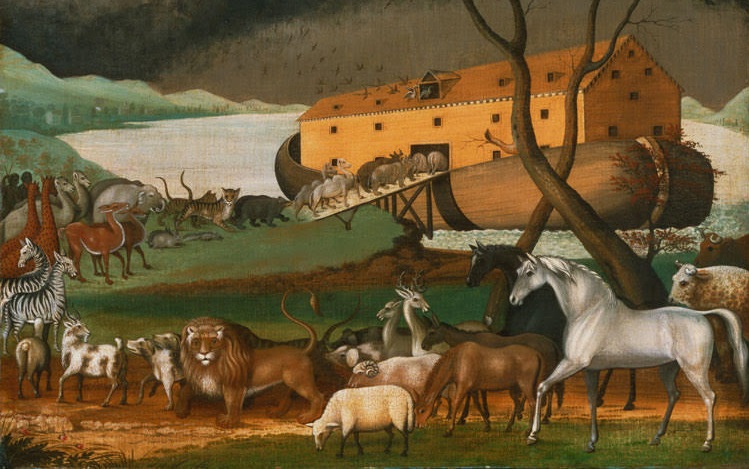
Noah’s Ark, by Edward Hicks, 1846 (detail)

God looked at the earth, and hey! nishechatah, because all flesh hishechit its way upon the land. And God said to Noah: “The end of all flesh is coming before Me, because the earth is filled with violence on account of them, so hey! —mashechitam along with the land. Make for yourself an ark … (Genesis/Bereishit 6:12-6:14)

nishechatah (נִשְׁחָתָה) = it had become spoiled, ruined. (A form of the verb shachat, שׁחת = spoil, ruin, corrupt.)

hishechit (הִשְׁחִית) = has spoiled, ruined; has wiped out. (Also a form of the verb shachat.)

mashechitam (מַשְׁחִיתָם) = spoiling themselves, ruining themselves. (Another form shachat.)

The God-character here sounds like a small child wailing, “They spoiled my toys!  Now everything is ruined! I’m going to kill them all, and wipe out the whole world! But me and my friends, we’ll build a boat and escape …”

Is God actually being childish in this passage? Is the Flood an overreaction? Or is humanity in this story irredeemable?

And is there any reason for wiping out all the other living things on the land?

One clue about the people of Noah’s generation is that the Torah calls them neither “humanity” (adam) nor “men” (anashim), but “all flesh” (kol basar). Perhaps the relationship between flesh and spirit in those early humans is spoiled; people’s spirits are unable to master their physical cravings. (See my post Bereishit & Noach: All Flesh.)

In the previous Torah portion, God creates the human out of two materials: dirt and the divine breath. Body and soul. Flesh and spirit. By Noah’s time, according to traditional commentary, the desires of human “flesh” have taken over. People think only of gratifying their physical appetites, and the desires of their spirits disappear.

According to some commentary, the people of Noah’s generation avoid having children, so they can devote more time to their own animal pleasures. Modern commentator Avivah Gottleib Zornberg argues that the real problem is the narcissism of these pleasure-seekers. If someone has no curiosity, no interest in other people, then love and kindness are impossible.1 I would add that if you do not care about other people, then you will speak and act with violence  whenever you feel like it (and believe you can get away with it).

According to the Torah, before the Flood all humans are wallowing in selfish sensuality, their souls beyond recovery, except for Noah (and possibly the other seven people God allowed on the ark: Noah’s wife, sons, and daughters-in-law). Noah is not a paragon; the Torah portion opens with this description:

These are the histories of Noah: Noah was a righteous man–he was unblemished in his generations–Noah walked with God. (Genesis 6:9)

In other words, compared to everyone else at the time, Noah is good. Presumably he retains the proper balance between his spirit and flesh, paying enough attention to his divine side to “walk with God”. But he never questions God’s plan to wipe out all life on earth. He is deficient in compassion, yet there is hope for him or his descendants.

So God decides not to give up on the human experiment altogether, but instead to destroy the failures, and start over again with Noah and his family. Then why does God choose to flood the earth, and wipe out millions of land animals and birds along with the irredeemable humans?

Traditional commentary claims that God made all the other animals, and everything else on earth, only for the sake of the human. Non-human life on earth has no value in itself. When humans use other living things for corrupt purposes, they have to be destroyed, too.

To me, this opinion demonstrates a lack of interest in, or curiosity about, the rest of the world. When a  commentator views other animals as merely tools for humans to use in carrying out God’s laws, he is committing the same error as the antediluvian man who views other animals as merely tools to use in the pursuit of selfish pleasure.

This is the kind of selfish attitude that leads people today to “spoil” nature: to pollute the air and water, to cut down forests, to disregard extinctions of species, and to do nothing about global climate change. They focus only on their own immediate desires, and take no interest in the earth and its life.

Clearly, human beings are still spoiled, and still spoiling the earth. In the Torah, after the Flood is over and Noah makes an animal sacrifice, God says to God’s heart:

Never again will I draw back to curse the earth (adamah) for the sake of the human (adam), because the shapings of the human heart are evil from its adolescence; and never again will I strike down every living being, as I have done. (Genesis 8:21)

God reseeds the earth with human beings who are still mixtures of dirt and divine breath, body and soul. God continues to grant humans free will, and accepts that sometimes adolescents and adults, people who are old enough to know better, will nevertheless choose evil. God’s experiment with humanity continues.

Today, we do not need an anthropomorphic God to create a flood. We humans have the ability to strike down every living being, all on our own. We are the ones melting the glaciers and ice caps, threatening to flood the earth. I just hope we have not completely spoiled it.


  1. Avivah Gottlieb Zornberg, The Beginning of Desire: Reflections on Genesis, Doubleday, New York, 1995, p. 46, 53, 54, 63.
Bereishit: A First-Rate Beginning

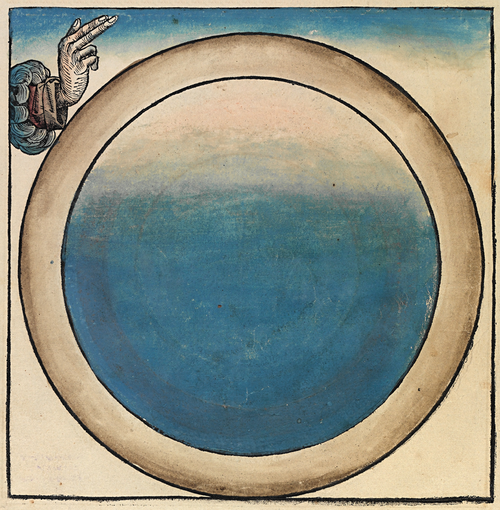
In the beginning God created the heaven and the earth. (Genesis/Bereishit 1:1, King James Version)

First Day of Creation, Nuremberg Chronicle, 1493

I used to find flaws in the King James translation of the first line of the Bible: 

Bereishit bara Elohim eit hashamayim ve-eit ha-aretz— (Genesis 1:1)

Consider the first word, a compound of be- (בְּ) = a prefix meaning “in”, “at”, “by”, “through”, or “when”, depending on context and idiomatic usage.

+ reishit (רֵאשִׁית) = (noun) beginning, first step, starting point; (adjective) first-rate, choicest, best.

I knew that “in the” was ba(בַּ), not be- (בְּ). So I preferred modern translations of bereishit, such as “In a beginning”. Then I checked all the other places where the word reishit appears in the Hebrew bible, and I discovered that reishit is an unusual word, in that it does not take a definite article even in contexts where the English translation would be “the beginning” or “the first step”. So in 50 of the 51 times that reishit appears in the Hebrew Bible, there is no prefix indicating a definite article (“the”).1 And the word bereishit appears four times in the book of Jeremiah in the phrase “at the beginning of the reign of”.2 I had to conclude that the King James version’s “In the beginning” is an acceptable translation after all.

The second Hebrew word is bara (בָּרָא) = “created”. Before I learned Biblical Hebrew grammar, I made the translation mistake that the Talmud warns against3, and wondered if bereishit bara Elohim meant that “In-a-beginning” created God. Then I found out that the subject follows the verb in Hebrew, so the correct translation of bara Elohim is “God created”, not “created God”.

What about the word Elohim? It is a plural noun, used in the Torah for both God and for other peoples’ gods. But the book of Genesis/Bereishit would hardly say that other peoples’ gods created the heavens and the earth!

The word translated in the King James version as “the heaven” is hashamayim (הַשָּׁמַיִם) = the heavens. But insisting on the plural is nit-picking.

When I began researching this blog, I still hoped I could come up with a more interesting, yet accurate, translation. Over the years I have enjoyed reading alternate translations, especially when they lead to intriguing ideas about the nature of God.

For example, here is one of 19th-century Rabbi Raphael Samson Hirsch’s translations: 

From the very beginning God created the heaven and the earth.4 

I notice that this version implies not only that God is the original, and perhaps the only, creator, but also that creating the heavens and the earth is an ongoing process.

Another is Rabbi David Cooper’s 20th-century translation: 

With a beginning, [It] created God (Elohim), the heavens and the earth.5 

Cooper explained that in kabbalah, the ein sof (“without end”) precedes Nothingness, and out of Nothingness comes Beginningness. From Beginningness comes Elohim, the plural name of God, and then plural creation follows, starting with the heavens and the earth. The first part of this amazing progression occured before the first word of the Torah. The word bereishit catches the kabbalistic progression at the stage of Beginningness.

Yet the 17th-century King James translation, prosaic as it seems, is closer to the original Hebrew. So then I wondered if I could invent an interesting alternate translation by using one of the other meanings of reishit.

The word reishit appears in the Hebrew bible 50 times. It is used most often (23 times) to indicate one kind of offering to the temple: an offering of the first or the finest sample of an agricultural product–usually fruit or grain, but sometimes bread, oil, or livestock. Another common use of the word (10 times) is to indicate that something else is first-rate: a person, a group of people, a father’s vigor, a land’s fertility, a fig’s flavor.

If the reishit part of the first word in the Bible meant “first-rate”, the first sentence could be translated: With the best, God created the heaven and the earth. We would learn that our universe is first-rate (or at least the best of all possible worlds), and that God also created other, inferior universes!

Is this stretching too far? The Hebrew bible uses reishit to mean “the beginning” at least 17 more times after the opening Bereishit. Twelve of these occurrences refer to the beginning of something that unfolds over a period of time: a year, an episode in someone’s life, a king’s reign, a person’s lifetime, a kingdom’s duration. Two more occurrences refer to the beginning of a process of divine creation: the book of Job claims the behemoth was the beginning of God’s creation of animals, while the book of Proverbs claims wisdom was the beginning of God’s creation of the world. The word reishit is also used three  times for a more abstract beginning, as in Psalm 111:10: The beginning of wisdom is awe of God.

The compound word bereishit shows up four times in the book of Jeremiah.2 All four times, bereishit merely gives the approximate date of a prophecy, by placing it “in the beginning of the reign of” a certain king. So the bereishit in the first sentence of the Torah must also be the beginning of something that unfolds over time, like a king’s reign. But this beginning came before everything. It is the beginning of time as we know it (one new thing after another), or the beginning of being.

Maybe Elohim, the god of plurals, means God the Creator, the God of Time, and the God of Endless Beginnings. Then what came before the beginning of time and creation, before Elohim? If the answer is God, this is a god we cannot even imagine. The Ein Sof (“Without End”) of kabbalah is, by definition, inconceivable. As the Zohar says, “No thought can grasp You at all.” Yet Elohim, the God that we can think about, points back at the Ein Sof, the inconceivable God  that began Rabbi David Cooper’s kabbalistic progression.

In the beginning God created the heaven and the earth” is more profound than I thought.


  1. The exception is the word lareishit (לָרֵאשִׁית) = “for the first [fruits]” (Nehemiah 12:44).
  2. Jeremiah 26:1, 27:1, 28:1, and 49:34.
  3. Talmud Bavli, Megillah 9a.
  4. Samson Raphael Hirsch, The Hirsch Chumash, English translation by Daniel Haberman, Feldheim Publishers, Jerusalem, 2002, p. 1.
  5. David A. Cooper, God is a Verb, Riverhead Books, Pernguin Putnam Inc., New York, 1997.

Vezot Habrakhah: Broad Daylight

And this is the blessing with which Moses himself, the man of God, blessed the children of Israel, before his death. (Deuteronomy/Devarim 33:1)

The book of Deuteronomy/Devarim is a series of speeches by Moses, sometimes in God’s name, sometimes in his own words, to the generation that is about to cross the Jordan without him. Moses repeatedly tells the Israelites that they have screwed up before, and God will punish them if they screw up again. The second-to-last Torah portion, Ha-Azinu, is God’s rather dark poem prophesying that they will, indeed, screw up again. But the last portion in Deuteronomy (the very last one in the Torah scroll) takes a brighter tone.

In this portion, Vezot Habrakhah (And this is the blessing), Moses blesses each tribe with prophesies of good outcomes: life, strength, religious knowledge, security, and plenty. After these unusually positive parting words, Moses climbs Mount Nevo and dies.

Before Moses blesses the first tribe, Reuben, he introduces his blessings with a few obscure poetic verses.  Modern scholars view these verses as quoted from a much older poem, with some bits lost in the transmission. One piece of evidence for this theory is that the mountain where the Israelites received the “Ten Commandments” is called Mount Sinai, just as it is in the book of Exodus/Shemot.  This is the only appearance of the name “Sinai” in the whole book of Deuteronomy; the rest of the time, Deuteronomy calls the mountain Choreiv (Horeb).

Here is the first obscure verse:  And he [Moses] said:

God entered from Sinai

and dawned from Se-ir for them;

shone out from a mountain of Paran,

and came from holy myriads;

from Its right side is אשדת for them. (Deuteronomy/Devarim 33:2)

אשדת = ?  These four Hebrew letters do not make a word anywhere else in the Hebrew bible. Commentators generally agree they indicate a compound word beginning with eish = fire.  For the second part of the word, we have only the two letters ד and ת, corresponding to “d” and “t”.   Traditional commentary assumes the two letters stand for dat = edict, a word borrowed from Persian that does not appear in Hebrew texts until  centuries later. They translate the whole word as “fiery law”.  Most modern scholars assume that d-t is a fragment of the word daleket = flaming, and translate the whole word as “fire-bolts” or “lightning”.

What does the verse mean? Se-ir is the land southeast of Canaan where, in the book of Genesis/Bereishit, Esau founds the kingdom of Edom.  The Talmud associates Se-ir with Rome. Paran is a wilderness south of Canaan where Ishmael settles in Genesis. The Talmud associates Paran with Islam.

Most commentary from the Talmud through the 19th century assumes that Moses is once again insisting that the religion of the Israelites is the only acceptable creed. The light of God, they said, is the Torah, and this verse means that God offered to Torah to the Israelites at Sinai, to the  Edomites (standing in for Romans or Christians) at Se-ir, and to the Ishmaelites (standing for Muslims) at Paran. But only the Israelites accepted the Torah. The “holy myriads” are God’s angels, who do not need the Torah to instruct them on how to live properly in the world. So God’s right hand gives Israel alone  the eish-dat, the fiery law.

I am not persuaded. Yes, Moses spends 40 years denigrating other religions and reminding the Israelites that God chose them– 40 years of warning and criticizing and yelling and laying down the law. But in Vezot Habrakhah, Moses finally drops that role and blesses the tribes with good fortune and plenty. He wants to leave the world with blessings rather than curses. In his softened mood, maybe he quotes part of an old poem not to reinforce Israelite triumphalism, but to hint that divine enlightenment can reach people who belong to other groups, other religions.

The simple meaning of the verse appears to be that God’s light shone on at least three different peoples south of Canaan. And I think the next verse continues this theme, despite traditional commentary’s insistence that it must mean God has power over all peoples, but loves only Israel.

One difficulty in translating verse 33:3 is that it seems to switch back and forth between referring to God in the second person singular and the third person singular. But this is not unusual in the Torah. To make the verse easier to read, I will use [God] instead of a confusing pronoun.

Indeed, [God] is a lover of peoples;

all of [God’s] holy ones are in [God’s] hand;

and they place themselves at [God’s] feet;

yissa from [God’s] pronouncements. (Deuteronomy 3:3)

yissa = he/it lifts; he/it carries

Traditional translations ignore the fact that the word amim means “peoples”, and change the word to “tribes” or “the people” in the singular. These translators assume that God would never be described as a lover of more than one people:  the people Israel.

But why not take the Hebrew word for “peoples” literally? What if God really is a lover of many “peoples”, many ethnicities, many religions? Then, as the next line says, all of God’s holy ones, from every population, are in God’s hand.  And they humbly position themselves at God’s feet.

In the last line of the verse, God lifts, or carries, from God’s pronouncements. Modern scholar Robert Alter, who translated the line as “he bears your utterances”, noted that its meaning is so unclear, it must have been altered in transmission from the original poem.

True, pronouncements are normally neither lifted nor carried nor borne. But I wonder if the word yissa is an abbreviation of an idiom. One common biblical Hebrew idiom is yissa rosh, “he lifts the head of”, and means “he pardons”. Maybe God pardons the holy ones at God’s feet for disregarding God’s pronouncements. Maybe, contrary to Talmudic thinking,  God pardons the more righteous members of many religions when they transgress God’s decrees.

With such obscure Hebrew, it is all guesswork.  But my guess is that the two verses together mean that the divine light is not like a laser focusing on just the children of Israel, but rather like the sun, that rises over every height where a people seeks inspiration. God offers enlightenment to everyone, in broad daylight.  Furthermore, God loves not just the Israelites, but many peoples. The Roman Christians of Se-ir and the Muslims of Paran can also count as holy. God does pronounce laws and requirements; but all holy ones who transgress them can be pardoned, if they place themselves humbly at God’s feet.

This is the poem Moses quotes before he blesses the tribes of Israel and climbs up the mountain to die. After spending 40 years of his life browbeating his people into committing themselves to God, maybe Moses feels that his great task is finished. Now, at last, he can let go of his anger and frustration and give blessings–not just to the tribes of Israel, but to all peoples.

If only we let go of our prejudices, and listen.

Ha-azinu: The Tohu Within

Before Moses dies, he teaches the Israelites a long song.  The words are recorded in this week’s Torah portion: Ha-azinu (“Use your Ears”).

The two main messages in the song are that God is all-powerful, and that God wreaks vengeance on the Israelites when they worship other gods.  This is not news; the God-character portrayed in the Torah has no concept of modern educational methods.

Yet within the song are some gems of inspiration.  One of them employs the relatively rare word tohu.

[God] found it/him in a land of wilderness

And in the tohu of a howling desolation;

[God] surrounded it/him and gave it/him understanding,

[God] protected it/him like the pupil of [God’s] eye. (Deuteronomy/Devarim 32:10)

tohu (תֹהוּ) = chaos, nothingness, formlessness, unreality.

Hebrew prefixes and suffixes indicating the third person singular can be translated as either “it” or “him”.  So what or who did God find in the wilderness of chaotic, howling desolation?

One third-century commentary says God found, or encountered, Abraham there.1  But the book of Genesis/Bereishit states that God called to Abraham when he was living in Charan and told him to go to Canaan.2   Charan was a civilized town, not a howling wilderness.

Most commentaries take their cue from the preceding line of the song, Because God’s portion is [God’s] people, Jacob …  (Deuteronomy 32:9) and assume that “it” is the people named after their ancestor “Jacob” or “Israel”.  (The Torah often refers to a people, an ethnic or political group, in the singular.)

Yet in the book of Exodus/Shemot, God does not find Israel in the wilderness.  God notices the Israelite slaves in Egypt when God hears their cries of distress.  Then God leads them out of Egyptian civilization and into the wilderness.

Modern scholars who take the verse about tohu literally explain these discrepancies by attributing the poem in Deuteronomy and the stories in Genesis and Exodus to different myths explaining the origin of the Israelite people.

But why get stuck on a literal reading? The Torah often uses metaphor and analogy, especially in its poetry. I think the word tohu  in this verse points toward a more profound meaning.

This is only the second occurrence of the word tohu in the Torah.  The first use of tohu is in the sentence just before God says “Let there be light”:

And the earth was tohu and vohu, and darkness over the face of the deep, and the wind/spirit of God hovering over the face of the deep.  (Genesis/Bereishit 1:2)

vohu (בֹהוּ= a poetic extension of tohu, translated as “unformed”, “void”, “empty”.   (The word vohu appears only three times in the Hebrew bible, always paired with tohu; here, in Isaiah 34:11, and in Jeremiah 4:24.)

I think the meaning that best fits all 19 appearances of the tohu in the Hebrew Bible is “unreal” or “unreality”.

Translating tohu as “unreality” in this week’s Torah portion is awkward if you take our verse literally.  But if “wilderness”, tohu, and “howling desolation” all describe a psychological state, tohu as “unreality” makes sense.  When you feel desperate and desolate, as if there is no hope and you are utterly alone, you experience an inner howling, and your mind no longer anchors itself in familiar habits and beliefs.  You wander in a mental wilderness, and your former world-view seems unreal.

What if someone in a mental state of unreality and howling desolation encounters God?  What if God then encircles them, gives them understanding, and protects them until they pull themselves together and reorganize their lives to fit their new outlook?  During this process, God protects the person’s soul as if it were the pupil of an eye, which can perceive reality and apply insights only if it is both uncovered and unharmed.

Atheists today might object that God itself is unreal, so believing that God is finding and protecting you is an indulgence in unreality.  I don’t blame them.  I am an atheist myself, if you define God as either the anthropomorphic jealous king who lives in the sky, or as the omni-being of medieval theologians.  But many people, including me, use the word “God” for something else, something we have no better word for in English.  Something that defies a clear definition, a mystery that we experience or intuit.

Connecting with this holy mystery is a real experience, one in which the phrases “God finds you” and “you find God” mean the same thing.  I have found that if it happens when my life is falling apart, the connection really does protect me, stabilize me, and give me understanding.

These days, when my emotions begin to overwhelm me, I don’t wait for God to find me.  I take preemptive action by singing prayers, singing until the tightness in my throat relaxes.  Then my mind becomes calmer and clearer, and understanding becomes possible.

So here is my version of the verse from Ha-azinu, with different pronouns.  Maybe this interpretation will ring true for you.

     I found God in a land of wilderness

     And in the unreality of a howling desolation;

     God surrounded me and understanding came;

     God protected me like the pupil of an eye, and I saw.

  1. Sifrei Devarim 313:1.
  2. Genesis 12:1-5.

Nitzavim: Still Standing

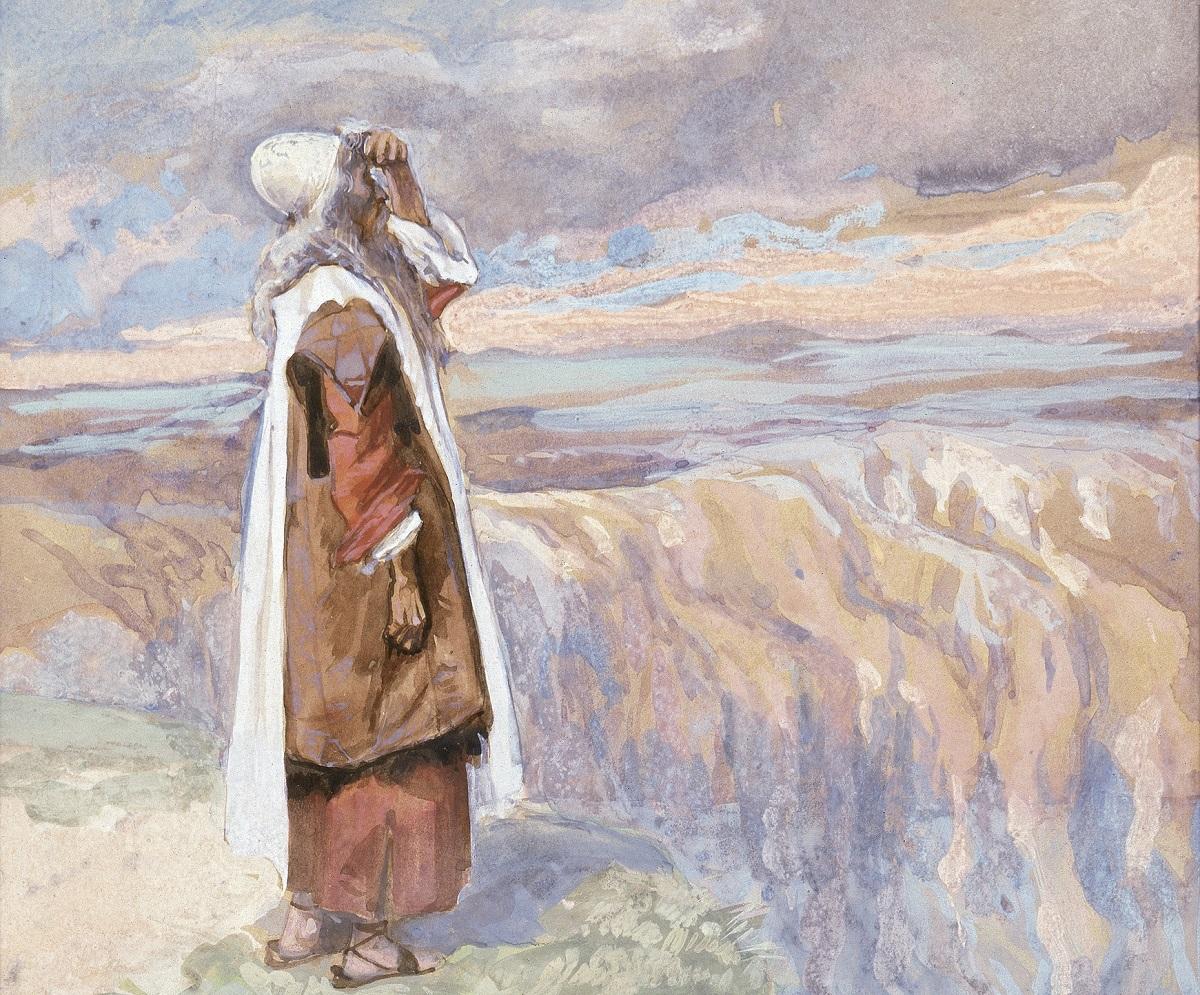
Moses by J.J. Tissot

Moses leads the refugees from Egypt for 40 years and brings them to the Jordan River.  There, he knows, he will die and they will cross over into a new life.  The book of  Deuteronomy/Devarim is his farewell speech to the people, and in this week’s Torah portion, Nitzavim (“taking a stand”) he launches into his conclusion.

Everyone standing there

First Moses lists everyone included in the renewed covenant with God that will take effect when the people cross into the “promised land” of Canaan.

You are the ones who are nitzavim today, all of you, before God, your God—your heads, your tribes(men), your elders, and your officials, every man of Israel; your young children, your women, and your stranger who is in the midst of your camps, from the gatherer of your wood to the drawer of your water—in order to cross into the covenant of God, your God, with its alah that God, your God, is cutting with you today.  (Deuteronomy/Devarim 29:9-11)

nitzavim = taking a stand, stepping up, stationing yourselves, standing firm.

alah = an obligation which puts a curse on anyone who fails to meet it; a penalty clause in a contract.

Moses includes not only all the men of Israel, regardless of rank, but also all the women and all the children.  Moreover, he includes the strangers in their midst: those who are not of the same blood, but who voluntarily chose to join the Israelites when they left Egyptin other words, the converts.  Moses even includes low-status converts, those who gather wood and draw water for the Israelites.

Journey from one border to another

This is not the same group of Israelites and converts who followed Moses out of Egypt.  Most of the adults in the original group  have died during the 40 years in the wilderness.  Some died when God punished various revolts with plague, fire, earthquake, or snakebite.  Others died of old age during the 38 years that passed between the group’s arrival at the southern border of Canaan in the desert, and their arrival at the more northern border of Canaan at the Jordan River.1

Now the survivors are standing on the river bank, ready to cross.  Most of them were children, or not born yet, when the original group embraced the original covenant with God at Mount Sinai.  So Moses says God is cutting a covenant with this new group.

It is a covenant with a penalty clause, an alah.  If they do not live up to their side of the covenant, following God’s laws and refraining from worshiping any other god, then the long list of curses in last week’s Torah portion would come to pass.  (For example, parents would eat their own children as they are starved by crop failure and besieging enemies.)

When God gave a covenant to the earlier generation at Mount Sinai, they replied, “We will do and we will hear!”  But in this week’s Torah portion, when Moses announces the covenant to the later generation, they say nothing.  No response is recorded in the Torah.

So why does Moses describe this passive group as nitzavimAre they really taking a stand in favor of God?  Are they standing firm, as the word nitzavim implies?  Or are they merely standing there waiting for Moses to finish his speech so that they can do the next thing they are required to do? Are they following orders because they want to serve God, or because they have grown up knowing that serving the God of Israel is better than the alternative?

Are they standing firm, or are they merely still standing?

Everyone else

Then Moses expands the group included in the covenant, quoting God:

And I, Myself, am cutting this covenant and this alah not with you alone, but with whoever is here standing with us today before God, our God, and whoever is not here with us today. (Deuteronomy 29:14)

Who are these additional people who are not standing in front of God that day?

According to Rashi2 they are the souls of all future Jews, yet to be born.  Traditional commentary agrees and includes both everyone who ever had or will convert to Judiasm, along with everyone who was or will be born to a Jewish mother.

(Converts enter the covenant with God at the time of their conversion, but people who are born Jewish have no choice; they are simply included.  Different commentators have held different opinions about whether individuals who were born Jewish can opt out of the covenant or not.)

What I wonder is whether traditional Jewish commentary is too narrow in its definition of who is included in “whoever is not here with us today”.  What if the covenant applies to every human being on earth, forever?  That would fit the plain sense of the words.

Is Moses saying that all human beings will become Torah-observant Jews?

No.  I think “whoever is not here with us today” means that all human beings ought to be standing before God.  And that means we should avoid acting as if we were gods.  Only through humility and responsibility can we avoid the curse of (psychologically) devouring our children, the curse of (metaphorically) devouring any other human being, the curse of devouring our own planet.

We should remember that we are small parts of the whole creation.  And we should remember that all human beings are in a covenant together, living on the earth.


  1. At the southern border, most of the people were afraid and refused to cross into Canaan.  (See my post Shelach Lekha: Sticking Point.)  God’s punishment was to make them wait until all but two men from that generation had died before they could attempt a second crossing into Canaanhence the 40 years of wandering in the wilderness.
  2. 11th-century rabbi Shlomo Yitzchaki.

Ki Teitzei: Too Many Vows

When did you last make a vow or swear an oath?  In our society, we often sign contracts and promise to do things; but a solemn, witnessed vow is usually reserved for a wedding, an oath of office, or (in some religions) an initiation into a religious order.  Nevertheless, when we violate solemn promises we have made to ourselves, we find ourselves in the same position as ancient Israelites who failed to fulfill their vows.

One warning about vows appears in this week’s Torah portion, Ki Teitzei (“when you go out”):

When you vow a vow to God, your god, you shall not delay in fulfilling it, because God, your god, will certainly call you to account, and there will be guilt in you. But if you refrain from vowing, there will not be guilt in you. You must guard what comes out of your lips; and you must make any voluntary gift that you spoke with your mouth, as you have vowed to God, your god. (Deuteronomy/Devarim 23:22-24)

The majority of vows mentioned in the Hebrew bible are vows to give something to God. People vow to offer an animal at the altar, or to give money to the Temple treasury, just because they want to do something extra for their religion. Both this week’s Torah portion and a similar passage in Ecclesiastes/Kohelet state that when you vow to make a gift to God, you must fulfill it with minimum delay, or you will be guilty of wrongdoing. Someone today would be guilty of similar wrongdoing if they promised to donate extra money to their congregation, but then took years to get around to it.

Another type of vow is the vow of self-denial. The most common vow of self-denial in the Torah is the vow to be a nazir, someone who abstains from haircuts and from wine (or anything else made with grapes) for a fixed period of time. (See my post Naso: Distanced by Hair.)

But like us, Israelites and Jews thousands of years ago made individual vows of self-denial, which are mentioned in the Hebrew bible and discussed in detail in the Talmud tractate Nedarim (“Vows”).  In modern American one common individual vow of self-denial is to abstain from certain foods.  Two thousand years ago this was also a possible vow, but vows to refrain from sex with your spouse get more coverage in the Talmud.

Carrying out your vow without delay is also a requirement for vows of of self-denial. The book of Numbers/Bemidbar says: If someone vows a vow to God or swears an oath to abstain an abstention for himself, he shall not desecrate his word; according to anything that goes out of his mouth he must do. (Numbers 30:3)

Making a vow before God seems to be a common human impulse.  Yet both Deuteronomy and Ecclesiastes, as well as the Talmud, emphasize that it is better to simply do what you intend without making a vow.

What is so bad about making vows? The Torah and the Talmud discourage vowing because the consequences are terrible if you do not fulfill your vow. All too often, people make vows and then fail to live up to them because of circumstances they did not anticipate.  Some people are simply stymied by bad luck. But others are carried away by their emotions at the time of the vow, and rashly promise more than they can realistically deliver. Some people make vows they regret the next morning.

Traditional commentary points out that people tend to find excuses to justify their failure to deliver on a vow, and comfort themselves with the thought that at least they meant well. This is a form of self-delusion that leads some people to substitute making vows for actually doing the right thing. Thus people who makes rash vows end up behaving less ethically.  They also suffer because other people stop believing what they say.

I have also noticed another reaction to the failure to fulfill a rash vow. I know people who made solemn promises to themselves to increase their Jewish religious observance–not just by adding one daily blessing or one small restriction, but by taking on a full day of orthodox Shabbat observance every week, or by switching from a diet of bacon cheeseburgers to keeping kosher so strictly that they can no longer eat out. And when they failed to fulfill their rash vows, they did not excuse themselves on the grounds of good intentions.  Instead, they gave up on their religion–an easy thing to do, in our modern society. And that, too, can be bad for the soul.

I agree with the Torah and Talmud that it is better to guard your lips and stop yourself from making vows. But if you need to make a vow, consider it carefully, over a period of time, to make sure it is something reasonable that you can fulfill.

But what if you have made a vow you cannot, or no longer want to, fulfill?  In Talmudic times, people called upon rabbis to annul their ill-considered vows of self-denial. Jews today have Yom Kippur, the annual Day of Atonement.  If we break our vows to other people, we can only make things right by going through a process of atonement with those individuals. But if we have failed to carry out our vows to ourselves, or to God, then we can atone in our communal prayers on Yom Kippur.

The holy day begins with the singing of “Kol Nidrei”, which means “All vows” in Aramaic. The Kol Nidrei prayer may have begun as a way to absolve Jews from vows of conversion to another religion, since so many Jews had to pretend to convert to Christianity in order to save their lives. Now it serves as a heartfelt introduction to the day when we can release ourselves from guilt over the personal vows before God that we now wish we had not made.

This week is the second week of Elul, the month leading up to Rosh Hashannah and Yom Kippur. The Jewish tradition is to spend this month examining ourselves, apologizing and atoning for the wrongs we have done to other people, and recognizing where we have failed the God inside each of us.

This month of Elul, may we all catch up on the good deeds we promised to do but never got around to; may we find ways to clear ourselves and start fresh with every person we have wronged; may we recognize and accept our failures to fulfill our personal vows; and may we figure out ways to improve ourselves gently, without making any rash vows.

Re-eih: Two Paths

Moses opens this week’s Torah portion, Re-eih (“See”), by giving a choice to the Israelites camped at the Jordan River, waiting to cross over into Canaan.

See, I am setting before you today a blessing and a curse. The blessing: asher you listen to the commandments of God, your god, that I command you today. And the curse: im you do not listen to the commandments of  God, your god, and you rebel from the path that I command you today, to walk after other gods that you did not know.  (Deuteronomy/Devarim 11:26-28)

asher (אֲשֶׁר) = that, which, whom

im (אִם) = if.

The Torah does not say here what material results will come from God’s blessing or God’s curse. But results can be inferred, either by looking at a parallel passage in the book of Leviticus/Vayikra, or by paying attention to several words in the passage above that are usually unimportant, and often mistranslated.

First let’s compare the warning in this week’s Torah portion with the two alternatives presented in Leviticus.  

Im you follow my decrees and observe my commandments and do them … (Leviticus/Vayikra 26:3)

Then God will make it rain in the right seasons, so you (plural) will have abundant crops and eat your fill; God will grant peace in your land, keeping away both vicious beasts and swords; God will give you many offspring; and God will always be present in your midst.

But im you do not listen to me and you to do not do all these commandments … (Leviticus 26:14) 

God continues, then God will afflict you with diseases, and crop failure, and wild beasts that kill your children and livestock, and enemies with swords who besiege you until you commit cannibalism and starve to death.

Words for blessing and curse are absent from the passage in Leviticus, but elsewhere in the Torah the word brakhah (“blessing”) implies an increase in fertility, health, and prosperity–as indicated in the list of results for following God’s decrees and commandments in Leviticus. The word for “curse” used in this week’s Torah portion, kelalah, implies diminishment in status and power, as well as disgrace and falling into a lower state of being. These conditions do seem to be graphically illustrated in the results given in Leviticus for disobeying God’s commandments.

Furthermore, obeying God’s commandments is what makes the difference in both the passage in Leviticus and the one in Deuteronomy this week. So it would be reasonable to assume that the two alternatives in Leviticus represent the results of God’s blessing and God’s curse.

Yet some Torah commentary draws a different conclusion, based on the words asher (“that”) and im (“if”).

In Leviticus, both the good result and the bad result are introduced by “if”; if you people obey God, then you will be collectively rewarded in life; if you people do not listen and do not obey every commandment, then you will be collectively punished in life. (Individual exceptions are not addressed, and as usual in the Torah, no reference is made to any reward or punishment after death.)

But this week, in Deuteronomy, the original Hebrew says:  The blessing: that you listen to the commandments of God, your god, that I command you today. (11:27)

Some English translations change the word asher (“that”) into an “if”. But two major 19th-century commentators, the mystical rabbi Yehudah Leib Alter of Ger (in Sefat Emet) and the scientific grammarian rabbi Meir Leibush (a.k.a. Malbim), argued that the original sentence means the blessing is listening to and obeying God’s commandments. Virtue is its own reward, because listening to God and doing good deeds elevates and expands your soul. Sefat Emet says that the choice between the path of blessing and the path of curse lies before everyone, at all times; and the reward for choosing the right path is to advance to the next choice, the next opportunity to choose good, as you climb higher on the ladder.

This interpretation speaks to me, not only because I care about the original words in Hebrew, but also because it moves from the communal blessing implied by the Torah’s plural “you” to an individual, personal blessing. If you live in a community of people who make bad choices, you will inevitably suffer materially for their mistakes and misdeeds.  In a material sense, you will be cursed. Nevertheless, if you, personally, choose what is good and right, you will get the more important reward of becoming a better person.

Eikev: Covered Heart, Stiff Neck

Some common Biblical Hebrew metaphors seem straightforward to English-speakers, some need only a little explanation, and others seem bizarre. The name of this week’s Torah portion, Eikev, is an easy metaphor. The word means “on the heels of”, and this makes sense to English-speakers in a fairly literal translation of the first sentence of the portion:

It will happen, eikev your listening to these laws, that if you keep and perform them, then God, your god, will keep for you the covenant and the kindness that He swore to your forefathers. (Deuteronomy/Devarim 7:12)

eikev (עֵקֶב) = on the heels of, as a consequence of.

Later in this Torah portion, we get the following sentence:

You must circumcise the foreskin of your leivav, and you must not stiffen your oref again. Because God, He is your god, the god of gods ... (Deuteronomy 10:16-17)

leivav (לֵבָב) = heart, thoughts and feelings, seat of consciousness, mind.

oref (עֺרֶף) = nape, neck, back of the neck

Most English speakers think that stiff-necked means stubborn, and that is certainly part of its meaning in Biblical Hebrew. But in the Torah kasheh-oref (“stiff of neck”) and related phrases have a more specific meaning.

The first time the Torah refers to a stiff neck is right after God has given Moses the two tablets of commandments on Mount Sinai.  God tells Moses that the people below have made and bowed down to a golden calf, and calls them stiff-necked— meaning that they are stubbornly reverting to the old-time religion of Egypt.

Necks are called stiff or hard 19 times in the Torah, and 18 of those references either accuse or warn descendants of the children of Israel regarding their attitude toward God.  Being stiff-necked is associated with deliberately disobeying God— by worshiping other Gods, or by refusing to listen to God, or by refusing to follow God’s laws.

The Torah also has nine references to turning one’s neck to someone. Since the word oref really means the back of the neck, it is not surprising that this Hebrew metaphor covers two English metaphors: turning your back on someone, and turning tail to flee. Perhaps stiff-necked people are those who stubbornly turn their backs on God.

The only time the Torah uses the concept of a stiff neck a different way is in Proverbs 29:1:  Reprimands make a man stiff-necked; suddenly he cracks, and there is no healing.  (If only Moses had known that, it might have been easier for him to lead the Israelites across the wilderness.)

In this week’s Torah portion, when Moses tells the people not to stiffen their necks again, he means that they must not  deliberately turn away from their own religion again.  But what does he mean when he says “You must circumcise the foreskin of your heart“?

The Hebrew word levav does mean the organ that pumps blood, but this literal meaning leaves us with a horrific image of open-heart surgery. In the Torah and Talmud, the heart is also the seat of our stream of consciousness, all our thoughts and feelings. In many Torah passages, a more accurate translation of levav would be “mind”. I usually prefer to keep the original metaphors in my translations from the Torah, but if I retranslate Deuteronomy 10:16 with the words levav (heart) and oref (back of the neck) changed into their implied meanings, here is what we get:

You must circumcise the foreskin of your mind, and you must not stubbornly reject [God] again. 

Then what does it mean to circumcise the foreskin of your mind? The 15th-century rabbi Ovadiah Sforno wrote that the Torah is asking us to remove the covering over our intelligence, by examining our thinking for errors that lead to false beliefs. Eliminating these errors of thought will remove the barrier between our minds and God.

The 19th-century rabbi Samson Raphael Hirsch proposed a harsher interpretation: our thoughts and desires are unruly, so we must gain mastery over them. Once we subordinate our hearts/minds to our real selves, we become able to subordinate ourselves to God.

Circumcision is certainly removing a covering (though what remains is rarely associated with intelligence, today). When Moses describes himself at the burning bush as someone with uncircumcised lips, he implies that an insensitive covering, literal or metaphorical, prevents him from speaking well.

I suppose circumcision can also be seen as a form of discipline; the ancient Israelites did view uncircumcised Greeks and Romans as licentious. But in the Torah, literal circumcision is primarily a sign of the covenant between the Israelites and God, the covenant first ratified by Abraham. Thus circumcisizing your heart is also a metaphor for making a covenant with God–not just with your actions, but with your inner mind.

It is hard enough to obey the rules laid down by your religion (particularly if you are an orthodox Jew facing a list of 613 commandments).  But is it even possible to cut away anything unholy from your innermost thoughts and feelings?

All too often, when we examine our own minds and judge the contents, we reprimand ourselves harshly.  Then we react to our own harshness either by rebelling against our superegos and stiffening our necks (perhaps like the man in the verse from Proverbs above); or by wrapping ourselves in suffocating layers of blame and depression, and sometimes covering that over with denial. It is as if, having peeled back the foreskin over our minds and peeked inside, we then add layer upon layer of extra skin, so we will not see our true inner minds again.

How can we uncover our hidden feelings and beliefs, and leave our minds open and able to grow? I think we need to relax our necks first. We need to be flexible, willing to turn around, to reconsider. Then, if we approach our inner selves either dispassionately or with kindness, instead of with reprimand and blame, we can choose to turn toward the good and the holy. Once we are turning toward God, instead of stubbornly turning our backs on God, then the coverings that have kept us out of a covenant with the divine might not even need to be cut. The barriers might softly fall away.

Or maybe that’s a woman’s point of view, and men need to tame their testosterone drive with a metaphorical circumcision of their hearts!  What do you think?

Va-etchanan: Extreme Love

Ve-ahavta God, your God, with all your heart and with all your soul and with all your uttermost. (Deuteronomy/Devarim 6:5)

ve-ahavta (וְאָהַוְתָּ) = And you shall love.

The verse commanding us to love God, which appears in this week’s Torah portion, Va-etchanan (“And I implored”), is also a key moment in every evening and morning Jewish prayer. For Jews serious about prayer, it can be a daunting commandment.

What does it mean to love God?  And how can we do it?

Loyalty

When the book of Deuteronomy was written down, perhaps in the 7th century B.C.E., the word ahavah, “love”, often meant loyalty. When treaties called for vassals to love their overlords with all their heart, they meant that the vassals must be totally loyal.

This definition of love answers the question “How can love be commanded?” Our emotions may not be under our own control, but we can freely choose, over and over again, to act with loyalty. Similarly, we can choose to be committed to someone, even when our desires pull us in another direction.

The concept of love as commitment and loyalty continued in the Talmud, which tells the story of Rabbi Akiva’s execution by the Roman government, after his conviction for teaching Torah. Akiva interpreted nafshekha as “your life”, and said at his execution that he was fulfilling the commandment to love God with all his life.

Today it is still possible to be loyal and committed to your religion, and in one sense this counts as loving God.

Obsession

Ideas about the meaning of the word  ahavah, “love”,  changed over the centuries, and Torah commentary on this verse changed accordingly. Medieval thinkers saw love as an overwhelming state of mind. In the 11th century, Bachya ibn Pakuda wrote in Duties of the Heart:

“What does the love of God consist of? The soul’s complete surrender of its own accord to the Creator in order to cleave to His supernal light…”

In this state of mind, there would be

“no place for any other thought, sending forth not even one of the limbs of its body on any other service but that drawn to be His will; loosening the tongue but to make mention of Him and praise Him out of love of Him and longing for Him.”

This kind of obsessive passion sometimes happens to a lover who is falling in love, or to a mother who is enraptured by her baby.  The condition is temporary, and does not require any deliberate choice. Can obsessive passion for God be commanded? Can we choose to enter into that state?

In the 12th century, Moshe ben Maimon, known as Maimonides or Rambam, wrote that passion for God can be prompted by deliberately paying attention to the wonders of God’s creation:

“When man contemplates His works and His wonderful, great creatures and fathoms through them His inestimable and boundless wisdom, he will immediately love, and praise, and exalt, and will be seized by a keen longing passion to know Him …” (Yesodei ha-Torah).

Judging by another of his books, Maimonides thought contemplation would lead to passionate obsession: 

“What is suitable love? To love God with an exceedingly great and very intense love until one’s soul is knit with the love of God and one is constantly obsessed by it. As in a state of love-sickness, in which the mind cannot be diverted from the beloved, the love is constantly obsessed by his love, lying down or rising up, eating or drinking.” (Teshuva).

Longing

The Chassidic movement among eastern European Jews in the 18th century also placed a high value on passionate attachment to God, but its rabbis emphasized the feeling of longing for union with God. The holy Chassids are described as desiring God with an intensity like the sexual desire of a young adult who has fallen in love–hard. Yet the yearning for God seems to be enough, even if the lover of God occasionally gets distracted, and even if the lover never feels as if the union with God is consummated.

Building on the Chassidic tradition, Rabbi Yehudah Leib Alter of Ger wrote in his 1808 work Sfaat Emet (as translated by Arthur Green):

“This means one should want nothing but God. ‘With all your soul’—‘with every single soul-breath that God has created in you.’ And the meaning of ‘be-khol levavekha’ is not ‘with all your heart,’ as most people interpret it. But rather, we need to become aware that each feeling we have is only the life force that comes from God. … Even if it is hard for us to imagine fulfilling ‘with all your heart,’ we should still have that willful longing to reach it at all times. For it is through this longing that gates open in the human heart.”

Unselfishness

Later in the 19th century, the rationalist Rabbi Samson Raphael Hirsch explained the verse this way:

“All your thoughts and emotions, all your wishes and aspirations, and all your possessions shall be regarded by you only as means for attaining closeness to God, for bringing God near to you; this shall be their sole value to you.”

Selfish desires, he continued, should be sacrificed for the sake of the relationship with God.

Although self-sacrifice acquired a bad reputation in the 1960’s, today many people believe that marriages are successful when both partners are willing to sacrifice selfish desires for the sake of the marriage. Can this view of love as being unselfish and giving the other person priority be applied to God?


When I say or read the commandment to love God with all my heart/mind and all my desire/life and all my uttermost means, my immediate thought is always that it’s too hard.  I just don’t have the inner means to do it–whether I define love as loyalty and commitment, as passionate obsession, as extreme longing, or as self-sacrifice.

Yet I have loved a few human beings in all of those ways. Perhaps if I believed in an anthropomorphic god, I would be able to follow the commandment to love God.  Since I do not, I am hoping that partial love of God is better than none at all.  So instead of loving God as I love a human being, I am committed to Torah and a moral life. I have established a habit of remembering to contemplate the wonders of the universe, as Maimonides recommends, and a habit of moving my feeling-soul by singing prayers.

I keep longing and seeking to go farther on this journey. I am taking better care of my real needs, but I am prepared to sacrifice any apparent needs to serve a greater good. That is my all my uttermost, all I can do to love God.

Devarim: What are these words?

Moses dedicates the last days of his life to a long speech: the book of Deuteronomy/ Devarim (“Words”).  He tells the Israelites their history since they left Mount Sinai, and he repeats the laws and decrees God gave them during their 40 years in the wilderness.

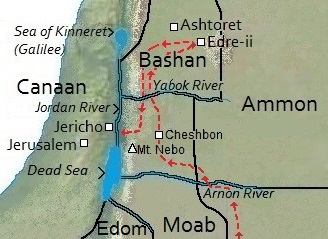
During this oration the Israelites are camped on the east bank of the Jordan River, right across from Jericho in the “promised land” of Canaan. The  book of Deuteronomy begins:

These are the words that Moses spoke to all Israel on the other side of the Jordan, in the wilderness, on the desert plain opposite Suf, between Paran and Tofel, and Lavan and Chatzerot and Di-Zahav. (Deuteronomy/Devarim 1:1)

Suf = reeds, water weeds; coming to an end

Paran = place of tree-branches, of beautifying with boughs

Tofel = probably an alternate spelling of tafeil = whitewash, whitewashing

Lavan = white; the name of Rebecca’s brother and Jacob’s uncle and father-in-law in the book of Genesis/Bereishit

Chatzerot = courtyards

Di-Zahav = enough gold

At first glance, the opening sentence seems to be giving coordinates for an actual geographic location.  Yet the place-names are all either invented, or located far away from the east bank of the Jordan. Why are they mentioned here?

Commentary as early as Targum Onkelos, from the first century C.E., found an alternate meaning in the list of supposed place-names. According to Onkelos, the list is a reminder of the times the Israelites made God angry during their wanderings in the wilderness. A few centuries later, the Talmud agreed, and it became the traditional interpretation of the verse.

Which offenses do the six place-names refer to? In other parts of the Torah, the word Suf is a place-name only in the combination Yam Suf, the Sea of Reeds (known in the English tradition as the Red Sea).  This is the sea the Israelites crossed to escape from the Egyptian army; it lay between Egypt and the Sinai peninsula, far away from the Jordan. When the Israelites came to the Red Sea, they asked Moses why God had brought them there to die; weren’t there enough graves in Egypt?

Paran was an unpopulated area just south of the Negev desert, south of the border of Canaan at the time.  The Israelites were camped there when Moses sent twelve men to scout out the “promised land” to the north, and ten of the twelve who reported back said that the Israelites could never win a battle against the residents of the land. The people rebelled against entering Canaan. According to classic commentary, Moses mentions Paran at the start of his speech in Deuteronomy to remind the surviving children of Israel that their fathers’ lack of trust in God doomed the people to wander in the wilderness for another 38 years. Now that they have another chance to cross into Canaan, albeit from a different border, they had better not repeat the earlier generation’s mistake!

No location named Tofel is mentioned anywhere in the Jewish bible, except in this single sentence. With a shift in vowels,  the word is tafeil, whitewashing or plastering over. First-century commentaries consider tafeil a metaphor for slander, and explain that the Israelites slandered the manna–which is described as  white, lavan, in Exodus/Shemot 31.

Chatzerot (Courtyards) was the name of the place the Israelites went right after Kivrot Hata-avah, the camp where they complained that they wanted meat instead of manna, and God sent quail–along with a plague (Numbers 11:35). In Chatzerot, Miriam and Aaron spoke against Moses on account of his wife, and God punished Miriam.

The last place in the list is  Di-Zahav, a variant of dai zahav, which means “enough gold”. Classic commentary pointed out that the Israelites brought so much gold out of Egypt, they could use it to make the golden calf at Mount Sinai. (Fortunately, they still had enough gold left over to make the furnishings for God’s sanctuary.)

Maybe the place-names in the first verse of Deuteronomy are indeed reminders of how the earlier generation of Israelites irritated God. Moses might begin his long speech with these reminders in the hope that the new generation would not repeat their parents’ mistakes. He knows he will die on the east side of the Jordan, so he will not be able to shepherd them.

On the other hand, in the original Hebrew there were no capital letters, no consistent way to indicate a word was a proper name.  The letter nun, pronounce like our letter N, was only occasionally added to an ordinary word to make it a place-name. So the first sentence of Deuteronomy could be legitimately translated with all of the so-called place-names as common nouns or verbs:

These are the words that Moses spoke to all Israel on the other side of the Jordan, in the wilderness, on the desert plain opposite coming to an end between beautifying and  whitewashing, and then whiteness and courtyards and enough gold(Deuteronomy/Devarim 1:1)

As Deuteronomy opens, Moses’ journey with the Israelites is coming to an end. Their end is on the opposite bank of the Jordan; his end is on the eastern side, where he will die. Should he give his people a glowing picture of Canaan, formerly described as the land of milk and honey, in order to increase their desire to cross over? Or would beautifying what lies ahead of them really be whitewashing it, covering up the hard reality that they will have to fight battles for the land?  Should he describe the land as full of white milk, and courtyards, and gold?

No, Moses decides; it is better if the Israelites do not expect to walk into a life of luxury.  Canaan is good land, but the people should not conquer it merely for the sake of its beauty, its food supply, its cities, its riches. They should conquer Canaan because God told them to.

And so after Moses hints at the beauty of the land across the Jordan, he begins his lengthy account of how the people  angered God on their journey, and how God helped them to seize the land on the east bank of the Jordan anyway, and how they must nevertheless go on.