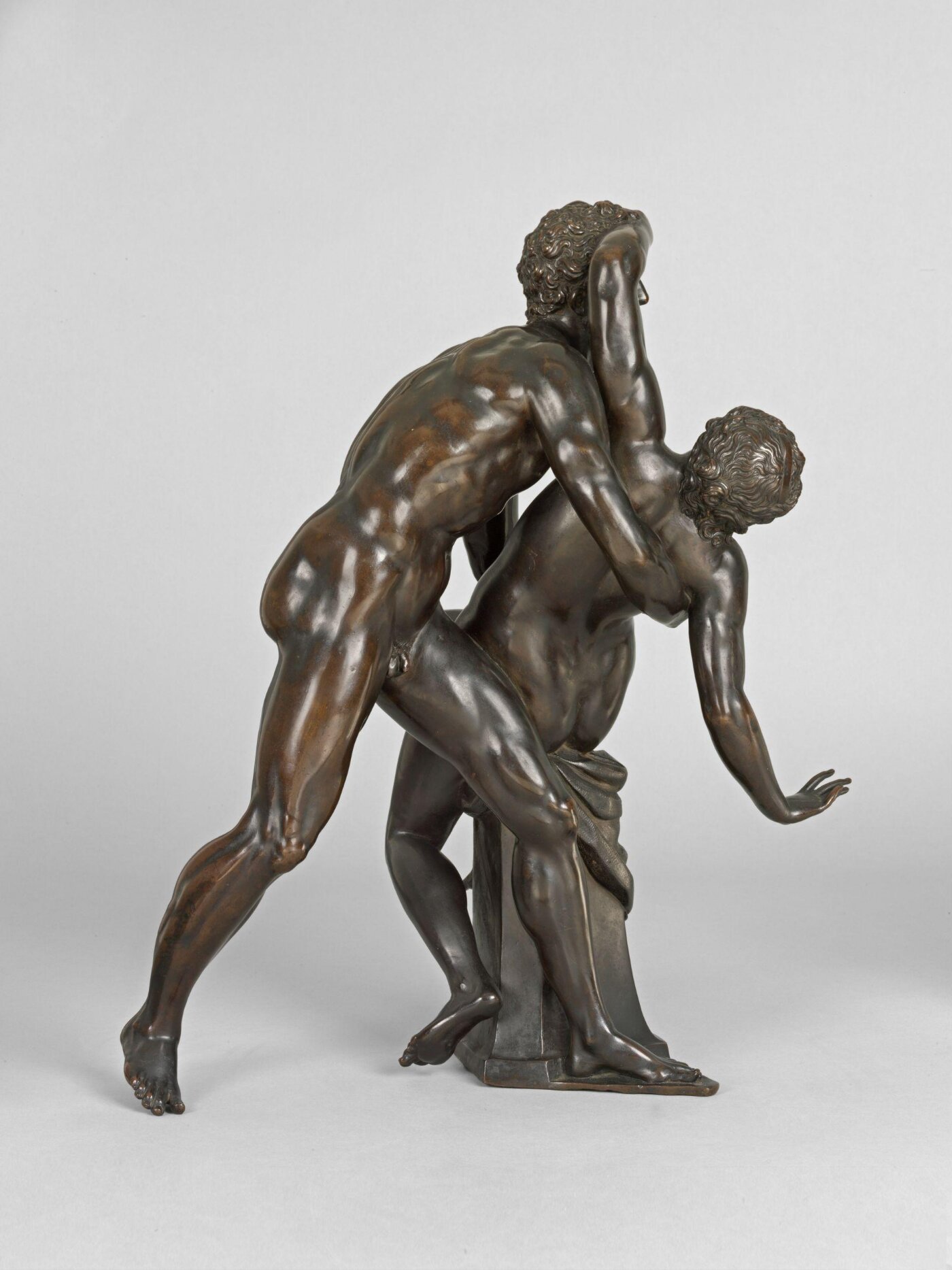
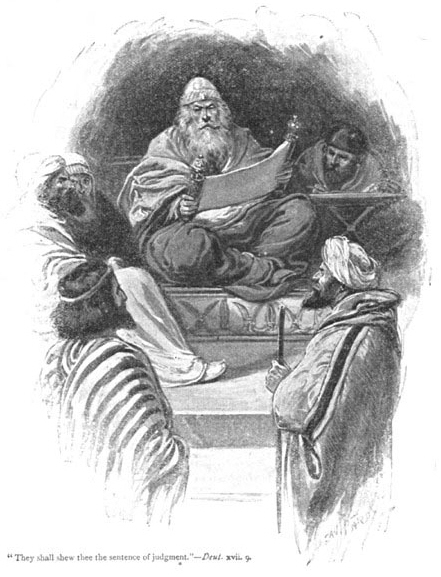
Vayishlach & Vayeishev: Yisrael Versus Ya-akov, Part 1

Jacob was born hanging onto the heel of his twin brother, Esau.

After that his brother emerged, and his hand was grasping the akeiv of his brother; so they called his name Ya-akov. (Genesis 23:26)

akeiv (עָקֵב) = heel.

Ya-akov (יַעֲקֺב) = “Jacob” in English. (From ya-ekov, יַעְקֺב  = he grasps by the heel; he cheats.)

The book of Genesis implies that from the beginning, Ya-akov wanted to be the firstborn son. In the Torah portion Toledot he tried to replace his brother twice, first by trading a bowl of stew for Esau’s inheritance as the firstborn, and then by impersonating Esau to steal their blind father Isaac’s blessing.

And Isaac loved Esau, because [Esau brought] hunted-game for his mouth. But Rebecca loved Ya-akov. (Genesis 25:28)

Their mother, Rebecca, arranged Jacob’s impersonation. Then when Esau vowed to kill his brother for cheating him twice, she arranged for Ya-akov to flee to her brother’s house in Padan-Aram. Twenty years later, Jacob returned with a large family of his own. On the eve of his reunion with Esau in last week’s Torah portion, Vayishlach (Genesis 32:4-36:43), Ya-akov receives a second name.

Vayishlach: A new name

And Ya-akov was left alone. And a man wrestled with him until dawn rose. (Genesis 32:25)
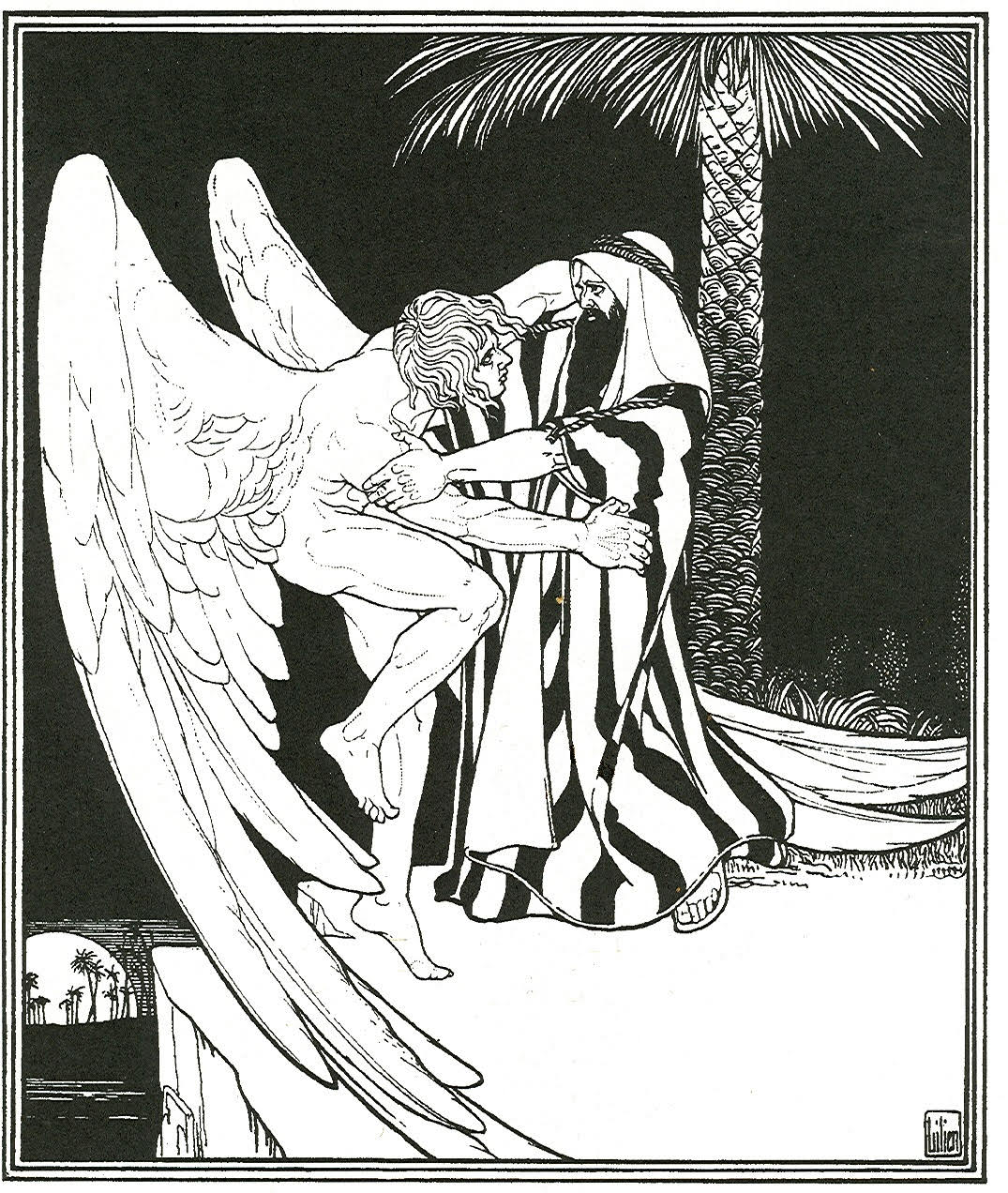
Jacob Wrestles, by Ephraim Moses Lillien, 1923

The Hebrew Bible often calls a divine messenger (or angel) a “man” at first. Other theories are that Jacob’s wrestling partner is a demon, or his own alter ego or subconscious.1 They wrestle all night, and neither prevails. Then the mysterious “man” dislocates Jacob’s hip and said:

“Let me go, because dawn has risen!” But Ya-akov said: “I will not let you go unless you bless me.” Then [the “man”] said to him: “What is your name?” And he said: “Ya-akov.” (Genesis 32:27-28)

Twenty years before, when Jacob impersonated Esau to steal their father’s blessing, Isaac had asked him to identify himself. At that time, Jacob had answered: “I am Esau.” (Genesis 27:19) But when Jacob asks the unnamed wrestler to bless him, he answers: Ya-akov.” (Genesis 32:28)

And [the “man”] said: “It will no longer be said that Ya-akov is your name, but instead Yisrael, because sarita with God and with men and you have prevailed.” (Genesis 32:29)

Yisrael (יִשְׂרָאֵל) = “Israel” in English. (Possibly yisar, יִשַׂר  = he strives, contends, perseveres + Eil, אֵל  = God, a god. This combination could mean either “God strives” or “He strives with God”.)

sarita (שָׂרִיתָ) = you strove, you persevered.

A much shorter, dryer story about Jacob’s new name appears later in the portion Vayishlach:

And God appeared to Ya-akov again when he came from Padan-Aram, and [God] blessed him. And God said to him: “Your name is Ya-akov. Your name will not be called Ya-akov again, because your name will be Yisrael.” (Genesis 35:9-10)

Modern scholars attribute the two versions of the naming story to two different sources; the story about wrestling probably comes from a non-P author, while the less colorful renaming by God comes from a P author.2 Both versions give Ya-akov the additional name Yisrael, so this is not a case of two traditions using two different names.

In subsequent biblical books, Yisrael is also the name of a people, Jacob’s descendants. And in biblical poetry, some couplets call the people both Ya-akov and Yisrael, treating the two names as mere synonyms.3

In the rest of the book of Genesis, Jacob son of Isaac is referred to as Ya-akov most often, but occasionally the text calls him Yisrael. Does the switch to Jacob’s new name mean anything?

Vayishlach: Equanimity?

The first time the narrative uses the name Yisrael is right after the household stops on the road so Jacob’s favorite wife, Rachel, can give birth. She dies right after Jacob’s twelfth and final son, Benjamin, is born.

Ya-akov set up a standing-stone over her grave … And Yisrael moved on and pitched his tent beyond the tower of Eider. (Genesis 35:20-21)

Ya-akov grieves over the death of his favorite wife. But Yisrael moves on; he is responsible for getting his flocks to good pastureland.

And it happened when Yisrael was residing in that land: Reuben went and lay with Bilhah, his father’s concubine. And Yisrael paid attention. (Genesis 35:22)

Yisrael pays attention, but he does not act. He does not even bring up the episode until he is on his deathbed. The old Ya-akov might have been overcome with outrage that his eldest son usurped him, taking possession of a woman who belongs to him. But the new Yisrael is either too tired to react, or willing to accept whatever happens.

Vayeishev: Playing favorites

This week’s Torah portion, Vayeishev (Genesis 37:1-40:23), begins with Jacob under his old name.

And Ya-akov settled in the land of his father’s sojournings, the land of Canaan. And these are the histories of Ya-akov: Joseph, seventeen years old, shepherded a flock along with his brothers, and he was a youth with the sons of Bilhah and the sons of Zilpah, wives4 of his father. And Joseph brought bad gossip to their father. (Genesis 37:1-2)

Joseph is Rachel’s first son, so Jacob loves him more than the sons of his other three wives.

And Yisrael loved Joseph more than all his sons, since he was a son of old age to him. And he made him a fancy tunic. And his brothers saw that it was he whom their father loved more than his brothers, so they hated him, and they could not speak to him in peace. (Genesis 37:3-4)

Jacob Blesses Joseph and Gives him the Coat,
by Owen Jones, 1865

Transparent favoritism is not surprising from someone who grew up with parents who favored one son over the other. But why did the author or redactor attribute this favoritism to Yisrael rather than to Ya-akov? After all the striving that Jacob did while wrestling with God’s messenger (and/or himself), we might expect Yisrael to choose peace in the family, and treat his sons more fairly, perhaps giving each one a different gift.5

Shortly after that, all ten of Joseph’s older brothers take the family flocks to Shekhem, a journey of about 60 miles (about 100 kilometers) from their home in Hebron.  

And Yisrael said to Joseph: “Aren’t your brothers shepherding in Shekhem? Go, and I will send you to them!” (Genesis 37:13)

Rashbam wrote: “The wording reflects Ya-akov’s surprise that Joseph’s brothers chose to tend their sheep in a dangerous location such as Shekhem, where they had killed the local inhabitants not so long ago.”6

At least Joseph’s brothers are ten strong young men traveling together. But why does Yisrael risk sending  the teenage Joseph to Shekhem alone? What if someone who remembered the massacre identifies him as a member of the notorious family of killers?

Maybe Jacob is in denial, having forgotten the atrocities his older sons committed in Shekhem. In that case, the name Yisrael here might indicate Jacob’s old age and his desire for peace, but not increased wisdom.

 And [Joseph] said to him: “Here I am.” And [Jacob] said to him: “Please go and  look into the well-being of your brothers and the well-being of the flocks, and bring back word to me.” (Genesis 37: 14)

Jacob deliberately sends out his favorite son to report on his brothers. Yet he does not seem to worry about the safety of the seventeen-year-old boy when he is far from home, surrounded by brothers who hate him (and may well assume he intends to bring back to their father more “bad gossip” about them).

Classic commentators7 maintained that Jacob assumed his older sons would never attack Joseph. Yet Jacob himself once had to flee to another country because his own brother had vowed to kill him. Perhaps in old age, Jacob was losing his ability to connect the past with the present.

On the other hand, Yisrael might realize that he has pampered Joseph too long. He might even realize that giving only Joseph an expensive gift had contributed to his favorite son’s feeling of entitlement, which then led to Joseph telling his jealous brothers his two dreams in which they bowed down to him.8 Perhaps Yisrael, the man who  wrestled with himself, sees Joseph’s psychological problem and takes the risk of sending him to Shekhem so he can learn self-reliance and grow up. He might even comfort himself with the thought that surely God would look after Joseph, and he would come home as a wiser young man.

Vayeishev: Mourning

Joseph finds no one in the vicinity of Shekhem except a man who tells him his brothers traveled on to Dotan. When he arrives in Dotan, his brothers seize him, throw him in an empty cistern, threaten to kill him, and finally sell him as a slave to a caravan bound for Egypt. Then they come up with a plan for fooling their father.

And they took Joseph’s tunic, and they slaughtered a hairy goat and dipped the tunic in the blood … and they brought it to their father and said: “We found this. Please recognize whether it is your son’s tunic or not.” (Genesis 37:31-32)
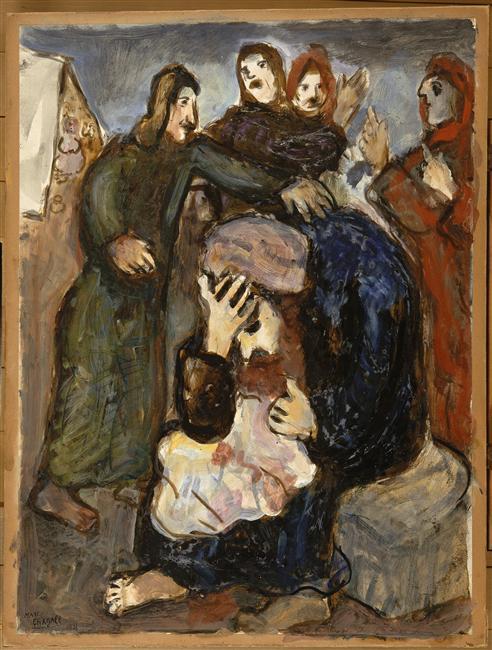
Jacob Weeps over Joseph’s Tunic,
by Marc Chagall 1931

Jacob falls for the deception; he assumes Joseph was eaten by a wild beast. He grieves as Ya-akov.

And Ya-akov tore his clothes, and he put sackcloth around his hips, and he mourned over his son a long time. And all his sons and all his daughters rose to comfort him, but he refused to be comforted. And he said: “If [only] I would go down to my son mourning, to Sheol!” And his father wept for him. (Genesis 37:34-35)

Jacob is entitled to grieve a long time over the death of his favorite son. But Ya-akov’s reaction is almost selfishly extravagant, consistent with his self-absorption while he was growing up: he rejects his children and grandchildren, and declares that he wants to die. His alter ego, Yisrael, does not have a chance to emerge.

The Torah does not refer to Jacob as Yisrael again until next week’s Torah portion, Mikeitz. Stay tuned for my next post, Mikeitz: Yisrael versus Ya-akov, Part 2.


  1. See my post Toledot & Vayishlach: Wrestlers.
  2. The documentary hypothesis discerns four traditions braided into the Pentateuch, named J, E, P, and D by Julius Wellhausen in the 19th century. In the 21st century the scholarly consensus is that there were more than four writers, and the story lines previously identified as J and E should all be called “non-P”. “P” is the “priestly” tradition, which was more interested in priestcraft than in narrative.
  3. Robert Alter, The Five Books of Moses, W.W. Norton & Co., New York, 2004, p. 181.
  4. Genesis always calls Leah and Rachel Jacob’s wives. Bilhah and Zilpah are their slaves, but after they become Jacob’s concubines, they are sometimes called his wives.
  5. This is what Jacob’s grandfather Abraham did in Genesis 25:5-6.
  6. Rashbam (12th-century Rabbi Shmuel ben Meier) translated in www.sefaria.org. In Genesis 34:1-31, Jacob’s older sons tricked all the men of the town of Shekhem into circumcising themselves, then slaughtered them and took their women and children as booty.
  7. Including Radak (Rabbi David Kimchi, ca. 1200), Chizkuni (editor Chizkiah ben Manoach, 13th century), and Or HaChayim (Rabbi Chayim ibn Attar, 18th century).
  8. See my post: Vayeishev: Favoritism.
Haftarat Vayishlach—Obadiah: Pulled Down

This week’s haftarah is the entire book of Obadiah, which is one chapter long! Obadiah protests that when the Babylonian army destroyed Jerusalem and its temple in 587-586 B.C.E., the small kingdom of Edom took advantage of the chaos to prey on their Israelite neighbors.

Didn’t you come into the gate of my people
on its day of calamity?
Didn’t you, too, look at its misery
on its day of calamity?
And didn’t you reach out for its wealth
on its day of calamity? (Obadiah 1:13)
And didn’t you stand at the crossroads
to cut down its fugitives?
And didn’t you deliver up its survivors
on the day of distress? (Obadiah 1:14)
When the Day of God draws near
against all the nations
As you did, it will be done to you.
Your dealings will come back on your head! (Obadiah 1: 15)
Obadiah, by James Tissot, ca. 1900

The rest of the book predicts that God will take revenge by utterly destroying the Edomites. I have not written about this haftarah before because revenge fantasies turn me off. But there is more than one way to interpret the Hebrew Bible.

How to interpret the bible

Back in the 1st century C.E., before the Romans destroyed the second temple in Jerusalem, Philo of Alexandria interpreted some passages in Genesis as allegories of Stoic philosophical concepts, identifying the characters with universal human aspects. (For example, Adam is the mind, Eve is the senses, and Noah is the state of tranquility.)

An allegorical tale in the 5th-century Babylonian Talmud tractate Chagigah features four actual Jewish scholars from the first century C.E., each with a different approach to biblical interpretation.1 They all enter pardeis (פַּרְדֵּס, the Persian word for “orchard”, a metaphor for deep Torah study which eventually became the English word “paradise”), but only one of them comes out whole. Rabbi Elisha ben Avuya, a.k.a. Acheir (אַחֵר, “Other”), was a literalist who found contradictions in the bible; Chagigah says he became a heretic. Tanna Shimon Ben Zoma found metaphorical meanings, and tried to reconcile different texts that employed the same uncommon Hebrew words; Chagigah says he lost his mind. Tanna Shimon Ben Azzai was a mystic; Chagigah says he died beholding God’s presence. Only Rabbi Akiva, who used reason to determine which biblical phrases should be taken literally and which metaphorically, left pardeis in the same condition as when he entered.

In the 13th century, the Spanish kabbalist Moshe de León pioneered the use of the word pardeis as an acronym for four types of exegesis, which Jews still use:

Peshat (פְּשַׁט, “stripped down”) is the plain, literal meaning of a text.

Remez (רֶמֶשׂ, “swarming creatures”) expands the literal meaning to cover similar situations, and transforms texts into allegories.

Derash (דְּררַשׁ, “inquiry”) adds to a text by drawing moral lessons from it, and/or inventing additional details to enhance a story’s meaning.

Sod (סוֹד, “secret”) uses words to point at an esoteric mystery that cannot be expressed in words.

Applying PaRDeiS to the haftarah

Before indicating what crimes the Edomites committed against the Israelites in Jerusalem, Obadiah quotes God as telling Edom:

The arrogance of your heart deceived you,
Dwellers in the clefts of the cliffs.
High in your dwellings, saying in your heart:
“Who could pull me down to earth?” (Obadiah 1:3)
If you were lofty as an eagle,
Or if you put your nest between the stars,
From there I will pull you down,
Declares God. (Obadiah 1:4)

A peshat reading of these two verses would point out that the ancient kingdom of Edom (located in the south of what we now call Jordan) was mountainous and rocky, poor for agriculture but easy to hide in and difficult to invade. The plain meaning is that the Edomites mistakenly believe they are invulnerable—even from God.

A Talmudic remez reading is that “the stars” means “the just”.2 Edomites believe they are among the just, but the book of Genesis says they are descended from Esau, Jacob’s undesirable brother. Midrash Tanchuma cited God’s promise to Abraham that his descendants would be like the stars in the heavens, and concluded that Obadiah’s reference to stars “can only mean Israel”.3

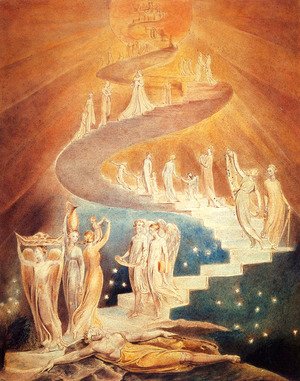
Vayikra Rabbah combined Obadiah 1:4 with Jacob’s dream in Genesis 28:12, then added to the story with the following derash:

Jacob’s Ladder, by William Blake

“It teaches that the Holy One, blessed be He, showed Jacob the guardian angel of Babylon ascending and descending, of Media ascending and descending, of Greece ascending and descending, and of Edom ascending and descending. The Holy One blessed be He said to Jacob: ‘You, too, will ascend.’ At that moment, Jacob our patriarch grew fearful and said: ‘Perhaps, God forbid, just as there was descent for these, so it will be for me.’ The Holy One, blessed be He, said to him: ‘You, have no fear; if you ascend, there will be no descent for you forever.’ He did not believe, and he did not ascend. … The Holy One blessed be He said to him: ‘Had you believed and ascended, you would never have descended. Now that you did not believe and did not ascend, your descendants will be subjugated by the four kingdoms in this world with land taxes, produce taxes, animal taxes, and head taxes.’”4

My own derash interpretations tend toward drawing moral lessons.5 What strikes me about Obadiah’s two verses on Edom’s arrogance is the idea that arrogant people believe they occupy high positions because they are superior. But their high positions are both barren (rocky) and precarious (cliffs).

The arrogant are afraid of being pulled down to earth. They spend so much time and energy defending their status and egos that they accomplish less than humble, hard-working people—from down-to-earth farmers to the rabbis and other religious leaders who care more about their work than about self-glorification.

But when the arrogant are successful, they question whether anything could pull them down. Obadiah points out that they are wrong. These exalted narcissists are not eagles, but human beings. Even autocrats and superstars are vulnerable, because they live in the complex world of human interactions. Millions of people may look up to them now, but anyone can fall off the cliff. Anyone can be pulled down.

It is better to do good work on the ground than to “put your nest between the stars”.

That is my derash. I am not a mystic, although I know a little about kabbalah, so a sod reading is beyond me; it might as well be between the stars.


  1. Talmud Bavli, Chagigah 14b.
  2. Talmud Yerushalmi, Nedarim 3:8:2.
  3. Midrash Tanchuma, 500-800 C.E., translated in www.sefaria.org, citing Genesis 15:5.
  4. Vayikra Rabbah 29:2:, circa 500 C.E., translated in www.sefaria.org.
  5. I reserve fleshing out biblical stories with additional narrative for my Torah monologues.

Vayeitzei: Father Figures

And Jacob went out from Beersheba and went toward Charan. (Genesis 28:10)

The first verse in this week’s Torah portion, Vayeitzei (“And he went”, Genesis 28:10-32:3), sounds simple—until you consider the family Jacob is leaving behind in Beersheba.

In last week’s Torah portion, Toledot, Jacob cheated his twin brother, Esau (older by a minute), into trading his firstborn rights for a bowl of lentil stew.1 Years later their father, Isaac, announced he would give his deathbed blessing to Esau, his favorite. The twins’ mother, Rebecca, talked Jacob, her own favorite, into impersonating his brother and stealing the blessing.2

When Esau found out, he vowed to kill his brother as soon as their father died. Rebecca urged Jacob to flee for his life, then maneuvered her husband into ordering Jacob to go to her old hometown in northern Mesopotamia and get a wife.3 At least Isaac gave Jacob a blessing of his own to send him off.4

Jacob turns his back on Isaac

What is Jacob thinking as he hikes north toward Charan? In my post Vayeitzei: Guilty Conscience, I argue that he might feel guilty about his deceptions—guilty enough to leave at once, without waiting for his wealthy father to give him a bride-price, pack animals, and a servant or two for the journey. Jacob does not even ask his father for a bag of silver; he arrives in Charan with nothing but his walking stick.

Besides guilt, Jacob may feel relief and a sense of freedom. For the first time in his life he is on his own, away from his remote father, his controlling mother, and his big, hairy, primitive brother.

Jacob’s Dream, German, 14th century

On the first night of his journey Jacob lies down with his head on a stone, and dreams about a ramp or stairway from the ground to the heavens, with divine messengers ascending and descending on it.

And hey! God stood above him and said: “I am Y-H-V-H, god of Abraham your av, and god of Isaac. The land that you are lying on, I will give to you and to your descendants.” (Genesis 28:13)

av (אָב) = father; someone in the role of a father (usually God or the head of a household or clan).

Why does God put it that way? Abraham is Isaac’s father, and Isaac is Jacob’s father. Jacob and his grandfather Abraham never interact in the book of Genesis, probably because Isaac and Abraham were estranged.5 So Abraham was neither a nurturer, nor an authority figure, nor a role model for Jacob.

According to 18th-century Rabbi Chayim ibn Attar, God means that Jacob is Abraham’s sole heir:

“The reason … was intended to emphasize that Esau had no share in the heritage of Abraham. The Torah here made Jacob the sole heir of Abraham. This heritage did not come to Jacob via his father Isaac but directly from his grandfather Abraham. … the fact that all the blessings of Abraham were transferred to Jacob excludes Esau as an heir.”6

According to 19th-century Rabbi S.R. Hirsch, God means that Jacob is Abraham’s spiritual successor:

“Nowhere else in Scripture do we find such a thing that the grandfather is called ‘father,’ with the father himself mentioned right afterward as though he were a stranger. …Jacob truly was the successor of Abraham, with Isaac being only the intermediate link.  Spiritually, Abraham was Jacob’s father.”7

But according to 21st-century Rabbi Shmuel Klitsner, it means Jacob wants Abraham’s God:

“… the Talmud records the observation … that in dreams, ‘a person is shown nothing if not the inner thoughts of his own heart’ (BT, Tractate Berakhot 55b). … It seems clear that in Jacob’s ‘inner thoughts of heart’ the Lord who will comfort him will be the Lord of Abraham his father. As for the God of Isaac (his genetic father), there is a missing relational adjective, as the very situation that begs comfort, Jacob’s precarious homeless state, is a result of his having betrayed the father-son relationship.”8

Does the phrase “god of Abraham your father” signal that only Jacob and his descendants will inherit what God promised to his grandfather Abraham (ibn Attar)? Or that Jacob will have the same relationship with God as Abraham (Hirsch)? Or that Jacob wants Abraham’s God rather than Isaac’s? (Klitsner)?

Does Jacob inherit Abraham’s blessings?

Chayim ibn Attar’s proposal is supported by the next words God says in Jacob’s dream:

“And your descendants will be like the dust of the land, and you will spread out to the west and to the east, to the north and to the south. And all the clans of the earth will be blessed through you and your descendants.” (Genesis 28:14)

This statement echoes two of the blessings God gave to Abraham:

“All the land that you see, I give it to you and to your descendants forever. And I will make your descendants like the dust of the earth, in that if a man were able to count the dust of the earth, your descendants could also be counted.” (Genesis 13:15-16)

“I will bless those who bless you, and those who despise you I will curse, and all the clans of the earth will be blessed through you.” (Genesis 12:3) Thus God promises both Abraham and Jacob that their descendants will be as uncountable as the dust, that their descendants will own the land, and that they will become a blessing to everyone on earth. Jacob does indeed inherit Abraham’s blessings.

Is Jacob Abraham’s spiritual successor?

However, Hirsch’s proposal that Abraham, not Isaac, is Jacob’s spiritual father gets only weak support from the book of Genesis. Abraham hears God speak on twelve occasions in the book of Genesis. Isaac hears God speak once.9 And Jacob hears God speak three times: once during Jacob’s ladder dream at the beginning of this week’s Torah portion, and twice when he returns to the same spot 20 or more years later.10 (Jacob also tells Leah and Rachel that God also spoke to him in a dream telling him to leave Charan and return to his native land,11 but since he had already decided to go, he might have invented this dream in order to secure his wives’ consent.)

Jacob never experiences the intimacy Abraham has with God. Abraham and God have six conversations.12 In one of these conversations, Abraham talks God into refraining from obliterating Sodom if the city has at least ten innocent men.13 Jacob hears God speak, but never answers. Once Jacob prays to God to rescue him, but God is silent.14

In addition to the conversations between Abraham and God, God speaks to Abraham another six times to deliver an order or a promise, or both.15 Abraham obeys all of God’s orders, even when God tests him by telling him to sacrifice his son Isaac.16 Jacob obeys God’s only order to him, to build an altar at Beit Eil.17

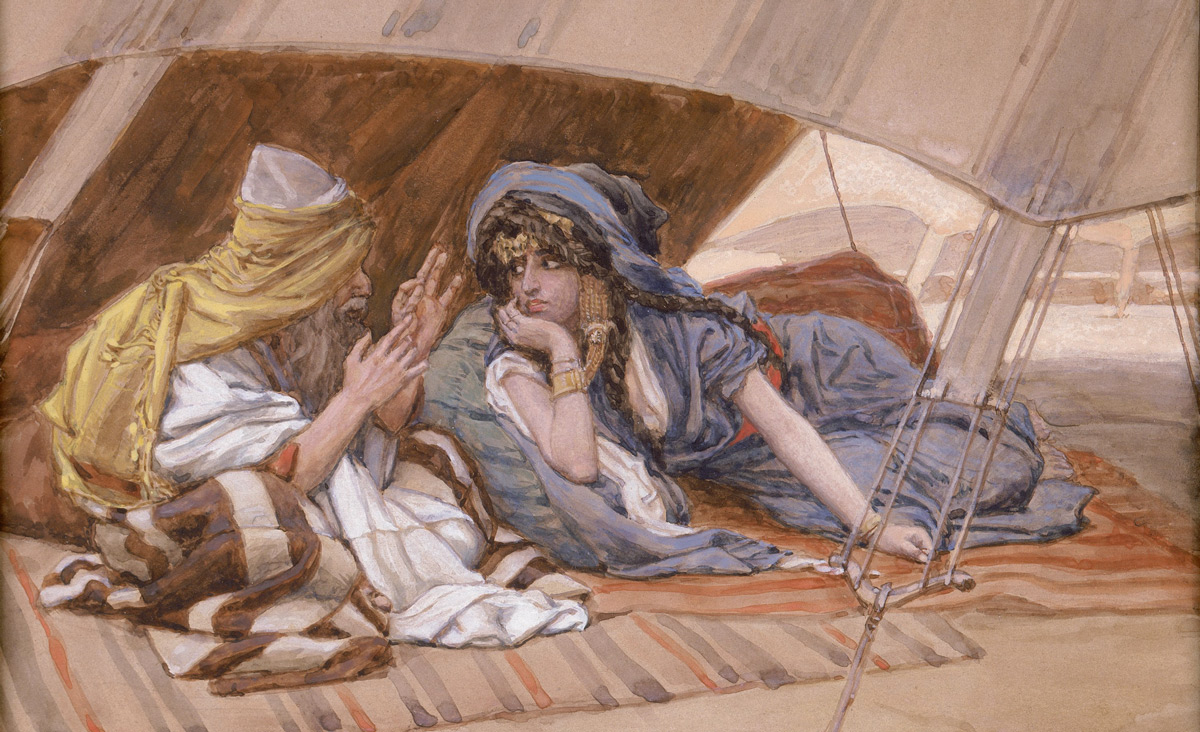
Abraham persuades Sarah, by James Tissot, ca. 1900, detail

Furthermore, God cooperates with Abraham’s scams. Twice when Abraham arranges for his wife, Sarah, to be carried off to a king’s harem, God afflicts the king so he cannot have sex with her.18

In short, God spends a lot more time with Abraham than with Jacob, and the two of them have a real relationship. With Jacob, God is almost as distant as with Isaac.

Is Jacob the heir to Abraham’s God?

What about Klitsner’s proposal that Jacob wants Abraham’s god rather than Isaac’s?

Near the end of this week’s Torah portion, Jacob has left Charan and is heading to Canaan with his family, servants, and herds, when Lavan (his employer, uncle, cousin, and father-in-law) catches up with him in a mountain pass. Lavan accuses Jacob of stealing his daughters—Jacob’s wives. Jacob accuses Lavan of cheating him multiple times as his employer. Jacob concludes:

“Had not for the god of my father—the God of Abraham and the Pachad of Isaac—been for me, certainly now you would have sent me off empty-handed!” (Genesis 31:42)

pachad (פַּחַד) = terror.

Twenty years after he left home and dreamed of the ladder, Jacob now calls both Abraham and Isaac his father.

The two men set up stones to serve as a boundary, and they both swear not to cross it for any harmful purpose. Lavan says:

The Heap of Witness, Holman Bible, 1890

“May the God of Abraham and the God of Nachor judge between us—the God of their father.” (Genesis 31:53a)

Lavan is referring to a single god, Y-H-V-H, worshiped by the both Abraham and Nachor, their respective paternal grandfathers. We know that Abraham and his brother Nachor had the same god because earlier in Genesis Lavan and his father said Rebecca’s marriage to Isaac “went forth from Y-H-V-H” (Genesis 24:50).19

But Jacob swore by the Pachad of Isaac. (Genesis 31:53b)

Twice Jacob calls God the Pachad of Isaac. There is no indication in the book of Genesis that Isaac threatened Jacob, with a punishment from God or any other way. So Jacob must be thinking about the defining event in Isaac’s life, when God ordered Abraham to sacrifice him, and did not call it off until Abraham had bound his son on an altar and put a knife to his throat.20

Jacob invokes Isaac’s God as a source of terror in order to make an implied threat against Lavan. But when he left home twenty years before, he did not want the Pachad of Isaac. He wanted a protective God who would help him out of tight spots the way God helped Abraham get his wife back from two kings.

And that is what Jacob got at the end of his dream about the ladder. After saying that Jacob’s descendants will own the land and be a blessing to the world, God added:

“And hey! I myself am with you. And I will guard you wherever you go, and I will bring you back to this ground, because I will not leave you until I have done what I have spoken to you.” (Genesis 28:15)

Then Jacob wakes up. The God of Abraham has promised to protect him.

He has a new father figure.


  1. Genesis 25:29-34. (See my post: Bereishit & Toledot: Seeing Red.)
  2. Genesis 27:1-30. (See my post: Toledot: To Bless Someone.)
  3. Genesis 27:31-28:5.
  4. Genesis 28:3-4.
  5. Ever since Abraham bound Isaac as a sacrifice and almost cut his throat (Genesis 22:1-19). See my post: Vayeira: Stopped by an Angel.)
  6. Chayim ibn Attar, Or Hachayim, translation in www.sefaria.org.
  7. Samson Raphael Hirsch, The Hirsch Chumash: Sefer Bereshis, translated by Daniel Haberman, Feldheim Publishers, Jerusalem, 2002, p. 602.
  8. Shmuel Klitsner, Wrestling Jacob, Urim Publications, Jerusalem, 2006, pp. 82-83.
  9. Isaac hears God speak to him, and builds an altar for God, in Genesis 26:24-25.
  10. Genesis 35:1, 35:9-13.
  11. Genesis 31:9-13.
  12. Genesis 15:1-11, 17:1-22, 18:9-10, 18:17-33, 22:1-2, 22:11-12.
  13. Genesis 18:17-33. (See my post: Vayeira: Who Is the Teacher?)
  14. Genesis 32:10-13.
  15. Genesis 12:1-4, 12:7, 13:14-18, 15:12-21, 21:12-13, 22:15-18.
  16. Genesis 22:1-10.
  17. Genesis 35:1-7.
  18. Genesis 12:11-20, 20:1-18.
  19. See my post Vayeitzei: Awe versus Terror for the complete inbred family tree.
  20. Genesis 22:9-12.

Haftarat Toledot—Malakhi: For the Sake of Integrity

Malakhi is the last book of the Prophets, written shortly after the second temple in Jerusalem was built (circa 516 BCE) and priests were once again burning offerings at the altar. But the priests were derelict in their duties, according to this week’s haftarah1 reading, Malakhi 1:1-2:7.

The book opens with God claiming credit for turning the kingdom of Edom into ruins, and warning that God can make Judea2 and its capital, Jerusalem, just as desolate. Why would God want to do that? Because the priests in Jerusalem are holding God’s “name” (i.e. reputation) in contempt.

Altar from Treasures of the Bible,
Northrup, 1894

And you say: “In what way have we held your name in contempt?” By bringing defiled food to my altar. And you say: “In what way have we defiled you?” By thinking God’s table can be despised.  (Malakhi 1:6-7)

The altar is poetically called God’s table, as if God were eating the meat, even though the Hebrew Bible goes no farther than imagining that God enjoys the smell of the smoke from the altar.3

First God accuses the priests of offering animals that are defiled because they are blind, lame, or diseased. These offerings are strictly prohibited in the book of Leviticus, which orders:

Anything that has a blemish in it, you must not offer, since it will not be accepted for you. (Leviticus 22:20)4

The book of Malakhi emphasizes that God will not accept blemished offerings.

And if you offer the blind as a slaughter-sacrifice, it is not bad? And if you offer the lame or the diseased, it is not bad? Offer it, if you please, to your governor! Will he be pleased with you, or lift your face [acknowledge you favorably]? (Malakhi 1:8)

Burning defective animals on the altar is useless, God says. It would be better to shut the doors of the temple and let the fire on the altar go out.

I take no pleasure in you, said the God of Hosts, and I will accept no gift from your hands. (Malakhi 1:9)

Even the countries around Judea honor God more than the priests in Jerusalem.

My name is great among the nations, said the God of Hosts. But you profane it … And you say: “Hey, what a bother!” … And you bring the stolen, the lame, and the sick.  (Malakhi 1:11-13)

Here God adds another category of gifts that only defile God’s altar: stolen animals. But then the book of Malakhi returns to the argument that a ruler does not want flawed animals:

A curse on the deceitful one who has [an unblemished] male in his flock, but he vows and slaughters some ruined one to my lord! Because I am a great king, said the God of Hosts, and my name is held in awe among the nations. (Malakhi 1:14)

Next comes a warning that God will curse the priests.

If you do not take heed and you do not set it in your heart to give honor to my name, said the God of Hosts, then I will send a curse upon you, and I will curse your blessings … (Malakhi 2:2)

These blessings, according to Rashi,5 include the grain, wine, and oil the priests receive from the people. The late Rabbi Adin Steinsaltz added that the it might mean “the blessings for which you pray, or the blessings with which you bless the people, the priestly benediction”.6 If the blessings that the priests pronounce backfired, then the people would despise the priests.

The High Priest, by James Tissot, ca. 1900

This week’s haftarah ends:

For the lips of a priest guard knowledge, and instruction is sought from his mouth; for he is a malakh of the God of Hosts. (Malakhi 2:7)

malakh (מַלְאַךְ) = messenger.

A malakh of God almost always turns out to be a divine being, or angel, as a manifestation of God. This verse is one of the rare exceptions. Rashi pointed out that both a divine malakh and a priest serve God and enter a holy place where God dwells.


There has been no temple in Jerusalem for almost two thousand years, and the distant descendants of priests have only minor roles in Jewish services. So why should we care whether the priests in the time of Malakhi were negligent? Does anything in this haftarah apply to us?

I think the underlying problem in the book of Malakhi is that the priests are two-faced. They maintain the appearance honoring God and doing their work reverently, when in reality they cut corners out of laziness (“Hey, what a bother!”—Malakhi 1:13). They even turn a blind eye to theft. Yet part of their job is to instruct the people about God’s laws!

The book of Malakhi gives an obvious example of this kind of deception. But it is easy to cheat when you are the boss, when you are responsible for work that affects others but does not mean much to you personally. If people who lead religious services today carefully follow the rules and rituals, and do whatever they can to make the services inspiring, then they are acting with integrity regarding their job—even if they are atheists. But if they ignore the rules, rush or plod through the services, and do a shoddy job, they are acting without integrity—whether they believe in God or not.

May we act with integrity in all the positions where we have authority, striving to do the job right, without cheating.


  1. Every week in the year is assigned a Torah portion (a reading from the first five books of the bible), and a haftarah (a reading from the Prophets).
  2. Malakhi was written after the Persian Empire had swallowed the Babylonian Empire, and Cyrus the Great had proclaimed that ethnic groups could rebuild their shrines and exercise limited self-governance in their provinces. The biblical books of Ezra and Nehemiah describe how those two leaders brought Israelites who had been held captive in Babylon back to the province of Judea, and rebuilt Jerusalem and its temple.
  3. See my post: Pinchas: Aromatherapy.
  4. See my post: Emor: Flawed Worship.
  5. Rashi is the acronym of 11th-century Rabbi Shlomoh Yitzhaki, whose commentary is still universally cited.
  6. Rabbi Adin Steinsaltz, Introductions to Tanakh: Malachi.

Vayeira: Who Is the Teacher?

Abraham and God debate the fate of Sodom in this week’s Torah portion, Vayeira (Genesis 18:1-22:24).

The portion is called Vayeira, (וַיֵרָא) “And he appeared”, because in the first sentence God appears to Abraham—as three men.

Abraham and the Three Angels,
by Bartolome Esteban Muriollo, 1670-1674

Abraham provides lavish hospitality, as he would for any humans trekking across the sparsely populated hills to his campsite at Mamre (near present-day Hebron). Then one of the “men” tells Abraham his wife Sarah (who is 89 years old) will have a son. And without transition, the text reports God speaking first to Abraham, then to Sarah.1 Often in the Hebrew Bible a man turns out to be a divine messenger or angel, and the transition between the messenger speaking and God speaking is seamless.

Then the men got up from there, and they looked down at Sodom. And Abraham was walking with them to send them off. (Genesis 18:16)

The “men” and Abraham walk to a hilltop from which they could look down at the Dead Sea and the towns of Sodom and Gomorrah near its shore.

Next comes a Shakespearean aside, in which God’s thoughts are expressed in words.

And God said: Will I hide from Abraham what I am doing? (Genesis 18:17)

Whenever the Hebrew Bible reports a character’s silent thoughts, the text uses the verb “said” (amar, אָמָר), but the context makes it clear that the character is saying something silently to himself or herself. Here, God continues thinking:

For Abraham will certainly become a nation great and numerous, and all the nations of the earth will be blessed through him. (Genesis 18:18)

The God character is recalling the promise at the beginning of last week’s Torah portion, Lekh Lekha. There, God told Abraham to leave his home and go “to the land that I will show you”, which turned out to be Canaan.

“And I will make you a great nation, and I will bless you, and I will make your name great. … And all the clans of the earth will seek to be blessed through you.” (Genesis 12:2-3)

Abraham did indeed leave home and go to Canaan. But the future that God promised can only happen if Abraham teaches his people the right behavior. God thinks:

ForI have become acquainted with him so that he will give orders to his sons and his household after him; then they will keep the way of God to do tzedakah umishpat, so that God will bring upon Abraham what [God] spoke concerning him. (Genesis 18:19)

tzedakah (צְדָקָה) = righteousness, acts of justice. (From the root tzedek, צֶדֶק = right, just.)

umishpat (וּמִשְׁפָּט) = and mishpat (מִשְׁפָּט) = legal decision, legal claim, law.

One way to translate tzedakah umishpatis: “what is right and lawful”. The way Abraham will become a great nation that is a source of blessing, God thinks, is by teaching the way of God—what is right and lawful—to his household, so they will pass on the information to the generations after him.

Why God is teaching Abraham

Naturally God wants Abraham to convey the correct information about the way of God. Now God is wondering whether it would be helpful to tell Abraham what is about happen in Sodom.

We know God switches from thinking to speaking out loud—or at least speaking so that Abraham can hear—because he responds to what God says next.

Then God said: “The outcry of Sodom and Gomorrah is great, because their abundant guilt is very heavy! Indeed I will go down, and I will see: Are they doing like the outcry coming to me? [If so,] Annihilation! And if not, I will know.” The men turned their faces away from there and they went to Sodom, while Abraham was still standing before God. (Genesis 18:20-22)

The God character in the Torah sees and hears a lot from the heavens above, but not everything, so sometimes God or a divine messenger comes down to the earth for more information.2 Abraham now knows that if Sodom is as guilty as God has heard, God will annihilate it. Why does God give him that information ahead of time? Perhaps God is testing Abraham, prompting him to think through what is right and lawful in a particular situation. If Abraham asks God a question about the divine plan for Sodom, they can discuss it—a subtle form of teaching.

Is Abraham teaching God?

Then Abraham came forward and said: “Would you sweep away the tzadik along with the wicked one?” (Genesis 18:23)

tzadik (צַדִּיק) = righteous, innocent. (Also from the root tzedek. The Hebrew Bible applies this adjective to men, nations, and God.)

Lot Prevents the Sodomites from Raping the Angels,
by Heinrich Aldegrever, 1555

Abraham probably knows already what God is about to find out: that rape and murder are rampant in Sodom. After all, his own nephew, Lot, lives in that city. And Lot knows that travelers are not safe in the town square after dark. Later in the Torah portion, after Lot has brought the two divine messengers who look just like men into his own house to spend the night, the other men in Sodom come to his door and order him to bring the strangers out to be raped. And Lot knows they will not take no for an answer.4

But so far, Lot has done nothing immoral himself, though he has tolerated the immorality around him. And as far as Abraham knows, there might be other innocent men in Sodom.

Abraham asks God:

“What if there are fifty tzadikim inside the city? Would you sweep away, and not pardon the place, for the sake of the fifty tzadikim who are in it? Far be it from you to do this thing, to bring death to the tzadik along with the wicked! Then the tzadik would be like the wicked. Far be it from you! The judge of all the earth should do justice!” (Genesis 18:24-25)

tzadikim (צַדִּיקִם) = plural of tzadik.

According to the commentary Or HaChayim, when Abraham said then the tzadik would be like the wicked, he meant that “if God applied the same yardstick to all creatures alike, the righteous would be deprived of every incentive to be righteous.”5 So the tzadikim in Sodom would give up and join their neighbors in doing evil.

However, not every man thinks raping and murdering other men would be fun if he could get away with it. So I think Abraham means that if God annihilates the whole city, God would be treating the tzadik just like the wicked man—which would be unjust.

And God said: “If I find in Sodom fifty tzadikim in the midst of the city, then I will pardon the whole place5 for their sake.” (Genesis 18:26)

Why does the God character agree immediately with Abraham’s request?

One answer is that God intended from the beginning to spare Sodom if there were enough tzadikim in the city; that is why God sent the two messengers down to find out how bad things really were. Abraham is merely suggesting a number.

Abraham answered, and said: “Hey, please, I am willing to speak to my lord, and I am dust and ashes. Perhaps the fifty tzadikim lack five. Will you ruin the whole city on account of the five?” And [God] said: “I will not ruin if I find forty-five there.” (Genesis 18:27-28)

Abraham’s reference to himself as dust and ashes is probably an expression of humility, intended to salve God’s pride. After all, Abraham is attempting to teach a being who could kill him in an instant.

Abraham asks if God would annihilate the whole city if there are forty tzadikim, then thirty, then twenty. Each time God promises to refrain from destroying Sodom for the sake of that number of tzadikim. Then Abraham says:

“Please don’t be angry, my lord, and I will speak just once more. Perhaps ten will be found there.” And [God] said: “I will not ruin, for the sake of the ten.” And God left, as [God] had finished speaking to Abraham. And Abraham returned to his [own] place. (Genesis 18:33)

Why does Abraham stop with ten? Perhaps he just assumes that there must be more than ten tzadikim in Sodom.

But according to S.R. Hirsch, God agreed to save Sodom not in order to keep the ten innocent men alive, but because a society that tolerated a certain number of righteous people was not totally evil, and so might someday reform. The number matters; “Only in the case of a medium number—where the righteous are too many to be inconsequential and too few to be intimidating—does the fact that the righteous are allowed to exist and are tolerated have full significance.”6

This explanation makes the God character more optimistic and forgiving than in the many Torah passages where God sends plagues to punish the Israelites for infractions in which not everyone participated, and arranges mass slaughters of non-combatants in war. Perhaps the God character does not fully absorb Abraham’s lesson.

What do God and Abraham teach?

The God character, by agreeing with each of Abraham’s proposals, teaches him that questioning God is acceptable and worthwhile.

According to Jonathan Sacks,7 “Abraham had to have the courage to challenge God if his descendants were to challenge human rulers, as Moses and the Prophets did. … This is a critical turning point in human history: the birth of the world’s first religion of protest—the emergence of a faith that challenges the world instead of accepting it. … meaning: be a leader. Walk ahead. Take personal responsibility. Take moral responsibility. Take collective responsibility.”

But Abraham also teaches God something, when he says: Far be it from you to do this thing, to bring death to the tzadik along with the wicked! … The judge of all the earth should do justice!”

According to Jerome Segal,8 “In arguing that justice requires that the innocent be treated differently from the guilty, Abraham is not only asserting a moral principle but also asserting that it is binding upon God. Thus, the independence of the moral order is again affirmed. Morality does not depend on God for its reality. It stands apart as something to which God must conform.”


Thus God teaches Abraham what is right and just, and Abraham teaches God what is just and right. It takes both of them to advance the cause of morality.

Now it is our turn to consult our inner voices of conscience and reason and advance the cause further.


  1. Genesis 18:9-15. See my post: Vayeira: On Speaking Terms.
  2. The first example in Genesis of God coming down to the earth for more information is in the story about the Tower of Babel: And God went down to look at the city and the tower that the humans had built. (Genesis 11:5)
  3. Genesis 13:5-13.
  4. Genesis 19:1-8.
  5. Chayim ibn Attar, Or HaChayim, 18th century, translated in www.sefaria.org.
  6. Rashi (11th-century rabbi Shlomoh Yitzchaki) wrote that the whole place means Sodom and its satellite towns, such as Gomorrah.
  7. Samson Raphael Hirsch, The Hirsch Chumash: Sefer Bereshis, translated by Daniel Haberman, Feldheim Publishers, Jerusalem, 2002, p. 428 and 429.
  8. Jonathan Sacks, Covenant & Conversation, “Answering the Call: Vayera 5781”.
  9. Jerome M. Segal, Joseph’s Bones, Riverhead Books, Penguin Group, New York, 2007, p. 63.

Lekh Lekha & Isaiah: Faith and Promises

Moving to another country is risky. You don’t know all the rules, all the dangers. And even if you believe God wants you to go, how do you know you will prosper? If life is not so terrible where you are, isn’t it safer to stay put?

Abraham and his household face the question of emigration in this week’s Torah portion, Lekh-Lekha (Genesis 12:1-17:27). So do the Israelite exiles in the accompanying haftarah reading, Isaiah 40:27-41:16. In both cases, God asks people who live in Mesopotamia to emigrate to Canaan. And God promises to reward them for doing so. But in both cases, there are reasons for doubt.

Lekh Lekha

Last week’s Torah portion, Noach, tells us that Abraham (originally named Avram) has already relocated once. He is the first of three sons Terach begets in Ur, a city in southern Mesopotamia.

And this is the genealogy of Terach: Terach begot Avram, Nachor, and Haran, and Haran begot Lot. And Haran died before his father Terach, in the land of his kin, in Ur of the Mesopotamians. (Genesis/Bereishit 11:27-28)

After naming the wives of Avram and Nachor and mentioning that Avram’s wife Sarai had no children, the story continues:

Then Terach took his son Avram; and his grandson Lot, son of Haran; and his daughter-in-law Sarai, the wife of his son Avram; and they left with him from Ur of the Mesopotamians to go to the land of Canaan. And they came as far as Charan, and they settled there. The days of Terach were 205 years, and Terach died in Charan. (Genesis 11:31-32)

The book of Genesis never says why Terach was heading for Canaan, or why he stops halfway and settles in northern Mesopotamia.

Then God said to Avram: “Go for yourself, from your land and from your kindred and from your father’s house, to the land that I will show you! And I will make you a great nation, and I will bless you, and I will make your name great. Then be a blessing! And I will bless those who bless you, and curse those who demean you. And all the clans of the earth will seek to be blessed through you.” (Genesis 12:1-3)

There are no divine threats that anything bad will happen if Avram does not emigrate to Canaan. Is he tempted by the reward God promises? In the Torah, a blessing from God means longevity, material prosperity, and fertility. A great name means fame. When God makes someone a great nation, it means that person’s descendants will someday own a country.

Avram went as God had spoken to him, and Lot went with him. And Avram was seventy-five years old when he left Charan. (Genesis 12:4)

Since Avram is already 75 and still healthy enough to walk all the way from Charan to Canaan, a journey of about 600 miles or 1,000 kilometers, he could assume he is already set for a long life. He does not need to emigrate to be blessed with longevity.

What about the blessing of prosperity?

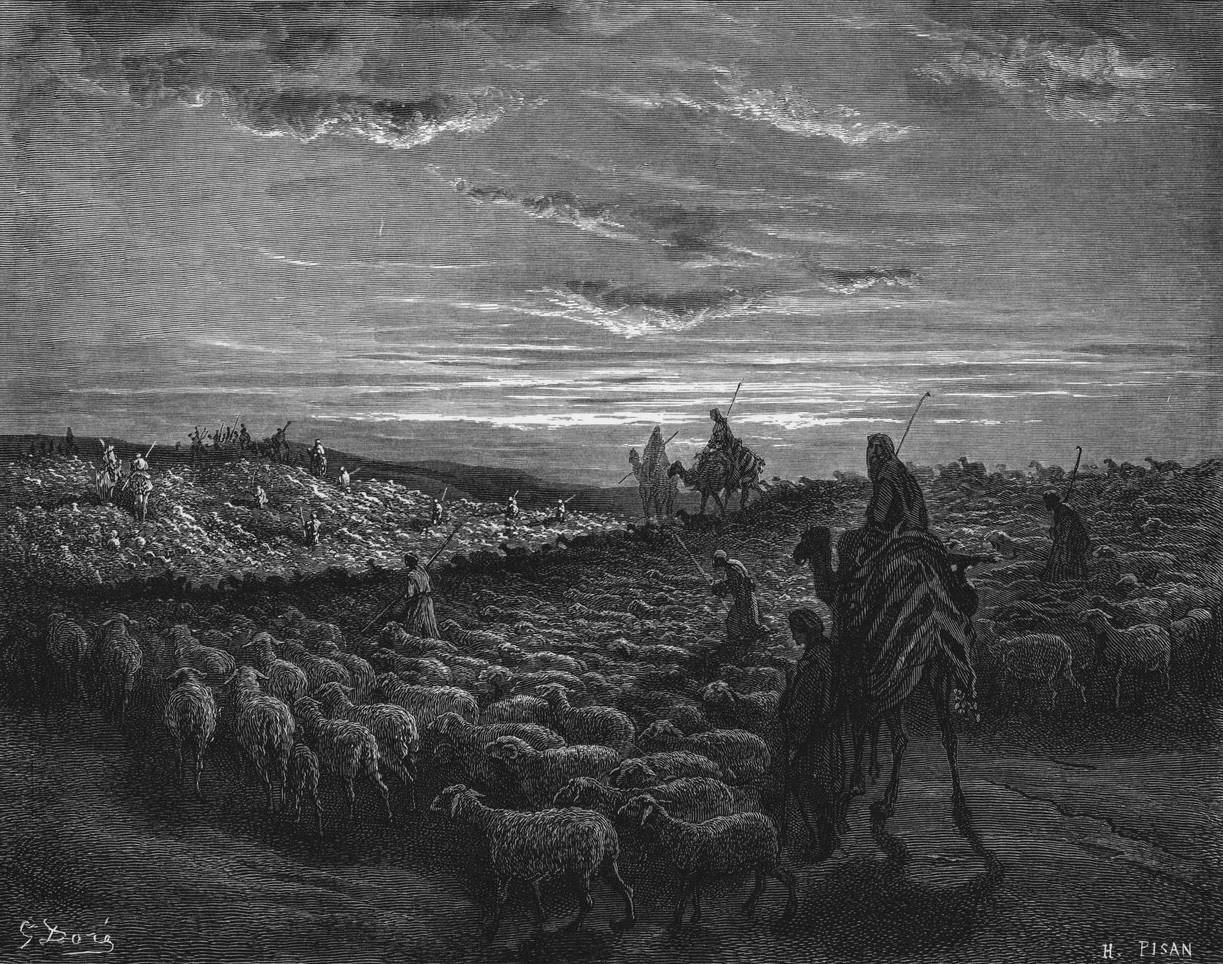
Abraham Journeying into the Land of Canaan,
by Gustave Doré, 1866

Avram took his wife Sarai and his brother’s son Lot, and all the property that they had acquired, and the people that they had acquired in Charan, and they left to go to the land of Canaan. And they entered the land of Canaan. (Genesis 12:4-5)

Avram, Sarai, and Lot have already acquired a lot of moveable property by the time they emigrate to Canaan, including animals, goods, and slaves.1 They do not need to emigrate to be blessed with material prosperity.

What about the blessing of fertility? We already know Sarai is childless, and we learn later that she is only ten years younger than Avram, so she is 65. Avram has not had any children in Charan, and unless he has a son in old age, he will have no descendants to become “a great nation”.

Perhaps the promise of fertility is the reason Avram obeys God and heads for Canaan. And the rest of his household, including his wife, his nephew, and his employees and slaves, have no say in the matter. They might have (unrecorded) opinions, but in their culture, the male head of household decides for everyone.

Unlike Terach, Avram and his people finish the trip to Canaan. They arrive at a sacred site near the Canaanite town of Shekhem.2

Then God appeared to Avram and said: “To your see [descendants] I give this land.” So he [Avram] built an altar there for God, whom he had seen. (Exodus 12:7)

I imagine that seeing some manifestation of God as well as hearing God speak about descendants again would confirm to Avram that he had made the right choice in following God’s instruction to move to Canaan. Yet when Canaan experiences a famine,

Avram went down to Egypt, lagur there, since the famine was severe in the land. (Exodus 12:10)

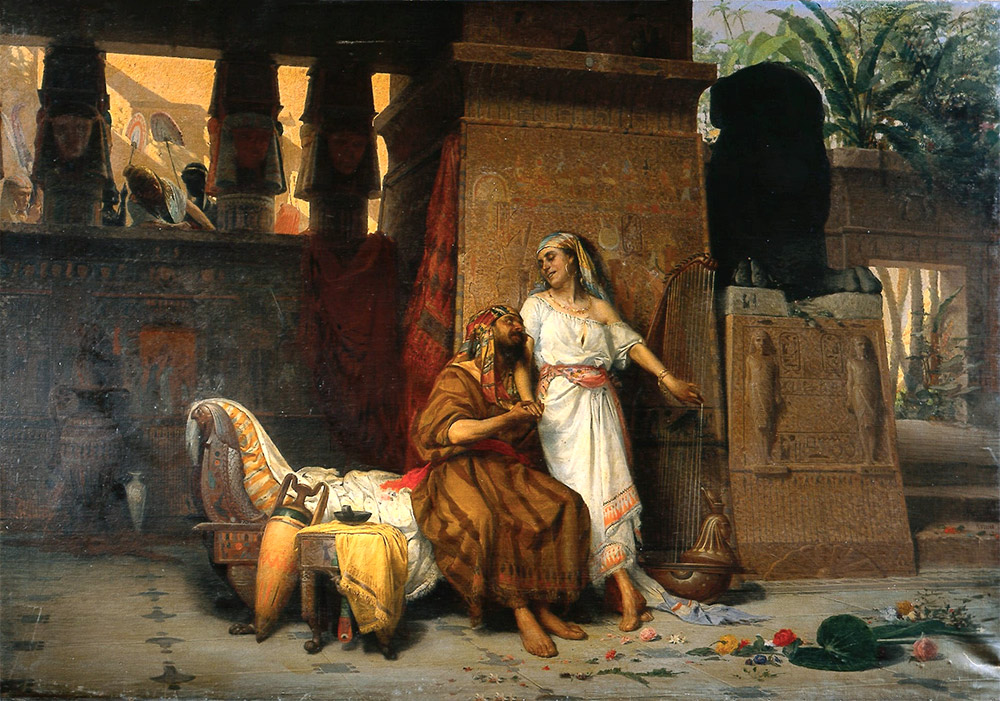
Abraham and Sarah in Pharaoh’s Palace,
by Giovanni Muzzioli, 1875

lagur (לָגוּר) = to live as a resident alien, to sojourn, to become a migrant.

And God does not object. In fact, God helps Avram pull off a scam that results in pharaoh giving Avram additional animals, silver and gold, and slaves—and ordering men to escort Avram and his household back to the border. (See my post Lekh Lekha, Vayeira, & Toledot: The Wife-Sister Trick, Part 1 and Part 2.)

Avram has further adventures in Canaan, and then the unsolved problem of his lack of descendants comes up again.

After these things, the word of God happened to Avram in a vision, saying: “Don’t be afraid, Avram. I myself am a shield for you; your reward will be very big!” But Avram said: “My lord God, what will you give me? I am going accursed, and the heir of my household is the Damascan, Eliezer!” And Avram said: “To me you have not given seed [a descendant], so hey! The head servant of my household is my heir!”  (Genesis 15:1-3)

When the same person says two things in a row, with nothing in between except “And he said”, it indicates a pause while the one being addressed fails to respond. In this case, God does not respond to Avram’s first statement, so Avram adds an explanation.

Then hey! The word of God happened to him, saying: “This one will not be your heir; but rather, the one who goes out from your inward parts will be your heir.” (Genesis 15:4) Another vague promise. So Avram’s wife Sarai tackles the problem herself by arranging for her husband to impregnate her female Egyptian slave. Avram no longer has to have faith that somehow God will provide.

Second Isaiah

Avram at least has the advantage of hearing God tell him directly to emigrate to Canaan from Mesopotamia. When the Babylonian Empire falls, the Israelites living in exile there have only the words of a human prophet who tells them that God wants them to move back and rebuild the razed city of Jerusalem. The prophet is not named, but since the prophecies compose the second half of the book of Isaiah, the speaker is known as “Second Isaiah”. In this week’s haftarah, God declares (through Second Isaiah):

Don’t be afraid, for I am with you.
Don’t look around anxiously, for I am your God.
I will strengthen you.
Also I will help you.
Also I will hold you up by the right hand of my righteousness. (Isaiah 41:10)

The Israelites living in Mesopotamia are anxious about returning to Jerusalem for understandable reasons. Between 597 and 587 B.C.E., while the Babylonian army was conquering the Kingdom of Judah, many Israelites were forcibly deported to Babylon.

Seal of Cyrus I (from Anshan)

Half a century later, when Second Isaiah began prophesying, the new Persian Empire had swallowed up the Babylonian empire. The first Persian king, Cyrus, gave all deportees and children of deportees permission to return to their former homes and rebuild their former temples. But after their traumatic experience, the Israelites are reluctant to believe it would really be safe to move back to Jerusalem. Besides, they saw the city burning down.

Assuring the exiles that their Babylonian conquerors are now powerless, God says:

Hey, everyone who was infuriated with you
will be shamed and humiliated;
They will be like nothingness,
And the men who contended with you will perish. (Isaiah 41:11)

But before the exiles can believe God will eliminate their enemies, they must believe that God is on their side now. And that is hard for people who remember when God failed to rescue them from death and deportation at the hands of the Babylonians. Then God promises to make the Israelites, not just the Persians, a weapon for defeating the Babylonian armies that seem as strong as mountains.

Hey, I will transform you into a new sharp thresher,
An owner of teeth,
You will thresh the mountains
And crush the hills, make them like chaff.
You will scatter them,
And the wind will carry them off,
And a whirlwind will disperse them.
And you, you will rejoice in God
And you will praise the Holy One of Israel. (Isaiah 41:15-16)

The Israelites in Babylonia hear (or read) the prophet’s speeches quoting God. But do they believe the quotes are real? Do they believe God will help them now? Do they set off for Jerusalem?

The Burning of Jerusalem by Nebuchadnezzar’s Army,
by the circle of Juan de la Corte, 1630-1660

The book of Isaiah does not give an answer. The conclusion of book of Jeremiah reports that a total of 4,600 people were deported by Babylonian King Nebuchadnezzar.3 (The poorest citizens of Judah were kept in the land to serve as “vine-dressers and field hands”.)4

The book of Ezra describes the return of 42,360 exiles to Jerusalem, along with their 7,337 slaves and 200 singers,5 but the archeological record indicates that the numbers are inflated.

It is also hard to determine how many of the exiles stayed in Babylonia under Persian rule. The city of Babylon had a large Jewish population when Philo of Alexandria wrote in the first century C.E., and had become the center of Jewish law and culture by the time the Talmud was written in the 3rd-5th centuries C.E.6 There is no historical record of a large in-migration of Jews to Babylon, so a lot of deported Israelites and their children must have stayed behind when Ezra and his group set off for Jerusalem.


Believing that God will help you is not so hard when your life has already been good, like Abraham’s. Believing that God will help you is harder when you, or your parents, can remember a time when God failed to rescue you from enemies—enemies who burned your city, killed many of your family and friends, and marched you off to a strange land. Jeremiah explains that God punished the Kingdom of Judah for the bad policies of its kings and for the widespread worship of other gods. Second Isaiah insists that now all that is forgiven.

What would it take for you to believe that God wants you to emigrate? What would it take for you to actually do it?

What if you were a Jew thinking about “making aliyah”—moving to Israel?


  1. An alternative reading from Talmudic times says that Avram, Sarai, and Lot had not acquired slaves in Charan, but rather made converts. This reading, however, does not fit the society of the time, and is not supported by any other reference in the Hebrew Bible.
  2. The site is named Eilon Moreh. An eilon (אֵל֣וֹן) is a large and significant tree, the kind that was involved in Asherah worship. Moreh (מוֹרֶה) means “teaching, instruction”.
  3. Jeremiah 52:30.
  4. Jeremiah 52:16.
  5. Ezra 2:65-66.
  6. Talmudic volumes were written both in Jerusalem (the Talmud Yerushalmi) and in Babylon (the Talmud Bavli), the two centers of Jewish scholarship. The Talmud Bavli is more complete and authoritative.

A month in Europe

Researching and writing this blog is one of my greatest pleasures. But sightseeing in Europe outshines even that, and I have the good fortune to spend the next month in France and Italy. I am not even bringing my laptop!

To read about the Torah portion of the week, or the themes of the upcoming Jewish holy days, you can click on these links to some blog posts I wrote after our 2019 trip to Europe:

For the week ending Sept. 28: Vayeilekh: Two Messages.

For Rosh Hashanah, Oct. 2-4: Rosh Hashanah & Yom Kippur: Our Father, Our King.

For Yom Kippur, Oct. 11-12: Psalm 130 & Yom Kippur: Waiting for Forgiveness.

For Sukkot, Oct. 16-23: Sukkot: Rootless.

For the week ending Oct. 26: Bereishit: How Many Gods?

For the week ending Nov. 2: Noach: Responses to Trauma.

After November 2, I’ll return to the pleasure of writing my blog at home!

Ki Tavo: The Curse of Frustration

What are the worst curses you can imagine?

A slew of curses that will result if the people do not obey God appear in this week’s Torah portion, Ki Tavo (Deuteronomy 26:1-29:8). This section begins:

But it will be, if you do not heed the voice of God, your God, by observing and doing all [God’s] commands and decrees which I command you today, then all these curses will come upon you and overtake you. (Deuteronomy 28:15)

The first curses in this section of the Torah portion use general language, such as:

Cursed will you be in your comings, and cursed will you be in your goings. (Deuteronomy 28:19)

But then the Torah moves to curses about specific areas of life, including the curse of failure in whatever you try to accomplish.

God will send against you the malediction, the vexation, and the reproach, against every undertaking of your hand that you do, until you are annihilated and you perish quickly because of your evil deeds when you abandoned me.  (Deuteronomy 28:20)

This sentence ends in the first person, with God reacting personally to being disobeyed, feeling abandoned.

But it opens in the third person, stating that God will reproach the disobedient Israelites by thwarting every effort they make to thrive. 19th-century rabbi Hirsch explained: “Consequent to the sin, inner serenity disappears and is replaced by inner disquiet, and by a constant feeling of reproach, self-reproach, the consciousness that one deserves God’s censure. … Inner disquiet and a constant mood of self-reproach will prevent the success of your labors.”1

This is an apt psychological explanation for why some people cannot bring their undertakings to completion. But what about the threat of being annihilated and perishing quickly? Many people live with guilt and self-reproach for decades, depressed but not annihilated.

Next the Torah describes how the disobedient Israelites will be cursed by diseases, drought, and defeat in battle—all potentially deadly. Then we return to the failure of people’s enterprises.

The Scream, by Edvard Munch, 1893

And God will strike you with shiga-on and with blindness and with confusion of mind. And you will grope around at midday the way the blind grope around in their [own] darkness, and your ways will not prosper; and indeed you will be exploited and robbed all the time, and there will be no rescuer. (Deuteronomy 28:28-29)

shiga-on (שִׁהָּעוֹן) = madness, insanity. (From the root verb shaga, שָׁגַע = acted insane.)

Since blindness is listed between insanity and confusion, it probably means the inability to foresee or understand anything, rather than a literal lack of vision.

Hirsch explained: “You will not have a clear perception of things and of the circumstances; hence, nothing that you do will achieve the desired end. Others, first and foremost the neighboring nations, will take advantage of your perplexity so as to rob you of your rights.”2

Three milestones

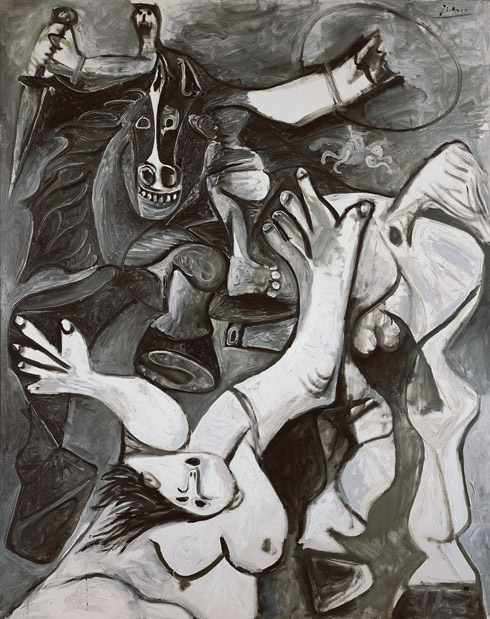
Rape of the Sabines, by Pablo Picasso,1962

The portion Ki Tavo then lists three deeds that require a major investment of a man’s time and money in order to reap a deeply satisfying reward. For all three, the disobedient Israelites will never get the reward.  

A woman you will betroth, and another man will use her for sex. A house you will build, and you will not live in it. A vineyard you will plant, and you will not use it. (Deuteronomy 28:30)

Arranging a marriage in the Torah included negotiations with the woman’s family and the payment of a bride-price; the reward was not only a sex partner, but a companion, a worker, and a  mother of one’s children. Building a house was also a big enterprise with a long-term reward. And grape vines, like fruit trees, had to be cultivated for three years without a harvest; only in the fourth year could they be picked for food, wine, and profitable trade.

The Torah portion Shoftim, earlier in Deuteronomy, treats the same three things as milestones in a man’s life. Officials who are recruiting troops are supposed to say:

“Who is the man that has built a new house and has not dedicated it? Let him go and return to his house, lest he die in the battle, and another man dedicate it. And who is the man that has planted a vineyard and has not used it? Let him go and return to his house, lest he die in the battle, and another man harvest it. And who is the man that has betrothed a woman and has not taken her [in marriage]? Let him go and return to his house, lest he die in the battle, and another man take her.” (Deuteronomy 20:5-7)3

No man wants to die before marrying, moving into his own house, and harvesting from his own grapevines (or fruit trees). If the Israelites are behaving well, following God’s directions, men can be excused from military service in order to enjoy reaching these milestones. Other men can go off to invade towns outside Israel’s borders, and God will give them success in battle.4

But if Israelites are behaving badly, flouting God’s directions, then they will be invaded by outsiders who seize their fiancées, their houses, and their vineyards.

Last week’s Torah portion, Ki Teitzei, expands on one of these military exemptions:

When a man takes a new wife, he must not go out with the troops, and he must not cross over to them for any matter. He will be exempt for his household one year and give joy to his wife whom he has taken. (Deuteronomy 24:5)

We can imagine the recruits crossing the town square to stand on one side, while the men who are staying home remain on the other side. This verse also informs us that the exemption from military service lasts for a year, and that a man must “give joy” to his new wife.

A wife in ancient Israel was not just a baby-making, bread-kneading, thread-spinning machine. She was supposed to be able to enjoy sex with her husband, and to be content with her new life in his household.

The Talmud adds that the exemptions for a new house and a newly mature vineyard also last for a full year.

“Since the wife needs twelve months, also all of them need twelve months.” (Talmud Yerushalmi, Sotah 8:8:2)5

“Those who are exempt for these reasons do not even provide water and food to the soldiers, and they do not repair the roads.” (Talmud Bavli, Sotah 43a)5

Thwarted by enemies

But when the Israelites disobey God, no one will get a year off for settling into a new marriage, a new house, or a new addition to their livelihood. Instead, God will let outsiders invade Israel and win. This week’s Torah portion continues:

Your ox will be slaughtered in front of your eyes, and you will not eat from it. Your donkey will be stolen in front of you, and it will not return to you. Your flock will be given to your enemies, and there will be no rescuer for you. Your sons and your daughters will be given to another people, and your eyes will be seeing and longing over them every day, but there will be no strength in your hand. The fruit of your land, and everything you toiled for, will be consumed by a people you do not know, and you will only be exploited and crushed all the time.  (Deuteronomy 28:31-33)

The laws laid down by God through Moses mandate returning stray animals to their owners,6 provide redemption for children sold as slaves, and even make the sale of land temporary.7 But invaders from other countries would disregard the local laws, and act only for their own benefit. Ironically, God will let the invaders succeed because the Israelites have been disregarding laws and acting only for their own benefit!

The curses that result from invasion by enemies are communal punishments, occurring when the people as a whole disobey God’s laws. Ethical and law-abiding individuals or families do not get special treatment when enemies invade.

Insanity

And you will be meshuga from the sight that you see with your eyes. (Deuteronomy 28:34)

The Sleep of Reason Produces Monsters, by Francisco de Goya, circa 1797

meshuga (מְשֻׁגָּ֑ע) = insane, crazy, raving. (Also from the root verb shaga, שָׁגַע, otherwise used only in the hitpael form: hishtaga-a, הִשְׁתַּגַּעַ = behaved like an insane person, or mishtaga-a, מִשְׁתַּגַּעַ = was behaving like an insane person.)

Ha-Emek Davar, a collection of 12th and 13th-century commentary, explained: “You will be amazed that you have become like this. That a few bandits have done so much damage, and your strength cannot save you, even though really it should have been strong enough against them. From this you will become insane and go out of your minds.”8

If the conquerors were merely a group of bandits, the Israelites might be driven mad by an inability to understand why they had not been able to defeat them. Only a few Israelites would attribute their unlikely failure to defend their land to a divine curse. If the conquerors were a large army, more Israelites might realize that God was no longer on their side, and remember that they needed God’s help. Either way, the Israelites could only explain their defeat if they acknowledged that they had done wrong and disobeyed their God.


It is human nature to cling to the belief that you are right and righteous, and to resist admitting that your actions have been unethical.

In a world-view with a God who administers rewards and punishments for collective behavior, the only responses to the total frustration of our plans and dreams are to admit our own bad behavior, to blame only the people around us, or to plunge into the mental blindness of believing that everything you are suffering is all for the best.

Without a God-centered world-view, there is a fourth option: to believe that tragedies sometimes happen when no one is at fault. This belief is easy to maintain when inexplicable tragedies are happening to people you don’t know. But it could lead to a mental breakdown when tragedies happen to you.

No wonder we feel cursed when undertakings we have nurtured for years are suddenly annihilated. Admitting collective guilt, blaming others, believing it’s all for the best, shrugging it off as bad luck, and going a little crazy are all possible responses. If, God forbid, it happened to you, what would your response be?


  1. Samson Raphael Hirsch, The Hirsch Chumash: Sefer Devarim, translated from German by Daniel Haberman, Feldheim Publishers, Jerusalem, 2009, p. 667.
  2. Ibid., p. 670.
  3. See my post Shoftim: More Important than War, Part 1.
  4. Deuteronomy 20:1.
  5. Translations of both Talmud Yerushalmi and Talmud Bavli are from www.sefaria.org.
  6. Deuteronomy 22:1-3.
  7. Deuteronomy 25:25-46.
  8. Ha-Emek Davar, commentary by the 12th to 13th-century Tosafists, translated in www.sefaria.org.

Ki Teitzei: Virginity

In ancient Israel, a bride who is not divorced or widowed1 was supposed be a virgin at her wedding. What if the groom accused her the next morning of not being a virgin? Or what if an unmarried virgin was raped?

This week’s Torah portion, Ki Teitzei (Deuteronomy/Devarim 21:10-25:19), provides rules for dealing with these situations.

A spiteful groom

If a man takes a wife and comes into her, and then he hates her, and he places a charge of wantonness on her, speaking out against her [giving her] a bad name, and says: “This woman I married, I approached her and I did not find betulim in her!”— (Deuteronomy 22:13-14)

betulim (בְּתוּלִים) = virginity.

In this example, the man claims publicly that his new bride did not bleed when he had intercourse with her on their wedding night; therefore she must have wantonly lost her virginity to someone else after they were betrothed but before the wedding night. A woman was considered betrothed once the marriage contract was written and the bride-price was paid to her father. After that, if she had sex with anyone else it counted as adultery.

If the husband’s accusation is accepted as true, the bride is guilty of a capital offense, and the bride’s parents are shamed, since she was supposed to be under their control while she was living under their roof.

Then the father of the na-arah, and her mother, take and bring out the betulim of the young woman to the elders of the town at its gate. (Deuteronomy 22:15)

Na-arah (נַעֲרָה orנַעֲרָ) = a female human during the years between puberty and marriage. (Na-arah overlaps, but is not the same as “teenage girl”; girls in ancient Israel were often married in their early teens.)

What do her parents bring out to the elders? Commentators from the Talmud (5th century C.E.) to Rabbi Samson Raphael Hirsch (19th century) declared that the groom would bring witnesses to the town gate to support his claim that the bride was not a virgin. Her parents would “take and bring” witnesses who would disprove the testimony of the groom’s witnesses. After all, the previous Torah portion, Shoftim, states that an accusation must be corroborated by at least two witnesses before a death sentence can be decreed.2

But how could witnesses observe either the consummation of the marriage, or any previous illicit sex act? Both acts would be done in private. Furthermore, the example in this week’s Torah portion refers to a different form of evidence. The bride’s father says to the elders in the gate:

Deuteronomy 22:17, King James Bible illustration

“But these are the betulim of my daughter!” And he will spread out the simlah before the elders of the town. (Deuteronomy 22:17)

simlah (שִׂמְלָה) = garment, wrapper, cloth.

It seems obvious that the bride’s father takes the nightgown or sheet that was stained with blood when the bride’s hymen broke, and brings it from the groom’s bedroom out to the town gate as evidence. Yet Hirsch claimed:

“The witnesses called by the girl’s father confront the witnesses cited by the man, and then the whole matter ius spread out for all to see, like a new garment without folds of creases.”3

It was hard for commentators to abandon a traditional explanation, especially one that reinforced a favorite rabbinic principle like the requirement for two witnesses. Modern commentators have advanced the straightforward explanation that the bride’s father must exhibit the blood stain.4

After seeing the evidence, the portion Ki Teitzei continues, the elders judging the case must decree three penalties for the slandering husband. The first is physical punishment.

Then the elders of that town will take the man and discipline him. (Deuteronomy 22:18)

Although Deuteronomy does not specify the type of discipline, the Talmud says the man is flogged.5

The second penalty for slandering the bride is monetary.

And they will fine him a hundred of silver, and they will give it to the father of the na-arah, because he gave a bad name to a betulah of Israel— (Deuteronomy 22:19)

betulah (בְּתוּלָה) = female virgin. (From the same root as betulim.)

The portion Ki Teizei mentions later that a disappointed husband could get rid of his wife at any time by writing a bill of divorce.6 But since the husband who hates his new bride does not do this, a divorce probably required a payment even when Deuteronomy was written, sometime during the 7th to 5th centuries B.C.E. (From Talmudic times to the present, a marriage document (ketubah) includes the statement that in the event of a divorce, the husband will give the wife a large sum of money.)

The slandering husband probably hoped to get rid of his bride for free. The requirement that he pay a large fine frustrates his purpose, and deters future slandering husbands. According to Hirsch, the fine also rewards the bride’s father, since:

“…the daughter’s chastity, manifested by her innocence, is first and foremost the merit of the father, the merit of the home that understood how to inculcate and instill in his daughter the pearl of Jewish national wealth, the Jewish chastity of woman.”7

Hirsch’s commentary demonstrates more than two thousand years after Deuteronomy was written, 19th-century European men still assumed not only that virginity was crucial in a daughter (but not in a son), and that the father was responsible for the behavior of his wife and daughters, whom he had to train so they would not do something foolish.

The third penalty prohibits the slandering man from ever divorcing his wife.

—and she will remain his wife; he is not able to send her away all his days. (Deuteronomy 22:19)

This certainly punishes the husband, who must live with a woman he hates for the rest of his life. But what about the wife, who faces a lifetime under the roof of a man who hates her? The writers of Deuteronomy considered this clause a protection for her, since she would at least have a home and the social status of a wife—the highest status available to a woman at that time, better than being an unmarried extra in her father’s house, a concubine, a slave, or a prostitute.

But if this thing was true—betulim was not found for the na-arah —then they will bring the na-arah to the entrance of her father’s house, and the men of the town will stone her with stones, and she will die. For she did a disgraceful thing in Israel, to be a harlot in her father’s house. And you will burn out the evil from your midst! (Deuteronomy 22:21)

No allowance is made for an accidental hymen breakage; the bride is deemed guilty. The husband who hates her is free of any penalty, the young woman is killed painfully, her parents are publicly shamed, and the whole kingdom of Israel is disgraced. Hirsch explained:

“The immorality of the young wife incriminates the upbringing she received in her parents’ home, and disgraces the entire nation … The enormity of this offense and depravity lies in the fact that a girl, still in the legal custody of her parents, still living under her parents’ supervision, committed knowingly an act of adultery!”8

A virgin who is not betrothed

What if a young woman loses her virginity before her father has betrothed her to anyone? The portion Ki Teitzei also considers this situation.

If a man finds a na-arah betulah who is not betrothed, and he seizes her and lies down with her, and they are found, then the man who lay with her will give to the father of the a na-arah fifty of silver, and she will be his as a wife. And since he overpowered her, he is not allowed to send her away, all his days. (Deuteronomy 22:28-29)

If there is no betrothal, there is no adultery, and there is no death penalty for either party. But a single adolescent girl is still someone’s property: she belongs to her father. (If her father is deceased, she belongs to the male relative who is her guardian.) The man who deflowers her is damaging another man’s property. In ancient Israel, a daughter was an investment which a father could cash in by marrying her off, thereby acquiring both a bride-price and an alliance with the groom’s family. A non-virgin had a lower market value.

Rape of Sabine Woman, Giovanni Bologna, late 16th century

Since the man seizes the virgin and overpowers her; it is a rape.9 The rapist’s payment counts as marriage, and she is never allowed to return to her father’s house, because the man is never allowed to divorce her. Whereas the penalty for raping a betrothed virgin is death, the penalty for raping an unbetrothed virgin is a bride-price and marriage. The young woman who was raped must live with her rapist until he dies, just like the young woman whose husband slandered her. Her father does not have the option of rejecting the rapist as his son-in-law. As in the first example in the portion Ki Teitzei, the woman at least has a home and the social status of wife. For the writers of Deuteronomy, that was enough.


The laws about virginity in this week’s Torah portion are rooted in the same two principles: that it is evil for a female to have sex with anyone except her eventual husband, and that women are controlled by their men—first their fathers, then their husbands. These two assumptions are not found in all cultures, but they have been the norm in western civilization through the 19th century, and continue to be the norm in many Muslim countries.

An anthropological explanation I have often encountered is that a man objected to raising another man’s child as his own, unless he had already chosen to adopt the child. Therefore he did not want to marry a woman who was already pregnant, and he did not want his wife to commit adultery. And therefore men, who made the rules, decided that brides must be virgins and adultery is a sin.

I do not find this argument convincing. The examples in Ki Teitzei do not say anything about children. And today, after five decades of very reliable birth control methods, virginity before marriage and adultery after marriage are still hot topics.

(Virginity until the wedding remains a goal for fundamentalist Christians and orthodox Jews, but not for the majority of Americans. There are more experiments with non-monogamous and open marriages today, but monogamy without adultery remains the goal for the majority. The biggest change is that in 21st century America, husbands as well as wives are expected to limit their sex to one another, and gay and lesbian couples face the same decisions regarding sexual fidelity.)

If the strict laws in the bible regarding female chastity (virginity before the wedding night and sexual fidelity after) were not the result of concerns about fatherhood, then what motivated them? I suspect it was a question of purity. An emission of semen was ritually impure, and required a period of cleansing before one could enter the sacred space of the temple or sanctuary courtyard. The same applied to menstrual blood and other icky discharges from the body.10

Ritual impurity easily became associated with moral impurity. And as long as men dominated a society, there was a double standard, and the rules for a female to count as morally good were stricter than the rules for a male.

During my lifetime, the rights and responsibilities of men and women have become more and more equal. I consider this an unqualified moral good. But the work is not finished. I hope that someday the double standard will completely disappear, and no one will say “Boys will be boys!” again; and that despite testosterone surges, everyone will master self-control and follow the same rules about both keeping marriage vows and respecting the rights of others.


  1. A woman could remarry after being divorced or widowed; the only caveat was that she could not marry the high priest, who was only allowed to marry a virgin (see Leviticus 21:13-14).
  2. Deuteronomy 17:5-6. See my post: Shoftim: To Do Justice.
  3. Rabbi Samson Raphael Hirsch, The Hirsch Chumash: Sefer Devarim, translated by Daniel Haberman, Feldheim Publishers, Jerusalem, 2009, p. 525.
  4. E.g. Everett Fox and Rabbi Adin Even-Israel Steinsaltz.
  5. Talmud Yerushalmi Ketubot 3:1, Talmud Bavli Makkot 4b, Talmud Bavli Sanhedrin 71b.
  6. Deuteronomy 24:1.
  7. Hirsch, pp. 527-528.
  8. Hirsch, p. 529.
  9. Unlike a superficially similar example in Exodus 22:15-16, in which a man seduces a virgin.
  10. Leviticus 15:1-32.

Shoftim: Trees Versus Humans

The rules for insiders have been different from the rules for outsiders since human history began. The difference is obvious in this week’s Torah portion, Shoftim (Deuteronomy 16:18-21:9).

Rules about insiders

A judge in Deuteronomy, by Paul Hardy, ca. 1900

The portion Shoftim includes several rules for justice among fellow Israelites: judges must be unbiased, two witnesses are required for any sentence, accidental manslaughter must not be punished with death, and a disputed case should be referred to a higher court.1

The Torah portion also includes rules for assembling troops to initiate a battle, providing a humane alternative to the draft. Every man who has just built a new house, planted a new vineyard, or become engaged to a woman—or who is fearful—is excused from joining the troops.2

But the rules for attacking a town are not so humane—at least not to the outsiders being attacked. This week’s Torah portion considers two categories of towns of outsiders. The first category covers “far-away” towns: any town outside the national border that God decreed for Israel. The second category includes any remaining towns of native Canaanites within the land that God promised to the Israelites.

Rules about far-away towns that surrender

The Torah assumes that, like everyone else in the Ancient Near East, Israelites will raid towns outside their own borders to bring home booty, and sometimes kings of Israel will assemble larger armies and try to conquer a neighboring kingdom in order to skim off its resources. The portion Shoftim moderates this “normal” behavior somewhat by distinguishing between towns that surrender immediately, and towns that fight back.

If you approach a town to wage battle against it, then you must call out to it [terms] for peace. And it will be, if it answers you with peace, and opens [its gates] to you, then all the people that are found in it will become yours for mas, and they will serve you. (Deuteronomy 20:10-11)

mas (מַס) = compulsory labor (corvée labor) imposed on a subjugated people.

The Israelites were subjected to mas in Egypt.3 Now Moses passes on the rule that if the Israelites threaten a town and it surrenders, the Israelites (insiders) will subject the town’s whole population (outsiders) to the same kind of oppression. But although the citizens of a town that immediately surrenders are treated like slaves, they are not killed or driven off their land.

Rules about far-away towns that fight back

Israelite solider, artist unknown

But if it does not make peace with you, and it does battle with you, then you may besiege it. And [when] God, your God, gives it into your hand, then you must strike down all its males with the edge of a sword. Only the women and the little children and the animals and everything that is in the town—all its spoils—you may plunder for yourself. And you may consume the spoils of your enemies, which God, your God, gives you. (Deuteronomy 20:12-13)

The town’s men are called enemies here, even though the Israelites start the hostilities. The women and children are part of the spoils, since in that culture they were the property of the men. Female captives, who were useful for sex as well as labor, and their children, who could be trained to be good slaves when they got older, were taken away from their homes and brought to Israel as permanent slaves.4

Rules about natives of Canaan

Next we learn that the rules about far-away towns do not apply to towns in the land of Canaan.

Thus you will do to all the towns that are very far away from you, that are not the towns of these nations [in Canaan]. Only in the towns of these peoples that God, your God, is giving to you as a possession, you must not leave alive anything that breathes, because hachareim!—You must hecharim them … as God, your God, commanded you. (Deuteronomy 20:14-16)

hachareim (הַחֲרֵם), hecherim (הֶחֱרִים) = prohibit for human use and dedicate to destruction for God.

Why are the Israelites obligated to exterminate the entire native population of Canaan? The reason for genocide is religious:

So that they do not teach you to do according to all their to-avot that they do for their gods, and then you wrong God, your God. (Deuteronomy 20:18)

to-avot (תּוֹעֲבֺת) = abominations, acts that are acceptable in one culture but taboo in another.

When the Israelites arrived at the Jordan River in the book of Numbers, many of them engaged in sex with the native women and worshiped their god, Ba-al Peor.5 Judging by the rest of the Hebrew Bible, Israelites could hardly resist the temptation to worship other gods.

Rules about fruit trees

The next verse applies to any walled town that Israelites are besieging, whether in Canaan or far away.

by Winslow Homer, 19th century

When you besiege a town for many days, to battle against it to capture it, you must not destroy its trees by swinging an axe against them. For you will eat from them, so you must not cut them down. For is a tree of the field a human being, to come in front of you in the siege? (Deuteronomy 20:19)

Why must the Israelites refrain from chopping down fruit trees?

One answer is for you will eat from them. Even if the fruit is not in season while the Israelites are conducting the siege, if they succeed in taking the town, they will appreciate the local source of fruit. Trampled fields can be sown for a crop the next year, but fruit trees take a long time to grow.

A 13th-century commentary, probably considering the case of a far-away town, added: “Since the object of the siege is not to kill all its inhabitants, but to make them subservient to you, depriving them of their fruit bearing trees would be neither in your interest and certainly not in their interest.” (Chizkuni)6

Why would besiegers want to cut down a town’s orchards anyway? One answer is in the next verse:

Only trees which you know are not trees for eating, those you may destroy and cut down, and build siege-works against the town that is doing battle with you, until it falls. (Deuteronomy 20:19)

A 14th-century commentator explained: “You are free to cut down such a tree without restriction whether in order to build platforms to shoot arrows from, or for whatever reasons, such as to build a fire at night to keep warm.” (Tur HaArokh)7

The Talmud generalizes the prohibition against cutting down fruit trees in a siege to ban any wasteful destruction, including tearing fabric when you are not in mourning (Kiddushin 32a), or scattering your money in anger (Shabbat 105b).8

For is a tree of the field a human being, to come in front of you in the siege?

No. In this week’s Torah portion, trees are treated pragmatically, in terms of their value to the humans who are insiders, the Israelite besiegers. Fruit-bearing trees must be unharmed in order to provide food for both the conquerors and the survivors of the town who will be subjugated. Other trees are more useful for building siege-works or burning as fuel. 

Humans in far-away towns are treated with the same pragmatism as trees. If the town under attack fights back (and the Israelites win), then all its men and older boys must be killed to prevent future attempts at revenge, but the rest of the residents are useful as slaves. Humans in far-away town that surrenders are useful as a compulsory work force.

But humans who are natives of Canaan are treated with less respect than trees; they must all be chopped down and not used. The policy is wasteful, but it prevents the Israelites from being  tempted to adopt any Canaanite religions.

Furthermore, although individual Israelites accused of crimes are protected by laws that require fair judges and witnesses, there is no justice for individuals who are outsiders because they live in Canaanite towns or “far-away” towns.


The text of chapters 12-26 in Deuteronomy was written in the 7th century B.C.E., then reframed as the central section of Moses’ series of speeches to the Israelites at the Jordan River. I am writing this blog post in the year 2024 C.E., more than 26 centuries later.

Are we more humane to outsiders now? Western intellectuals condemn genocide by conquering settlers who view the natives of a land view as outsiders, “not like us”. Subcultures in many countries disapprove of initiating a war for any reason.

Yet in this year of 2024, the Russian government continues to attack Ukraine, ignoring the rights of Ukrainians to democratic self-rule and to life itself. The governments of other nations, such as Myanmar, attack minority groups of citizens who happen to be outsiders because of ethnicity and religion, forcing them to leave their homes and land. Modern Israel uses other methods to force members of an Arab minority to leave their homes and land—including, ironically and poignantly, destroying their olive trees.

This week’s Torah portion says: “Justice, justice you must pursue!”9 But when will people pursue justice for insiders and outsiders alike?


  1. Deuteronomy 16:18-20, 17:6 and 19:15-19, 19:1-7, and 17:8-12. See my post: Shoftim: To Do Justice.
  2. Deuteronomy 20:5-9. See my post: Shoftim: More Important Than War, Part 2.
  3. Exodus 1:11.
  4. Leviticus 25:39-54 decrees that when poverty forces native Israelites to sell themselves as slaves, their owners must treat them like hired workers, release them if a relative pays a fair amount to redeem them, and free them in the yoveil (jubilee) year without payment. But foreign slaves and their children can be kept in slavery indefinitely, and passed on to the owners’ heirs.
  5. Numbers 25:1-9. See my post: Balak: Wide Open.
  6. Chizkuni, compiled by Chizkiah ben Manoach, translated in www.sefaria.org.
  7. Tur HaArokh, by Jacob ben Asher, translated in www.sefaria.org.
  8. For more on the Jewish prohibition against waste that originated in the Talmud, see my post: Shoftim: Saving Trees.
  9. Deuteronomy 16:20.