Vayechi: Three Tribes Repudiated

Jacob/Yaakov delivers his last words to his twelve sons in this week’s Torah portion, Vayechi (“And he lived”).

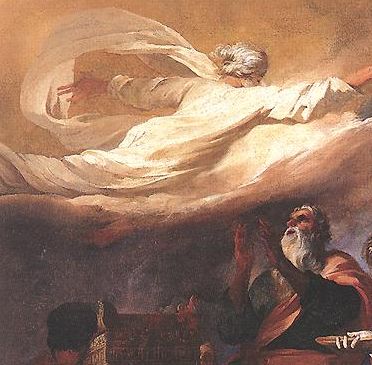
Jacob on his Deathbed,
1539 woodcut

And Jacob called his sons and he said: “Gather, and I will tell you what will happen to you in future times.”  (Genesis/Bereishit 49:1)

Jacob, also called Israel, then launches into a long poem about the fate of the twelve tribes named after his twelve sons.1  This poem resembles the poems in the books of prophets transmitting God’s warnings and plans from the divine point of view.  Jacob pauses once to cry out: “I wait for your deliverance, God!”2  This interruption only makes the rest of his poem sound more like a direct divine prophecy.

When Jacob finishes his poem, the Torah says:

All these were the twelve tribes of Israel, and this is what their father spoke to them.  Vayevarekh them, each with what was kevirkhato he blessed them.    (Genesis 49:28)

vayevarekh (וַיְבָרֶךְ) = and he blessed.  (A form of the verb beirakh, בֵּרַךְ = bless; bestow or wish on someone the achievement of something desirable.  In the Torah, the achievement is most often prosperity, success in battle, or fertility.)

kevirkhato (כְּבִרְכָתוֹ) = according to his own blessing.  (From the same root as beirakh.)

Immediately after this sentence about blessings, Jacob gives instructions for his burial, draws his feet into the bed, and dies without mentioning any of his sons’ names again.3  So the prophecies about the twelve eponymous tribes must also be the blessings.

Except for the first three sons, this is a reasonable interpretation.  Jacob blesses his fourth son (or his tribe), Judah/Yehudah, with future kingship, success in battle, and fertile vineyards.4  Zebulun, he says, will succeed in shipping, and Issachar in farming.5  He compares Dan to a snake, but at least he declares the tribe will remain part of the land of Israel.6  Gad and Benjamin/Binyamin will be successful in raiding, Asher will be wealthy, and Naftali beautiful.7  Jacob blesses Joseph/Yoseif with overall success and prosperity.8

Yet Jacob’s first three sons appear to get curses instead of blessings.

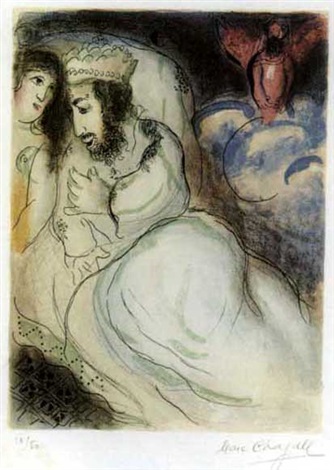
by Marc Chagall, stained glass

Reuven, my first-born are you,

my vigor and the first fruit of my potency,

Exceedingly noble,

       exceedingly fierce!

Heedless as water, you will no longer exceed,

       for you mounted your father’s bed.

That was when you desecrated it.  My couch he mounted!  (Genesis 49:3-4)

Jacob refers to a specific incident in Genesis.  After the death of Jacob’s favorite wife, Rachel, Reuven has intercourse with Bilhah, Rachel’s servant and Jacob’s concubine.9  Reuven may  hope to become the family’s leader through an ancient custom by which the new ruler assumes his office by having sex with the old ruler’s concubines.10  Reuven is the firstborn son, and therefore normally entitled to become the head of the extended family after his father’s death. But although Jacob is at least 119 years old, his own father is still alive, and does not die until he is 180.  Reuven may prefer not to wait.  (It would have been a long wait; Jacob dies in this week’s Torah portion at age 147.)

Because of that undisciplined and defiant act, Jacob declares that Reuven is unfit for leadership.

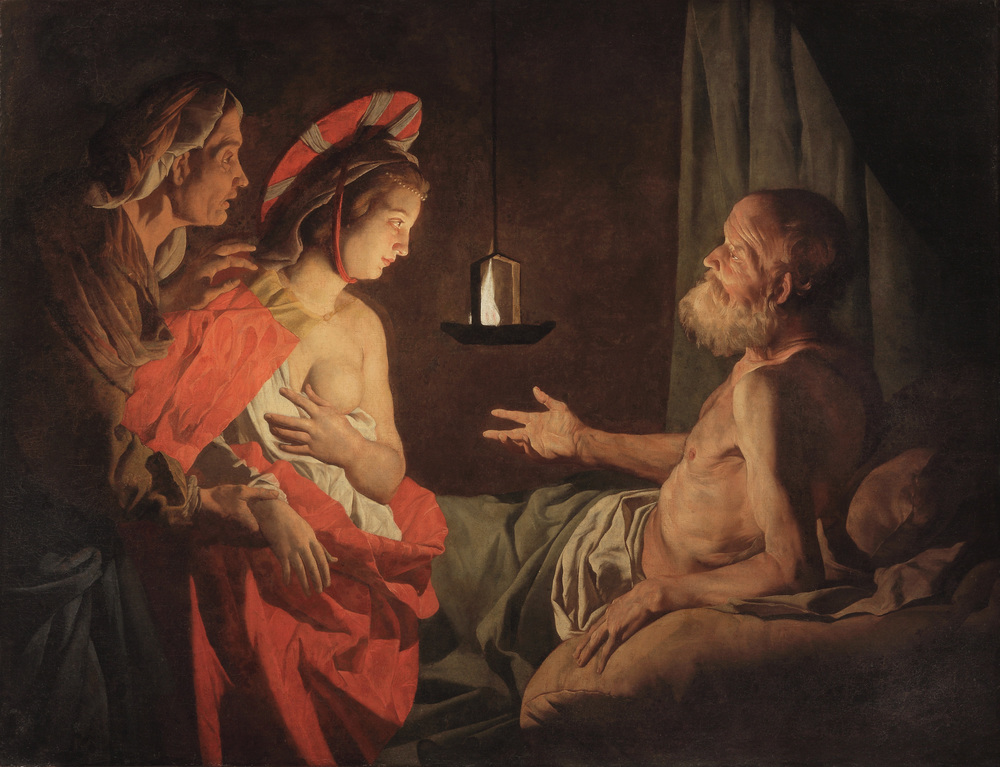
by Francisco Coelho, 1675

In the biblical tradition, leadership would then pass to the next oldest son.  But Jacob rules out both his second son, Shimon, and his third son, Levi.

Shimon and Levi are partners;

Weapons of violence are their wares.

Don’t let my soul be brought into their council!

Don’t let my honor be reckoned by their assembly!

by Marc Chagall, stained glass

For in their rage they murder a man,

and in their desire they uproot a wall.11

Accursed be their fury because it is fierce,

and their wrath because it is remorseless!

I will split them up in Jacob,

and I will scatter them in Israel.  (Genesis 49:5-7)

Since Jacob condemns Reuven on the basis of an incident during his lifetime and reported in the bible, the reader expects him to cite another such incident as his reason for criticizing Shimon and Levi.  The closest match is when the two brothers trick the rulers of Shekhem, enter the town as friends, murder the man who raped their sister Dinah, kill all the other men, destroy the town, and carry off the booty.  No doubt some walls fell.  (See my posts Vayishlach: Change of Heart, Part 1 and Part 2.)

Then Jacob said to Shimon and Levi: “You made me shunned, odious among the inhabitants of the land!”  (Genesis 34:30)

On his deathbed, Jacob attributes Shimon and Levi’s violence to the intensity of their anger.  When he says “I will split them up in Jacob” the “I” is God, the “Jacob” is an alternate name for the territory of Israel, and the need to split them up may imply that they are more dangerous when they are together and their fiery natures combine in a conflagration of rage.

Having eliminated Reuven, Shimon, and Levi with his prophetic curses, Jacob announces that the descendants of his fourth son, Judah, will be king over other Israelites.


Only some of the predictions in Jacob’s deathbed poem come true according to the history of the twelve tribes in the rest of the Hebrew Bible.  This is normal for biblical prophecies, which are often warnings of what will happen unless certain people change their ways.  In this case, the prophecy about Judah “comes true”; the second king of a united Israel is David, from the tribe of Judah, and his descendants continue to rule even after the northern kingdom secedes from the southern kingdom of Judah.
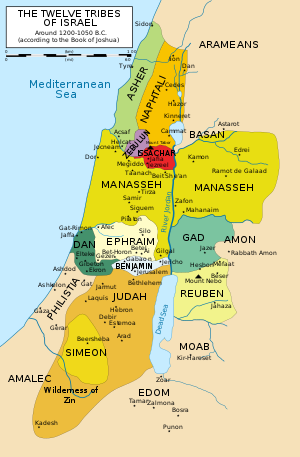
12 Tribes according to Joshua

The tribe of Reuven is part of the northern kingdom, but its members live in the land east of the Dead Sea, which is sometimes ruled by the Moabites who also live there.12  The tribe of Shimon occupies an enclave within the southern desert of the Kingdom of Judah, and is “scattered” only in the sense that all desert nomads are scattered.13  The tribe of Levi consists of hereditary priests and other religious functionaries.  In the book of Joshua, the Levites are assigned 48 towns in the territories allotted to the other tribes, including a few in the territory of Shimon.14  So the Levites are indeed scattered, but they are not entirely split apart from the Shimonites.

From the viewpoint of the stories in Genesis, however, Jacob’s deathbed prophecies  assign appropriate consequences for the behavior of Jacob’s first three sons.

Reuven’s attempts to take leadership, both when he beds Bilhah and when he acts regarding Joseph, are undisciplined and poorly thought out.  His eponymous tribe is cursed with never producing a king; but it gets the blessing of being a member tribe of the northern Kingdom of Israel, a.k.a. Samaria.

Since Shimon and Levi are the ringleaders in the disaster at Sheckhem, their tribes are cursed with being too scattered to lead their brother tribes into trouble again.  Yet their scattering is also a blessing; the nomadic tribe of Shimon is protected by Judah, and the Levites become a caste of priests and clerics with authority throughout Israel.

I think Jacob’s first prophecies are indeed blessings.  When people have been bad leaders, it is a blessing for them, as well as for their followers, to have their leadership removed—and for the former leaders to continue to be included in the larger community, like Reuven and Shimon.

by Francisco Coelho, 1675

As for Levi, it is a great blessing when people who are inflamed by intense feelings do wrong, are stripped of leadership, and then change their hearts and apply their passionate natures to positive acts for a good cause.

May we all “bless” leaders with their appropriate fates, as Jacob did.  May we work to remove leadership from those who abuse it.  May we accept all human beings as flawed but precious individuals.  And may we be able to recognize when others have truly changed.


  1. Jacob’s wives name his first eleven sons in Genesis 29:31-30:24; Jacob names his twelfth son Benjamin/Binyamin in Genesis 35:18. The first mention of “twelve tribes’ in the bible is in Genesis 49:28, at the end of Jacob’s poem.  Elsewhere in the Torah there are always twelve tribes, but they are not always identical with the names of Jacob’s twelve sons.  Whenever Shimon or Levi is omitted from the list, then Joseph is replaced by tribes named after his own two sons (adopted by Jacob), Efrayim and Menasheh.
  2. Genesis 49:18.
  3. Genesis 49:29-33.
  4. Genesis 49:8-12.
  5. Genesis 49:13-14.
  6. Genesis 49:16-17.
  7. Genesis 49:19-21, 27.
  8. Genesis 49:22-26. (Jacob’s references to God as “Shaddai” and blessings from “the heavens above” echo Isaac’s blessing of Jacob in Genesis 27:28 and 28:3.)
  9. Genesis 35:22.
  10. Absalom slept with King David’s concubines for that purpose in 2 Samuel 16:21-22.
  11. Another legitimate translation of the third couplet is some version of:

For in their rage they murder a man,

              and in their desire they cripple an ox.

How can the last two words be translated as either “uproot a wall” or “cripple an ox”?  In the Masoretic text the phrase is עִקְּרוּ שׁוֹרIkru (עִקְּרוּ) = uproot, cripple.  Shor (שׁוֹר) = bull, ox, steer.  The Masoretic text is based on earlier scrolls that did not use vowel pointing.  Although translations generally assume the Masoretes assigned the correct vowels to the words in the bible, Robert Alter makes a case that in Genesis 49:6 a better reading of the final word is shur (שׁוּר) = wall.  (Robert Alter, The Five Books of Moses, W.W. Norton & Co., New York, 2004, p. 284.)

  1. Numbers 32:1-32, Joshua 2:1-7, 1 Chronicles 5:18-22.
  2. Joshua 19:1-9.
  3. Joshua 21:4.
Vayigash: Near a Narcissist

Vayigash to him, Judah did, and he said: “Pardon me, my lord.  Let your servant speak, please, speak in your ears, my lord, and don’t be angry with your servant, since you are like Pharaoh.”  (Genesis/Bereishit 44:18)

vayiggash (וַיִּגַּשׁ) = and he came near, and he approached, and he stepped forward.  (A form of the verb nigash, נִגַּשׁ = came near, stepped up.)

Judah steps closer to the viceroy of Egypt.  He does not know this all-powerful man is his younger brother Joseph, whom he and his brothers sold as a slave 22 years before.  After Judah’s painfully polite introduction at the beginning of this week’s Torah portion, Vayiggash, comes a cascade of revelations: Judah’s empathy, Joseph’s identity, and the true extent of Joseph’s narcissism.

*

The trouble started with Jacob.  He had four wives but loved only one, Rachel.  After Rachel died in childbirth he had twelve sons but loved only Rachel’s two children, Joseph and little Benjamin.

At age seventeen, Joseph had become a tattletale and a narcissist —someone with a psychological condition characterized by an inflated sense of self-importance, a deep need for admiration and attention, and a lack of empathy for others.   (See my posts Vayeishev: What Drove Them Crazy and Mikeitz & Vayeishev: A Narcissist in the Pit?)

When Joseph came to report on them again, his ten older brothers stripped him and threw him in an empty cistern.  Then they talked about killing him and telling their father wild animals did it.  Judah convinced the others to sell him as a slave instead, to a caravan bound for Egypt.

Joseph heard everything from the bottom of the pit.

*

At age 38, Joseph is the viceroy of Egypt, with absolute power over stockpiled grain during a severe famine.  When his older brothers come from Canaan to buy grain he recognizes them, but they do not recognize him.  The Torah says he sets up a “test” for them.  Joseph imprisons one of the brothers, Shimon, and promises to release him only when the others return with their youngest brother.  (See my post Mikeitz & Vayiggash: Testing.)

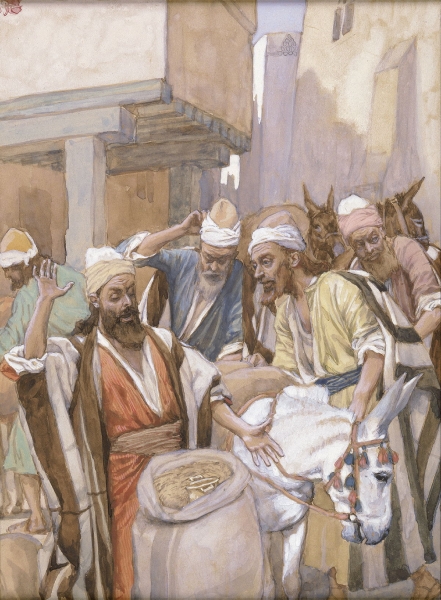
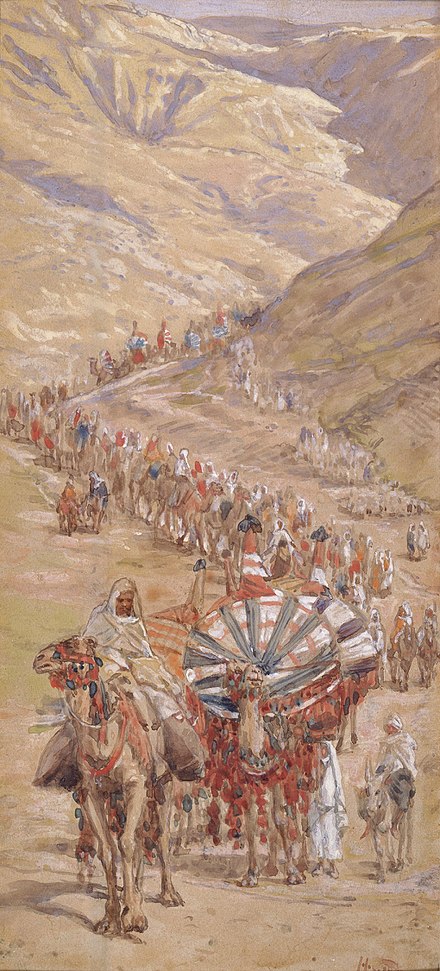
The Cup Found, by James Tissot

The opening of this week’s Torah portion is the culmination of the test.  When the family in Canaan runs out of food in the second year of famine, Jacob finally lets his older sons return to Egypt with Benjamin.  Joseph releases Shimon, shows favoritism toward Benjamin, and sells them more grain.  Then he arranges a trap: he has his steward hide a silver goblet in Benjamin’s sack, then follow them, “discover” the goblet, and let them know that the punishment for stealing it is slavery.  Will the ten older brothers head north and leave Benjamin behind as a slave?

They do not.  They return to Joseph’s palace and say they will all be the viceroy’s slaves.  When Joseph refuses this offer, Judah steps forward (vayiggash) and gives an eloquent and unselfish speech about how their father’s life depends on Benjamin.  He concludes:

“And now, please let your servant stay instead of the youth as a slave to my lord, and let the youth go up with his brothers.  For how can I go up to my father if the youth is not with us?  Let me not see the evil that would meet my father!”  (Genesis 44:33-34)

Judah has changed in the last twenty years;1 he is no longer callous or selfish, and he has empathy for his father.  Has Joseph also changed?

Joseph was not able to pull himself together before all those attending him, and he called out: “Clear out every man around me!”  So not a man stood with him when Joseph made himself known to his brothers.  And he wept aloud and the Egyptians heard, and the house of Pharaoh heard.  (Genesis 45:1-2)

Joseph weeps, by Owen Jones, 1869

Twice before Joseph was overcome and left the room to weep: once when his older brothers expressed guilt for their lack of compassion for Joseph in the pit2, and once when he saw his little brother Benjamin, all grown up.3  At the sight of Benjamin, the Torah says, Joseph’s rachamim (רַחֲמִים), his compassion or loving emotion, is kindled.  It is the first unambiguous empathy Joseph exhibits.  (See last week’s post, Mikeitz & Vayeishev: A Narcissist in the Pit?)

Now Joseph cries in front of all his brothers.

And Joseph said to his brothers: “Geshu, please, to me.”  Vayigashu.  And he said: “I am Joseph, your brother who you sold to Egypt.”  (Genesis 45:4)

geshu (גְּשׁוּ) = Approach!  Come closer!  (Another form of the verb nigash.)

vayigashu (ו־יִּגָּשׁוּ) = and they approached, and they stepped forward.  (Also a form of the verb nigash.)

Joseph asks his brothers to come closer, and they do—physically.  But can they come closer emotionally?  Joseph’s next words are:

“And now, don’t find fault and don’t be angry with yourselves that you sold me here, because God sent me before you to preserve life. Because this pair of years the famine has been in the midst of the land, and for another five years there will be no plowing nor harvest.  But God sent me before you to set up food for you in the land and to keep you alive as a large group of survivors.”  (Genesis 45:5-7)

In Joseph’s explanation, his older brothers bear no guilt—and have no agency.  They are not responsible for their crime, because God made them do it.  Their deeds have no importance; they were only God’s means for bringing Joseph to Egypt, where he would become a hero.

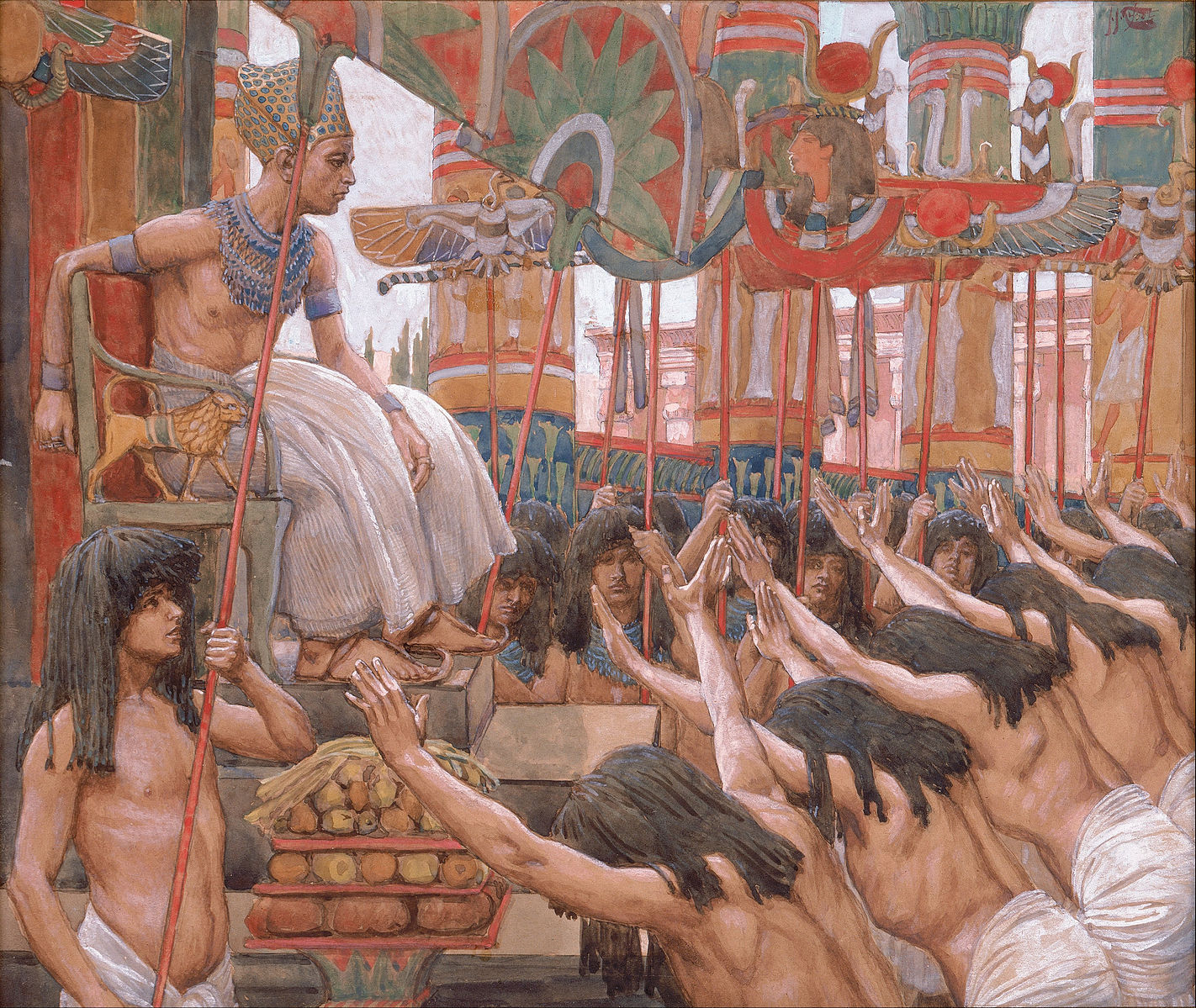
Joseph Dwelleth in Egypt,
by James Tissot

So now, you did not send me here, but God!  And He has set me up as a father-figure to Pharaoh, and as the master of all his household, and as the one who dominates all the land of Egypt.  (Genesis 45:8)

Joseph’s moment of compassion and affection for Benjamin did not transform him.  His statement that God manipulated his brothers like pawns in order to make him the ruler of everything and the savior of his family is an undisguised expression of narcissism.

After delivering this statement and requesting that his brothers bring Jacob and the rest of the extended family to Egypt so Joseph can take care of them, he wants to exchange tears and embraces with his brothers.  It is an opportunity for them to express gratitude toward their savior.

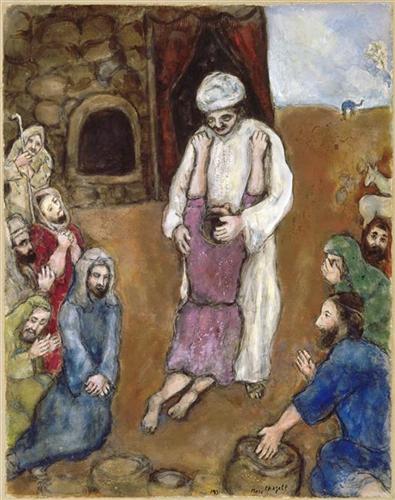
Joseph Recognized, by Marc Chagall

The first embrace is successful.

And he fell on the neck of his brother Benjamin and he wept, and Benjamin wept on his neck.  (Genesis 45:14)

Benjamin has no bad memories or guilt regarding his brother Joseph.  The ten older brothers do the best they can, but the Torah does not say they wept, or kissed him, or embraced him.

And he kissed all his brothers and he wept on them.  And after that his brothers spoke with him.  (Genesis 45:15)

Joseph may feel affection for Benjamin.  For all we know, he also feels affection for his own Egyptian wife and sons.  But he exhibits more narcissism than empathy.

During the seven-year famine, his brothers have no alternative but to obey Joseph and bring Jacob and their own wives and children and grandchildren down to Egypt.

And Joseph settled his father and his brothers, and he gave them holdings in the land of Egypt, in the best part of the land …  And Joseph sustained his father, his brothers, and all the household of his father with bread, down to the mouths of the little ones.  (Genesis 47:12)

With his extended family members, Joseph acts like a benign God.  As long as they are completely dependent on him, he is generous and happy.

With the Egyptian farmers, Joseph enjoys a different aspect of his importance and power.  Sometime after the second year of famine they run out of silver to pay for the grain that Joseph collected and stored during the seven years of plenty.

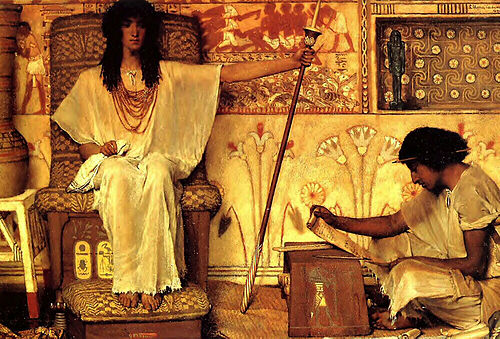
Joseph, Overseer of the Pharaoh’s Granaries, by Lawrence Alma-Tadema, 1874

And Joseph said: “Bring your livestock, and I will give to you in exchange for your livestock, if there is no more silver.”  (Genesis 47:16)

Soon the Pharaoh owns all the livestock in Egypt (except for the animals belonging to Joseph’s family and to the Egyptian priests).  The following year the Egyptian farmers tell Joseph that they have nothing left to trade for grain except themselves and their fields.  Joseph calls it a deal.

And Joseph acquired all the soil of Egypt for Pharaoh, since each Egyptian sold his field, because the famine was so hard on them.  And the land became Pharaoh’s.  And he made the people cross, town by town, from one end of the border of Egypt to the other end.  (Genesis 47:20-21)

Joseph not only takes each farming family’s title to its land, but moves the family away from home to farm in another part of the country.

And Joseph said to the people: “Hey!  I have acquired you today, and your land, for Pharaoh.  There is seed for you, and you shall sow the land.  And it will happen at every harvest, you shall give one-fifth to Pharaoh …”  And they said: “You have kept us alive.  May we find favor in the eyes of my lord, and we will be slaves to Pharaoh.”  (Genesis 47:23-25)

Joseph’s motivation is not greed; he arranges for the Pharaoh to own everything.  His purpose is to display his power.  Joseph, and Joseph alone, can rearrange the government and population of all Egypt.


One does not need to be a narcissist to lack empathy for members of a particular population.  Even today, many people who are unselfish, sympathetic, and caring members of their own community also speak and vote callously when it comes to foreigners and outsiders.  It is easier to blame the stranger than to love the stranger.

Joseph is a narcissist with his extended family as well as with the Egyptians; the only affection he exhibits in the Torah is for his younger brother Benjamin.  Sometimes he is cold and calculating, and other times he is a drama queen.  His narcissism makes him untrustworthy; even after his older brothers have lived for seventeen years living under his protection in Egypt, as soon as their father dies they are afraid Joseph will take revenge on them.4

You cannot really come close to a narcissist.  But you can approach your own soul, and ask yourself for whom you feel no empathy.


  1. Genesis 38:1-26.
  2. Genesis 42:21.
  3. Genesis 43:30-31.
  4. Genesis 50:15-20. Fortunately for the brothers, Joseph still believes God arranged everything so Joseph would be the hero.

Mikeitz & Vayeishev: A Narcissist in the Pit?

Narcissistic personality disorder: a mental condition in which people have an inflated sense of their own importance, a deep need for excessive attention and admiration, troubled relationships, and a lack of empathy for others.1

The Mayo Clinic definition continues by noting that the cause of this mental disorder is still unknown, but it may be linked to genetics, neurobiology, and/or environment, specifically “mismatches in parent-child relationships with either excessive adoration or excessive criticism that is poorly attuned to the child’s experience”.

In the book of Genesis, the character of Joseph exhibits some level of narcissism due to a parent’s “excessive adoration”.  But narcissism in childhood and even adolescence can be outgrown if the person learns a measure of humility, empathy, and appreciation for others.  Does this happen with Joseph?

Joseph at seventeen

Joseph Reveals His Dream, by James Tissot

Jacob has twelve sons, but he showers attention on Joseph, and gives him an outrageously expensive garment.  Joseph wears it even when he is in the fields with his jealous older brothers.  He is a tattletale, and reports to their father when his brothers share unsavory gossip.  And he tells his brothers two dreams of his in which they all bow down to him.  (See last week’s post, Vayeishev: What Drove Them Crazy.)

These behaviors indicate that Joseph is a narcissist at age seventeen.  If he notices his older brothers’ jealousy and hatred, he does not mind.  When Jacob asks him to travel for several days to check up on his older brothers and report back, Joseph sets off in his fancy garment and walks right up to them as if he were invulnerable.  They seize him and strip him.

And they took him and they cast him into the bor …  (Genesis/Bereishit 37:24)

bor (בּוֹר) = a cistern with cemented walls, a pit, a prison, a grave.

They sit and eat lunch while they discuss whether to kill him.  Then a caravan headed for Egypt approaches, and they pull him naked out of the bor and sell him as a slave.2  In Egypt, the Pharaoh’s captain of executioners, Potifar, buys Joseph.

The shock of being instantly demoted from the expensively-dressed favorite son to the naked slave of an executioner might lead some adolescents to wonder if they did something wrong.  Does Joseph take his first steps from narcissism to empathy, from thinking only of his own importance to considering the feelings of others?

Joseph and adultery

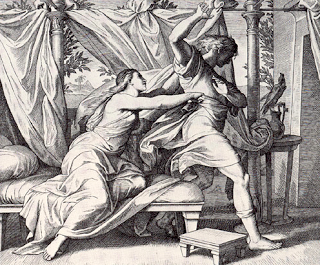
Joseph and Potiphar’s Wife, by Schnorr von Carolsfeld

At Potifar’s estate God blesses all of Joseph’s work with complete success, so his master makes him steward over his whole household.3  Then Joseph, who is beautiful as well as successful, encounters a potential moral dilemma.

After these things his master’s wife fixed her eyes on Joseph and said: “Lie with me.”  And he refused.  He said to his master’s wife: “With me here, my master does not know what is in the house; everything that he has, he has placed in my hands.  He is no greater in this house than I, and he has not held back anything from me except you, since you are his wife.  So would I do this great evil and be guilty before God?”  (Genesis 39:7-8)

What is Joseph’s motivation for refusing to have sex with Potifar’s wife?  Is his speech an example of narcissism, or empathy?

Narcissism:  Narcissists treat higher-status people with respect, even as they dismiss everyone they consider inferior.  If Joseph is a narcissist, he wants to keep his record clean with Potifar and God.

Empathy:  People capable of empathy can feel gratitude and affection.  If Joseph is not a narcissist, he is grateful to Potifar for giving him so much trust and authority, and does not want to hurt the man who is good to him.

When Joseph and Potifar’s wife are alone in the house she grabs him and he flees, leaving his garment in her hand.  (See my post Vayeishev: Stripped Naked, which argues that Joseph learns humility.)  She lies and says he attacked her, and Potifar throws him in prison.  But God blesses Joseph’s work for the chief jailer with success, and he becomes the virtual head of the prison.4

Joseph in prison

Joseph in Prison, by James Tissot

God sent Joseph two significant dreams when he was seventeen, both indicating that someday his brothers would bow down to him.  Now, when he is 28, the Pharaoh’s chief butler and chief baker wait in prison for their judgments, and each has a dream on the same night.

And they said to him: “A dream we dreamed and there is no interpreter.”  And Joseph said to them: “Aren’t interpretations for God?  Recount, please, to me.”  (Genesis 40:8)

What does Joseph mean by that?

Narcissism:  Joseph is either equating himself with God, or at least assuming that he has a God-given power to interpret dreams which will always work.

Empathy:  Joseph implies that only God can interpret a dream.  Awkwardness makes him sound peremptory rather than hopeful when he asks the prisoners to tell their dreams.

Joseph meets the pharaoh

Two years later, in this week’s Torah portion, Mikeitz (“In the end”), the Pharaoh has two dreams that none of his soothsayers or wise men can interpret.  The Pharaoh’s chief butler remembers Joseph’s correct interpretations of the two dreams in prison, and speaks up.

And Pharaoh sent and summoned Joseph, and they brought him quickly from the bor, and he shaved and he changed his clothing and he came to Pharaoh.  (Genesis 41:14)

The first time Joseph is brought up from a bor is when his brothers sell him into slavery just to get rid of him.  This time it is when a king needs his skill.        

And Pharaoh said to Joseph: “A dream I dreamed, and no one could interpret it.  And I have heard it said about you, that you [merely] hear a dream to interpret it.”  And Joseph answered Pharaoh, saying: “Not I.  God will answer for the welfare of Pharaoh.”  (Genesis 41:15-16)

Narcissism:   Joseph is cleverly pretending to be humble, while reminding the Pharaoh that he speaks for God.

Empathy:  Joseph is deflecting admiration out of the humble knowledge that he is only a mouthpiece for God.

Joseph Interprets Pharaoh’s Dream, by Reginald Arthur, 1894

Joseph (correctly) interprets Pharaoh’s dreams as indicating God’s plan to give Egypt seven years of plenty followed by seven years of famine.  Then he adds gratuitous advice.

And now, may Pharaoh look for a man who is discerning and wise, and may he set him over the land of Egypt.  (Genesis 41:33)

This man, Joseph continues, should oversee the collection and storage of grain during the years of plenty and its distribution during the years of famine.  Why does Joseph suggest appointing one man, and imply that it should be a newcomer rather than the usual government administration?

Narcissism:  Not only does he want the job himself, but he knows that only he could do it right.

Empathy:  He has observed the Egyptian government bureaucracy and believes a strong hand is needed, but he expects someone else in Egypt may be a better candidate for the job.

The Pharaoh responds with a narcissist’s dream-come-true.

And Pharaoh said to Joseph: “Since God has made all this known to you, there is no one as discerning and wise as you.  You yourself shall be over my house and on your command all my people shall be ordered.  Only by the throne will I be greater than you.”  And Pharaoh said to Joseph: “See, I place you over all the land of Egypt.”  And Pharaoh removed his ring from upon his hand and he placed it on the hand of Joseph, and he dressed him in clothes of fine linen, and he put a gold collar on his neck.  And he had him ride in the chariot of his second-in-command, and they called out before him “Avreikh!”; thus he appointed him over all the land of Egypt.  (Genesis 41:39-43)

Avreikh, by James Tissot

Avreikh (אַבְרֵךְ) = either an unknown Egyptian word, or an invention meaning “I cause kneeling” in Hebrew.

Joseph says nothing.

Narcissism:  He believes he is getting what he deserves.

Empathy:  He recognizes that since he is a complete unknown in Egypt, a lot of pomp is required to convince the people that he now has authority.

After the seven years of plenty, famine spreads over not only Egypt, but all of Canaan.

Joseph and his brothers

And Joseph was the tyrant over the land; he was the grain-seller to all the people of the earth.  And Joseph’s brothers came, and they bowed low to him, noses to the ground.  (Genesis 42:6).

Apparently Joseph, who must have a large staff, prefers to personally greet foreigners who bow to him and ask for rations.  He recognizes his ten older brothers, but they do not recognize him.  Joseph was 17 when they sold him; now he is 38, wearing Egyptian garb, and accompanied by a translator.  He accuses his brothers of being spies, causing them to babble defensively that they are ten of twelve brothers—“and hey! The youngest is with our father today, and one is no more.” (Genesis 42:13)

Joseph gives them a test, supposedly to prove they are not spies.  He will keep one of the brothers hostage while the others go home with food; but they must return to Egypt with their youngest brother to prove their honesty.

The brothers then realize their own lack of empathy, twenty years before.

And they said, each to his brother: “Ah, we are guilty on account of our brother, because we saw his distress in pleading to us for pity, and we did not listen; therefore this distress came to us.”  (Genesis 42:21)

Joseph hears this, although he is pretending he does not know Hebrew.

And he turned around from them, and he wept.  Then he turned back to them and he spoke to them and he took from among them Shimon, and he fettered him before their eyes.  (Genesis 42:24)

Narcissism:  Joseph weeps for himself, remembering how he wept at age seventeen when he was in their power.

Empathy:   Joseph weeps in sudden recognition that his brothers have feelings and know they are guilty.

Joseph is Governor, by Owen Jones, 1869

Joseph continues to carry out his elaborate charade and test.  (See my post Mikeitz & Vayiggash: Testing.)  Because their father, Jacob, is unwilling to let go of Rachel’s remaining son, the brothers wait until they have run out of food before returning to Egypt with Benjamin.  Joseph has his steward bring them to his palace and return Shimon to them.  Then Joseph comes and makes polite conversation, not neglecting to ask if their father is still alive.  Finally he takes a good look at Benjamin, his only full brother, who was a small child when Joseph was sold into slavery.  Now Benjamin is in his twenties.

And Joseph hurried out, because his rachamim was kindled toward his brother and he needed to weep; and he came to the inner room and he wept there.  Then he washed his face and he went out and he pulled himself together and he said: “Serve food.”  (Genesis 43:30-31)

rachamim (רַחֲמִים) = compassion, loving feelings, affection, mercy.  (From rechem (רֶחֶם) = womb.)

Here the Torah finally states that Joseph feels compassion toward someone.  He knows that his father, Jacob, would treat Rachel’s only remaining son with favoritism.  Perhaps he assumes that Benjamin, too, has suffered at his half-brothers’ hands.

This is a form of empathy.  Can Joseph take the next step, and become interested in Benjamin as an individual in his own right, or will Joseph always see his little brother as a reflection of himself?  When his elaborate test is completed, will he be able to consider his older brothers’ feelings as well?  Or will the story be all about him?

The answer is hidden in next week’s Torah portion, Vayiggash.

  1. https://www.mayoclinic.org/diseases-conditions/narcissistic-personality-disorder/symptoms-causes/syc-20366662. Only extreme cases of narcissism are classified as personality disorders, but the clinical definition applies to all levels of narcissism.
  2. Genesis 37:25-28.
  3. Genesis 39:1-6.
  4. Why does God keep blessing Joseph with success? Maybe this is the Torah’s way of saying that Joseph is inherently intelligent and capable.  (Some narcissists are, and their commitment to their own importance drives them to work hard.)  On the other hand, maybe the anthropomorphic God-character portrayed in the book of Genesis is testing Joseph by repeatedly making him successful under difficult circumstances.  Maybe God wants to find out whether his clan will be worthy of leading the Israelites in the future.  Modern scholars date the original composition of the Joseph story to J and E sources recorded during 922 to 722 B.C.E., when the Israelites lived in two kingdoms, with the northern kingdom dominated by the Efraimites, descendants of Joseph, and the southern kingdom dominated by descendants of Judah.  When the Assyrian Empire swallowed the northern kingdom in 722 B.C.E., it seemed like a vindication of the Judahite narrative.

Vayeishev: What Drove Them Crazy

Why do Joseph’s ten older brothers hate him?  Because they resent their father’s favoritism?  Or because they resent Joseph’s behavior?

An obnoxious father

Jacob, a.k.a. Israel, has always played favorites.  He has children with his two official wives (Leah and Rachel) and their two female servants (Zilpah and Bilhah), but he loves only Rachel.  It is no surprise to learn in this week’s Torah portion, Vayeishev (“And he settled down”) that he loves Rachel’s son Joseph more than his ten older half-brothers.

Jacob Blesses Joseph and Gives Him the Coat, by Owen Jones, 1869

And Israel loved Joseph most out of all his sons, because he was a son of his old age, and he made him a ketonet passim.  And his brothers saw that their father loved him more than all his brothers, and they hated him and could not speak in peace.  (Genesis 37:3-4)

ketonet (כְּתֺנֶת) = a long tunic/shirt/loose dress worn by both men and women, either alone or underneath a robe or cloak.  It was belted with a sash, and removed at night.1

passim (פַּסִּים) = ?  Translations include “multicolored” (as in the King James “coat of many colors”), “ornamented”, and “long-sleeved”.

The only other appearance of ketonet passim in the bible is in 2 Samuel 13:18-19, which notes that every unmarried daughter of King David wore one.  Joseph is a shepherd like his brothers, but Jacob gives him a garment fit for a king’s child.

The opening of this week’s Torah portion says Jacob loves Joseph the most because he is a son of Jacob’s old age.  But his feelings are even stronger because of his love for Joseph’s mother, Rachel, who dies in childbirth in this week’s Torah portion.  Although the Torah promises to give us the lineages2 of Jacob, it does not name any descendants but Joseph, the most important person in Jacob’s life once Rachel is gone.

Besides giving Joseph the princely tunic , Jacob refuses to be comforted when he believes his favorite son has been killed.3  In next week’s portion, Mikeitz, Jacob is not alarmed to learn that the vizier of Egypt has imprisoned Shimon, one of his sons with Leah.  But he refuses to let Benjamin, his second son with Rachel, leave his side and go to Egypt.4

An obnoxious youth

Naturally Jacob’s ten older sons resent their father’s favoritism.  But they have another reason to hate Joseph.  When one child in a family is spoiled and the others neglected, the spoiled one can become a narcissist—either because he believes he truly is wonderful, or because he wants to believe it in order to justify all the attention.  This week’s Torah portion does not say directly that Joseph is selfish at age seventeen, but the implication is there, beginning with the word na-ar.

These are the lineages of Jacob: Joseph, seventeen years old, tended the flock along with his brothers, and he was a na-ar … (Genesis/ Bereishit 37:2)

na-ar (נַעַר) = male slave, male assistant, boy, young marriageable man.

What does na-ar mean in Joseph’s case?  Joseph is certainly not a slave.  At most he is an assistant to his brothers as he learns the shepherding business.

Kohl used by Egyptian men and women

Bereishit Rabbah 84.7, citing Joseph’s beauty, claims he acts like a vain youth, daubing kohl around his eyes, lifting his heels, and dressing his hair.5  (I assume that Joseph is not tripping through the sheep pastures all dolled up, but saves the show for when they stop at a village.)

Or perhaps he is a na-ar because he is immature for his age.  Right after calling him a na-ar, the Torah says Joseph is a tattletale.

…  and he was a na-ar with the sons of Bilhah and the sons of Zilpah, women of his father’s, and Joseph brought bad dibatam to their father.  (Genesis/Bereishit 37:2)

dibatam (דִּבָּתָם) = (noun) slander about them, gossip about them; their slander, their gossip, their reputation.  (dibah (דִּבָּה) = gossip (usually malicious), slander + tam (תָם) = suffix for the third person masculine plural construct form.)

Many translators rework the final clause into “Joseph brought an ill report of them to their father” or something similar.  This translation fits the context, but it makes the word dibah superfluous. 

If we translate the clause as “Joseph reported their bad gossip to their father” we account for all the words in the original Hebrew.  Another accurate translation is “Joseph reported their malicious gossip to their father.

What are Zilpah and Bilhah’s sons gossiping about?  And what does Joseph report?  One possibility is that the four young men are slandering Joseph, drawing wicked conclusions about his beauty treatments or the way he wears his fancy tunic.  If Joseph were six years old, like his little brother Benjamin, he might well run home and cry, “Daddy, Daddy, they said mean words about me!”  But does he do this at age seventeen?  If so, his father is too blind with devotion to notice his favorite’s immaturity.

Another possibility is that Zilpah and Bilhah’s sons are slandering Leah’s oldest sons, who would be likely to lord it over them because of their superior age, experience, and status.  By reporting this malicious gossip to Jacob, Joseph would make all ten of his older brothers look bad.  Joseph, who proves his intelligence later in the story,6 may even use these bad reports as a pre-emptive strike.  If any brother subsequently tells Jacob about Joseph’s unworthy deeds, Jacob will not be inclined to believe him.

Of course by reporting his brothers’ malicious gossip, Joseph becomes guilty of malicious gossip himself.  But he does not worry about that.  He knows it will not occur to his doting father, and he himself is not yet concerned about ethics.7  Sure enough, later in this week’s Torah portion Jacob sends Joseph on a journey to check up on all his brothers and report back.8

Joseph is about to suffer for his own contributions to his brothers’ hatred: his malicious reports, and also his narration of his dreams.

Joseph Reveals His Dream,
by James Tissot

Joseph dreamed a dream and he told his brothers, and it increased their hatred of him.  He said to them: “Listen, please, to this dream that I dreamed.  Hey, we were binding sheaves in the middle of the field, and hey, my sheaf stood up and was even standing firm, and hey, your sheaves gathered around and bowed down to my sheath.”  (Genesis 37:5-7)

If the brothers were on friendly terms, they would merely tease him about this grandiose dream.  Instead they hate him more—but although Joseph is intelligent, he does not change his behavior.  He tells them a second dream in which his brothers are symbolically bowing down to him.9  This time Jacob also hears the dream, yet he still sends Joseph off to spy on his brothers.

When Joseph catches up with his brothers they throw him into a pit, sell him into slavery, and then convince their father that the boy was killed by wild beasts.  (See my post Mikeitz: Forgetting a Father.)  Thus Jacob suffers for his clueless favoritism.


Jacob and Joseph make the same mistake in this week’s Torah portion: they both fail to respect the feelings of others.

And what about Joseph’s older brothers?  Their hatred is understandable; nobody likes being denigrated and treated as insignificant, especially by a parent or younger sibling.  But they could choose a different reaction.

I have had a few young Josephs in my life, narcissists too wrapped up in their own dramas to wonder what I think, to have any interest in me as an individual.  I have imagined how nice it would be if these people were dead, or banished to another country.

Over decades of suffering and reflection, I have realized that when I cannot speak to someone in peace, it is better to run away.  And that when I am blessed enough to hold compassion in my heart and peace on my tongue, it is good to listen—even when I am not heard in return.  When I do the right thing myself, I have peace inside, and I do not have to spend the rest of my life feeling guilty, like Joseph’s brothers.10  It helps to remind myself that the “young Josephs” in my life, however old they are in years, are not being narcissistic on purpose; they are themselves victims of their upbringing.

(I posted an earlier version of this essay in November 2010.)


  1. A ketonet was belted with a sash: see Isaiah 22:21. It was taken off at night: see Song of Songs 5:3.
  2. Toledot (תּוֹלֵדוֹת).
  3. Genesis 37:34-35.
  4. Genesis 42:38.
  5. Bereishit Rabbah, a collection of commentary from 400- 600 C.E., extrapolates from Genesis 39:6, which mentions Joseph’s extraordinary good looks in order to explain why Potifar’s wife repeatedly tries to seduce him.
  6. Joseph demonstrates his intelligence in Egypt both in his implementation of his 14-year plan for preventing famine in Egypt while increasing the power of the government (Genesis 41:33-36, 47:13-26) and in his complicated scheme for testing his brothers before revealing his identity to them (Genesis 42:6-45:3).
  7. Joseph’s first ethical act reported in the Torah is after Potifar, who buys Joseph as a slave, makes him steward over his whole household. Then when Potifar’s wife attempts to seduce Joseph, he refuses her.  (Genesis 39:4-12).
  8. Genesis 37:12-14.
  9. Genesis 37:9-11.
  10. Genesis 42:21-22, 50:15-17.

Vayishlach: Mother Figure

And he built an altar there, and he called the place of God “Beit-El” because there God had been revealed to him in his flight from the face of his brother.  And Deborah, the wet-nurse of Rebecca, died and was buried beneath Beit-El, beneath the great tree; and he called its name “Great Tree of Weeping”.  (Genesis 35:7-8)

Why does an aged wet-nurse suddenly appear in this week’s Torah portion, Vayishlach (“And he sent”)?  And why does Jacob name her grave a place of weeping?

*

Jacob is Rebecca’s favorite son, and she mothers him well into his adulthood.  When her husband, Isaac, is about to give a blessing to their other son, Esau, she arranges for Jacob to impersonate his brother and steal the blessing.  She cooks the meat Isaac asked for, and she even dresses Jacob in Esau’s best clothes, as well as in goatskins to imitate Esau’s hairy hands and neck.1

After Esau finds out about the stolen blessing and vows to kill his brother, Rebecca tells Jacob to run away from home, and she arranges his journey to Charan.  (See my post Toledot: Rebecca Gets It Wrong.)  She tells Jacob he will only need to stay with his uncle in Charan—

Until the anger of your brother turns away from you and he forgets what you did to him; then I will send and bring you from there … (Genesis 27:45)

Jacob’s Dream,
by James Tissot

Jacob (who is over 40) spends his first night away from home at a place where God gives him a dream of a stairway between earth and heaven.  God promises:

“I will guard you wherever you go and I will bring you back to this soil …” (Genesis/Bereishit 28:15)

When Jacob wakes up he names the place Beit-El, “House of God”.  Even though God has already promised to guard him, he makes a vow to serve God on the condition that God will take care of him until he returns.

“If God is with me and guards me on this way where I am going and gives me bread to eat and clothes to wear, and I return in peace to my father’s house, then God will be my god, and this stone that I set up as a pillar will become a house of God, and everything that you give me I will repeatedly tithe to you.”  (Genesis 28:20-22)

Jacob thinks in terms of deals, like the one he made with Esau when he traded lentil soup for Esau’s inheritance.2  He also thinks in terms of a parental figure providing food and clothing, as his mother did when he tricked his father into giving him Esau’s blessing.

Jacob stays in Charan for twenty years, working as a shepherd for his uncle Lavan in exchange for wives and his own flocks.  During that whole time, the Torah does not mention any message from Jacob’s mother.  Subconsciously, now that he has lost Rebecca’s apron strings, Jacob may want to stay as long as possible under God’s motherly care.  After all, the terms of the deal he offered God will end once he returns to Beit-El and builds a house (a permanent altar) for God.

Esau and Jacob Reconcile, by Francesco Hayez, 1844

Yet after twenty years Jacob does leave Charan, with a large party of wives, children, servants, and livestock.  In this week’s Torah portion he sends gifts to his estranged brother, Esau.  The brothers meet, embrace, and cry on one another’s necks.  Having made peace with Esau, Jacob’s next order of business must be to return to his father’s house, and then build an altar at Beit-El.  Right?

Wrong.  Once he has crossed into Canaan, Jacob stops at Shekhem and decides to settle down there; he even buys land.3  He is in no hurry to see his parents or to complete his deal with God.

But his own children ruin his plan.  The prince of Shekhem lies with Jacob’s daughter Dinah, then offers to marry her.  Jacob’s sons Shimon and Levi respond by murdering every male in the town.4  Jacob complains that Shimon and Levi have destroyed his reputation in the region.  He is about to despair when God reminds him to go to Beit-el and make the altar he promised.5

Jacob leads his people south and builds the altar.

And Deborah, the wet-nurse of Rebecca, died and was buried tachat Beit-El, tachat the allon; and he called its name “Allon of Weeping”.  (Genesis 35:8)

tachat (תַּחַת) = beneath, under; instead of, in exchange for.

allon (אַלּוֹן) = stately tree, possibly with religious significance.  (Translators guess it may be an oak or a terebinth.)

The only other time Deborah is mentioned is when Rebecca leaves Charan to marry Isaac, and she brings along her former wet-nurse, who is not named at this point.6  Presumably the woman is at least fifteen years older than Rebecca, and they have a relationship of trust and affection.

Why is Deborah is traveling with Jacob’s household in this week’s Torah portion? Rashi7 answered that after twenty years, Rebecca finally sent someone to Jacob in Charan to tell him it was safe to come home.  She used the aged Deborah as her messenger, and Deborah died in Beit-El on the journey back.  (This would not be surprising, since by then she must have been at least 87, and probably more than 100.)

The Torah, however, does not mention Deborah or any other human messenger arriving in Charan.  Instead, the message comes from God.

God said to Jacob: “Return to the land of your fathers and to your homeland, and I will be with you.”  (Genesis 31:3)

Jacob would not need a signal from his mother once he had received a signal from God, his new protector.

Another possibility is that Deborah travels to Beit-El from Hebron, where Isaac and Rebecca have settled,8 in order to tell Jacob that his mother has died.  Having accomplished her final mission in life, the aged wet-nurse dies.  When Jacob buries her, he weeps for both her and his mother—even though the Torah does not mention the news about Rebecca.  (Although Rebecca is one of the speaking female characters in the book of Genesis, the Torah never gives her age, and mentions her death only when Jacob is giving his own burial instructions and lists who is already buried in the cave.9)

In Genesis Rabbah 81:5 (300-500 C.E.), Rabbi Samuel ben Nahman says that in Greek, allon means “another”, and therefore Jacob was mourning for another while he was mourning for Deborah.  Modern commentator Avivah Gottlieb Zornberg has pointed out: “The word tachat—under, instead—is used twice in this verse, suggesting substitution, a hidden grief.  On this other level, eluding consciousness, Jacob weeps for his mother.”10

Modern commentator Shmuel Klitsner wrote: “This, after all, is Jacob, perhaps only now belatedly ‘weaned’ from his mother Rebecca’s influence.  This is Jacob, who inappropriately relinquished his autonomy to a mother who dressed her adult son in another’s clothing …  Now, at this juncture, upon Jacob’s return to Beth-El and just prior to the moment of the divine reconfirmation of his new identity, he must divest himself of the last vestigial ties to that inappropriate dependence.  This is expressed symbolically in the burial of a mythic woman who has silently accompanied Rebecca and then Jacob through their lives, and whose role, despite her years, is still described as one who nourishes from the breast.”11

Immediately after Deborah is buried, God appears to Jacob and confirms that his new name is Israel: Yisrael (ישְׂרָאֵל) = he struggles/argues (with) God.  Jacob’s relationship with God is no easier than his relationship with his mother.


A modern adult knows God is not an anthropomorphic yet all-powerful hero who can replace Mommy or Daddy.  Yet how many of us, even today, are like Jacob?  How many of us, after we realize that our parents cannot protect us from harm, react by bargaining with God to protect us?

I never expected God to be parental—perhaps because I was brought up as an atheist.  When I became an adult and groped my way toward an idea, or perhaps a feeling, of God, I never wanted to bargain.  I have never even asked God to protect and take care of me, because I believe the world is not set up that way.  I do pray in gratitude.  And I pray for courage, strength, empathy, and other inner qualities that help me to face our unpredictable world, and even do some good in it.  I think my prayers are slowly being answered.


(An earlier version of this essay was published in November 2010.)

  1. Genesis 27:1-17.
  2. Genesis 25:29-33.
  3. Genesis 33:19.
  4. Genesis 34:1-26.
  5. Genesis 35:1.
  6. Genesis 24:59.
  7. 11th-century Rabbi Shlomoh Yitzchaki.
  8. Genesis 35:27.
  9. Genesis 50:29-31.
  10. Avivah Gottlieb Zornberg, The Murmuring Deep, Schocken Books, NewYork, 2009, p. 230.
  11. Shmuel Klitsner, Wrestling Jacob, Urim Publications, Jerusalem, 2006, p. 130.

Vayeitzei: Stealing Away

Jacob runs away twice in this week’s Torah portion, Vayeitzei (“and he went”).  At the beginning he runs away from his brother Esau in Beersheva, and arrives alone at his uncle Lavan’s house in Charan.  He works as a shepherd for his uncle for twenty years, but Lavan still refuses to grant him independence.  So Jacob runs away again at the end of the Torah portion.  He heads back toward Beersheva with two wives, two concubines, eleven children, many servants, assorted tents and household goods, and more livestock than his own household needs,1 including expensive riding camels.2

His wives Leah and Rachel resent their father and agree it is time to go.3

Lavan went to shear his sheep.  And Rachel, vatiginov the terafim that belonged to her father.   (Genesis/Bereishit 31:19)

vatiginov (וַתִּגְנֺו) = she stole, (or) you stole.  (A form of the verb ganav, גָּנַב = stole, robbed.)

terafim (תְּרָפִים) = figurines or statues of household gods?  (Although the -im suffix usually indicates a plural, the noun terafim can be plural or singular in the bible.)

Unlike his wife Rachel, Jacob takes only what he believes is rightfully his.  But he does a different kind of stealing.

Jacob Flees Laban, by Charles Foster, 1897 (detail)

And Jacob, vayignov et leiv Lavan the Aramean by not telling him that he was running away.  And he ran away, he and all that was his; he got up and he crossed the Euphrates and he set his face toward the hills of the Gilead.  (Genesis 31:20-21)

vayignov et leiv (וַיִּגְנֺב אֶת לֵב) = he deceived.  (Literally: vayignov = he stole + et = (definite direct object indicator) + leiv = the mind of.)

Lavan learns three days later that Jacob and his household have fled.  He takes some kinsmen and chases after them, catching up with Jacob’s party in the hills of Gilead.  The next morning Lavan confronts Jacob and says:

“What were you doing when vatignov et levavi and you carried off my daughters like captives of the sword?  Why did you hide to run away, vatignov me, and you did not tell me? … I have power in my hand to do bad to you all, but last night the god of your fathers spoke to me, saying: ‘Protect yourself from speaking with Jacob for good or bad’.”  (Genesis 31:26-27, 29)

vatignov et levavi (ותִּגְנֺב אֶת לְבָבִי) = you deceived me.  (The same idiom as vayignov et leiv.)

He accuses Jacob of both deception (“stealing his mind”) and robbery.  But influenced by the dream from the God of Israel, Lavan gives Jacob the benefit of the doubt.

“And now you surely walked away because you surely longed deeply for the house of your father.  [But] why ganavta my gods?”  (Genesis 31:30)

ganavta (גָנַבְתָּ) = did you steal.   (Another form of the verb ganav.)

Lavan cannot help exclaiming about what bothers him the most: that his household gods, his terafim, are missing.

And Jacob answered and he said to Lavan: “Because I was afraid, because I said [to myself]: ‘What if you tear away your daughters from me?’  If you find anyone has your gods, he shall not live.  In front of our kinsmen, identify what is yours with me and take it!”  And Jacob did not know that Rachel genavatam.  (Genesis 31:31-32)

genavatam (גְּנָבָתַם) = had stolen them.  (Another form of the verb ganav.)

Lavan acts on Jacob’s invitation by searching the tents of Jacob, Leah, the two concubines, and finally Rachel.

Bedouin camel saddle, photo by hannatravels.com

And Rachel?  She had taken the terafim and put them inside the camel saddle, and she sat on them.  Lavan groped through the whole tent, but he did not find them.  (Genesis 31:34)

Rachel tells her father she cannot stand up to greet him because it is her monthly period, and he leaves her tent.  Jacob is spared the anguish of finding out the truth and making good on his promise to kill the thief.

Jacob justifies deceiving Lavan by explaining that he secretly fled because he was afraid of losing his wives.  Later in the confrontation he justifies his deception by bringing up Lavan’s history of cheating him.4

But what about Rachel?  Why does she steal from her father, and is she justified?

What are Lavan’s terafim?

from Judah, 7th century BCE

Lavan’s terafim may be small terra cotta figurines, which archaeologists have found in abundance throughout Mesopotamia as well as at pre-586 B.C.E. sites in the kingdom of Judah.  These figurines came from private houses, not temples.  They may have represented a clan’s ancestors, and ancestor-worship may have been distinguished from idol-worship.5

One proposal is that Lavan’s terafim are similar to the “gods” mentioned in tablets from 1440-1340 B.C.E. at Nuzi.6  According to one Nuzi tablet, the chief heir of an estate received the “gods” of the deceased.  The chief heir was usually a son of the deceased, but if he had no natural son, his adopted son could inherit the “gods” along with the rest of the estate.7

If possession of a family’s terafim indicated the ownership of a household in Charan as well, then Rachel might steal her father’s terafim in case she needs future proof that her husband owns the flocks, slaves, and goods he took.

This explanation is based on 20th-century archaeology, and assumes that the biblical term terafim applies to small terra cotta figurines.  But what if we interpret the word terafim in this week’s Torah portion by examining the other seven occurrences of the word terafim in the Hebrew Bible?

Traditional commentary assumed that terafim were idols, which God forbids in the Ten Commandments and later biblical passages.  Genesis Rabbah 74:5-6 and Rashi (11th-century C.E. rabbi Shlomoh Yitzchaki) credited Rachel with taking the terafim in order to reform her father and end his idol-worship.  19th-century rabbi S.R. Hirsch added that since the terafim could not protect themselves from theft, Lavan should realize that they were also powerless to protect him.8

But if Rachel despised the terafim, she could have discarded or destroyed them during the first ten days of the journey, before Laban caught up with them.

Furthermore, the book of Genesis never censures anyone for owning terafim.  And the book of Hosea includes terafim in a list of things the Israelites will be deprived of until they turn back to God.9  The implication is that in the northern kingdom of Israel (Samaria) where Hosea prophesied, terafim were acceptable accompaniments to the worship of the God of Israel.

Michal Lets David Out the Window, by Gustave Dore, 1865

The first book of Samuel also considers household terafim acceptable.  In 1 Samuel 19:13, King Saul sends men to kill David, and David’s wife Mikhal helps him escape out the bedroom window.  Then she arranges his bed so that it will look as if he is still sleeping there.  She takes a terafim in their house, gives it a wig of goat-hair, and pulls the bedclothes over it.  This man-sized terafim is obviously larger than the ones Rachel steals and hides in her camel saddle.  It seems to be a normal item for a God-fearing Israelite general to have in his house.

That leaves five negative references to terafim in the bible.  Judges 17-18 gently pokes fun at Micah by relating how he acquires four “gods”: a carved silver idol, a cast silver idol, an oracular object, and a terafim.  Like the silver idols, a terafim is a physical object used for dubious religious purposes.

Terafim are listed along with false and/or idolatrous items used for divination in 1 Samuel, 2 Kings, Ezekiel, and Zecharaiah.  These lists assume that terafim are also devices for soothsaying.10  The purpose of Lavan’s terafim may therefore be to provide omens about the future and knowledge of the unknown.

In that case, Rachel might steal the terafim so Lavan could not use them to find out what route Jacob and his household were taking.11  But Lavan and his men track them down anyway.

Jacob and Laban Set a Boundary (artist unknown)

Once Lavan no longer has his terafim for divination, he also becomes able hear God in a dream: an inner voice telling him to guard his own behavior and be careful when he speaks to Jacob.  The next day, Lavan becomes a reasonable man, giving up his “rights” for the sake of peace.12  The two men conduct a ritual to set a clear boundary between the areas they will occupy, and Jacob walks off as a free man and head of his own household.

*

If Rachel had ditched the terafim after stealing them from Lavan, would she, too, have heard God’s voice in dream?  God never speaks to her in the Torah, and she dies in childbirth on the road south of Beit-El.  The contention between Rachel and her sister Leah continues between her sons and Leah’s sons.  Would it have been different if she had heard God’s voice?  What kind of person would she have become?

What if you threw away your terafim?  So many people get attached to the figurines they have acquired: viewing every coincidence as an omen, reacting as if human beings were stock characters made of clay, denying inconvenient realities.  What if you stopped deceiving yourself, stopped stealing your own mind?  What would you be able to hear?

  1. Jacob evidently leaves Charan with more flocks and herds than he needs, since he can afford to give away 580 animals to Esau in Genesis 32:14-16.
  2. Genesis 31:17-18 and 32:16.
  3. Genesis 31:11-16.
  4. Jacob promises to serve Lavan for seven years in exchange for marriage with Lavan’s younger daughter, Rachel, but at the wedding Lavan substitutes his older daughter, Leah. He gives Rachel to Jacob a week later as a second wife, but he requires Jacob to work another seven years (Genesis 29:15-27).  After he has completed 14 years of service, Jacob asks Lavan to let him go back to Canaan with his wives and children, but Lavan negotiates wages for continued service (Genesis 30:25-31).  Jacob alludes to this history in Vayeitzei in Genesis 31:41.
  5. Aaron Greener, “What Are Clay Female Figurines Doing in Judah During the Biblical Period?”, www.thetorah.com, Aug 16, 2016.
  6. The ruins of Nuzi were unearthed near present-day Kirkuk, Iraq, about 430 miles (690 km) east of Charan (present-day Harran in Turkey near the Syrian border).
  7. jewishvirtuallibrary.org/nuzi.
  8. Samson Raphael Hirsch, The Hirsch Chumash: Sefer Bereshis, English translation by Daniel Haberman, Feldheim Publishers, Jerusalem, 2002, p. 640.
  9. Hosea 3:4.
  10. 1 Samuel 15:23, 2 Kings 23:24, Ezekiel 21:26, and Zecharaiah 10:2. Following up on the idea of diviniation, Targum pseudo-Jonathan (originally Targum Yerushalmi) defined a terafim is a mummified head that can speak prophecy.  12th-century commentator Abraham ben Meir Ibn Ezra proposed that a terafim was an image made by astrologers at a propitious time so that it could speak.
  11. Elie Munk, The Call of the Torah, Bereishis (vol. 1), English translation by E.S. Mazer, Mesorah Publications, Ltd., Brooklyn, NY, 1994, p. 424.
  12. Genesis 31:43-44.

Lekh Lekha, Vayeira, & Toledot: The Wife-Sister Trick, Part 3

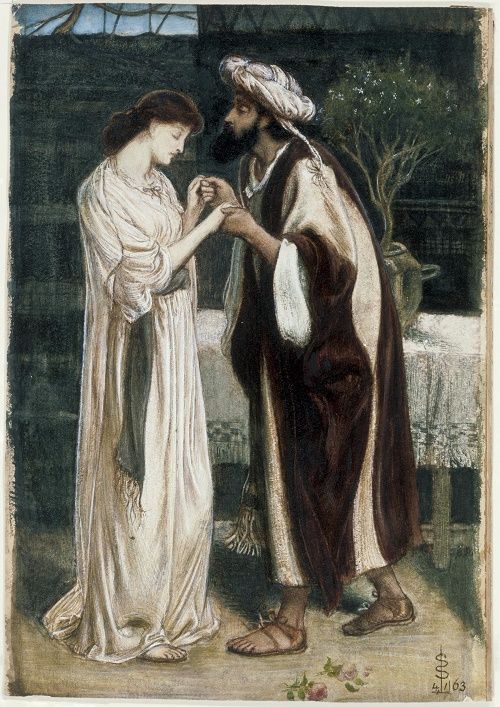
Isaac and Rebekah, by Simeon Solomon, 1863

And Isaac stayed in Gerar.  And the men of the place asked about his wife, and he said: “She is my sister,” because he was afraid to say “my wife”—“lest the men of the place kill me on account of Rebecca, since she is good-looking.”  (Genesis 26:6-7)

Isaac’s father, Abraham, pulls the wife-sister trick twice, once in Egypt and once in Gerar(See The Wife-Sister Trick, Part 1 and Part 2.)  Now Isaac moves to Gerar and starts the process a third time in this week’s Torah portion, Toledot (“Lineages”).

The Torah tells us he is afraid; he believes that people in Gerar are so immoral they would kill a man in order to marry his wife—perhaps because he heard the story from his father.  (The assumption is that marrying an already-married woman is so sinful, not even foreigners would do it.  Murder is the lesser sin.)

Abraham’s feelings about passing off his wife as his sister are omitted; we do not even know if he believes he would be killed, or if he sees it as a way to get rich.  At least Abraham has a reason for moving to Egypt.

A famine happened in the land, and Abraham went down to Egypt lagur there, because the famine was heavy on the land.  (Genesis 12:10)

lagur (לָגוּר) = to live as a resident alien, to sojourn.1

In the second tale, Abraham goes to Gerar for no apparent reason—except maybe to get richer.

And Abraham pulled out from there to the land of the Negev, and he settled between Kadeish and Shur, vayagar in Gerar.  And Abraham said of Sarah, his wife: “She is my sister.”  And Avimelekh, king of Gerar sent and took Sarah. (Genesis 20:1-2)

vayagar (וַיַּגָר) = and he lived as a resident alien, and he sojourned.  (Another form of the verb lagur.)

After the king of Gerar discovers the ruse, he showers gifts on Abraham and Sarah in order to induce Abraham to pray for him and compensate Sarah for any loss of honor.

In the third iteration of the wife-sister tale, Isaac faces another famine, and goes to Gerar even though he believes the men of Gerar are exceptionally lusty and murderous.

Then a famine happened in the land, apart from the first famine that happened in the days of Abraham.  And Isaac went to Avimelekh, King of the Philistines, to Gerar.  And God appeared to him and said: “Do not go down to Egypt.  Stay in the land that I say to you.  Gur in this land and I will be with you and I will bless you, for I will give all these lands to you and your descendants, and I will establish the oath that I swore to Abraham, your father.”  (Genesis 26:1-3)

gur (גּוּר) = Live as a resident alien!  Sojourn!  (Another form of the verb lagur.)

What is “the land that I say to you”?  Canaan is the land God “shows” Abraham.2  But perhaps Isaac interprets God’s words as an order to stay in Gerar.

When Isaac tries Abraham’s wife-sister trick with the second Avimelekh3 of Gerar, the reader or listener expects the same outcome: the king will marry Rebecca, God will afflict the king and his household with a disease, and he will discover that the cause of the affliction is the sin of marrying an already-married woman.  Then the king will restore Rebecca to Isaac, along with some movable property as compensation, and they will return to Canaan richer than when they left.

But this time it does not happen.  The new king of Gerar merely watches and waits.  After a while Isaac gets tired of treating Rebecca like a sister.

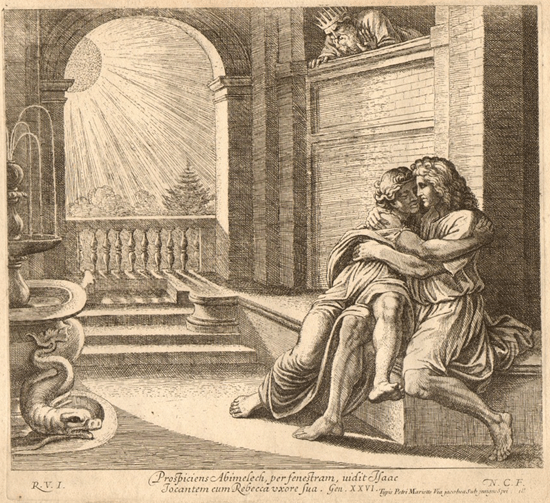
Abimelech Spies Isaac Fondling Rebecca, by Bernard Salomon, 1558

And it happened because the days were long for him.  Then Avimelekh, the king of the Philistines, looked out the window, and he saw—hey!  Isaac was fooling around with Rebecca, his wife.  And Avimelekh summoned Isaac and said: “So hey!  She is your wife!  Then why did you say: ‘She is my sister?”

And Isaac said to him: “Because I said (to myself): ‘Lest I die on account of her.’”

And Avimelekh said: “What is this you have done to us?  Is it a small thing that one of the people might have lain down with your wife?  Then you would have brought guilt upon us!”  (Genesis 26:8-10)

Even though Rebecca is beautiful, not a single man in Gerar has attempted to bed her or marry her.  The only moral transgression that occurs is Isaac’s deception about their relationship.

Then Avimelekh commanded all the people, saying: “Anyone who touches this man or his wife will certainly be put to death.”  And Isaac sowed that land, and he obtained that year a hundredfold.  And God blessed him.  And the man became great, and he grew constantly greater until he became very great.  (Genesis 26:11-13)

This king does not need to shower Isaac with gifts.  God makes Isaac rich.

This new ending for the tale raises questions about all three explanations in The Wife-Sister Trick, Part 1 and Part 2.

Explanation A:  Exculpating the Patriarchs

Traditional commentators take the wife-sister tales as literal history, and also assume that Abraham and Sarah are more virtuous than any of the kings.  They do not question Abraham’s claims that the men of both Egypt and Gerar routinely seize beautiful female immigrants and kill their husbands if they happen to be married.

But when Isaac tries the wife-sister trick and nothing happens, their attempts to prove that the foreign king and his men are immoral prove feeble.  Nineteenth-century rabbi Samson Raphael Hirsch wrote: “Isaac’s concern was not unfounded; for as soon as the true relation between Rebecca and Isaac became known, Avimelech found it necessary to protect them by a decree of the death penalty for any assault.”4

However, Avimelekh might issue the order, “Anyone who touches this man or his wife will certainly be put to death” simply in order to reassure the fearful Isaac, not because there is any real danger.  If Rebecca were at risk for sexual assault, why would so much time pass without any man making the attempt?

Early commentary interprets Avimelekh’s question “Is it a small thing that one of the people might have lain down with your wife?” as proof that the king was at least planning to lie with Rebecca.  Rashi interpreted the phrase achad ha-am (אַחַד הָעָם),one of the people” as “the most prominent of the people, meaning the king”.5  And 16th-century rabbi Ovadiah Sforno claimed Avimelekh means he can bed Rebecca whenever he wants because the king “is singular among his people”.6

But although these commentators strained to paint the second Avimelekh in a bad light, the most they could say was that the king thinks about having sex with Rebecca, but does not do it.

Abimelech Sees Isaac and Rebecca, by Daniele Squaglia, 1649

Meanwhile, they find Isaac and Rebecca’s behavior scandalous.  Rashi, following Bereishit Rabbah, wrote that when Avimelekh saw Isaac and Rebecca “fooling around”, they were actually engaging in marital relations.7  They were doing it during the day where they could be seen; married couples are supposed to do it at night and in private.

Thus the efforts of traditional commentators to exculpate the patriarchs and matriarchs of Israel, and paint foreign kings and their male subjects as immoral, break down when it comes to the third wife-sister tale.  The king of Gerar and his men think about sex, but do not do anything wrong.  Isaac and Rebecca, on the other hand, are guilty of unseemly behavior in public.

Explanation B: Instilling Xenophobia

Modern scholars view the three wife-sister tales as three iterations of an ancient folk tale, casting first Abraham and then Isaac as the trickster husband.  But why did the people who wrote and edited most of Genesis during the 8th and 9th centuries B.C.E. choose to include these tales in the first place?  Perhaps they would encourage readers to believe  that the descendants of the patriarchs belong in Canaan, and that foreigners are dangerous.8  (See The Wife-Sister Trick, Part 2)

Alan Segal argued that the first wife-sister tale reinforces other warnings in the Hebrew Bible against dealing with Egyptians; the second tale “stresses God’s promise to live in the Canaanite land in which the patriarchs wander; the third shows that Hebrews were also invited to live on land controlled by the Philistines, both with their flocks and to raise crops.”9

Isaac does gur for some years in Gerar, which this Torah portion refers to as Philistine territory.10  There he copies his father by pretending his wife is his sister, and by redigging his father’s wells.11

Yet the second Avimelekh actually does not invite Isaac to stay.  Isaac apparently takes Avimelekh’s command to his people not to touch him or Rebecca as a free pass to engage in any lawful activity in Gerar.  The next sentence says he plants seeds and harvests an excellent crop.  The Torah does not say who, if anyone, owns the land Isaac farms, but it does say he uses wells that his father’s servants had dug during Abraham’s sojourn in Gerar.  As Isaac becomes richer, the native Philistines become envious, and they plug the wells with dirt.12

And Avimelekh said to Isaac: “Go away from us, because you have become much more mighty than we are.”  (Genesis 26:16)

This is the opposite of an invitation to stay.  Only after Isaac has moved to Beer-sheva does Avimelekh come over with his councilor and his army chief to make peace.  They say politely:

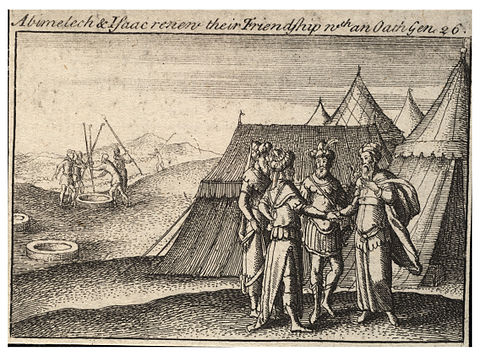
Abimelech Visits Isaac, by Wenceslas Hollar

“We see clearly that God is with you, and we say: Let there be, please, an obligation by oath between our sides, between us and you, and let us cut a covenant with you: that you will do no harm to us, as we have not touched you, and we did only good to you and sent you away in peace.  Now may you be blessed of God!”  (Genesis 26:28-29)

Thus the third wife-sister tale implies that the Israelite kingdoms can co-exist peacefully with Philistine states, not that Israelites have a right to use Philistine land.  The peace treaty, rather than instilling xenophobia, demonstrates that Israelites can get along with at least some outsiders.

Explanation C: Exploring Morality in a Trickster Tale

If the Torah is presenting three versions of a trickster tale as an entertaining way to teach a moral lesson, then the third wife-sister iteration must be the climax, the one with a turn that makes us think.

The new turn in the tale is that after the patriarch passes off his wife as his sister, nobody tries to get her into bed.  Every man of Gerar, including the king, is circumspect and sexually virtuous.  (I can imagine the second Avimelekh remembering what happened to his father, and being especially careful to avoid strange women.)

The funniest part of this version is when Isaac and Rebecca are fooling around right under the king of Gerar’s window, and the king pops his head out, looking outraged. Then he questions Isaac, just as the previous two kings questioned Abraham.  But he does not need to pay them anything, since he did nothing wrong, and God has not afflicted him.

All three kings in the three wife-sister tales respect the moral law that one must not poach a married man’s wife.  There is no indication that any of them resort to murder to fix their domestic affairs.  And when they find out they were deceived, none of them take revenge.  They ask the trickster to leave the country, but let him take his wife and his new riches with him.

The king in the bible who actually does kill a man in order to marry his wife is not a foreign king at all, but the second king of Israel, David.

David Sees Bathsheba, by Jean-Leon Gerome, 1889

While King David’s men are off fighting the Philistines, David looks down from his rooftop and sees “a very good-looking woman” bathing.  He finds out she is Bathsheba, another man’s wife, but he has her brought to his bed anyway.  After he has impregnated her, he tries to get her husband to spend a night with her, but he fails.  So David has her husband killed, and then marries her.13

Is it a coincidence that King David actually commits the moral crimes that Abraham and Isaac claim the kings of Egypt and Gerar would consider committing?  Or is the book of Genesis making an implicit criticism of Israel’s legendary king?

The wife-sister tale in Toledot demonstrates that a foreign king, even a king of Israel’s enemies the Philistines, can be more virtuous than an Israelite king.

It is not enough to say:

And you must love the geir, since you were geirim in the land of Egypt.  (Deuteronomy/Devarim 10:19)

geir (גֵר) = foreigner, resident alien, sojourner.  Plural geirim (גֵרִים).  (From the same root as lagur.)

We should not only love foreigner and immigrants, but also remember that some of them are better than we are.

  1. All three patriarchs in the Torah are sojourners: temporary resident aliens, staying in countries where they are not citizens. After Abraham leaves Charan, his homeland in Mesopotamia, the bible describes him as “sojourning” in Egypt (Genesis 12:10), Gerar (20:1), Beersheba (21:34), and Hebron (35:27).  Isaac lives most of his life in Beer-sheva and Beer-lachai-roi, but he “sojourns” in Gerar (26:3) and Hebron (35:27).  Jacob grows up in Beer-sheva, then sojourns with his uncle Lavan in Charan during his prime (32:5), and in Egypt during his old age (47:4).
  2. Genesis 12:1, 12:5-7.
  3. Avimelekh can be translated as “My Father King”: avi (אֲבִי) = my father + melekh (מֶלֶךְ) = king. Avimelekh may be a title, like “Pharaoh”, and the second Avimelekh of Gerar may be the first one’s son and successor.
  4. Samson Raphael Hirsch, The Hirsch Chumash: Sefer Bereshis, English translation by Daniel Haberman, Feldheim Publishers, Jerusalem, 2002, p. 566.
  5. “Rashi” is the acronym for 11-century rabbi Shlomoh Yitzchaki.
  6. Ovadiah Sforno, Sforno: Commentary on the Torah, translation and notes by Rabbi Raphael Pelcovitz, Artscroll Mesorah Series, 1993, p. 136.
  7. Bereishit Rabbah, also called Genesis Rabbah, is a collection of commentary on the book of Genesis by rabbis from the Talmudic period of about 300-500 C.E. “Fooling around” is one translation of metzacheik (מְצַחֵק) = amusing oneself, fooling around, playing around with; from the root tzachak (צָחַק) = laughed, which is also the root of the name Isaac (יִצְחָק) = he laughs, he will laugh.
  8. Alan F. Segal, Sinning in the Hebrew Bible, Columbia University Press, New York, 2012, chapter one.
  9. Segal, p. 33.
  10. Scholars agree that the reference to Philistines (Plishtim) is an anachronism, since these people did not cross the Mediterranean and settle between the Negev and the sea until circa 1200 B.C.E., much later than the putative time of the three patriarchs. The Torah may use “Plishtim” here to indicate the geography, or remind the reader of one of Israel’s old enemies.  The term “Canaan” in the Torah refers to a region that always includes the west bank of the Jordan and the Negev desert, but only sometimes includes the Philistine states as well.
  11. Genesis 26:15-18.
  12. Genesis 26:14-15.
  13. 2 Samuel, chapter 11.

Lekh Lekha, Vayeira, & Toledot: The Wife-Sister Trick, Part 2 

Abraham has a low opinion of two kings in the book of Genesis/Bereishit: the Pharaoh of Egypt, and Avimelekh of Gerar.  Yet he emigrates to both their countries with his wife Sarah: to Egypt in the Torah portion Lekh-lekha and to Gerar in Vayeira.

Both times, Abraham says Sarah is so beautiful that if men knew they were husband and wife, he would be killed and the king would marry his widow.  So he asks Sarah to pretend to be his unmarried sister; that way, he figures, he will survive when the king takes her.  And as her nearest male relative, he might even receive gifts.

“Say, please, you are my sister, so that yitav for me for your sake, and my soul will live on account of you.”  (Genesis 12:13)

yitav (יִיטַב) = it goes well, it becomes better.

Both times, the king does take Sarah as one of his wives.  Then the hoax is revealed.  The horrified king releases her and sends off Abraham and Sarah with gifts to buy their silence.  The couple journeys on, richer than before.

Last week’s post, The Wife-Sister Trick, Part 1, reviewed “Explanation A”: traditional commentary’s attempt to take the wife-sister stories as literal history while also rescuing the reputations of Sarah and Abraham.  Here are two other explanations of what each iteration of the tale “really” means.

Explanation B: Instilling Xenophobia

Modern commentator Alan Segal posits that in the 8th and 9th centuries B.C.E., when most of Genesis was written,1 the editor(s) of Genesis cast Abraham and Isaac as the tricksters in an existing folk tale.  Then they added details to promote the view that the descendants of the patriarchs belong in Canaan and should have no dealings with outsiders.2

  1. Pharaoh

In the portion Lekh-Lekha Abraham hears God tell him to leave his hometown, Charan, and move to a new land that God would show him.3  He and his household, including his childless wife (called Sarai at this point) journey south through Canaan.  But there is a famine, so they continue south to live as resident aliens in Egypt.4  (See last week’s post, The Wife-Sister Trick, Part 1.)  There Abraham passes off his wife as his sister.

And [Pharaoh] heytiv for Abraham because of her, and he acquired a flock and a herd and male donkeys and male slaves and female slaves and female donkeys and camels.  (Genesis 12:16)

heytiv (הֵיטִיב) = he made it good, he made things go well.  (From the same root as yitav.)

Abraham and Sarah’s return to Canaan with additional movable property prefigures the liberation from Egypt in Exodus.  Near the end of Genesis, their grandson Jacob and his descendants, the Israelites, migrate to Egypt.5  In the book of Exodus, God liberates the Israelites from Egypt and leads them back toward Canaan, enriched by “gifts” from the Egyptians.  Later prophets warn the kings of Judah not to ally with Egypt.

The Torah makes it clear that God wants the Israelites, Abraham’s descendants, to live in Canaan.  The first iteration of the wife-sister tale reinforces this idea, and also prejudices Israelites against making treaties with Egypt.

  1. Avimelekh

According to Segal, the second iteration of the wife-sister tale adds the information that the God of Israel also speaks to non-Israelites—at least when it is necessary to promote the welfare of the people of Israel. 6

Then God came to Avimelekh in a dream at night and said to him: “Hey, you are dead, on account of the woman that you took, for she is a wedded wife!”  (Genesis 20:3)

Avimelekh protests that he was an innocent dupe, and God takes credit for preventing Avimelekh from touching Sarah.  (See The Wife-Sister Trick, Part 1.)  Then God tells the king what to do.

“And now, restore the wife to the man, because he is a prophet, and he can pray for you, and then you shall live.”  (Genesis 20:7)

In the morning Avimelekh asks Abraham why he told such a terrible lie.

And Abraham said: “Because I said [to myself] only: there is no fear of God in this place, and they will kill me over the matter of my wife.”  (Genesis 20:11)

Abraham receives Sarah from King Abimelech, by Nicholaes Berchem, ca. 1665

Abraham appears to believe that any foreign country with a foreign religion must be lawless and immoral.  After Abraham has insulted him, Avimelekh collects himself and bribes the man with lavish gifts.

Then Abraham prayed to God, and God healed Avimelekh and his wife and his slave-women, and they bore children.”  (Genesis 20:17)

This version of the wife-sister tale repeats the lesson that outsiders are immoral, and also shows that God is in charge everywhere and promotes the welfare of divinely favored people.

I often find that a scholarly analysis of a passage in Torah provides valuable information about the details, but misses the meaning of the bigger story.  In this case Segal shows how the biblical editor(s) used the wife-sister trickster tale for political persuasion.  But why not find a less sordid story for this purpose?  Why does the Torah use the wife-sister tale in the first place?

Explanation C: Exploring Morality in a Trickster Tale

A reader or listener without an agenda, someone who does not require Abraham and Sarah to be saintly or the kings of foreign countries to villainous, might well consider the wife-sister stories humorous tales that raise questions about morality.

  1. Pharaoh

In the first iteration of the tale, Abraham is traveling from Beit-El toward the Negev when he notices there is a famine in Canaan.  He takes his household all the way to the border of Egypt, a journey of about 200 miles (320 km), before he tells Sarah:

“Hey, please!  I know that you are a woman of beautiful appearance.   And it will happen that the Egyptians will see you and they will say: ‘This is his wife!”  And they will kill me, but they will let you live.  Say, please, you are my sister …”  (Genesis 12:11-13)

After traveling toward Egypt for weeks, does Abraham suddenly remember how immoral Egyptians are?  Or does he get a brilliant idea for leaving Egypt with a lot more wealth, if his scam comes off?  I know which alternative I would believe if I were Sarah.

And the officials of Pharaoh saw Sarah, and they praised her to Pharaoh, and the woman was taken to the House of Pharaoh.  (Genesis 12:15)

Pharaoh Takes Sarah (at 65!), from Treasures of the Bible, H.D. Northrop

Out of all the beautiful women the border guards detain, 65-year-old7 Sarah is the one who gets referred to Pharaoh.  Abraham receives a generous bride-price, just as he had hoped.  Twentieth-century commentator Pamela Tamarkin Reis wrote, “To the ancient reader, I am convinced, this shady deal was funny.  Pharaoh, more fool he, is paying all those livestock and servants for a woman who is not even a virgin. And no spring chicken into the bargain.”8

Then God afflicts Pharaoh with some unmentionable disease.

And God afflicted Pharaoh with great afflictions, and his household, over the matter of Sarah, the wife of Abraham.  And Pharaoh summoned Abraham and said: “What is this you have done to me?  Why didn’t you tell me she is your wife?”  (Genesis 12:17-18)

The Torah never says whether Pharaoh’s disease prevents him from bedding Sarah, but he does discover the truth about Sarah, perhaps because the disease makes him impotent and he wants to know why.  Pharaoh has Sarah and Abraham escorted out of the country—but they get to keep the bride-price, perhaps because Pharaoh wants to avoid publicity.

Caravan of Abraham, by James Tissot, ca. 1900

So Abraham went up from Egypt, he and his wife and everyone that was his, and Lot with him, to the Negev.  And Abraham was very heavy with livestock and with silver and with gold.  (Genesis 13:1-2)

Pharaoh is the dupe in this story, but he is innocent of any deliberate wrongdoing.

Sarah is passive; the Torah does not report anything she says in Egypt.  The custom among Abraham and Sarah’s people is to give a prospective bride the chance to consent or refuse the prospective groom.9  But the Torah does not say Sarah protested against being taken to Pharaoh—and the Torah never depicts her as shy.  Perhaps she is more interested in getting rich than in avoiding polyandry.

Abraham is the chief trickster in this tale.  He lies to the Egyptians at the border, to Pharaoh, and perhaps to Sarah.  He destroys his wife’s honor by putting her in a position where she, too, appears to be a liar, and where she stays in Pharaoh’s harem long enough for her chastity to be questioned.  Yet despite his moral failings, Abraham goes unpunished.  He leaves Egypt in safety and with riches.  Cleverness, not virtue, is rewarded.

  1. Avimelekh

In the second wife/sister story there is no famine in Canaan, no practical reason for Abraham and Sarah to leave their campsite in the Negev.10  God has recently told them both that in a year Sarah (who has been childless her whole life) will have a son.11

Abraham should be focusing on giving his aged wife the baby God promised, but instead he decides to repeat the wife-sister trick, this time in the relatively nearby city-state of Gerar.  His supposed fear that the men of Gerar would kill him over Sarah is more ridiculous the second time, since Sarah is now 89.

And Avimelekh, king of Gerar, sent and took Sarah. (Genesis 20:2)

I can imagine Abraham cheerfully waving goodbye, not caring whether God prevents Avimelekh from bedding her, or uses the arrangement to get Sarah pregnant.  Either way, once the king discovers the truth about Sarah he will have to buy they off to avoid public shame.

This time God tells the king in a dream that he will die because Sarah is already married.  Avimelekh protests his innocence.  God is not impressed, and tells him to restore Sarah to Abraham—because Abraham is a prophet who can pray for the king’s life.

When Avimelekh summons Abraham in the morning, his first words are:

“What have you done to us?  And what is my sin against you, that you brought [this] upon me and my kingdom?  [You committed] a great sin, doing what should not be done against me!” (Genesis 20:9)

Avimelekh’s outburst is justified; he did not act against Abraham, but Abraham tricked him into marrying an already married woman.  Abraham insults the king by explaining his poor opinion of the morals of Gerar, and adds feebly that Sarah really is his half-sister as well as his wife.

Prophet Abraham

But Avimelekh does not blow up.  He remembers that he needs Abraham to pray for him, so he gives the man a flock, a herd, slaves, and permission to settle wherever he likes in the land of Gerar.  He gives Sarah a thousand silver pieces as hush money.

At that point in the story we finally learn what God has been doing to Avimelekh.

Then Abraham prayed to God, and God healed Avimelekh and his wife and his slave-women, and they bore children.  For God had closed up every womb in the House of Avimelekh over the matter of Sarah, the wife of Abraham.  (Genesis 20:18)

In other words, God afflicted the king and his household with impotence.  Once again the duped king cannot even enjoy his wedding night with Abraham’s “sister”.

In this second iteration of the wife-sister tale, God forces an innocent and protesting Avimelekh to bribe Abraham in exchange for the prayer of a so-called prophet.  This demonstrates favoritism rather than justice on the part of the God-character.

Sarah is silent again.  And Abraham?  He has no excuse for his behavior.  If he were really worried about being murdered in Gerar, he could simply stay home.  Instead he swindles Abimelekh because he can get away with it and make a profit.  No sense of honor or consideration for his wife stops him.  Abraham does not care about the king of Gerar, who is, after all, a foreigner.  But he prays for him anyway, once he has received enough gifts.

*

The first two wife-sister tales in the Torah were undoubtedly derived from an ancient folk tale.  Folk tales love reversals.  In this story, the poor man tricks a rich man into giving him wealth.  The king expects to marry a beautiful virgin and discovers he has taken an old married woman.

Another common feature of folk tales is that men never learn.  Abraham manages to escape Egypt with his wife and Pharaoh’s gifts. Then 25 years later, when God has promised Sarah a miraculous birth, Abraham casually goes to Gerar and tries the same trick.  It never occurs to him that when Sarah’s son is born, someone might wonder whether he is really the father.

Yet the kings in both iterations of this tale try to do the right thing.  When they discover they have been duped, they resolve the situation with generosity rather than death sentences.  Everyone benefits from the righteous behavior of Pharaoh and Avimelekh.

God heals both kings after they have returned Sarah to Abraham, with gifts.  But God does even more for Abraham, the trickster with the shady morals.  He dies happy after a long and healthy life.12

Does this mean God does not care about human morality?

The third time a patriarch claims that his wife is his sister, the story takes a different turn.  See next week’s post, The Wife-Sister Trick, Part 3.

  1. Scholars who subscribe to the Documentary Hypothesis consider the wife-sister passages as either J or E, both sources dating from 922-722 B.C.E., the period when the Israelites had two small kingdoms, Samaria (a.k.a. Israel) in the north and Judah in the south. (Scholars who view the sources as more fragmentary do not dispute this dating.) The kings of Samaria and Judah vacillated between paying tribute to Assyria and allying with Egypt, but biblical books from Exodus through Zephaniah opposed cooperation with world powers, the worship of other gods, and intermarriage with other peoples.
  2. Alan F. Segal, Sinning in the Hebrew Bible, Columbia University Press, New York, 2012, chapter one.
  3. Charan had became an important Assyrian city by the time this passage was written.
  4. Genesis 12:10.
  5. The first three Torah portions of the Joseph story: Genesis chapters 37-47.
  6. Also God warns Lavan in a dream that he must not do anything bad to Jacob (Genesis 31:22-24) and God tells Bilam in a dream that he cannot curse the Israelites because God has blessed them. When Bilam attempts to curse them anyway, God puts blessings in his mouth (Numbers 22:7-12 and 23).
  7. Sarai and Avram leave Charan when Avram is 75 (Genesis 12:4). Avram is ten years older than Sarai (Genesis 17:17).
  8. Pamela Tamarkin Reis, Reading the Lines, Hendrickson Publishers, 2002, p. 45.
  9. Genesis 24:58-59.
  10. Genesis 20:1.
  11. Genesis 18:10-14.
  12. At age 175. And Avraham breathed his last, and he died at a good old age, old and satisfied.  (Genesis 25:7-8)

Note: Any ads below provide revenue to WordPress, not to me.


Lekh Lekha, Vayeira, & Toledot: The Wife-Sister Trick, Part 1

The tale

A man and his beautiful wife immigrate to a foreign kingdom.  The man assumes that if the local king knew they were married, he would be killed and the king would marry his widow.  So he asks his wife to pretend to be his unmarried sister.  He knows the king will still take her, but as her nearest male relative, the man might live—and receive the customary bride-price.

Sarah is seized (artist unknown)

The beautiful woman does become one of the king’s wives (or concubines).  Then the hoax is revealed.  The horrified king releases her and sends off the man and his wife with gifts to buy their silence, and their god’s favor.  The couple journeys on, richer than when the story began.

A version of this sordid tale appears two and a half times in the book of Genesis/Bereishit.  The first time, in the portion Lekh Lekha (“Go for yourself”), the husband is Abraham and the king is the Pharaoh of Egypt.

And Pharaoh summoned Abraham and said: “What is this you have done to me?  Why didn’t you tell me that she is your wife?  Why did you say ‘She is my sister’, va-ekach her for my wife?”  (Genesis/Bereishit 12:18-19)

va-ekach (וָאֶקַּח) = and I took; and I married.

In this week’s portion, Vayeira (“And he appeared”), Abraham and Sarah do it again with Avimelekh, King of Gerar.

And Abraham said of Sarah, his wife: “She is my sister”.  And Avimelekh, the king of Gerar, sent vayikach Sarah.  (Genesis 20:2) … Avimelekh summoned Abraham and said: “What have you done to us?” (Genesis 20:9)

vayikach (וַיִּקַּח) = and he took; and he married.

In a later portion, Toledot (“Lineages”), Abraham’s son Isaac passes off his wife Rebecca as his sister.  This time the tale is cut short because the king (also called Avimelekh)1 never takes her as a wife.  The aborted version begins the same way as the first two iterations, but it reverses the lessons of the Abraham tales.

In this series about the wife-sister tales, my first two posts will present different explanations of the first two wife-sister tales, in which the trickster is Abraham.  The third post will show how Isaac’s attempt to use the wife-sister lie challenges the conclusions of all three interpretations.

Explanation A: Exculpating the patriarchs

Early commentary such as Bereishit Rabbah2 takes the wife-sister stories as literal history, and assumes that Abraham and Sarah are more virtuous than Pharaoh or Avimelekh.  It does not question Abraham’s claims that the men of both Egypt and Gerar routinely seize beautiful female immigrants, and kill their husbands if they are married.

And it happened, as he [Abraham] was close to entering Egypt, he said to Sarah, his wife: “Hey, please!  I know that you are a woman of beautiful appearance.   And it will happen that the Egyptians will see you and they will say: ‘This is his wife!”  And they will kill me, but they will let you live.”  (Genesis/12:11-12)

Abraham implies that the Egyptian border guards routinely detain beautiful women of all ages (Sarah is at least 65)4 and then kill their husbands if they are married.  With these orders, the guards would have to murder a lot of foreign men.  But perhaps the idea is not so preposterous, given that in 2018 American guards on the border of Mexico jailed the children of would-be immigrants separately from their parents, without making any provision for reuniting the families.  Foreigners have been fair game in many cultures.

Babylon Marriage Market, by Edward Long, 1875, detail

The first part of Abraham’s claim, that beautiful immigrants will be seized, turns out to be true in both episodes.

And it happened, that Abraham came to Egypt and the Egyptians saw that the woman was very beautiful.  The officials of Pharaoh saw her, and they praised her to Pharaoh, vatukach ha-ishah to the House of Pharaoh.  (Genesis 12:14-15)

vatukach ha-ishah (וַתֻּקַּח הָאִשָּׁה) = and the woman was taken; and the wife was taken.

And Abraham said of Sarah, his wife: “She is my sister”.  And Avimelekh, the king of Gerar, sent vayikach Sarah.  (Genesis 20:2)

For both stories, the early commentary only needed to explain:

  • why Sarah is so beautiful,
  • why she is never molested by a king, and
  • why Abraham’s behavior is excusable.
  1. Pharaoh
from Bisson, La Fiancee, 1895

Although Sarah is in her sixties when Pharaoh takes her, early commentary maintains that she is extraordinarily beautiful.  Talmud Bavli, Megillah 15a, lists Sarah as one of the four most beautiful women in the world.5  According to Bereshit Rabbah 40, the whole land of Egypt was illuminated by her beauty.

The Torah does not say whether Pharaoh has sexual intercourse with Sarah.  But early commentators wrote that both times when Abraham passes her off as his sister, God protects her from being molested by afflicting the king with a disease that prevents intercourse.

And God afflicted Pharaoh and his household with great afflictions over the matter of Sarah, the wife of Abraham.  And Pharaoh summoned Abraham and said: “What is this you have done to me?  Why didn’t you tell me that she is your wife?” (Genesis 12:17-18)

The Torah does not describe the nature of the affliction.  Bereishit Rabbah 41 suggested lupus or another disease that affects the skin.  Rashi6 wrote that this affliction made intercourse harmful to Pharaoh.  Whatever God’s affliction is, according to classic commentary it prevents Pharaoh from molesting his new wife, and alerts him that things are not what they seem.  Then Sarah tells him the truth, and he is outraged that he was tricked into marrying another man’s wife.  He sends Abraham and Sarah out of the country, and lets them take all their new wealth with them.7

Abraham and Sarah Before Pharaoh, by Comnenian, Byzantine

Pre-modern commentators differ when it comes to the question of Abraham’s virtue.  The Zohar says that Abraham sees the divine presence is with Sarah, and an angel confirms it, so he knows she will be safe.8  But Ramban wrote: “Know that our father Abraham inadvertently committed a great sin by placing his virtuous wife in a compromising situation because of his fear of being killed.  He should have trusted in God.”9

Even if Abraham is not guilty of putting his wife in peril, what about his deception?  Some commentators view Abraham’s lie as his only alternative, given the nastiness of the Pharaoh and the famine in Canaan.

  1. Avimelekh

The second version of the wife-sister tale appears in the Torah portion Vayeira, after God has promised Abraham and Sarah they will have a child at last.  They settle in the Negev Desert, but travel west to Gerar to live there as resident aliens for a while.  Once again Abraham calls Sarah his sister.  The king of Gerar, Avimelekh, “takes” her.

At this point in the Torah, Sarah is 89 years old.10  So classic commentary needs to explain why Sarah is still beautiful enough to tempt a king.  Before Abraham takes her to Gerar, three angels announce that in a year she will have a son.  (See my earlier post, Vayeira: Laughter, Part 1.)  In Talmud Bavli, Bava Metzia 87a, Rav Hisda explains that after the annunciation, Sarah’s worn and wrinkled skin is rejuvenated, and her beauty returns.

Sarah and Abimelech, by Marc Chagall

In this iteration of the wife-sister tale, God speaks to the king in a dream after he has married Sarah.  God informs him that Sarah is another man’s wife, and declares that Avimelekh and his people must die for this sinful marriage.

But Avimelekh had not come close to her.  And he said: “My Lord, will you slay even innocent people?  Did not he himself [Avraham] say: ‘She is my sister’?  And she even said: ‘He is my brother’!  With a pure heart and with clean palms I did this.”

And God said to him in the dream: “Even I myself knew that you did this with a pure heart, so I restrained you from sinning against me, even I myself.  Therefore I did not let you touch her.”  (Genesis 20:4-6)

How does God restrain Avimelekh from having intercourse with Sarah?  Through “a closing up of orifices” according to Bereishit Rabbah.  Rashi wrote that God closes the orifices of Avimelekh and his household, including their ears and noses as well as genital and urinary openings.

The rabbis of Bereishit Rabbah overlooked Avimelekh’s protest that his intention were good, and give God all the credit for the king’s restraint.  “R. Aibuil said: It is like the case of a warrior who was riding his horse at full speed, when seeing a child lying in the path, he reined in the horse, so that the child was not hurt. Whom do all praise, the horse or the rider? Surely the rider!”11

And Avimelekh summon Abraham and said to him: “What did you do to us?  And what is my sin against you, that you brought [this] upon me and my kingdom?  [You committed] a great sin, doing what should not be done against me!” (Genesis 20:9)

Abraham explains his poor opinion of the morals of Gerar, and adds that Sarah really is his half-sister as well as his wife.  Avimelekh then gives Abraham a flock, a herd, and slaves, and permission to settle wherever he likes in the land of Gerar.  He gives Sarah a thousand silver pieces as hush money.

Then Abraham prayed to God, and God healed Avimelekh and his wife and his slave-women, and they gave birth.  For God had shut every womb in the house of Avimelekh on account of the matter of Sarah, the wife of Abraham.  (Genesis 20:18)

This is the verse that Bereishit Rabbah and Rashi interpreted as meaning that God had “closed up every orifice”.  Other commentators, including Ramban and 18th century Rabbi Chayim ben Moshe ibn Attar, wrote that the men’s genitals were also closed, and this proved that Avimelkh could not be the biological father of Sarah’s son Isaac.

Is Abraham’s behavior excusable in this case?  The idea that Abraham knew God would protect Sarah still applies in the story of Avimlekh, but why does he take Sarah to Gerar in the first place, when they could just continue grazing their livestock in the Negev?  The classic commentary has no answer.

*

Traditional commentators assumed the first two wife-sister stories relate what actually happened to Abraham and Sarah.  They talked up Sarah’s beauty to explain why she was brought straight to the king both times, and they worried about and how Sarah and Abraham retained their virtue.  But they offered no insights on why these stories are included in the Torah; traditional commentary views the tales as part of history.

When one considers the Torah as an ancient composite crafted by one or more religious editors, the questions that traditional commentary answered are not the important ones.  What is the purpose of including the sordid story at all?  And why does the patriarch Abraham tell lies and sell his wife to a foreign king—twice?  What kind of sacred book is this, anyway?

These questions illustrate the frequent problems that arise when one both takes the bible literally and believes that the designated heroes are good, and the designated villains are bad.  Some people feel a psychological need to have faith in a religion that contains contradictions, so the classic explanations serve them well.

What about the rest of us?  Next week’s post will examine two other explanations, one from the viewpoint of a modern scholar and one from the viewpoint of a modern storyteller.


  1. Avimelekh can be translated as “My Father King”; avi (אֲבִי) = my father + melekh (מֶלֶךְ) = king. Avimelekh may be a title, like “Pharaoh”, and the second Avimelekh may be the first one’s successor.
  2. Bereishit Rabbah, also called Genesis Rabbah, is a collection of commentary on the book of Genesis by rabbis from the Talmudic period of about 300-500 C.E.
  3. 2 Samuel 11:1-17.
  4. Sarai and Avram leave Charan when Avram is 75 (Genesis 12:4). Avram is ten years older than Sarai (Genesis 17:17).
  5. The other three beautiful women in Megillah 15a are Rahab, Abigail, and Esther.
  6. 11th-century C.E. Rabbi Shlomoh Yitzchaki.
  7. Genesis 12:20.
  8. Moses de Leon, 13th century Spain, Zohar 1:181b, 3:52a.
  9. Ramban (13th-century Rabbi Moses ben Nachman, a.k.a. Nachmanides), translated in Etz Hayim, ed. David L. Lieber, Jewish Publication Society, 2001, p. 73.
  10. In Genesis 17:15-17 and 18:10 Abraham learns that Sarah will give birth at age 90. An alternative to early commentators’ claim that Sarah miraculously regains the beauty of youth is a theory that the border officials single her out for a different reason.  Twentieth-century commentator Savina Teubal (Sarah the Priestess, Swallow Press Reprint edition, 1984) suggests that Sarai was the priestess of a god or goddess in Charan, and her marriages with Pharaoh and Avimelekh were examples of hieros gamos, an ancient ritual in which a high priestess and a king had intercourse in order to enact the coupling of the gods who made the land fertile.  Teubal did not explain why a king would employ a priestess from a foreign land for this ritual, instead of using the priestess of one of his own country’s gods.
  11. Bereishit Rabbah, translation by H. Freedman, Soncino Press, London, 1939.

Lekh-lekha: Please

Sarai and Avram (later renamed Sarah and Abraham) are an unusual couple.  In a society dominated by men, Sarai appears to have authority equal to her husband’s.  Neither can give unilateral orders to the other.

The Torah portion Lekh-lekha (“Go for yourself”) begins with Avram, Sarai, and their nephew Lot leaving Charan (along with all their livestock and servants) and traveling through Canaan.  Since there is a famine in that land, they continue south to Egypt.

Abraham Gives his Wife to Pharaoh

It happened, as he was close to entering Egypt, he said to Sarai, his wife: “Hey, na!  I know that you are a woman of beautiful appearance.  And it will happen that the Egyptians will see you and they will say: ‘This is his wife!”  And they will kill me, but they will let you live.  Say, na, you are my sister, so that it will go well for me for your sake, and my soul will live on account of you.”  (Genesis my12:11-13)

na (נָא) = Please!  (An indicator of courtesy and urgency.)

Avram believes that Sarai will end up in an Egyptian’s bed one way or another: either they will kill her husband to get her, or they will pay her brother to get her.  (I will discuss Avram’s peculiar assumptions about Egyptian customs in my next two posts, Lekh-Lekha, Vayeira, & Toledot: The Wife-Sister Trick, Part 1 and Part 2.)

Even though Avram believes his life is on the line, he does not command Sarai to masquerade as his  unmarried sister.  He implores her, saying na twice.

Sarai cooperates, and the Egyptian officials at the border take her to the Pharaoh’s harem.  Perhaps she foresees that her stay there will be temporary, and then they will both leave Egypt with extra wealth.  Or perhaps the childless 65-year-old is making her last bid for a baby.1  (Her menopause might be late, and at this point she does not know whether Avram is fertile.)  The Torah does not tell us Sarai’s motivation.

Avram and Sarai return from Egypt to Canaan with more more livestock, slaves, gold, and silver, but no pregnancy.  This is a problem for both of them.  God promised to give the land of Canaan to Avram’s descendants, yet he has no descendants.  Sarai does not need a child to take care of her after her husband dies, like other biblical women.  She appears to have wealth of her own, enough so that in very old age she can afford to leave Avram in Beersheba, move north with her retinue, and pitch her own tent near Hebron.2  But like Avram, she would want a child to inherit her possessions and continue her name.

Later in this week’s Torah portion, Sarai concludes that her best option is to adopt a baby.  A long-standing legal custom in the ancient Near East was for a childless wife to give her personal slave to her husband as a surrogate, and then adopt the resulting child as her own.3

Since Avram is Sarai’s equal, she does not command him to comply with this arrangement; she implores him.

Sarah Presents Hagar to Abraham, by Matthias Stomer

Sarai, the wife of Avram, had not borne children to him, but she had an Egyptian female slave, and her name was Hagar.  Sarai said to Avram: Hey, na! God has shut me off from childbirth.  Enter, na, my slave; perhaps I will be built up through her.”  And Avram listened to the voice of Sarai.  Sarai, the wife of Avram, took Hagar the Egyptian, her slave, at the end of ten years of Avram’s dwelling in the land of Canaan; and she gave her to Avram, her husband, as a woman for him. (Genesis 16:1-3)

Sarai uses the same approach that Avram used on the border of Egypt, opening with “Hey, na!”4 then stating the problem, then asking for a favor with a second na.  (These are the only two speeches in the Hebrew Bible in which the word na appears twice.)  Like Sarai, Avraham agrees to go along with his partner’s scheme.

Although Sarai says “please” to her high-status husband, she can command her personal slave to do anything, so she does not bother to ask Hagar about the arrangement.  When Sarai says “perhaps I will be built up through her” she indicates her intention to adopt the child Hagar bears as her own.

But once Hagar is pregnant with Avram’s child, she is not as subservient as Sarai expected.

When she [Hagar] saw that she was pregnant, [her] mistress was demeaned in her eyes. Then Sarai said to Avram: “The violence against me is because of you! I myself put my slave into your lap.  Now she sees that she is pregnant, and I am demeaned in her eyes. May God judge between me and you!”  (Genesis 16:4-5)

Sarai, accustomed to having complete authority over her own slaves, cannot bear to be snubbed and ignored by Hagar.  She has lost some of her power.

Why does she blame Avram?  Although Sarai may not feel sexual jealousy about the arrangement, I believe she is jealous in another way.  Perhaps Sarai’s husband and business partner is continuing to spend time with Hagar instead of with her, thus reinforcing Hagar’s idea that her status has increased.  Others in the household who notice this might also begin to treat Sarai with less respect, and Hagar with more.

So Sarai accuses Avram of encouraging Hagar’s new behavior.  Then she cries, “May God judge between me and you!”  She still believes that she and Avram are supposed to have equal authority.  Anything that demeans Sarai challenges her God-given status.  And Avram recognizes this.

Then Avram said to Sarai: “Hey!  Your female-slave is in your hand; do to her as you see fit.”  And Sarai oppressed her.  And she [Hagar] ran away from her.  (Genesis 16:6)

Angel of the Lord Appearing to Hagar,
by Gheorge Tattarescu ca. 1870

An angelic messenger from God reassures Hagar that her son will prosper in the long run, and tells her to return to Sarai and “submit yourself to her hand” (Genesis 16:9)   Hagar obeys God.  Sarai does not adopt the baby; instead of reporting a birth on Sarai’s lap or knees (the usual adoption ritual), the Torah says:

And Hagar bore to Avram a son, and Avram named his son that Hagar bore: Ishmael.  (Genesis 16:15)

Thirteen years later God changes the names of Avram and Sarai to Avraham and Sarah, and tells Avraham that Sarah will bear him a son when she is 90.5  In next week’s Torah portion, Vayeira, Avraham holds a celebration on the day Sarah weans her own son, Isaac.

And Sarah saw the son of Hagar the Egyptian, whom she had borne to Avraham, making fun!  And she said to Avraham: “Drive out this slave-woman and her son, so that the son of this slave-woman will not inherit with my son, with Isaac!”  (Genesis 21:9-10)

Now Sarah is giving Abraham orders without saying “please”.  Abraham does not argue with her, but he is worried about his son Ishmael.  God reassures him that Ishmael and his progeny will become a great nation, and tells him:

“Everything that Sarah says to you, listen to her voice; because through Isaac your descendants shall be identified.”  (Genesis 21:12)

Abraham follows Sarah’s orders and exiles Hagar and Ishmael the next morning.  At this point, Sarah has more authority than Abraham.  What she says, goes—because God is backing her up.

*

Unlike Sarai/Sarah, I have never had much authority.  I never had staff working under me in any of my paid jobs.  In one congregation I became a leader by dint of years of hard work, continuing Jewish education, and volunteering, but I learned that my opinions held no more weight than anyone else’s.  Sometimes even when I thought we had reached a consensus, other volunteers ignored it.  I felt snubbed and demeaned, like Sarai in response to Hagar.

I wonder if any of the other volunteers felt like Hagar under Sarai’s—my—thumb?

Or was I like Hagar, pregnant with knowledge and know-how, slaving away day and night without remuneration, sometimes appreciated and sometimes snubbed?

Authority and deference are still hard to balance, even when you say “please”.

  1. Sarai and Avram leave Charan when Avram is 75 (Genesis 12:4) and Avram is ten years older than Sarai (Genesis 17:17). Therefore Sarai is 65 or so when they emigrate to Egypt.
  2. And Avraham stayed in Beersheba (Genesis 22:19). Sarah died in Kiryat Arba, which is [now] Hebron … (Genesis 17:17).  Isaac inherits his mother’s tent (Genesis 24:67).
  3. The Code of Hammurabi specifies that when a wife gives one of her female slaves to her husband for the purpose of bearing his child (or children), she remains a slave until the husband dies, and her children by him are free. The man’s wife has the option of adopting her child.
  4. Hey, na = הִנֵּה־נָא. Hineh (הִנֵּה) is often translated as “Behold!” or “Look!” or “Here!”, but since it is an attention-getting exclamation, I have been translating hineh as “Hey!”
  5. Genesis 17:17.