Vayakheil & Psalm 13: Waiting in Contentment

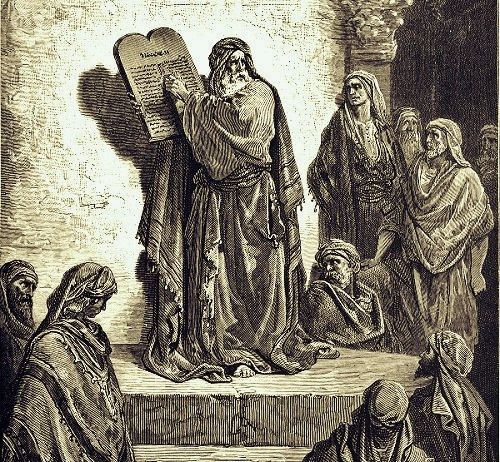
detail of “Moses on Mt. Sinai” by Jean-Leon Gerome, ca. 1900

The Israelites are overcome with anxiety the first time Moses spends 40 days on Mount Sinai.  In last week’s Torah portion, Ki Tisa:

The people saw that Moses was long delayed in coming down from the mountain, and they assembled against Aaron, and they said to him: “Get up, make for us a god who will go in front of us, since this Moses, the man who brought us up from the land of Egypt, we don’t know what has happened to him!”  (Exodus/Shemot 32:1)

Aaron asks them to donate their gold earrings to melt down.  They do, but Aaron does the work of making the golden calf.  Even though he says the new idol represents the God of Israel, not another god, it turns out to be a bad solution to the people’s anxiety.  Between them, Moses and God destroy thousands of Israelites and chasten the survivors.  After a while God forgives them.  (See last week’s post, Ki Tisa: Stiff-Necked People.)

Then Moses tells the Israelites what God does want them to make: a portable tent-sanctuary, where God will speak from the empty space above the ark inside the inner chamber.  In in this week’s Torah portion, Vayakheil (“And he assembled”), they gladly pitch in.

Every man and woman whose heart prompted them to bring anything for the work that God had commanded to do through Moses, the Israelites brought as a nedavah for God.  (Exodus 35:29)

nedavah (נְדָבָה) = spontaneous voluntary offering.

Betzaleil and Oholiav, Anton Koberger, Nuremberg Bible, 1483

Then Moses called on Betzaleil and on Ohaliav and on everyone with a skilled mind, to whom God had given a skilled mind; everyone whose heart lifted at approaching the work to do it.  (Exodus 36:2)

Moses appoints the most skilled craftsman, Betzaleil, to make the most holy objects.  But everyone with skill in weaving, sewing, metal-smithing, and woodworking gets to make some part of the new Tent of Meeting and its courtyard enclosure.  And the people with materials keep on donating them, until Moses has to tell them to stop because the artisans have more than enough.1

For the rest of the book of Exodus (five chapters), nobody complains and nobody worries.  The people are content, fulfilled by using their gifts to make something important, secure in their knowledge that God will be with them.

Yet in the book of Numbers, three days after they set out from Mount Sinai, the Israelites start complaining again—this time about the food.2  Even though both the ark and a divine cloud are leading them, even though the Levites are carrying all the pieces of the portable sanctuary, the people are discontented.  Perhaps the problem is that they no longer have anything to do but march to the border of Canaan.

The Israelite ex-slaves in the books of Exodus through Deuteronomy are like children, who enjoy doing things on their own but depend on an adult to straighten out anything that goes wrong.  When they are hungry or afraid, they complain and wait for God to relieve their suffering.

The book of Psalms includes pleas by suffering individuals as well as pleas for all the Israelites.  Psalm 44 is the first of a series of psalms complaining that God is neglecting and hiding from the Israelites as a whole, letting them be defeated in battle and subjugated by enemies.  Individuals feel abandoned and ask how long God will make them wait for rescue from diseases or personal enemies in Psalms 6, 10, 13, 22, and 35.  Only Psalm 13 hints at a solution to God’s abandonment.

Psalm 13
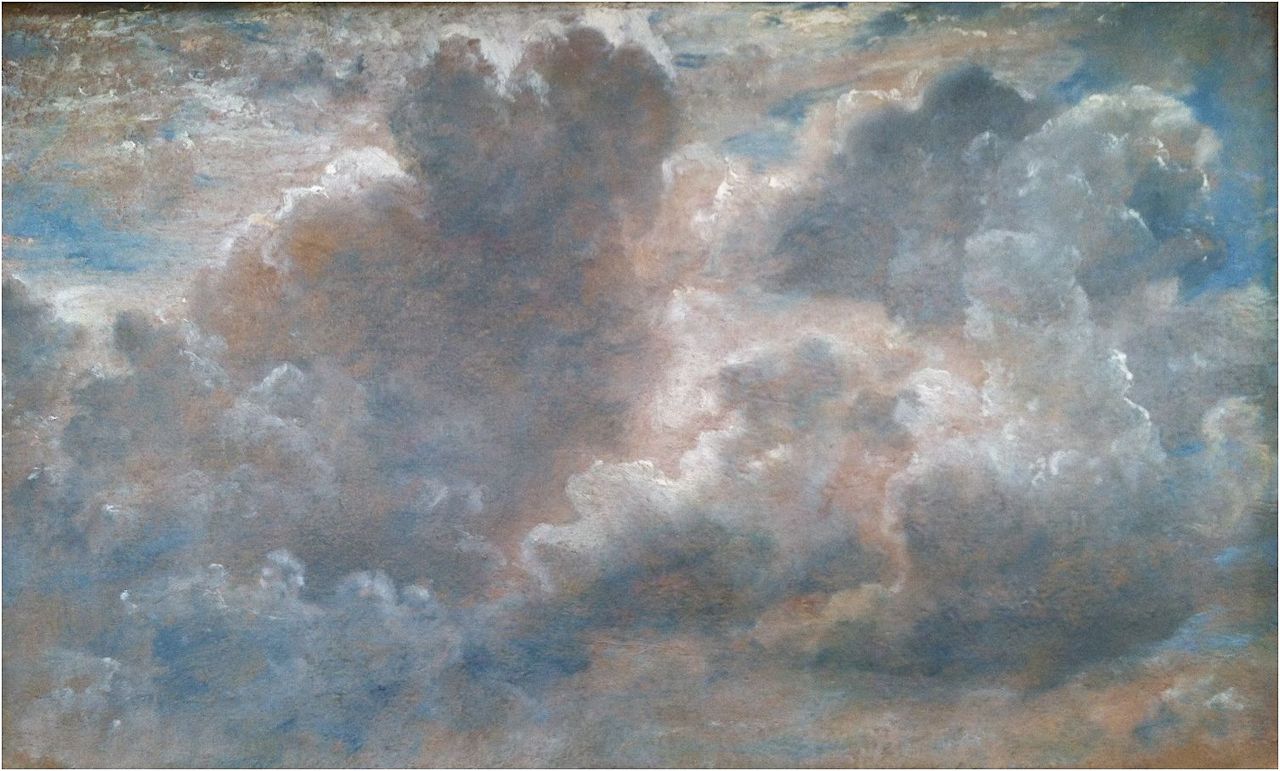
by John Constable

How long, God, will you endlessly forget me?

How long will you hide your face from me?

How long must I make schemes inside myself,

My heart in torment all day?

How long will my enemy loom over me?

Look!  Answer me, God, my God!

Light up my eyes, lest I sleep death!

Lest my enemy say he has prevailed over me,

My adversaries rejoice when I am made to stumble.  (Psalm 13:2-5)

The speaker has two problems:

1) God is hiding God’s face; i.e. the speaker is no longer aware of God’s presence, and so feels abandoned.

2) The enemy seems to be winning, despite the schemes the speaker devises.  In this life-and-death struggle, only God’s intervention can turn the tables.  But the speaker has already been waiting an unbearably long time for God to manifest and act.  Where is the responsible adult in charge?3

Unlike the Israelites who wait 40 days for Moses to return, only to give up and demand an idol, the speaker in Psalm 13 finds a better response.

by James Tissot

Yet I will trust in your loyal-kindness.

My heart will rejoice in your rescue.

I will sing to God,

Because [God] gamal me.  (Psalm 13:6)

gamal (גָמַל) = ripened, weaned, rewarded, made mature.

Even if God seems to have abandoned the speaker, the speaker decides not to abandon God.  A more mature approach is to sing to God while waiting for God to act.


In this week’s Torah portion, Vayakheil, God makes a request, and the Israelites create beautiful items for God’s sanctuary.  As long as they are doing that work, they are content to wait for God to rejoin them.

In Psalm 13, God neither makes a request nor acts to rescue the speaker.  After waiting a long time, the speaker takes initiative and creates a song for God.  They are still waiting for God to rescue them, but at least they are mature enough to sing, which leads to a hopeful frame of mind.

I think there is a third possibility, not mentioned in the Hebrew Bible.  If you are miserable and God does not tell you what to do, then act on your own initiative.  Even when you cannot figure out a scheme for improving your situation, you can make something beautiful for God.  Sing, write, paint.  Smile and speak humbly to a fellow human being.  Whenever you do something beautiful, God is inside you.


  1. Exodus 36:4-7.
  2. Numbers 10:33, 11:1-6.
  3. Breuggemann’s interpretation goes farther: “The speaker does not for a moment entertain the thought that the trouble comes from guilt or failure. It is because of Yahweh’s irresponsible absence, which is regarded as not only unfortunate, but unfaithful to covenant.” (Walter Breuggemann, The Message of the Psalms, Augsburg Publishing House, 1984, p. 59)
Ki Tisa: Stiff-Necked People

Pharaoh has a hard heart in the book of Exodus; the Israelites have hard necks.

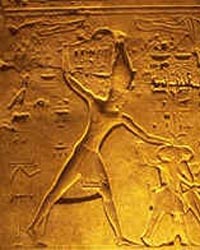
Pharaoh Merneptah subjugates Semites

Pharaoh stubbornly refuses to let the Israelites go, ignoring both a series of miraculous disasters and the advice of his own counselors.  Every time he is tempted to change his heart (i.e. mind), it hardens again.

The Israelites escape from Egypt and slavery, but whenever something makes them anxious they turn their backs on the God who rescued them, and revert to the mentality of slaves in Egypt.  (For some examples, see my posts Ki Tissa: Making an Idol Out of Fear, Beha-alotkha & Beshallach: Stomach vs. Soul, and Shelach-Lekha: Mutual Distrust.)

During the revelation at Mount Sinai God makes it clear that idols will not be tolerated.  The “Ten Commandments” include:

Do not make yourself a carved idol or any likeness of what is in the heavens above, or of what is in the land below, or of what is in the water beneath the land.  Do not bow down to them and do not serve them.  (Exodus/Shemot 20:4-5)

And God’s next set of laws repeats:

With me, you shall not make gods of silver or gods of gold; you shall not make them!  (Exodus 20:20)

Before Moses leaves to spend 40 days at the top of Mount Sinai, the Israelites swear twice that they will obey everything God said.1

But they panic in this week’s Torah portion, Ki Tissa (“When you bring up”), when 40 days have passed since Moses walked into the cloud and fire on the mountaintop.  As Moses is hiking down with the two stone tablets, God tells him what the Israelites are doing:

Apis, Egyptian bull god

“They turned aside quickly from the path that I commanded them; they made for themselves a calf of cast metal, and they bowed down to it, and they slaughtered sacrifices for it, and they said: ‘These are your gods, Israel, who brought you up from the land of Egypt!’”  And God said to Moses: “I see this people, and hey!  Am-keshei-oref!”.  (Exodus 32:8-9)

am-keshei-oref = a hard-necked people, a stiff-necked people.

am (עַם) = a people: the humans of a particular ethnic group, community, or location.

keshei (קְשֵׁה) = construct form of kasheh (קָשֶׁה) = hard, stiff, heavy, severe, difficult.  (From the root verb kashah (קָשָׁה) = be hard, harden.  Pharaoh’s heart is hardened (הִקְשָׁה) in Exodus 7:3 and 13:15.)

oref (עֺרֶף) = back of the neck, nape, neck.

In the bible turning one’s oref, the back of one’s neck, on somebody can mean fleeing, like the English idiom “turning tail”.2  But it can also mean rejection, like the English idiom “turning one’s back on”.3  According to the commentary of Rashi and Ibn Ezra on Exodus 32:9, stiff-necked people turn their backs on God and refuse to turn around.4  (See my post Eikev: Covered Heart, Stiff Neck.)

After telling Moses about the golden calf, God says:

“And now, leave me alone and my rage will increase against them and I will consume them.  Then I will make you into a great nation.”  (Exodus 32:10)

Moses Breaking the Tablets, by Rembrandt

But Moses does not leave God alone.  He persuades God to refrain from exterminating the Israelites.  Then he goes down and sees the calf worship with his own eyes.  Moses shatters the two stone tablets God gave him, and orders a massacre of the worst offenders.  God sends a plague to kill the rest of the guilty.  After God and Moses have both simmered down, God declares that the surviving Israelites should still go to Canaan.

“And I will send a divine messenger in front of you, and I will drive out the Canaanites … But I will not go up in your midst, lest I consume you on the way; because you are an am-keshei-oref.”  (Exodus 33:2-3)

The people go into mourning.  They want God right there travelling along with them; the idea of an impersonal angel does not satisfy their need for security.  But the God-character predicts that accompanying these stiff-necked people would be so infuriating that God would erupt again in murderous rage.

And God said to Moses: “Say to the Israelites: ‘You are an am-keshei-oref!  [If] for one instant I went up in your midst, I would put an end to you.  So now, strip off the ornaments you are wearing, and I will figure out what I will do to you.’”  (Exodus 33:5)

Stiff-necked deity?

At this point God has rejected the Israelites and called them an am-keshei-oref  three times.  Yet the God-character’s metaphorical neck does not remain hard.  God backs off from the original threat to exterminate all the Israelites and tells Moses only the guilty will die.  Then God softens a little more and promises to drive the natives out of Canaan and to send an angel to lead the Israelites—but not to go in their midst.

Moses then pitches the Tent of Meeting outside the camp so God will not have to speak with him in the midst of the people.  When Moses walks over to the tent and goes inside, the divine pillar of cloud appears at the entrance.  Then all the people watching from the camp rise and bow down to the ground.  This probably makes a good impression on God.5

After a while Moses asks God for a personal favor.

“And now, please, if I have found favor in your eyes, please let me know your ways.  Then I will know you, so that I will continue to find favor in your eyes.  And see that this nation is your am.”  (Exodus 33:13)

God promises to reveal part of the divine nature (“my back”)6 and also to inscribe two replacement tablets.  So Moses climbs up Mount Sinai again.  God appears in a cloud and passes in front of him, announcing that God is compassionate, gracious, slow to anger, full of kindness and good faith, extending kindness to the thousandth generation, and forgiving transgressions (although the guilt of parents continues to have an effect for three or four generations).7

These may be aspirational traits that the God-character has decided to adopt—especially “slow to anger”.  After hearing God’s glowing self-portrait, Moses bows to the ground.

And he said: “If, please, I have found approval in your eyes, my lord, will my lord go, please, in our midst?  Even though it is an am-keshei-oref?  And will you pardon our wrongdoing and our errors, and accept us as yours?”  (Exodus 34:9)

And the gentler, kinder God-character agrees—on the condition that the Israelites avoid making any treaties with the natives of Canaan, destroy all the natives’ religious items, avoid intermarriage, and never make another cast-metal idol of their own.8

Thus the God-character turns out to be flexible, able to reconsider and turn the divine “face” back toward the people he had rejected.

Stiff-necked people

The Israelites remain stiff-necked.  Even when they can see Canaan across the Jordan River, they still revert to their old ways and join the native Moabites in worshiping a local god.9

Nevertheless, these same Israelites wander in the wilderness for 40 years as they wait for their God to let them into Canaan.  Occasionally they stray, but most of those four decades they are remarkably patient.  Although it is hard for them to abandon their need for a physical representation of God, it is also hard for them to abandon their God altogether.  They are stubborn that way.

“They are so stubborn that, if only You will pardon them until they are immersed in Your faith, they will cling as stubbornly to that as they did to the previous one, and You will own them forever.”10


My own neck is literally stiff, due to an old injury, and I have to work daily to loosen the hard muscles.  I also have to work to loosen my stubborn preconceptions.  Sometimes (thank God) I realize that I’ve been unconsciously reacting to an old emotional injury.  Then I know it’s time to turn my head and consider a different path.

Stubbornness helps you to keep going when you are following the path that the divine presence within you knows is right.  Turning your neck to look at other paths helps you to find the right way to “walk with God” when you get lost.

May we all know when to be stiff-necked, and when to turn our heads.

(An earlier version of this post was published in February 2010.)


  1. Exodus 24:3 and 24:7.
  2. Turning one’s oref indicates fleeing from enemies in Exodus 23:27, Joshua 7:8 and 7:12, and Jeremiah 18:17.
  3. Jeremiah 2:27, Jeremiah 32:33, and 2 Chronicles 29:6.
  4. Rashi (11th-century Rabbi Shlomoh Yitzchaki) wrote “They turned the hardness of the backs of their necks toward those who reproved them, and they refused to listen.” (translation by chabad.org). Abraham Ibn Ezra (12th-century) wrote “The image is that of a man walking down the road who, if someone calls him, will not turn his head.”  (translation by Michael Carasik, The Commentator’s Bible: Exodus, The Jewish Publication Society, 2005, p. 285).
  5. Exodus 33:7-11.
  6. Exodus 33:23.
  7. Exodus 34:6-7, the source of the “Thirteen Attributes” in Jewish liturgy.
  8. Exodus 34:10-17.
  9. Numbers 25:1-3.
  10. 14th-century Rabbi Levi ben Gershon, also known as Ralbag or Gersonides, repeating a teaching by his grandfather, Rabbi Levi ha-Kohein. Translated by Carasik, p. 304.

(I did not approve any ads that might appear here.  I hope to pay WordPress soon to remove this feature.)


Tetzaveh: Flower on the Forehead

Garments of the High Priest

by Melissa Carpenter, maggidah

Some of the unique items the high priest wears, such as his sky-blue robe, add to his awe-inspiring appearance.1  Others items described in this week’s Torah portion, Tetzaveh (“You shall command”), have an additional purpose; for example, the high priest wears a gem-studded choshen on his breast, and uses it to consult God with yes or no questions.2

Another item that only the high priest wears is a tzitz tied to his forehead.

And you shall make a tzitz of pure gold, and you shall engrave on it with engraving like a chotam: “Holy to God”.  You shall put it on a cord of sky-blue.  And it shall be on the turban; at the front of the turban it shall be.  (Exodus/Shemot 28:36-37)

tzitz (צִיץ) = a flower.  (Plural: either tzitz or tzitztim (צִצִּים).  From the root verb tzutz (צוּץ) = bloom.3  Another word from the same root is tzitzit (צִיצִּת) = tassel, fringe, or lock of hair.)

chotam (חֺתָם) = cylindrical seal or signet ring, carved to impress a design on damp clay that serves as the wearer’s signature.  (From the root verb chatam (חתם) = to affix a seal, to confirm, to close up securely.)

The noun tzitz appears 16 times in the Hebrew Bible.  The first three times, tzitz refers to the gold engraved object the high priest wears on his forehead.4  The word tzitz next appears when God orders a demonstration to prove who deserves authority over the Israelites.  If the leader of each of the twelve tribes leaves his wooden staff inside the tent-sanctuary overnight, God will make the staff of the winner sprout buds.  In the morning:

Hey!  The staff of Aaron of the house of Levi had budded, and it had brought forth buds, and it had bloomed tzitz, and it had produced almonds.  (Numbers/Bamidbar 17:23)

In the rest of the Hebrew Bible, a tzitz is a flower.  In King Solomon’s temple, tzitzim are carved into wood panels for ornamentation.5   In five places where the word tzitz appears, humans are compared to wildflowers that quickly wilt and die.6  When Isaiah rails against rich drunkards, he describes their heads as crowned with wilted flowers.7

But the high priest’s head is crowned with a flower made out of gold.  The Torah assumes that this object, as well as the high priesthood, will continue indefinitely, passing from one man to the next.

The gold tzitz must have a flat surface where the words “Holy to God” are engraved, as well as two small holes for attaching the blue cord, but otherwise the design is a matter of speculation.  Flavius Josephus, describing the sacred items stored in a Roman treasury after the sack of the second temple in Jerusalem in 70 C.E., wrote that around the high priest’s headdress was:

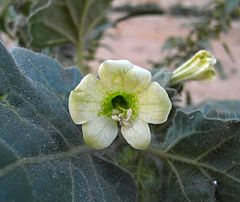
Hyoscyamus albus

“… a golden crown polished, of three rows, one above another; out of which arose a cup of gold, which resembled the herb which we call ‘saccharis,’ but those Greeks that are skillful in botany call it ‘hyoscyamus.’  … a flower that may seem to resemble that of the poppy.  Of this was a crown made … [it] did not cover the forehead, but it was covered with a ‘golden plate,’ which had inscribed upon it the name of God in sacred characters.”8

Several centuries later the rabbis of the Talmud described the tzitz as a kind of smooth plate of gold, and its width is two fingerbreadths, and it encircles the forehead from ear to ear.”  Rabbi Eliezer ben Yosei added: “I saw it in the Caesar’s treasury in the city of Rome and Sacred to God was written on one line.”9

Whether the gold object tied to the high priest’s forehead is an engraved band with a gold flower rising up from it, or a flower-shaped gold medallion with engraving in the center, it is more than a symbol.  This week’s Torah portion continues:

And it shall be on the forehead of Aaron, and Aaron shall lift off any transgression from the holy things which the Israelites make holy, from all their holy gifts.  And it shall be on his forehead perpetually, for their acceptance before God.  (Exodus 28:38)

Just by wearing the tzitz on his forehead, the high priest compensates for any accidental ritual impurity in the people’s offerings to God at the altar.

How?  The words “Holy to God” are a double reminder.  The Israelites seeing it would remember that the whole purpose of their ritual sacrifices is to make themselves holy—i.e., to dedicate themselves to God above all other purposes.  This dedication must be their core identity; thus the words are engraved into the gold medallion the way an identity seal is carved.

The words on the tzitz also remind God to treat the people as sacred.  “Holy to God”, according to Rabbi Elie Munk, “relays a message of Divine love by proclaiming Israel as a nation consecrated to God.  Yet, it is also a reminder of Israel’s permanent duty to strive every closer to the ideal of holiness.  The Tzitz expresses both Divine love and Israel’s moral obligations.”10


The high priest’s tzitz could be viewed narrowly as a magical object designed to ensure conformity to God’s rules about ritual purity.  Or it could be viewed as an aesthetic object inspiring a feeling of spiritual elevation.

But Munk points out that love and moral obligations are more important than conformity or spirituality.  What good is a religious object if we are not kind and helpful to our fellow human beings?

So the built-in symbolism of the tzitz matters after all.  Gold is the most precious metal in the Torah, reserved for the most sacred items in the sanctuary.  A flower is one of God’s most beautiful creations, and also one of the most evanescent.  Yet after a flower wilts, its fruit becomes the source of seeds for new life.

The word for “God” engraved on the gold flower is the four-letter name of God, a possible permutation of the verb “to be” or “to become”.  (See my post Beshellach & Shemot: Knowing the Name.)  And the words “Holy to God” are to be carved in relief on the tzitz, like the symbol of identity carved on a chotam, a seal.  Thus the identity of God is confirmed and secured.

The flower and God’s name both remind us that our universe is always becoming.  Flowers wilt, but the spirit of God goes on creating as seeds fall and new plants bloom.

May we all walk through life as if we wear an invisible tzitz, dedicating ourselves to life despite death, to change rather than stagnation, to growth instead of destruction.  And may we all be kind to each another on the path of becoming.

(An earlier version of this post was published in February, 2011.)


  1. Exodus 28:31. The sky-blue dye is techelet; see my post Bemidbar: Covering the Sacred.)
  2. Exodus 28:30. The choshen is a stiff rectangular pocket attached with gold rings and blue cords to the front of the high priest’s tabard (eifod).  On the outside front surface, over his chest, the choshen bears twelve precious stones engraved with the names of the twelve tribes of Israel.  Inside the pocket of the choshen are the urim and tummim, used to divine God’s answers to yes/no questions.  (See Judges 20:27-28, 1 Samuel 23:9-12, 1 Samuel 30:7-8.)
  3. Out of nine occurrences of the verb tzutz in the Hebrew Bible, all but one clearly refer to budding or blooming. The questionable reference is in Song of Songs 2:9, in which the woman describes her male beloved as “This one, standing behind our wall, gazing through the windows, meitzitz through the lattices.”  Meitzitz ((מֵצִײץ is usually translated as “peering” rather than “blooming”.  But this is the poem that says the beloved woman’s teeth are “like a flock of sheep climbing up from the washing pool” and her forehead is “like a slice of pomegranate”.  (Songs 4:2-3)  Maybe her lover is “blooming” through the lattices, like an eager flowering vine.
  4. Exodus 28:36 and 39:30, Leviticus 8:9.
  5. 1 Kings 6:18, 6:29, 6:32, 6:35.
  6. Isaiah 40:6, 40:7, 40:8; Psalm 103:15; Job 14:2.
  7. Isaiah 28:1, 28:4. Tzitz also appears in Jeremiah 48:9.
  8. Flavius Josephus, The Works of Flavius Josephus, translated by William Whiston, Baltimore, 1835, book III, chapter VII, p. 71.
  9. Talmud Bavli, Shabbat 63b, in the William Davidson Talmud, Koren Noe Edition, sefaria.org/Shabbat.63a?lang=bi.
  10. Rabbi Eli Munk (20th-century), The Call of the Torah: Shemos, translated by E.S. Mazer, Mesorah Publictions, Ltd., Brooklyn, 2001, p. 405.

Terumah: Wood Inside

From everyone whose heart urges him on, you shall take my donation.  And this is the donation that you shall take from them … (Exodus/Shemot 25:2-3)

All the materials to make the portable sanctuary for God, and all its furnishings, must be given voluntarily.  The necessary materials are then listed in this week’s Torah portion, Terumah (“Donation”):

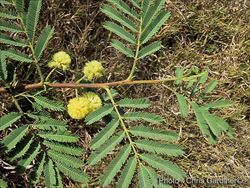
Acacia nilotica leaves and flowers

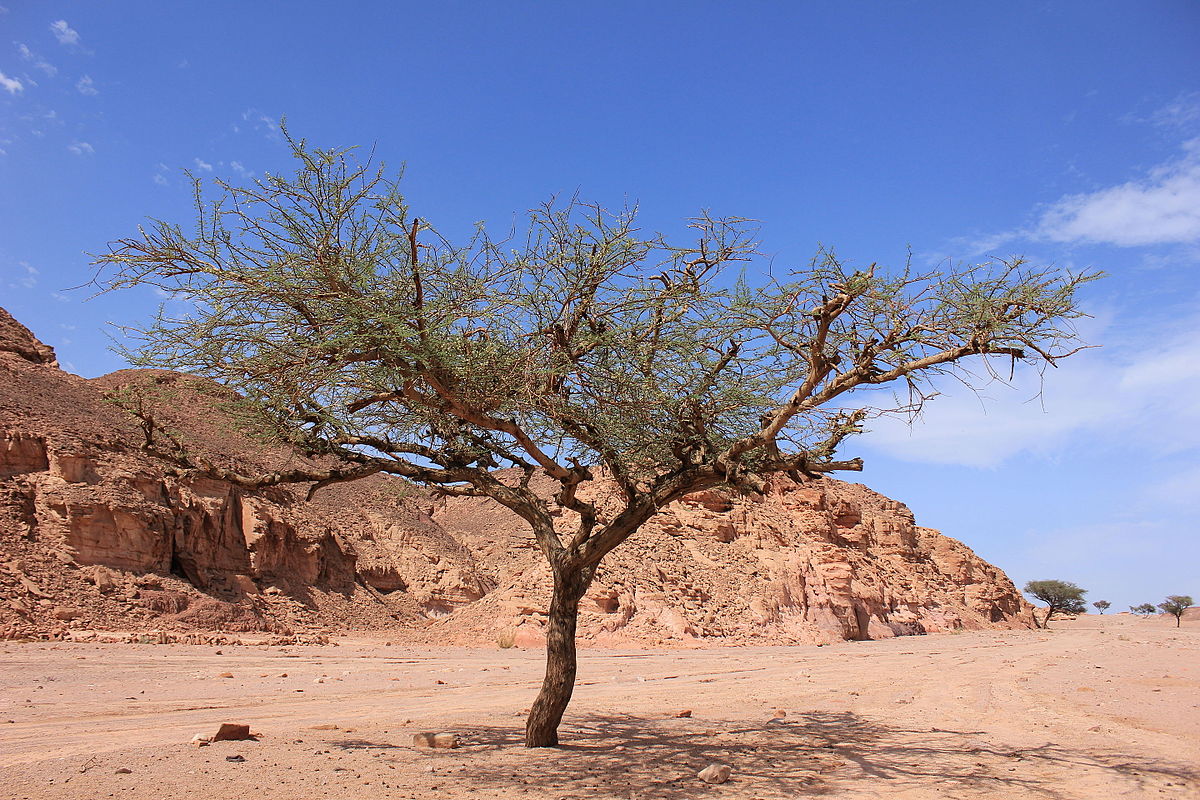
shittim (שִׁטִּים) = trees tentatively identified as one of the taller species of acacia, acacia nilotica (also called a gum Arabic tree or a thorn mimosa).  Native to India, the Middle East, and Africa, they thrive in arid conditions.  The trunks are a source of hardwood, the bark exudes medicinal gum, and the seed pods are used for livestock feed.  These acacias can reach a height of 30 meters (98 feet), though short trees are more common.

Why use acacia wood?

All the wood used to make the pieces of the portable sanctuary is shittim.  The word shittim shows up in one other context in the Torah, as the place-name for where the Israelites camp on the east bank of the Jordan, before they finally cross into Canaan to conquer their “promised land”.1

And Israel was staying at the Shittim, and the people began to be unfaithful with Moabite women. (Numbers/Bemidbar 25:1)

What do the Israelite men do with the Moabite women on the acacia-covered plain?  They worship the local god, Ba-al Pe-or.  (See my post Balak & Pinchas: How to Stop a Plague, Part 1.)  The God of Israel punishes them for this act of infidelity with a plague that kills 24,000 people.2

Since acacias were plentiful throughout the ancient Near East, it could be a coincidence that the place where Israelites first worship another god bears the same name as the wood in God’s sanctuary.  But it is hard not to read more meaning into the name Shittim.

Rabbi Bachya ben Asher wrote circa 1300 CE that the shittim wood of the portable sanctuary atones for the people’s sin at Shittim because “G’d arranges for the cure before the onset of the disease”.3

Perhaps this wood can be viewed two different ways.

What did they make from the wood?

an Egyptian ark with poles

And they shall make an ark of shittim wood, a pair and a half cubits long and a cubit and a half wide and a cubit and a half high.  And you shall plate it with pure gold, inside and outside …  (Exodus 25:10-11)

The divine instructions for the sanctuary also call for shittim wood to make the carrying-poles attached to the ark, the bread table and its poles, and the incense altar and its poles.  All three items will be gold-plated so the wood is hidden.  Out of all the furnishings inside the tent, the only items that are not gold-covered wood are solid gold: the lid of the ark (with keruvim),4 the solid gold lampstand/menorah,5 and the solid gold utensils for the bread table and the menorah.6

This week’s Torah portion also describes the fabrics and leathers that will be hung to make the walls, curtains, and roof of the tent.  The rigid framework to hold these in place will be made of planks, bars, and pillars of shittim, all of them covered with gold, their tenons inserted into silver sockets.7

The altar for animal offerings, to be placed in front of the tent, will be made of shittim covered with copper (or bronze).8  The curtain-wall defining the courtyard around the tent will be supported by wooden posts, probably also of acacia, though the Torah does not specify the wood.  Instead of being completely overlaid with metal, these posts are merely bound with silver bands.9

Why are the wood items in the tent sanctuary covered with gold?

Acacia on the Sinai Peninsual

Acacia wood is naturally water-resistant, and in the desert it would not need another covering to protect it from rain.

But appearances matter. The Israelites probably found gold more impressive and more likely to elevate the soul than mere wood, which could be seen anywhere an acacia tree cracked or was cut into firewood.  The God of Israel deserved a sanctuary in which every exposed surface is either brilliantly colored fabric or gleaming with gold.  Gold was the most precious of the precious metals, and it shines like the sun.  When the Israelites make an idol to represent their God, they make a calf out of gold.10

Acacia wood

Yet the strength of wood is necessary to hold up the structures that soft gold could not support.  The ark lid with its keruvim and the menorah could be made of solid gold because they were relatively small.  According to this week’s Torah portion, the ark lid was only one meter (just over 3 feet) by 2/3 meter (just over 2 feet), and the extra weight of the gold keruvim on the two ends would be supported by the gold-plated boards underneath.

The height of the menorah is not given in the Torah, but the Talmud (Menachot 28b) says it was 18 handbreadths: about 1½ meters (just over 5 feet).  Pure gold cannot hold its shape, or support any additional weight, if it is taller than two meters.

According to the portion Terumah, God would speak from the empty space between the keruvim and above the lid of the ark.11  Thus the lid and its keruvim are made entirely from gold, the metal associated with God.

But the ark itself, like the bread table and the incense altar, only looks ethereal and golden from the outside.  The ark can support the weight of the keruvim, the table can support the weight of the gold bowls, jars, and jugs, and the incense altar can support the weight of the coals only because they are all constructed out of strong wood.

Similarly, the uprights and crossbars of the tent itself may shine like sunbeams, but inside the gold covering are planks of wood strong enough to support the weight of the roof-coverings and curtain walls.

*

In this week’s Torah portion, God says that after the people have donated all the materials,

Then they shall make for me a holy place, and I shall dwell among them.  (Exodus 25:8)

It is not enough for everyone whose heart urges him on” to donate the materials.  The people with generous hearts, hearts open to God, must also donate their labor.  And even when every part of the sanctuary is assembled and completed, the work is not over.  God is not something that just happens to the people; they must actively serve God by bringing all the prescribed offerings to the altar, by purifying themselves before they enter the courtyard of the sanctuary, and by feeding the priests and Levites who conduct the rituals.  They must come to God with their own bodies and hearts.

Perhaps the acacia wood in the sanctuary represents this ongoing human effort.  Human beings are like trees, growing and aging, surviving accidents and eventually dying.  We are not shiny or immutable like gold, but we are strong.  Our relationship with God will not hold up unless we apply our inner strength and persistence, unless we keep reminding ourselves to pay attention and bring the divine into our daily lives.  Reserving God for ecstatic, golden experiences does not make a place for God to dwell among us.

On the other hand, if human effort is all bare wood without a glimpse of gold, it may become deadwood.  We may forget our purpose in life when we are camped at Shittim on the bank of the Jordan River.  Then we end up imitating whoever appears in front of us—perhaps thoughtless neighbors, or famous people in the media.  We forget the inner gold standard of our own ethics.

Like the sanctuary, we need both wood and gold.

  1. Shittim refers to the same camping site in Numbers 33:49. It appears as a place-name for an unknown location in Joel 4:18.
  2. Numbers 25:9.
  3. Bachya ben Asher ibn Halawa, Shemot 26:15, following Midrash Tanchuma. Translation by Eliyahu Munk, 1998, in Sefaria, sefaria.org.
  4. Exodus 25:17-22. See my post Terumah: Cherubs Are Not for Valentine’s Day.
  5. Exodus 25:31-40. See my post Terumah: Tree of Light.
  6. Exodus 25:9-30, 25:38.
  7. Exodus 25:15-37.
  8. Exodus 27:1-2.
  9. Exodus 27:17.
  10. Exodus 32:1-6.
  11. Exodus 25:22.

Mishpatim: On Slavery

The same word, avodah, means both “service” and “slavery” in Biblical Hebrew.  Just as today we consider it virtuous to serve a good cause, the ancient Israelites considered it virtuous to serve God.  But is it ever virtuous to serve a human master?  Or to be one?

Jacob and Rachel, by William Dyce

The word avodah first appears in the book of Genesis/Bereishit, after Jacob works for his uncle Lavan for seven years as his bride-price for Rachel.  When Lavan gives him Rachel’s sister Leah as a bride instead, Jacob complains.  Lavan replies that Jacob can marry Rachel in only one week, but then he owes Lavan another seven years of avodah that ta-avod with me”.  (Genesis/Bereishit 29:7)

avodah (עֲבֺדָה) = service, slavery, labor.  (From the root verb avad, עָבַד = serve, be a slave, perform rites for a god, work.)

ta-avod (תַּעֲבֺד) = you shall serve, you shall be a slave.  (A form of the verb avad.)

When Jacob agrees, he is voluntarily selling himself as a temporary slave, i.e. an indentured servant who has no rights during his term of indenture, but is free once it ends.

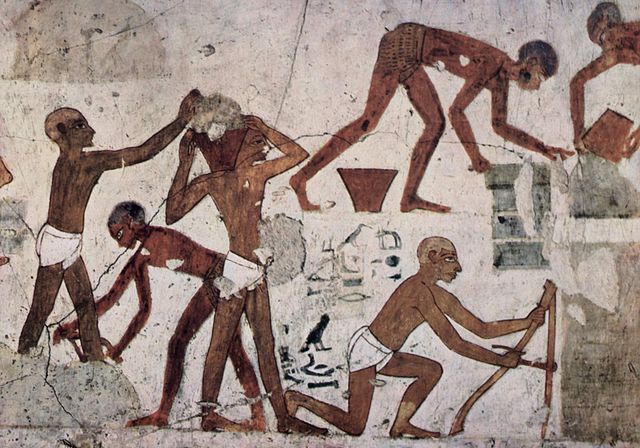
Another type of involuntary labor is corvée labor, when a ruler or feudal lord imposes unpaid labor on people for certain periods of time.  In Exodus/Shemot, the Pharaoh decides to impose corvée labor on the resident Israelites.

Slaves making bricks, tomb of Rekmire, c. 1450 BCE

The Egyptians, vaya-avidu the Israelites with crushing torment, and made their lives bitter with hard avodah with mortar and bricks, and with every avodah in the field, all of their crushing avodah that avdu.  (Exodus/Shemot 1:13-14)

vaya-avidu (וַיַּעֲבִדוּ) = they enslaved, they forced to work.  (Another form of the verb avad.)

avdu (עָבְדוּ) = they labored at, they slaved away at.

Yet the Torah accepts that the Israelites themselves own slaves, and it provides laws granting slaves limited rights.  These rights are more limited for foreign slaves (Canaanites as well as people whom Israelites defeat in battle and bring home as booty) than for slaves who are fellow Israelites.  Out of the first eleven laws in this week’s Torah portion, Mishpatim (“Laws”), five concern the treatment of slaves.  The first two laws set terms for Israelite slaves:

      If you acquire a Hebrew eved, six years ya-avod … (Exodus 21:2)

      And if a man sells his daughter as an amah … (Exodus 21:7)

eved (עֶבֶד), plural avadim (עֲבָדִים) = (male) slave; dependent subordinate (such as an advisor or administrator) to a ruler.  (From the root verb avad.)

ya-avod (יַעֲבֺד) = he will work for a master, be a slave, serve.  (A form of the verb avad.)

amah (אָמָה) = foreign or Israelite slave-girl; foreign slave-woman.

Three more laws in Mishpatim address the most egregious abuses of foreign slaves:

      And if a man strikes his eved or his amah with a stick and he dies … (Exodus 21:20)

      And if a man strikes the eye of his eved or his amah and destroys it … (Exodus 21:26)

      If the ox gores an eved or an amah … (Exodus 21:32)

Although the books of Leviticus and Deuteronomy upgrade the laws in this week’s Torah portion and grant both foreign and Israelite slaves additional rights,1 the institution of slavery is never outlawed in the Hebrew Bible.2

Temporary slaves

There is no requirement that foreign slaves must be freed.  Unless an owner decides to release a slave in exchange for payment, the condition of slavery is permanent, and the slave is inherited by the owner’s heirs.3

But an Israelite slave is always temporary, unless he himself chooses to make his condition permanent.4

A free Israelite man who is impoverished or indebted, and has sold everything else he owns, may sell himself.  That way he and his family will have food, clothing, and shelter while he works for his master.  In addition, a court can sell a convicted thief if he does not have the means to repay the person he stole from.5

An Israelite girl becomes a slave if her father sells her while she is still a minor.  That way her father receives a payment at once in lieu of the bride-price he would normally receive when she reaches puberty and marries.

Unlike a foreign slaves, Israelite slaves must be given the option of freedom after six years, in the Jubilee year, or when their kinsmen redeem them, whichever comes first.6  Meanwhile, temporary slavery is acceptable as long as the master follows the laws, starting with the laws laid out in this week’s Torah portion.

*

If you acquire a Hebrew eved, six years ya-avod, and in the seventh he shall leave free, without charge.  If he comes alone, he leaves alone.  If he is the husband of a woman, then she leaves with him.  (Exodus 21:2-3)

The slave does not have to repay his master for any expenses incurred during the period of his servitude.  And if he was married when he was sold, his master must also take in his wife and children, so they will not go homeless.7

If his master gives him a woman and she bears him sons or daughters, the woman and her children will belong to her master, and he [the Israelite slave] will leave alone.  (Exodus 21:4)

The Israelite slave’s master can, however, use him for stud service, to breed children with a non-Israelite female slave.  These children will be permanent slaves, like their mother.8

*

The Torah portion Mishpatim also lays out the terms of service for a female Israelite slave.  Even free women in ancient Israel were considered the property of their fathers, husbands, or nearest male kin, but the only Israelite female called a slave (amah) was a girl sold by her father.

And if a man sells his daughter as an amah, she shall not leave like the avadim.  If she is undesirable in the eyes of her master who had designated her for himself, he shall turn her over [arrange to have her redeemed].  He shall not exercise dominion over her to sell her to strange people, since he has broken faith with her.  (Exodus 21:7-8)

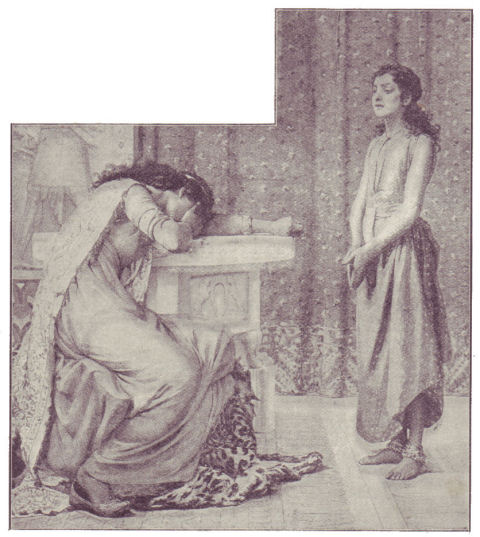
Slave-girl and Naaman’s Wife, from Rev. Hurlburt, Story of the Bible, 1904

In the Torah a man can buy a future wife or concubine, for himself or for his son, when she is still underage. Her purchase price is then considered an advance payment of the bride-price that a groom pays before he marries.  By this means impoverished fathers could sell their daughters for cash without waiting for them to come of age.

If the girl reaches puberty and her owner decides not to marry her after all, he must arrange for her family to redeem her by repaying him; he cannot sell her to anyone else.  If her owner bought her as a future wife for his son, the marriage must take place.

And if he designated her for his son, he shall treat her as is the law of daughters: if he marries another, he shall not diminish her [the former amah’s] meals, covering [clothing or honor], or right to marital intercourse.  (Exodus 21:9-10)

Once the girl marries her owner or her owner’s son, she must be treated like any wife and given food, clothing, honor, and sex, regardless of whether her husband likes another of his wives better.

In other words, the amah’s owner is obligated to make an acceptable provision for her when she comes of age. The three things the Torah considers most acceptable are marriage to the owner, marriage to the owner’s son, or a return to her original family.

And if he [the owner] does not do [any of] these three things, she shall leave without charge, without any silver.  (Exodus 21:11)

If her owner does not provide for her in any of the three preferred ways, then he must set her free like a male Israelite slave who has completed his period of service, without charging her anything.  (Non-Israelite slaves would have to pay their owners to be set free.)  Freedom was an inferior option for a young woman in ancient Israelite society, since it was hard for a single woman to make a living, but at least it was better than being sold to an outsider.

*

The Torah’s laws about slavery, in this week’s Torah portion and elsewhere, provide some rights for slaves in a society where slavery is normal.  Does that mean these laws have only historical interest to us today?

Alas, no.  In the United States, for example, the conquering Europeans treated the indigenous peoples the way the conquering Israelites treated the Canaanites, refusing to grant them the same legal rights to life and liberty.  The Americans in power also enslaved people who were kidnapped from their homes in Africa, just like the Israelites enslaved foreigners captured in battle. Although Native and African Americans now have legal equity, they remain at a disadvantage due to earlier injustice and continuing prejudice.

Furthermore, throughout the United States there are still many people who are so impoverished, in terms of finances and/or knowledge, that they “sell” themselves by doing degrading, dangerous, or illegal work in order to feed themselves and their families.  Our “social safety net”  limits the level of impoverishment in some circumstances, but it is currently being reduced rather than expanded.

Those who struggle under a disadvantage should not be left alone to starve.  The Torah’s solution, temporary slavery, is essentially adoption by a wealthier family that can support the impoverished in exchange for their labor.  But with all our resources in the United States, we can do better.  Collectively, through taxes, we can and should rescue the destitute with solutions that give them basic living expenses, health care, and education. Other rich countries today are farther along this path; it is time for Americans to catch up and stop treating disadvantaged people like slaves.

  1. E.g. Deuteronomy 15:12-14 on Israelite slaves, Deuteronomy 21:10-11 on foreign female slaves (see my post Ki Teitzei: Captive Soul).
  2. The Talmud, Gittin 65a, claims that slavery was abolished when the first temple fell and there were no more Jubilee years when all Israelite slaves were freed and their family lands returned to them. But the books of Ezra and Nehemiah count 7,337 male and female slaves among the households that returned from Babylonia to Jerusalem to build the second temple (Ezra 2:65, Nehemiah 7:67).
  3. Leviticus 25:44-46.
  4. Exodus 21:5-6 in this week’s Torah portion.
  5. Exodus 22:2 in this week’s Torah portion.
  6. Male Israelite slaves are freed in the seventh year in Exodus 21:2-3; female Israelite slaves have the same right by the time of Deuteronomy 15:17. Every fiftieth year all Israelite slaves are freed and their ancestral lands are returned to them (Leviticus 25:10-28, 25:39-43).  A male slave’s kinsmen can redeem him before his term is up by paying for his remaining years (Leviticus 25:50-52), and a female slave’s kinsmen can redeem her when she reaches puberty, providing that her master or his son no longer want to marry her (Exodus 21:7-8).
  7. Rashi (11th-century rabbi Shlomoh Yitzchaki), Rambam (12th-centery rabbi Moses ben Maimon), Ramban (13th-century rabbi Moses ben Nachman), and subsequent tradition.
  8. Rashi and Ramban on Exodus 21:4.

Ezekiel & Psalm 46: Desist!

Desist!  And know that I am Elohim.  (Psalm 46:11)

Elohim (אֱלוֹהִים) = God; gods in general.

The phrase “know that I am God” appears nine times in the book of Exodus, but it always uses God’s personal name (whose four letters approximate Y-H-V-H) instead of Elohim.  God wants Egyptians and Israelites to know the identity of the god who creates the miracles they witness.  (See my post Beshallach & Shemot: Knowing the Name.)

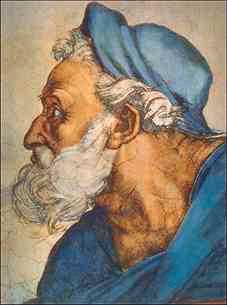
Ezekiel, by Michelangelo

In the book of Ezekiel, the phrase “know that I am God” appears more than 50 times using God’s personal name.  The book opens in the settlement near Babylon where the prophet Ezekiel was deported during King Nebuchadnezzar’s conquest of the southern Israelite kingdom of Judah in the 6th century BCE.   Jerusalem, the only remaining Israelite city, is still under siege.1  Its people are suffering—and it is their own fault, according to Ezekiel.  They enraged God by worshiping idols, so God sent famine, pestilence, and the Babylonian army to destroy them.  The losing side in a war, according to Ezekiel, is the side that made God angry.

Then you shall know that I am Y-H-V-H, whose decrees you did not follow, and whose laws you did not do; you did according to the laws of the nations that surrounded you.  (Ezekiel 11:12)

At least 25 times Ezekiel prophesies that the surviving Israelites will realize their guilt and “know that I am Y-H-V-H”.2

Ezekiel also declares that God will send Babylonians to conquer Ammon, Moab, Philistia, Tyre, Egypt, and Edom because none of these nations tried to help the Israelites.  Then their people, too, “shall know that I am Y-H-V-H”.3

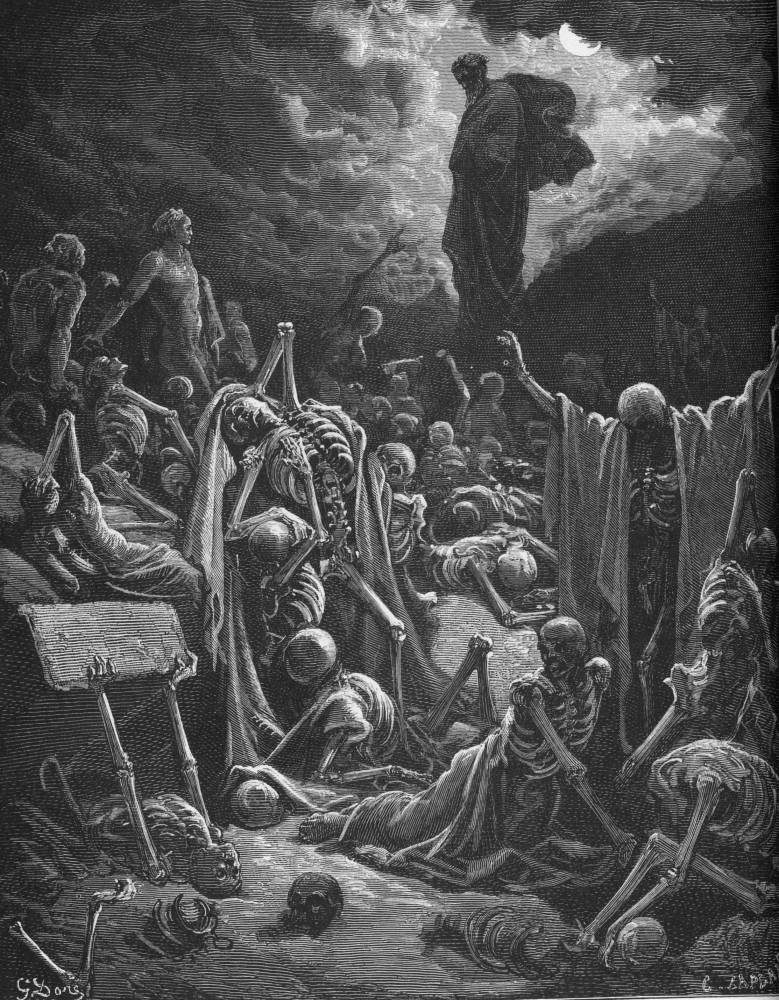
Valley of the Dry Bones, by Gustave Dore, 1866

But eventually God will forgive the deportees from Judah, reestablish the covenant with them, and return them to Jerusalem.  Ezekiel prophesies seven times that when God stops punishing the people and repopulates Jerusalem, the Israelites “shall know that I am Y-H-V-H”.4

In the distant future, the prophet says, the vast armies of Gog from Magog and his allies will invade the hills of Israel, and God will defeat them both by creating natural disasters (earthquake, pestilence, hail) and by making Gog and his allies turn on each other.5

“Thus I shall manifest my greatness and my holiness, and make myself known in the eyes of many nations.  And they shall know that I am Y-H-V-H”.  (Ezekiel 38:3)

In Ezekiel, people recognize Y-H-V-H only after a human army is wiped out.

*

In Psalm 46 people recognize God when God puts an end to war.  The song begins:

View of Fortress on a Hill, detail, by Augustin Hirschvogel, 1546

Elohim is for us a refuge and a stronghold,

            A help in dire straits, very accessible.

Therefore we are not afraid when the earth is transformed,

            When mountains collapse into the heart of the seas,

Its waters roar and foam,

            The mountains quake in its surge.  Selah.  (Psalm 46:2-4)

Some commentators have claimed that the upheavals of earth and sea are a metaphor for the violence of warring nations expected at the end of history, i.e. the war of Gog prophesied by Ezekiel.6  Others take this first section of the song so literally that they date the psalm according to an earthquake that occurred two centuries before the time of Ezekiel.7   A third interpretation is that God is responsible for all natural disasters, from floods to earthquakes, and that God will protect devout Israelites even while God is inflicting these “acts of God” on others.8

The first part of the psalm ends with the ancient Hebrew word Selah, a musical instruction whose meaning is unknown.  The second part presents an image of joy and stability in the “city of Elohim where God dwells on earth, in contrast with the chaos around it.9  This section ends with another Selah.  Then the psalmist says:

Go perceive the marvelous acts of Y-H-V-H;

            Who puts frightful devastations on the earth,

Stopping wars to the edge of the earth,

            breaking a bow and cutting up a spear,

            flaming [war] wagons with fire.

“Desist!  And know that I am Elohim.

            “I am higher than the nations,

            “I am higher than the earth.”  (Psalm 46:9-11)

This last part of Psalm 46 may be a prediction that someday God, who initiates natural disasters, will cause humans to desist from war over the entire earth.  In other words, when all humans know that Elohim is still active in nature, we will stop fighting and have world peace.

Biblical commentators usually follow Ezekiel in assuming that world peace will happen only after the defeat of Gog from Magog and the end of history, when messianic time begins.

But I believe we cannot wait for the legendary armies of Gog.  Groups of humans from families to nations have been fighting each other not only with wars, but also by exercising their own power without pity for any other creatures, human or not.  Now we are beginning to suffer from world-wide natural disasters, otherwise known as global climate change.

Can we stop fighting and making heartless power plays?  Can we change our own human natures, and rescue whoever and whatever can be rescued all over the earth?

I pray that God will inspire even the most intransigent hearts to “Desist!  And know that I am Elohim”, the divinity in all of nature, including ourselves.

  1. The people known collectively as Israelites in the Hebrew Bible had two kingdoms, the northern kingdom of Israel with its capitol in Samaria, and the southern kingdom of Judah with its capitol in Jerusalem, until the Assyrian Empire conquered the northern kingdom circa 720 BCE. The Babylonian Empire took over the Assyrian Empire circa 605 BCE, conquered most the kingdom of Judah, and besieged Jerusalem on and off from 605 BCE until it fell in 586 BCE.  Leading Israelites from Jerusalem and Judah were deported from 597 BCE to as late as 581 BCE.
  2. Ezekiel 6:7, 6:10, 6:13, 6:14, 7:4, 7:27, 11:10, 11:12, 12:15, 12:16, 12:20, 13:9, 13:14, 13:21, 13:23, 14:8, 15:7, 20:38, 20:26, 20:44, 22:16, 23:49, 24:4, 24:27, 33:29.
  3. Ezekiel 25:5, 25:7 regarding Ammon; 25:11 regarding Moab; 5:17 regarding Philistines; 26:6 regarding Tyre; 29:6, 29:9, 29:16, 29:21, 30:8, 30:19, 30:25, 30:26, and 32:15 regarding Egypt; 35:4, 35:9, and 35:15 regarding Edom (Mt. Seir); and 36:23 regarding “the nations” in general.
  4. In Ezekiel 16:62, 20:20, 20:42, 34:27, and 36:38, God will accept the repentance of the surviving Jerusalemites who were deported to Babylon, renew the old covenant, and return them to their land. In Ezekiel 37:6 and 37:13, God will (at least metaphorically) bring the dry bones of the slain back to life.
  5. Ezekiel 38:19-22. Ezekiel adds that the Israelites will “know that I am Y-H-V-H” in 39:22 and 39:28.
  6. g. Radak (12th-13th century Rabbi David Kimchi): “At the time when the mountains quake and collapse and the waters of the sea are stirred up, that is to say—when there will be great distress and war between the kingdoms of the nations, Israel will not be afraid but instead will rejoice.  This is what is said in a metaphorical fashion…”  (Sefaria translation, www.sefaria.org/Radak_on_Psalms.46. )
  7. The earthquake mentioned in Amos 1:1 occurred circa 750 BCE. See Robert Alter, The Book of Psalms, W. Norton & Co., New York, 2007, p. 162; and Arie Folger, “Understanding Psalm 46”, Jewish Bible Quarterly, http://jbq.jewishbible.org/assets/Uploads/411/jbq411psalm46folger.pdf.  Rashi (11th-century rabbi Shlomoh Yitzchaki) cites Numbers 16:31-32, where the earth swallows people, but the descriptions there sounds more like a sudden sinkhole than an earthquake.
  8. Folger, ibid.
  9. Psalm 46:5-7.

Note: Any ads below provide revenue to WordPress, not to me.

Beshalach & Shemot: Knowing the Name

Six weeks after they leave Egypt, the Israelites grumble that they are starving, and they would rather have died in Egypt with full stomachs.1

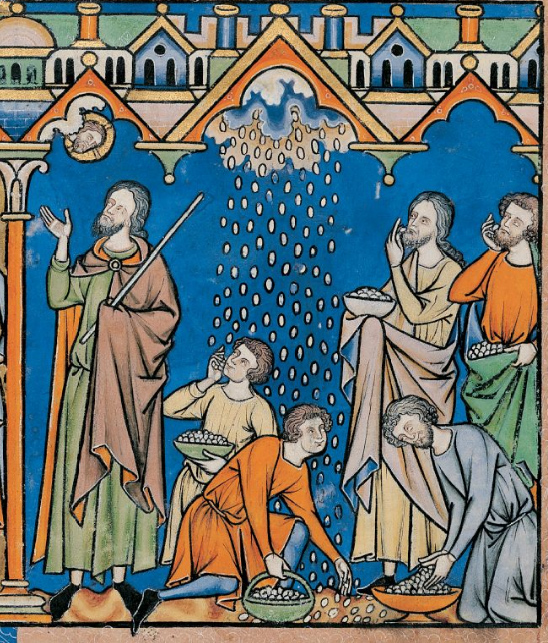
Manna rains from heaven, Maciejowski Bible, circa 1250 CE

So in this week’s Torah portion, Beshalach (“When he sent away”), God promises to provide bread and meat in the form of manna and quail every day.

Y-H-V-H spoke to Moses, saying: “I have heard the grumblings of the Israelites.  Speak to them, saying: In the evenings you shall eat meat, and in the morning you shall be sated with bread.  And you shall know that I am Y-H-V-H, your Elohim.”  (Exodus/Shemot 16:11-12)

Y-H-V-H (yud-heh-vav-heh) = the “tetragrammaton”, God’s most holy and personal name.  (In Jewish tradition this name may no longer be pronounced, and can only be spelled in Hebrew in sacred texts.  When prayers are said aloud, the tetragrammaton is read as “Adonai”)

elohim (אֱלוֹהִים) = God; gods in general.

Being God’s personal name, the tetragrammaton is not a reference to God’s status as a god, or even as a lord, master, or ruler.  The common English written translation of Y-H-V-H as “LORD” can be deceptive.  So can the Jewish practice of saying Adonai for Y-H-V-H in prayers, since Adonai literally means “my lords”.  When God says that people “shall know that I am Y-H-V-H, God wants them to know that the god they are thinking about is the one named Y-H-V-H.

But surely the Israelites know by now that the name of their god is Y-H-V-H.

The book of Genesis/Bereishit calls God by several different names, including Y-H-V-H.  (See my post Lekh-Lekha: New Names for God.)  But the personal name of God becomes more important in the book of Exodus/Shemot.  In the first Torah portion (also called Shemot), God chooses Moses as a prophet at the burning bush, and Moses asks for God’s proper name:

Hey, I come to the Israelites and I say to them: “The elohim of your forefathers sent me to you”.  And they say to me: “What is his name?”  What shall I say to them?  (Exodus 3:13)

First the voice from the burning bush replies:

… Thus you shall say to the Israelites: “Ehyeh sent me to you.”  (Exodus 3:14)

Ehyeh (אֶהְיֶה) = I am, I will be, I become, I will become.  (A form of the verb hayah (הָיָה) = be, become, happen.)

In the next verse, God amends the answer.

… Thus you shall say to the Israelites: “Y-H-V-H, the Elohim of your forefathers, the Elohim of Abraham, the Elohim of Isaac, and the Elohim of Jacob, sent me to you.” …  (Exodus 3:15)

The name Y-H-V-H may also be a form of the verb hayah, which also appears as havah.2  Biblical Hebrew lexicons list no hifil (causative) form of either root.  But if there were a hifil form, one conjugation would use the letters Y-H-V-H and would mean “He/it brings into being.”3

Thus the first name God gives to Moses might mean “I become” and the second name might mean “He makes [things] become”.  God decides to stick with the second name, Y-H-V-H.

… This is my name forever; this is how I shall be remembered forever.  (Exodus 3:15)

Moses and Aaron confront Pharaoh, by Marc Chagall, 1931

But the name is unfamiliar to the Pharaoh of Egypt when Moses and Aaron first ask him to grant the Hebrew slaves a leave of absence.

Pharaoh said: “Who is Y-H-V-H that I should listen to his voice to send away Israel?  I do not know Y-H-V-H.”  (Exodus 5:2)

After that, God wants someone to “know that I am Y-H-V-H nine times in the book of Exodus/Shemot.4  Five times God declares that the Pharaoh or the Egyptians will “know that I am Y-H-V-H once God has performed a miracle that damages Egypt.5

And four times in Exodus, God declares the Israelites will “know that I am Y-H-V-H”: after God has brought them out of Egypt (Exodus 6:7), mocked the Egyptians with miracles (Exodus 10:2), given them manna and meat in the wilderness (Exodus 16:12), and dwelled among the Israelites after they have made a sanctuary (Exodus 29:46).

After the book of Exodus, the Israelites and their fellow-travelers sometimes disobey or rebel against God, but at least they know the name of the god who has adopted them.  The statement that somebody “shall know that I am Y-H-V-H does not appear again until the book of Deuteronomy/Devarim, when Moses reminds the Israelites that God took care of them in the wilderness, giving them water, manna, and quail, and ensuring they would not need to spend time on making clothes.

I led you across for 40 years across the wilderness; your clothes did not wear out upon you, and your sandals did not wear out upon your feet.  You ate no bread and drank no wine or liquor—so that you would know that I am Y-H-V-H, your Elohim.  (Deuteronomy 29:4-5)


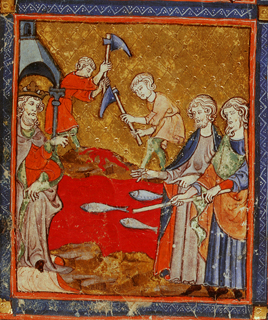
Plague of Blood, Golden Haggadah, circa 1320

In short, people shall know that God is Y-H-V-H when they witness or remember miracles.  The miracles might be as benign as the provision of manna in this week’s Torah portion, or as devastating as turning the whole Nile River into blood.

If Y-H-V-H means “He brings into being”, then a miracle demonstrates that even though the natural world was created long ago, the god of miracles can still bring major new events into being.

And if Y-H-V-H has a different meaning?  Some modern scholars have suggested that the four-letter name may derive from a more ancient god-name used by nomads living in an area south of the Dead Sea called “the land of Yehwa”.6  Three of the most ancient poems in the bible refer to Y-H-V-H as coming to Israel from an earlier home in the south: the Song of Moses (Deuteronomy 33:2), the Song of Deborah (Judges 5:4, part of this week’s haftarah reading), and the Song of Habbakuk (Habbakuk 3:1-3).

If the name Y-H-V-H came from the name “Yehwa”, what did “Yehwa” mean?  It might be related to the later Arabic word hawaya = love, passion.7  And if Y-H-V-H means “He is passionate”, then a miracle demonstrates that this god is deeply emotional about human beings at the collective level, and does extraordinary things to arrange their fates.  In Exodus the God of passion makes the Egyptians suffer and helps the Israelites—except when they enrage him by worshiping the golden calf, and he kills 3,000 of them with a plague.  Y-H-V-H also gets furious over some Israelite actions in the book of Numbers/Bemidbar, and kills many thousands more.  (See my posts Balak & Pinchas: How to Stop a Plague, Part 1 and 1 Samuel: How to Stop a Plague, Part 4.)

Today most people do not believe in miracles, and those who do often apply the word “miracle” to events that do not defy the laws of nature and could just as well happen by coincidence.  They might be awed by the pseudo-miracles they notice, and they might consider God responsible.  But their concept of God is different from the God in Exodus: either more abstract, or milder and kinder.

What would it be like today to believe that God is Y-H-V-H, “He brings into being” or “He is passionate”?


  1. Exodus 16:2-3.
  2. This verb is most often conjugated from the root hayah (היה), but occasionally the bible uses a conjugation of the synonymous root havah (הוה)—for example, in the imperative in Genesis 27:29, Isaiah 16:4, and Job 37:6.
  3. The verb spelled with the letters Y-H-V-H would be the third person singular imperfect hifil.  A more elegant but slightly less literal translation is: “He who brings things into being”.  Robert Alter, The Five Books of Moses, A Translation with Commentary, W.W. Norton & Company, New York, 2004, p. 321-322, footnote on Exodus 3:14.
  4. In addition to these nine times, God also wants the Israelites to know that there is none like Y-H-V-H in Exodus 8:6, 9:14, and 18:11; to know that Y-H-V-H owns the earth in Exodus 9:29; to know that Y-H-V-H distinguishes between Egyptians and Israelites in Exodus 11:7; and to know that Y-H-V-H sanctifies them with Shabbat in Exodus 31:13.
  5. The miracles are bringing the Israelites out of Egypt (Exodus 7:5), turning the Nile and all the surface water in Egypt into blood (Exodus 7:17), releasing swarms of mixed vermin (Exodus 8:18), and eliminating Pharaoh’s army (Exodus 14:4 and 14:18).
  6. The “land of Yehwa” appears in a 14th-century BCE Egyptian list discovered in Amunhotep III’s Soleb Nubian temple.  Israel Knohl, “YHWH: The Original Arabic Meaning of the Name”, www.thetorah.com, 01/01/2019, .  Also see Richard Elliott Friedman, The Exodus, HarperCollins, 2017, pp. 122-123.
  7. Knohl, ibid.

Bo: Minglers or Riffraff?

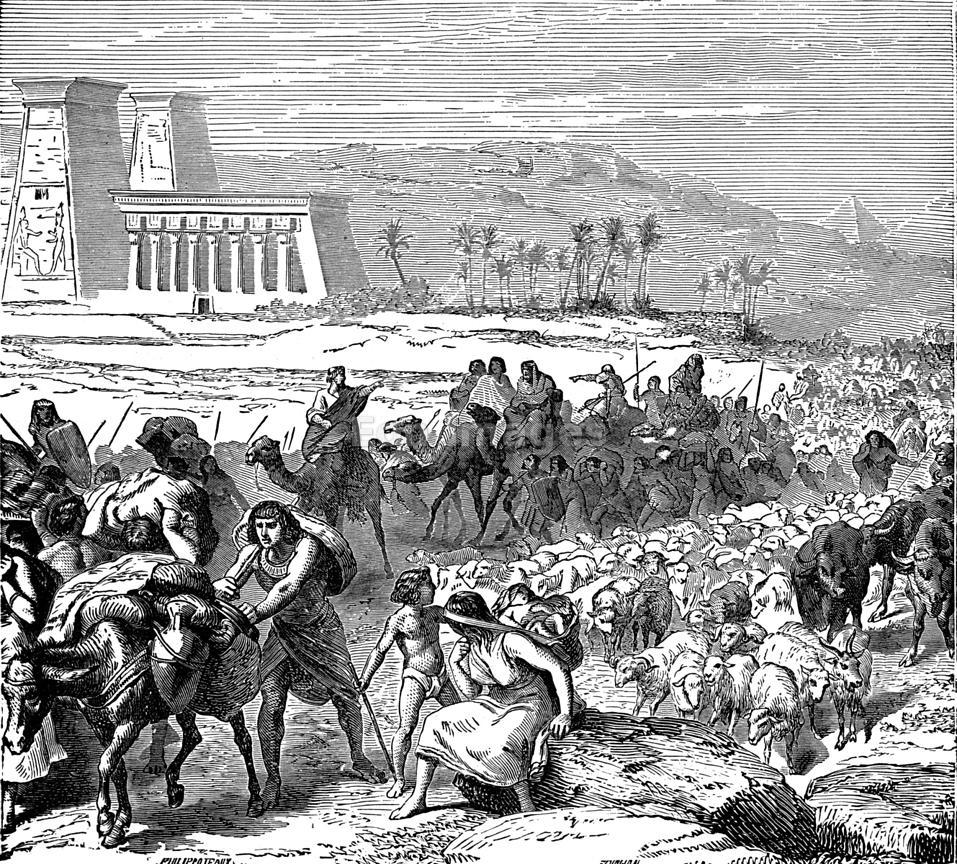
Exodus from Egypt,
19th century print

After the tenth plague, the Pharaoh lets the Israelites go into the wilderness, just as God predicted to Moses.1  What God did not predict is that many non-Israelites leave Egypt with them.  Near the end of this week’s Torah portion, Bo (“Come”), we read:

And the children of Israel pulled out from Ramses toward Sukkot, about 600,000 adult men on foot, aside from non-marchers.  And also an eirev rav went up with them, and flocks and herds of very impressive property.  (Exodus/Shemot 12:37-38)

eirev rav (עֵרֶב רַב) = “mixed multitude” (King James version), motley crowd.  From the words eirev (עֵרֶב) = mixed or mingled (used for people or thread in fabric) + rav (רַב) = numerous, abundant, great.

Words from the same root as eirev include:

  • erev (עֶרֶב) = evening, sunset (when day and night mix); a weaving term, possibly for the woof.
  • arav (עֲרַב) =Arabs, Bedouins.
  • the hitpael form of the verb arav (עָרַב) = associate with, mingle with.

A negative view of the Eirev Rav

The noun eirev in reference to people (rather than to weaving) occurs only rarely in the Hebrew Bible.  In Jeremiah ha-erev (הָעֶרֶב = the eirev) refers to people of mixed race who are living in other lands, not to those living with Israelites.2  But in Nehemiah, eirev refers to  people from Ammonite or Moabite stock who live in Judah:

Ezra Reads the Law, by Gustave Dore, 1866

On that day they read to the people from the book of Moses, and they found written in it that no Ammonite or Moabite could enter the congregation of God, ever … And they heard the teaching, and they separated all the eirev from Israel.  (Nehemiah 13:1, 3)

In the books of Nehemiah and Ezra, the men who returned to Judah from exile divorce the wives they took from the local population.3  Their leaders sign a written oath “that we will not give our daughters [in marriage] to the people of the land, and their daughters we will not take for our sons.” (Nehemiah 10:31)

Another indication that eirev rav in this week’s Torah portion may be a pejorative is the duplicative rev-rav sound, like “riffraff” and “ragtag” in English, or asafsuf later in the Torah:

And the asafsuf who were in their midst craved a craving, and they sat down, and even the Israelites wept, and they said: “Who will feed us meat?”  (Numbers/Bemidbar 11:4)

asafsuf (אֲסַפְסֻף) = riffraff, rabble.  Literally, “gather-gathered”, from the verb asaf (אָסַף) = gather.

This is the only occurrence of asafsuf in the Bible, and there is no indication here whether the riffraff are of Israelite or foreign descent.  Yet 12th-century rabbi Ibn Ezra assumed that the asafsuf in Numbers were the eirev rav in Exodus, and that the foreign riffraff gathered in order to make trouble.4  Kli Yakar agreed, explaining: “But the mixed multitude, who had originated in the licentious Egypt, did not learn their lesson, and continued to sin, uttering outwardly whatever thoughts arose within them.”5

Babylon

A lack of discretion and self-control is only one of the failings that commentators have attributed to the eirev rav.  The Talmud quotes Rabbi Natan bar Abba as saying that the wealthy Jews of Babylon “… came from the eirev rav … Anyone who has compassion for God’s creatures, it is known that he is of the descendants of Abraham, our father, and anyone who does not have compassion for God’s creatures, it is known that he is not of the descendants of Abraham, our father.  Since these wealthy Babylonians do not have compassion on people, clearly they are not descended from Abraham, Isaac, and Jacob.”6

In other words, the descendants of the eirev rav who converted to Judaism in Exodus are not compassionate like people with a pure Jewish bloodline.  This is ironic, since judging people by their bloodline is anything but compassionate; that kind of thinking led to the Nazi genocide, with Jews as the victims.

One of the earliest biblical commentators, Philo of Alexandria, wrote that there were two kinds of people in the eirev rav: fellow slaves looking for a better life, and those who wanted to change their allegiance to the God of Israel after witnessing the plagues and recognizing God’s power.8

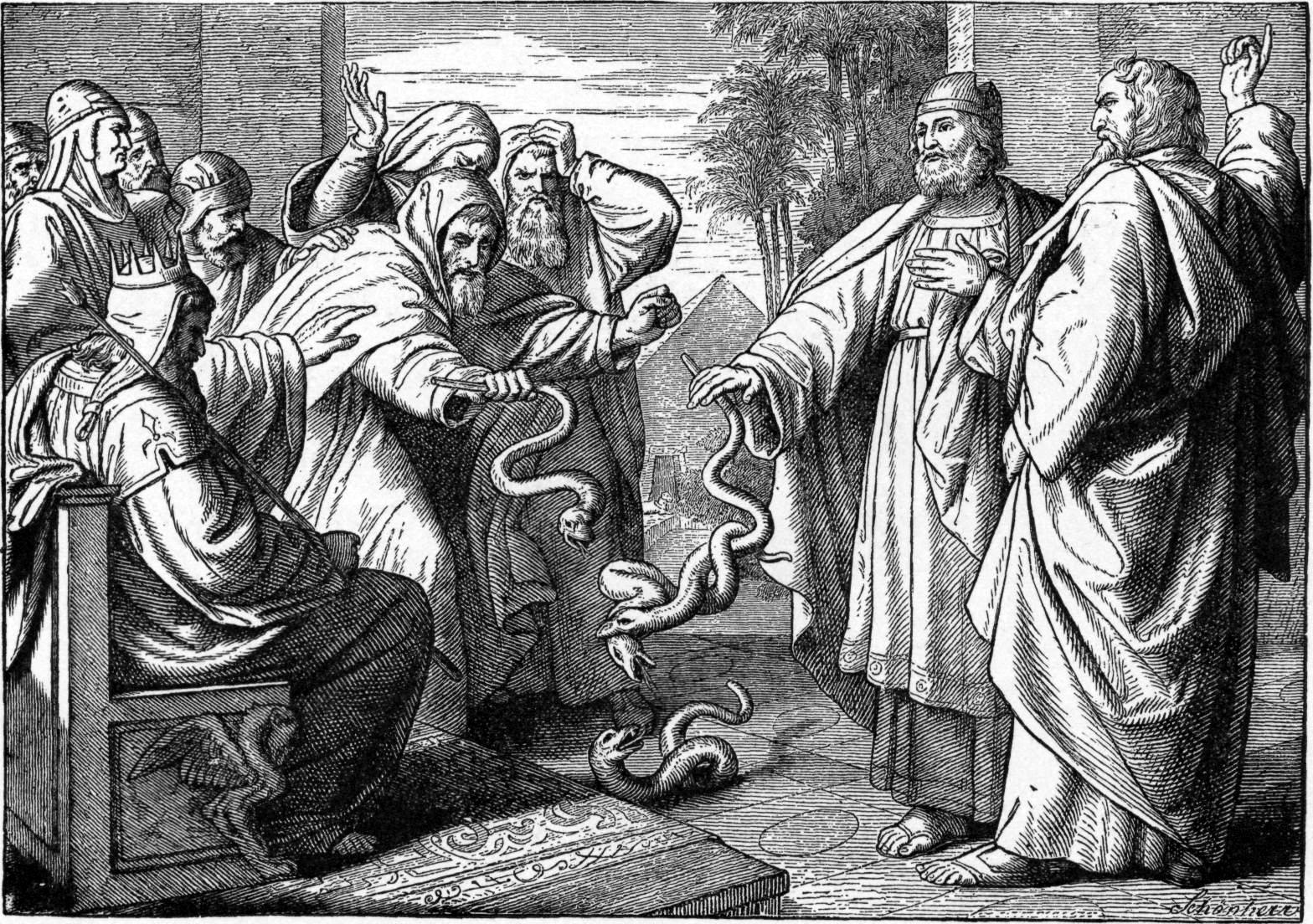
Pharaoh’s sorcerers also change staffs into serpents; Foster Bible Pictures

But the Zohar, the 13th-century C.E. kabbalistic opus, claimed: “In fact, however, the mixed multitude consisted entirely of … all the sorcerers of Egypt and all its magicians … for they wanted to oppose the wonderful works of the Holy One, blessed be He.  When they beheld the signs and the wonders which Moses wrought in Egypt they came to Moses to be converted.  Said the Holy One to Moses, “Do not receive them!” Moses, however, replied, “Sovereign of the universe, now that they have seen Thy power they desire to accept our Faith, let them see Thy power every day and they will learn that there is no God like unto Thee.” And Moses accepted them.9

According to the Zohar, the new converts let Moses down by instigating rebellions during the journey through the wilderness—and their souls are still being reincarnated in people who make trouble for the Jews.10

In Modern Hebrew eirev rav still means “motley crowd”, and in some circles eirev rav is a pejorative referring to the “wicked that scheme and plot against us”10 and “individuals who do not show their loyalty to the Jewish people.”11

A positive view of the Eirev Rav

In short, much commentary has painted the eirev rav as impulsive and selfish troublemakers who may even be deliberately trying to bring down the Israelites of old and the Jews of today.

Yet the bible only says: “And also an eirev rav went up with them”.  That particular phrase is not used again.  And although the rest of the journey from Egypt to the Jordan River features many complainers, whiners, and panickers, the Torah itself does not identify any of these troublemakers with the eirev rav.

In fact, the books of Exodus through Deuteronomy take pains to distinguish resident aliens who choose to live in Israel or Judah from the foreigners in other nations.  The bible dictates fair and compassionate treatment for resident aliens 52 times.  This week’s Torah portion says that resident aliens may participate in Passover rites as long as the men are circumcised, because:

There will be one teaching for the native and for the geir residing with you.  (Exodus 12:48)

geir (גֵּר) = resident alien; convert.  Plural: geirim (גֵּריִים).

Later in Exodus, God gives the order that:

You must not wrong a geir, and you must not oppress him, because you were geirim in the land of Egypt.  (Exodus 22:20)

The book of Leviticus/Vayikra goes so far as to say:

Ruth and Boaz, Eduard C.F. Holbein, 1830

The geir residing with you shall be like a native for you, and you shall love him like yourself, because you were geirim in the land of Egypt.  (Leviticus 19:34)

Although passages in Ezra and Nehemiah oppose intermarriage, in the book of Ruth a virtuous Moabite woman converts and becomes the great-grandmother of King David.  His great-grandfather, Boaz, is descended from the union of Jacob’s son Judah with Tamar, an Adulamite.12

After northern Israel secede, its kings come from the tribe of Efrayim, who is one of the sons of Jacob’s son Joseph and Asenat, the daughter of an Egyptian priest.13

*

How did the single remark in this week’s Torah portion that an eirev rav went up with them” lead to so much vilification of those who joined the Israelites on their exodus from Egypt?  Perhaps it is human nature to seize any excuse to shun people who seem foreign, any apparent “proof” that outsiders are bad people and bad people are outsiders.

Yet some of us learn to overcome our primitive fears, recognize the humanity in strangers, and treat them fairly.  This is what the Hebrew Bible urges when it tells us not to oppress a geir residing among us, and even to love the geir without prejudice.

I converted to Judaism several decades ago, when I was 32.  I have experienced both prejudice and welcome from people who were born Jewish.  I did not have the same childhood experiences as those born Jewish, but I am a Jew as well as a stubborn member of the eirev rav.

May everyone treat converts to their own in-groups with fairness, respect, and a little love.  And may everyone treat outsiders as human beings who deserve the benefit of the doubt.  There is no virtue in prejudice.

  1. During the era of the New Kingdom in Egypt, when the exodus story is set, the Egyptian Empire included not only the area around the Nile, but also the Sinai Peninsula and Canaan. Moses did not ask Pharaoh to let the Israelites go out of the Egyptian Empire, but only to go “a three-day march into the wilderness” (Exodus 5:3), which would get them to the Sinai Peninsula, an area with only scattered Egyptian outposts.
  2. Jeremiah 25:20, 50:37.
  3. Ezra 9:10-14, 10:2-12; Nehemiah 10:31, 13:1-3.
  4. Abraham ben Meir Ibn Ezra, in Michael Carasik, editor and translator, The Commentators’ Bible; The Rubin JPS Miqra’ot Gedolot, Exodus, The Jewish Publication Society, Philadelphia, 2005, p. 89.
  5. Shlomo Ephraim of Luntshitz (1550-1619), Kli Yakar, translated in Brachi Elitzur, “You were Rebellious or The Kindness of Your Youth: Parashat Beshalach”, etzion.org.il/en/you-were-rebellious-or-kindness-your-youth#_ftn3.
  6. Talmud Bavli, Beitzah 32b, The William Davidson Talmud, sefaria.org/Beitzah.32b?lang=bi.
  7. Philo of Alexandria (circa 30 B.C.E.-50 C.E.), De Vita Mosis, cited in Munk, pp. 147-148.
  8. Zohar, Exodus, Section 2, 191a-b, Soncino translation, quoted in Gerald Aranoff, “The Mixed Multitude According to the Zohar”, Jewish Bible Quarterly, http://jbqnew.jewishbible.org/assets/Uploads/402/jbq_402_firstborn.pdf.
  9. Elie Munk, The Call of the Torah, translated by E.S. Mazer, Mesorah Publications, 1994, p. 148.
  10. Professor Gerald Aranoff, “Who Were the Mixed Multitude?”, 2015, Arutz Sheva, http://www.israelnationalnews.com/Articles/Article.aspx/16386.
  11. Rabbi Kenneth Cohen, “What Is Erev Rav”, 2016, http://blogs.timesofisrael.com/what-is-erev-rav/.
  12. Genesis 38.
  13. Genesis 41:25, 41:50-52, 48:8-21.

Va-eira: Taking a Stand at the Nile

Aaron’s Rod Changed into a Serpent, Foster Bible Pictures, 1873

The pharaoh is not impressed when Aaron’s staff swallows the staffs of the Egyptian court magicians.  He will not listen to the request of the two men, Moses and Aaron, to let the Hebrew slaves go on a three-day journey to worship their god.  Probably he suspects they will never come back.  Certainly he does not believe their god has any power.1

It is time for the first plague to prove him wrong.  In this week’s Torah portion, Va-eira (“and he saw”) God tells Moses:

Go to Pharaoh in the morning.  Hey, he will be going out to the water, venitzavta on the shore of the Nile, and the staff that had changed into a snake you shall take in your hand.  And you shall say to him: “God, the god of the Hebrews, sent me to you to say: ‘Send out my people so they can serve me in the wilderness!  And hey, so far you have not listened.’”  (Exodus/Shemot 7:15-16)

venitzavta (וְנִצַּבְתָּ) = and you shall stand, take a stand, station yourself, stand firm.  (A form of the verb nitzav, נִצָּב = took a stand.)

Plague of Blood, Golden Haggadah, c. 1320, Spain

Moses does so, and then Aaron obeys God’s next order.

Then he raised the staff and he struck the water that was in the Nile, in the sight of Pharaoh and his courtiers, and all the water in the Nile changed into blood.  (Exodus 7:20)

Pharaoh and his advisers him see for themselves that the Nile is transformed exactly when the staff touches the water, so they cannot invent another explanation for the plague of blood.  But the Pharaoh still refuses to listen to Moses.

After two more plagues, God tells Moses to catch Pharaoh at the waterfront again.

Then God said to Moses: “Get up early in the morning vehityatzeiv in front of Pharaoh.  Hey, he is going out to the water, and you shall say to him: ‘Thus says God: “Send out my people and they will serve me!”  Because if you are not sending out my people, here I am sending out against you and your courtiers and your people and your houses mixed vermin2, and they will fill the houses of Egypt, and even the ground that they are on!’” (Exodus 8:16)

vehityatzeiv (וְהִתְיַצֵּב) = and station yourself, establish yourself.  (Another form of the verb nitzav.)

There is no obvious reason this time for Moses give his warning on the bank of the Nile.  God does not even tell him to use his staff.  It is certainly more dramatic to interrupt Pharaoh’s regular morning routine than to arrive at the palace with all the other petitioners of the day.  But why is the Pharaoh going to the shore of the Nile in the mornings?

Over the centuries commentators have generated a variety of answers.  According to Exodus Rabbah, Pharaoh always sneaked out to the river to relieve his bladder, so nobody would know he was not a god.3  Others proposed that in the morning Pharaoh went out to exercise.4  The Talmud suggested that Pharaoh was a magician and went to the Nile to do divination.5  Ibn Ezra wrote that the king of Egypt went to the Nile to check the water level during the summer flood season.6

Nilometer

Contemporary scholar Scott B. Noegel has argued that none of these explanations fit what we now know about the New Kingdom period in ancient Egypt.7  In fact, Pharaohs spent the whole morning indoors.  They bathed and performed their ritual duties indoors.  During flood season, officials in the Pharaoh’s bureaucracy measured the level of the Nile, not the Pharaoh himself.8

Noegel concludes that the Torah invented Pharaoh’s morning trips to the Nile in order to set up a literary structure dividing the ten plagues into three sets of three followed by the final catastrophe.  “The first plague in each of these series (1st, 4th, 7th) contains Yahweh’s commandment to Moses to “station himself” before pharaoh, each time employing the Hebrew root נצב.  Each also contains the phrase “in the morning.”9

But plagues #1, #4, and #7 do not agree on the location where Moses should intercept Pharaoh.  Only plagues #1 (blood) and #4 (mixed vermin) call for Moses to catch Pharaoh at the Nile.  Before plague #7 (hail) God instructs Moses to “Get up early in the morning vehityatzeiv in front of Pharaoh.”  But the Torah says nothing about Pharaoh going out to the water; the confrontation could happen anywhere.


I think Moses intercepts the Pharaoh at the Nile because it dramatizes this Torah portion’s contrast with an earlier part of the Exodus story the part in which Moses’ sister stations herself at the Nile to intercept Egyptian royalty.

When Moses is only three months old his mother can no longer protect him from the previous Pharaoh’s command that all Hebrew infant boys must be drowned in the Nile.  So she puts him in a little ark among the reeds at the edge of the river.

Moses Saved, by Marc Chagall

Vateitatzav, his sister, at a distance to find out what would happen to him.  And the daughter of Pharaoh went down to bathe on the Nile, and her girls were walking at hand [along] the Nile.  And she saw the ark in the midst of the reeds, and she sent her slave-woman, who fetched it.  And she opened it, and she saw the child, and hey!—it was a boy, crying.  And she took pity on him and she said: “This is one of the Hebrews.”  (Exodus 2:4-6)

vateitatzav (וַתֵּתַצַּב) = she stationed herself.

Once the princess has expressed sympathy for the plight of the Hebrews, Moses’ older sister Miriam speaks up.

And his sister said to Pharaoh’s daughter: “Shall I go and summon for you a nursing woman from the Hebrews, so she can nurse the child for you?”  And Pharaoh’s daughter said to her: “Go.”  And the girl went and she summoned the child’s mother.  (Exodus 2:7-8)

The princess even pays Moses’ mother for the service.  When Moses is weaned, his mother brings him to the princess, and she adopts him.

Miriam stations herself where she knows Pharaoh’s daughter will come down to the water.  She asks the princess to rescue the Hebrew child, and it works.

Eighty years later9 Moses stations himself where he knows the current Pharaoh will come down to the water.  He asks the Pharaoh to rescue the whole Hebrew people, and—as God predicts—it does not work, not even when he confronts the Pharaoh at the Nile again after three plagues.

The difference is that Miriam, her mother, and Pharaoh’s daughter are collaborators, not competitors.  All three women want to save the baby’s life more than they want personal control over him.

Moses and the next Pharaoh cannot collaborate because the Pharaoh wants personal control over his kingdom at all costs, while Moses wants to free the population of Hebrews from any Egyptian control.  Both men were brought up in the Egyptian court, both order the death of both Hebrews and Egyptians without flinching,10 and both are the leaders of large populations.  When the two men face one another at the Nile, they stand as two alternatives for rulership.

Moses keeps taking a stand for the well-being of the Hebrew people, defying both Pharaoh and God.11  His goal is to change the status quo in Egypt through a revolutionary emigration to Canaan, at that time a distant part of the Egyptian empire.

Pharaoh takes a stand against any change in Egypt, or in his way of government.


We all know people who go into denial about the facts when they feel threatened by change.  We know people who are eager for changes that may be improvements, and willing to take the risk of moving forward.  And we  know people in the middle who recognize history in the making and adapt to it, like the courtiers who beg Pharaoh to let the Hebrews go before Egypt is  destroyed, or like the Hebrews who cannot take a stand against slavery until Moses shows up with an alternative.

The best outcome is when Pharaoh’s daughter can join Miriam and her mother on common ground, cooperating to save a child’s life.  But what about when the Pharaoh and Moses stand against one another at the Nile and find no common ground?

The Torah shows that in the long run slaves will be freed, and a kingdom devastated by its own ruler will recover and become great again.

May such a recovery happen to us, speedily and in our own time.


  1. Exodus 5:2.
  2. There is no consensus about how to translate the Hebrew word for plague #4, arov (עָרֺב). It is usually translated as “insect swarms” or “wild animals”.  Arov appears to be related to a root meaning “mixture”, which is also the root for arov spelled עֲרוֹב = becoming evening.  It is hard to imagine a plague of evenings.  Through another etymology, arov spelled עֵרוֹב = mortgaging.
  3. From Midrash Tanḥuma 2:2:14, 5thcentury E.  (Translation from Scott B. Noegel, “Why Pharaoh Went to the Nile”, www.thetorah.com/why-pharaoh-went-to-the-nile/, 04/07/2017.)   This explanation also appeared in Exodus Rabbah 9:8 and in the commentary of Rashi (Shlomoh Yitzchaki, 11th century C.E.).
  4. Rashbam (R. Shlomo ben Meir, 12th century) suggested Pharaoh went riding, Ramban (Moses men Nachman or Nachmanides, 12th century) that he played in the water, Bekhor Shor (12th century) that he went hawking, and Abarbanel (15th century) that he was strolling or playing ball. (Michael Carasik, editor and translator, The Commentators’ Bible; The Rubin JPS Miqra’ot Gedolot, Exodus, The Jewish Publication Society, Philadelphia, 2005, p. 48)
  5. Talmud Bavli, Mo-ed Katan 18a.
  6. Ibn Ezra (12th century) according to Noegel, ibid.
  7. The Exodus story is set in the New Kingdom period in Egypt, during the 16th-11th centuries B.C.E.
  8. Noegel, ibid.
  9. This week’s Torah portion reports Moses’ age as 80 and Aaron’s as 83 (Exodus 7:7).
  10. Moses kills an Egyptian (Exodus 2:11-12) and orders the killing of Hebrew golden calf worshippers (Exodus 32:26-28). The Pharaoh orders the execution of every male Hebrew infant (Exodus 1:15-22) and refuses to prevent the deaths of every firstborn Egyptian (Exodus 11:4-10).
  11. Moses talks God out of abandoning the Hebrew people in Exodus 32:9-12 and 31-32, after the golden calf episode, and in Numbers 14:11-17.

Shemot: Mixing Fire and Water

Does Moses have the temperament of a Levite?

Simeon and Levy Slay the People of Shechem, by Gerard Hoet, 1933

The original Levi in Genesis/Bereishit, Jacob’s third son, is a ringleader in the massacre at Shekhem.  (See last week’s post, Vayechi: Three Tribes Repudiated.)  When Jacob delivers prophecies on his deathbed, he gives this description of either his sons Levi and Shimon, or the future tribes of their descendants:

Accursed be their af because it is fierce, and their wrath because it is remorseless! (Genesis/Bereishit 49:7)

af (אָף) = nose.  (A common biblical idiom for anger is having a hot nose.)

The first mention of the tribe of Levi in the book of Exodus/Shemot (“Names”) is in the announcement of Moses’ birth.  After the first Torah portion (also called Shemot) describes how the Pharaoh calls for all Hebrew male infants be killed by drowning,

A man from the house of Levi went and married a daughter of Levi.  And the woman became pregnant and she bore a son and she saw him, that he was good, and she hid him for three months.  Then she was not able to hide him anymore, and she took for him a ark of papyrus …  (Exodus/Shemot 2:1)

Moses Saved, by Marc Chagall

He is a “good” baby, not an angry one.  Moses cries only when his mother leaves him in a waterproofed box floating among the reeds at the edge of the Nile.1  An Egyptian princess has the little ark fished out, and pays the infant’s own mother to be his wet-nurse.

And the child grew, and she brought him to the daughter of Pharaoh, and he became her son, and she called his name Mosheh [Moses], and she said: “Because from the water meshitihu.”  (Exodus 2:10)

Mosheh (מֺשֶׁה) = a Hebrew variant of the Egyptian word moses = gave birth to him.

meshitihu (מְשִׁיתִהוּ) = I pulled him out of water.  (From the verb mashah, מָשָׁה = pull out of water, which sounds like Mosheh.)

Deep or flooding water is used in the Torah as a metaphor for an overwhelming threat—either from human enemies or from God.2  By adopting Moses, the Pharaoh’s daughter pulls him out of the danger of her father’s death decree.

The Torah uses water as a metaphor not only for danger, but for fear.  When people are afraid, their hearts or knees turn into water.3

As a young adult Moses sees an Egyptian man beating a Hebrew slave. He is outraged and wants to kill the Egyptian.  But fear checks his impulse for a moment.

He turned this way and that, and saw that there was nobody [around].  Then he struck down the Egyptian and hid him in the sand.  (Exodus 2:12)

Moses pauses long enough to make sure there are no witnesses (except the Hebrew slave), but not long enough to consider whether killing one Egyptian will do any good.  His rash act does not change any of the customs or institutions regarding the treatment of Hebrews in Egypt.  But it does get Moses into trouble.

And Pharaoh heard of this matter, and he sought to kill Moses.  So Moses ran away from Pharaoh, and he stopped in the land of Midian, and he stopped at the well.  (Exodus 2:15)

Again Moses reacts out of fear. Then the seven daughters of the local priest arrive to draw water for the family flock.

And male shepherds came and drove them away. But Moses got up and he rescued them and he watered their flock. (Exodus 2:17)

Once again Moses is outraged at an injustice and takes action.

The Midianite priest takes him in and marries him to one of his daughters. Over the years, while Moses works as a shepherd for his father-in-law, Moses’ personality changes from watery (fearful) to calm, deliberate, and occasionally fiery.

Moses at the Burning Bush, by Rembrandt, 17th century

Moses was tending the flock of Yitro, his father-in-law, the priest of Midian, and he led the flock behind the wilderness, and he came to the mountain of the God …  Then a messenger of God appeared to him in the heart of a fire in the middle of a bush.  And he looked, and hey!  The bush was burning with the fire, but the bush was not consumed.  And Moses said: “I must turn aside, yes, and look at this great sight!  Why does the bush not burn?”  (Exodus 3:1-3)

Calm and deliberate, Moses notices the subtle miracle and stops to study it.  God calls to him from the bush, and for the rest of his life, whether he likes it or not, Moses is God’s prophet.  (In this week’s Torah portion, Moses tries to turn down God’s mission five times.)4

He returns to Egypt to be God’s mouthpiece as God carries out an elaborate plan to free the Hebrew slaves and lead them out of Egypt.  Moses remains impassive during the first nine divine plagues, even though Pharaoh waffles six times, promising to let the Israelites leave and then rescinding his promise.5  But when he tells Pharaoh about tenth and final plague, the death of the firstborn, Moses is finally fed up.

Moses and Aaron with Pharaoh, by Marc Chagall

Moses said: “Thus says God: ‘Around midnight I am going out among the Egyptians.  And every firstborn n the land of Egypt dies …’  Then all these, your courtiers, will come down to me, and they will bow low to me, saying: ‘Go, you and all the people who follow behind you!’  And after that I will go.”  And he went away from Pharaoh chari af.  (Exodus 11:4-5, 8)

 chari af = in anger.  chari (חָרִי) = in the heat of.  af (אָף) = nose.

After that, the Israelites and their fellow-travelers complain and criticize Moses five times during the journey to Mount Sinai, but Moses only loses his temper once, when he tells them not to try to save any manna for the next day (except on Shabbat), and some of them do it anyway, so the divine food gets maggots and stinks.6

Moses does not become angry or hot-nosed again until he comes down from the mountain and sees the people worshiping a golden calf.

And as he came near the camp, he saw the calf and the dancing.  Vayichar, the af of Moses, and he threw down the tablets from his hands and he smashed them at the bottom of the mountain.  (Exodus 32:19)

vayichar (וַיִּחַר) = and it got hot.

Moses loses his temper only a few more times in the books of Leviticus/Vayikra and Numbers/Bemidbar.  He expresses his anger by yelling at people or talking to God.  He hits a rock, but after his youthful murder he never hits another human being.7  God’s anger, on the other hand, burns frequently and causes plagues that kill thousands of people.

Moses even manages to transform the temperament of his fellow Levites.  In the book of Exodus the tribe of Levi is violent when it carries out Moses’ command to run through the camp and slaughter all the golden calf worshippers.8  Yet after that the Torah records only one more violent act by a Levite; he skewers two intruders in the Tent of Meeting.9  Moses ordains five of his Levite relatives as priests, and assigns the rest of them to assist with the work of the sanctuary.  Since they are responsible for the holy work, the Levites are the only tribe he does not muster for battle.


Although Moses begins life strongly associated with water, he overcomes his early watery fear.  He has the fiery heart of a Levite, but his passion is for the underdog and for the Israelite people.  His anger at the golden calf worshippers is fierce and remorseless, like that of his tribe’s founder, Levi.  But then instead of flipping to the dangerous side of water and behaving like an overwhelming flood, Moses succeeds in setting limits on both his watery and his fiery natures.  Like the bush on the dry mountain, Moses is not consumed by fire.

Is Moses simply born “good”, like a placid baby?  Or do his encounters with God teach him to stay patient and level-headed even when outrageous things are happening?

I believe each human being is born with a natural temperament, a tendency to react to adversity with fight or with flight, with anger or fear or melancholy or serenity.  But I also believe that we can gradually modify our own natures if we keep reflecting on our experiences and questioning ourselves.  Moses modifies his nature as he struggles to deal effectively with a capricious and often angry God.

How can we modify our own natures?


  1. Exodus 2:6.
  2. 2 Samuel 22:17 & Psalm 18:17; Psalms 32:6, 69, 88:17-18, 124, and 144.7; Hosea 5:10; and Job 22:11.
  3. Joshua 7:5, Ezekiel 7:17, Psalm 22:15, and Job 27:20.
  4. Exodus 3:11, 3:13, 4:1, 4:10, and 4:13.
  5. Exodus 8:4-11, 8:21-28, 9:27-35, 10:8-11, 10:16-20, and 10:24-27.
  6. Moses becomes angry about the manna in Exodus 16:20. He does not get angry when the people complain in Exodus 14:10-14, 15:23-25, 16:2-8, or 17:1-4.
  7. Leviticus 10:16, Numbers 16:15, and Numbers 31:14. We can also assume Moses is angry in Numbers 20:10, when he yells at the people before hitting the rock.
  8. About 3,000 in Exodus 32:26-29.
  9. Only priests are allowed to enter the Tent of Meeting, and only well-defined holy activities are permitted there. The other Levites have a duty to guard the sanctuary from unauthorized entry.  When a Shimonite and a foreigner enter it to fornicate in Numbers 25:7, Pinchas grabs a spear and runs it through the couple.