Yom Kippur: We

Since my husband and I began packing in August, my weekly post has consisted of a reflection on the current step in our journey, and a link to one of my past posts on the Torah portion of the week.  But this week is different.
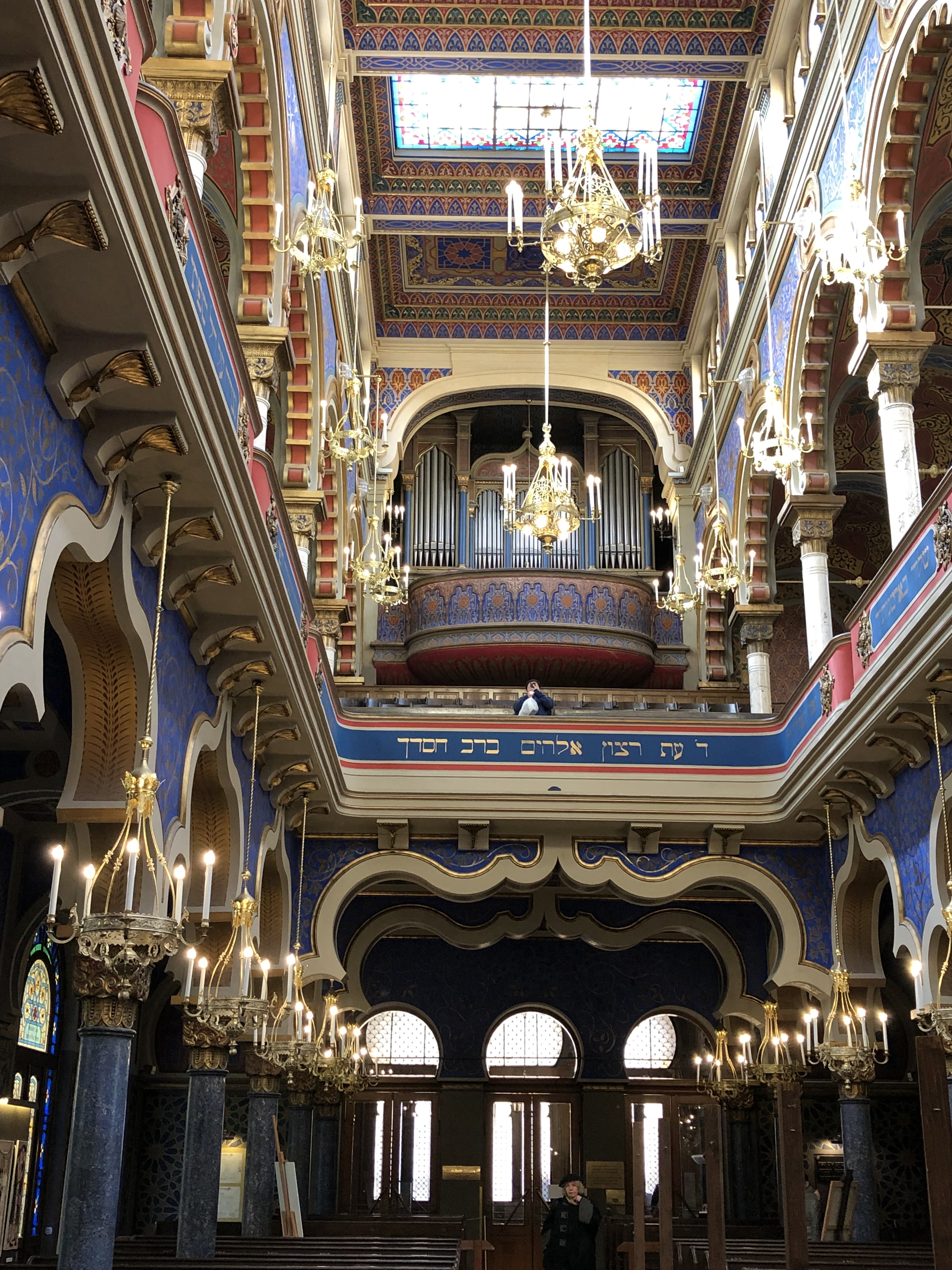
Jeruzalemska Synagoga, Praha

Today we saw the Jerusalem Synagogue in Prague, a breathtakingly beautiful Neo-Moorish and Art Nouveau building completed in 1906 to replace synagogues demolished when the city built a new boulevard through the old Jewish quarter.  During World War II the Nazi occupiers used the building as a warehouse for confiscated Jewish property, instead of destroying it.  After the war a small group of Jews resumed prayer services there, despite Soviet discouragement, and since the Velvet Revolution the congregation has grown.

Tomorrow we will visit Terezin, a fortified village near Prague which Hitler’s government turned into a concentration camp.  The Nazis imprisoned 144,000 Jews there from 1941 to 1945; only around 23,000 survived.  About 33,000 died of malnutrition and disease inside Terezin; 88,000 were sent on to extermination camps.

Four days later we will observe Yom Kippur with a congregation in Prague, and I will repeat the fundamental liturgy in Hebrew, the confessions and pleas that Jews all around the world will recite.

And tonight I find I must write a new post.

*

Ashamnu, bagadnu, gazalnu, dibarnu dofi.

          We are guilty, we have betrayed, we have robbed, we have spoken slander.

On the day of Yom Kippur, the day for seeking atonement with God, Jews chant the vidui, a confession of the whole community’s sins.1

Our religion asks each of us to do a personal atonement during the weeks before Yom Kippur.  We consider who we might have harmed during the past year, repent as much as we can, and ask each person for forgiveness (when it is possible, and when it does no further harm).  We also consider how we have fallen short in our service to God, or perhaps to the still, small voice within.  This work is different for each individual.

But on Yom Kippur we all chant out loud a list of sins that we as individuals may not have committed.  And every offense is in the first person plural, “we”, indicated by the verb ending with the letter וּ (u) = we.

Ha-evinu vehirshanu, zadnu, chamasnu, tafalnu sheker.

          We have been perverse and we have been wicked, we have acted with malice, we have done violence, we have made false claims.

In the story of Noah, God decided to destroy the world and start over because “the earth was full chamas”, the violence that humans committed.2  To this day, humans have not overcome the habit of violence.

Ya-atznu ra, kizavnu, latznu, maradnu, niatznu.

          We have given harmful advice, we have lied, we have mocked, we have rebelled, we have been unrespectful.

Who are “we”?  This part of the communal confession could refer to any congregation, to any relatively small group of human beings.  Nearly everyone has tossed off advice without considering whether it might be harmful to the advisee.  We all tell “white lies” out of what we think is kindness to the other person, or because explaining the truth seems too complicated and unnecessary.  And it is so easy to mock someone who is far away, different from you, and taking actions you resent—a president, perhaps, or someone interviewed on television.  Everyone rebels at some time against an authority figure or what we have learned is our duty.  It takes constant attention to be respectful to every human being and to the Creator.

Sararnu, avinu, pashanu, tzararnu, kishinu oref.

          We have disobeyed (God), we have been immoral, we have been negligent, we have oppressed, we have been stiff-necked (refusing to change).

Who are “we”?  Sure, everyone is negligent at times, there are too many families in which one person has oppressed another, and change is difficult.  But this part of the list implies a more serious level of wrongdoing.  What happens when a whole segment of society oppresses another segment, using religion or politics or even a dress code as an excuse?  What happens when a large number of people reinforce each other in refusing to change to meet new challenges that have arisen in the world?

Rashanu, shichatnu, ti-avnu, ta-inu, titanu.

          We have been wicked, we have been corrupt, we have committed atrocities, we have gone astray, we have led others astray.

Who are “we”?  What if “we” means all human beings, including Nazis and others who do evil deliberately?  Including people who do bad deeds out of peer pressure or the fear of punishment?  Including people who merely witness atrocities, and do not know how to stop them?

Ashamnu.  We are guilty.  That is the nature of humankind.  But we can pray, this Yom Kippur and all year round, for atonement and realignment, for change—for us and for all human beings.


  1. Each time the service reaches another vidui, there are two confessions of communal wrongdoing. The first, called the Ashamnu after the first word, lists offenses in alphabetical order (according to the Hebrew aleph-bet), with each entry being a verb in the form “we have ____”.  One tradition is to beat one’s breast when chanting each offense.  After the Ashamnu list, the congregation switches to a different melody and chants sentences asking forgiveness “for the sin we have committed before you”, using another list of communal sins, with the chorus “And for all these, God of pardons, pardon us, forgive us, grant us atonement.”
  2. Genesis 6:11.

Repost: Nitzavim

Glimpsing how people in other cultures live is one benefit of travel.  Before we left New York, Will and I took a tour of Hasidic Brooklyn—actually of the Lubavitcher enclave in Crown Heights.

Rav Yoni Katz, tour guide

Our guide, Rabbi Yoni Katz, is an American Jew, like us.  But we wore casual clothes that would blend in anywhere in the country, while he wore a 1940-style black hat, an untrimmed beard, and a black suit with white fringes (tzitzit) hanging out from under the bottom of his jacket.  We have only one child; he has seven children so far.  We enjoy the gender equality of our era; he is comfortable in a community that believes women have different natures, a community where most (though not all) women stay home to raise their many children.  We grope to define the mystery called “God”; he speaks as if God were his beloved grandfather, still living in the neighborhood.

It seems natural for him and some other Lubavitcher Hasids we met to take injunctions in the Torah as literal expressions of what God needs from the humans “He” created.  For example, the book of Numbers/Bemidbar tells us to wear tzitzit (knotted fringes) on four corners of a garment to remind us of the rules, so Hasidic men wear tzitzit every day for God’s sake.  The Torah lists rules for kosher eating and the Talmud expands on them, so the men and women carefully keep kosher for God’s sake.

As for myself, I never accept a religious rule because a human being with authority wrote it down and claimed it came from God.  Humans may be inspired by God, but our own brains translate inspiration into words, and a lot can get lost or altered in translation.  Therefore if I cannot think of a good reason for a Jewish rule, I ignore it.  I do not obey chukim (directives with no rationale).

Nevertheless, Yoni’s introduction to the Lubavitcher philosophy of life spoke to my heart.  In short, he said that acting out of egotism will never make life meaningful.  What matters is meeting the needs of others—both other humans who need us and God, who created us because “He” needs us.

Every week during our journey toward Jerusalem, I am sending a link to one of the posts on the weekly Torah portion that I have written during the last nine years.  This week, after listening to Yoni, I chose Nitzavim: Still Standing

What does it mean to be standing before God?  Can anyone do it?  What does it mean to stop acting just for your own benefit, as if you were a god?  Click on the link above and see what I wrote in 2012.

Today, as I post this, we are sitting in the airport in Rome.  Next week I will be posting from Prague.  Our journey continues.

(Note: If any of my comments about Lubavitchers is wrong, please let me know.)

Repost: Ki Tavo

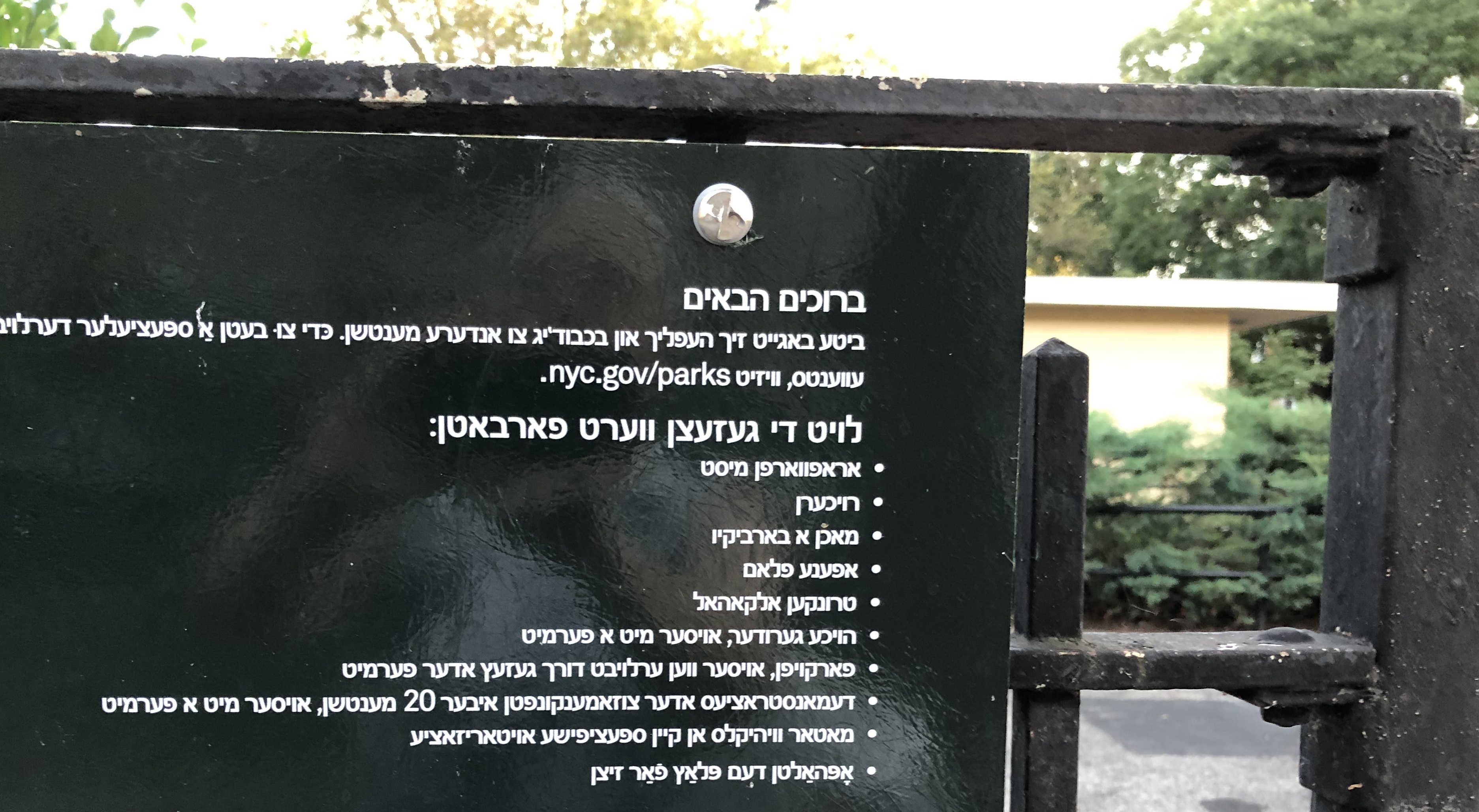
Bruchim Habayim (“Blessed are those who come”, i.e. “Welcome”)

Are we there yet?  Is this sign in Israel?

No, it’s part of a bilingual sign welcoming people to Saratoga Park in Brooklyn.  We are renting an apartment across the street, for a week, before we continue our journey east.

Between Portland, Oregon and New York, New York my husband and I spent a good weekend at my sister’s house in the New England woods.

Both my sister and I are called to write.  (To find my sister’s writing, see sarabacker.com.)  We both have a passion for ethics, and a commitment to thinking things through.

For me, ethics is not a list of God-given rules, but rather a method for treating other human beings (and the whole world of living things) with respect and consideration.

So this week I polished up an essay I wrote nine years ago on Moses’ ritual for dedicating oneself to good behavior.  Here’s the link:  Ki Tavo: Cursing Yourself.

Repost: Ki Teitzei

Our adventure begins before dawn.  Everything we still own that we are not taking on the airplane tomorrow is now packed away in our storage unit.  (We also loaned our car to our son and daughter-in-law.)  At 5:00 a.m. the motel shuttle will take us to the airport, and we will fly the first leg of our trip: Portland, Oregon, to Boston, Massachusetts.  This is the trip we have spent years waiting for, the one that will eventually take us to Israel.

Here is my 2015 post on this week’s Torah portion: Ki Teitzei: Crossing Gender Lines.

Repost: Shoftim

Four things are called toeivah (abominable, repugnant) in this week’s Torah portion, Shoftim: offering defective animals as a sacrifices for God, worshiping other gods, keeping carved images of gods, and practicing magic.

My 2015 blog post on these abominations pointed out that while it is fine to avoid doing things we find repugnant, it is immoral to kill human beings who do repugnant things.

I still believe that.  But when I reviewed my 2015 post, I decided to rewrite the last part of it.  Since the 2016 American election I have become more concerned about government-sponsored heartlessness than about individual heartless deeds.  So here is my rewritten post: Shoftim: Abominable.

Repost: Re-eih

One can eat meat, but not blood, according to this week’s Torah portion, Re-eih (“See”).

Only be strong, do not eat the blood!  Because the blood is the nefesh, and you must not eat the nefesh with the meat. (Deuteronomy 12:23)

nefesh (נֶפֶשׁ) = animating soul, vital force; mood, appetite, desire; individual; throat.

Like humans, animals are animated by a soul that experiences moods, appetites, and desires.  The Torah locates that soul in the arterial blood.

Not only must the blood of an animal be drained and discarded before the meat can be eaten, but the animal must also be kosher.  Later in this week’s Torah portion, Moses repeats the rules for kosher animals.

And every animal that has a split hoof and has a hoof cloven into two hoof sections, [and] chews the cud among the animals that you may eat. (Deuteronomy 14:6)

Birds may also be eaten, but not birds of prey.  Fish may be eaten as long as they have fins and scales.  Any other animals, including shellfish and flying insects, are forbidden in this week’s Torah portion.

Fully observant American Jews heading to Europe would be planning out how to eat only kosher meat, they way they do at home.

I am not strict about keeping kosher.  However, I am planning to continue avoiding meat altogether.  It was hard for me to give up meat 23 years ago, but I did it.  I do not believe an animal’s nefesh is only in its arterial blood, the way the portion Re-eih implies.  I believe that eating any meat, drained of blood or not, is participating in the slaughter of an animal that, when alive, had an emotional life–moods, appetites, and desires–just like humans do.

For some people, honoring the death of the animal with a blessing, a prayer, or another ritual is enough.  Maybe they are right.  After all, everything we eat used to be alive in some sense.  The book of Genesis says God created humans to eat fruit from living trees for nourishment; modern science points out that nature made us omnivores.

Canaan dog

But I cannot watch a dog joyfully greet its roommates, or crows defend an injured member of their flock, and then go and eat meat.  I confess I make an exception for fish, which are less aware of moods and desires than birds and mammals–less like us.  (Fish also provide the B-12 and omega-3 fatty acids my omnivore body needs.)

When I get to Israel, I hope my diet will be easier than in America.  The Jewish prohibition against mixing meat and milk means, I believe, that I need only ask if a dish is “kosher dairy”.

But in Europe, I will ask in the local language whether there is any “meat” or poultry in a dish I might order.  There, as here, I will hope the waiters know what I am talking about.

To read my earlier blog post about the Torah’s version of not eating the soul of an animal, click on Re-eih & Acharey Mot: The Soul in the Blood.


Repost: Eikev

I am exhausted from a week of luxury on an Alaskan cruise.  The cruise reminded me that it is easy to get too much of a good thing, to go from satisfaction to satiation to surfeit.  I am proud of myself for not taking seconds when I faced an abundance of tasty food.  But I wore myself out with a surfeit of experiences.  The concerts and shows on the ship, as well as the tours and sights at each stop, were all enjoyable and even enriching.  But now that I am home again, packing and making last-minute arrangements for a more important journey, I wish I had more energy.

This week’s Torah portion, Eikev, also considers the concepts of satisfaction and surfeit.  So I brushed up my 2017 post, Eikev: No SatisfactionClick on the link to read it.

Repost: Devarim & Va-etchannan

A journey begins before you leave.  We won’t begin our journey to new lands until September, but for most of August we are immersed in sorting through our worldly goods and packing them for storage.  So I am starting to post links to my favorite past blog posts this week.  (See my note at the end of last week’s post, Massey: Stages of a Journey.)

Next week I am taking a break from sorting and packing to see family in Alaska.  So I decided to share my post from 2015 about the Torah portions for both this week and next:

Devarim & Va-etchannan: Enough Already

Masey: Stages of a Journey

Caravan, by James Tissot ca. 1900

The last Torah portion in the book of Numbers/Bemidbar begins:

These are the masey the Israelites when they departed from the land of Egypt in their troops by the power of Moses and Aaron.  Moses wrote down their departures for maseyhem at the word of God.  And these were the maseyhem for their departures:  (Numbers/Bemidbar 33:1-2)

masey (מַסְעֵי) = stages of the journey of.  (A form of the noun massa (מַסַּע) = breaking camp, travelling on, journeying, stage of a journey.  Derived from the root verb nasa (נָסַע) = pulled out, started out, uprooted.)

maseyhem (מַסְעֵיהֶם) = their stages of travel, their journeys.  (Another form of the noun massa.)

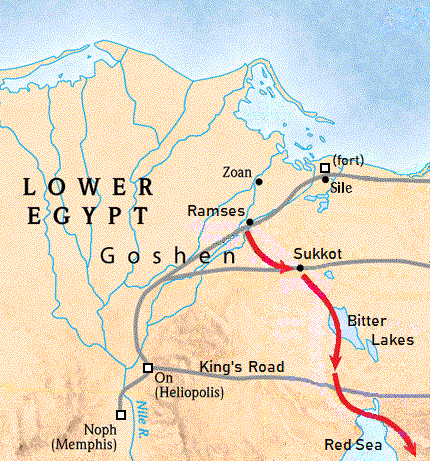
The Torah then lists 42 locations, from Ramses, the city where the Israelites assembled to leave Egypt, to the bank of the Jordan River, where the book of Numbers ends.  In the list are a few geographical notes to help locate the campsites, and three references to events that occurred on the way.

Which three events?

  1. At Rameses

Vayisu from Ramses on the first month, on the fifteenth day of the first month.  On the day after Passover the Israelites departed with a high hand, before the eyes of all the Egyptians.  The Egyptians were burying those that God had struck down, every firstborn; and against their gods God had done justice.  (Numbers 33:3-4)

vayisu (וַיִּסְעוּ) = and they pulled out.  (A form of the verb nasa.)

The extra information about the first location, the Egyptian city of Ramses, is that the Israelites left the morning after the night of the tenth and final plague God inflicted on the Egyptians, the death of their firstborn;1 that the Egyptians no longer tried to stop them; and that their God was stronger than the Gods of the Egyptians.  Therefore the Israelites left proudly and openly, confident that God was on their side.

  1. At Refidim

Vayisu from Alush and they camped at Refidim, and there was no water for the people to drink.  (Numbers 33:14)

This sentence refers to a story in the book of Exodus/Shemot that begins:

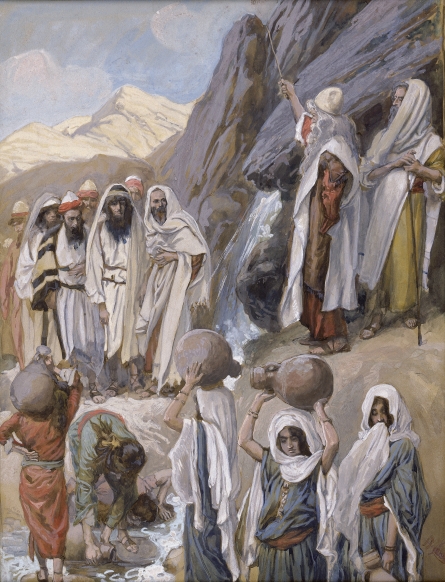
Moses Strikes the Rock,
by James Tissot

Vayisu, the whole community of Israelites, from the wilderness of Sin for maseyhem at the word of God.  And they camped at Refidim and there was no water for the people to drink.  And they argued with Moses, and they said: “Give us water so we can drink!”  And Moses said to them: “Why do you argue with me?  Why do you test God?”  (Exodus 17:1-2)

At the end of the story, the Torah reports that the Israelites said:

“Is God among us or not?”  (Exodus 17:7)

Eleven times during their travels from Egypt to the Jordan River the Israelites complain about the conditions and reveal their lack of trust in God, Moses, or both.2  But this week’s Torah portion picks out only the time at Refidim, when  God tells Moses to address the problem by striking a rock with his staff, and water comes out.

Why pick this complaint over any of the other ten times3 the Israelites test the leadership of either God or Moses?  Why not include the time when Moses strikes the rock but fails to give God credit for the water?4  Or the confrontation at the Reed Sea?5  Or the complaint about food that led to God sending daily manna?6  Or the demand for the golden calf?7  Or the refusal to cross into Canaan at its southern border, which led to another 38 years in the wilderness?8

  1. At Hor

Vayisu from Kadeish and they camped at Hor the Mountain, at the edge of the land of Edom.  And Aaron the priest went up to Hor the Mountain at the word of God, and he died there in the 40th year of the exodus of the Israelites from the land of Egypt, on the fifth month, on the first of the month.  And Aaron was 123 years old when he died at Hor the Mountain.  And the Canaanite, the king of Arad who lived in the Negev in the land of Canaan, heard of the coming of the Israelites.  (Numbers 33:37-40)

Both of Moses’ siblings, Miriam and Aaron, die on the journey.  Both are leaders of the people, but only Aaron’s death is mentioned in the list.  It might be sexism, or it might be because his death establishes the succession of high priests.  Aaron’s oldest surviving son, Elazar, climbs the mountain with his father and Moses, and Aaron dies after Moses has removed his vestments and dressed Elazar in them.9

But why does the Torah portion Masey also mention the king of Arad?  In a brief story earlier in Numbers, this king hears of the approaching Israelites, attacks them, and takes some captives.

Then the Israelites vowed a vow to God and said: “If you actually give this people into our hands, then we will dedicate their towns to destruction.”  And God listened to the voice of the Israelites and gave [them] the Canaanites …  (Numbers 21:2-3)

They were testing God again, but not complaining.  In the Torah, dedicating something captured in battle to destruction means dedicating the whole battle to God instead of keeping some booty for personal benefit.  Perhaps the Torah mentions the king of Arad here to show that the Israelites are not always rebellious; once in a while they dedicate everything to God.

Not at Mount Sinai

Why does the Torah pick these three events, and no others—not even what happened at Mount Sinai?  The Torah portion merely says:

Vayisu from Refidim and they camped in the wilderness of Sinai.  Vayisu from the wilderness of Sinai and they camped at Kivrot Hata-avah.  (Numbers 33:15-16)

Yet at Mount Sinai the Israelites experience the presence of God in a revelation full of smoke, fire, thunder, and earthquake.10  God gives them the Ten Commandments, first in a voice only Moses can bear to hear, then engraved on  pair of stone tablets, twice.11  At Mount Sinai the Israelites believe Moses will never return from the mountaintop, and worship Golden Calf.12  At Mount Sinai the Israelites make covenants with God, verbal and sacrificial, and their elders see God’s feet.13  At Mount Sinai they craft a portable tent-sanctuary so God will dwell among them.14

During their year in the wilderness at Mount Sinai, the attitude of the Israelites toward God swings between terror and total devotion, with a side-trip into ecstatic idol-worship.

The three events mentioned in this week’s list, however, focus on the attitude of the Israelites toward God when they are on their journey, not pausing in ecstasy.  At Ramses the Israelites who leave with Moses are confident that God can and will protect them.  At Refidim they doubt that God is with them.  At Hor they accept their high priest’s successor (a sign that they will also accept Moses’ successor), and they rededicate themselves to God.

No Itinerary

Vayisu from the hills of the Avarim and they camped in the deserts of Moab, by the Jordan at Jericho.  (Numbers 33:48)

The list ends where the Israelites are waiting to cross the river into Canaan, their “promised land”.

An itinerary is a planned route for a journey, listing locations and transportation between them in the order one has determined.   But Moses’ list in Masey covers only the locations the Israelites have already camped at.  It follows their route in the past, not the future.  The added comments on three events mark their attitudes toward God in the past, but do not predict their attitudes toward God in the future.

When the Israelites travel, they cannot even predict where their next campsite will be.  For each stage of their journey, they follow the God’s pillar of cloud and fire to their next stopping place.15

*

I am preparing now to go on a journey through Europe to Israel, crossing two seas to get to the same land the Israelites in the Torah reached by crossing the Jordan River.  My husband and I have been longing to take this trip since the turn of the century, and now we can finally do it.

We have made an itinerary.  We are paying for our reservations for the first three months, and making tentative plans in case we can extend our trip to nine months.  But even when you have pre-paid for airfare and lodging, things happen along the way; you do not really know where you will find yourself.  The definitive list is the one you make at the end of your travels.

***

What will happen to this blog while we are moving our things into storage, then moving ourselves from country to country?

This is the last new blog post I will have time to write for months.  Knowing that makes me wistful.  But every week I plan to look at the posts I have written on that week’s Torah portion over the last eight years, and choose one of my favorites.

Then I will e-mail the link to you, my readers.  From time to time I will add my photos of old synagogues and other relevant sites in Europe and Israel.  I will keep you posted on the masey of Melissa and Will Carpenter!

  1. Exodus 12:1-32. Exodus 12:37 begins: Vayisu, the Israelites, from Ramses …
  2. I am not counting the times in the book of Numbers when only a small subset of Israelites complained: Miriam and Aaron in Numbers 12:1-2, 250 Levites in 16:1-11, two Reuvenites in 16:12-5, and Moses and Aaron in Numbers 20:10-12.
  3. The other ten times are Exodus 14:10, Exodus 15:23-24, Exodus 16:2-3, Exodus 32:1-10, Numbers 11:1-2, Numbers 11:4-20, Numbers 14:1-4, Numbers 17:6-15, Numbers 20:2-5, and Numbers 21:4-7.
  4. Numbers 20:2-13.
  5. Exodus 14:10-12.
  6. Exodus 16:1-4.
  7. Exodus 32:1-10.
  8. Numbers 14:1-4.
  9. Numbers 20:22-29.
  10. Exodus 19:16-20, 20:15-18.
  11. Exodus 20:1-18, 31:18, 32:15-19, 34:1-4, and 34:27-28.
  12. See my post Ki Tissa: Making an Idol Out of Fear.
  13. Exodus 19:1-9, 24:3-13. See my posts Mishpatim & Ki Tissa: A Covenant in Writing, and Mishpatim: After the Vision, Eat Something.
  14. See my post Terumah & Psalm 74: Second Home.
  15. Exodus 13:20-22 and 40:36-38.


Pinchas: New Moon

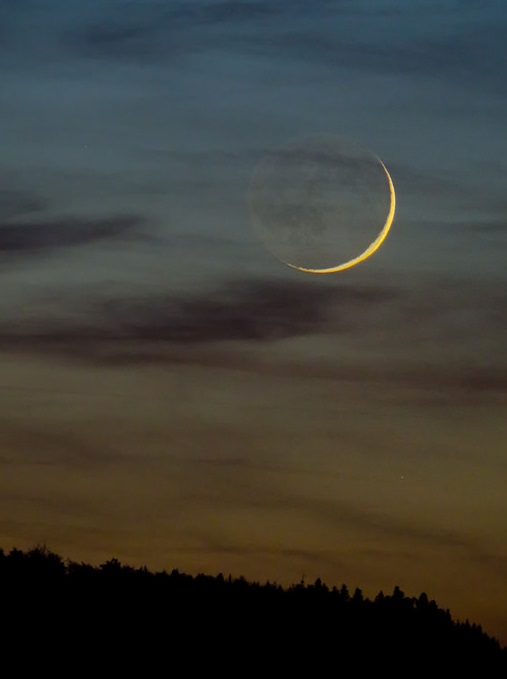
The moon waxes to a full, bright circle; then it wanes until it disappears.  In the Hebrew calendar the new moon is not the invisible one, but the first thin curved line to appear the blue daytime sky.  It sets just after the sun sets, and the first day of a month begins.

The book of Leviticus/Vayikra prescribes offerings at the altar for annual holidays, for Shabbat every week, and for morning and evening every day.  But the new moon is not singled out for its own monthly celebration until the book of Numbers/Bemidbar.

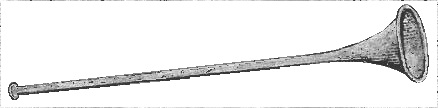
And on your days of rejoicing, and at your appointed times, and on the beginnings of chadesheykhem, you shall blow trumpets over your rising-offering and over your slaughter-sacrifices of your wholeness offerings.  (Numbers/Bemidbar 10:10)

chadesheykhem (חָדְשֵׁיכֶם) = your months.  (A form of the noun chodesh, חֺדֶשׁ = month, new moon.  From the root verb chadash, חָדַשׁ = renew.)

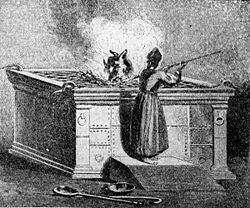
New moon at the altar

What offerings are prescribed for the new moon?  We find out in this week’s Torah portion, Pinchas.

And at the beginnings of chadesheykhem you shall offer a rising-offering for God: two bulls of the herd, and one ram, and seven yearling lambs, unblemished.  (Numbers 28:11)

(I refer to an olah (עֺלָה) as a “rising-offering” because the Hebrew word comes from the verb alah (עָלָה) = rose, ascended, went up.  What rises in an olah is smoke, when the animal is completely burned up for God.)1

Each animal is burned with its own measure of fine flour mixed with oil,

…a rising-offering of soothing scent, a fire-offering for God.  And their libations2 shall be wine, half a hin for a bull, and a third of a hin for the ram, and a quarter of a hin for a lamb.  This is the rising-offering of chodesh in chadesho for the chakeshey the year.  And one hairy goat for a guilt-release offering3 for God …  (Numbers 28:14)

chadesho (חַדְשׁוֹ) = its renewal.  (From the root verb chadash.)

chadeshey (חָדְשֵׁי) = months of, new moons of.  (Another form of chodesh.)

What we learn about the observance of the new moon in the book of Numbers is that there must be a rising-offering on the altar with a specific combination of animals, grain products, and wine; and that a trumpet is blown when the offering takes place.

New moon at the table

When King Saul becomes insanely jealous of his young general David, he orders David killed.  David talks with Jonathan, his best friend and Saul’s son and heir.

And David said to Jonathan: “Hey, chodesh is tomorrow and I should definitely sit with the king to eat.  But let me go, and I will hide in the countryside until the third evening.”  (1 Samuel 10:5)

Jonathan urges his beloved friend to flee, and the two young men work out the logistics.

This passage is famous for Jonathan’s declaration of love and allegiance to David.  But it also shows that at the time of King Saul (around the 11th century BCE) the observance of the new moon included an obligatory feast at the king’s table for his officers.

New moon with a prophet

The woman of Shunem makes a room on the rooftop of her house where the prophet Elisha can stay whenever he visits the town.  When her son dies suddenly, she lays him on Elisha’s bed, then goes out and asks her husband for a servant and a donkey so she can hurry to Elisha.

But he said: “Why are you going to him today?  It is not chodesh and not Shabbat.”  And she said: “Peace!”  And she saddled the donkey …  (2 Kings 4:23-24)

The woman tells no one that the boy has died, and she talks Elisha into coming back at once with her.  The prophet miraculously brings her son back to life.

This story indicates that during the reign of King Yehoram of the northern kingdom of Israel (9th century BCE), travelling prophets conducted ceremonies for their followers on the sabbath every week, and on the new moon every month.

New moon outdoors

After the Roman army destroyed the second temple in Jerusalem in 70 CE, it was never rebuilt as a Jewish temple, and animal offerings gradually ceased for Jews.4  The old method of worship was replaced by prayers and good deeds.

Only a few centuries after the fall of the second temple, Jews were going outside to look at the moon during the week when it grew from a new moon to a half moon, and reciting a blessing.  The Talmud says that blessing the new month at the proper time is like greeting the face of the divine presence (Shekhinah), so one should say the blessing while standing.  The full blessing, according to the Talmud, is:

Blessed are you God, our God, king of the universe, who by his word created the heavens, and by the breath of his mouth all their hosts.  He set for them a law and a time, that they should not deviate from their task.  And they are joyous and glad to perform the will of their owner; they are workers of truth whose work is truth.  And to the moon he said that it should renew itself as a crown of beauty for those he carried from the womb, as they are destined to be renewed like it, and to praise their Creator for the name of his glorious kingdom.  Blessed are you, God, who renews the months.  ((Talmud Bavli, Sanhedrin 42a)5

This formal prayer (in Aramaic) praises God for the creation of an orderly universe including the moon, the monthly renewal of moonlight, and an undefined renewal of human beings.  The focus is on the heavenly bodies, personified.

New moon in the synagogue

For centuries, Jewish congregations were led outside once a month to look at the moon and recite the blessing above.  This communal blessing happened right after the havadalah ceremony concluded the Shabbat that fell during those seven days.

But as more and more Jews went home after morning Shabbat services instead of staying with their rabbi all day through havdalah, a new custom arose to observe the new moon.

Now the morning Shabbat services before each new moon include an extra section of prayer and blessing in the Torah service.  First the congregation chants the following prayer (in Hebrew):

May it be your will God, our God and God of our forefathers, shetechadeish for us this chodesh for goodness and for blessing.  And may it give to us a long life, a life of peace, a life of goodness, a life of blessing, a life of right livelihood, a life of bodily health, a life full of awe of heaven and fear of wrongdoing, a life without shame or disgrace, a life of wealth and honor, a life of love of Torah and awe of heaven, a life of fulfillment by God of all desires of our heart for the good.  Amen, selah!

shetechadeish (שֶׁתְּחַדֵּשׁ) = to renew.  (A form of the verb chadash in “Prayerbook Hebrew”.)

The focus here is on blessings for humans.  In a traditional Jewish prayerbook, prayers that ask God for blessings tend to be thorough.

Next the service leader holds the Torah scroll and announces which day the new moon will appear in the coming week, saying a shorter prayer before and after the announcement.6

If the new moon is scheduled to appear at the end of Shabbat, the traditional service adds a reading of the scene between David and Jonathan mentioned above.7

New moon in women’s circles

A more recent practice is for a circle of Jewish women to gather on the evening of the new moon, the first day of each Hebrew month, to conduct their own rituals.  These have not been codified, but rosh chodesh (“beginning of a month”) groups are increasingly popular in America.

*

Celebrating the new moon follows the same trajectory as many other Jewish observances in history.  In the Torah, the new moon is an occasion for a special offering at the altar, presided over by priests.  After temple worship was replaced by communal prayers, rabbis developed different ways of celebrating the new moon, starting with a concrete act (saying a blessing outside while looking at the moon) and changing to a more abstract prayer in the synagogue.  Finally, in the last half-century, liberal Jews have been developing their own innovative celebrations.

But is it still worthwhile to devote time and energy to thanking God for each new moon?

The gravity of the moon still creates the tides in our world.  The changing moon still strikes many human beings as beautiful and awe-inspiring.  Thanking God for the moon helps us to remember that like everything else in nature, it is a gift; we did not make it.

And in Hebrew the new moon, chodesh, also signals renewal, chadash.  Something new is possible for all human beings, every month and every minute, from birth to death.  We are never as stuck as we think.

  1. See my post Vayikra & Tzav: Fire Offerings Without Slaughter, Part 1.
  2. See my post Emor: Libations.
  3. Here chataat (חַטָּאת) means an offering to remove guilt for a misdeed.
  4. Samaritans, descendants of the Israelites in the northern kingdom of Samaria, still sacrifice sheep on Mount Gezirim for Passover.
  5. sefaria.org , translation from Aramaic by William Davidson.
  6. After that, the congregation anywhere outside of Israel recites another blessing.
  7. 1 Samuel 20:18-42.