Noach: Responses to Trauma

When I finished the first draft of my book about moral psychology in Genesis, I realized that examining why most of the characters do the wrong thing was not enough.  I needed an ongoing argument about why humans find it so hard to take the high road out of Eden. Now I am doing more research and rewriting my book.

Meanwhile, here is an essay from my first version.  The Torah portion this week is Noach (the Hebrew for “Noah”).  Many people know about the flood and Noah’s ark, but not everyone knows what Noah did after the waters dried up and he let the animals out.

Drinking and Incest

Noah begins by following all of God’s directions; then he sees God drown all life on land.  After the devastation of the worldwide flood, one might expect Noah’s first crop to be a plant that can produce food in a single growing season.  Instead, the Torah says:
And Noah began to be a man of the soil, and he planted a vineyard.  And he drank some of the wine, and he became drunk …  (Genesis 9:20-21)

Noah has to plan his drunkenness.  A grapevine cutting or rootstock must grow for about two years before it produces any grapes.  After that Noah has to wait while the grapes he crushes ferment into wine.

The Torah does not report Noah’s feelings, but he might be haunted by the deaths of everyone he knew outside his own immediate family.  (God told him to take only seven humans with him in the ark: his wife, his three sons, and his sons’ wives.)  Noah might have nightmares about children drowning.  He might even question the morality of his own behavior, and feel guilty for not trying to change God’s mind about flooding the world.

Noah’s attempt to escape into an altered state of consciousness, or unconsciousness, is understandable.  But his drunkenness subverts his ability to defend himself against incest.
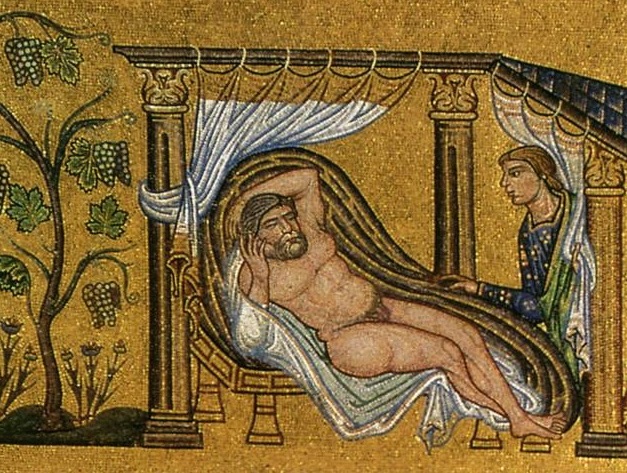
Noah and Cham, mosaic, Basilica di San Marco, Venice, circa 1215

And [Noah] drank some of the wine, and he became drunk, and vayitgal in the middle of his tent.  And Cham, the father of Canaan, saw the ervah of his father and he told his two brothers outside.  (Genesis 9:20-22)

vayitgal (וַיִּתְגַּל) = he uncovered himself, exposed himself.  (The hitpael form of the verb galah, גָּלָה = uncover, reveal.)

ervah (עֶרְוָה) = nakedness.

A modern reader might wonder what is so bad about lying down naked in the privacy of your own tent—even if one of your sons barges in and sees you.  But in the Torah, to “uncover the nakedness” of someone is a euphemism for a sexual act.  The fifteen incest laws in the book of Leviticus use the same words for “uncover” and “nakedness” as the passage above.  The first law covers any kind of incest:

Nobody may come close to any blood-relation of his flesh legalot ervah.  I am God.  (Genesis 18:6)

legalot (לְגַלּוֹת) = to uncover.  (A piel form of the verb galah.)

The next law begins as if it is prohibiting a son from copulating with his father, then corrects itself to a heterosexual formula:

The ervah of your father, or the ervah of your mother lo tegaleih; she is your mother, lo tegaleih her ervah.  (Leviticus 18:7)

lo tegaleih (לֺא תְגַלֵּה) = you must not uncover.  (lo = not + a piel form of the verb galah.)

The incest laws are phrased in terms of a male perpetrator “uncovering” a passive female.  Noah is not entirely a passive victim; the Torah says he uncovers himself.  Only then does his son Cham take advantage of the opportunity.

Then Cham tells his brothers what just happened—an indication that his motive is to degrade his father in their eyes, not to seek sexual satisfaction outside his marriage.

Modern scholars have pointed out that this story of incest provides propaganda that denigrates both Egypt and Canaan, which are listed as descendants of Cham right after the Noah story.1  Similarly, the introduction to first list of incest laws in Leviticus is:

You must not do as it is done in the land of Egypt, where you dwelt; and you must not do as it is done in the land of Canaan, where I am bringing you. You must not follow their decrees.  (Leviticus 18:3)

When Noah wakes up and realizes what happened, he lashes out and curses “his youngest son”, who is called Canaan rather than Cham in the actual curse (probably an interpolation from another source):

Cursed be Canaan!

A slave of slaves

He will be to his brothers.  (Genesis 9:25)

Neither Noah nor his son Cham have learned anything from Cain’s question, “Am I my brother’s protector?”  The whole human race after the flood consists of eight individuals in the same family.  They all count as brothers, for ethical purposes, and the story of Cain and Abel makes it clear that each one is responsible for protecting the others.  But Noah abandons responsibility for his family by deliberately drinking himself into a stupor, and Cham takes advantage of a chance to demean his father.

Neglect

Noah pursues his own escape from trauma through inebriation, but he does not pay attention to the effects of trauma on his family.  Perhaps on his good days he offers a few words of comfort to his wife, his sons, his daughters-in-law.  But he either does not notice or does not address Cham’s anger.  Trapped in his own misery, Noah drinks and carelessly exposes himself.

Maybe he undresses because it is hot inside his tent.  (Cham, חָם = hot.)  But then his hot-headed son named Cham comes in.

Noah’s feeling of guilty despair is understandable.  But his self-absorption subverts his ability to recognize and address his son Cham’s problem.

Abuse

While Noah is guilty of neglect, Cham is guilty of abuse.  Forcing a sexual act that the “partner” would avoid if he were sober is unethical because the perpetrator does not treat the victim as a fellow human being with rights and feelings.  Most human cultures also maintain that incest is unethical.  After the deed, Cham publicly dishonors his father, another ethical failure.2

What makes it hard for him to do the right thing and protect Noah instead of raping and degrading him?  Cham is hot with anger that the world was destroyed, just as Cain was hot with anger that his offering was not accepted.  Neither man can take out his anger on the actual perpetrator, God.  So just as Cain vents his anger on Abel, Cham vents his anger on Noah.  He can blame his father for following directions and enabling God to drown the world.

Cham’s angry resentment prevents him from feeling empathy for the old man.  It also prevents him from stopping to think about whether raping and telling is good or evil.

Revenge

Then Noah becomes guilty of uttering the curse against Cham (or Canaan).  A father’s blessing or curse has power in the book of Genesis.  By cursing Cham/Canaan, Noah dooms him and his descendants to enslavement—and also introduces slavery into the reborn world.3

Until this point, Noah has been submissive, following God’s instructions without question, making no effort to save any human or animal God has not mentioned, and figuring out that the extra animals God ordered could be used in a burnt offering to appease God.4

The Torah does not give us a clue about Noah’s attitude toward his own family until he wakes and realizes what Cham has done.  Then he lashes out with a curse, an act of revenge for his humiliation.  He does not stop to mull over the long-term effects of his curse.5

Kindness

Naturally the trauma of witnessing mass destruction can breed negative emotions including guilt, despair, and anger.  These emotions can all subvert our ability to make good moral choices, especially if, like Cain, we do not recognize them as beasts crouching outside our doors.
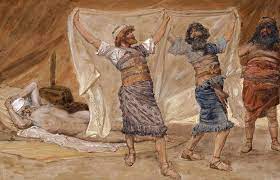
Noah’s Drunkenness, by James J.J. Tissot, 1902

Yet Cham’s brothers Sheim and Yefet, who also witnessed the destruction of their world, choose a modest act of kindness after Cham tells them about Noah’s shame.

And Sheim and Yefet took a cloak and placed it over their shoulders and walked backward, and they covered the erveh of their father, [which] they did not see.  (Genesis 9:23)

Even when we suffer from trauma, we owe it to our family members to stop ourselves from hurting them, and find acts of kindness we can do instead.


  1. Genesis 10:6.
  2. Dishonoring a parent was serious wrongdoing in ancient Israelite culture. The ten commandments require honoring parents in both Exodus 20:12 and Deuteronomy 5:16, and Leviticus 20:9 says anyone who curses his father or mother must be put to death.
  3. Tikva Frymer-Kensky, Reading the Women of the Bible, Schocken Books, New York, 2002, p. 205.
  4. Genesis 7:23, 8:20-21.
  5. For the author of this part of Noah’s story, the curse probably served as a justification for the conquest of Canaan by the Israelites many centuries later.

 

Bereishit: Bad Stewardship

What happened to my book about moral psychology in Genesis?  I finished it—then realized that examining why most of the characters in Genesis do the wrong thing is not enough.  I needed an ongoing argument about why humans find it so hard to take the high road out of Eden.

Now I am doing more research and rewriting my book.  Meanwhile, here is an essay from my first version.  The Torah portion this week is Bereishit (“In a beginning”), and tells about the beginning of everything, including good and evil.

§

Humans Dominate the Earth

And God made beasts of the land according to their type, and cattle by their type, and all creeping things of the earth by their type; and God saw that it was tov. (Genesis 1:25)

tov (טוֹב) = good; functional, attractive, beneficial, or virtuous.

Fourth Day of Creation, Nuremberg Chronicle, 1493

In the first creation story, God sees that seven creations are tov: light (day 1); the separation of dry land from waters (day 3); plants (day 3); sun, moon, and stars (day 4); swimming and flying animals (day 5); land animals excluding humans (day 6); and the whole world (day 6).1  In all seven of these divine observations, tov means functional, attractive, or beneficial for some divine plan, but not virtuous.  Stars and fish are not moral agents.

All the land animals, including humankind, are made on the same day, but God only considers the other animals tov.  When God makes humans, God blesses them, but does not see that they are tov.

And God created humankind in [God’s] image; in the image of God [God]created it; male and female [God] created them. And God blessed them, and God said to them: “Be fruitful and multiply, and fill the earth vekhivshuha; urdu over the fish of the sea and over the flyers of the skies and over every beast that crawls on the earth.” (Genesis 1:27-28)

vekhivshuha (וְכִבְשֻׁהָ) = and subjugate her, make her subservient, rape her, bring her under control. (An imperative form of the verb kavash, כָּבַשׁ.)

urdu (וּרְדוּ) = and subdue, dominate, rule over. (An imperative form of the verb radah, רָדָה.)

Humankind is the only creation that gets a blessing and a directive from God.

Why does God tell humans to subjugate and rule over a perfectly good world? What if they ruin the earth and its animals?

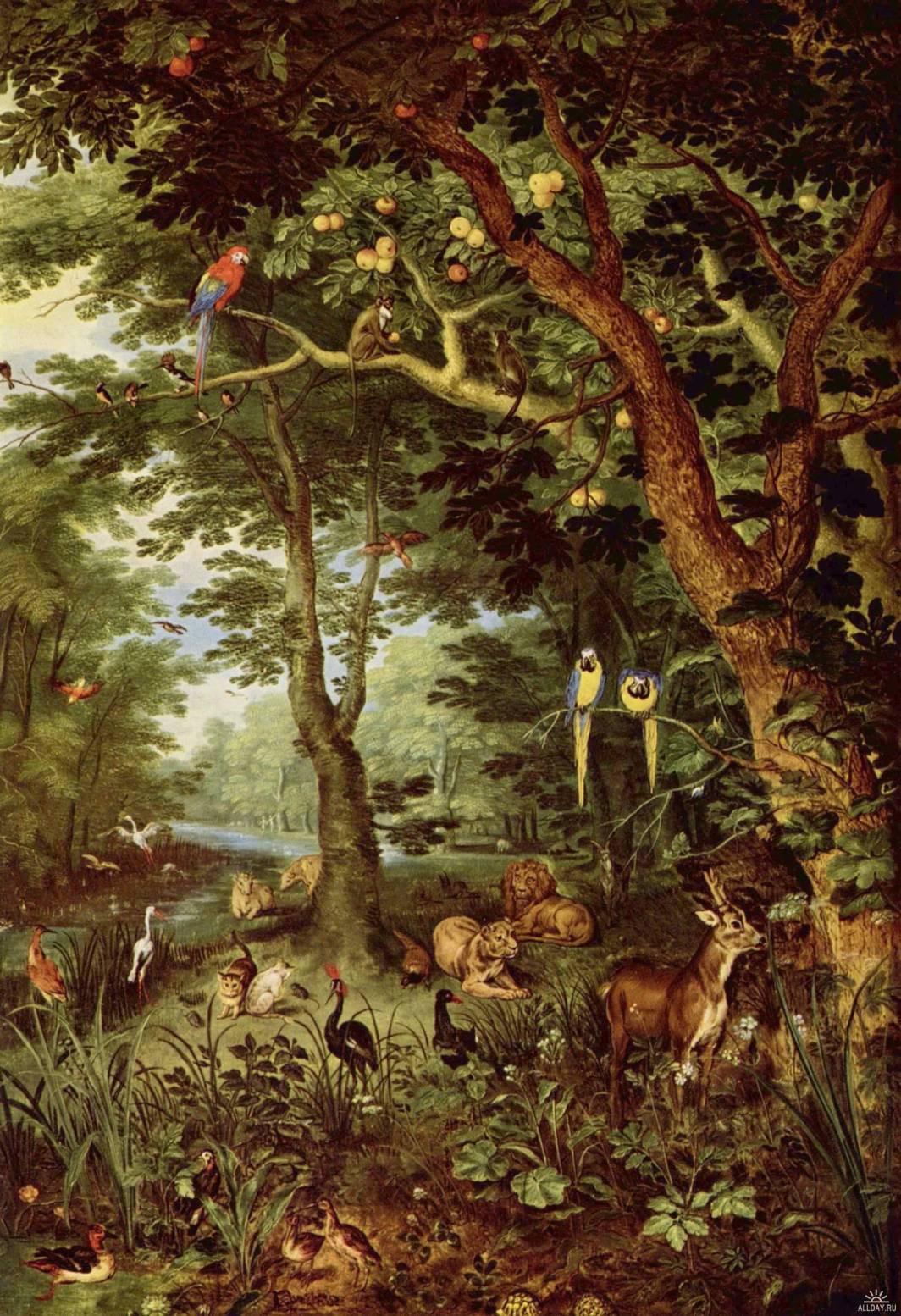
A Garden of Eden by Jan Brueghel the Younger, 1630

If God had created an imperfect world and given humankind the job of improving it, humans might have organized an uncivilized wilderness into parklands and gardens. The Garden of Eden might have served as a model, as well as being the source of humankind’s awareness of the categories of good and evil. But God does not create an imperfect world; God sees that the entire creation is already “very good”.

*

What if God expected humans to be good stewards of the earth? Since humans have the free will to choose between good and evil actions, and since we have the intelligence to learn and extrapolate from experience, we could have multiplied only until we filled the earth without overtaxing its resources. And we could have husbanded the earth rather than raped it.

Instead, our widespread adherence to a red meat diet led to overgrazing, which caused desertification (that’s why the Sahara is so big) and deforestation (e.g. to create more pastureland in 20th century South America). Our demand for lumber at unsustainable rates has led to millennia of clear-cutting, which changes biomes and causes more deforestation. (The bible praises the cedars of Lebanon, which used to be a vast forest and now consist of isolated urban trees and endangered wooded enclaves high in the mountains.) During the last century humans have also poisoned the air, soil, and water, and released greenhouse gases that are causing permanent climate change. Worldwide, humans have had neither the right intuitions nor the wisdom to be good stewards of the earth.

What if God, who gives humankind free will in the Garden of Eden, does not know whether humans will be good stewards or not?  What if God’s instruction to subjugate and dominate the earth and its animals is a temporary authorization, conditional upon good behavior?

Some classic commentators have proposed that at first humans were afraid of other animals and needed to be encouraged to control them by using their superior intelligence.2 The project of bringing wilderness under cultivation must also have seemed daunting.

But by the time humankind achieved the power to alter the earth’s ecology, the divine instruction to the first humans was no longer useful.

Bereishit Rabbah, a 5th-century C.E. collection of commentary, presents one rabbi’s opinion that people with merit will dominate the animals, but people without merit will descend to the state of being dominated by animals—perhaps by the beastly side of their own natures.3

This interpretation is based on an ambiguous word in God’s initial remark about letting humankind rule over the earth and all the animals:

And God said: “Let us make humankind in our image, like our likeness, veyirdu the fish of the sea and over the flyers of the skies and over the big animals and over all the earth and over all the crawlers that crawl on the earth.” (Genesis/Bereishit 1:26)

veyirdu (וְיִרְדּוּ) = and they shall subdue, dominate, rule over. (An imperfect form of the verb radah, רָדָה)

The word veyirdu is another form of the verb radah only when it is spelled with the Masoretic vowel pointings added to the Torah in the 6th to 10th century C.E.. But there were no vowel pointings in the Torah scrolls the Masoretes annotated.4  Therefore commentators are free to interpret a biblical passage as if one of the words originally had different vowels. Bereishit Rabbah is perhaps the earliest, but not the only, commentary that spells the word v-y-r-d-u as veyeirdu.5

veyeirdu (וְיֵרְדוּ) = and they shall go down, descend; and they might descend. (An imperfect form of the verb yarad, יָרַד).6

According to this interpretation, God still tells humankind to subjugate and dominate the earth and its animals, but only after predicting that humans might descend to the level of unthinking animals themselves.

*

In the 21st century it looks as if our beastly natures have won. Too many of us have acted in ways that control the earth without thinking about the consequences. Yet human intelligence could also be used for restoring the earth, or at least minimizing its degradation. What we and all the other animals and plants on earth need now is for every human leader, in governments and industries, to choose ethical actions over selfish short-term benefits.

Humans already rule over the earth, for good or bad. Our rule has already caused global climate change, with some areas flooding and others burning up.  Our only hope now is to stop choosing what seems good, tov, because it is functional, attractive, or beneficial to only a few individuals, and start choosing what is virtuous because it reduces the harm to all humans and all living creatures on earth.

  1. Genesis 1:4, 1:10, 1:12, 1:18, 1:21, 1:25, and 1:31.
  2. e.g. Nachalas Yaakov in Siftei Chakhamim, a 17th-century collection of commentary; Haamek Davar, a 19th-century commentary by Naftali Zvi Yehuda Berlin.
  3. Bereishit Rabbah 8:12.
  4. At services today Jews still read out loud from parchment Torah scrolls on which scribes have copied the letters without vowel pointings or other diacritical marks indicating pronunciation (nikkudim).
  5. e.g. Rashi (11th-century Rabbi Shlomoh Yitzchaki), and Jacob ben Asher (13th-century rabbi) in Kitzur Baal Haturim, Nachalas Yaakov (ibid.).
  6. Biblical Hebrew has no past, present, or future tense. Veyeirdu is in the imperfect aspect, which means that its action has not been completed. Often the context indicates that an imperfect verb in Biblical Hebrew should be translated as a future tense verb in English, but in this case the imperfect verb yeirdu could be translated equally well as “they will descend”, “they shall descend”, “they could descend”, or “they might descend”.

Sukkot & Ecclesiastes: Rejoicing Without Justice

Life on earth is the only life that humans get, according the Hebrew Bible (except the second-century B.C.E. book of Daniel1).  The souls of all dead humans, good and bad, go to Sheol, an underground place of oblivion.  There is no reward or punishment for human deeds after death.

The reward for virtue in most of the Hebrew Bible is a long and healthy life with male descendants and a good reputation.  The punishment for wicked deeds is an early death, the early death of one’s children, or being forgotten.

Psalm 37

Do not get inflamed over evildoers;

            Do not envy those who do wrong.

For quickly they will dry up like grass;

            Like green plants they will wither.  (Psalm 37:1-2)

In a little while the wicked one will be no more;

            When you look at his place, he will not be there.

But the humble will take possession of the earth

            And delight in abundant well-being.  (Psalm 37:10-11)

For the wicked will be shattered,

            But God supports the virtuous.  (Psalm 37:17)

In the Psalms, God is omnipotent and just.  If bad things happen to good people, they are temporary setbacks, and only those who have done something wrong suffer sickness and beg God for mercy.

Yom Kippur and Sukkot

At Yom Kippur services, Jews pray to a God who tempers justice with mercy.  Besides begging God to forgive us for our misdeeds, we chant God’s self-description to Moses in the “thirteen attributes”, including “a compassionate and gracious god, slow to anger and abounding in kindness and dependability.”2

Four days after the sun sets on Yom Kippur we begin the week of Sukkot, when the Torah commands us to “rejoice before God, your God, seven days”.3  Rejoicing seems appropriate after the work of atonement is done, the last crops have been harvested, and the grapes have been pressed for new wine.  Life is good.

But the Torah reading for Sukkot also says:

In sukkot you must dwell for seven days.  All the citizens of Israel must dwell in sukkot, so that your (future) generations will know that I made the Israelites dwell in sukkot when I brought them out from the land of Egypt. (Leviticus 23:42-43)

Modern American sukkah

sukkot (סֻכֺּת) = temporary shelters; huts made of branches and mats to provide shade for harvesters in fields and vineyards, for travelers, or for cattle.  (The roofs of ritual sukkot must provide more shade than sun, but still let in any rain.)

So we rejoice even though our shelters are temporary, our harvest is temporary, and our lives are temporary. 

Ecclesiastes

During Sukkot we read the book of Ecclesiastes/Kohelet, which begins:

Haveil of havalim, said Kohelet.

          Haveil of havalim! Everything is havel.  (Ecclesiastes/Kohelet 1:2)

haveil (הֲבֵל), havel (הָבֶל), or hevel (הֶבֶל) = puff of air, vapor; ephemeral, futile, fleeting.  (“Vanity” in the King James Bible.  Plural: havalim (הֲבָלִים).)

All human achievements and human lives are as temporary as puff of air.  Meanwhile the seasons go around forever, like the cycles of the sun, the winds, and the water.

And there is nothing new under the sun.  (Ecclesiastes 1:9)

Furthermore Kohelet observes that wisdom and foolishness, virtue and wickedness, make no difference in the fate of human beings.  Kohelet does not question God’s omnipotence, and refers to God as judging humans according to their virtue, but concludes that humans cannot change the quality or length of their lives through good deeds or religious observances.  God has predetermined everything.

And I said to myself: The virtuous and the wicked God will judge …  God sifts them out only to show them they are beasts.  Because the fate of the sons of humankind and the fate of beasts are one fate, since this one dies and that one dies.  The spirit of the human has no advantage over the beast, since everything is hevel.  They all go to one place, they all come from the dust and they all return to the dust.  (Ecclesiasters 3:17-20)

Humans die like beasts.  But does God grant virtuous humans any of the biblical rewards during their lifetimes—

—by  giving them longer lives?

I have seen everything in my days of hevelThere is a virtuous one perishing in his virtue, and there is a wicked one living long in his evil.  (Ecclesiastes 7:15)

—by giving them descendants to inherit what they built?

And I hated everything I earned from my toil that I was toiling under the sun, that I would leave it to the human who will come after me.  And who knows whether he will be wise or foolish?  But he will control everything I earned from my toil that I toiled, and that I gained by wisdom under the sun.  This, too, is havel.  (Ecclesiastes 2:18-19)

—or by giving them renown in the memories of those who follow?

There is no remembrance of the wise or of the fool.  For it is already certain that in the days to come everything will be forgotten.  (Ecclesiastes 2:16)

After examining what actually happens on earth, “under the sun”, Kohelet concludes that dispensing justice is simply not something that God does.

Then is there any point in avoiding evil?

Kohelet considers any pleasure in life an unpredictable gift from God.4  But he recommends against either drowning in despair or drowning in sensuality.  The wisest course of action is to enjoy simple physical pleasures, friendship, and love.

Go, eat your bread with joy and drink your wine with a good heart, because long ago God was favorable …  At all times let your clothes be clean and let your head be oiled.  (Ecclesiastes 9:7-8)

Friendship is also valuable.

Better are a pair than one alone, for they get good recompense for their toil.  For if they fall, one can raise his friend, but if one falls alone there is no second one to raise him.  Also if a pair lie down together they are warm, but for one alone there is no warmth.  And if one is attacked, the pair can stand against [the attacker].  (Ecclesiastes 4:9-12)

Succumbing to a woman who is a sexual predator leads to bitterness, not enjoyment.5  But if one happens to have a good spouse, that is another reason to rejoice.

Enjoy life with a woman whom you love all the hevel days of your life that have been given to you under the sun.  (Ecclesiastes 9:9)


According to Kohelet, the only good that humans can do is to appreciate the good things in their ephemeral lives.  But later Jewish tradition adds that in situations even when God is not righting wrongs, humans should do what they can to improve the world.  Kohelet notes the violent oppression that humans commit, but does not advocate taking any action to reduce it.6  Nevertheless, Kohelet says:

All that you find your hand has the power to do, do it, because there is no doing or learning or wisdom in Sheol where you are going.  (Ecclesiastes 9:10)

I believe that the best life, however fleeting, is one in which we not only enjoy the physical pleasure, friendship, and love that come our way, but also do everything within our own power to improve life for other humans, and for all living things under the sun.


  1. Daniel 12:1-3 describes the resurrection of at least some of the dead, perhaps in messianic times. (See my post Vayeilekh: The End of Days.)  Another work written in the second century B.C.E., the non-canonical Book of Enoch, describes the separation of virtuous souls from wicked souls in preparation for the resurrection of the virtuous and the torture of sinners.  Only after the first century C.E. did the writers of the Christian New Testament and the rabbis of the Talmud imagine an afterlife in which good souls are rewarded in a heaven and bad souls suffer in a hell.
  2. Exodus 34:6.
  3. Leviticus 23:40. The Torah reading for the first day of Sukkot is Leviticus/Vayikra 22:26-23:44.
  4. Ecclesiastes 3:12-14.
  5. Ecclesiastes 7:26.
  6. Ecclesiastes 4:1-3.

Psalm 130 & Yom Kippur: Waiting for Forgiveness

When we are guilty of harming another person, we can often acknowledge what we did, apologize to the person we wronged, offer to make amends, and promise not to do it again.  Then our human victim may (or may not) forgive us.

But what if we have wronged God, or the divine spirit within us?  Is forgiveness even possible?

Psalm 130

One answer is found in Psalm 130, traditionally read between Rosh Hashanah and Yom Kippur.

Levites singing on the temple steps, by James J.J. Tissot

(A song of ascending steps.)

From the depths I called to you, God:

            “My lord, hear my voice!

May your ears be attentive to the voice of my plea.”

If you kept a watch over avonot, my lord Yah,

            Who could stand?

However, forgiveness is yours

            So that tivarei.

I hoped for God,

            My soul hoped,

                        And I waited for God’s word.

My soul [watches] for my lord

            More than watchmen for the morning,

                        Watching for the morning.  (Psalm 130:1-6)

avonot (עֲוֺנֺת) = wrongdoing, immoral activity, intentional sins.  (Singular avon, עָוֹן.)

tivarei (תִּוָּרֵא) = you will be feared, you will inspire awe.  (From the root yarei, יָרֵא  = was afraid of, was in awe of, was reverent of.)

The speaker (whom I will call “they”, since the first person pronoun is ungendered in Hebrew, as in English) cries out to God from the depths of mental suffering due to guilt.  How can they forgive themselves for deliberately doing something morally wrong?  Their only hope is that God will forgive them.  But at first they cannot quite believe God would grant forgiveness out of compassion.  So the speaker hypothesizes two other motivations:

1) If God held every human being accountable for every avon, nobody would be left standing, left alive.  Perhaps the speaker recalls that God swore not to destroy the world again after the Flood, even though “the inventions of the human mind are evil from youth”.4  Therefore God must sometimes exercise mercy.

2) Forgiveness is one of the ways God inspires awe.  Being forgiven by God seems incredible to the speaker, so amazing they would be dumbstruck and trembling.  And this is just what God wants; throughout the bible God asks to be regarded with fear and awe.  Instead of rewarding awe with forgiveness, maybe God forgives in order to earn the awe.

The last two verses of Psalm 130 switch from a guilty individual to the Israelites as a whole.  Being human, they have all transgressed in one way or another.  But when the speaker steps back from their own need for forgiveness and embraces a larger perspective, they realize that God forgives out of kindness.

Israel will wait for God

            Because with God is steadfast kindness

                        And abundant redemption.

And [God] will ransom Israel

            From all its avonot.    (Psalm 130:7-8)

Despite all the times the Israelites disobeyed God by worshiping idols, ignoring the poor, and committing injustice, God does redeem the Israelites from their captivity in Babylonia in the books of Ezra and Nehemiah.  The speaker in Psalm 130 hopes that this means it is God’s nature to forgive.  They wait and watch for the morning of a new day, a new life, that God will grant them.

Yom Kippur

If we have not already made atonement with human beings whom we wronged or who wronged us during the past year, Jews try to do it before Yom Kippur starts.  We do not always succeed.  I have found myself apologizing to people who don’t take me seriously, and to people who don’t remember the incident that I feel guilty about.  Often the only people who ask me for forgiveness are the ones who have always been kind and respectful, while those who actually hurt me never apologize.  But I do the best I can to make amends, clearing the way to seeking atonement with God on Yom Kippur.

How do we wrong God?

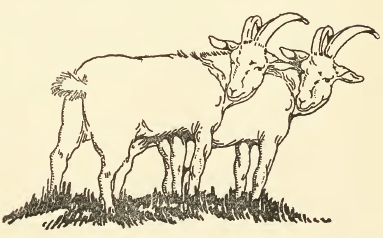
drawing by Dugald Stewart Walker (1883-1937)

In the book of Leviticus /Vayikra, the high priest atones for the whole community in the Torah portion Acharei Mot (which is chanted at Yom Kippur services) through a ritual involving two goats.  (See my post Acharey Mot: Azazel.)

And Aaron shall both his hands on the head of the live goat and confess upon it all the avonot of the Israelites and all their insubordinations, for all their chatot, and put them on the head of the goat.  And it shall be sent by the hand of a designated man into the wilderness.  (Leviticus/Vayikra 16:21)

chatot (חטֺּאת) = wrongdoing, misdeeds, lapses, unintentional offenses.  (Singular chatat, חַטָּאת or cheit, חֵטְא.  The root of the noun is the verb chata (חָטָא) = missed the mark, offended, was at fault, was guilty.)

In Leviticus, rules for purity and rituals, as well as ethical principles, are labeled as avonot and chatot.  These words for intentional and unintentional offenses are applied to everything from touching an animal that died of natural causes to hating one’s neighbor.1

But in the liturgy for Yom Kippur, we wrong God only when we succumb to evil thoughts and unethical behavior.

Jews Praying in the Synagogue on Yom Kippur, by Maurycy Gottlieb

On Yom Kippur, Jews chant two confessional prayers again and again: the Ashamnu and the Al Cheit, both extant in the 9th century C.E.2   The Ashamnu (אָשַׁמְנוּ = We have become guilty), is a list of 23 immoral actions that begins with betrayal, robbery, and slander, and ends with leading others astray.  After confessing that we, as a group, have been wicked in all these ways, the prayer asks God to “make atonement for us for all our chatot, forgive us for all our avonot, and pardon us for all our insubordinations”.

The Al Cheit (עַל חֵטא = For the wrong) is a list of both immoral actions and bad attitudes (such as arrogance and recklessness) that lead to wrongdoing.  Each line begins with:

Al cheit shechatanu lefanekha (עַל חֵטא שֶׁחָטָאנוּ לְפָנֶיךָ) = For the wrong that we have done wrong in your presence.

“Your presence” means the presence of God.  Some people think of God as the ruler of the universe; for others, God is the “still, small voice” inside.3  Either way, God notices the bad deeds and wicked thoughts we are guilty of, even when no humans do.  And our souls or psyches are affected.

After each group of six or more bad deeds or attitudes in the Al Cheit, we sing this refrain:

Ve-a’ kulam, Eloha selichot, selach lanu, machal lanu, kaper lanu! (וְעַל כֻּלָּם אֱלוֹהַּ סְלִיחוֹת סְלַח לָנוּ מְחַל לָנוּ כַּפֶּר לָנוּ) = And for all of them, God of forgiveness, forgive us, pardon us, reconcile with us!

We confess that we are guilty as a group, and we wait, like Israel in Psalm 130, for God’s forgiveness.

Yet it is impossible not to think of our individual moral failings when we spend all day praying for forgiveness.


How do we wrong God?

If humans are made in God’s image,5  then we wrong God both when we wrong other humans, and when we damage our own souls.  I believe we degrade our souls when we treat other people as objects, when we selfishly or carelessly hurt or neglect or endanger any of our fellow human beings.

If we are lucky, we realize what we did wrong—maybe the same year, maybe many years later.  Then we feel guilty.  We can make any amends that are possible, and we can sincerely change our ways.  Then we only need to wait until we hear the still, small voice of God releasing us from guilt.

May we all find our way to forgiveness.


  1. See Leviticus 4:2-3, 4:13, 5:1-6, 7:18, and 24:15 on transgressing ritual laws, and Leviticus 18:6-25, 19:17, and 19:20-22 on transgressing ethical laws.
  2. In the Siddur Rav Amram, compiled by Amram ben Sheshna, the Gaon of Sura.
  3. 1 Kings 19:12. When God crosses in front of the cave where the prophet Elijah is hiding, there is a windstorm, an earthquake, and a fire, but God is not in any of these things.  After the fire Elijah hears “a thin, murmuring sound” or “a soft murmuring voice”, and knows God is there.
  4. Genesis 8:21.
  5. According to Genesis 1:27 and 5:1.

Vayeilekh: Two Transitions

An old era ends, a new era begins.  The old leader steps back, the new leader steps forward. 

In the Hebrew calendar both the new year and the new leader are recognized at the beginning of autumn, before the final harvest. The Jewish New Year (Rosh Hashanah, “Head of the Year”), is a time to reflect on how we missed the mark during the previous year, individually and communally, and to prepare to turn around and dedicate ourselves to being more ethical and, if you will, God-centered during the next year.1  And the Israelites are given a new leader in the Torah portion for this coming Shabbat, Vayeilekh (“And he went”).

The portion begins with Moses announcing that he is 120 years old and cannot lead the people in the conquest of Canaan.  He mentions that God had told him he would not cross the Jordan River; he knows he will die without setting foot on the “promised land”.

Moses urges first the Israelites, then their next leader, not to be afraid of the Canaanites:

Chizku and imtzu!  You must not be overawed nor in dread of their faces, because God himself, your God, is the one going with you.  [God] will not let go of you nor abandon you.”  Then Moses called Joshua and said to him before the eyes of all Israel: “Chazak and eimatz!  Because you yourself will bring this people to the land the God vowed to give your forefathers, and you yourself will apportion inheritances [of land] to them.”  (Deuteronomy 31:6-7)

chizku (חִזְקוּ) = (plural imperative of chazak, חָזַק)  Be strong!  Be courageous!  Be resolute!  chazak (חֲזַק) = (singular imperative of חָזַק).

imtzu (אִמְצוּ) = (plural imperative of amatz, אָמַץ)  Be strong!  Be courageous!  Be resolute!  eimatz (אֶמָצ) = (singular imperative of amatz).2

Moses gives Joshua and the Israelites the same message.  But when God speaks to Moses and Joshua inside the Tent of Meeting, God gives them different messages.

And God said to Moses: “Hey, you will be lying with your forefathers, and these people will rise up and go whoring after the foreign gods of the land that they are coming into.  And they will abandon me and break my covenant that I cut with them. And my nose will heat up against them on that day, and I will abandon them!  And I will hide my face from them, and they will become fodder, and they will encounter many evils and constrictions …” (Deuteronomy 3:16-17)

Then God tells Moses to teach the people the song in next week’s Torah portion, Ha-Azinu, so that someday they will realize how they screwed up.

And [God] commanded Joshua, son of Nun, and said: “Chazak and eimatz!  Because you yourself will bring the children of Israel into the land that I have vowed to them, and I myself will be with you.”  (Deuteronomy 31:23)

That is all God says to Joshua—a repetition of Moses’ earlier encouragement.  Although both men stand inside the Tent of Meeting, each one seems to hear only the divine message addressed to him.

Why does God give Moses a discouraging prediction?

Moses dedicated the last 40 years of his life to shepherding the recalcitrant Israelites to Canaan.  How can he die in peace now that he knows they will abandon God again in their new land?

I have discovered that when I am giving up a project that was important in my life, I am finally able to accept any unpleasant truth about it.  As long as I did my best, most of the time, that is enough. But I am curious about what will happen next.  If I found out that the project I started would fail, but could someday be revived, I think I would be content.

Why does God encourage Joshua?

The new leader of the Israelites has more energy than Moses.  If Joshua knew that is charges were going to abandon God and go after idols again, wouldn’t he do something to mitigate the situation?


I have noticed that when I am about to begin a new enterprise, I feel nervous and I crave encouragement.  I do not need someone to tell me the project will fail; I can easily imagine that myself.  If an authority figure confirmed my fears, I might give up prematurely.

For everything there is a season: a time to release and accept, and a time to be brave and resolute.  In the Torah portion Vayeilekh, God knows which time it is for Moses, and which time it is for Joshua.


  1. Jews outside Israel observe Rosh Hashanah for two full days. Synagogues provide ten or more hours of services in addition to the outdoor ritual of Tashlich, in which we symbolically cast away our regrettable behaviors from the past year by tossing pebbles in the water.  The extra liturgy for Rosh Hashanah introduces the themes of repentance that come to full bloom on Yom Kippur.  In between Rosh Hashanah and Yom Kippur, we still read a Torah portion from Deuteronomy as we approach the end of the annual cycle of readings.
  2. Chazak and eimatz are close synonyms. Biblical Hebrew often uses a pair of synonyms either to indicate emphasis or as a poetic device.

Haftarat Nitzavim—Isaiah: Power of Names

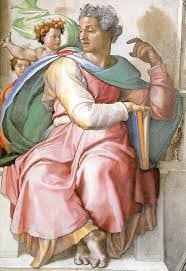
Prophet Isaiah by Michelangelo, Sistine Chapel

Hey!  God has announced

            To the ends of the earth:

“Say to the daughter of Zion

            Hey!  Your rescue is coming!”  (Isaiah 62:11)           

The second prophet Isaiah is speaking to the people of Judah who were deported to Babylon when the Babylonian army razed Jerusalem in 586 B.C.E.  The verse appears in the haftarah reading which accompanies this week’s Torah portion, Nitzavim.  It is is the seventh and final “haftarah of consolation” after the annual fast of Tisha B’Av, when Jews mourn the destruction of the temple.1  This week’s haftarah offers more than consolation; Isaiah predicts that God will return the exiles to Jerusalem in triumph.

Then, Isaiah says, instead of denigrating the deportees and their ruined city, everyone in the world will admire the Jews and Jerusalem.

And so my lord, God,

          Will make virtue and praise sprout up

          In front of all the nations.  (Isaiah 61:11)

Then nations will see your virtue,

            And every king your glory.

And you will be called by a new sheim

            That the mouth of God will pronounce.  (Isaiah 62:2)

sheim (שֵׁם) = name, reputation, fame.

In fact, after about 45 years in exile, a group of deportees and their families did return to Jerusalem.  The book of Ezra credits God with using Cyrus, the first king of the Persian Empire, as a tool for achieving the liberation of these Jews.2

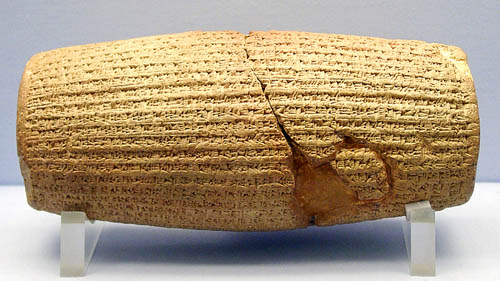
Cyrus Cylinder, photo by Ferrell Jenkins

King Cyrus of Persia recorded his conquest of Babylon in 539 B.C.E. in a cuneiform record called the Cyrus Cylinder.  One ambiguous sentence on the cylinder could be interpreted as a decree that all peoples deported by the Babylonians, including the Jews from Judah, were now free to return to their homes and rebuild their temples.3

Cyrus could be called virtuous and praiseworthy for establishing freedom of movement and religious freedom for the subjects in his empire.  But how will God make the Jews who return to Jerusalem virtuous and praiseworthy?  How will God give them a new sheim?

The country the Israelites return to is no longer the independent kingdom of Judah (Yehudah, יְהוּדָה), but a Persian province called Judea (Yehud).  But this is not the kind of name change second Isaiah means.  Instead, the prophet says God will change the way other people describe the Jews and Jerusalem.

Never again will it be said of you: “Forsaken”

            And never again will it be said of your land: “Desolation”.

For you will be called: “I Delight in Her”

            And your land: “Betrothed”.

Because God delights in you,

            And your land is embraced.  (Isaiah 62:4)

Once the returning exiles rebuild Jerusalem and its temple, it makes sense that nobody would call the people “forsaken” or the city-state “desolation” any more.  Judea would become one thriving province among many.

But the governors of other provinces in the Persian Empire would not describe the people Israel as “I Delight in Her”, since the first person would only apply to God.   And the land is “betrothed” to God, not to Cyrus or the provincial governor.  “I Delight in Her” and “Betrothed” are the new names that “the mouth of God will pronounce”.

Later in the poem the Israelites and Jerusalem are assigned other positive descriptors.

And they will be called: “The Holy People”,

            “Redeemed by God”.

And you [Zion] will be called: “Sought Out”,

            “City Not Forsaken”.  (Isaiah 62:12)

Who will use those names to refer to the people and the land?  The phrase “Redeemed by God” could only be used by the redeemed exiles themselves.  They are also the most likely to use the other three names.  We learn in the book of Ezra that the Jews who returned from Babylon sought out Jerusalem/Zion instead of leaving the city forsaken because they believed it was their holy mission to rebuild the temple and reestablish their religion there.

In other words, first Isaiah announces the new names of praise that God will speak.  Then the people act, living up to those names by returning to their parents’ homeland and rebuilding Jerusalem and its temple.  Once they have succeeded, they deserve the names.


Can we use the same technique?  For example, what if Americans started referring to the United States with the name “Mother of Exiles” from the 1893 Emma Lazarus poem for the Statue of Liberty?  Would we be more inclined to welcome the “huddled masses yearning to breathe free” who seek asylum in the United States?

What if we took seriously the final phrase from the American pledge of allegiance (1942), “with liberty and justice for all”?  If millions of yard signs said: “America: Liberty and Justice for All”, would more people work to make it true?

And on a personal level, what if we named ourselves according to our good qualities, however nascent?  For example, I realized I have been getting through a hard year with fortitude.  Calling myself “Fortitude” might help me to stay strong and calm until various health issues are resolved.

I can also call myself “Blessed”, because after all, I have good food to eat, I live in a good apartment with my beloved husband, I have good long-distance conversations with my friends and with my son and daughter-in-law, and I can still write.  I say “I am blessed” and I appreciate what I have.


  1. Traditionally, Tisha B’Av (the ninth of the summer month of Av) is a day for mourning the fall of both temples in Jerusalem—the first by the Babylonians in 586 B.C.E. and the second by the Romans in 70 C.E. Today most Jews who observe Tish B’Av mourn the destruction and suffering without any desire to return to the temple method of worship.
  2. Ezra 1:1-4, 3:7, 4:3-5, and 5:13-6:12.
  3. “[32]I returned the images of the gods, who had resided there [i.e. in Babylon] to their places and I let them dwell in eternal abodes. I gathered all their inhabitants and returned to them their dwellings.” (translation of the Cyrus Cylinder in https://www.livius.org/sources/content/cyrus-cylinder/cyrus-cylinder-translation/).  The cylinder specifically mentions the return of the images of two Akkadian gods. The Israelites would have no “images” of their God, and the ark of the covenant is missing from the biblical and historical record after the fall of the first temple in 587 B.C.E.

Ki Tavo & Vayigash: Tithes and Taxes

How does a theocracy support itself?

Governments today, both democratic and autocratic, levy taxes to pay for government programs that range from making war to feeding children.  But a few thousand years ago in the Ancient Near East, most countries were theocracies; gods were considered the ultimate rulers, and their deputies were anointed kings and priests.

Both Egypt and the two kingdoms of Israel conscripted soldiers for war and laborers for major building projects.1  But how did they fund the programs that kept at least some of their people from starving?

The book of Genesis credits Joseph, the pharaoh’s viceroy, with refinancing the government of Egypt.  The next four books of the bible state what Israelites must contribute when they have their own nation, their own king, and their own clergy.

Joseph, Overseer of Pharaoh’s Granaries, by Lawrence Alma-Tadema, 1874

Egypt in Genesis

Joseph stockpiles grain in Egypt during the seven years of plenty in the Torah portion Vayigash.  Then in the first year of the seven-year drought, he sells it (to Egyptians as well as Canaanites) for silver.  In the second year, he sells grain to Egyptians in exchange for their livestock.  The third year, when the pharaoh owns all of Egypt’s silver and livestock, the  farmers offer:

“Acquire us and our farmland for the food, and we ourselves will be Pharaoh’s slaves, and our land.” (Genesis 47:19)

Joseph agrees.  All the farmland of Egypt, except what belongs to the priests, becomes the property of the government, and the farmers become serfs.  Joseph gives them grain for planting and eating.  And from then on, the farmers have to give one-fifth of their produce to Pharaoh as rent.

Joseph does not create any means for them to buy back their former land.  In fact, he moves whole villages to other parts of the country.  This underscores the claim in the story that the pharaoh now owns all the land and the farmers are mere serfs.

Israel in Numbers and Deuteronomy

Moses, speaking for God, decrees a different plan for the Israelites to follow after they have conquered their own country.  God is the true owner of all the land, but God has assigned a landholding to every Israelite in every tribe.  Plots of land can be sold, but only for temporary ownership; all lands return to the original clans every fifty years.2

King Solomon, French 13th century

Kings throughout the Ancient Near East appointed tax collectors to make sure landowners paid taxes, mostly in the form of foodstuffs.  In the bible, King Solomon divides the united kingdom of Israel into twelve districts, each supervised by an official who had to provide food for the king and court one month out of the year.3

Landowners are also responsible in the Torah for supporting the kingdom’s two most important social programs: the state religion, and care for the poor.  While the priests and their households receive portions from individual offerings at the altar,4 and wealthier Israelites are obligated to extend loans to their poorer neighbors and kin,5 the primary method for supporting people without their own land is mandatory tithing.

The Talmud distinguishes three kinds of tithes in the Hebrew Bible.  The first tithe is brought to the temple for the resident priests and their households.  The second tithe is also brought to Jerusalem, but consumed on the spot in a feast for the landowner’s family, slaves, and employees; Levites and landless immigrants are also invited to feast.6  Every third year, the second tithe is replaced with a “poor tithe” stored in the towns and doled out to the local Levites, immigrants, widows, and orphans.

This week’s Torah portion, Ki Tavo (“when you come”), requires landowners to accompany their tithes both in Jerusalem and in their home towns with declarations that they owe their livelihood to God and they are tithing to obey God’s orders.  First Moses addresses the annual contribution of the best of the first fruits:

First Fruits, bible card by Providence Lithograph Co. ca. 1900

You shall take some of the first of every fruit of the earth that you bring in from your land, which God, your God, is giving to you, and put it in a basket.  And you shall go to the place where God, your God, chooses to let [God’s] name dwell.  And you shall go to whoever the priest is at that time, and you shall say to him: “I announce today to God, our God, that I have come into the land that God vowed to our fathers to give to us.”  (Deuteronomy/Devarim 26:2-3)

The farmer then recites a brief history from Jacob’s descent to Egypt through his descendants’ arrival in Canaan.7  He concludes:

“And [God] brought us to this place and gave us this land, a land flowing with milk and honey.  And now, hey!  I bring the first fruits of the earth that you gave to me, God!”  And you shall leave [the basket] in front of God, your God, and you shall bow down in front of God, your God.  (Deuteronomy 26:9-10)

The baskets of first fruits are presented to God, then eaten by the resident priests and their households.

Then you shall rejoice in all the good things that God, your God, gave to you and your household—you and the Levite and the immigrant who is in your midst.  (Deuteronomy 26:11)

The summer pilgrimage festival in Jerusalem, Shavuot, is identified as the “Day of First Fruits” in Numbers 28:26.  But the Israelites must continue to bring the first fruits of each of seven species8 as they ripen through the summer, until the fall pilgrimage festival, Sukkot.  The Israelites are obligated to bring the first-born animals from their herds and flocks to the temple for the spring pilgrimage festival, Pesach or Passover.9

For all three pilgrimage festivals, as well as for other offerings at the temple, landowners are obligated to invite the Levites and immigrants from their own neighborhoods to accompany them to Jerusalem and join in the feast.10  Perhaps the participation of Levites and immigrants is why the Talmud calls this the “second tithe”.

barley

But a feast every few months is not enough to sustain life.  So every third year, landowners must bring the “poor tithe” to a central location in the nearest town.  This tithe includes foods that have a longer shelf life (grain, wine, and olive oil), and it is also accompanied by a declaration in this week’s Torah portion.

When you have finished laseir every maseir of your produce in the third year, the year of the maseir, and you give it to the Levite, to the immigrant, to the fatherless child, and to the widow, then they will eat inside your gates and they will be satisfied.  Then you shall say in the presence  of God, your God: “I cleared out the sacred [portion] from the house, and also I gave it to the Levite and to the immigrant, to the fatherless child and to the widow, as in your commands that you commanded me.  I did not bypass your commands, and I did not forget.”  (Deuteronomy 26:12-13)

laseir (לַעְשֵׂר) = tithing, assembling a tithe, collection one-tenth.  (From eser, עֶשֶׂר = ten.)

maseir (מַעְשֵׂר) = tithe.  (Also from eser.)

The Levites serve at the temple on a rotating schedule as administrators, guards, assistants, and musicians, and by God’s decree cannot own farmland of their own.  The third tithe also provides sustenance for immigrants who have not been able to buy land, and for two other categories of people who were often impoverished in ancient Israel: widows and children who have lost their fathers.

The grain and other foods set aside for the third-year tithe are considered sacred because they are prohibited for mundane use; they cannot be either sold or eaten by the owner’s household.  This tithe is also sacred because it serves God; giving food to those who do not have the means to feed themselves is a sacred obligation.

*

Today the citizens of most nations are required to pay taxes.  Portions of our taxes go to the military, though sometimes we also conscript soldiers.  In modern nations, no one is conscripted to provide labor for government building projects; they are supported by taxes (including roads and other infrastructure).  Our taxes are also spent on education, on health care, and on supporting those who do not have the means to support themselves—the elderly and disabled, minor children whose parents cannot take care of them, recent victims of disasters.

I believe we should treat the taxes we pay for these social programs as a sacred obligation.

  1. Corvée labor, called mas (מַס) in Hebrew, is imposed by both pharaohs in Exodus on the Israelites to build brick storehouses (Exodus 1:11-13. 5:6-9) and by the Israelite tribes on Canaanites (Josiah 16:10, 17:13; Judges 1:27-35). A list of King David’s top officials includes an officer in charge of mas (2 Samuel 20:23-26); so does the list of King Solomon’s top officials (1 Kings 4:6).  King Solomon imposes mas on 30,000 Israelites who spent every third month in Lebanon cutting wood and quarrying stone (1 Kings 5:27).  Then he imposes mas on resident Canaanites to build the temple, his own palace, a citadel, and city walls around Jerusalem, Chazor, Megido, and Gazer.
  2. Leviticus 25:10-24.
  3. 1 Kings 4:7-19, 5:7-8.
  4. Numbers 18:8-19.
  5. Leviticus 25:35-37.
  6. Except in Numbers 18:21-29, which describes an earlier system of tithing. In that system, the first tithe is given to the Levites, who then give one-tenth of what they receive to the priests.
  7. See my post Ki Tavo: A Perishing Aramean.
  8. Deuteronomy 8:8-9 calls Israel “a land of wheat and barley, of grapevines and figs and pomegranates, a land of olive trees and honey/date syrup; a land where you need not stint on eating food …”  Mishnah Bikkurim 1:3 states that only these seven species are brought to the temple, and they are not brought before Shavuot.
  9. Exodus 13:11-13 and 22:28-29; Numbers 18:13-18. God assigns the first fruits of Pesach and the meat of the firstborn animals to the Levites (including the priests), as well as a contribution of five shekels for each firstborn son.
  10. In front of God, your God, you shall eat them, in the place that God, your God, choosesyou and your sons and your daughters and your male slaves and your female slaves and the Levites who [live] within your gates. And you will rejoice in front of God, your God, in everything you put your hand to. Guard yourself lest you abandon the Levite on any of your days on the earth.  (Deuteronomy 12:18-19)

Ki Teitzei & Kedoshim: Two Kinds

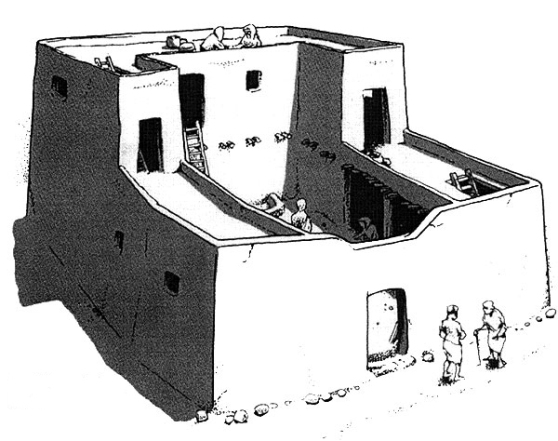
House in ancient Israel with parapets

This week’s Torah portion, Ki Teitzei (“If you go”), is packed with ethical rules.  But right after the law about building a parapet around your roof so no one can fall off, Moses gives a apparently senseless rule about segregating different crops.

The contrast is more pronounced in a similar passage in the portion Kedoshim (“Holiness”) in the book of Leviticus/Vayikra.  Right after the command to love your neighbor as yourself, the Torah switches to rules about segregating different species of animals, plants, and even fibers.

In Kedoshim

You shall love your neighbor as yourself; I am God.  My chukot you shall observe: You may not breed together livestock of kilayim, you may not plant your field with kilayim, and clothing of woven material of kilayim may not go over you.  (Leviticus 19:18-19)

chukot (חֻקֺּת) = decrees, fiats.  (Early commentators wrote that chukot are the divine rules that humans cannot figure out using reason, but that Jews must obey anyway.1)

kilayim (כִּלְאָיִם) = two kinds; an enforced mixture of two different kinds.  (Kele, כֶּלֶא = imprisonment + ayim= a suffix meaning a pair.2)

Were these three rules about forbidden mixtures always chukot, or was there an early rationale behind them that was lost over the centuries?  No definite reason for the rules has yet been discovered, but many commentators have argued that these rules instill respect for God the Creator.

Attempting to crossbreed two different species of animals (or even a wild donkey with a domesticated donkey3) insults God by implying that the animals God created are insufficient or imperfect.4  Growing crops of two different species without a clear separation between them, or grafting a branch from one tree onto another kind of tree, gives an observer the impression that species of plants that God created have been altered—another insult.5

19th-century rabbi Samson Raphael Hirsch even applied this argument to clothing made with kilayim (mixed wool and linen, according to the Torah portion Ki Teitzei) when he wrote: “…every seedling and fiber of organic life does the Will of its Creator, without deviating from its assigned task.”6

In Ki Teitzei

The three chukot from Leviticus change a bit when Moses repeats them in Deuteronomy, right after the law about the parapet.

You may not plant your vineyard with kilayim, or else it will be holy: [both] the full yield of the seeds that you plant, and the produce of the vineyard.  You may not plow with an ox and with a donkey together as one.  You may not wear material woven of wool and linen together as one.  (Deuteronomy/Devarim 22:9-11)

The version in Ki Teitzei refers to mixing seeds in a vineyard rather than a field, and adds the warning that such a mixture is holy.  (Usually when something is holy in the Torah, it is prohibited from ordinary use and reserved for God, but here the grapes and other produce are merely prohibited from use.)

The next change in the Deuteronomic version is that plowing with two different animals is banned, instead of breeding them.  Finally, Ki Teitzei specifies that only woven material that mixes wool and linen is forbidden.7

Commentators have used these changes or clarifications to generate additional explanations for the inexplicable chukot.  If the rationale that the rules enforce respect for God the Creator is not convincing, we can read arguments that the chukot about kilayim are instructions for distinguishing between the traits of Cain and Abel, or for segregating the holy from the ordinary.  The second rule, about plowing with two kinds of animals, has also been interpreted as an ethical command.

Distinguishing Cain from Abel

The distinction between linen and wool suggests the story of Cain and Abel, in which God rejects Cain’s offering of plants, but accepts Abel’s offering of a sheep, and Cain kills his brother Abel.8  In the 8th or 9th century C.E., the author of  Pirkei DeRabbi Eliezer wrote: “Rabbi Joshua ben Ḳorchah said: The Holy One, blessed be He, said: Heaven forbid ! Never let the offerings of Cain and Abel be mixed up (with one another), even in the weaving of a garment …”9

13th-century Rabbi Hezekiah ben Manoah went farther.  Besides identifying Cain’s offering as flax (the raw material for linen), and Abel’s as sheep which grow wool, he declared that Cain’s father was the serpent in the Garden of Eden, while Abel’s father was Adam, so Cain and Abel were themselves kilayim, as well as the first murderer and the first murder victim.10

Segregating the holy

Another explanation is suggested by the reference to holiness in the rule about vineyards.  In the 19th century, Hirsch wrote that only wine from grapes grown in observance of God’s rule could be taken into the sanctuary as a libation to God.11  In that case, holy means prohibited for any use.

But in the 21st century, Richard Elliott Friedman speculated that all three chukot might forbid those particular combinations because they are associated with gods, and therefore holy.  “The law against cooking a kid in its mother’s milk may be because that was regarded as a food for a deity, since a Ugaritic text pictures the chief god, El, having kid cooked in milk …  The law against wearing wool and linen together may be because they were both used in the Tabernacle …  And so it may be in the case of mixed seeds, as well: the prohibition of mixing them may not be because the mixing is bad in some way but rather because some mixtures are regarded as divine.”12

Wool and linen are combined for several sacred uses in the Torah.  In God’s portable sanctuary, both the screen at the entrance of the tent and the curtain concealing the Holy of Holies inside must be made out of “sky-blue and red-violet and red and linen”.13  The technology to dye linen was unavailable in the Ancient Near East, so the colored threads must be wool.14

High priest vestments

A priest’s vestments are woven out of the same combination of colored wool and linen,15 and priests dedicate their lives to serving God at the sanctuary.

In the book of Numbers/Bemidbar, men are required to wear fringes on the four corners of a garment, and each fringe must include a cord of blue wool.  Whenever they glance at it, they will remember God’s commandments.16

In this week’s Torah portion, people may not wear or cover themselves with material woven of wool and linen together.  The mixture is prohibited for these ordinary uses of fabric, and reserved for holy purposes.

Ethical plowing

The need to separate the holy and the profane does not explain the middle rule: You may not plow with an ox and with a donkey together as one.  (Deuteronomy 22:10)

Some commentators claimed this rule was derived from the prohibition in Leviticus about breeding different species of animals.  If a farmer used two different animals to plow together, he would house both in the same shed, where they might try to mate.17

But by the 13th-century, Chizkuni offered: “An alternate interpretation; G-d’s mercy extends not only to human beings but to all of His creatures. Therefore these two categories of beasts being mismatched as one is far stronger than the other, it would be causing the donkey pain to be part of such a team pulling the plough.”18  This is the dominant interpretation today.

*

I confess that until this week I was only interested in the prohibition against yoking a donkey and an ox to plow together.  This rule not only opposes cruelty to animals, but can also be extended to cover situations in which human beings with unequal abilities are expected to perform the same tasks.  How often have you heard people with good jobs or inherited wealth accusing the poor of being lazy or careless?  We need to oppose cruelty to humans, too.

Now that I have studied the chukot about kilayim, I am also pondering the human need to make distinctions.  We want clear choices and definite rules so we can navigate our ordinary daily lives without unnecessary anxiety.  Here is a vineyard, over there is a field of wheat.  Here are the foods on my diet, over there are the things I don’t eat.

But when it comes to our spiritual lives, we embrace paradoxes and non-rational unifications.  So although we try to avoid kilayim in mundane things, we celebrate merging on a spiritual level.  God fills the universe, God once lived inside the Tent of Meeting, and today God spoke to me.  God creates disasters and approves of wars, and God is good and loves every individual.

Are these good approaches to mundane and spiritual life?

  1. The Tanchuma (circa 500 C.E.) and subsequent commentaries, including Rashi.
  2. Following 19th-century rabbi Samson Raphael Hirsch, The Hirsch Chumash: Sefer Vayikra Part II, translated by Daniel Haberman, Feldheim Publishers, Jerusalem, 2002, pp. 629-630.
  3. Mishnah Kilayim 1:6 (circa 200 C.E.).
  4. g. 12th-century rabbis Abraham Ibn Ezra and Ramban (Moses ben Nachman); Rabbeinu Bachya ben Asher (1255-1340).
  5. Mishnah Kilayim 3:5, translated in sefaria.org : “One may plant a cucumber and a gourd in one hole, as long as this [species] inclines in one direction, and the other [species] in the opposite direction. And he should tip the leaves of one [species] one way, and the other the opposite way, since all that the sages prohibited [in matters of kilayim] they only decreed because of appearance.”
  6. Hirsch, ibid., p. 633. He then launched into an argument that this divine decree is a reminder that a man’s (sic) animal nature should rule over his vegetative nature—unless he is a priest, who can wear wool and linen in the same garment because his whole self is dedicated to God.
  7. The word sha-atnez (שַׁעַטנֵז), probably a loan-word from Egyptian, appears only in Leviticus 19:19 and Deuteronomy 22:11. It may mean “woven material”, in which case Leviticus prohibits material woven with any kilayim.  Or it may mean “woven material combining wool and linen”, in which case Leviticus and Deuteronomy agree.
  8. Genesis 4:1-8.
  9. Pirkei DeRabbi Eliezer 21:6, translated in sefaria.org.
  10. Hezekiah ben Manoah, Chizkuni, (13th century) translated in sefaria.org.
  11. Samson Raphael Hirsch, The Hirsch Chumash: Sefer Devarim, translated by Daniel Haberman, Feldheim Publishers, Jerusalem, 2002, p. 516.
  12. Richard Elliott Friedman, Commentary on the Torah with a New English Translation, HarperCollins, 2001, p. 632.
  13. Exodus 26:31, 26:36.
  14. Friedman, ibid., p. 633.
  15. Exodus 28:5-6.
  16. Numbers 15:38-39.
  17. g. Abraham Ibn Ezra.
  18. Hezekiah ben Manoah, Chizkuni, translated in sefaria.org.


Psalm 27: Not Forsaken

Shofar in “Minhagim”, Amsterdam 1707

The Hebrew month of Elul began Sunday evening.  This is the month for Jews to listen to the wake-up call of the shofar (ram’s horn), add Psalm 27 to our prayers, and identify where we went wrong during the past year.  We begin apologizing to the people we wronged, and repenting of our deeds that wronged God.

By the end of Yom Kippur (“Day of Atonement”) next month,1 we hope to have made amends with both human beings and the divine spirit within us.

Psalm 27:1-9, promise and plea

The custom of reading Psalm 27 every day during the month of Elul began in the mid-18th century.2  How does that psalm help us in our work of self-review and repentance?

One answer is that we are begging God for forgiveness, and Psalm 27 includes both a promise and a plea about God’s response in times of trouble.  It begins with the promise, a statement of faith that God will continue to help the poet:

God is my light and my salvation; whom would I fear?

          God is the stronghold of my life; whom should I dread?  (Psalm 27:1)

Later in the psalm, the speaker is less certain of God’s benign attention, and begs:

Listen to my voice, God, when I call!

           And by gracious to me, and answer me!  (Psalm 27:7)

Do not conceal your face from me, do not turn away from your servant in anger!

           My helper you have been.

           Don’t you cast me off, and don’t ta-azveini, God of my salvation!  (Psalm 27:9)

ta-azveini (תַּעַזְבֵנִי) = you leave me, forsake me, abandon me, give up on me, set me free.  (A form of the verb azav, עָזַב.)

Psalm 27:10, abandonment

Another answer is that Psalm 27 contains this couplet guaranteeing that God will accept anyone who sincerely repents:3

Although my father and my mother azavuni,

            God ya-asefeini.  (Psalm 27:10)

azavuni (עֲזָבוּנִי) = they have left me, forsaken me, deserted me, neglected me, set me free.  (Another form of the verb azav.)

ya-asefeini (יַאַסְפֵנִי) = will gather me in, will take me in.  (A form of the verb asaf, אָסַף.)

In other words, even if my parents kick me out, God will take me in.

The standard interpretation of this couplet is that all parents are attached to their children at first, but let them go at some point.  God, on the other hand, is always ready to bring us in and take care of us, no matter how old we are.

For 16th-century rabbi Obadiah Sforno, parents set their children free when they reach adulthood, and after that only God helps them.  For some later commentators, parents love their children indefinitely, unless the children commit unforgivable acts; but even then, God is willing to forgive them.4  19th-century rabbi S.R. Hirsch rephrases Psalm 27:10 this way:  “For even if I were so depraved that my own father and mother would abandon me and leave me to my own devices, God would still take me up and believe in my ability to mend my ways.”5

This interpretation of Psalm 27:10 follows the usual psychology of an abused or neglected child.  Parents have absolute power over their children, so it would be devastating to believe that these god-like creatures were unjust, inflicting punishment for no reason.  Therefore most abused or neglected children assume that they are the “bad” ones, that they deserve what they get, and that if only they can manage to do the right things, their parents will reciprocate with protection and affection.

Of course this strategy does not work, since the parents are defective because of their own psychological problems.  So then it helps to believe that “Although my father and my mother have forsaken me, God will take me in.”  Adult children who still feel as though anything that goes wrong must be their own fault can take comfort in this view of God as the supreme parent.

I can imagine people who grew up with loving, attentive, and empathetic parents either skipping over Psalm 27:10, or interpreting it as “Even when my father and my mother have [died and] left me, God will gather me in [like a good parent].”  Perhaps they picture confessing a mistake to God, and God enfolding them in a forgiving embrace.

What about people whose parents were neither terrible nor excellent, but merely inadequate?  What about those of us with parents who provided us with meals and clothing, some signs of affection, and punishments only for actual disobedience; but who made us feel like failures?  Can we find encouragement in Psalm 27:10?

I know some people brought up by inadequate parents who think of God as an improved parent, an invisible presence who substitutes for what they missed.  I take a different approach.  I gradually learned to recognize my parents’ flaws and stop blaming myself, and I worked hard to be a better parent to my own child.  Now I think of God not as a substitute parent, but as the inner inspiration that sets me free to choose my path.

As for Psalm 27:10, I take it as a goal for ethical behavior.  If one of my fellow human beings is forsaken and deserted by others, I would like to welcome that person and offer my attention and kindness.  I cannot be a substitute for a forgiving God; after all, I am not omnipotent, so I need to avoid outcasts who would put me in danger.  But a harmless outcast might only need someone to talk to.

I regret the times this past year when I have ignored people.  I hope to become someone who listens.

  1. Yom Kippur is the 10th of Tishrei, the month after Elul in the Hebrew calendar.
  2. The recitation of Psalm 27 continues until Hoshanah Rabbah, the 21st of Tishrei. This custom was first recorded by Rabbi Ya’aokov Emden in Siddur Bet Yaakov, 1745.
  3. Rabbi Nosson Scherman, The Complete ArtScroll Machzor: Yom Kippur, Mesorah Publications, Ltd., 1987, p. xiv.
  4. Including Scherman (ibid); and Robert Alter, The Book of Psalms, W. Norton & Co., New York, 2007, p. 93.
  5. Samson Raphael Hirsch, The Hirsch Tehillim, translated from German by Gertrude Hirschler, Feldheim Publishers, 2014, p. 237.

Re-eih & Bechukotai: Two Kinds of Blessings

by Melissa Carpenter, maggidah

Jordan River

Moses opens this week’s Torah portion, Re-eih (“See”), by giving a choice to the Israelites who are camped at the Jordan River, waiting to cross over into Canaan.

See, I am setting before you today a brakhah and a kelalah. (Deuteronomy/Devarim 11:26)

brakhah (בְּרָכָה) = blessing.  (Plural: brakhot, בְּרָכוֹתIn the Torah humans are considered “blessed” by God when they have prosperity, good health, fertility, victory over enemies, and/or power over subordinates.)

kelalah (קִלָלָה) = curse.  (This word for “curse” implies that the curse diminishes, belittles, or demeans the recipient.)

What do the people need to do to get the brakhah instead of the kelalah?  Pay attention to God’s rules and refrain from worshiping other gods.

The brakhah: that you pay attention to the commands of God, your god, that I am commanding you today. And the kelalah: if you do not pay attention to the commands of  God, your god, and you turn away from the path that I am commanding you today, to go after other gods that you have not known.  (Deuteronomy/Devarim 11:27-28)

Moses does not say what good things will happen if the Israelites choose the blessing, nor what bad things will happen if they choose the curse.  Instead he prescribes a ritual:

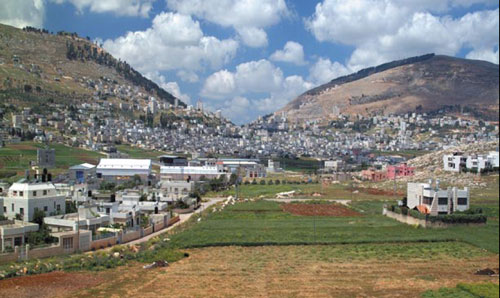
Mt. Gezerim left, Mt. Eyval right, part of Nablus today, photo by James C. Martin

And it will be when God, your God, brings you to the land that you are entering to possess, you must give the brakhah on Mount Gezirim and the kelalah on Mount Evyal.  (Deuteronomy 11:29)

He gives the location of the two hills,1 but he does not say what the people are to recite.2  Then he delivers a long list of laws about religious observance, beginning with a command to destroy the idols and shrines of the Canaanites.3 The implication is that if the Israelites obey these religious laws they will be blessed, and if they disobey they will be cursed.

Consequences of the Choice in Bechukotai

The Israelites are given a similar choice in Leviticus, in the Torah portion Bechukotai (“In my decrees”), when God declares:

If you walk in my decrees and you observe my commands and carry them out, then I will give you rains in their seasons, and the earth will give its produce and the tree of the field will give its fruit.  And threshing will overlap vintage for you, and vintage will overlap sowing. And you will eat your food until you are sated, and you will dwell in safety in your land.  (Leviticus/Vayikra 26:3-5)

The passage continues by listing more blessings that will ensue if the Israelites obey God including the absence of dangerous wild beasts and human enemies in the land, victory in battle abroad, fertility and population increase, and the presence of God’s dwelling-place.  Although God does not use the word brakhah, all of these benefits are standard blessings except for:

I will set my dwelling-place in your midst, and I will not vomit you out.  And I will walk around in your midst, and I will be your God, and you will be my people.  (Leviticus 26:11-12)

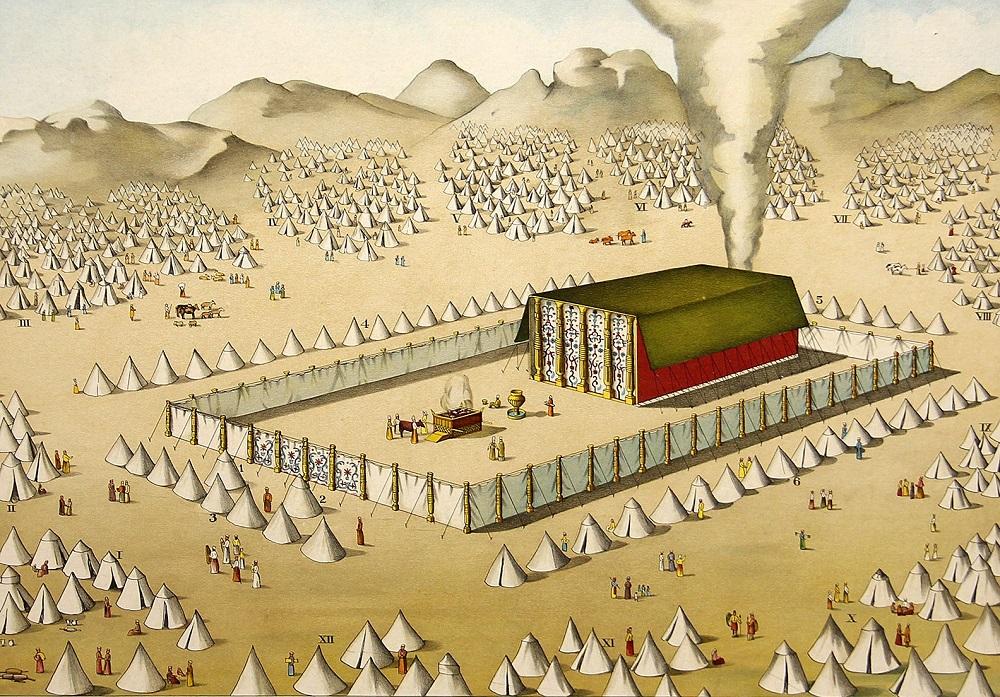
Tent of Meeting, Collectie Nederland

The dwelling-place of God is the Tent of Meeting in Exodus through Joshua, and the temple in Jerusalem from 1 Kings on.  But the promise to walk around among the Israelites implies God will constantly be present.

After the blessings, God lists curses.

But if you do not pay attention to me and you do not follow all these commands … I for my part will do this to you: I will appoint terror over you, tuberculosis, and fever, wearing out eyes and wearing away vitality, and you will sow seed for nothing; your enemies will eat it.  I will set my face against you and you will be beaten by your enemies, and those who hate you will rule over you … (Leviticus 26:14, 16-17)

Although God does not use one of the words for “curse” here, the usual curses in the Torah also focus on sickness, famine, and subjugation to enemies.

In the portion Bechukotai God says that if, after these disasters, the Israelites still disobey God, there will be a severe drought.  If the drought is not enough to make the people obedient, God will afflict them with wild beasts that kill children and livestock, starvation, subjugation, panic, and deportation to enemy nations.4

Both the blessings and the curses in Bechukotai are introduced by the word “if” (im, אִם).  If the Israelites obey God, then they will be collectively rewarded with prosperity, fertility, safety, and God’s sanctuary.  If they do not obey God, then they will be collectively punished with starvation, sickness, danger, and exile.

These blessings and curses apply to the Israelites as a whole; the word I translate above as “you” is consistently in the plural.  Individual exceptions are not addressed.  And, as usual in the Torah, no reference is made to any reward or punishment after death.  People experience blessings and curses only during their lives.

Consequences of the Choice in Re-eih

Moses may have similar blessings and curses in mind in this week’s portion, Re-eih.  But some commentators have noticed that in Re-eih the statement about the brakhah uses the word “asher” in place of the usual word “im” (if).

The brakhah: asher you pay attention to the commands of God, your god, that I am commanding you today.  And the kelalah: im you do not pay attention to the commands of  God, your God …  (Deuteronomy 11:27-28)

asher (אֲשֶׁר) = that.

The implication might be that paying attention to God’s rules is in itself a blessing.  If so, this is a new kind of blessing, absent from the choice between blessings and curses in Bechukotai.5

An 18th-century C.E. commentary called Or HaChayim explained: “Hearkening to G’d’s commandments is perceived as a pleasurable experience by itself.  It helps the soul to feel ‘alive’ …  Whenever someone who studies Torah gains an understanding of what the Torah has in mind he experiences a physical and spiritual sense of wellbeing.  He owes G’d a debt of gratitude for affording him such pleasure.  There is no need to add that such a person cannot demand a reward from G’d for having allowed him to experience such joy.”6

19th-century commentator S.R. Hirsch reached a similar conclusion, although he interpreted the blessing as that you obey God’s rules.  “The observance of God’s commandments is in itself part of the blessing. … The spiritual and moral act of faithfully observing the Torah constitutes in itself a blessed advancement of our whole being; hence, each time we carry out a mitzvah, we bring blessing upon ourselves.”7

Perhaps just as a kelalah is a diminishment, a brakhah is an enlargement.  Those who choose to pay attention to God may be enlarged materially, with blessings of prosperity, fertility, etc.; or spiritually, with the blessing of an expansive and joyful soul.

This points to another meaning of the presence of God’s dwelling-place in the list of blessings in Bechukotai.  Regardless of whether there is a temple or not, God will be present among the people who pay attention to God’s words and live by them.  This kind of presence is indeed an enlargement.


If you live in a community of people who make bad choices, you will inevitably suffer for their mistakes and misdeeds.  In a material sense, you will be cursed.  Nevertheless if you, personally, choose to do the right thing, you will receive the blessing of becoming a better and more joyful person.8

Thus virtue becomes its own reward.

(I posted an earlier version of this essay in 2012.)

  1. Deuteronomy 11:30, near the ancient town of Shekhem. See my post Ki Tavo: Cursing Yourself.
  2. The formula for the recital comes later, in Deuteronomy 27:11-28:48.
  3. Deuteronomy 12:1-31.
  4. Leviticus 26:18-33, followed by: And those of you remaining, I will bring despair into your heart in the lands of your enemies. And you will pursue the sound of leaves being blown away, and you will flee as if you were fleeing from the sword, and they will fall when there are none pursuing.  And you will become lost among the nations, and the land of your enemies will eat you up.”  (Leviticus 26:36-37)  (This description could be based on the Assyrian conquest of the northern kingdom of Israel in the 8th century B.C.E., with its mass deportations.)
  5. It is also absent from the Torah’s third and final list of blessings and curses, Deuteronomy 28:1-48.
  6. Rabbi Chayim ben Moshe ibn Attar, Or HaChayim, translated in sefaria.org.
  7. Rabbi Samson Raphael Hirsch, The Hirsch Chumash: Sefer Devarim, translated by Daniel Haberman, Feldheim Publishers, Jerusalem, 231 on 11:27.
  8. In some parts of the bible (which was, after all, written down by fallible humans), the God-character demands actions that are not ethical. Paying attention to the bible should include discerning which commands are divinely inspired ethical principles.