
How do you know whether to believe someone who claims to receive supernatural messages?
This question appears in two different Torah portions in the book of Deuteronomy, Re-eih (this week’s portion) and Shoftim (next week’s portion)—with different answers.
The prophet Moshe (“Moses” in English) speaks to his people one last time before he dies and the Israelites cross the Jordan River to begin the conquest of Canaan. His speech takes up almost all of the book of Deuteronomy. Moshe repeatedly urges the Israelites to obey all the laws which he received from God and passed on to them. He also warns them to shun anything that has to do with Canaanite religious practices. But he does not rule out future Israelite prophets. Instead, he warns the Israelites—twice—not to listen to false prophets.
Signs and wonders
This week’s Torah portion, Re-eih (Deuteronomy 11:26-16:17), introduces the subject of false prophets right after a reminder not to worship Canaanite gods1 a reminder not to add (or subtract) anything from God’s laws as given to Moshe.2
Moshe assumes that when new prophets make themselves known, they will prove they are really prophets by making a prediction that immediately comes true.
When there arises in your midst a prophet or a dreamer of dreams, and he gives you an ot or a mofeit—and it comes about, the ot or the mofeit of which he spoke to you— (Deuteronomy/Devarim 13:2-3)
ot (אוֹת) = a sign; a mark.
mofeit (מוֹפֵת) = an omen; a wonder.
Most commentators follow Ramban’s clarification of the terms ot and mofeit in this passage:
“For when a prophet comes and says ‘The following [natural] matter is to represent something which is to take place’ that is termed an ot (a sign) … A mofeit (a wonder), on the other hand, applies to something novel which the prophet does before us, making some change in the natural order of the world …”3
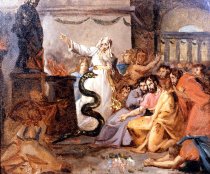
An example of a wonder is when God tells Moshe and his brother Aharon (“Aaron” in English): “When Pharaoh speaks to you, saying: ‘Give us your mofeit!’ then you will say to Aharon: ‘Take your staff and cast it down in front of Pharaoh! It will become a serpent.” (Exodus 7:9) He does, and the wonder occurs.
According to the Jerusalem Talmud, “If a prophet starts to prophesy, one listens to him if he gives a sign or miracle; otherwise one does not listen to him.”4
Furthermore, the sign or wonder must occur soon after the prophet has declared it. The Baal haTurim wrote: ““He would predict that the “sign” was something that would occur in short order and when it did, it would establish his credibility. … The word mofeit refers to something supernatural that this impostor performs in the presence of all his listeners immediately, again in order to establish his credibility as having contact with the supernatural.”5
A prophet who has already established his or her6 credibility on a previous occasion does not need to keep producing more signs or wonders. However, Bachya ben Asher wrote, “If a single detail of what the claimant promised did not materialize, it is certain that he is not a prophet.”7
Except, wrote Bachya ben Asher, “if he will foretell a disaster in the future, and the disaster does not occur, this does not mean that he is a fraud. … When prophets predict disasters which do not occur, one does not suspect them, but attributes this to other causes, primarily that the people [who were] warned of the disaster had repented. After all, the whole purpose of the prophet’s mission is to cause people to return to God in penitence.”8
Forbidden message
The second criterion the Torah portion Re-eih gives for believing a prophet has to do with the content of the prophesy.
—and [if] it comes about, the ot or the mofeit of which he spoke to you, [and if he was] saying: “Let us walk after other gods—whom you have not known—and let us serve them,”—you must not listen to the words of that prophet or to that dreamer of dreams …” (Deuteronomy 13:3-4)
“Said R. Yose the Galilean: ‘See how far the verse goes to meet the intentions of the idolaters and grant them dominion; even if they halt the sun, moon, stars and constellations in their courses, hearken not to them!’”9
Apparently it is safe to believe in prophets who establish credibility and then tell the Israelites to do something that is consistent with the laws of the Torah. According to Tze-enah Ure-enah: “When he gives you great signs and wonders, he may have done this by magic. However, when a prophet says to you that you should fulfill the commandments, … then you may follow him, since he acted as a prophet and is still pious and does not follow his desires.”10
However, any prophet who tells people to serve other gods is urging them to violate Torah law. Rambam wrote:
“Therefore, if a prophet should arise and perform signs and great miracles and endeavour to controvert the prophecy of Moses our teacher, we may not hearken to him and we may be sure that those signs were performed through trickery and sorcery.”11
Hirsch added: “In any event, not only permitting idolatry, but also abolishing one of the [commands] of the Torah, is beyond the authority of a prophet …”12
Testing and omniscience
Then why does God let the false prophet’s signoccur? And why does God let a false prophet perform a supernatural wonder? The Torah answers:
… because God, your God, is testing you, to know: Is there love for God, your God, in all your mind and all your being? (Deuteronomy 13:4)
The implication is that God is not omniscient, and does not know whether a person will continue to cling to God when the “facts” seem to support the prophet who rejects God. Throughout the Hebrew Bible, God’s knowledge is vast, but does not include what will happen in the future. The prophecies God gives to true prophets only predict what will happen if people do not change their ways.
Furthermore, the God of the Hebrew Bible has to make a special effort to find out what is going on inside human minds. Even Psalm 139, which says “you understand my purpose from afar” also begs: “Examine me, God, and know my mind; test me, and know my thoughts!”13
Even in the Middle Ages, not all rabbinic commentators believed God is omniscient regarding human thoughts.14 But those who were dedicated to the belief that God is omniscient were determined to find reasons why God would test people’s love for God. Wouldn’t God already know?
Rashbam wrote that the purpose of God’s test is to give people an opportunity to “accumulate merits in God’s books. Refusing to believe such false prophets is in itself a good deed.”15
Others claimed that the purpose of God’s test is to show the rest of the world how much the Israelites love God. Rambam phrased it this way:
“… know that God intends thereby to prove to the nations how firmly you believe in the truth of God’s word, and how well you have comprehended the true Essence of God; that you cannot be misled by any tempter to corrupt your faith in God. Your religion will then afford a guidance to all who seek the truth, and of all religions man will choose that which is so firmly established that it is not shaken by the performance of a miracle.”16
Whether God is omniscient or not, this verse assumes that God has the power (and interest, and attention to details) to prevent a false prophet’s prediction about a sign or wonder from coming true.
Death penalty
The Torah portion continues with Moshe’s declaration that the Israelites must follow, revere, obey, listen to, serve, and cling to only their own God.17
Then comes the penalty for being a false prophet.
And that prophet or that dreamer of dreams you must put to death, because he has spoken defection against God, your God … to drive you away from the way that God, your God, commanded you to walk in. Then you will burn out the evil from your midst! (Deuteronomy 13:6)
Chayim ibn Attar explained that the death penalty applies to such a prophet “even though he himself had not insisted that the people engage in idolatry, but had left the decision up to them and to their interpretation of the miracle’s meaning. Although the people themselves had freely decided to engage in worship of such a deity, the ‘prophet’ is still guilty …”18
Persuading others to worship another god in addition to the God of Israel always deserves the death penalty, according to the Torah portion Re-eih. The next few verses say:If your brother, your mother’s son, or your son, or your daughter, or the wife of your bosom, or your friend who is like your own soul, entices you in secret, saying, “Come let us worship other gods” … then you must stone him to death with stones, because he sought to drive you away from God, your God … and all Israel will hear and be afraid, and they will not continue do like this evil thing in your midst! (Deuteronomy 13:7, 13:11-12)
Some people today follow more than one religion, finding them all compatible with an underlying spirituality. If their religions refer to a god, they assume it is the same god going by different names.
This concept would be unthinkable to the scribes who wrote the Hebrew Bible. In their worldview, all other people’s gods are anathema. Whether the God whose name is Y-H-V-H is the only god, the best god, or the God of Israel, all Israelites and eventually all human beings must serve only Y-H-V-H.
But who can we trust to tell us what God wants? See next week’s post: Shoftim & Jeremiah: False Prophets, Part 2.
- Deuteronomy 12:29-31.
- Deuteronomy 13:1.
- Ramban is the acronym of 13th-century Rabbi Moshe ben Nachman, a.k.a. Nachmanides. Translation in www.sefaria.org.
- Talmud Yerushalmi, Sanhedrin 11:6:3, translated by Rabbi Adin Even-Israel Steinsaltz in the William Davidson Talmud, www.sefaria.org.
- Rabbi Jacob ben Asher (c. 1269 – c. 1343), known as Ba’al haTurim, Tur HaArokh, translation in www.sefaria.org.
- Four female prophets are named in the Hebrew Bible: Miriam (Exodus 15:20), Devorah (Judges 4:4), Chuldah (2 Kings 22:14), and No-adyah (Nehemiah 6:14).
- 14th century rabbi Bachya ben Asher, translation in www.sefaria.org.
- Ibid.
- Sifra, c.250 – c.350 CE, quoted in Nehama Leibowitz, Studies in Devarim, translated by Aryeh Newman, The World Zionist Organization, 1980, p. 127.
- Tze-enah Ure-enah, 17th century Yiddish commentary, translation in www.sefaria.org.
- Rambam (acronym of Rabbi Moshe Maimon, a.k.a. Maimonides), Mishneh Torah, translation in Leibowitz, ibid., p. 131.
- 19th-century rabbi Samson Raphael Hirsch, The Hirsch Chumash: Sefer Devarim, translated by Daniel Haberman, Feldheim Publishers, Jerusalem, 2009, p. 275.
- Psalm 139:2 and 23.
- E.g. Avraham ibn Daud, 12th century, or Ralbag (Rabbi Levi ben Gershon), 14th century.
- Rashbam (acronym of 12th-century rabbi Shmuel ben Meir), translation in www.sefaria.org.
- Rambam/Maimonides, The Guide for the Perplexed, translated by M. Friedlander, Dover Publications, New York, 1956, Part III ch. 24, p. 304.
- Deuteronomy 13:5.
- 18th-century rabbi Chayim ibn Attar, Or Hachayim, translation in www.sefaria.org.

 Questioning Torah
One thought on “Re-eih: False Prophets, Part 1”