
Deuteronomy is reasonable name for the fifth book of the bible, since it comes from a Greek word meaning “second law”, and this book does repeat laws given in Exodus, Leviticus, and Numbers, with some innovations. This book is named Devarim in the Hebrew canon. The Jewish tradition names each of the five books of the Torah proper, and each Torah portion in each book, by picking out the most important word in the first sentence.
The book of Deuteronomy/Devarim—and this week’s Torah portion, Devarim (Deuteronomy 1:1-3:22)—begins:
These are the devarim that Moshe diber to all Israel at [the place] across the Jordan … (Deuteronomy 1:1)
devarim (דְּבָרִים) = words; affairs, things. (From the root verb davar, דָּבַר = spoke.)
diber (דִּבִֶּר) = he spoke. (A form of the verb davar.)
Devarim is an apt title for the book, which consists entirely of speeches by Moshe (“Moses” in English)—except for the final chapter, which describes his death. Moshe recounts the journey of the Israelites from Mount Sinai to the east bank of the Jordan River, issues many laws, and utters a warning poem and a prophecy before he dies.
Before Moshe begins to speak, the text appears to specify where he is addressing the Israelites. But the words that appear to be placenames are either invented, or located far away.
These are the words that Moshe spoke to all Israel at [the place] across the Jordan in the wilderness, on the steppe, in front of Suf, between Paran and Tofel, and Lavan and Chatzerot and Di Zahav. (Deuteronomy 1:1)
At the end of the book of Numbers/Bemidbar, the Israelites are indeed camped on the east bank of the Jordan River, in what might be called a wilderness now that the Israelites have killed the local population. (See my post Matot: Killing the Innocent.) The area is indeed a steppe, a dry plain, although Ha-Aravah (הָעֲרָבָה = the steppe) is a placename for a flat valley to the south, between the Dead Sea and the Gulf of Aqaba.
But the rest of the sentence seems to be using the wrong words.
Far away places
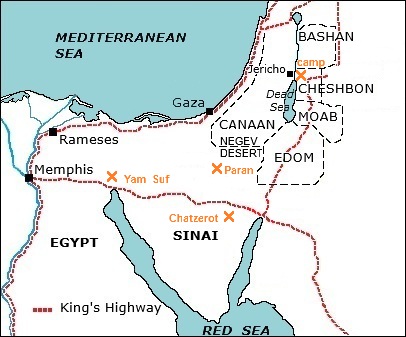
Suf (סוּף) = reeds. The word suf is only used as a placename in Yam Suf, the Sea of Reeds. The Torah uses this name for two bodies of water. One is where God splits the sea with an east wind, the Israelites cross, and the Egyptian chariot unit drowns in Exodus 14:21-30. Commentators do not agree on the exact location of this miracle, but it is somewhere between Egypt and the Sinai Peninsula—and therefore more than 400 miles (640 km) from the Jordan.
The other Yam Suf is between Edom and the Gulf of Aqaba, and the Israelites take the road past it when they leave Paran and head into the wilderness in Numbers 14:18. It would have been about 150 miles (477 km) from the east bank of the Jordan.
Paran (פָּארָן) = the name of an arid wilderness in or near the Negev Desert. The Israelites are camped there in Numbers 12:16-13:3 when Moshe sends twelve scouts north into Canaan. But this border is more than 200 miles (250 km) from the Jordan.
Chatzerot (חַצֵרֺת) = farms; courtyards. The Israelites move their camp to a place called Chatzerot in Numbers 11:35, on their journey from Mount Sinai to Paran.
And although Yam Suf, Paran, and Chatzerot are placenames, the three places are nowhere near the east side of the Jordan River.
Chizkuni explained: “In other words, the things Moses was about to speak to the Israelites here, he had already spoken to them about in the various places …”1
But this solution assumes that Tofel, Lavan, and Di Zahav are also the names of places on the Israelites’ journey from Mount Sinai to the Jordan River—even though they are not mentioned as placenames anywhere else in the Hebrew Bible.
Symbolic places
One traditional line of commentary, starting with Targum Onkelos in the first century C.E., considers the list from Suf to Di Zahav a reminder of the times when the Israelites made God angry during their wanderings in the wilderness.
According to Sifrei Devarim, circa 200 CE, the first reminder comes before the word Suf. The word for steppe (aravah) “teaches that he rebuked them for their behavior on the steppes of Moab … where the people whored with the daughters of Moab.”2
The steppe where the Israelites are actually camped is the place where many Israelite men engaged in sex with the Moabites and bowed down to their god in Numbers 25:1-3; God was enraged.
In Sifrei Devarim Rabbi Yehudah declares that the subsequent names in Deuteronomy 1:1 refer to ten “trials” when the Israelites rejected God during their 40 years in the wilderness: “Two at the [Reed] Sea, two at the waters [of Marah], two regarding the manna, two regarding the quail, and one regarding the scouts in the wasteland of Paran.”3
This does not even add up to ten. And there is no further explanation. A later book, Avot DeRabbi Natan, attempts to connect these ten trials with the words Suf through Di Zahav, but only four of the explanations make sense:
“Suf: because they rebelled at the Red Sea.” [They accused Moshe of taking them out of Egypt to die in the wilderness in Exodus 14:10-12]
“Between Paran: in the episode of the spies …” [The twelve scouts returned to that campsite and reported that Canaan was impossible to conquer; the Israelites decided to go back to Egypt in Numbers 13:28-14:4]
“… And Chatzerot: in the matter of the quails.” [The people whined that they wanted meat instead of manna, and God sent a plague of quails while they were camped at Kivrot Hataavah in Numbers 11:4-6, 11:31-34, After burying the victims, they moved to Chatzerot in Numbers 11:35. Avot DeRabbi Natan does not mention that at Chatzerot Miriam and Aaron spoke against Moses on account of his wife, and God punished Miriam.]
“… And Di-zahav: Aaronsaid to them, ‘Sufficient unto you is this sin of the gold which you provided for the calf’.”4
Di Zahav (דִּ זָהָב) = enough gold. (Dai, דַּי = enough, sufficiency, necessary supply.)
An earlier Talmudic book provides a better explanation of Di Zahav: “The school of Rabbi Yannai said: Moses said before the Holy One, Blessed be He: Master of the Universe, because of the gold and silver that You lavished upon the Jewish people during the exodus from Egypt until they said enough [dai], this wealth caused the Jewish people to fashion for themselves gods of gold. The combination of wealth and leisure left them open to a transgression of that sort.”5
Not places at all
Hebrew has no capital letters to indicate that a word is a proper name. The letter nun, נ, is only occasionally added to an ordinary word to make it a placename. Furthermore, rabbis added diacritical marks (nikkudim) for vowel sounds to the Torah text only during the 7th to 10th centuries C.E., in what became the Masoretic text. For about a thousand years before that, the book of Deuteronomy/Devarim was only written without nikkudim, so there were many more homographs (words that have the same spelling but mean different things).
There is a long tradition in the commentary of changing a word’s vowels and reinterpreting a verse accordingly. Here are some alternatives for the mysterious six words in Deuteronomy 1:1:
Suf (סוּף) = reed, reeds. Sof (סוֹף) = end.
Paran (פָּארָן) = an area in or south of the Negev. Pa-eir (פָּאֵר) = to glorify.
Tofel (תֺּפֶל) = (unknown). Tafal (תָּפַל) = talked nonsense, was silly. Tafeil (תָּפֵל) = whitewash, mud-plaster; something insipid or worthless.
Lavan (לָבָן) = white; whitening, cleaning.
Chatzerot (חַצֵרֺת) = farming villages, courtyards.
Di Zahav (דִּ זָהָב) = (unknown). Dai Zahav (זָהָב דַּי) = enough gold.
Thus the first sentence of Deuteronomy could be legitimately translated with all of the apparent placenames as common nouns or verbs:
These are the words that Moses spoke to all Israel on the other side of the Jordan, in the wilderness, in the steppe, in front of an end, between glorifying and whitewashing, and whiteness and farm villages and enough gold. (Deuteronomy 1:1)
Moshe and the Israelites confront an end. His end is on the east bank of the Jordan, where he will soon die. When the Israelites cross the river, their journey from Egypt to the “promised land” will end, and the conquest will begin.
Should Moshe speak words that glorify Canaan, the land of milk and honey, in order to increase their desire to cross over? Or would that be whitewashing the hard reality that they will have to fight battles for the land? Should he describe the country as white and clean? Full of farm villages? A place where everyone can earn enough gold?
He does not. Instead Moshe begins his speech with God’s instruction to leave Mount Sinai, head north, and take possession of Canaan. As he proceeds, Moshe says nothing about the land of Canaan, but he does remind the Israelites that God will make sure they win the coming battles with the Canaanites.
Their campsite on the east bank of the Jordan was part of the kingdom of Cheshbon, which the Israelites recently conquered. Moshe tells them that God ordered the battle for Cheshbon, saying:
“This day I will start to put the terror of you and the awe of you upon the peoples under all the heavens, so that when they hear reports of you, they will quake and writhe before you!” (Deuteronomy 2:25)
Moshe dwells on the complete conquest of Cheshbon, and then the kingdom of Bashan to the north. This week’s Torah portion concludes with Moshe saying:
“Your eyes have seen everything that God, your God, did to those two kings. Thus will God do to all the kingdoms that you are passing through! You must not be afraid of them, because God, your God, is the one who does battle for you!” (Deuteronomy 3:21-22)
If the first verse of Devarim sets a scene in which Moshe’s leadership of the Israelites is at an end, and he is prepared to glorify Canaan, then his spoken words indicate that he has decided to glorify God instead, emphasizing that God will grant the Israelites victory.
- Chizkuni, 13th century, translation in www.sefaria.org.
- Sifrei Devarim 1:12, circa 200 CE, translated by Marty Jaffee, 2015, in www.sefaria.org.
- Sifrei Devarim 1:18, ibid.
- Avot DeRabbi Natan 34:1, circa 650-950 CE, translation in www.sefaria.org.
- Talmud Bavli, Sanhedrin 102a, Steinsaltz translation in www.sefaria.org.


