
Two hundred years ago in the United States, only single women could inherit and own property. As soon as they married, all of their property belonged to their husbands, who could do as they pleased with it. The first state that changed this law was New York in 1848.
In Israelite society during most of the first millennium B.C.E., even single women could not inherit property. Women owned only their clothing, jewelry, and other personal items. An unmarried woman was, in effect, the property of her father or nearest male relative; a married woman was the property of her husband.
Ilan summarized: “The basic assumption of the law is that women, rather than owning property, are in themselves a form of property.”1
The man who was the head of the household controlled all the family property (women, slaves, livestock, and land).2 When a man died, his property automatically passed to his sons, who were then responsible for supporting their mother and unmarried sisters.
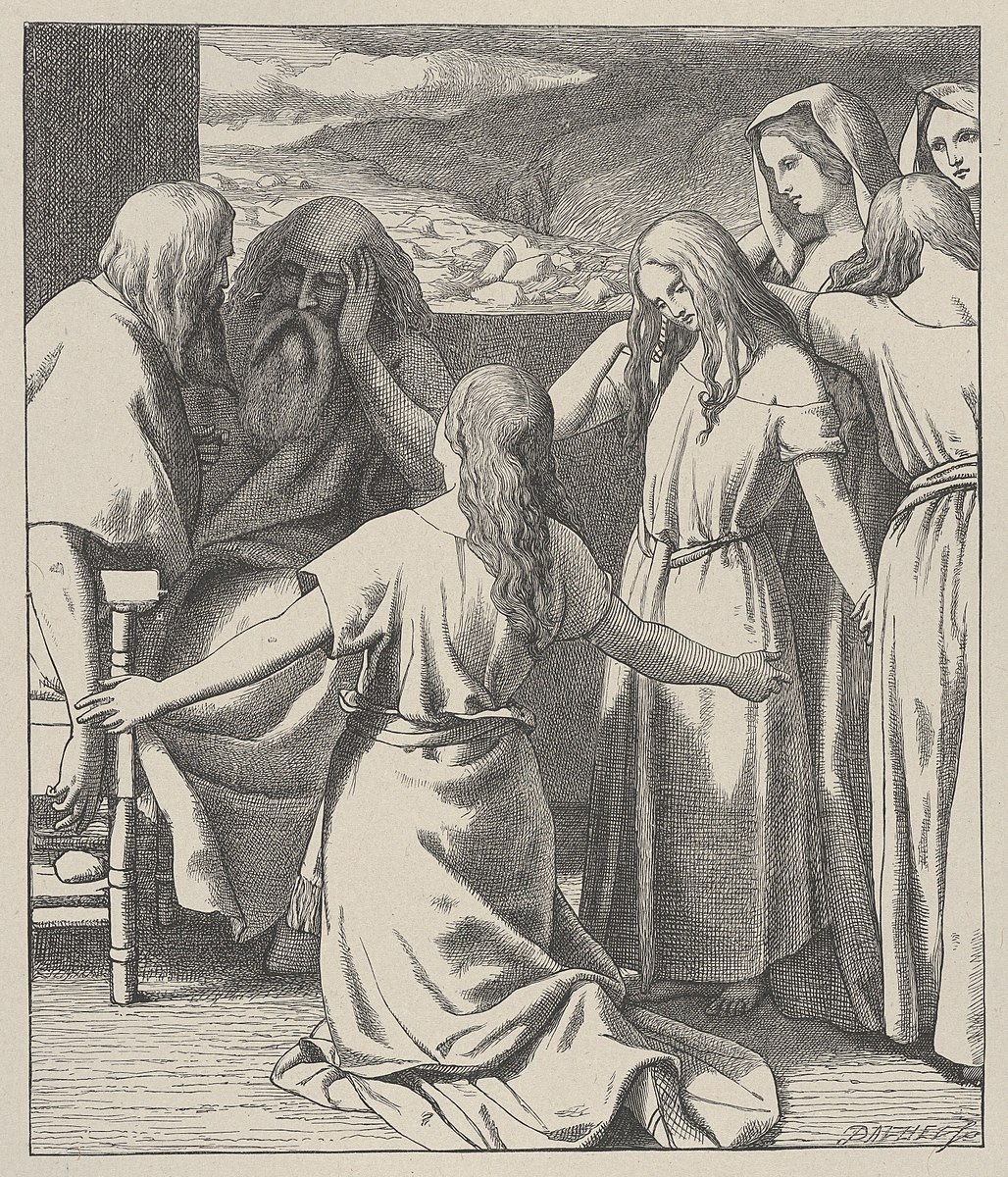
Under this system, what happened to a man’s daughters if he died without leaving a son?
The five daughters of Tzelafechad raise this question in this week’s Torah portion, Pinchas (Numbers 25:10-30:1).
Moshe (“Moses” in English) has just taken a census that will be the basis for distributing land in Canaan. The census counts all the men in the twelve tribes who are 20 and older (excluding the Levites, who will be neither soldiers nor landowners). Once the men have conquered the “promised land” across the Jordan, a lottery will give one region of Canaan to each tribe; an area within that region to each clan in the tribe; and an individual plot of land within that area to each family in the clan.
The total count is 601,730 Israelite (but not Levite) men. All but two of the men are under the age of 60, since the Israelites have completed the 40 years of wandering in the wilderness that God decreed after they refused to cross the southern border of Canaan and begin the conquest.
For God had said to them: “They will definitely die in the wilderness.” And not one of them remained, except for Caleb son of Yefuneh and Joshua son of Nun. (Numbers 26:65)
Caleb and Joshua were the only two scouts who had urged the Israelites to go up and conquer Canaan. Their reward is that they will lead now the conquest of Canaan, and receive their own land to be passed down through their families.
The very next verse is:
Then they came forward, the daughters of Tzelafechad … And the names of his daughters were Maḥlah, Noah, and Ḥaglah, and Milkah, and Tirzah. And they stood in front of Moshe, and Elazar the Priest, and the chieftains, and the whole assembly, at the entrance of the Tent of Meeting, saying… (Numbers 27:1-2)
The five daughters of Tzelafechad, from the tribe of Menasheh, make their request in the most public place possible, with a multitude of witnesses. Presumably one of the five women is the spokesperson, but the Torah reports their claim as if they were all speaking simultaneously. They say:
“Our father died in the wilderness. And he was not among the community that assembled against God, in the community of Koraḥ. Instead, he died for his own guilt, and he did not have sons.” (Numbers 27: 3)
In other words, Tzelafechad died like all the other Israelite men during the 40 years of imposed wandering. He had not participated in any additional challenge to authority, such as Korach’s rebellion. Therefore his family has as much right to land in Canaan as the family of any other Israelite man of his generation. But his family consists of only women.
After establishing this, the five women make their request.
“Why should the sheim of our father be taken away from the midst of his clan because he has no son? Give us landed property in the midst of our father’s brothers!” (Numbers 27:4)
sheim (שֵׁם) = name; reputation, posthumous renown.
If the five daughters of Tzelafechad had had a brother, he would have been counted in the census, and assigned land in Canaan after the conquest. He would then have supported his sisters until he had married them off. His plot of land would be passed down to his own son or sons, and on through the male line forever.
But since Tzelafechad had no sons, there is no provision for his five daughters.
The problem
Until the Israelites cross the Jordan River, the five sisters can presumably continue tending their father’s cattle and eating manna from God. But after the conquest of Canaan, the Israelites will be dependent on farming. If the women own a plot of land in Canaan, they can support themselves. If they do not, their only option is to attach themselves to men with land—either by marrying them, or by becoming their slaves.
And if they were eager to marry, they would have done so while their father was alive.
Rather than grimly accepting a situation they find unacceptable, Tzelafechad’s daughters bring their case to Moshe. According to Munk, “They were motivated to seek justice by their confidence that Hashem’s [God’s] love is not like a father’s love. A father may prefer his sons to his daughters, but the Creator loves us all equally. His mercy extends to all of His creatures.”3
Imagine five people who grew up in the paradigm of patriarchal society deciding that women should count as independent adults with the right to own land without male supervision! This idea was too radical for Israelite society at the time. I can imagine the five sisters making their plans in hushed undertones, so nobody would overhear them. They agreed to limit their claim to cases in which there was no male head of household. And they agreed to ask for land not for themselves, but to perpetuate their father’s name.
For the sake of a name
This is the same rationale that the book of Deuteronomy gives for a “Levirate marriage”:
When brothers dwell together and one of them dies, and has no son, it should not happen that the wife of the dead one goes outside [in marriage] to a strange man; her brother-in-law should enter upon her and take her for himself as a wife … And it will be that the firstborn son that she bears will be established under the name of his dead brother. Then his name [the dead brother’s] will not be blotted out from Israel. (Deuteronomy 25:5-6)
Presumably a Levirate marriage is impossible in the case of Tzelafechad, either because he had no brother, or because his wife predeceased him. Nevetheless, his five daughters claim a share of land in Canaan for a legally respectable reason: so that his name will not be blotted out. Future genealogies will include the name of Tzelafechad, and his descendants will remember him.4
Perpetuating the family name was a persuasive rationale for a legal court consisting entirely of men. (See my post Pinchas: Tribal Loyalty, Part 1.) It was also a persuasive rationale for male commentators up to the 20th century, who praised the daughters of Tzelafechad for making their father’s sheim a priority. For example, in the 19th century Hirsch wrote: “…the extraordinary opportunity for its perpetuation presented by the apportionment of the Land according to families and houses will be lost, and his name will cease to be remembered.”5
Despite the need to perpetuate a man’s name, Moshe feels uncertain about the case. There is no precedent for women inheriting property from their fathers.
And Moshe brought their case forward in front of God. (Numbers 27:5)
How many portions
And God spoke to Moshe, saying: “The daughters of Tzelafechad spoke correctly! You must definitely assign them landed property of nachalah in the midst of their father’s brothers; and you must transfer the nachalah of their father to them.” (Numbers 27:6-7)
nachalah (נַחֲלָה) = inheritance, hereditary possession
After approving the claim of the five sisters to land in Canaan, God has two alternatives: giving them five plots of land in Canaan, as if each woman had been counted like a man in the census; or giving all five sisters a single plot of land in Canaan, as if their deceased father had been counted in the census.
By saying “you must transfer the nachalah of their father to them” God opts for the second choice. Only the inheritance of one man, their father Tzelafechad, will be assigned to them.
Hirsch pointed out: “Had Tzelafechad left five sons instead of five daughters, these five sons—like their cousins—would first have received five portions.”6
Instead, Ibn Ezra wrote, “What he [Tzelafechad] should have received, they shall receive.”7
At this point, the daughters of Tzelafechad have won the right to one man’s plot of land in Canaan. But if they were men, they would receive five times as much land.
Next generation
Will they get to pass their land down to their own children, if they have any? The answer can be deduced from the general rule God gives Moshe:
“And you will speak to the Israelites, saying: When any man dies and does not have a son, then you will transfer his nachalah to his daughter. And if he has no daughter, then you will assign his nachalah to his brothers. And if he has no brothers, then you will assign his nachalah to his father’s brothers. And if his father has no brothers, then you will assign his nachalah to his blood-relative that is nearest to him from his clan, and he will take possession of it. And it will be a legal decree for the Israelites, as God commanded Moshe.” (Numbers 27:8-11)
In other words, a woman only inherits land when she is the daughter of a man who died without a son. In all other cases, the property goes to the nearest male relative. If a daughter who inherits has only daughters, the land reverts to the nearest male relative. And the man’s wife does not inherit anything.
(Only in the first century B.C.E. was the bride-price, a payment from the groom to the bride’s father, replaced with the ketubah, a document which ensured property for the wife if the husband died or divorced her.)
Won or lost?
Do the five daughters of Tzelafeḥad win their case?
One feminist commentary says yes:
“One notes two striking features of the story. First, disenfranchised women successfully confront an unjust system and propose a more equitable law. Second, God approves of their proposal and formulates it as a new law, one that enables other women as well to inherit land in certain circumstances. As unmarried women whose father had died, the five daughters represent the least powerful members of the community. Yet they dare challenge the tradition and call for change when the tradition is unjust. In the end, their proposal becomes God’s Torah.”10
Another feminist commentary says no:
“However, the discriminatory character of the definite new ruling is still apparent. It does not assume that daughters, as a rule, share in their father’s estate. Furthermore, the ruling is clear-cut. If a legislator will, in the future, wish to incorporate women as full heirs, he will be going against the specific words of Scripture, which qualify their legal rights in the area of inheritance.”11
Because of the restriction on inheritance by daughters in this week’s Torah portion, rabbis after the fall of the second temple in 70 C.E. recommended that a father give his daughter a “deed of gift” to part of his property while he was still alive. This granted her an independent means of support even though her brother inherited everything else. But, Ilan pointed out, it did not give her equal rights.
“Any property a woman may come to own in her own right depends entirely on the goodwill of her father who can, if he wishes, write her a deed of gift and make her economically independent. If no such goodwill exists, however, the woman remains dependent on others throughout her life …”12
Suppose an unmarried woman did acquire property, either by Torah law because she had no brothers, or by a deed of gift from an enlightened father. Then who owned it if she got married? This question is addressed in next week’s double Torah portion. Look for my next post, Masey: Do Women Count? Part 2.
- Tal Ilan, “The Daughters of Zelophehad and Women’s Inheritance”, Exodus to Deuteronomy: The Feminist Companion to the Bible (Second Series), ed. by Athalya Brenner, Sheffield Academic Press, Sheffield, England, 2000, p. 176.
- Proverbs 31:16 says a superlative wife not only runs a successful business out of her home, but “she sets her mind on a field and she takes it”. But even if she purchased a field, her husband would hold all legal rights to it.
- Rabbi Elie Munk, The Call of the Torah: Bamidbar, translated by E.S. Maser, Mesorah Publications Ltd., New York, 1994, p. 333.
- Sifrei Bamidbar and Sifrei Devarim, two midrashic commentaries from circa 200 C.E., claim that the word sheim in reference to both Tzelafechad and Levirate marriage means a bequest, and offspring to receive the bequest.
- 19th-century rabbi Samson Raphael Hirsch, The Hirsch Chumash: Bamidbar, translated by Daniel Haberman, Feldheim Publishers, Jerusalem, 2007, p. 551.
- Ibid., p. 554.
- 12th century rabbi Abraham Ibn Ezra, translation in www.sefaria.org.
- 14th-century rabbi Bachya ben Asher, translation in www.sefaria.org.
- The Torah: A Women’s Commentary, ed. by Tamara Cohn Eskenazi & Andrea Weiss, New York, NY: URJ Press, 2007, reprinted in www.sefaria.org.
- Ibid.
- Ilan, ibid., p. 181.
- Ibid., p. 186.


One thought on “Pinchas: Do Women Count? Part 1”