The Israelites were enslaved in Egypt, and their God brought them out to freedom and led them to a new home in the land of Canaan. This is the plot summary of the books of Exodus and Numbers, the theme of the spring holiday of Passover, and the foundational story of the Jewish people.
No other population in the Ancient Near East had a foundational story with themes of enslavement, liberation, or emigration.
Pesach (פֶּסַח), “Passover” in English, begins this Wednesday. Even Jews who never set foot inside a synagogue will gather for a seder (סֵדֶר = order) one or more evenings during the seven or eight days of the holiday.1
Observance in Exodus
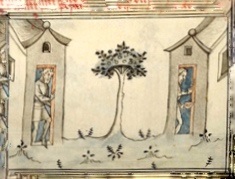
The holiday of Pesach is rooted in the Torah portion Bo in the book of Exodus (Exodus 10:1-13:6). It is spring when God is just about to afflict Egypt with the tenth and final plague: the death of firstborn sons, even the pharaoh’s. But God will spare the firstborn sons of the Israelites, as long as they follow instructions. Every Israelite household must slaughter a one-year-old lamb or goat on the 14th day of the month. They must catch its blood in a basin, dip a branch of oregano in it,2 and daub blood on the frame around their door: the two doorposts and the lintel. Because, God explains:
“And the blood will be a sign for you on the houses where you are. I will see the blood, ufasachti you, and there will not be a blow of destruction for you, when I strike in the land of Egypt.” (Exodus 12:13)
ufasachti (וּפָסַחְתִּי) = and I will skip. (A form of the verb pasach, פָּסַח = skip, hop, limp. This is also the source of the name of the festival, Pesach.)
The Israelites must roast the lamb and eat it inside their house on the fateful night, along with matzah and bitter herbs. And they must eat quickly, standing up, with their robes hiked up and girded, their sandals on their feet, and their staffs in their hands.3 Not an easy task!
Then God decrees that every spring from then on, the Israelites must celebrate the holiday of Pesach, Skipover (“Passover” in the King James translation), by remembering the exodus from Egypt, eating matzah, and not eating leaven for seven days.4
Only later does the Exodus story say that as their firstborn sons died, the Egyptians panicked and urged the Israelites to leave the country at once.
The people picked up their dough before it could become chameitz, their kneading-troughs wrapped up in their cloaks upon their shoulders. … And they baked the dough that they had taken from Egypt in rounds of matzot, for it was not chameitz because they were banished from Egypt and they could not delay, and they had not even prepared provisions for themselves. (Exodus 12:34, 39)
matzot (מַצּוֹת) = plural of matzah; unleavened flatbread.
chameitz (חָמֵץ) = leavened bread, leavened food.
This is a post-hoc explanation of what God had already decreed. (See my post Pesach: Being Unleavened, Part 2.) Why does God call for seven days of matzah in the first place?
Modern scholars suspect that three thousand years ago, before the book of Exodus was written, farmers in Canaan celebrated Chag HaMatzot, the festival of unleavened flatbread. Their barley was ripe and their wheat was ripening. So they threw out their old bread and sourdough starter, and ate matzah made with fresh flour from new grain.
So anyone in Canaan who felt attached to the original, ancient matzah festival got to keep on doing it.
Observance at the first temple
In the book of Deuteronomy, God says that all the Israelites have to slaughter their Pesach lambs at one place: the temple in Jerusalem.5
You must slaughter a pesach for God, your God, [from] flock and herd, in the place where God chooses to settle [God’s] name. You must not eat it with chameitz … (Deuteronomy 16:2-3)
In the long list of laws that God gives Moshe (“Moses” in English) at Mount Sinai is the requirement for a seven-day spring pilgrimage-festival called Chag HaMatzot. When God says: “And they will not appear before me empty-handed.” (Exodus 23:14), the implication is that people will bring offerings to an altar at a central location
Numbers 28:16-25 specifies extra offerings to be burned during the seven days of Pesach, but does not say where they should be burned. Apparently observance of Pesach at the temple in Jerusalem was neglected until the reign of King Yoshiyahu (“Josiah” in English) in the 7th century B.C.E.
Only in the eighteenth year of King Yoshiyahu was this Pesach done for God in Jerusalem. (2 Kings 23:23)
Observance at the second temple
We do not know the details of the Pesach observance at the first temple. But we do know how Pesach was observed in Jerusalem during the second temple period, thanks to the Mishnah Pesachim, a collection of Pesach laws and rabbinic discussions of those laws written by Yehudah HaNasi about a hundred years after the fall of the second temple in 70 C.E.
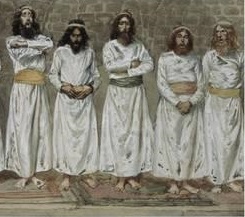
Pesach was one of three pilgrimage festivals, when groups of people came to Jerusalem to make offerings at the temple and celebrate. A group consisted of family members, their slaves if any, and sometimes their friends. For Pesach, the spring pilgrimage festival, they came with lambs or money to buy lambs (or goat kids). The head of each household (or his delegate) brought the animal to the temple courtyard to be slaughtered after the usual afternoon offerings to God were completed. Priests collected the blood of the Pesach lambs or kids in gold and silver basins, and sprinkled it on the altar. Then the people flayed their own animals, hanging them on hooks fixed in the walls. They removed the fatty parts, as in a normal shelamim or wholeness offering, and gave them to priests, who burned them on the altar to make smoke for God. Meanwhile, Levites sang the prescribed psalms.6
The men then brought the sanctified carcasses to their homes (if they lived in Jerusalem), or to the buildings in Jerusalem where they had rented rooms or parts of large halls (if they had come from out of town). As darkness fell, each one roasted his carcass whole, on a spit in an oven inside the building.7 Then his group (including slaves) feasted on the roasted meat with matzah and bitter herbs, as in the book of Exodus.
They also drank wine diluted with hot water.8 But they probably did not stand upright while eating, as God instructs the Israelites to do on their last night in Egypt. The Mishnah Pesachim notes that only the first Pesach required daubing blood on doorframes or eating in haste.9 We do not know whether the Israelites during the time of the second temple sat or reclined as they ate.
Home observance in the mishnah
The tenth and final chapter of Mishnah Pesachim describes how to observe Pesach at home, in a ritual resembling a symposium held in an upper-class Roman home. In a symposium, the host and guests lay on their left sides on couches, propped up on their left elbows, while servants waited on them. As they ate and drank, they followed a traditional format for discussing a topic chosen by the host.
Jews observing Pesach always had the same discussion topic, the liberation of the Israelites in the Torah portion Bo in Exodus. For them, certain foods (such as matzah and bitter herbs) were required, and others (any grain product with leaven were forbidden. Few Jews had servants waiting on them, but if they did, their servants ate and drank the same things they did.
Before the Pesach ritual began, Jews were required to search their homes for chameitz by the light of an oil lamp (or candle) and eliminate it before sundown—by eating it, feeding it to animals, selling it to a non-Jew, or burning it.10
Eating roasted meat became optional, since the meat was no longer sanctified at the temple.11 Both the search for chameitz and the option to avoid meat remain today. Many of the other rules for the home Pesach ritual in chapter 10 of Mishnah Pesachim are also observed to this day:

- Reclining on one’s left side, like free and wealthy Romans—except that today we sit in a chair and lean to the left at certain points in the seder, or lean back on a cushion.
- Eating chazeret, matzah, and charoset (a mixture made of fruit and wine). (In the Mishnah, the chazeret or bitter lettuce is dipped in something and eaten first. In today’s Pesach seder, any spring vegetable, called karpas, is dipped in salt water and eaten first. , matzah, and charoset (a mixture made of fruit and wine). (In the Mishnah, the chazeret or bitter lettuce is dipped in something and eaten first. In today’s Pesach seder, any spring vegetable, called karpas, is dipped in salt water and eaten first. Lettuce is still made available, to be used as the karpas or as a bitter herb.)
- Drinking four cups of wine.
- Reciting or singing the blessing for the holiday with the blessing for the first cup.
- A son asking his father, after the second cup is poured, why this night is different from all other nights. (The Mishnah gives the father three prompts if the son does not come up with his own questions: why we dip twice, why we eat only matzah, and why we eat only meat roasted in fire. Today four questions are prescribed for the youngest child: why we eat only matzah, why we eat bitter herbs, why we dip our vegetables twice, and why we recline.)
- Telling the story of the exodus from Egypt, starting with “An Aramean …” (See my post Ki Tavo: A Perishing Aramean on this ambiguous verse, Deuteronomy 26:5.)
- Quoting Rabbi Gamliel: “Whoever does not make mention of these three things on Pesach does not fulfill his duty. And these are they: the pesach, matzah, and bitter herbs. The pesach because God passed over the houses of our fathers in Egypt. The matzah because our fathers were redeemed from Egypt. The bitter herb because the Egyptians embittered the lives of our fathers in Egypt. In every generation a man is obligated to regard himself as though he personally had gone forth from Egypt, because it is said, “And you shall tell your son on that day, saying: ‘It is because of that which the Lord did for me when I came forth out of Egypt”12
- Reciting or singing the psalms of the Haleil that were once sung by Levites at the temple for joyful holidays.
- Reciting or singing the blessings after the meal with the third cup of wine.
Additional observances from the first millennium
Mekhilta DeRabbi Yishmael, a midrash on the book of Exodus compiled around 200 C.E., claims there are four types of sons in the story of the exodus from Egypt —the wise son, the wicked son, the simple son, and the son who does not know how to ask. This midrash also prescribes what the father should say to each type of son. To this day, every haggadah (הַגָּדָה = telling: a script with instructions, sayings, and prayers for all the steps of the Pesach seder) includes a version of that midrash.
The books of mishnah led to later rabbinic discussions called the gemara, which were recorded in abbreviated form by around 500 C.E.. The mishnah and gemara together make the complete Talmud, in two versions: Talmud Bavli and Talmud Yerushalmi.13 The gemara in the Talmud Bavli tractate Pesachim includes a few more elements that are found today in every Pesach seder:
- Washing hands twice: once before dipping and eating the karpas, and once before dipping and eating the bitter herbs. (Pesachim 115a-b)
- Reciting Deuteronomy 16:3 about the bread of affliction or poverty. (Pesachim 115b)
- Repeating Rabbi Yochanan’s statement that we eat charoset in remembrance of the mortar used by the Jews for their forced labor in Egypt. (Pesachim 116a)
- Lifting the matzah and the bitter herbs when quoting Rabbi Gamliel. (Pesachim 116b)
- Eating a bit of matzah last, after dessert. (Pesachim 119b-120a)
The gemara in the Talmud Yerushalmi tractate Pesachim 10:1 explains the four cups of wine as corresponding to God’s four promises of redemption in Exodus 6:6-7: “… I will bring you out … I will rescue you … I will redeem you … I will take you …” This explanation is also a standard part of today’s Pesach seder.
But there is a fifth promise of redemption in Exodus 6:8: “And I will bring you into the land …”
Some medieval rabbis connected this with the mention of a fifth cup of wine in the gemara in the Talmud Bavli, Pesachim 118a, arguing that it was not a scribal error, but an indication that a fifth cup should be poured, but not necessarily drunk, since the redemption of the Jews is not yet complete. The fifth cup became known as the cup of Eliyahu (“Elijah” in English), because of the legend that someday that prophet will return to resolve all disputes and to usher in the messiah or messianic age. At our seders today, we always pour a cup of wine for Eliyahu —and open the door briefly in case he shows up.
Additional observances from the second millennium
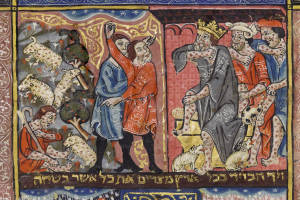
The ten plagues inflicted upon Egypt are naturally part of the story told after the second cup of wine is poured. The custom of removing one drop of wine from the cup for each plague was first mentioned in a Pesach sermon by Rabbi Eleazer of Worms (1176-1238). But it was Rabbi Yirmiyahu Löw (1812-1874) who wrote that we do it in sympathy for the Egyptians, a sentiment found in many a haggadah today.
The first haggadah in the modern sense of a script for every step in the seder, with midrash, may have been the one Rabbi Amram Gaon wrote around 850 C.E.. But thousands of haggadot have been written since then, adding new elements and omitting others. The process continues in the 21st century. This year, for example, some Jews are planning to add an olive to the seder plate exhibited before the ritual begins, to express hope for peace and reconciliation between Israelis and Palestinians.
The celebration of Pesach has gradually changed over three millennia, but every haggadah includes the statement Avadim hayinu: “We were slaves”. Because the underlying purpose of Pesach is to teach the importance of liberation from slavery and oppression. We have needed that message for thousands of years, and we still need it now.
- Pesach lasts seven days in Exodus 12:15-20 and to this day in Israel, but some communities outside Israel celebrate it for eight days.
- See my post Pesach, Metzora, & Chukat: Blood and Oregano.
- Exodus 12:11.
- Exodus 12:14-20.
- See my post Re-eih & Isaiah: Only in Jerusalem.
- Mishnah Pesachim, chapter 5.
- Mishnah Pesachim, chapter 7.
- Ibid.
- Mishnah Pesachim, chapter 9.
- Mishnah Pesachim, chapters 1 and 2.
- Mishnah Pesachim, chapter 4.
- Exodus 13:8.
- Talmud Bavli is the version recorded by rabbis living in Babylon, the city called Bavel in Hebrew. Talmud Yerushalmi is the version recorded during the same period by the rabbis living in Palestine, especially in Jerusalem, the city called Yerushalayim in Hebrew.

 Questioning Torah