Pesach: A History

The Israelites were enslaved in Egypt, and their God brought them out to freedom and led them to a new home in the land of Canaan. This is the plot summary of the books of Exodus and Numbers, the theme of the spring holiday of Passover, and the foundational story of the Jewish people.

No other population in the Ancient Near East had a foundational story with themes of enslavement, liberation, or emigration.

Pesach (פֶּסַח), “Passover” in English, begins this Wednesday. Even Jews who never set foot inside a synagogue will gather for a seder (סֵדֶר = order) one or more evenings during the seven or eight days of the holiday.1

Observance in Exodus
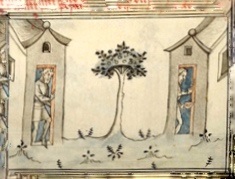
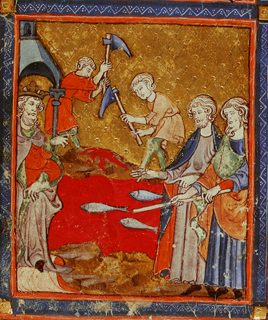
Painting the blood, History Bible, Paris,1390

The holiday of Pesach is rooted in the Torah portion Bo in the book of Exodus (Exodus 10:1-13:6). It is spring when God is just about to afflict Egypt with the tenth and final plague: the death of firstborn sons, even the pharaoh’s. But God will spare the firstborn sons of the Israelites, as long as they follow instructions. Every Israelite household must slaughter a one-year-old lamb or goat on the 14th day of the month. They must catch its blood in a basin, dip a branch of oregano in it,2 and daub blood on the frame around their door: the two doorposts and the lintel. Because, God explains:

“And the blood will be a sign for you on the houses where you are. I will see the blood, ufasachti you, and there will not be a blow of destruction for you, when I strike in the land of Egypt.” (Exodus 12:13)

ufasachti (וּפָסַחְתִּי) = and I will skip. (A form of the verb pasach, פָּסַח = skip, hop, limp. This is also the source of the name of the festival, Pesach.)

The Israelites must roast the lamb and eat it inside their house on the fateful night, along with matzah and bitter herbs. And they must eat quickly, standing up, with their robes hiked up and girded, their sandals on their feet, and their staffs in their hands.3 Not an easy task!

Then God decrees that every spring from then on, the Israelites must celebrate the holiday of Pesach, Skipover (“Passover” in the King James translation), by remembering the exodus from Egypt, eating matzah, and not eating leaven for seven days.4

Only later does the Exodus story say that as their firstborn sons died, the Egyptians panicked and urged the Israelites to leave the country at once.

The people picked up their dough before it could become chameitz, their kneading-troughs wrapped up in their cloaks upon their shoulders. … And they baked the dough that they had taken from Egypt in rounds of matzot, for it was not chameitz because they were banished from Egypt and they could not delay, and they had not even prepared provisions for themselves. (Exodus 12:34, 39)

matzot (מַצּוֹת) = plural of matzah; unleavened flatbread.

chameitz (חָמֵץ) = leavened bread, leavened food.

This is a post-hoc explanation of what God had already decreed. (See my post Pesach: Being Unleavened, Part 2.) Why does God call for seven days of matzah in the first place?

Modern scholars suspect that three thousand years ago, before the book of Exodus was written, farmers in Canaan celebrated Chag HaMatzot, the festival of unleavened flatbread. Their barley was ripe and their wheat was ripening. So they threw out their old bread and sourdough starter, and ate matzah made with fresh flour from new grain.

So anyone in Canaan who felt attached to the original, ancient matzah festival got to keep on doing it.

Observance at the first temple

In the book of Deuteronomy, God says that all the Israelites have to slaughter their Pesach lambs at one place: the temple in Jerusalem.5

You must slaughter a pesach for God, your God, [from] flock and herd, in the place where God chooses to settle [God’s] name. You must not eat it with chameitz (Deuteronomy 16:2-3)

In the long list of laws that God gives Moshe (“Moses” in English) at Mount Sinai is the requirement for a seven-day spring pilgrimage-festival called Chag HaMatzot. When God says: “And they will not appear before me empty-handed.” (Exodus 23:14), the implication is that people will bring offerings to an altar at a central location

Numbers 28:16-25 specifies extra offerings to be burned during the seven days of Pesach, but does not say where they should be burned. Apparently observance of Pesach at the temple in Jerusalem was neglected until the reign of King Yoshiyahu (“Josiah” in English) in the 7th century B.C.E.

Only in the eighteenth year of King Yoshiyahu was this Pesach done for God in Jerusalem. (2 Kings 23:23)

Observance at the second temple

We do not know the details of the Pesach observance at the first temple. But we do know how Pesach was observed in Jerusalem during the second temple period, thanks to the Mishnah Pesachim, a collection of Pesach laws and rabbinic discussions of those laws written by Yehudah HaNasi about a hundred years after the fall of the second temple in 70 C.E.
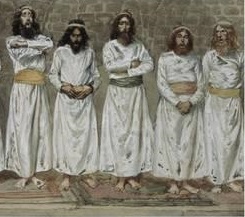
Levites singing, by James Tissot, ca. 1900

Pesach was one of three pilgrimage festivals, when groups of people came to Jerusalem to make offerings at the temple and celebrate. A group consisted of family members, their slaves if any, and sometimes their friends. For Pesach, the spring pilgrimage festival, they came with lambs or money to buy lambs (or goat kids). The head of each household (or his delegate) brought the animal to the temple courtyard to be slaughtered after the usual afternoon offerings to God were completed. Priests collected the blood of the Pesach lambs or kids in gold and silver basins, and sprinkled it on the altar. Then the people flayed their own animals, hanging them on hooks fixed in the walls. They removed the fatty parts, as in a normal shelamim or wholeness offering, and gave them to priests, who burned them on the altar to make smoke for God. Meanwhile, Levites sang the prescribed psalms.6

The men then brought the sanctified carcasses to their homes (if they lived in Jerusalem), or to the buildings in Jerusalem where they had rented rooms or parts of large halls (if they had come from out of town). As darkness fell, each one roasted his carcass whole, on a spit in an oven inside the building.7 Then his group (including slaves) feasted on the roasted meat with matzah and bitter herbs, as in the book of Exodus.

They also drank wine diluted with hot water.8 But they probably did not stand upright while eating, as God instructs the Israelites to do on their last night in Egypt. The Mishnah Pesachim notes that only the first Pesach required daubing blood on doorframes or eating in haste.9 We do not know whether the Israelites during the time of the second temple sat or reclined as they ate.

Home observance in the mishnah

The tenth and final chapter of Mishnah Pesachim describes how to observe Pesach at home, in a ritual resembling a symposium held in an upper-class Roman home. In a symposium, the host and guests lay on their left sides on couches, propped up on their left elbows, while servants waited on them. As they ate and drank, they followed a traditional format for discussing a topic chosen by the host.

Jews observing Pesach always had the same discussion topic, the liberation of the Israelites in the Torah portion Bo in Exodus. For them, certain foods (such as matzah and bitter herbs) were required, and others (any grain product with leaven were forbidden. Few Jews had servants waiting on them, but if they did, their servants ate and drank the same things they did.

Before the Pesach ritual began, Jews were required to search their homes for chameitz by the light of an oil lamp (or candle) and eliminate it before sundown—by eating it, feeding it to animals, selling it to a non-Jew, or burning it.10

Eating roasted meat became optional, since the meat was no longer sanctified at the temple.11 Both the search for chameitz and the option to avoid meat remain today. Many of the other rules for the home Pesach ritual in chapter 10 of Mishnah Pesachim are also observed to this day:

Chazeret, now usually Romaine
  • Reclining on one’s left side, like free and wealthy Romans—except that today we sit in a chair and lean to the left at certain points in the seder, or lean back on a cushion.
  • Eating chazeret, matzah, and charoset (a mixture made of fruit and wine). (In the Mishnah, the chazeret or bitter lettuce is dipped in something and eaten first. In today’s Pesach seder, any spring vegetable, called karpas, is dipped in salt water and eaten first. , matzah, and charoset (a mixture made of fruit and wine). (In the Mishnah, the chazeret or bitter lettuce is dipped in something and eaten first. In today’s Pesach seder, any spring vegetable, called karpas, is dipped in salt water and eaten first. Lettuce is still made available, to be used as the karpas or as a bitter herb.)
  • Drinking four cups of wine.
  • Reciting or singing the blessing for the holiday with the blessing for the first cup.
  • A son asking his father, after the second cup is poured, why this night is different from all other nights. (The Mishnah gives the father three prompts if the son does not come up with his own questions: why we dip twice, why we eat only matzah, and why we eat only meat roasted in fire. Today four questions are prescribed for the youngest child: why we eat only matzah, why we eat bitter herbs, why we dip our vegetables twice, and why we recline.)
  • Telling the story of the exodus from Egypt, starting with “An Aramean …” (See my post Ki Tavo: A Perishing Aramean on this ambiguous verse, Deuteronomy 26:5.)
  • Quoting Rabbi Gamliel: “Whoever does not make mention of these three things on Pesach does not fulfill his duty. And these are they: the pesach, matzah, and bitter herbs. The pesach because God passed over the houses of our fathers in Egypt. The matzah because our fathers were redeemed from Egypt. The bitter herb because the Egyptians embittered the lives of our fathers in Egypt. In every generation a man is obligated to regard himself as though he personally had gone forth from Egypt, because it is said, “And you shall tell your son on that day, saying: ‘It is because of that which the Lord did for me when I came forth out of Egypt”12
  • Reciting or singing the psalms of the Haleil that were once sung by Levites at the temple for joyful holidays.
  • Reciting or singing the blessings after the meal with the third cup of wine.

Additional observances from the first millennium

Mekhilta DeRabbi Yishmael, a midrash on the book of Exodus compiled around 200 C.E., claims there are four types of sons in the story of the exodus from Egypt —the wise son, the wicked son, the simple son, and the son who does not know how to ask. This midrash also prescribes what the father should say to each type of son. To this day, every haggadah (הַגָּדָה = telling: a script with instructions, sayings, and prayers for all the steps of the Pesach seder) includes a version of that midrash.

The books of mishnah led to later rabbinic discussions called the gemara, which were recorded in abbreviated form by around 500 C.E.. The mishnah and gemara together make the complete Talmud, in two versions: Talmud Bavli and Talmud Yerushalmi.13 The gemara in the Talmud Bavli tractate Pesachim includes a few more elements that are found today in every Pesach seder:

  • Washing hands twice: once before dipping and eating the karpas, and once before dipping and eating the bitter herbs. (Pesachim 115a-b)
  • Reciting Deuteronomy 16:3 about the bread of affliction or poverty. (Pesachim 115b)
  • Repeating Rabbi Yochanan’s statement that we eat charoset in remembrance of the mortar used by the Jews for their forced labor in Egypt. (Pesachim 116a)
  • Lifting the matzah and the bitter herbs when quoting Rabbi Gamliel. (Pesachim 116b)
  • Eating a bit of matzah last, after dessert. (Pesachim 119b-120a)

The gemara in the Talmud Yerushalmi tractate Pesachim 10:1 explains the four cups of wine as corresponding to God’s four promises of redemption in Exodus 6:6-7: “… I will bring you out … I will rescue you … I will redeem you … I will take you …” This explanation is also a standard part of today’s Pesach seder.  

But there is a fifth promise of redemption in Exodus 6:8: “And I will bring you into the land …”

Some medieval rabbis connected this with the mention of a fifth cup of wine in the gemara in the Talmud Bavli, Pesachim 118a, arguing that it was not a scribal error, but an indication that a fifth cup should be poured, but not necessarily drunk, since the redemption of the Jews is not yet complete. The fifth cup became known as the cup of Eliyahu (“Elijah” in English), because of the legend that someday that prophet will return to resolve all disputes and to usher in the messiah or messianic age. At our seders today, we always pour a cup of wine for Eliyahu —and open the door briefly in case he shows up.

Additional observances from the second millennium
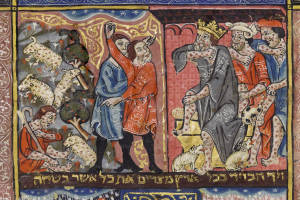
Two plagues illustrated in the Rylands Haggadah, 17th century Spain

The ten plagues inflicted upon Egypt are naturally part of the story told after the second cup of wine is poured. The custom of removing one drop of wine from the cup for each plague was first mentioned in a Pesach sermon by Rabbi Eleazer of Worms (1176-1238). But it was Rabbi Yirmiyahu Löw (1812-1874) who wrote that we do it in sympathy for the Egyptians, a sentiment found in many a haggadah today.

The first haggadah in the modern sense of a script for every step in the seder, with midrash, may have been the one Rabbi Amram Gaon wrote around 850 C.E.. But thousands of haggadot have been written since then, adding new elements and omitting others. The process continues in the 21st century. This year, for example, some Jews are planning to add an olive to the seder plate exhibited before the ritual begins, to express hope for peace and reconciliation between Israelis and Palestinians.


The celebration of Pesach has gradually changed over three millennia, but every haggadah includes the statement Avadim hayinu: “We were slaves”. Because the underlying purpose of Pesach is to teach the importance of liberation from slavery and oppression. We have needed that message for thousands of years, and we still need it now.


  1. Pesach lasts seven days in Exodus 12:15-20 and to this day in Israel, but some communities outside Israel celebrate it for eight days.
  2. See my post Pesach, Metzora, & Chukat: Blood and Oregano.
  3. Exodus 12:11.
  4. Exodus 12:14-20.
  5. See my post Re-eih & Isaiah: Only in Jerusalem.
  6. Mishnah Pesachim, chapter 5.
  7. Mishnah Pesachim, chapter 7.
  8. Ibid.
  9. Mishnah Pesachim, chapter 9.
  10. Mishnah Pesachim, chapters 1 and 2.
  11. Mishnah Pesachim, chapter 4.
  12. Exodus 13:8.
  13. Talmud Bavli is the version recorded by rabbis living in Babylon, the city called Bavel in Hebrew. Talmud Yerushalmi is the version recorded during the same period by the rabbis living in Palestine, especially in Jerusalem, the city called Yerushalayim in Hebrew.
Va-eira & Bo; Psalm 78 & Psalm 105: Responding to Miracles

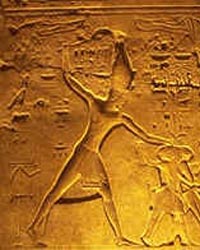
Pharaoh Merneptah subjugating Semites

(One of a series of posts comparing ideas in the book of Exodus/Shemot with related ideas in the book of Psalms.)

It takes two Torah portions (Va-eira this week and Bo next week) to describe the miraculous “plagues” that force the Pharaoh to let the enslaved Israelites walk out of Egypt. Two psalms, Psalm 78 and Psalm 105, offer briefer versions of the story. And the festival of Passover/Pesach tells the story of how God rescued the Israelites from Egypt in such detail that the seder (“order”;  ritual retelling of the story) can last half the night.

In the Torah portion Va-eira, God lays out the plan to Moses:

Therefore say to the children of Israel: “I am God, and I will bring you out from under the burden of Egypt, and I will rescue you from enslavement, and I will redeem you with an outstretched arm and with great acts of judgement. And I will take you to be My people, and I will be your god. And you will yada that I am God, your god, who is taking you out from under the burden of Egypt. (Exodus/Shemot 6:6-7)

yada (יָדַע) = know, realize, recognize, become acquainted, come to understand through direct experience. (Yada is the root verb. The Hebrew here uses the form viyda-etem (וִידַעְתֶּם) = and you will yada.)

Why does God inflict “great acts of judgement” on Egypt? The first reason given in this week’s Torah portion is so that the Israelites will yada God.

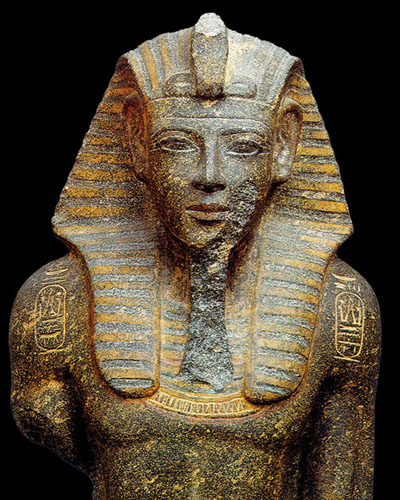
Pharaoh Mernptah, son of Ramses II
Pharaoh Merneptah, son of Ramses II

The second reason is so that the Pharaoh and the Egyptians will yada God, or at least recognize God’s existence and power:

And Egypt, they will yada that I am God when I stretch out my hand against Egypt and I bring out the children of Israel from their midst. (Exodus 7:5)

(The Hebrew in this verse uses form veyade-u (וְיָדְעוּ) = and they will yada.)

How many plagues does it take before both the Israelites and the Egyptians yada God?  Anyone who has participated in a Passover seder, spilling a drop of wine for each plague, knows the answer is ten. And in the book of Exodus/Shemot God does indeed inflict ten miracles on Egypt—the first seven in Va-eira (And I appeared), and the last three in Bo (Come).

However, the ten plagues are described in two different voices. Any close reader of  Va-eira and Bo, even in translation, notices points where the narrative suddenly stops and restarts, rephrasing a bit of the story that has already been told. Scholars examining the language itself have discovered that two stories of the plagues are woven together (but not seamlessly).

Both strands have something to say about the plagues of blood, frogs, and death of the firstborn. The other seven plagues are described by one strand or the other, not both. Maybe each of the two original stories had fewer than ten plagues. Or maybe the redactor(s) who combined the two stories decided to give both descriptions of three plagues, but chose only their favorite descriptions for the other seven.

Psalms 78 and 105 report fewer than ten plagues, and the order is different than in Exodus.

plagues-table

What accounts for these differences? We cannot identify any of these accounts as the original story. At least one strand in the composite story in Exodus was probably written in the 8th century B.C.E. Psalm 78 may have been written as early as the 10th century B.C.E., soon after the first Israelite temple was built in Jerusalem. Psalm 105 could have been written any time after that, maybe before the book of Exodus, maybe as late as the period of the second temple. Probably the story of God’s miracles in Egypt was familiar to all the authors before they began to write down their own versions.

The two psalms and the composite in Exodus borrow language from each other, not only using the same words for the plagues, but sharing pieces of description. For example, Exodus describes the plague of blood this way:

Plague of Blood, Golden Haggadah, c. 1320 Spain

…and he raised the staff and he struck the water that was in the Nile before the eyes of Pharaoh and his courtiers, and all the waters of the Nile turned into blood. And the fish that were in the Nile died. And the Nile stank and the Egyptians were not able to drink water from the Nile, and there was blood throughout the land of Egypt. (Exodus 7:20-21)

Psalm 78 focuses on the lack of drinking water:

And [God] turned into blood the Nile and its streams;

            They could not drink. (Psalm 78:34)

Psalm 105 focuses on the loss of an important food:

           [God] turned their waters into blood

                        And it made their fish die. (Psalm 105:39)

Whether the story is expanded in the book of Exodus, or contracted in a psalm, it is always offered as a decisive example of God’s miracles on behalf of the Israelites.

In the book of Exodus, the purpose of the plagues is to get both the Israelites and the Egyptians to yada God. But the Torah portion Bo also gives instructions several times for the earliest Passover rituals, which were conducted about 3,000 years ago. The purpose of these rituals is to remember the story of the exodus.

This day shall be for you for remembrance, and you shall celebrate it as a festival for God, through [all] your generations. It is a decree forever: you shall celebrate it. (Exodus 12:14)

While Exodus only calls for remembering the story of God’s miracles in Egypt, Psalms 78 and 105 tell the story in order to motivate the Israelites of Judah to action.

Psalms 78 hopes that if the Israelites remember the miracles God did for them, then they will stop backsliding, trust God, and obey God’s rules.

           What we have listened to, and we yada,

                      and our ancestors recounted to us,

           should not be concealed from their descendants,

                      to the last generation recounting

           praises of God and Its strength

                      and Its wonders that It did. (Psalm 78:3-4)

(The Hebrew in verse 3 uses form vaneida-eim (וַנֵּדָעֵם) = and we will yada.)

Why must God’s miracles be recounted to every generation?

           Then they will place their kesel in God,

                      and they will not forget the deeds of God,

                      and they will comply with Its commandments. (Psalm 78:7)

kesel (כֶּסֶל) = conviction, certitude, unwavering belief regardless of other evidence or arguments; folly, stupidity.

The section of Psalm 78 that tells about the miracles God inflicted on Egypt (78:42-51) is not designed to mention every single plague, but rather to bring the story to life in ten short verses. Psalm 78 leaves out the kinim, the shechin, and the darkness, but it adds a few details that are not in Exodus:

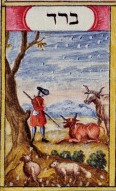
Plague of Hail, Haggadah by Judah Pinchas, 1747 Germany

—that the action happened at Tzoan, a specific place in the Nile Delta. (78:43)

—that the arov, the mixed hordes of vermin, ate the flesh of the Egyptians. (78:45)

—that when God sent hail, Egyptian flocks were hit by lightning. (78:48)

—that the hail killed grapevines and fig trees (important crops in Canaan, but not in Egypt). (78:47)

These additional details would make the story more vivid in the listener’s imagination.

Psalm 105 is less concerned than Psalm 78 about lack of faith and commitment among the people of Judah. I believe its purpose is to whip up enthusiasm for God and the religion among the worshipers at the temple.

           Thank God, call out Its name,

                      hodiyu among the peoples Its deeds!

           Sing to [God], make music to It,

                      consider all Its wonders!

           Revel in the name of Its holiness!

                      Let the heart of those who seek God rejoice! (Psalm 105:1-3)

hodiyu (הוֹדִיעוּ) = make known, inform, announce. (A different form of the root verb yada.)

Rylands Haggadah, 14th century Spain. Left: livestock pestilence. Right: Shechin.

Psalm 105 then tells the story of the people who became Jews, starting with God’s covenant with Abraham and ending with the Israelites’ conquest of part of Canaan. When it describes the plagues, it omits both livestock pestilence and shechin, perhaps because the thought of rashes and boils would depress the congregation.  Or, according to 19th-century rabbi Samson Raphael Hirsch, because diseases do not seem supernatural enough to count as miracles. But Psalm 105 uses some of same vivid details as Psalm 78.

*

Do the stories of God’s miracles in Egypt achieve their purpose?

Direct experience of miracles works in Exodus; both the Israelites and the Egyptians yada—know, realize, and recognize—a powerful god acting on behalf of the Israelites. The instruction to perform a ritual to remember what happened also worked; we have been celebrating Passover for about 3,000 years.

Does the account in Psalm 78 work, leading people to kesel, an unshakeable belief in God, and to a determination to obey God’s rules? I think it would depend on the listener. Some people believe any account that is vivid (like Psalm 78’s selection of details) and comes from an accepted source (such as the temple priests, or a particular news station, or a friend’s e-mail). Other people are skeptics by nature; they examine a story to see if it is logical and how it fits with personal experience and other information. This type of person would probably need direct experience, yada, to achieve kesel and commit themselves to obeying all the rules of the religion.

What about Psalm 105? I believe that an account of past miracles can inspire both kinds of people, especially when it is poetry set to uplifting music. Even natural skeptics can get caught up in singing joyful praise, and leave the temple (or synagogue) with a better attitude toward their God and their religion. And natural believers might be moved to proselytize, following the instruction hodiyu—make known, announce!

The singing of the psalms continued as part of both Jewish and Christian prayer after the fall of the second temple in Jerusalem in 70 C.E. It continues today. But Jewish liturgy concentrates on other psalms. It quotes only one verse from Psalm 78 and fifteen from Psalm 105, none of which are verses addressing the plagues in Egypt.

However, serious-minded Jews study the story of the plagues in the Torah portions Va-eira and Bo every winter, when we reach this time in the cycle of Torah readings. And in the spring many more Jews celebrate Passover, a festival of dramatic rituals, prayers, songs, and stories about how God freed the Israelites from slavery in Egypt.

The haggadah (“the telling”), the book that provides the texts and ritual instructions, includes many quotes from our two Torah portions in Exodus. Psalms 78 and 105 are not traditionally included. In a modern American haggadah, the song “Go Down Moses” usually is.

from an Iraqi haggadah, printed in Vienna 1930

Out of all the stories of God’s miracles in Egypt, I would say Passover is by far the most effective at getting Jews to remember the claim that God created miracles to rescue our people from Egypt. The ritual itself has changed and grown over the millennia, so it can speak to new generations. Even Jews who grew up in families that managed to conduct a boring seder  every year cannot help but remember the symbolic foods, the song that the youngest child must sing, the exodus story, spilling a drop of wine for each of the ten plagues, and hunting for the hidden piece of matzah.

Thus Passover still serves the purpose given in the book of Exodus: remembering the story. Whether we can go further and yada God (as in Exodus), or commit ourselves to kesel (as in Psalm 78), or be moved to joy and a desire to recommend the religion (as in Psalm 105) depends on the individual.

Personally, I have a skeptical nature, and I actively try to avoid kesel—while remaining committed to studying Torah and being a Jew in a liberal sense. But I remember the exodus story every winter when I study it in the Torah, as well as every spring when I participate in Passover. I do not yada the God of the ancient Israelites, but I do yada something I cannot describe that I call God. And when I sing psalms that have uplifting words and melodies, I am indeed moved to joy. I would recommend that to anyone!

Pesach: Isaiah and the Peaceable Kingdom

(Note: I will be traveling during the week of Passover, so I’m publishing my post for April 24-30 ahead of time. This year, the eight days of Passover end on April 30, 2016.)

For the eighth day of Passover/Pesach, the special Torah reading is Deuteronomy 14:22-16:17, which includes directions for observing Passover “so that you will remember the day of your exodus from the land of Egypt all the days of your life”. (See last week’s post, Pesach: The Matzah of Misery.)

The haftarah (the accompanying reading from the Prophets) is Isaiah 10:32-12:6. It mentions Egypt only in Isaiah’s prediction that God will return the Israelites from the far-flung places where they were deported by Assyrian Empire.

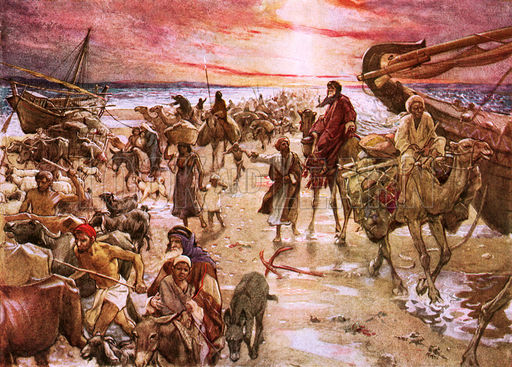
Crossing the Red Sea, by William Hole
Crossing the Red Sea,
by William Hole

God will dry up the tongue of the sea of Egypt, and will wave a hand over the River [Euphrates] with the might of God’s ruach and break it into seven wadis so it can be walked over dry-shod. And it will become a highway for the remainder of God’s people who remained from Assyria, like [the highway] for Israel on the day it went up from the land of Egypt. (Isaiah 11:15-16)

ruach (רוּחַ) = wind (when blowing over water); spirit (when sweeping into a human being).

But the return of the exiled Israelites is only part of Isaiah’s grand vision in this week’s haftarah.

The prophet has been urging King Achaz of Judah to avoid taking sides in the revolt of Aram and the northern kingdom of Israel against the empire of Assyria, which had conquered the two  states during the 8th century B.C.E. Isaiah tells the king of Judah that Aram, Israel, and even Assyria will all disappear in only a few years. God has a three-part plan. First God will eliminate the vast empire of Assyria; then a great and righteous king will arise in Judah; and finally people everywhere will unite in worshiping Judah’s God.

In the ancient Near East, people believed major change came from the top down: from god to king to the people. A great king was required for a civilization to be transformed. So Isaiah prophesies:

A shoot will go out from the stump of Jesse

And a crown from its root will bear fruit.

And a ruach of God will rest upon him,

A ruach of wisdom and insight,

A ruach of counsel and courage,

A ruach of knowledge and awe of God. (Isaiah 11:1-2)

God will inspire a human king, a descendant of King David’s father Jesse, to establish a moral government. Then, Isaiah prophesies, human nature itself will change.

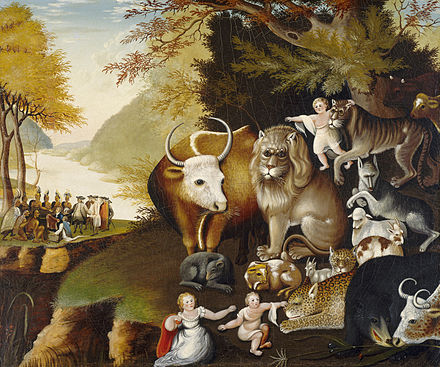
The Peaceable Kingdom by Edward Hicks, 1826 version (William Penn's peace treaty in background)
The Peaceable Kingdom by Edward Hicks, 1826 version
(William Penn’s peace treaty in background)

A wolf will dwell with a young ram,

And a leopard will lie down with a goat kid,

And a calf and a young lion will pasture together,

And a little boy will be leading them.

And a heifer and a she-bear will graze

And they will let their young ones lie down together.

And a lion, like an ox, will eat straw.

A baby will play over a viper’s hole,

And a toddler will put his hand over a snake’s lair. (Isaiah 11:6-8)

In other words, there will be no predators; all animals will be peaceful and non-violent. Judah and the other small countries in the hills of Canaan are like lambs, kids, calves, babies.  But in the future, the wolves, leopards, lions, and bears of great empires will no longer prey on them.

Not only will all peoples live together in peace, but they will all be morally upright and search out the same god.

They will do no evil nor destruction

On all My holy mountain

Because the land will be as filled with seekers of God

As the water covering the sea.

On that day the root of Jesse will be standing

As a banner for peoples.

Nations will come to him with inquiries,

And his haven will be honored.  (Isaiah 11: 9-10)

Isaiah claims that this great king from “the root of Jesse” will arise in just a few years—i.e. right after the reign of King Achaz. Achaz’s son Hezekiah was indeed one of the religious kings praised by the Bible. But after Hezekiah’s reign (~716-697 B.C.E.), people noticed that the rest of Isaiah’s prophecy was no closer to coming true; the empires of Assyria and Egypt continued to squabble over ownership of the lands between them until the Neo-Babylonian Empire became the new top predator.

We are still waiting for world peace. Christianity developed the theory that Isaiah’s righteous king was Jesus, who would return someday to straighten out the world. According to traditional Judaism, we are still waiting for the messiah—or at least for a messianic era without predators or prey.

According to the Torah, the Israelites in Egypt waited 400 years for an opportunity to escape and become a free people, serving only their god.

We have already waited over 2,400 years for Isaiah’s vision to come true. Maybe it’s time to stop praying to an all-powerful God who lives outside the world. Maybe it’s even time to stop waiting for a Moses, a king, a messiah. We need to take action ourselves.

Imagine one individual after another dedicating him-or-her-self to respecting everyone and preying on no one; to avoiding violence; and to seeking the divine in everyone and everything.

May all human beings become filled with the ruach of Isaiah’s inspiration.


Pesach: The Matzah of Misery

“This is the bread of affliction,” we intone during the Passover/Pesach ritual, holding up a piece of matzah. Many Jews feel that just eating this dry unleavened cracker is an affliction—especially if they eat it for the prescribed eight days and eschew real bread, or anything else made with yeast or other leavening.

matzah001

At a traditional Passover seder, we hold up the matzah and say in Aramaic: Ha lachma anya di akhalu avhatana be-ara demitzrayim!  which means: “The bread of misery that our ancestors ate in the land of Egypt!” This phrase is based on one of the Torah portions we read during the week of Passover, Deuteronomy /Devarim 14:22-16:17.

You must not eat with [the meat from the animal sacrifice] anything leavened. Seven days you shall eat with it matzot, the bread of oni, because in haste you went out from the land of Egypt. Thus you shall remember the day of your going out from the land of Egypt all the days of your life. (Deuteronomy/Devarim 16:3)

matzot (מַצּוֹת) = plural of matzah (מַצָּה) = unleavened flatbread made of flour and water only, quickly mixed and baked before any sourdough in the air can act on it.

oni (עֳנִי or עֹנִי) = misery, suffering, humiliation, plight, deprivation. (This noun comes from one of the four root verbs spelled ענה, this one meaning “to stoop down in humiliation, humility, or subjection”.)

The noun oni appears 37 times in the Hebrew Bible, although the passage above is the only one mentioning “bread of oni”. Individuals in the Bible experience oni, misery, because they are unloved, infertile, abused, or deprived of their due. The poor live in a state of oni because they are victimized by a selfish upper class. The Israelites live in oni because they have been conquered by enemy armies—or because they are abused slaves, as in the Passover story.

Kneading bowl in the Egyptian royal bakery
Kneading bowl in Egypt

Why is matzah the bread of oni? The book of Exodus claims that the enslaved Hebrews had to hurry out of Egypt before the dough in their kneading-bowls had time to rise. I find this unconvincing. (See my post Pesach: Being Unleavened, Part 2.)

I think the oni, the misery, came first, and the matzah symbolizes it. Matzah, made out of flour and water paste with nothing interesting added, not even sourdough, serves to remind us of the tedious life of slaves making bricks for Pharaoh.

Matzah, the “bread of oni”, can also remind us of times in the Bible when people live in misery and God sees their oni, stops ignoring them, and acts to improve their situation. I counted 13 occurrences of this motif, as well as additional occasions when God acts after hearing people cry out in their oni.

For example, God tells Moses at the burning bush:

I certainly see the oni of my people who are in Egypt, and I have paid attention to their cry for help in the face of their being hard-pressed, for I know their anguish. … And I have said I will lift them out from the oni of Egypt, to the land of the Canaanites…to a land flowing with milk and honey. (Exodus 3:7, 3:17)

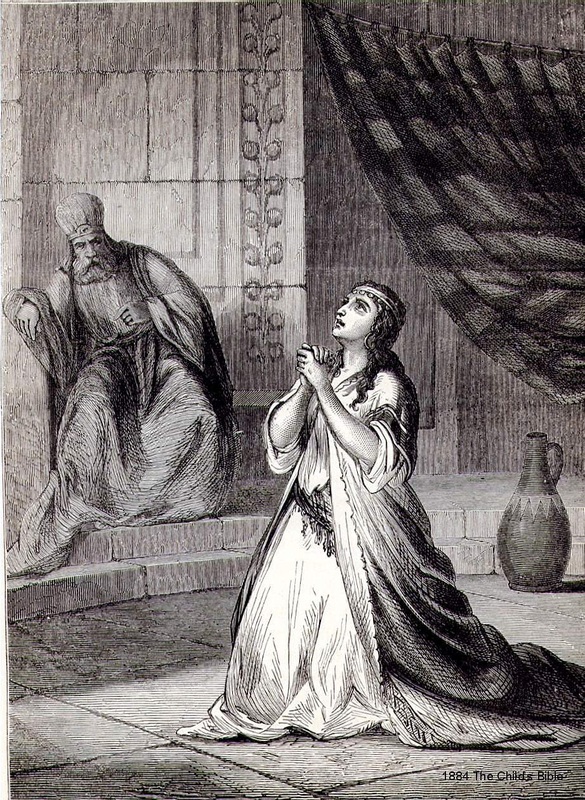
Channah in the Child's Bible 1884
Channah in the Child’s Bible 1884

Sometimes people draw God’s attention to their own oni, hoping that God will then notice it, stop ignoring them, and act. For example, Channah suffers because she is infertile and verbally abused by her husband’s other wife, who has many children.

And she vowed a vow, and she said: God of Armies, if you will really look at the oni of your female-servant, and you remember me and do not ignore me, and you give your female-servant a male child, then I will give him to God for all the days of his life… (1 Samuel 1:11)

The psalms also include pleas to God to notice the singer’s misery and act. For example,

See my oni and my misfortune

And lift off all my wrongdoing. (Psalm 25:18)

May I sing out and may I rejoice in your kindness

Because you see my oni and you know the distress of my soul. (Psalm 31:8)

See my oni and save me

Because your teaching I have not ignored. (Psalm 119:153)

matzah001

Maybe Jews began holding up matzah during the Passover ritual not just to remind themselves of times of deprivation, but also to draw God’s attention to their own oni. To make sure God gets the point, we call the matzah the “bread of oni”. If God sees our misery, pays attention to it, then maybe God will stop ignoring us and do something to improve our lives—the way God freed the slaves in Egypt.

What is your oni this year? What misery is enslaving you? Is it something that you can fix?  Or something that will lift by itself?

Or is it something that you can only be freed from by a divine intervention? If so, what would a true divine intervention be?


Pesach:  Being Unleavened, Part 2

by Melissa Carpenter, maggidah

In the Hebrew Bible, Passover appears to be a conflation of three holidays:

* chag ha-aviv (“festival of the new ears of grain”), a one-day celebration of spring on the 15th of the month that was called Aviv until the Babylonian exile in the sixth century B.C.E, then renamed Nissan. (See Leviticus 2:14.)

lamb 2

* chag ha-matzot (“festival of the unleavened bread”), a seven-day period of refraining from eating, or owning, any leavened food.  This period fell at the beginning of the barley harvest in the spring. (See Exodus 23:15, 34:18.)

* pesach (“skipping over”), a one-day observance in Aviv, in which a lamb or goat kid was sacrificed, and the meat was roasted and eaten in one night.

Some modern scholars speculate that the Torah combines an ancient festival of matzot (when farmers cleared out their old grain products in preparation for the new grain) with an ancient festival of pesach (when shepherds celebrated the spring lambing by sacrificing a lamb and performing a skipping dance)—and then incorporates both spring holidays in the story of the exodus from Egypt.

Thus the special Torah reading for the first day of Passover, Exodus 12:21-51 (in the Torah portion Bo), begins with Moses’ instructions to the Israelites for the night of the tenth and final plague in Egypt: the death of the firstborn.  Each family must slaughter a lamb as a pesach offering, paint the blood on the lintel and doorposts of its home, and stay indoors all night, eating the roasted meat, while God “skips over” the marked houses and kills only the firstborn children of the Egyptians. The Torah adds that the Israelites shall continue to re-enact this ritual every spring.

Then, after describing the final plague and Pharaoh’s command that the Israelites leave at once, the Torah says:

The people picked up their dough before it could become chameitz, their kneading-troughs wrapped up in their cloaks upon their shoulders. …And the Children of Israel journeyed from Ramses to Sukkot… And they baked the dough that they had taken from Mitzrayim in rounds of matzot, because it was not chameitz, because they were banished from Mitzrayim and they could not delay, and they had not even prepared provisions for themselves. (Exodus 12:34, 37, 39)

chameitz (חָמֵץ) = leavened bread, leavened food.

Mitzrayim (מִצְרַיִם) = Egypt.  The dual form —ayim (ַיִם) probably refers to the combined kingdoms of Upper and Lower Egypt. The first three letters, מצר, might be related to the word meitzar (מֵצַר) = narrow strait, constriction, confinement, bondage.

Egyptian kneading trough

I have always found the above explanation of the festival of matzot unconvincing.  If the Israelites normally made leavened bread in Egypt, then they would always have a jar of sourdough starter bubbling in the house.  Why not bring that jar along with a kneading-trough and flour?  The story in the book of Exodus smacks of a post-hoc, invented rationale.

Nevertheless, one of the special Torah readings for intermediate days of the week of Passover, Exodus 13:1-16 (also in the Torah portion Bo), makes the festival of matzot an essential part of the observance of Passover:

Moses said to the people: Remember this day on which you went out from Egypt, from the house of slavery.  For with a strong hand God brought you out from this, and you shall not eat chameitz.  Today you are leaving, in the month of Aviv… and it will happen when God brings you into the land…then you shall serve this service in this month.  Seven days you shall eat matzot, and on the seventh day [will be] a festival for God. Matzot shall be eaten these seven days, and chameitz must not be seen with you, and se-or must not be seen with you in all your borders. And you shall tell your child on that day, saying:  Because of this, God acted for me when I went out from Egypt. (Exodus 13:3-8)

se-or (שְׂאֹר) = sourdough starter; any leavening agent.

Throughout history, religions have connected their new holidays to pre-existing holidays.  Sometimes the only real connection between the new and old holiday seems to be the time of year.  Spring is certainly a good time of year to celebrate both the promise of new grain and the concept of liberation.

But the connection between the festival of matzot and the story of liberation from Egypt may be deeper than that.

In last week’s post, Tzav & Pesach: Being Unleavened, Part 1, I wrote about the symbolic meanings of matzot and chameitz proposed by Philo of Alexandria in the first century C.E. and by Rabbi Raphael Samson Hirsch in the 19th century.

Philo considered how leaven makes bread rise and puff up, like an arrogant person.  He wrote that eating matzot is a reminder of our humility before God.

Hirsch wrote that chameitz is the bread of independence, and matzot the bread of dependence.  Among other arguments, he cited a verse from the special Torah reading for the eighth day of Passover, Deuteronomy 15:19-16:17 (in the Torah portion Re-eih):

Seven days you shall eat matzot, the bread of oni, because in hurried flight you went out from the land of Egypt—so that you shall remember the day of your exodus from the land of Egypt all the days of your life. (Deuteronomy/Devarim 16:3)

oni (עֹנִי) = misery, wretchedness; a state of dependence due to poverty.

By eating matzot in remembrance of our deliverance from slavery, Hirsch argued, we acknowledge that we did not escape from poverty and oppression by our own actions, but only because of God’s actions: the ten plagues or miracles, and the warnings God communicated through Moses.  We rose to the independence represented by chameitz only because God lifted us out of Egypt.

That is as far as Hirsch went.  But I wonder:  Does leaven itself represent one aspect the divine?  What if God is the fermentation in our souls, and in the world, which leads to liberation and expansion?

During Passover we might acknowledge that without the divine spark, we would be as flat as matzah.  We could not escape from Egypt, Mitzrayim, or the constrictions in our own souls. We would be slaves to our genetic predispositions and to all the psychological complexes we have acquired during our lives.

But if the divine spark in our souls bubbles up like the se-or that bubbles up and makes bread rise, and we are inspired with an insight, then we can make different decisions. With a holy insight, we can push open some of the narrow places in our psyches, and expand into a new life of more freedom and independence.

But we cannot change from matzot into chameitz through sheer willpower. It takes a touch of leavening, and that is a gift from God.

matzah001

The festival called Chag ha-Matzot, Pesach, or in English, Passover, lasts for seven days in Israel.  By Jewish tradition, Passover lasts for eight days outside of Israel (to make sure that those who live far away will be observing Passover during all of Israel’s seven days). This year in the diaspora, Passover begins on a Friday evening and ends on a Saturday evening the following week.  That means we will study the special Torah portions for Passover—including the ones in this blog post—for two weeks.

So it will be two weeks before I return to the annual cycle of Torah portions, and post my new thoughts on Shemini, the next Torah portion in the book of Leviticus.

May all my Jewish readers have a happy Passover! And may some divine insight bubble up in everyone during this change of seasons.

Passover: Children of Four Worlds

This week we pause in the yearly cycle of Torah readings to celebrate Passover/Pesach. The Passover ritual celebrates the exodus from Egypt—but not only by telling the story. The seder (“order” or agenda) that has evolved over that last 2,000 years has 13 sections of ritual plus dinner, punctuated by blessing four cups of wine.

To keep track of it all, Jews have a haggadah (“the telling”—plural haggadot), a book to work through during the long evening of ritual. But the old joke applies that wherever you have two Jews you have three opinions, so we keep writing new haggadot, retaining the basic elements but explaining them in new ways.

Some haggadot associate the four cups of wine with the four “worlds” of kabbalah, so that as we bless each cup we ascend one stage closer to God.

The first and lowest world is Assiyah (עֲשִׂיָה) = action. (From the verb asah, עָשָׂה = make, do.) Assiyah is the physical world we operate in. Its symbol is earth.

The second world is Yetzirah (יְצִירָה) = formation. (From the verb yatzar, יָצַר = form, shape.) Yetzirah includes intuitions, dreams, myth, and metaphor. Although the word yetzirah does not mean emotion, it is often associated with emotion because it is non-rational. Its symbol is water.

The third world is Beriah (בְּרִיאָה) = creation. (From the verb bara, בָּרָא= create.) Beriah includes inventing and designing in the stage of abstract ideas. Its symbol is air.

The fourth and highest world is Atzilut (אֲצִילוּת) = emanation. (Probably from the preposition eitzel, אֵצֶל= beside, next to.) The world of Atzilut is undifferentiated divine spirit, at a level we can barely imagine. Its symbol is fire.

Human beings operate in the world of assiyah, and approach awareness of God by rising up through yetzirah and beriah toward atzilut. This is the order in which we drink the four cups of wine on Passover. The fourth cup, representing atzilut, comes at the end of the evening, when we are exhausted and uninhibited.

During the first part of the seder (covered by the first two ritual cups of wine) we build up to the story of the exodus with songs and stories based on the number four, including “the four questions” about why this night is different from all other nights, and the description of four types of children (traditionally “the four sons”).

The four children are based on four passages in the Torah which tell parents what to say when their children express curiosity about Passover:

When your son will ask you in the future, saying: What are the rules and the decrees and the laws that God, our god, commanded you? Then you shall say to your son: We were slaves to Pharaoh in Egypt, and God brought us out from Egypt with a strong hand. (Deuteronomy/Devarim 6:20-21)

A traditional haggadah labels this son “the wise son” because he wants to know all the rules.

And it will happen that your son says to you: What is this service to you? Then you shall say: It is an animal-offering to God, because He pasach over the houses of the children of Israel in Egypt, by dealing a blow to Egypt but rescuing our houses. (Exodus/Shemot 12:26)

pasach (פָּסַח) = limped, skipped. (One possible meaning of the word Pesach is “skip over”.)

Tradition labels this son “the wicked son” on the grounds that he seems uninterested in what Passover might mean to himself.

And it will happen that your son asks you, in the future, saying: What is this? Then you shall say to him: With a strong hand God brought us out from Egypt, from the house of slavery. (Exodus 13:14)

Tradition labels this son “the simple son” because his question is elementary.

The Torah has no fourth question from a son about Passover, so the early rabbis found a fourth question implied in the following verse:

And you shall tell your son that day, saying: Because God did this for me when I went out from Egypt. (Exodus 13:8)

Tradition labels this son “the son who does not know how to ask”.

In an earlier post, I suggested that the four sons could correspond to the four sons of Aaron in the Torah. (See Shemini: Four Sons.)

But we can also look at these four children in terms of the four worlds of kabbalah. Here is the “Four Children” section in the haggadah I wrote this year:

Children of the Four Worlds

 Assiyah:  One kind of child (the so-called “simple son”) asks:  “Mah zot?  What is that?”  This is the child of Assiyah, the world of doing.  Assiyah people are most interested in practical action, the physical senses, and tangible things.

Yetzirah:  Another child (the so-called “wicked son”) asks:  “What does this ritual mean to you?”  This is the child of Yetzirah,the world of intuition, dreams, and metaphors.  Yetzirah people are most interested in personal symbolic meanings. They are introspective and find more truth in the arts than in the sciences.

Beriah:  A third child (the so-called “wise son”) asks:  “What is the meaning of the statutes, laws, and rules which our God has commanded?”  This is the child of Beriah, the world of the intellect.  Beriah people love abstract thinking.

Atzilut:  The fourth kind of child (the so-called “son who does not know how to ask”) is silent.  This is the child of Atzilut, the world of divine emanation, where all forms are aspects of God.  Atzilut people seek a life of mystery, ecstasy, and divine union.

Though every human has a particular strength, all four of these worlds are aspects of being fully human. We fail if we reject one of the worlds and try to exclude it from our lives.

Pause for a few moments and consider silently:  Am I spending too much of my energy in one of the worlds—Assiyah, Yetzirah, Beriah, or Atzilut?  Am I stuck in that world, that approach to life, as if it were an Egypt? Do I need to liberate myself so I can receive the blessings of a different world?