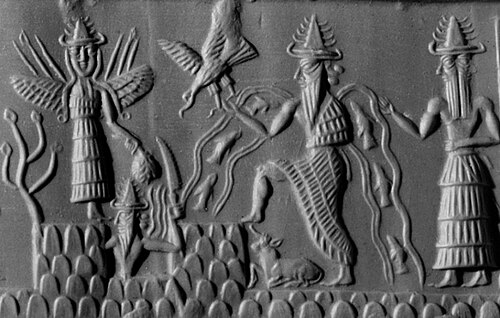
Polytheism was the norm in the Ancient Near East. Throughout the region, people believed there were many gods, and although it was important to worship the god that was the patron of your own territory, you also appealed to other gods affecting your life. These gods and goddesses had vast powers and were not easy to see, but they looked like humans or human-animal hybrids. They felt the full range of human emotions, and acted like humans—eating and drinking, having sex and children, fighting with weapons, and so forth—but on a grand scale.
Most of the Hebrew Bible does not challenge this anthropomorphic polytheism. There are references to other gods besides the God of Israel—inferior gods who must submit to God’s authority.1 Regardless of the existence of other gods, the Israelites are required to worship only their own God.
The books of Deuteronomy2 and Isaiah, however, include clear statements of monotheism.
This week’s haftarah (reading from the Prophets accompanying the Torah portion) is Isaiah 43:21–44:23, a passage from “Second Isaiah” 3 which declares that the God of Israel is the only god there is. But that does not mean that God is an abstract, incorporeal omnipresence with no human functions or body parts.
The haftarah begins by noting that the Israelites have not been making offerings to God. (This provides the rationale for pairing the reading with this week’s Torah portion, Vayikra (Leviticus 1:1-5:26), a procedure manual for four kinds of offerings.4) Then comes a brief statement of monotheism. After that God ridicules people who believe that their hand-made idols are gods.
The sections before and after the declaration of monotheism reveal that the author still has an anthropomorphic view of God.
A dearth of offerings
The haftarah opens with God saying:
This people I formed for myself;
My praise they should declare!
But you have not invoked me, Yaakov,
For you are weary of me, Yisrael. (Isaiah 43:21-22)
In the book of Genesis the ancestor of the Israelites is named Yaakov, “Jacob” in English, and also Yisrael, “Israel” in English. Subsequent biblical books use either of his names to refer to the Israelites as a whole.
What counts as praising and invoking, God explains, is burning edibles into smoke that rises into the skies:
You have not brought me sheep for your complete-burned-offerings
	  And you have not honored me with your animal-slaughters.
I did not burden you with grain-offerings,
	  And I did not make you weary about frankincense.
You have not used silver to buy incense ingredients for me,
	  And you have not hirvitani with the fat of your slaughters.
Instead, you have burdened me with your misdeeds;
	  You have made me weary with your depravities. (Isaiah 43:23-24)
hirvitani (הִרְוִתָנִי) = intoxicated me, sated me with drink. (A form of the verb ravah, רָוַה = drunk one’s fill.)
In other words, God misses “drinking up” the smoke from the fat of the animals sacrificed at the altar. The implication is that God has a throat, and a physical mind (which people in the Ancient Near East located in the organ of the heart) that can become intoxicated.
This week’s Torah portion, Vayikra (which, like Second Isaiah, may also have been written in the 6th century B.C.E.) prescribes the correct procedures for making four kinds of offerings at the altar in front of the temple in Jerusalem. For every kind of offering, it says that God enjoys smelling the smoke.5 The first reference to God’s act of smelling comes at the end of the instructions for sacrificing a bull as a rising offering:
And the sons of Aharon, the priests, will arrange the pieces, the head and the fat, on the wood that is on the fire that is on the altar … and the priest will burn up all of it into smoke at the altar: a rising-offering, a fire-offering, a soothing smellfor God. (Leviticus 1:8-9)
Although later readers of the Hebrew Bible interpreted descriptions of God drinking or smelling as metaphors, it is likely that the authors of both Leviticus and Second Isaiah still thought of God as having a nose and a throat, even though humans could not see them. In this week’s haftarah, God misses smelling the smoke rising up from the altar, and accuses the Israelites of not doing their job.
Yet these Israelites are living in captivity in Babylonia, roughly a thousand miles away from the temple in Jerusalem. Seven verses before the haftarah begins, God promises to redeem them, saying:
For your sake I send to Babylon,
          and I will take down her bars [across the doors], all of them! (Isaiah 43:14)
How can God blame the Israelites for failing to burn offerings at the temple? Perhaps Second Isaiah agrees with the book of Ezekiel, also written in the 6th century B.C.E. during the Babylonian captivity, which criticizes the negligence and idol worship of the priests in Jerusalem before the Babylonians destroyed Jerusalem. Or perhaps Second Isaiah is pointing out that even in Babylon, the Israelites could at least burn incense for their God.
After commenting in this week’s haftarah that the Israelites have not been burdened with offerings, but nevertheless have burdened God with their misdeeds, God adds:
I, I am the one who wipes away your transgressions for my own sake,
          And your misdeeds I will not recall. (Isaiah 43:25)
The current misdeeds of the Israelites probably include worshiping foreign Babylonian gods. According to Plaut, “Undoubtedly there were many among them who doubted that God would redeem them, and they began to revert to the worship of idols.”5
Monotheism
After promising to pour the divine spirit on the children of the Israelites and bless them with fertility, God pauses to establish unequivocally that there are no other gods.
Thus said God, the king of Yisrael and their redeemer, God of Armies:
“I am the first and I am the last,
	And besides me, there is no god.” (Isaiah 44:6)
Idols versus the real thing
After a couple of obscure verses that seem intended to reinforce the idea that there is no other god, God begins a long criticism of idols:
[What] the shapers of a pesel [make] is entirely unreal,
          and what they find desirable has no benefit.
          And they themselves are witnesses!
They [idols] cannot see and they cannot think.
          On account of that they should be ashamed!
Who would shape a god or cast a pesel
          that has no benefit?
Hey, all its worshipers should be ashamed.
          And the artisans, they are human ... (Isaiah 44:9-11)
pesel (פֶּסֶל) = idol; a three-dimensional image in the likeness of a human and/or animal representing a god.
A real god would be able to see and think like a human being—like the God of Israel. After pointing out that artisans in both iron and wood are only human, and have no special power to make gods, God says that a wood-carver uses some of his wood to build a fire for cooking.
And the rest he makes as a god, as his pesel.
          He bows down to it, and prostrates himself to it,
And he prays to it, and he says:
          “Rescue me, for you are my god!” (Isaiah 44:17)
The idol-makers, God says, are deficient in both the sense of sight and in common sense:
They do not know and they do not discern,
          for their eyes are plastered over from seeing,
          their minds separated from understanding. (Isaiah 44:18)
The hierarchy is established. Idols made of metal or wood cannot see, cannot think, and cannot rescue anyone. Human beings can see and can think, but are often unable to rescue themselves; the Israelites deported to Babylon could not rescue themselves from captivity. But God can see, can think, and can rescue human beings.
Does that mean God has eyes, as well as a nose that smells and a heart (brain) that can both think and get intoxicated? In “First Isaiah”, God threatens:
And when you spread out your hands,
          I will hide my eyes from you.
Also, if  you multiply your prayers,
          I will not listen.
Your hands are full of bloodshed!” (Isaiah 1:15)
Later in the book of Isaiah, the king of Judah prays for God to rescue to his kingdom from the Assyrians by saying:
“Incline your ear, God, and hear! Open your eye, God, and see!” (Isaiah 37:17)
The author of this week’s haftarah probably shared the conception of God as having eyes, ears, nose, and throat—not made of flesh, like a human’s, but with similar shapes and functions,
Even today many monotheists picture God as a man with a flowing white beard, floating in some inaccessible region of the sky. If you ask, they will quickly say that of course God is invisible and not a physical being, although God has power over physical things. They might also say that God is everywhere—and in the next breath, talk about God “looking down” on us.
The belief that there is only one god is easier to maintain than the belief that God is not anthropomorphic.
- See my posts Bereishit: How Many Gods?, Yitro & Psalms 29, 82, & 97: Greater Than Other Gods, and Haftarot for Vayikra & Tzav—Isaiah & Jeremiah: Useless Gods.
- Deuteronomy 4:35, 10:14, and 32:39. Some people also interpret the Shema, Deuteronomy 6:4, as a statement that there is only one god, but other interpretations are also valid.
- The book of Isaiah consists of works by at least three prophets writing in different eras. “First Isaiah”, attributed to Yeshayahu (“Isaiah” in English) son of Amotz in Isaiah 1:1, was written in the 8th century B.C.E., when the kingdom of Judah was threatened by the Assyrian Empire. “Second Isaiah” begins with either chapter 34 or chapter 40, and was written by an unknown author in the 6th century B.C.E. after the Babylonian emperor Nebuchadnezzar razed Jerusalem and deported many of its citizens to Babylonia.
- The offerings described in the portion Vayikra are the olah, in which a bull, ram, billy-goat, or bird is completely burned into smoke in order to win God’s favor (Leviticus 1:2-17); the minchah, in which something made of grain without leaven is given to the priests, who burn a token portion for God (Leviticus 2:1-16); the shelamim, an expression of gratitude to God in which an animal’s fat parts are burned up into smoke for God but the meat is eaten by both priests and the donor’s party (Leviticus 3:1-17); and various chatat offerings burned to expiate eleven kinds of guilt (Leviticus 4:1-5:26).
- See my post Pinchas: Aromatherapy.
- W. Gunther Plaut, The Haftarah Commentary, translated by Chaim Stern, UAHC Press, New York, 1996, p. 232.

 Questioning Torah