(In this post I refer to people by their Hebrew names first, but to books and places by their English names.)
The English word “prophet” means “1. one who utters divinely inspired revelations. … 2. one gifted with more than ordinary spiritual and moral insight. … 3. one who foretells future events: predictor.”1
The Biblical Hebrew word navi (נָבִיא), routinely translated as “prophet”, means: 1. one who goes into a temporary altered state and experiences God.2 2. one who receives messages from God and communicates at least some of them to other people.3
Even the second kind of navi does not predict the future, but rather warns people about what God will do to them if they do not change their ways.4 Everyone in the Hebrew Bible who hears or reads one of these prophecies has a choice: to continue their behavior and eventually suffer the prescribed doom from God, or to stop doing the wrong things and avoid the doom.
Ironically, although the recipients of prophecies have free will (the ability to choose their own actions), the prophets themselves may not.
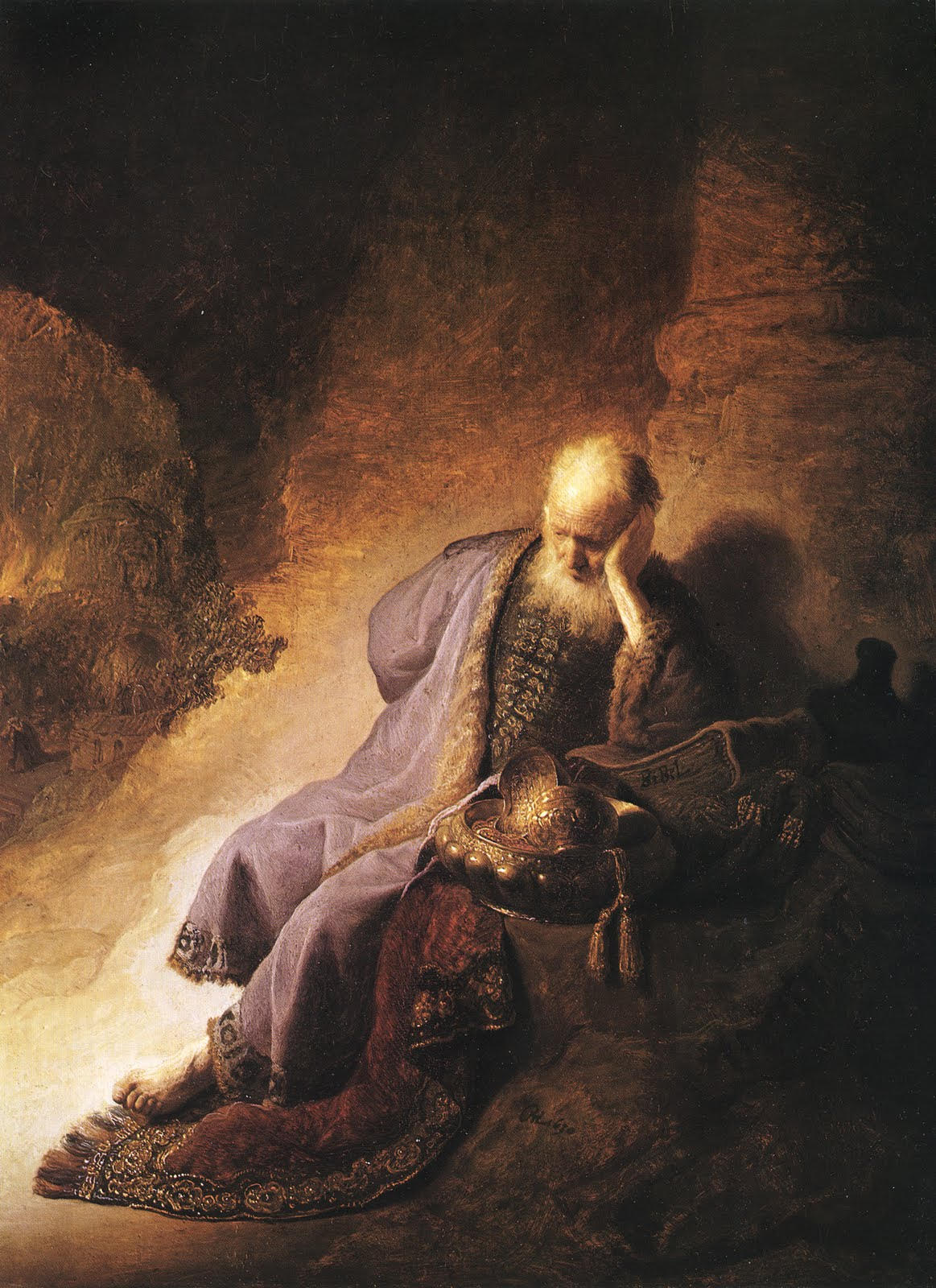
A time for prophecy
Yirmeyahu (“Jeremiah” in English) seems to have no choice but to prophesy, whether he wants to or not. His dilemma is introduced in the haftarah reading Jeremiah 1:1-2:3, which goes with this week’s Torah portion, Shemot, according to the Sefardi tradition.5 The book of Jeremiah opens:
The words of Yirmeyahu, son of Chilkiyahu, one of the priests who were at Anatot in the territory of Benjamin. (Jeremiah 1:1)
Already we know that the father of Yirmeyahu (Jeremiah) is a priest, perhaps even the high priest named Chilkiyahu during the reign of King Yoshiyahu (“Josiah” in English).6 Priesthood is hereditary in Ancient Israel, so Yermiyahu (Jeremiah) is born a priest. He is also born in the territory of Benjamin, close to Jerusalem, the capital city of the kingdom of Judah.
Before he reaches adulthood, he finds out that he is also a prophet.
The word of God happened to him in the days of Yoshiyahu son of Amon, king of Judah, in the thirtieth year of his reign. (Jeremiah 1:2)
King Yoshiyahu (“Josiah” in English) ruled the kingdom of Judah from 640 to 608 B.C.E.—after the Assyrian Empire to the north had become weak and ceded some of northern kingdom of Israel to Judah, and before the new Babylonian empire had grown strong. According to 2 Kings 22 and 23, King Yoshiyahu crusaded to get rid of all the shrines and priests serving other gods.7
There is not much work for Yirmeyahu (Jeremiah) until after King Yoshiyahu dies, since the main roles of a prophet during the time of the Israelite kingdoms are to challenge government policies and to shame or frighten rich citizens into reforming. But then Babylon’s power grows, and the kings of Judah make no changes in policy to address the threat. The word of God happens to Yirmeyahu (Jeremiah) more often, and many of his prophesies warn that unless people return to the exclusive worship of God, and embrace God’s ethical rules, the Babylonians will conquer Judah and Jerusalem.
And it happened through the days of Yehoyakim son of Yoshiyahu, king of Judah, until the end of the eleventh year of Tzidekiyahu son of Yoshiyahu, until Jerusalem went into exile in the fifth month. (Jeremiah 1:3)
The reign of King Tzidekiyahu (“Zedekiah” in English) ended in 586 B.C.E. when the Babylonian army completed its conquest of Judah by destroying Jerusalem and exiling almost all of its remaining citizens to Babylon.
A congenital prophet
The narrative in this week’s haftarah then switches to the first person, and Yirmeyahu (Jeremiah) speaks.
And the word of God happened to me, saying: “Before I formed you in the belly, I knew you; and before you went out of the womb, I set you apart as holy. A prophet to the nations I appointed you.” (Jeremiah 1:4-5)
What is God communicating here?
“Before I formed you in the belly, I knew you.” Psalm 139 is the only other biblical passage that says God gives human fetuses their physical form and some aspect of their personality:
For you yourself provided my conscience;
You wove me together in my mother’s womb. (Psalm 139:13)
Furthermore, in Psalm 139 God knows all human thoughts:
God, you have examined me and you know me.
You know [when] I sit down and stand up,
You discern my intention from afar. (Psalm 139:1-2)
The new claim in the book of Jeremiah is that God knows Yirmeyahu even before weaving him together in the womb. This might mean that God knows what certain individuals will be like in the future. Or it might mean that God creates someone’s personality even before creating that person’s body.
“And before you went out of the womb, I set you apart as holy.” This statement could mean merely that Yirmeyahu (Jeremiah) was born into the priesthood, since priests are holy in the sense of being set apart for temple service and restricted regarding marriage and mourning.8 But it might also mean that God made him, in utero, even holier than a priest, even more set apart from normal life.
“A prophet to the nations I appointed you.” In the rest of the book of Jeremiah, the prophet addresses most of his prophecies to the citizens of Judah, although he does utter some prophecies about other nations.9 But the point in this verse is that before Yirmeyahu (Jeremiah) was born, God determined how he would spend his entire adult life.
A right of refusal?
That raises the question of whether it is even possible for Yirmeyahu (Jeremiah) to refuse to speak as a prophet. (Presumably he cannot help hearing, or otherwise experiencing, God.) Some modern commentators assert that he does have the power to refuse. For example, Plaut wrote:
“The call to Jeremiah may thus be seen to express both predetermination and freedom: the child was born with particular gifts and a high degree of religious sensitivity. But giving his life to a pursuit of the divine call—with all its rewards, difficulties and dangers—was a decision that Jeremiah had to make for himself.”10
After God’s opening salvo, Yirmeyahu (Jeremiah) protests that he does not have the eloquence to be a prophet.
“Ah-ah, my lord God! Hey, I do not know how to speak, since I am a na-ar.” (Jeremiah 1:6)
na-ar(נַעַר) = boy or young man.
He says this, according to Malbim, because he lacks confidence, because he does not know how to speak well in front of a congregation, and because he is afraid people will kill him on account of his prophecies.11
And God said to me: “Don’t you say ‘I am a na-ar’. For you will go wherever I send you, and you will speak whatever I command you.” (Jeremiah 1:7)
Midrash Tanchuma explains, ominously: “That is, against your will you will go, and against your will you will speak.”12
Indeed, later in the book Yirmeyahu (Jeremiah) complains:
“… the word of God happens to me, for scorn and derision all day. So I thought: I will not mention him, and I will not speak any more in his name. But it [God’s word] happened in my mind like a burning fire shut up in my bones, and it exhausted me to hold it in, and I could not endure.” (Jeremiah 20:8-9)
By the prophet’s own testimony, he has no freedom of choice when it comes to prophecy.
A promise of rescue
After God tells Yirmeyahu (Jeremiah) that he must go and speak at God’s command, God attempts to reassure him by saying:
“Don’t be afraid in front of them! For I am with you to rescue you.” (Jeremiah 1:8)
“To rescue you” could mean merely to rescue him if his speech stumbles. But God makes the real meaning clear before the interview is over:
“And hey, I appoint you this day as a fortified city, and as an iron pillar, and as bronze walls, against the whole land—against the kings of Judah, against its officers, against its priests, and against the people of the land. And they will battle against you, but they will not prevail over you, because I am with you,” declares God, “to rescue you!” (Jeremiah 1:18)
Later in the book, the prophecies of Yermiyahy (Jeremiah) are so unpopular that he needs to be rescued from various death threats.13 The worst is when he tries to leave Jerusalem on a business trip, and a guard at the gate accuses him of defecting to the Babylonians. City officials beat him, imprison him, and eventually convince King Tzediyahu to put him to death. Yirmeyahu (Jeremiah) is lowered into a pit with no water, only mud. But before he dies of thirst and hunger, the king changes his mind and has him pulled up and returned to the regular prison. He remains there until the Babylonians capture Jerusalem.14 Then, while the city is burned down and its nobles are killed, the Babylonians remove him, give him food, and set him free.15
The characters in the Hebrew Bible have fewer choices than we do in today’s world, but almost all of them have free will, the ability to choose to do something different. We know this because the prophets who utter prophecies issue warnings about how people will suffer if they do not change their ways.
But do the prophets themselves have free will? It is hard to know, since even reluctant prophets like Moses come to accept their role in the world—except for Yirmeyahu (Jeremiah), who hates being a prophet so much that he wishes he had never been born. He declares:
“Accursed is the day that I was born! … Why did I ever go out from the womb to see trouble and grief, and to use up my days in shame!” (Jeremiah 20:14-20)
Today we have more choices than anyone in ancient Jerusalem, yet our range of choices is still limited by our starting point. A person is born into a family; events can change one’s upbringing as time goes on, but one’s first environment makes its mark. A person is born with predetermined genes; they can be turned on or off by events, but not replaced by different genes.16 Some infants have congenital defects. Some, for all we know, might be congenital prophets.
Do we have more control over our own lives than Yirmeyahu? Or are we just less aware that someone or something is pulling the strings?
- www.merriam-webster.com, 2025.
- E.g. 1 Samuel 10:5-6 and 10-13.
- E.g. Deutereonomy 34:10, 1 Samuel 3:20, etc. There are also false prophets, as in Deuteronomy 13:1-4.
- Deuteronomy 18:22 is an exception to this rule; the book of Jonah is a prime example.
- The haftarah reading Jeremiah 1:1-2:3 goes with the portion Matot in Numbers according to the Ashkenazi tradition.
- 2 Kings 22:4ff.
- 2 Kings 22:1-23:25.
- Leviticus 21:1-15.
- Jeremiah 9:25, 25:9–29, 27:3–11, and chapters 46–51.
- W. Gunther Plaut, The Haftarah Commentary, UAHC Press, New York, 1996, p. 413.
- Malbim is the acronym of Meir Leibush ben Yehiel Michel Weisser (1809–1879).
- Midrash Tanchuma, c.500–c.800 C.E., translation in www.sefaria.org.
- Jeremiah 11:21-23, 26:8-11, 26:24, 36:26.
- Jeremiah chapters 37-38.
- Jeremiah 40:1-4.
- At least not yet; gene splicing is still in its infancy.

 Questioning Torah
One thought on “Haftarat Shemot or Matot—Jeremiah: A Congenital Prophet”