(corrected version)
In last week’s Torah portion, Noach, God gives Noach (Noah in English) orders, and Noach obeys. The communication is strictly one-way; Noach never says anything to God. (See my post Noach: Silent Obedience.)
In this week’s Torah portion, Lekh-Lekha (Genesis/Bereishit 12:1-17:27), God speaks to Abraham, and Abraham responds—at first with action, like Noach, but eventually with questions.
An order or an offer?
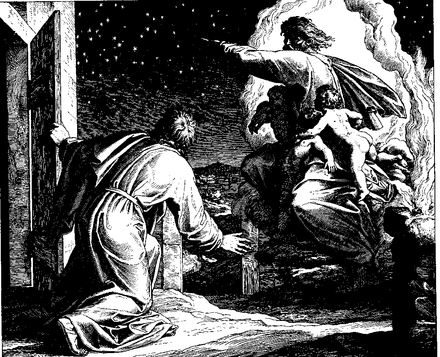
The Torah portion opens when God first addresses Avram. (“Avram” is Abraham’s original name before God changes it.)
Then God said to Avram: “Go for yourself, from your land, from your kindred, and from your father’s house, to the land that I will show you. And I will make you into a great nation, and I will bless you, and I will magnify your name.” (Genesis 12:1-2)
The beginning of God’s first speech to Avram sounds more like an offer than an order. If Avram leaves and goes to the land God indicates, then God will make Avram’s descendants into a great nation, bless Avram with success, and make his name famous.
Although God could simply command Avram to move to Canaan, God seems to want Avram to choose going to Canaan over staying in Charan. 19th-century Rabbi S.R. Hirsch explained that God’s first promise would compensate Avram for giving up his nationality in the Aramean kingdom where he and his family lived; the second promise would compensate him for his prosperity there; and the third promise would compensate him for starting over again without his family’s reputation.1
Next God says:
“Veheyeih brakhah!” (Genesis 12:2)
veheyeih (וֶהְיֵה) = Then become! (The prefix ve- (וֶ) is a conjunction that means either “and” or “then”. Heyeih (הְיֵה) is the imperative of the verb hayah (הָיָה), which means either “be” or “become”.)
brakhah (בְּרָכָה) = blessing, a blessing. (In the Hebrew Bible, humans are considered blessed when they have prosperity, good health, fertility, victory over enemies, or power over subordinates.)
What does God’s imperative “Then become a blessing!” mean?
One tradition from the 13th century to the present is that the word veheyeih was assigned the wrong vowels, and actually means “then you will be”. According to this line of commentary, God is predicting that Avram will become part of peoples’ prayers for blessing. For example, Ramban wrote: “You will be the blessing by whom people will be blessed, saying, ‘God make you like Abraham.’”2 And eight centuries later Steinsaltz wrote: “… people will use you as a paradigm for blessings. When they bless one another, they will say: May you merit to be like Abram.”3
I prefer the alternate tradition, that God is telling Avram to act in such a way as to be a blessing to others. In Bereishit Rabbah (circa 400 C.E.), Avram becomes a blessing by praying for childless women, who then become pregnant, and for the sick, who then heal.4
Then God finishes:
“And I will bless those blessing you, and those demeaning you I will curse. And all the clans of the earth, nivrekhu vekha.” (Genesis 12:3)
nivrekhu vekha (נִבְרְכוּ בְךָ) = they will want to be blessed like you. (Nivrekhu (נִבְרְכוּ) is the third person plural of the rare nifil form of verb barakh (בָּרוּךְ), “be blessed”, and means “they seek to be blessed”. Vekha(בְךָ) in other contexts could mean “in you”, “by you”, or “through you”, but immediately after nivrekhu it means “like you”.)5
The second part of God’s initial speech to Avram, from “Become a blessing” through “they will want to be blessed like you” sounds like another if-then statement. If Avram becomes a blessing, then God will bless or curse everyone Avram encounters according to how they treat him, and everyone in the world will want the kind of blessing Avram has.
And Avram went, as God had spoken to him … (Genesis 12:4)
Avram’s first blessing from God
Avram brings along his wife Sarai (whom God later renames Sarah), his nephew Lot, all their servants, and all their livestock. When they reach a sacred tree near Shekhem in Canaan, God appears to Avram and says:
“To your descendants I give this land!” And he built an altar there to God, who had appeared to him. (Genesis 12:7)
Avram does not mention to God that he is still childless at age 75. He and his household keep traveling south, and when there is a famine in Canaan, they go all the way to Egypt.
There Avram scams the pharaoh by claiming Sarai is his sister, not his wife. (See my post Lekh-Lekha, Vayeira, & Toledot: The Wife-Sister Trick, Part 2.) The pharaoh takes Sarai as a concubine, and pays Avram a generous bride-price. The God character plays along and afflicts the pharaoh with an unmentionable disease. Then the pharaoh has Avram escorted out of Egypt—along with Sarai, all the other humans and animals who came with him, and the bride-price. Thanks to God’s assistance, Avram is blessed with even more prosperity.
Avram talks back
Enriched by more slaves, livestock, silver, and gold, Avram returns to the hills east of Beit-Eil. There he and his nephew Lot separate, with Avram staying in the highlands, while Lot takes his men and livestock down to the plain of Sodom.
And God said to Avram, after Lot had separated from him: “Raise your eyes, please, and look from the place where you are … For all the land that you yourself see, I will give it to you and to your descendants forever. And I will make your descendants like the dust of the earth, so that if a man were able to count the dust of the earth, your descendants could also be counted.” (Genesis 13:14-17)
Again Avram responds by building an altar to God, rather than by saying anything. Avram’s name is magnified (i.e. his reputation rises) in the central part of Canaan because he defeats four invading kings and returns the captives and the loot to their own communities. Then the priest-king Melchizedek says to Avram:
“Blessed be Avram by God Most High, founder of heaven and earth! And blessed be God Most High, who delivered your adversaries into your hand!” (Genesis 14:19-20)
So if this mysterious priest-king is correct, and if his god is Avram’s God, then God rewarded Avram for moving to Canaan with the blessing of success in battle.
But what about the blessing of fertility, which is necessary for God’s promise of a great nation of descendants?
The next time God makes him a promise involving descendants, Avram speaks up.
After these events, the word of God happened to Avram in a vision, saying: “Don’t be afraid, Avram! I myself am a shield to you; your reward multiplies exceedingly!” Then Avram said: “My lord God, what will you give to me? And I am going childless, and the heir of my household is a Damascan, Eliezer.” And Avram said: “Hey, you have not given a descendant to me, and hey! The heir of my household will inherit from me.” (Genesis 15:1-3)
The repetition of “Avram said” in the middle of a speech is a biblical convention indicating that the speaker pauses, but the one being addressed does not respond, so the speaker says more. In this case, the God character may be surprised that Avram asked a question; it is the first time someone questions God in the book of Genesis.6
After Avram rephrases his issue, God does respond:
“This one will not inherit from you. Instead, one going out from your innards, he will inherit from you.” And [God] brought him outside and said: “Look, please, toward the heavens and count the stars, if you are able to count them.” And [God] said to him: “Thus will be your descendants.” (Genesis 15:4-5)
Does Avram believe God’s promise that he will father a son, who will have countless descendants? The text says:
And he trusted in God, and [God] reckoned it as righteousness on his part. (Genesis 15:6)
Yet after God repeats the promise to give Avram the land of Canaan (through his descendants), Avram says:
“My lord God, how will I know that I will possess it [the land]?” (Genesis 15:8)
Now he sounds as if he has some doubts about God’s promises, and wants something more reassuring than words. So God arranges an elaborate ceremony commonly called the “Covenant of the Pieces”. Following God’s instructions, Avram cuts in half a heifer, a she-goat, and a ram, and lines up the pieces facing each other. He adds two birds, so each row has three half-animals and a bird. One ritual in the Ancient Near East was for two leaders “cutting” a treaty to cut an animal in half and then walk between the two parts.7
Abraham falls into a deep sleep or trance at sunset, and hears God reveal that his descendants will suffer a 400-year exile in Egypt, but then return to Canaan. Then he sees an oven smoking, and a flaming torch passing between the pieces of the animals. The story concludes:
On that day, God cut a covenant with Avram, saying: “To your descendants I give this land, from the river of Egypt to the great river, the river Euphrates.” (Genesis 15:18)
Is God’s first covenant with Avram lop-sided, with only God vowing to do something? Or will God give Avram’s descendants all that land only if Avram “becomes a blessing”?
This year I am moved by Hirsch’s commentary saying that Jews, as Avram’s descendants, are also required to “become a blessing”:
“Honesty, humanity, and love are duties incumbent upon the individual, but are regarded as folly in relations between nations and are viewed as unimportant by statesmen and politicians. … In the midst of a world where mankind’s … ambition is to increase its power and extend its domain no matter what the cost, the nation of Avraham is—in private and public life—to heed only one call: Veheyeih brakhah! Its life is to be devoted to the Divine aims of bringing harmony to mankind and to the world and restoring man to his former glory.”8
May all human beings finally learn to be a blessing to others.
- Rabbi Samson Raphael Hirsch, The Hirsch Chumash, Sefer Bereshis, English translation by Daniel Haberman, Feldheim Publishers, Jerusalem, 2002, p. 290.
- Ramban (the acronym for 13th-century Rabbi Moshe ben Nachman, or Nachmanides), translated in www.sefaria.org.
- Rabbi Adin Even-Israel Steinsaltz, The Steinsaltz Tanakh, Koren Publishers, 2019.
- Bereishit Rabbah 39:11, ca. 400 CE, translated in www.sefaria.org.
- William L. Holladay, A Concise Hebrew and Aramaic Lexicon of the Old Testament, William B. Eerdmans Publishing Co., Grand Rapids, MI, 1971, p. 49. (On the other hand, the 1906 edition of The Brown-Driver-Briggs Hebrew and English Lexicon states that the nifil form of barakh means the same as the hitpael form: “bless oneself” or “congratulate oneself”.
- Not counting Cain’s remark “Am I my brother’s keeper?”, which is an excuse rather than a true question.
- E.g. Jeremiah 34:18. Also see my post Lekh-Lekha: Unconditional Covenant.
- Hirsch, p. 292-293.

 Questioning Torah
3 thoughts on “Lekh-Lekha: Conversation”