Ten years ago I wrote a post called Balak, Pinchas, & Matot: How Moabites Became Midianites. I received some positive comments, but also some hate mail. I am leaving that post up to remind myself that my writing is not always interpreted the way I intended it.
This week Matot (Numbers 30:2-32:42) arrives again in the annual cycle of Jewish Torah portions, and I want to add another interpretation of the Israelites’ massacre of Midianite women. I also want to re-examine my conclusion in 2015, in which I compared my own unreflective discrimination against Republicans to Moses’ discrimination against Midianites.
Midianites in Moab

Moses first encounters Midianites in the area where archaeologists have confirmed that they actually lived: east of the Gulf of Aqaba (in present-day Saudi Arabia), and north up to and including Timna. In the book of Exodus, Moses is fleeing from a murder charge in Egypt, and a priest of Midian invites Moses to live with him and marry one of his daughters.1
Years later in the book of Numbers, Moses leads the Israelites all the way to the east bank of the Jordan River. When King Sichon will not let them pass through Cheshbon, they conquer his whole kingdom, and the kingdom of Bashan to the north. Then they go back and camp in the acacias on the “Plains of Moab”, so-called because the land of Cheshbon was once part of kingdom of Moab.
In the Torah portion Balak, King Balak of Moab is afraid of the horde of Israelites camped just north of his border.
And Moab said to the elders of Midian: “Now this assembly will lick up everything around us like the ox licks up the green plants of the field!” (Numbers 22:4, in the portion Balak)
Apparently there is no king of Midian, so King Balak sends his message to the elders of each town. And apparently the Midianites respond to his call for an ally, because when Balak sends a delegation to Bilam, a Mesopotamian “sorcerer”, the Torah says:
The elders of Moab and the elders of Midian went, and tools of divination were in their hand, and they came to Bilam and they spoke Balak’s words to him. (Numbers 22:7).
Balak’s message asks Bilam to come to Moab and curse the Israelites. Eventually the two men meet on a ridge at Moab’s northern border, overlooking the Israelite camp. But King Balak’s plan fails, because Bilam is actually a prophet, and God will not let him curse the Israelites.2
Then Bilam got up and went, and he returned to his place. And also Balak went on his way. And Israel stayed in the acacias, and the people began to whore with the women of Moab. They [the women] called the people for animal sacrifices of their gods, and the people ate, and they bowed down to their gods. And Israel yoked itself to the Ba-al of Peor, so God’s nose heated up against Israel. (Numbers 24:25-25:3)
As usual, the God character responds to “whoring” after other gods with a plague. Next, an Israelite man brings a foreign woman into the Tent of Meeting itself for sex. Aaron’s grandson Pinchas quickly thrusts a spear through both of them, and the plague halts.
One would expect the impaled woman to be a Moabite, since the Israelite men were seduced into worshiping Ba-al Peor by Moabite women. But the next Torah portion, Pinchas, identifies the foreign woman as the daughter of a Midianite elder.

And the name of the Midianite woman who was struck down was Kozbi, daughter of Tzur, the head of the people of a paternal household from Midian. And God spoke to Moses, saying: “Be hostile toward the Midianites, and strike them down. Because they were hostile to you through their deceit, when they deceived you about the matter of Peor …” (Numbers 25:15-18)
Suddenly Moabite women have become Midianite women.
In this week’s Torah portion, Matot, God reminds Moses to attack the Midianites.
And God spoke to Moses, saying: “Take vengeance, the vengeance of the Israelites, from the Midianites; afterward you will be gathered to your people.” (Numbers 31:1-2)
Moses obediently musters an army.
And they arrayed against Midian, as God had commanded Moses, and they killed every male. And the kings of Midian they killed … five kings of Midian, and Bilam son of Beor, they killed by the sword. But the children of Israel took captive the women of Midian and their little ones… (Numbers 31:7-9)
In this passage, the Midianites are not ruled merely by elders, but by five kings. And Bilam, who goes home at the end of the portion Balak, mysteriously appears among the kings of Midian.
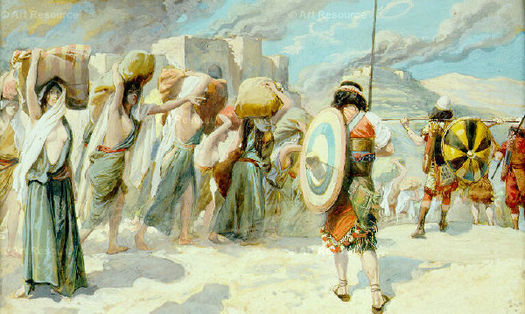
The story ends with the slaughter of the captive Midianite women. (See my post Matot: Killing the Innocent.)
And Moses said to them: “You left every female alive! Hey, they were the ones who, by the word of Bilam, led the Israelites to treachery against God in the matter of Peor, so there was a plague in God’s assembly. So now, kill every male among the little ones; and every woman who has known a man by lying with a male, kill!” (Numbers 31:15-17)
Has Moses forgotten that the Israelite men were seduced into worshiping Ba-al Peor by Moabite women? Or does he assume that God must be right, so the women whom he thought were Moabites must secretly be Midianites?
Another Explanation for Midianites in Moab
In my 2015 post, I review three kinds of attempts by commentators to reconcile the apparent conflation of Moabites and Midianites in this storyline: the “apologists”, who invented bizarre explanations for the inconsistencies; the “scientists”, modern scholars who assigned the scenes to two different sources and noted that the redactor left both Moab (the enemy in the J/E source) and Midian (the enemy in the P source) in the story; and the “psychologists”, who imagined that Moses, whose own wife is a Midianite, is flummoxed when God tells him that the Midianite women are all guilty.
Now I would add a fourth explanation. Angela Roskop Erisman3 dates the storyline about Midianites in Moab to the reign of Hezekiah, the king of Judah from circa 716 to 687 B.C.E. Before King Hezekiah rebelled against being a vassal of the Assyrian Empire, he lined up support from Egypt, but Egypt (ruled by Kushites at the time) was not much help. So, according to Erisman, he probably arranged an alliance with Midian instead. These two political alliances are reflected in the Torah, where Moses has a Midianite wife in the book of Exodus, but a Kushite wife in Numbers 12:1.
Jerusalem survived the Assyrian siege in 701 B.C.E. not because of any allies, but because King Hezekiah had built a new city wall and dug a tunnel between the city and the nearest water source, the Siloam Pool. No assistance from Midianites was recorded either in the Hebrew Bible or on the Assyrian stelae that have been excavated.
If the Midianites failed to come to the aid of Jerusalem, that would be reason enough to vilify them in one of the stories about Moses.
Floored by comments
Ten years ago, I wrote this conclusion to my post on Midianites in Moab:
“Just as Moses judges all Midianites in the five northern tribes as evil because of the actions of a few of their members, human beings throughout history have made judgements about undifferentiated groups. It is so much easier than discriminating among individuals. From Biblical times to the present day, some people have judged all Jews as bad.
“Today, I catch myself ranting against Republicans, as if every person who voted Republican in the last election were responsible for the particular propaganda efforts and political actions that I deplore. A psychological look at the story of Moses and the Midianites near Moab reminds me that I need to be careful not to slander the innocent with the guilty.”
My intention was to sound a warning against treating all members of a group as if they were the same. It is obvious that “All Midianites are bad” is a false statement in the context of the whole Torah, since Moses’ father-in-law and wife are Midianites and do nothing but good deeds.
My next example was my own bad tendency to talk about “Republicans” as if all Republicans were bad. I thought I was being clear that there were people who voted for Republican candidates in the 2014 election for reasons that had nothing to do with the claims and policies that I, personally, objected to.
But I got a lot of comments that were vicious put-downs. I deleted them, since I did not want hate language in this blog. Now I wish I had saved them, so I would have examples of knee-jerk emotional reactions.
This year I received a milder negative comment on my 2015 post:
“You had me until you started the Republican rant…. Too bad TDS once again ruins scripture talk unnecessarily.”
I had to look up TDS. I found it that it stands for “Trump Derangement Syndrome”, and is a term that some supporters of Donald Trump use to criticize people whom they perceive as having knee-jerk emotional reactions against Trump that make them incapable of perceiving reality.
Who is making a rational analysis, and who is having a knee-jerk emotional reaction? It turns out to be a complicated question.
Should I have avoided any mention of politics in my 2015 blog post, and found a different example of my own tendency to discriminate against whole groups (instead of being discriminating about the differences among individual members of those groups)?
Maybe. But I find American politics more frightening now than I did ten years ago. When I wrote my 2015 post, I thought it was obvious that “All Jews are bad” is a false statement, like “All Midianites are bad”. But now anti-Semitism is increasing in the United States, and it comes from both ends of the political spectrum. I suspect that the increase on the right is part of today’s greater tolerance for hate speech, while the increase on the left is due to a false assumption that all Jews support the current government of Israel’s war on Gaza.
Will human beings ever overcome the black-and-white thinking that leads us to slander whole groups of people?
- Exodus 2:15-22.
- See my post Balak: Prophet and Donkey.
- Angela Roskop Erisman, “Moses is Modeled on Horus and Sargon, but His Story Is About King Hezekiah” and “Miriam Complains of Moses’ Cushite Wife: Hezekiah Married the Wrong Empire!” in www.thetorah.com, 2025.

 Questioning Torah