The idea of being tamei (טָמֵא) is hard to understand in the 21st century. The adjective tamei has been translated into English as “unclean”, but it has nothing to do with dirt. It has been translated as “impure” or “contaminated”, but it has nothing to do with a being less than 100% one substance. It has been translated as “defiled”, but that word is appropriate only when one is tamei because of idol worship or sexual misdeeds; the Torah does not consider childbirth or married intercourse defiling, yet both activities make people temporarily tamei.
“Ritually impure” often works as a definition of tamei, because in the Hebrew Bible a tamei person is not allowed to enter even the outer courtyard of the precincts where God is worshipped (the tent sanctuary first, later the temple). But a person who is tamei because of a skin condition called tzara-at (צָרַעַת)1 is not allowed inside the camp or town at all; that person might be considered “socially impure”.
Animals and objects can also be tamei, regardless of their location. An animal that is not kosher for people to eat is called tamei.2 The carcass of a dead non-kosher animal is tamei, and any person who touches it becomes tamei.3 Cloth and leather become tamei if mold grows on them. (See last week’s post: Tazria: Mold or Mood?) Some objects are tamei merely because they touched a tamei person or animal.
Being tamei is often treated as a contagious condition, but it does not refer to any contagious diseases. Touching someone or something that is already tamei spreads an abstract contagion. Perhaps “tainted” or “icky” captures the meaning of the word—except that tamei has a religious as well as a visceral aspect.
The adjective tamei and its related verb and noun appear 269 times in the Hebrew Bible. In the book of Leviticus alone, words from the root tamei occur 136 times!4
Why is tumah (טֻמְאָה, the condition of being tamei) a major theme in Leviticus? In ancient Judah, priests diagnosed the condition, told people what to do about it, and performed purification rituals when needed.5 Modern scholars have concluded that Leviticus was written by priests over a period of several centuries, probably between the 7th and 4th centuries B.C.E., and its main purpose was to describe the responsibilities of priests.
Tamei skin conditions
This week’s Torah portion, Metzora (Leviticus 14:1-15:32), gives instructions on three of the many types of tumah: human skin diseases, moldy house walls, and genital discharges.
The first section describes the ritual by which a priest changes a person who has recovered from one of the skin conditions called tzara-at from tamei to tahor.
This is the teaching of the metzora at the time of his taharah … (Leviticus 14:2)
metzora (מְצֺרָע) = person with one of the skin conditions called tzara-at.
taharah (חָהָרָה) = state of being tahor; process of becoming tahor. (Tahor, טָהוֹר = not tamei; clean, ritually or socially pure, not tainted or icky.)
A metzora must live outside the camp or town. If the skin of the metzora appears to have returned to normal, a priest must go out and inspect it. If the priest deems that there is no more tzara-at, he assembles the items needed for the first of several rituals to confirm that the man or woman is now tahor and can return to normal life.
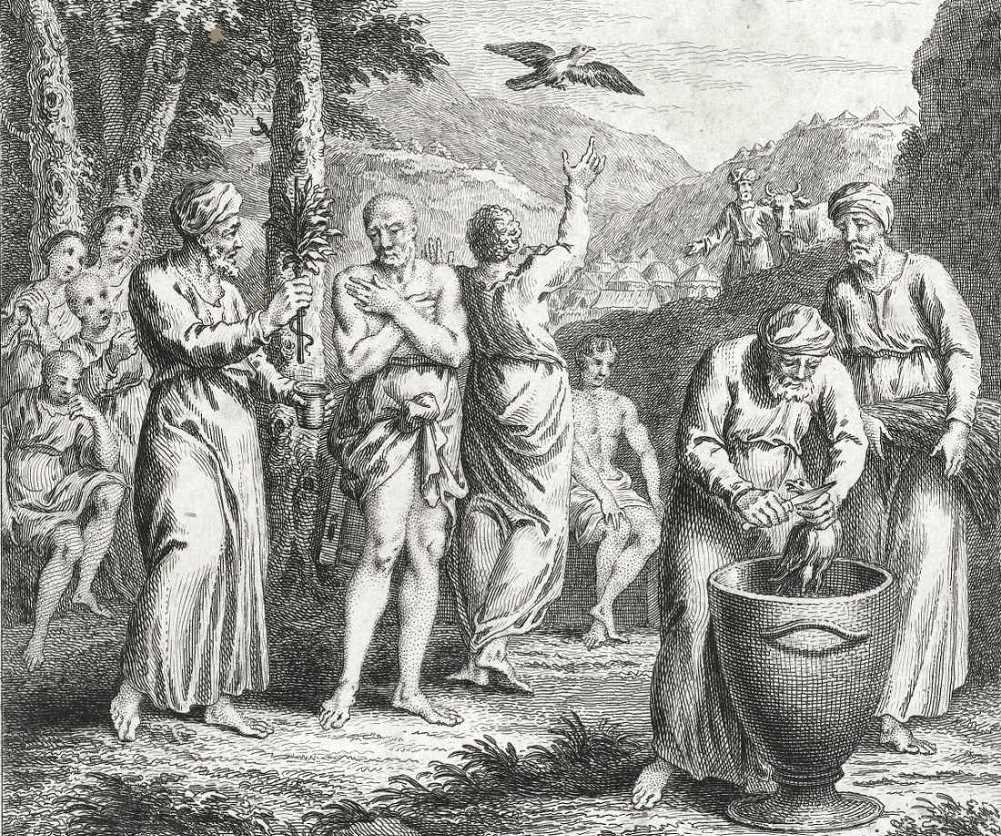
…he will take for the mitaheir two live tahor birds, and cedar wood, and red stuff, and [a branch of] oregano. And he will issue an order and have one of the birds slaughtered over fresh water in an earthenware vessel. He will take the live bird and the cedar wood and the red stuff and the oregano, and dip them, along with the live bird, in the blood of the bird that was slaughtered over the fresh water. Then he will sprinkle it over the mitaheir from the tzara-at seven times, and he will become tahor; and he will send free the living bird over the open field. (Leviticus 14:3-7)
mitaheir (מִטַּהֵר) = one becoming tahor (i.e. not tamei).
After the priest has used the oregano branch to sprinkle the bloody water, the person who has recovered from tzara-at must become literally clean.
Then the mitaheir will scrub his clothes and shave off all his hair and wash in water; and he will be tahor. Afterward he may enter the camp, but he must live outside his tent for seven days. (Leviticus 14:8)
At this point, the mitaheir is no longer socially unacceptable, and can live inside the camp. But further ritual is required before the mitaheir can resume all of normal life. The clothes-scrubbing, shaving, and washing must be repeated on the seventh day. On the eighth day the person comes to the entrance of the sanctuary with various offerings, and the priest conducts the final ritual, which includes daubing first lamb’s blood, and then oil, on the person’s right ear, right thumb, and right big toe.6
And the priest reconciles the mitaheir with God. (Leviticus 14:31)
Tamei walls

The middle section of Metzora provides instructions on what to do if the walls of a house are tamei. If the owner of the house observes green or red stains in a wall,
…he must come and tell the priest, saying: “Something like a mark has appeared in the house.” (Leviticus 14:34-35)
The owner of the house is not allowed to make the diagnosis; that is the priest’s job. (For a literal and a metaphorical description of what the priest does, see my post: Metzora: A Diseased Family.)
When the priest considers the house mold-free and tahor, he conducts a ritual using the same materials as in the first ritual for a person who has healed from tzara-at.
Then he will take, to make amends for the house, two birds, and cedar wood, and red stuff, and [a branch of] oregano. (Leviticus 14:49)
The priest follows the same procedure, this time sprinkling the bloody water seven times on the house, instead of on a person. But no further waiting period or ritual is required. The passage concludes:
And he has made reconciliation for the house; and it is tahor. (Leviticus 14:53)
Tamei discharges
The third section of this week’s Torah portion deals with tumah because of genital discharges: gonorrhea or semen from a man, blood from a woman. The gonorrhea calls for the most extensive response.
Any bed that the discharger lies upon is tamei. And anyone who touches his bed must scrub his clothes and wash in water, and will be tamei until evening. (Leviticus 15:4-5)
The same goes for anyone whom the afflicted man spits on, who touches him, or who sits where he sat. The contaminating effect even applies to some dishes.
And any earthenware vessel that the discharger touches must be shattered, and any wooden implement must be rinsed in water. (Leviticus 15:12)
Seven days after the man has recovered, he scrubs his clothes and washes himself in fresh water. Then he is tahor, but he must bring two birds to a priest on the eighth day. The priest sacrifices both birds at the altar.
And the priest reconciles him with God for his discharge. (Leviticus 15:15)
Semen is a less serious source of tumah. The man only has to wash himself and anything the semen falls on, and he will become tahor at sunset. The same goes for a couple having intercourse.
A woman is tamei during her menstrual period for at least seven days, more if she bleeds longer than seven days. Anything she lies on or sits on is tamei, and anyone who touches these things must bathe and wash their clothes; then they become tahor at sunset.
And if a man actually lies with her, then her menstruation is upon him, and he will be tamei seven days, and any bed he lies on will be tamei. (Leviticus 15:24)
If a woman has a discharge of blood when it is not her period, then the same rules apply as for a man with gonorrhea, including the priest sacrificing two birds to reconcile her with God once it is over and she is tahor again.
The passage in this week’s Torah portion about a woman’s discharge of blood does not mention bathing to become tahor again, even though bathing is required for a man who had a discharge and for anyone who recovered from tzara-at. But by the time the Talmud tractate Niddah was written (circa 500 C.E.) the rabbis had already established that a woman must immerse herself completely in the water of a mikveh after her period. They argued about the number of days the woman had to allow after she stopped bleeding, and other details. Traditional observant Jewish women today still submerge in a mikveh after their periods.
The Torah portion Metzora concludes as God tells Moses:
And you will separate the Israelites from their tumah, so they will not die from their tumah by their making tamei my sanctuary that is in their midst. (Leviticus 15:31)
All the rules about not touching anything tamei, and taking the ritual steps to undo the tumah, prevent God’s sanctuary itself from becoming tamei. A contaminated sanctuary would be a disaster, according to ancient Israelite thinking.
Perhaps it is because the idea of tumah in the sanctuary is so awful that a person who has become tahor again after the most serious cases of tumah must be reconciled with God. The Hebrew word I translate here as “reconciled” is kiper (כִּפֶּר), which is often translated as “atoned” when the purpose of the ritual is to make amends for a sin against God. Being tamei is not a sin, yet a tamei person is unfit to stand before God.
And the worship of God must be free of anything remotely icky. Our thoughts and feelings matter.
- Tzara-at was formerly translated as “leprosy”, but it is unrelated to the disease once called leprosy and now called Hansen’s disease. The instructions for diagnosing tzara-at in Leviticus 13:1-44 (in last week’s portion, Tazria) describe several separate skin conditions that cause changes in skin color and texture and the appearance of the hairs growing in the affected skin.
- Leviticus 11:1-23.
- Leviticus 11:24-40.
- The biblical book with the second highest frequency of words from the root tamei is Numbers, with 48. Third is Ezekiel, with 34, and fourth is Deuteronomy, with 10.
- The book of Ezekiel probably has frequent references to being tamei because the prophet Ezekiel belonged to a family of priests (kohanim), and would have served as a priest before he was exiled to Babylonia.
- More of this ritual is described in my post: Metzora: Time to Learn, Part 2.

 Questioning Torah