Bo & Beshalach: Winds

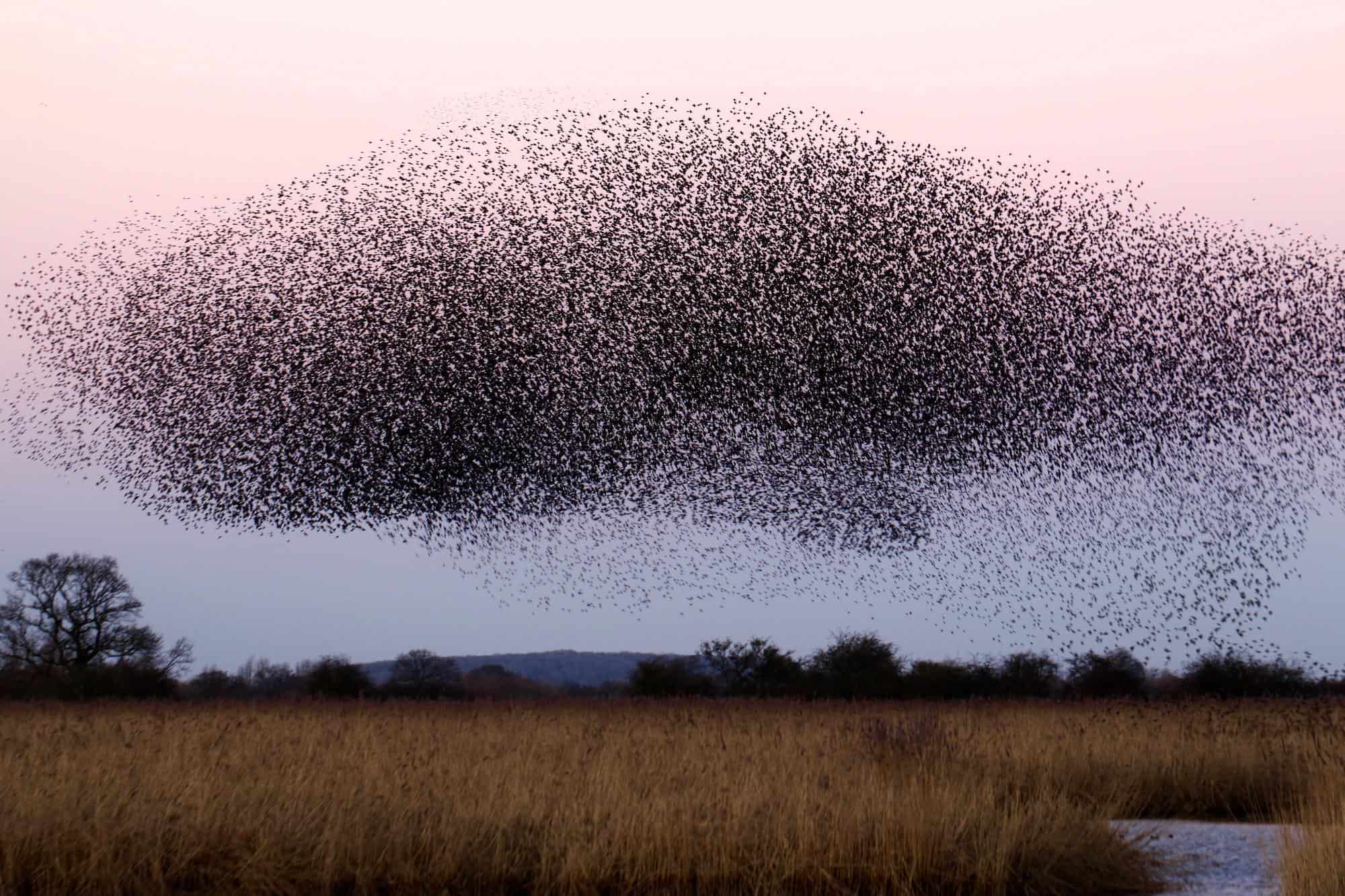
A plague of locusts descended on Egypt in last week’s Torah portion, Bo (Exodus 10:1-13:16). A swarm of Egyptian charioteers pursues the Israelites in this week’s Torah portion, Beshalach (Exodus 13:17-17:16). Both the locusts and the charioteers are frightening in their numbers and  destructiveness—and the God character controls both hordes with winds, to spectacular effect.

Locust winds

The eighth of the ten plagues the God character creates in Egypt is a plague of locusts that eat all the vegetation remaining after the previous plagues.

And Moses held out his staff over the land of Egypt, and God guided a ruach kadim through the land all that day and all the night. And in the morning the ruach hakadim carried in the locust swarms. And the locusts went up over the whole land of Egypt and settled down very heavily throughout the territory of Egypt. There were no locust swarms just like it before, and there will be none after. (Exodus 10:13-14)

ruach (רוּחַ) = wind; spirit, disposition, mood.

ruach kadim (רוּחַ קָדִים), ruach hakadim (רוּחַ הַקָּדִים) = wind from the east; dry east wind.

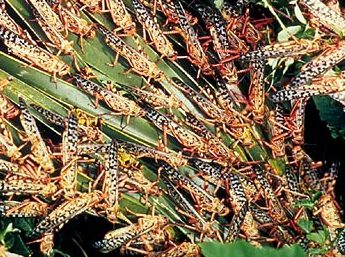
Actual desert locusts in northern Africa and southwestern Asia (Schistocera gregaria) breed in areas where there has been sufficient rainfall (to moisten the ground for egg-laying) and vegetation (for the larvae to eat). The breeding grounds in the early spring, when the locust plague in Exodus occurs (see map above) are different from the breeding grounds in summer. Adult locusts congregate into swarms when there is enough vegetation. They can fly short distances, but for long distances they take advantage of winds, catching a ride only on warm, relatively humid winds. Locust swarms from winter and spring breeding grounds around the Red Sea would need to catch a warm wind from the south to southeast to reach Egypt to the north.1

So why does the Torah say the wind that carries the locusts into Egypt is a ruach kadim, a dry east wind? One theory is that the Israelite wrote down this story was thinking in terms of winds in Canaan or Judah. When a wind brings disaster there, it is a dry wind from the eastern desert.

The God character ends the plague of locusts by changing the direction of the wind.

And God turned around a very strong ruach yam, and it lifted the locusts and blew them toward the Yam Suf. Not one locust remained in all the territory of Egypt. (Exodus 10:19)

yam (יָם) = sea, Mediterranean Sea; west.

ruach yam (רוּחַ יָם) = wind from the sea; wind from the west.

suf (סוּף) = reed, reeds, water plants.

Yam Suf (יָם סוּף) = Sea of Reeds; Red Sea.

If the God character reverses the wind from the southeast, it becomes a wind from the northwest. A strong wind coming down from the Mediterranean northwest of Egypt would indeed blow locust swarms in Egypt back toward the Red Sea or the Sea of Reeds.

The important point in the book of Exodus is that God controls the locust plague, bringing the devouring swarms into Egypt with one wind, and removing them with another.

The Hebrew Bible also uses the word for wind, ruach, to refer to someone’s mental spirit, ranging from calm wisdom  to insane jealousy or rage. And in the land of Canaan, dry desert winds were dangerous because they stripped crops, dried up ponds, and made people sick. Moist winds from the Mediterranean left dew in the morning that helped keep plants alive during the summer.

So a ruach kadim could be someone’s bad attitude or a dangerous mood—which plagues any people nearby like a swarm of locusts. A ruach yam could represent someone’s pleasant and kindly spirit, which gives others comfort and relief.

Chariot winds

Pharaoh lets the Israelites leave Egypt after God’s final plague, the death of the firstborn.2 On the second day of their exodus from Egypt, just when they thought they were free, the God character makes Pharaoh change his mind. God tells Moses:

“I will strengthen Pharaoh’s heart, and he will chase after them. Then I will be honored by Pharaoh and by all his forces, and the Egyptians will know that I am God.” (Exodus 14:5)

The God character in this part of Exodus cannot resist staging one more dramatic miracle to drive the point home that the God of Israel is more powerful than any other.3

And the Egyptians chased after them and caught up with them [when they were] encamped on the yam, all of Pharaoh’s chariot horses and riders and his army … (Exodus 14:9)

The Israelites panic when they see charioteers approaching, but God halts the action for the night.  The supernatural pillar of cloud and fire that has led the Israelites to the shore of the Sea of Reeds circles around their camp and stands between them and the Egyptians, so they cannot get any closer.4

Then Moses held out his hand over the yam, and God made the yam go with a strong  ruach kadim all night, and [God] made the yam dry up, and the waters split. Then the Israelites came through the middle of the yam on dry ground (Exodus 14:21-22)

When a strong east wind blows into Egypt or Israel, the air is so dry that ponds can evaporate and shallow lakes can shrink in an afternoon. Blowing sand increases the effect. Was the biblical Yam Suf shallow enough so a strong east wind could expose part of its bed–enough for people and livestock to walk across on the mud?

Yes, if two or more of the lakes between the Sinai peninsula and Egypt proper were connected during Egypt’s Nineteenth Dynasty, as some scholars claim. No, if it was the Gulf of Suez on the Red Sea, as other scholars believe.
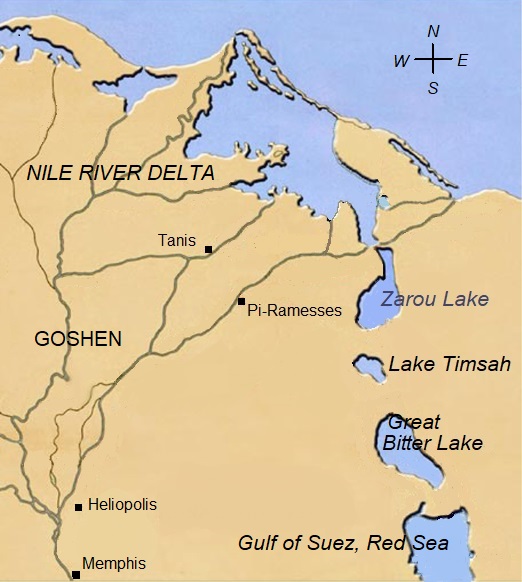
If Yam Suf refers to the Red Sea, the water would be too deep for an east wind to dry out a path across it. But the narrative gives two different accounts of the depth of the yam before God parted it. First it describes an east wind drying up the sea. Then the narrator says:

Then the Israelites came through the middle of the yam on dry ground, and the waters were a wall for them on their right and on their left. (Exodus 14:22)

Many of us picture walls of water rising almost vertically from the dry sea bed, as in this illustration:

The Waters Are Divided, by James J.J. Tissot, 1896-1902

An east wind drying up part of a shallow lake does not make walls of water. But after the Egyptian army has drowned, the Israelites on the other side rejoice by singing an ancient song or poem. (We know Exodus 15:1-18 dates to a much earlier time than the narrative because the Hebrew is older.) In this poem, the wind comes not from the east, but from God’s nose. And instead of exposed mud at the bottom of a shallow sea, the deep waters congeal or freeze solid.

And by a ruach from your nostrils the waters piled up;

            The watercourses stood up like a dam.

            The deeps congealed in the heart of the yam. (Exodus 15:8)

Nevertheless, whoever wrote the narrative that precedes this poem knew about harsh, dry east winds, and therefore could easily imagine walking across dry ground in the middle of a sea.

If the “Sea of Reeds” is a shallow salt lake, the miracle would lie in the inability of the Egyptians to follow the Israelites an hour or two later.

This week’s Torah portion says that the Egyptian charioteers followed the Israelites as far as the middle of the sea—on dry ground that was probably still muddy—and then were drowned by the sudden return of the water.

Then God made the wheels of their chariots fall off, and they moved laboriously. And the Egyptians said: “Let me flee from before Israel, because God is fighting for them against Egypt!” Then God said to Moses: “Hold out your hand over the yam, and the waters will come back over the Egyptians, over their chariots and over their riders!” And Moses held out his hand over the yam, and the yam came back to its normal position. And the Egyptians were fleeing from meeting it, but God shook the Egyptians off (their chariots) in the middle of the yam. The waters returned and covered the chariots and the riders and all Pharaoh’s soldiers coming in after them into the yam; not one of them remained. (Exodus 14:25-28)

The Egyptians Are Destroyed, by James J.J. Tissot, 1896-1902

The narrative does not say how God made the waters return to their normal level so quickly. But the poem that follows it says:

You blew with your ruach; the yam covered them;

            They sank like lead in the majestic waters. (Exodus 15:10)

The ancient poem tells us the wind from God’s nostrils opens a path through the sea and closes it again. The later narrative says God summons an east wind to expose the sea bed, and then makes the waters return through some unknown means.

Either way, the Yam Suf opens or closes according to God’s whim. And the word ruach can mean mood or spirit as well as wind. In the Torah portion Beshalach, the God character rescues the Israelites and drowns the Egyptians in a spirit of pride and determination to demonstrate superior power.


In the story of the plague of locusts, the God character dooms all the innocent people who stay in Egypt to a year of famine. In the story of crossing the Sea of Reeds, God dooms the army unit that pursues the Israelites to instant death.

But the God character’s objectives are achieved. The Israelites are free to march on to Canaan, and both the Egyptians and the Israelites know God is supreme.

And Israel saw the great power that God used against Egypt, and the people feared God and had faith in God and in [God’s] servant Moses. (Exodus 14:31)

Imagine you were an anthropological god and you wanted to rescue a downtrodden ethnic group from one country, motivate it to travel to another country, and make it the ruling class there. Could you formulate a proposal that killed fewer innocent people than the divine plan in Exodus?


  1. World Meteorological Organization, “Weather and Desert Locusts”, https://library.wmo.int/doc_num.php?explnum_id=3213#:~:text. In the book of Exodus, the last four plagues take place in the early spring.
  2. Exodus 12:29-32.
  3. See my post: Va-eira: Pride and Ethics.
  4. See my post: Beshalach: Pillar of Cloud and Fire.
Bo: Eyes and Swarms

Ten “plagues”, or devastating miracles, destroy the land of Egypt bit by bit in the book of Exodus, until the pharaoh finally acknowledges the God character’s superior power and gives the Israelites unconditional permission to leave. Last week’s Torah portion, Va-eira (Exodus 6:2-9:35), ends with the seventh plague: hail. (See my post: Va-eira: Hail That Failed.)

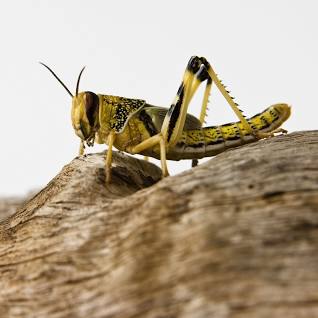
Desert locust: Schistocera gregaria

The eighth plague, locusts,1 opens this week’s Torah portion, Bo (Exodus 10:1-13:16). First Moses and Aaron tell Pharaoh:

“Thus says Y-H-V-H, the god of the Hebrews: How long do you refuse to humble yourself before me? Release my people so they will serve me! Because if you refuse to release my people, here I am, bringing arbeh in your territory tomorrow!” (Exodus/Shemot 10:3-4)

arbeh (אַרְבֶּה) = locust swarm(s); the desert locust Schistocera gregaria.

Then they deliver a practical threat and two frightening images. The practical threat is that the plague of locusts will devour every green thing in Egypt left after the hail, leaving the human population without food.2

Before and after the practical threat, Moses and Aaron transmit God’s frightening images.

Eyes, up and down

The first image conjures blindness, like the plague of darkness that will follow the locust plague.

“And it [the locust  swarm] will conceal the ayin of the land, and nobody will be able to see the land …” (Exodus 10:5)

ayin (עַיִן) = eye; view; spring or fountain.

After Pharaoh refuses to let the Israelites leave, the locust plague does exactly that.

And it concealed the ayin of the whole land, and it darkened the land and ate up all the green plants of the land and all the produce of the trees that the hail had left. Then nothing remained, nothing green remained on the trees or in the plants of the field, in the whole land of Egypt. (Exodus 10:15)

What does the word ayin mean in this story? The Hebrew Bible frequently uses ayin (most often in its duplex form, eynayim, עֵינַיִם = pair of eyes) to mean “view” or “sight”. Therefore many classic commentators assumed the Torah meant that the view of the land was blocked by the hordes of locusts. After all, the first reference to “the ayin of the land” is immediately followed by “nobody will be able to see the land”. If the locust swarms blanket every surface when they land, it would be as impossible to see through them as it is to see through the total darkness the Egyptians experience in the ninth plague.

On the other hand, the phrase “the ayin of the land” occurs only three times in the Hebrew Bible: twice in this week’s Torah portion (see above), and once in Numbers 22:5 (see below). According to contemporary commentator Gary Rendsburg, the rarity of this phrase means it is probably an adaptation of a common Egyptian phrase, “the eye of Ra”, which referred to either the sun (since Ra was the sun god) or the land of Egypt (which belonged to Ra). He wrote that Onkelos, who translated the Hebrew Bible into Aramaic in the second century C.E., inserted the word for “sun” in both phrases: “… ‘the eye of the sun of the land’ in 10:5 and … ‘the eye of the sun of the whole land’ in 10:15.”  Rendsburg suggested that Israelite readers would understand that the plague of locusts caused “the worst possible chain of events for the Egyptian nation, the disappearance of their omnipresent sun-god Ra”.3

Then what about the phrase “it darkened the land” in the second reference to “the ayin of the land”? When a locust swarm is in the air, it would not only block anyone underneath it from seeing the sun above, but also cast a broad shadow. According to Chizkuni,4 the shade cast by the swarm darkens the earth below.

Locust swarm, photo by James Wainscoat

However, the context of the only other biblical appearance of the phrase “the ayin of the land” refers to a swarm or horde on the ground. In the book of Numbers/Bemidbar. Balak, the king of Moab, is alarmed because Moses has led a horde of Israelites north from Egypt, and they are encamped on the border of his country. This king says to his advisors:

“Now the throng will lick bare everything around us like an ox licks bare the grass of the field!” (Numbers 22:4)

This is the behavior of locusts on the ground eating up the vegetation, not of locusts on the wing blocking the sun. King Balak then sends a message to the prophet-sorcerer Bilam, saying:

“Here are people [who] left Egypt, and hey! They conceal the ayin of the land, and they are living next to me! So now please come and put a curse on this people, because they are too strong for me …” (Numbers 22:5-6)

In other words, Balak sees the Israelites covering the ground like a giant swarm of locusts; and like locusts they are powerful because of sheer numbers.

Swarms: inside and out

Plague of Locusts, Nuremberg Chronicle, 1493

After the practical warning that the coming locust swarms will consume Egypt’s entire food supply, Moses and Aaron transmit a second frightening image to Pharaoh—one that conjures an gruesomely intimate invasion.

“And they will fill your houses, and the houses of all your courtiers, and the houses of all Egyptians …” (Exodus 10:6) 

It is not the first such invasion in the contest between the God character and Pharaoh. Before the second plague, frogs, God orders Moses to tell Pharaoh:

“And the Nile will swarm with frogs, and they will go up and come into your palace and your bedroom and climb into your bed, and go up into your courtiers’ houses and your people’s, and into your ovens and your kneading bowls.” (Exodus 7:28)

The fourth plague is arov, עָרֹב = swarms of insects (traditional translation), mixed vermin (translation based on the fact that the root ערב means “mixture”). Again God says:

“… and the arov will fill the houses of the Egyptians, and even the ground they stand on.” (Exodus 8:17)

Swarms of unpleasant animals are bad enough outside. Being unable to escape them even inside your own personal space is a horrifying invasion.


The plague of locusts both signals the coming plague of darkness, and echoes the earlier plagues of frogs and swarms of vermin. It also completes the destruction of Egypt, by eliminating the last sources of food. After Moses and Aaron warn Pharaoh about the locust plague,

Pharaoh’s courtiers said to him: “How long will this one be a snare for us? Release the men so they will serve Y-H-V-H, their god! Don’t you know yet that Egypt is lost?” (Exodus 10:7)

Locusts feeding, photo by Compton Tucker, NASA

Pharaoh is so invested in his power struggle with God and Moses that he is past the point of caring whether his country is lost. But his courtiers have a different motivation. The first seven plagues have already ensured the economic downfall of Egypt; the loss of more crops will only mean that landowners lose more wealth as they feed their people during the coming famine. They have nothing to prove about who has more power. Some of Pharaoh’s courtiers have already acknowledged God’s power by bringing in their field slaves and livestock before the seventh plague, hail.5

So why do Pharaoh’s courtiers beg him to let the Israelites go? Probably because they cannot bear the thought of one more plague, especially a plague that will blot out their sight of the sun and the ground, and will once again invade even their bedrooms.


Over the past twenty years I have had problems I could deal with, and two persistent troubles that drove me crazy because I felt constantly under attack from well-meaning people who could not understand me and would not leave me alone. I was plagued by their incessant arguments and their refusals to accommodate me. These plagues darkened my life so I despaired of seeing sunlight. They invaded my home because I had to keep returning their phone calls. All I wanted was to be free of them.

I cut myself loose from one plague by resigning from my position. At the time, it seemed as hard for me to give up on that part of my life as it was for Pharaoh to give up and let the Israelites go. I waited out the other plague until my unwitting tormenter died. In that case, I was more like Pharaoh’s courtiers, whose power was limited.

Now that I am free, I hope that if I see another plague coming, I will be able to cut my losses right away. But I also pray that I will have empathy for others who suffer from unrelenting troubles. It is painfully hard to make a major change to improve your life, especially when you can see no illumination, and you have no safe place of refuge.


  1. When a wind brings multiple swarms of desert locusts into the same large region, it is still called a “plague” of locusts. (World Meteorological Organization, “Weather and Desert Locusts”, https://library.wmo.int/doc_num.php?explnum_id=3213#:~:text)
  2. Exodus 10:5.
  3. Gary Rendsburg, “YHWH’s War Against the Egyptian Sun-God Ra”, https://www.thetorah.com/article/yhwhs-war-against-the-egyptian-sun-god-ra.
  4. Chizkuni is a compilation of Torah commentary and insights written by 13th-century Rabbi Hezekiah ben Manoah.
  5. Exodus 9:13-26. See my post: Va-eira: Hail That Failed.

Va-eira: Hail That Failed

Is it ethical to harm or even kill innocent people? The liberal answer is no. Someone with more traditional morality might answer: no … unless you need to do it for the sake of your own people, whose welfare comes first.

In terms of either answer, the God of Israel and the pharaoh of Egypt are unethical in this week’s Torah portion, Va-eira (Exodus 6:2-9:35).

The God character wants the Israelites to walk out of Egypt and serve God as the new rulers of the land of Canaan. The pharaoh character wants the Israelites to stay in Egypt as forced labor making bricks and building cities for him. The God character also wants to be acknowledged as the most powerful force in the world, while the pharaoh wants to keep every iota of power he already has.1

Following God’s instructions, Moses repeatedly offers Pharaoh what sounds like a compromise: that Pharaoh give the Israelites a three-day vacation to hold a festival for their God in the wilderness.2 (Meanwhile Moses informs the Israelites that the real goal is a new life in a different country.) Pharaoh refuses, and the God character responds by devastating Egypt with a series of “plagues”: miraculous disasters. The plagues devastate the country and harm or kill human beings, including both the Israelite immigrants God has adopted, and Pharaoh’s native Egyptians.

The Ten Plagues, Erlangen Haggadah, by Judah Pinchas, 1747

Before the seventh plague, hail, God tells Moses to pass on this information to Pharaoh:

“For by now shalachti my hand, and you, you and your people, would be wiped off the earth by bubonic plague. However, on account of this I have let you stand: to show you my power, so that my name will be made known over all the earth.” (Exodus 9:15-16)

shalachti (שָׁלַחְתִּי) = I could have sent forth, I could have released. (A kal form of the verb shalach, שָׁלַח = sent, let go. Throughout this week’s Torah portion, forms of the verb shalach are used both when God releases a plague, and when Moses and Pharaoh talk about releasing, or not releasing, the Israelites.)

In other words, God is refraining from simply killing every native Egyptian. The purpose of sending one plague after another is to spread the word about God’s awesome power, and to eventually make Pharaoh so terrified that he gives in and lets the Israelites go out into the wilderness.

Pharaoh’s strategy is to keep refusing to give the Israelites permission to go. He assumes they would never leave Egypt without his permission, probably because then his army would kill them.3

Plague of Death of the Firstborn, Erlangen Haggadah, by Judah Pinchas, 1747

So much is at stake that neither of the God character nor the pharaoh is willing to stop them. Only after the tenth plague, the death of the firstborn, does Pharaoh concede defeat.

Yet these entrenched enemies soften their positions briefly in this week’s Torah portion, in the story of the seventh plague: hail.

Ethics of a god

The first three plagues in the book of Exodus/Shemot afflict everyone in Egypt indiscriminately. When God turns the Nile into blood, the Israelites as well as the native Egyptians are affected by the shortage of both drinking water and fish.4 The second plague, frogs, and the third, lice, also affect everyone in Egypt without exception.

Then the God-character seems to notice that his demonstrations of power are causing suffering to the people he plans to rescue. Before the fourth plague, swarms of mixed vermin, God declares that all the Egyptians will be affected, but the region occupied by Israelites, Goshen, will be vermin-free.5

The Israelites also get a divine exemption from the fifth plague, cattle disease; the ninth plague, darkness; and the tenth, death of the firstborn. (Through the oversight of either the narrator or the God character, no exception is mentioned for the sixth plague, boils, nor for the eighth plague, locusts.)

The seventh plague, hail, is a unique case. No hail falls on Goshen, where the Israelites live. But this time God gives some of the Egyptians a chance to reduce their losses ahead of time. God tells Moses to tell Pharaoh and his court:

“Here I will be, about this time tomorrow, raining down a very heavy hail, the like of which has never been in Egypt from the day it was founded until now. So now, shelach your livestock and everything in the field that is yours! Every human and beast that is found in the field and has not been gathered into [its] house, the hail will descend upon them and they will die.” (Exodus 9:18-19)

shelach (שְׁלַח) = Send! Send in! (Another kal form of shalach.)

Perhaps God is testing Pharaoh to see whether he rejects everything God says, not just the demand to give the Israelites a three-day leave of absence. Pharaoh is stubborn and does not issue any orders about his own livestock or field slaves.

Plague of Hail, Erlangen Haggadah, by Judah Pinchas, 1747

But everyone in the audience hall hears God’s advice regarding the coming hailstorm, and some of Pharaoh’s courtiers act on it.

Whoever feared the word of God among the servants of Pharaoh had his slaves and his beasts flee into the houses. But whoever did not pay attention to the word of God left his slaves and his beasts in the field. (Exodus 9:20-21)

The hail still destroys the barley and flax crops and shatters trees throughout all of Egypt—except Goshen, where the Israelites live.6 This means a loss for even the God-fearing landowners, since all Egyptians now face a future shortage of food (barley and fruit) and clothing (linen from flax). The hail also kills or injures the slaves of the Egyptian landowners who ignored God’s warning and left them out in their fields along with the livestock.

The God character must notice that some of Pharaoh’s courtiers now believe in the power of the God of Israel. This is progress on God’s agenda of becoming known as the supreme deity. An ethical and intelligent deity would now devise a way to exempt every Egyptian who fears the God of Israel from the suffering and death that will be caused by the last three plagues.

But God’s lenience preceding the seventh plague does not last. The three plagues in next week’s Torah portion, Bo, affect all Egyptians without exception. The tenth and final plague kills the firstborn son of everyone in Egypt who does not paint blood on the doorframe of their house—and God does not tell anyone but the Israelites about this sign.

And it was the middle of the night, and God struck down all the first-born in the land of Egypt, from the first-born of Pharaoh who sits on his throne to the first-born of the captive who was in the dungeon, to all the first-born of the livestock. (Exodus 12:29)

For the plague of hail, God experimented with mitigating the damage to Egyptians who feared God. But the final and most horrible plague punishes all Egyptians, even those who are eager to let the Israelites leave.

Ethics of a king

During the first six plagues, Pharaoh makes two false promises to let the Israelites go, but breaks them as soon as the plagues are removed.7 He does not express any guilt over the devastation to his country and its people.

But he appears to have a change of heart during the seventh plague, hail.

Then Pharaoh summoned Moses and Aaron and said to them: “I am guilty this time. God is the righteous one and I and my people are the wicked ones. Plead to God that there will be no more of God’s thunder and hail, va-ashalchah you, and you will not continue to stay.” (Exodus 9:27-28)

va-ashalchah (וַאֲשַׁלְּחָה) = and I will send away, let go, set free. (A piel form of the verb shalach.)

Plague of Hail, Golden Haggadah, Spanish, ca. 1320

Only here and during the eighth plague, locusts, does Pharaoh say he is guilty. When the hail is pummeling the land, he qualifies his confession in two telling ways. He classifies his people as well as himself as “wicked” even though so far, only Pharaoh and his taskmasters have harmed the Israelites. And he says he is guilty “this time”, ignoring the previous six times he refused to release the Israelites.

Does Pharaoh really believe he acted unethically? Or is he just saying so in the hope that a little groveling will help to get the plague of hail removed?

After all, Moses has not been frank with Pharaoh. So far he has kept repeating God’s request that the pharaoh give the Israelites three days off to worship their God in the wilderness. Pharaoh, by adding “and you will not continue to stay”, hints for the first time that he suspects the truth: if the Israelites got a three-day head start, they would not return to Egypt. Both Moses and Pharaoh hide their true agendas.

This week’s Torah portion ends:

And Pharaoh saw that the rain and the hail and the thunder had ended. Then he added to his guilt, and his heart was unmoved,8 his and his courtiers’. And Pharaoh’s heart hardened, and he did not shilach the Israelites, as Hashem had spoken through Moses. (Exodus 9:34-35)

shilach (שִׁלַּח) = let loose, let go, sent away. (Another piel form of the verb shalach.)

It is the narrator who says Pharaoh “added to his guilt” by being hard-hearted and refusing to let the Israelites go. Pharaoh himself is no longer talking about guilt. He has returned to his stubborn refusal to recognize that he cannot win against God. And Pharaoh’s courtiers stand with him this time.

By now Pharaoh knows that every time he refuses to release the Israelites another plague strikes Egypt. Perhaps during the hail he realizes that he, too, bears some responsibility and guilt for the damage the plagues have done. But then he returns to making  his own status as Egypt’s absolute ruler his top priority. He does not free the Israelites until the plague of the firstborn kills his own son and heir.


Both God and Pharaoh soften briefly during the story of the plague of hail. The God character enables the Egyptian landowners who take God seriously to protect some of their property. Pharaoh entertains the idea that he is wrong to prioritize his pride and his free labor over the health and safety of his own Egyptian citizens. Yet this softening quickly vanishes without leading to a moral improvement in either character.

It is easy to keep on angling to get what you want, regardless of the consequences for anyone else. I have acted that way myself, until I realized the damage I was doing and repented.

But some individuals are too narcissistic to feel compassion and repent. Occasionally a narcissist says or does something that appears to be kind and compassionate but, as I know from personal experience, this temporary kindness may be only a ploy to win favor. When push comes to shove, narcissists will harden again, because nothing is more important than their own agendas.

The book of Exodus paints the characters of both God and Pharaoh as narcissistic. Nevertheless, people still enjoy a story about a battle between two superpowers, regardless of the collateral damage in human lives.

But in our own lives, may we remember to look and see whether we are harming others as we pursue our own agendas. And may we protect ourselves, and others, from narcissists who cannot see the harm they do.

And may we not confuse God with the narcissistic God character in the book of Exodus.


  1. See my post Bo: Pride and Ethics.
  2. Exodus 5:1-3, 7:16, 8:21-24, 10:9-11, 10:24-26.
  3. Pharaoh and his charioteers do pursue the Israelites in Exodus 14:6-10 after Pharaoh changes his mind about letting them go.
  4. Exodus 7:20-24.
  5. Exodus 8:17-8:18.
  6. Exodus 9:16, 9:25, 9:31.
  7. Pharaoh promises to let the Israelites go during the plague of frogs in Exodus 8:4 and backs out in Exodus 8:11. He promises during the plague of vermin in Exodus 8:21 and 8:24 and backs out in Exodus 8:28.
  8. The Hebrew reads: vayakhebeid libo (וַיַּכְבֵּד לִבּוֹ) = and his heart was heavy. In English, the idiom “heavy heart” means sadness. But in Biblical Hebrew, a “heavy heart” is unmoved or immovable.

Shemot: Demagogue

Demagogue (noun): a leader who makes use of popular prejudices and false claims and promises in order to gain power. (Merriam-Webster Dictionary)

Egypt has too many immigrants! says the pharaoh says at the beginning of the book of Exodus, in the Torah portion Shemot (Exodus 1:1-6:1). If the immigrant population increases any more, we’re in trouble!

“Hey, the Israelite people are countless, more numerous than we are! Come, let us use our wits, or else they will increase. Then it will happen that war will be proclaimed against us, and [these people] will actually join our enemies and make war against us, then go up from the land!” (Exodus/Shemot 1:9-10)

Semites visiting Egypt, Tomb of Knumhotep II, c. 1900 BCE

A few centuries before, in the book of Genesis, a pharaoh appreciated Joseph’s service so much he invited Jacob’s clan of 70 people to migrate from Canaan to Egypt. Now they have so many descendants that some of the native Egyptians are nervous. The pharaoh escalates their fears by predicting both that the Israelites will rise against the Egyptians, and that they will leave Egypt and, presumably, stop contributing to its economy.

Today demagogues in many western nations spread the notion that immigrants and their descendants will take away jobs, use up public resources, and change the culture of the country. Why did the pharaoh at the beginning of the book of Exodus raise the specter of civil war instead?

The scenario the pharaoh describes in this week’s Torah portion may have actually happened when a Semitic people called the Hyksos conquered northern Egypt and ruled it from 1638 to 1530 B.C.E.. A recent analysis of teeth found in skeletons in the remains of Aravis, their capital in the Nile delta, indicates that the Hyksos came from an established immigrant community within Egypt.1

Ramesses II capturing enemies, c. 1250 BCE

None of the pharaohs in the book of Exodus are named, but the first one to speak is sometimes identified with Ramesses II, who ruled in 1279–1213 B.C.E. and built a new capital city, Pi-Ramesses, near the old site of Avaris. During his reign Canaan was a colony of the Egyptian Empire, populated by Semites but controlled by Egyptian administrators and soldiers. Nevertheless, historical memory of the Hyksos might have haunted Egyptians.

After fomenting fear and loathing of the Semitic Israelites living in Egypt, the first pharaoh in Exodus takes two actions. First he takes advantage of the anti-Semitism he has revived to get free labor for his own projects.

Then they set over them [the Israelite men] overseers for corvée labor in order to oppress them with their forced labor, and they built cities of warehouses for Pharaoh: Pitom and Rameseis. (Exodus 1:11)

Native Egyptians are probably glad their pharaoh is conscripting resident aliens instead of them. However, this corvée labordoes not address the pharaoh’s original claim that the Israelites are dangerous because they might fight on the enemy’s side in a war. Even though the Israelite men are supervised by Egyptian overseers, they might revolt if an army from another country promised them liberation.

(The first book of Kings provides an example of rebellion due to forced labor. King Solomon imposes corvée labor on his own people, sending Israelite men in shifts to quarry stone in Lebanon for building Jerusalem’s new temple. Unlike the Israelites in Egypt, Solomon’s laborers work in the quarries one month, then get two months off at home.2 The levy continues for further building projects in the northern part of Solomon’s kingdom.3 When Solomon’s son and successor, Rechavam, announces he will work the northern Israelites harder, they revolt and set up their own kingdom.4)  

The first pharaoh in Exodus, besides taking advantage of the anti-Semitism he has revived in order to levy forced labor, attempts to commit gradual genocide. He orders the midwives for the Israelites to kill the male infants of Israelite women, but let the females live.5 Perhaps his rationale is that the boys would grow up to become soldiers fighting against the native Egyptians. A more efficient way to commit genocide would be to kill the girls as well, since they will give birth to future generations. But the cultural assumption was that girls could be trained as servants and concubines and safely absorbed into the Egyptian population. Why deprive the native Egyptians of a class of docile domestic servants?

But the midwives disobey the pharaoh.

Then the king of Egypt summoned the midwives and said to them: “Why have you done this thing and let the boys live?” And the midwives said to Pharaoh: “Because the Ivriot are not like the women of Egypt, because [they are] chayot. Hey! Before you come to them to serve as a midwife, they have given birth.” (Exodus 1:18-19) 

Ivriot (עִבְרִיֺּת) = female Hebrews.  (Plural female of Ivri, עִבְרִי. The term Ivri may be related to the term habiru in letters sent from Canaan to Egypt in the 14th century B.C.E.. The habiru were a marginal social class of outsiders, often outlaws or mercenaries. In Hebrew, Ivri is related to the verb avar, עָוַר = pass through, cross over; an ivri is a boundary-crosser or a nomad. Today the Hebrew language is called Ivrit, עִבְרִית.)

chayot (חָיוֹת) = wild animals.

The midwives probably refer to the Israelite women as Ivriot and chayot in order to sound as if they are as anti-Semitic as the pharaoh.6 They get away with their excuse; the pharaoh refrains from punishing them.

Although classic commentary says the two spokeswomen for the midwives, Shifrah and Puah, and actually Moses’ mother and sister, Pharaoh would hardly respond positively to their excuse if they were Semites! But why would the Israelite women use Egyptian midwives? The Torah offers no explanation. Why complicate a juicy story?

Even though the pharaoh lets the midwives off the hook, he still needs to pander to the masses he has inflamed. So he incites the native Egyptians to take violent action.

Then Pharaoh commanded his entire people, saying: “Every son that is born, you shall throw him into the Nile. But every daughter you shall keep alive.” (Exodus 1:22)

Vigilante groups of Egyptian men must have responded by searching Israelite houses, seizing infant boys, and drowning them. The next two sentences in the Torah portion are:

And a man from the house of Levi went and married a daughter of Levi. And the woman conceived, and she gave birth to a son. And she saw him, that he was good, and she hid him for three months. (Exodus 2:1-2:2)

This baby boy is Moses, who is later adopted by a daughter of the pharaoh who does not share her father’s anti-Semitism.


I believe the pharaoh in this story acts unethically by inciting murder, by imposing corvée labor on residents of his country in a time of peace, and by encouraging prejudicial acts against native-born children of an immigrant population. But not everyone today would agree with me. Demagogues have risen in more than one modern Western nation in the 21st century, and a few have even been elected as heads of state.

Since the pharaoh in this week’s Torah portion is an absolute ruler, he can issue inflammatory orders without fear of reprise. I pray that all demagogues who incite violence in our time will be brought to justice.


  1. https://www.smithsonianmag.com/smart-news/first-foreign-takeover-ancient-egypt-was-uprising-not-invasion-180975354/
  2. 1 Kings 5:27-31.
  3. 1 Kings 11:26-28.
  4. 1 Kings 12:1-20.
  5. Exodus 1:16.
  6. Exodus 1:17-19. See my post Shemot: Disobedient Midwives.

Vayechi: When Jacob Bows

The prophecy

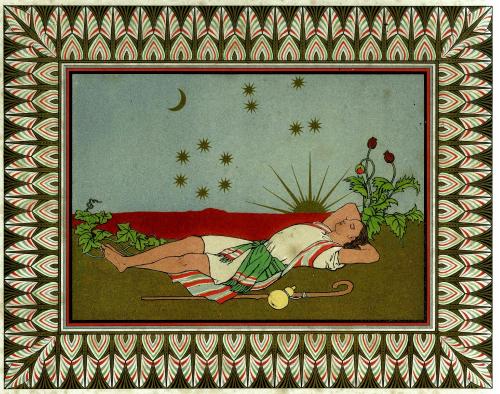
Joseph has two prophetic dreams when is seventeen, according to the Torah portion Vayeishev (Genesis 37:1-40:23). After the second dream, he tells his brothers:

“Hey, I dreamed a dream again! And hey! The sun and the moon and eleven stars mishtachavim to me!” And he reported [it] to his father and to his brothers, and his father rebuked him and said to him: “What is this dream that you dreamed? Will we actually come, I and your mother and your brothers, lehishtachot to the ground to you?” And his brothers were jealous of him, and his father observed the matter.  (Genesis/Bereishit 37:9-11)

mishtachavim (מִשְׁתַּחֲוִים) = were bowing down, were prostrating themselves. (From the root verb shchh, שׁחה = bow down deeply in humility, do homage.)

lehishtachot (לְהִשְׁתַּחֲוֺת) = to bow down. (Also from the root sh-ch-h.)

Joseph’s Second Dream, by Owen Jones, 1865

Joseph’s father, Jacob (a.k.a. Israel), is over 100 years old at this time, and so far the Torah has not mentioned him bowing down to anyone except his brother, Esau.

The previous prostration

That happened in the Torah portion Vayishlach (Genesis 32:4-36:43), when the two brothers met again after a twenty-year estrangement. Esau had vowed to kill his brother after Jacob had cheated him out of both his birthright and the blessing he expected from their father. Jacob had fled to his uncle’s house in Charan. When he finally headed home again, after acquiring a large family and his own fortune, he learned that Esau was coming down the road with 400 men to intercept him. Jacob did everything he could think of to prevent disaster: sending his brother generous gifts ahead of time, praying to God, and finally, as Esau came into view with his troop,

He himself went across to face him, vayishtachu to the ground seven times, until he came up to his brother. (Genesis 33:3)

vayishtachu (וַיִּשְׁתַּחוּ) = and he bowed down, and he prostrated himself. (Also from the root sh-ch-h.)

In the Hebrew Bible, prostrations are a way to demonstrate humility and deference to a superior—usually to a king or to God. By bowing down to Esau seven times, Jacob is symbolically renouncing any advantage he tried to get over Esau in his youth, and demonstrating as graphically as possible that he considers Esau his superior. His prostrations are the equivalent of a puppy rolling over and exposing its throat to an older dog.

Inferior to nobody

After Jacob and his family and servants depart from Esau in peace, he does not bow to anyone for over forty years. Why should he? Jacob, jealous of his twin brother’s extra rights as the firstborn, has always been self-conscious about his position in life. After he failed to secure the rights of a firstborn son by fraud, he labored in Charan for twenty years until he had earned them. Now Jacob is a chieftain with twelve sons, many slaves and employees, and a great  wealth of livestock. The chieftain of the town of Shekhem treats Jacob as an equal, and when he makes an offer to Jacob he goes out to his camp instead of summoning him to his own residence in town.1

Jacob does not bow down to God, either. He first encounters God in the dream with angels on a stairway, and when he wakes up he treats God as someone to bargain with, vowing to give God a tithe of his wealth if God protects him and brings him safely back home.2 When Jacob worships God, he does so by pouring oil on a stone or burning animal offerings on an altar.3

Jacob and his people settle somewhere near Hebron/Chevron in Canaan.4 After Jacob’s older sons come home from the field without their younger brother and show their father Joseph’s bloody tunic, Jacob thinks his favorite son is dead. He mourns Joseph for 22 years. During that time Joseph is actually living in Egypt, where he rises from slave to viceroy. Finally Joseph sends for his father and his whole extended family in last week’s Torah portion, Vayigash (Genesis 4:18-47:27).

And Joseph harnessed his chariot and went up to Goshen to meet Israel [a.k.a. Jacob], his father. And he appeared to him, and he fell on his neck and he wept on his neck a long time. Then Israel said to Joseph: “I can die now, after seeing your face, that you are still alive.” (Genesis 46:29-30)

But the prophetic dream Joseph had when he was seventeen is not fulfilled. Jacob’s brothers have already bowed down to him many times, but his father has not.

Jacob does not bow down to Pharaoh, either, when Joseph presents him at court. He greets the king of Egypt with a blessing, and answers Pharaoh’s inquiry about how old he is by saying he is 130, and his life has been hard and short.5 Then Jacob blesses the king again, and leaves.

The prophecy fulfilled

Jacob finally bows down for the second time of his life on his deathbed, in this week’s Torah portion, Vayechi (Genesis 47:28-50:26).

Then the time approached for Israel [a.k.a. Jacob] to die, and he called for his son, for Joseph, and said to him: “If, na, I find favor in your eyes, place, na, your hand under my thigh and do a loyal and faithful deed for me: don’t, na, bury me in Egypt. When I lie down with my forefathers, then bring me up from Egypt and bury me in their burial place!” (Genesis 47:29-30)

na (נָא) = please, pray, I beg you. 

Joseph gives his word, but Jacob wants the formal hand gesture of an oath as well.6

And he [Israel/Jacob] said: “Swear to me!” And he swore to him. Vayishtachu, Israel, upon head of the bed. (Genesis 47:31)

vayishtachu (וַיֱִשְׁתַּחוּ) = and he bowed. (Also from the root sh-ch-h.)

Many classic commentators wrote that Jacob bowed toward the head of his bed, because the presence of God is at the head of the bed of a sick person (and prepositions are ambiguous). But that interpretation implies he was standing up. The Torah has already told us that Jacob is 147, and his death is approaching. I have been at the beside of four people near death, and I believe even Jacob would be too feeble to stand up during his final days.7 Perhaps he is seated on his bed, resting against a cushion, and he manages to bow at the waist.

In that case, he is not bowing toward the head of his bed; he is probably bowing to Joseph. This was the opinion of 12th-century rabbi Shmuel ben Meir, known as Rashbam, who wrote: “ ‘And Israel bowed low’: To Joseph, from the place where he was at [the top of] the bed.”8

Rabbi Bachya ben Asher (1255-1340 C.E.), known as Rabbeinu Bachya, added: “Seeing that Joseph had agreed to honour his father by undertaking to fulfill his wishes, Yaakov in turn prostrated himself before him to show that he respected the position Joseph occupied as effective ruler of the country.”8

Jacob spent the first hundred years of his life struggling to be the one on top, the one in charge. But during his final years in Egypt, he accepts that his son Joseph is his superior. He knows he is dependent on Joseph to carry out his final request, so he uses the language of an inferior, using the subservient phrase “if I find favor in your eyes” and repeating he word na. Then he uses the gesture of a humble inferior, coming as close as he can to a prostration.

This is the moment when Jacob fulfills the prophecy of the dream his son Joseph had when he was seventeen.

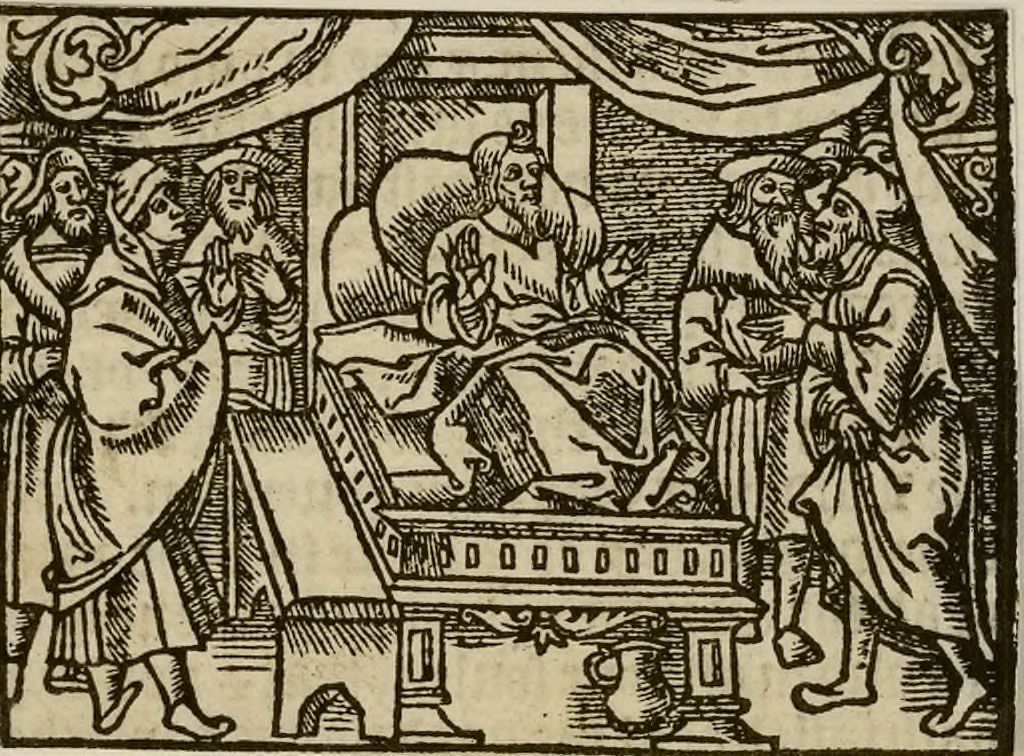
Jacob on his Deathbed, woodcut, 1539

After that, Jacob lives long enough to do the equivalent of rewriting his will, adopting Joseph’s two sons as his own so they will receive shares of the inheritance equal to those of Joseph’s brothers. Jacob also delivers his own prophecies to all his sons, predicting what will happen to the tribes that descend from them. Finally he orders all twelve of his sons to bury him with his deceased family members in the cave of Machpelah in Canaan.

And Jacob completed commanding his sons, and he drew back his feet in the bed, and he expired, and he was gathered to his people. (Genesis 49:33)

One prostration to Joseph before he died was enough for Jacob.


“Honor your father and your mother,” says the fifth of the Ten Commandments in the book of Exodus. In my post Yitro, Mishpatim, & Va-etchanan: Relative or Relevant? Part 1, I suggest that parents should also honor their children. But should they show humble submission to them, as Jacob did by bowing to Joseph on his deathbed?

Nobody would advise submission to a callow seventeen-year-old. But what about when the child is middle-aged, and the parent’s ability to deal with the world is declining in old age? If the adult child is competent and kind, then it would be better to humbly submit to that child’s arrangements than to insist on complete autonomy. I hope that is what I will do when I am considerably older—though I do not expect to live to age 147!


  1. Genesis 34:6-24.
  2. Genesis 28:20-22.
  3. Jacob’s journey south from Shekhem ends at the home of his father, Isaac, in Hebron/Chevron (Genesis 35:27). After that, the Torah only says Jacob lives “in the land of Canaan”, without specifying the location. His first stop on the way to Egypt is Beir-sheva, which is south of Chevron.
  4. Genesis 28:16-19, 33:19-20, 35:6, 35:13-14, 46:1.
  5. Genesis 47:7-10.
  6. Biblical Hebrew sometimes uses the word for “thigh”, yareich (יָרֵךְ) as a euphemism for the genitals. According to Pirkei DeRabbi Eliezer, midrash written between 630 and 1030 C.E., Jacob said: “O my son! Swear to me by the covenant of circumcision that thou wilt take me up to the burial-place of my fathers in the land of Canaan to the Cave of Machpelah.” (translation of Pirkei DeRabbi Eliezer 39:13 by sefaria.org)
  7. This is the first of Jacob’s three deathbed scenes. In the second, he has to summon his strength (vayitchaek, וַיִּתחַזֵּק) to sit up in bed.
  8. Both quotations are from sefaria.org.