Vayikra: A Voice Calling

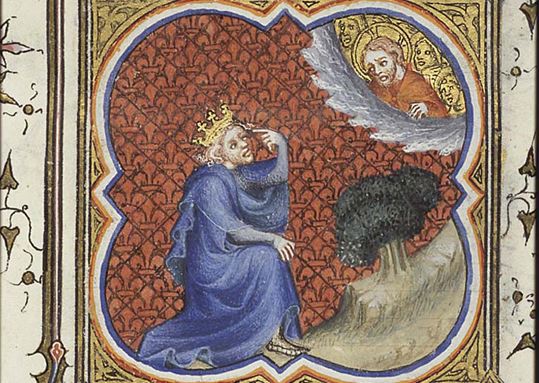
Moses at the Burning Bush,
by Rembrandt

There are only four times in the Bible when God “calls” to Moses before speaking to him, and all four happen at Mount Sinai. God calls from the burning bush1 for their first introduction; from the top of Mount Sinai when the ex-slaves from Egypt first arrive2; and from the top of the mountain again (when it is smoking and thundering) to give Moses more instructions before the revelation known as the “Ten Commandments”3.

The fourth time, God calls to Moses from within the Tent of Meeting that the Israelites have constructed at the foot of Mount Sinai.

Vayikra to Moses, and God spoke to him from the Tent of Meeting, saying: Speak to the children of Israel and say to them… (Leviticus/Vayikra 1:1-2)

vayikra (וַיִּקְרָא) = and he/It called (by name).

This divine call opens the book of Leviticus/Vayikra and this week’s Torah portion, which is also named Vayikra. Why does God call to Moses before giving him a new set of instructions?

One answer is that God always called Moses before speaking to him, as an expression of affection or courtesy, but the Torah does not always mention it.4

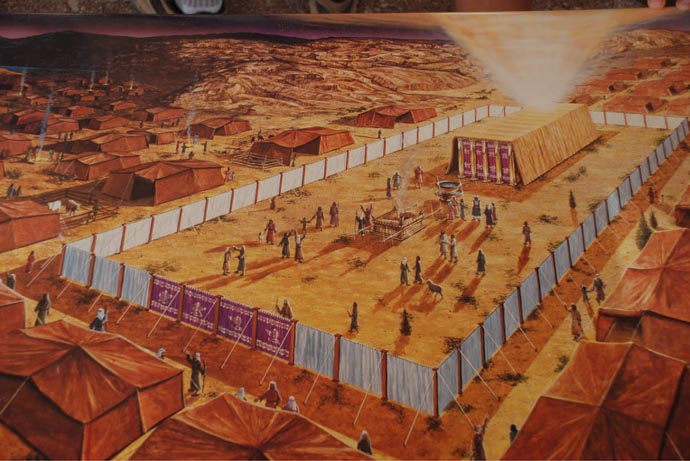
Tabernacle in the Wilderness, by J.J. Derghi, 1866

Another explanation points out that at the end of the book of Exodus/Shemot, Moses assembles the new Tent of Meeting for the first time, and the presence of God moves from the top of Mount Sinai into the tent.

Then Moses was not able to enter the Tent of Meeting because the cloud dwelled in it, and the magnificence of God filled the Dwelling-Place.  (Exodus 40:35)

Moses is not willing to try entering again until God calls to him from inside the tent. When he hears this call, he realizes that his job is not finished; he must continue to serve as an intermediary between God and the Israelites.5  The only difference is that now he will hear God’s voice from the empty space above the ark in the back chamber of the tent, the Holy of Holies.6 To facilitate this, the cloud moves and hovers above the tent.

A unique feature of the word vayikra at the beginning of Leviticus is that in every Torah scroll, the letter aleph (א) at the end of the word is written smaller than the other letters.

Six words in the first five books of the Bible (Genesis through Deuteronomy, the contents of a Torah scroll) have been written with one letter smaller than the others ever since the 7th century C.E.7  No one knows the historic reason for these miniature letters, but symbolic interpretations have been proposed for each one.

The Zohar explains the small א in vayikra as indicating a restriction in God’s summons. Earlier in the Torah, God calls to Moses in full majesty from out of fire: first from the burning bush, then from the fire at the top of Mount Sinai. Now God calls from the Tent of Meeting, from inside the Holy of Holies.8

The idea of restriction is reinforced by the fact that in the first sentence of Leviticus, the Torah says He/It called to Moses, instead of God called to Moses; the name of God is only used in the second clause, when God speaks to Moses and gives him instructions. Moses hears the initial call when he is standing outside the Tent of Meeting. Then he goes inside to receive God’s new instructions.

From that point on, although Moses occasionally prostrates himself on the ground to get a quick word of divine advice, God usually speaks to him from the empty space above the ark in the Holy of Holies.
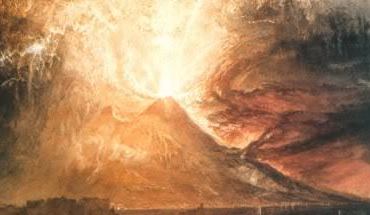
from Vesuvius in Eruption,
J.M.W. Turner, 1817

What does it mean that God now speaks with an indoor voice instead of an outdoor voice?  I think this change is related to a change in the Israelites’ relationship with God.  In the book of Exodus, God only speaks to the people once, on the day of revelation, and the people at the foot of Mount Sinai experience thunder, lightning, heavy cloud, the blare of a horn, smoke and fire, and earthquake.9

The experience is too devastating for the people, and they beg Moses to be a go-between for them.10  Moses does so, trotting up and down Mount Sinai, speaking with God at the top and the people at the bottom.  The ex-slaves from Egypt remain passive.  Even when they are afraid Moses has died, and they want an idol to replace him as their leader, they ask Moses’ brother Aaron to make it; they wouldn’t dare make a golden calf by themselves.

But when Moses passes on God’s instructions for making a dwelling-place for God, everyone with a willing heart donates materials, and everyone with a wise heart helps with the craftsmanship. (See my post Vayakheil: Will My Cup Run Over?)  In the book of Leviticus, Moses passes on God’s instructions for when and how the people should serve God by bringing their offerings, both animal and vegetable, to the altar.  Aaron and his four sons get new jobs as priests conducting sacred rituals, and at every stop on the journey through the wilderness, each tribe has a designated camping spot in relation to the Tent of Meeting.

Everyone is involved in serving God.  But only Moses and Aaron (the high priest) hear God’s voice; only they are permitted to enter the Holy of Holies.


Today we still see a difference between the organized religion of a congregation, and a lone person hearing God’s voice on a mountain-top.  People still have individual mystical experiences, usually when they are alone and confronted with a sight or sound that inspires awe.  Those experiences are precious.  But they are not sufficient for leading a good or holy life.  After all, does anyone today get explicit instructions from God whenever he or she needs them?  Is anyone today like Moses?

When we yearn for a moral compass or a way to walk with (or at least toward) God, we need help from other people.  We need a community of fellow-seekers, wise teachers to advise us, books to study, prayers to chant, rituals to perform.  We need our own equivalent of the Tent of Meeting.

If we do build a dwelling-place for God, in the right way for our own community in our own time, then we, too, can draw closer to God.  We may not hear God’s voice, but we can all feel that God is calling, and God’s presence rests in our midst.

(An earlier version of this essay was posted on March 6, 2010.)


  1. And God saw that he had turned aside to look, vayikra to him, God, from the middle of the bush, and said: Moses! Moses!  (Exodus 3:4).
  2. And they journeyed on from Refidim, and they entered the wilderness of Sinai, and they camped in the wilderness; and Israel camped there in front of the mountain. And Moses went up to God. Vayikra to him, God, from the mountain, saying: Thus you shall say to the House of Jacob…  (Exodus 19:2-3).
  3. And God came down onto Mount Sinai, vayikra Moses, God did, to the top of the mountain.  And Moses went up. (Exodus 19:20).
  4. Rashi (12th-century rabbi Shlomo Yitzchaki) on Torat Kohanim (Leviticus), after Sifra, ed. by Rav Chiyya of the Babylonian Talmud.  Also see Midrash Rabbah, Bamidbar, 14:21.
  5. “Moses needed constant goading because he was a humble person who instinctively withdrew from the attention and the honors that go with leadership.”  (Rabbi Elie Munk, The Call of the Torah: Vayikra, trans. by E.S. Mazer, Mesorah Publications, 1992, p. 2).
  6. And when Moses went into the Tent of Meeting to speak with [God], then he would hear the voice speaking to him from above the lid that was on the Ark of the Testimony, from between the two keruvim; and [God] spoke to him.  (Numbers 7:89).
  7. During the 7th to 10th centuries C.E., a series of rabbis arrived at a single, authoritative Biblical text derived from various copies written in consonants only. The Masoretes added diacritical marks to the text to indicate vowels, cantillation, and grammar. They also added marginal notes, and made some letters abnormal in size or position. The small letters (zeira) were among the earliest changes by the Masoretes. These six miniscule letters appear in Genesis 2:4 (ה in behibaram = when being created), Genesis 23:2 (כּ in velivkotah = and to wail for her), Genesis 27:46 (ק in katzeti = I am disgusted), Leviticus 1:1 (א in vayikra), Leviticus 6:2 (מ in mokdah = fire-place), and Numbers 25:11 (י in the name Pinchas).
  8. Munk, p. 3, paraphrasing the Zohar, a multi-volume 13th-century kabbalistic commentary by Moshe deLeon.
  9. Exodus 19:16-19.
  10. Exodus 20:15-18.

Vaykheil & Psalm 18: Wings for Chariots

(This is the last of a series of posts comparing ideas in the book of Exodus/Shemot with related ideas in the book of Psalms. Next week I will begin revisiting some sparks in the ancient priestly religion described in the book of Leviticus/Vayikra.)

Skilled artisans among the Israelites make all the items for the portable tent that is to be a dwelling-place1 for God in the Torah portion Vayakheil. Moses then assembles the new Tent of Meeting, the divine fiery cloud covers it, and the glory of God fills the inside in the next Torah portion, Pekudei. The golden calf was a mistake, but this time the Israelites got it right! The success in this week’s double portion, Vayakheil-Pekudei, completes the book of Exodus/Shemot.

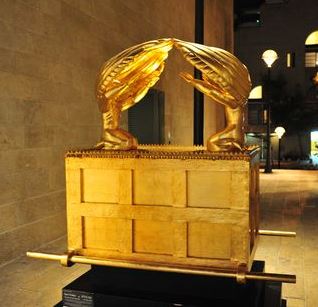
One replica of the ark, Jerusalem

The focal point for God’s presence is the empty space above the ark inside the inner chamber of the tent.  The ark is a gold-plated wooden box holding the second pair of tablets Moses brought down from Mount Sinai. The master-artisan Betzaleil hammers out a solid gold lid for the ark—not just a slab of gold but a sculpture, with two winged creatures rising from the lid in one continuous piece of gold.

And he made two keruvim; of gold hammered work he made them, from two edges of the lid: one keruv from this edges and one keruv from that edges. From the lid he made the keruvim, from its edges. And the keruvim were spreading out wings above, shielding the lid with their wings. And each one faced its brother, and the faces of the keruvim were toward the lid.  (Exodus/Shemot 37:76-9)

keruv (כּרוּב) = a hybrid creature with wings and a human face. Plural: keruvim (כְּרוֻבִים  or  כְּרוּוִים). (The English word “cherub” is derived from the Hebrew keruv, but a keruv in the Bible does not look like a chubby baby with stubby white wings.)

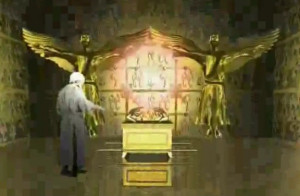
Keruvim and ark in First Temple (one interpretation)

When King Solomon builds the first temple in Jerusalem, its back room, the Holy of Holies, contains two free-standing gold-plated sculptures representing keruvim. Each is 10 cubits tall (15 to 20 feet) and has a 10-cubit wingspan. Solomon has the ark carried in and placed under their wings. (See my post Pekudei & 1 Kings: A Throne for the Divine.)

The Hebrew word keruv may come from the Akkadian word kuribu, “blessed ones”, their name for the colossal statues of hybrid winged beasts guarding doorways and gates. Commentators have speculated that keruvim might have the bodies of bulls (like Assyrian shedu) or lions (like Egyptian sphinxes or Phoenician lammasu) or humans. Raanan Eichler has made a good argument that the keruvim spreading their wings over the ark must have stood upright on two legs, and therefore probably had human bodies.

Hybrid beings with wings and human faces appear in many Ancient Near Eastern sculptures. When they are not demons battling heroes, they are either guardians of gates, or servants transporting a god. Keruvim in the Hebrew Bible are never demons, but they do appear as both guardians and transportation.

Guardians

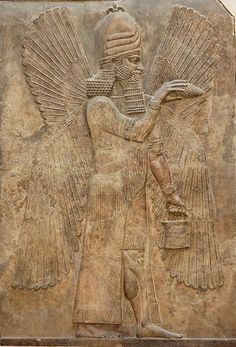
Kusarikku from palace of Sargon II

Assyrians placed sculptures of shedu, winged bulls, as guardians at either side of a gateway into a city or palace. Another guardian figure, called Gud-alim by Sumerians and Kusarikku by later Mesopotamians, represented a door-keeper who protected a house from intruders. He stood upright and looked fairly human, except that he often had wings, horns, or a bull’s legs. In some depictions he carries a bucket.

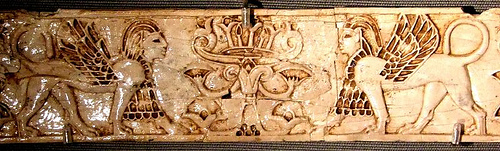
Phoenician artworks from coastal cities west of ancient Israel and Judah also feature a pair of hybrid winged creatures on either side of a tree of life. Their tree of life is a composite of a lotus and a papyrus (borrowed from Egyptian art) and sometimes a palm tree.

Phoenician sphinxes and tree of life

Similarly, the decorations carved in the walls of King Solomon’s temple—by artisans from the Phoenician city-state of Tyre—featured keruvim and palm trees.2

In the book of Genesis/Bereishit, two keruvim serve as guardians of the way back into the Garden of Eden, where the Tree of Life remains untasted.3

One of Ezekiel’s prophesies compares the king of Tyre with a keruv that is supposed to protect its city.4  In an earlier post, Terumah: Cherubs Are Not for Valentine’s Day, I suggested that since God speaks to Moses from the empty space above the ark,5 the two keruvim are also guardians of an entrance: a portal to the invisible God.

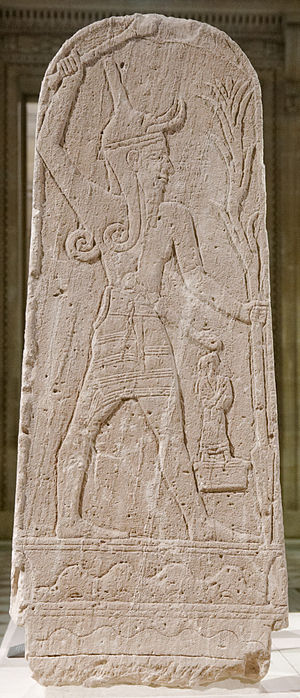
Baal Hadad with thunderbolt, Ugarit

Divine Transportation

Tarhunz from Arslantepe, Turkey

The gods of other religions in the ancient Near East rarely rode on the backs of winged creatures; instead they used these creatures to pull their chariots. Tarhunz, the high god of the Luwian people living north of Canaan, was in charge of weather and war. He used lightning as a weapon, and rode in a chariot pulled by winged horses. South of the Luwians and north of Israel, the Canaanites of Ugarit worshiped Baal Hadad (“Master of Thunder”), a weather and war god who also wielded lightning. The Ugarit writings call this Baal “Rider of Clouds”.

The God of Israel also seems to have a chariot of clouds, in the poetry of Jeremiah and Psalm 104.6

God’s cloud chariot is pulled by keruvim in a poem that appears twice in the Bible, once as chapter 22 in the second book of Samuel, and later (with only slight changes) as Psalm 18. The speaker, King David, faces death at the hands of an enemy army, and calls on God for help. God descends from the heavens.

            Smoke went up from His nostrils

                        And fire from His mouth devours.

                        Embers blazed from Him.

            He tilted the heavens and descended,

                        And a thundercloud was beneath His feet.

            And He drove a keruv and flew,

                        And He soared on the wings of the wind. (Psalm 18:9-11)

I use the pronoun “He” in this translation because God is presented as if “He” were Baal Hadad from the Canaanite pantheon of male and female gods. Psalm 18 continues with imagery of dark clouds, hail, thunder, and arrows of lightning. God then stages a dramatic rescue, and David wins the battle.

A Chariot Throne

The ark with its two keruvim is often considered God’s throne in the Bible—the authoritative location where God sits like a king. But sometimes this throne is movable, like a chariot.

Before David conquers Jerusalem, when the ark is housed in a temple at Shiloh, the Israelite army decides to carry it with them into battle against the Philistines, hoping that God will fight for them.

And they took away from there the ark of the covenant of God of Armies Sitting on the Keruvim … (1 Samuel 4:4)

Although the Israelite forces carry God’s throne, they lose the battle. The Philistines capture the ark, then later abandon it in Israelite territory. When King David retrieves it for his new capital in Jerusalem, it is called

the ark of the god whose name was invoked, the name of God of Armies Sitting upon the Keruvim.  (2 Samuel 6:2)

The title is also used in psalms 80 and 99.

            Listen, Shepherd of Israel, You who lead Joseph like a flock!

                        Sitter on the keruvim, shine forth!  (Psalm 80:2-3)

           God, King, the peoples will tremble!

                        Sitter on the keruvim, You will shake the earth!  (Psalm 99:1)

The Babylonian army razed the first temple in Jerusalem in 579 B.C.E., burning it to the ground. The army carried off some of its gold items as booty, but the ark and its keruvim disappeared from history. When some of the Israelites returned to Jerusalem under Persian rule and built a second temple, they left the Holy of Holies empty.

Ever since the destruction of the first temple with its ark and gold keruvim, God’s throne could only be an abstraction or a vision. The prophet Ezekiel reports two mystical visions of hybrid winged creatures during the exile in Babylon (Ezekiel 1:4-28; Ezekiel 10:1-22 and 11:22-23). In his second vision he identifies these creatures as keruvim.

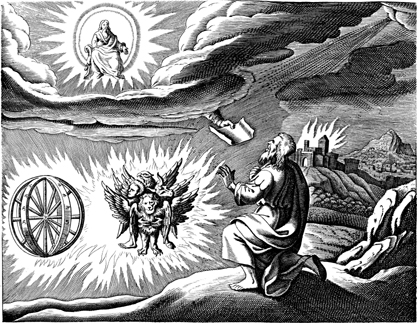
Ezekiel’s Vision, by Matthuas Merian 1670 (some assembly required)

In both visions, the glory of God (not God Itself) appears as a fiery figure on a throne that looks like sapphire, suspended above four keruvim, each of which is accompanied by an interlocking wheel covered with eyes.  Each keruv has a single leg ending in a calf’s hoof, a human body, four wings, a human hand below each wing, and a head with four faces: one human, one lion, one eagle, and one that is called the face of an ox in the first vision and the face of a keruv in the second vision.

The keruvim and their wheels move up and down as well as in all four directions, and the throne suspended above them moves along with them. Although Ezekiel does not call this arrangement a chariot, subsequent Jewish writers developed a school of mysticism based on the merkavah (מֶרְכָּבָה = chariot) in the book of Ezekiel.

Clouds by John Constable

Even without a temple, even without keruvim, the human mind needs poetic images to think about God. Today many of us no longer need to assign God a face, a hand, or a body in robes; we can handle the paradox of God as both invisible and manifest in everything we see. Yet poetic images still well up around the notion of God:  clouds, beams of light, opalescent radiance, perhaps even wings. They are not God, yet God is in the imagery.

When God Itself seems too abstract, perhaps we can think of something like a keruv, a creation that pulls the presence of God toward us when we need rescue, and that stands at our gateways when we need a guardian.

1  (See my post Terumah & Psalm 74: Second Home.)

2  In the first (Israelite) temple in Jerusalem, keruvim and palms  are carved in relief on the wooden walls and two sets of double doors (1 Kings 6:29, 32, 34). Keruvim, palms, and lions are engraved on the stands for ten bronze wash-basins (1 Kings 7:36).

3  Genesis 3:24.

4  Ezekiel 28:14, 16.

5  Exodus 25:22, Numbers 7:89.

6           Hey! Like clouds it ascends;

            Like a whirlwind is [God’s] chariot;

            Lighter than eagles are His horses.  (Jeremiah 4:13)

In Psalm 104, God’s cloud chariot is pulled by the wind:

            Setting beams for [God’s] roof chambers in the waters [above the sky],

                        Making the clouds His chariot,

                        He goes on the wings of the wind.  (Psalm 104:3)


Ki Tissa & Psalms 109 & 69: Wiped Off the List

(One of a series of posts comparing ideas in the book of Exodus/Shemot with related ideas in the book of Psalms.)

Gold calf from Byblos

Of course God is angry about the golden calf. “You shall not make for yourself an idol, or any likeness of what is in the heavens above or what is on the earth below.” (Exodus/Shemot 20:4) It’s right there in the Ten Commandments. Why can’t these Israelites follow simple directions?

Moses is about to walk back down Mt. Sinai with the two stone tablets in this week’s Torah portion, Ki Tissa, when God warns him that the Israelites below have cast a golden calf and are worshiping it. (See my blog post Ki Tissa: Heard and Not Seen.)

And God said to Moses: “I have observed this people, and hey, it is a stiff-necked people! So now let Me be, and My anger will blaze over them and I will consume them, and I will make you into a great nation.” (Exodus 32:9-10)

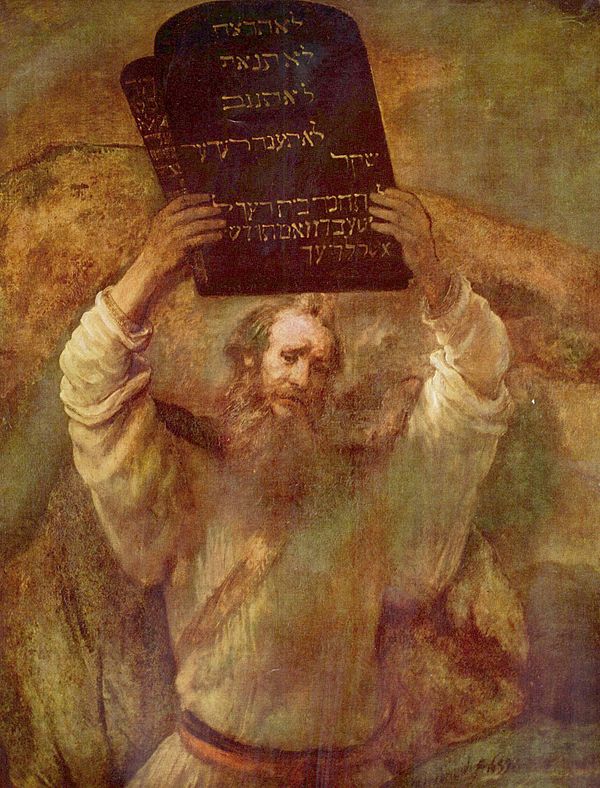
Moses talks God out of this idea. Then he walks down the mountain, smashes the two stone tablets, and gets the Levites to kill the 3,000 worst offenders.

Moses Breaking the Tablets, by Rembrandt, 1659

The next day he climbs back up Mt. Sinai to ask God to forgive the surviving Israelites.

“And now, if you will only lift their guilt!  But if not, please mecheini from your book that you have written.” But God said to Moses:  “Whoever sinned against Me, emechenu from My book.  Now go lead the people to [the place] that I have spoken of to you.”  (Exodus 32:32-33)

mecheini (מְחֵנִי) = wipe me away, erase me. (A form of the verb machah, מָחָה = wiped out, wiped off, destroyed, blotted out.1)

emechenu (אֶמְחֶנּוּ) = I will wipe them off, I will erase them. (Another form of the verb machah.)

In other words, Moses insists that his personal fate must not be separated from that of the Israelites. If God erases them from the book, God must erase him, too.  God replies that guilty individuals will erased, but the people of Israel as a whole will continue their journey under Moses’s leadership.

When the story is retold in the book of Deuteronomy/Devarim, God says to Moses:

“Hey! This is a stiff-necked people. Leave me alone, and I will exterminate them, and emecheh their name from under the heavens, and I will make you a nation greater than they.” (Deuteronomy 9:13-14)

emecheh (אֶמְחֶה) = I will wipe it out, I will erase it. (Another form of the verb machah.)

The Hebrew word for “name”, sheim (שֵׁם), means not only an appellation, but also someone’s reputation, standing, or renown (as in the English “making a name for herself”).

God’s book appears to be a list of names recorded at birth. Female names are not mentioned (the Bible reflects the male-centered, patriarchal society of its time), so we do not know if the list is comprehensive.

What happens when someone’s name is machah from the divine list?

One clue appears later in Deuteronomy. Lineage is important in the Bible; for a man to die without any male heirs is a terrible fate. So if a married man died without issue, his brother was obligated to impregnate the widow. If she bore a son, he would become the dead man’s heir.

And the firstborn that she bears shall be established on the name of his dead brother, and his name will not yimacheh from Israel. (Deuteronomy 25:6)

yimacheh (יִמָּחֶה) = be wiped out, be erased. (Another form of the verb machah.)

Similarly, a name is erased from God’s book if God decrees that the man will pass out of collective memory—perhaps by his own early death, or perhaps by dying without heirs to carry on his lineage.

*

Two of the psalms include pleas for God to punish enemies by erasing their names from the divine book. Psalm 109 opens with a complaint that certain people are lying about the psalmist, accusing him without cause. Verses 6-19 ask God to punish a personal enemy. These verses include separate requests for the man to be convicted of a crime, lose his job, and become impoverished while alive; for him to die before his time; for his children and his parents to suffer; and for his lineage to be exterminated.

            May no one extend kindness to him;

                        And may no one be gracious to his orphans.

            May his posterity be cut off;

                        In the next generation, may their names yimach. (Psalm 109:12-13)

yimach (יִמַּח) = be blotted out, erased. (Another form of the verb machah.)

In Psalm 69, the speaker feels as though he is drowning, and asks God to rescue him from being shamed and abused.  Then he asks God to punish all his enemies. This middle section concludes with:

            Place guilt upon their guilt,

                        and do not let them come into Your righteous deliverance.

            Yismachu from the book of life,

                        And among the righteous do not record them.  (Psalm 69:28-29)

yimachu (יִמַּחְוּ) = May they be blotted out, erased. (Another form of the verb machah.)

This passage alludes to two divine lists: a “book of life” or “book of the living” (seifer chayim, סֵפֶר חַיִּים), and a record of the righteous, which may or may not be the same scroll. When the psalmist asks for the names of his tormentors to be erased from the book of life, he may be asking God to deprive them of heirs, or he may be asking God to make them die soon.

The Hebrew Bible refers to God’s list of names as a “book of life” only in Psalm 69, which was written around 500 B.C.E.  Almost a thousand years later, the Babylonian Talmud (tractate Rosh Hashanah 16b) cited Psalm 69:29 as support for the idea that God keeps three books of names. According to this tractate, on the first day of each new year, Rosh Hashanah, God writes down the names of the righteous in one book and the names of the wicked in another.  People whose deeds are partly good and partly bad are listed in the third book until Yom Kippur, nine days later, when God decides which of these intermediate people to record in the book of the righteous and which in the book of the wicked.

What happens to the people listed in these books? The Talmud says that according to school of Shammai, those in the book of the righteous are rewarded with everlasting life, while those in the book of the wicked go to Gehinnom after death.2

But by the Rosh Hashanah liturgy, codified in the 9th century C.E.,  says simply that God writes down who will live and who will die that year; any possibility of life after death is omitted.3 Neither does the liturgy mention wiping out any names that were written earlier.

*

The image of God erasing names from a book expresses a biblical hope that people will be punished for bad deeds, either by untimely death or by the end of their lineage—equally bad fates from an ancient Israelite point of view.

Few people today believe God punishes miscreants in this way. Some folks still cling to the idea of reward or punishment after death.  I prefer the idea that virtue is its own reward, and I believe that people who enjoy being mean never get to experience the best things in life, such as true friendship and love.

Today the image of God keeping a book, or books, of names is still used in Rosh Hashanah and Yom Kippur services as a metaphor for the idea that God only knows when a person will die. The liturgy pleading to be written into this year’s “book of life” provides emotional reinforcement for the knowledge that the time of our death is unknown—and therefore it behooves us to use our present lives well.

May all human beings, whatever their past deeds and attitudes have been, wake up with new insight into the shortness of life and the value of goodness.  And may we all realize, like Moses in this week’s Torah portion, that there is no point in having our own names written in the book of life unless our fellow human beings are also listed there.

1  The Bible uses various forms of the verb machah not only for wiping away or erasing names, but also for wiping away tears, wiping a dish clean, or wiping out (killing) an entire population. God tells the Israelites to wipe out the memory of an enemy tribe called Amaleik; several Israelite leaders beg God not to wipe out, i.e. forget, someone’s good or bad deeds. When a husband accused his wife of adultery, a priest wrote a curse on a scroll, then machah it in water and made the woman drink it; the results determined her guilt or innocence (Numbers/Bemidbar 5:23-24).

2   Talmud Bavli, Rosh Hashanah 16b. There is also a Christian tradition about a “book of life” that is a divine record of who will “go to heaven” after death.

3  Prayers for God to “inscribe us in the book of life” were added to the Amidah sections of Rosh Hashanah liturgy by the Babylonian Geonim in the 9th century C.E. The “Unetaneh Tokef” prayer, an earlier addition to the liturgy, states that every year God decrees who will die, and by what means, during the coming year.

Ramban (13th century Rabbi Moses ben Nahman, known as Nachmanides) explained that the book of the righteous is the book of life, and the book of the wicked is the book of death. Everyone whose name is written in the book of life merits life until the following Rosh Hashanah, and everyone whose name is written in the book of death will die that year.

Tetzaveh & Psalms 141, 51, and 40: Smoke and Prayer

(One of a series of posts comparing ideas in the book of Exodus/Shemot with related ideas in the book of Psalms.)

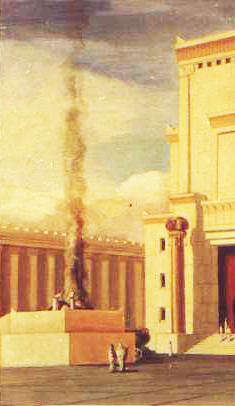
Outdoor altar at First Temple

Two kinds of smoke please God, according to the book of Exodus:

* the smoke from burning sacrificial animals and grain products on the copper altar in front of the Tent of Meeting described in last week’s Torah portion, Terumah,1 and

* the smoke from burning incense on the gold altar inside the tent, described in this week’s Torah portion, Tetzavveh (“you shall command”):

And you shall make an altar for miketar ketoret; from wood of acacias you shall make it. …And you shall plate it with pure gold …And place it in front of the curtain that is over the Ark of the Reminder, …where I will reveal myself to you. Vehiketeyr on it, Aaron, ketoret of spices …  (Exodus/Shemot 30:1-7) 

miketar (מִקְטַּר) = letting smoke rise; scenting with smoke. (A form of the verb ketar, קִטּר  = burned incense.)

ketoret  (קְטֺרֶת) = incense. (From the root verb ketar.)

vehiketeyr (וְהִקְטֵיר) = And he shall make smoke. (Another form of the verb ketar.)

In the Wilderness

The altar for burning animals and grain (which would otherwise be food for people) is outside the Tent of Meeting that the Israelites construct in the wilderness of Sinai.  The incense altar is inside, right in front of the Holy of Holies. All the Israelites worship God by bringing food offerings for the priests to burn on the outdoor altar. Only the high priest, Aaron, burns spices on the incense altar for God.

Food offerings are sent up in smoke for various reasons. Some offerings express gratitude to God, some atone for transgressing God’s rules, some mark a change in ritual status, and some observe holy days. The fragrance of the incense, however, is intended only to honor and please God.

The Israelites send columns of smoke up to God. And God sends columns of cloud and fire down to the people. When the Israelites are walking from Egypt to Mount Sinai,

God was walking in front of them in a column of cloud by day, to lead them on the way, and in a column of fire by night, to make light for them, [so they could] walk day and night.  (Exodus 13:21)

After God’s tent-dwelling is completed, the book of Exodus ends with:

For the cloud of God was over the dwelling-place by day, and there was fire in it by night, before the eyes of all the house of Israel, on all their journeys.  (Exodus 40:38)

During the Babylonian Exile

Israelites continue to use the smoke from burning food and incense as their main communication with God until the Babylonians destroyed the first Israelite temple in Jerusalem in 597 B.C.E. (The Bible also mentions a few individual prayers, but does not portray Levites as singing psalms until the time of the second temple.)

The Israelites deported to Babylon were not sure what to do.  Should they continue sending up smoke to God, even without the temple, the food altar, or the incense altar?  Or should they use another approach?

Psalm 141 is a plea for God to help the psalmist avoid harmful speech and bad company. The psalm opens with a request that this prayer be considered as a substitute for making smoke.

           God, I called You. Hurry to me!

                        Listen to my voice when I call to You!

            May my prayer endure as ketoret before You,

                        Lifting up my palms2 as an evening offering.  (Psalm 141:1-2)

After the Second Temple

After the Persians conquered Babylon, some of the Israelites returned to Jerusalem and built a second temple in 516 B.C.E. They reinstituted the sacrificial system in their new temple, making both an outside altar for burning food offerings and an inside altar for incense. This type of worship continued until the Romans destroyed the second temple in 70 C.E.

After the fall of the second temple, some Jews hoped for a third temple, and another return to worshiping God through smoke. The Amidah (“standing”) prayer, which is recited at morning and evening services to this day, begins with a verse from Psalm 51 about spoken prayer:

             My lord, may you open my lips,

                        And my mouth will declare Your praise.  (Psalm 51:17)

However, Psalm 51 ends:

            May You rebuild the walls of Jerusalem.

                        That is when You will want slaughter-offerings of righteousness,

                        Rising-offerings and complete offerings.  (Psalm 51:20)

Similarly, in traditional prayer books the Amidah3 includes this request: “And return the service to the inner sanctum of Your house, and the fire-offerings of Israel, and their prayer, with love, accepting it with favor.”  According to this tradition, prayer is good, but prayer and smoke together are better.

Many liberal prayer books produced in the last century or so omit or reinterpret this prayer in the Amidah, so as to avoid praying for either reinstituting animal sacrifices or building a third temple.

Psalm 40, composed at least 2,000 years ago, is bolder and more direct:

            Slaughter and grain offering You do not want.

                        You dug open a pair of ears for me!

                        Rising-offerings and guilt-offerings You do not request.

            That is when I said:

                        Hey, I will bring a scroll of the book written for me.

            I want to do what You want, my God,

                        And Your teaching is inside my guts.

            I delivered the news of right behavior to a large assembly.

                        Hey! I will not eat my lips.  (Psalm 40:7-10)

The speaker in Psalm 40 insists that God does not want smoke, only words. Nothing can make this prophetic poet recant; he will not “eat his lips”.

Tomorrow

I almost envy the simplicity of the early Israelite religion, in which people and priests burn something to make a column of smoke rise up to God in the sky or “heavens”, and God sends down a column of divine smoke (described as cloud and fire) to guide the people.

Personally, I could not even imitate this process by burning incense, since I am allergic to any type of smoke.  And these days, columns of cloud and fire do not descend from the sky; we only get lightning and general precipitation.

But I do pray to God with words, for all the reasons the ancient Israelites made smoke: to express gratitude, to ask for forgiveness and self-improvement, to observe holy days, and just to honor the divine. And though I often say, or sing, the words out loud, I do not pray to a God in the sky, but to a divine source I encounter “inside my guts”, like the author of Psalm 40.

I was brought up to be an atheist; I did not begin praying until I was 32.  My life for the past 30 years has been deeper, thanks to prayer; I have become more grateful, less egotistical, and more accepting.  And, God willing, I can continue to improve.

May everyone who would benefit from a prayer practice discover a good one.

            Oh God, may you open my lips,

                        And my mouth will declare Your praise.  (Amidah and Psalm 51:17)         

1  See my post Terumah & Psalm 74: Second Home about the Tent of Meeting, and my post Pinchas: Aromatherapy about smoke from animal sacrifices.

2  The Hebrew Bible describes two postures for prayer.  Prostration—bowing until you lie face down on the ground) indicates submission and the willingness to receive any word God might send you.  Raising your hands, palms up, toward the sky (with or without kneeling) indicates a petitionary prayer, in which you are asking God for something.

King Solomon

One example is when King Solomon dedicates the first temple in Jerusalem:

As Solomon was finishing praying to God all this prayer and this supplication, he got up from in front of the altar of God, from kneeling on his knees and his palms spread toward the heavens.  (1 Kings 8:54)

3   This prayer, called the Avodah (“Service”), is number 5 in the Shabbat Amidah, and number 17 in the longer weekday Amidah.


Terumah & Psalm 74: Second Home

(One of a series of posts comparing ideas in the book of Exodus/Shemot with related ideas in the book of Psalms.)

David Addresses God, P. Comestor Bible Historiale
David Addresses God, Petrus Comestor Bible Historiale, 1372

Where does God live?

The “heavens” are the primary residence of many gods, including the God of Israel in the Hebrew Bible.  In Canaanite and Babylonian religions, the gods inhabit both the heavens and any number of statues on earth.  The God of Israel flatly rejects idols, but still wants a second home on earth.  In this week’s Torah portion, Terumah (“Donations”), Moses is receiving instructions from God on top of Mount Sinai.  God tells him:

They shall make a holy place for me, veshakhanti among them. Like everything that I show you, the pattern of the mishkan and the pattern of all its furnishings, that is how you shall make it.  (Exodus/Shemot 25:8-9)

veshakhanti (וְשָׁכַנְתִּי) = and I will dwell, and I will stay.   (A form of the root verb shakhan (שָׁכַן) = stay, settle, dwell, inhabit.  This is the first occurrence in the Bible of the verb shakhan.)

mishkan (מִשְׁכָּן) =  dwelling-place, home.  (Also from the root verb shakhan. This is also the first occurrence in the Bible of the noun mishkan.)

Gold calf from the temple of Baalat in Byblos

Moses stays on top of Mount Sinai so long—40 days and 40 nights—that in the Torah portion Ki Tissa the Israelites at the foot of the mountain despair of seeing him again.  So they make a golden calf in the hope that God will inhabit it.1 God refuses the golden statue and threatens to destroy all the Israelites except Moses and his direct descendants.  Moses refuses God’s offer, and God settles for sending a plague.2

Cloud descends on the mishkan
Cloud on the mishkan

After the surviving Israelites have built an elaborate portable tent-sanctuary according to God’s instructions, God descends on it in a pillar of cloud.3  In the book of Leviticus/Vayikra, God speaks to Moses from the empty space above the ark in this mishkan’s innermost chamber.

Throughout the books of Exodus, Leviticus, and Numbers the only mishkan for God is the portable tent-sanctuary. In the first book of Samuel a temple in Shiloh houses the ark, and God speaks to Samuel there.4

King Solomon builds a temple of stone and wood in Jerusalem for God to inhabit.  (See my post Terumah & 1 Kings: Tent vs. Temple.)  This temple lasts until the Babylonian army razes it in 587 B.C.E., along with most of the city.

Psalm 74 argues that this act was not merely a political conquest by the expanding Babylonian empire, but an attempt to eradicate the worship of God by destroying God’s home on earth. The psalmist, like most prophets writing after the fall of the first temple, probably believed God arranged the fall of Jerusalem in order to punish the Israelites for worshiping idols. Now that the punishment is complete, the psalmist is waiting for God to rescue the deported Israelites (and punish the Babylonians).

            Why, God, do You endlessly reject us?

                        Your anger smokes at the flock You tended.

            Remember Your community You acquired long ago!

                        You redeemed the tribe of your possession.

                        Mount Zion is where shakhanta.  (Psalm 74:1-2)

shakhanta  (שָׁכַנְתָּ) = you dwelled, you lived. (Another form of the verb shakhan.)

History repeats itself: Siege and Destruction of Jerusalem by the Romans, by David Roberts, 1850 (history repeats itself)
History repeats itself:
Siege and Destruction of Jerusalem by the Romans, by David Roberts, 1850

The psalm then describes how the Babylonian army replaced all the emblems of the Israelite religion in the temple with their own emblems, hacked up the carved ornamentation, and burned the wooden parts of the building down to the ground.

            They set Your holy place on fire;

            They profaned the ground inside the mishkan of Your name.  (Psalm 74:7)

Given this disrespect, and given that the Israelites are the people God adopted and brought to Jerusalem in the first place, Psalm 74 asks why God is taking so long to restore God’s own mishkan, city, and people.

            Why do you draw back Your right hand,

                        Holding it in Your bosom?  (Psalm 74:11)

The psalm then points out that God created the world and the day and night, then did great deeds without a mishkan on earth. Lack of power is not holding God back.  And the Israelites, particularly the poor and needy, belong to God.

           Look to the covenant!  (Psalm 74:20)

If God would only pay attention, the psalm implies, God would honor Its covenant, restore the Israelites to Jerusalem, and cause a new mishkan to be built there to facilitate worship.

           Do not let the miserable turn back disgraced.

                        Let the poor and the needy praise Your name!  (Psalm 74:21)

In Psalm 74, the mishkan of God is also the mishkan of the people. They need their own home, and they need to have a home for God in their midst.  Then, instead of suffering miserably, the needy can praise God and rejoice.

*

Many Jews still want a home where we are free to praise God, to practice our own religion without fear or discrimination.

Half of the Jews in the world live in the nation of Israel, founded in 1948 as a homeland where Jews could escape the genocide, as well as less drastic forms of discrimination, inflicted on them in Europe. Yet over the next 69 years, the Jewish and Muslim residents of Israel have been attacked both by neighboring countries and by each other.

Most of the Jews living outside Israel today are American citizens. Discrimination against Jews in the United States has fallen over the past sixty years, and many of us view America as our real home, where we can participate in the life of our country and remain free to practice our own religion. God has many second homes among religious American Jews; every synagogue is a divine mishkan, and each of us can make a mishkan for God to dwell in our own hearts.

Yet in the past year, discrimination against ethnic and religious groups has become more socially acceptable in the United States.  Psalm 74 suddenly seems more relevant.

I pray that the divine spirit blooms in all of our hearts.  May we quickly reverse this dangerous trend.  And may all people, everywhere, find a safe home.

           Do not let the miserable turn back disgraced!

1  Exodus 32:1-5.

2  Exodus 32:35:  Then God struck the people over what they had done with the calf that Aaron made.

3  Exodus 40:33-34:  When Moses completed the work, the cloud covered the Tent of Meeting, and the magnificence of God filled the mishkan.

4  1 Samuel 3:1-10.