Ki Teitzei: Crossing Gender Lines

by Melissa Carpenter, Maggidah

Joan of Arc 15th century CE
Joan of Arc, 15th century CE: Toeivah?

The equipment of a gever shall not be upon a woman, and a gever shall not wear the outer garment of a woman; for toeivah of God, your god, are all those who do these things.  (Deuteronomy/Devarim 22:5)

gever (גֶּבֶר) = an adult man; a man in a position of power; a warrior or soldier.

toeivah (תּוֹעֵבָה) = abhorrent, repugnant, causing visceral disgust; an “abomination”.

A hasty reading of the above verse in this week’s Torah portion, Ki Teitzei (“When you go out”) leads some people to think that God finds all cross-dressing abominable.

Last week, in Shoftim: Abominable, I wrote about how attributing toeivah to God is an anthropomorphization.  Whoever wrote down this verse in Ki Teitzei1 probably found everyone found everyone who did “these things” disgusting, and wanted to reinforce a social norm by attributing that disgust to God.

But does the verse actually prohibit cross-dressing?

The Babylonian Talmud (Nazir 59a) states that the purpose of the verse cannot be to teach that men should not dress like women, and vice versa, because mere cross-dressing is not an abomination.  It suggests two other reasons for the verse.  The first is that someone should not cross-dress in order to sneak into a single-sex group in order to seduce someone.  (According to the Talmud, unauthorized sex is abominable.)

Assyrian bronze sickle sword

This first interpretation fails to account for specific words in the verse in Deuteronomy, which prohibits a woman from wearing the equipment of a man (kli), not his clothing.  Furthermore, the text uses the word gever, which implies a warrior or a ruler, rather than ish, the common term for any man.  In the Torah, the equipment of a warrior is his sword or his bow and arrows; the equipment of the ruler of a clan or tribe is his staff.
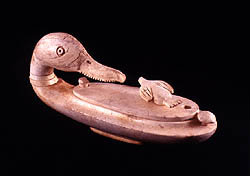
Ivory cosmetics box from Sidon

The second Talmudic interpretation, attributed to Rabbi Eliezer ben Yaakov, fits the verse better: women should not go to war bearing weapons, and men should not use cosmetics to beautify themselves.2

In today’s terms, it would be acceptable for a woman to wear pants, but not for her to carry a gun (a common weapon today).  A man could wear a skirt (for comfort, not to show off his legs), but he should not wear make-up.

The underlying assumption is that weapons and war are part of a man’s nature, and  personal beautification is part of a woman’s nature.  This assumption was rarely questioned until the 20th century C.E.

As late as the 19th century, Rabbi Samson Raphael Hirsch wrote that Deuteronomy 22:5 “forbids each sex that which is specifically suited to the nature of the opposite sex.  A man shall not attend to his external physical appearance in the way appropriate to a woman’s nature, and a woman shall not appear in a vocation suited to a man’s nature…”  He added that a woman’s place was in the home—i.e. that motherhood was the calling of all women, and any other vocation was for men only.

I suspect it did not occur to Hirsch, any more than it occurred to my mother and many other women born in the 1920’s and 1930’s, that women who made beauty and sex appeal their top priority were planning to be dependent on men for financial support.  From Biblical times until my own “baby boomer” generation, most cultures assumed that war and jobs requiring either muscle or authority were for men, while housework and child care were for women.

This view of the “natures” of men and women is countered by two stories in the Hebrew Bible: one about a primping man, and one about two warrior women.

The Primping Man

The Torah does not say that Joseph primps or applies cosmetics.  But the book of Genesis/Bereishit does say that Jacob spoils his son Joseph by giving him a fancy coat or tunic.  When Joseph becomes a slave to Potifar, and Potifar’s wife tries to seduce him, the Torah says:

“The Glory of Joseph” by James Tissot

And Joseph was beautiful of shape and beautiful of appearance.  (Genesis/Bereishit 39:6)

Rashi, following Midrash Tamchuma, commented: “As soon as he saw that he was ruler (in the house) he began to eat and drink and curl his hair.  The Holy One, blessed be He, said to him, “Your father is mourning and you curl your hair!  I will let a bear loose against you.”Other classic commentary implies that Joseph not only curled his hair, but put kohl around his eyes and wore elevated heels.

Yet Joseph eventually became a viceroy of Egypt, and Jacob’s deathbed blessing praises Joseph’s power with a manly weapon:

And his bow was continually taut, and his arms and hands were agile… (Genesis 49:24)

Thus Joseph has a reputation as both beautifying himself like a woman, and being a gever with both weapons and the power to rule.

The Warrior Women

A story in the book of Judges features two women who engage in acts of war.  The prophetess Devorah serves openly as the general of an army recruited from some of the tribes of Israel, though she wears no weapon and her male lieutenant, Barak, leads the soldiers into battle.  When the Israelites win, the enemy general, Sisera, flees to a tent where he believes he will be safe.  (Sisera’s king is friends with the owner of the tent, Chever the Kenite.)  Cheve, the owner of the tent, is not at home, so his wife Jael welcomes Sisera inside and gives him a drink of milk.
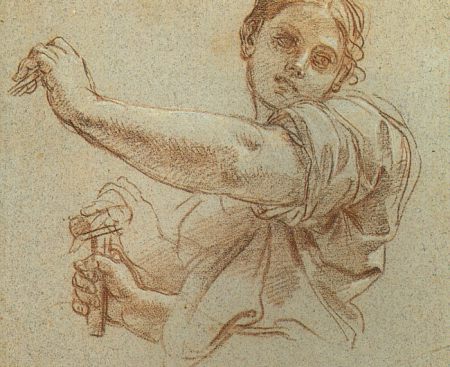
"Study of Jael in Red Chalk" by Carlo Maratta
“Study of Jael in Red Chalk”
by Carlo Maratta

Sisera naturally assumes all women are subservient to their men, so he swallows the milk and relaxes.  Then she kills him.

The Bible gives two accounts of the murder.  In the first one, Jael waits until Sisera falls asleep, then kills him by hammering a tent peg through his skull.  Next comes an ancient poem describing the same incident, but implying that Jael crushes Sisera’s head with a hammer while he is still awake and upright.  Either way, Jael does not have access to men’s equipment, so she improvises her own weapon.

Far from censuring her for using a weapon and taking the authority to make an independent decision, the book of Judges praises Jael—as a woman.

Most blessed of women is Jael, the wife of Chever the Kenite; most blessed is she in the tent.  (Judges/Shoftim 5:24)

Thus  a man who is beautiful (and perhaps enhances his beauty as if it were the “outer garment of a woman”), and a woman who improvises the equipment of a gever, are both praised for taking on the roles of two genders at once.

Adopting roles previously associated with the opposite gender is commonplace in advanced societies today.  Some men are tender parents of infants and young children, and some men devote themselves to looking sexy.  Some women succeed in vocations previously reserved for men, and some women are soldiers.

Perhaps we are moving away from the society preferred in this week’s Torah portion, and toward a society in which both men and women are complete people, like Joseph and Jael.

  1. According to current scholarship the book of Deuteronomy was written, or at least recorded in written form, in 7th-century B.C.E. Judah.
  2. This is also the interpretation of Targum Onkelos, the first century C.E. translation of the Torah from Hebrew into Aramaic, which says that men should not beautify their bodies in the manner of women.
  3. Genesis Rabbah 86:3, edited in the 4th to 5th centuries C.E.
  4. Rashi (11th-century Rabbi Shlomo Yitzchaki), following Midrash Tanchuma, Vayeshev 8, translation by http://www.sefaria.org.


Shoftim: Abominable

by Melissa Carpenter, Maggidah

lamb 2

You shall not slaughter for God, your god, an ox or a lamb or kid that has a defect in it, any bad thing, because it is toeivah to God, your god.  (Deuteronomy/Devarim 17:1)

to-eivah (תּוֹעֵבָה) = repugnant, causing visceral disgust; taboo; an abomination, a foreign perversion, a custom in one culture that is prohibited in another culture.

This is only the first of five times the word to-eivah appears in this week’s Torah portion, Shoftim (“Judges”). This emotionally loaded word appears as a noun or adjective 117 times in the Hebrew Bible, and its verb form (תעב) appears 23 times. An object or action can be to-eivah to a class of human beings, or to God.  The first three times the word to-eivah appears in the Bible, it describes what disgusts Egyptians.

To-eivah to Egyptians

The book of Genesis/Bereishit says that Egyptians find eating at the same table with Hebrews to-eivah (Genesis 43:32).  We do not know whether Egyptians considered the manners or the diet of the Hebrews abominable.

Next Joseph tells his brothers that shepherds are to-eivah to Egyptians (Genesis 46:34), meaning that Egyptians shun that occupation.  Then in the book of Exodus/Shemot, Moses tells the Pharaoh that the Hebrews must travel some distance to make sacrifices to God because their animal offerings are to-eivah to Egyptians (Exodus 8:22).

To-eivah to God

The first thing considered to-eivah to God, rather than to a group of humans, is in the book of Leviticus:

With a male you shall not lie down as one lies down with a woman; it is to-eivah. (Leviticus/Vayikra 18:22)

This infamous line (misused by fundamentalists to claim that all homosexuality is an “abomination”) occurs in the middle of a list of sexual prohibitions God tells Moses to issue to the Israelites.  Since God is the speaker in this verse, the implication is that God considers that particular type of intercourse (whatever it might actually be)1 to be to-eivah.

Attributing visceral disgust to God is an anthropomorphization.  God, unlike Egyptians or other humans, has no viscera. But the Hebrew Bible often ascribes human emotions to God, including anger and disgust.

The God of Israel finds five more kinds of sexual pairings to-eivah in the book of Leviticus. The Torah assumes they are practiced by Canaanites, and forbids them to Israelites.2

Nothing is labeled to-eivah in the book of Numbers, but Moses uses that word sixteen times in Deuteronomy–six of them in this week’s Torah portion. The first verse in the portion Shoftim to use that word specifies that offering an animal with a defect is to-eivah to God.3

Immediately after warning that God is revolted by offerings with physical defects, this week’s Torah portion says that for Israelites to worship other gods is to-eivah.

And hey, [if] it is truly established the thing was done, this to-eivah, in Israel, then you must bring out that man or that woman who did the evil thing to your gates. And you must stone the man or the woman with stones so they die. (Deuteronomy 17:4-5)

To-eivah magic

To-eivah deeds in this week’s Torah portion include not only offering defective animals and worshiping other gods, but also practicing magic:

When you come into the land that God, your god, is giving to you, you must not learn to do as the to-avot of those nations. There must not be found among you one who makes his son or his daughter pass through the fire, a caster of cast lots, a cloud-reader, or a snake-diviner, or a sorcerer, or one who casts spells with a familiar, or a woman who inquires of the dead, or a man who consults ghosts, or a medium for the dead.  Because everyone who does these things is to-avot, and on account of these to-eivot, God, your god, is dispossessing them [the Canaanite nations] before you.  (Deuteronomy 18:9-12)

To-avot, to-eivot  (תּוֹעֵבֹת, תּוֹעֲוֹת) = plurals of to-eivah.

To-eivah temptation

disgust 1

The word to-eivah appears one more time in this week’s Torah portion.  Moses tells the Israelites that when they conquer any Canaanite town in the land designated for Israel, they must kill all the inhabitants, men, women, and children.

Only from the towns of these people, [the towns] that God, your God, is giving to you as a possession, you must not let any soul live … so that they will not teach you to do like any of their to-avot that they do for their gods; then you would do wrong for God, your god. (Deuteronomy 20:16,18)

Here Moses appears to assume that since the Israelites are so easily tempted, they are not responsible for their own actions.  He orders them to murder all of the potential tempters, as if genocide were a mere peccadillo compared to conversion to a different religion.

Which comes first, visceral disgust or the decision to commit genocide?

The most famous example of modern genocide is the Nazi round-up and slaughter of Jews and members of smaller minorities, including homosexual men, Gypsies, Jehovah’s Witnesses, and blacks.

When Hitler came to power, Germany was suffering from a long economic depression.  Hitler wanted to make Germany great again.  His government intensified pre-existing prejudices, and used the perception of minorities as “inferior races” or abominations as an excuse to confiscate Jewish wealth, which funded 3-5% of the national budget and perhaps a third of the German war effort.

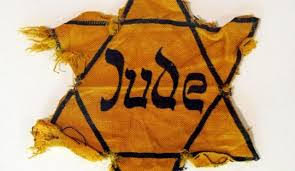
Required identification

Then the Nazi government doomed Jewish men, women, and children, as well as members of smaller minorities, to slavery and death in concentration camps.

Increasing visceral disgust for Jews enabled the government to improve the German economy, and treating the Jews as to-eivah led to and justified genocide.

In the book of Deuteronomy, Moses wants to inspire the Israelites to conquer Canaan and secure it as an Israelite land, without any future assimilation or retaliation.  The most certain way to accomplish this would be to murder every Canaanite in every captured village or town.

Is the purpose of the proposed genocide to ensure Israelite ownership of the land?  Or to eliminate religious freedom and enforce the worship of one God?  Either way, labeling the Canaanites as to-eivah justifies Moses’ call for genocide.


When we feel repugnance, our impulse is to get rid of whatever is disgusting us.  Personally, I find okra disgusting.  I believe that no moral issue is involved if someone gives me a bowl of gumbo with okra and I quietly dispose of it.

But what if we find a class of human beings disgusting and believe that they are even to-eivah to God?  Can we just get rid of them?  No.  Genocide is never justified.

Moses underestimates the need for human responsibility in this week’s Torah portion.  He should be preaching that we are responsible for our own  religious worship—and that we must avoid doing abominable deeds in the name of God.


  1. Modern commentary is divided over whether the Torah is calling any homosexual act to-eivah, or whether the Torah is telling men not to ask other men to be submissive, as women were required to be in that era.
  2. Leviticus 18:26, 18:27, 18:29, 18:30, 20:23.
  3. See Deuteronomy 17:1 above.

Re-eih: Releasing Your Hand

by Melissa Carpenter, Maggidah

Nevertheless, there should not be among you evyon; because God will truly bless you in the land that God, your god, is giving to you to possess as a hereditary holding—but only if you truly pay attention to the voice of God, your god, to be careful to do this entire commandment that I Myself command you today. (Deuteronomy/Devarim 15:4-5) 

Beggar, by Rembrandt van Rijn
Beggar,
by Rembrandt van Rijn

evyon (אֶבְיוֹן) = paupers, needy, destitute, those with no means to make a living.

This week’s Torah portion, Re-eih (“See!”) claims that the land of Canaan is fertile enough so that none of its residents need be paupers—as long as the Israelites share their wealth according to God’s instructions.

The portion gives directions for several ways to reduce poverty. First, Re-eih calls for landowners to tithe for six years out of a seven-year cycle. The tithe—a tenth of the landowner’s produce—is designated for several different purposes. A third of the annual tithe (or perhaps the whole tithe every three years) is given to the poor in the landowner’s town, specifically to landless resident aliens, orphans, and widows.

In the seventh year of the cycle, all farmland lies fallow, and whatever food grows naturally is available to everyone. This week’s Torah portion also calls  for the release of debts in the seventh year.

At the end of seven years you shall  make a shmittah. And this is the matter of the shmittah: everyone who  has  handed out a loan shamot the loan to his fellow. He  shall not press his fellow or his brother, for a shmittah has been proclaimed for the sake of God. (Deuteronomy 15:1-2)

shmittah (שְׁמִטָּה) = release;  remission of debt.

shamot (שָׁמפּט) = releases.

In other words, borrowers who are simply too poor to repay their debts on time are freed from the obligation. They are no longer dunned by their creditors or burdened by guilt.

The Torah warns people to continue to make loans to the poor, even if it is getting close to the end of the seventh year. It assumes that we feel a natural sympathy for paupers, but sometimes check that feeling with second thoughts.

When there is among you an evyon from one of your brothers within one of your gates in your land that God, your god, is giving to you, you shall not harden your heart and you shall not shut your hand to your brother the evyon. Rather, you shall truly open your hand to him, and you shall truly lend him what he lacks, so that it shall not be lacking for him. (Deuteronomy 15:7-8)

At this point, the Torah has progressed from the artificial mechanisms of tithing and the release of debt every seven years to simply giving the poor in your town what they need whenever they need it.

A token donation is not enough. “…you shall truly lend him what he lacks” had been interpreted to mean  not only food, but also anything from a kind word to the tools, training, and starter loan to take up a trade.

The passage in this week’s Torah portion  concludes:

Because the evyon will not cease from the midst of the land, therefore I myself command you, saying: Truly open your hand to your brother, to your oni, and to your  evyon in your land! (Deuteronomy 15:11)

oni (עָנִי) = the poor, the wretched, the  unfortunate, the humble.

This week’s Torah portion first says “there  should not be among you evyon”, then later acknowledges that since not everyone is generous enough, “the evyon will not cease from the midst of the land”.

giving b-w

Today we still have evyon, paupers who are unable to earn a living and depend entirely on charity, and oni, people who have become poor because of bad luck. If the products of our planet were distributed evenly, everyone would have enough food and shelter. But the governments of the world still are not generous enough. And individuals with means still are not generous enough.

How often have you had an impulse to give to an unfortunate person, and then hardened your heart by deciding that this person did not deserve your money?

How often have you passed a beggar without opening your hand—either because you were saving those dollars for a latte, or because the beggar looked, smelled, or behaved like someone who might be unpleasant or dangerous?

I am cultivating a practice of opening my hand and giving a dollar to every beggar I pass, regardless of the judgments that pop up in my mind. I also donate a dollar to the county food share program every  time I buy groceries at the store that handles donations. I pay dues to my congregation, which provides the space for many people (including me) to serve as the equivalent of Levites. I pay taxes, of which a small percentage goes to programs that help the poor.

Yet I pass up countless other opportunities to donate to charities and good causes. (Even as I was writing this, a canvasser knocked on my door and I did not answer.) I do not have the time, I tell myself, I do not have the money. And how can I tell whether responding to this particular appeal would do any real good?

This week’s Torah portion says to make loans and gifts to the poor within your gates, the ones whom you encounter in your own life. That sounds reasonable, since you are more likely to know “what they truly lack”.

Yet I wonder what I should give to the people I know who are too handicapped to earn a living and who are not supported by their families. I do not have enough emotional strength to act as their friend or substitute family member, which is “what they truly lack”. So I settle for giving a token—a cookie, a ride, a smile—until the person becomes too difficult  and demanding.  Then I harden my heart and close my hand.

I would rather pay extra taxes for social programs.

A passage in  the book of Proverbs that describes the virtues the eshet chayil or “woman of valor” includes this couplet:

Her palm spreads open to the poor

And her hands stretch  out to the evyon. (Proverbs 31:20)

I am not a “woman of valor”. I am not strong enough to open my hands to all the evyon within my gates. I do not understand how to be an eshet chayil.

If you have suggestions, please reply to this post!

Eikev: Not by Bread Alone

by Melissa Carpenter, Maggidah

“Man does not live by bread alone” is an old-fashioned aphorism in English, indicating that human beings also have essential spiritual needs. Christian English-speakers trace it to Matthew 4:4, where Jesus quotes it to Satan. But the original source is in this week’s Torah portion, Eikev (“on the heels of”), when Moses warns the Israelites that when they take over Canaan, they must remember what they learned in the wilderness.

bagel

And you shall remember the entire way that God, your god, made you walk these 40 years in the wilderness in order to anotekha, to test you, to know what was in your heart: Would you observe [God’s] commandments or not? So [God] anotekha and let you go hungry and fed you the manna, which you did not know and your fathers did not know, in order to let you know—that not by bread alone does the human live; rather, the human lives on everything that comes out of the mouth of God. (Deuteronomy/Devarim 8:2-3)

anotekha (עַנֹּתְךָ) = humble(d) you, humiliate(d) you, impoverish you, deprive(d) you of all independence.

This is a new reason for keeping the Israelites in the wilderness for 40 years.  In the book of Numbers/Bemidbar, the wilderness time was prolonged from two years to forty when the people first reached the southern border of Canaan and refused to cross it.  (See my post on the story of the scouts: Shelach-Lekha: Mutual Distrust.)

God decided then that the people would spend an additional 38 extra years in the wilderness, until the generation that refused to cross into the “promised land” had died out.  Now, in Deuteronomy, Moses reveals another reason for the extra 38 years: so that the new generation would be tested.

Testing: Shabbat

Back in the book of Exodus/Shemot, the people journeyed for a month and a half after leaving Egypt without running out of food. Then halfway between the oasis of Eylim and Mount Sinai they complained of a famine.

This seems like an odd complaint for people who are traveling with large herds of milk-producing animals. Did their cows, ewes, and nannies all dry up at once?  Was there an unrecorded rule that they could not slaughter any of their livestock for food until after God gave them the rules for animal offerings? God must have done something to the Israelites’ walking food supply, since this week’s Torah portion says God let you go hungry and fed you the manna”.

from Maciejowski Bible, circa 1250 C.E.
Manna, Maciejowski Bible,
circa 1250 C.E.

In Exodus,

God said to Moses: Here I am, raining down for you bread from the heavens. And the people shall go out and gather up the day’s worth on its day, so that I can test them: Will they go by my teaching or not? (Exodus/Shemot 16:4)

Manna began appearing on the ground every sunrise, looking like tiny white seeds. Unlike any other food the Israelites had known, manna melted in the sun, and rotted when people tried to keep it overnight in their tents. They could cook and eat only one day’s portion for each person—except on the sixth day of the week. On that day only, they were able to cook or bake a double portion of manna, and follow God’s commandment to rest on the seventh day, Shabbat.

The first phase of the test was whether people would go out to gather manna on Shabbat. Some people did, hoping to hoard their extra one-day portion of cooked or baked manna. But the ground was bare on Shabbat, and they had to eat the manna they had saved.  They could never get ahead.

Testing: Dependence

The manna continued the rest of the time the Israelites lived in the wilderness, but the test changed. If the first phase was to train people to observe Shabbat, the second phase focused on the people’s dependence on a food that they were powerless over.

In this week’s Torah portion, Moses says twice that God anotekha: humbled you or humiliated you. Moses is addressing the adult children of slaves, who were never as independent as the free and wealthy. But at least the slaves had procured their own food. Now all the adults were as dependent on manna as an infant is on its mother’s milk.

From one point of view (particularly among men used to ruling their own households) this was a form of humiliation. From another point of view, it was a reminder of humankind’s dependence on God’s gifts. The manna tested which point of view each person would take—so they would know what was in their heart.

God humbled—or humiliated—the Israelites by making them dependent on manna, Moses says, …in order to let you know that not by bread alone does ha-adam live; rather, on everything that comes out of the mouth of God ha-adam  lives. (Deuteronomy 8:3)

In context, this statement means:

1) Humans cannot live on what we make for ourselves (such as bread); we can live only because of everything God gives us (which may include the grains, rains, and brains required to make bread—or may include some other food).

2) Humans depend on God not only for food, but also for everything else God calls into being to sustain us. In the book of Genesis, this “everything” includes companionship (It is not good for the human to be alone (Genesis 2:18), language (and whatever the human called each living creature, that was its name (Genesis 2:19), and the ability to learn from tests.

For 40 years in the wilderness, God trained the Israelites to accept their utter dependence on God for everything in life. At the same time, God insisted that the Israelites follow all the rules Moses put into words, and punished the most egregious violations with death.

This training seems designed to make people passive and submissive.  Yet when the Israelites finally did cross the Jordan and conquer Canaan, they would need to act independently, first in war and then in agriculture and commerce. Why wasn’t God training these children of slaves to take initiative and manage their own physical needs?

I would answer that all the rebellions against God and Moses indicate that the people were neither passive nor submissive by nature. Left to their own devices, they would act, not just wait for something to happen.  In fact, when they were left to their own devices while Moses spent 40 days on Mount Sinai, they took the initiative and made the Golden Calf.

The lessons the Israelites really needed, both in the wilderness and in Canaan, were that no matter what they did on their own, their very lives depended on God (or nature); and that the only route to a good life was obeying God’s rules. They had to be trained to accept whatever God gave them, so that they could love and fear (or be in awe of) their god.


We face the same test today. As adults, most of us want to take care of ourselves and avoid being dependent on other people. We may not have spent 40 years in a wilderness, but when we were children, our dependence frustrated us, and we learned that humans we depended on could suddenly be absent when we needed them.

Yet we also know that we cannot do everything on our own; we are not gods.  We will always be at least partly dependent on other people. We will always be dependent on “nature”, which we can alter somewhat for better or worse, but cannot create in the first place. And even though we can often improve our lives by taking the right actions, there will always be surprises: both bad and good things will happen that we have no control over. In a sense, we are always at the mercy of God.

Not by bread alone does a human live; rather, a human lives on everything that comes from God.

The choice we can make in our hearts is whether to feel humble or humiliated; to feel grateful for what we are given, or resentful over what we are deprived of.

After I converted to Judaism 29 years ago, I discovered that I could use prayer in order to cultivate humbleness and gratitude. Life is better that way! May each one of us find a practice that will help us to accept every test and every portion of manna that comes our way.