Friendliness from foreigners is a new experience for the Israelites, after 40 years in a wilderness where the only new people they encountered were armed and hostile.

In this week’s Torah portion, Balak, the Israelites are camped on the northern border of Moab, overlooking the Jordan River. They have already skirted Moab, then conquered the Amorite country to its north. They are poised to cross the Jordan into Canaan, but Balak, the king of Moab, does not know that. He panics at the sight of thousands of Israelites on his border, and hires the Mesopotamian prophet Bilam to curse them. (See my earlier post, Balak: A Question of Anxiety.) Bilam’s blessings and curses always come true—because he can only declare the words God puts into his mouth. But God makes Bilam give only good prophecies about Israel.
Immediately after this, the Israelites prove themselves unworthy of the honor.
Israel settled among the acacias, and the people began liznot with the daughters of Moab. They invited the people lezivchey to their gods, and the people ate and bowed down to their gods. (Numbers/Bemidbar 25:1-2)
liznot (לִזְנוֹת) = to be unfaithful (to God or to a husband); to prostitute oneself.
lezivchey (לְזִבְחֵי) = to slaughter an animal on an altar, as a sacrifice to a god.
The Israelites already know what it means to slaughter animals on an altar, give selected portions to God, and eat the rest themselves; they do the same thing for their own god when they make wholeness offerings (shelamim). They are also accustomed to bowing down to their own god. Now they are performing the same kinds of worship to the gods of Moab.
What makes the dinner invitations of the young women of Moab so irresistible?
One frequently quoted midrash (commentary that adds backstories not in the bible) invents a mass seduction scene in which the Moabites set up booths in a marketplace.
“They crafted curtains for them and seated harlots in them, and in their hands were all types of precious vessels. An elderly woman would sit outside and watch over the young woman, who was inside the shop. When an Israelite would pass to purchase an object in the market, the elderly woman would say to him: ‘Young man, do you not want linen garments from Beit She’an?’ She would show him and say: ‘Go inside and you will see fine objects.’ The elderly woman would say for more, and the young woman for less. From that point on, the young woman would say: ‘You are like a member of the household, choose for yourself.’ There was a bottle of wine with her, and the wine of gentiles had not yet been prohibited. A young woman would come out adorned and perfumed and seduce him. She would say to him: ‘Why is it that we love you and you hate us? Take this vessel for yourself at no cost. Is it not that “we are all the children of one man” (Genesis 42:11), the sons of Teraḥ, father of Abraham? You do not wish to eat from our slaughter and from our cooking? We have calves and roosters; slaughter in accordance with your mitzva and eat.’ Immediately, she would give him wine to drink and Satan was inflamed within him, and he strayed after her, as it is stated: “Harlotry, wine and new wine capture the heart” (Hosea 4:11).” (Bamidbar Rabbah)1
But I think this elaborate scenario is unnecessary. All the Israelites need is the novel experience of a friendly invitation to dinner.
Unfriendly foreigners
The last friendly foreigners the Israelites encountered were Moses’ own Midianite family, who came to visit him in the wilderness at Refidim, on the way to Mount Sinai, nearly 40 years before. The next time Israelites see other people is two years later, when the twelve scouts go into Canaan and see “giants”. Their report leads the Israelites waiting at Kadesh in Paran to despair and decide to go back to Egypt—and this leads to God’s decree that the people must stay in the wilderness for a total of 40 years before they have another chance to enter Canaan.
The next morning, some of the men charge over the hill into Canaan anyway, and the Amalekites trounce them. So the Israelites spend another 38 years in the wilderness, mostly in isolation at Kadesh. Then, instead of crossing the border into Amalek country again, they circle east and north, so they can enter Canaan by crossing the Jordan River.

Here are the foreigners the Israelites encounter during that journey:
* The troops of Edom, who meet them at the border to make sure the Israelites take the long away around, without entering their land.
* The king of Arad and his troops, who attack them and take captives. (The Israelites retaliate, with God’s help, and destroy Arad’s towns.)
* The troops of Sichon, king of the Amorites, who respond to the Israelites’ request for safe passage through their country by attacking them. (The Israelites conquer and occupy Sichon’s country.)
* King Og and his troops, who meet the Israelite men in battle when the Israelites go up the road to Bashan for no obvious reason. (See my post Devarim & Shelach-Lekha: A Giant Detour.)
No wonder the Israelites associate other peoples with war, and consider outsiders bad news.
Friendly foreigners
The Israelites camp in the Amorite land they have conquered, among the acacias near the Jordan, just north of the Moab border. Then suddenly some Moabite women invite them over for a feast in honor of their gods.
Perhaps some of the men are interested in sex with exotic foreign women. And perhaps all the Israelites are touched by an unprecedented gesture of friendliness. It would be easy for them to forget that by participating in the animal sacrifice and bowing down to the Moabite god, they are being unfaithful to their own God.
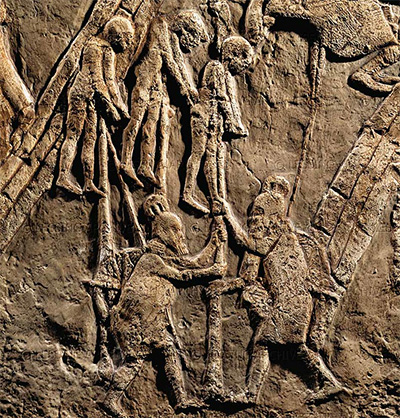
Israel yoked itself to the ba-al of Peor, and God became hot with anger against Israel. So God said to Moses: Take all the heads of the people and impale them for God in front of the sun; then God’s blazing anger will turn back from against Israel. But Moses said to the judges of Israel: Each man, kill the men yoked to the ba-al of Peor. (Numbers 25:3-5)
ba-al (בַּעַל) = a local god; master, owner. (In Canaan, ba-al could also mean the main god of weather and war.)
How easy it is for some of the Israelites to slide from attending rituals for foreign gods to worshipping one of those gods! Moses later orders the Israelites to kill the Midianite women from Moab, saying:
Hey! They are the ones who led the Children of Israel, by the word of Bilam, to betray God over the matter of Peor! (Numbers 31:16)
Thus he shifts the blame for the Israelites’ unfaithfulness to their God onto the foreign women, and even onto Bilam (who merely goes home unpaid after blessing the Israelites in this week’s Torah portion).
Are outsiders really bad news? Should we avoid attending a different religion’s services? Should we suspect and reject friendly overtures from people who are not part of our own community?
No. I believe that once again, a Torah story can inspire us to exercise more maturity than the characters in it. Friendship between people of different religions can benefit both the individuals and the world. What we need to do is examine our own standards for behavior, and then stick to them (politely), while still meeting new people with a peaceful and friendly attitude.
- Bamidbar Rabbah, circa 1200 C.E., from the translation in http://www.sefaria.org.

 Questioning Torah
3 thoughts on “Balak: False Friends?”