Children passionately want life to be fair. For the sake of fairness, they can even be persuaded to share their possessions. But if a young child is the victim of unfairness, prepare for a tantrum.
Adults know that life is not fair. People in power are biased, and bad luck happens. Nevertheless, most of us feel bitter when we do all the right things, and still get the short end of the stick.
When is the distribution of benefits “fair”? Merriam-Webster’s dictionary gives two possible answers: when the distributor is impartial, i.e. free from self-interest, prejudice, or favoritism; or when everyone is given their due according to established rules.
Unfairness to Canaanites
This week’s Torah portion, Pinchas, looks ahead to how the land of Canaan will be distributed after the Israelites have conquered it by killing or subjugating the Canaanites. The question of fairness to the indigenous Canaanites never comes up in the Torah. Over and over again, from the book of Genesis/Bereishit through the conquest of the land in the book of Joshua, we read that God is giving the land of Canaan to the children of Israel. And what God wants trumps any human notion of fairness. Although later Jewish writings paint the Canaanites as evil perverts, the only objection to Canaanites in the Torah itself is that they worship different gods.
Fairness among Israelites
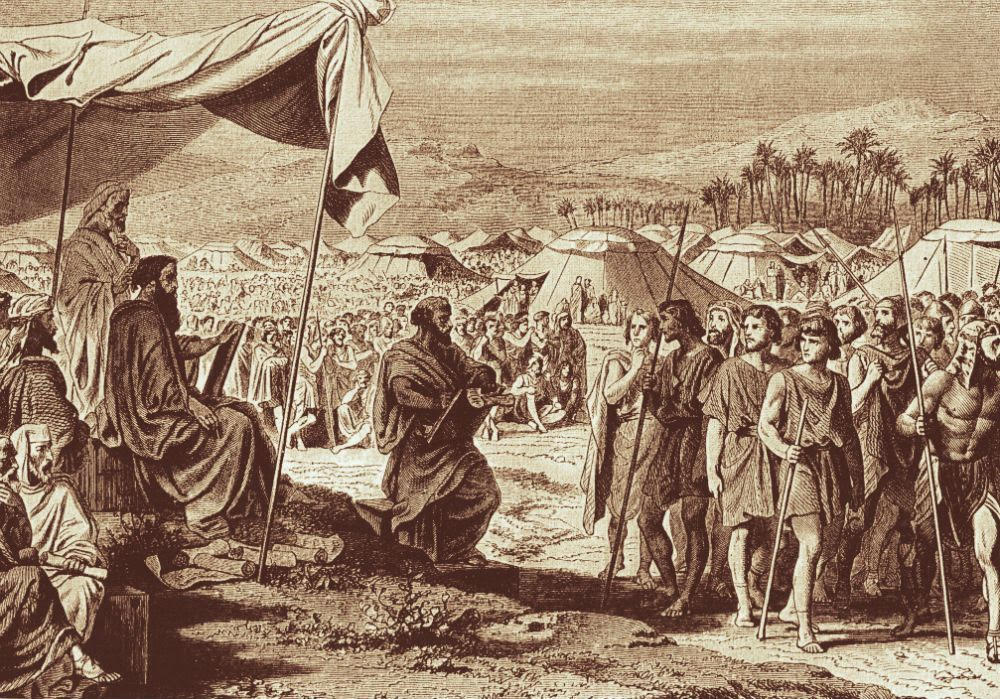
19th century
In this week’s Torah portion, God prescribes how the land the Israelites are about to conquer should be divided among themselves. The first step is to take a census of men aged 20 and older. The census serves both as a mustering of eligible fighters for the upcoming conquest, and as a count of the households that will own plots of land once Canaan has been conquered.
The census of adult men raises two questions: What about women? And why should the land be divided according to the current population on the banks of the Jordan, rather than the previous generation, or the next generation? The Torah addresses these issues in the story of the daughters of Tzelofchad, which begins in the portion Pinchas and resumes in the portion Masey. I plan to examine that two-part story in next week’s blog post.
Right or wrong, the census clearly defines the in-group for the distribution of land: male heads of households. The next step is to divide the land fairly among the tribes of the in-group.
This is the census of the sons of Israel: 601,730. Then God spoke to Moses, saying: “For these the land shall be divided as a nachal, by the account of names. The abundant [tribe] will have an abundant nachal, and the scanty [tribe] will have a scanty nachal; each one shall be given its nachal according to the bidding of the census. Yet the land shall be divided according to the bidding of a lottery; nachal [will be assigned] to the names of the tribes of their fathers. According to the bidding of the lottery you shall divide [land] among the abundant [tribes] and the scanty [tribes], giving each its nachal.” (Numbers/Bemidbar 25:51-55)
nachal (נָחַל)=a permanent possession to pass on as an inheritance; a hereditary land-holding.
In other words, each tribe will get a territory proportionate to the number of adult men in the tribe, and tribes will be matched with territories through a lottery. This procedure goes out of its way to achieve fairness. The land will be distributed according to population, and an impartial lottery will match each tribe with its territory. (After that, the leaders of each tribe are to use a similar process to allocate land to individual clans and households.)
According to the Talmud Bavli, tractate Bava Batra 121b-122a, every man in the census will end up with his own plot of land, and all the plots will be equal—not in size, but in value. Where the land is more fertile, the plots will be smaller. This seems fair because each male Israelite head of household, i.e. each member of the in-group, will get his due.
The purpose of the lottery is to make sure this distribution is carried out without favoritism. Later in the Hebrew Bible, lotteries express the will of God, but here a lottery might be merely a randomizing mechanism, as it is today. The choice is left up to blind chance rather than a human decision. A lottery seems to meet the dictionary definition of fairness as impartial distribution, free from self-interest, prejudice, or favoritism.
But there is a catch. Each tribe must get a territory whose total value matches its total count of adult males. And the tribes are different sizes. The tribe with the largest head-count is Yehudah (Judah in English), with a total of 76,500 men. The smallest is Shimon (Simeon in English) with a total of 22,200. In a truly random lottery, the high priest might draw the name Yehudah the same time as the description of a territory that could only support Shimon. Thus the leaders cannot conduct a random lottery and still give each tribe land according to its head-count. Either the land will not be not distributed equally, or the lottery will be rigged.
Fairness versus foreknowledge
The Talmud explained that when the lottery took place, the high priest Elazar already knew which tribe would be matched with which territory, because he was supported by the ruach hakodesh, the holy spirit of God. First he would predict the tribe and its territory. Then he would shake the urn of tribe names and pick one, and shake the urn of land boundaries and pick one. Every time, the two lots matched his prediction (Talmud Bavli, Bava Batra 122a). In other words, the whole lottery was predetermined by God.
Thus God’s orders for land distribution are fair only for the group counted in the census, and only if God is impartial and does not play favorites. The obvious question is: Is God fair?
God wears a human face in the Torah; “He” is an anthropomorphic character who feels emotions such as regret (for creating this world) and rage (every time the Israelites disobey him). Nevertheless, God is the creator of the universe, far greater than any other gods, if they even exist. Sometimes this God character is benevolent. When God tells Moses “His” 13 attributes in Exodus/Shemot 34:6, the list begins with compassion, grace, patience, abundant kindness, and truth. Fairness is not mentioned.
And it is hard to attribute fairness to the god who saves Noah’s family but drowns the rest of the world, including innocent children; or to the god who routinely wipes out thousands of Israelites with plagues that make no distinction between the innocent and the guilty.
Some people still assume that the God character in the Torah is the same being as the theologian’s omnipotent all-benevolent God, and that both are the same as God the Unknowable. After all, the three versions of God all have the same name. It is hard for these people to believe that life is unfair. If God is human enough to care about fairness, and God runs everything in the universe, then why does bad luck strike some people and not others? Surely the unlucky must deserve a worse deal than their luckier neighbors. Otherwise, God would be unfair.
This confusion about God led some Jews to believe that they must have deserved the Holocaust; if only they had been more observant, God would have intervened to prevent it. During the current long recession, some Americans who lose their houses and jobs blame themselves for not working hard enough, or for making the wrong decisions. It is easier for them to believe they are undeserving than to believe that either God or the American system is unfair.
Other people embrace the reality that life is not fair, and campaign to change the system to make it more fair. Still others view the desire for fairness as childish, and focus on moral values they find less simplistic.
Life is not fair. What do you want to do about it?
 Questioning Torah