From prison to palace, from slave to ruler, in one day.
At Pharaoh’s command, Joseph leaves the dungeon and becomes the vice-regent of all Egypt in this week’s Torah portion, Mikeitz (Genesis 41:1-44:17). Joseph has intelligence and God’s favor; Pharaoh has power. Yet Joseph’s elevation would not have occurred without the honesty of Pharaoh’s chief butler, the Egyptian “magicians”, and Joseph himself.

Joseph is a Hebrew youth who grew up as the favorite son of a rich man, Jacob. His descent was precipitous in last week’s portion, Vayeishev. His older brothers stripped off his fancy clothing, told a caravan bound for Egypt that he was a slave, and sold him. The Egyptian who bought him recognized Joseph’s intelligence and ability, and made him the head slave of his household. But his Egyptian master’s wife falsely accused him of attempted rape, and Joseph was thrown into the dungeon.
Thanks to the dishonesty and cruelty of his own brothers and his master’s wife, Joseph became the lowest of the low. At least he is not sentenced to death. Joseph lives in the dungeon, and once again his attitude and abilities lead to a small increase in status: the chief jailer makes Joseph his assistant, and lets him run everything inside the dungeon. But he is not allowed to leave.
The chief butler forgets
The portion Vayeishev ends with Joseph interpreting the dreams of two of his fellow prisoners. Joseph predicts that the former chief baker will be executed, but the former chief butler will be pardoned and restored to his post.
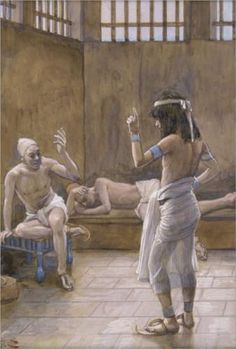
This man is the only person Joseph knows who will soon be in Pharaoh’s presence. He tells the chief butler he is innocent, and begs him to mention his case to Pharaoh.
The chief butler does not actually promise Joseph he will tell Pharaoh, but he does not demur. Yet the portion Vayeishev ends with the sentence:
But the chief butler did not zakhar Joseph, and he forgot him. (Genesis 40:23)
zakhar (זַכַר) = remember.
This week’s portion, Mikeitz, begins:
It was at the end of two years, and Pharaoh had a dream … (Genesis 41:1)
For two years nothing happened. The chief butler did not mention Joseph to Pharaoh. Joseph continued to live in the dungeon.
Why does the chief butler “forget” to bring up Joseph’s case?
An 18th-century commentary explained that the Torah says he “did not remember Joseph and he forgot him” to refer to two stages of forgetting:
“At the beginning he simply did not recall Joseph’s name, something that Joseph had asked him to remember. … This verse also informs us that the chief butler subsequently forgot Joseph completely, he erased the incident from his heart. … a deliberate act of forgetting.” (Or HaChayim)1
When I put myself in the chief butler’s place, I imagine that when he is first pardoned and restored to his position, he would want to keep his head down and not ask Pharaoh for any favors. I’ll bring it up later, he would think, after I’m sure Pharaoh trusts me again.
A few months later, when everything is going well, the man remembers Joseph. But now he does not want to remind Pharaoh about whatever he did that caused Pharoah to throw him into the dungeon in the first place. I imagine the chief butler rationalizing that he did not actually make a promise to Joseph. And it is not as if the young Hebrew man is under a death sentence. So gradually the butler forgets all about Joseph’s request—until Pharaoh asks for a dream interpretation.
A 12th-century commentator, Rashbam, wrote that God “performed a miracle for the sake of Joseph” by sending Pharoah two dreams that his own interpreters could not understand. That way, the chief butler “was forced to remember him.” 2
The chartumim do not cheat
Pharaoh has two dreams in a single night. In the first dream, seven healthy cows are eaten by seven gaunt cows. In the second, seven healthy ears of grain are swallowed up by seven thin, scorched ears.
Then it was morning, and his spirit was disturbed. And he sent out and summoned all the chartumim of Egypt, and all of its wise. But there was no dream-interpreter among them for Pharaoh. (Genesis 41:8)
Chartumim (חַרְטֻמִּים) = literate priests with occult knowledge. (Probably from the Hebrew word charut, חָרוּת = engraved, written. These high-level priests wrote down and read incantations out loud.)
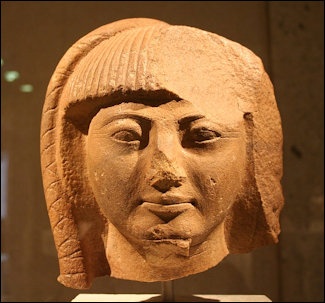
The word chartumim is often translated in English as “magicians”. But they were not magicians in the modern sense: people who create illusions and trick their audience. The ancient Egyptians believed that the gods created and maintained the universe with “heka”, a cosmic power that some individuals could also tap into and use to manipulate reality. Priests who were chartumim accomplished this through incantations and ritual actions.3
The Torah assumes that are that significant dreams are predictions about the future. In last week’s portion, when seventeen-year-old Joseph related his two dreams, his brothers and his father assumed they were predictions that someday they would bow down to Joseph (although they did not want to believe it).4
The other assumption in the portion Mikeitz is that chartumim were usually able to interpret significant dreams. Perhaps they failed with Pharaoh’s two dreams because their occult knowledge was about Egyptian gods. This time, although Pharaoh does not know it, his dreams came from the God of Abraham, the God of Joseph. So the rituals of the chartumim do not yield any results.
And they are honest enough to say so.
The chief butler remembers
Then the chief butler spoke to Pharaoh, saying: “My offenses I am mazkir today. Pharaoh became angry with his servant, and he placed me in custody of the house of the chief of the guards, me and the chief baker.” (Genesis 41:9-10)
mazkir (מַזְכִּיר) = mentioning, recounting. (A form of the verb zakhar = remember.)
When the chief butler mentions his “offenses”, he probably is not including his failure to mention Joseph to Pharaoh. His “offenses” are whatever he did two years ago that offended Pharaoh. He chooses not to remind Pharaoh of exactly what he had done, but he does take the risk of Pharaoh remembering it—in order to help his boss now, and perhaps even in order to help the young Hebrew in the dungeon.
The chief butler continues:
“And one night we [both] dreamed a dream, I and he, each dream according to its own meaning. And there was with us a young Hebrew man, a slave of the chief of the guards, and we told him, and he interpreted our dreams for us … And it happened as he had interpreted for us: I was restored to my position, and he was hanged.”
(Genesis 41:11-13)
This true account is all it takes to move the story along; the chief butler does not even need to add Joseph’s claim that he is innocent. Pharaoh is so eager to have his two disturbing dreams interpreted that he sends for Joseph immediately.
Joseph does not take credit
Then Pharaoh sent and summoned Joseph, and he was rushed out of the dungeon, and he shaved and he changed his clothes and he came to Pharaoh. And Pharaoh said to Joseph: “A dream I dreamed, and there is no interpreter for it. But I have heard it said about you: you [need only] hear a dream to interpret it.” (Genesis 41:14-15)
Pharaoh’s chief butler did indeed describe Joseph interpreting his dream and the chief baker’s dream right after he heard them, without engaging in any of the occult rituals the chartumim would use.
Joseph knows his dream interpretations in the dungeon were inspired by God; he would never have made such accurate guesses on his own. He had even told the chief butler and chief baker:
“Isn’t interpretation of them for God?” (Genesis 40:8)
Now that he stands in front of Pharaoh, Joseph once more refuses to pretend he has magic power of his own.
And Joseph answered Pharaoh, saying: “Not I! Elohim will answer for the welfare of Pharaoh.” (Genesis 41:16)
Elohim (אֱלֺהִים) = plural of eloha, אֱלוֹהַּ = god. Elohim = gods, god, God.
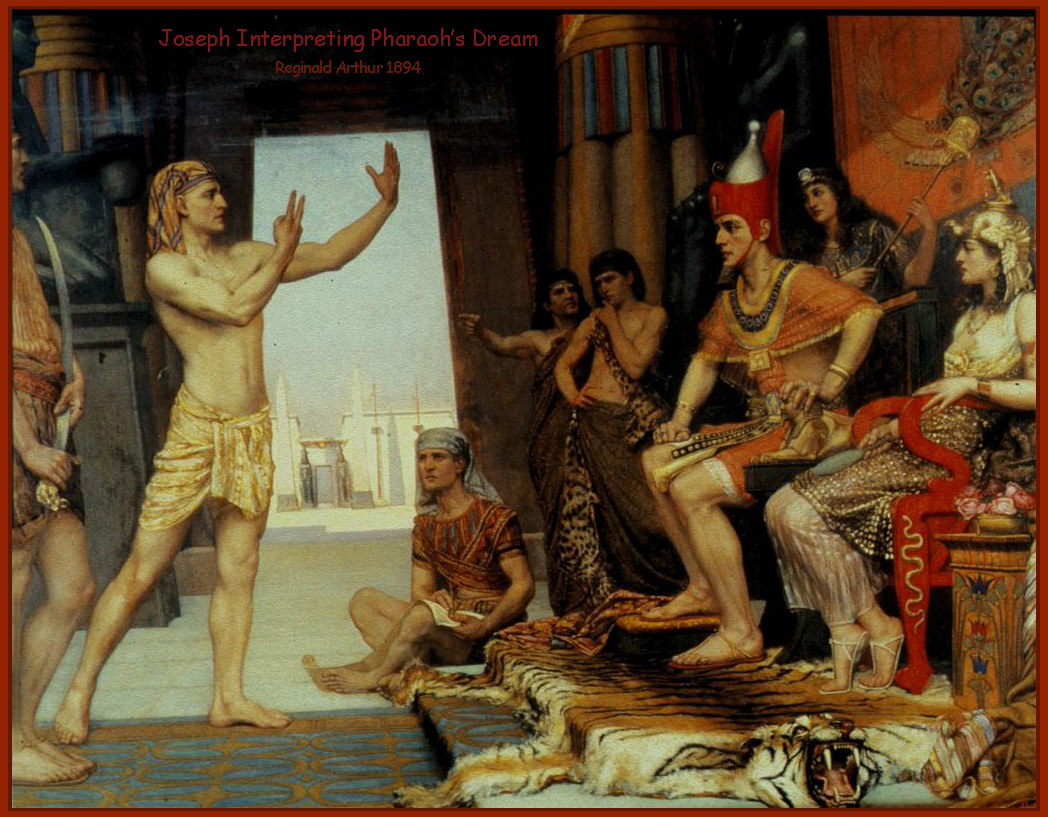
Instead of using God’s personal name, Y-H-V-H, Joseph uses an ambiguous word that could as easily refer to the gods of Egypt as to Joseph’s God, the God of his great-grandfather Abraham. He is both honest about his own abilities, and intelligent about using a neutral word for God that will not trigger any negative reaction from Pharaoh.
With no further ado, Pharaoh tells Joseph his two dreams, concluding:
“And the scanty ears of grain swallowed up the seven good ears of grain. And I told the chartumim, but none [of them] was an explainer for me.” (Genesis 41:24)
Joseph might have decided to make the number seven mean seven years if he wanted to invent an explanation for the dreams of seven scrawny cows consuming seven fat cows and seven scanty ears of grain swallowing up seven good ears. But how could anyone invent explanations for the other elements in Pharaoh’s dreams that would turn out to be true predictions? There is too much at stake for anyone to prophesize without the help of a guidebook or a god.
The chartumim had no guidebook for the dreams sent by Joseph’s God. But Joseph has God, who instantly puts the meaning of the dreams into his mind. He explains the dreams to Pharaoh, ending with this summary:
“What the Elohim is doing, he made Pharaoh see. Behold, seven years of great plenty are coming throughout the land of Egypt. And seven years of famine will arise after them, and all the plenty in the land of Egypt will be forgotten, and the famine will completely use up the land. … And the dream came to Pharaoh two times because the matter was determined by the Elohim, and the Elohim is hastening to do it.” (Genesis 41:28-32)
Next Joseph gives Pharaoh some good advice. The text does not indicate whether God is transmitting these words to Joseph as well, or whether Joseph now had an idea of his own.
“And now, let Pharaoh select a man of discernment and wisdom, and set him over the land of Egypt. … And let them collect all the food of the seven good years … in cities under guard. And let the food be a reserve for the land for the seven years of the famine that will be in the land of Egypt. Then the land will not be cut down by the famine.” (Genesis 41:33-36)
And the thing was good in the eyes of Pharaoh and all his courtiers. And Pharaoh said to his courtiers: “Could we find another man like this, who has the spirit of Elohim in him?” (Genesis 41:37-38)
Pharaoh makes Joseph his viceroy on the spot—because the spirit of Elohim is in him.
Pharaoh needs a dream interpreter. He does not know that he also needs a viceroy in charge of agriculture and food rationing. Joseph wants to be released from both prison and slavery. He does not know what he wants to do once he is free.
Pharoah and Joseph need each other. But they would never meet, if it were not for the honesty of the Egyptian chartumim, and a belated good deed by Pharaoh’s chief butler. And their meeting would not have led to Joseph’s elevation if Joseph had not been honest about the true source of his dream interpretations. Pharaoh gives him the job title and the signet ring because he respects Elohim—whether that means Joseph’s God or many gods—and sees that Joseph has Elohim’s favor.
Does everything come together by chance? Are Joseph and Pharaoh just lucky?
Or does God arrange everything as part of a master plan? (Later in the Joseph story, Joseph tells the brothers who sold him into slavery “you did not send me here, but God!” and “you planned evil for me, but God planned it for good, in order to bring about this time of keeping many people alive.”)5
Or is it a combination of luck and the honest, ethical behavior of everyone involved at the time?
The same questions apply to our life stories today. When the right people do the right things and everything “clicks” for a good outcome, what do you attribute it to? Luck? A master plan of God’s? Or a combination of luck and a few individuals acting honestly for the good of everyone?
- Or HaChayim is a collection of 18th-century Moroccan Jewish commentary. Translation from www.sefaria.org.
- Rashbam is the acronym of 12th-century Rabbi Shmuel ben Meir. Translation from www.sefaria.org.
- Scott B. Noegel, “The Egyptian Magicians”, www.thetorah.com/article/the-egyptian-magicians; Flora Brooke Anthony, “Heka: Understanding Egyptian Magic on Its Own Terms”, https://www.thetorah.com/article/heka-understanding-egyptian-magic-on-its-own-terms.
- Genesis 37:5-11.
- Genesis 45:8 and 50:18-20. See my post: Vayigash & Vayechi: Forgiving?
 Questioning Torah