Vayeishev: Stripped Naked

What does it mean to be stripped naked and exposed in public? Joseph finds out—twice—in this week’s Torah portion, Vayeishev (“And he stayed”).

When Joseph is growing up, his father, Jacob, treats him as superior to all ten of his older brothers. Naturally his brothers are jealous. They also hate Joseph because he tells them his two dreams, both of which predict his brothers will bow down to him.

Jacob makes things worse by giving a special garment only to his favorite son, Joseph.

Jacob Blesses Joseph and Gives Him the Coat, by Owen Jones, 1865

…and he made for him a ketonet passim. And his brothers saw that it was he their father loved most out of all his brothers, so they hated him, and they were not able to speak to him with peace. (Genesis/Bereishit 37:3-4)

ketonet  = a long tunic

passim = ? (Newer translations include “ornamented” and “long-sleeved”. Pas = palm of hand (or sole of foot). A garment with sleeves below the wrist would be impractical for physical labor, and therefore a sign of high rank.  The only other biblical reference to passim is in 2 Samuel 13:18-19, which explains that King David dresses his unmarried daughters in katenot passim.)

The King James Bible translated ketonet passim, inaccurately, as a “coat of many colors”. I wonder if the translators chose the word “coat” in order to imply that Jacob is fully dressed underneath the garment his brothers strip off. But a coat or cloak would be a simlah or me-iyl in biblical Hebrew, not a ketonet. And as far as we know, nothing was worn under a ketonet.

Jacob sends Joseph to check up on his brothers, who are pasturing the family flocks far away in Dotan. Although Joseph knows his brothers could not speak to him in peace” (Genesis 37:4), he does not imagine that while they watch him approach they are debating whether to kill him.

And so it was, when Joseph came to his brothers, then they stripped off Joseph his ketonet, the ketonet of the passim, which was on him. And they took him and threw him down into the pit; and the pit was empty, there was no water in it. (Genesis 37:23-24)

The brothers decide to sell Joseph as a slave instead of killing him. They have no trouble selling him to a passing merchant caravan; a naked adolescent boy at the bottom of an empty cistern is unlikely to be anyone of importance. When the merchants reach Egypt, they resell Joseph to the Pharaoh’s chief butcher, Potifar.

What if you found yourself in a foreign country with no clothes, no money, and no identification, being handed over to your new owner? Would you scream that it was a mistake, and keep trying to explain who you are?

At age 17, Joseph accepts his new situation with remarkable equanimity. He sees that without his father’s ketonet and his father’s authority, he has no identity. Naked, he has only the blessings God gave him at birth: brains and beauty. So he applies his intelligence to his new situation and makes the best of it.

God was with him and he became a successful man, and it happened in the house of his master, the Egyptian. (Genesis 39:2)

Joseph’s master, Potifar, promotes him from field slave to steward of his entire household. Egyptian field slaves worked naked, but a steward would wear a linen kilt called a shenti or shendyt.

Once Joseph is nicely dressed, his beauty attracts Potiphar’s wife. She propositions him day after day, but Joseph refuses her on the grounds that it would be unfair to his master and an offense against God.

A less mature young man would assume his elevation to steward was entirely due to his own cleverness and hard work. But Joseph’s reply to Potifar’s wife shows that he knows he would still be working in the field naked without the goodwill of his human and divine masters.

Then it happened one day, he came into the house to do his work, and none of the men of the house were there inside the house. And she seized him by his beged, saying: Lie with me! But he left his beged in her hand, and he fled and he went outside. (Genesis 39:11-12)

beged = garment (of any kind), clothing, cloth covering; treachery.

Joseph Flees Potiphar’s Wife, by Julius Schnorr von Carlsfeld, 19th century

Joseph’s wrap-around linen kilt would be tied in front, and if the knot came loose—or were pulled loose by a lustful woman—the garment would fall off onto the floor.

What does an Egyptian wear under his kilt? In the time of the Middle Kingdom, an Egyptian nobleman wore a sheer linen shendyt and a short under-skirt. But Joseph, as a high-ranking slave, would wear a coarse linen shendyt and nothing underneath. When he flees and goes outside, he is naked.

Potifar’s wife is afraid that other servants will see Joseph naked, and find Joseph’s garment in her room. To avoid being accused of adultery, she screams, and then accuses Joseph of imposing himself on her. As a result, Joseph finds himself back in a pit: Potifar sends him to prison.

Once again, Joseph has been stripped of his clothing and his position due to the treachery of someone whom he never suspected would go that far.

Joseph continues to use his brains in prison, and God continues to bless him with success. He becomes the chief jailer’s steward. After two years, Joseph is given an opportunity to interpret the Pharaoh’s dreams, and he succeeds at this, too. Pharaoh elevates him to viceroy of Egypt, and Joseph wears a gold ring and the finest sheer linen. This time he keeps his public identity, along with his clothes.


Clothing still gives people visible status and identity today. We treat a man wearing a suit and tie differently from one wearing a torn sweatshirt. And even today, we might lose our social identities at any time, no matter how wonderful our innate qualities are.

But we increase the odds of keeping our public identities when we treat other people not as clothes hangers, but as human beings with their own feelings and desires. We do better if we are grateful to the Potifars in our lives, and extremely cautious with the jealous brothers and philandering wives.

We are all naked under our clothes. May we all become humble enough, like Joseph, to learn from the times we are exposed, and reinvent our lives for the better.
Chayei Sarah & Lekh-Lekha: A Holy Place

What makes a place holy?

The word for “holy”, kadosh, means separated from mundane use, dedicated to God, or simply inspiring religious awe.  Kadosh appears only once in the book of Genesis/Bereishit, in verb form, when God blesses the seventh day of creation and makes it holy.  The word does not show up again until the book of Exodus/Shemot, when Moses stops to look at the burning bush, and God tells him to take off his shoes, because the place where you are standing is holy ground (Exodus 3:5).  Later in Exodus, Mount Sinai becomes holy ground for a whole people.  Eventually the Bible names Jerusalem as a holy city.

Even though there are no places called kadosh, “holy”, in the book of Genesis, there many sites where God makes first contact with a human being.  At two of the locations where God speaks to a human, the human dedicates the spot, and later someone returns to the same place to connect with God.  These places, Be-eir Lachai Ro-i and Beit-El, must surely count as holy!

Isaac and his bride Rebecca meet in a field next to Be-eir Lachai Ro-i (“Well for the Living One Who Sees Me”) in this week’s Torah portion, Chayei Sarah (“the life of Sarah”).  But it is Hagar, an Egyptian, who first encounters God there.

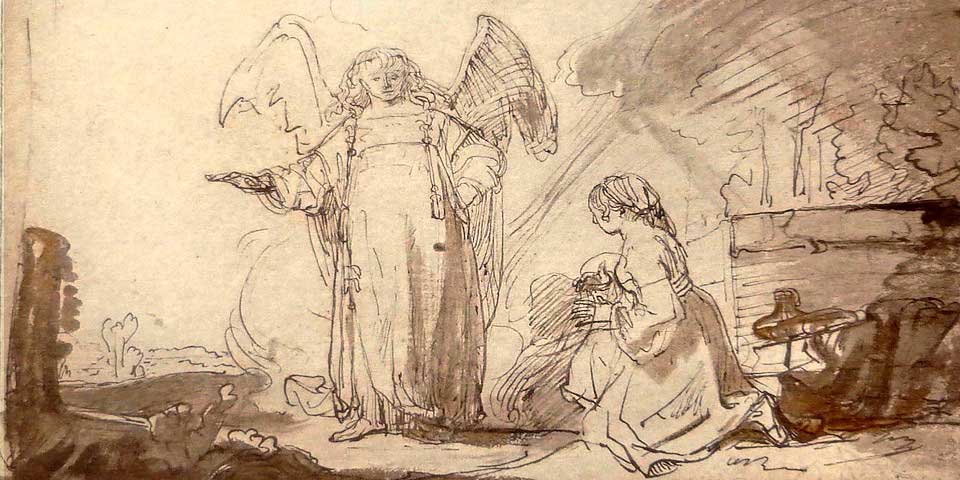
Hagar and the Angel, by Rembrandt

When Abraham and his wife Sarah leave Egypt in the Torah portion Lekh-Lekha (“Go for Yourself”), Hagar goes with them as Sarah’s servant.  Sarah gives Hagar to her husband for the purpose of producing a child Sarah can adopt.  But once Hagar is pregnant, Sarah abuses her, and Hagar runs away across the Negev Desert, back toward Egypt.  A messenger of God  finds her at a spring, a watering-place by the road.  God speaks to Hagar through the messenger and convinces her to return to Abraham and Sarah.

And she called the name of God, the one speaking to her: You are the God of Ro-i; for she said: Even as far as here, I saw after ro-i! Therefore the be-eir is called Be-eir Lachai Ro-i. (Genesis 16:13-14)

ro-i = seeing me, one who sees me.

be-eir = well, watering-place.

lachai = for the living one.

For Hagar, accustomed to being a pawn in Sarah’s schemes, the most amazing thing is that God actually notices her—and she survives.  Hagar does return, and gives birth to Ishmael.  Sarah adopts Ishmael, but later bears her own son, Isaac, and sends Hagar and Ishmael into exile.

Isaac is 40 years old before the Torah once again mentions Be-eir Lachai Ro-i, the Well of the Living One Who Sees Me.  At this point, Isaac is estranged from his father.  In last week’s Torah portion, Vayeira (“And He Saw”), Abraham bound Isaac as a sacrificial offering, and raised the knife to his son’s throat before a voice from God called him off.  After that, Isaac did not go home with his father.  In this week’s Torah portion, Abraham buries Sarah, Isaac’s mother, without Isaac’s presence.  Then he arranges for Isaac to marry an Aramean without even informing his son.  Apparently they are not on speaking terms.

Abraham lives in Beersheba (Be-eir Sheva), and Isaac lives farther south, in the Negev Desert.

And Isaac, he came from coming to Be-eir Lachai Ro-i, and he himself lived in the land of the Negev.  And Isaac went out lasuach in the field, in the face of the sunset; and he raised his eyes and he saw—hey!  Camels were coming. (Genesis 24:62-63)

lasuach = to ?? (This is the only occurrence of the word in the Bible, and though it is in the form of an infinitive verb, scholars do not agree on its meaning.  Lasuach has been translated as to stroll, to pray, to supplicate, and to meditate.  It might be a variant spelling of the verb siyach = meditate, go over a matter, contemplate something.)

I like the literal translation he came from coming to; it emphasizes that a holy well is a place you come to.  Isaac is avoiding his father, but he comes to the well where God noticed and spoke to Hagar.  Since he has no intention of traveling to Egypt on the road that runs past the well, he must come there because he knows about Hagar’s experience.

Like Hagar, Isaac is used to being overlooked as a person, accustomed to being a pawn in his father’s schemes.  Maybe he hopes that God will notice him at Hagar’s well, or maybe he hopes he will be able to see himself.

Coming from the Well of the Living One Who Sees Me, Isaac heads out into the field at sunset to lasuach.  Maybe Isaac senses the holy presence of God at the well, and he walks back through the field slowly to absorb the experience.

Lost in thought, he raises his eyes and is surprised to see camels approaching.  He is not far from the road between Beersheba and Egypt, but these camels have left the road and are heading across the field toward him.  The first rider to dismount is Rebecca, the bride that Abraham’s servant is bringing to Isaac.  They meet in the field, he loves her, and he begins his new life.

Near the end of the Torah portion, Isaac and his half-brother, Hagar’s son Ishmael, bury Abraham in the family cave to the north.  Then Isaac returns to Hagar’s well.

And it was after the death of Abraham when God blessed Isaac, his son; and he settled next to Be-eir Lachai Ro-i. (Genesis 25:11)

The only other place in the book of Genesis that remains holy years later, under the same name, is Beit-El (sometimes called Bethel in English).  In the upcoming Torah portion Vayeitzei (“And he went”), Jacob stops for the night on his way to Charan and dreams of a stairway between heaven and earth. God speaks to him for the first time.  When Jacob wakes, he says:

Truly God yesh in this place and I, I did not know! And he was awestricken, and he said: How awesome is this place! This is nowhere but Beit El, and this is the gate of the heavens! (Genesis 28:16-17)

yesh = it exists, it is present, there is.

Beit El = the house of God.

For Jacob, the most amazing thing is not that God notices him, but that God exists at all in this world.

Jacob dedicates the spot by setting up a stone pillar and pouring oil over it, and naming it Beit-El.  More than 20 years later, God tells him to return to Beit-El.  Jacob first buries all the idols belonging to his household.  Then he leads them to the spot and builds an altar. God blesses him again, and Jacob pours a libation as well as oil on the stone pillar before moving on.  By returning to the place where God first spoke to him, Jacob rededicates himself to God.

*

Few of us today hear God speaking to us in Biblical Hebrew.  But once in a while, we notice God, or God notices us, and we are amazed.  Suddenly our usual mundane perspective changes, and the world is suffused with new meaning.

Sometimes this happens because a place strikes us as holy, awe-inspiring, connected with God.  It might be a liminal place in nature—the edge of the ocean, deep in a forest, a remote spot with a brilliant night sky.  I have also felt that mysterious awe inside medieval cathedrals, though as a Jew I do not go looking for God there.

Sometimes we go back later, and find God again.  Sometimes we go back and discover that the place seems ordinary now; the holiness was in our own heart.  Either way, it is a blessing to be able to stand on holy ground.

Bereishit: Divine Inner Voices

The first Torah portion in the first book of the Torah (both called Bereishit, “In a beginning”) opens with God’s creation of the world. It closes with God’s decision to destroy the world and start over again.

Just before God makes this decision, the Torah gives us a curious story fragment:

And beney ha-elohim saw the daughters of the human, how tov they were, and they took themselves wives from whomever they chose. (Genesis 6:2)

The Nefilim were on the earth in those days, and also afterward, for beney ha-elohim came into the daughters of the human, and they bore children to them. They were the mighty ones from long ago, men of renown. (Genesis 6:4)

beney ha-elohim = the sons of God.

tov = good, attractive.

What does “the sons of God” mean? Some traditional commentary claims the phrase refers to superior human men, who make the mistake of marrying an inferior class of women. Other commentators say the “sons of God” are angels, angels of a lower grade than the malachim (“messengers”) that appear in the Torah in human form in order to speak as mouthpieces for God.

What strikes me is that the phrase beney ha-elohim appears only four times in the whole Hebrew Bible: twice in the passage above, and twice in the book of Job. The book of Job begins by describing how upright, good, and God-fearing Job is. Then the scene shifts to the court of God:

One day beney ha-elohim came to present themselves in front of God, and ha-satan came too, in the middle of them. And God said to ha-satan: Where do you come from? And ha-satan answered God, and said: From roving about on the earth and from going back and forth on it. (Job 1:6-7)

ha-satan = the adversary, the obstacle

God pays attention to ha-satan, and does not question any of the other “sons of God”. The Adversary doubts whether Job is genuinely good and God-fearing, and persuades God to test Job’s faithfulness. God assigns the Adversary to strike all Job’s possessions. Ha-satan eliminates Job’s wealth and all his children—for no good reason—but Job still blesses God.

Then one day beney ha-elohim came to present themselves in front of God, and ha-satan came too, in the middle of them, to present itself in front of God. And God said to ha-satan: Where do you come from this? And ha-satan answered God, and said: From roving about on the earth and from going back and forth on it. (Job 2:1-2)

Once again God only converses with ha-satan. The Adversary persuades God to test Job again, this time by afflicting his body, and God authorizes another injustice in order to find out what Job will do.

The book of Job is a theological conversation in the guise of a story about a man who lived long ago and far away. In order to set up the question of whether God is just, the story uses an allegory of God in His court, receiving His sons, the lesser gods (a scene obviously borrowed from one of the pantheistic religions in the region).

But on another level, I see both stories about beney ha-elohim as allegories for the human mind.

In the book of Job, I think God’s court represents the human mind. The decision-making ego is visited by various sub-personalities, including one that takes an adversarial role and obstructs the ego by planting doubt, then tempting the ego to abandon morality in order to find out for sure.

In the book of Genesis, the interaction between “the sons of God” and the “daughters of the human” can also represent the human mind. Like ha-satan in Job, beney ha-elohim in Genesis  visit the earth. The purpose of the visit in Job is to observe the human beings from a different perspective than God’s, and bring that perspective into the heavenly court that I think represents the human mind.

The purpose of the visit in Genesis is to marry and “come into” human women. When the book of Genesis says “for beney ha-elohim came into the daughters of the human, and they bore children to them”, we can read it as simply a description of the sons of God having sex with their wives, who then give birth to mighty and famous men. But we can also read it as a representation of subconscious aspects of the mind coming into the consciousness of human women, and inspiring them to give birth to new ideas and notions.

In the Bible divine inspiration, ruach elohim, can be good or bad; good when a prophet is moved to speak out and warn people they are doing wrong, but bad when King Saul is seized by divinely-induced madness. What if divine inspiration comes from different aspects of God, different “sons”? One aspect might give us an impulse to speak out against injustice. Another aspect (such as ha-satan in Job) might give us an impulse to commit any injustice in order to prove a point.

The “sons of God” in Genesis are apparently bad impulses, leading to bad thoughts and actions.

And God saw the abundant badness of the human on the earth, that the shape of every idea of his heart was only bad all the time. And God nicham that It had made the human on the earth, and It was heartbroken. (Genesis/Bereishit 6:5-6)

nicham = had a change of heart, reconsidered. (This verb covers at least two kinds of change of heart: regret, and consolation.)

Before the beney ha-elohim show up, the humans on earth seem like a mixed lot, more good than bad. Cain is a murderer, and his great-great-great grandson Lemekh boasts to his wives about vengeance, but the other people the Torah mentions seem innocent enough. When Enosh is born, people start invoking the four-letter name of God. One of Enosh’s descendants, Enoch (Chanokh), “walked with God”.

Only after the beney ha-elohim influence the human race does God consider the ideas of the human heart “only bad all the time”. Perhaps these “sons of God” are like ha-satan in Job. The Adversary in Job corrupts the ruling god with feelings of doubt. The sons of God in Genesis apparently introduce urges that corrupt the conscious mind of the human “daughter”, and become obstacles to good behavior.

And God said: I will wipe away the human that I created from the face of the earth, from human to beast to creeper to flyer in the sky, because I have nicham that I made them. But Noah found grace in the eyes of God. (Genesis/Bereishit 6:7-8)

In next week’s Torah portion, God decides to start the world over again with Noah and his family (as well as pairs of all the animals). This is like deciding to eliminate all those awkward feelings of beney ha-elohim, and reduce the mind to a single virtuous ego. Yet when the flood ends, God reaches the more mature conclusion that the human mind is always subject to evil, and decides to put up with it.

Today, we all hear the mental voices of divine inspiration inside our own minds. Sometimes they are Adversaries, trying to push us off the right path and make us act out of doubt or resentment or another negative urge. Sometimes they enter with enlightenment, and impregnate us with ideas that lead to good actions.

May we all learn to put up with the many shapes of our ideas, as the god in Genesis did. And may we all become more discriminating about our inner promptings than the god in Job.