Yitro: Rejected Wife

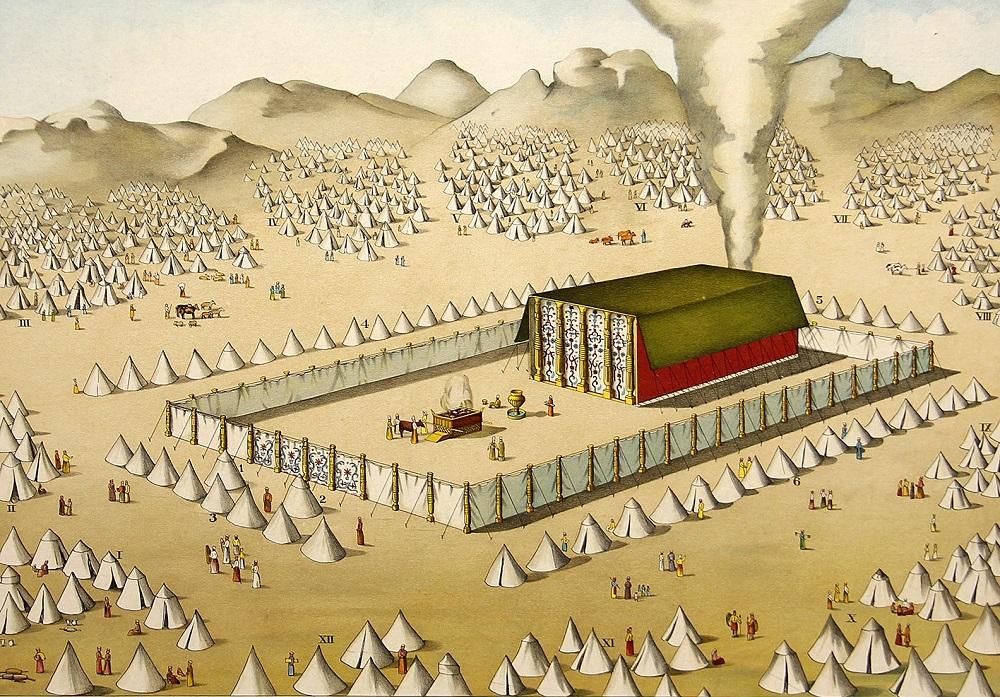
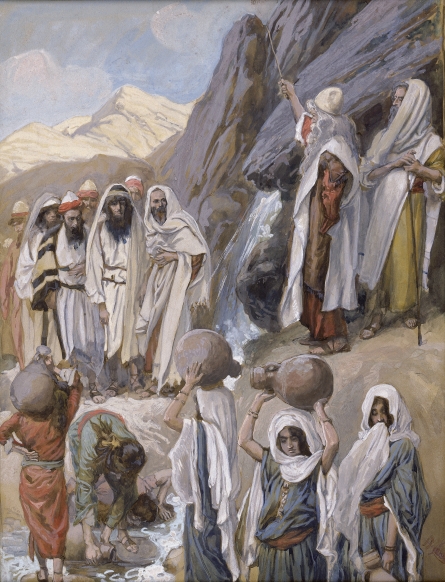
Mount Sinai, by Elijah Walton, 19th century

Moses, the Israelites, and some menials who joined them in the exodus from Egypt , are camping in the wilderness of Sinai when visitors arrive at the beginning of this week’s Torah portion, Yitro.

And Yitro, priest of Midian, father-in-law of Moses, heard all that God had done for Moses and for his people, Israel: that God had brought Israel out from Egypt.  So Yitro, father-in-law of Moses, took Tzipporah, wife of Moses, after shilucheyha, and her two sons … (Exodus/Shemot 18:1-3)

shilucheyha (שִׁלּוּחֶיהָ) = she had been sent: sent away, dismissed, or divorced. (A pual form of the root verb shalach (שָׁלַח) = send, let go.)

After Moses received orders from God at the burning bush, he took his wife and sons on the first leg of his journey back to Egypt.  They spent the night at a lodging place where God came to kill Moses, and Tzipporah saved his life by circumcising one of their sons and smearing the blood on her husband, calling him a “bridegroom of blood”.1  (See my post Va-eira & Shemot: Uncircumcised, Part 2.)

Tzipporah’s decisive action indicates she would be a good person to have by his side in a dangerous situation.2  Yet something about that dramatic ritual made Moses change his mind about bringing his wife to Egypt.  Maybe he did not even believe her account of what happened while he was unconscious.  So he sent Tzipporah back to her father’s house after she saved his life, and before he met his brother Aaron on the road.3

Was it merely a separation, or a divorce?  Was he protecting or rejecting her?

Sending away versus casting out

The pual form4 of the verb shalach appears only 15 times in the Hebrew Bible, usually referring to when a man was sent somewhere. The only other occurrence of this verb in reference to a woman is in second Isaiah:

Where is this scroll of divorce

            Of your mother, whom I shilucheyha? (Isaiah 50:1)

Deuteronomy uses the related piel verb form shillach in three laws about sending away wives.

If a man wants a female war captive, he must take her home and let her mourn unmolested for one month before he takes her as a wife.  “Then if you no longer want her, veshillachtah her soul, and you must certainly not sell her for silver; you must not treat her brutally, since you overpowered her.”  (Deuteronomy 21:14)

veshillachtah (וְשִׁלַּחְתָּה) = then you must set her free, let her go.

If a man tries to return his bride the next morning by claiming falsely that she was not a virgin, “… then she will be his wife; he will not be able to shallechah all his days.”  (Deuteronomy 22:19)

shallechah (שַׁלְּחָהּ) = send her away.

And if a man rapes a virgin who is not engaged, he must pay her father and accept her as his wife.  “… since he overpowered her, he will not be able to shallechah all his days.”  (Deuteronomy 22:29)

In all three of these laws, the verb shillach is used to mean divorce.

Separating

Nowhere else in the Hebrew Bible does a man send his own wife back to her father’s house temporarily, without divorcing her.  Yet most commentary before the 20th century assumed Moses did this, either so that Tzipporah and their children would not suffer,5 or so that he could “devote himself entirely to the fulfillment of his mission”.6

One piece of evidence for this interpretation is that when Yitro brings Tzipporah back to Moses, she is still called eishet Moshe (אֵשֶׁת מֺשֶׁה) = wife of Moses, and Yitro is still called chotein Moshe (חֺתֵן מֺשֶׁה) = father-in-law of Moses.

The Hebrew Bible uses only two types of words for divorce:  variants of shillach (שִׁלַּח) = send away, set free, let go; and variants of goreish (גֺּרֵשׁ) = cast out, driven out.  In other biblical books a divorcee is called a gerushah (גְרוּשָׁה), a female who has been cast out.7  But Tzipporah is not called a gerushah.  Moses did not “cast out” Tzipporah; he “sent her away”.

Divorcing

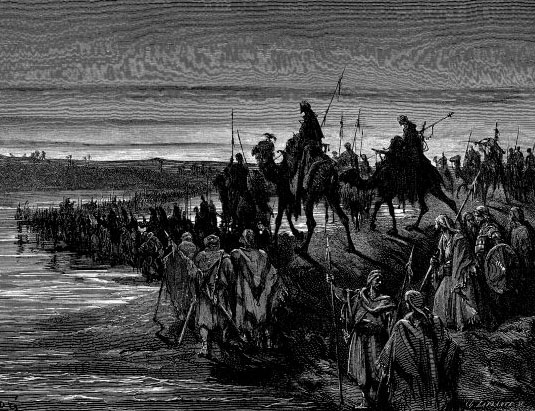
by E.A. Girardet, 19th century

And Moses went out to invite his father-in-law, and he bowed down to him, and he kissed him, and they inquired about one another’s welfare, and they came into the tent.  (Exodus 18:7)

Moses greets Yitro warmly, but he does not even acknowledge the presence of Tzipporah and their two sons.  Although there are no instances in the Hebrew Bible of a man kissing his wife or ex-wife in public, men do kiss their kinsmen in front of other people.8  Yet the Torah does not say Moses greets his own sons in any way.  He does not even perform the basic courtesy of inviting them to dismount and rest.

Inside the tent, Moses tells his father-in-law the details of God’s miracles in Egypt and afterward.  Yitro makes a burnt offering to Moses’ God, and feasts with Moses, Aaron, and the elders of Israel.  No provision for Tzipporah, Gershom, or Eliezer is mentioned.  The next day, Yitro gives Moses advice on how to delegate the legal cases his people bring to him.

And Moses sent off his father-in-law, and he went to his own land.  (Exodus 18:27)

Do Tzipporah, Geirshom, and Eliezer go home again with Yitro, ignored and rejected?  Or do they stay with Moses and the Israelites, ignored and rejected?

The Kushite wife

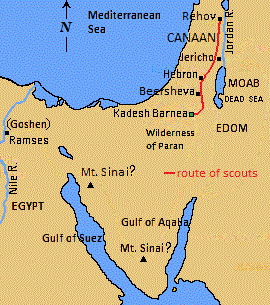
The name “Tzipporah” never appears again in the Hebrew Bible.  A wife of Moses is mentioned only once more, when Miriam and Aaron complain about Moses “on account of the Kushite wife that he took; for he had taken a Kushite wife”(Numbers/Bemidbar 12:1)  Elsewhere in the bible, a Kushite is a dark-skinned person from Kush, which may be either Nubia (south of Egypt) or part of southern Midianite territory (near the Gulf of Aqaba).  The commentary is divided on whether this wife is Tzipporah or another woman.  One tradition is that Miriam and Aaron complain because Moses is denying his wife sexual relations.9

Certainly Moses does not share his tent with a wife.  His tent becomes the Tent of Meeting (with God), and only Moses and his apprentice Joshua sleep there.

Moses’ sons, Geirshom and Eliezer, have no role in the rest of the story of Moses’ life.  Joshua inherits Moses’ position as political leader of the Israelites, and Aaron’s son Elazar becomes the high priest.  Geirshom and Eliezer are not mentioned again until the first book of Chronicles, which includes them in genealogical lists of Levites in charge of the temple treasuries.10

So I believe that Yitro does leave his daughter and grandsons behind when he says farewell to Moses and goes home.  Moses lets Tzipporah and their two sons travel with the Israelites, but he has little or no contact with his erstwhile family.  Although they travel with the Israelites, perhaps pitching their tent with the other foreigners on the edges of the camps, Moses maintains his separation from them.

And I think that when Miriam and Aaron speak against Moses “on account of his Kushite wife” in the book of Numbers, they are referring to his neglect of Tzipporah.  (I plan to explore this idea further when we reach Beha-alotkha in the Jewish cycle of Torah portions at the end of May 2018).


After Moses separates from Tzipporah on the road to Egypt, we never see him interacting with a wife or child again.  If he is married to anyone, he is married to God.  If he has any children, they are the thousands of children of Israel that he has become responsible for.  He misses out on the long companionship of marriage partners.

So does Tzipporah.  Her heroic act in the bridegroom of blood scene is ignored, forgotten.  She is treated like excess baggage, passed back and forth between Yitro and Moses.  Her name means “bird”, but she is never allowed to fly.

May we have compassion for all caged birds—and for all great leaders.


  1. Exodus 4:24-26.
  2. Pamela Tarkin Reis, Reading the Lines, Hendrickson Publishers, Peabody, MA, 2002, pp. 101-102.
  3. Rashi (11th-century Rabbi Shlomo Yitzchaki) follows the Mekhilta by adding dialogue in which Aaron advises Moses not to bring his wife and sons into Egypt. But the Torah says only that Aaron met Moses at the mountain of God and kissed him; Moses told Aaron what God wanted them to do; and the two brothers went into Egypt and assembled the elders of Israel.  There is no mention of Tzipporah or Moses’ sons.  (Exodus 4:27-29)
  4. The pual stem of a verb is passive form of the piel stem, which is usually an intensive.
  5. Rashi, based on the Mekhilta.
  6. Samson Raphael Hirsch (19th-century rabbi), The Hirsch Chumash: SeferShemos, translated by Daniel Haberman, Feldheim Publishers, Jerusalem, 2005, p. 301.
  7. Leviticus 21:7, 21:14, 22:13; Numbers 30:10.
  8. Jacob kisses his cousin Rachel in front of strangers when he first meets her at the well in Genesis 29:2, 29:10-12. Lavan kisses his daughters and grandsons farewell in front of his men and Jacob’s servants in Genesis 32:1.  Esau and Jacob, long-lost brothers, kiss and embrace in front of Esau’s 400 men and Jacob’s retinue in Genesis 33:4.
  9. Including Exodus Rabbah 46:3, Deuteronomy Rabbah 11:10, Midrash Tachuma Tzav 13, Rashi (11th-century rabbi Shlomo Yitchaki).
  10. 1 Chronicles 23:15-17 and 26:24-25.

Beshalach: See, Fear, Trust, Sing

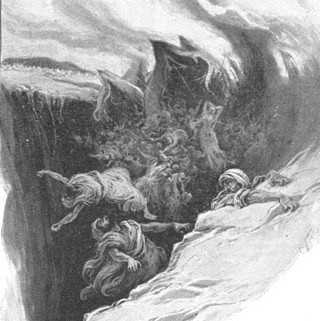
Crossing the Red Sea,
by Bernardino Luini, ca. 1515

The Reed Sea splits.  The Israelites and their fellow travelers cross on dry land.  The chariots pursue them.  The sea returns and drowns the Egyptian army.

After the miracle at the Reed Sea in this week’s Torah portion, Beshelach (“When sending away”), the consciousness of the Israelites changes in four steps.  They perceive God’s power1, they feel fear and awe, and they give up their reservations (at least for a while) and trust in God and Moses. Then Moses begins to sing, and everyone joins in.

Vayareh, the Israelites, the great power that God used against the Egyptians; vayiyre-u, the people, of God; vaya-aminu in God and in Moses, God’s servant.  That was when yashir, Moses and the Israelites, this song in honor of God.  (Exodus 14:31, 15:1)

vayareh (וַיַּרְא) = and they saw, perceived, looked at, recognized, acknowledged, considered. (A form of the root verb ra-ah, רָאָה.)

vayiyre-u (וַיִּירְאוּ) = and they felt fear, fear and awe, awe and reverence.  (A form of the root verb yarei, יָרֵא.)

vaya-aminu (וַיַּאֲמִינוּ) = and they believed, trusted, relied upon.  (Probably from the same root as amen, אָמֵן.)

yashir (יָשִׁיר) = he sang.

Vayareh

Vayareh the great power that God used against the Egyptians …

The Israelites have already witnessed the ten miraculous plagues in Egypt.  Why do they only now see God’s power?

Beating a slave, Egyptian tomb, 15th century

I think they have been reluctant even to acknowledge God’s plan for taking them out of Egypt because they know they are doomed if it does not work.  After all, the first time Moses asked Pharaoh to give them three days off to worship God, Pharaoh only increased their workload.2

The first two plagues proved that either Moses or his God had strong magic; but Pharaoh’s magicians could also turn water into blood and make frogs overrun houses.  The next six plagues, from lice to locusts, could be explained as large-scale natural disasters; only the quick succession of afflictions betrayed a supernatural power at work.  The last two plagues, three days of total darkness and the overnight death of the firstborn, were too unnatural to mean anything but the power of a god.  But was the God of Moses their savior, or just a god of destruction?

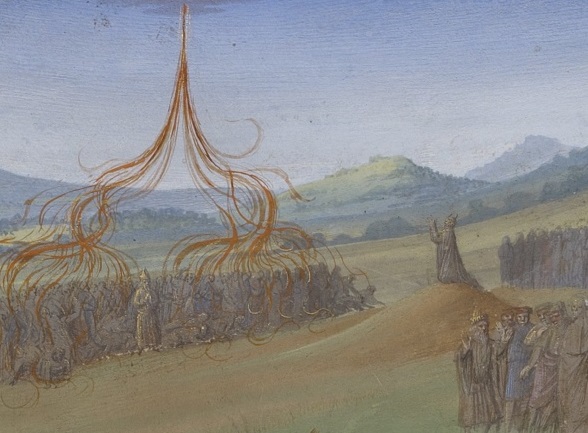
Pillar of Cloud, by Johann Jakob Scheuchzer, 1731

After the Israelites and their fellow-travelers march out of Egypt, they are accompanied by a miraculous pillar of cloud by day and fire by night.3  But it is still hard for them to believe that any god is working for them and against Pharaoh.  Everyone in Egypt knows that the pharaoh is not only a king, but the son of all the Egyptian gods.4  Their whole lives, he has had absolute power over them.  How can they think of Pharaoh any other way?

When they find out that his army has pursued them into the wilderness, they are full of fear (although they do not lose their dark humor).

And Pharaoh came close, and the Israelites raised their eyes, and hey!  The Egyptians were pulling out after them!  Vayiyre-u very much, and the Israelites cried out to God.  And they said to Moses: “Was it for lack of graves in Egypt that you took us to die in the wilderness?”  (Exodus 14:11)

They are trapped, camped between that army and the Reed Sea.  They cry to God for help, but they expect Pharaoh’s army to win.  It always has.

During the night God splits the sea and the Israelites cross on dry land, with God’s pillar of fire as a rearguard between them and the Egyptians.  The Pharaoh’s charioteers follow across the sea bed, but the chariot wheels get stuck in the mud.  At dawn God makes the water return, and the Israelites watch the Egyptian army drown.

The world changes.  I imagine the Israelites trembling with shock.  Now their hearts crack open and they finally see the great power of God.

Vayiyre-u

Vayiyre-u of God

After seeing that God really has drowned the Egyptian army and rescued them from slavery, the Israelites stop being afraid of Pharaoh, and start being afraid of God.

When the Egyptian army drowns, the Israelites see and believe that their world has changed.  Amazed, they can now believe that God is liberating them from Egypt altogether.  But they do not fall in love with this God who changes the status quo by sending plagues and killing people.  Instead, they feel fear and awe.

Va-aminu

Vaya-aminu in God and in Moses, God’s servant

Only after the Israelites fear God more than Pharaoh do they put their trust in God and Moses.  (At least until the next serious setback, when they run out of food in the wilderness of Sin.)5

They did not believe or trust or rely upon God when they marched out of Egypt; Pharaoh had kicked them out.  They followed Moses because they had to follow somebody.  When the pillar of cloud and fire appeared, they followed that.  Why not?  They had nothing to lose.

When they walk across the bed of the Reed Sea during the last shift of the night, they do not believe that they will get safely to the other side.  But the enemy is right behind them; why not go forward?

Only after God destroys the Egyptian army does the Israelite attitude changes from “I’m doomed anyway, I’ll take the risk” to “I am committed to this God.”  This trust and commitment comes from awe and amazement at being saved—but also from fear of such a powerful God.

Yashir

That was when yashir, Moses and the Israelites, this song in honor of God.  (Exodus 15:1)

Critical scholars agree that the psalm following this introduction is in an older Hebrew than the rest of the story.  The details of the story in Beshallach and the psalm they sing do not quite match.  (See my post Beshallach & Psalm 136: Miracle at Sea.)  But why should we expect Moses to invent a new song on the fly?  When people are overwhelmed with emotion and feel moved to sing, they sing the most appropriate song they know.

Everyone sings, and all the women drum and dance to celebrate God’s victory.6  This is the first singing in the Torah.


What if you felt oppressed and hopeless your whole life?  What if you could not believe anything could change?  What if suddenly your old life ended, and you had to cope with an entirely new situation?  Could you see and believe in the change?  Would you feel afraid?  Could you turn your fear into wonder (Abraham Joshua Heschel’s “radical amazement”)?  Could you make a commitment to the new reality?  And would the emotion welling over inside you come pouring out in song?

(An earlier version of this essay was published in January 2010.)


  1. In this post, I have consistently translated the word yad (יַָד) as “power”. In Biblical Hebrew, yad means “hand” literally, and “power” metaphorically.
  2. Exodus 5:1-21.
  3. Exodus 13:21-22.
  4. See Jan Assmann, “Pharaoh’s Divine Role in Maintaining Ma’at (Order)”, www.thetorah.com.
  5. Exodus 16:1-3.
  6. Exodus 15:20.

Bo & Va-eira: A Hard Habit

Plague of Blood, Golden Haggadah, c. 1320

Blood, frogs, lice or gnats, swarms of vermin, livestock disease, skin disease, hail, locusts, impenetrable darkness, death of the firstborn.  Why does it take ten miraculous plagues in the Torah portions Va-eira and Bo before Pharaoh lets the Israelite slaves go?1

When Moses first returns to Egypt, he and his brother Aaron simply ask the new pharaoh to give the Israelite slaves three days off to make animal sacrifices to their God in the wilderness.2  Pharaoh replies that he does not know this god.  Then he increases the workload of the Israelites, so they will not even think about taking a vacation.  Ruling through oppression is the model his father used, the only model he knows.

Moses and Aaron return to perform a small demonstration miracle: Aaron throws down a staff that turns into a crocodile.3  Pharaoh summons his wonder-workers, who perform a similar trick.  Even though Aaron’s magic crocodile eats the Egyptians’ magic crocodiles, Pharaoh refuses to be impressed.

Vayechezak, the leiv of Pharaoh, and he did not listen to them, as God had spoken.  And God said to Moses: “Kaveid is the leiv of Pharaoh; he refuses to let the people go”.  (Exodus 7:13-14)

vayechezak (וַיֶּחֶזַק) = and it hardened, became stronger, became unyielding.  (From the same root as chazak, חָזָק = strong, firm, resolute.)

leiv (לֵב) = heart; conscious mind, conscious thoughts and feelings.

kaveid (כָּבֵד) = heavy, dull and slow, immobilized; oppressive, impressive.

Pharaoh’s mind is already so heavy that it “hardens” itself; he dismisses questions before they arise, and continues to behave as he always has.

We are what we learn

Moses and the current pharaoh both grew up in the Egyptian court.  But Moses was the son of Israelite slaves before he was adopted by an Egyptian princess, and he never forgot his origins.  As a young man, he left Egypt and joined a Midianite clan east of Sinai.  Thus he learned how to adapt to novel situations with curiosity and an open mind.  When he saw the bush that burned but was not consumed he approached it, and when he heard God’s voice he believed it.

Nevertheless, Moses argued with God.  At the burning bush he tried five times to get out of returning to Egypt as God’s prophet before he finally accepted his mission and changed his life again.4

Pharaoh Ramses III followed by his son

The old pharaoh’s firstborn son, on the other hand, grew up knowing he would someday succeed his father as the god-like ruler of Egypt.  All he had to do was learn his predefined role.  He had no reason to question anything, no new situations to master.

After the staff-crocodile demonstration the miraculous plagues begin: seven in last week’s Torah portion, Va-eira, and three this week in Bo.  Several times Pharaoh promises Moses and Aaron that if they get God to end the current plague, he will let the Israelites go for three days.5  But as soon as the plague stops, Pharaoh goes back on his promise.  After each plague, Pharaoh’s leiv returns to being either chazak or kaveid.  He acts as if he can continue to depend on the labor of his Israelite slaves, and their God will not afflict the country with another miracle.

Pharaoh’s mind hardens on its own after six of the plagues. But after the plagues of skin disease, locusts, and darkness, God–or at least the character of God as portrayed in the book of Exodus–hardens Pharaoh’s heart.

Plague of Boils, Haggadah by Judah Pinchas, 1747

After the sixth plague, a skin rash with boils,

Vayechazeik, God, the leiv of Pharaoh, and he did not listen to them, as God had spoken to Moses.  (Exodus 9:12)

Vayechazeik (וַיְחַזֵּק) = and [God] hardened, strengthened, made rigid.  (Another verb form from the same root as chazak.)

Why does God intervene?  One possibility is that Pharaoh is finally wavering, wondering whether his refusal to listen to Moses is taking too a high toll on his country—or on his own body.  Is his “heart” softening, his mind becoming a little more flexible?  If so, God apparently wants to prevent Pharaoh from changing his mind too soon, before God has finished the whole demonstration.

Plague of Locusts, Haggadah by Judah Pinchas, 1747

During the plagues of locusts and darkness in this week’s Torah portion, Pharaoh switches from empty promises to genuine offers—with conditions.  While the locusts are devouring all the remaining crops, he offers to let the Israelite men go, as long as their children remain hostage in Egypt.  Moses refuses the condition.

Vayechazeik, God, the leiv of Pharaoh, and he did not let the Israelites go.  (Exodus 10:20)

During the plague of impenetrable darkness, Pharaoh offers to let all the Israelites go for three days, as long as they leave their flocks and herds behind.  Again Moses refuses.

Vayechazeik, God, the leiv of Pharaoh, so he was not willing to let them go.  (Exodus 10:27)

Pharaoh remains attached to being the all-powerful ruler of an economy based on slavery.  Is the God character or Pharaoh responsible for the king’s inability to imagine a new world order?

Free will

If God is deliberately hardening Pharaoh’s mind, then the king of Egypt has no free will.  God is depriving Pharaoh of the ability to make choices.

The idea that God can remove a human being’s free will has disturbed commentators through the ages.  The ability to make our own choices is part of being human, according to the book of Genesis; God gave Adam and Eve the ability to decide whether to eat from the Tree of Knowledge or not.  And we all prefer to believe that we are not automatons, that it is possible for us to choose and change.

Other commentators have argued that God hardens Pharaoh’s mind not by making him more stubborn, but by giving him the courage to bear the suffering caused by his bad choices.  God does not want Pharaoh to make a reasonable decision because he realizes that his country is collapsing into poverty and disease.  Instead, God wants Pharaoh to believe in the power of God and repent.  So instead of making Pharaoh more stubborn, God gives Pharaoh the courage to bear the suffering of Egypt.6

Yet the Torah describes God as making Pharaoh’s heart chazak and kaveid, the same two words it uses for what Pharaoh does to himself.  It does not use an alternate word or phrase to indicate strengthening by instilling courage.7

Another possible reading of God’s intervention is that Pharaoh’s mind is already so inflexible that God does not need to make it any more rigid.  He has developed an ingrained habit of hardening his heart the moment a disaster ends.

Some commentators have written that the book of Exodus gives God credit for the power of habit.  God made humans so that the longer someone persists in doing evil, the harder it becomes to switch to doing good.8

Modern neuroscience shows that the human brain cannot make an unaccustomed choice in the heat of the moment.  The choice happens and our words or actions are triggered before we become consciously aware of what we have already decided.  In order to make a free choice, we have to train ourselves to pause as soon as we become aware of our reaction, then give ourselves time to make a conscious decision.

One last time

Death of Firstborn, Haggadah by Judah Pinchas, 1747

When Moses announces the tenth plague, death of the firstborn, he storms out before Pharaoh can react.  Why should he listen to another empty promise, another unacceptable bargain?

In the middle of the night, death strikes the oldest son of everyone in Egypt, from the Pharaoh to the lowest slave—except for the Israelites who are safe inside the houses they have marked with lamb’s blood for that night.9  Only after his own son is killed does Pharaoh come to Moses and insist that all the Israelites must leave, without conditions.  In the morning, the exodus from Egypt begins.

Yet in next week’s Torah portion, Beshallach, Pharaoh reconsiders one more time.  The damage has been done, so why should he lose so many slaves whose labor could help rebuild Egypt?  He sends an army to pursue his ex-slaves across the wilderness.  Pharaoh has not truly broken his habit.

*

Some of us are like Pharaoh, and cannot break our bad habits for more than a day, even after life has hammered at us from every side.  Yet many of us are like Moses; although we may refuse to accept our calling five times, we then find the courage to change and do what really needs to be done.  What a blessing to know that Moses’ response is also possible!

May every mind that has become hard and heavy finally open, and receive the blessing of change.

  1. Psalm 78 lists seven plagues, and Psalm 105 lists eight. See my post Va-eira & Bo: Psalm 78 & Psalm 105: Responding to Miracles.
  2. Exodus 5:1.
  3. When God rehearses this demonstration with Moses in Exodus 4:1-5, Moses’ staff becomes a nachash (נָחָשׁ) = snake. Most modern scholars attribute this version of the demonstration miracle to a story from the northern kingdom of Israel, the “E” source. In the demonstration in 7:10, Aaron throws down the staff and it becomes a tannin (תַנִּין) = crocodile, cobra, or other large reptile.  This version  is considered a later addition from the “P” source, written by priests sometime after the first Israelite temple in Jerusalem was built.
  4. See my post last week, Ve-eira and Shemot: Uncircumcised, Part 2.
  5. Frogs (Exodus 8:4), swarms of vermin (Exodus 8:21-24), and hail (Exodus 9:27-28).
  6. Nehama Leibowitz cites 15th-century rabbi Joseph Albo and 16th-century rabbi Obadiah Sforno in New Studies in Shemot (Exodus), Part 1, translated by Aryeh Newman, Zion Ezra Production, Maor Wallach Press, Jerusalem, 1996, pp. 152-153.
  7. For example, Deuteronomy 2:30 uses the phrase imeitz et levavo (אִמֵּץ אֶת־לְבַבוֹ) to say that God had made King Sihon’s heart braver.
  8. Rambam (12th-century rabbi Mosheh ben Maimon, a.k.a. Maimonides), Mishneh Torah, chapter 5, cited in Nehama Leibowitz, New Studies in Shemot (Exodus), Part 1, pp. 155-156.
  9. Exodus 12:21-23.

Va-era & Shemot: Uncircumcised, Part 2

Moses flees Egypt in last week’s Torah portion, Shemot, because he killed an Egyptian who was beating a Hebrew man.1  He returns to Egypt as God’s prophet, but the new pharaoh responds to his request by increasing the work of the Israelite slaves.2

Egyptian brick-making

In this week’s Torah portion, Va-eira (“And I appeared”), Moses tries to convince the Israelite slaves that God really has sent him to liberate them.  But they are unable to listen, because they are short of breath (or spirit) from their hard labor.3  When God tells Moses to speak to Pharaoh again, he balks, saying:

“Hey!  The Israelites would not listen to me, so how would Pharaoh listen?  And my lips are aral!”  (Exodus 6:12)

aral (עָרַל) = uncircumcised, possessing a foreskin.

Power of Speech

Moses expresses the problem more literally in last week’s Torah portion, Shemot.  When he sees the burning bush, he notices something numinous that others might overlook—a fire that burns but does not consume—and he steps closer to it.  So God speaks to the potential prophet and orders him to return to Egypt and demand that the pharaoh let the Israelite slaves go free to worship their own god.

But Moses is unwilling to accept the job.  He tries to turn down his mission five times, and each time God answers his objection.4  For his fourth attempt to excuse himself, Moses says he is the wrong man for the job because he is not a good speaker.

And Moses said to God: “Excuse me, my lord, I have not been a man of words, yesterday, nor the day before, nor earlier than when you spoke to your servant; for I am kaveid of peh and kaveid of lashon.”  (Exodus/Shemot 4:10)

kaveid (כָּבֵד) = (When used as an adjective for a body part): heavy, dull, hard, insensitive, clumsy.  (When used as an adjective for a person): honored, impressive, oppressive.

peh (פֶּה) = mouth; statement, spoken command.

lashon (לָשׁוֹן) = tongue; language.

A kaveid mouth and tongue are like aral lips.  Some thickness, covering, or blockage prevents Moses from speaking effectively.

Moses could merely be making another desperate excuse to avoid the mission in Egypt.  But since he claims his lips are aral in the portion Va-eira, after he is already in Egypt, he must be truly blocked, either physically or psychologically.

Commentators have proposed that Moses has a speech impediment or stutter5, that he has forgotten the Egyptian language6, and that he lacks the enthusiastic dedication to be eloquent enough to persuade anyone.7

In the Torah, circumcision of the foreskin is not just the removal of a covering, but a sign of consecration to God’s covenant with the people of Israel.8  The symbol of a man’s power in the Torah is a staff.  Circumcision dedicates a male’s power to God.

I think Moses feels powerless in both Shemot and Va-eira because he has had no authority to speak.  When he is accused of murder in Egypt, he flees instead of defending himself.  Then he serves for decades as a shepherd under the Midianite priest Jethro/Yitro, and defers to his authority.  Moses has been silent so long that his mouth, tongue, and lips feel too heavy to move.

Furthermore, he has never spoken as a Hebrew or Israelite before.  Once he was weaned, he lived in the Egyptian court as the adopted son of a pharaoh’s daughter.  He arrived in Midianite territory as an Egyptian, and married the daughter of a Midianite priest.  Only at the burning bush does Moses discover the God of his ancestors.

When Moses pleads that his mouth and tongue are too kaveid to speak well, God replies:

“Who puts the peh in humankind, or who appoints the dumb or the deaf, the clear-sighted or the blind?  Is it not I, God?  Now go, and I myself will be with your peh and I will instruct you what you shall speak!”

But he said: “Excuse me, my lord, please send by the hand of whom you will send!”  And God burned in anger against Moses.  (Exodus 4:11-14)

After God overrides Moses’ fourth protest, he has no more excuses.  He merely begs God to send someone else.  God gets angry, but tells Moses he can use his brother Aaron as a go-between.  Finally Moses gives up.  He returns to his father-in-law and asks his permission to go to Egypt.

Power of Blood

Moses, Tzipporah, and sons,
Rylands Haggadah

On the way, at a lodging-place, God met him and sought to put him to death.  And Tzipporah took a flint, and she cut the foreskin of her son, and she touched it to his raglayim, and she said: “Because you are a bridegroom of bloodshed for me!”  And it/he desisted from him.  That was when she said: “A bridegroom of bloodshed for the circumcisions”.  (Exodus/Shemot 4:24-26)

raglayim (רַגְלַיִם) = pair of feet, pair of legs; a euphemism for genitals.

The only clear information in this brief ambiguous story is that the is that one of Tzipporah’s sons still has a foreskin, and she circumcises him.  Which son is uncircumcised?  Whom does God seek to put to death?  If it is Moses, why would God attack him?  Why does Tzipporah circumcise her son?  Whose raglayim does she touch with the bloody foreskin?  Why does this save him from death?

In last week’s post (Shemot: Uncircumcised, Part 1) I argued that the uncircumcised son is probably their firstborn, Geirshom, and that God seeks to put Moses to death.  The remaining enigmas in the “Bridegroom of Blood” passage can all be related to Moses’ feeling that he is incapable of serving as God’s prophet because his lips are aral.

Why would God attack Moses?

According to one Talmudic opinion, God wants to kill Moses because he had not circumcised his son, and therefore left the boy outside the covenant between God and the Israelites.  (See Shemot: Uncircumcised, Part 1.)

But there is a more psychologically compelling reason for God to attack Moses: God is still angry about Moses’ five attempts to reject his assignment.  (Three later prophets in the bible are initially reluctant, but accept their vocation after one demurral.9  Only Moses continues to argue with God.  Rashbam6 wrote that God’s anger over Moses’ rejection leads to the attack on the way to Egypt.)

In the 21st century, Avivah Gottlieb Zornberg wrote: “It is striking that when he complained about his speech problem at the Burning Bush, God made no move to heal him; he did not even promise him that his situation would change, for this problem is expressive of a radical resistance on Moses’ part, which arouses God’s anger and almost brings about his death …”10

It is Moses’ responsibility to rise to God’s challenge and remove his own impediment.  So far he has failed.

Why does Tzipporah circumcise her son?

The Hebrew Bible requires an Israelite father to circumcise each of his sons eight days after birth, in order to enroll the infant boy into the covenant between the Israelites and God.11  Although Moses knows his birth parents were Israelites12, he grew up in the Egyptian court, then joined the family of a Midianite priest.  Only at the burning bush does he discover the God of Israel.

After Moses finally accepts the job God gives him, it may not even occur to him to mark his firstborn son as a member of the Israelites’ covenant with God.

While Moses lies helpless under God’s attack, his Midianite wife, Tzipporah, takes action.  Her first thought might be to appease God through an animal sacrifice.  The Midianites as well as the Israelites shared the Canaanite custom of sacrificing animals to their gods.13  But the only animal they have with them is the donkey that Tzipporah and the boys need to travel through the desert.

Then Tzipporah has an inspiration.  She can sacrifice a small bit of blood and flesh from their own son to the God who has commandeered Moses.  She knows that this God approves of circumcision, since Moses is circumcised.14

Whose raglayim does she touch with the bloody foreskin?

The Torah says only that Tzipporah touches the foreskin to “his” raglayim—to someone’s feet, or legs, or genitals.  I believe she uses Geirshom’s foreskin to dab blood on Moses’ genitals as a symbolic second circumcision, a rededication to the God of Israel.  Her explanation “Because you are a bridegroom of bloodshed for me!” is an incantation that completes the sympathetic magic.

If circumcising Moses’ firstborn son is not enough to appease God, this additional ritual, she hopes, will do the trick.  And it works.

Why does this save Moses from death?

If God is angry at Moses, why would Tzipporah’s actions solve the problem?

The book of Exodus presents God in two different ways.  Usually God speaks like an intelligent but easily offended human being.  This anthropomorphic God is the character who talks with Moses at the burning bush, and gives him further instructions just before he sets off for Egypt.

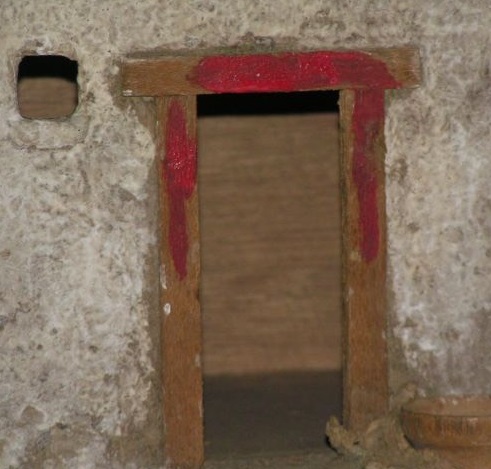
Painting blood on the doorposts, Paris Bible c. 1390

This God-character also gets angry, and “his” anger sometimes releases a divine force which slaughters people indiscriminately.  Before the tenth plague strikes Egypt, Moses warns the Israelite slaves about the coming “death of the firstborn”, and tells them to daub lamb’s blood on their lintels and doorposts.

And God will pass through to strike Egypt, and “he” will see the blood on the lintel and on the two doorposts, and God will skip over the entrance, and “he” will not allow the Destroyer to come into your houses to strike.  (Exodus 12:23)

Here “the Destroyer” refers to God’s raging alter ego, which does not distinguish between the guilty and the innocent and cannot stop itself without a dramatic visible sign.15  The blood on Moses’ genitals proves as effective as the blood on the Israelite doorways in halting this primitive aspect of God, which does not distinguish between individuals.

Power of Dedication

Moses is not merely reluctant to become God’s prophet; he is afraid of speaking for God and getting it all wrong.  The anthropomorphic God-character becomes angry with Moses for trying to excuse himself from the job instead of trusting God’s assurances.  A silent, more primitive aspect of God seeks to kill Moses on the way to Egypt.

Tzipporah responds by physically circumcising their son.  Then she symbolically re-circumcises her husband, rededicating him to the covenant with God.  This act also serves to metaphorically circumcise Moses’ lips, removing the weight of his determined silence, making his mouth sensitive for God’s use.

At first Moses does not realize the full extent of what his wife has done.  He sends Tzipporah back to her father, along with their sons—perhaps for their own safety, now that he knows how deadly God can be.  (See my post Yitro: Rejected Wife.)  When he first arrives in Egypt, he uses Aaron to speak to the pharaoh for him, believing his lips are still aral.  Only when the ten miraculous plagues begin does Moses find his own voice.

*

What does it mean to be dedicated to God?  A Jewish ritual dedicating eight-day-old boys only shows how their parents identify them.  Adults might follow all the extant rules of a religion out of habit and to fit in with their community, but lack the personal and vitally serious dedication that Moses accepts after the “Bridegroom of Blood” episode.

Can that kind of dedication to God come only out of necessity, as a life-and-death choice?  What about those of us who are not threatened?  Can we at least choose to dedicate ourselves to seeking out God?

  1. Exodus 3:11-15.
  2. Exodus 5:1-9.
  3. Exodus 6:9. The Hebrew word ruach (רוּחַ) can mean wind, breath, or spirit.
  4. The first three times are in Exodus 3:11-12, Exodus 3:14-15, and Exodus 4:2-9.
  5. Exodus Rabbah 1:26 tells a story in which Moses burns his lips as a child. Rashi (11th-century rabbi Shlomoh ben Yitzchaki) wrote that Moses stammered and mumbled.
  6. Rashbam (12th-century rabbi Samuel ben Meir).
  7. g. 19th-century rabbi Samson Raphael Hirsch’s commentary on Exodus 4:10; and Avivah Gottlieb Zornberg, Bewilderments, Schocken Books, New York, 2015, p. 176.
  8. Genesis 17:9-15.
  9. Isaiah feels unworthy until an angel purifies his lips (Isaiah 6:1-8); Jeremiah protests a single time that he is too young to know how to speak (Jeremiah 1:4-9); and Jonah flees because he does not want to obey God and give his enemies a chance to repent (Jonah 1:1-3).
  10. Avivah Gottleib Zornberg, Bewilderments, Schocken Books, New York, 2015, p. 161.
  11. Genesis 17:10-14, Leviticus 12:1-3. By the fourth century C.E., there were also professional circumcisers called mohalim.
  12. Exodus 2:11.
  13. Tzipporah’s father, Yitro, demonstrates animal sacrifice when he comes to visit Moses and the liberated Israelites camping near Mount Sinai (Exodus 18:10-12).
  14. Moses would have undergone circumcision either as an infant with Hebrew parents, or at puberty as an upper-class Egyptian. Talmud tractate Nedarim 32a and Exodus Rabbah 5:8 imagine Tzipporah watching the angel of death swallow Moses from his head down to his genitals, where Moses’ circumcision stops the process.
  15. Besides Exodus 4:24-25 and 12:29, other examples of God as a mute, irrational force of destruction, unable to distinguish the innocent from the guilty without an obvious sign, appear in Numbers 11:1-3 (fire), Numbers 25:1-9 (plague after Baal Pe-or worship), and 1 Samuel 6:19 (the ark).

Shemot: Uncircumcised, Part 1

Moses at the Burning Bush,
by Rembrandt

Moses’ quiet life as a shepherd for a band of Midianites ends when he sees a bush that keeps burning without being consumed.  When Moses comes closer, God speaks to him and gives him a mission:  to return to Egypt and tell Pharaoh to let the Israelite slaves go.

Moses tries five times to refuse the job.  (See next week’s post, Shemot & Va-eira: Uncircumcised, Part 2.)  But God will not let him get out of it.  Finally Moses gives up, takes the flock home, and gets permission from his father-in-law to go to Egypt.

As soon as he leaves, God speaks again, warning him that despite the miracles to come, Pharaoh will not let set the Israelites free to worship their own god.

“Then you shall say to Pharaoh: Thus said God: My firstborn son is Israel.  And I say to you: Let my son go, and he will serve Me—[or] hey, I will be slaying your firstborn son!”  (Exodus/Shemot 4:22-23)

God has plans for the Pharaoh and Egypt that include the tenth plague, “death of the firstborn”.  God creates this miracle in the Torah portion Bo, and Pharaoh’s firstborn son dies.  But why does God give this information to Moses in Shemot (“Names”, the first Torah portion of the book of Exodus/Shemot)?

The sudden focus on firstborn sons comes right after Moses’ departure for Egypt with his wife Tziporah and their two sons. After God emphasizes the value of sons, a mysterious event takes place at a lodging on the way to Egypt. Everyone survives, but Moses changes his plan and does not take his family all the way to Egypt.

Moses, Tziporah, and sons,
Rylands Haggadah

On the way, at a lodging-place, God met him and sought to put him to death.  And Tziporah took a flint, and she cut the foreskin of her son, and she touched it to his raglayim, and she said: “Because you are a bridegroom of bloodshed for me!”  And it/he desisted from him.  That was when she said: “A bridegroom of bloodshed by the circumcision”.  (Exodus/Shemot 4:24-26)

raglayim (רַגְלַיִם) = pair of feet, pair of legs; a euphemism for genitals.

God is uncharacteristically silent in this brief, spooky tale.  And the language is so ambiguous, the only clear information is that one of Moses and Tziporah’s two sons still has a foreskin, and she circumcises him.

Can we figure out any more about what commentators call the “Bridegroom of Blood” episode?

Which son is uncircumcised? 

The birth of Moses and Tziporah’s first son was reported earlier in this week’s Torah portion:

She gave birth to a son, and he called his name Geirshom, for he said: “A geir I have been in a foreign land.”  (Exodus 2:22)

Geirshom (גֵּרְשֹׁם) = a name used for three men in the Hebrew Bible.1  Moses says he chose the name because it combines two words:

geir (גֵּר) = stranger, resident alien.

sham (שָׁם) = there.

Moses and Tziporah’s second son is not mentioned until after the Israelites have left Egypt and are near Mount Sinai.  Then Moses’ father-in-law arrives, bringing Tziporah—

And her two sons, of whom the name of one was Geirshom, because he said “Geir I have been in a foreign land,” and the name of the other was Eliezer, because “Eli of my father was my ezer and rescued me from the sword of Pharaoh.”  (Exodus 18:3-4)

Eliezer (אֱלִיעֶזֶר) = a name used for at least eight men in the Hebrew Bible.2  The name combines two words:

eli (אֱלִי) = my God.

ezer (עֶזֶר) = help, aid.

This is the first time in the book that a second son is mentioned.3  When was Eliezer born and named?  Moses sends Tziporah and their son(s) back to his wife’s father, Yitro (Jethro), after the “Bridegroom of Blood” episode, and before Moses and Aaron meet near Egypt proper.  He does not see his wife again until Yitro brings her to him in Sinai, along with both sons.  A consistent story requires that Moses named Eliezer before he left for Egypt.

When his second son was born, Moses must have been remembering his youth in Egypt, including his Hebrew parents, his adoption, the death sentence Pharaoh imposed on him when he was a young man, and his flight to Midian.4  Pharaoh’s gods would not have helped him, nor would the Midianite gods he had never worshiped.  So, I imagine, Moses credits his parents’ God with helping him escape.  Given Eliezer’s name, it is reasonable to assume that he then circumcises the infant in honor of the God of his parents.

But the name Geirshom has no reference to God.  Moses feels rootless and alienated when he names his first son, perhaps even alienated from his parents’ God. He has not yet seen or heard any evidence of God. Why would he bother with the Hebrew custom of infant circumcision?

(The name Geirshom and the “Bridegroom of Blood” scene inspired a pre-Talmudic story that Moses and his Midianite father-in-law agreed that Moses’ first son would not be circumcised.5)

Whom did God seek to put to death?

Did God seek to kill Moses, or his uncircumcised son?  In the Talmud Bavli, Nedarim 32a, two rabbis gave two different opinions.  Rabbi Shimon b. Gamaliel said the “satan”, the spiritual adversary, came to kill the boy who was uncircumcised.  Rabbi Yehudah b. Bizna said God sent two angels of death to swallow up Moses because he had neglected to circumcise his son.  Moses could hardly represent God in Egypt when he had left his own firstborn son outside the covenant between God and the Israelites.

Commentators are still divided on the question of whom God sought to kill.  One theory is that the “Bridegroom of Blood” scene foreshadows God’s announcement in Exodus 12:7 and 12:12-13 that when the tenth and final miracle arrives, “the destroyer” will strike down the firstborn son of everyone in Egypt—except the Hebrews who have painted lamb’s blood on the doorposts and lintels of their houses.6  The act of painting blood on the doorways resembles the circumcision in the “Bridegroom of Blood” scene—as long as it is Moses’ uncircumcised son Geirshom whom God intends to kill on the way to Egypt.

However, I think God seeks to put Moses to death, because in the verses immediately preceding the “Bridegroom of Blood” scene, God is addressing Moses.  No other male is mentioned between verse 23 and verse 24.

And there is another reason for God to attack Moses.  In next week’s post, Shemot & Va-eira: Uncircumcised, Part 2, I will explore God’s anger at the man God has chosen as a prophet.

The God-character in the Torah is, after all, an anthropomorphic version of second Isaiah’s God:

            Forming light and creating darkness,

            Making peace and creating evil,

            I, God, do all these.  (Isaiah 45:7)

God gives with one “hand” and takes away with the other.  It is up to us human beings to find meaning in the twists of our life stories.

  1. The name Geirshom refers to the firstborn son of Moses and Tziporah in Exodus 2:22 and 18:3, Judges 18:30, and 1 Chronicles 23:15-16 and 26:24. It is used for a son of Pinchas/Phineas in Ezra 8:2, and for a son of Levi in 1 Chronicles chapter 6.
  2. The first Eliezer in the bible is Abraham’s steward in Genesis 15:2. Moses’ son Eliezer is mentioned in Exodus 18:4 and 1 Chronicles chapter 23.  At least six other men named Eliezer appear in Ezra 8:16, 10:18, 10:31, and 10:23; 1 Chronicles 7:8, 15:24, 26:25, and 27:16; and 2 Chronicles 20:37.
  3. Modern biblical scholarship explains that a redactor combined two or more accounts of the exodus: one (sometimes called J) in which Moses and Tzipporah have only one son, and another (sometimes called E) in which they have two sons.
  4. Exodus 2:11-15.
  5. Jethro said to him: ‘The son that is born to you first will be given over to idolatry [and hence will not be circumcised]; those born thereafter can be given to the worship of [your] God.’ He accepted the condition … For that reason did the angel seek to kill Moses at the inn, whereupon “Zipporah took a flint and cut the foreskin of her son.”  (James L. Kugel, How to Read the Bible, Free Press, New York, 2007, p. 219, translation from Mekhilta de R. Ishmael, Yitro.)

At this point, Moses’ father-in-law Yitro is still a Midianite priest, and might well want his grandson to worship the gods of Midian.  (It is an unrealistic detail, however, for Yitro to call his own religion “idolatry”!)

  1. For example, see Serge Frolov, “A Murderous Bridegroom”, in www.thetorah.com.

Vayigash & Vayechi: Forgiving?

Salachtikha; I forgive you.

Joseph never says that.  But then, no form of the verb salach, סָלַח (forgave) appears in the book of Genesis/Bereishit.  When the word shows up elsewhere in the Bible, it is always God, not a human being, who forgives.

Joseph in Prison,
by James Tissot, ca. 1900

However, Joseph does know about pardoning, which men in command can do.  In the Torah portion Vayeishev he interprets the dreams of two of his fellow inmates in an Egyptian prison.  He tells one, the pharaoh’s chief cupbearer:

“In another three days the pharaoh yissa your head and he will restore you to your position and you will put the pharaoh’s cup on his palm…”  (Genesis/Bereishit 40:13)

yissa (יִשָׂא) = he will lift. To lift up someone’s head is an idiom meaning “to pardon”.  (A form of the root verb nasa, נָשָׂא = lifted, raised high, carried.)

Joseph then interprets the chief baker’s dream:

“In another three days the pharaoh yissa your head off you, and he will impale you on a pole and the birds will eat your flesh off you.”  And it was the third day, the birthday of the pharaoh, and he made a banquet for all of his servants.  Vayissa the head of the chief cupbearer and the head of the chief baker from among his servants.  And he restored the chief cupbearer to bearing cups, and he put the pharaoh’s cup on his palm.  But the chief baker he impaled…  (Genesis 40:19-22)

vayissa (וַיִּשָּׁא) = and he lifted.  (From the root verb nasa.)

The pharaoh lifts up the cupbearer’s head, pardoning him; but he lifts off the baker’s head, executing him.

Two years later, Joseph is brought up from prison to interpret two dreams of the pharaoh, and by the end of their conversation the pharaoh has made Joseph the viceroy of Egypt.1

Joseph wants to forget his family back in Canaan, especially his ten older brothers, who hated him so much they were not able to speak to him in peace2, and his father, who was responsible both for creating the discord among his sons and for sending Joseph out alone to find and report back on his brothers.  (See my post Mikeitz: Forgetting a Father.)  The brothers seized him, threw him in a pit, then sold him as a slave to a caravan bound for Egypt.

When he sees his brothers again, Joseph is 37 years old and the viceroy of Egypt.  He now has the power to execute his brothers or to pardon them.

He decides to test them first.  He overhears them express remorse over how they treated their younger brother Joseph.  Then Joseph puts the brothers through a series of tests, and concludes that they have indeed changed.  (See my post Mikeitz & Vayiggash: Testing.)  The tests are mysterious to Joseph’s brothers because they do not recognize him; they assume their younger brother died as a slave, and the viceroy is an Egyptian.

The conditions are ripe for forgiveness; Joseph’s older brothers have expressed remorse, and he can now trust them not to harm him or his younger brother Benjamin.  But does Joseph ever forgive—or at least pardon—his brothers?  Does he forgive his father for putting him in danger?

Vayiggash: Does Joseph forgive his brothers?

Joseph reveals his identity to his brothers after they refuse to leave Egypt without Benjamin, the youngest of Jacob’s sons and the only one with the same mother as Joseph.

And Joseph said to his brothers: “I am Joseph.  Is my father really still alive!”  But his brothers were not able to answer him, because they were aghast before his face.  (Genesis 45:3)

His brothers are too stunned, and perhaps terrified, to answer.  The man who has absolute power over them is the man whom they once sold into slavery.

Meanwhile, Joseph realizes that events had to unfold this way, or his whole extended family would have starved to death during the famine.  His brothers’ crime was necessary to get Joseph to Egypt, where God inspired him to interpret the pharaoh’s dreams and he became the viceroy in charge of the only food supply in the region.

“And now, don’t worry, and don’t be angry with yourselves that you sold me here, because God sent me ahead of you to preserve life.  For this pair of years the famine has been in the land, and for another five years there will be no plowing nor harvest.  So God sent me ahead of you to set up food for you in the land and to keep you alive as a large group of survivors.” (Genesis 45:5-7)

By telling his older brothers not to worry or be angry with themselves over their crime, Joseph is telling them that the concept of guilt does not apply in their case.  They are not responsible for their bad deed; God made them do it.

So now, you did not send me here, but God!  And He has set me up as a father-figure to the pharaoh, and as the master of all his household, and as the ruler of all the land of Egypt.  (Genesis/Berishit 45:8)

Now, Joseph thinks, he can be a hero and save everyone—his brothers, his father, and the whole extended family.

“Hurry and go up to my father and say to him: Thus said your son Joseph:  God placed me as master of all Egypt.  Come down to me, don’t stand still.  And you shall dwell in the land of Goshen, and you shall be near me, you and your children and the children of your children, and your flocks and your herds and everything that is yours.  And I will provide for you there …” (Genesis 45:9-11)

Although Joseph starts off attributing everything to God, he ends up promising that he, Joseph, will be a father-figure to his own family, as well as to the pharaoh.  He is in charge.3  And he wants his actual father, Jacob, to be impressed by his long-lost son’s power.

“And you must tell my father about all my honor in Egypt, and all that you have seen.  And you must hurry and bring my father down here.”  (Genesis 45:13)

Joseph Embraces Benjamin,
by Owen Jones, 1869

Having reduced his brothers to mere dependents, Joseph embraces Benjamin and weeps.  Benjamin hugs him back, also weeping.

Then he kissed all his brothers and he wept upon them, and after that his brothers spoke to him.  (Genesis 45:15)

Maybe now his older brothers can “speak to him in peace” because they no longer hate him.  Or maybe their hatred has been replaced by fear.  Benjamin, who was six years old and at home when the older brothers sold Joseph, can embrace his long-lost brother.  But the ten older men merely speak; they neither cry, nor kiss Joseph, nor embrace him.

By denying that his brothers made a choice to sell him into slavery, Joseph shows that he does not respect them as adult human beings who are responsible for their own actions.  Personally, I would rather admit a crime and apologize for it, than be silenced because my victim insists I had no freedom of choice.

As far as Joseph is concerned, he has absolved his older brothers of guilt and reconciled with him.  But his brothers do not see it that way.  Joseph’s speech allays their fear of retribution for a while, but it does not resolve their guilt.

Vayiggash: Does Joseph forgive his father?

Joseph sends his brothers back to Canaan with gifts, and his whole extended family moves to Egypt to live under Joseph’s protection.

Joseph and Jacob Reunited,
by Owen Jones 1869

Joseph hitched up his chariot and went up to Goshen to meet Israel [a.k.a. Jacob], his father.  And he [Joseph] appeared to him, and he fell upon his neck, and he wept upon his neck a while.  Then Israel said to Joseph: “I can die now, after seeing your face, [knowing] that you are still alive.”  (Genesis 46:29-30)

Like many parents, Jacob does not know that he failed his son, so he does not apologize.  Joseph could bring up what his father did 22 years before, and hope for an apology.  (See my post Miketiz: Forgetting a Father.)  Instead he treats Jacob the same way he treated the innocent Benjamin.  There is no apology and no forgiveness; both father and son act as if their relationship is just fine.

This may be pragmatism on Joseph’s part.  After all, Joseph has all the authority now, and he knows Jacob is not an insightful person.  Why stir up old trouble?

Or Joseph may be thinking that if his father had not played favorites, then sent him alone into danger, he would never have been sold to the caravan headed for Egypt.  Therefore God must have arranged Jacob’s behavior, too.

Vayechi: Does Joseph forgive his brothers after Jacob’s death?

Jacob dies in this week’s Torah portion, Vayechi (“and he lived”).  Then his ten older sons become afraid that Joseph only restrained himself from executing them so as not to upset Jacob.  In desperation, they invent a deathbed command.

And the brothers of Joseph saw that their father was dead, and they said: “What if Joseph bears a grudge against us and he indeed pays us back for all the evil that we rendered to him?”  And they sent an order to Joseph saying: “Your father gave an order before he died, saying: Thus you shall say to Joseph: Please sa, please, the offense of your brothers and their guilt because of the evil they rendered to you. And now sa, please, the offense of the servants of the god of your father.”  And Joseph wept over the words to him.  (Genesis 50:15-17)

sa (שָׂא) = lift!  (A form of the verb nasa.)

This communication proves that Joseph’s brothers did not feel pardoned or forgiven when he first told them that God arranged everything, including their crime.

And they do not feel safe with Joseph.  Why should they?  According to Joseph’s philosophy, anyone might become a puppet in God’s hands, deprived of free will.  In such a universe, no one can be trusted.

On the other hand, if Joseph is wrong and humans do have a measure of free will, they still cannot trust Joseph.

by James Tissot, ca. 1900

Then his brothers even went and threw themselves down before him, and they said: “Here we are, your slaves.”  And Joseph said to them: “Don’t be afraid!  Am I instead of God?4 And you, you planned evil for me, but God planned it for good, in order to bring about this time of keeping many people alive.”  (Genesis 50:18-20)

Joseph implies that only God can decide whether to punish the brothers.  He also continues to make God responsible for his brothers’ crime.  And although their false deathbed order explicitly begs Joseph to pardon—sa!—his brothers, he does not do so.  Instead he says:

“And now, don’t be afraid; I, myself, will provide for you and your little ones.”  And he comforted them and he spoke upon their hearts.  (Genesis 50:21)

In the Torah, to speak upon someone’s heart is an idiom for changing that person’s feelings.  (See my post Vayishlach: Change of Heart, Part 1.)  Joseph both comforts his brothers and persuades them that he will continue to be responsible for their well-being.  Even without a pardon, they finally trust Joseph.

Forgiveness or pardon is not the only road to reconciliation.


It’s a tall order, but I try to do better than Joseph.  When people offer me apologies, explicitly or implicitly, I remember Joseph, and I am careful to accept them.  Instead of saying merely, “It’s okay,” I say: “It’s okay, I forgive you.”  I do not want anyone to suffer lingering guilt or uncertainty on my account.

On the other hand, if people wrong me or those I love, and they never admit it nor apologize, I struggle to forgive them.  Sometimes I can reach a working relationship with them, but I never feel safe.  Any reconciliation is incomplete.

May we all be blessed with a greater ability to be responsible for our own actions, to apologize, to forgive, and to change.


  1. Genesis 41:1-41.
  2. Genesis 37:4.
  3. Although Joseph is indeed second only to the pharaoh in power, he is not the absolute ruler he claims to be when he is bragging to his brothers. Later he has to ask the pharaoh for authorization for his family to settle in Goshen (Genesis 46:31-34) and for permission to leave Egypt to bury his father (Genesis 50:4-6).
  4. Jacob protested “Am I instead of God?” when Rachel, his second wife, has not become pregnant and she demands that Jacob give her children (Genesis 30:2, Vayeitzei).

Mikeitz: Forgetting a Father

To name your infant, in the book of Genesis/Bereishit, is usually to tell a piece of your own life story.  Eve begins this convention when she names her firstborn son Kayin (Cain in English) and declares:

Kaniti a man with [the help of] God!  (Genesis/Bereishit 4:1)

Kaniti (קָנִיתִי) = I have acquired, produced, created.  (A form of the verb kanah, קָנָה.  The name Kayin, קַיִן, is probably derived not from kanah but from the same root as kiynah, קִינָה = dirge.  Eve’s explanation of the name is a folk etymology.)

Jacob’s wives Leah and Rachel name all twelve of their natural and adopted sons to express their sentiments about their own lives in the Torah portion Vayeitzei.  Rachel’s son Joseph does the same when he has a son of his own.

And Joseph called the name of the firstborn Menasheh “because God nashani all my hardship and all the household of my father”.  (Genesis 41:51)

Menasheh (מְנַשֶּׁה) = Manasseh in English; m-, ־מְ = from + nashah, נָשָׁה = forget, overlook, neglect.

nashani (נַשַּׁנִי) = he made me forget, overlook, neglect.  (A form of the verb nashah.)1

Joseph implies that his current good fortune is such a blessing from God that he can now overlook two periods of suffering in his past: his hardship (presumably his slavery and imprisonment in Egypt) and his father’s household.

Joseph Reveals his Dream to his Brothers, by James Tissot

How did Joseph suffer in Jacob’s household?  Last week’s Torah portion, Vayeishev, informs us that after his beloved Rachel dies, Jacob continues to play favorites, loving Rachel’s son Joseph more than his ten older sons.  Joseph’s half-brothers hate him for three reasons: because they are jealous of their father’s love, because Joseph brings Jacob bad reports about them, and because Joseph tells them two of his dreams in which his brothers appear to be bowing to him.2

After the brothers head north to pasture the flocks at Shechem, Jacob sends Joseph to find them and then report back.  Joseph’s brothers spot him coming, seize him, strip him, and throw him into an empty cistern.  After debating whether to kill him, they sell him as a slave to a caravan headed for Egypt.3

Joseph is 30 years old in this week’s Torah portion, Mikeitz (“In the end”), when he is summoned to interpret the pharaoh’s two dreams.  The pharaoh, impressed by the slave’s gift of prophecy and by his intelligent advice, makes him the viceroy of Egypt, and gives him a high-born Egyptian wife.4  Joseph names his first son Menasheh.

It is easy to see why Joseph wants to bury his memories of the brothers who sold him as a slave.  But when he names his first son, he says “God nashani all my hardship and all the household of my father”—not just his older brothers.  When Joseph was sold at age seventeen, Jacob’s household also included the mothers of the ten older brothers, Leah, Zilpah, and Bilhah; Joseph’s little brother Benjamin; various employees and slaves; and the patriarch Jacob himself.  Most of these people were merely the background of Joseph’s misery after his own mother died.  But I believe one of them was an additional source of hardship: Jacob.

A telling clue is that Joseph never sends a message back to Canaan to let his father know that he is alive and well.  Maybe he is unable to send a message to another country when he is a slave, even though he quickly rises to the post of steward.  But during the first nine years after Joseph becomes the viceroy of Egypt, he still does not send Jacob any word.  Nor does he ask any of the pharaoh’s agents in Canaan to check up on the old man.

Apologists who saw Joseph as an exemplar of righteousness have theorized that Joseph avoided any communication with Canaan because:

  1.  He did not want to shame his family by revealing that his brothers had sold him.5
  2.  Or: If Jacob found out what his ten older sons had done, the family would fall apart.  Then their aged father would be even worse off.6
  3.  Or: Joseph knew his dreams at age seventeen were prophetic, and he did not want to interfere with God’s plan by taking any action regarding his father or his brothers until the dreams were fulfilled—until all of them had come and bowed down to him.7

Modern commentator Avivah Gottlieb Zornberg8 speculated that Joseph is so traumatized when his brothers seize him and throw him into the pit, that thirteen years later he suffers from post-traumatic stress disorder.  He functions successfully in Egypt only by going into denial about his past.  When he sees his brothers again, he cries because he remembers his trauma.

Jacob Blesses Joseph and Gives him the Coat, by Owen Jones

I wonder if the answer is simply that Joseph hates his father.  A child enjoys being spoiled at first, but later becomes uneasy about being treated differently from everyone else.  Jacob’s love might have felt both smothering and unreal.  The princely tunic that Jacob gave him may have fed Joseph’s grandiosity, but it also may have struck him as a ridiculous garment for a shepherd.  When he wore it in last week’s Torah portion, Vayeishev, travelling alone to Shechem and on to Dotan, the tunic made it easy for his brothers to identify him from a distance and plan their ambush.

Joseph must have asked himself why his father, who should have known better, sent him off on a two- or three-day journey from Hebron to Shechem and beyond without providing an escort or any other protection against bandits and enraged brothers.  Did his father secretly want him to die?  Did Jacob really love him, or did he just love Joseph’s face, because it looked like the face of his beloved dead wife Rachel?  When Joseph was seventeen and his formerly girlish face began sprouting whiskers, did his father stop loving him?

I can imagine Joseph riding toward Egypt in fetters, facing a life of slavery, and thinking bleakly that nobody loves him.  Obviously his ten half-brothers hate him, and now it appears that his father does not care what happens to him.  His full brother Benjamin is only six years old, and his mother is dead.  He might as well give up on his whole family, “all the household of his father”.  He will have to build a new life from scratch, supported by nothing but his own wits—and the one hope remaining to him, that God might someday make those dreams of rulership come true.

Thus when his first son is born, Joseph gives him a name that memorializes both his change of fortune in Egypt, and also his lingering bitterness that he was betrayed not just by his older brothers, but even by his father.  In Egypt he has a new life with honor and authority, and a family of his own.  He will be the father from now on.

Joseph is Governor,
by Owen Jones

When Joseph’s prediction comes true and the first year of  famine arrives after seven years of plenty, only Egypt has large stores of grain—thanks to Joseph’s iron rule.  Then suddenly his past reappears.  He recognizes his ten older brothers as they bow to the ground and ask him for permission to buy Egyptian grain.

Joseph’s first action looks like revenge.  He keeps his own identity secret and accuses his brothers of being spies—perhaps because he remembers that his father sent him to spy on his brothers and report back.  Then he imprisons all ten brothers for three days, just as they had thrown him in the empty cistern while they discussed whether to kill him or sell him.9

But Joseph’s next move is different.  He devises a test to find out whether his brothers have changed over the last thirteen years.

*

Our childhood and adolescent wounds never disappear.  Small slights may fade into insignificance from an adult perspective, but we carry our early psychological wounds for the rest of our lives—and use various strategies to function nevertheless in our roles as adults.  One common strategy is to “forget” our wounds or traumas—avoid thinking about them, and carry on as if they never happened.  Another is to “overlook” them, to pretend that they do not affect us in our adult lives.

Yet these early wounds continue to influence our reactions.  And eventually something happens that forces us to face them—as Joseph suddenly found himself face to face with his brothers.

(What Joseph does about his brothers and his father is the subject of next week’s post on the Torah portion Vayiggash.)

May we all remember our early wounds well enough so that we can recognize them when the time to deal with them arises.  And may we refrain from naming or addressing our children from the viewpoint of our wounds!

  1. The traditional translation of Menasheh and nashani in this sentence assumes that the words come from the root verb nashah, נָשָׁה = forget, overlook, neglect. However, Biblical Hebrew scholars Samson Raphael Hirsch and Robert Alter have pointed out that sometimes the root verb nasha, נָשָׁא is conjugated as if it ended in a ה rather than an אNasha, נָשָׁא = lend, borrow, indebt, become a creditor or debtor (depending on the verb form).  If the words Menasheh and nashani in Genesis 41:51 are actually from the root nasha in that alternate conjugation the sentence could be translated: And Joseph called the name of the firstborn Menasheh/From debt “because I am in debt to God for all my hardship and all the household of my father”.
  2. Genesis 37:1-11(Torah portion Vayeishev).
  3. Genesis 37:12-28 (Torah portion Vayeishev).
  4. Genesis 41:1-46 (Torah portion Mikeitz).
  5. e.g. Philo of Alexandria, De Josepho 41, as cited in Rabbi Elie Munk, The Call of the Torah: Bereishis, trans. by E.S. Mazer, Mesorah Publications, New York, @1994, p. 567.
  6. e.g. Rabbi Samson Raphael Hirsch, The Hirsch Chumash: Sefer Bereshis, trans. by Daniel Haberman, Feldheim Publishers, Jerusalem, @2002, p. 778.
  7. e.g. Ramban (13th-century Rabbi Moses ben Nachman or Nachmanides) as cited in Elie Munk, p. 566; Rabbi Adin Steinsaltz, Biblical Images, trans. by Yehuda Hanegbi and Yehudit Keshet, Jason Aronson Inc., Northvale, NJ, 1994, p. 78.
  8. Avivah Gottlieb Zornberg, The Murmuring Deep, Schocken Books, New York, 2009, p. 303.
  9. Genesis 42:6-17 (Torah portion Mikeitz).

Vayishlach: Change of Heart, Part 2

(My last post considered how the feelings of Shekhem and Dinah change in the Torah portion Vayishlach.  This post considers the decision of Dinah’s brothers in the same story.)

And Jacob came safely from Paddan Aram to the town of Shekhem, which is in the land of Canaan, and he camped in front of the town. (Genesis/Bereishit 33:18)

shekhem (שְׁכֶם)= shoulders; an ancient town; a certain chieftain in that town.

Mt. Gerizim (left) and Mt. Eyval (right)

The city of Shekhem, now part of the modern city of Nablus, sat in a narrow valley between two hills (“shoulders” of land):  Mount Gezerim and Mount Eyval.  Later in the Torah, when the Israelites are about to cross the Jordan, Moses instructs them to perform a ritual on those two hills.  While the Levites recite a list of good deeds that God rewards with blessings, and a list of bad deeds that God punishes with curses, half of the tribes will stand on Mount Gezerim to confirm the blessings, and half on Mount Eyval to confirm the curses.  (Deuteronomy 27:11-14; see my post Ki Tavo: Cursing Yourself.)

Thus Shekhem represents a decision point.  North or south?  Good or evil?  Blessing or curse?

Jacob makes the wrong decision when he arrives.  He has been returning on the same route he took from Beersheba to Charan 20 years before.  Now is supposed to continue south to Beit-El (Bethel), where he promised God that he would build an altar.  Then he should travel farther south to Beersheba, where his aged parents are still waiting for him.  Instead he stops at the crossroads of Shekhem, unwilling to move or choose.  He buys the plot of ground where he is camped.

And Dinah, the daughter of Leah whom she had borne to Jacob, went out to see the women of the land. And Shekhem, son of Chamor the Chivvite, a chieftain of the land, saw her, and he took her, and he lay with her, and he violated her. (Genesis/Bereishit 34:1-2)

Shekhem the young chieftain enters the story as a bad guy who rapes a virgin.  Then he falls in love with his victim, Dinah.  (See my post Vayishlach: Change of Heart, Part 1.)  He speaks “upon the heart of the young woman”, reassuring her, changing her feelings about him, persuading her that he will become a good husband.  He plans to offer her father exorbitant bride-price so he can marry her and restore her honor.  And he asks his own father, Chamor, to come with him to arrange the marriage contract.

Unfortunately, Chamor has another idea.  His clan has land; Jacob has lots of livestock.  What if they all intermarry, and become one people?  Surely the union would benefit both sides.  Chamor makes this a stipulation in the marriage negotiation of Shekhem and Dinah.

Jacob does not respond, but his sons pretend to agree to both Dinah’s marriage and the union of the two peoples, provided that all the men of the town circumcise themselves.  Chamor goes back and tells his men that this is a way everyone can marry into wealth, acquiring Jacob’s livestock.  And the men of Shekhem go for it.

Ruins of stairs and city gate of Shekhem

It was the third day, when they were in pain.  And two of the sons of Jacob, Simon and Levi, [full] brothers of Dinah, each took his sword, and they came upon the town without resistance, and they killed all the males. (Genesis 34:25)

They take Dinah, and then some “sons of Jacob”—maybe the same two, maybe others—plunder all the houses and enslave all the women and girls.

They have made Jacob’s decision for him.  They could have chosen the good side (represented by Mt. Gezerim) and dealt honestly with the citizens of Shekhem.  What if Chamor’s offer turned out to be part of God’s plan to give the land of Canaan to the descendants of Jacob, and God would bless them if they accepted and converted the Shekhemites to their own religion?

On the other hand, even if Jacob’s sons refuse to intermarry or proselytize, they could still accept a generous bride-price for their sister and try to negotiate a peaceful covenant with the town.  This approach would also result in a blessing of prosperity and peace with their new neighbors.

Instead, Jacob’s sons choose the bad side (represented by Mt. Eyval) and commit vengeance.  After they have massacred the men of Shekhem and enslaved the women, their father finally speaks up.

Then Jacob said to Simon and Levi: “You cut me off from the inhabitants of the land, from the Canaanites and Perizzites!  And I am few in number, so they will unite against me and strike at me, and I will be exterminated, I and my household!” (Genesis 34:30)

Jacob Burying the Strange Gods,
by Sebastien Bourdon

At that point God tells Jacob to move to Beit-El.  Jacob collects everyone’s idols and earrings and buries them at Shekhem, perhaps hoping to win God’s favor that way.  Then he abandons the empty town and the land he bought, and flees south.

And they set out, and a horror of God came upon the towns that surrounded them, and they did not pursue the sons of Jacob. (Genesis 35:5)

So God blesses Jacob’s sons even though they choose evil at the decision point of Shekhem.  God also fails to reward Shekhem for turning away from evil and trying to do good.


Like the book of Job, the story of Dinah in last week’s Torah portion illustrates that we cannot expect to get our just rewards out in the world.  Instead, we are rewarded or punished inside.  When we feel anger and hatred but nevertheless choose to do good, our self-control strengthens, and it is easier to choose good in the future.

When we let our bad feelings carry us away, we may momentarily enjoy doing violence, but then it becomes easier to choose evil the next time.  After committing genocide in the Torah portion Vayishlach, Jacob’s older sons sell their brother Joseph as a slave in next week’s portion, Vayeishev—and they feel guilty the rest of their lives.

May each of us, when we reach a decision point, set our immediate feelings aside, consider the moral implications of each option, and do the right thing.

Vayishlach: Change of Heart, Part 1

Jacob’s Family Meets Esau,
by Francesco Hayez, 1844

Jacob, after working for his uncle Lavan for twenty years, returns to Canaan in this week’s Torah portion, Vayishlach (“And he sent”). When he left Canaan he was alone; when he returns he brings back two wives, two concubines, eleven sons, servants, a wealth of livestock, and one daughter—or perhaps only one daughter whom the Torah considers worth mentioning.

Eager to settle down, Jacob buys the land where his household is camping in front of the town of Shekhem.

And Dinah, the daughter of Leah whom she had borne to Jacob, went out to see the women of the land. And Shekhem, son of Chamor the Chivvite, a chieftain of the land, saw her, and he took her, and he lay with her, and he violated her. (Genesis/Bereishit 34:1-2)

dinah (דִינָה) = judge her, pass sentence on her; her judgment, her verdict.

shekhem (שְׁכֶם)= shoulders; an ancient town on the west bank of the Jordan1.

The Seduction of Dinah,
by James Tissot

Dinah’s name hints that she is doing something unacceptable.  In the culture of the ancient Near East, a young unmarried woman did not leave her family’s compound unaccompanied.  Her motive is merely to make friends with the women who have become her neighbors.  But walking alone, in that time and place, was considered asking for trouble.

And trouble comes.  Dinah is raped—by the young chieftain whose name is the same as the town.  It is as if the whole town of Shekhem rapes the whole household of Jacob.  Honor, shame, and responsibility were not restricted to individuals in the ancient Near East; what happened to one family member affected the standing of the entire family.

But Shekhem does not throw his victim out in the morning.

And his soul became attached to Dinah, daughter of Jacob, and he loved the young woman, and he spoke al leiv the young woman.  Then Shekhem spoke to Chamor, his father, saying: “Take for me this girl as a wife” (Genesis 34:3-4)

al leiv (עַל־לֵב) = upon the heart of. (In biblical Hebrew, the heart is the mind, the seat of conscious thoughts and feelings.)

Clearly Shekhem falls in love with Dinah.  He not only wants to keep her and take care of her; he wants to repair her reputation (as much as he can) by marrying her through an official contract between his family and hers.

How does Dinah feel now about the man who raped her?  The Torah does not say.  The only clue we have is that Shekhem speaks al leiv her, upon her heart.

Touching the heart

Biblical Hebrew uses several idioms that include the word leiv or its alternative spelling levav. When something arises in someone’s heart, an idea or a memory is occurring to that person.2  To place something upon one’s heart is to think it over.3  What does it mean to speak upon someone’s heart?

At the end of the book of Genesis, Joseph’s brothers are afraid that Joseph will finally take revenge for when they sold him as a slave.  Joseph reassures them: “And now don’t you fear, I will provide for you and your little ones.”  And he comforted them, and he spoke al leiv them. (Genesis 50:21)

Joseph’s intent is to reassure his brothers so they no longer feel afraid.

In the book of Judges, a man’s concubine runs away to her father’s house.  After four months, Her husband got up and went after her, to speak al leiv her to get her back. (Judges 19:3)

The concubine does head back with the man, so he must have changed her feelings about him.4

David’s Grief over Absalom, Bible card

King David’s troops win a battle and kill his son Absalom, who had seized David’s throne.  When David ignores his soldiers and weeps for his dead son, the troops become demoralized.  David’s general, Yoav, warns him that if he does not act at once, they will all desert overnight.  Yoav concludes: “And now get up! Go out! And speak al leiv your followers!” (2 Samuel 19:8)

Here, King David must persuade his soldiers that he appreciates their victory after all, and he is still their king.5  He must change their feelings from despondency to optimism.

Ruth gives the idiom a different shade of meaning when she is a gleaner in Boaz’s field.  He asks her to stick to his field, where he has ordered his men not to molest her; tells her to help herself from the water jugs; compliments her on taking care of her mother-in-law; and gives her a blessing.  Ruth replies: “I find favor in your eyes, my lord, since you comfort me and since you speak al leiv your maidservant—although I, I am not even one of your maidservants.” (Ruth 2:13)

Ruth does not need to be persuaded to return to Boaz’s field.6  She is telling him that he has reassured her and made her feel better.

The other two occurrences in the Hebrew Bible of the idiom “to speak al leiv” are in prophecies that God (in the role of a husband) will take back the Israelites (in the role of a wife) even though they have strayed with other gods.  God will tenderly reassure Israel that “her” suffering is over.7  Then the Israelites will no longer feel despair.

So if speaking al leiv someone means reassuring someone or changing someone’s feelings, we can conclude that in this week’s Torah portion, Shekhem changes Dinah’s feelings about him, and she wants to marry him.

Not touching the heart

Shekhem offers to pay Jacob any bride-price he asks for.  But his father, Chamor, stipulates that the people of Shekhem and Jacob’s household will all intermarry and become one people.  He promises Jacob’s people that they can share the town’s land, and he promises the town’s people that they can share Jacob’s livestock.  It does not occur to Chamor that Dinah’s family is still upset about her rape and hates Shekhem—both the man and the town.

Chamor does not speak al leiv Jacob or his sons, and their feelings do not change.

Then the sons of Jacob answered Shekhem and his father Chamor, and they spoke deceitfully, since he had defiled their sister Dinah.  And they said to them: “We cannot do this thing, giving our sister to a man who has a foreskin, because that is a disgrace for us.” (Genesis 34:13-14)

Dinah’s Brothers Attack Shekhem
(artist unknown)

Jacob says nothing.  But his sons pretend to agree to intermarriage if all the men of the town will circumcise themselves.  After the men of Shekhem have done so, and are disabled by pain, two of Dinah’s brothers, Simon and Levi, swoop in, kill every male, take their sister out of the chieftain’s house, and leave.  Then the “sons of Jacob” (which sons are not specified) plunder the town of Shekhem and take its women and girls as slaves.

When Dinah’s brothers are finished, the reformed Shekhem is dead, and Dinah is a tainted woman with low market value instead of the happy wife of a chieftain.


The story of Dinah illustrates both that human feelings can change—and that when people refuse to change their feelings, they may hurt the people they care about as well as those they consider enemies.

May everyone who is trapped in old feelings of anger, resentment, or despair be freed.  And if nobody steps forward to speak al leiv, may we hear an inner voice comforting our hearts with a different point of view.


  1. Shekhem was 30 miles (49 km) north of Jerusalem, between two round hills, Mt. Gezerim and Mt. Eyval. It is now part of the modern city of Nablus.
  2. Arising in someone’s heart: e.g. Jeremiah 44:21, Ezekiel 38:10.
  3. Placing upon one’s heart: e.g. Deuteronomy 6:6, Jeremiah 12:11, Isaiah 57:11, Malachi 2:2.
  4. The King James Bible (KJV) translation is “to speak friendly unto her”; the Jewish Publication Society (JPS) translation is “to woo her”.
  5. The JPS translation is “placate your followers”.
  6. The KJV translation is “thou hast spoken friendly”; the JPS translation is “to speak gently to”.
  7. Hosea 2:16, Isaiah 40:1.

Vayeitzei: The Place

Jacob’s Dream,
by Jusepe de Ribera, 1639, detail

Jacob departed from Beersheba and he went toward Charan.  He encountered the makom, and he spent the night there because the sun had set.  He took one of the stones of the makom and he put it at his head, and he lay down at that makom. (Genesis/Bereishit 28:10-11)

makom (מָקוֹם) = place, location, space.

The repetition of the word makom at the beginning of this week’s Torah portion, Vayeitzei (“And he left”) establishes that the place Jacob stumbles upon at sunset will be significant for him. But when he arrives, all he notices is hard, stony ground., detail

Jacob has lived his entire life in Beersheba, but now he is running away from his twin brother, Esau. In last week’s Torah portion, Toledot, Jacob cheated Esau first out of his birthright, then out of the family blessing. Esau threatened to kill him, and the twins’ mother, Rebecca, arranged Jacob’s hasty departure on the pretext that he must find a wife in her old hometown in northern Mesopotamia.

So in this week’s portion Jacob sets off on a journey of about 620 miles (1,000 km) to his uncle’s house in Charan. He hikes north from Beersheba, carrying with a flask of olive oil and some other provisions, but no donkey nor servant nor livestock nor silver.1 For the son of a wealthy man, he is ill-equipped for either a long journey or a marriage negotiation.

At sunset on the second or third day he arrives at the makom, identified later as the site of the former town of Luz and the future town of Beit-El (Bethel).2 Nobody lives in the vicinity to offer a traveler a place to sleep.  So Jacob lies on the ground with a stone for a pillow.

During the day, Jacob’s conscious mind is busy as he acts and schemes.  But on this night, his unconscious mind opens in a dream.

German 14th century

And he dreamed, and hey! A stairway was set to the ground and its top reached to the heavens, and hey! Messengers of God were ascending and descending on it. (Genesis 28:12)

The stairway and its traffic of messenger angels may represent a new idea for Jacob. He knows that his father was almost sacrificed on an altar by his grandfather Abraham; after all, at the end of this week’s Torah portion, Jacob calls God “the terror of Isaac”.3 He knows that a messenger of God called to Abraham and ordered him to desist.

But we never see Jacob praying or conversing with God before this week’s Torah portion. Jacob has depended on his own guile to get what he wants.  Now his dream reveals that communication between heaven and earth happens all the time. It could happen with him.

And hey! God stood over him and said: “I am God, the god of Abraham your forefather and the god of Isaac. The ground that you yourself are lying on, I will give it to you and to your descendants.” (Genesis 28:13)

God continues speaking to Jacob in the dream, giving him the blessing of Abraham, and promising to guard Jacob wherever he goes and return him to the place where he is lying now.

And Jacob woke up from his sleep, and he said: “Actually, there is God in this makom, and I, I did not know!”  And he was awed, and he said: “How awesome is this makom!  This is none other than the home of God, and this is the gate of the heavens!”  (Genesis/Bereishit 28:16-17)

What is Jacob’s amazing realization?

One tradition claims that Jacob dreams in the same place where his father, Isaac, was almost sacrificed—at the top of Mount Moriyah, which that tradition identifies with Jerusalem.4 It actually is the gate between heaven and earth, the makom where humans pray and God speaks. Jacob does not even recognize anything holy about it when he lies down. Yet he is transformed by the dream he has in that particular makom, where God broke through to his father and grandfather.5

Ruins of Jeroboam’s temple at Beit-El

However, this week’s Torah portion clearly states that the makom of Jacob’s dream is the site of Beit-El (Bethel in English), about 12 miles north of Jerusalem. In the Torah, Beit-El becomes a holy place because Jacob erects and anoints a standing-stone there to commemorate his dream, and upon his return he builds an altar.6 (These actions provide a rationale for why Jereboam, the first king of the northern kingdom of Israel, built a temple at Beit-El.7)

Rashi reconciles the two stories about the location of Jacob’s dream by suggesting that God simply collapses the distance between Beit-El and Jerusalem for that one night. Therefore the foot of the ladder is at Beit-El, while the top of the ladder is at the gate of the heavens above the future temple in Jerusalem.2

I prefer the theory that God is in every place, even an unremarkable patch of stony ground; the question is whether we are aware of God. Jacob lies down unaware. When he wakes up from his dream, he is aware of and awed by the presence of God.

He could only become aware of God by losing awareness of himself, according to Tiferet Shlomo: “This “I, I did not know,” means I did not know myself at all. I was not aware of myself at all, but only of the unity of the Holy One, Blessed Be He.”8

Jacob’s father, Isaac, had a direct waking encounter with God while he was bound on the altar, then twice heard God promise him the blessing of Abraham.9 But Jacob spent his waking hours scheming for his own advantage. God could only reach him in a dream.

Jacob’s real achievement is taking his dream seriously. And he takes two more psychological steps. He realizes with amazement that God is still there, in the same place where he is. And he realizes that his own ego, his own “I” (anokhi in Hebrew), has been ignorant, unaware of God and perhaps of his own larger self.10

Until this point, Jacob has been driven by the identity he has held ever since he heard the story of how he emerged from the womb second, grasping Esau’s heel. Jacob has acted from the conviction that he was cheated at birth. He could only get a full inheritance and a full blessing by cheating his brother out of them.

When he lies down at the makom, Jacob owns nothing. He may never receive an inheritance. His father gave him the blessing of Abraham before he left, but was it real?  Since Jacob duped Isaac into giving him the first blessing, how can he believe his father’s second blessing is intentional and authentic?

Now, in his dream, God blesses him and promises to stay with him. Now Jacob has a chance to become someone larger, separate from Esau.


Several times when I was a young atheist I happened to step outside with nothing particular in mind and suddenly, for some unknown reason, I was struck by how everything around me was alive.  Everything was one thing, and I was part of it.

If I had known some Torah then, I might have thought: “Actually, there is God in this place, and I, I did not know!”

May we all find ourselves in that makom, and may we discover our deeper selves.


  1. No animals or servants are mentioned in this week’s Torah portion. And when Jacob head home twenty years later, he says: “With only my staff I crossed this Jordan, and now I have become two camps” (Genesis 32:11).
  2. Genesis 28:19. Beit-El (“Bethel” in English) is about 60 miles (100 km) north of Beersheba, so Jacob could not have reached in on his first day of travel. It is about 12 miles (20 km) north of Jerusalem.
  3. In Genesis 32:42 Jacob refers to God as “the God of Abraham and Pachad Yitzchak (פַּחַד יִצְחָק) = “the terror of Isaac”. In Genesis and 32:53 Jacob swears by Pachad Yitzchak.
  4. See note 3 on Pirkei d’Rabbi Eliezer. This tradition continues in the Midrash Rabbah, and is repeated by Rashi (11th-century Rabbi Shlomoh Yitzchaki).
  5. g. Avivah Gottlieb Zornberg, The Beginning of Desire, Doubleday, New York, 1995, p. 187-188.
  6. Genesis 28:19, Genesis 35:6-7.
  7. 1 Kings 12:28-33.
  8. Tiferet Shlomo, by 19th-century Polish Rabbi Shlomo Hakohen Rainowicz, translated by Rabbi David Kasher, ParshaNut Weekly Post: Parshat Vayeitzei.
  9. Genesis 26:2-5, Genesis 26:24.
  10. Avivah Gottlieb Zornberg, The Murmuring Deep, Schocken Books, New York, 2009, p. 278: “The Zohar reads his waking speech—va-anokhi lo yadati—‘I–I did not know,’ as referring to his own selfhood: ‘I have not known my anokhi—my self.’”