Yom Kippur & 2 Samuel: When David Goes Too Far

Below is the eighth and final post in my series on why David is God’s favorite king. It is also a post for Yom Kippur, which begins this Wednesday evening.


Yom Kippur

Yom Kippur (יוֹם כִּפּוּר) means “Day of Atonement”. Atonement is a good translation because, like  kippur, it means making amends or reparations for something a person or a whole group did wrong. The wrong might be ethical and/or it might be a violation against God. The Torah imagines God as a person who issues lots of rules for behavior, and is offended when we disobey them. One of the ways of imagining God today is as our own inner core, the seat of our conscience, from which we are alienated when we violate what we know inside is right.

The Hebrew word kippur can also be translated as “reconciliation”, since we hope that making reparations will lead to forgiveness and a cleaner, better relationship with the people we have wronged, with God, with ourselves. And historically, the English word “atonement” includes the concept of reconciliation. It was coined in the 16th century out of the words “at” and “one”, to express the idea of reunification.

All humans make mistakes. Some are so inconsequential that as soon as we realize we did something wrong, we can apologize, be forgiven, and be reunited in just a minute or two. Others are more serious.

Jews Praying in the Synagogue on Yom Kippur, by Maurycy Gottlieb, 19th century

In Ancient Israel, a day was set aside once a year for an elaborate ritual using two hairy goats to atone for the outstanding misdeeds of the whole community. (See my post Yom Kippur: We.) The nature of the ritual changed almost two thousand years ago, when temple sacrifices were replaced with communal prayer. But the purpose of Yom Kippur is the same. Jewish tradition now encourages people to spend the month leading up to Yom Kippur reflecting on their misdeeds against other people and making whatever apologies and reparations we can—as well as working on forgiving those who wronged us. We also reflect on our misdeeds against God—or ourselves—in the hope of finding forgiveness for them on Yom Kippur.

What counts as an immediately forgivable mistake, and what mistake is so serious that its effects are still outstanding when we reach this time of year?

There is a different answer for each person. In the first and second books of Samuel, David commits a number of errors that count as peccadilloes in the fond eyes of God. But then he goes too far.

David’s peccadilloes

When David first flees from King Saul’s attempts to kill him, he lies to the high priest, who then colludes with him to break God’s rule that the sacred bread laid out for God inside the sanctuary can only be eaten later by priests. The high priest gives him five flat loaves, which he eats on his flight. (See my post 1 Samuel: David the Devious.) The God character stands by when King Saul has the high priest killed for letting David escape; David goes unpunished.

When David has become the leader of a large band of outlaws, he runs a protection racket; he guards Nabal’s sheep and shepherds without any previous arrangement, then asks for payment in food. Nabal refuses, and David sets off with 400 of his men with the intention of killing Nabal and every male in his house. Killing an Israelite without a previous court order of execution is so serious a crime that it gets the death penalty.1 Fortunately, Nabal’s wife intercepts David and persuades him that murder would be a bad idea. Since David does not actually commit the crime, God kills Nabal the next day. (See my post 1 Samuel: David the Devious.)

When David and his outlaw band have moved to the Phillistine state of Gat to avoid King Saul, David deceives the king of Gat into believing that he is a trustworthy defector and vassal. He claims that he is raiding Israelite villages and bringing the loot back to the king of Gat, but actually he is getting the loot by raiding Canaanite villages. David leaves no survivors—no one to reveal his deception. (See my post 1 Samuel: David and the King of Gat.) The God character does not object, since in the Hebrew Bible it is perfectly acceptable to make unprovoked attacks on non-Israelite villages and exterminate everyone, as long as the villages are within the boundaries of the land God assigned to the future kingdom of Israel.2

When David is the king of Judah, General Abner unites the rest of Israel under a puppet king and the two sides fight. Then Abner proposes a peaceful reunification, and concludes a treaty with David in which David will become the king of all Israel. But Joab, David’s nephew and general, kills Abner. King David denounces the murder, but does nothing to punish Joab, who remains his general for the rest of David’s life. (See my post 2 Samuel: David the King.) This is a serious mistake for a king, whose job is to dispense justice. But God looks the other way.

From the time he is secretly anointed as Israel’s next king as a young adolescent, until he actually becomes the king of Israel at age 30, David often misses the mark. But he also demonstrates good qualities for a king, such as intelligence, courage, cleverness, eloquence, charm, and solidarity with his followers. And at key times he inquires of God3 and follows God’s advice. So God, who chose him in the first place, continues to help him despite his peccadillos.

Then David goes too far.

David’s unforgiveable act

By the time he becomes the king of Israel, David already has seven wives.4 Some years pass while King David builds his new capital in Jerusalem and engages in various conquests. Then, while General Joab and his troops are besieging the capital of the kingdom of Ammon, David goes for an evening stroll on the roof of his palace in Jerusalem.

Bathsheba, by Jean-Leon Gerome, 1889

And from upon the roof he saw a woman bathing. And the woman was very good-looking. And David sent [someone] and he inquired about the woman. And he said: “Isn’t this Bathsheba, daughter of Eliam, wife of Uriyah the Hittite?5 (2 Samuel 11:2-3)

An upright man would sigh and perhaps distract himself with one of his own wives. Adultery is forbidden in the Ten Commandments, and a man who has sex with a married woman gets the death penalty—if he gets caught.6

Then David sent messengers and had her taken. And she came to him and he lay down with her. And she had just purified herself from her [menstrual] impurity. And she returned to her house. And the woman became pregnant, and she sent and had it told to David; she said: “I am pregnant!” (2 Samuel 11:4-5)

Bathsheba has just had a ritual bath to purify herself after the end of her period, and her husband is away at the war in Ammon. David’s first thought is that he can still cover up his crime by getting Uriyah to come home and have sex with his wife before her pregnancy shows.

King David summons Uriyah, has a plausible conversation with him about what is happening at the battlefront, then tells him to go home, wash his feet, and relax.

But Uriyah lay down at the entrance of the king’s house with all his lord’s servants, and he did not go down to his own house. (2 Samuel 11:9)

In the morning David asks him why, and Uriyah replies that when his fellow soldiers are camping on the bare ground in Ammon,

“… then I, should I come into my house to eat and to drink and to lie down with my wife?” (2 Samuel 11:11)

Uriyah’s refined moral scruples are blocking David’s unscrupulousness. The next day David gets Uriyah drunk, but the man still refuses the comforts of home. So David sends him back to Ammon with a letter for General Joab: a secret order to put Uriyah in a position where Ammonite soldiers will be sure to kill him. It works; Uriyah is shot down.

And Uriyah’s wife heard that Uriyah, her man, was dead, and she lamented over her husband. And when the mourning period was past, David sent and had her removed to his house, and she became his wife, and she bore him a son.  (2 Samuel 11:26-27)

Problem solved, from King David’s point of view. But not from God’s point of view.

And the thing that David had done was evil in the eyes of God. And God sent Nathan to David. (2 Samuel 11:27-12:1)

The prophet Nathan tells King David a parable in which a rich man with many flocks seizes and slaughters a poor man’s only lamb, whom the poor man had nurtured like his own child. Outraged, David declares that the rich man deserves death. Then, probably remembering that the legal penalty for theft is restitution,7 he declares that the rich man must compensate the poor man by paying him four times the price of the lamb—

“—because he did this thing, and since he had no pity!” Then Nathan said to David: “You are the man!  (2 Samuel 12:6-7)

The prophet then repeats a long speech by God, including these two key sentences:

“Why have you despised the word of God, to do what is evil in my eyes?” (2 Samuel 12:9)

“Here I am, making evil rise up against you from your own house!” (2 Samuel 12:11)

When the speech is over,

Then David said to Nathan: “I am guilty before God!” And Nathan said to David: “Furthermore God has passed along your guilt. You will not die … the son who was born to you, he will definitely die.” (2 Samuel 12:13-14)

Then God afflicts the baby with sickness, and seven days later he dies. But David and Bathsheba have another son, Solomon, who eventually becomes the next king of Israel.

Atonement

Is it enough for David to realize his crime, admit his guilt, and suffer the punishment of the death of his son? Has he now achieved atonement or reconciliation with God?

No. That would be too easy for such a heinous crime. Evil does indeed rise up against David from his own house. As the Talmud points out,

“The lamb was a metaphor for Bathsheba, and ultimately David was indeed given a fourfold punishment for taking Bathsheba: The first child born to Bathsheba and David died (see 2 Samuel 12:13–23); David’s son Amnon was killed; Tamar, his daughter, was raped by Amnon (see 2 Samuel 13); and his son Avshalom rebelled against him and was ultimately killed (see 2 Samuel 15–18).”8

The character of God does not appear during that whole complicated story. There is no divine interference even when David’s son Avshalom (Absalom) claims Jerusalem, and David is forced into exile. After Joab kills Avshalom in a battle between the two sides, a grieving David laboriously puts his kingdom back in order. After those years of suffering, there is a three-year famine. Then King David finally turns back to God and asks what to do, and God answers.9


The story of King David illustrates that a person who is blessed, like God’s favorite king, can get away with a lot of missteps. But if someone who seems to have a charmed life strays too far from fundamental morality, a chasm opens inside, and it takes many years to find atonement, reconciliation, and reintegration. One Yom Kippur, I believe, is not enough. In this new year of 5786 in the Hebrew calendar, I pray that all those who remember to return to the right path will rejoice to find their feet on it once more. And I pray that those who have gone too far will begin the long journey back.


  1. Exodus 21:12, Deuteronomy 17:6-12.
  2. See my post Eikev & Judges: Love or Kill the Stranger?
  3. See my post 2 Samuel: David the King.
  4. Mikhal, King Saul’s daughter; Achinoam of Jezreel; Abigail, Nabal’s widow; Maacah, daughter of the king of Geshur; and three wives of unknown provenance from his time as the king of Judah, Chagit, Avital, and Eglah. See 1 Samuel 18:20-27, 2 Samuel 3:2-5.
  5. He is called “Uriyah the Hittite” to identify his ethnicity. The troops of Israelite kings in the Hebrew Bible often include men from non-Israelite lineages who nevertheless are treated as citizens of Israel. His name is Hebrew: Uri-yah (אוּרִיָּה) = My Light is God.
  6. Leviticus 20:10.
  7. The Torah prescribes different amounts of financial restitution for different objects stolen. Exodus 21:37 lists the penalty for stealing a sheep as paying the owner four times the value of the sheep.
  8. Talmud Bavli, Yoma 22b, William Davidson (Steinsaltz) translation, in www.sefaria.org. The sources in parentheses are included in the text.
  9. 2 Samuel 21:1.
Re-eih & Isaiah: Rights of the Poor

Beggars, by Rembrandt

Let the poor glean the leftovers from your harvest. If a debtor pawns their only cloak to you, return it at night so they can sleep. That’s the way the books of Exodus and Leviticus address poverty.1

But what if scraps are not enough?

Two laws given in this week’s Torah portion, Rei-eh (Deuteronomy 11:26-16:17), treat the rights of the poor with new seriousness. This serious approach becomes impassioned in second Isaiah—not in this week’s Haftarah of Consolation (the third in the series of seven readings from Isaiah), but in the haftarah for Yom Kippur  six weeks from now.

Re-eih: Debt relief

Yet there will not be among you an evyon, because God will definitely bless you in the land that God, your God, is giving to you to hold as a possession—if only you really listen to the voice of God, your God, and take care to do all these commands that I command today. (Deuteronomy 15:4-5)

evyon (אֶבְיוֹן) = pauper, needy person, impoverished person.

What if people who suffer a run of bad luck become so poor they cannot even make payments on their debts?

A modern solution is to convict and imprison them—not just in Britain during the time of Charles Dickens, but in the United States today. When these debtors they have served their prison term, they are released—with no job, no new skills, and no money or property to make a fresh start. Unless someone helps them privately, they are likely to end up in debtor’s prison again.

The Torah portion Rei-eh has two more permanent solutions to the problem. The first is a time limit on indebtedness.

At the end of every seven years you must do shmitah. And this is the procedure of the shmitah: every owner of a loan in his hand, which he has loaned to his fellow, shamot. He must not press his fellow or his kinsman [for payment], since the shmitah of God has been proclaimed. (Deuteronomy 15:1-2)

shmitah (שְׁמִטָּה) = remission (cancellation) of debts. (From the root verb shamat, שָׁמַט = drop, let fall, release.)

shamot (שָׁמוֹט) = he must drop, let fall, release, remit.

In other words, every seventh year, the shmitah year, all debts are canceled. A business arrangement that includes repayment of a loan is written to take this seven-year pattern into account. But those who incurred debts because of poverty, and have not been able to pay off their debts in seven years, get relief.

In the books of Exodus and Leviticus, the seventh year is merely when farmland must lie fallow and rest for a year. During that year, paupers as well as the owner’s household may eat whatever food the land produces without cultivation; but no debts are remitted.2 Leviticus also provides a form of relief from poverty every fiftieth year, with a rule that families who had to sell their ancestral land get it back without payment.3 Then, with luck, they can make a living by farming their land again.

But these approaches only nibble around the edge of the problem of poverty. Deuteronomy takes a big step forward with its seven-year limit on debt.

Re-eih: Debt slavery

The second solution to chronic poverty in the portion Rei-eh concerns the institution of debt slavery.

Exodus declares that a male debt slave—a man who sold himself because he could not pay his debt any other way—must be freed after six years of service (unless the slave himself then signs up for life). But if a man sells his daughter as a slave, she is not freed unless a judge rules that her owner deprived her of food, clothing, or sex. Debt slaves of both genders are freed if their owner hits them and ruins an eye or knocks out a tooth.4

Leviticus adds that those who make loans to poor citizens may not charge interest. If impoverished borrowers cannot pay off their debts they can be taken as debt slaves, but they must be treated like employees, as well as being given room and board. However, debt slaves and their children must be freed only in the fiftieth year (if they live that long), the yoveil or “jubilee” year when all lands revert to the families of their original owners at the founding of the kingdom of Israel.5

These partial solutions are not enough, according to Deuteronomy. This week’s Torah portion imagines two scenarios in which these rules in Exodus and Leviticus do not help the poor at all.

For one thing, if the shmittah year is coming right up, lenders might refuse to make any further loans, and the poor might starve. So the portion Re-eih says:

If there is an evyon among you … you must not harden your heart and you must not draw shut your hand against your brother the evyon. Instead you must definitely open your hand to him and you must definitely pledge to him enough [to make up for] his lack that he lacks. Watch yourself, lest you have a wicked thought saying “The seventh year, the year of the shmitah, is approaching,” and you are bad to your poor, the evyon among your brothers, and do not give to him! (Deuteronomy 15:7-9)

Another problem is that if a debt slave is freed in the seventh year of service, he will be like American debtors today who finish their prison terms but have no job nor money nor property to make a fresh start. So this week’s Torah portion decrees:

When your brother is sold to you, a Hebrew man or a Hebrew woman, then he will serve you six years, and in the seventh year you must send him out free from beside you. And when you send him out free from beside you, you must not send him out empty-handed. You must definitely outfit him from your flock and from your threshing floor and from your wine-vat, your blessing which God, your God, has given you. (Deuteronomy 15:12-14)

This is an improvement over Exodus, since women must also be freed, and an improvement over Leviticus, since nobody has to be a debt slave for more than seven years. And the provision in this week’s portion of Deuteronomy also provides the freed slaves with products to sell or eat until they find employment.

Second Isaiah: Doing more

At first the desperately poor are mentioned in second Isaiah only in a promise that God will take care of them.

The poor and the evyonim

            Are seeking water, and there is none.

Their tongue is dry with thirst.

I, God will answer them.

            The God of Israeli will not forsake them.

I will open up streams on bare hills … (Isaiah 41:17-18)

evyonim (אֶבְיוֹנִים) = plural of evyon.

This week’s haftarah of Consolation, Isaiah 54:1-55:5, returns to second Isaiah’s continuing focus on motivating the Israelites in Babylon to go back to Jerusalem. But the prophet bursts into a rousing call for rescuing and embracing the poor in the haftarah for fast day of Yom Kippur.

Is the fast I prefer like this:

            A day of mortifying a human’s appetite?

Is it to bow one’s head like a reed,

            And go out in sackcloth and ashes?

Is it this you call a fast,

            A day pleasing to Y-H-V-H?

Isn’t this is the fast I prefer:

            Opening the shackles of wickedness,

            Untying the bonds of the yoke,

And sending out the downtrodden free,

            And breaking off every yoke?

Isn’t it offering your bread to the hungry,

            And bringing the homeless poor into your house?

When you see the naked, then clothe him,

            And do not ignore your own flesh!

That is when your light will break forth like the dawn …

That is when you call and Y-H-V-H will answer. (Isaiah 58:5-9)


The laws in this week’s Torah portion, Re-eih, cancel all debts at the end of seven years, free all debt slaves, and require the lender-owner to send them off with a grubstake. This is an improvement over the laws in Exodus, Leviticus, and the United States.

Then Isaiah 58 urges people to go beyond the law, and do even more to rescue the impoverished: feed them, clothe them, let them sleep in your own house! And stop treating your slaves or employees like dirt instead of human beings!

It is a tall order for private individuals, and we can only do so much. But in a modern democracy, we can also campaign and vote to help the poverty-stricken, instead of pretending that all their woes are their own fault and they deserve to die. We can reform our government and dedicate our joint resources to preventing sudden misfortune from driving people into unpayable debts, to habilitating those who resort to drugs in despair, to making sure every human being has food and health care.

The Torah portion Re-eih says:

However, there should be no evyon among you, since Y-H-V-H will certainly bless you in the land that Y-H-V-H, your God, is giving to you. (Deuteronomy 15:4)

We, too, live in a land of plenty; there should be no evyon among us.


  1. Exodus 22:24, 23:6, 23:11; Leviticus 19:10, 23:22.
  2. Exodus 23:10-11 and Leviticus 25:2-7.
  3. Leviticus 25:8-24.
  4. Exodus 21:2-11, 21:26-27.
  5. Leviticus 25:35-43.

Rosh Hashanah & Yom Kippur: Book of Life

Shofar on Rosh Hashanah,blowing , Amsterdam, 1707

Many Jews spend hours and hours standing together and praying for God to write their names in the “Book of Life” on Rosh Hashanah and Yom Kippur.

The term “book of life” appears only once in the Hebrew Bible, in Psalm 69:

Erase them from the seifer chayim,

                        And do not inscribe them among the righteous!  (Psalm 69:29)

seifer (סֵפֶר) = book, account written on a scroll.

chayim (חַיִּים) = [of] life, lives, living.

The psalmist is begging God to punish the enemies who have reviled and tortured him.1 Moses takes a more noble approach in a story that implies God keeps a “book of life”; after the people worship a golden calf, Moses tells God:

“And now, if [only] you will pardon their sin! But if not, please erase me from your seifer that you have inscribed.” (Exodus 32:32)

The Talmud elaborates on the metaphor of the seifer chayim by saying that on the first day of each new year, Rosh Hashanah, God writes down the names of the righteous in one book and the names of the wicked in another.  People whose deeds are partly good and partly bad are listed in a third book until Yom Kippur, ten days later, when God decides which of these intermediate people to record in the book of the righteous and which in the book of the wicked.2

Gehinnom was named after the Valley of Hinnom, where Jersualem’s trash was burned

What happens to the people whose names are listed in God’s books? The account in the Talmud adds that those in the book of the righteous are rewarded with everlasting life, while those in the book of the wicked suffer in the fires of Gehinnom after death.

But the prayers for God to “inscribe us in the Book of Life” in the Amidah sections of Rosh Hashanah and Yom Kippur liturgy omit any reference to a possibility of life after death. 3 Instead, the Book of Life lists the names of everyone will live in the world for the next year. The individuals God does not write down will die before the year is over.

This idea motivated Jews to pray repeatedly for God to write down their names, just in case they had been omitted from the book.

One addition to the first prayer of the Amidah (the standing prayer) on both Rosh Hashanah and Yom Kippur is known as Unetaneh Tokef. 4 It features a chant with this refrain:

On Rosh Hashanah it is inscribed, and on Yom Tzom Kippur it is sealed.

Rosh Hashanah (רֺאשׁ הַשָּׁנָה) = head of the year.

Yom Tzom Kippur (יוֹם צוֹם כִּפּוּר) = day of the fast of kipur (כִּפּוּר = atonement, reconciliation).

Here is one translation5 of the verses that are punctuated by that refrain:

~How many shall slip away and how many shall be created?

~Who shall live and who shall die?

~~Who at their natural end and who before?

~~Who by water and who by fire?

~~Who by sword and who by wild beast?

~~Who by hunger and who by thirst?

~~Who by earthquake and who by plague?

~~Who by strangling and who by stoning?

~~Who shall rest and who shall roam?

~~Who shall be peaceful and who shall be harried?

~~Who shall be impoverished and who shall be enriched?

~~Who shall sink and who shall rise?

The first two questions are directly about the “Book of Life”. How many people will die, and how many will be born? Who will still be alive in a year, and who will die during the year?

The middle six lines refer to various ways to die. Death awaits us all, but just as we do not know when it will come, we do not know how it will happen.

The last four questions are not even about life versus death; they bring up other unknowns. Even if we live the whole year, we cannot know what our lives will be like. Will something either make us settle down or uproot us? Will it be an easy year, or a year full of difficulties?

The chant concludes:

~But teshuvah and tefilah and tzedakah bypass the ro-a of the decree!

teshuvah (תְשׁוּבָה) = return, repentance. (From the verb shuv, שׁוּב = turn, return, change.)

tefilah (תְפִלָּה) = prayer. (From the verb paleil, פַּלֵּל = ask God for a favorable judgment or a pardon, intercede with God on someone else’s behalf, plead with God for a miracle. In post-biblical times, prayer also came to mean praising God or expressing appreciation for God’s works.

tzedakah (צְדָקָה) = good deeds, right behavior. (From the root verb tzadak (צָדַק) = was justified, was not guilty, was ethical.)

ro-a (רֺעַ) = badness, ugliness, perverseness. (Related to ra, רַע = bad, evil.)

If you repent all your misdeeds and reform, and you appreciate God’s gifts, and you act as ethically as you can, then will God inscribe your name in the Book of Life for another year? No. Good people die every year—some because of very old age, and some by disasters such as those mentioned in the Unetaneh Tokef chant.

However, death does not have to be bad, ugly, or perverse. Even if God decrees the time and the means of our deaths, we get to decide whether this fate is evil or not. Of course we can always imagine what we would do if only we could live longer. But the real question is what we have already done with our life.

Both those facing death and their survivors are comforted when they know that by the end of life there was teshuvah (anyone the person wronged received an apology or compensation or acknowledgement, whatever sort of repentance was still possible); there was tefilah (the person appreciated life, the universe, and everything); and there was tzedakah (the person did what was right).

May we all die well, when the time comes. And as the year 5783 begins,6 may we all be inscribed in the Book of Life for a good year!


  1. Psalm 69 is written in the first person singular, from the viewpoint of someone whose service to God is public (and irritating to those who reject God or God’s laws). Therefore the psalmist is probably a priest or Levite, and therefore male. However, it is possible that the narrator is a female prophet or nazir, and the pronoun in this sentence should be “her”.
  2. Talmud Bavli, Rosh Hashanah 16b.
  3. These prayers were added by the Babylonian Geonim in the 9th century C.E. Ramban (13th century Rabbi Moses ben Nachman, known as Nachmanides) explained that the book of the righteous is the book of life, and the book of the wicked is the book of death. Everyone whose name is written in the book of life merits life until the following Rosh Hashanah, and everyone whose name is written in the book of death will die that year.
  4. Unetaneh Tokef (וּנְתַנֶּה תֺּקֶף) = And now we give (an account of) the power (of God) … (These words introduce the subsequent prayer.)
  5. (Mine.)
  6. Year 5783 in the Hebrew calendar began at sunset on September 25, 2022.

Psalm 130 & Yom Kippur: Waiting for Forgiveness

When we are guilty of harming another person, we can often acknowledge what we did, apologize to the person we wronged, offer to make amends, and promise not to do it again.  Then our human victim may (or may not) forgive us.

But what if we have wronged God, or the divine spirit within us?  Is forgiveness even possible?

Psalm 130

One answer is found in Psalm 130, traditionally read between Rosh Hashanah and Yom Kippur.

Levites singing on the temple steps, by James J.J. Tissot

(A song of ascending steps.)

From the depths I called to you, God:

            “My lord, hear my voice!

May your ears be attentive to the voice of my plea.”

If you kept a watch over avonot, my lord Yah,

            Who could stand?

However, forgiveness is yours

            So that tivarei.

I hoped for God,

            My soul hoped,

                        And I waited for God’s word.

My soul [watches] for my lord

            More than watchmen for the morning,

                        Watching for the morning.  (Psalm 130:1-6)

avonot (עֲוֺנֺת) = wrongdoing, immoral activity, intentional sins.  (Singular avon, עָוֹן.)

tivarei (תִּוָּרֵא) = you will be feared, you will inspire awe.  (From the root yarei, יָרֵא  = was afraid of, was in awe of, was reverent of.)

The speaker (whom I will call “they”, since the first person pronoun is ungendered in Hebrew, as in English) cries out to God from the depths of mental suffering due to guilt.  How can they forgive themselves for deliberately doing something morally wrong?  Their only hope is that God will forgive them.  But at first they cannot quite believe God would grant forgiveness out of compassion.  So the speaker hypothesizes two other motivations:

1) If God held every human being accountable for every avon, nobody would be left standing, left alive.  Perhaps the speaker recalls that God swore not to destroy the world again after the Flood, even though “the inventions of the human mind are evil from youth”.4  Therefore God must sometimes exercise mercy.

2) Forgiveness is one of the ways God inspires awe.  Being forgiven by God seems incredible to the speaker, so amazing they would be dumbstruck and trembling.  And this is just what God wants; throughout the bible God asks to be regarded with fear and awe.  Instead of rewarding awe with forgiveness, maybe God forgives in order to earn the awe.

The last two verses of Psalm 130 switch from a guilty individual to the Israelites as a whole.  Being human, they have all transgressed in one way or another.  But when the speaker steps back from their own need for forgiveness and embraces a larger perspective, they realize that God forgives out of kindness.

Israel will wait for God

            Because with God is steadfast kindness

                        And abundant redemption.

And [God] will ransom Israel

            From all its avonot.    (Psalm 130:7-8)

Despite all the times the Israelites disobeyed God by worshiping idols, ignoring the poor, and committing injustice, God does redeem the Israelites from their captivity in Babylonia in the books of Ezra and Nehemiah.  The speaker in Psalm 130 hopes that this means it is God’s nature to forgive.  They wait and watch for the morning of a new day, a new life, that God will grant them.

Yom Kippur

If we have not already made atonement with human beings whom we wronged or who wronged us during the past year, Jews try to do it before Yom Kippur starts.  We do not always succeed.  I have found myself apologizing to people who don’t take me seriously, and to people who don’t remember the incident that I feel guilty about.  Often the only people who ask me for forgiveness are the ones who have always been kind and respectful, while those who actually hurt me never apologize.  But I do the best I can to make amends, clearing the way to seeking atonement with God on Yom Kippur.

How do we wrong God?

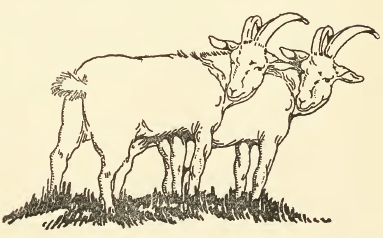
drawing by Dugald Stewart Walker (1883-1937)

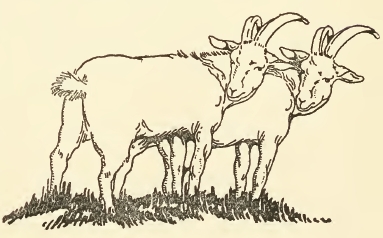
In the book of Leviticus /Vayikra, the high priest atones for the whole community in the Torah portion Acharei Mot (which is chanted at Yom Kippur services) through a ritual involving two goats.  (See my post Acharey Mot: Azazel.)

And Aaron shall both his hands on the head of the live goat and confess upon it all the avonot of the Israelites and all their insubordinations, for all their chatot, and put them on the head of the goat.  And it shall be sent by the hand of a designated man into the wilderness.  (Leviticus/Vayikra 16:21)

chatot (חטֺּאת) = wrongdoing, misdeeds, lapses, unintentional offenses.  (Singular chatat, חַטָּאת or cheit, חֵטְא.  The root of the noun is the verb chata (חָטָא) = missed the mark, offended, was at fault, was guilty.)

In Leviticus, rules for purity and rituals, as well as ethical principles, are labeled as avonot and chatot.  These words for intentional and unintentional offenses are applied to everything from touching an animal that died of natural causes to hating one’s neighbor.1

But in the liturgy for Yom Kippur, we wrong God only when we succumb to evil thoughts and unethical behavior.

Jews Praying in the Synagogue on Yom Kippur, by Maurycy Gottlieb

On Yom Kippur, Jews chant two confessional prayers again and again: the Ashamnu and the Al Cheit, both extant in the 9th century C.E.2   The Ashamnu (אָשַׁמְנוּ = We have become guilty), is a list of 23 immoral actions that begins with betrayal, robbery, and slander, and ends with leading others astray.  After confessing that we, as a group, have been wicked in all these ways, the prayer asks God to “make atonement for us for all our chatot, forgive us for all our avonot, and pardon us for all our insubordinations”.

The Al Cheit (עַל חֵטא = For the wrong) is a list of both immoral actions and bad attitudes (such as arrogance and recklessness) that lead to wrongdoing.  Each line begins with:

Al cheit shechatanu lefanekha (עַל חֵטא שֶׁחָטָאנוּ לְפָנֶיךָ) = For the wrong that we have done wrong in your presence.

“Your presence” means the presence of God.  Some people think of God as the ruler of the universe; for others, God is the “still, small voice” inside.3  Either way, God notices the bad deeds and wicked thoughts we are guilty of, even when no humans do.  And our souls or psyches are affected.

After each group of six or more bad deeds or attitudes in the Al Cheit, we sing this refrain:

Ve-a’ kulam, Eloha selichot, selach lanu, machal lanu, kaper lanu! (וְעַל כֻּלָּם אֱלוֹהַּ סְלִיחוֹת סְלַח לָנוּ מְחַל לָנוּ כַּפֶּר לָנוּ) = And for all of them, God of forgiveness, forgive us, pardon us, reconcile with us!

We confess that we are guilty as a group, and we wait, like Israel in Psalm 130, for God’s forgiveness.

Yet it is impossible not to think of our individual moral failings when we spend all day praying for forgiveness.


How do we wrong God?

If humans are made in God’s image,5  then we wrong God both when we wrong other humans, and when we damage our own souls.  I believe we degrade our souls when we treat other people as objects, when we selfishly or carelessly hurt or neglect or endanger any of our fellow human beings.

If we are lucky, we realize what we did wrong—maybe the same year, maybe many years later.  Then we feel guilty.  We can make any amends that are possible, and we can sincerely change our ways.  Then we only need to wait until we hear the still, small voice of God releasing us from guilt.

May we all find our way to forgiveness.


  1. See Leviticus 4:2-3, 4:13, 5:1-6, 7:18, and 24:15 on transgressing ritual laws, and Leviticus 18:6-25, 19:17, and 19:20-22 on transgressing ethical laws.
  2. In the Siddur Rav Amram, compiled by Amram ben Sheshna, the Gaon of Sura.
  3. 1 Kings 19:12. When God crosses in front of the cave where the prophet Elijah is hiding, there is a windstorm, an earthquake, and a fire, but God is not in any of these things.  After the fire Elijah hears “a thin, murmuring sound” or “a soft murmuring voice”, and knows God is there.
  4. Genesis 8:21.
  5. According to Genesis 1:27 and 5:1.

Rosh Hashanah & Yom Kippur: Our Father, Our King

A king, 15-13th cent. BCE, Hazor

Avinu malkeinu, we have missed the mark before you.

Avinu malkeinu, we have no king other than you.

avinu (אָבִינוּ) = our father.

malkeinu (מַלְכֵּנוּ) = our king.

These are the first two verses of a prayer sung from Rosh Hashanah through Yom Kippur to ask God to forgive our misdeeds of the past year.  (The new year, 5781, began on Friday evening, and Yom Kippur will end the evening of September 28, 2020 in the secular calendar.)

The Avinu Malkeinu prayer can be traced to the Talmud, which records a story about Rabbi Akiva’s prayer during a drought.1  Akiva’s teacher, Rabbi Eliezer, prayed for rain.

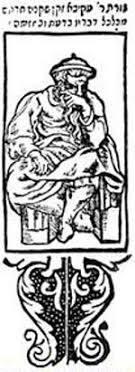
Rabbi Akiva, Mantua Haggadah, 1568

And he recited twenty-four blessings, but he was not answered.  Rabbi Akiva descended before the ark after him and said: “Our Father, our King, we have no king other than You. Our Father, our King, for Your sake, have mercy on us.”  And rain immediately fell. The Sages were whispering among themselves that Rabbi Akiva was answered while his teacher, Rabbi Eliezer, was not.  A Divine Voice emerged and said: “It is not because this Sage, Rabbi Akiva, is greater than that one, Rabbi Eliezer, but that this one is forgiving, and that one is not forgiving.  God responded to Rabbi Akiva’s forgiving nature in kind by sending rain.” 2

Over the centuries more verses were added to Rabbi Akiva’s original two verses, all beginning with the words Avinu malkeinu.3

The first book of Isaiah, dated to the 8th century B.C.E., warns King Ahaz of Judah about dangers from other nations and urges him not to become a vassal of Assyria.  The prophet calls God, not King Ahaz, malkeinu:

For God is our judge

          Who issues decrees;

God is malkeinu;

          [God] rescues us.  (Isaiah 33:22)

A king here is not only a judge and a legislator, but also the one who rescues his subjects from foreign threats.

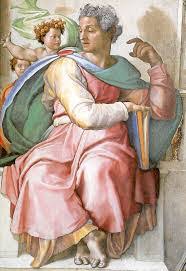
Prophet Isaiah, by Michelangelo, Sistine Chapel

The second book of Isaiah, dated to 540 B.C.E. or later, predicts that God will return the exiles in Babylonia to their homeland of Judah.  The prophet reminds God that the Israelites are like children waiting for their parent to rescue them:

For you are avinu.

          Even if Abraham did not know us

          And Israel did not recognize us

You, God, are avinu.

            Our redeemer from long ago is your name.  (Isaiah 63:16)

A father knows his children, and if they become slaves he redeems them.

If God is like our father and our king, then each of us is like a child or a servant to God.  In fact, the Musaf service on Rosh Hashanah includes a special three-part section with the following words after each set of shofar blasts:

Today the world is born.  [God] makes all creations of all worlds stand in judgment, whether as children or as servants.  If as children, have compassion toward us like the compassion of a father for children!  And if as servants, our eyes hang on you until you pardon us and you release our verdict like a light, fear-inspiring Holy One!

What does it mean to be like a child to God?

Although children may be born with some instincts about fairness and kindness, they have a lot to learn.  When they miss the mark, or even commit serious violations, children should be guided to realize that what they did was wrong and taught to repent, apologize, and make amends.  A good human parent or mentor can do this with unflagging love for the child.

A child without help from an adult either misses out, or learns slowly through trial and error and close observation.  The bible offers some rules about morality and about how to right the wrongs we do, but these hints are easy to overlook in the flood of narrative and ancient case law.

And although God may continue to love us when, like children, we miss the mark out of ignorance or naivety in a new situation, God does not provide the kind of instruction and guidance that humans can.  Only after we have developed a mature sense of right and wrong, and a process for righting the wrongs we do, is it possible to hear the voice of God inside our own consciences.  We need good humans in our lives before we can grow up and become good humans ourselves.

What does it mean to be like a servant to God?

In an absolute monarchy, the ruler’s subjects are like servants.  Some are obedient minions of the monarchs themselves.  Others are public servants who help, advise, and make requests of the monarch as they work for the good of the kingdom.

Do we serve God by obeying as many of God’s original orders to the Israelites as we can, even if God issued them several millennia ago?  Do we take the biblical command to exterminate Canaanites as an order to exterminate Palestinians?  Do we stone women who are not virgins on their wedding day?  Do we obey other ancient rules that seem unethical by modern standards?

Or do we serve God by working for the good of God’s kingdom?  In the book of Genesis God creates the world and then lets human beings rule over it.4  Now human beings are becoming absolute rulers of the world, and we are doing it badly; pollution has led to global climate catastrophe, and intolerance has prevented us from working together for mutual aid.  We need to improve as human beings so we can rescue God’s world.

What does it mean for God to rescue us?

Here is the final verse of the prayer Avinu Malkeinu:

Avinu malkeinu, be gracious to us and answer us.

          Even if we have no [good] deeds

          Treat us with charity and kindness, and rescue us.

We pray for God, our father, our king, to forgive us for our failings the previous year and rescue us from the consequences.  But as adults, we have to rescue ourselves—by doing the appropriate good deeds.

Now that I am no longer a child, I pray to the still small voice of God within for inspiration on how to recognize my misdeeds, how to make amends graciously, and how to change my approach to life so I can gradually learn to do better.

And when I think of God as a parent or a monarch, I imagine God silently praying for us wayward servants to pull ourselves together, turn around, and collectively rescue the world by doing what only human beings can do: teaching our children, restoring our planet, and treating everyone with charity and kindness.


  1. Akiva ben Yoseif, called “Rabbi Akiva” in the Talmud, lived in Judea 30-135 C.E.
  2. Talmud Bavli, Taanit 25b, The William Davidson Talmud, www.sefaria.org.)
  3. The total number of verses used for the Days of Awe (Rosh Hashanah and Yom Kippur) ranges from 27 in the Yemenite tradition to 53 in the tradition of the Jews of Salonika.
  4. Genesis 1:26.

Repost: Ha-azinu

Most years the Torah portion Ha-azinu (“Use your ears”) is read the week before Yom Kippur, but in this new year of 5780 it comes afterward.

I did not prepare for Yom Kippur this time, except to find a synagogue in Prague where my husband and I could go.  I did not review my deeds of the past year or determine where I had missed the mark.  I did not ask anyone for forgiveness (though when a friend reached out to me, I did have an honest conversation and forgive her, and I honor her for that).  I did not reconsider my relationship with God.

I was too busy moving and packing and planning for the big change in our lives, and then I was too busy with the beginning of our journey.

I have continued to say a few prayers every morning, and blessings before every meal, but I have not been to a Shabbat service for the past two months.

In Prague I have been grateful for all the Czechs who speak English, and for the English translations on some plaques, brochures, and menus.  I have also been surrounded by people speaking a language I cannot begin to understand, and writing in a language I can neither pronounce nor decipher.

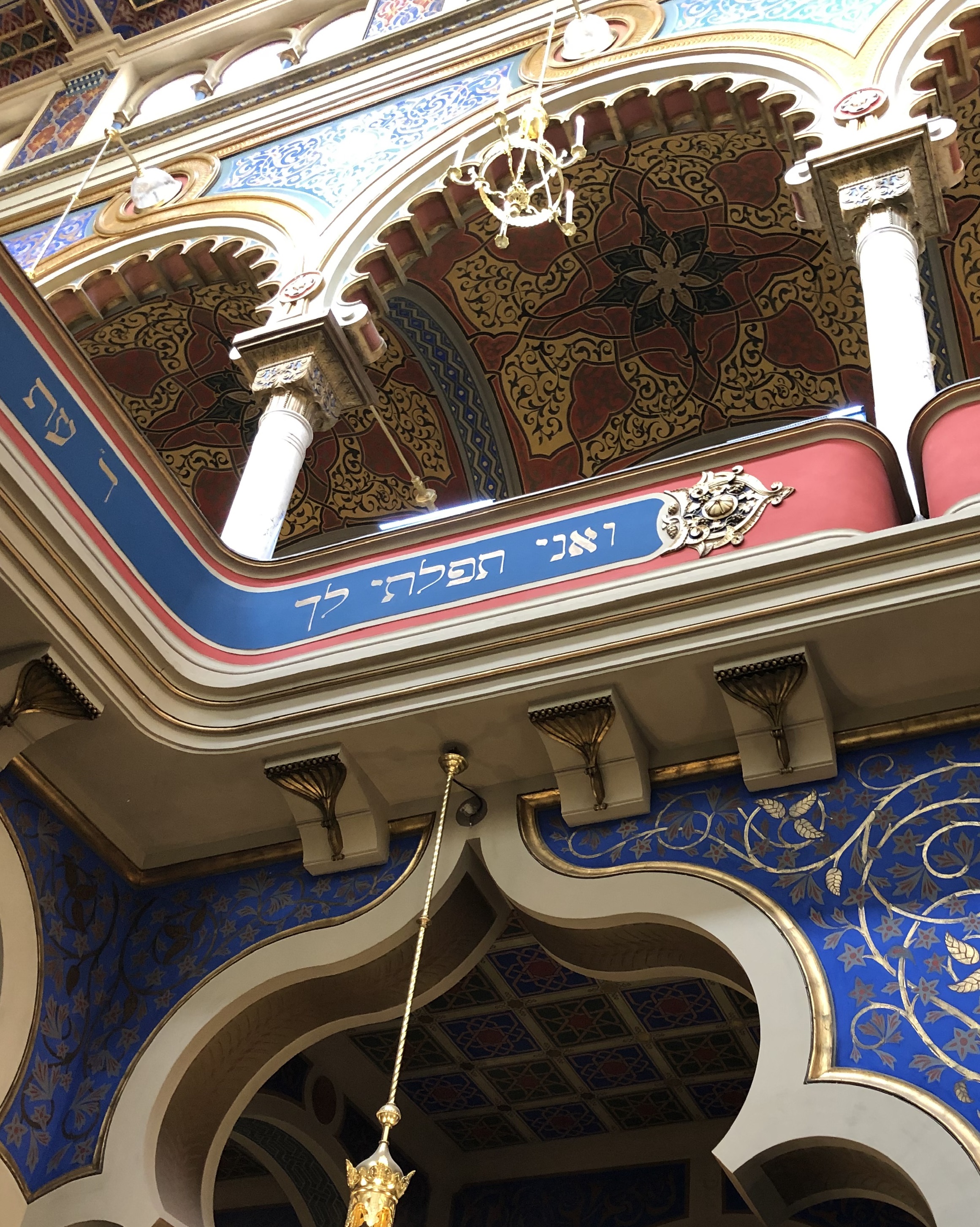
Jerusalem Synagogue

But when we went to the Jerusalem Synagogue, and I saw Hebrew texts from the psalms on the walls.  I could read them!  Softly I began singing a psalm to myself, uplifted not only by the beautiful 1906 Neo-Moorish synagogue building, but by the words in the universal language of the Jewish religion.

On Yom Kippur, we went to a service led by a small congregation in the Maisel Synagogue, built in 1592 in the Renaissance style.  The building is part of the Jewish Museum except on Saturdays and Jewish holidays, when the Bejt Praha congregation uses it for its original purpose.  We will come back another day to tour the whole building and look and the displays, but on Yom Kippur we sat on folding chairs in the middle of the echoing central hall, and sang prayers.

Maisel Synagogue

Although the congregation had hired an American rabbi who spoke English, the prayer books were in Czech and Hebrew.  Whenever the rabbi or the cantor began to sing, we could find the right prayer in Hebrew.  Most of the melodies were also familiar.  We joined in the singing, and their community was also our community for a while.

I have been happy exploring Prague, not worrying about atonement, so I could not plead with God in the spirit of the holy day.  But praying in the old synagogue with other Jews brought me comfort and reminded me of God.

After Yom Kippur ended, I polished up my 2012 post on this week’s Torah portion, which considers meeting God in a desolate place without comfort, a place where we all find ourselves at some point in our lives.  Click on Ha-azinu: The Tohu Within, to read it.

Yom Kippur: We

Since my husband and I began packing in August, my weekly post has consisted of a reflection on the current step in our journey, and a link to one of my past posts on the Torah portion of the week.  But this week is different.

Jeruzalemska Synagoga, Praha

Today we saw the Jerusalem Synagogue in Prague, a breathtakingly beautiful Neo-Moorish and Art Nouveau building completed in 1906 to replace synagogues demolished when the city built a new boulevard through the old Jewish quarter.  During World War II the Nazi occupiers used the building as a warehouse for confiscated Jewish property, instead of destroying it.  After the war a small group of Jews resumed prayer services there, despite Soviet discouragement, and since the Velvet Revolution the congregation has grown.

Tomorrow we will visit Terezin, a fortified village near Prague which Hitler’s government turned into a concentration camp.  The Nazis imprisoned 144,000 Jews there from 1941 to 1945; only around 23,000 survived.  About 33,000 died of malnutrition and disease inside Terezin; 88,000 were sent on to extermination camps.

Four days later we will observe Yom Kippur with a congregation in Prague, and I will repeat the fundamental liturgy in Hebrew, the confessions and pleas that Jews all around the world will recite.

And tonight I find I must write a new post.

*

Ashamnu, bagadnu, gazalnu, dibarnu dofi.

          We are guilty, we have betrayed, we have robbed, we have spoken slander.

On the day of Yom Kippur, the day for seeking atonement with God, Jews chant the vidui, a confession of the whole community’s sins.1

Our religion asks each of us to do a personal atonement during the weeks before Yom Kippur.  We consider who we might have harmed during the past year, repent as much as we can, and ask each person for forgiveness (when it is possible, and when it does no further harm).  We also consider how we have fallen short in our service to God, or perhaps to the still, small voice within.  This work is different for each individual.

But on Yom Kippur we all chant out loud a list of sins that we as individuals may not have committed.  And every offense is in the first person plural, “we”, indicated by the verb ending with the letter וּ (u) = we.

Ha-evinu vehirshanu, zadnu, chamasnu, tafalnu sheker.

          We have been perverse and we have been wicked, we have acted with malice, we have done violence, we have made false claims.

In the story of Noah, God decided to destroy the world and start over because “the earth was full chamas”, the violence that humans committed.2  To this day, humans have not overcome the habit of violence.

Ya-atznu ra, kizavnu, latznu, maradnu, niatznu.

          We have given harmful advice, we have lied, we have mocked, we have rebelled, we have been unrespectful.

Who are “we”?  This part of the communal confession could refer to any congregation, to any relatively small group of human beings.  Nearly everyone has tossed off advice without considering whether it might be harmful to the advisee.  We all tell “white lies” out of what we think is kindness to the other person, or because explaining the truth seems too complicated and unnecessary.  And it is so easy to mock someone who is far away, different from you, and taking actions you resent—a president, perhaps, or someone interviewed on television.  Everyone rebels at some time against an authority figure or what we have learned is our duty.  It takes constant attention to be respectful to every human being and to the Creator.

Sararnu, avinu, pashanu, tzararnu, kishinu oref.

          We have disobeyed (God), we have been immoral, we have been negligent, we have oppressed, we have been stiff-necked (refusing to change).

Who are “we”?  Sure, everyone is negligent at times, there are too many families in which one person has oppressed another, and change is difficult.  But this part of the list implies a more serious level of wrongdoing.  What happens when a whole segment of society oppresses another segment, using religion or politics or even a dress code as an excuse?  What happens when a large number of people reinforce each other in refusing to change to meet new challenges that have arisen in the world?

Rashanu, shichatnu, ti-avnu, ta-inu, titanu.

          We have been wicked, we have been corrupt, we have committed atrocities, we have gone astray, we have led others astray.

Who are “we”?  What if “we” means all human beings, including Nazis and others who do evil deliberately?  Including people who do bad deeds out of peer pressure or the fear of punishment?  Including people who merely witness atrocities, and do not know how to stop them?

Ashamnu.  We are guilty.  That is the nature of humankind.  But we can pray, this Yom Kippur and all year round, for atonement and realignment, for change—for us and for all human beings.


  1. Each time the service reaches another vidui, there are two confessions of communal wrongdoing. The first, called the Ashamnu after the first word, lists offenses in alphabetical order (according to the Hebrew aleph-bet), with each entry being a verb in the form “we have ____”.  One tradition is to beat one’s breast when chanting each offense.  After the Ashamnu list, the congregation switches to a different melody and chants sentences asking forgiveness “for the sin we have committed before you”, using another list of communal sins, with the chorus “And for all these, God of pardons, pardon us, forgive us, grant us atonement.”
  2. Genesis 6:11.

Acharey Mot: Azazeil

The high priest may only enter the Holy of Holies once a year, according to this week’s Torah portion, Acharey Mot (“after the death”).1  On Yom Kippur (“Day of Atonement”), the high priest must burn incense inside the Holy of Holies and flick the blood of a bull and a goat on the ark.

drawing by Dugald Stewart Walker (1883-1937)

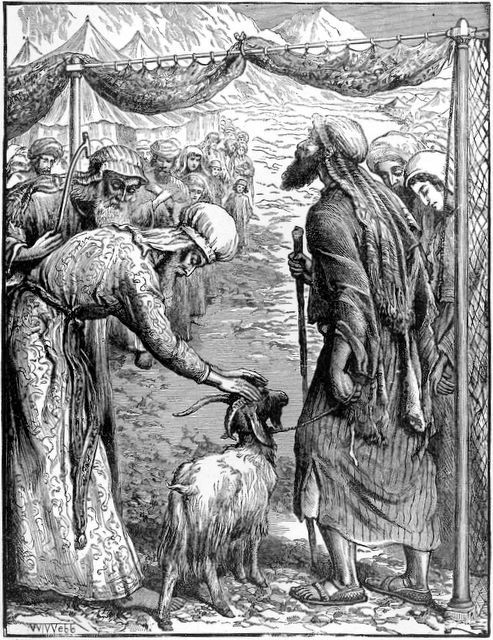
The bull is a sacrifice from the priests’ own herd, slaughtered to atone for anything he or his household did wrong during the past year.  The goat is one of two goats (se-irim) provided by the Israelite people.  The high priest (Aaron, in this Torah portion) gives one goat to God, burning its body and sprinkling its blood, to make atonement for all the people.2  The other goat carries away all the misdeeds the Israelites committed over the past year.

After the high priest bathes and puts on sacred linen garments,

Then he shall take the two se-irim and stand them in front of God at the entrance of the Tent of Meeting.  And Aaron shall place lots on the two se-irim: one lot for God and one lot for Azazeil.  Then Aaron shall bring forward the sa-ir for which the lot for God came up, and he shall make it the reparation-offering.  And the sa-ir for which the lot for Azazeil came up, it shall stand alive in front of God, to make atonement upon it.  And he shall send it to Azazeil in the wilderness.  (Leviticus/Vayikra 16:7-10)

sa-ir (שָׂעִיר) = hairy male goat; long hair; rain shower.  Plural: se-irim (שְׂעִרִם) = goats, goat-demons.

Azazeil (עֲזָאזֵל) = a proper name.

The name Azazeil appears only three times in the Hebrew Bible, all three in the passage above.  Commentators have suggested that it is the name of a place, the name of a fallen angel, the name of a desert demon, or a symbol of chaos.

Azazeil: the cliff

And Aaron shall lay both his hands on the head of the living sa-ir, and he shall confess over it all the crimes of the Israelites and all their transgressions for all their wrongdoing, and he shall place them on the head of the sa-ir, and send it by the hand of a designated man into the wilderness.  Then the sa-ir will carry off all the crimes on itself to a cut-off land; he shall send out the sa-ir into the wilderness.  (Leviticus 16:21-22)

In the time of the second temple in Jerusalem (516 BCE to 70 CE), the goat for Azazeil was led out past seven stations and pushed off a cliff.  It died on the way down, its body broken by rocks.  The Talmud, redacted circa 500 CE but including a few eyewitness accounts from the final years of the second temple, assumed Azazeil was the name of the cliff.3  Rashi, writing in the 11th century CE, explained that “a cut-off land” meant a cliff.4

The Talmud offers two proposals for the etymology of the place-name Azazeil.  According to the sages Azazel means “rough and hard”, because it combines azaz (עַז עַז) = “strong, strong” and eil (אֵל), one of whose meanings is “strength, power”.  (Therefore the Azazeil place is full of rocks.)  But according to the school of Rabbi Yishmael, the cliff is called Azazeil “because it atones for the actions of Uza and Asael.  These are the names of sons of God who sinned with daughters of men (Genesis 6:2) and thereby caused the world to sin during the generation of the Flood.” 5

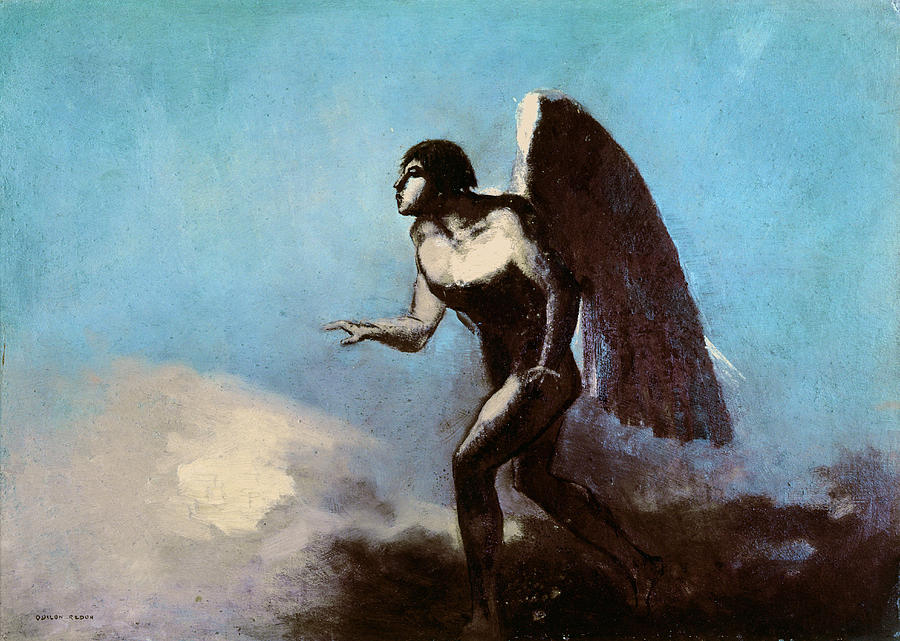
Azazeil: the fallen angel

Fallen Angel, by Odilon Redon, 19th century

None of “the sons of God” are named in Genesis.  The school of Rabbi Yishmael probably got the names Uza and Asael from a much later story identifying the “sons of God” in Genesis 6:2 with fallen angels called Watchers.  The earliest extant version of this story appears in the apocryphal Book of Enoch written in the third century BCE.  Here Shemyaza and Asael are the two chief leaders of 200 angels who descend to earth, land on Mt. Hermon (in the Golan Heights), and fornicate with human women, producing a race of giants.  Then the book focuses on the actions of Asael, now called Azazeil.

And Azazeil taught men to make swords, and daggers, and shields and breastplates.  And he showed them the things after these, and the art of making them: bracelets, and ornaments, and the art of making up the eyes and of beautifying the eyelids, and the most precious and choice stones, and all [kinds of] coloured dyes. And the world was changed.  And there was great impiety and much fornication, and they went astray, and all their ways became corrupt.”  (Book of Enoch, 8:1-2) 6

Thus in the Book of Enoch, the fallen angel Azazeil not only fornicates with human women, but is responsible for the human evils of war and seduction.  God tells the angel Raphael to bind Azazeil’s hands, throw him into darkness, and throw jagged stones on him—reminiscent of the rocks that kill the goat on Yom Kippur during the time of the second temple in Jerusalem.

In another apocryphal book, The Apocalypse of Abraham, Azazeil is a fallen angel who serves as a satanic figure, tempting humans to lie and do evil deeds.  God says:  “Go, Azazeil, into the untrodden parts of the earth!”7  This is reminiscent of sending the goat to Azazeil in the cut-off land of the wilderness in this week’s Torah portion.

Azazeil: the desert demon

However, the whole concept of fallen angels was invented several centuries after the book of Leviticus was written.  There are no fallen angels in the Torah.  The Biblical Hebrew word for “angel” is the same as the word for “messenger”, malakh (מַלְאַךְ).  All angels that visit earth are simply God’s mouthpieces.

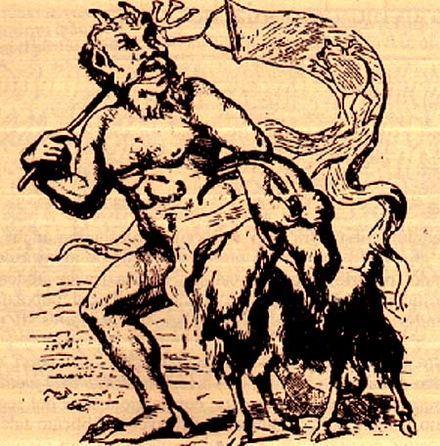
Azazel, by Colin de Plancy, 1882

Therefore some commentators concluded that the name Azazeil in this week’s Torah portion refers not to any kind of angel, but to an ancient desert goat-demon.  Later in this week’s Torah portion, God tells Moses to tell the Israelites:

They must not slaughter any more of their slaughterings for the se-irim they are whoring after.  This will be a decree forever for them throughout their generations.  (Leviticus 17:7)

The people have not been sacrificing goats to other goats; here se-irim must mean gods or demons in the shape of goats.

The last book of the Hebrew Bible provides one other hint of a goat-god or goat-demon cult.  When the second book of Chronicles retells the story of how King Jereboam builds two temples in the northern kingdom of Israel, it states disapprovingly that he furnished them not only with golden calves, but also with se-irim (2 Chronicles 11:15).8

There may well have been a tradition involving goat-demons in ancient Canaan.  In the 12th century CE, Rambam wrote that some Sabeans worshipped demons who took the form of goats,9  and Ibn Ezra wrote that “lunatics who see these demons experience visions of goat-like creatures”.10

Azazeil: the symbol of chaos

What if Azazeil is neither a place nor a supernatural being, but rather a personified concept?  Let’s look again at the etymology of the word.

The Talmud’s explanation that Azazeil (עֲזָאזֵל) comes azaz (עַז עַז) = “strong, strong” and eil (אֵל) = “strength, power” is far-fetched, since it requires moving the letter aleph (א).  In Biblical Hebrew, related words often use different vowel sounds, and weak letters may appear and disappear.  But a strong letter such as an aleph is never moved to a different position.

One can, however, divide Azazeil (עֲזָאזֵל) into az (עז) and azal (אָזַל) = disappear, go away.  The participle form of azal is ozeil (אֺזֵל) = disappearing.  So Azazeil may mean “Disappearing Goat”: eiz (עֵז) = goat, she-goat, goat hair + azal (אָזַל) = disappear, go away.

21st century translator and commentator Robert Alter used this etymology, and also wrote that the lot for God represents civilization and order, while the lot for Azazeil represents wilderness and chaos.  Thus the goat who carries the misdeeds of the Israelites symbolically takes them to the chaos, the tohu and bohu, that was present in Genesis 1:2 before God began creating the universe.11

*

Whether Azazeil is a symbol, a demon, a fallen angel, or a place in the wilderness near Jerusalem, the goat (sa-ir) that gets the lot Azazeil becomes the goat (eiz) that goes away into a land that is cut off from humans and disappears forever.  What could be better than to have all the crimes the community committed over the past year disappear forever?

Alas, our own wrongdoing does not completely disappear.  Even after we make atonement with God through whatever means our religions offer, we still remember our guilt.  And even if we are conscientious about acknowledging our bad deeds against other people and obtain their forgiveness, our former victims sometimes remember as well.  It is hard not to slip back into guilt or resentment.

But if we remember Azazeil as the Disappearing Goat, perhaps we can turn our memories of missing the mark into reminders that humans can change and make new choices.

  1. The opening sentence of this week’s portion is: “God spoke to Moses after the death of two of Aaron’s sons, who came too close in front of God and died.” This opening underlines the danger of entering the Holy of Holies without permission.  See my post Shemimi: Fire Meets Fire.
  2. See my post Acharey Mot & Shemini: So He Will Not Die.
  3. Talmud Bavli, Yoma 67b, William Davidson Talmud, www.sefaria.org.
  4. Rashi is the acronym of 11th-century Rabbi Shlomoh Yitzchaki.
  5. After the mating of the “sons of God” and human women in Genesis 6:2, God sees in Genesis 6:5 “that the wickedness of humankind abounds on the earth”, and resolves to destroy everyone except Noah and his family.
  6. Translated by Miryam T. Brand, Outside the Bible, The Jewish Publication Society, 2013, p. 1370.
  7. Apocalypse of Abraham, translated by Alexander Kulik, Outside the Bible, The Jewish Publication Society, 2013, pp. 1465-1466. This apropcryphal book was originally composed in Aramaic in the first or second century CE.
  8. Jereboam, the first ruler of the northern kingdom of Israel after it secedes, builds two temples with golden calves as idols in 1 Kings 12:28-30.
  9. Rabbi Moses ben Maimon or Maimonides, Guide for the Perplexed, 3:46.
  10. 12th-century Rabbi Abraham Ibn Ezra, translated in www.sefaria.org.
  11. Robert Alter, The Five Books of Moses, W. Norton & Co., New York, 2004, pp. 612-613.

Jonah: Turning Around

Yom Kippur, the “Day of Atonement”, is when Jews spend 25 hours trying to turn around and get back to God.  It is the last of ten days of teshuvah (תְּשׁוּבָה), often translated as “repentance”, though teshuvah literally means “returning, turning around’.  On Yom Kippur we acknowledge our collective as well as individual sins and misdeeds against the inner and/or outer force we call God.  And we pray for forgiveness and a new start on a more righteous life.

Jonah, National Library of the Netherlands

Late in the afternoon of Yom Kippur, Jews read one last passage from the bible.  What could be uplifting and inspiring enough to help us finally turn around and enter the gates of heaven?

The book of Jonah.

Did the ancient rabbis play a joke on us?  What is the story of this reluctant and ridiculous prophet good for, besides comic relief?

The meaning of Nineveh

The word of God happened to Jonah, son of Amittai, saying: “Kum!  Go to the great city of Nineveh and proclaim about it, because the perversity of their wickedness [has come] before me.”  (Jonah 1:1-2)

Kum (קוּם) = Get up!  Stand up!  Rise!  Arise!

750 BCE

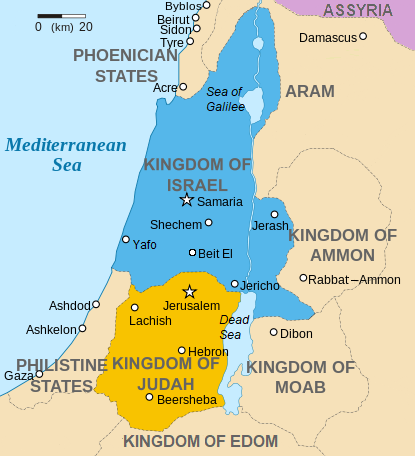
Jonah son of Amittai is not a new prophet; he appears earlier in the bible as a prophet from Gat-Hachefer in the northern kingdom of Israel.1  At that time, Jonah tells King Jereboam II that God wants him to conquer some Aramean territory from Lebo-Hamat to the Dead Sea.  The king does so.

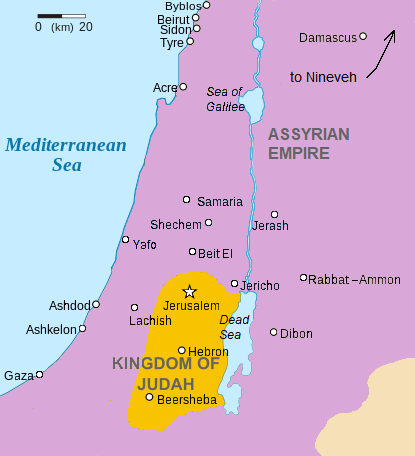
Jereboam II expanded the kingdom of Israel circa 790-750 B.C.E.  About ten years after his death, the king of the Neo-Assyrian Empire, Tiglath-Pileser III, began chipping away at Israel, capturing town after town and deporting its leading citizens.  In 722 B.C.E. the Assyrian king Sargon II conquered its capital, Samaria, and the northern kingdom of Israel ceased to exist.

700 BCE

Some of its residents escaped deportation by fleeing to the southern kingdom of Judah, which the Assyrian armies had reduced to a small vassal state required to send annual tribute to Assyria.

The capital of the Neo-Assyrian Empire was Nineveh.2  When the book of Jonah was written down, probably in 3rd century B.C.E. Judah, any Israelite would think of “Nineveh” as an evil enemy.

Jonah’s descent

Vayakam, Jonah, to run away to Tarshish, away from God.  Vayeired to Yafo and found a ship going to Tarshish, and he paid [his] fare, vayeired into her to go with them to Tarshish, away from God.  (Jonah 1:3)

vayakam (וַיָּקָם) = but he got up, and he rose.  (Another form of the verb kum.)

vayeired (וַיֵּרֶד) = and he went down, and he descended.  (A form of the verb yarad (יָרַד) = went down, descended.)

Jonah gets up, but then instead of heading northeast to Nineveh, he flees toward Tarshish, the westernmost city on the Mediterranean known to the ancient Israelites.

Does he think he can run away from God?  Probably not.  Jonah simply does not want to hear God’s call, either because he is afraid of prophesying in Nineveh or, as he says later, because he does not want God to forgive Nineveh for any reason.  So he gets up—and then flees inside himself, going down into denial: down to the seaport and down into the ship.  When a storm threatens to break up the ship, Jonah goes even farther down.

But Jonah yarad to the hold of the vessel, and he lay down, and he fell into a deep sleep.  (Jonah 1:5)

Unconsciousness is the only way he can escape his feelings of fear and hatred regarding Nineveh, or his guilt over disobeying God.

The captain wakes up Jonah and says:

“How are you sleeping so soundly?  Kum, call to your god!  Maybe the god will take notice of us and we will not perish.”  (Jonah 1:6)

The sailors cast lots to see whose god is responsible for the storm, and the lot falls on Jonah.  Jonah admits he is running away from his god, and asks them to throw him overboard in order to end the storm.  He would rather die than do teshuvah.  But at least he is honest, and makes an effort to save the lives of innocent bystanders.

The men rowed hard lehashiv to dry land, but they could not, because the sea was going violently about them.  (Jonah 1:13)

lehashiv (לְהָשִׁיב) = to return, to bring back or restore something.  (From the same root as teshuvah.)

Only Jonah has turned away from God; only Jonah needs to do teshuvah.  Finally the sailors give up and follow Jonah’s orders.  The prophet begins to sink—but God will not let him descend any farther.

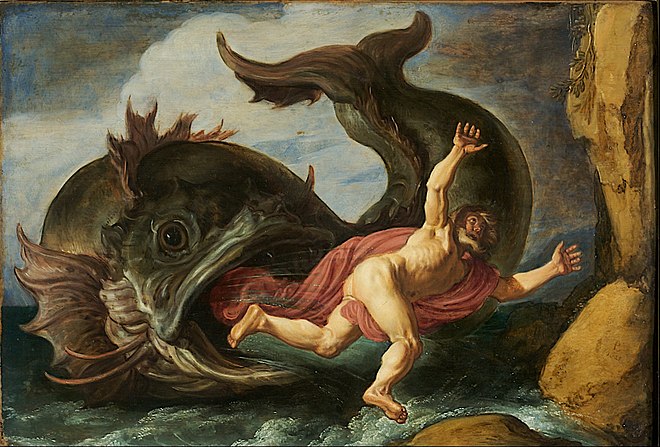
Jonah and the Whale,
by Pieter Lastman, 1621

And God supplied a big fish to swallow Jonah, and Jonah was in the belly of the fish for three days and three nights.  And Jonah prayed to God, his God, from the belly of the fish.  (Jonah 2:1-2)

In the subsequent hymn Jonah even expresses thanks to God for saving his life.3  He appears to have turned around.

And God spoke to the fish, and it vomited Jonah onto the dry land.  And the word of God happened to Jonah a second time, saying: “Kum!  Go to the great city of Nineveh and proclaim to it the appeal that I will be speaking to you!”  Vayakum, Jonah, and he went to Nineveh, as God had spoken.  (Jonah 2:11-3:3)

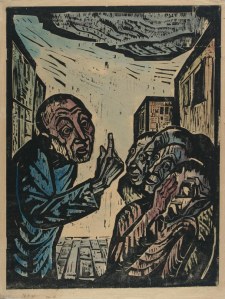
Jonah in Nineveh,
by Jakob Steinhardt, 1923

This time Jonah gets up and walks in the right direction.  But we soon learn that despite his poetic prayer inside the fish, he has not really turned around inside his mind.  He obeys God only minimally: he walks into the city, utters five words in Hebrew (“Another forty days and Nineveh will be overthrown”), and leaves with no explanation.

Hope for Ninevites

Today we do teshuvah by praying and searching our souls.  Many Jews also fast during the day of Yom Kippur.  In the Hebrew Bible people do teshuvah by fasting, wearing scratchy sackcloth, and lying in ashes.

That is exactly what the Ninevites do.  Somehow they realize at once that God wants them to repent.  They all fast and put on sackcloth, even the king, who decrees from his ash-heap:

“They shall cover themselves with sackcloth, human and beast, and they shall call out mightily to God.  And every man yashuvu from his evil ways and from the violence in his palm.  Who knows, God yashuv and have a change of heart, veshav from his wrath, and we will not perish.”  (Jonah 3:8-9)

yashuvu (יָשֻׁבוּ) = they shall turn back, turn around.  (From the same root as teshuvah.)

yashuv (יָשׁוּב) = he shall turn back, turn around.  (Also from the same root as teshuvah.)

veshav (וְשָׁב) = and he shall turn back.  (Also from the same root as teshuvah.)

And God saw their deeds, that shavu from their evil ways, and God had a change of heart over the bad thing he [intended] to do to them, and did not do it.  (Jonah 3:10)

shavu (שָׁבוּ) = they had turned away, repented.  (Also from the same root as teshuvah.)

Someone listening to the book of Jonah at a Yom Kippur service might think: If even the Ninevites could do teshuvah, then so could anyone.  And if God could forgive Nineveh, then I could forgive all those people I believe have harmed my people.

Hope for Jonah

Jonah is enraged at God’s forgiveness.  He wants retribution, not compassion, when it comes to Israel’s worst enemy.  He tells God:

“Isn’t this what I spoke of when I was in my own land?  This is why I fled to Tarshish in the first place, because I know that you are a gracious and compassionate god4 …  So now, God, please take my life from me, because better I die than I live.”  And God said: “Is your anger good?”  (Jonah 4:2-4)

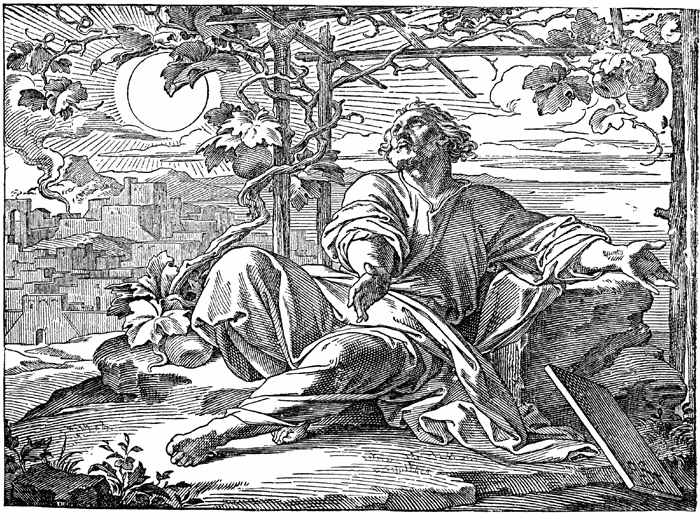
With that question hanging in the air, Jonah builds himself a sukkah5 where he has a view of the city, and sits down to wait 40 days to see what happens.  God supplies a vine to give Jonah shade; the next day God makes it wither and sends a hot east wind.  This triggers Jonah’s anger and death-wish again.

The patience of God with his perverse prophet is remarkable.  God keeps giving Jonah another chance—after he runs away toward Tarshish, after he utters a single half-hearted prophecy, after he is angry with God for forgiving Nineveh, and after he is angry about the death of the vine.

God even tries to teach Jonah to stay aware when he wants to be unconscious (during the storm at sea), to realize his anger is not good, and to be compassionate toward the innocent (especially children and animals):

And God said: “You were concerned about the vine, which you did not exert yourself over …  And I, shall I not be concerned about Nineveh, the great city that has 120,000 humans in it who do not know the difference between their right and their left, and also many beasts?”  (Jonah 4:10-11)

Someone at a Yom Kippur service might think: I keep screwing up, like Jonah, but maybe God will be patient and give me another chance, too.  Maybe God will even teach me how to be less angry, more aware, and more compassionate.

Behind the humor of the story, the book of Jonah can indeed inspire listeners to complete the work of Yom Kippur, to finally do teshuvah and atone with God—whether we think of God as the ruler of the universe and creator of miracles (such as a fish a man can live inside for three days), or as a mysterious force inside ourselves.

Anyway, a little humor near the end of a long fast can only help.

(I published some of the material in this post in September 2010.)


  1. 2 Kings 14:25. From about 930 to 722 B.C.E., Israelites lived in two kingdoms, the more prosperous northern kingdom of Israel (capital: Samaria) and the poorer southern kingdom of Judah (capital: Jerusalem).
  2. King Sargon II moved the capital of the Neo-Assyrian Empire from Kalhu/Nimrud to the district of Nineveh circa 710 B.C.E., when he built a new city called Dur Sharrukin (Sargon’s City) close to the old walled city of Nineveh.
  3. Jonah 2:10.
  4. Jonah actually recites the first five of the 13 attributes of God, given in Exodus 34:6-7 and repeated during Yom Kippur.
  5. Sukkah (סֻכָּה) hut, temporary shelter. It is a Jewish tradition to take meals in a sukkah during the week of Sukkot, which follows Yom Kippur.

Acharey Mot & Shemini: So He Will Not Die

How can anyone enter the Holy of Holies and come out alive?

God spoke to Moses after the death of two of the sons of Aaron, when they drew close in front of God and they died.  And God said to Moses: “Speak to Aaron, your brother, so he shall not come at [just] any time into the holy place inside the curtain, to the front of the atonement-cover that is on the ark—so he will not die, because I appear in an anan over the atonement-cover.  (Leviticus/Vayikra 16:2)

anan (עָנָן) cloud (of water vapor, smoke, or anything that hangs in the air and limits vision.  Anan comes from the same root as onein, עוֹנֵן = made appear, conjured up.)

by James Tissot

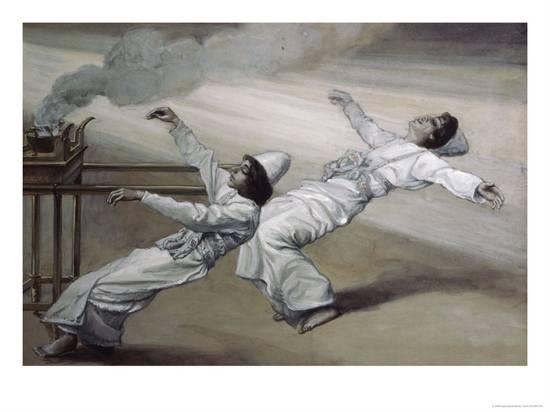
Aaron’s two older sons, Nadav and Avihu, bring unauthorized incense “close in front of God” earlier in the book of Leviticus/Vayikra.  (See my post Shemini: Fire Meets Fire.)  Their souls are consumed by a divine fire.1  Only in this week’s Torah portion, Acharey Mot (“After the death”), does the Torah indicate how “close in front of God” is too close.

A curtain separates the Tent of Meeting, a portable sanctuary for God, into two rooms.  All the priests walk in and out of the larger front chamber, as they tend the incense altar, the bread table, and the menorah.  The smaller back chamber is the Holy of Holies where the ark stands.  The solid gold lid of the ark is called the atonement-cover or kaporet (כַּפֺּרֶת).  According to the Torah, God speaks to Moses from the empty space above the lid.2

Tent of Meeting. (Red lines are curtains.)

Do Nadav and Avihu go too far by bringing their unauthorized incense into the front chamber of the tent?  Or did they go farther and transgress by entering the Holy of Holies?  The commentary is divided, but the beginning of Acharey Mot implies that they walk all the way into the Holy of Holies.3

Then God says that even Aaron, the high priest, will die if he enters the back chamber at the wrong time.  When is the right time?  The ensuing instructions designate one day a year when the high priest will enter the Holy of Holies as part of a long ritual to make atonement with God.4  Identified here as “the tenth day of the seventh month”, this day came to be known as Yom Kippur.

On that day the high priest steps inside the Holy of Holies twice, and both times he sprinkles blood on the atonement-cover of the ark.  The first time the blood comes from a bull he has slaughtered to make atonement for himself and his own household.5

The second time the blood comes from a goat he has slaughtered as an atonement offering for the people.6  (It is one of two goats chosen by lot; the other goat is sent out into the wilderness to Azazel.  See my post Metzora & Acharey Mot: Doubles.)

But before the high priest sprinkles blood the first time, he must make a cloud of incense inside the Holy of Holies.

He shall take a pan-full of glowing charcoal embers from the side of the altar facing God, and two handfuls of finely-ground, fragrant incense, and he shall bring them through the curtain.  And he shall place the incense on the fire, in front of God.  And the anan of the incense shall conceal the atonement-cover that is over the Reminder [inside the ark], so he will not die.  Then he shall take some blood of the bull and sprinkle it with his finger over the surface of the atonement-cover… (Leviticus 16:12-14)

Apparently when Aaron first enters the Holy of Holies, no cloud covers the lid of the ark.  He has to generate a cloud from incense, on the spot.7  According to the Talmud, in the Holy of Holies inside the temple in Jerusalem the smoke from the high priest’s incense “rose straight up like a palm tree”.  Then it spread out over the ceiling and down the walls until it filled the whole room.8

The chamber remains thick with smoke when the high priest returns with the goat’s blood.  The Talmud says the smell of the incense on Yom Kippur spread out so far from the temple in Jerusalem that it made the goats in Jericho sneeze.9  (I imagine the goat led out into the wilderness for Azazel was also sneezing as it went.)

The phrase “so he will not die” is linked with an anan both at the beginning of the Torah portion and in the instructions for filling the Holy of Holies with smoke.

… so that he shall not come at [just] any time into the holy place inside the curtain, to the front of the atonement-cover … so he will not die, because I appear in an anan over the atonement-cover.

Leviticus 16:2

 And he shall place the incense on the fire, in front of God.  And the anan of the incense shall conceal the atonement-cover … so he will not die.

 Leviticus 16:13

In verse 16:2, God appears in an anan over the ark.  In verse 16:13, Aaron must generate an anan to conceal the ark.  In verse 16:2, this sight of God in an anan seems to be fatal.  In verse 16:13, a prolonged view of the ark cover seems to be fatal.

One cloud or two?

Are there two clouds, one conjured up by God and the other made by the high priest?  Classic commentary is divided on the question.10  If there is only one cloud, the anan of incense, then what would Aaron see when he first walks into the Holy of Holies?  This week’s Torah portion implies that he would see the lid of the ark and empty air above it.  Since he would remain alive long enough to fill the room with incense, the sight of the atonement-cover would be fatal only when he sprinkles blood on it.

We can assume God is in residence, to witness the atonement ritual.  The book of Exodus/Shemot tells us that no human being can see God’s “face” and live.11  Even Moses would not see God’s face when God spoke to him from above the lid of the ark.  So God’s presence above the ark must be either invisible, or clouded by God’s own anan.

From Egypt to Mount Sinai, and again from Mount Sinai to the Jordan River, God provides a pillar of cloud (by day) and fire (by night) to guide the Israelites and their fellow-travelers.12  At Mount Sinai, only Moses can enter the cloud of smoke at fire on the mountaintop, where he goes to converse with God before the tent-sanctuary is built.

But when Moses finishes assembling the sanctuary,

…the anan covered the Tent of Meeting, and the glory of God filled the dwelling-place.  Moses was not able to enter the Tent of Meeting because the anan settled on it and the kavod of God filled the dwelling-place.  (Exodus/Shemot 40:34-35)

kavod (כָּווֹד) = splendor, magnificence, weightiness.  (When kavod refers to God, it is usually translated as “glory” or “presence”.)

from
Collectie Nederland

Everyone can see the cloud on top of the tent roof, just as everyone can see the pillar of cloud and fire during the Israelites’ journeys.  But even Moses cannot enter the Tent of Meeting when it is filled with the kavod of God—looked, to human eyes, like either cloud or fire.

The cloud above the tent remains until God gives the signal to strike camp and journey on by lifting the cloud and restoring the guiding pillar of cloud and fire.  The kavod inside the tent shrinks or disappears at some point while the tent is still pitched at Mount Sinai, before Moses takes Aaron inside in the portion Shemini.

And Moses and Aaron came into the Tent of Meeting and they went out and they blessed the people.  Then the kavod of God appeared to all the people.  And fire went out from in front of God …  (Leviticus 9:23-24)

The fire consumes the offerings on the altar.  Then Aaron’s sons Nadav and Avihu go into the tent with their unauthorized incense, and the fire appears again and consumes them.  Yet after that, Aaron’s cousins safely enter the Tent of Meeting and carry out the two bodies.  And from then on, the priests move freely in and out of the front chamber of the tent.  Only the back chamber, the Holy of Holies, remains dangerous—probably because God might appear at any time in an anan of kavod over the ark.

If only the sight of God’s appearance in an anan is fatal, it follows that Aaron can enter the Holy of Holies safely on Yom Kippur because that is the day God will refrain from appearing in an ananat least until the room is so full of incense smoke that the high priest could not see God’s anan.

Therefore when Aaron first steps into the Holy of Holies there is no anan inside.  God is either invisible or not yet in residence.  Aaron makes a cloud of incense in order to hide the atonement-cover of the ark, so he can sprinkle blood on it without dying.  When the incense has filled the room, either God remains an invisible presence (as when God speaks to Moses in that spot), or God appears in a small anan of kavod over the ark, which Aaron cannot see through the smoke.

Inevitable Fog

I can understand why God’s kavod appears as cloud and fire.  We are finite creatures; when we try to understand the infinite, our minds cannot penetrate the mystery, and we find ourselves in a mental fog, glimpsing only transient flickers of enlightenment.  When we try to turn our experiences of God into concrete words or images, we lose their essence.

Perhaps if human beings look straight at the anan of God’s kavod for more than a moment, our minds snap.13  Our bodies remain whole, like those of Nadav and Avihu, but we lose our personal selves or souls, and what remains cannot function in the world.  This is the kind of death Aaron must avoid by entering the Holy of Holies under only two conditions:

  • when God has signaled that it is time to strike camp and move on; then Aaron and his two surviving sons take down the curtain and cover the ark with it.14
  • on Yom Kippur, the one day a year God has designated for the ritual of atonement.

The rest of the time, Aaron must stay out, so he will not accidentally see God appear in an anan.

While the incense altar in the front chamber of the Tent of Meeting is used for other purposes, the high priest creates an anan of incense inside the Holy of Holies only on Yom Kippur, the day of atonement.  This is the day when we ask God for forgiveness for everything we have done wrong over the past year.  When we ask for that level of divine, inner forgiveness, it is not enough to know that God appears in a cloud.  We need to know that we cannot see ourselves clearly, either: neither our motivations nor how our actions look to others.  Like God, our own souls are manifest only in a cloud.

Yet as we grope through the fog of life, we can still try to become better people and try to serve God, whatever “God” might mean to each of us.

Even if we generate so much smoke our goats sneeze.


  1. The fire consumes them in Leviticus 10:1-2. Aaron’s cousins carry the bodies of Nadav and Avihu out of the camp, holding them by their tunics, in Leviticus 10:4-5.  Therefore the divine fire took their lives without incinerating their bodies or even burning their clothes.
  2. Exodus 25:22, Numbers 7:89.
  3. Since the divine fire passes through their tunics without charring them, it could also pass through both the inner curtain and the curtained doorway to the courtyard without damaging either curtain.
  4. Leviticus 16:29-34.
  5. Leviticus 16:6, 16:14.
  6. Leviticus 16:15.
  7. It seems clear to me that Aaron walks into the chamber carrying a pan of embers, two handfuls of ground incense (probably in a bag), and a bowl of bull’s blood (Leviticus 16:11-12). Once inside, he shall place the incense on the fire, in front of God, and the smoke conceals the atonement-cover (Leviticus 16:14).  This was also the opinion of the Pharisees during the time of the second temple in Jerusalem.  The Sadducees insisted the incense had to be smoking before the high priest entered the Holy of Holies.  They also tied a rope around the high priest’s ankle so someone could pull him out if he did die inside the Holy of Holies.
  8. Talmud Bavli, Yoma 53a.
  9. Talmud Bavli, Yoma 39b.
  10. Rashi and Maimonides wrote that Leviticus 16:2 refers to God’s cloud of kavod, so there were two clouds. Nachmanides and the Talmud Yerushalmi tractate Yoma  say that Leviticus 16:2 refers to the high priest’s cloud of incense.
  11. Exodus 33:18-23. Face (panim, פָּנִים) and kavod are used as synonyms in this passage.
  12. Exodus 13:21-22, Leviticus 40:36-37.
  13. The Talmud Bavli, Chagigah 14b, tells the story of four rabbis who entered pardes, paradise. Ben Azai looked at the divine kavod and died, Ben Zoma looked and went mad, and Elisha ben Abuyah (a.k.a. Acher) became an apostate.  Only Akiva, the greatest rabbi of that era, returned whole.
  14. When the Israelites break camp, Aaron and his two surviving sons take down the curtain in front of the Holy of Holies and cover the ark with it. Touching the uncovered ark would be fatal to the Levites who will carry it to the next campsite, but the priests are safe while they cover it. (Numbers 4:5-6, 4:15.)