Lamentations: Starvation

The Burning of Jerusalem by Nebuchadnezzar’s Army, studio of Juan de la Corte, 17th century

Jews observe a day of mourning every year on Tisha Be-Av, the ninth day of the month of Av. Starting at sunset this Saturday evening, we will once again mourn the destruction of Jerusalem in 587 B.C.E and its temple in 586 B.C.E. by the Babylonian army.

After the Romans destroyed the second temple in 70 C.E., Tisha Be-Av became the day to mourn both events. Over the millennia, the mourning on this day has expanded to include other wholesale catastrophes inflicted on Jews, such as the Crusades, the Spanish Inquisition and Expulsion, and the Nazi Holocaust.

Besides fasting and praying on Tisha Be-Av, the Jewish tradition calls for chanting the book of Lamentations: four poems mourning the Babylonian destruction of Jerusalem, and a poem of personal lamentation in the middle.

What I noticed when I reread Lamentation this year is the theme of death by starvation—the result of the 30-month siege before Jerusalem surrendered to the Babylonians in 587 B.C.E.

Chapter 1: Neglected city

The book of Lamentations is called Eykhah in Hebrew because it opens with that word:

Eykhah she sits in isolation?
The city [once] teeming with people?
She has become like a widow. (Lamentations 1:1)
Eykhah (אֵכָה) = How, where, alas; how can it be?1

After describing the desolation of the razed city, the deportation of some of its survivors, and the lack of allies to help the remaining survivors, the poem says:

All her people are moaning,
searching for bread.
They have given away their treasures for food
to restore their lives.
See, God! And notice
how I have become worthless. (Lamentations 1:11)

The last couplet in this verse switches to first person, from the viewpoint of Jerusalem herself. The city is worthless now. The victims of the siege would also feel worthless, not even worthy of being fed.

I called out to my lovers;
they had deceived me.
My priests and my elders perished in the city
as they searched for food for themselves
to restore their lives.
See, God, that I am in narrow straits!
Mei-ay are in turmoil.
My heart is turning over inside me,
for I have surely rebelled.
Outside, the sword bereaves;
in the house, it is like death. (Lamentations 1:19-20)

mei-ay (מֵעַי) = my bowels, my innards; my inner feelings.

“My lovers” refers to the kingdom of Judah’s erstwhile allies, who abandoned it when the Babylonian army began its conquest. “My priests and my elders” are the religious leaders and judges who were formerly sustained by public funding. “Bowels in a turmoil” could be a literal description of a symptom of malnutrition, or a reference to extreme anxiety.

“I have surely rebelled” is one of many lines in Lamentations which reflect the biblical assumption that the victims must have done something wrong, or God would not have let the devastation happen. (See my post: Isaiah & Lamentations: Any Hope?) In this first poem the city has surrendered and the siege is over, but the deaths continue. The last two lines refer to Jerusalemites being slain by enemy soldiers in the streets, while people inside their houses are still dying of the diseases caused by slow starvation.

Chapter 2: Starving children

The second poem in Lamentations points out the fate of children in Jerusalem.

My eyes are consumed with tears,
mei-ay are in turmoil.
Keveidi pours out on the ground,
over the shattering of my people.
Small child and nursing baby are fainting
in the plazas of the city. (Lamentations 2:11)

keveidi (כְּבֵדִי) = my liver (the heaviest organ in the body). From the same root as the adjective kaveid (כָּבֵד) =heavy, weighty, oppressive, impressive; and theverb kaveid (כָּבֵד) = was heavy, was honored.

The speaker’s liver is not literally pouring out on the ground. The person full of tears and inner turmoil either finds the situation either unbearably heavy and oppressive, or has lost any hope of being honorable.

The poem continues:

They say to their mothers:
“Where is grain and wine?”
While they faint like the fatally wounded
in the plazas of the city,
As their life pours out in their mothers’ bosoms. (Lamentations 2:12)

After a digression criticizing the enemies of the almost-conquered kingdom of Judah, the poet cries out to Jerusalem:

Get up! Sing out in the night
at the beginnings of the watches,
Pour out your heart like water
in front of our Lord!
Raise your palms to God
over the life of your small children,
Who faint with hunger
at every street corner! (Lamentations 2:19)

The poet even raises the threat that people might commit what the Hebrew Bible considers the most horrible kind of cannibalism: a mother eating her own child.

See, God, and notice
to whom you are ruthless!
If women eat their own fruit,
children [they once] fondled?
If priest and prophet are killed
in the holy place of God? (Lamentations 2:20)

But in the book of Lamentations, God never responds.

Chapter 4: Slow death

After the third poem in Lamentations, a first-person lament that does not mention Jerusalem, the fourth poem returns to stirring sympathy for the innocent children caught in the siege.

The tongue of the nursing baby sticks
to its palate in thirst.
Small children beg for bread;
there is no one to break it for them. (Lamentations 4:4)

Breaking bread is an idiom; we can assume at this point there are no loaves of bread available to break in the besieged city! The poet then describes how the survivors of the long siege have changed.

Her consecrated ones were cleaner than snow,
whiter than milk.
Their limbs were ruddier than coral,
gleaming like sapphire.
[Now] they appear darker than black;
they are not recognized in the streets.
Their skin is shriveled on their bones;
it has become dry as wood. (Lamentations 4:7-8)

Starvation and malnutrition turn people who were once gleaming with good health into black stick-figures. Their shriveled and discolored faces are no longer recognizable. Metaphorically, they are so sick and depleted that they have lost their individuality.

Better those slain by the sword
than slain by famine,
Since those pierced through gush blood
more than the crop of the field. (Lamentations 4:9)

In other words, it is better to die suddenly when one is in good health, losing blood in a rush, than to die gradually by drying up. The Talmud explained: “This one, who dies of famine, suffers greatly before departing from this world, but that one, who dies by the sword, does not suffer.”2

The metaphor of bleeding crops is obscure. Robert Alter suggested: “Run through by the sword, their bodies ooze blood more abundantly than the crop of the field runs with sap (alternately, more than the crop of the field flourishes).”3

The poet then turns to the horror already broached in the second poem:

The hands of compassionate women
cooked their own children!
They were for eating, for them,
during the shattering of my people. (Lamentations 4:10)

Neither reference to cannibalism in Lamentations accuses the mothers of killing their children. After all, children die of starvation much sooner than adults.4 The Talmud viewed a mother’s cannibalism as the most severe punishment from God for whatever sin the Jerusalemites might have committed.5

Chapter 5: Burning

The fifth and final poem in Lamentations sums up what happened, including the lack of food during and after the siege.

At the risk of our lives we gathered our bread
in the face of the sword of the wilderness.
Our skin was hot like a furnace
in the face of burning hunger. (Lamentations 5:9-10)

Rabbi Steinsaltz suggested two possible meanings: “In order to obtain food, we must put our lives at risk by traveling through the desert, which is frequented by robbers. Alternatively: In order to survive during the war we must bring food from faraway places, even from the wilderness.”6

And Robert Alter speculated that the verse about gathering bread referred to Jerusalemites who were fleeing into the desert after Jerusalem surrendered, and faced armed bandits.7 Regardless of the poet’s exact meaning, the two couplets refer to the same alternatives as in the fourth poem: death by the sword, or death by starvation. And the opportunistic diseases that accompany starvation give people high fevers.


War has not ended. There is always somewhere in the world where people are suffering due to destruction, death, and exile inflicted upon them by enemies. In 587 B.C.E., Jerusalem was one of those places. And since the city had been under siege for two and a half years, many of the deaths were due to starvation.

The book of Lamentations begs God for compassion. No one expected the Babylonians to exercise compassion. But whoever deprives innocent people, especially infants and children, of food tortures them to death, and deprives them of their humanity.

Today the Gaza strip has been under siege for almost two years. Hamas started the war, but the government of Israel has continued bombing the enclave. Residents are warned about each new offensive so they can move to another area of the Gaza strip while their homes are ruined. But the distribution of food, clean water, and medical supplies has been hampered rather than encouraged. More and more survivors of the bombs (today’s equivalent of swords) are dying of starvation. What was once true for Jews in Jerusalem is now true for Palestinians in Gaza:

All her people are moaning, searching for bread. (Lamentations 1:11)

Small child and nursing baby are fainting in the plazas of the city … their life pours out in their mothers’ bosoms. (Lamentations 2:11-12)

Eykhah! How can it be?


  1. For more on Eykhah and the incomprehension at how things could have reached this point, see my post: Devarim, Isaiah, & Lamentations: Desperation.
  2. Talmud Bavli, Bava Batra 8b.
  3. Robert Alter, The Hebrew Bible, Volume 3: A Translation with Commentary, W.W. Norton & Co., New York, 2019, p. 665 footnote 9.
  4. Growing children have higher nutritional needs than adults, and their immune systems are more susceptible to disease and infection. Infants die quickly in a famine because mothers who have not eaten cannot breastfeed them.
  5. Talmud Bavli, Sanhedrin 104b, translation in www.sefaria.org.
  6. Rabbi Adin Even-Israel Steinsaltz, Introductions to Tanakh: Lamentations, quoted in www.sefaria.org.
  7. Alter, p. 668 footnote 9.

Isaiah & Lamentations: Any Hope?

The annual fast day of Tisha Be-Av (the ninth of the summer month of Av) is the day of mourning for the Babylonian destruction of Solomon’s temple in Jerusalem in 587 B.C.E.—and the Roman destruction of the second temple in 70 C.E..

The Flight of the Prisoners (as Jerusalem burns),
by James Tissot, 1896

Tisha Be-Av falls during the week after Jews read the first Torah portion in Deuteronomy and the third “haftarah of admonition”, Isaiah 1:1-27. And the day has its own reading: the book of Lamentations, which describes the ruin of Jerusalem and its people after the Babylonian conquest.

Both the haftarah and Lamentations personify Jerusalem as a woman whom God has destroyed for her misdeeds. Yet both readings offer the hope that God might revive the city, if her people reform.

Isaiah

The haftarah from Isaiah, like Lamentations, uses the word eykhah to express a stunned realization of how degenerate Jerusalem has become.

Eykhah she has become a prostitute,
The [once] faithful city,
Filled with justice.
The righteous used to linger in her,
But now—murderers! (Isaiah 1:21)

eykhah (אֵיכָה) = Oh, how?  Oh, where?  Oh, how can it be?  (See my post: Devarim, Isaiah, & Lamentations: Desperation.)

Isaiah asked “Oh, how can it be she has become a prostitute?” in the 8th century B.C.E., when the Assyrian army had burned the towns around Jerusalem and was attempting to take the city. The prophet Isaiah asked why God was letting it happen, and answered that although the people of Judah were observing the forms of worship in the temple, they were ignoring God’s commands regarding justice.

Your sarim are rebels 
And companions of thieves,
All of them loving a bribe
And chasing after gifts.
They do not judge an orphan
And the case of a widow does not come to them. (Isaiah 1:23)

sarim (שָׂרִ’ם) = officials, leaders.

All the men in charge of justice are corrupt, selling themselves like prostitutes; they also refuse to hear cases that would benefit the poor. This makes them rebels against God, who had commanded:

You must not pervert justice for your impoverished in their legal cases. … You must not take a bribe, because the bribe blinds the clear-sighted and overturns the words of those who are in the right. (Exodus 23:6-8)

Naturally God is enraged. But now God is punishing the sarim of Jerusalem by punishing the whole city and its kingdom, Judah.

Therefore, thus says the lord, God of Armies, the mighty one of Israel:
“Ah! I will console myself about my adversaries,
And I will take vengeance on my enemies.” (Isaiah 1:24)

Rabbi Steinsaltz explained: “Once I have punished them I will be able to relax, as it were. These sinners are considered God’s adversaries and enemies.”1

Can anything be done so that God will send the Assyrian army away?

“Cease to do evil!
Learn to do good!
Advance the oppressed!
Judge the orphan!
Plead for the widow!
Go, please, and let us reason together,” said God.
“If your misdeeds are like crimson,
They can become white like snow.
If they are red like scarlet dye,
They can become like fleece.” (Isaiah 1:16-18)

If the officials in Jerusalem change their ways, God will rescue the whole kingdom. But if they do not, “The sword will devour you.” (Isaiah 1:20)

Speaking through the prophet Isaiah, God adds that the punishment is part of the long-term plan for improvement.

“And I will turn my hand against you [Jerusalem]
And smelt your dross away as if with lye,
And remove all your slag.
And I will restore judges to you like those at her beginning,
And counsellors to you like those she had first.
After that you will be called the town of the righteous,
The city of the faithful.
Zion will be redeemed through lawful judgements,
And those who return to her, through righteousness.” (Isaiah 1:24-1:27)

Isaiah does not say how God will achieve this metaphorical smelting, but his prophecy does promise that the king’s judges and counsellors will be replaced by virtuous men who are faithful to God’s laws for human justice.

Lamentations

If there were any reforms in Jerusalem when the Assyrians ended the siege and retreated, they did not last. When Babylonian army besieged Jerusalem in 589-587 B.C.E., the prophet Jeremiah claimed that God was letting the enemy win because the people of Judah practiced injustice and worshiped other gods. (See last week’s post on the second haftarah of admonition: Haftarat Masey—Jeremiah: Israel’s Divorce.)

The belief that disaster is caused by disobedience to God is also the foundation of the book of Lamentations (called Eykhah in Hebrew), five long acrostic poems of mourning. The first poem (or chapter) mourns the starvation and degradation caused by the Babylonian siege and destruction of Jerusalem. It begins:

Eykhah the city sits alone?
Once teeming with people,
She has become like a widow.
Once great among the nations,
A princess among the provinces,
She has become a slave. (Lamentations 1:1)

The poet explains that Jerusalem is deserted now, most of her people dead or in exile, and the remainder dying of starvation or disease.

Her adversaries are on top,
Her enemies are at ease,
Because God has afflicted her
On account of her many transgressions. (Lamentations 1:5)

The poet alludes to the biblical assumption that when bad things happen to the Israelites, it means God is punishing them for doing something wrong. The assumption pops up again a few verses later:

Jerusalem is certainly guilty,
	  Therefore she has become like filth. (Lamentations 1:8)

And Jerusalem herself says:

"God is in the right,
For I have disobeyed him." (Lamentations 1:18)

But the first poem never says how Jerusalem transgressed. The second poem blames Judah’s false prophets for God’s punishment, without saying what the people did wrong.

[What] your prophets foresaw for you
Was false and foolish.
They did not expose your iniquity
In order to turn back your backsliding. (Lamentations 2:14)

The third chapter of Lamentations says that God only afflicts people who have sinned, and hints that the sin is injustice.

To pervert justice for the strong man,
In front of the face of the Most High,
To subvert a human being in his legal case,
My lord [God] would not consider. (Lamentations 3:34-36)

The poet urges us to recognize our unjust deeds, repent, and reform.

Why does a living human being, a strong man,
Complain about [the punishment for] his own guilt?
Let us investigate our ways, and search,
And return to God. (Lamentations 3:39-40)

Earlier in this chapter the poet said that an individual man who has stopped his wrongdoing should wait humbly and patiently for God to rescue him from his suffering.

Let him put his mouth in the dust;
Perhaps there is hope.
Let him offer his cheek to be struck;
Let him be surfeited with scorn.
For my lord [God]
Does not reject forever,
For though he causes grief, then he has compassion,
According to the abundance of his steadfast kindness. (Lamentations 3:29-32)

But what if the people of a whole city, a whole country, keep on suffering because of the wrongs done by their leaders? The patient endurance of one person will not help.

The fifth poem of Lamentations suggests that God needs a reminder to end the collective punishment, and the people need a reminder that God is waiting for them to reform. The book concludes with a prayer to God that is repeated weekly in Jewish liturgy:

Why have you continued to forget us,
Have you forsaken us for the length of [our] days?
Return us to you, God,
And we will return!
Renew our days as of old! (Lamentations 5:20-21)

How can human beings return to a God who has abandoned them? The poet begs God to take the initiative.


If God is omnipotent and just, why do innocent people suffer so much? The prophet Isaiah offers a partial answer to that question: a whole people must suffer for the crimes of their leaders because justice can only be collective, not personal. All the people of Judah suffer because of the crimes of Jerusalem’s officials and judges. The book of Lamentations also blames human injustice for the suffering God afflicts through enemies, but does not distinguish between individuals and whole populations.

Both the haftarah from Isaiah and the book of Lamentations record the despair of the survivors, who see no evidence that God will ever rescue them. Isaiah responds that God will rectify the situation by making sure good leaders are installed. The book of Lamentations insists that if the survivors wait patiently, God may be compassionate—and then prays that God will remind the people that they can return and reform.

Today countless innocent people still suffer and die because of the crimes of a small minority: those who are powerful, politically or economically, but not ethical. Would it help us to wait and pray for God to install new leaders, or to remind us of what we ought to do?

Is there another way we can turn our countries and our world around?


  1. Rabbi Adin Even-Israel Steinsaltz, The Steinsaltz Tanakh, Koren Publishers, Jerusalem, 2019.

Lamentations: Seeking Comfort

Sorrowing Old Man, by Vincent Van Gogh, 1890

Mourning has fallen out of style in much of America. After someone close to you dies, you are allowed to act distraught until after the funeral, but then you are supposed to pull yourself together and assume a positive attitude. Treat that emptiness in your life with a new routine, an affirmation, an anti-depressant.

Jewish culture, however, remains more mourning-friendly. There are rituals for the first week, the first month, and the first eleven months after someone’s death. There is a specific prayer to say in the presence of other Jews on the anniversary of the death,1 and memorial services for everyone on four holidays during the year.2

All of these rituals and prayers require the presence of at least ten adults who stand or sit with the person who has been bereaved. Their witnessing presence provides some comfort and consolation; at least the survivor is not alone.

But what if there are millions of mourners observing the death of whole cities, nations, civilizations?

Once a year Jews dedicate a day to this kind of mourning: the fast day of Tisha Be-Av (the ninth day of the month of Av), which begins at sunset this Saturday.

Tisha Be-Av commemorates the destruction of Jerusalem by the Babylonians in 586 B.C.E. and by the Romans in 70 C.E. But it is not a day for mourning the end of temple worship and its animal sacrifices; most Jews prefer the rabbinic religion that evolved to replace it.  Our mourning on Tisha Be-Av focuses on mass destruction, death, and exile from our homes. Over the centuries Jews have attached other vast tragedies to Tisha Be-Av, including the Spanish expulsion of Jews in the 1490’s and the Nazi genocide of Jews in the 1940’s.

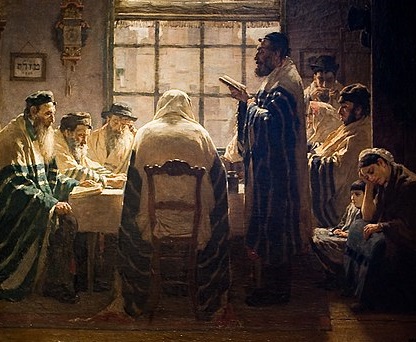
Mourning Day, by Jan Voerman, 1864

On Tisha Be-Av Jews around the world gather not only to fast and pray together, but to read the book of Lamentations/ Eikhah3, five long poems mourning the fall of Jerusalem in 586 B.C.E.. The book begins:

Oh, how can she sit alone,

            The city [once] great with people?

            She has become like a widow.

Great among nations,

            A noblewoman among provinces,

            She has become an unpaid laborer. (Lamentations/Eikhah 1:1)4

What does it mean to be like a widow? In the male-dominated society of the ancient Israelites, a woman depended on a man for food and shelter. If she did not have a father, husband, or son to provide for her, she was in a vulnerable position. Another male relative might take her in, or she might glean fields, like Ruth. She might sell herself as a slave, resort to prostitution, or depend on charity. The book of Deuteronomy/Devarim urges people eight times to feed the fatherless child and the widow.5

In Lamentations, Jerusalem is like a widow because she has lost not only her people, but also her wealth. It was standard practice in the ancient Near East for successful invaders to make the surviving natives do unpaid labor.6

She weeps and weeps through the night;

            Her tears are on her cheek.

There are none menacheim her

            Out of all who loved her.

All her friends have been faithless to her;

            They have become like enemies to her. (Lamentations/Eikhah 1: 2)

menacheim (מְנַחֵם) = comforting, consoling; one who comforts or consoles. (A piel form of the verb nacham, נָחַם, which in the nifil form means a change of heart: either regret or consolation.)

Jerusalem’s lovers and friends in this verse are her erstwhile allies, particularly Egypt. The poet calls these allies faithless because they did not come to her aid when the Babylonian army attacked Judah and besieged its capital city.

Jerusalem weeps without consolation because the countries she expected to help her are absent. A real friend shows up and offers to help, but Jerusalem sits all alone.

Is God there? Yes, but this time God is allied with Jerusalem’s enemies. The book of Lamentations says repeatedly that God initiated the Babylonian conquest in order to punish Jerusalem for violating God’s laws.

There are none menacheim her” becomes a refrain in the first poem of Lamentations, repeated in verses 1:9 and 1:17.

In verses 1:12-16, Jerusalem speaks for herself in the first person. She describes her suffering on God’s “day of wrath”, and blames God for the defeat of her men at the hands of the Babylonian army. Then she says:

Over these things I am weeping;

            My eyes, my eyes flood with water.

Because distant from me is [any] menacheim

             Who might restore my spirit. (Lamentations 1:16)

At the end of the first poem in Lamentations, Jerusalem addresses God directly:

They heard that I myself sighed:

            “There are none menacheim me!”

All my enemies have heard of my evil fate.

            They rejoice because you yourself did it!

You brought on the day you called for.

            Then let them become like me!

Bring all their evil before yourself,

            And inflict on them

What you have inflicted on me

            For all my mutinies.

Because my groans are many

            And my heart is sick. (Lamentations 1:21-22)

Here Jerusalem realizes that even though God permitted the Babylonian army to raze God’s temple, the Babylonians sinned when they did it. So she begs God to punish her human enemies the same way God punished her.

Perhaps she believes this rough justice would console her.

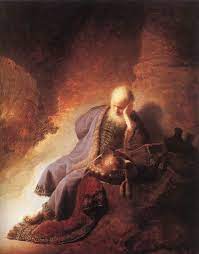
Jeremiah Lamenting the Destruction of Jerusalem, by Rembrandt, 1630

The subject of consolation comes up once more in the book of Lamentations, in the second poem. The speaker now is the poet, who describes God’s fury and the resulting destruction, then calls Jerusalem a virgin daughter rather than a promiscuous widow.

What can I compare to you va-anachameikh,

            Virgin daughter of Zion?

For your shattering is as vast as the sea.

            Who will heal you? (Lamentations 2:13)

va-anachameikh (וַאֲנַחֲמֵךְ) = and I comfort you (with)? (Another form of the verb nacham.)

According to Rashi,7 the poet wants to console Jerusalem by telling her that something just as bad happened to another city, another people. But no sufficiently horrible example comes to mind.

The question “Who will heal you?” hangs unanswered. The Babylonians could rebuild the walls and the houses, and erect their own temple. But who will heal the people of Jerusalem?

Eikhah Rabbah, a Talmudic-era collection of commentary on Lamentations, suggests that God will. After all, God split the Reed Sea to let the Israelites pass through on dry land when they were fleeing the Egyptian army. Then God healed the breach in the water, destroying the enemy.8 Since God created miracles that helped the Israelites in the past, then someday, after God’s rage is spent, God will save them again.

In the second book of Isaiah, God declares: “I, I am the one menacheim you!” (Isaiah 51:12)

*

The book of Lamentations is only one of many biblical texts that view God as an omnipotent father with an anger management problem. Those who believe in that particular anthropomorphic version of God often blame themselves for disasters, since anything is better than accusing their father-figure God of injustice. And if they are very, very good, Daddy will forgive them and comfort them.

I believe we humans must comfort one another, if only by acknowledging one another’s losses as real.

But perhaps ultimately, comfort and consolation can only come from God—either through a fortunate change in circumstances beyond our control, or through the divine spirit that lives within us.

  1. The Mourner’s Kaddish, in Aramaic, a part of every prayer service.
  2. Yizkor services on Passover/Pesach, Shavuot, Yom Kippur, and Shemini Atzeret.
  3. Lamentations begins with the Hebrew word eikhah, which here means: “Oh, how can it be?” See my post Devarim, Isaiah, & Lamentations: Desperation.
  4. Although most of the poetry in Lamentations falls into couplets, I follow Robert Alter in dividing the first verse into triplets and retaining the order of the original Hebrew phrases. (Robert Alter, The Hebrew Bible: Volume 3, The Writings, W.W. Norton & Co., New York, 2019)
  5. Deuteronomy 14:29, 16:11, 16:14, 24:19, 24:20, 24:21, 26:12-13, 27:19.
  6. Deuteronomy 20:10-14 instructs the Israelites that if a foreign town surrenders to them immediately, they must impose forced labor on the residents. But if the town does not surrender until after the Israelites have besieged it, they must kill all the men and take the women and children as booty. The Babylonians, however, ended their siege of Jerusalem by deporting Israelite men who were skilled or educated, along with their families, to enclaves in Babylon. Their usual policy was to assign unpaid labor to any remaining residents of a conquered city.
  7. 11th-century rabbi Shlomoh Yitzchaki.
  8. Eikhah Rabbah 2:17, sefaria.org.