Haftarat Shemini—2 Samuel: A Dangerous Spirit

Every week of the year has its own Torah portion (a reading from the first five books of the Bible) and its own haftarah (an accompanying reading from the books of the prophets). This week the Torah portion is Shemini (Leviticus 9:1-11:47) and the haftarah is 2 Samuel 6:1-7:17.

Being touched by God is a dangerous thing.

Uzza, in this week’s haftarah, walks next to the cart carrying the ark of the covenant during King David’s first attempt to move it to Jerusalem.

"The Chastisement of Uzzah" by James Tissot
“The Chastisement of Uzzah”
by James Tissot, ca. 1900

When the oxen pulling the cart stumble, Uzza instinctively reaches out and grabs at the ark—and God strikes Uzza dead.  (See my post Shemini & 2 Samuel: Segregating the Holy.)

And David was angry that God had broken through, [making] a breach in Uzza. (2 Samuel 6:8)

The bible does not say whether David is angry at Uzza or at God, but he is certainly upset that he has to abort his carefully-planned procession to bring the ark to his new capital, Jerusalem. For one thing, David is still consolidating his position as Israel’s second king.

He began his career as King Saul’s loyal lieutenant, a charismatic hero in Saul’s war against the Philistines. After Saul turned against David and repeatedly tried to kill him, David fled and found refuge in Philistine territory. After Saul died, David returned and was acclaimed king of Judah, the southern part of Saul’s former kingdom, but one of Saul’s sons became king of the northern territory. Gradually David conquered that land as well, then captured the foreign stronghold of Jerusalem and made it his new capital. But not all the people of Israel supported King David. Some still viewed him as the charismatic war hero who used to lead Saul’s troops; others resented him for opposing King Saul’s son.

So King David decides to bring the ark of the covenant, the people’s most important religious object, into Jerusalem. That way his new administrative center will also be his subjects’ primary center of worship. But after God breaks through and kills Uzza, David asks: How can it come to me, the ark of God? (2 Samuel 6:9)

David's first attempt with ark, illuminated manuscript
David’s first attempt with ark, illuminated manuscript

David is also angry and afraid because he deliberately set up the transportation of the ark as an occasion of religious rejoicing.

And David and the whole house of Israel were laughing and playing before God, with every woodwind of cypress, and with lyres and harps and tambourines and castanets and cymbals. (2 Samuel 6:5)

At that time, there were companies of “prophets” among the Israelites who entered altered states in order to experience God. Their usual method, according to the two books of Samuel, included playing music and encouraging ecstatic dancing and speaking in tongues.

For example, after the prophet Samuel anoints Saul as the first king of Israel, he tells him:
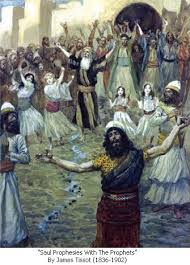
"Saul Prophesies with the Prophets", by James Tissot
“Saul Prophesies with the Prophets”, by James Tissot, ca. 1900

… as you are coming into the town you shall encounter a company of neviyim coming down from the high shrine, preceded by lute and tambourine and flute and lyre, and they shall be mitnabim. (1 Samuel 10:5)

neviyim (נְבִיאִִים) = prophets. (From the root verb niba (נבּא) = raved; conveyed the word of God. The Hebrew Bible uses the word neviyim (singular navi (נָבִיא) for both those who go into an altered state in order to experience God, and those who hear God and serve as God’s interpreters. (See my post Haftarah for Ki Tissa—1 Kings: Ecstatic versus Rational Prophets.)

mitnabim (מִתְנַבְּאִים) = speaking in an altered state (including glossolalia), often with ecstatic movement. (Also from the root niba.)

Samuel continued:

Then the ruach of God will overpower you, vehitnabita with them, and you shall be transformed into another man. (1 Samuel 10:6)

ruach (רוּחַ) = wind, spirit, overpowering mood.

vehitnabita (וְהִתְנַבִּיתָ) = and you shall babble in an altered state, move in ecstasy.

A ruach of God does overpower Saul, but it does not transform him into a better man. It merely makes a breach without killing him, so a ruach can overpower him again and again. Most often Saul is seized with angry jealousy and tries to kill David.

Maybe Saul’s original personality simply could not be transformed so that his altered states were joyful, like those of the neviyim.

David, however, enters the narrative as a charismatic, brave, and clever young man who sizes things up and plans ahead. When things go wrong, he optimistically bounces back with a new scheme.

Although David is a musician, he does not act like the neviyim until it fits his plan to bring the ark to his new capital. And after his first attempt fails because of the death of Uzza, David waits three months and then tries again.

Then David went and he brought up the ark of God from the house of Oveid-Edom to the City of David with rejoicing. …And David was whirling with all his might before God; and David had belted on a linen tunic. (2 Samuel 6:12, 6:14) 

King David’s tunic is an eifod (אֵפוֹד), two rectangles of material fastened together at the shoulders and belted at the waist. Elsewhere in the Bible an eifod is a ritual garment worn by the high priest over his robe and underpants. David is planning to take the role of high priest as well as king. But on this occasion, he does not wear anything under his tunic.

The ark arrives in Jerusalem (David not shown)
The ark arrives in Jerusalem (David, scantily dressed, is not shown)

David and all the household of Israel were bringing up the ark of God with shouts and with the sound of the ram’s horn. And the ark of God entered the City of David. And Mikhal, daughter of Saul, looked down from the window, and she saw the king, David, leaping and whirling before God, and she scorned him in her heart. (2 Samuel 6:16)

Mikhal is not only Saul’s daughter, but also one of David’s wives—arguably his most important wife at the time, since David’s marriage to her helps to legitimize his claim to Saul’s kingdom. She notices that while David is ecstatic leaping and whirling, the front piece of his tunic flaps around below the belt—revealing his lack of underpants.

Once the ark is ensconced in a tent in Jerusalem, King David makes animal offerings and blesses the people in the name of God, like a high priest. Then he hands out bread and cakes to everyone before going to his palace to bless his own household. Mikhal intercepts him at the door.

And Mikhal, daughter of Saul, went out to meet David and she said: How he was honored today, the king of Israel—who exposed himself today to the eyes of the slave-women of his servants as one of the worthless exposes himself! (2 Samuel 6:20)

And David said to Mikhal: Before God—who chose me instead of your father and instead of any of his household, to appoint me sovereign over the people of God, over Israel—before God I will laugh and play; and I will be dishonored even more than this, and I will be debased in my own eyes! But with the slave-women of whom you speak, with them I will be honored. (2 Samuel 6:21)

King David is claiming that he knows proper behavior according to members of the ruling class—and that nevertheless, he will behave in the way that wins the love of the common people. There are times when a king is better off dancing with a flapping tunic—as long as the dancing proves the king has been touched by God.

Religious ecstasy did not help Israel’s first king. King Saul lived in the moment, and if the spirit of God touched him, he acted, for good or for bad.

King David, on the other hand, always planned ahead. He whirled ecstatically in front of the ark because a joyful and over-the-top religious procession was part of his plan for uniting his people.

Sometimes it is good to get emotional over God. I have led Shabbat services with a sequence of songs designed to inspire and elevate people into joy, and even dancing.

But there must be a safe container for ecstasy. Samuel did not realize that Saul was not a safe container for the spirit of God.  And Mikhal did not realize that David had created a procession that would be a safe container for religious ecstasy.

May we all be blessed with intuitive knowledge of when it is good to let go, and when it is better to restrain oneself.

Lekh Lekha & Vayeira: Hints of Jerusalem

by Melissa Carpenter, maggidah

“Next year in Jerusalem!” is the phrase that concludes both the Passover seder and the holy day of Yom Kippur.  For more than two millennia, Jews have referred to Jerusalem as their holiest place and ultimate home.

Yet the city we call Jerusalem in English, and Yerushalayim (יְרוּשָׁלַיִם‎) in Hebrew, is a Jebusite city in the Hebrew Bible until the second book of Samuel, when King David conquers its citadel and makes it his capital.

An Egyptian vassal city

So far, the oldest reference archaeologists have found to a place in Canaan called something like Jerusalem appears on Egyptian potsherds from the 19th century BCE, where Rushalimum is one of 19 Canaanite cities.

Rushalimum = uru (city of, founded by) + shaleim (the Canaanite god of the evening star, in the Semetic language of the Jebusites).

In the Amarna letters of the 14th century B.C.E., the king of the land of Rishalimum complains to the pharaoh of Egypt about how the Egyptian soldiers treated his capital city, “Beit-Shulmani”—a Semetic name meaning “House of Shaleim”.

Shaleim (שָׁלֵם) = the Canaanite god of the evening star (in the Jebusite language); completeness, safety, peace (in Hebrew, another Semitic language).

A place called Shaleim

Abraham is blessed by the king of Shaleim in the Torah portion Lekh Lekha (“Get yourself going”).  And in this week’s portion, Vayeira (“And he saw”), Abraham almost slaughters his son as an offering on Mount Moriyah, later identified as the temple mount.  Both of these place-names hint at the future Israelite city of Jerusalem.

A blessing in the city of Shaleim concludes Abraham’s only recorded military campaign.  Five kings at southern end of the Dead Sea had lost a battle against four northern kings, who then headed north with the booty and all the southerners they rounded up as slaves.  One of the kidnapped southerners was Abraham’s nephew Lot.

Abraham and his 318 men chase the northerners, defeat them, and head back south with all the captured people and goods.  Before they reach Abraham’s encampment in Hebron, the southern king of Sodom meets Abraham and his men in the Valley of Shaveh.

And the king of Sodom went out to meet him, after he returned from striking Kedarlaomer and the kings who were with him, in the Valley of Shaveh, which is the valley of the king.  But Malki-Tzedek, king of Shaleim, brought out bread and wine; and he was a priest to Eil Elyon.  (Genesis/Bereishit 14:17-18)

Shaleim (שָׁלֵם) = peace, safety, wholeness.

Eil Elyon (אֵל עֶלְיוֹן) = the High God.

If Shaleim is a shortened name for Jerusalem, then the Valley of Shaveh may be the level area where the Kidron Valley meets the Valley of Ben-hinnom.  Commentators have pointed out that Shaveh also means “level”.

And he blessed him and he said: “Blessed be Avram to Eil Elyon, owner of heaven and earth.  And blessed be Eil Elyon, Who delivered your enemies into your hand”.  And he gave him a tithe of everything. (Genesis 14:19)

Abraham adds the name Eil Elyon to the four-letter name of God when he swears to the King of Sodom that he will not keep any of the people or goods that he won in battle.  (See my blog post Lekh Lekha: New Names for God.)  Abraham’s use of Eil Elyon may be diplomatic, but it also implies that Malki-Tzedek and Abraham recognize the same god as supreme.

Why would Malki-Tzedek give a tithe of the booty, when he is not listed as participating in the battle?  Probably it is Abraham who gives a tithe of his booty to Malki-Tzedek, prefiguring the tithes that Israelites brought to the high priest in Jerusalem centuries later.

So the stage is set for the Jebusite city of Shaleim to become the capital and holy city of the Israelites someday. The site is associated with a name of God, with priesthood, with blessings, and with tithes.

A place called Moriyah

This week’s Torah portion, Vayeira, hints at the future site of the temple through a very different story.  After Abraham and Sarah’s son Isaac has grown up and become a young man, God speaks to Abraham in the night.

And [God] said:  “Take, please, your son, your only one, whom you love, Isaac, and get yourself going to the land of the Moriyah.  And lead him up there for a burnt offering on one of the mountains, [the one] which I will say to you.”  (Genesis 22:2)

Moriyah (מֹרִיָּה) = Mor of God.  Mor (מֹר) = myrrh; a shortened form of moreh (מוֹרֶה) = throwing or teaching; or a homonym for mareh (מַרְאָה) = seeing, vision, apparition, mirror.

After a three-day walk from his home in Beersheba, Abraham sees the place.  The Torah does not say how he knows this particular hilltop is the one God chooses, but he climbs up with Isaac, some firewood, a fire-box, and a knife.

Beersheba is 44 miles from Jerusalem.  If the Moriyah is one of the hills surrounding Jerusalem,  then Abraham and Isaac would have to walk 14 to 15 miles a day—a reasonable distance, especially if the two servants Abraham brings along carry the firewood, and the donkey carries Abraham, age 117.

Just as Abraham lifts his knife to kill his son at the top of the hill, another voice from God calls to him and tells him to stop.  Abraham sacrifices a ram caught by its horns in the thicket in place of Isaac.  (The Torah does not say whether it is a thicket of myrrh.)

And Abraham called the name of that place “God Yireh”, as it is said to this day:  On the mountain of God yeira-eih. (Genesis 22:14)

yireh (יִראֶה) = he sees, will see, perceive, look at, consider.

yeira-eih (יֵרֶָאֶה) = he/it will be seen, will become visible, will appear.

In this story Abraham connects the place-name Moriyah (מֹרִיָּה) with the word mareh (מַרְאָה) = seeing, appearance, vision.

The only other occurrence of the name Moriyah in the Hebrew Bible is in a book written several centuries later:

Then Solomon began to build the house of God in Jerusalem on the hill of the Moriyah, where [God] had appeared to his father David, where David had appointed the place on the threshing floor of Ornan the Jebusite.”  (2 Chronicles 3:1)

Moriyah is not mentioned in 2 Samuel, an earlier book that includes an account of Solomon building the temple.  But this retelling of the story in 2 Chronicles (written circa 400-250 C.E.) firmly identifies Moriyah as a hill in Jerusalem.

A placed called Yerushalaim

The Hebrews conquer much of Canaan in the book of Joshua, but even though Joshua executes the king of Jerusalem, he cannot conquer the city-state itself.

As for the Jebusites, the inhabitants of Yerushalaim: the children of Judah were not able to dispossess them, so the Jebusites dwell with the children of Judah in Yerushalaim to this day.  (Joshua 15:63)

Yerushalaim (יְרֽוּשָׁלַ֔םִ) = Jerusalem; yeru (יְרֽוּ) = (possibly from of yarah (יָרָה) = “he founded” or “he shot arrows”) + shaleim.1

Joshua sets up the Israelites’ portable tent-sanctuary in Shiloh, about 20 miles north of Jerusalem, and it remains there for centuries, acquiring stone walls and becoming the main temple of the Israelites.

The city-state of Jerusalem remains an independent Jebusite enclave until King David conquers its citadel and makes it his capital in the second book of Samuel.  Instead of enslaving or subjugating the native Jebusites, David integrates them into his kingdom.  He moves the ark to his new capital in Jerusalem (2 Samuel 6:12-17), and his son Solomon builds the first temple there.

*

The story of Abraham and Malki-Tzedek, set in Shaleim, prefigures the requirement to donate a tithe to the priests in Jerusalem, first mentioned in the book of Leviticus/VayikraShaleim is also were Malki-Tzedek blesses Abraham, as priests later blessed people.

The story of Abraham’s near-sacrifice of Isaac establishes the principle of burnt offerings of animals only, which later became the central form of worship in the temple in Jerusalem.  The  name Moriyah and its folk etymology at the end of this story make this the place where humans see and are seen by God.

So Jerusalem is supposed to be a place of blessing, and a place where humans meet God.

Over the centuries, Jerusalem has occasionally lived up to the promise of its name under Malki-Tzedek, the Hebrew word shaleim = wholeness, peace, and safety.  At other times, too many of the human beings in Jerusalem have been unable to bless or to see each other—and therefore unable to truly bless or perceive the divine.

May the promises of a holy, whole, peaceful, and safe Jerusalem in Lekh Lekha and Vayeira finally come true, speedily and in our time.

  1. In Genesis Rabbah 56:10, Yerushaleim is interpreted as a combination of yir’eh, “He will see [to it],” and shaleim, the city of King Melchizedek in Genesis 14:18.