Haftarat Yitro—Isaiah: Burning Angels

Every week of the year has its own Torah portion (a reading from the first five books of the Bible) and its own haftarah (an accompanying reading from the books of the prophets). This week the Torah portion is Yitro (Exodus 18:1-20:23), and the haftarah is Isaiah 6:1-7:6 & 9:5-6.

You cannot see My face, because humankind may not see Me and live. (Exodus/Shemot 33:20)

Although God cannot be seen directly, people in the Bible do experience visions of God. The Israelites see a manifestation of God in this week’s Torah portion, and Isaiah sees a manifestation of God in this week’s haftarah.

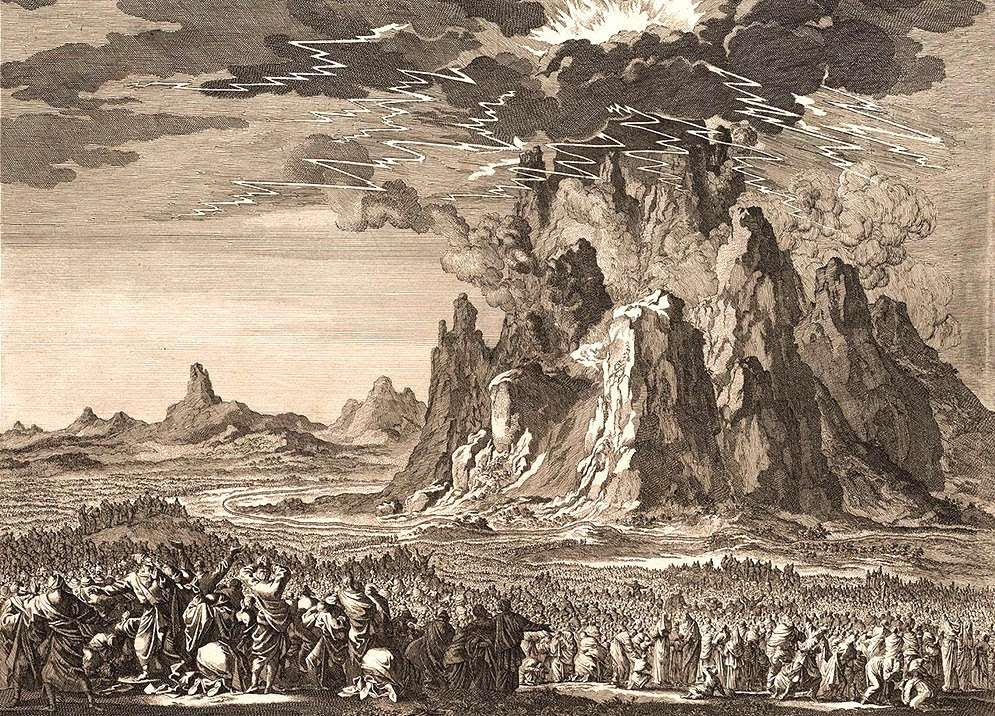
Mount Sinai
Mount Sinai

In the vision shared by everyone at Mount Sinai, God appears only as fire.

And Moses brought out the people from the camp to meet God, and they stationed themselves at the bottom of the mountain. And all of Mount Sinai smoked, because God went down upon it in fire, and its smoke went up like the smoke of the furnace, and all the mountain shuddered very much. (Exodus 19:17-18)

A shuddering, smoking mountain could be a volcano—except that in this vision, God’s fire comes down from the sky, not up from a crater. God also manifests in the book of Exodus as the fire Moses sees in the burning bush on Sinai, as the pillar of cloud and fire that leads the Israelites to Mount Sinai, and as fire and cloud on the mountain when Moses ascends to receive each pair of stone tablets.

No angels or other semi-divine creatures appear in the revelation at Mount Sinai; only fire, smoke, and various sounds.

In Isaiah’s moment of revelation, God does not appear as fire.

In the year King Uzziyahu died, I saw my Master sitting elevated on a lofty throne, and His skirts filling the heykhal. (Isaiah 6:1)

heykhal (הֵיכָל) = palace, temple; main room of the temple in Jerusalem; heavenly palace.

Isaiah beholds God wearing a robe and sitting on a throne, like a king—except that the skirts of the robe mysteriously flow out to fill the room. As the vision continues God speaks, but does not move.

However, angelic attendants surrounding God move, speak, and burn with fire.

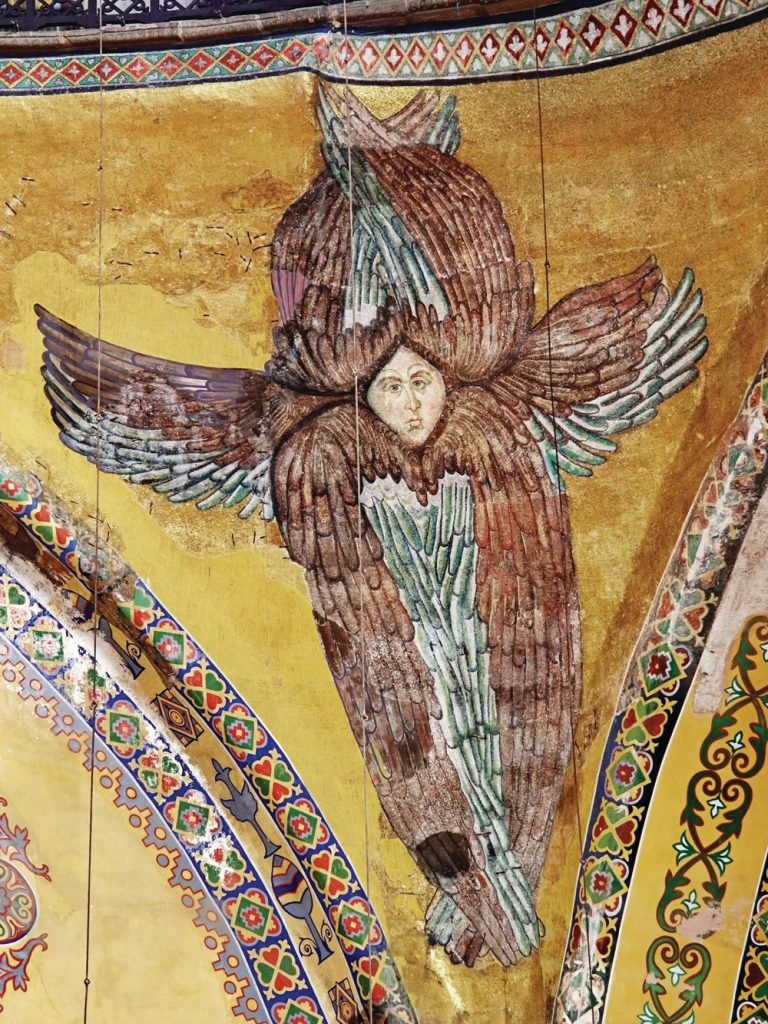
Isaiah 6 serafSerafim are stationed above Him, each with six wings; with one pair he covers his face, and with a pair he covers his raglayim, and with a pair he flies. And one calls to another, and he says: Holy, holy holy! God of Tzevaot, Who fills all the earth with His glory! And the supports of the threshold shiver from the sound of the calling, and the house fills with smoke. (Isaiah 6:1-4)

serafim (שְׂרָפִים) = burners, burning creatures. (From the verb saraf, שָׂרַף = burn. Used in Numbers and Deuteronomy for “burning serpents”—probably poisonous snakes.)

tzevaot  (צְבָאוֹת) = armies (on earth); the stars (in the heavens).

raglayim (רַגְלָיִם) = (pair of) feet, legs; a euphemism for the penis. Singular: regel (רֶגֶל) = foot, leg; walking pace; time set for a pilgrimage-festival.

The serafim must both cover and uncover their faces and their raglayim; if these body parts were permanently covered, they would not need wings for that purpose. When and why do they conceal these parts of their anatomy?

In Leviticus Rabbah, a collection of commentary from 400-600 C.E., Rabbi Jacob ben Zadbi says the serafim cover their faces to avoid looking at God’s presence, and cover their feet so God would not have to look at such unsightly appendages. (The writer assumed that the feet of the serafim were like the feet of Ezekiel’s angelic keruvim, which resembled calves’ feet.)

Twelfth-century C.E. rabbi Moses Maimonides wrote in The Guide for the Perplexed that the description of serafim covering their body parts is symbolic. The faces of the serafim are covered to indicate that “the cause of their existence is hidden and concealed”, while their feet are covered to indicate that their actions in the universe are also hidden. The wings for flying, Maimonides adds, merely represent the speed with which the serafim move when they act.

I propose a simpler explanation. Maybe the serafim cover their faces whenever they turn toward Isaiah, so he is not exposed to the blinding light radiating from these burning creatures. If seeing God’s face means death, seeing the faces of the serafim might be almost as bad.

Moses at the burning bush

As for covering their raglayim, I doubt the serafim are concealing their feet.  After all, humans must have bare feet when they are in God’s presence; Moses must remove his sandals in front of the burning bush, and the priests must go barefoot inside the sanctuary. Since Isaiah’s vision is set inside a heykhal, the serafim in God’s presence probably expose their bare feet.

Although the word raglayim most often refers to feet or legs, sometimes it implies the pubic area between the legs, and there are three places in the Bible where raglayim is definitely a euphemism for the male genital organs. In Judges 3:24 and 1 Samuel 24:4 the word raglayim is combined with a verb to indicate a man urinating.  And in the part of chapter 7 of Isaiah that is left out of this week’s haftarah, the prophet says that God will use the king of Assyria as a razor to shave off the head of hair and the hair of the raglayim (JPS: public hair) and also snatch away the beard. (Isaiah 7:20)

A man’s hair, especially his beard and pubic hair, stood for virility in ancient Israelite culture. Isaiah employs a shaving metaphor to prophesy that God will use Assyria to symbolically castrate Israel’s other enemies.

Why would the serafim in Isaiah’s vision use their extra wings to cover their genitals?

The penis is a symbol of rule, dominance, and control throughout the Bible, from the oath Abraham’s servant swears on his master’s yareich (which can also mean genitals; see my post Chayyei Sarah: A Peculiar Oath) to the Persian king who approves Esther’s interruption by lifting his sharvit (scepter). But God is the ultimate ruler. It would be subversive for a male to uncover his genitals in God’s presence.

That is why this week’s Torah portion specifies that all altars for God must be built without stairs or steps.

You must not ascend on stairs to My altar; that way you would expose your nakedness upon it. (Exodus 20:23)

The Torah also requires that priests must wear linen undergarments, so their genitals will be concealed in all areas of God’s sanctuary.

So each seraf uses one pair of wings to conceal his fiery face from Isaiah, for his own protection; and one pair of wings to conceal his genitals, so Isaiah will know that God rules, not the serafim.

Nevertheless, these angels are endowed with the potential to generate independent decisions and actions. One example occurs after Isaiah expresses his anxiety about having a vision of God.

The Prophet Isaiah, by Marc Chagall

And I said: Woe to me! I am as good as dead, because I am a man of impure lips, and I am living in the midst of a people of impure lips, yet my eyes behold the King, God of Tzevaot! Then one of the serafim flew toward me, and in his hand was a live coal he had taken from the altar with a pair of tongs. And he touched it to my mouth and he said: Hey! Now that this has touched your lips, your bad deeds have gone away, and your offense is atoned for. Then I heard the voice of my Master saying: Whom shall I send, and who will go for us? And I said: Here I am, send me! (Isaiah 6:5-8)

We have come a long way from the vision at Mount Sinai of God as undifferentiated fire, unaccompanied by any furniture or subsidiary creatures.

Isaiah sees God in terms of a throne and skirts, not in terms of fire. The fire exists in God’s serafim, “burning ones”, who occupy a station somewhere between humankind and God. They praise God (Holy, holy holy!) and they are privy to some of God’s plans (and who will go for us?) They protect Isaiah from the blinding brightness of their faces, and they cover their genitals to indicate that although they have some power, God is the ultimate ruler. And one seraf, hearing Isaiah’s anxiety about his unworthiness, takes action to remove his guilt. In his relief, Isaiah volunteers to be God’s prophet. Thus the seraf both furthers God’s plan and helps Isaiah rise to his calling.

The image of God as a king with a throne and a long robe has continued to be popular, from some of the writings after the fall of the first temple to some of the explanations given to children today. For me, God as fire is a better metaphor. An individual human cannot become a god.

But maybe we can aspire to be brighter, more aware of God’s presence, and more able to listen to people and address their concerns.

May all of us humans learn to act as thoughtfully as the serafim in Isaiah’s vision.

Haftarat Devarim—Isaiah: Ignoring the Divine

Every weekly Torah portion is paired with a haftarah (“what emerges”), a passage from Prophets/Neviim. For nearly 2,000 years, in traditional Saturday Torah services, the chanting of the haftarah follows the chanting of the Torah portion. This week, Jews read the first Torah portion in the book of Deuteronomy/Devarim, which is also called Devarim (“Words”). The haftarah this week is Isaiah 1:1-27. Both the Torah portion and the haftarah contain the word eykhah, which means “how” as in “Oh, how could this happen?” This is also the opening word of the book of Lamentations, which we read on Tisha Be-Av, the fast day shortly after this Shabbat. (See my post: Devarim, Isaiah, & Lamentations: Desperation.)

All three readings accuse the Israelites of rebellion against God. But Isaiah offers the most hope for change. The Shabbat before Tisha Be-Av is called Shabbat Chazon (Sabbath of Vision) because the book of Isaiah begins with the word chazon (vision or revelation).

The vision of Yeshayahu, son of Amotz, who had vision concerning Judah and Jerusalem … (Isaiah 1:1)

The Hebrew for Isaiah is Yeshayahu, which means “Rescue of God”. Again and again, even as Isaiah points out how despicably the children of Israel are behaving, he promises that eventually God will rescue them.

After the opening sentence, which also dates Isaiah’s prophecies by listing the names of the kings of Judah during his time, Isaiah’s first poem begins:

Listen, heavens, and use [your] ears, earth;

Because God has spoken:

I brought up children, and I made them high,

And they? They rebel against me.

An ox knows his koneh,

And a donkey the feeding-trough of his ba-al.

Israel does not know;

My people do not hitbonan. (Isaiah 1:2-4)

koneh = owner, buyer; creator.

ba-al = master, ruler; local god.

hitbonan = consider. (From the same root as binah = understanding, analysis.)

In these verses, the ox is the most knowledgeable because it recognizes its owner. Next comes the donkey, which recognizes the place where its owner provides nourishment. Last come the Israelites, who do not even recognize that someone is giving them nourishment.

The reverse order applies to the role of God. God, who creates all creatures, is only the creator (an earlier meaning of koneh) as far as the ox is concerned. God is the ba-al, the local god, of the donkey. But when it comes to the children of Israel, God is also like a parent, bringing them up, making them high (superior), and considering them “My people”.

Does this mean that the more God does for someone, the less that creature recognizes God? Not necessarily. The tragedy in these opening verses is that God elevates human beings in general by endowing us with both the intelligence to consider, analyze, and understand, and the desire to distinguish between good and bad. The Israelites, like any people, have the God-given ability to figure out that God is their creator, sustainer, and parent. They also have the ability to feel gratitude, and to choose good behavior. Yet they do not take the trouble to stop and consider any of this.

Isaiah views this willful ignorance not as laziness, but as deliberate denial: They rebel against me. Furthermore, in Isaiah’s view, those who turn their backs on God also turn their backs on ethical behavior. He calls them People heavy with crooked deeds. (Isaiah 1:4)

Willful ignorance is not bliss. Isaiah mourns how much the Israelites have suffered at the hands of the Assyrians, whose attack on the two Israelite kingdoms began around 740 B.C.E. The Assyrians conquered the northern kingdom, and besieged but did not capture Jerusalem, the capital of the southern kingdom of Judah. Isaiah, like most of the prophets, assumes that if the Israelites had been upright and ethical, God would not have permitted their enemies to defeat and burn their cities. Isaiah calls God the God of Armies, including Assyrian armies. He uses God’s complete destruction of Sodom and Gomorrah to remind his audience that God destroys immoral peoples.

If the God of Armies had not left us a few survivors,

We would be like Sodom,

We would resemble Gomorrah. (Isaiah 1:9)

Nevertheless, the surviving Israelites are not doomed. They still have the ability to change, and God still wants them to turn back from evil. Isaiah reports God saying:

Give up doing evil!

Learn to do good!

Seek out the rule of law.

Step on the oppressor.

Get justice for the orphan.

Defend the case of the widow. (Isaiah 1:16-17)

God assures the people that they can, indeed, be redeemed from their immorality, if they pay attention and obey God. Then Isaiah mourns over how far the people of Jerusalem have fallen, beginning with the line: Eykha (Oh, how) has it become a prostitute, [this] faithful city? (Isaiah 1:21)

Nevertheless, at the end of the haftarah, Isaiah says that if the surviving Israelites in Judah (also called Zion) learn to do good, then God will save them.

Zion will be redeemed through lawful justice,

And those who turn back, through righteousness. (Isaiah 1:27)

Isaiah’s poetry calls for the repentance of the people of Judah. But does it address any people today?

Certainly human beings are still endowed with the intelligence to figure out that we did not create ourselves, nor the world that supports us. We might also notice that our elaborate intelligence and our ethical intuitions are extraordinary gifts. Yet like the Israelites of the 8th century B.C.E., we often do not take the trouble to stop and consider.

Someone who does stop and consider today might conclude that human abilities are merely an accidental result of evolution, and have nothing to do with anything that might be called God. For atheists, Isaiah’s claim that turning away from God means turning away from moral behavior makes no sense. When I was an atheist myself, I still felt gratitude for the world and humanity, and I believed that the human condition came with its own ethical imperatives.

Someone with a traditional Jewish or Christian background who stopped to consider might conclude that God is sufficiently anthropomorphic to prefer some types of human behavior over others. Such a person might analyze the Bible as well as the world, and conclude that God prescribes moral behavior such as honoring parents and protecting orphans, and proscribes immoral behavior such as cheating, adultery, and murder. Someone who believes in a somewhat anthropomorphic God, but takes the Bible with a grain of salt, might conclude that God desires whatever human behavior promotes harmony, cooperation, and mutual respect.

What if someone who is neither an atheist nor a believer in a semi-anthropomorphic God stops to consider? My intellectual analysis deduces that God is the condition of “becoming” implied by the four-letter name of God (sometimes written in Roman letters as YHVH) based on the Hebrew verb for “to be” or “to become”. Another part of my mind concludes that the word “God” covers various mysterious forces in the world. I believe God is evolving along with the universe, and our human attitudes and actions affect God’s evolution. If we become more ethical, the forces of God become more ethical.

Does this mean that eventually God will not let the army of one country devastate another country? Maybe so—if God works through the human psyche.

The lesson I draw from the Isaiah’s opening poem is that if we learn to do good as individuals, the whole world will improve. And the first step toward learning to do good is to stop and consider that our existence depends on forces outside our control; and therefore we owe gratitude to other human beings, to the whole universe, and—yes—to God.