Haftarat Shemini—2 Samuel: A Dangerous Spirit

Every week of the year has its own Torah portion (a reading from the first five books of the Bible) and its own haftarah (an accompanying reading from the books of the prophets). This week the Torah portion is Shemini (Leviticus 9:1-11:47) and the haftarah is 2 Samuel 6:1-7:17.

Being touched by God is a dangerous thing.

Uzza, in this week’s haftarah, walks next to the cart carrying the ark of the covenant during King David’s first attempt to move it to Jerusalem.

"The Chastisement of Uzzah" by James Tissot
“The Chastisement of Uzzah”
by James Tissot, ca. 1900

When the oxen pulling the cart stumble, Uzza instinctively reaches out and grabs at the ark—and God strikes Uzza dead.  (See my post Shemini & 2 Samuel: Segregating the Holy.)

And David was angry that God had broken through, [making] a breach in Uzza. (2 Samuel 6:8)

The bible does not say whether David is angry at Uzza or at God, but he is certainly upset that he has to abort his carefully-planned procession to bring the ark to his new capital, Jerusalem. For one thing, David is still consolidating his position as Israel’s second king.

He began his career as King Saul’s loyal lieutenant, a charismatic hero in Saul’s war against the Philistines. After Saul turned against David and repeatedly tried to kill him, David fled and found refuge in Philistine territory. After Saul died, David returned and was acclaimed king of Judah, the southern part of Saul’s former kingdom, but one of Saul’s sons became king of the northern territory. Gradually David conquered that land as well, then captured the foreign stronghold of Jerusalem and made it his new capital. But not all the people of Israel supported King David. Some still viewed him as the charismatic war hero who used to lead Saul’s troops; others resented him for opposing King Saul’s son.

So King David decides to bring the ark of the covenant, the people’s most important religious object, into Jerusalem. That way his new administrative center will also be his subjects’ primary center of worship. But after God breaks through and kills Uzza, David asks: How can it come to me, the ark of God? (2 Samuel 6:9)

David's first attempt with ark, illuminated manuscript
David’s first attempt with ark, illuminated manuscript

David is also angry and afraid because he deliberately set up the transportation of the ark as an occasion of religious rejoicing.

And David and the whole house of Israel were laughing and playing before God, with every woodwind of cypress, and with lyres and harps and tambourines and castanets and cymbals. (2 Samuel 6:5)

At that time, there were companies of “prophets” among the Israelites who entered altered states in order to experience God. Their usual method, according to the two books of Samuel, included playing music and encouraging ecstatic dancing and speaking in tongues.

For example, after the prophet Samuel anoints Saul as the first king of Israel, he tells him:
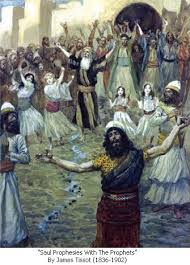
"Saul Prophesies with the Prophets", by James Tissot
“Saul Prophesies with the Prophets”, by James Tissot, ca. 1900

… as you are coming into the town you shall encounter a company of neviyim coming down from the high shrine, preceded by lute and tambourine and flute and lyre, and they shall be mitnabim. (1 Samuel 10:5)

neviyim (נְבִיאִִים) = prophets. (From the root verb niba (נבּא) = raved; conveyed the word of God. The Hebrew Bible uses the word neviyim (singular navi (נָבִיא) for both those who go into an altered state in order to experience God, and those who hear God and serve as God’s interpreters. (See my post Haftarah for Ki Tissa—1 Kings: Ecstatic versus Rational Prophets.)

mitnabim (מִתְנַבְּאִים) = speaking in an altered state (including glossolalia), often with ecstatic movement. (Also from the root niba.)

Samuel continued:

Then the ruach of God will overpower you, vehitnabita with them, and you shall be transformed into another man. (1 Samuel 10:6)

ruach (רוּחַ) = wind, spirit, overpowering mood.

vehitnabita (וְהִתְנַבִּיתָ) = and you shall babble in an altered state, move in ecstasy.

A ruach of God does overpower Saul, but it does not transform him into a better man. It merely makes a breach without killing him, so a ruach can overpower him again and again. Most often Saul is seized with angry jealousy and tries to kill David.

Maybe Saul’s original personality simply could not be transformed so that his altered states were joyful, like those of the neviyim.

David, however, enters the narrative as a charismatic, brave, and clever young man who sizes things up and plans ahead. When things go wrong, he optimistically bounces back with a new scheme.

Although David is a musician, he does not act like the neviyim until it fits his plan to bring the ark to his new capital. And after his first attempt fails because of the death of Uzza, David waits three months and then tries again.

Then David went and he brought up the ark of God from the house of Oveid-Edom to the City of David with rejoicing. …And David was whirling with all his might before God; and David had belted on a linen tunic. (2 Samuel 6:12, 6:14) 

King David’s tunic is an eifod (אֵפוֹד), two rectangles of material fastened together at the shoulders and belted at the waist. Elsewhere in the Bible an eifod is a ritual garment worn by the high priest over his robe and underpants. David is planning to take the role of high priest as well as king. But on this occasion, he does not wear anything under his tunic.

The ark arrives in Jerusalem (David not shown)
The ark arrives in Jerusalem (David, scantily dressed, is not shown)

David and all the household of Israel were bringing up the ark of God with shouts and with the sound of the ram’s horn. And the ark of God entered the City of David. And Mikhal, daughter of Saul, looked down from the window, and she saw the king, David, leaping and whirling before God, and she scorned him in her heart. (2 Samuel 6:16)

Mikhal is not only Saul’s daughter, but also one of David’s wives—arguably his most important wife at the time, since David’s marriage to her helps to legitimize his claim to Saul’s kingdom. She notices that while David is ecstatic leaping and whirling, the front piece of his tunic flaps around below the belt—revealing his lack of underpants.

Once the ark is ensconced in a tent in Jerusalem, King David makes animal offerings and blesses the people in the name of God, like a high priest. Then he hands out bread and cakes to everyone before going to his palace to bless his own household. Mikhal intercepts him at the door.

And Mikhal, daughter of Saul, went out to meet David and she said: How he was honored today, the king of Israel—who exposed himself today to the eyes of the slave-women of his servants as one of the worthless exposes himself! (2 Samuel 6:20)

And David said to Mikhal: Before God—who chose me instead of your father and instead of any of his household, to appoint me sovereign over the people of God, over Israel—before God I will laugh and play; and I will be dishonored even more than this, and I will be debased in my own eyes! But with the slave-women of whom you speak, with them I will be honored. (2 Samuel 6:21)

King David is claiming that he knows proper behavior according to members of the ruling class—and that nevertheless, he will behave in the way that wins the love of the common people. There are times when a king is better off dancing with a flapping tunic—as long as the dancing proves the king has been touched by God.

Religious ecstasy did not help Israel’s first king. King Saul lived in the moment, and if the spirit of God touched him, he acted, for good or for bad.

King David, on the other hand, always planned ahead. He whirled ecstatically in front of the ark because a joyful and over-the-top religious procession was part of his plan for uniting his people.

Sometimes it is good to get emotional over God. I have led Shabbat services with a sequence of songs designed to inspire and elevate people into joy, and even dancing.

But there must be a safe container for ecstasy. Samuel did not realize that Saul was not a safe container for the spirit of God.  And Mikhal did not realize that David had created a procession that would be a safe container for religious ecstasy.

May we all be blessed with intuitive knowledge of when it is good to let go, and when it is better to restrain oneself.

Shemini: Is Strong Wine Divine?

fire

by Melissa Carpenter, maggidah

In this week’s portion, Shemini (Eighth), Aaron and his four sons complete the eighth day of their ordination as priests by presenting an animal offering at the new altar.  God sends forth a miraculous fire that consumes everything on the altar, and all the people shout with joy and bow down to the ground.

Then Aaron’s two older sons, Nadav and Avihu, bring unauthorized incense into the Tent of Meeting, and God sends forth a miraculous fire that consumes them.  (See my post Shemini: Fire Meets Fire.)

Moses gives instructions regarding removing the bodies and mourning.  Then God tells Aaron:

Wine or sheikhar do not drink, you or your sons with you, when you come into the Tent of Meeting, and you will not die—a decree forever for your generations—and to distinguish between the holy and the ordinary, and between the ritually-impure and the ritually -pure; and to teach the Children of Israel all the decrees that God, your god, has spoken through Moses.  (Leviticus/Vayikra 10:9-11)

sheikhar (שֵׁכָר) = strong drink.  (From the root verb shakhar, שׁכר = was drunk, became intoxicated.)

Sheikhar is not liquor or fortified wine, since distilling was not inventing until the fourth century B.C.E.  The alcoholic drinks available to the ancient Israelites were wine from grapes, wine from other fruits, and beer from grain.  Judging by other Biblical passages containing the word sheikhar, the word might mean any of these fermented drinks, if they happened to be especially strong.

The Torah distinguishes between new wine, chemer (חֶמֶר), and old wine, called shemer (שֶׁמֶר) or sheikhar.  New wine has only progressed through the first stage of fermentation; old wine has fermented for at least 40 days (according to the Talmud, Sanhedrin 70a) and has more alcoholic content.  (The Torah also refers to both new and old wine as yayin (יַיִן), which simply means “wine”.)

Does God give Aaron the injunction above shortly after Nadav and Avihu’s fatal error because they were drunk when they brought the unauthorized incense?  The commentary is divided.  Either way, God states the reason why priests must not drink on duty: alcohol decreases reasoning and discernment, and therefore would interfere with several of the priests’ duties: judging whether something is holy, judging whether something or someone is ritually pure, and teaching the laws correctly.

Coin with libation flagon for second temple (photo by CNG)

However, the Torah does not banish wine altogether from the sanctuary or temple.  Priests are required to give offerings of wine to God, poured out as libations on the altar.  The book of Numbers/Bemidbar even specifies strong wine for God:

And you shall say to them: This is the fire-offering you shall bring close to Hashem: male yearling lambs, unblemished, a pair for the day, as a perpetual rising-offering.  The one male lamb you shall do in the morning, and the second male lamb you shall do in the evening.  … And he shall pour out a fourth of a hin for the one male lamb, on the holy place, to provide a libation, a drink-offering of sheikhar for Hashem.  (Numbers/Bemidbar 28:3-4, 7)

During the time of the second temple in Jerusalem, the wine libation was poured near the southwest corner of the altar.  The wine flowed down through holes into drainpipes.  (See my post Emor: Libations.)  The wine of a libation had to be be entirely poured out; Jews did not follow the Greek practice of pouring a libation and then drinking the rest of the wine.

On the other hand, it was acceptable for non-priestly worshipers to drink their own wine in front of the sanctuary.

You must definitely tithe all the yield of your planting, what comes out of the field, year by year.  And you shall eat in front of God, your god … so that you will learn to be in awe of God, your god, all the time.  And if the road is too long for you … Then you shall give silver, and you shall bundle up the silver in your hand, and you shall go to the place that God, your god, will choose.  And you may give the silver for what your nefesh craves: cattle, or sheep, or wine, or sheikhar, or anything that your nefesh asks you for.  And you shall eat it there in front of God, your god, and you shall rejoice, you and your household.  (Deuteronomy/Devarim 14:22-26)

nefesh (נֶפֶשׁ) = appetite; the soul that animates the body.

Here the Torah seems to approve of imbibing (as well as feasting) as an aid to feeling both joy and awe when serving God.  Yet in the first book of Samuel/Shmuel, the high priest Eli criticizes Hannah for coming to the temple when she is, apparently, drunk.

And Channah, she was speaking in her heart; only her lips moved, but her voice was not heard.  And Eli considered her leshikorah.  And Eli said to her:  How long will you go on making yourself drunk?  Remove your wine from over yourself!

But Channah replied, and she said:  No, my lord, I am a woman of heavy spirit, and I have not drunk wine nor sheikhar, but I have poured out my nefesh before God.  (1 Samuel 13-15)

leshikorah (לְשִׁכּוֹרָה) = to be drunk.

By pouring out her soul before God, Channah is, in effect, making her own libation offering.  And she is dedicating something stronger than old wine.

Perhaps the priests must avoid drinking at the sanctuary not only to keep their minds sharp, but also to serve God with appropriate levels of joy and awe, avoiding emotional excess.  Their libation offerings could be interpreted as pouring out their own emotionality, emptying themselves in order to become holy vessels for their work.


When I lead prayer services, the people in front of me seem to find more comfort, or insight, or elevation, when I manage to step away from the emotions that I walked in with, but retain my rational alertness.  At those times, I find myself empty and available for inspiration, yet also able to notice when I need to change the volume or tempo of a song, to skip something I had planned, to say something different, to invite comment or to move back into song.

If only I could do that every time!

Next time, I will imagine pouring out all my sheikhar, my old, strong wine, in a libation to God before the service begins.  Then maybe I can be both clear and clear-headed in the sanctuary that it is my duty to help create.

Shemini: Mourning in Silence

The death of someone close to you, even after a long illness, is hard to accept.  A sudden death is like an earthquake.  But what if the sudden death came neither from an accident nor from a gun, but from a blast of divine fire?

That is how Aaron’s two older sons die in this week’s Torah portion, Shemini (“Eighth”).  Aaron and his four sons undergo an eight-day sanctification and ordination, along with the altar of the newly-assembled mikdash (“holy place”).  At the conclusion of the ritual, a miraculous fire rushes out from the Holy of Holies and consumes everything on the altar.  All the Israelites shout with joy and prostrate themselves. The five newly-ordained priests no doubt rejoice as well in this manifestation of God’s glory.

The Dead Bodies Carried Away, by James Tissot, ca. 1900

Then Aaron’s older sons, Nadav and Avihu, grab their incense-burners and bring “alien fire” to God.  (See my post Shemini: Prayer and Glory.) Another miraculous fire rushes out from the Holy of Holies and consumes them. But their bodies remain sufficiently intact for their cousins to drag them out of the sanctuary by their tunics.

Then Moses said to Aaron:  It is what God spoke, saying: Bikrovai, I will be proven holy; and in the presence of all the people I will be glorified. And Aaron, vayidom. (Leviticus/Vayikra 10:3)

bikrovai (בִּקְרֺבַי) = through those near me.

vayidom (וַיִּדֺּם) = he was silent; he was motionless; he waited. (Another verb from the same root, דּמם , means “was silenced”.)

Moses seems to be quoting God, but when did God say that?

According to Rashi1 Moses elaborated: “Aaron, my brother, I knew that this House would be sanctified by those who are cherished by God, and I thought it would be either through me or through you. Now I see that these [Nadav and Avihu] are greater than I and you.”

In this reading, Moses is assuring his brother Aaron that God did not kill his sons because they were unworthy; God killed his sons because they were so wonderful. This reminds me of when I was in first grade, and a Catholic friend of mine solemnly told me that the happiest day of her life would be when her husband died—because she knew he would go straight to heaven, and she knew she would be unselfish enough to rejoice.  (I thought my friend was crazy.)

But the religion in the Torah has no concept of an afterlife, except for vague references to an underworld called Sheol where nothing happens.  Whatever Moses intends, he is not saying that God has suddenly rewarded Nadav and Avihu for their virtue by transporting their souls to heaven.

Most Jewish commentators agree that God is punishing rather than rewarding Nadav and Avihu. After all, the two men brought “alien fire” into the new Tent of Meeting without authorization, so they were guilty of at least careless over-enthusiasm, and at worst egotism and disdain for their elders.  But did they deserve death for their mistake?

Naphtali Herz Weisel2 wrote that while humans tend to be lenient with the people they love the most, God does the opposite.  God overlooks a minor infraction committed by an ordinary person, but severely punishes even a tiny error by a leader who was divinely chosen.

The implication is that God’s killing of Nadav and Avihu for making a small mistake proves that the two new priests were extraordinarily holy and close to God. This is how Moses tries to console Aaron.  And Aaron responds to this attempt with silence.

Some commentary says that Aaron was silent because he accepted Moses’ explanation.  Indeed, I can imagine that if you were afraid your children had died committing a crime, it might be some comfort to know that they had only made a minor error in judgment.

Other commentary brings in other possible meanings of vayidom.  Isaac Abravanel3 wrote that Aaron was not consoled; he wailed at first, then became silent and motionless as his heart turned to stone.  Modern commentators add that Aaron was in shock; we might say his soul was silenced.

And Aaron’s silence continues.  In the Torah, the acceptable response to the death of a family member is to wail, tear your clothing, and untie your hair.  You are supposed to show your grief in public.  But before Aaron, or his two younger sons, Elazar and Itamar, can begin to dishevel themselves, Moses stops them.

Moses said to Aaron, and to his sons Elazar and Itamar:  Don’t let the hair hang loose on your heads, and don’t tear your clothes; then you will not die, nor will God become furious at the whole community.  But your brothers, all the house of Israel, will bewail the burning that God burned.  And do not go out of the opening of the Tent of Meeting, lest you die, for the oil of anointing of God is upon you.  And they did as Moses spoke.  (Leviticus 10:5-7)

Everyone in the whole camp of Israel is expected to mourn for Nadav and Avihu—except for the three surviving priests, the three men closest to them. Later in the book of Leviticus, in chapter 21, a high priest is forbidden to grow his hair long, tear his garments, or come near any dead body.  The other priests may engage in mourning practices, but only for their closest family members (including sons and brothers), and only when they are not on duty. This exception does not apply, however, to the newly anointed Elazar and Itamar.  Since they are not allowed to leave the opening of the Tent of Meeting, they are like high priests, unable to go off-duty.

Other ancient religions in the region had priests who specialized in serving and summoning the dead.  But for the priests of the Israelites, any contact with the dead was a contamination, making them unable to do their jobs until they had been purified.  True, their jobs included a great deal of contact with dead animals, not to mention diagnoses of skin diseases.  Nevertheless, it was important for priests to inspire the people to become “holy”, to worship God with joy as well as devotion.  In order to do this, priests were expected to look joyful and devout as they served God, no matter what they felt inside.

20th-century rabbi Elie Munk went further, and wrote that the priests had to maintain a joyful state of mind in order to give blessings to the people.  They could not let themselves mourn on either the outside or the inside.4

Today we would call that going into denial.  Yet it remains true that there are times when we must all rise to the occasion, pretending to be more serene than we feel inside, in order to do some important job—maybe to take care of someone else in need.  The danger lies in always being “on”—never leaving the opening of the tent of meeting.

May we all be blessed with both the strength to rise above our feelings at times, in order to serve others, and the strength to remove ourselves from service at times, in order to do the mourning we need for our own souls.


  1. 11th-century Rabbi Shlomo Yitchaki.
  2. 18th-century rabbi Naphtali Herz Weisel, translated in Nehama Leibowitz, New Studies in Vayikra, Vol. 1, World Zionist Organization, Jerusalem,1993, p. 131.
  3. 15th century philosopher Isaac ben Judah Abravanel.
  4. Elie Munk, The Call of the Torah: Vayikra, Mesorah Publications, Brooklyn, N.Y.,1992, p. 89-90.

Shemini: Aaron’s Four Sons

Four sons.  We have completed the week of Passover/Pesach, with its ritual commemorating the exodus from Egypt.  For at least 1,500 years this ritual has included a description of the “four sons”—four kinds of children the parent must teach about the exodus.

Now I am preparing to go to Ashland, Oregon, for a weekend learning from Rabbi Zalman Schacter-Shalomi, and I will be telling a new Torah monologue inspired by the Torah portion of the week, Shemini (“Eighth”).  In this portion, Aaron and his four sons emerge from seven days of seclusion after Moses anointed them as priests, and  engage in the final ritual inauguration of  the mishkan, the dwelling-place for God.  Only two of Aaron’s four sons survive the day.

The four sons in the Passover reading are based on four places in the Torah where a father tells his son the reason for performing the Passover ritual.  Three of these answers are preceded by a question by a hypothetical son (Deuteronomy 6:20, Exodus 12:26, and Exodus 13:14).  The fourth place, Exodus 13:8, merely implies it is the answer to a child’s question.  The rabbis of the first several centuries C.E. took these lines out of context in order to describe four kinds of children:

the “wise son” who wants to know all the rules;

the “wicked son” who thinks Passsover has nothing to do with him;

the “simple son” who merely asks “What is this?”;

and the son who does not even know how to ask.

In the Torah, all four answers are variations on “Because God freed us from slavery in Egypt”.  The answers in the Torah are clearly addressed to the descendants of the Israelites in general, while the elaborations in the Passover ritual refer to four general types of children.  I have never seen a haggadah (a book telling the Passover ritual from start to finish) that connects the “four sons” with Aaron’s four sons.  But next year, I hope to write one.

Two years ago I analyzed what happened to Aaron’s two older sons, Nadav and Avihu, in my blog “Shemini: Strange Fire”.  As I wrote my new Torah monologue the past week, I became interested in the psychology of the two younger sons, the survivors who were not consumed by the fire from God:  Elazar and Itamar.

In birth order, the sons of the high priest Aaron and his wife, Elisheva, are:

Nadav = Willing Donor

Avihu = He Is My Father

Elazar = God Helps

Itamar = Island of Date Palms

Although the Torah gives reasons for the names of many of the people in its stories, it is silent about these four.  Here is what I imagine:

Elisheva had a dream when each of her four sons was born in Egypt. She saw her firstborn walking toward God’s throne, bringing God a glorious gift.  So she named him Nadav, “Willing Donor”.  And Nadav lived up to his name.  Whenever he learned another way to worship the Holy One, he threw his whole soul into it.  When the men asked his father, Aaron, to make an idol for them to worship, Nadav said, “No, don’t do it!  Our god only appears in fire, or in a pillar of cloud.  You can’t drag that holiness down into mere metal!” Later, when holy fire poured forth from God and consumed the animals on the new altar before the mishkan (the new, authorized dwelling-place for God), Nadav picked up his fire-pan in an ecstasy of desire to give his soul to the true god, the god of fire.  And his soul was consumed.

When her second son was born, Elisheva dreamed he was toddling after Aaron, mimicking his father’s walk.  So she named him Avihu, “He is My Father”.  And Avihu lived up to his name.  From his first step, he was always imitating Daddy.  When the men asked Aaron for an idol, Avihu said, “Yes, do it!  Our god is so great, He can appear anywhere, even in an idol.”  And when Aaron made the Golden Calf, Avihu built the fire to melt the gold.  Later, Avihu watched his father pick up an incense-pan and follow Moses into the inner sanctuary of the new mishkan.  Both men came out and blessed the people, and then a river of holy fire poured over the altar.  Avihu took his own pan and walked toward the Holy of Holies.  And the fire from God consumed his soul.

When her third son was born, Elisheva saw a shepherd’s staff moving all by itself, pointing out hazards along the road.  And she saw her baby following the staff carefully, and walking in safety.  So she named him Elazar, “God Helps”.  And Elazar lived up to his name.  He took his job as a Levite, and then as a priest, very seriously, and he never acted without checking to get the details right.  When the men asked Aaron for an idol, Elazar said, “No, don’t do anything without Moses’ approval.  And if we have to spend the rest of our lives waiting for Moses to come back down the mountain, so be it.”  Later, when holy fire poured over the new altar, Elazar reached for his fire-pan, wanting to give something, anything, to the all-powerful God.  But he drew his hand back, because Moses had not commanded it.  And he lived to become the high priest after Aaron died.

When her fourth son was born, Elisheva was exhausted.  She didn’t dream about anybody.  She just had a vision of an island covered with palm trees, date palms.  So she named the baby Itamar, “Island of Dates”.  And little Itamar turned out to be a sweet and loving boy. When the men asked Aaron for an idol, Itamar said nothing, because he did not understand enough about God—and because he was so much younger, he was not used to being listened to.  Later, when holy fire poured over the new altar, Itamar could not even remember where he had left his fire-pan, and he felt no impulse to bring incense to God.  He just wanted to survive the awesome spectacle, and learn his new priestly duties, and make his own life in whatever free time was left to him.

The Torah monologue I’ll tell in Ashland is from the viewpoint of Itamar.  But maybe next year I will write another Torah monologue, from the viewpoint of Elisheva.

And next year, God willing, I will write a haggadah for Passover in which the four sons of Aaron and Elisheva are the four sons of  Passover.  But I won’t list them by birth order.  Elazar will be the “wise son”, the one who wants to learn all the rules, so he will make no mistakes in his service to God.

Nadav. as I imagine him, is like the “wicked son”, the one who thinks the religion of his fathers has nothing to do with him.  He not really wicked, since he willingly gives himself to God.  But he does not listen to his father Aaron or his uncle Moses; he brings his own “strange fire” to God.

Avihu, in my book, is the “simple son”, awed by all the ceremony.  All gods are exciting to him, and he is just as willing to worship the Golden Calf as his father was to make it.  When Aaron repents and commits to the god of Moses, so does Avihu.  But without real understanding, he flings himself into the impulse of the moment.

Itamar, Aaron’s youngest son, is like the son who does not know how to ask.  He does not understand the new family business of priesthood, but he is willing to learn it.  He does not understand the impulse to give everything to God, but he understands the desire to give to other human beings.

I have to admit I am more like Nadav than Elazar, making up my own mind regardless of what my my predecessors taught.  So I had better be careful when I play with fire. At least I am not impulsive, the way I see Avihu.  Most of all, I can identify with Itamar, the novice who does not even know what to ask, and who tries to serve both God and his own life and loved ones.

Which son do you resemble?