Kedoshim: Reciprocal Holiness

The Torah portion named Kedoshim (“holy” in the plural) begins:

And God spoke to Moses, saying:  “Speak to the whole community of the Children of Israel, and you shall say to them:  Kedoshim you shall be, because kadosh am I, God, your God.”  (Leviticus/Vayikra 19:1-2)

kedoshim (קְדֺשִׁים) = plural of kadosh.

kadosh (קָדוֹשׁ) = (As an adjective:) holy, sacred; set apart for religious use; dedicated to God. (As a noun:) something that is holy. (Kodesh, קֺדֶשׁ, has a similar meaning, and is also used in the Torah both as an adjective and as a noun.)

Vestments of the high priest

An object (such as a priest’s vestments, a tool for the altar, an animal offering) is kadosh in the Hebrew Bible when it is for religious use only. A place is (such as Mount Sinai, the temple, Jerusalem) is kadosh when God is present there, either manifesting as a fire or a voice, or simply known to dwell there. (See my posts Chayyei Sarah: A Holy Place and Terumah & Psalm 74: Second Home.) The day of Shabbat is kadosh because it is dedicated to abstaining from ordinary activities in order to spend time in contemplation or worship of God.

God’s reputation is also called kadosh. Later in the Torah portion Kedoshim, God warns that anyone who gives a child to the Molekh, an alien idol, profanes the reputation of God’s kodesh.1

A priest is kadosh because he is formally dedicated to God and leads a different life from non-priests.  He must serve God at the temple and instruct the people on ritual matters; and he depends on the whole community for support, owning no farmland of his own.

But what does it mean for God to be kadosh? And what does it mean for human beings who are not priests to be kedoshim?

Here are the three passages in the Hebrew Bible in which God orders people to be kedoshim because God is kadosh:

1. Holiness as ritual purity

The first two times God declares that the Israelites shall be kedoshim because God is kadosh happen in the Torah portion Shemini, earlier in the book of Leviticus. Right after a list of which animals are and are not kosher for eating, the Torah says:

Because I, God, am your god, vehitkadishtem, and you will be kedoshim, because kadosh am I; and you shall you shall not make yourselves impure through any of the tiny teeming animals swarming over the earth.  Because I am God, the one who brought you up from the land of Egypt to be your god; and you shall be kedoshim because kadosh am I. This is the teaching of the land-animals and the flying-animals, and for all living beings teeming in the water and for all swarming animals on the earth: to distinguish between the impure and the pure, and between the edible living things and the living things that you may not eat. (Leviticus 11:44-47)

vehitkadishtem (וְהִתְקַדִּשְׁתֶּם) = you shall make yourselves kedoshim, you shall consecrate yourselves.

Animals that the Israelites are forbidden to eat cause temporary ritual impurity in any person or thing that touches their dead carcasses.  The mammals and birds that are acceptable sacrificial offerings to God (cattle, sheep, goats, and two kinds of birds) are all from the kosher list.

The Torah includes many other laws about ritual observance. Transgressing one of these laws means being less obedient to God, and therefore no longer kadosh—until one has made atonement with the appropriate sacrifice.

The Torah portion Kedoshim reinforces this idea two-thirds of the way through its list of rules:

Vehitkadishtem, and you will be kedoshim, because I, God, am your god. And you shall observe My decrees and do them.  I, God, am mekadishkhem. (Leviticus 20:7-8)

mekadishkhem (מְקַדִּשְׁכֶם) = the one who makes you kedoshim, the one who consecrates you, the one who transfers holiness to you.

For a human, in other words, being kadosh is a condition like ritual purity.  People who follow all the rules of the Israelite religion are kedoshim—because God puts them in a kadosh state.  Maybe for God, being kadosh means being mekadishkhem.

2. Holiness as moral virtue

Honor Your Parents,
by Hans der Maler, 1529

The Torah portion Kedoshim begins with Kedoshim you shall be, because kadosh am I” (Leviticus 19:2). Right before this divine direction, in the previous portion, Acharey Mot, is a list of forbidden sexual partners.2  Right after it is a list of 20 commandments, starting with “Everyone shall revere his mother and his father” and concluding with “You shall love your neighbor as yourself”. While two or three of these commandments are about religious ritual3, the rest lay out ethical standards for human interactions.

For the last millennium, many commentators have concluded that God is asking us to become kedoshim by behaving ethically toward other people. In the 11th century C.E. three great rabbis, Rashi in France4, Maimonides in Egypt5, and Bachya ibn Pakudah in Spain6, all responded to Kedoshim by writing that human beings become kedoshim by exercising self-restraint over their passions and appetites, especially their sexual appetites. Besides avoiding the immoral deeds specifically mentioned in Acharey Mot and Kedoshim, humans must fully dedicate themselves to holiness by acting moderately and responsibly even when they are doing what is permitted.

More recently, Rabbi Adin Even Israel Steinsaltz has pointed out: “Bringing a korban [an offering to the altar] every once in a while is simple. But to fulfill all the various major and minor requirements listed in Parashat Kedoshim every day is quite another story. Not for naught does the Torah say, ‘Everyone shall revere his mother and his father’ (Lev. 19:3). Anyone who has any experience in this knows how difficult it is. It is something that we are faced with every day, and it can be especially challenging when one’s father and mother are themselves not exceptionally holy people.

            “This struggle is the fundamental struggle for holiness. Parashat Kedoshim presents a long list of minor requirements, none of which is extraordinary on its own, but each one recurs day after day. The very requirement to maintain this routine without succumbing to jadedness and despair—that itself creates the highest levels of holiness.”7

For a human, in other words, being kadosh means continuously striving to act ethically in the world.  Most commentators who argue for this meaning of kadosh assume that God is kadosh because God is morally perfect, and we become kedoshim to the extent that we imitate God.

Yet the anthropomorphic God portrayed in much of the Torah often seems to act immorally. The “God” in the first five books of the Torah or Bible frequently bursts into anger and kills thousands of people without discriminating between the truly evil ringleaders (if any) and those who are merely weak or imperfect, or happen to be part of a wrong-doer’s family.

However, in the book of Exodus God claims to be compassionate, gracious, slow to anger, kind, truthful, and forgiving.8 Some people claim that what looks to us like God’s bad behavior, both in the Torah and when bad things happen to good people today, is really part of God’s larger plan for ultimate justice and mercy for everyone.  We humans can’t see the big picture, but this is the best of all possible worlds, and God is kodesh after all.

3. Holiness as exclusive possession

Sometimes the Torah calls the Israelites kadosh because they are set apart by God, and God is kadosh through the distinction of being the only god the Israelites worship.9 This concept of holiness as segregation appears near the end of this week’s Torah portion.

And you shall be kedoshim for Me, because kadosh am I, God, and I have separated you from the [other] peoples to be Mine.  (Leviticus 20:26)
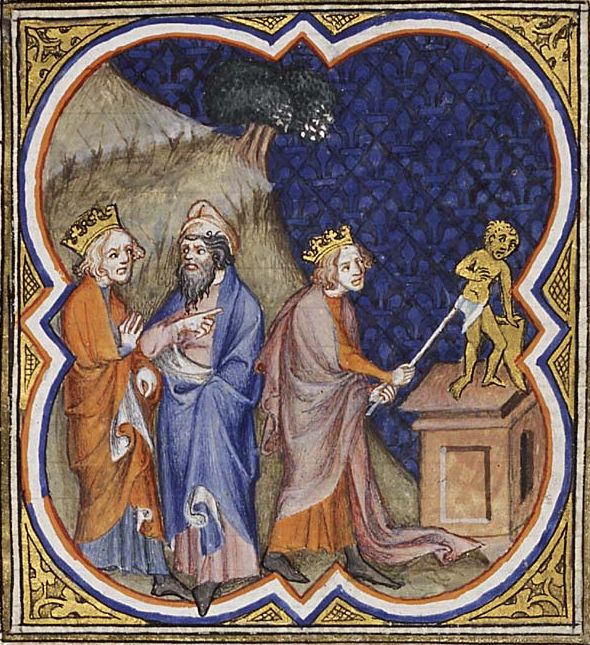
Asa Destroys Idols,
Petrus Comestor Bible Historiale, France, 1372

The exclusivity of this arrangement between God and the Israelites leads to rules that discriminate against non-Israelites.  For example, in the book of Deuteronomy/Devarim, Moses warns the people that when they conquer their “promised land’ in Canaan and defeat the seven tribes already living there, they must not make any treaties with these tribes; they must not intermarry with them; and they must destroy all their religious items.

For you are a kadosh people to God, your god; God, your god, chose you to belong to It as a treasured possession, out of all the peoples on the face of the earth.  (Deuteronomy/Devarim 7:6)

Sifra, a collection of commentary on Leviticus that was probably compiled in the third century C.E., rephrases God’s direction at the beginning of the Torah portion Kedoshim this way: “As I, God, am set apart, so you must be set apart.” The same condition of being “set apart”—from other peoples or from other gods—defines how both the Israelite people and God are kadosh.


All of the passages in the Torah that include some version of Kedoshim you shall be, because kadosh am I” concern activities in the physical world: obeying or decreeing ritual rules; behaving ethically; and excluding other people and other gods. None of these passages mention spiritual transcendence.

Later in the Hebrew Bible, the prophets sometimes use the word kadosh to indicate that God is an awesome and overpowering mystery.10  In the 16th century C.E., the Maharal of Prague wrote that a person or act is kadosh when it is transcendent in its essence—like God.11 And in the 18th century, Hassidic rabbis defined holiness as an intense and continuous attachment and devotion to God. This deep mental connection let God’s holiness flow into a person.12

But in the book of Leviticus, kadosh describes something in the physical world: an object, a place, a day, a priest—or an ordinary Israelite’s actions in the world, or God’s actions in the world.

What it means to say God’s actions are kadosh depends on how you define “God”—and that determines what human beings do to become kadosh.

1. The God of ritual purity

Some people think of “God” as the anthropomorphic biblical character who makes all the rules. They strive to follow whatever rules their current human leaders have selected from the Bible in a literal way, eschewing symbolism. (It would be impossible to follow all the rules in the Bible; some contradict each other, and some cannot be performed in the modern world.)

To the extent that literal-minded religious people achieve this, they consider themselves holy. But all too often this definition of God leads people to denounce those who they believe are not following their chosen biblical rules.

2. The God of moral virtue

Some people think of “God” not as an anthropomorphic being, but as a theological abstraction of perfection: omnipotent, omniscient, and omnibenevolent. Others think of “God” as the force of goodness in the world. Either way, “God” is perfectly virtuous by definition, and the bible should not always be taken literally.

When people think of “God” as an ethical ideal (from the original 13 attributes to modern variations on “God is love”), and they try to become holy, they strive to act with more forethought or kindness or compassion toward others—thus imitating their God.

3. The God of exclusive possession

Some Jews consider themselves the “chosen people”, descendants of the Israelites with whom “God” has a special and exclusive relationship in the Hebrew Bible.  Some Christians consider themselves the “chosen people”, with whom “God” made a new covenant in the Christian Bible.

Defining God in terms of the in-group usually results in disparaging the out-group. People imitate the “God” who singles out one “chosen people” by discriminating against all other groups of people, who they assume are inferior and/or threatening.

If you want to become kadosh, be careful how you think about God!


1  Leviticus 20:3.  The Torah portion does not say whether sacrificing a child to the alien god Molekh profanes God’s reputation for separating the Israelites from people with other religions, or God’s reputation for the ethical act of banning child sacrifice.

2  Leviticus 18:1-30.

3  Seventeen of the twenty commandments in 19:3-18 are definitely about behavior toward other people, i.e. ethics.  The other three are:

* Observe Shabbat. (Leviticus 19:5)

* Do not worship idols. (19:4)

* Eat a wholeness-offering (שְׁלָמִים) in the first two days. (19:5-8)  This appears to be an instruction about ritual, but some commentators point out that the wholeness-offering is the only offering in which some of the roasted meat and grain is shared with guests. In order to make sure this large offering is eaten in two days, the person making the offering must invite multiple guests, so this commandment may also address the ethical virtue of generosity.

4  Rashi (Rabbi Shlomoh Yitzchaki), commentary on Leviticus 19:2.

5  Maimonides (Rabbi Moses ben Maimon), Guide for the Perplexed.

6  Rabbi Bachya ben Yosef ibn Pakudah, Kad HaKemach.

7  Rabbi Adin Even-Israel Steinsaltz, Talks on the Parasha, Koren Publishers, Jerusalem, 2015, p 250.

8  This is a summary of the “13 attributes” God proclaims to Moses in Exodus 34:6-7. However, 34:7 ends by saying that God punishes not only wrongdoers, but their children and children’s children, to the fourth generation.

9  God is called kedosh Israel, “the holy one of Israel”, twelve times in the first book of Isaiah and fourteen times in the second book of Isaiah, as well as in 2 Kings 19:22; Jeremiah 50:29 and 51:5; Ezekiel 39:7; and Psalms 71:22, 78:41, and 89:19.

10  One example is a vision of the first Isaiah: In the year of the death of the king Uzziyahu, I beheld my lord sitting on a high and elevated throne, and [God’s] skirts were filling the palace.  Serafim were standing over [God], six wings, six wings to each … And they would call, one to another, and say:  “Kadosh! Kadosh! Kadosh!  God of hosts!  [God’s] glory fills the earth!” (Isaiah 6:1-3)

11  Rabbi Yehudah Loew ben Betzaleil, a.k.a. the Maharal of Prague, Tiferet Yisrael 37.

12  Arthur Green, Speaking Torah, Vol. 1, Jewish Lights Publishing, Woodstock, Vermont, 2013, pp. 292, 295.
Haftarat Kedoshim—Amos: Chosen People

Every week of the year has its own Torah portion (a reading from the first five books of the Bible) and its own haftarah (an accompanying reading from the books of the prophets). This week the Torah portion is Kedoshim (Leviticus 19:1-20:27) and the haftarah according to some traditions is Amos 9:7-15.

Because God chose to rescue the Israelites from slavery in Egypt, the Israelites owe God their fealty and obedience. This idea appears throughout the Hebrew Bible and Jewish liturgy, including this week’s Torah portion, Kedoshim (“Holy”):

I myself am God, your god, who brought you out from the land of Egypt. And you must observe all my decrees and all my laws and do them; I am God. (Leviticus/Vayikra 19:36)

And you shall be holy to me, because I, God, am holy, and I separated you from the other peoples to be mine. (Leviticus 20:26)

Other peoples have their own gods. But the god that chose the Israelites as its own people is superior to all those other gods, according to the early books of the Torah.  The miracles God made in Egypt prove it.

The book of Deuteronomy, which was probably written in the mid-seventh century B.C.E., offers the Bible’s first definite statement of monotheism, the belief that there is only one god in the whole universe.

God is “the gods” in the heavens above and on the earth below; there is no other. (Deuteronomy/Devarim 4:39)

In this book the Israelites become the chosen people of the one and only god.

For you are a sacred people for God, your god, and God chose you to be Its am segulah out of all the peoples that are on the face of the earth. (Deuteronomy 14:2)

am segulah (עַם סְגֻלָּה) = a people (am) of personal possession (segulah); personally chosen people.

Yet a hundred years earlier, the prophet Amos hinted at monotheism with his claim that the same God is in charge of all the nations on earth. Amos was the first prophet to declare that God punishes every country that does wrong, not just the two kingdoms of the Israelites.

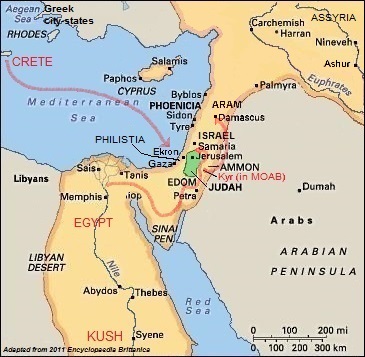
The book of Amos begins with dire prophecies of the downfall of every small country in the region: Aram and its capital, Damascus; the four city-states of the Philistines, from Gaza to Ekron; the Phoenician city-state of Tyre; the kingdoms of Edom, Ammon, and Moab; the southern Israelite kingdom of Judah; and the northern Israelite kingdom of Israel.

Amos says God will decree their destruction because of their various misdeeds. He does not mention the rising Assyrian Empire, which had already begun conquering or subjugating the small states to its west. But then, most biblical prophets assumed that God used foreign armies to punish people.  (See my post Haftarah for Bo—Jeremiah: The Ruler of All Armies.)

In the last chapter, this week’s haftarah, Amos questions the whole idea that God and the Israelites have a special relationship.

map Amos ch9 v7-8

“Aren’t you like the Kushiyim to me, children of Israel?” 

—declares God.

“Didn’t I bring Israel up from the land of Egypt,

“And the Philistines from Crete,

“And Aram from Kyr?

Hey! The eyes of my master, God

Are on the sinful kingdom.

“And I will wipe it off from the face of the earth.

“However, I will certainly not wipe out the house of Jacob”

—declares God. (Amos 9:7-8)

Kushiyim (כֻשִׁיִּים) = Kushites, black-skinned people, people from Kush (a region identified with Sudan and Ethiopia). Elsewhere the Bible treats Kushites like other foreigners from distant lands, countries with which Israel and Judah had no quarrel.   

So what if God brought the Israelites out of Egypt? God also brought other peoples to new lands. In the book of Amos, God does not play favorites.  In fact, Amos predicts that God is about to wipe out the northern kingdom of Israel—though some Israelites (a.k.a. the house of Jacob) will survive, and someday their descendants will return.

(The Assyrians did capture the capital of Israel, Samaria, in 720 B.C.E., and deported much of its population. Some northern Israelites fled south to the kingdom of Judah, which also considered itself part of the house of Jacob. Judah survived as a semi-independent vassal state of Assyria until the empire was conquered by the Babylonians around 610 B.C.E.)

It is tempting to read this week’s haftarah as an early statement of universalism: “Everyone is special, everyone is chosen in a different way.” At least Amos, unlike many other books in the Hebrew Bible, avoids triumphalism: “Only we are special, only we are chosen.” But I suspect Amos’s real point is: “Who do you think you are?  You’re not so special!”

Nevertheless, the book of Amos is a good antidote to the common late biblical view that there is only one god, and God singled out the Israelites to be Its personal possession.


Today, nobody follows the religion of the ancient Israelites, with its animal sacrifices and its laws about the sub-human status of slaves, women, children, and innocent bystanders in war. The Jewish religion has become much more ethical than the Israelite religion portrayed in the Torah.

Yet many people today, Jews and non-Jews, believe that their own religion is the only right one, the only true religion—and therefore they and their co-religionists are God’s chosen people.

I pray that we all receive the divine inspiration Amos received, and realize that God is not like a biased parent or teacher, singling out one child for extra benefits. God rescues lots of people and brings them to new lands. In God’s eyes, Israelites are the same as Kushiyim.

None of us are chosen ahead of time. We must make our own choices to become holy people.


Kedoshim: Holier than Thou

by Melissa Carpenter, maggidah

God spoke to Moses, saying: Speak to the whole assembly of the Children of Israel, and say to them: Kedoshim tiheyu, for kadosh [am] I, God, your god. (Leviticus/ Vayikra 19:1-2)

kadosh (קָדוֹשׁ) = holy; set apart for religious ritual. (plural kedoshim).

tiheyu (תִּהְיוּ) = you shall become, you shall be.

This divine directive, which opens the Torah portion Kedoshim, bundles together three statements:

1) You can, and should, become holy.

2)  God, the God of Israel, is holy. (Or God will be holy.  English requires a form of the verb “to be” between “holy” and “I” in this sentence, but Hebrew omits it, so we can only guess whether God is holy, or used to be holy, or will be holy.)

3)  God’s holiness is related to human holiness.

First, what does it mean for a human being to be holy? 

A place is called “holy” in the Hebrew Bible if it is physically close to a manifestation of God. (When Moses stands in front of the Burning Bush, he is standing on holy ground.  The Holy of Holies in the sanctuary or temple is where the voice of God manifests.)

Medieval depiction of high priest

Objects (such as incense pans) and days (such as Shabbat) are holy if they are set apart for religious use. The holy status of the high priest of the Israelites is probably due to both his proximity to God’s presence in the Holy of Holies, and the dedication of his life to service in the sanctuary.

The Torah mentions two other ways human beings can become holy. One way is by always obeying God’s laws and decrees.

This day God, your god, commands you to perform these decrees and the laws, and you must observe and perform them with all your heart and with all your soul.  …  And God promised to you today you will be Its treasured people … a holy people to God, your god, as [God] has spoken.  (Deuteronomy 26:16-19)

Another way that a person can become holy is by always acting ethically. In Kedoshim, after telling the Israelites to become holy, God provides a list of general rules of behavior which scholars call the Holiness Code.  The opening of the Torah portion is followed by a list of general rules, most of which are about treating other people ethically, from You shall respect your mother and your father (Leviticus:19:3) to You shall love your fellow as yourself (Leviticus 19:18).

So human beings become holy if they are set apart for religious ritual, if they observe and perform all of God’s laws and decrees, or if they consistently behave according to the ethics laid out in this Torah portion.

What does it mean for the God of Israel to be holy?

The god portrayed in the Bible is not holy in any of the three ways humans become holy.  God is not set apart for religious ritual; “He” also interferes in a variety of human affairs, telling people what to do, sending plagues, and frightening armies.  God does not obey “His” own laws and decrees, since they are written so they only apply to humans.  And the God character in the Torah violates at least two of the ethical imperatives in the Holiness Code.

You shall not do injustice in judgement … (Leviticus 19:15)

The God character often makes a judgement in anger and then wipes out the innocent with the guilty.  For example, “He” floods the earth and kills every human being except for Noah’s immediate family—deliberately drowning thousands of innocent children. Another example is when God is responsible for killing all of Job’s children and afflicting him with horrible diseases—just in order to find out what Job will do.

You shall not hate your brother in your heart; you shall certainly reprove your fellow person and …you shall not take vengeance.  (Leviticus 19:17-18)

In other words, when someone’s behavior angers you, you must give that person an opportunity to repent, rather than lashing back in revenge.  But in the Torah, God is often keen on vengeance.  For example, in the poem at the end of Deuteronomy/Devarim, God vows:

When I whet the lightning of My sword

And my hand seizes it with judgement

I will give back vengeance to My adversary

And My hated enemy I will repay.  (Deuteronomy/Devarim 32:41)

In later parts of the Hebrew Bible, God becomes more ethical.  A shining example is the book of Jonah, in which God rescues Jonah from drowning even though he has refused to obey God’s order to go to Nineveh, makes sure Jonah reproves the inhabitants of Nineveh so they have an opportunity to repent, withholds vengeance against them when they do repent, and reproves the refractory Jonah with a lesson in compassion.

The directive at the opening of Kedoshim is usually translated:

You shall be holy, for I, God, your god, am holy.

But maybe we should translate it this way:

You shall become holy, for I, God, your god, will become holy.

Medieval depiction of a seraph

Another way to explain the difference between human holiness and divine holiness is to note that God in the Bible seems to be holy by definition; anything pertaining to God is, or ought to be, holy.

One of the names of God is Ha-kaddosh, “the holy one”.  In the Prophets, God’s holiness appears to refer to a numinous experience of the divine beyond our ordinary perceptions.

In the year of the death of the king Uzziyahu, I beheld my Lord sitting on a high and elevated throne, and [God’s] skirts were filling the palace.  Serafim are standing up above him, six wings, six wings to each: with a pair it covers its face and with a pair it covers its feet and with a pair it flies. And it would call, one to another, and say:  “Kadosh! Kadosh! Kadosh! God of hosts!  Its glory fills the earth!” (Isaiah 6:1-3)

How is God’s holiness related to human holiness?

Nevertheless, there must be some relationship between God’s holiness and human holiness, or the opening directive in Kedoshim would not instruct us to become holy because God is holy.

In the first chapter of the book of Genesis, God creates humankind “in God’s image”. Even the primeval adam, human, seems to lack most of God’s traits, but he-she can speak and name things, has the potential to make new objects, and has the potential to acquire knowledge of good and bad—like God. Before they can actually make things or distinguish between good and bad, humans have to spend time learning and thinking.

I think that humankind also has the potential to become holy like God.  The first stage is to learn how to serve the divine and how to behave ethically.  Next we must dedicate ourselves to a divine purpose and to always striving to do the right thing.  After that comes practice.  I have met a few people who had practiced for a long time, and to me they seemed to embody holiness.  I could sense it just by being in their presence—the way someone who beheld God might be moved to sing out Kadosh! Kadosh! Kadosh!  Holy! Holy! Holy!

Kedoshim: Hard to Love

Some people are hard to love.

The word “love” in English and the word ahavah (אַהֲבָה) in Biblical Hebrew have the same wide scope, including all four of the types of love distinguished in Classical Greek: agapé (selfless devotion to the welfare of another), eros (sensual desire for and attachment to another person, or enthusiastic attachment to a pleasurable activity), philio (mutual affection and harmony between friends), and storgé (fondness for familiar people, animals, and places).

This week’s Torah portion, Kedoshim (“Holiness”), commands the agapé type of love, devotion to the welfare of another—even when warm feelings do not arise naturally, and the only reward is knowing you are doing the right thing.

You shall not hate your brother in your heart; you must definitely reprove your fellow person, so you shall not carry guilt because of him. You shall not take revenge and you shall not hold a grudge against the members of your people; ve-ahavta lerei-akah kamokha; I am God. (Leviticus/Vayikra 19:17-18)

ve-ahavta (וְאָהַבְתָּ) = and you shall love, and you shall be loving.

lerei-akha (לְרֵעֲךָ) = to your colleague, to your fellow.

kamokha (כָּמוֹךָ) = like you, like yourself, as yourself.

The phrase ve-ahavta lerei-akha kamokha is often translated as “and you shall love your fellow as yourself”. The problem with this translation is that the word rei-akha has the prefix le-, which is the preposition “to”.  So a more literal translation is: And you shall be as loving to your fellow as you are to yourself.

In other words, you are not required to feel love for your fellow humans, only to act loving toward them. If the fellow in question is someone you are in love with (eros), or a friend (philio), or a  familiar person you have grown fond of (storgé), then it is usually easy to act loving toward them.  But what about someone you are not fond of, someone who has wronged you?

This week’s Torah portion calls for agapé (devotion to the welfare of another) for those who have wronged us.  We are forbidden to take revenge, and we we forbidden to hold a grudge.  We may not feel love for them, but we must act as if we did, and at least banish any feeling of hatred.

We must reprove them for what they did, and then, even if they neither apologize nor make amends, we must let go of our anger. On top of that, we must devote ourselves to their welfare as we do to our own welfare.

Does this mean I have to spend just as much time and energy on improving the lot of my antagonists as I do on improving my own lot? Oy, vey! My time and my energy are limited, and I do not want to stint on doing good things for myself, my  family, and my friends so I can give equal time to people who I barely know and people who are not good to me. Anyway, why should I do anything good at all for someone who wronged me? Isn’t it enough to do no harm?

Maybe “And you shall be as loving to your fellow as you are to yourself” does not mean “And you shall be loving to your fellow [exactly as much as you are loving to] yourself”. It could also be translated: “And you shall be loving to your fellow, [who is] like yourself”. The classic commentary reminds us that we, too, are fallible, and we, too, make moral mistakes. If we can nevertheless be loving to ourselves, we can be loving to our fellows the same way.

Yet sometimes this argument is not enough. Sometimes you feel too upset about the other to be loving.  Sometimes you feel too ashamed to be loving to yourself. Then what? The book of Genesis/Bereishit says we are all created in the image of God. Jewish kabbalah says we all contain divine sparks; we are all part of God. 19th-century Rabbi Samson Raphael Hirsch wrote that since human beings are part of God and God wants us to perfect ourselves, it is our duty to devote care both to our own welfare and to the welfare of everyone else. This is how we can fulfill our duty to be loving toward God.

I would revise this argument to say that all human beings are moral agents for God. When we act lovingly, promoting what is good for every person, we are improving God (or the divine spirit, or holiness) as we improve the world. When we act hatefully, toward ourselves or toward anyone else, we are undermining God as we undermine the world. I know that “doing the right thing” myself will not help everyone I encounter, but I believe it will at least contribute to an overall improvement in the world. So I practice acting with kindness and respect for everyone, whether I feel like it or not. And the longer I do it, the more I feel like it.

So may it be for all of us.