Haftarat Kedoshim—Amos: Chosen People

Every week of the year has its own Torah portion (a reading from the first five books of the Bible) and its own haftarah (an accompanying reading from the books of the prophets). This week the Torah portion is Kedoshim (Leviticus 19:1-20:27) and the haftarah according to some traditions is Amos 9:7-15.

Because God chose to rescue the Israelites from slavery in Egypt, the Israelites owe God their fealty and obedience. This idea appears throughout the Hebrew Bible and Jewish liturgy, including this week’s Torah portion, Kedoshim (“Holy”):

I myself am God, your god, who brought you out from the land of Egypt. And you must observe all my decrees and all my laws and do them; I am God. (Leviticus/Vayikra 19:36)

And you shall be holy to me, because I, God, am holy, and I separated you from the other peoples to be mine. (Leviticus 20:26)

Other peoples have their own gods. But the god that chose the Israelites as its own people is superior to all those other gods, according to the early books of the Torah.  The miracles God made in Egypt prove it.

The book of Deuteronomy, which was probably written in the mid-seventh century B.C.E., offers the Bible’s first definite statement of monotheism, the belief that there is only one god in the whole universe.

God is “the gods” in the heavens above and on the earth below; there is no other. (Deuteronomy/Devarim 4:39)

In this book the Israelites become the chosen people of the one and only god.

For you are a sacred people for God, your god, and God chose you to be Its am segulah out of all the peoples that are on the face of the earth. (Deuteronomy 14:2)

am segulah (עַם סְגֻלָּה) = a people (am) of personal possession (segulah); personally chosen people.

Yet a hundred years earlier, the prophet Amos hinted at monotheism with his claim that the same God is in charge of all the nations on earth. Amos was the first prophet to declare that God punishes every country that does wrong, not just the two kingdoms of the Israelites.

The book of Amos begins with dire prophecies of the downfall of every small country in the region: Aram and its capital, Damascus; the four city-states of the Philistines, from Gaza to Ekron; the Phoenician city-state of Tyre; the kingdoms of Edom, Ammon, and Moab; the southern Israelite kingdom of Judah; and the northern Israelite kingdom of Israel.

Amos says God will decree their destruction because of their various misdeeds. He does not mention the rising Assyrian Empire, which had already begun conquering or subjugating the small states to its west. But then, most biblical prophets assumed that God used foreign armies to punish people.  (See my post Haftarah for Bo—Jeremiah: The Ruler of All Armies.)

In the last chapter, this week’s haftarah, Amos questions the whole idea that God and the Israelites have a special relationship.
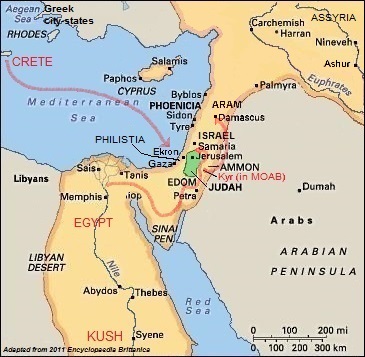
map Amos ch9 v7-8

“Aren’t you like the Kushiyim to me, children of Israel?” 

—declares God.

“Didn’t I bring Israel up from the land of Egypt,

“And the Philistines from Crete,

“And Aram from Kyr?

Hey! The eyes of my master, God

Are on the sinful kingdom.

“And I will wipe it off from the face of the earth.

“However, I will certainly not wipe out the house of Jacob”

—declares God. (Amos 9:7-8)

Kushiyim (כֻשִׁיִּים) = Kushites, black-skinned people, people from Kush (a region identified with Sudan and Ethiopia). Elsewhere the Bible treats Kushites like other foreigners from distant lands, countries with which Israel and Judah had no quarrel.   

So what if God brought the Israelites out of Egypt? God also brought other peoples to new lands. In the book of Amos, God does not play favorites.  In fact, Amos predicts that God is about to wipe out the northern kingdom of Israel—though some Israelites (a.k.a. the house of Jacob) will survive, and someday their descendants will return.

(The Assyrians did capture the capital of Israel, Samaria, in 720 B.C.E., and deported much of its population. Some northern Israelites fled south to the kingdom of Judah, which also considered itself part of the house of Jacob. Judah survived as a semi-independent vassal state of Assyria until the empire was conquered by the Babylonians around 610 B.C.E.)

It is tempting to read this week’s haftarah as an early statement of universalism: “Everyone is special, everyone is chosen in a different way.” At least Amos, unlike many other books in the Hebrew Bible, avoids triumphalism: “Only we are special, only we are chosen.” But I suspect Amos’s real point is: “Who do you think you are?  You’re not so special!”

Nevertheless, the book of Amos is a good antidote to the common late biblical view that there is only one god, and God singled out the Israelites to be Its personal possession.


Today, nobody follows the religion of the ancient Israelites, with its animal sacrifices and its laws about the sub-human status of slaves, women, children, and innocent bystanders in war. The Jewish religion has become much more ethical than the Israelite religion portrayed in the Torah.

Yet many people today, Jews and non-Jews, believe that their own religion is the only right one, the only true religion—and therefore they and their co-religionists are God’s chosen people.

I pray that we all receive the divine inspiration Amos received, and realize that God is not like a biased parent or teacher, singling out one child for extra benefits. God rescues lots of people and brings them to new lands. In God’s eyes, Israelites are the same as Kushiyim.

None of us are chosen ahead of time. We must make our own choices to become holy people.


Kedoshim: Holier than Thou

by Melissa Carpenter, maggidah

God spoke to Moses, saying: Speak to the whole assembly of the Children of Israel, and say to them: Kedoshim tiheyu, for kadosh [am] I, God, your god. (Leviticus/ Vayikra 19:1-2)

kadosh (קָדוֹשׁ) = holy; set apart for religious ritual. (plural kedoshim).

tiheyu (תִּהְיוּ) = you shall become, you shall be.

This divine directive, which opens the Torah portion Kedoshim, bundles together three statements:

1) You can, and should, become holy.

2)  God, the God of Israel, is holy. (Or God will be holy.  English requires a form of the verb “to be” between “holy” and “I” in this sentence, but Hebrew omits it, so we can only guess whether God is holy, or used to be holy, or will be holy.)

3)  God’s holiness is related to human holiness.

First, what does it mean for a human being to be holy? 

A place is called “holy” in the Hebrew Bible if it is physically close to a manifestation of God. (When Moses stands in front of the Burning Bush, he is standing on holy ground.  The Holy of Holies in the sanctuary or temple is where the voice of God manifests.)

Medieval depiction of high priest

Objects (such as incense pans) and days (such as Shabbat) are holy if they are set apart for religious use. The holy status of the high priest of the Israelites is probably due to both his proximity to God’s presence in the Holy of Holies, and the dedication of his life to service in the sanctuary.

The Torah mentions two other ways human beings can become holy. One way is by always obeying God’s laws and decrees.

This day God, your god, commands you to perform these decrees and the laws, and you must observe and perform them with all your heart and with all your soul.  …  And God promised to you today you will be Its treasured people … a holy people to God, your god, as [God] has spoken.  (Deuteronomy 26:16-19)

Another way that a person can become holy is by always acting ethically. In Kedoshim, after telling the Israelites to become holy, God provides a list of general rules of behavior which scholars call the Holiness Code.  The opening of the Torah portion is followed by a list of general rules, most of which are about treating other people ethically, from You shall respect your mother and your father (Leviticus:19:3) to You shall love your fellow as yourself (Leviticus 19:18).

So human beings become holy if they are set apart for religious ritual, if they observe and perform all of God’s laws and decrees, or if they consistently behave according to the ethics laid out in this Torah portion.

What does it mean for the God of Israel to be holy?

The god portrayed in the Bible is not holy in any of the three ways humans become holy.  God is not set apart for religious ritual; “He” also interferes in a variety of human affairs, telling people what to do, sending plagues, and frightening armies.  God does not obey “His” own laws and decrees, since they are written so they only apply to humans.  And the God character in the Torah violates at least two of the ethical imperatives in the Holiness Code.

You shall not do injustice in judgement … (Leviticus 19:15)

The God character often makes a judgement in anger and then wipes out the innocent with the guilty.  For example, “He” floods the earth and kills every human being except for Noah’s immediate family—deliberately drowning thousands of innocent children. Another example is when God is responsible for killing all of Job’s children and afflicting him with horrible diseases—just in order to find out what Job will do.

You shall not hate your brother in your heart; you shall certainly reprove your fellow person and …you shall not take vengeance.  (Leviticus 19:17-18)

In other words, when someone’s behavior angers you, you must give that person an opportunity to repent, rather than lashing back in revenge.  But in the Torah, God is often keen on vengeance.  For example, in the poem at the end of Deuteronomy/Devarim, God vows:

When I whet the lightning of My sword

And my hand seizes it with judgement

I will give back vengeance to My adversary

And My hated enemy I will repay.  (Deuteronomy/Devarim 32:41)

In later parts of the Hebrew Bible, God becomes more ethical.  A shining example is the book of Jonah, in which God rescues Jonah from drowning even though he has refused to obey God’s order to go to Nineveh, makes sure Jonah reproves the inhabitants of Nineveh so they have an opportunity to repent, withholds vengeance against them when they do repent, and reproves the refractory Jonah with a lesson in compassion.

The directive at the opening of Kedoshim is usually translated:

You shall be holy, for I, God, your god, am holy.

But maybe we should translate it this way:

You shall become holy, for I, God, your god, will become holy.

Medieval depiction of a seraph

Another way to explain the difference between human holiness and divine holiness is to note that God in the Bible seems to be holy by definition; anything pertaining to God is, or ought to be, holy.

One of the names of God is Ha-kaddosh, “the holy one”.  In the Prophets, God’s holiness appears to refer to a numinous experience of the divine beyond our ordinary perceptions.

In the year of the death of the king Uzziyahu, I beheld my Lord sitting on a high and elevated throne, and [God’s] skirts were filling the palace.  Serafim are standing up above him, six wings, six wings to each: with a pair it covers its face and with a pair it covers its feet and with a pair it flies. And it would call, one to another, and say:  “Kadosh! Kadosh! Kadosh! God of hosts!  Its glory fills the earth!” (Isaiah 6:1-3)

How is God’s holiness related to human holiness?

Nevertheless, there must be some relationship between God’s holiness and human holiness, or the opening directive in Kedoshim would not instruct us to become holy because God is holy.

In the first chapter of the book of Genesis, God creates humankind “in God’s image”. Even the primeval adam, human, seems to lack most of God’s traits, but he-she can speak and name things, has the potential to make new objects, and has the potential to acquire knowledge of good and bad—like God. Before they can actually make things or distinguish between good and bad, humans have to spend time learning and thinking.

I think that humankind also has the potential to become holy like God.  The first stage is to learn how to serve the divine and how to behave ethically.  Next we must dedicate ourselves to a divine purpose and to always striving to do the right thing.  After that comes practice.  I have met a few people who had practiced for a long time, and to me they seemed to embody holiness.  I could sense it just by being in their presence—the way someone who beheld God might be moved to sing out Kadosh! Kadosh! Kadosh!  Holy! Holy! Holy!

Kedoshim: Hard to Love

Some people are hard to love.

The word “love” in English and the word ahavah (אַהֲבָה) in Biblical Hebrew have the same wide scope, including all four of the types of love distinguished in Classical Greek: agapé (selfless devotion to the welfare of another), eros (sensual desire for and attachment to another person, or enthusiastic attachment to a pleasurable activity), philio (mutual affection and harmony between friends), and storgé (fondness for familiar people, animals, and places).

This week’s Torah portion, Kedoshim (“Holiness”), commands the agapé type of love, devotion to the welfare of another—even when warm feelings do not arise naturally, and the only reward is knowing you are doing the right thing.

You shall not hate your brother in your heart; you must definitely reprove your fellow person, so you shall not carry guilt because of him. You shall not take revenge and you shall not hold a grudge against the members of your people; ve-ahavta lerei-akah kamokha; I am God. (Leviticus/Vayikra 19:17-18)

ve-ahavta (וְאָהַבְתָּ) = and you shall love, and you shall be loving.

lerei-akha (לְרֵעֲךָ) = to your colleague, to your fellow.

kamokha (כָּמוֹךָ) = like you, like yourself, as yourself.

The phrase ve-ahavta lerei-akha kamokha is often translated as “and you shall love your fellow as yourself”. The problem with this translation is that the word rei-akha has the prefix le-, which is the preposition “to”.  So a more literal translation is: And you shall be as loving to your fellow as you are to yourself.

In other words, you are not required to feel love for your fellow humans, only to act loving toward them. If the fellow in question is someone you are in love with (eros), or a friend (philio), or a  familiar person you have grown fond of (storgé), then it is usually easy to act loving toward them.  But what about someone you are not fond of, someone who has wronged you?

This week’s Torah portion calls for agapé (devotion to the welfare of another) for those who have wronged us.  We are forbidden to take revenge, and we we forbidden to hold a grudge.  We may not feel love for them, but we must act as if we did, and at least banish any feeling of hatred.

We must reprove them for what they did, and then, even if they neither apologize nor make amends, we must let go of our anger. On top of that, we must devote ourselves to their welfare as we do to our own welfare.

Does this mean I have to spend just as much time and energy on improving the lot of my antagonists as I do on improving my own lot? Oy, vey! My time and my energy are limited, and I do not want to stint on doing good things for myself, my  family, and my friends so I can give equal time to people who I barely know and people who are not good to me. Anyway, why should I do anything good at all for someone who wronged me? Isn’t it enough to do no harm?

Maybe “And you shall be as loving to your fellow as you are to yourself” does not mean “And you shall be loving to your fellow [exactly as much as you are loving to] yourself”. It could also be translated: “And you shall be loving to your fellow, [who is] like yourself”. The classic commentary reminds us that we, too, are fallible, and we, too, make moral mistakes. If we can nevertheless be loving to ourselves, we can be loving to our fellows the same way.

Yet sometimes this argument is not enough. Sometimes you feel too upset about the other to be loving.  Sometimes you feel too ashamed to be loving to yourself. Then what? The book of Genesis/Bereishit says we are all created in the image of God. Jewish kabbalah says we all contain divine sparks; we are all part of God. 19th-century Rabbi Samson Raphael Hirsch wrote that since human beings are part of God and God wants us to perfect ourselves, it is our duty to devote care both to our own welfare and to the welfare of everyone else. This is how we can fulfill our duty to be loving toward God.

I would revise this argument to say that all human beings are moral agents for God. When we act lovingly, promoting what is good for every person, we are improving God (or the divine spirit, or holiness) as we improve the world. When we act hatefully, toward ourselves or toward anyone else, we are undermining God as we undermine the world. I know that “doing the right thing” myself will not help everyone I encounter, but I believe it will at least contribute to an overall improvement in the world. So I practice acting with kindness and respect for everyone, whether I feel like it or not. And the longer I do it, the more I feel like it.

So may it be for all of us.