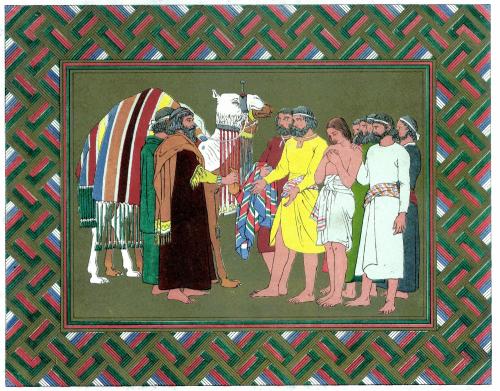
Mikeitz & Vayeishev: Yoseif’s Theology, Part 1

At age 17, Yoseif (“Joseph” in English) is a spoiled brat. He tattles on his ten older brothers, and he tells them two dreams that predict they will all bow down to him someday. His brothers hate him so much that they want to kill him. As soon as they are all far from home, they grab Yoseif, strip off the fancy tunic their father gave him, and throw him into a pit. Then they sell him as a slave to a caravan bound for Egypt.

Vayeishev: Success

No doubt this is a sobering experience for Yoseif; in Egypt he is far more diplomatic. As last week’s Torah portion, Vayeishev (Genesis 37:1-40:23), continues, we learn that Yoseif is also intelligent, and has what a modern person might call good luck. The Torah puts it another way:

And Y-H-V-H was with Yoseif, and he became a successful man … and everything that he did, God made successful in his hand. (Genesis/Bereishit 39:2-3)

Potifar, the Egyptian official who buys him, notices Yoseif ‘s achievements, and makes Yoseif his steward and personal attendant. What Potifar’s wife notices about the young Hebrew man is his exceptional good looks.

Joseph Flees Potiphar’s Wife, by Julius Schnorr von Carlsfeld, 19th century

And she said: “Lie down with me!” But he refused, and he said to his master’s wife: “Hey, my master … has not withheld anything from me except for you, his wife. Wouldn’t this be a great evil? And I would be doing wrong before Elohim!” /(Genesis 39:7-9) 

Elohim (אֱלֹהִים) = gods, a god, God.

This is the first time in the Torah that Yoseif mentions God. He uses a term that could apply to any god, although he would know the name Y-H-V-H, the personal name of the God of his father, Yaakov (“Joseph”). Perhaps Yoseif does not want to reveal that name to a foreigner. Or perhaps he uses a generic term so that Potifar’s wife will know what he is talking about.

Despite Yoseif’s refusal, Potifar’s wife keeps importuning him, and as soon as they happen to be alone in the house, she grabs him. Yoseif flees, leaving his garment in her hands. Spitefully, she accuses him of attacking her, and he is sent to jail.

In the dungeon, God blesses Yoseif with success again, and the prison overseer puts him in charge of all his tasks.

The overseer of the roundhouse did not need to look after anything at all in his hands, because Y-H-V-H was with him [Yoseif], and whatever he did, Y-H-V-H made successful. (Genesis 39:23)

One morning Yoseif asks two of the prisoners, Pharaoh’s chief cup-bearer and Pharaoh’s chief baker, why they are looking especially glum.

And they said: “A dream we have dreamed, and there is no interpreter for it!” And Yoseif said to them: “Aren’t interpretations from Elohim? Recount it, please, to me.”  (Genesis 40:8) 

All dreams in the Hebrew Bible are considered messages from God. Some dream symbols have obvious interpretations; Yoseif’s brothers had no doubt that his dream of eleven wheat sheaves bowing down to him meant that his eleven brothers would someday bow to him as if he were a king. But more difficult dreams require professional interpreters. Being in jail, Pharaoh’s two officials have no access to professionals.

According to Ramban, Joseph is not claiming either that he is a professional interpreter or that God answers his questions; he is merely saying “If it is obscure to you, tell it to me; perhaps He will be pleased to reveal His secret to me.’”1
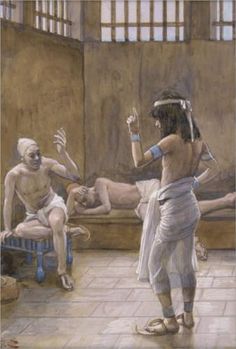
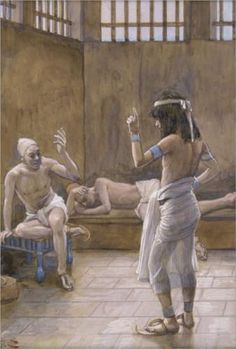
Joseph in Prison, by James Tissot, circa 1900

The two prisoners tell Yoseif their dreams, which seem like two variations of the same dream.

At this point, we might expect God to speak to Yoseif and tell him what their dreams mean. After all, hearing God speak runs in his family. God spoke to his father, Yaakov, and to his grandfather Lavan, in their dreams.2 And God spoke in the middle of the day to Yoseif’s other grandfather, Yitzchak (“Isaac”), and to his great-grandparents Avraham and Sarah.3

But God never speaks to Yoseif. Instead, dream interpretations occur to him on the spot. He assigns the two dreams of the prisoners different meanings, saying that in three days Pharaoh will pardon the chief cupbearer, but execute the chief baker. That is exactly what happens.

Mikeitz: Pharaoh

In this week’s Torah portion, Mikeitz (Genesis 41:1-44:17), Pharaoh4 has two dreams. When none of his magicians can interpret the dreams, Pharaoh’s chief cup-bearer speaks up and tells him about the young Hebrew dream interpreter in the prison. At once Pharaoh sends for Yoseif.

And Pharaoh said to Yoseif: “… I have heard about you, saying you [need only] hear a dream to interpret it.” And Yoseif answered Pharaoh, saying: “It is not in me! Elohim will answer, for Pharaoh’s welfare.” (Genesis 41:15-16)

Yoseif is still claiming that only God can interpret a difficult dream. Now he assumes that God will reveal the interpretations of two more dreams to him. He also assumes that the interpretations he gets from God will lead to Pharaoh’s welfare.
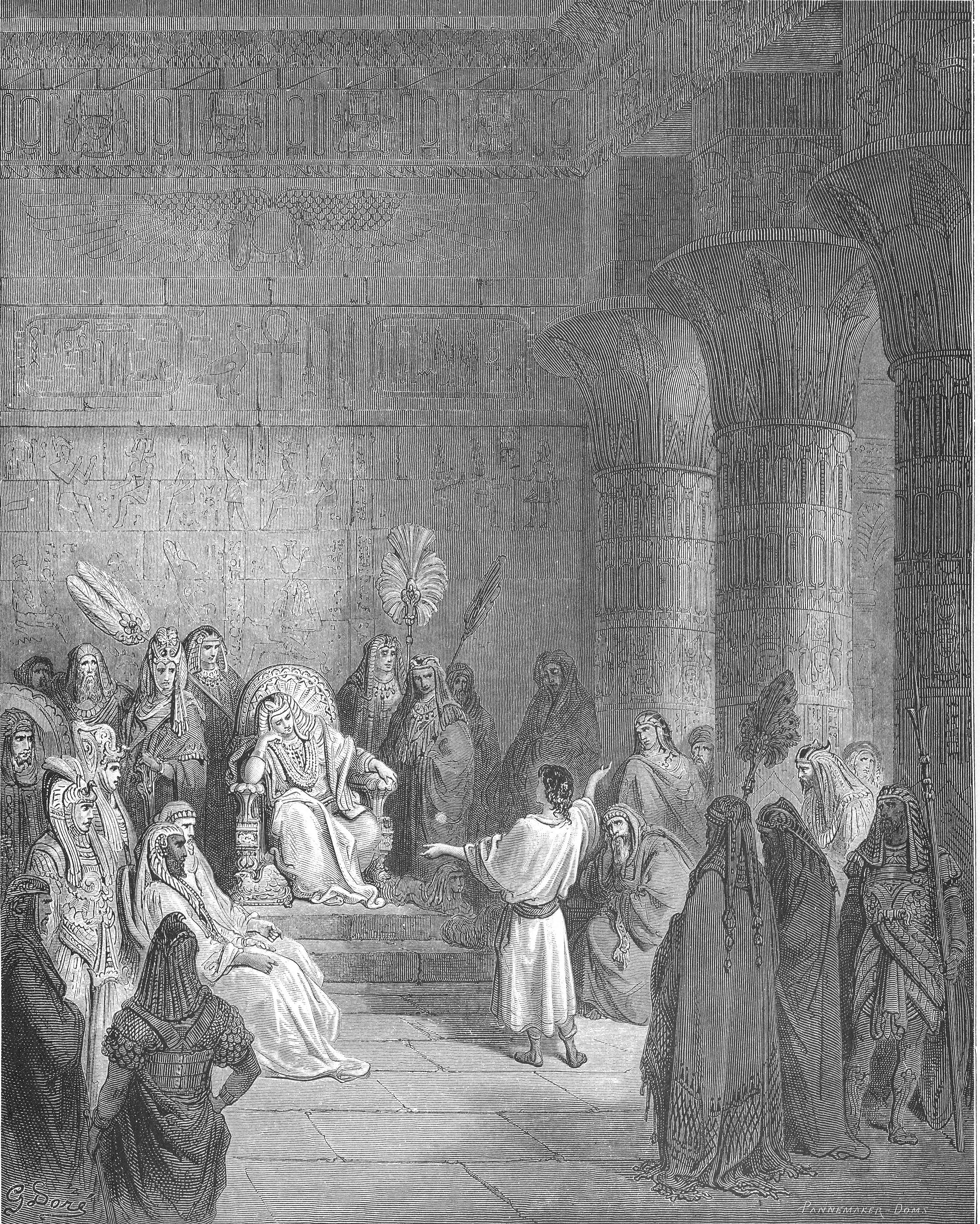
Joseph Interprets Pharaoh’s Dreams, by Gustave Dore, 19th century

Pharaoh tells Yoseif the two dreams. Again the interpretation of Pharaoh’s dreams occurs to Yoseif immediately. He announces:

“What the Elohim will do, he has told Pharaoh.” (Genesis 41:25)

Both dreams, Yoseif explains, are warning Pharaoh that there will be seven years of plenty followed by seven years of “very heavy” famine.

“And about the repetition of the dream to Pharaoh two times: [it means] that the matter is established by the Elohim, and the Elohim is hastening to do it.” (Genesis 41:32)

Although God does not control everything—the prophecies that God dictates to prophets in the Hebrew Bible only predict what will happen to people if they do not change their course of action—God does control the weather.

Next Yoseif unselfconsciously gives Pharaoh some advice.

“And now, may Pharaoh be shown a discerning and wise man, and may he set him over the land of Egypt.” (Genesis 41: 33)

Yoseif goes on to explain how this man must appoint overseers to stockpile grain during the seven good years, and guard the stockpiles as a reserve for the seven years of famine. Since he does not mention God when he tells Pharaoh the wisest course of action, we can assume Yoseif figures it out himself.

And Pharaoh said to his servants: “Could we find [another one] like this man, who has the spirit of an elohim in him?” (Genesis 41:38)

Pharaoh is not saying that Yoseif is possessed, but rather that he receives divine inspiration.

And Pharaoh said to Yoseif: “After an elohim has made you know all this, there is no one who is as discerning and wise as you. You yourself will be over my house! … See, I place you over all the land of Egypt!” (Genesis 41:39-41)

And he gives Yoseif his signet ring. Pharaoh remains the monarch, but Yoseif, at age 30, is now the ruler of Egypt.

Eight years later, after the famine has struck “the whole surface of the earth”,9 Yaakov sends his ten older sons from Canaan to Egypt to buy grain.

And Yoseif’s brothers came, and they bowed down to him, nostrils to the earth. (Genesis 42:6)

They do not recognize Yoseif, who is now shaved and dressed like an Egyptian, and converses with them through an interpreter without revealing that he knows Hebrew. But Yoseif recognizes them. He falsely accuses them of being spies, probably so that they will talk about their family. When Yoseif finds out that Yaakov kept his twelfth and youngest son, Binyamin (“Benjamin”), at home, he instantly hatches a plan to get his little brother down to Egypt. Yoseif and Binyamin are the only sons of Yaakov’s favorite wife, Rachel, and Yoseif may be afraid that his older brothers want to get rid of Binyamin, just as they got rid of him 21 years before.

He imprisons all ten of his older brothers for three days, then tells them that he will keep one of them as a hostage until they return with their youngest brother. At that point he hears their private conversation in Hebrew, in which they agree this must be a punishment (presumably from God) for ignoring Yoseif’s pleas from the pit long ago.5  (See my post Mikeitz: A Fair Test, Part 1.)

A year later, Yaakov finally lets Binyamin go to Egypt with his brothers, because the whole extended family is Canaan is starving. When Yoseif sees the grown man who was a child when Yoseif was sold as a slave, he says:

“Is this your littlest brother, of whom you spoke to me?” And he said: “May Elohim be gracious to you, my son!” (Genesis 43:29)

Yoseif himself plans to be gracious to Binyamin. But he also values God’s blessings.


So far, Yoseif is consistently using the generic term elohim to refer to God. He believes that God controls the weather, and also affects the lives of at least some individuals, including himself. He hopes that God will also improve Binyamin’s life. Yoseif recoils from the thought of committing an offense against God. He believes that dreams come from God, and seems to believe that when he interprets dreams correctly, God is inspiring him. Yoseif’s thoughts about God seem simple, and unlikely to upset anyone.

But in next week’s Torah portion, Vayigash, Yoseif goes out on a theological limb.


  1. Ramban (13th century Rabbi Moses ben Nachman), translation in www.sefaria.org.
  2. God speaks in dreams to Yaakov in Genesis 28:12-15 and to Lavan in Genesis 31:24.
  3. God speaks during the day, directly, to Yitzchak in Genesis 26:2-5 (and at night in 26:24), to Sarah in Genesis 18:15, and to Avraham in Genesis 12:1-3, 12:7, 13:14-17, 15:1-9, 17:1-21, 18:20-33, 21:12-13, and 22:16-18 (and in dreams in Genesis 15:12-29 and 22:1-2).
  4. The title “Pharaoh” in English is Paroh (פַּרֺה) in Hebrew. The bible uses it for every pharaoh, without an article.
  5. Genesis 42:21-22.

Vayeishev: Envy

A note on names: This blog has never been consistent about how biblical names are spelled. For years I used the standard English spelling (which borrows from early German biblical translations) for the most familiar characters and place-names, and transliterations of the Hebrew for all other names. In my last two posts, however, I transliterated every proper name (following it with the English version in parentheses the first time).

TThis week I realized that sometimes the English version of a name is close enough, especially if the only difference is a vowel sound, or if one of its letters is pronounced differently in Mizrahi Hebrew than in Ashkenazi Hebrew. However, I am not going back to using the English version of all the familiar names in the Hebrew Bible. When the English version sounds markedly different from the Hebrew—as in “Jacob” instead of “Yaakov”—I am going to use the Hebrew version (with the English version after the first reference, so everyone can keep track). Here goes!


One person has absolute power over a country or company. Another person has more wealth and status than you do, but is not the ruler. Which one do you fear or admire? Which one do you envy?


This week’s Torah portion, Vayeishev (Genesis 37:1-40:23), begins:

Joseph the Shepherd, by Marc Chagall

And Yaakov settled in the land of his father’s sojournings, the land of Canaan. These are the histories of Yaakov: Yoseif, at age 17, was tending the flock with his brothers, and he was a naar with the sons of Bilhah and the sons of Zilpah, his father’s women …  (Genesis 37:1-2a)

(Yaakov (יַעֲקֺב) is “Jacob” in English; his alternate name is Yisraeil (יִשְׂרָאֵל), “Israel” in English.  Yoseif (יוֹסֵף) is “Joseph”, Yaakov’s eleventh son.)

naar (נַעַר) = boy, young unmarried man, male servant, male slave.

We get a clue right at the beginning of the portion: the histories of Yaakov are all about Yoseif.

Job status

In the culture portrayed in the Torah, a man’s firstborn son gets an extra inheritance and extra responsibilities. Wives have more status than concubines, and the first wife has more status than the second. Reuben is the firstborn son of Yaakov and his first wife, Leah, so he should be at the top of the pecking order among the twelve brothers. Yoseif is merely Yaakov’s eleventh son, born to his second wife, Rachel.

Rachel, the woman Yaakov loved the most, died giving birth to Binyamin (“Benjamin”), her second son and Yaakov’s twelfth.1 Now Yaakov dotes on Rachel’s older son, Yoseif.

Yaakov also has two concubines, Bilhah and Zilpah. Once Yoseif is old enough to become a shepherd, like his brothers, he goes out with the four sons of the concubines, rather than with the six sons of Leah. According to Rashbam, “he spent most of his time in the company of those four children who were far closer to him in age.”2

Perhaps Yoseif is called a naar because he is an informal servant to his slightly older brothers. But the midrash3 says that he primps like a boy, even curling his hair and using kohl eyeliner. Other commentators explain that he is a tattletale because he is immature and does not know any better.

… And Yoseif brought dibatam to their father. (Genesis 37:2b)

dibatam (דִּבָּתָם) = slander about them, their slander, their bad reputation.

One way to rise in status is to denigrate your rivals, pushing them down the ladder. It only works if the boss at the top of the ladder believes you, but this is not a problem for Yoseif. Yaakov trusts everything he says, and later dispatches him to a distant pastureland to check on how his brothers are doing and report back.4

On the other hand, Yoseif may not be deliberately pushing his older brothers down the ladder. Maybe he denigrates them when he chats with his father simply because he does not understand them, and he has not yet learned the value of tact and discretion.

Conspicuous consumption

Jacob Blesses Joseph and Gives Him the Coat by Owen Jones, 1865

And Yisraeil loved Yoseif most out of all his sons, because he was a son of his old age, and he made him a ketonet passim. (Genesis 37:3)

ketonet (כְּתֺנֶת) = a long tunic/shirt/loose dress worn by both men and women. It was belted with a sash.5

passim (פַּסִּים) = ?  Translations include “multicolored” (as in the King James “coat of many colors”), “ornamented”, and “long-sleeved”.

The only other appearance of ketonet passim in the Hebrew Bible is in 2 Samuel 13:18-19, which notes that every unmarried daughter of King David wore one. Yoseif is only an assistant shepherd, but Yaakov gives him a royal garment.

He can afford it. Although Yaakov is a nomad, he has more wealth than many Canaanite kings. He returned to Canaan with servants, huge herds of cattle and flocks of goats and sheep, and the Rolls-Royces of the Ancient Near East: camels, so many that he could give his estranged brother 30 female camels with their colts and still have enough left as mounts for his two wives, two concubines, and twelve children.6

Yaakov is as rich as a king, but he has a ketonet passim made only for his favorite child. And Yoseif’s ten older brothers envy him—not just for his clothing, but for their father’s love.

They do not envy their father, who owns everything and issues all the orders. That is the unquestioned role of the oldest male in the family. Sometimes in the Hebrew Bible a younger son usurps the place of the firstborn son, but no one challenges the authority of the patriarch. So like Cain, who reacts to God’s unfair favoritism by attacking his brother Hevel (“Abel”) rather than God, the ten older brothers react to their father’s unfair favoritism by attacking Yoseif rather than their father. (See my post Vayeishev: Favoritism.)

At first their attacks are only verbal. 

And his brothers saw that their father loved him more than any of his brothers. And they hated him, and they could not speak to him peacefully. (Genesis 37:4)

Prophetic dreams

Then their little brother tells them two exciting dreams he has had. In the first dream, his brothers are binding sheaves, and all of their sheaves bow down to his sheaf.

Joseph’s Dream of Sheaves, by Owen Jones, 1865

And his brothers said to him: “Will you actually be king over us? Or will you actually rule over us?” And they hated him even more, because of his dreams and because of his words. (Genesis 37:8)

They do not mind their father ruling over them, but Yoseif is supposed to be their equal, or slightly less.

All dreams in the Hebrew Bible are divine communications about the future, never psychological symbols from one’s own unconscious, so Yoseif’s older brothers probably do not blame him for having a grandiose dream. But since they believe that a dream foretells an event that is likely to come true, they envy and resent him even more.

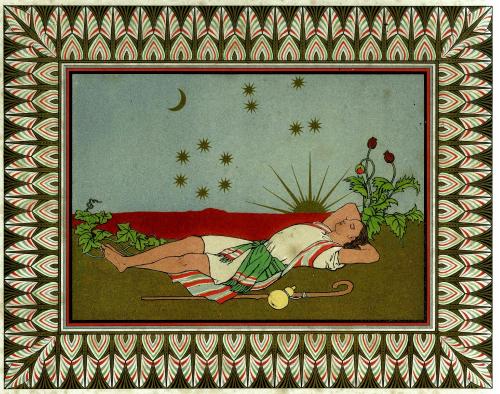
In Yoseif’s next dream the sun, the moon, and eleven stars are bowing down to him.

And he recounted it to his father and his brothers, and his father rebuked him, and said to him: “What is this dream that you dreamed? Will we actually come, I and your mother and your brothers, to bow down to the ground to you?” (Genesis 37:10)

Yaakov assigns the obvious meaning to the symbolism of the dream, even though Yoseif’s mother, symbolized by the moon, is no longer alive.

Vayekanu, his brothers, of him. And his father kept the matter in mind. (Genesis 37:11)

vayekanu (וַיְקַנְאוּ) = and they were jealous, and they were envious, and they were zealous.

One 18th-century commentary, Or HaChayim, explained: “When the brothers had heard this second dream they backtracked from accusing Joseph of wanting to be a ruler over all of them; they agreed that Joseph could not have aspired to rule over his own father. The very fact that he had such a dream, however, indicated that he had received a message from heaven. They were jealous of Joseph having received that communication.”7

Yaakov knows that his older sons resent Yoseif, but it does not occur to him that they hate their little brother so much that they would consider murdering him. According to Sforno, Yaakov “remembered it because he thought that the dream reflected what would in fact occur. In fact, his father was looking forward to the fulfillment of Joseph’s dream.”8

But Yoseif’s older brothers do not want a callow tattletale who does not even know how to handle sheep to rule over them like a king. At first, the only way they can think of to prevent Yoseif’s dream from coming true is to kill him. So when he travels all the way to Datan to check up on them, they seize him and throw him into an empty cistern. While they are eating lunch, ignoring Yoseif’s cries from the pit, they see a caravan bound for Egypt. Then they change their minds, and decide to get rid of him by selling him to the traders as a slave.

Twenty years later, the ten brothers travel to Egypt to buy grain. They do not recognize that Pharaoh’s viceroy is Yoseif.9 He is not a king, but he has power, and they bow down to him.


The ten older sons of Yaakov are all shepherds, and good at their business. Their father spent his whole life as a shepherd and livestock dealer. Naturally when Yoseif becomes an apprentice shepherd, the ten brothers expect him to be the kind of man they are (even if their father does fawn over him too much).

But Yoseif is different from his brothers. They excel at practical, hands-on work. He is an abstract thinker, good at planning and analysis. Today someone with Yoseif’s style of thinking would get a graduate degree and a high-status office job, becoming a member of what we now call the “elites”.

The brothers would not want his job even if they could get it. They like working outdoors, walking through fields under the open sky. But they resent his status, since he is neither their father nor their king. They are all sons of the same man. So why should Yoseif look down on them, wear a fancy suit, and get a high-status job? They envy and resent him so much that they want to destroy him.

“Elites” of the United States, beware!


  1. Genesis 35:16-26.
  2. Rabbi Shmuel ben Meir, a.k.a. Rashbam, 12th century, translation in www.sefaria.org.
  3. Midrash is a type of commentary that adds backstories and/or mystical meanings to the original text.
  4. Genesis 37:13-14.
  5. Isaiah 22:21.
  6. Genesis 30:43, 31:17-18, 32:14-15. At that point, Yaakov has 11 sons and one daughter, Dinah.
  7. Rabbi Chayim ben Moshe ibn Attar (1696-1743), translation in www.sefaria.org.
  8. Rabbi Ovadiah Sforno, 16th century, translation in www.sefaria.org.
  9. Because of his ability to plan ahead and organize, Yoseif becomes Potifar’s steward in Genesis 39:1-5, the prison supervisor in Genesis 39:22-23, and Pharaoh’s vizier in Genesis 41:25-44.

Mikeitz & Vayigash: Yisrael Versus Ya-akov, Part 2

Jacob is the only character in the book of Genesis who gets a new name and still keeps the old one. His parents name him Ya-akov (יַעֲקֺב, “He grasps by the heel”) at birth, because he comes out clutching his twin brother Esau’s heel. As he grows up, he tries twice to usurp Esau’s place in the family. He is crafty, and willing to cheat to get what he wants.

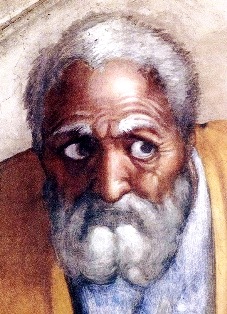
Jacob, by Michelangelo,
Sistine Chapel

Jacob goes to live with his uncle Lavan for twenty years, where he learns long-term planning and patience. As he is returning to Canaan with his own large family, he wrestles all night with an unnamed being—a divine messenger, but perhaps also his own alter ego—who blesses him with a new name: Yisrael (יִשְׂרָאֵל, “He strives with God”).

Yet in the remainder of the book of Genesis, he is referred to as Ya-akov more often than as Yisrael

When does the text call him Yisrael?

According to the 19th-century commentary Ha-amek Davar, Genesis calls Jacob Yisrael when it is ”indicating a return to a more elevated spiritual state”.1 But there are several examples when Yisrael’s state does not seem at all elevated.

In the two previous Torah portions, Vayishlach and Vayeishev, the narrative refers to Jacob as Yisrael in four scenes (See my post: Vayishlach & Vayeishev: Yisrael Versus Ya-akov, Part 1):

  • Ya-akov is overcome with grief whenhis favorite wife, Rachel, dies. But Yisrael pulls himself together and considerately moves his household and flocks from the roadside to good pastureland.
  • When he finds out that his son Reuben lay with Bilhah, one of Jacob’s concubines, Yisrael refrains from taking any action. Perhaps he simply has no emotional energy left after Rachel’s death.
  • Jacob’s favorite son is Joseph, Rachel’s older child. Yisrael gives a fancy tunic to Joseph but does not give anything to his other sons. Here he makes the same mistake his parents made when he was growing up as Ya-akov: playing favorites, which promotes jealousy.
  • Yisrael sends Joseph alone to a dangerous place to report on his ten older brothers who hate him. Here he is not thinking things through as well as Ya-akov did when he was younger.

In these four references, Yisrael seems like an old man who can see the need and handle the logistics to get his people and flocks to their next destination, but cannot figure out what to do about complex family relationships. The name Yisrael does not seem to indicate a more elevated spiritual state.

So far, the most consistent difference between the two names is that while Yisrael is always relatively calm, Ya-akov fluctuates between being calm and being at the mercy of strong emotions. He is overcome when Rachel dies, and again the end of the Torah portion Vayeishev when he believes Joseph has died. He jumps to that conclusion when his ten older sons bring home Joseph’s fancy tunic covered with goat’s blood. Ya-akov mourns extravagantly.

Joseph’s older brothers have actually disposed of him by selling him as a slave bound for Egypt. After some years in Egypt, Joseph gets a reputation as a dream interpreter.

Mikeitz: The famine

At the beginning of this week’s Torah portion, Mikeitz (Genesis 41:1-44:7), Joseph is summoned to interpret two of the pharaoh’s dreams. He explains that both dreams predict seven years of plenty followed by seven years of famine. The pharaoh makes him the viceroy in charge of agriculture, and Joseph stockpiles grain during the next seven years. (See my post: Mikeitz: An Unlikely Ascent.) When the famine begins, it affects not only Egypt, but also Canaan, where Joseph’s father and brothers live.

Ya-akov sends his ten older sons down to Egypt to buy grain. But he keeps his youngest son, Benjamin, at home. Benjamin is his only other son by his beloved deceased wife, Rachel. Now that Joseph is gone, Benjamin has become Jacob’s favorite.

And Ya-akov would not send Benjamin, Joseph’s brother, with his brothers. For he said: “Lest harm happens to him!”  (Genesis 42: 4)

Ya-akov does not mind so much if harm happens to any of his sons by his other wives or concubines.

When Jacob’s ten older sons arrive in Egypt, they do not recognize the viceroy as Joseph, but he recognizes them. He accuses them of being spies, and they babble that they are all brothers, all the sons of one man except for the youngest, who stayed at home. Joseph imprisons one of them, Shimon, and sells the rest of them grain on the condition that they return to Egypt with their youngest brother.

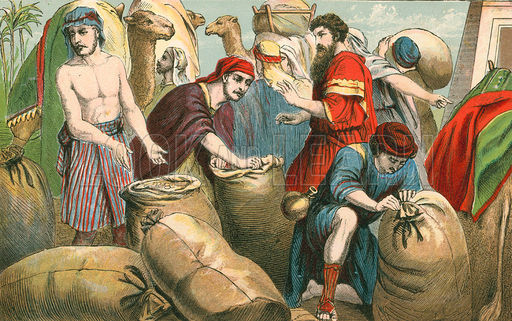
Joseph’s Brothers Find Money in their Sacks, Aunt Louisa’s Sunday Picture Book, ca. 1870

When they return to their father and empty their sacks of grain, they find the pouches of silver that they had handed over as payment. Why is the silver back in their bags? Everyone becomes frightened, including Jacob. As usual, when he is overcome by emotion, he can think only of himself.

And Ya-akov, their father, said to them: “Me you have bereaved of children! Joseph is not, and Shimon is not, and Benjamin you would take away. To me everything happens!” (Genesis 42:36)

Jacob has never been more self-centered. When his extended family has eaten all the grain, he tells his older sons to return to Egypt. One of them, Judah, reminds him that the viceroy will not sell to them again unless they bring Benjamin.

Then Yisrael said: “Why did you do evil to me, by telling the man you have another brother?” (Genesis 43:6)

Although the text calls him Yisrael now, Jacob still sounds self-centered (and not at all spiritually elevated). One would think his wrestling match with the unnamed being had never occurred. His sons dodge his accusation by saying that the viceroy had asked about their family.

Then Judah said to Yisrael, his father: “Send the youth with me, and we will get up and go, and we will live and not die: we, you, and our little children!” (Genesis 43:8)

Judah, addressing Yisrael, reminds his father that everyone’s lives are at stake, including his grandchildren. Then he personally pledges to bring Benjamin back. And Yisrael pulls himself together.

Then Yisrael, their father, said to them: “In that case, do this: Take some choice products of the land in your containers, and bring them down to the man as a gift: a little balsam, a little honey … And take twice the silver … Perhaps it was a mistake. And take your brother! Get up, return to the man. And may Eil Shaddai [i.e. God] give you mercy before the man, so he will release to you your other brother, and Benjamin. And I, if I am bereaved of children, I am bereaved of children!” (Genesis 32:11-24)

Here Jacob combines the best features of Ya-akov and Yisrael. Like Ya-akov in his youth and middle age, he is crafty and plans ahead. But unlike Ya-akov, he overcomes his selfishness. Yisrael even remembers that one of his least favorite sons, “your other brother” Shimon, is still imprisoned in Egypt, and he hopes for everyone’s return to Canaan. Having ordered the best arrangements he can devise, Yisrael is now willing to accept whatever happens.

Vayigash: Reunion with Joseph

The next time Jacob is referred to as Yisrael is in next week’s Torah portion, Vayigash (Genesis 44:18-47:27). Joseph reveals his identity to his brothers, then sends them with back to Canaan with twenty loaded donkeys and instructions to bring Jacob and his whole extended family down to Egypt.

And they went up from Egypt and came to the land of Canaan, to Ya-akov, their father. And they told him, saying: “Joseph is still alive! And indeed, he is the ruler of all of Egypt!” Then his heart grew numb, because he did not believe them. But they spoke to him all Joseph’s words he had spoken to them, and he saw the wagons that Joseph had sent to carry him, and their father Ya-akov’s spirit came back to life. (Genesis 43:25-28)

Again Jacob is called Ya-akov when he is seized by emotion. But then when he accepts the new reality, he changes from Ya-akov to Yisrael.

Then Yisrael said: “Enough! My son Joseph is still alive. I will go and see him before I die!” (Genesis 43:28)

Some classic commentators claimed that it is enough for Yisrael that Joseph is alive, and he does not care whether Joseph has become a powerful man. But according to Abraham ibn Ezra, Yisrael means: “This happiness is enough for me.”2

As Yisrael, Jacob can stop grasping for more. He accepts reality and understands limits. Like many old men, he also thinks about his own death—not in the melodramatic way Ya-akov reacted to Joseph’s bloody tunic and talked about going down to join Joseph in Sheol, but in the way mature people who have retired from their active lives consider what is left for them to do during their remaining years.

Joseph and Jacobs Reunited, by Owen Jones, 1865

Joseph meets the caravan in Goshen and embraces his father.

And Yisrael said to Joseph: “I can die now that I have seen your face, because you are still alive.” (Genesis 46:30)

Rabbi Adin Steinsaltz wrote that Jacob means: “I traveled here to see you, and now that we have reunited, I have received all that I could wish for and I lack nothing in life.”3

As Yisrael, Jacob is finally able to feel contentment. Jealousy and greed no longer motivate him.

At least in that moment. Humans can change, but there are always moments of backsliding. When Joseph introduces his father to the pharaoh, Jacob has slipped back into being Ya-akov. When the pharaoh asks him how old he is, Jacob answers like a grumpy self-centered old man complaining that his life is a waste.

Then Ya-akov said to Pharaoh: “The days and years of my sojourn are 130. The days and years of my life have been few and bad, and they have not attained the days and years of my fathers’ lives.” (Genesis 47:9)


When Jacob was young and had only one name, Ya-akov, he was calculating and selfish, but able to control his emotions better than his twin brother, Esau. When Jacob is old and has two names, Ya-akov and Yisrael, he remains calculating (when he has the energy) and often selfish. But he is not overcome by needy emotions, as his Ya-akov side is. Yisrael he accepts life as it is, does what he can, and is content.

Jacob’s two names indicate two models of old age. Now that I live in a retirement community, I have met a few fellow old people who complain often about the vicissitudes of old age: the aches and pains, the disabilities, the inefficiencies of the medical system, how their children have disappointed them. They are like Ya-akov, caught up in their own negative emotions.

I have also met many old people who are cheerful and grateful for what they do have: safe homes with heating and air-conditioning, a number of readily available services, and the company of fellow residents who delight in learning and in instigating and attending a wide variety of activities. They embody the Yisrael model of old age.

I hope I can spend most of the rest of my life being a Yisrael, doing what I can and enjoying what I do—while accepting that life is always uncertain and impermanent.


  1. Rabbi Naphtali Tzvi Yehudah Berlin, Ha-amek Davar,commentary on Genesis 43:28, translation by www.sefaria.org.
  2. 12th-century rabbi Abraham ibn Ezra, translation by www.sefaria.org.
  3. Adin Even-Israel Steinsaltz, The Steinsaltz Tanakh, Koren Publishers, Jerusalem, 2019, quoted in www.sefaria.org.

Vayishlach & Vayeishev: Yisrael Versus Ya-akov, Part 1

Jacob was born hanging onto the heel of his twin brother, Esau.

After that his brother emerged, and his hand was grasping the akeiv of his brother; so they called his name Ya-akov. (Genesis 23:26)

akeiv (עָקֵב) = heel.

Ya-akov (יַעֲקֺב) = “Jacob” in English. (From ya-ekov, יַעְקֺב  = he grasps by the heel; he cheats.)

The book of Genesis implies that from the beginning, Ya-akov wanted to be the firstborn son. In the Torah portion Toledot he tried to replace his brother twice, first by trading a bowl of stew for Esau’s inheritance as the firstborn, and then by impersonating Esau to steal their blind father Isaac’s blessing.

And Isaac loved Esau, because [Esau brought] hunted-game for his mouth. But Rebecca loved Ya-akov. (Genesis 25:28)

Their mother, Rebecca, arranged Jacob’s impersonation. Then when Esau vowed to kill his brother for cheating him twice, she arranged for Ya-akov to flee to her brother’s house in Padan-Aram. Twenty years later, Jacob returned with a large family of his own. On the eve of his reunion with Esau in last week’s Torah portion, Vayishlach (Genesis 32:4-36:43), Ya-akov receives a second name.

Vayishlach: A new name

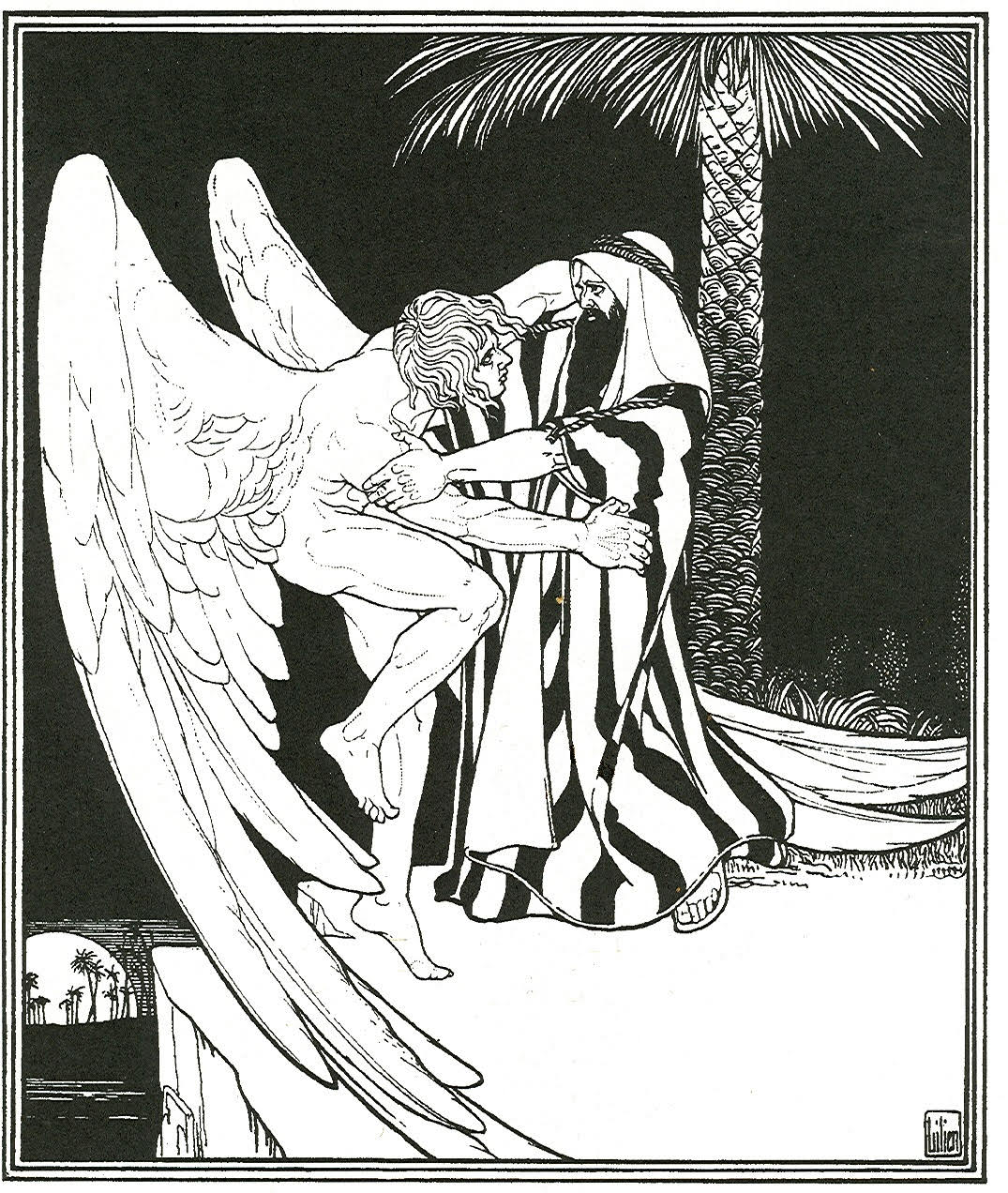
And Ya-akov was left alone. And a man wrestled with him until dawn rose. (Genesis 32:25)

Jacob Wrestles, by Ephraim Moses Lillien, 1923

The Hebrew Bible often calls a divine messenger (or angel) a “man” at first. Other theories are that Jacob’s wrestling partner is a demon, or his own alter ego or subconscious.1 They wrestle all night, and neither prevails. Then the mysterious “man” dislocates Jacob’s hip and said:

“Let me go, because dawn has risen!” But Ya-akov said: “I will not let you go unless you bless me.” Then [the “man”] said to him: “What is your name?” And he said: “Ya-akov.” (Genesis 32:27-28)

Twenty years before, when Jacob impersonated Esau to steal their father’s blessing, Isaac had asked him to identify himself. At that time, Jacob had answered: “I am Esau.” (Genesis 27:19) But when Jacob asks the unnamed wrestler to bless him, he answers: Ya-akov.” (Genesis 32:28)

And [the “man”] said: “It will no longer be said that Ya-akov is your name, but instead Yisrael, because sarita with God and with men and you have prevailed.” (Genesis 32:29)

Yisrael (יִשְׂרָאֵל) = “Israel” in English. (Possibly yisar, יִשַׂר  = he strives, contends, perseveres + Eil, אֵל  = God, a god. This combination could mean either “God strives” or “He strives with God”.)

sarita (שָׂרִיתָ) = you strove, you persevered.

A much shorter, dryer story about Jacob’s new name appears later in the portion Vayishlach:

And God appeared to Ya-akov again when he came from Padan-Aram, and [God] blessed him. And God said to him: “Your name is Ya-akov. Your name will not be called Ya-akov again, because your name will be Yisrael.” (Genesis 35:9-10)

Modern scholars attribute the two versions of the naming story to two different sources; the story about wrestling probably comes from a non-P author, while the less colorful renaming by God comes from a P author.2 Both versions give Ya-akov the additional name Yisrael, so this is not a case of two traditions using two different names.

In subsequent biblical books, Yisrael is also the name of a people, Jacob’s descendants. And in biblical poetry, some couplets call the people both Ya-akov and Yisrael, treating the two names as mere synonyms.3

In the rest of the book of Genesis, Jacob son of Isaac is referred to as Ya-akov most often, but occasionally the text calls him Yisrael. Does the switch to Jacob’s new name mean anything?

Vayishlach: Equanimity?

The first time the narrative uses the name Yisrael is right after the household stops on the road so Jacob’s favorite wife, Rachel, can give birth. She dies right after Jacob’s twelfth and final son, Benjamin, is born.

Ya-akov set up a standing-stone over her grave … And Yisrael moved on and pitched his tent beyond the tower of Eider. (Genesis 35:20-21)

Ya-akov grieves over the death of his favorite wife. But Yisrael moves on; he is responsible for getting his flocks to good pastureland.

And it happened when Yisrael was residing in that land: Reuben went and lay with Bilhah, his father’s concubine. And Yisrael paid attention. (Genesis 35:22)

Yisrael pays attention, but he does not act. He does not even bring up the episode until he is on his deathbed. The old Ya-akov might have been overcome with outrage that his eldest son usurped him, taking possession of a woman who belongs to him. But the new Yisrael is either too tired to react, or willing to accept whatever happens.

Vayeishev: Playing favorites

This week’s Torah portion, Vayeishev (Genesis 37:1-40:23), begins with Jacob under his old name.

And Ya-akov settled in the land of his father’s sojournings, the land of Canaan. And these are the histories of Ya-akov: Joseph, seventeen years old, shepherded a flock along with his brothers, and he was a youth with the sons of Bilhah and the sons of Zilpah, wives4 of his father. And Joseph brought bad gossip to their father. (Genesis 37:1-2)

Joseph is Rachel’s first son, so Jacob loves him more than the sons of his other three wives.

And Yisrael loved Joseph more than all his sons, since he was a son of old age to him. And he made him a fancy tunic. And his brothers saw that it was he whom their father loved more than his brothers, so they hated him, and they could not speak to him in peace. (Genesis 37:3-4)

Jacob Blesses Joseph and Gives him the Coat,
by Owen Jones, 1865

Transparent favoritism is not surprising from someone who grew up with parents who favored one son over the other. But why did the author or redactor attribute this favoritism to Yisrael rather than to Ya-akov? After all the striving that Jacob did while wrestling with God’s messenger (and/or himself), we might expect Yisrael to choose peace in the family, and treat his sons more fairly, perhaps giving each one a different gift.5

Shortly after that, all ten of Joseph’s older brothers take the family flocks to Shekhem, a journey of about 60 miles (about 100 kilometers) from their home in Hebron.  

And Yisrael said to Joseph: “Aren’t your brothers shepherding in Shekhem? Go, and I will send you to them!” (Genesis 37:13)

Rashbam wrote: “The wording reflects Ya-akov’s surprise that Joseph’s brothers chose to tend their sheep in a dangerous location such as Shekhem, where they had killed the local inhabitants not so long ago.”6

At least Joseph’s brothers are ten strong young men traveling together. But why does Yisrael risk sending  the teenage Joseph to Shekhem alone? What if someone who remembered the massacre identifies him as a member of the notorious family of killers?

Maybe Jacob is in denial, having forgotten the atrocities his older sons committed in Shekhem. In that case, the name Yisrael here might indicate Jacob’s old age and his desire for peace, but not increased wisdom.

 And [Joseph] said to him: “Here I am.” And [Jacob] said to him: “Please go and  look into the well-being of your brothers and the well-being of the flocks, and bring back word to me.” (Genesis 37: 14)

Jacob deliberately sends out his favorite son to report on his brothers. Yet he does not seem to worry about the safety of the seventeen-year-old boy when he is far from home, surrounded by brothers who hate him (and may well assume he intends to bring back to their father more “bad gossip” about them).

Classic commentators7 maintained that Jacob assumed his older sons would never attack Joseph. Yet Jacob himself once had to flee to another country because his own brother had vowed to kill him. Perhaps in old age, Jacob was losing his ability to connect the past with the present.

On the other hand, Yisrael might realize that he has pampered Joseph too long. He might even realize that giving only Joseph an expensive gift had contributed to his favorite son’s feeling of entitlement, which then led to Joseph telling his jealous brothers his two dreams in which they bowed down to him.8 Perhaps Yisrael, the man who  wrestled with himself, sees Joseph’s psychological problem and takes the risk of sending him to Shekhem so he can learn self-reliance and grow up. He might even comfort himself with the thought that surely God would look after Joseph, and he would come home as a wiser young man.

Vayeishev: Mourning

Joseph finds no one in the vicinity of Shekhem except a man who tells him his brothers traveled on to Dotan. When he arrives in Dotan, his brothers seize him, throw him in an empty cistern, threaten to kill him, and finally sell him as a slave to a caravan bound for Egypt. Then they come up with a plan for fooling their father.

And they took Joseph’s tunic, and they slaughtered a hairy goat and dipped the tunic in the blood … and they brought it to their father and said: “We found this. Please recognize whether it is your son’s tunic or not.” (Genesis 37:31-32)

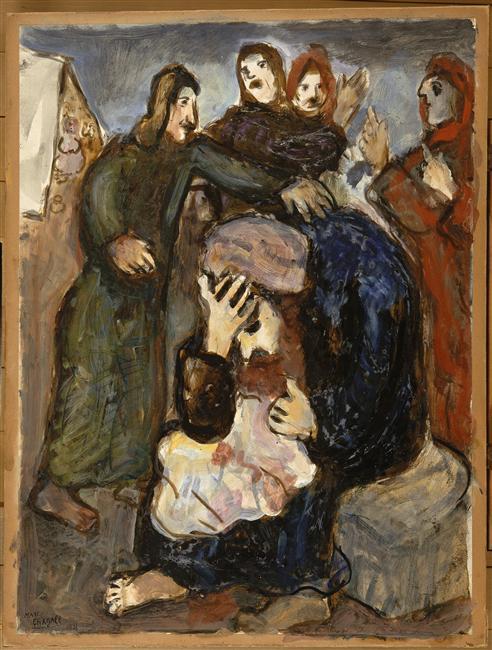
Jacob Weeps over Joseph’s Tunic,
by Marc Chagall 1931

Jacob falls for the deception; he assumes Joseph was eaten by a wild beast. He grieves as Ya-akov.

And Ya-akov tore his clothes, and he put sackcloth around his hips, and he mourned over his son a long time. And all his sons and all his daughters rose to comfort him, but he refused to be comforted. And he said: “If [only] I would go down to my son mourning, to Sheol!” And his father wept for him. (Genesis 37:34-35)

Jacob is entitled to grieve a long time over the death of his favorite son. But Ya-akov’s reaction is almost selfishly extravagant, consistent with his self-absorption while he was growing up: he rejects his children and grandchildren, and declares that he wants to die. His alter ego, Yisrael, does not have a chance to emerge.

The Torah does not refer to Jacob as Yisrael again until next week’s Torah portion, Mikeitz. Stay tuned for my next post, Mikeitz: Yisrael versus Ya-akov, Part 2.


  1. See my post Toledot & Vayishlach: Wrestlers.
  2. The documentary hypothesis discerns four traditions braided into the Pentateuch, named J, E, P, and D by Julius Wellhausen in the 19th century. In the 21st century the scholarly consensus is that there were more than four writers, and the story lines previously identified as J and E should all be called “non-P”. “P” is the “priestly” tradition, which was more interested in priestcraft than in narrative.
  3. Robert Alter, The Five Books of Moses, W.W. Norton & Co., New York, 2004, p. 181.
  4. Genesis always calls Leah and Rachel Jacob’s wives. Bilhah and Zilpah are their slaves, but after they become Jacob’s concubines, they are sometimes called his wives.
  5. This is what Jacob’s grandfather Abraham did in Genesis 25:5-6.
  6. Rashbam (12th-century Rabbi Shmuel ben Meier) translated in www.sefaria.org. In Genesis 34:1-31, Jacob’s older sons tricked all the men of the town of Shekhem into circumcising themselves, then slaughtered them and took their women and children as booty.
  7. Including Radak (Rabbi David Kimchi, ca. 1200), Chizkuni (editor Chizkiah ben Manoach, 13th century), and Or HaChayim (Rabbi Chayim ibn Attar, 18th century).
  8. See my post: Vayeishev: Favoritism.

Mikeitz: An Unlikely Ascent

From prison to palace, from slave to ruler, in one day.

At Pharaoh’s command, Joseph leaves the dungeon and becomes the vice-regent of all Egypt in this week’s Torah portion, Mikeitz (Genesis 41:1-44:17). Joseph has intelligence and God’s favor; Pharaoh has power. Yet Joseph’s elevation would not have occurred without the honesty of Pharaoh’s chief butler, the Egyptian “magicians”, and Joseph himself.

Joseph Sold into Slavery, by Own Jones, 1865

Joseph is a Hebrew youth who grew up as the favorite son of a rich man, Jacob. His descent was precipitous in last week’s portion, Vayeishev. His older brothers stripped off his fancy clothing, told a caravan bound for Egypt that he was a slave, and sold him. The Egyptian who bought him recognized Joseph’s intelligence and ability, and made him the head slave of his household. But his Egyptian master’s wife falsely accused him of attempted rape, and Joseph was thrown into the dungeon.

Thanks to the dishonesty and cruelty of his own brothers and his master’s wife, Joseph became the lowest of the low. At least he is not sentenced to death. Joseph lives in the dungeon, and once again his attitude and abilities lead to a small increase in status: the chief jailer makes Joseph his assistant, and lets him run everything inside the dungeon. But he is not allowed to leave.

The chief butler forgets

The portion Vayeishev ends with Joseph interpreting the dreams of two of his fellow prisoners. Joseph predicts that the former chief baker will be executed, but the former chief butler will be pardoned and restored to his post.

Joseph in Prison, by James Tissot, c. 1900

This man is the only person Joseph knows who will soon be in Pharaoh’s presence. He tells the chief butler he is innocent, and begs him to mention his case to Pharaoh.

The chief butler does not actually promise Joseph he will tell Pharaoh, but he does not demur. Yet the portion Vayeishev ends with the sentence:

But the chief butler did not zakhar Joseph, and he forgot him. (Genesis 40:23)

zakhar (זַכַר) = remember.

This week’s portion, Mikeitz, begins:

It was at the end of two years, and Pharaoh had a dream … (Genesis 41:1)

For two years nothing happened. The chief butler did not mention Joseph to Pharaoh. Joseph continued to live in the dungeon.

Why does the chief butler “forget” to bring up Joseph’s case?

An 18th-century commentary explained that the Torah says he “did not remember Joseph and he forgot him” to refer to two stages of forgetting:

“At the beginning he simply did not recall Joseph’s name, something that Joseph had asked him to remember. … This verse also informs us that the chief butler subsequently forgot Joseph completely, he erased the incident from his heart. … a deliberate act of forgetting.” (Or HaChayim)1

When I put myself in the chief butler’s place, I imagine that when he is first pardoned and restored to his position, he would want to keep his head down and not ask Pharaoh for any favors. I’ll bring it up later, he would think, after I’m sure Pharaoh trusts me again.

A few months later, when everything is going well, the man remembers Joseph. But now he does not want to remind Pharaoh about whatever he did that caused Pharoah to throw him into the dungeon in the first place. I imagine the chief butler rationalizing that he did not actually make a promise to Joseph. And it is not as if the young Hebrew man is under a death sentence. So gradually the butler forgets all about Joseph’s request—until Pharaoh asks for a dream interpretation.

A 12th-century commentator, Rashbam, wrote that God “performed a miracle for the sake of Joseph” by sending Pharoah two dreams that his own interpreters could not understand. That way, the chief butler “was forced to remember him.” 2

The chartumim do not cheat

Pharaoh has two dreams in a single night. In the first dream, seven healthy cows are eaten by seven gaunt cows. In the second, seven healthy ears of grain are swallowed up by seven thin, scorched ears.

Then it was morning, and his spirit was disturbed. And he sent out and summoned all the chartumim of Egypt, and all of its wise. But there was no dream-interpreter among them for Pharaoh. (Genesis 41:8)

Chartumim (חַרְטֻמִּים) = literate priests with occult knowledge. (Probably from the Hebrew word charut, חָרוּת = engraved, written. These high-level priests wrote down and read incantations out loud.)

Khamwese, Egyptian Priest and Heka manipulator, 13th century BCE

The word chartumim is often translated in English as “magicians”. But they were not magicians in the modern sense: people who create illusions and trick their audience. The ancient Egyptians believed that the gods created and maintained the universe with “heka”, a cosmic power that some individuals could also tap into and use to manipulate reality. Priests who were chartumim accomplished this through incantations and ritual actions.3

The Torah assumes that are that significant dreams are predictions about the future. In last week’s portion, when seventeen-year-old Joseph related his two dreams, his brothers and his father assumed they were predictions that someday they would bow down to Joseph (although they did not want to believe it).4

The other assumption in the portion Mikeitz is that chartumim were usually able to interpret significant dreams. Perhaps they failed with Pharaoh’s two dreams because their occult knowledge was about Egyptian gods. This time, although Pharaoh does not know it, his dreams came from the God of Abraham, the God of Joseph. So the rituals of the chartumim do not yield any results.

And they are honest enough to say so.

Thechief butler remembers

Then the chief butler spoke to Pharaoh, saying: “My offenses I am mazkir today. Pharaoh became angry with his servant, and he placed me in custody of the house of the chief of the guards, me and the chief baker.” (Genesis 41:9-10)

mazkir (מַזְכִּיר) = mentioning, recounting. (A form of the verb zakhar = remember.)

When the chief butler mentions his “offenses”, he probably is not including his failure to mention Joseph to Pharaoh. His “offenses” are whatever he did two years ago that offended Pharaoh. He chooses not to remind Pharaoh of exactly what he had done, but he does take the risk of Pharaoh remembering it—in order to help his boss now, and perhaps even in order to help the young Hebrew in the dungeon.

The chief butler continues:

“And one night we [both] dreamed a dream, I and he, each dream according to its own meaning. And there was with us a young Hebrew man, a slave of the chief of the guards, and we told him, and he interpreted our dreams for us … And it happened as he had interpreted for us: I was restored to my position, and he was hanged.”
 (Genesis 41:11-13)

This true account is all it takes to move the story along; the chief butler does not even need to add Joseph’s claim that he is innocent. Pharaoh is so eager to have his two disturbing dreams interpreted that he sends for Joseph immediately.

Joseph does not take credit

Then Pharaoh sent and summoned Joseph, and he was rushed out of the dungeon, and he shaved and he changed his clothes and he came to Pharaoh. And Pharaoh said to Joseph: “A dream I dreamed, and there is no interpreter for it. But I have heard it said about you: you [need only] hear a dream to interpret it.” (Genesis 41:14-15)

Pharaoh’s chief butler did indeed describe Joseph interpreting his dream and the chief baker’s dream right after he heard them, without engaging in any of the occult rituals the chartumim would use.

Joseph knows his dream interpretations in the dungeon were inspired by God; he would never have made such accurate guesses on his own. He had even told the chief butler and chief baker:

“Isn’t interpretation of them for God?” (Genesis 40:8)

Now that he stands in front of Pharaoh, Joseph once more refuses to pretend he has magic power of his own.  

And Joseph answered Pharaoh, saying: “Not I! Elohim will answer for the welfare of Pharaoh.” (Genesis 41:16)

Elohim (אֱלֺהִים) = plural of eloha, אֱלוֹהַּ = god. Elohim  = gods, god, God.

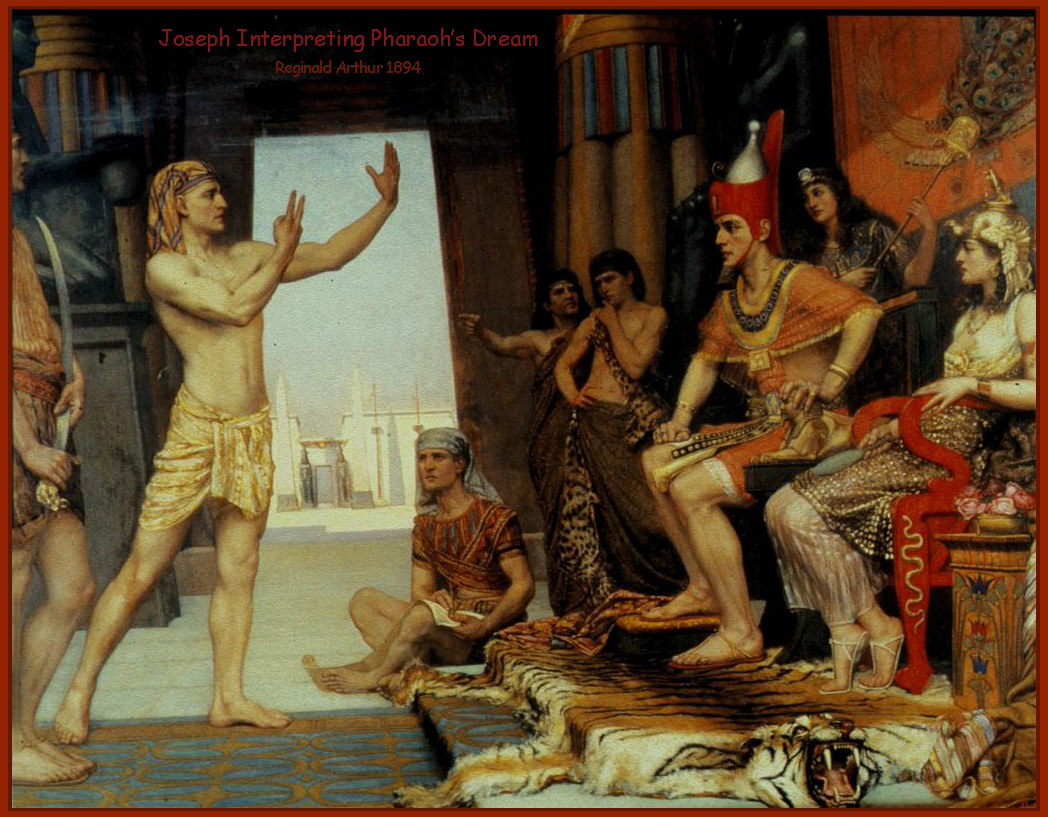
Joseph Interprets Pharaoh’s Dreams, by Reginal Arthur, 1894

Instead of using God’s personal name, Y-H-V-H, Joseph uses an ambiguous word that could as easily refer to the gods of Egypt as to Joseph’s God, the God of his great-grandfather Abraham. He is both honest about his own abilities, and intelligent about using a neutral word for God that will not trigger any negative reaction from Pharaoh.

With no further ado, Pharaoh tells Joseph his two dreams, concluding:

“And the scanty ears of grain swallowed up the seven good ears of grain. And I told the chartumim, but none [of them] was an explainer for me.” (Genesis 41:24)

Joseph might have decided to make the number seven mean seven years if he wanted to invent an explanation for the dreams of seven scrawny cows consuming seven fat cows and seven scanty ears of grain swallowing up seven good ears. But how could anyone invent explanations for the other elements in Pharaoh’s dreams that would turn out to be true predictions? There is too much at stake for anyone to prophesize without the help of a guidebook or a god.

The chartumim had no guidebook for the dreams sent by Joseph’s God. But Joseph has God, who instantly puts the meaning of the dreams into his mind. He explains the dreams to Pharaoh, ending with this summary:

“What the Elohim is doing, he made Pharaoh see. Behold, seven years of great plenty are coming throughout the land of Egypt. And seven years of famine will arise after them, and all the plenty in the land of Egypt will be forgotten, and the famine will completely use up the land. … And the dream came to Pharaoh two times because the matter was determined by the Elohim, and the Elohim is hastening to do it.” (Genesis 41:28-32)

Next Joseph gives Pharaoh some good advice. The text does not indicate whether God is transmitting these words to Joseph as well, or whether Joseph now had an idea of his own.

“And now, let Pharaoh select a man of discernment and wisdom, and set him over the land of Egypt. … And let them collect all the food of the seven good years … in cities under guard. And let the food be a reserve for the land for the seven years of the famine that will be in the land of Egypt. Then the land will not be cut down by the famine.” (Genesis 41:33-36)

And the thing was good in the eyes of Pharaoh and all his courtiers. And Pharaoh said to his courtiers: “Could we find another man like this, who has the spirit of Elohim in him?” (Genesis 41:37-38)

Pharaoh makes Joseph his viceroy on the spot—because the spirit of Elohim is in him.


Pharaoh needs a dream interpreter. He does not know that he also needs a viceroy in charge of agriculture and food rationing. Joseph wants to be released from both prison and slavery. He does not know what he wants to do once he is free.

Pharoah and Joseph need each other. But they would never meet, if it were not for the honesty of the Egyptian chartumim, and a belated good deed by Pharaoh’s chief butler. And their meeting would not have led to Joseph’s elevation if Joseph had not been honest about the true source of his dream interpretations. Pharaoh gives him the job title and the signet ring because he respects Elohim—whether that means Joseph’s God or many gods—and sees that Joseph has Elohim’s favor.

Does everything come together by chance? Are Joseph and Pharaoh just lucky?

Or does God arrange everything as part of a master plan? (Later in the Joseph story, Joseph tells the brothers who sold him into slavery “you did not send me here, but God!” and “you planned evil for me, but God planned it for good, in order to bring about this time of keeping many people alive.”)5

Or is it a combination of luck and the honest, ethical behavior of everyone involved at the time?

The same questions apply to our life stories today. When the right people do the right things and everything “clicks” for a good outcome, what do you attribute it to? Luck? A master plan of God’s? Or a combination of luck and a few individuals acting honestly for the good of everyone?


  1. Or HaChayim is a collection of 18th-century Moroccan Jewish commentary. Translation from www.sefaria.org.
  2. Rashbam is the acronym of 12th-century Rabbi Shmuel ben Meir. Translation from www.sefaria.org.
  3. Scott B. Noegel, “The Egyptian Magicians”, www.thetorah.com/article/the-egyptian-magicians; Flora Brooke Anthony, “Heka: Understanding Egyptian Magic on Its Own Terms”, https://www.thetorah.com/article/heka-understanding-egyptian-magic-on-its-own-terms.
  4. Genesis 37:5-11.
  5. Genesis 45:8 and 50:18-20. See my post: Vayigash & Vayechi: Forgiving?

Vayeishev: Question at Shekhem

His brothers went to pasture their father’s flocks at Shekhem. And Israel said to Joseph: “Aren’t your brothers pasturing at Shekhem? Go, and I will send you to them.” And [Joseph] said to him: “Here I am.” And he said to him: “Go, please, see the welfare of your brothers and the welfare of the flock, and bring back word to me.” (Genesis 37:12-14)

This passage in the Torah portion Vayeishev (Genesis 37:1-40:23) sounds pleasant—as if there were nothing ominous about Shekhem, or dangerous about sending Joseph to report on his brothers. But someone who reads the book of Genesis up to this point knows that something dire is about to happen.

At Shekhem: Rape and murder

The Seduction of Dinah, by James Tissot, ca. 1900

When Joseph and his half-sister Dinah were about twelve or thirteen years old, their father Jacob (a.k.a. Israel) brought his whole family to Shekhem1 and pitched camp next to the town. Jacob even purchased the land they were camping on, as if he intended to stay. Then one day Dinah walked into town alone “to see the daughters of the land”.2 Instead of making some female friends, she is abducted and raped by the son of the town’s ruler.

Jacob delayed taking action until his older sons came home from pasturing the flocks. By that time the ruler’s son, also named Shekhem, had fallen in love with Dinah and talked her into changing her mind about him.3 Shekhem and his father came to Jacob’s camp to arrange a marriage. The son offered to pay Jacob any bride-price he asked for. The father upped the ante, proposing that his people and Jacob’s people would intermarry and become one people.4

Jacob said nothing. His sons pretended to agree to intermarriage if all the men of the town  circumcised themselves first.  After the men of Shekhem had done so, and were disabled by pain, two of Jacob’s sons, Simon and Levi, came into town and killed every male. They took their sister and left.  Then “the sons of Jacob” (which sons are not specified) plundered the town, seizing its women and girls as slaves, and its goods and livestock as booty.5

Then Jacob said to Simon and Levi: “You have stirred up trouble, making me stink among the inhabitants of the land, among the Canaanites and Perizites! And I am few in number, and they will gather together against me, and they will strike me and I will be destroyed, I and my household!” (Genesis 34:30)

To escape vengeance from neighboring towns, Jacob makes his whole household pack up and move south to Hebron.

Joseph was probably too young to participate in the massacre or the looting of Shekhem. His mother, Rachel, was protective of her only son; and when Jacob introduced his family to Esau and his soldiers, he placed Rachel and Joseph in back, the safest position.6

But Joseph saw his half-brothers Simon and Levi arm themselves with swords, go into Shekhem, and return covered with other men’s blood. Later that day Joseph saw his older brothers herding their new female slaves. And when the whole household packed up and took down the tents, Joseph knew that they were moving again to escape a possible counter-attack.

Now, only four or five years later, Joseph’s ten older brothers have taken the family flocks to
Shekhem, of all places. And his father wants him to go there and check up on them.

At Hebron: Joseph’s negative reports

Joseph is seventeen when Jacob sends him from their home in Hebron back to Shekhem. By this time Joseph’s ten older brothers hate him—partly because their father demonstrated blatant favoritism by giving only Joseph a garment fit for royalty; partly because Joseph told them two of his dreams, in which his brothers were bowing down to him; and partly because he maligns them when he reports to their father.7

Joseph, at age seventeen, was tending the flock with his brothers, and he was an assistant to the sons of Bilhah and Zilpah, his father’s women.8 And Joseph brought bad slander about them to their father.9 (Genesis 37:2)

Jacob may believe everything his favorite son says, and trust him to bring an honest report back from Shekhem. He may also be concerned that his ten older sons decided to take the flocks to Shekhem. (I assume that Jacob’s older sons are still making independent decisions without consulting their father, as they did several years before at Shekhem.)  What if someone from a neighboring town recognized them from the time before the massacre?

On the other hand, what if someone in the vicinity of Shekhem recognizes Joseph? This possibility does not seem to occur to Jacob.

Perhaps he does not think logically where his favorite son is concerned, especially now that Joseph’s mother, Rachel, has died. It also does not occur to Jacob that his older sons might hate Joseph so much that they are a greater danger to him than any neighbors of the former Shekhemites.

At Shekhem: The question

Joseph answers his father, “Here I am!” With the blitheness of a spoiled adolescent, he heads off alone for Shekhem.

And [Jacob] sent [Joseph] away from the valley of Hebron. And he came to Shekhem.  And a man found him, and hey! He was wandering in the fields. And the man asked him: “What tevakeish?” (Genesis 37:14-15)

tevakeish (תְּבַקֵּשׁ) = do you seek, will you seek, are you looking for. (A conjugation of the piel verb bikeish, בִּקֵּשׁ  = seek, look for, try to get.)

Joseph probably wandered off the road and through the fields looking for his brothers and the flocks. The Torah never identifies the “man” who questions Joseph. It might be an ordinary man, or it might be a “man” like the “man” who wrestled with Jacob in Genesis 32:25 and turned out to be a divine being. Most classic commentators said it was an angel, i.e. a divine messenger who looked like a man,10 though Ibn Ezra wrote that the man was simply someone passing by.11 

At Shekhem: Joseph’s answer

And he said: “My brothers I am mevakeish.  Tell me, please, where they are pasturing.” (Genesis 37:16)

mevakeish (מְבַקֵּשׁ) = seeking. (Another piel form of bikeish.)

Why does Joseph assume that a man who happens to be crossing a field near the former town of Shekhem would know who his brothers are, or where they went?

Perhaps Joseph’s polite request implies “if you happen to know”.12 Perhaps Joseph intuitively senses that the “man” is actually a divine messenger from God.13 Or perhaps he simply figures he might as well ask, just in case the man has seen them.

Growing up with his family’s religion and stories, Joseph would know that God’s divine messengers sometimes look like men—until they disappear. So the question “What do you seek?” might be an inquiry from God.  In that case, Joseph could take the opportunity to give a different answer, and receive a different response.

1) He could say: “I am seeking to find out what my brothers are doing wrong this time, so I can report back our father.”

He knows his father loves him more than any of his brothers, but he is old enough to wonder if it will last. Perhaps Joseph thinks that slandering his brothers helps to keep him in first place.

2) He could say: “I am seeking to find out what really happened when my family lived here in Shekhem.”

If Joseph had asked his mother and other adults in the household about Shekhem, their reactions combined with his own vivid but incomplete memories would give him a morbid fascination with the subject.

3) He could say: “I am seeking an interpretation of those two dreams I had in which my brothers were bowing down to me.”

His father and his brothers thought that Joseph was fantasizing that he would become a king and rule over them all.14 But what if the dreams were true prophecies from God? Was there something else he should know?

4) But he would not say: “I am seeking to know why my father sent me all the way to an abandoned city to check up on my brothers who hate me enough to kill me.”

If he had been more aware of his family’s psychology, Joseph would have been afraid of finding his brothers. Readers today might suspect Jacob of the psychological blindness of narcissism. (See my post: Mikeitz: Forgetting a Father.) We might also wonder about the Joseph’s older brothers, who were brought up in a family where two of their mothers were openly jealous of one another,15 where their father and grandfather were cheating one another,16 and where they literally got away with murder at Shekhem. Would these young men feel any ethical qualms about harming the little brother they hated?

Joseph has an excuse for giving up and going home, since he could not find his brothers near Shekhem. But he is determined to complete the mission his father sent him on. So instead of giving a more response, he merely tells the stranger that he is looking for his brothers.

Does Joseph feel some inner calling in the presence of God’s angel? Or does he simply believe, with the naivety of a spoiled seventeen-year-old, that he will return safely to his father in Hebron?

And the man said: “They pulled out from here, for I heard them saying: Let’s go to Dotan.”  So Joseph went after his brothers and he found them at Dotan.  (Genesis 37:17)

When the brothers at Dotan see Joseph approaching, some of them want to kill him right away and throw him into a nearby dry cistern. Reuben, the oldest, says they should throw him into the pit alive. So the brothers seize Joseph, strip off his royal clothing, and throw him in. Then a caravan headed for Egypt passes by, and the brothers sell him to the traders as a slave.17

They think they will never see him again. But the rest of the book of Genesis is a story about the complicated reconciliation between Joseph and his brothers, and how all the children of Israel ended up living in Egypt.


History haunts the story of Joseph and his brothers. They leave Shekhem with their father to make a fresh start; but then they return, and Shekhem becomes the place where Joseph makes the fateful decision to follow his brothers instead of going home. Jacob gives Joseph a royal tunic and Joseph blabs about his dreams and his brothers’ faults; and these relatively small errors in judgment lead to attempted murder, slavery, redemption, and four hundred years of exile in Egypt.

Everything is connected in the Joseph story. Everything he does matters.

I suspect this is true in our own lives as well. Before we act, before we speak, we might ask ourselves: What are we looking for?


  1. Shekhem was about 30 miles (50 km) north of Jerusalem, between two round hills, Mt. Gezerim and Mt. Eyval. (The common noun shekhem, שְׁכֶם, means “shoulders”.) The site is now part of the city of Nablus.
  2. Genesis 34:1.
  3. Genesis 34:2-4. See my post Vayishlach: Change of Heart, Part 1.
  4. Genesis 34:4-12
  5. Genesis 34:13-29.
  6. Genesis 33:1-2.
  7. Genesis 37:3-4. See my post Vayeishev: Favoritism.
  8. Jacob’s two wives, Rachel and Leah, gave him their slaves Bilhah and Zilpah as concubines in Genesis 30:3-9.
  9. The Hebrew word is dibatam (דִּבָּתָם), which could mean slander or negative gossip about them, reports of their own slander, or their bad reputation. See my post Vayeishev: What Drove Them Crazy.
  10. C.f. Aggadat Bereshit 73:3, Bereshit Rabbah 84:14, Midrash Tanchuma Buber, Rashi, Kli Yakar, Siftei Chakhamim.
  11. 12th-century rabbi Abraham Ibn Ezra.
  12. C.f. Ibn Ezra, Radak.
  13. C.f. Haamek Davar by 19th-century Naftali Zvi Yehuda Berlin.
  14. Genesis 37:5-11.
  15. Leah and Rachel in Genesis 29:31-30:24. Leah’s son Reuben, at least, knows about their competition for Jacob’s love when he gives his mother mandrake roots in Genesis 30:14.
  16. Lavan cheats his son-in-law Jacob in Genesis 29:18-27. Lavan and Jacob both try to cheat one another regarding Jacob’s wages in Genesis 30:31-30:2.
  17. Genesis 37:18-28.

Vayechi: When Jacob Bows

The prophecy

Joseph has two prophetic dreams when is seventeen, according to the Torah portion Vayeishev (Genesis 37:1-40:23). After the second dream, he tells his brothers:

“Hey, I dreamed a dream again! And hey! The sun and the moon and eleven stars mishtachavim to me!” And he reported [it] to his father and to his brothers, and his father rebuked him and said to him: “What is this dream that you dreamed? Will we actually come, I and your mother and your brothers, lehishtachot to the ground to you?” And his brothers were jealous of him, and his father observed the matter.  (Genesis/Bereishit 37:9-11)

mishtachavim (מִשְׁתַּחֲוִים) = were bowing down, were prostrating themselves. (From the root verb shchh, שׁחה = bow down deeply in humility, do homage.)

lehishtachot (לְהִשְׁתַּחֲוֺת) = to bow down. (Also from the root sh-ch-h.)

Joseph’s Second Dream, by Owen Jones, 1865

Joseph’s father, Jacob (a.k.a. Israel), is over 100 years old at this time, and so far the Torah has not mentioned him bowing down to anyone except his brother, Esau.

The previous prostration

That happened in the Torah portion Vayishlach (Genesis 32:4-36:43), when the two brothers met again after a twenty-year estrangement. Esau had vowed to kill his brother after Jacob had cheated him out of both his birthright and the blessing he expected from their father. Jacob had fled to his uncle’s house in Charan. When he finally headed home again, after acquiring a large family and his own fortune, he learned that Esau was coming down the road with 400 men to intercept him. Jacob did everything he could think of to prevent disaster: sending his brother generous gifts ahead of time, praying to God, and finally, as Esau came into view with his troop,

He himself went across to face him, vayishtachu to the ground seven times, until he came up to his brother. (Genesis 33:3)

vayishtachu (וַיִּשְׁתַּחוּ) = and he bowed down, and he prostrated himself. (Also from the root sh-ch-h.)

In the Hebrew Bible, prostrations are a way to demonstrate humility and deference to a superior—usually to a king or to God. By bowing down to Esau seven times, Jacob is symbolically renouncing any advantage he tried to get over Esau in his youth, and demonstrating as graphically as possible that he considers Esau his superior. His prostrations are the equivalent of a puppy rolling over and exposing its throat to an older dog.

Inferior to nobody

After Jacob and his family and servants depart from Esau in peace, he does not bow to anyone for over forty years. Why should he? Jacob, jealous of his twin brother’s extra rights as the firstborn, has always been self-conscious about his position in life. After he failed to secure the rights of a firstborn son by fraud, he labored in Charan for twenty years until he had earned them. Now Jacob is a chieftain with twelve sons, many slaves and employees, and a great  wealth of livestock. The chieftain of the town of Shekhem treats Jacob as an equal, and when he makes an offer to Jacob he goes out to his camp instead of summoning him to his own residence in town.1

Jacob does not bow down to God, either. He first encounters God in the dream with angels on a stairway, and when he wakes up he treats God as someone to bargain with, vowing to give God a tithe of his wealth if God protects him and brings him safely back home.2 When Jacob worships God, he does so by pouring oil on a stone or burning animal offerings on an altar.3

Jacob and his people settle somewhere near Hebron/Chevron in Canaan.4 After Jacob’s older sons come home from the field without their younger brother and show their father Joseph’s bloody tunic, Jacob thinks his favorite son is dead. He mourns Joseph for 22 years. During that time Joseph is actually living in Egypt, where he rises from slave to viceroy. Finally Joseph sends for his father and his whole extended family in last week’s Torah portion, Vayigash (Genesis 4:18-47:27).

And Joseph harnessed his chariot and went up to Goshen to meet Israel [a.k.a. Jacob], his father. And he appeared to him, and he fell on his neck and he wept on his neck a long time. Then Israel said to Joseph: “I can die now, after seeing your face, that you are still alive.” (Genesis 46:29-30)

But the prophetic dream Joseph had when he was seventeen is not fulfilled. Jacob’s brothers have already bowed down to him many times, but his father has not.

Jacob does not bow down to Pharaoh, either, when Joseph presents him at court. He greets the king of Egypt with a blessing, and answers Pharaoh’s inquiry about how old he is by saying he is 130, and his life has been hard and short.5 Then Jacob blesses the king again, and leaves.

The prophecy fulfilled

Jacob finally bows down for the second time of his life on his deathbed, in this week’s Torah portion, Vayechi (Genesis 47:28-50:26).

Then the time approached for Israel [a.k.a. Jacob] to die, and he called for his son, for Joseph, and said to him: “If, na, I find favor in your eyes, place, na, your hand under my thigh and do a loyal and faithful deed for me: don’t, na, bury me in Egypt. When I lie down with my forefathers, then bring me up from Egypt and bury me in their burial place!” (Genesis 47:29-30)

na (נָא) = please, pray, I beg you. 

Joseph gives his word, but Jacob wants the formal hand gesture of an oath as well.6

And he [Israel/Jacob] said: “Swear to me!” And he swore to him. Vayishtachu, Israel, upon head of the bed. (Genesis 47:31)

vayishtachu (וַיֱִשְׁתַּחוּ) = and he bowed. (Also from the root sh-ch-h.)

Many classic commentators wrote that Jacob bowed toward the head of his bed, because the presence of God is at the head of the bed of a sick person (and prepositions are ambiguous). But that interpretation implies he was standing up. The Torah has already told us that Jacob is 147, and his death is approaching. I have been at the beside of four people near death, and I believe even Jacob would be too feeble to stand up during his final days.7 Perhaps he is seated on his bed, resting against a cushion, and he manages to bow at the waist.

In that case, he is not bowing toward the head of his bed; he is probably bowing to Joseph. This was the opinion of 12th-century rabbi Shmuel ben Meir, known as Rashbam, who wrote: “ ‘And Israel bowed low’: To Joseph, from the place where he was at [the top of] the bed.”8

Rabbi Bachya ben Asher (1255-1340 C.E.), known as Rabbeinu Bachya, added: “Seeing that Joseph had agreed to honour his father by undertaking to fulfill his wishes, Yaakov in turn prostrated himself before him to show that he respected the position Joseph occupied as effective ruler of the country.”8

Jacob spent the first hundred years of his life struggling to be the one on top, the one in charge. But during his final years in Egypt, he accepts that his son Joseph is his superior. He knows he is dependent on Joseph to carry out his final request, so he uses the language of an inferior, using the subservient phrase “if I find favor in your eyes” and repeating he word na. Then he uses the gesture of a humble inferior, coming as close as he can to a prostration.

This is the moment when Jacob fulfills the prophecy of the dream his son Joseph had when he was seventeen.

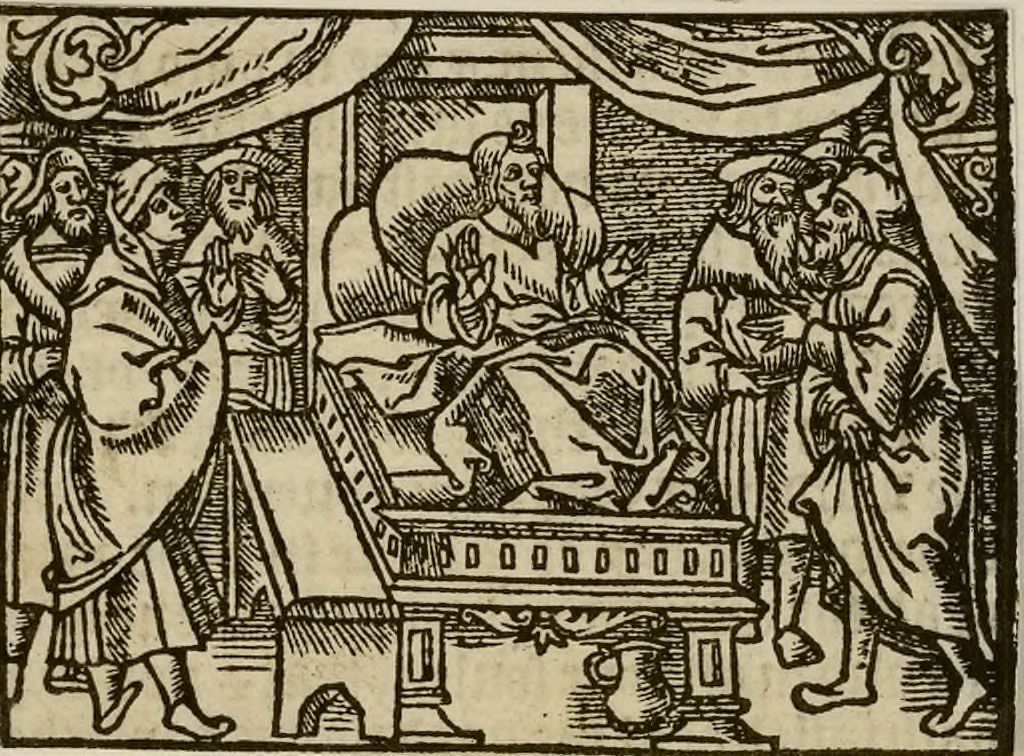
Jacob on his Deathbed, woodcut, 1539

After that, Jacob lives long enough to do the equivalent of rewriting his will, adopting Joseph’s two sons as his own so they will receive shares of the inheritance equal to those of Joseph’s brothers. Jacob also delivers his own prophecies to all his sons, predicting what will happen to the tribes that descend from them. Finally he orders all twelve of his sons to bury him with his deceased family members in the cave of Machpelah in Canaan.

And Jacob completed commanding his sons, and he drew back his feet in the bed, and he expired, and he was gathered to his people. (Genesis 49:33)

One prostration to Joseph before he died was enough for Jacob.


“Honor your father and your mother,” says the fifth of the Ten Commandments in the book of Exodus. In my post Yitro, Mishpatim, & Va-etchanan: Relative or Relevant? Part 1, I suggest that parents should also honor their children. But should they show humble submission to them, as Jacob did by bowing to Joseph on his deathbed?

Nobody would advise submission to a callow seventeen-year-old. But what about when the child is middle-aged, and the parent’s ability to deal with the world is declining in old age? If the adult child is competent and kind, then it would be better to humbly submit to that child’s arrangements than to insist on complete autonomy. I hope that is what I will do when I am considerably older—though I do not expect to live to age 147!


  1. Genesis 34:6-24.
  2. Genesis 28:20-22.
  3. Jacob’s journey south from Shekhem ends at the home of his father, Isaac, in Hebron/Chevron (Genesis 35:27). After that, the Torah only says Jacob lives “in the land of Canaan”, without specifying the location. His first stop on the way to Egypt is Beir-sheva, which is south of Chevron.
  4. Genesis 28:16-19, 33:19-20, 35:6, 35:13-14, 46:1.
  5. Genesis 47:7-10.
  6. Biblical Hebrew sometimes uses the word for “thigh”, yareich (יָרֵךְ) as a euphemism for the genitals. According to Pirkei DeRabbi Eliezer, midrash written between 630 and 1030 C.E., Jacob said: “O my son! Swear to me by the covenant of circumcision that thou wilt take me up to the burial-place of my fathers in the land of Canaan to the Cave of Machpelah.” (translation of Pirkei DeRabbi Eliezer 39:13 by sefaria.org)
  7. This is the first of Jacob’s three deathbed scenes. In the second, he has to summon his strength (vayitchaek, וַיִּתחַזֵּק) to sit up in bed.
  8. Both quotations are from sefaria.org.

Vayeishev & Vayigash: Is Joseph Ethical?

It is one thing to take an ethical stand when only you and a few other individuals are concerned. It can be harder to perceive and make the most ethical choice when a whole population is affected.

Joseph as ethical examplar

I have written before about Joseph’s iffy behavior as a troubled seventeen-year old and his older brothers’ inflated response: selling him as a slave to a caravan bound for Egypt.1 I have also written about how twenty years later Joseph saves his brothers’ lives and declines to take revenge, though he could easily enslave them; he merely puts them through a nerve-wracking test.2

Joseph acts even more ethically when he is propositioned by the wife of his Egyptian owner, Potifar. God blesses Joseph with success in everything he does, and Potifar promotes him to steward over his household in the Torah portion Vayeishev (Genesis 37:1-40:23). Potifar’s wife notices how good-looking Joseph is, and asks him to lie down with her.3

And he refused, and he said to his master’s wife: “Hey, with me, my master is not concerned about what is in the house, because everything that is his, he placed in my hand. There are none greater in this house than I am, and he has not withheld anything at all from me except you, since you are his wife. So how could I do this great wickedness, and be guilty before God?” (Genesis/Bereishit 39:8-9)

Joseph Flees Potiphar’s Wife,
by Julius Schnorr von Carlsfeld, 19th century

Joseph feels intuitively that committing adultery with his owner’s wife would be wicked. Potifar did not enslave him, but merely purchased him as a slave. Since then his owner has treated him well and trusted him completely. Joseph believes it would be wrong to cheat him.

He also believes that adultery is wrong according to God. Although the God of Israel does not explicitly prohibit adultery until the Ten Commandments,4 God has already punished two kings who unknowingly attempted adultery with Joseph’s great-grandmother Sarah. Furthermore, adultery is a general taboo in the region; both kings were appalled when they discovered what they had almost done.5

So when Potifar’s wife approaches him again, Joseph flees.

Several years later, Pharaoh has two significant dreams, and Joseph is called upon to interpret them. He tells Pharaoh that the dreams are God’s warning that Egypt will have seven years of plenty followed by seven years of famine. Then he advises Pharaoh to appoint someone make sure grain is stockpiled during the years of plenty. Pharaoh appoints Joseph viceroy in charge of all agriculture in Egypt.6

He spends the next seven years commandeering and storing Egypt’s excess grain. The Torah does not say how Joseph acquires the grain; it may be through eminent domain, for the public good. Or he may purchase the grain, as the United States purchases crude oil to stock its Strategic Petroleum Reserve. Either way, Joseph is earning his livelihood as Pharaoh’s agent in an ethical way.

We learn what Joseph does during the seven years of famine in this week’s Torah portion, Vayigash (Genesis 44:18-47:27).

Joseph, Overseer of the Pharaoh’s Granaries,
by Lawrence Alma-Tadema, 1874

Joseph as capitalist

During the first year of famine, Joseph sells grain from the government’s reserves for silver, the currency of that time and place, and brings the silver into Pharaoh’s palace. The second year of famine, there is no more silver left in either Egypt or Canaan.

Then all the Egyptians came to Joseph, saying: “Give us bread! Why should we die in front of you? For the silver is all gone.” (Genesis 47:15)

Rather than distributing grain for free, Joseph offers to trade grain for livestock. So that year Pharaoh acquires ownership of all the horses, donkeys, cows, and sheep in Egypt.

In the third year of famine, the Egyptians tell Joseph:

“We cannot hide from my lord that all the silver and the cattle [we] possessed have gone to my lord. Nothing remains before my lord except our bodies and our soil. Why should we die before your eyes, us and our soil? Keneih us and our soil for bread, and we will be slaves to Pharaoh. And give us seed, so we will live and not die, and the soil will not turn into desert.” (Genesis 47:18-29)

keneih (קְנֵה) = Acquire! Buy! (An imperative form of kana, קָנָה = acquired through purchase, ransom, or production.)

By the third year of the famine, the Egyptians are in the position of debt slaves who must sell both their land and themselves just so they can eat. Their poverty is entirely due to the weather, which is an act of God.

How does Joseph respond? First he acquires all the farmland in Egypt for Pharaoh—all except for the land Pharaoh had previously allotted to the priests,7 and the land of Goshen where Pharaoh invited Joseph’s extended family to settle.8

Vayiken, Joseph, all the soil of Egypt for Pharaoh, since all the Egyptian sold their fields because the famine was too strong for them. And the land became Pharaoh’s. (Genesis 47:20)

vayiken (וַיִּקֶן) = and he acquired. (Another form of kana.)

Since Pharaoh has a monopoly on all the grain remaining in the region, Joseph can sell the grain at any price he likes. If laissez-faire capitalism is ethical, then Joseph’s acquisition of all the farmland is ethical.

Next, in order to make sure that the Egyptian farmers know they no longer own the land they farm, Joseph moves whole communities to different areas. People have the same neighbors as before, but they live in a different place, and farm different plots than their parents and grandparents.

Is this ethical? It could be worse; at least Joseph deports existing communities together, so people have the same friends, neighbors, and social structure in their new location. But they do not have a choice about where to live. In that respect, they have indeed become slaves rather than citizens.

The Hebrew Bible accepts slavery as a necessary evil, but decrees that Israelites may only sell themselves as debt slaves for a term of six years. In the seventh year they must be freed, unless they choose to undergo a ritual committing them to their owner for life. And when owners free their slaves, they must supply them with goods that will give them a start in their new life.9

So if Joseph were ethical by later Israelite standards, he would buy the Egyptians as temporary slaves, and set them free after a reasonable number of years.

If he were ethical by modern standards, he would acquire their land, but not their bodies. No doubt they would choose to work for the government as tenant farmers for a while, since it was the only way they could get food. But when times improved, they would be free to choose another form of livelihood.

After Joseph acquires the farmland for Pharaoh and deports whole communities, he takes one more step.

Then Joseph said to the people: “Hey, kaniti you and your soil today for Pharaoh. See, there is seed for you, and you shall sow the soil. And when you harvest, you will give one-fifth to Pharaoh, and four-fifths will be yours to sow the field and to eat, you and everyone in your households and your little ones.” (Genesis 47:24)

kaniti (קָנִיתִי) = I have acquired. (Another form of kana.)

Thus Joseph institutes a system of serfdom, turning the people into permanent tenant farmers. Every year the farmers must give Pharaoh 20% of their harvest. It is not a tax on their income, but rather a split of the profits between the owner of the land and the workers who do the labor.

The farmers gratefully accept this arrangement simply in order to eat. They would rather be alive with no freedom and no belongings, than dead of starvation.

And they said: “He has kept us alive! We found mercy in the eyes of my lord, and we will be slaves to Pharaoh.” (Genesis 47:25)

Mandating a tenant farmer arrangement in perpetuity certainly benefits Pharaoh and his government, which will now receive a steady annual income of grain. Joseph is a successful administrator. But is his arrangement ethical?

Some classic commentators praised Joseph for his moderation. Since Egyptian farmers got to keep four-fifths of their harvest, they did not suffer hardship, according to Radak (13th-century rabbi David Kimchi) and 16th-century rabbi Obadiah Sforno. Sforno also noted that all slave-owners were responsible for feeding their slaves, so in the event of another famine Pharaoh would have to provide his tenant farmers with food.

However, the bottom line is that few human beings want to be someone else’s property. We want to make our own decisions about where we live and how we earn a livelihood. Joseph did less harm to the farmers of Egypt than he might have, but his actions were still unethical.

Is he motivated by a desire for revenge due to his own enslavement? Joseph threatens his brothers with slavery, but does not impose it. He knows them, and he overhears them admit to each other that they were guilty of enslaving him.10 He feels empathy for them, and turns away to weep.

He also feels warmhearted toward Potifar, who promoted him and trusted him. But he does not have any feelings about the farmers of Egypt.

I believe Joseph’s ethics are imperfect because he is human. It is hard to imagine the viewpoint of thousands of people you have never met. Yet someone with power in government must do just that in order to make ethical decisions. Saving lives is good, but it is not the only good.


  1. See my post Vayeishev: Favoritism.
  2. See my posts Mikeitz: A Fair Test, Part 1 and Part 2.
  3. Genesis 39:6-7.
  4. Exodus 20:13.
  5. Genesis 15:11-20, 20:1-7 and 47:27.
  6. Genesis 41:1-46.
  7. Genesis 47:22.
  8. Genesis 47:1-6, 47:11-12.
  9. Exodus 21:2-6, Deuteronomy 15:12-18.
  10. Genesis 42:21-24.

Vayeishev & Mikeitz: Blame

When something bad happens that is neither an accident nor an act of God, who gets the blame?

Blame a beast

Joseph’s ten older brothers cannot stand him anymore in last week’s Torah portion, Vayeishev (Genesis 37:1-40-23). Their father, Jacob, dotes on him, and he lords it over his brothers. When they are out with the flocks Joseph spies on them, and brings back bad reports to Jacob.

Jacob Weeps over Joseph’s Tunic,
by Marc Chagall

Once the brothers say they are taking the flocks to Shekhem, but they make an additional day’s journey to Dotan. There they look back down the road, and see their seventeen-year-old brother. Is there no escape?

Several of the older brothers decide to kill him then and there, throw his body into a pit, and tell Jacob a wild beast ate him. But Reuben tells them to throw him in alive, so his blood will not be on their hands. When Joseph prances up tot them, they grab him, strip off his fancy clothing, and heave him into the nearest dry cistern. Then while they are eating lunch, they see a caravan heading for Egypt, and Judah convinces his brothers to sell Joseph to the traders as a slave. That way they get rid of him and make some money, too. Before they go home, the brothers dip Joseph’s fancy clothing in goat’s blood. The ploy works; when they show the bloody garment to Jacob, he believes Joseph was killed by a wild animal. So far, they have escaped the blame.

Blame the victim

Meanwhile a high-ranking Egyptian named Potifar buys Joseph. Potifar notices that everything his new slave undertakes succeeds, so he advances Joseph to the position of steward of his household. Then Potifar’s wife tries to seduce the handsome young slave, but he refuses her on ethical grounds. When she grabs at his clothing he runs away, leaving his garment in her hand.1

When Potifar comes home, his wife shows him Joseph’s garment and says:

“He came to me, the Hebrew slave that you brought to us, to fool around with me! But it was like I cried out at the top of my voice, and he left his garment beside me and he fled outside.” (Genesis 39:17-18)

Blaming the victim works; Potifar sends Joseph to prison.

Blaming the guilty for a different crime

Joseph’s run of success continues in prison, and thanks to God he correctly interprets the dreams of two men in custody awaiting their sentences. One is executed and the other is exonerated, exactly as Joseph predicted. Two years later, in this week’s Torah portion, Mikeitz (Genesis 41:1-44:17), Pharaoh has two troubling dreams that none of his advisors can interpret. The exonerated man remembers Joseph, and he is brought up from prison.

Joseph tells Pharaoh that both of his dreams mean the same thing: seven years of plenty will be followed by seven years of famine. Then he gives Pharaoh some advice about stockpiling grain during the years of plenty. Pharaoh is so impressed with the young man that he elevates Joseph to his second-in-command. Joseph becomes a successful minister of agriculture.

After seven years, the famine comes not only to Egypt but to the whole known world. Jacob sends his ten older sons from Canaan down to Egypt to buy grain.

And Joseph saw his brothers, and he recognized them, but he acted like a stranger to them and he spoke to them harshly … (Genesis 42:7)

They do not recognize Joseph, who was seventeen when they sold him. Now he is thirty-seven, he has an Egyptian name, he shaves and dresses like an Egyptian, and he speaks through an interpreter.2 Joseph accuses his brothers of being spies. They blurt out the first reason that comes into their heads why they are innocent of this charge.

Joseph’s Brothers Bow to the Governor, by Owen Jones, 1865

And they said: “Your servants are twelve brothers! We are sons of one man in the land of Canaan. But hey, the youngest is with his father now, and the one is not.” (Genesis 42:13)

Joseph uses this scant information as a means to get the youngest of the twelve brothers down to Egypt—Benjamin, Joseph’s only full brother as well as the only innocent one. He puts his ten older brothers in the guardhouse for three days, then announces that one of them must stay behind under guard while the rest go home with the grain.

“But the youngest brother you must bring to me, so your words will be verified and you will not die.”And they said, one to another: “Ah! We are asheimim on account of our brother, because we saw the distress of his soul when he was pleading to us for pity, and we did not listen. Therefore this distress has come to us.”  (Genesis 42:20-21)

asheimim (אֲשֵׁמִים) = bearing the consequences of guilt. (A form of the verb asham, אָשָׁם = became guilty.)

The brothers finally blame themselves for doing something wrong. And they consider their punishment under a false charge their just deserts—although Reuben then tries to exonerate himself by saying:

“Didn’t I say to you: Don’t techetu about the boy? But you did not pay attention. And now here is the reckoning for his blood!” (Genesis 42:22)

techetu (תֶּחֶטְאוּ) = you be blameworthy, be at fault. (A form of the verb chata, חָטַא = was blameworthy, was at fault, missed the mark.)

Blame others for your own misery

Joseph keeps Simeon under guard while the others take grain home to their extended family. When they tell their father what happened, he complains:

“I am the one you bereave of children! Joseph is not, and Simeon is not, and [now] you would take Benjamin! Everything happens to me!” (Genesis 42:36)

Now that Joseph is gone, Benjamin is the only remaining child of Jacob’s favorite wife, Rachel. Jacob flatly refuses to let Benjamin go.

The famine continues. When Jacob’s family in Canaan has eaten all the Egyptian grain, he tells his sons to go back to Egypt for more. Judah points out that the Egyptian minister said they could not see him again unless they brought their youngest brother with them.

And Israel [a.k.a. Jacob] said: “Why did you treat me badly, telling the man you had another brother?” (Genesis 43:6)

Again, Jacob thinks only about himself, and blames his ten older sons for his own misery. They are, in fact, guilty of taking Joseph away from him, but they sold Joseph to relieve their own misery, not to afflict their father. But a narcissist does not think other people have their own independent motives.

Take the blame in advance

Then Judah steps up and promises to take responsibility for Benjamin. First he points out that if Benjamin does not go down to Egypt, he will die of starvation, along with the rest of the family.

Then Judah said to Israel, his father: “Send the young man with me, and we will go, and we will live and not die: me, you, and our little ones. I myself will be the pledge; from my hand you can seek him. If I do not bring him back to you and place him before you, then chatati for all time.” (Genesis 43:8-9)

chatiti (חָטָאתִי) = I am blameworthy, I have missed the mark. (Another form of the verb chata.)

Judah makes no extravagant promises, but he does accept blame ahead of time if anything goes wrong. That is enough. Jacob lets Benjamin go with his brothers to Egypt.


Accepting the blame when you are guilty is an ethical response. Yet humans instinctively shrink from being blamed. We do not want to look bad, and we do not want to be punished. On the other hand, humans find it all too easy to blame others without knowing the whole story.

Joseph’s ten older brothers are all responsible, in one way or another, for his disappearance from Canaan. But they deceive their father so that his blame will fall on a wild beast rather than on any of them. Jacob fails to investigate at the time, and years later he blames them for his misery over the loss of Joseph even though he has no evidence against them. He is not an ethical blamer.

Potifar’s wife takes pre-emptive action by delivering a false accusation before Joseph can tell Potifar what actually happened. Blaming the victim is still a common strategy of the guilty.

Joseph does not even try to defend himself against the woman’s accusation. But he makes a false accusation himself when his brothers come to him to buy grain. His accusation lets him manipulate circumstances so that his brothers finally blame themselves for their old crime, and so that in the long run he can transplant his whole family to Egypt, alive and well. The only punishment he afflicts on his guilty brothers is their anxiety about what he will do to them.

Judah turns out to be the best at handling blame. Although as a young man he is guilty of talking his brothers into selling Joseph as a slave, he changes over the years—most notably when he sentences his daughter-in-law to death for an illegal pregnancy, then learns the rest of the story. He publicly admits he was wrong and stops the execution.3

By the second year of famine, Judah is able to accept blame ahead of time for whatever happens to Benjamin, knowing that it is the only way he can get food for the whole family. And in next week’s Torah portion, Vayiggash, Judah fulfills his pledge by volunteering to become a slave in order to save Benjamin from that fate.

Some of the characters in Genesis never change. But others learn how to accept blame when they deserve it. May more of us today learn how to overcome our natural tendencies to slap blame on others and dodge it ourselves. If Joseph and Judah can change, so can we.


  1. See my post Vayeishev: Stripped Naked.
  2. Genesis 41:14, 42:23.
  3. See my post Vayeishev & Mikeitz: Symbols of Authority.

Vayeishev: Favoritism

This week I am having a good time rewriting a Torah monologue from the viewpoint of the snake in the Garden of Eden. I also made some Thanksgiving dishes, and looked over this week’s Torah portion, Vayeishev, the beginning of the story about Joseph and his brothers. This essay on Vayeishev comes from the first draft of my book on Genesis.

Joseph Cast into the Pit, by Owen Jones, 1865

Joseph’s ten older brothers are guilty of throwing him into an empty cistern with the intention to kill him, then selling him as a slave to a caravan bound for Egypt. Their behavior is clearly immoral.

What is less blatant is the unethical behavior of Joseph and his father, Jacob.

Joseph’s unethical behavior

These are the histories of Jacob: Joseph, at age 17, was tending the flock with his brothers, and he was a na-ar with the sons of Bilhah and the sons of Zilpah, his father’s women. And Joseph brought dibatam to their father. And Israel loved Joseph most out of all his sons, because he was a son of his old age, and he made him a fancy tunic. (Genesis 37:2-3)

na-ar (נַעַר) = boy, young single man, male servant.

dibatam (דִּבָּתָם) = slander about them, slander of theirs, their bad reputation.  (dibat, דִּבַּת = slander of, bad reputation of + suffix -am, ָם = third person masculine plural.)

Joseph is “a son of his old age”,1 but that is not the only reason Jacob (also called Israel) loves him the most.  Joseph is Rachel’s older son, and the Torah says that Jacob loves Rachel more than his other three women, Leah, Bilhah, and Zilpah.  When he meets Esau at the Yabok River, Jacob places Rachel and Joseph last, the farthest from harm.  After Rachel dies, Joseph is the person he loves most in the world.

In what way is Joseph a na-ar? At age 17, his role might be to assist some of his adult brothers in the family business.  Joseph is a na-ar with the four sons of Jacob’s concubines, Bilhah and Zilpah.

Perhaps Jacob divided his sons into two groups in charge of different flocks because Leah’s older sons destroyed Shekhem, and he does not trust them to be a good influence on Joseph, his favorite. (Probably Leah’s youngest three children, who are about the same age as Joseph, are assisting her four adult sons.)

Or perhaps Joseph chose to go out with the sons of the concubines because they are conscious of the inferior status of their mothers, and therefore defer to him.2

Besides being an assistant, Joseph acts like a juvenile (another meaning of na-ar) when he brings dibatam to Jacob.  He might be slandering his brothers.  Or he might be reporting that his brothers are slandering him.  If he were a young child there would be nothing wrong with running to his father and saying the equivalent of “Daddy, Daddy, they said mean words about me!” But at age 17, Joseph should be mature enough to fight his own battles, especially if they are battles of words; later in the story he turns out to be exceptionally intelligent.

The word dibatam refers to any words that harm another person’s reputation, whether they are the truth or slander.  Whether Joseph is lying about his brothers or merely reporting all of their actual bad deeds, he is lowering their reputations. There is no indication in the Torah that he does this to achieve any higher good.

Then he antagonizes his brothers even more by telling them one of his dreams.

Joseph’s Dream of Sheaves, by Owen Jones, 1865

And Joseph dreamed a dream, and he told it to his brothers, and it added to their hatred of him even more. (Genesis 37:5)

In this first dream, the brothers are binding sheaves, and all of their sheaves bow down to his sheaf. The brothers conclude that their younger brother wants to rule over them like a king.

Joseph’s behavior is ethically unsavory. He harms four of his brothers by making them look bad, and all ten of his older brothers by flaunting his dream of dominance, which makes them feel inferior.

Joseph’s weaknesses

What subverts Joseph’s ability to make better moral choices?

He knows, at least subconsciously, that he has done nothing to earn the status of Jacob’s favorite son; his father dotes on him merely because Rachel was his mother. Since Rachel’s death, Jacob has probably become even more attached to her older son.

Joseph cannot prove that he deserves his father’s esteem, but at least he can prove that the four sons of Jacob’s concubines deserve less esteem than he does by bringing his father bad reports, true or false.

Why does Joseph tell his brothers his dream? Is he too egocentric to realize that it will upset them? Or does he want to upset them, at least subconsciously?

Nobody sees Joseph as an individual; he is only Jacob’s favorite son. Since his mother’s death he has needed attention as a human being, not as a symbol.  Even negative attention is better than none. So he makes another poor moral choice, telling his brothers that according to the predictive world of dreams, they are going to be subservient to him.

Jacob’s unethical behavior

Jacob Blesses Joseph and Gives him the Coat, by Owen Jones, 1865

Their father, Jacob, foolishly shows his favoritism when he gives Joseph a fancy tunic. Like Cain, who reacts to God’s unfair favoritism by attacking his brother Abel rather than God, Joseph’s older brothers react to their father’s unfair favoritism by attacking their brother rather than Jacob.

At first their attacks are only verbal: they never speak a peaceful word to Joseph.3  Then their little brother tells them two of his dreams.

In Joseph’s second dream the sun, the moon, and eleven stars bow down to him.

And he told it to his father and to his brothers, and his father rebuked him, and said to him: “What is this dream that you dreamed? Will we actually come, I and your mother and your brothers, to bow down to the ground to you?” And his brothers were jealous of him, and his father observed the matter. (Genesis 37:10-11)

Joseph’s Second Dream, by Owen Jones, 1865

Jacob interprets the sun and moon as representing himself and Rachel (deceased), and the eleven stars as Joseph’s eleven brothers (including little Benjamin, Rachel’s youngest). It is not clear whether Jacob rebukes his favorite son for the content of the dream, or for telling it to his family. He observes that the dream makes Joseph’s brothers jealous, but he does not seem to be aware that he contributed to their jealousy by giving only Joseph an upper-class tunic.

Then Jacob’s ten older sons take the family’s flocks to Shekhem. Jacob gives Joseph instructions that might be straightforward—or might imply he does not trust his other sons, and he wants Joseph to continue acting as a tattletale.

And he said to him: “Go, please, see about the well-being of your brothers    and the well-being of the flock, and return word to me.” (Genesis 37:14)

Jacob knows that his older sons resent Joseph, but it does not occur to him that they hate Joseph so much they would consider murdering him.

Jacob’s weaknesses

Why does Jacob listen to Joseph’s bad reports about his brothers?

Subconsciously he may realize that his partiality for Joseph is based only on his love for the boy’s mother. (The Torah does not mention Joseph’s good looks or intelligence at this point.) Jacob may need a reason to believe that Joseph actually is superior to his brothers; then he would have less reason to feel guilty for his preferential treatment. So when Joseph gives him bad reports about at least four of his brothers, Jacob is happy to believe they are inferior.

Why does he send Joseph on a journey of several days4 to check up on his older brothers?

Perhaps he is merely worried that his older sons are up to no good. Or perhaps Joseph’s second dream has alerted his father that his favorite son is either narcissistic or dangerously naive. Traveling alone to Shekhem might teach Joseph more independence and give him time to reflect. He might even encounter God, as Jacob did when he traveled alone to Charan.

Those are charitable explanations. But it is also possible that Jacob is simply in the habit of soliciting more evidence that his bias toward Joseph is justified. The collusion between the father and his favorite son would make them seem closer, and that would reinforce Jacob’s bad  habit of asking Joseph to inform on his brothers.

Jacob is too narcissistic to realize that his own behavior is lowering Joseph’s moral standards. When he dispatches Joseph to Shekhem to check up on his brothers, he is too narcissistic to realize that he is jeopardizing his favorite son’s life.

When Joseph finally catches up with his brothers,

Joseph Sold into Slavery, by Owen Jones,1865

They said, each man to his brother: “Hey!  Here comes the master of dreams!  And now let’s go murder him, and let’s throw him into one of these pits, and we can say a wicked beast ate him.  Then we’ll see what happens to his dreams!”  (Genesis 37:19-20)

They do not murder Joseph, but they do sell him as a slave to a caravan bound for Egypt.

Small unethical deeds can have big consequences.


  1. Commentators disagree on Jacob’s age when his son Joseph is born. When Jacob leaves for Charan we know he is over 40 (Genesis 26:34); Nachmanides (13th-century rabbi Moshe ben Nachman, a.k.a. Ramban) wrote that he is 84.  (Like some other fabulously aged heroes of Genesis, Jacob has no problem with sex and physical labor after 80.)  Joseph is born 14 years after Jacob arrives in Charan (Genesis 29:14, 19-20, 27, 30; Genesis 30:25).  Although Leah’s youngest sons, Issachar and Zebulun, are born in the same year or two as Joseph, only Joseph is called the “son of his old age”.  Nachmanides explained that when Jacob was well over 100, he must have picked Joseph to be the son who took care of his physical needs in old age.
  2. Samson Raphael Hirsch, The Hirsch Chumash: Sefer Bereshis, p. 706.
  3. Genesis 37:4.
  4. Jacob believes his ten oldest sons are pasturing the flocks in Shekhem, which is about 50 miles (80 km) from his home in Hebron. When Joseph arrives at Shekhem he learns that his brothers have gone on to Dotan, so his journey is even longer.