Lekh Lekha & Vayeira: Hints of Jerusalem

by Melissa Carpenter, maggidah

“Next year in Jerusalem!” is the phrase that concludes both the Passover seder and the holy day of Yom Kippur.  For more than two millennia, Jews have referred to Jerusalem as their holiest place and ultimate home.

Yet the city we call Jerusalem in English, and Yerushalayim (יְרוּשָׁלַיִם‎) in Hebrew, is a Jebusite city in the Hebrew Bible until the second book of Samuel, when King David conquers its citadel and makes it his capital.

An Egyptian vassal city

So far, the oldest reference archaeologists have found to a place in Canaan called something like Jerusalem appears on Egyptian potsherds from the 19th century BCE, where Rushalimum is one of 19 Canaanite cities.

Rushalimum = uru (city of, founded by) + shaleim (the Canaanite god of the evening star, in the Semetic language of the Jebusites).

In the Amarna letters of the 14th century B.C.E., the king of the land of Rishalimum complains to the pharaoh of Egypt about how the Egyptian soldiers treated his capital city, “Beit-Shulmani”—a Semetic name meaning “House of Shaleim”.

Shaleim (שָׁלֵם) = the Canaanite god of the evening star (in the Jebusite language); completeness, safety, peace (in Hebrew, another Semitic language).

A place called Shaleim

Abraham is blessed by the king of Shaleim in the Torah portion Lekh Lekha (“Get yourself going”).  And in this week’s portion, Vayeira (“And he saw”), Abraham almost slaughters his son as an offering on Mount Moriyah, later identified as the temple mount.  Both of these place-names hint at the future Israelite city of Jerusalem.

A blessing in the city of Shaleim concludes Abraham’s only recorded military campaign.  Five kings at southern end of the Dead Sea had lost a battle against four northern kings, who then headed north with the booty and all the southerners they rounded up as slaves.  One of the kidnapped southerners was Abraham’s nephew Lot.

Abraham and his 318 men chase the northerners, defeat them, and head back south with all the captured people and goods.  Before they reach Abraham’s encampment in Hebron, the southern king of Sodom meets Abraham and his men in the Valley of Shaveh.

And the king of Sodom went out to meet him, after he returned from striking Kedarlaomer and the kings who were with him, in the Valley of Shaveh, which is the valley of the king.  But Malki-Tzedek, king of Shaleim, brought out bread and wine; and he was a priest to Eil Elyon.  (Genesis/Bereishit 14:17-18)

Shaleim (שָׁלֵם) = peace, safety, wholeness.

Eil Elyon (אֵל עֶלְיוֹן) = the High God.

If Shaleim is a shortened name for Jerusalem, then the Valley of Shaveh may be the level area where the Kidron Valley meets the Valley of Ben-hinnom.  Commentators have pointed out that Shaveh also means “level”.

And he blessed him and he said: “Blessed be Avram to Eil Elyon, owner of heaven and earth.  And blessed be Eil Elyon, Who delivered your enemies into your hand”.  And he gave him a tithe of everything. (Genesis 14:19)

Abraham adds the name Eil Elyon to the four-letter name of God when he swears to the King of Sodom that he will not keep any of the people or goods that he won in battle.  (See my blog post Lekh Lekha: New Names for God.)  Abraham’s use of Eil Elyon may be diplomatic, but it also implies that Malki-Tzedek and Abraham recognize the same god as supreme.

Why would Malki-Tzedek give a tithe of the booty, when he is not listed as participating in the battle?  Probably it is Abraham who gives a tithe of his booty to Malki-Tzedek, prefiguring the tithes that Israelites brought to the high priest in Jerusalem centuries later.

So the stage is set for the Jebusite city of Shaleim to become the capital and holy city of the Israelites someday. The site is associated with a name of God, with priesthood, with blessings, and with tithes.

A place called Moriyah

This week’s Torah portion, Vayeira, hints at the future site of the temple through a very different story.  After Abraham and Sarah’s son Isaac has grown up and become a young man, God speaks to Abraham in the night.

And [God] said:  “Take, please, your son, your only one, whom you love, Isaac, and get yourself going to the land of the Moriyah.  And lead him up there for a burnt offering on one of the mountains, [the one] which I will say to you.”  (Genesis 22:2)

Moriyah (מֹרִיָּה) = Mor of God.  Mor (מֹר) = myrrh; a shortened form of moreh (מוֹרֶה) = throwing or teaching; or a homonym for mareh (מַרְאָה) = seeing, vision, apparition, mirror.

After a three-day walk from his home in Beersheba, Abraham sees the place.  The Torah does not say how he knows this particular hilltop is the one God chooses, but he climbs up with Isaac, some firewood, a fire-box, and a knife.

Beersheba is 44 miles from Jerusalem.  If the Moriyah is one of the hills surrounding Jerusalem,  then Abraham and Isaac would have to walk 14 to 15 miles a day—a reasonable distance, especially if the two servants Abraham brings along carry the firewood, and the donkey carries Abraham, age 117.

Just as Abraham lifts his knife to kill his son at the top of the hill, another voice from God calls to him and tells him to stop.  Abraham sacrifices a ram caught by its horns in the thicket in place of Isaac.  (The Torah does not say whether it is a thicket of myrrh.)

And Abraham called the name of that place “God Yireh”, as it is said to this day:  On the mountain of God yeira-eih. (Genesis 22:14)

yireh (יִראֶה) = he sees, will see, perceive, look at, consider.

yeira-eih (יֵרֶָאֶה) = he/it will be seen, will become visible, will appear.

In this story Abraham connects the place-name Moriyah (מֹרִיָּה) with the word mareh (מַרְאָה) = seeing, appearance, vision.

The only other occurrence of the name Moriyah in the Hebrew Bible is in a book written several centuries later:

Then Solomon began to build the house of God in Jerusalem on the hill of the Moriyah, where [God] had appeared to his father David, where David had appointed the place on the threshing floor of Ornan the Jebusite.”  (2 Chronicles 3:1)

Moriyah is not mentioned in 2 Samuel, an earlier book that includes an account of Solomon building the temple.  But this retelling of the story in 2 Chronicles (written circa 400-250 C.E.) firmly identifies Moriyah as a hill in Jerusalem.

A placed called Yerushalaim

The Hebrews conquer much of Canaan in the book of Joshua, but even though Joshua executes the king of Jerusalem, he cannot conquer the city-state itself.

As for the Jebusites, the inhabitants of Yerushalaim: the children of Judah were not able to dispossess them, so the Jebusites dwell with the children of Judah in Yerushalaim to this day.  (Joshua 15:63)

Yerushalaim (יְרֽוּשָׁלַ֔םִ) = Jerusalem; yeru (יְרֽוּ) = (possibly from of yarah (יָרָה) = “he founded” or “he shot arrows”) + shaleim.1

Joshua sets up the Israelites’ portable tent-sanctuary in Shiloh, about 20 miles north of Jerusalem, and it remains there for centuries, acquiring stone walls and becoming the main temple of the Israelites.

The city-state of Jerusalem remains an independent Jebusite enclave until King David conquers its citadel and makes it his capital in the second book of Samuel.  Instead of enslaving or subjugating the native Jebusites, David integrates them into his kingdom.  He moves the ark to his new capital in Jerusalem (2 Samuel 6:12-17), and his son Solomon builds the first temple there.

*

The story of Abraham and Malki-Tzedek, set in Shaleim, prefigures the requirement to donate a tithe to the priests in Jerusalem, first mentioned in the book of Leviticus/VayikraShaleim is also were Malki-Tzedek blesses Abraham, as priests later blessed people.

The story of Abraham’s near-sacrifice of Isaac establishes the principle of burnt offerings of animals only, which later became the central form of worship in the temple in Jerusalem.  The  name Moriyah and its folk etymology at the end of this story make this the place where humans see and are seen by God.

So Jerusalem is supposed to be a place of blessing, and a place where humans meet God.

Over the centuries, Jerusalem has occasionally lived up to the promise of its name under Malki-Tzedek, the Hebrew word shaleim = wholeness, peace, and safety.  At other times, too many of the human beings in Jerusalem have been unable to bless or to see each other—and therefore unable to truly bless or perceive the divine.

May the promises of a holy, whole, peaceful, and safe Jerusalem in Lekh Lekha and Vayeira finally come true, speedily and in our time.

  1. In Genesis Rabbah 56:10, Yerushaleim is interpreted as a combination of yir’eh, “He will see [to it],” and shaleim, the city of King Melchizedek in Genesis 14:18.
Chayei Sarah & Lekh-Lekha: A Holy Place

What makes a place holy?

The word for “holy”, kadosh, means separated from mundane use, dedicated to God, or simply inspiring religious awe.  Kadosh appears only once in the book of Genesis/Bereishit, in verb form, when God blesses the seventh day of creation and makes it holy.  The word does not show up again until the book of Exodus/Shemot, when Moses stops to look at the burning bush, and God tells him to take off his shoes, because the place where you are standing is holy ground (Exodus 3:5).  Later in Exodus, Mount Sinai becomes holy ground for a whole people.  Eventually the Bible names Jerusalem as a holy city.

Even though there are no places called kadosh, “holy”, in the book of Genesis, there many sites where God makes first contact with a human being.  At two of the locations where God speaks to a human, the human dedicates the spot, and later someone returns to the same place to connect with God.  These places, Be-eir Lachai Ro-i and Beit-El, must surely count as holy!

Isaac and his bride Rebecca meet in a field next to Be-eir Lachai Ro-i (“Well for the Living One Who Sees Me”) in this week’s Torah portion, Chayei Sarah (“the life of Sarah”).  But it is Hagar, an Egyptian, who first encounters God there.

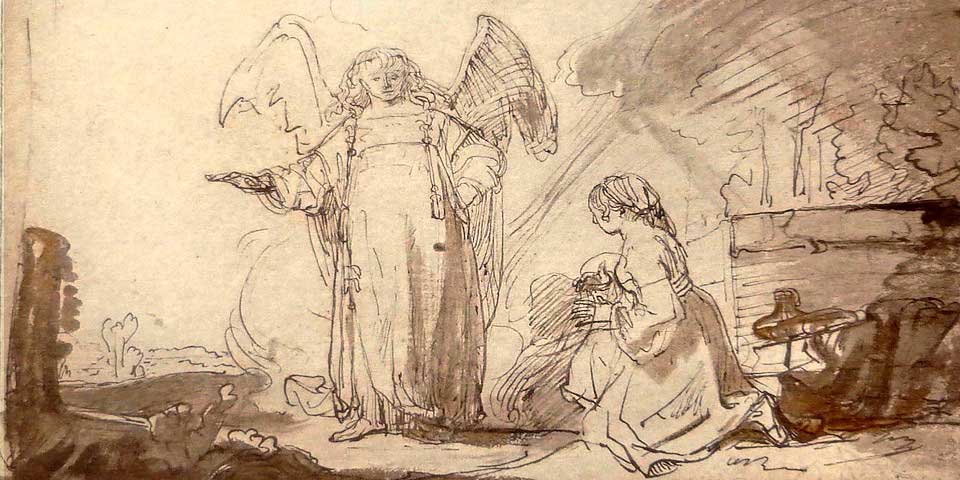
Hagar and the Angel, by Rembrandt

When Abraham and his wife Sarah leave Egypt in the Torah portion Lekh-Lekha (“Go for Yourself”), Hagar goes with them as Sarah’s servant.  Sarah gives Hagar to her husband for the purpose of producing a child Sarah can adopt.  But once Hagar is pregnant, Sarah abuses her, and Hagar runs away across the Negev Desert, back toward Egypt.  A messenger of God  finds her at a spring, a watering-place by the road.  God speaks to Hagar through the messenger and convinces her to return to Abraham and Sarah.

And she called the name of God, the one speaking to her: You are the God of Ro-i; for she said: Even as far as here, I saw after ro-i! Therefore the be-eir is called Be-eir Lachai Ro-i. (Genesis 16:13-14)

ro-i = seeing me, one who sees me.

be-eir = well, watering-place.

lachai = for the living one.

For Hagar, accustomed to being a pawn in Sarah’s schemes, the most amazing thing is that God actually notices her—and she survives.  Hagar does return, and gives birth to Ishmael.  Sarah adopts Ishmael, but later bears her own son, Isaac, and sends Hagar and Ishmael into exile.

Isaac is 40 years old before the Torah once again mentions Be-eir Lachai Ro-i, the Well of the Living One Who Sees Me.  At this point, Isaac is estranged from his father.  In last week’s Torah portion, Vayeira (“And He Saw”), Abraham bound Isaac as a sacrificial offering, and raised the knife to his son’s throat before a voice from God called him off.  After that, Isaac did not go home with his father.  In this week’s Torah portion, Abraham buries Sarah, Isaac’s mother, without Isaac’s presence.  Then he arranges for Isaac to marry an Aramean without even informing his son.  Apparently they are not on speaking terms.

Abraham lives in Beersheba (Be-eir Sheva), and Isaac lives farther south, in the Negev Desert.

And Isaac, he came from coming to Be-eir Lachai Ro-i, and he himself lived in the land of the Negev.  And Isaac went out lasuach in the field, in the face of the sunset; and he raised his eyes and he saw—hey!  Camels were coming. (Genesis 24:62-63)

lasuach = to ?? (This is the only occurrence of the word in the Bible, and though it is in the form of an infinitive verb, scholars do not agree on its meaning.  Lasuach has been translated as to stroll, to pray, to supplicate, and to meditate.  It might be a variant spelling of the verb siyach = meditate, go over a matter, contemplate something.)

I like the literal translation he came from coming to; it emphasizes that a holy well is a place you come to.  Isaac is avoiding his father, but he comes to the well where God noticed and spoke to Hagar.  Since he has no intention of traveling to Egypt on the road that runs past the well, he must come there because he knows about Hagar’s experience.

Like Hagar, Isaac is used to being overlooked as a person, accustomed to being a pawn in his father’s schemes.  Maybe he hopes that God will notice him at Hagar’s well, or maybe he hopes he will be able to see himself.

Coming from the Well of the Living One Who Sees Me, Isaac heads out into the field at sunset to lasuach.  Maybe Isaac senses the holy presence of God at the well, and he walks back through the field slowly to absorb the experience.

Lost in thought, he raises his eyes and is surprised to see camels approaching.  He is not far from the road between Beersheba and Egypt, but these camels have left the road and are heading across the field toward him.  The first rider to dismount is Rebecca, the bride that Abraham’s servant is bringing to Isaac.  They meet in the field, he loves her, and he begins his new life.

Near the end of the Torah portion, Isaac and his half-brother, Hagar’s son Ishmael, bury Abraham in the family cave to the north.  Then Isaac returns to Hagar’s well.

And it was after the death of Abraham when God blessed Isaac, his son; and he settled next to Be-eir Lachai Ro-i. (Genesis 25:11)

The only other place in the book of Genesis that remains holy years later, under the same name, is Beit-El (sometimes called Bethel in English).  In the upcoming Torah portion Vayeitzei (“And he went”), Jacob stops for the night on his way to Charan and dreams of a stairway between heaven and earth. God speaks to him for the first time.  When Jacob wakes, he says:

Truly God yesh in this place and I, I did not know! And he was awestricken, and he said: How awesome is this place! This is nowhere but Beit El, and this is the gate of the heavens! (Genesis 28:16-17)

yesh = it exists, it is present, there is.

Beit El = the house of God.

For Jacob, the most amazing thing is not that God notices him, but that God exists at all in this world.

Jacob dedicates the spot by setting up a stone pillar and pouring oil over it, and naming it Beit-El.  More than 20 years later, God tells him to return to Beit-El.  Jacob first buries all the idols belonging to his household.  Then he leads them to the spot and builds an altar. God blesses him again, and Jacob pours a libation as well as oil on the stone pillar before moving on.  By returning to the place where God first spoke to him, Jacob rededicates himself to God.

*

Few of us today hear God speaking to us in Biblical Hebrew.  But once in a while, we notice God, or God notices us, and we are amazed.  Suddenly our usual mundane perspective changes, and the world is suffused with new meaning.

Sometimes this happens because a place strikes us as holy, awe-inspiring, connected with God.  It might be a liminal place in nature—the edge of the ocean, deep in a forest, a remote spot with a brilliant night sky.  I have also felt that mysterious awe inside medieval cathedrals, though as a Jew I do not go looking for God there.

Sometimes we go back later, and find God again.  Sometimes we go back and discover that the place seems ordinary now; the holiness was in our own heart.  Either way, it is a blessing to be able to stand on holy ground.

Vayeira & Noach: Drunk and Disorderly

As I read the book of Genesis/Bereishit again this year, I feel sorry for the characters who try to rise to the challenge of walking with God, but are just too limited to keep up. Two of those who fall by the wayside are Noah and Lot, who both attempt to do the right thing, then collapse into drink and incest after they see their worlds destroyed.

Noah begins by following all of God’s directions; he sees God destroy all life on land with the over-the-mountaintop flood. Abraham’s nephew Lot begins by offering hospitality to strangers in this week’s Torah portion, Vayeira (“And he saw”). He sees the strangers, who are actually messengers from God, destroy the city of Sodom and the land around it.

After their respective catastrophes are over, and it is time to build a new life, both men think only about getting drunk.

Noah

Drunkenness of Noah, mosaic, Basilica di San Marco, Venice, 1215

And Noah began to be a man of the soil, and he planted a vineyard. And he drank some of the wine, and he became drunk, and vayitgal in the middle of his tent. And Cham, the father of Canaan, saw the erat of his father and he told his two brothers outside. (Genesis/Bereishit 9:20-22)

vayitgal = he uncovered himself, exposed himself

erat = nakedness

Noah plans his drunkenness with the foresight of an alcoholic who hides stashes of liquor in strategic places. He has to wait a long time, through planting and harvesting and fermentation, before he gets his first drink after the flood. Although the Torah does not report Noah’s feelings, I imagine he is haunted by the deaths of everyone he knew outside his own immediate family of eight. Perhaps he dreams of children drowning. Perhaps he wishes he had said something to change God’s mind, or found some way to rescue more people.

I suspect that Noah cannot find a way to live with this knowledge and move forward. So he opts to escape into an altered state of consciousness, or unconsciousness.

After becoming drunk, Noah uncovers his nakedness in the middle of his tent. A modern reader might wonder what is so bad about lying down naked in the privacy of your tent—even if one of your sons barges in and accidentally sees you.

But in the Torah, to “uncover the nakedness” of someone is a euphemism for a sexual act. The book of Leviticus/Vayikra devotes thirteen verses to listing close relatives whose nakedness you must not uncover, using the same words for “uncovering” and “nakedness” as the passage above.

The implication is that Noah and his son Cham (whose name means “heat”) are guilty of some illicit sexual act. Furthermore, Noah begins it, by “uncovering himself”. Yet Noah shifts all the blame to his son.

And Noah woke up from his wine, and he knew what his youngest son had done to him. (Genesis 9:24)

Noah expresses his anger at Cham by cursing Cham’s son Canaan. Alas, it is a common human reaction to reject your own guilt by lashing out at someone else.

Lot

In this week’s Torah portion, Lot and his daughters act out a different version of the drunken incest theme.

Lot, like Noah, means well. His story begins with a good deed; when two messengers from God, disguised as ordinary men, come to the city of Sodom, Lot goes out of his way to give them hospitality and treat them with respect and kindness—just as his uncle Abraham did in the previous scene in this week’s Torah portion. After Lot has brought the strangers home and fed them, the men of Sodom converge on Lot’s house and demand that he bring out his guests, so that they can “know” them.

Just as it never occurs to Noah to question God’s plan to wipe out the earth, it never occurs to Lot that there might be an alternative to sacrificing two people to the mob. Since his two guests are out of the question, Lot steps outside and offers the would-be rapists his two virgin daughters instead.

Maybe Lot is so terrified of his neighbors that he cannot think straight. But we can still question his impulse to sacrifice his daughters—and perhaps after the crisis is over, Lot is tormented by remembering his own behavior.

The mob outside ignores Lot’s proposed substitution of rape objects, and crowd forward to break down the door. The messengers from God save the day (or night) by pulling Lot inside and blinding the men outside. Then they tell Lot that God has sent them to destroy the whole city, and they order Lot to flee with his family.

Lot panics, and at dawn he is still dithering in his house. The messengers grab him, his wife, and their two daughters by the hand and lead them outside the city. They tell Lot to save himself by escaping to the mountain, without stopping or looking back.

When God rains sulfur and fire down from the heavens, Lot’s wife looks back and turns into a pillar of salt, but Lot hurries on. He settles into a cave on the mountain with his two daughters.

And the elder said to the younger: Our father is old, and there is no man on the earth to marry us as the way of all the earth. Come, we will give our father a drink of wine, and we will lie down with him, and we will keep alive seed from our father. So they gave their father wine to drink that night, and the elder came, and she lay down with her father, and he did not know when she was lying down or when she was getting up. (Genesis 19:31-33)

They repeat the procedure the next night, with the younger daughter as the seed collector. And once again the Torah claims Lot did not know when she was lying down or when she was getting up. Both women become pregnant, as they planned.

Many commentators have pointed out that preserving a man’s lineage is a high value in the Torah, and concluded that Lot’s daughters were doing the right thing. But if incest were truly the right behavior in their situation, they would simply ask their father to cooperate, without resorting to wine. Lot may not have read the Torah’s prohibition against “uncovering the nakedness of your father”, but he obviously knows that incest, like mistreating a stranger, is wrong.

The Torah appears to view Lot as innocent of incest by reason of unconsciousness. Yet it is Lot’s decision to keep drinking the wine until he passes out; even two strong young women could not force it down his throat.

And where did the wine come from? The Midrash Rabbah, a collection of commentary from Talmudic times, speculates that either the Sodomites stored wine in distant mountain caves, or the wine appeared miraculously. However, I agree with modern commentator Jonathan Kirsch that Lot probably grabs some wine when they pass through the village of Zoar on the way to the mountain. Like Noah, Lot would anticipate a need for escape from sanity after the catastrophe. And as in Noah’s story, the Torah blames Lot’s subsequent sexual misdeed on his children.

It is easy for me to judge both Noah and Lot harshly. But if God gave me orders, would I have the imagination or the courage to talk back? If I were faced with a mob of evil men, would I have the imagination or the courage to divert them safely? I have lots of imagination—except when it comes to my own problems. I’m learning courage, but I still prefer avoidance.

If all my friends, most of my family, and every familiar thing in my life were suddenly wiped out, would I have the imagination and courage to build a new life from nothing? I think I would, but how do I know?

When life becomes unbearable, do I stick with reality and avoid any drugs of escape? Cookies don’t count, do they?

When something bad happens between two people, do I duck responsibility by blaming it on the other guy? Never—except for when I am fixated on escaping the situation.

As I read the book of Genesis again this year, I feel sorry for the characters who try to rise to the challenge of walking with God, but are just too limited to keep up. I might be one of them.

Lekh-Lekha & Vayeira: Going with the Voice

The phrase lekh-lekha appears only twice in the Torah.  Both times God is telling Abraham to do something radical.

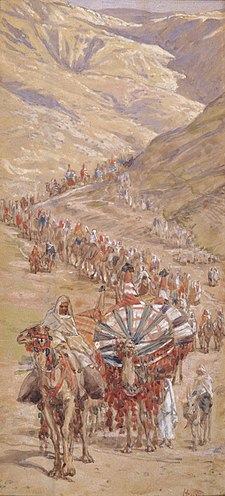
The Caravan of Abraham, by James Tissot

The first time God says lekh-lekha is in his first request of Abraham, at the beginning of this week’s Torah portion (called “Lekh-lekha”):

God said to Abraham: “Lekh-lekha , away from your land, and away from your birthplace, and away from the house of your father, to the land that I will show you.”  (Genesis/Bereishit 12:1) 

lekh (לֶךְ) = Go! 

lekha (לְךָ) =  for yourself, to yourself.

lekh-lekha (לְךְ־לְךָ) = Go for yourself!  Go to yourself!  Go, yourself!  Get going!  

God’s final request to Abraham, in the Torah portion Vayeira (“And he appeared”), contains the same phrase.

And [God] said:  “Please take your son, your only one, whom you love, Isaac; and lekh-lekha to the land of the Moriyah, and bring him up there for a burnt offering upon one of the mountains, which I will tell to you.” (Genesis 22:2)

God’s first request seems difficult but relatively benign.  Yes, Abraham leaves his father and his familiar life.  But he takes along his wife Sarah, his nephew Lot, a number of servants or followers, and his wealth in livestock.  Although he is venturing into a strange land to find himself,  he has the benefit of both resources and companions of his choosing.  He also has the reassurance of knowing his brother Nachor has remained in Charan to take care of their elderly father, Terach.

Sacrifice of Isaac, French, 13th century

God’s final request, on the other hand, seems impossibly horrific.  Abraham must cut the throat of his son and heir, and burn him up as an offering to God.  In dire circumstances, chieftains in the Middle East did sacrifice their own sons to prevent national disaster.But at this point in the story of Abraham, his small clan is living peacefully at Beer-sheva, with no threat in sight.

So Abraham knows that although he will prove something to God and himself by sacrificing Isaac, his own people and his neighbors will probably think he is a lunatic.  He also knows that his wife Sarah is so attached to Isaac that she will either die of shock or become his bitterest enemy.  Nevertheless he leaves early in the morning with his son and three servants, without speaking to Sarah and without telling the servants what kind of offering he is planning.

God’s final request leaves Abraham without aid or comfort from anyone.   At this point Abraham only has two family members at home: his wife Sarah, and their son Isaac.  (He has already sent away his concubine Hagar and their son Ishmael.  His nephew Lot separated from him long ago.)  By sacrificing Isaac, Abraham will lose the rest of his family: his wife and his remaining son.

Yet God’s two requests, one benign and one disastrous, are related.  Not only do both requests use the unusual term lekh-lekha, but both of them also use a series of phrases that increase Abraham’s emotional stake in obeying.  In the first request, God asks Abraham to leave not just his country, but also the culture he grew up with, and even his own birth family.  In the final request, God asks Abraham to sacrifice not just his son, but his only child (now that Ishamel is exiled), the son he loves.

Both sentences with the phrase lekh-lekha also leave Abraham’s destination a mystery.  The first time, God does not even tell Abraham that he should head for Canaan; he must blindly go to “the land that I will show you”.  The second time, God tells Abraham to go to the land of Moriyah (a place name that may be related to the word marah,  “something shown”) and promises to point out the right mountain to Abraham when he arrives.  Both times, Abraham must start out on his mission trusting God to reveal where it will end.

Furthermore, both of God’s orders come at times when Abraham has a settled life and there is no emergency.  When Abraham first hears God say lekh-lekha, he is simply living in Charan with his extended family.  (Later commentary invented stories about his dramatic youth there as an idol-smasher, but the Torah itself says nothing.)  And when Abraham hears God say lekh-lekha again, he and his people have been living at Beer-sheva for “many years”.

Both times, when nothing in particular is happening, Abraham hears God speak to him out of the blue.  Maybe lekh lekha does mean “Get going!”, since both times Abraham responds by rousing himself and taking an action that changes his whole life.

Rashi wrote that lekh-lekha meant “Go for yourself”, i.e. for your own benefit.2  He pointed out that God promised Abraham many descendants, a famous name, and blessing in return for leaving Charan and going to God’s undisclosed destination.

But surely Abraham would not benefit from sacrificing Isaac, his son and heir.

The sacrifice is not completed; an angel of God stops Abraham at the last minute, when he is holding his knife over Isaac’s throat.  But Abraham’s willingness to sacrifice his own son causes lifelong psychological trauma for Isaac.  Although Abraham arranges a marriage for his younger son, there is no indication in the Torah that he and Isaac ever see one another again.

Furthermore, after the attempted sacrifice, the next story in the book of Genesis is about the death of Abraham’s wife Sarah.3  Although Abraham eventually remarries, the death of Sarah probably weighs on him.

*

Lekh-lekha!

How do you know whether the apparently divine voice in your head is summoning you to an adventure, or to a nightmare?  How do you know whether it is ethical to follow that call?

Maybe you experience a divine call as an urgent need to change your life, even though you do not know where the need comes from, or where you will end up if you act on it.  Suppose you ignore this inner voice, this inner god.  Will you feel ashamed for the rest of your life that you did not rise to the challenge?

Suppose you do heed the call.  Will you become a revered leader and the founder of a new way of life, like Abraham?  Or will you become a crazy person ready to sacrifice his own child—like Abraham?

Listen carefully.

  1. For example, in 2 Kings 3:27, when the king of Moab is losing to the invading armies of Israel, Judah, and Edom, he sacrifices his son and heir as a burnt offering, and the invaders retreat.
  2. Rashi is the acronym of 11th-century rabbi Shlomoh Yitzchaki.
  3. The story of Abraham’s near-sacrifice of Isaac is Genesis 22:1-19.  Then there is a brief genealogical interlude, Genesis 22:20-24.  The story of Sarah’s funeral begins with Genesis 23:1.