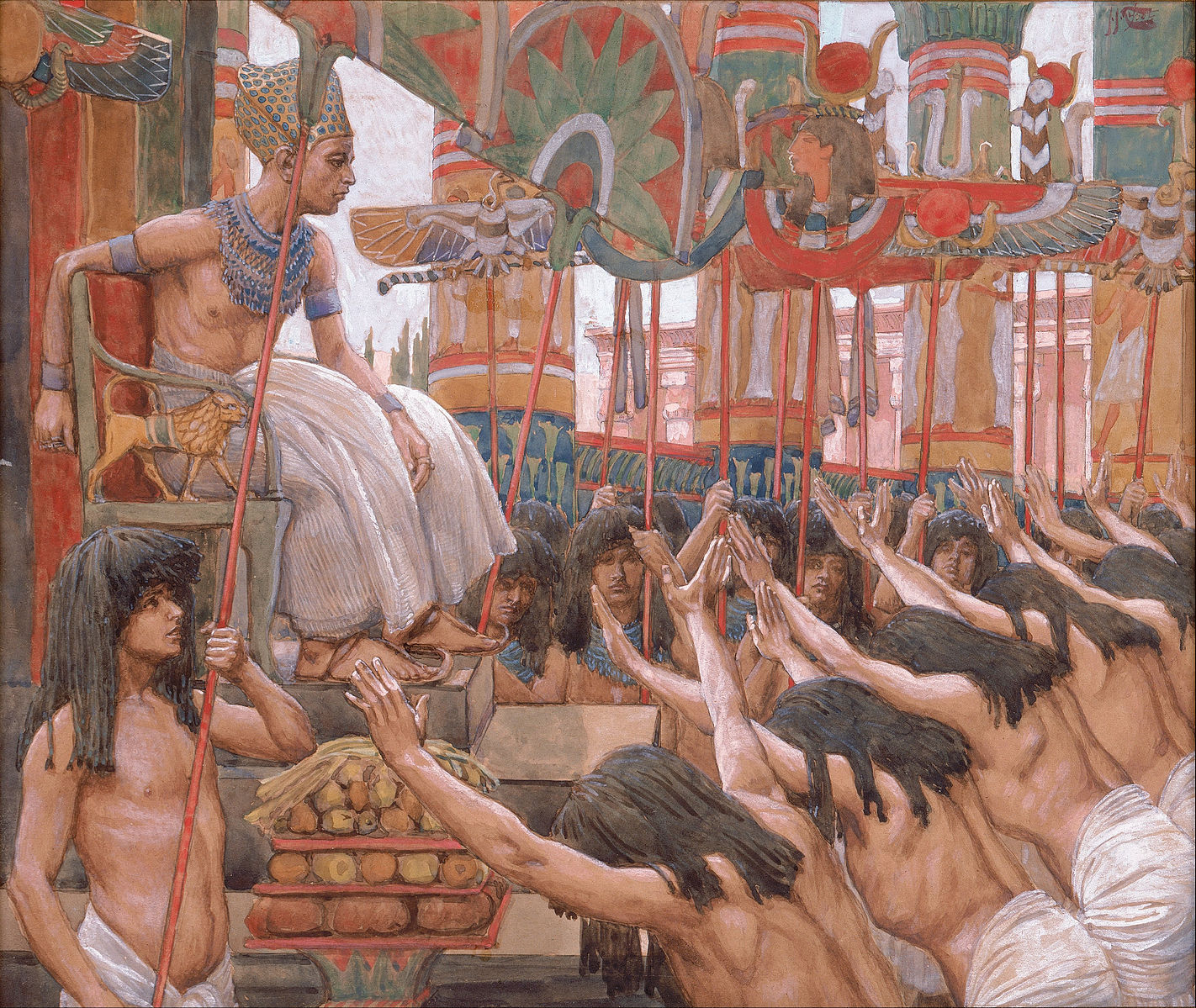
Mikeitz & Vayeishev: Yoseif’s Theology, Part 1

At age 17, Yoseif (“Joseph” in English) is a spoiled brat. He tattles on his ten older brothers, and he tells them two dreams that predict they will all bow down to him someday. His brothers hate him so much that they want to kill him. As soon as they are all far from home, they grab Yoseif, strip off the fancy tunic their father gave him, and throw him into a pit. Then they sell him as a slave to a caravan bound for Egypt.

Vayeishev: Success

No doubt this is a sobering experience for Yoseif; in Egypt he is far more diplomatic. As last week’s Torah portion, Vayeishev (Genesis 37:1-40:23), continues, we learn that Yoseif is also intelligent, and has what a modern person might call good luck. The Torah puts it another way:

And Y-H-V-H was with Yoseif, and he became a successful man … and everything that he did, God made successful in his hand. (Genesis/Bereishit 39:2-3)

Potifar, the Egyptian official who buys him, notices Yoseif ‘s achievements, and makes Yoseif his steward and personal attendant. What Potifar’s wife notices about the young Hebrew man is his exceptional good looks.

Joseph Flees Potiphar’s Wife, by Julius Schnorr von Carlsfeld, 19th century

And she said: “Lie down with me!” But he refused, and he said to his master’s wife: “Hey, my master … has not withheld anything from me except for you, his wife. Wouldn’t this be a great evil? And I would be doing wrong before Elohim!” /(Genesis 39:7-9) 

Elohim (אֱלֹהִים) = gods, a god, God.

This is the first time in the Torah that Yoseif mentions God. He uses a term that could apply to any god, although he would know the name Y-H-V-H, the personal name of the God of his father, Yaakov (“Joseph”). Perhaps Yoseif does not want to reveal that name to a foreigner. Or perhaps he uses a generic term so that Potifar’s wife will know what he is talking about.

Despite Yoseif’s refusal, Potifar’s wife keeps importuning him, and as soon as they happen to be alone in the house, she grabs him. Yoseif flees, leaving his garment in her hands. Spitefully, she accuses him of attacking her, and he is sent to jail.

In the dungeon, God blesses Yoseif with success again, and the prison overseer puts him in charge of all his tasks.

The overseer of the roundhouse did not need to look after anything at all in his hands, because Y-H-V-H was with him [Yoseif], and whatever he did, Y-H-V-H made successful. (Genesis 39:23)

One morning Yoseif asks two of the prisoners, Pharaoh’s chief cup-bearer and Pharaoh’s chief baker, why they are looking especially glum.

And they said: “A dream we have dreamed, and there is no interpreter for it!” And Yoseif said to them: “Aren’t interpretations from Elohim? Recount it, please, to me.”  (Genesis 40:8) 

All dreams in the Hebrew Bible are considered messages from God. Some dream symbols have obvious interpretations; Yoseif’s brothers had no doubt that his dream of eleven wheat sheaves bowing down to him meant that his eleven brothers would someday bow to him as if he were a king. But more difficult dreams require professional interpreters. Being in jail, Pharaoh’s two officials have no access to professionals.

According to Ramban, Joseph is not claiming either that he is a professional interpreter or that God answers his questions; he is merely saying “If it is obscure to you, tell it to me; perhaps He will be pleased to reveal His secret to me.’”1
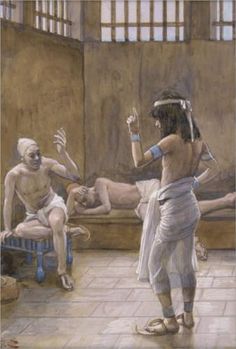
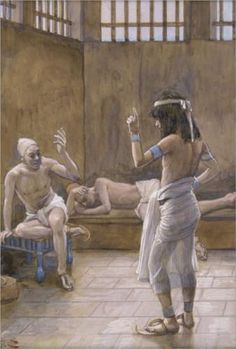
Joseph in Prison, by James Tissot, circa 1900

The two prisoners tell Yoseif their dreams, which seem like two variations of the same dream.

At this point, we might expect God to speak to Yoseif and tell him what their dreams mean. After all, hearing God speak runs in his family. God spoke to his father, Yaakov, and to his grandfather Lavan, in their dreams.2 And God spoke in the middle of the day to Yoseif’s other grandfather, Yitzchak (“Isaac”), and to his great-grandparents Avraham and Sarah.3

But God never speaks to Yoseif. Instead, dream interpretations occur to him on the spot. He assigns the two dreams of the prisoners different meanings, saying that in three days Pharaoh will pardon the chief cupbearer, but execute the chief baker. That is exactly what happens.

Mikeitz: Pharaoh

In this week’s Torah portion, Mikeitz (Genesis 41:1-44:17), Pharaoh4 has two dreams. When none of his magicians can interpret the dreams, Pharaoh’s chief cup-bearer speaks up and tells him about the young Hebrew dream interpreter in the prison. At once Pharaoh sends for Yoseif.

And Pharaoh said to Yoseif: “… I have heard about you, saying you [need only] hear a dream to interpret it.” And Yoseif answered Pharaoh, saying: “It is not in me! Elohim will answer, for Pharaoh’s welfare.” (Genesis 41:15-16)

Yoseif is still claiming that only God can interpret a difficult dream. Now he assumes that God will reveal the interpretations of two more dreams to him. He also assumes that the interpretations he gets from God will lead to Pharaoh’s welfare.
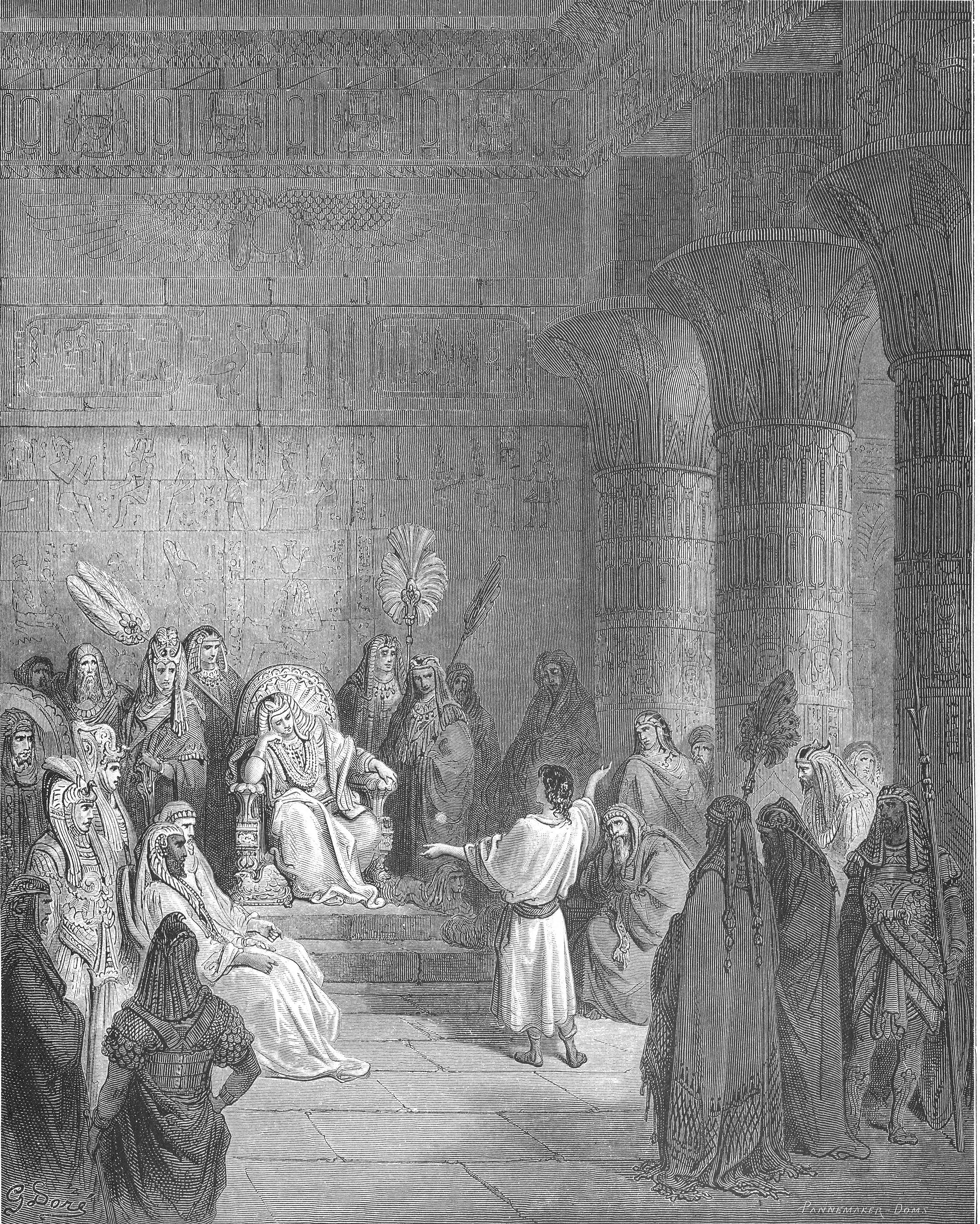
Joseph Interprets Pharaoh’s Dreams, by Gustave Dore, 19th century

Pharaoh tells Yoseif the two dreams. Again the interpretation of Pharaoh’s dreams occurs to Yoseif immediately. He announces:

“What the Elohim will do, he has told Pharaoh.” (Genesis 41:25)

Both dreams, Yoseif explains, are warning Pharaoh that there will be seven years of plenty followed by seven years of “very heavy” famine.

“And about the repetition of the dream to Pharaoh two times: [it means] that the matter is established by the Elohim, and the Elohim is hastening to do it.” (Genesis 41:32)

Although God does not control everything—the prophecies that God dictates to prophets in the Hebrew Bible only predict what will happen to people if they do not change their course of action—God does control the weather.

Next Yoseif unselfconsciously gives Pharaoh some advice.

“And now, may Pharaoh be shown a discerning and wise man, and may he set him over the land of Egypt.” (Genesis 41: 33)

Yoseif goes on to explain how this man must appoint overseers to stockpile grain during the seven good years, and guard the stockpiles as a reserve for the seven years of famine. Since he does not mention God when he tells Pharaoh the wisest course of action, we can assume Yoseif figures it out himself.

And Pharaoh said to his servants: “Could we find [another one] like this man, who has the spirit of an elohim in him?” (Genesis 41:38)

Pharaoh is not saying that Yoseif is possessed, but rather that he receives divine inspiration.

And Pharaoh said to Yoseif: “After an elohim has made you know all this, there is no one who is as discerning and wise as you. You yourself will be over my house! … See, I place you over all the land of Egypt!” (Genesis 41:39-41)

And he gives Yoseif his signet ring. Pharaoh remains the monarch, but Yoseif, at age 30, is now the ruler of Egypt.

Eight years later, after the famine has struck “the whole surface of the earth”,9 Yaakov sends his ten older sons from Canaan to Egypt to buy grain.

And Yoseif’s brothers came, and they bowed down to him, nostrils to the earth. (Genesis 42:6)

They do not recognize Yoseif, who is now shaved and dressed like an Egyptian, and converses with them through an interpreter without revealing that he knows Hebrew. But Yoseif recognizes them. He falsely accuses them of being spies, probably so that they will talk about their family. When Yoseif finds out that Yaakov kept his twelfth and youngest son, Binyamin (“Benjamin”), at home, he instantly hatches a plan to get his little brother down to Egypt. Yoseif and Binyamin are the only sons of Yaakov’s favorite wife, Rachel, and Yoseif may be afraid that his older brothers want to get rid of Binyamin, just as they got rid of him 21 years before.

He imprisons all ten of his older brothers for three days, then tells them that he will keep one of them as a hostage until they return with their youngest brother. At that point he hears their private conversation in Hebrew, in which they agree this must be a punishment (presumably from God) for ignoring Yoseif’s pleas from the pit long ago.5  (See my post Mikeitz: A Fair Test, Part 1.)

A year later, Yaakov finally lets Binyamin go to Egypt with his brothers, because the whole extended family is Canaan is starving. When Yoseif sees the grown man who was a child when Yoseif was sold as a slave, he says:

“Is this your littlest brother, of whom you spoke to me?” And he said: “May Elohim be gracious to you, my son!” (Genesis 43:29)

Yoseif himself plans to be gracious to Binyamin. But he also values God’s blessings.


So far, Yoseif is consistently using the generic term elohim to refer to God. He believes that God controls the weather, and also affects the lives of at least some individuals, including himself. He hopes that God will also improve Binyamin’s life. Yoseif recoils from the thought of committing an offense against God. He believes that dreams come from God, and seems to believe that when he interprets dreams correctly, God is inspiring him. Yoseif’s thoughts about God seem simple, and unlikely to upset anyone.

But in next week’s Torah portion, Vayigash, Yoseif goes out on a theological limb.


  1. Ramban (13th century Rabbi Moses ben Nachman), translation in www.sefaria.org.
  2. God speaks in dreams to Yaakov in Genesis 28:12-15 and to Lavan in Genesis 31:24.
  3. God speaks during the day, directly, to Yitzchak in Genesis 26:2-5 (and at night in 26:24), to Sarah in Genesis 18:15, and to Avraham in Genesis 12:1-3, 12:7, 13:14-17, 15:1-9, 17:1-21, 18:20-33, 21:12-13, and 22:16-18 (and in dreams in Genesis 15:12-29 and 22:1-2).
  4. The title “Pharaoh” in English is Paroh (פַּרֺה) in Hebrew. The bible uses it for every pharaoh, without an article.
  5. Genesis 42:21-22.

Mikeitz & Vayigash: Yisrael Versus Ya-akov, Part 2

Jacob is the only character in the book of Genesis who gets a new name and still keeps the old one. His parents name him Ya-akov (יַעֲקֺב, “He grasps by the heel”) at birth, because he comes out clutching his twin brother Esau’s heel. As he grows up, he tries twice to usurp Esau’s place in the family. He is crafty, and willing to cheat to get what he wants.

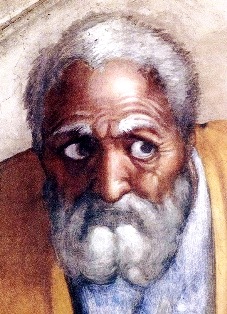
Jacob, by Michelangelo,
Sistine Chapel

Jacob goes to live with his uncle Lavan for twenty years, where he learns long-term planning and patience. As he is returning to Canaan with his own large family, he wrestles all night with an unnamed being—a divine messenger, but perhaps also his own alter ego—who blesses him with a new name: Yisrael (יִשְׂרָאֵל, “He strives with God”).

Yet in the remainder of the book of Genesis, he is referred to as Ya-akov more often than as Yisrael

When does the text call him Yisrael?

According to the 19th-century commentary Ha-amek Davar, Genesis calls Jacob Yisrael when it is ”indicating a return to a more elevated spiritual state”.1 But there are several examples when Yisrael’s state does not seem at all elevated.

In the two previous Torah portions, Vayishlach and Vayeishev, the narrative refers to Jacob as Yisrael in four scenes (See my post: Vayishlach & Vayeishev: Yisrael Versus Ya-akov, Part 1):

  • Ya-akov is overcome with grief whenhis favorite wife, Rachel, dies. But Yisrael pulls himself together and considerately moves his household and flocks from the roadside to good pastureland.
  • When he finds out that his son Reuben lay with Bilhah, one of Jacob’s concubines, Yisrael refrains from taking any action. Perhaps he simply has no emotional energy left after Rachel’s death.
  • Jacob’s favorite son is Joseph, Rachel’s older child. Yisrael gives a fancy tunic to Joseph but does not give anything to his other sons. Here he makes the same mistake his parents made when he was growing up as Ya-akov: playing favorites, which promotes jealousy.
  • Yisrael sends Joseph alone to a dangerous place to report on his ten older brothers who hate him. Here he is not thinking things through as well as Ya-akov did when he was younger.

In these four references, Yisrael seems like an old man who can see the need and handle the logistics to get his people and flocks to their next destination, but cannot figure out what to do about complex family relationships. The name Yisrael does not seem to indicate a more elevated spiritual state.

So far, the most consistent difference between the two names is that while Yisrael is always relatively calm, Ya-akov fluctuates between being calm and being at the mercy of strong emotions. He is overcome when Rachel dies, and again the end of the Torah portion Vayeishev when he believes Joseph has died. He jumps to that conclusion when his ten older sons bring home Joseph’s fancy tunic covered with goat’s blood. Ya-akov mourns extravagantly.

Joseph’s older brothers have actually disposed of him by selling him as a slave bound for Egypt. After some years in Egypt, Joseph gets a reputation as a dream interpreter.

Mikeitz: The famine

At the beginning of this week’s Torah portion, Mikeitz (Genesis 41:1-44:7), Joseph is summoned to interpret two of the pharaoh’s dreams. He explains that both dreams predict seven years of plenty followed by seven years of famine. The pharaoh makes him the viceroy in charge of agriculture, and Joseph stockpiles grain during the next seven years. (See my post: Mikeitz: An Unlikely Ascent.) When the famine begins, it affects not only Egypt, but also Canaan, where Joseph’s father and brothers live.

Ya-akov sends his ten older sons down to Egypt to buy grain. But he keeps his youngest son, Benjamin, at home. Benjamin is his only other son by his beloved deceased wife, Rachel. Now that Joseph is gone, Benjamin has become Jacob’s favorite.

And Ya-akov would not send Benjamin, Joseph’s brother, with his brothers. For he said: “Lest harm happens to him!”  (Genesis 42: 4)

Ya-akov does not mind so much if harm happens to any of his sons by his other wives or concubines.

When Jacob’s ten older sons arrive in Egypt, they do not recognize the viceroy as Joseph, but he recognizes them. He accuses them of being spies, and they babble that they are all brothers, all the sons of one man except for the youngest, who stayed at home. Joseph imprisons one of them, Shimon, and sells the rest of them grain on the condition that they return to Egypt with their youngest brother.

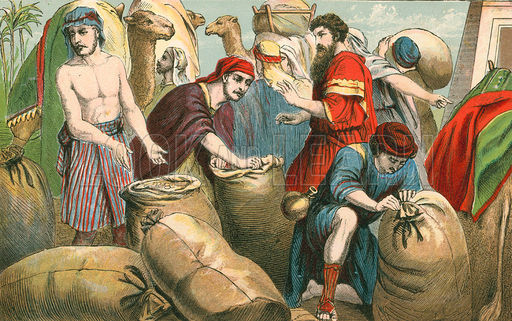
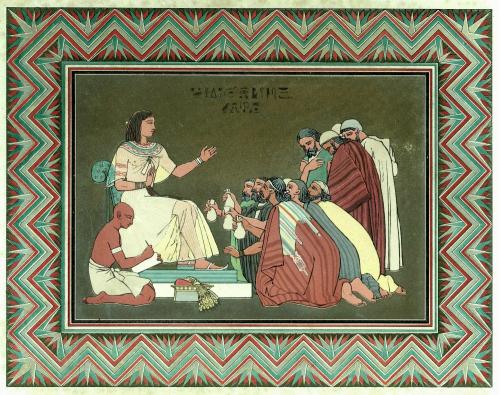
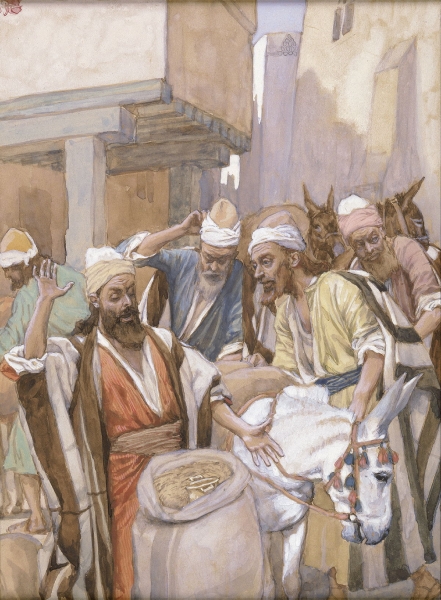
Joseph’s Brothers Find Money in their Sacks, Aunt Louisa’s Sunday Picture Book, ca. 1870

When they return to their father and empty their sacks of grain, they find the pouches of silver that they had handed over as payment. Why is the silver back in their bags? Everyone becomes frightened, including Jacob. As usual, when he is overcome by emotion, he can think only of himself.

And Ya-akov, their father, said to them: “Me you have bereaved of children! Joseph is not, and Shimon is not, and Benjamin you would take away. To me everything happens!” (Genesis 42:36)

Jacob has never been more self-centered. When his extended family has eaten all the grain, he tells his older sons to return to Egypt. One of them, Judah, reminds him that the viceroy will not sell to them again unless they bring Benjamin.

Then Yisrael said: “Why did you do evil to me, by telling the man you have another brother?” (Genesis 43:6)

Although the text calls him Yisrael now, Jacob still sounds self-centered (and not at all spiritually elevated). One would think his wrestling match with the unnamed being had never occurred. His sons dodge his accusation by saying that the viceroy had asked about their family.

Then Judah said to Yisrael, his father: “Send the youth with me, and we will get up and go, and we will live and not die: we, you, and our little children!” (Genesis 43:8)

Judah, addressing Yisrael, reminds his father that everyone’s lives are at stake, including his grandchildren. Then he personally pledges to bring Benjamin back. And Yisrael pulls himself together.

Then Yisrael, their father, said to them: “In that case, do this: Take some choice products of the land in your containers, and bring them down to the man as a gift: a little balsam, a little honey … And take twice the silver … Perhaps it was a mistake. And take your brother! Get up, return to the man. And may Eil Shaddai [i.e. God] give you mercy before the man, so he will release to you your other brother, and Benjamin. And I, if I am bereaved of children, I am bereaved of children!” (Genesis 32:11-24)

Here Jacob combines the best features of Ya-akov and Yisrael. Like Ya-akov in his youth and middle age, he is crafty and plans ahead. But unlike Ya-akov, he overcomes his selfishness. Yisrael even remembers that one of his least favorite sons, “your other brother” Shimon, is still imprisoned in Egypt, and he hopes for everyone’s return to Canaan. Having ordered the best arrangements he can devise, Yisrael is now willing to accept whatever happens.

Vayigash: Reunion with Joseph

The next time Jacob is referred to as Yisrael is in next week’s Torah portion, Vayigash (Genesis 44:18-47:27). Joseph reveals his identity to his brothers, then sends them with back to Canaan with twenty loaded donkeys and instructions to bring Jacob and his whole extended family down to Egypt.

And they went up from Egypt and came to the land of Canaan, to Ya-akov, their father. And they told him, saying: “Joseph is still alive! And indeed, he is the ruler of all of Egypt!” Then his heart grew numb, because he did not believe them. But they spoke to him all Joseph’s words he had spoken to them, and he saw the wagons that Joseph had sent to carry him, and their father Ya-akov’s spirit came back to life. (Genesis 43:25-28)

Again Jacob is called Ya-akov when he is seized by emotion. But then when he accepts the new reality, he changes from Ya-akov to Yisrael.

Then Yisrael said: “Enough! My son Joseph is still alive. I will go and see him before I die!” (Genesis 43:28)

Some classic commentators claimed that it is enough for Yisrael that Joseph is alive, and he does not care whether Joseph has become a powerful man. But according to Abraham ibn Ezra, Yisrael means: “This happiness is enough for me.”2

As Yisrael, Jacob can stop grasping for more. He accepts reality and understands limits. Like many old men, he also thinks about his own death—not in the melodramatic way Ya-akov reacted to Joseph’s bloody tunic and talked about going down to join Joseph in Sheol, but in the way mature people who have retired from their active lives consider what is left for them to do during their remaining years.

Joseph and Jacobs Reunited, by Owen Jones, 1865

Joseph meets the caravan in Goshen and embraces his father.

And Yisrael said to Joseph: “I can die now that I have seen your face, because you are still alive.” (Genesis 46:30)

Rabbi Adin Steinsaltz wrote that Jacob means: “I traveled here to see you, and now that we have reunited, I have received all that I could wish for and I lack nothing in life.”3

As Yisrael, Jacob is finally able to feel contentment. Jealousy and greed no longer motivate him.

At least in that moment. Humans can change, but there are always moments of backsliding. When Joseph introduces his father to the pharaoh, Jacob has slipped back into being Ya-akov. When the pharaoh asks him how old he is, Jacob answers like a grumpy self-centered old man complaining that his life is a waste.

Then Ya-akov said to Pharaoh: “The days and years of my sojourn are 130. The days and years of my life have been few and bad, and they have not attained the days and years of my fathers’ lives.” (Genesis 47:9)


When Jacob was young and had only one name, Ya-akov, he was calculating and selfish, but able to control his emotions better than his twin brother, Esau. When Jacob is old and has two names, Ya-akov and Yisrael, he remains calculating (when he has the energy) and often selfish. But he is not overcome by needy emotions, as his Ya-akov side is. Yisrael he accepts life as it is, does what he can, and is content.

Jacob’s two names indicate two models of old age. Now that I live in a retirement community, I have met a few fellow old people who complain often about the vicissitudes of old age: the aches and pains, the disabilities, the inefficiencies of the medical system, how their children have disappointed them. They are like Ya-akov, caught up in their own negative emotions.

I have also met many old people who are cheerful and grateful for what they do have: safe homes with heating and air-conditioning, a number of readily available services, and the company of fellow residents who delight in learning and in instigating and attending a wide variety of activities. They embody the Yisrael model of old age.

I hope I can spend most of the rest of my life being a Yisrael, doing what I can and enjoying what I do—while accepting that life is always uncertain and impermanent.


  1. Rabbi Naphtali Tzvi Yehudah Berlin, Ha-amek Davar,commentary on Genesis 43:28, translation by www.sefaria.org.
  2. 12th-century rabbi Abraham ibn Ezra, translation by www.sefaria.org.
  3. Adin Even-Israel Steinsaltz, The Steinsaltz Tanakh, Koren Publishers, Jerusalem, 2019, quoted in www.sefaria.org.

Mikeitz: An Unlikely Ascent

From prison to palace, from slave to ruler, in one day.

At Pharaoh’s command, Joseph leaves the dungeon and becomes the vice-regent of all Egypt in this week’s Torah portion, Mikeitz (Genesis 41:1-44:17). Joseph has intelligence and God’s favor; Pharaoh has power. Yet Joseph’s elevation would not have occurred without the honesty of Pharaoh’s chief butler, the Egyptian “magicians”, and Joseph himself.

Joseph Sold into Slavery, by Own Jones, 1865

Joseph is a Hebrew youth who grew up as the favorite son of a rich man, Jacob. His descent was precipitous in last week’s portion, Vayeishev. His older brothers stripped off his fancy clothing, told a caravan bound for Egypt that he was a slave, and sold him. The Egyptian who bought him recognized Joseph’s intelligence and ability, and made him the head slave of his household. But his Egyptian master’s wife falsely accused him of attempted rape, and Joseph was thrown into the dungeon.

Thanks to the dishonesty and cruelty of his own brothers and his master’s wife, Joseph became the lowest of the low. At least he is not sentenced to death. Joseph lives in the dungeon, and once again his attitude and abilities lead to a small increase in status: the chief jailer makes Joseph his assistant, and lets him run everything inside the dungeon. But he is not allowed to leave.

The chief butler forgets

The portion Vayeishev ends with Joseph interpreting the dreams of two of his fellow prisoners. Joseph predicts that the former chief baker will be executed, but the former chief butler will be pardoned and restored to his post.

Joseph in Prison, by James Tissot, c. 1900

This man is the only person Joseph knows who will soon be in Pharaoh’s presence. He tells the chief butler he is innocent, and begs him to mention his case to Pharaoh.

The chief butler does not actually promise Joseph he will tell Pharaoh, but he does not demur. Yet the portion Vayeishev ends with the sentence:

But the chief butler did not zakhar Joseph, and he forgot him. (Genesis 40:23)

zakhar (זַכַר) = remember.

This week’s portion, Mikeitz, begins:

It was at the end of two years, and Pharaoh had a dream … (Genesis 41:1)

For two years nothing happened. The chief butler did not mention Joseph to Pharaoh. Joseph continued to live in the dungeon.

Why does the chief butler “forget” to bring up Joseph’s case?

An 18th-century commentary explained that the Torah says he “did not remember Joseph and he forgot him” to refer to two stages of forgetting:

“At the beginning he simply did not recall Joseph’s name, something that Joseph had asked him to remember. … This verse also informs us that the chief butler subsequently forgot Joseph completely, he erased the incident from his heart. … a deliberate act of forgetting.” (Or HaChayim)1

When I put myself in the chief butler’s place, I imagine that when he is first pardoned and restored to his position, he would want to keep his head down and not ask Pharaoh for any favors. I’ll bring it up later, he would think, after I’m sure Pharaoh trusts me again.

A few months later, when everything is going well, the man remembers Joseph. But now he does not want to remind Pharaoh about whatever he did that caused Pharoah to throw him into the dungeon in the first place. I imagine the chief butler rationalizing that he did not actually make a promise to Joseph. And it is not as if the young Hebrew man is under a death sentence. So gradually the butler forgets all about Joseph’s request—until Pharaoh asks for a dream interpretation.

A 12th-century commentator, Rashbam, wrote that God “performed a miracle for the sake of Joseph” by sending Pharoah two dreams that his own interpreters could not understand. That way, the chief butler “was forced to remember him.” 2

The chartumim do not cheat

Pharaoh has two dreams in a single night. In the first dream, seven healthy cows are eaten by seven gaunt cows. In the second, seven healthy ears of grain are swallowed up by seven thin, scorched ears.

Then it was morning, and his spirit was disturbed. And he sent out and summoned all the chartumim of Egypt, and all of its wise. But there was no dream-interpreter among them for Pharaoh. (Genesis 41:8)

Chartumim (חַרְטֻמִּים) = literate priests with occult knowledge. (Probably from the Hebrew word charut, חָרוּת = engraved, written. These high-level priests wrote down and read incantations out loud.)

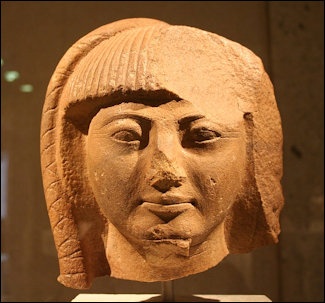
Khamwese, Egyptian Priest and Heka manipulator, 13th century BCE

The word chartumim is often translated in English as “magicians”. But they were not magicians in the modern sense: people who create illusions and trick their audience. The ancient Egyptians believed that the gods created and maintained the universe with “heka”, a cosmic power that some individuals could also tap into and use to manipulate reality. Priests who were chartumim accomplished this through incantations and ritual actions.3

The Torah assumes that are that significant dreams are predictions about the future. In last week’s portion, when seventeen-year-old Joseph related his two dreams, his brothers and his father assumed they were predictions that someday they would bow down to Joseph (although they did not want to believe it).4

The other assumption in the portion Mikeitz is that chartumim were usually able to interpret significant dreams. Perhaps they failed with Pharaoh’s two dreams because their occult knowledge was about Egyptian gods. This time, although Pharaoh does not know it, his dreams came from the God of Abraham, the God of Joseph. So the rituals of the chartumim do not yield any results.

And they are honest enough to say so.

Thechief butler remembers

Then the chief butler spoke to Pharaoh, saying: “My offenses I am mazkir today. Pharaoh became angry with his servant, and he placed me in custody of the house of the chief of the guards, me and the chief baker.” (Genesis 41:9-10)

mazkir (מַזְכִּיר) = mentioning, recounting. (A form of the verb zakhar = remember.)

When the chief butler mentions his “offenses”, he probably is not including his failure to mention Joseph to Pharaoh. His “offenses” are whatever he did two years ago that offended Pharaoh. He chooses not to remind Pharaoh of exactly what he had done, but he does take the risk of Pharaoh remembering it—in order to help his boss now, and perhaps even in order to help the young Hebrew in the dungeon.

The chief butler continues:

“And one night we [both] dreamed a dream, I and he, each dream according to its own meaning. And there was with us a young Hebrew man, a slave of the chief of the guards, and we told him, and he interpreted our dreams for us … And it happened as he had interpreted for us: I was restored to my position, and he was hanged.”
 (Genesis 41:11-13)

This true account is all it takes to move the story along; the chief butler does not even need to add Joseph’s claim that he is innocent. Pharaoh is so eager to have his two disturbing dreams interpreted that he sends for Joseph immediately.

Joseph does not take credit

Then Pharaoh sent and summoned Joseph, and he was rushed out of the dungeon, and he shaved and he changed his clothes and he came to Pharaoh. And Pharaoh said to Joseph: “A dream I dreamed, and there is no interpreter for it. But I have heard it said about you: you [need only] hear a dream to interpret it.” (Genesis 41:14-15)

Pharaoh’s chief butler did indeed describe Joseph interpreting his dream and the chief baker’s dream right after he heard them, without engaging in any of the occult rituals the chartumim would use.

Joseph knows his dream interpretations in the dungeon were inspired by God; he would never have made such accurate guesses on his own. He had even told the chief butler and chief baker:

“Isn’t interpretation of them for God?” (Genesis 40:8)

Now that he stands in front of Pharaoh, Joseph once more refuses to pretend he has magic power of his own.  

And Joseph answered Pharaoh, saying: “Not I! Elohim will answer for the welfare of Pharaoh.” (Genesis 41:16)

Elohim (אֱלֺהִים) = plural of eloha, אֱלוֹהַּ = god. Elohim  = gods, god, God.

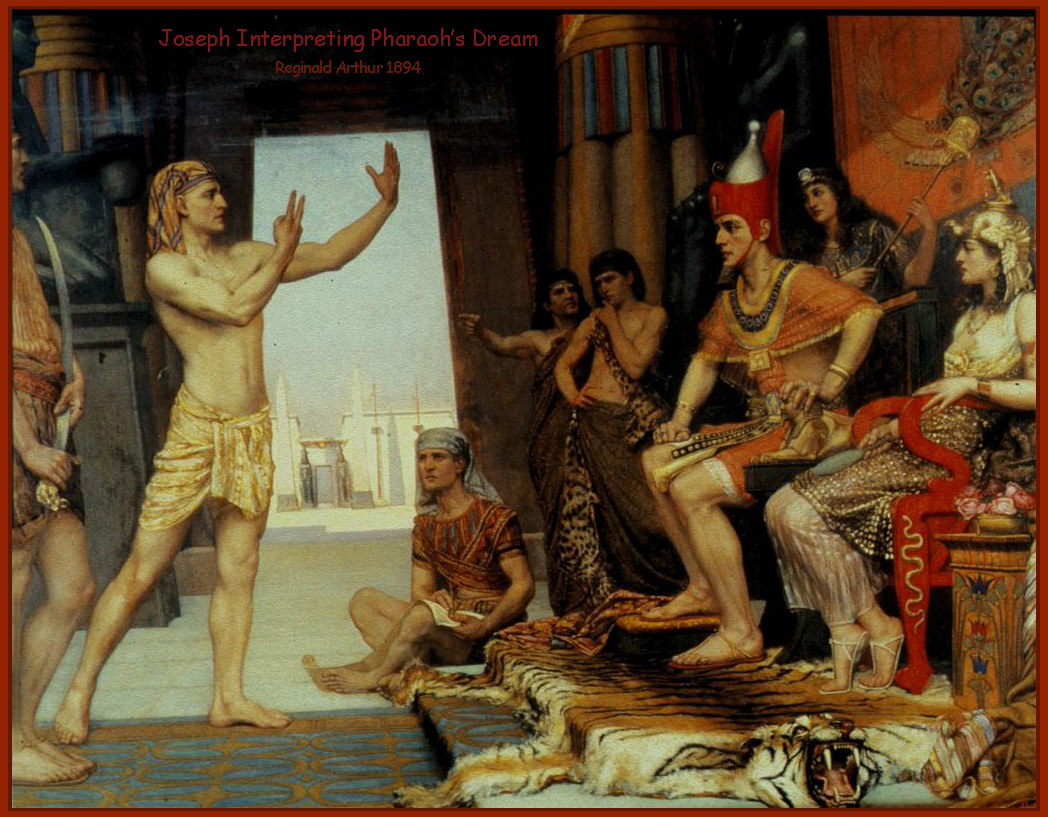
Joseph Interprets Pharaoh’s Dreams, by Reginal Arthur, 1894

Instead of using God’s personal name, Y-H-V-H, Joseph uses an ambiguous word that could as easily refer to the gods of Egypt as to Joseph’s God, the God of his great-grandfather Abraham. He is both honest about his own abilities, and intelligent about using a neutral word for God that will not trigger any negative reaction from Pharaoh.

With no further ado, Pharaoh tells Joseph his two dreams, concluding:

“And the scanty ears of grain swallowed up the seven good ears of grain. And I told the chartumim, but none [of them] was an explainer for me.” (Genesis 41:24)

Joseph might have decided to make the number seven mean seven years if he wanted to invent an explanation for the dreams of seven scrawny cows consuming seven fat cows and seven scanty ears of grain swallowing up seven good ears. But how could anyone invent explanations for the other elements in Pharaoh’s dreams that would turn out to be true predictions? There is too much at stake for anyone to prophesize without the help of a guidebook or a god.

The chartumim had no guidebook for the dreams sent by Joseph’s God. But Joseph has God, who instantly puts the meaning of the dreams into his mind. He explains the dreams to Pharaoh, ending with this summary:

“What the Elohim is doing, he made Pharaoh see. Behold, seven years of great plenty are coming throughout the land of Egypt. And seven years of famine will arise after them, and all the plenty in the land of Egypt will be forgotten, and the famine will completely use up the land. … And the dream came to Pharaoh two times because the matter was determined by the Elohim, and the Elohim is hastening to do it.” (Genesis 41:28-32)

Next Joseph gives Pharaoh some good advice. The text does not indicate whether God is transmitting these words to Joseph as well, or whether Joseph now had an idea of his own.

“And now, let Pharaoh select a man of discernment and wisdom, and set him over the land of Egypt. … And let them collect all the food of the seven good years … in cities under guard. And let the food be a reserve for the land for the seven years of the famine that will be in the land of Egypt. Then the land will not be cut down by the famine.” (Genesis 41:33-36)

And the thing was good in the eyes of Pharaoh and all his courtiers. And Pharaoh said to his courtiers: “Could we find another man like this, who has the spirit of Elohim in him?” (Genesis 41:37-38)

Pharaoh makes Joseph his viceroy on the spot—because the spirit of Elohim is in him.


Pharaoh needs a dream interpreter. He does not know that he also needs a viceroy in charge of agriculture and food rationing. Joseph wants to be released from both prison and slavery. He does not know what he wants to do once he is free.

Pharoah and Joseph need each other. But they would never meet, if it were not for the honesty of the Egyptian chartumim, and a belated good deed by Pharaoh’s chief butler. And their meeting would not have led to Joseph’s elevation if Joseph had not been honest about the true source of his dream interpretations. Pharaoh gives him the job title and the signet ring because he respects Elohim—whether that means Joseph’s God or many gods—and sees that Joseph has Elohim’s favor.

Does everything come together by chance? Are Joseph and Pharaoh just lucky?

Or does God arrange everything as part of a master plan? (Later in the Joseph story, Joseph tells the brothers who sold him into slavery “you did not send me here, but God!” and “you planned evil for me, but God planned it for good, in order to bring about this time of keeping many people alive.”)5

Or is it a combination of luck and the honest, ethical behavior of everyone involved at the time?

The same questions apply to our life stories today. When the right people do the right things and everything “clicks” for a good outcome, what do you attribute it to? Luck? A master plan of God’s? Or a combination of luck and a few individuals acting honestly for the good of everyone?


  1. Or HaChayim is a collection of 18th-century Moroccan Jewish commentary. Translation from www.sefaria.org.
  2. Rashbam is the acronym of 12th-century Rabbi Shmuel ben Meir. Translation from www.sefaria.org.
  3. Scott B. Noegel, “The Egyptian Magicians”, www.thetorah.com/article/the-egyptian-magicians; Flora Brooke Anthony, “Heka: Understanding Egyptian Magic on Its Own Terms”, https://www.thetorah.com/article/heka-understanding-egyptian-magic-on-its-own-terms.
  4. Genesis 37:5-11.
  5. Genesis 45:8 and 50:18-20. See my post: Vayigash & Vayechi: Forgiving?

Vayeishev & Mikeitz: Blame

When something bad happens that is neither an accident nor an act of God, who gets the blame?

Blame a beast

Joseph’s ten older brothers cannot stand him anymore in last week’s Torah portion, Vayeishev (Genesis 37:1-40-23). Their father, Jacob, dotes on him, and he lords it over his brothers. When they are out with the flocks Joseph spies on them, and brings back bad reports to Jacob.

Jacob Weeps over Joseph’s Tunic,
by Marc Chagall

Once the brothers say they are taking the flocks to Shekhem, but they make an additional day’s journey to Dotan. There they look back down the road, and see their seventeen-year-old brother. Is there no escape?

Several of the older brothers decide to kill him then and there, throw his body into a pit, and tell Jacob a wild beast ate him. But Reuben tells them to throw him in alive, so his blood will not be on their hands. When Joseph prances up tot them, they grab him, strip off his fancy clothing, and heave him into the nearest dry cistern. Then while they are eating lunch, they see a caravan heading for Egypt, and Judah convinces his brothers to sell Joseph to the traders as a slave. That way they get rid of him and make some money, too. Before they go home, the brothers dip Joseph’s fancy clothing in goat’s blood. The ploy works; when they show the bloody garment to Jacob, he believes Joseph was killed by a wild animal. So far, they have escaped the blame.

Blame the victim

Meanwhile a high-ranking Egyptian named Potifar buys Joseph. Potifar notices that everything his new slave undertakes succeeds, so he advances Joseph to the position of steward of his household. Then Potifar’s wife tries to seduce the handsome young slave, but he refuses her on ethical grounds. When she grabs at his clothing he runs away, leaving his garment in her hand.1

When Potifar comes home, his wife shows him Joseph’s garment and says:

“He came to me, the Hebrew slave that you brought to us, to fool around with me! But it was like I cried out at the top of my voice, and he left his garment beside me and he fled outside.” (Genesis 39:17-18)

Blaming the victim works; Potifar sends Joseph to prison.

Blaming the guilty for a different crime

Joseph’s run of success continues in prison, and thanks to God he correctly interprets the dreams of two men in custody awaiting their sentences. One is executed and the other is exonerated, exactly as Joseph predicted. Two years later, in this week’s Torah portion, Mikeitz (Genesis 41:1-44:17), Pharaoh has two troubling dreams that none of his advisors can interpret. The exonerated man remembers Joseph, and he is brought up from prison.

Joseph tells Pharaoh that both of his dreams mean the same thing: seven years of plenty will be followed by seven years of famine. Then he gives Pharaoh some advice about stockpiling grain during the years of plenty. Pharaoh is so impressed with the young man that he elevates Joseph to his second-in-command. Joseph becomes a successful minister of agriculture.

After seven years, the famine comes not only to Egypt but to the whole known world. Jacob sends his ten older sons from Canaan down to Egypt to buy grain.

And Joseph saw his brothers, and he recognized them, but he acted like a stranger to them and he spoke to them harshly … (Genesis 42:7)

They do not recognize Joseph, who was seventeen when they sold him. Now he is thirty-seven, he has an Egyptian name, he shaves and dresses like an Egyptian, and he speaks through an interpreter.2 Joseph accuses his brothers of being spies. They blurt out the first reason that comes into their heads why they are innocent of this charge.

Joseph’s Brothers Bow to the Governor, by Owen Jones, 1865

And they said: “Your servants are twelve brothers! We are sons of one man in the land of Canaan. But hey, the youngest is with his father now, and the one is not.” (Genesis 42:13)

Joseph uses this scant information as a means to get the youngest of the twelve brothers down to Egypt—Benjamin, Joseph’s only full brother as well as the only innocent one. He puts his ten older brothers in the guardhouse for three days, then announces that one of them must stay behind under guard while the rest go home with the grain.

“But the youngest brother you must bring to me, so your words will be verified and you will not die.”And they said, one to another: “Ah! We are asheimim on account of our brother, because we saw the distress of his soul when he was pleading to us for pity, and we did not listen. Therefore this distress has come to us.”  (Genesis 42:20-21)

asheimim (אֲשֵׁמִים) = bearing the consequences of guilt. (A form of the verb asham, אָשָׁם = became guilty.)

The brothers finally blame themselves for doing something wrong. And they consider their punishment under a false charge their just deserts—although Reuben then tries to exonerate himself by saying:

“Didn’t I say to you: Don’t techetu about the boy? But you did not pay attention. And now here is the reckoning for his blood!” (Genesis 42:22)

techetu (תֶּחֶטְאוּ) = you be blameworthy, be at fault. (A form of the verb chata, חָטַא = was blameworthy, was at fault, missed the mark.)

Blame others for your own misery

Joseph keeps Simeon under guard while the others take grain home to their extended family. When they tell their father what happened, he complains:

“I am the one you bereave of children! Joseph is not, and Simeon is not, and [now] you would take Benjamin! Everything happens to me!” (Genesis 42:36)

Now that Joseph is gone, Benjamin is the only remaining child of Jacob’s favorite wife, Rachel. Jacob flatly refuses to let Benjamin go.

The famine continues. When Jacob’s family in Canaan has eaten all the Egyptian grain, he tells his sons to go back to Egypt for more. Judah points out that the Egyptian minister said they could not see him again unless they brought their youngest brother with them.

And Israel [a.k.a. Jacob] said: “Why did you treat me badly, telling the man you had another brother?” (Genesis 43:6)

Again, Jacob thinks only about himself, and blames his ten older sons for his own misery. They are, in fact, guilty of taking Joseph away from him, but they sold Joseph to relieve their own misery, not to afflict their father. But a narcissist does not think other people have their own independent motives.

Take the blame in advance

Then Judah steps up and promises to take responsibility for Benjamin. First he points out that if Benjamin does not go down to Egypt, he will die of starvation, along with the rest of the family.

Then Judah said to Israel, his father: “Send the young man with me, and we will go, and we will live and not die: me, you, and our little ones. I myself will be the pledge; from my hand you can seek him. If I do not bring him back to you and place him before you, then chatati for all time.” (Genesis 43:8-9)

chatiti (חָטָאתִי) = I am blameworthy, I have missed the mark. (Another form of the verb chata.)

Judah makes no extravagant promises, but he does accept blame ahead of time if anything goes wrong. That is enough. Jacob lets Benjamin go with his brothers to Egypt.


Accepting the blame when you are guilty is an ethical response. Yet humans instinctively shrink from being blamed. We do not want to look bad, and we do not want to be punished. On the other hand, humans find it all too easy to blame others without knowing the whole story.

Joseph’s ten older brothers are all responsible, in one way or another, for his disappearance from Canaan. But they deceive their father so that his blame will fall on a wild beast rather than on any of them. Jacob fails to investigate at the time, and years later he blames them for his misery over the loss of Joseph even though he has no evidence against them. He is not an ethical blamer.

Potifar’s wife takes pre-emptive action by delivering a false accusation before Joseph can tell Potifar what actually happened. Blaming the victim is still a common strategy of the guilty.

Joseph does not even try to defend himself against the woman’s accusation. But he makes a false accusation himself when his brothers come to him to buy grain. His accusation lets him manipulate circumstances so that his brothers finally blame themselves for their old crime, and so that in the long run he can transplant his whole family to Egypt, alive and well. The only punishment he afflicts on his guilty brothers is their anxiety about what he will do to them.

Judah turns out to be the best at handling blame. Although as a young man he is guilty of talking his brothers into selling Joseph as a slave, he changes over the years—most notably when he sentences his daughter-in-law to death for an illegal pregnancy, then learns the rest of the story. He publicly admits he was wrong and stops the execution.3

By the second year of famine, Judah is able to accept blame ahead of time for whatever happens to Benjamin, knowing that it is the only way he can get food for the whole family. And in next week’s Torah portion, Vayiggash, Judah fulfills his pledge by volunteering to become a slave in order to save Benjamin from that fate.

Some of the characters in Genesis never change. But others learn how to accept blame when they deserve it. May more of us today learn how to overcome our natural tendencies to slap blame on others and dodge it ourselves. If Joseph and Judah can change, so can we.


  1. See my post Vayeishev: Stripped Naked.
  2. Genesis 41:14, 42:23.
  3. See my post Vayeishev & Mikeitz: Symbols of Authority.

Mikeitz & Vayigash: A Fair Test, Part 2

Does Joseph behave ethically when he deceives his brothers and secretly tests them during their two visits to Egypt?

Joseph is Governor, by Owen Jones, 1865

Last week I posted an essay on Joseph’s first round of testing, when his ten older brothers come to Egypt to buy grain in the first year of famine. When they meet the viceroy of Egypt, they do not recognize their brother Joseph, whom they had thrown into a pit and sold as a slave twenty-one years before.1 After they mention that their youngest brother is at home in Canaan, Joseph imprisons Simeon as a hostage, sells grain to the rest, and says they must return with their youngest brother. (See my post Mikeitz: A Fair Test, Part 1.) This youngest brother is Benjamin, the only one of Jacob’s sons with the same mother as Joseph.

Joseph’s second round of testing begins in the Torah portion Mikeitz and concludes in this week’s portion, Vayigash. The following essay comes from an earlier draft of my book on moral mistakes in Genesis, which I am now rewriting.

Second year test

When the brothers arrive in Egypt with Benjamin, Joseph releases Simeon, and invites them all to dine at his palace. He finally sees his baby brother Benjamin, who is now a young man.

Joseph Weeps, by Owen Jones, 1865

And Joseph hurried [out] because rachamav was stirred up toward his brother, and he needed to break into sobs. And he came into the inner room and he sobbed there. Then he washed his face and he left and controlled himself, and he said: “Serve bread!” (Genesis 43:30-31)

rachamav (רַחֲמָיו) = his compassion, his feeling of deep affection. (From the noun rechem, רֶחֶם = womb.)

Is Joseph moved to tears by a sudden feeling of love for his brother? Or is he feeling compassion over Benjamin’s situation? He would remember what it was like to live with a clinging father and ten jealous and dangerous older brothers.

Joseph keeps his brothers on edge by having them seated in order by age. Benjamin is obviously the youngest, but the ten older men, who were all born during a seven-year period that ended with Joseph’s own birth, are now middle-aged. No outsider could have guessed their birth order.

And he had portions passed to them from in front of himself, and Benjamin’s portion was five times bigger than anyone else’s. And they drank and they got drunk with him. (Genesis 43:34)

By giving Benjamin five times as much food as the others, Joseph displays unfair favoritism just as Jacob did when he gave Joseph an expensive tunic. This time the ten older brothers do not react to the favoritism.

Then the final test begins. Once again, Joseph has the silver returned to his brothers’ packs. He also has his steward plant a silver cup in Benjamin’s pack. The eleven brothers load their donkeys and set off early in the morning. Then Joseph orders his steward:

“Get up! Pursue the men, and when you catch up with them you shall say to them: Why did you pay back evil for good? Isn’t this what my lord drinks from and uses himself for divination? You did evil in what you did!” (Genesis 44:4-5)

The hint that the viceroy knows how to do divination, along with the previous day’s seating plan by birth order, might frighten the brothers into believing that the viceroy has magically divined their old crime. The steward overtakes the brothers as they leave the city, and repeats Joseph’s words.

And they said to him: “Why does my lord speak these things? Far be it from your servants to do [anything] like this! Hey, the silver that we found in the mouths of our packs, we brought back to you from the land of Canaan. So how would we have stolen silver or gold from your master’s house? [If] it is found with any of your servants he will die, and also we ourselves will become slaves to my lord.” (Genesis 44:7-9)

Their righteous indignation indicates that the eleven brothers all trust one another to refrain from stealing.

The Cup Found, by James J.J. Tissot, circa 1900

They quickly put their packs on the ground and open them, and the steward conducts a search, dramatically saving Benjamin’s pack for last. When the steward pulls out the silver cup, the brothers tear their garments in mourning. They accompany him back to the viceroy’s house, where they throw themselves on the ground in yet another prostration to the man who controls their fate.

And Joseph said to them: “What is this deed that you have done? Didn’t you know that a man like me does divination?” (Genesis 44:15)

Joseph is still playing his role in the elaborate test he has arranged. Judah answers for all eleven brothers.

And Judah said: “What can we say to my lord? How can we speak, and how can we be vindicated? The God has discovered the crime of your servants. Here we are, slaves to my lord, including us as well as he in whose possession the cup was found.” (Genesis 44:16)

In other words, Judah says the brothers are collectively culpable. He may feel that they are so united that if one of them commits a crime they are all guilty; or he may remember that all of them except Benjamin (and Reuben, who was absent at the time) sold Joseph as a slave, and therefore are just as guilty as the presumed thief of the silver cup.2

The older brothers’ solidarity with Benjamin could be the final piece of evidence Joseph needs for them to pass his test. But a lingering doubt makes him repeat that only Benjamin will stay as a slave in Egypt.

And [Joseph] said: “Far be it from me to do this! The man who is found with the cup in his possession, he will be my slave; and [the rest of] you, go up in peace to your father.” (Genesis 44:17)


Joseph acts ethically by fulfilling his promise to release Simeon when the brothers brought Benjamin to him.

But planting an item in Benjamin’s pack and pretending it was stolen is a more serious kind of deception than hiding his identity as their lost-lost brother. Now Joseph is framing an innocent man for a crime he did not commit.

He probably does not intend the accusation to go any farther. Joseph enjoys creating dramatic effects (the mysterious return of the silver to their sacks,3 the seating order at the feast, the talk of divination). When he ends the test, he is likely to reveal everything, and savor his brothers’ shock and amazement.

Joseph may not realize that framing his little brother for the theft might ruin Benjamin’s reputation with his older brothers. What if, after Joseph reveals his identity, his older brothers thought Benjamin did steal the cup, and Joseph was covering up for him? His desire to amaze his brothers prevents Joseph from  choosing the morally better action of protecting his little brother’s reputation.

Nevertheless, he does no long-term harm to any of his brothers. In this week’s Torah portion, Vayigash, Judah appeals to the viceroy’s feelings and offers himself as a slave in place of Benjamin so that he can fulfill his promise to their father, Jacob, to bring him back. If Benjamin did not return, he says, it would kill his father.

“And now, please let your servant remain instead of the young man as my lord’s slave, and let the young man go up with his brothers. For how could I go up to my father [if] the young man were not with me? Then I would see the evil that would come upon my father!” (Genesis 44:33)

At this moral example of unselfish sacrifice, Joseph “could no longer restrain himself”.4 He dismisses all his Egyptian servants and reveals his identity to his brothers.  He invites his whole extended family to move to Egypt so that he can provide for them during the remaining five years of the famine.


What if Joseph’s older brothers had not passed the test? What if, despite their guilt over mistreating Joseph, they had not volunteered to become the viceroy’s slaves along with Benjamin? What if Judah had not proven that he met his promises, had compassion for his father, and sincerely wanted to sacrifice his own freedom to save his little brother?

Joseph’s plan in that case might have been to keep Benjamin safe in Egypt, and let his older brothers to back to Canaan with another year’s supply of grain, no matter how much their father grieved. He might even have planned to let them all starve after the grain was consumed. As long as he believed his older brothers were a threat to Benjamin, he could not just forgive them and let them live in Egypt, too. Alternatively, Joseph might have planned to imprison them for the rest of their lives, feeding them but denying them freedom of movement.

Whether he chose to lock up his older brothers or send them home, would it be ethical for Joseph to punish men who committed a crime 22 years ago and who, in his opinion, might do so again?

Since his brothers (especially Judah) do pass Joseph’s secret test, he avoids facing this moral question. But I suspect Joseph is so carried away by his own cleverness that he does not consider the long-term ethical consequences of his test.


  1. Genesis 37:18-28.
  2. It would be unethical of Judah to speak for his brothers without their prior approval, even by ancient Israelite standards, since he is not the oldest brother or otherwise the head of a household they belong to. However, the ten older brothers had agreed that God was punishing them for their long-ago cruelty to Joseph. They may have discussed it again later and agreed that they deserved to be punished further, perhaps by becoming slaves themselves.
  3. Genesis 42:35, 43:19-23.
  4. Genesis 45:1.

Mikeitz: A Fair Test, Part 1

Rorschach test, card 3

Evaluating the people we meet is a human reflex. But sometimes we go farther, and arrange tests in order to judge people by their responses. When is it fair to test someone?

Honesty requires advance notice when one person is testing another. We expect to be tested in certain situations, such as a job interviews or class assignments. But otherwise we assume that others are not testing us—unless they warn us ahead of time.

Some situations, however, involve a higher moral value than honesty. For example, you might ethically deceive someone in order to save another person’s life.

What about Joseph’s secret testing of his brothers in this week’s Torah portion, Mikeitz? Is Joseph behaving ethically?

The following essay is from the first draft of the book I am now rewriting on moral psychology in Genesis.

The first test

Joseph ruling in Egypt, by James J. Tissot

Joseph faces his ten older brothers again 21 years after they threw him into a pit and then sold him as a slave to a caravan bound for Egypt.1 During those years, thanks to his own intelligence and a prophetic gift from God, Joseph has become Pharaoh’s viceroy. He has spent seven years stockpiling grain in Egypt to prepare for the long famine he has prophesied. Now he is in charge of selling that grain.

And the sons of Israel came to buy grain among [others who were] coming, because the famine was [also] in the land of Canaan. And the ruler of the land was Joseph; he was the grain seller for all the people of the land. And Joseph’s brothers came and prostrated themselves to him, noses to the ground. (Genesis 42:5-6)

This fulfills Joseph’s adolescent dream in which his brothers were sheaves of wheat bowing down to his sheaf.2

And Joseph saw his brothers and he recognized them, but he kept his identity from them and he spoke to them harshly. And he said to them: “From where do you come?” And they said: “From the land of Canaan, to buy grain.” And Joseph recognized his brothers, but they did not recognize him. (Genesis 42:7-8)

When the brothers last saw Joseph he was 17. Now he is 38. He has an Egyptian name and wears Egyptian clothes. He recognizes his brothers, but they do not recognize him. So he pretends to be the stranger he appears, and he speaks to them through an interpreter.

And Joseph remembered the dreams that he dreamed about them, and he said to them: “You are spies! You have come to see the naked places of the land.” (Genesis 42:9-11)

Joseph wants to accuse his brothers of something so he will have an excuse to detain them. Spying may occur to him first because when he was 17 he was a spy; he brought “bad reports” of his brothers to Jacob (a.k.a. Israel).3

And they said to him: “Never, my lord! Your servants have come to buy food. We are, all of us, sons of one man. We are keinim. Never have your servants been spies!” (Genesis 42:10-11)

keinim (כֵּנִים) = upright, honest, virtuous. (Plural of kein, כֵּן.)

Joseph knows that they were certainly not keinim when they sold him into slavery. But have they changed over the last 21 years?

He repeats that they are spies. Presumably it would be strange, in the Ancient Near East, for a ruler to send ten spies from the same family; in the book of Numbers, Moses sends one scout from each of the ten tribes to investigate Canaan.4

And they said: “Your servants were twelve brothers, sons of one man in the land of Canaan. And hey! The youngest is with our father now, and the [other] one— einenu. (Genesis 42:13)

einenu (אֵינֶנּוּ) = he is not, he is nothing, he is absent.

What else can they say about Joseph? They probably wish they had not brought up their two missing brothers. Joseph accuses them a third time of being spies, and declares:

“By this tibacheinu, by the life of Pharaoh! If you leave this place, then your youngest brother must come here. Send one of yourselves, and he will take your brother; and [the rest of] you will be imprisoned. And your words, yibachanu, [to see if] the truth is with you. If not, by the life of Pharaoh, then you are spies.” (Genesis 42:15-16)

tibacheinu (תִּבָּחֵנוּ) = you will be tested. (A form of the verb bachan, בָּחַן = tested.)

yibachanu (יִבָּחַנוּ) = they will be tested. (Also a form of the verb bachan.)

Joseph does say he is testing the ten men. But he claims he is testing them to see if they are really spies, when in fact he knows that are not. His actual reason turns out to be a test of how they will treat their youngest brother, Benjamin.

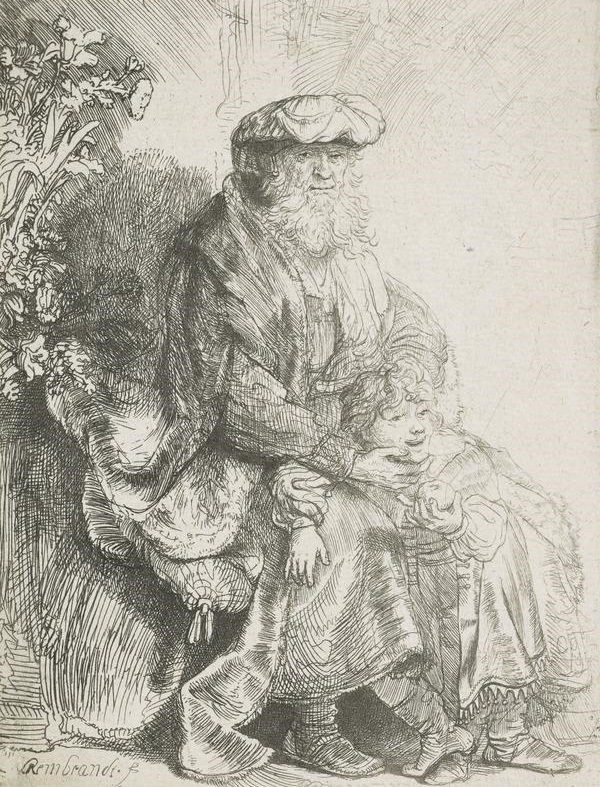
Jacob Caressing Benjamin, by Rembrandt, 1637

Benjamin is Joseph’s only full brother—the only other son Jacob had with his beloved Rachel. Since Jacob kept Benjamin home, Joseph knows that Benjamin has replaced him as the favorite son, the one his father dotes on. This raises the question of whether his half-brothers would ever treat Benjamin as badly as they once treated him. What if they became more jealous of their father’s new favorite? Twenty-one years before they were willing to kill or sell Joseph.  Would they do the same to Benjamin?

Joseph throws all ten of his older brothers in prison for three days. When he releases them, he makes a better offer: nine of the men can return to Canaan with grain, and he will keep only one of them under detention in Egypt until they return with their youngest brother.

This modification of the test means that their families back in Canaan will not starve. Joseph realizes that one man could not handle all the donkeys they brought to carry grain.5 He is deceiving his brothers, but he is also feeding his whole extended family.

Then Joseph overhears them speaking in Hebrew.

And they said, each man to his brother: “Alas! We are guilty on account of our brother, because we saw the distress of his soul when he pleaded to us for mercy, and we did not listen. Therefore this distress came upon us.” (Genesis 42:21)

This is the first evidence Joseph gets that his older brothers have changed. When he was seventeen, they were only concerned about getting rid of him for good without being held responsible. Now they remember Joseph as a human being with feelings, and they feel guilty. Throwing him in the pit and then selling him is the worst thing they have ever done, so they conclude it must be why God is punishing them now.

Joseph Weeps, by Owen Jones, 1865

Joseph turns away from them and weeps, but he still does not trust his brothers. He is determined to continue his test. He keeps Simeon as the hostage, and sells grain to the other nine. Then he has their silver returned to their packs just before they leave for Canaan. Again he orders them to return with their youngest brother, threatening that they will not see his face again unless they do.

At this point we might wonder about the purpose of Joseph’s test. Jacob would be reluctant to let Benjamin go to Egypt, but his brothers would gladly bring him whether they are keinim or not.

Probably Joseph is already planning the second part of his test. He knows that the famine will last seven years, so his brothers will have to return to Egypt the following year for more grain. If his ten half-brothers fail the second part of test, Joseph will be able to protect Benjamin by keeping him in Egypt.


Is Joseph’s deception ethical so far? Unlike his brothers 21 years before, he does no physical harm, and he enslaves no one. He takes a hostage, but gives clear conditions for Simeon’s release.

Nevertheless, restricting Simeon’s freedom is unethical. Simeon has committed no crime in Egypt. Furthermore, Simeon’s imprisonment does not actually achieve anything. Joseph should know that Jacob would rather let Simeon spend the rest of his life in prison than let Benjamin go to Egypt. And his brothers will have to return to Egypt for more grain anyway. It would have been equally effective, and more ethical, for Joseph to let all ten men go, with a warning that if they came to Egypt again without Benjamin he would turn them away.

What if he took his brothers aside, revealed his identity, and demanded an apology for selling him into slavery? Then he would not even be guilty of dishonesty. But his brothers might apologize out of fear, not remorse, and he still would not be sure that Benjamin was safe with them.

Perhaps Joseph’s devious route to reconciliation through a complicated test is actually the most ethical option at this point (though the test would be more ethical if he let Simeon go with his brothers). But will the test remain ethical when the brothers return? See my next post, Mikeitz: A Fair Test, Part 2.


  1. Joseph is 17 when his brothers sell him (Genesis 37:2, 37:12-27) and 30 when Pharaoh makes him the viceroy of Egypt (Genesis 41:44-46). He is 37 at the end of the seven years of plenty, and 38 when his brothers have endured a year of famine and come to Egypt to buy grain.
  2. Genesis 37:5-7.
  3. Genesis 37:2, 37:14.
  4. Numbers 13:1-20.
  5. Genesis 42:26.

Passover, Vayeishev & Mikeitz: Four of Jacob’s Children, Part 2

The wise child, the wicked child, the simple child, and the child who does not know how to ask; these are the four kinds of children in the Passover Seder.  Can we find them among Jacob’s progeny?

Last week I argued that out of the three of Jacob’s children with speaking roles in the book of Genesis, Reuben is an unwise wise child, and Judah is a reformed wicked child.  You can read that post here: Passover, Vayeishev & Mikeitz: Four of Jacob’s Children, Part 1.

The only other one of Jacob’s children who speaks is Joseph.  In the Passover Haggadah, the simple child says only, “What is this?”  Joseph says a great deal more.

Joseph: Complicated Simple Son

In fact, he talks too much.  By the time he is seventeen, four of his older brothers hate him because he brings bad reports of them to their father, Jacob.1  The rest hate him because he is Jacob’s favorite.  Joseph should notice their animosity, since “they could not speak to him in peace”.2

Joseph Reveals his Dream to his Brothers, by James J.J. Tissot

Yet he tells his brothers about two dreams in which they (thinly disguised as sheaves of grain, then as stars) are bowing down to him.3

Only a simple child would tell these dreams to brothers who already hate him.  Does Joseph realize how his older brothers feel?  Is he unable to imagine that they might lash out at him?

Their father, Jacob (who may also be deficient in emotional intelligence) sends Joseph off alone to check up on his brothers and their flocks.  As soon as he reaches them, they seize him, throw him into a pit, and argue about whether to kill him, let him slowly starve, or sell him as a slave.4  He pleads with them to no avail,5 and before the day is over he is a slave bound for Egypt.

The next time Joseph speaks is when his Egyptian master’s wife tries to seduce him, and he explains that he will not lie down with her because it would be wicked.6   It does not even occur to him to flatter her when he refuses her advances. She does not take his rejection well, and Joseph ends up in Pharaoh’s prison.

One morning in prison Joseph notices that two of his fellow prisoners, Pharaoh’s head butler and head baker, have “bad expressions”7—the first sign that he is noticing the feelings of others.  He asks them why, and they say there is no one to interpret their dreams.

Joseph in Prison, by James J.J. Tissot

Then Joseph said to them: “Aren’t dream interpretations for God?  Please tell me.”  (Genesis 40:8)

Is Joseph giving credit to God for his upcoming interpretations, or is he claiming that God gives him secret information?  Probably both.  Joseph’s predictions based on their dreams come true, and two years later when Pharaoh has a pair of puzzling dreams, the head butler recommends Joseph.

This time Joseph says God is revealing the future to Pharaoh through those dreams.8  The implication that God is giving Pharaoh, not Joseph, secret information indicates Joseph’s increasing sophistication.  He says the dreams are forecasting seven years of plenty followed by seven years of famine, and throws in some advice: Pharaoh should appoint an insightful man to organize stockpiling and later distribution of food.  Impressed, Pharaoh appoints Joseph.  From then on, he is the viceroy of Egypt.9

When Joseph’s ten older brothers come to the viceroy to buy grain during the first year of famine they do not recognize him.  Joseph plays a complicated game, arranging elaborate tests to see if his brothers have reformed.10  Joseph’s premise is that he can judge his older brothers according to how they treat Benjamin, Jacob’s youngest son and his new favorite.

Joseph still has grandiose impulses, and adds details to his game that are not strictly necessary.  For example, he invites them to dinner and seats them in order from oldest to youngest, although no Egyptian could guess their exact birth order.  They are astonished by his apparent magical power.11

The final test comes when Joseph plants a silver cup in Benjamin’s pack, then accuses him of stealing it and decrees that the punishment is to stay in Egypt as the viceroy’s slave.  Joseph’s ten older brothers say they are all guilty and they will all be slaves with him.  Even this is not enough for Joseph, who insists that only Benjamin will stay.12  Finally Judah breaks the deadlock by explaining that their father could not live without Benjamin.  Judah begs to be the viceroy’s slave instead of Benjamin, and Joseph finally breaks down and admits who he is.13

But there is one more complication.  Joseph is so attached to his role as the savior of Egypt, Canaan, and his own family, that he says:

“And now don’t worry and don’t be angry with yourselves because you sold me.  Because hey! God sent me ahead of you to save life.  For this was a pair of years of the famine in the midst of the land, and there will be five more years when there will be no plowing nor reaping …  So now, you did not send me here!  Rather, God did, and he placed me as a father-figure to Pharaoh and as a master to all his household and a ruler over all the land of Egypt.” (Genesis 45:5-8)

By the end of this speech Joseph is bragging about his high position.  As Pharaoh’s 39-year-old viceroy, he is older and wiser than he was at age 17.  But he is still as full of himself as a simple child.  He is also full of his theory of divine providence (at least for him and his family), and does not see that his brothers need his forgiveness.

Joseph invites the whole extended family to live in Egypt and benefit from his munificence.  Yet when their father Jacob dies, his ten older sons send a message to Joseph begging for a pardon.  They still do not feel safe with a simple child who has absolute power over them and never explicitly forgave them.

Then Joseph said to them: “Don’t be afraid!  Am I instead of God?  And you, you planned evil for me, but God planned it for good, in order to bring about this time of keeping many people alive.  And now, don’t be afraid; I, myself, will provide for you and your little ones.”  And he comforted them, and he spoke to their hearts.  (Genesis 50:19-21)

Whatever Joseph says to comfort them works, and they have a change of heart.  But I wish one of Joseph’s brothers would protest, “What is this?”

Benjamin: Speechless Son

Jacob has nine sons who are not quoted in the Torah.  He also has a daughter, Dinah, who is silent about her own rape, the subsequent proposed marriage, and the murder of her would-be bridegroom.14  I am tempted to call Dinah the fourth child in the Passover Seder, the “child who does not know how to ask”, so I could grandstand about how women in the Ancient Near East were pawns and chattels of the men, deprived even of the right to speak for themselves.15

But if Reuben, Judah, and Joseph correspond to the three children who ask questions, then the fourth child, who is amazed by the Passover rituals but cannot put together a question, must be Benjamin.

Benjamin is the youngest of Jacob’s children, and the only one who does not commit or witness any terrible deeds.  He has not even been born when Dinah is raped and Jacob’s oldest sons massacre all the men in the town of Shekhem.  He is only a toddler in Jacob’s camp when Joseph’s older brothers sell him as a slave.  The first year Jacob sends his ten older sons to Egypt to buy grain, he does not let Benjamin go.  The second year, when Benjamin does go, he is a married man with children of his own—but he is leaving his father’s home for the first time in his life!

He is silent—probably flabbergasted—when the viceroy’s steward “finds” the silver cup in his pack and accuses him of stealing it.  Benjamin remains silent when his older brothers tell the viceroy they will all stay in Egypt and suffer the punishment of slavery.  Another man might protest at this point, but Benjamin is not used to making his own ethical decisions.

After the viceroy reveals that he is Joseph, he embraces Benjamin first.

And [Joseph] fell on the neck of Benjamin, his brother, and he sobbed, and Benjamin sobbed on his neck.  And he kissed all his brothers and he sobbed on them.  And after that his brothers spoke to him.  (Genesis 45:14-15)

Benjamin is the only one of Joseph’s brothers who sobs back.  He is overwhelmed by Joseph’s affection, and unlike his older brothers, he is innocent of any wrongdoing.  He can react freely, and non-verbally.

Like the fourth child in the Passover Seder, Benjamin is the baby of the family.  It does not even occur to him to question what is going on.  We do not learn whether he ever grows up.

  1. Genesis 37:2.
  2. Genesis 37:3-4.
  3. Genesis 37:5-9.
  4. Reuben argues that they should throw Joseph in the pit without killing him outright, implying that he will eventually die of dehydration.  Reuben’s plan is to sneak back and rescue him (Genesis 37:21-22).  Judah persuades his brothers to sell Joseph to a passing caravan (Genesis 37:26-28).
  5. Genesis 42:21.
  6. Genesis 39:8-9.
  7. Genesis 40:7.
  8. Genesis 41:25.
  9. Genesis 41:39-44.
  10. Genesis 42:9-25, 43:26-44:17.
  11. Genesis 43:33.
  12. Genesis 44:16-17.
  13. Genesis 44:18-45:3.
  14. Genesis 34:1-31.
  15. Except for Rebecca, who can say “yes” or “no” to her engagement to Isaac (Genesis 24:57-58).


Passover, Vayeishev & Mikeitz: Four of Jacob’s Children, Part 1

The number four is big in the Passover/Pesach seder.  The Haggadah (the script for the ritual) is punctuated by four cups of wine.  Between the first cup and the second, the youngest person present sings the four questions, we read about four rabbis who stayed up all night, and we answer questions from four kinds of children.

The Four Seder-night Sons, American Haggadah, circa 1920

“The Four Sons” Passover tradition is first reported in the Mekhilta di Rabbi Yishmael, and might date as early as the second century C.E.1

There are four sons: a wise son, a wicked son, a simple son, and one who does not know how to ask.  (Mekhilta di Rabbi Yishmael, 13:14)2

The Torah prescribes what a father should say to a son on Pesach four times.3  Three of these instructions are preceded in the Torah by a hypothetical question from a child.  These three questions are similar in the Torah, the Mekhilta di Rabbi Yishmael, and the Haggadah:

  1. The “wise child”: “What are the terms and the decrees and the laws which God, our God, has commanded us?”
  2. The “wicked child”: “What does this service mean to you?”
  3. The “simple child”: “What is this?”
  4. The “child who does not know how to ask”.  (This child corresponds to an implied question about why everyone must eat only unleavened bread during the seven-day festival.  Moses gives the answer: “And you shall tell your child on that day, saying: This is because God did for me when I went free from Egypt.”  (Exodus 13:8))

The three questions may be similar, but the answers in the Haggadah leave out a lot of the information in the Torah, and one answer, to the so-called wicked child, is quite different.3  You can compare the Torah versions and the Haggadah versions in my 2019 post: Pesach: Changing Four Sons.

Every year as Pesach approaches, I enjoy playing with the idea of four kinds of children.  In 2012 I applied the four children model to Aaron’s four sons in this post: Shemini: Aaron’s Four SonsIn 2014 I wrote a post about the four children in terms of the four worlds of kabbalah in this post: Passover: Children of Four Worlds.

This year I am writing my book on morality in Genesis, and thinking about  Jacob’s twelve sons and one daughter.  Only three of his children get speaking roles in the Torah: Reuben, Judah, and Joseph.  Do they correspond to the three children who ask questions in the Haggadah?  What about the fourth child, the silent one?

Reuben: Unwise Son

Reuben, Jacob’s oldest son, is an unwise “wise child”.  I can imagine him asking for all the rules because he wants to do the right thing.  But then he blunders into some stupidity and messes it up.

When Joseph’s ten older brothers see him from a distance and plot to seize him, throw him into a pit, and kill him, Reuben says: “Let us not take his life!”  His brothers ignore him, so he waters down his protest.

And Reuben said to them: “Don’t shed blood!  Throw him into that pit that is in the wilderness, but don’t send a hand against him!”—in order to rescue him from their hand and restore him to his father.  (Genesis/Bereishit 37:22)

After Joseph is at the bottom of the pit, the other brothers sit down for a meal, but Reuben wanders away for some reason not recorded in the Torah.  Early commentators invented excuses for Reuben’s absence at the critical moment, but I maintain Reuben is not thinking clearly.  What could be more important than staying near the pit in case his murderous brothers suddenly decide to act?

And they do.  While Reuben is gone, Judah proposes selling Joseph as a slave to a passing caravan headed for Egypt.

And he [Reuben] returned to his brothers, and he said: “The boy is not here!  And I, where can I go?”  (Genesis 37:30)

Reuben intended to do the right thing, but he was not wise enough to carry it out properly.

Twenty-one years later, during the first year of a long famine, the viceroy of Egypt tells the ten brothers that he will not sell them grain again unless they bring their youngest brother down with them.  Back in Canaan the famine continues a second year, and the brothers try to persuade their father to let Benjamin go, even though he has become Jacob’s favorite now that Joseph is gone.  Reuben knows the whole family will starve to death unless his father lets Benjamin go, so he says:

“You may kill my two sons if I do not bring him back to you!  Put him in my hand, and I myself will return him to you.”  (Genesis 42:37)

He sounds ready to make a noble sacrifice.  But why would Jacob want to kill two of his own grandsons?  Once again, Reuben tries to be the wise child who does the right thing, but what he actually does is far from wise.

Judah: Reformed Wicked Son

The “wicked son” in the Haggadah asks, “What does this service mean to you?”  In the Torah it is an innocent question, and the parent merely answers that they are making a Passover offering to God to remember when God smote the Egyptians but passed over their households.  But in the Haggadah and the Mekhilta di Rabbi Yishmael, the parent accuses this son of separating himself from other Jews by saying “you” instead of “us”.4

Judah, Jacob’s fourth son, starts out as selfish as the Haggadah’s version of the “wicked son”. When Joseph is naked at the bottom of the pit, Judah is the one who says:

“What is the profit if we kill our brother and cover up his blood?”  (Genesis 37:26)

He persuades his brothers to sell Joseph as a slave to a passing caravan instead, and they are paid 20 silver pieces for him.  At this point, Judah is indeed wicked, separating himself from any empathy toward his younger brother Joseph.  Later, he deprives his widowed daughter-in-law Tamar of her traditional right to stay in his family by having a child with her deceased husband’s nearest male relative.  Tamar deceives Judah in order to get pregnant by him, and when Judah sentences her to death for adultery, she produces evidence that he is the father of her unborn child.  Judah’s eyes are opened, and he admits he was wrong, saying: “She is more righteous than I am!”  (Genesis 38:26)

After that wake-up call, Judah exhibits the empathy that I believe is implied by the question “What does this service mean to you?”  I think the so-called wicked child is actually interested in the feelings of other people, like Judah later in his life.

When Jacob refuses to let Benjamin go to Egypt so his sons can buy food during the second year of famine, Judah is the one who finally makes him change his mind.

Then Judah said to his father, Israel: “I will bring him.  Send the young man with me, and we will get up and go, and we will live and not die—we and you and our little ones. I myself will be the pledge for him; from my hand you may seek him.  If I do not bring him back to you and produce him before you, I will be guilty to you forever.”  (Genesis 43:8)

Judah’s word is good; when the viceroy of Egypt plants a silver cup in Benjamin’s pack and accuses him of stealing it, Judah volunteers to be the viceroy’s slave instead of his brother.  This act, along with a moving story about Jacob’s love for Benjamin, turns the tide, and the viceroy confesses that he is actually their brother Joseph.  Thanks to Judah’s empathy, the family arrives at a happy ending.

*

Does Joseph, the third of Jacob’s children who has a speaking role in the Torah, correspond in any way to the Haggadah’s “simple son”?  And who is the silent child?  You can find out next week in Passover, Vayeishev, & Mikeitz: Four of Jacob’s Children, Part 2.

  1. The Mekhilta di Rabbi Yishmael collection of commentary on the books of Exodus through Deuteronomy written during the first through fourth centuries CE and by Rabbi Yishmael ben Elisha, his students, and subsequent commentators.  The four sons in the Mekhilta are alluded to in the Jerusalem Talmud, but not in the Babylonian Talmud.
  2. This quote and all subsequent quotes from the Mekhilta use the translation in sefaria.org/Mekhilta_d’Rabbi_Yishmael.
  3. Deuteronomy 6:20-24 (wise), Exodus 12:27 (wicked), Exodus 13:15 (simple), and Exodus 13:6-8 (silent).
  4. This is outrageous, since in the Torah the wise son’s question is “What are the duties and the decrees and the laws that God, our God, commanded to you?”

A Feast and a Famine

Sometimes I cannot find any connection between the week’s Torah portion and the story I am analyzing for my book on ethics in Genesis.  Coincidence and synchronicity are lovely, but unreliable.

So here is a link to the first blog post I wrote on this week’s Torah portion in the book of Exodus: Mishpatim: After the Vision, Eat Something.  I have long been fascinated by the brief account of how Moses, Aaron, Nadav, Avihu, and 70 elders climb halfway up Mount Sinai and see God’s feet on a sapphire pavement–and then sit down and eat.

Meanwhile, I am writing about Pharaoh’s two dreams that predict seven years of plenty followed by seven years of famine, and Joseph’s advice on how to keep the Egyptians alive until the famine is over.  Pharaoh not only takes his advice, but makes Joseph the viceroy of Egypt so he can direct the operations.  This scene (Genesis 41:14-46) is unusual in the book of Genesis because both protagonists behave ethically toward one another and for the good of the people of Egypt.

Naturally Joseph is happy to get promoted from prison trusty to ruler of Egypt, but he does not engage in deception or any other unsavory act to make it happen.  He gives God credit for his dream interpretations, comes up with a sound plan through his own quick intelligence, and presents it in a respectful way.  Pharaoh bypasses the existing hierarchy of courtiers and makes the outsider Joseph the viceroy at age 30, giving him the status symbols he will need to be successful in the job.

You never know what human beings will turn out to be capable of doing.

Repost: Vayigash

I went back to my 2014 post on Joseph as a “Serial Sobber”, and I could not resist tearing it in two and rewriting both parts extensively.  You can read the first part here: Mikeitz & Vayigash: Serial Sobber, Part 1.  I’ll post the second part next week, after I finish rewriting it.

Unlike Joseph, I am a person who  does not cry easily.  I only break into sobs once every five to ten years, when I have been trying and trying to accomplish something, and I finally realize I have to give up.

There are also times when another person touches my heart and I feel moved, like Joseph, but the closest I get to weeping then is a small tightening of my throat.

My throat tightened a bit this week when I was walking around Split, Croatia.  Most of the other folks on the streets are Croatians, since this is definitely the off season.  It dawned on me that only people under 30 looked happy.  The faces of most older Croatians are engraved with lines of grim endurance, broken only when someone says hvala, “thank you”, and flashes a quick smile.

And then I remembered: Croatia used to be part of Yugoslavia under the totalitarian dictatorship of Josip Tito.  After his death in 1980 the country deteriorated further, and then war began: first between Croats and Serbs, then between an independent Croatia and the splintering Yugoslavia.  Croatia’s secession and independence were finally secured in 1995.  The Croatian economy began to recover around 2000, and the country became a member of the EU in 2013.

View from Narodni Trg, a popular plaza in old Split (photo by M.C.)

Now Split has a prosperous tourist industry.  Sunshine and a warm seashore help, but so do all the ancient stone buildings that nobody could afford to raze and replace during the second half of the 20th century, when so many other cities lost their architectural treasures to the brutal aesthetic of the time.  Now, thanks to the segments of “Game of Thrones” filmed in Split, the old city is more attractive to tourists than ever.

The young adults look relaxed and happy here.  But when I consider the older adults who lived through the war in the 1990’s, and some even through the Tito years, my throat tightens.  I respect them just for carrying on.