Yitro: The Heaviness of Honoring Parents

by Melissa Carpenter, maggidah

“Heavy, man!”

When we said that back in the 1970’s, we meant that something was impressive, difficult, or profound, not to be taken lightly. The Hebrew word for “heavy”, kaveid, has similar shades of meaning.

Moses at the Burning Bush by Rembrandt van Rijn
Moses at the Burning Bush
by Rembrandt van Rijn

When God tells Moses his mission at the burning bush, Moses objects that he cannot speak to either the Pharaoh or the Israelites in Egypt because his tongue is kaveid.

But Moses said to God: Excuse me, my lord, I am not a man of words…because I am khevad mouth and khevad  tongue. (Exodus/Shemot 4:10)

khevad (כְבַד) = heavy of. (Another formation from the root verb kaveid, כָּבֵד.)

What does Moses mean by saying his mouth and tongue are heavy? Rashi (11th-century Rabbi Shlomo Yitzhaki) wrote that Moses stammered or had a speech impediment.  His grandson Rashbam (12th-century Rabbi Shmuel ben Meir) wrote that Moses was no longer proficient in Egyptian. Either way, Moses’ speech is kaveid because it is slow and difficult for him.

Later in the Torah, Moses speaks at length.  Then his speech might be kaveid because it is impressive to the listener, difficult to grasp, and profound.

When Moses and Aaron first ask Pharaoh to give the Israelites a three-day vacation to worship their god, Pharoah increases his laborers’ workload instead, saying:

Tikhebad, the work, upon the men, and they must do it, and they must not deal in lying words. (Exodus/Shemot 5:9)

tikhebad (תִּכְבַּד) = it will weigh heavily, let it be heavy, it must be a burden. (A form of the root verb kaveid, כָּבֵד.)

Pharoah’s heart (the seat of his thoughts and feelings, in Biblical Hebrew) also becomes heavy. After each divine miracle except the final one (the death of the firstborn), Pharaoh is tempted to let his slaves go on that three-day vacation. But then he reverts and refuses to change his economic and political system. Pharaoh’s heart is hardened six times, and made heavy (hakhebeid, הַכְבֵּד) five times. He is too stiff and too heavy to move.

Brick making Tomb of King Rekhmire in Thebes
Brick Making, Tomb of King Rekhmire in Thebes

Furthermore, the Torah describes four of the miraculous plagues (swarming insects, cattle disease, hail, and locusts) as kaveid, heavy, because they are so oppressive.

When Pharaoh finally lets the Israelites and their fellow-travelers leave, we read:

And the Children of Israel journeyed from Ramses to Sukkot, about 600,000 strong men on foot, besides non-marchers. And also a mixed throng went up with them, and flocks and herds, very kaveid property. (Exodus/Shemot 12:37-38)

kaveid (כָּבֵד) = heavy, weighty, oppressive, impressive, magnificent.

For newly-freed slaves, they leave with a lot of property: their own livestock, and all the gold and silver objects the Egyptians gave them on their way out. As they march away, the abundance of their possessions is impressive.

God also wants to be impressive.  When the emigrants have entered the wilderness, God tells Moses that Pharoah’s army will pursue them, so that God can stage one last miracle at the Reed Sea.

…then ikavedah through Pharaoh and through all his army; … and the Egyptians will know that I am God. (Exodus 14:4, 14:17-18)

ikavedah (עִכָּבְדָה) = I will be recognized as important, I will be honored, I will be respected, I will appear magnificent. (A form of the root verb kaveid.)

The people reach Mount Sinai in this week’s Torah portion, Yitro (“his surplus”, the name of Moses’ father-in-law).  This is where God pronounces the Ten Commandments. The fifth commandment begins with the word kaveid.

Kabeid your father and your mother, so that your days will lengthen upon the soil that God, your god, is giving to you. (Exodus 20:12)

Kabeid (כַּבֵּד) = Honor! Respect! Treat as weighty, important!  (This imperative verb comes from the same root as the adjective kaveid.)

Honoring your parents sounds like a nice idea, but why is it one of God’s top ten rules?

In traditional commentary from the third century C.E. to the present, honoring your parents is a necessary step to honoring God, and neglecting your parents is an insult to God. One reason given is that your biological parents—and God—created you. However, the Talmud (Ketubot 103a) states that this commandment applies not only to biological parents, but also to step-parents and older brothers—and therefore, presumably, to adoptive parents.

The other traditional reason why honoring parents means honoring God is that parents must teach their children Jewish history and Torah. (Apparently reading books, including the Bible, is not enough; religious knowledge must be transmitted orally.) Children honor their parents by learning their religion and passing it on to the next generation.  Without this transmission, God would cease to be honored.

Underage children are supposed to honor their parents by learning Torah from them, and by obeying them (as long as the parental request does not contradict God’s will).

Adult children must honor their parents in other ways. The Talmud (Kiddushin 31b) explained that you honor your parents by making sure they have food, drink, clothing, and coverings, and by “leading them in and out”. (It was assumed that the responsible son continued living in his parents’ house, and so could always arrange to escort them.)

Rambam (12th-century Rabbi Moses Maimonides) added in his Mishneh Torah, book 14, that if a man’s parents are poor and their son is able to take care of them, he must do so. He must also treat his parents with the respect of a student for a teacher, performing personal services and rising before them. However, Rambam wrote, if a parent is mentally ill and the son can no longer bear the stress, he may move out and hire someone else to care for his parents.

All this deference and personal care, the commentary insists, is required regardless of whether your parents were kind to you as you grew up. Nowhere in the Torah are parents required to honor or love their children; they are only required to circumcise their sons, to teach their children God’s commandments, and to refrain from incest and child-sacrifice.

If your parents were kind to you, it is a natural human inclination to honor them. But even if your parents did not earn your gratitude or love, the commentary on the fifth of the Ten Commandments says you must still honor them—in order to honor God.

Maybe the fifth commandment adds “so that your days will lengthen” in order to encourage people to honor even difficult parents. A longer life would be an especially good reward if it gives you more years to enjoy life after your difficult parent has died.

Yet we can all observe that some of the most dutiful children die younger than some of the most neglectful.  A famous story in the Talmud (Chullin 142a) tells of a father who ordered his son to climb to the top of a building and bring down some chicks. The son “honored” his father by climbing up, and followed another Biblical rule that promises prolonged life by chasing away the mother bird before collecting her young.  On the way down the ladder, the son fell and died. The rabbis in the Talmud conclude that “there is no reward for precepts in this world”, and declare that the story is an argument in favor of the doctrine of the resurrection of the dead.

Since the commandment says: so that your days will lengthen upon the soil that God, your god, is giving to you, Hirsch and other commentators explained that honoring parents would prolong the period of time when the Israelites got to live in the “Promised Land” of Canaan.

But the commandment in this week’s Torah portion uses the singular “you” throughout.  I think the only way your days might be lengthened because you honor your parents is if each day feels longer to you.  We can only hope that the day seems longer because it is fuller and richer, not because you can hardly wait for it to be over!

What kind of “honor” do we owe our parents today?

I think we should kabeid  (honor) our own parents according to the way they have been kaveid (heavy) in their relations with us.  Has a parent been oppressive, or impressive?

If parents caused childhood trauma, and remain crushing impediments, I think we are entitled to “move away”, as Rambam suggested. We do not need to personally delegate a caregiver, when we pay taxes for social services that will maintain them.

If parents were magnificently kind and encouraging, we should pay them every feasible honor, and continue to learn from them.

And in between? How shall we honor parents who are burdensome, but not bad—heavy, but not heavies?

Yitro: The Power of the Name

The Israelites and their fellow-travelers camp at Mount Sinai in this week’s Torah portion, Yitro, and Moses tells them to prepare for a divine revelation. God comes down to the top of Mount Sinai with fire, smoke, lightning, thunder, and horn blasts. Then God makes ten statements, commonly called the “Ten Commandments”. First God declares Itself and tells the people not to worship other gods (or the gods of others; see my earlier post, Yitro: Not in My Face). God continues by telling them not to make or bow down to images.

Detail of Mount Vesuvius in Eruption, by Jacob More, 18th century

The third commandment, according to the 1611 King James translation, is: “Thou shalt not take the name of the LORD thy God in vain; for the LORD will not hold him guiltless that taketh his name in vain.”

That is not a bad translation, although it raises the question of what it means to “take” God’s name “in vain”. Let’s look at the Hebrew words that translated as “take” and “in vain”.

You shall not nasa the name of God, your god, lashav; because God shall not leave unpunished whoever will nasa Its name lashav. (Exodus/Shemot 20:7)

nasa (נָשָׂא) = lift up, raise, carry, take on a burden, lift away a burden.

lashav (לַשָׁוְא) = for falsehood, for  deceit; for nothing, idly.

What does it mean to “raise” God’s name? It does not mean merely raising the subject of God. Nor does it mean praising God, anywhere in the Hebrew bible.

The consensus in ancient commentary is that “raising the name of God” means invoking God’s name while swearing an oath or vow. In the Hebrew bible, lifting up one’s hand often means taking an oath. Sometimes the bible uses the verb nasa (lift up) but omits the word for “hand” when someone swears an oath.

The Talmud devotes a whole tractate to oaths, and advises against swearing oaths whenever possible. About the same time, Philo of Alexandria wrote in On the Decalogue: “For an oath is the calling of God to give his testimony concerning the matters which are in doubt; and it is a most impious thing to invoke God to be witness to a lie.” God will not bear false witness, and therefore will punish anyone who swears falsely using God’s name.

The word lashav can mean either “for falsehood” or “for nothing”. Invoking God’s name to support a false claim, or a promise that one might not carry out, denigrates God and denies God’s power. But what if you are in the habit of sprinkling God’s name throughout your conversation? Philo and 12th-century rabbi Abraham Ibn Ezra argued that this habit of invoking God for “emptiness” inevitably leads to using God’s name “for falsehood”.

Rabbis in the Talmud were so concerned about invoking God’s name for emptiness—i.e., idly or needlessly—that the mishnah (core text) of tractate Berakhot says anyone who invents trivial blessings such as “May Your mercies extend to a bird’s nest!” should be silenced.

I was alarmed when I read this, since I often say Barukh Hashem! (Bless God!) when I notice something beautiful or wonderful; and when I lead Saturday morning services, I give ad-hoc blessings to the people who have come up for the honor of the Torah reading. Should I be silenced?

I think not, because I am not using the name of God that is given in the third commandment. There, the Hebrew word I translate above as “God” is the co-called Tetragrammaton, the sacred four-letter name composed of the same letters as the various three-letter forms of the Hebrew verb that means “be”, “become”, or “happen”.

I follow the Jewish custom of avoiding any attempt to write or pronounce that particular name of God. On the other hand, I freely use synonyms such as Hashem (“the Name”), the Holy One, or the English word God, and I transliterate the common god-names Adonai and Elohim as they are pronounced in Hebrew—practices that many orthodox Jews avoid.

Maybe I do not take God’s sacred name seriously enough. The second commandment forbids making images of things that other people consider gods; the third commandment forbids misusing God’s name. In The Torah: A Modern Commentary, Rabbi W. Gunther Plaut wrote, “Both image and name are aspects of identity, and man must take care lest he infringe on the sanctity of God in any manner.”

I can understand commitments between human beings that are so sacred they take top priority. I also consider some ethical imperatives sacred. But I find it harder to understand the sanctity of God—perhaps because I am always wondering what the word “God”, and the Tetragrammaton, actually refer to. There are so many different definitions of God, even within the Hebrew bible! So am I entitled to use the word “God” for a definition that means something important to me? Or am I limited to one of the more common definitions that other people assume?

I hope this prayer is not lashav, “for emptiness”:

May Hashem guide me to do this work that comes from my love of Torah, this work that means so much to me, without falseness or deception. And may we all discover our own inner truths, and find ways to live by them without hurting others.

Mishpatim, Ki Tisa, & 2 Samuel: Soul Recovery

The curious verb nafash shows up only three times in the whole Hebrew Bible. The first occurrence comes in this week’s Torah portion, Mishpatim (Laws):

Six days you shall make your makings, and on the seventh day you shall shavat, in order that your ox and your donkey will rest in tranquility, veyinafeish, the son of your slave-woman and the resident foreigner. (Exodus 23:12)

shavat (שָׁבַת) = desist, cease, stop an activity. (From the same root as shabbat = day of stopping, not-doing.)

veyinafeish (וְיִּנָּפֵשׁ) = and he can refresh his soul, recovered himself, and reanimate himself. (From the same root as nefesh = soul, the soul that animates the body, inclination, appetite.)

Hebrew has several words for “soul”; nefesh means the soul at the level that animates the body.  It also means an individual person, or an inclination or appetite. The corresponding verb nafash implies resting to recover one’s personal energy and self-direction.

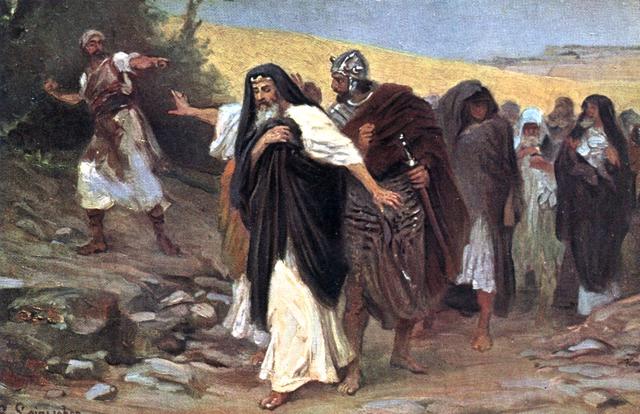
Shimi throws stones at David (artist unknown)

This definition certainly applies to the only use of the verb nafash in the Hebrew Bible excluding the book of Exodus. In the second book of Samuel/Shmuel, King David and his men have endured a long march while Shimi, a member of Saul’s clan, walked beside them hurling insults, dirt clods, and stones. Finally they leave Shimi behind, and camp at the Jordan.

The king, and all the people who were with him, arrived exhausted; and he veyinafeish there. (2 Samuel 16:14)

King David and his men are used to marching; they are not exhausted physically, but their souls are exhausted by enduring the abuse. They rest to recover their animation and their inner selves.

The drudgery and daily misfortunes of life can wear down anyone’s soul at the nefesh level. So Mishpatim orders us to share our shabbat with  humans less fortunate than we are—including those who work for us, or who are alienated in our society—get one day a week to refresh their energy and recover their individual selves.

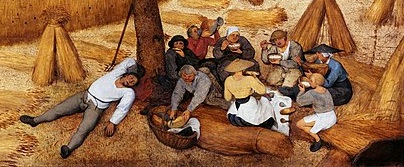
detail from The Harvesters, by Pieter Bruegel the Elder, 1565

The two elements in this shabbat process are desisting from productive work, and refreshing the spirit. The Hebrew Bible specifically prohibits lighting a fire (Exodus 35:3), gathering food or wood (Exodus 16:23-30, Numbers 16:32-36), carrying burdens outside (Jeremiah 17:21), treading in a winepress (Nehemiah 13:15), and selling or buying food (Nehemiah 13:15-18). Apparently the Israelites needed extra reminders not to do any work related to getting food to the table.

Other activities prohibited on shabbat can be inferred, but are not actually stated in the bible. Later, the Talmud multiplied rules about what a Jew cannot do on shabbat. The 312-page Talmud tractate Shabbat discusses every finicky prohibition the rabbis of the first few centuries C.E. could imagine. Although many orthodox Jews today observe  shabbat according to strict and complex rules that evolved from the Talmud, I know that if I tried to imitate them, I would spend the whole day worrying. My anxiety and resentment would make  shabbat a day to dread, and I would look forward to the six weekdays when I could relax and refresh my soul!

Fortunately, the Torah itself offers a more attractive and interesting view of Shabbat for unorthodox people like me. Desisting from creative work is connected with recovering the soul in a passage from the upcoming portion of Exodus called Ki Tisa. (It is also part of the Shabbat liturgy.)

The children of Israel shall observe the shabbat, to make the shabbat for their generations a covenant for all time. Between Me and the children of Israel it will be a sign forever, because for six days God made the heavens and the earth, and on the seventh day (God) shavat vayinafash. (Exodus 31:16-17)

vayinafash וַיִּנָּפַשׁ)= and he refreshed his soul, recovered himself, reanimated himself. (Also from the same root as nefesh.)

I am awed by this portrayal of a god that changes through time, breathing life into the universe and then stopping to catch its breath and recover the divine soul. That is how I experience life, the universe, and everything—not as a static abstraction, but as the changing rhythmic flow of heartbeats, breaths, lifespans, seasons.

The Torah says that in order to be holy to God, we humans must add another rhythm to our lives: a seven-day cycle of work and rest, creative production and cessation. For six days we may pour out our energy and creativity into productive work, but on the seventh day we desist from creative work to re-center and re-animate our inner selves. 

But wait a minute! I used to need a day off from my bookkeeping job to recover my self. But a lot of the creative work I do now—including writing this blog—re-energizes me. When I finish writing an essay or a story, I feel joy, and a sense of purpose, and the re-centering that comes from returning to my own soul. Why should I deprive myself of creative work once a week?

One answer is that I cannot keep creating endlessly without pause. Even God, in the story of creation that opens the book of Genesis/Bereishit, divides the job into six separate days, completes each day of creation before starting the next, and then takes a break at the end. I need to finish a piece of work and then stop to pay attention to where I am and where God is. I can believe that I need not only those moments of stopping every day, but also a whole day of stoppage every week. a whole day to reconnect with myself and the holy.

Alas, I still have not developed a steady practice for spending the day of shabbat in tranquility, restoring my soul. Merely refraining from certain activities doesn’t do it for me. Joining my congregation in prayer is uplifting,  and following or leading Shabbat services does remind me of what to focus on. Yet all too often, the long drive and the personal interactions disturb my ability to focus on anything.

Nevertheless, I have not given up on establishing a shabbat practice. Any suggestions, readers?

Yitro: Not in My Face

Moses, frieze on U.S. Supreme Court building, by Adolph Weinman

Terrified by a direct experience of God, the people ask Moses to be their intermediary and tell them God’s orders.  So God gives Moses the “Ten Commandments” in this week’s Torah portion, Yitro.  Both “Ten” and “Commandments” are designations invented by commentators; the Torah merely introduces the set of fundamental obligations with:

And God spoke all these words, saying—  (Exodus/Shemot 20:1)

The next sentence is:

I am God, your God who brought you from the land of Egypt, from the house of slaves.  (Exodus 20:2)

Some commentators count this as the first commandment, and Exodus 20:3-6 as the second commandment, prohibiting other gods and idols.  But the reminder that the God of Israel delivered the people from slavery in Egypt does not sound like a commandment to me.  I agree with commentators who count Exodus 20:3, prohibiting other gods, as the first commandment, and Exodus 20:4-6, prohibiting physical objects as idols, as the second commandment.

The verse prohibiting other gods reads:

You must have no elohim acheirim al panai.  (Exodus/Shemot 20:3)

elohim acheirim (אֱלֺהִים אֲחֵרִים) = other gods; gods of others.

al (עַל) = on, upon, over, above; besides, in addition to; over against; concerning; because of.  (The most common meaning of al is “on: or ”over”, but verse 5 explains that you must not worship anything else but God—so verse 3 cannot mean that it’s okay to serve other gods as long as they are below God. )

panai (פָּנָי) = my face, my presence, my surface, my visible side, my identity.

Here are five literal translations of this ambiguous commandment:

      You must not have other gods besides My presence.

      You must not have gods of others in addition to My presence.

      You must not have gods of others in addition to My visible side.

      You must not have other gods over against Me.

      You must not have other gods in My face.

First let’s look at the difference between “other gods” and “gods of others”, two phrases that are identical in Biblical Hebrew.  If the Israelites can’t have “other gods”, they are forbidden to worship not only the gods of others, but also any gods they happen to think of or notice on their own.  Therefore they must not worship any manifestations of God, such as angels or the stars or nature.  Modern commentary sometimes adds that we must not make a god out of wealth, or having a perfect body, or any other value exalted by our culture.  We may only have one God.

On the other hand, if the Israelites can’t have “gods of others”, the focus turns to the kind of gods worshiped by Egyptians, Mesopotamians, and Canaanites.  These peoples made idols in an effort to entice gods to come down out of the heavens or up from under the earth and inhabit their statues, the way humans inhabit their bodies.  A god living in a statue is easier to communicate with, and easier to appease and honor and butter up so it will act for your benefit.

Throughout the Torah, God may appear as a humanoid angel or as fire or a cloud, but what we see is God’s choice of manifestation, not the work of our own hands.  The vision may disappear at any moment; it is not solid; it cannot be set on a table or paraded through town.  Therefore God is not like the gods of others.

Reading elohim acheirim as “gods of others” leads right into the next three verses in this week’s Torah portion:

Do not make yourself a carved idol or any likeness of what is in the heavens above, or of what is in the land below, or of what is in the water beneath the land.  Do not prostrate to them and do not serve them.  Because I am God, your god, a jealous god, calling to account the wrongdoing of fathers upon children over the third and fourth (generations), for my enemies; but doing kindness to the thousandth (generation) for those who love me and who observe my commandments.  (Exodus 20:4-6)

This continuity supports the theory that Exodus 20:3 and Exodus 20:4-6 are one “commandment”, but it makes the list of what the people must do and not do add up to nine instead of ten.

The ambiguity is not over.  What about the last two words of Exodus 20:3, al panai?

If the phrase means “over against Me”, or even “in My face”, it is a warning that God would be offended if you worshiped any other gods.  After all, God is the one who rescued you from slavery (Exodus 20:2).  And God is a “jealous” god, i.e. passionately exclusive (Exodus 20:5).

However, if al-panai is translated as “in addition to My presence” or “besides My presence”, it means simply that the Israelites must worship and serve only the one god.  Some commentators who have translated the word panai as “My presence” have interpreted it as meaning that God is present everywhere and at all times, so don’t think you can get away with having another god without the One God noticing.

But since the next verse in Exodus begins “Do not make yourself a carved idol”, I think panai means both “My presence” and “My visible surface”.  The Torah contrasts the carved idols that are supposedly inhabited by the gods of others with the presence of the God of the Israelites, which is sometimes visible as a vision of an angel or a fire, and sometimes invisible, as when God speaks from the empty space above the cherubim in the Holy of Holies.

Similarly, sometimes the God of the Torah is audible to everyone, as a sound like thunder or the blowing of rams’ horns.  And sometimes God is audible only to one person, who “hears” the words that God speaks inside him or her.

*

The commandment in Exodus 20:3 not only orders us to refrain from serving other gods, but also asks us to serve our God.  How do we do that?

How can we honor the face of God, when God cannot be contained in a statue, a synagogue, a church, a mosque, or even the Holy of Holies?  What can we do when God makes its presence known unpredictably, when you never know where, when, or who will become aware of God for a moment?

And how can we serve our elusive God when even the Ten Commandments give us only a general idea of what we are supposed to do?  And when half of the more specific laws in the Torah were dropped as inapplicable more than 1,500 years ago in the Talmud?

Does anyone today have the authority to tell us how to serve God?  What actions and attitudes can we take that count as service?

I’m working on some answers to those questions.  It will take me the rest of my life.

(An earlier version of this blog was posted on January 16, 2011.)