Hafarat Va-eira—Ezekiel: How to Know God

Every week of the year has its own Torah portion (a reading from the first five books of the Bible) and its own haftarah (an accompanying reading from the books of the prophets). This week the Torah portion is Va-eira (Exodus 6:2-9:35), and the haftarah is Ezekiel 28:25-29:21.

Apparently God really wants Egypt to know who God is. The god of Israel asks the prophet Moses to tell Pharaoh “and you will know that I am God” three times in this week’s Torah portion, Va-eira. And God tells the prophet Ezekiel how God will bring down the Egyptians “and they will know that I am God” four times in this week’s haftarah.

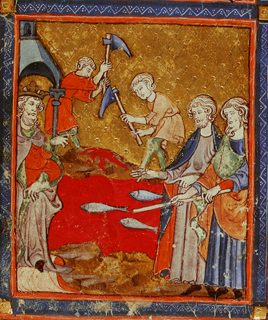
Plague of Blood, as depicted in 14th century CE

Before God inflicts the first of ten terrible miracles on Egypt, God instructs Moses to meet Pharaoh on the shore of the Nile and warn him that the water will turn into blood.

And you shall say to him: YHVH, the god of the Hebrews, sent me to you to say, ‘Let My people go and they shall serve Me in the wilderness’, but hey—you did not listen before now. Thus says YHVH: ‘By this teida that ani YHVH’. (Exodus 7:16-17)

YHVH = the Tetragrammaton or four-letter personal name of God that Jews consider most sacred. The name appears to be a form of havah  or hayah (הוה or היה) the root of the verb “to be”, “to happen”, or “to become”, but it is a form that does not fit any Hebrew verb conjugations.

teida (תֵּדַע) = you will know, experience, be acquainted with, recognize, realize, have intercourse with.

ani (אֲנִי) = I [am].

Pharaoh hardens his heart during the seven days of bloody water, claiming it is not a divine miracle, so he does not experience or recognize the god of Israel.

God’s goal of being known by Pharaoh reappears when Moses talks about the second miracle, the plague of frogs:

… so that teida that there is none like YHVH our god. (Exodus 8:6)

—and again when God tells Moses the fourth plague will be more miraculous, because the swarm will be excluded from the place where the Israelites live,

…so that teida that ani YHVH in the midst of the land. (Exodus 8:18)

It takes ten miracles or plagues before Pharaoh finally knows YHVH, and can no longer harden his heart in denial. The knowledge comes from experiencing what God can do in the world.

The haftarah for this week’s Torah portion is a passage from the book of Ezekiel, set many centuries later during the Babylonian exile after King Nebuchadnezzar conquered the Israelite nation of Judah in 597 BCE. Judah had asked Egypt to help it fight the Babylonians, and Egypt had not come to the rescue. So Ezekiel prophesies that God will restore the land to the Israelites and punish Egypt, and both peoples will “know” God.

build houses and plant vineyards…then they will dwell on their soil that I gave to My servant, to Jacob. And they will dwell on it in safety, and they will build houses and plant vineyards, and they will dwell on it in safety when I have passed judgments on all those who despise them from all around; veyad-u that ani YHVH their god. (Ezekiel 28:25-26)

veyad-u (וְיָדְעוּ) = and they will know, realize, experience, etc. (A form of the same verb as teida.)

The Israelites will once again know YHVH is their god when they have first-hand experience of this amazing reversal in fortune.

The hafatarah continues with a poem describing the future downfall of Egypt. Then Ezekiel says:

Thus said my master, YHVH: Here I am over you, Pharaoh, king of Egypt …To the beasts of the earth and to the birds of the sky I have given you for food. Veyade-u, all the inhabitants of Egypt, that ani YHVH; because you were a walking-stick of reed to the House of Israel; when their hand grasped you, you would break…(Ezekiel 29:3-6)

The implication is that because Egypt failed to support the Israelites, God will make sure all Egyptians know from experience who YHVH is.

And the land of Egypt will become a deserted place and a ruin; veyade-u that ani YHVH, because he [Pharaoh] said: The Nile is mine and I made it. (Ezekiel 29:9)

Egyptians must also realize that although their pharaoh claimed he created the Nile, really YHVH created everything. In order to accomplish this, God will reduce Egypt to the lowest of nations.

And never again will they inspire trust in the House of Israel … veyade-u that ani the lord YHVH. (Ezekiel 29:16)

Therefore, thus says my master YHVH: Here I am, giving the land of Egypt to Nebuchadnezzar, king of Babylon. And he will carry off her wealth and loot her loot and plunder her plunder, and she will be a reward for his army. …On that day… veyade-u that ani YHVH. (Ezekiel 29:19, 29:21)

In all of these cases in Exodus and Ezekiel, people are expected to realize who God is after they have experienced an unexpected disaster or triumph, a miraculous change in fortune. The experience is supposed to be so powerful that both Israelites and Egyptians will realize that only the most powerful god in the world could create such a miracle, and that this supreme god is the god of Israel.

Furthermore, both peoples will know God by the name YHVH, the four-letter name based on the verb “to be”.  Is this detail repeatedly included simply because it is the name the Israelites use for their god? Or does it carry another meaning?

In last year’s post on this Torah portion (Va-eira: The Right Name) I suggested that the idea of God as “being” or “becoming” is intellectually appealing, but too abstract for an emotional relationship with God. Now I notice that the phrase “know that I am YHVH” always occurs in the Torah and haftarah portions in the context of knowing God’s power to change fate and to create. What is most important is for the Egyptians and for the defeated and deported Israelites to realize that the god of Israel is the god of existence itself. Nothing can have power over YHVH.

I have experienced no inexplicable miracles or reversals of fortune in my own life. I do not know God in that way. I acknowledge the reality of being, that there is something rather than nothing, and I could call that God, even if it is irrelevant to the anthropomorphic god of the Bible.

But I will not. My unmiraculous life is full of meaning and my soul is full of awe, so “I know”—yadati (יָדַעְתִּי)—that there is something I might as well call God that goes beyond the fact of existence.

Teida that ani YHVH = You will know that I am Being.

Then what, or who, is the “I”?

Va-eira: The Right Name

by Melissa Carpenter, maggidah

Go to the king of Egypt, and tell him to declare a three-day holiday for his labor force, so they can go out into the wilderness and worship a god the king has never heard of.

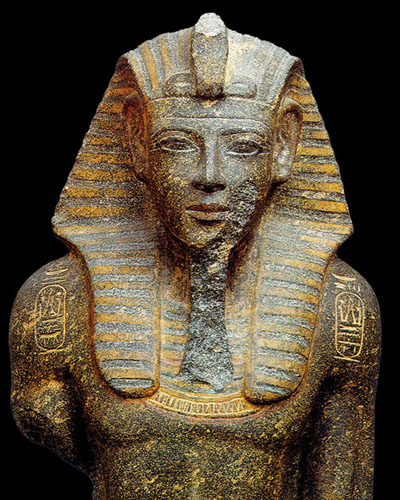
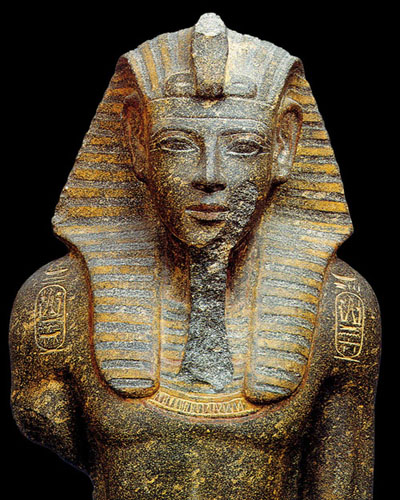
Pharaoh Merneptah, son of Rameses II

This is the mission God gives Moses in the first Torah portion of Exodus/Shemot. Moses tries to get out of it, but God insists, and Moses gives in.

And afterward Moses and Aaron came and said to Pharaoh: Thus says YHWH, god of Israel: Send out My people and they will celebrate-a-festival for Me in the wilderness. And Pharaoh said: Who is YHWH that I should listen to His voice and send out the Israelites? I do not know YHWH… (Exodus/Shemot 5:2)

YHWH = probably a form of the verb hayah (היה) = be, exist, become, occur. A variant spelling of this verb is havah or hawah (הוה). If the initial Y (י) indicates a third-person singular imperfect form, YHWH = he/it becomes, he/it exists, he/it will be.  If the four-letter word is a unique verb form, YHWH = us-was-will be; being-becoming.

(YHWH is considered the most sacred name of God, God’s four-letter personal name. I do not include the Hebrew spelling here because according to Jewish tradition, any text containing the personal name of God must be treated with respect and disposed of by special means. Furthermore, the name YHWH is not supposed to be pronounced except once a year inside the Holy of Holies—which has not existed since the fall of the second temple in Jerusalem in 70 C.E., almost 2,000 years ago.)

Since Pharaoh does not know YHWH, he refuses to give the Israelites three days off.  Instead he doubles the work of the Israelites forced to build his cities. The Israelite foremen complain to Moses, and Moses complains to God:

Since I came to Pharaoh to speak in Your name, he has done evil to this people, and You certainly did not rescue Your people! (Exodus 5:23)

Moses’ complaint implies that using the name of God was ineffective. But for God, everything is going according to plan.  As God tells Moses repeatedly in this week’s portion, Va-eira (“And I appeared”), God’s purpose in performing miracles in Egypt is: 1) so that the Israelites will know their own God as YHWH, and 2) so that the Egyptians will know the power of the god YHWH.

From God’s point of view, the ten miraculous “plagues” God plans to create will be all the more effective coming from a previously unknown god. God assures Moses that although it will be a long process, at its conclusion God will indeed rescue the Israelites from Egypt and bring them to Canaan.

But first God insists on being known by the right name.

And Elohim spoke to Moses, and said to him:  I am YHWH. And I appeared to Abraham, to Isaac, and to Jacob as Eil Shaddai, but [by] my name YHWH I was not known to them. (Exodus 6:2-3)

elohim (אֱלֹהִים) = gods (when used with a plural verb suffix); God (when used with a singular verb suffix).

eil (אֵל) = god

shaddai (שַׁדָּי) = of breasts (if it comes from shad = breast), of devastation (if it comes from shadad = devastate), of the mountain (if it comes from the Akkadian word shadu).

In the book of Genesis Abraham, Isaac, and Jacob certainly know that YHWH is one of God’s names; all three of them sometimes use that name to refer to God. So why does God claim, in this week’s Torah portion, “my name YHWH I did not make known to them”?

Most commentators explain that the three patriarchs knew God in terms of the attribute or power associated with the name Eil Shaddai, but not in terms of the power associated with the name YHWH.

In fact, the name Shaddai only appears six times in the book of Genesis, four times followed by blessings for being fruitful and multiplying (17:1, 28:3, 35:11, and 48:3). Jacob also uses that name of God to pray for rachamim (רַחֲמִים) = mercy (literally, “wombs”—43:14) and to bless Joseph with “blessings of breasts and womb” (49:25).

Although Eil Shaddai took on other meanings in later books of the Hebrew Bible, it seems safe to say that as far as the three patriarchs are concerned, Eil Shaddai is the name of the god of fertility. Abraham, Isaac, and Jacob are all concerned with the question of fertility, and want to be founders of a people or nation.

But in the book of Exodus, the Israelites in Egypt are already fertile. (The first pharaoh worries about the rapid birth rate of the Israelites; his son, the pharoah Moses speaks to in God’s name, agrees that there are far too many Israelites.) So a different aspect of God is needed to impress both Israelites and Egyptians. And God Itself seems eager to promote a new identity.

One can deduce the divine power associated with Eil Shaddai from context, but this cannot be done with the name YHWH.  The four-letter name appears 162 times in the book of Genesis alone, in a wide variety of actions and statements by God.

Commentary on which divine aspect is represented by the name YHWH ranges from the god of miracles (12th-century rabbi Abraham Ibn Ezra); to the god expressed by all ten sefirot, i.e. divine emanations (Sefer Yetzirah, a book of kabbalah possibly written in the 4th century); to the preserver of existence (16th-century rabbi Ovadiah Sforno).

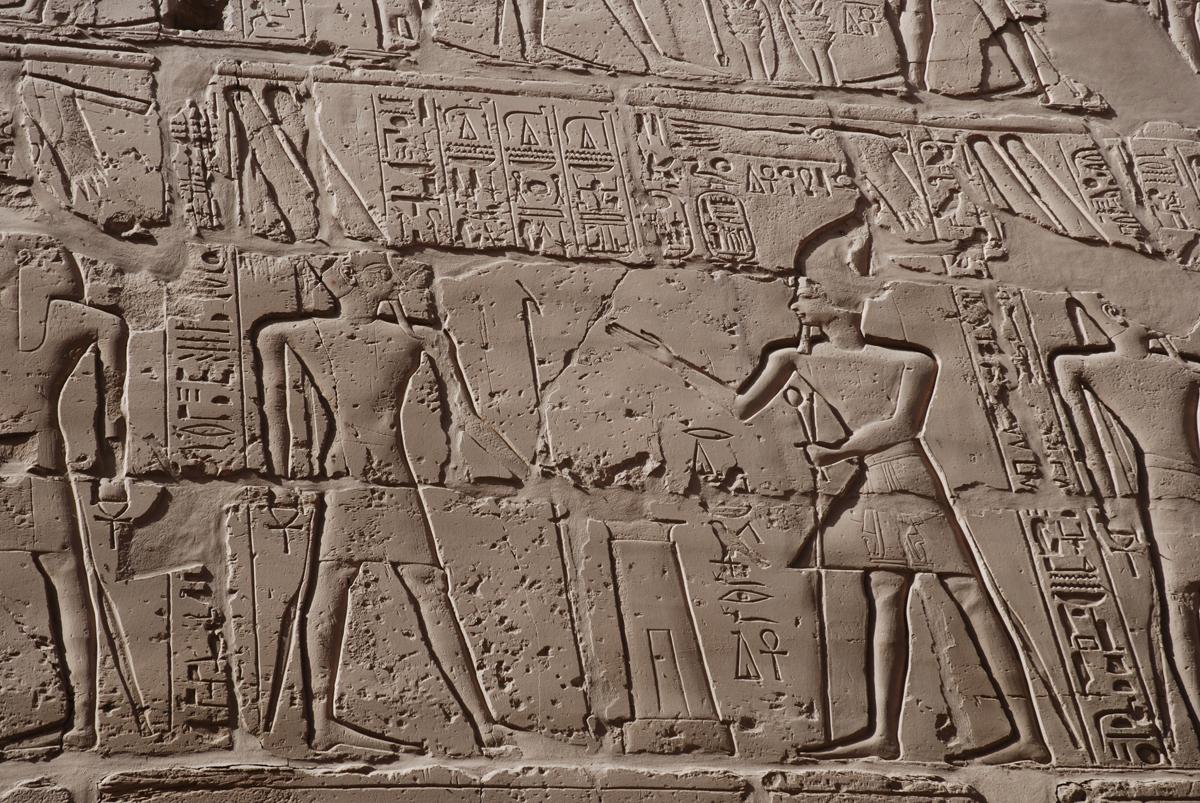
Rameses II (right) dedicating a temple to his god, Amun-Ra

All three of these interpretations boil down to the idea that God is the supreme deity; if any other gods can be said to exist, they are only emanations of YHWH, the god whose name means existence itself.

In the Exodus story, God wants Egypt to know that the god of the Israelites is the most powerful god in world, far more powerful than any of Egypt’s gods. And God wants the Israelites to know that the god who is making a covenant with them is not merely a fertility god, but a god with power over everything. Once everyone knows that God is YHWH, nobody can question God’s existence or decisions.

Or so God thinks, in the first two portions of the book of Exodus.

As the story continues, we read that after each time Pharaoh admitted the superior power of the god of the Israelites, he changed his mind and behaved as if he could win the contest with YHWH.  Even after the tenth and final plague, when Pharaoh finally lets the Israelites leave Egypt, he changes his mind again and sends his army to pursue them.  He only gives up after God splits the Reed Sea for the Israelites, then drowns the Egyptian army.

The Israelites themselves keep forgetting their god’s awesome power over life and death. As they travel through the wilderness of Sinai they worry whenever they run out of water or food, when Moses does not return from the top of Mount Sinai for 40 days, and when they face enemy forces. They cannot seem to trust the god who has taken them as Its people, even when the name of that god is YHWH.

Why doesn’t the name work?

I think that the idea of God as “being” or “becoming” is intellectually appealing. And sometimes I feel grateful that this universe exists, or that everything is in the process of becoming.

But psychologically, human beings cannot have a relationship with “existence” or “becoming”; the concepts are too abstract. To be followed, or loved, or feared, or trusted, God must be named after a more human attribute.

Eil Shaddai, the god of fertility, is not a useful divine name for most people today. When we lack children, we take practical steps; otherwise, we enjoy being fruitful in our own creative endeavors. Elohim, the God who combines the powers of all gods, is an irrelevant name at a time when nearly everyone is either an atheist or a monotheist. And YHWH, the concept of being and becoming, is too abstract for a relationship.

Then what name can inspire us to strive to “know” God? I welcome your suggestions.


Va-eira & Shemot: Request for Wilderness

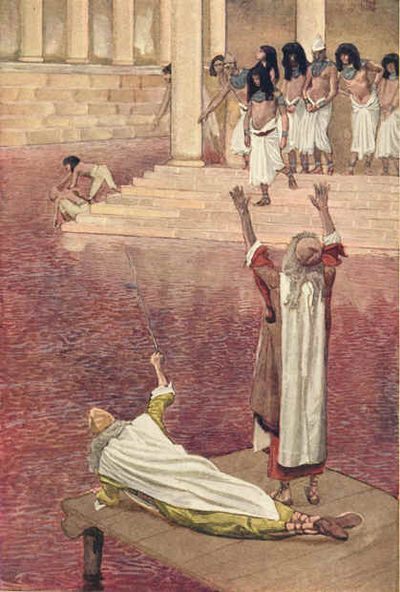
Water is Changed into Blood, by James J.J. Tissot

The preliminaries end and the ten “plagues”1 begin in in this week’s Torah portion, Va-eira (“and I appeared”).  God asks Moses to meet Pharaoh at the river and tell him the reason for the first plague, when water will turn into blood.

And you shall say to him: “Y-H-V-H, the god of the Hebrews, sent me to you, saying: Send out my people, and they will serve me in the midbar!  And hey, you have not paid attention before now.”  (Exodus/Shemot 6:16)2

midbar (מִּדְבָּר) = wilderness, uninhabited land, uncultivated land (pasturage or desert).

Moses had asked for a leave of absence for the Israelites when he first came before the pharaoh, just as God had ordered him at the burning bush on Mount Sinai:

“And you shall say to him: God, the god of the Hebrews, appeared to us; and now, let us go, please, a journey of three days into the midbar, and we will bring animal-offerings for Y-H-V-H, our god.”  (Exodus/Shemot 3:18)

It seems like a small request.  The pharaoh has been forcing the Israelite men to do corvée labor building brick storehouses.  He could afford to grant them all one week off—three days to travel into the wilderness, perhaps one day for ritual offerings, and three days to come back.  Then as soon as they returned he could put them back to work.

Why does God order Moses to make this small request, when the long-term plan is to take the  Israelites out of Egypt altogether and relocate them in Canaan?  Why should Moses ask for a short leave of absence, instead of for permanent emancipation?

A trick?

I used to wonder if Moses’ repeated request for a leave of absence to serve God in the wilderness is a ploy to give the Israelites a head start on their journey to Canaan before the Egyptians realize they were not coming back, and decide to pursue them. After all, when they do finally leave Egypt, it takes them only three days to get to the Reed Sea, part of the boundary of Egypt proper.3

However, God already knows that the pharaoh will repeatedly refuse to grant the Israelites a leave of absence.4  God is already planning to harden the Pharaoh’s heart and inflict the miraculous plagues on Egypt.

Therefore Moses’ request is both an excuse for Pharaoh to say no, and an expression of two things the Israelites ought to desire, according to God: serving their own god, and going into the wilderness to do it.

When Moses and his brother Aaron first come before the pharaoh they phrase the request this way:

“Thus says Y-H-V-H, the god of Israel: Send out my people and let them make a festival-offering for me in the midbar.”  (Exodus 5:1)

The pharaoh refuses, giving two reasons:

“Who is Y-H-V-H that I should listen to his voice to send out Israel?  I do not know Y-H-W-H, and neither will I send out Israel.”  (Exodus 5:2)

Why, Moses and Aaron, would you disturb the people from their work?  Go to your [own] burdens!”  (Exodus 5:4)

The pharaoh then gives the Israelites additional hours of work; they must gather the straw stubble for brickmaking while still meeting their quota for making bricks (and presumably for building the brick storehouses).  His move is effective; the Israelites tell Moses and Aaron that this additional hardship is all their fault.5  But the two brothers continue to cooperate with God’s plan for eventually liberating the Israelites from Egypt.

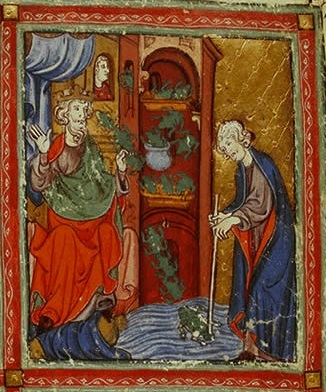
Plague of Frogs, Golden Haggadah, Barcelona, 14th century

The pharaoh ignores the first plague in this week’s Torah portion, Va-eira, in which all the water in Egypt turns into blood.  The second plague, an infestation of frogs, bothers the pharaoh enough so he summons Moses and Aaron.

…and he said: “Plead for me to God, so He will clear away the frogs from me and from my people; then I will send out the people, and they may slaughter an offering to Y-H-V-H.” (Exodus 8:4)

At this point the pharaoh mentions only the offering to God, not the request to make it in the wilderness. And Moses does not bring it up.

After Egypt is relieved of frogs, the pharaoh hardens his own heart and refuses to carry out his side of the bargain anyway; he still stands firm in his two original objections to Moses’ request: that he does not recognize the god of the Israelites, and that he will not give them any time off work.

Going into the wilderness

Only after the fourth plague (arov = mixed vermin) does the pharaoh make a more genuine offer—perhaps because this time God inflicts the plague only on native Egyptian houses, leaving the houses of the Israelites vermin-free.

And Pharaoh summoned Moses and Aaron, and he said: “Go!  Slaughter offerings to your god, in the land.”  (Exodus 8:21)

Moses refuses.  He says they will only make offerings to God in the wilderness, not in the populated part of Egypt.  His excuse is that the animal offerings God wants from the Israelites are taboo to native Egyptians.

“Sure, we slaughter the taboo of Egyptians in front of their eyes, and they do not stone us?  Let us go for a journey of three days into the midbar, and we will slaughter animals for Y-H-V-H, our god, as [God] says to us.”  (Exodus 8:22-23)

Then Pharaoh said: “I, I will send you, and you may slaughter offerings for Y-H-V-H, your god, in the midbar—only you definitely must not go far away.  Plead for me!”  (Exodus 8:24)

After Moses has pleaded with God to remove the plague of arov, the pharaoh hardens his heart again, and refuses to give the Israelites any leave of absence.

During the rest of the plagues, God, Moses, and the pharaoh speak only of sending out the people; the wilderness is now assumed to be their destination.

What is the deeper reason why the Israelites must serve their god in the wilderness, not in the settled land of Egypt?

Routine sacrifices to God are conducted at altars in long-term campsites in the books of Genesis through Joshua, and at temples in towns populated by Israelites in the rest of the Torah.  But in situations that make it harder to reach God, the wilderness is often where the connection happens.

In Genesis, God speaks to Hagar twice, both times when she has walked far into the midbar south of Beersheva.6  Abraham must travel away from Beersheva to a remote hilltop in order to commit the difficult sacrifice of his son Isaac.7  Jacob wrestles with a divine being in an uninhabited area on the Yabbok River.8  Moses does not encounter God until he is 80, when he sees the burning bush on Mount Sinai, so deep in the wilderness that last week’s Torah portion says:

And he led the flock behind the midbar, and he came to the mountain… (Exodus 3:1)

*

In my own experience, there are two kinds of divine connection.  I find that when I am praying with my friends and fellow travelers on the Jewish path, the connection among all of us brings in the divine, and we rise toward the universal divine together—rather like the Israelites in the Torah who gather at at their communal altars.  I miss prayer services when I go too long without them.

Yet if I want a deeper connection with the divine spirit inside myself, I can only reach it in a wilderness: a place where there are no other people to distract me, not even praying people or inspiring speakers; and no buildings or vehicles in sight to remind me of what else I might be doing.  If I see only what we call nature, and hear only wind or water or bird songs as well as my own breathing, then I can do a different and deeper kind of prayer.

In a midbar, I am separated from my usual labors.  I am neither a pharaoh who demands achievement, nor an Israelite who works harder than she really can in order to achieve.  You might say that “serving God” in this way gives me freedom.  And a little freedom returns with me when I return to the world of people.

May we all find a wilderness when we need it.

  1. What we call the ten “plagues” are ten miracles that cause widespread devastation in Egypt.
  2. Although I usually translate the four-letter personal name of God as simply “God”, in this essay I spell it out in Roman letters because Pharaoh does not know there is a god by that name, and one of the reasons God sends Moses to Egypt and inflicts the plagues is so that all Egypt will know the name Y-H-W-H.  God brings this up at least ten times.  For more on the tetragrammaton, the four-letter name, see my post Beshallach & Shemot: Knowing the Name.
  3. The Reed Sea is the third place where the Israelites encamp for the night after they leave the capitol city of Ramses.  The first is Sukkot, the second is Eitam (Exodus 13:20), and the third is Pi Hachirot by the Reed Sea (Exodus 14:2 and 14:9).  (See also Numbers 33:3-8.)  God chooses not to part the sea until after the Egyptian army arrives and is available to be drowned.
  4. And God said to Moses: “When you come and return to Egypt, see all the wonders that I have put in your hand and do them before Pharoah.  But I, I will strengthen his heart and he will not send out the people.”  (Exodus 4:21.)
  5. Exodus 5:6-21.
  6. Genesis 16:7-13, 21:14-19.
  7. Genesis 22:2.
  8. Genesis 32:23-29.

Va-eira: Shortness of Ruach

(This blog was first posted on January 10, 2010.)

And Moses spoke thus to the children of Israel, but they did not listen to Moses, from kotzer of ruach and from avodah kashah.  (Exodus/Shemot 6:9)

Moses asks Pharaoh to give the Israelite slaves a leave of absence to spend three days in the wilderness worshiping their god.  Pharaoh responds by accusing the Israelites of laziness and giving them extra work: they must collect their own straw to mix with clay, and still make the same quota of bricks.  The slaves complain to Moses, who then complains to God that now the people are even worse off than before.  This week’s Torah portion,Va-eira (“And I appeared”), opens with God reaffirming the divine plan to rescue the children of Israel from Egypt.

Moses passes on this communication to the Israelite slaves, but they do not listen to him.  Why not?  The brief explanation ending the sentence in Exodus 6:9,  “from kotzer of ruach and from avodah kashah“, can be translated in many ways.  Below are some possibilities; pick one from each list to make your own translation.

kotzer = shortness.  being stunted.  despondency.  impatience.

ruach = wind.  spirit.  breath.  motivation.

avodah = labor.  service.  ritual.  worship.

kashah = difficult.  heavy.  stubborn.  severe.

Some translators choose a physical interpretation, writing that the Israelites did not listen to Moses out of shortness of breath and hard bondage (Robert Alter, following Rashi).  How can you listen to someone promising an unimaginable future when you’re working so hard that you’re panting?  Ramban says physical exhaustion made the people impatient and sapped them of the strength to hope.

Other translators take a psychological approach, writing that the Israelites did not listen to Moses because of a constriction of the spirit (the Zohar) and because of the heathen service which weighed heavily upon them (the Targumim, according to Elie Munk).  Their suffering was so continuous that they were reduced to animals who could only think about their daily physical needs; they did not have enough human spirit to imagine anything else.  Lacking imagination and believing themselves powerless, they paid homage to the Egyptian gods of their slave-masters.  This idol worship also prevented them from listening to any communication from their own god.

Avivah Gottlieb Zornberg, in The Particulars of Rapture, wrote:  “To hear is to open oneself up to vulnerability, change, contingency.”  Pharoah the hard-hearted cannot consider even the idea of change, so he refuses to hear out Moses.  Pharoah afflicts his Israelite slaves with the same deafness, by making their lives so hard that they cannot stop and listen to any revolutionary ideas.  Thus Egypt, which in Hebrew is called Mitzrayim, “Narrow Places”, is the place of constriction for both master and slave.  It is the place where people are stunted, cut short—“kotzer”—from the freedom of thought that make us human.

In Kabbalistic terms, the children of Israel are stunted in the ruach level of soul.  Like animals, they exist from day to day with only the nefesh, the level of soul that animates the body.  They have neither time nor energy to access their ruach and neshamah levels of soul.  (The neshamah is the soul level where one can hear one’s calling and receive inspiration.  The ruach is the level where one is seized by the drive and motivation to seek that calling, to do something new.)

In the story of creation at the beginning of Genesis, the ruach—wind or spirit—of God hovers over the face of the waters.  Throughout the Torah, certain humans are seized by the irresistible power of the ruach of God, which turns them into prophets or madmen, or perhaps both.  A human being’s own ruach may not be as enormous as God’s ruach, but it is still a motivating force that can be ignored only by rigorous denial.

Pharaoh is the king of denial.  He does not listen to the word of God because his ruach is stunted; he refuses to believe that change is unavoidable.  The children of Israel do not listen to the word of God because their ruach is imprisoned by continuous suffering; they refuse to believe that change can happen to them.

I’ve been in that constricted place, too.  I’ve cried over more than one unbearable situation in my life, unable to believe that I could do anything about it or that it would ever change.  But each situation did change.  Sometimes I heard a different inner voice, and I found a way out.  Other times the change happened without an action on my part, by the grace of God, and all I had to do was to respond, to gird my loins and go with it.

But what about when you’re still trapped in the suffering?  How do you find the voice you haven’t been hearing?  Does it take a temporary break—a deep breath, a real Shabbat, three days in the wilderness—to hear the voice of freedom?  Or do you need someone, or something, to lead you out of your Egypt whether you’re ready or not?