Shemot to Bo: Moses Finds his Voice

(This is my sixth post in a series about the interactions between Moses and God on Mount Sinai, and how their relationship evolves. If you would like to read one of my posts about this week’s Torah portion, Terumah, you might try: Terumah: Insecurity.)


Moses hears God speak to him for the first time out of the fire in the thornbush on Mount Sinai. (See my post: Shemot: A Close Look at the Burning Bush.) God has already decided to use devastating miracles to liberate the Israelites in Egypt, but needs a human agent to persuade the Israelites to leave for Canaan and the pharaoh to let the Israelites go.

For this job, God picks an Israelite by birth who was raised by Egyptian royalty, and is now herding sheep in Midian. Moses’ assets are that he is curious and open to new ideas, he empathizes with the underdog, he is humble, and he is sufficiently awed to hide his face when he hears a divine voice speaking out of the fire. (See my post: Shemot: Empathy, Fear, and Humility.)

But he does not want to go. He knows he is not an adept speaker. (See my post: Shemot: Not a Man of Words.) And he longs to continue his safe and peaceful life in Midian. So he tries five times to excuse himself from the mission. (See my post: Shemot: Names and Miracles.)

In this first conversation on Mount Sinai, Moses sounds like an anxious child, and God sounds like a patient parent. It takes God a long time to reassure Moses enough so he will cooperate with God’s plan. Finally God promises that Moses’ brother Aaron will be his spokesman in Egypt, and Moses stops trying to get out of the job. (See my post: Shemot: Moses Gives Up.) After a brief stop at his father-in-law’s camp, he heads back to Egypt.

A year or two passes before Moses meets God on Mount Sinai again. During that time, God continues to give Moses instructions, and occasionally Moses asks God a question. These conversations are silent, inside Moses’ mind.

Does Moses change during this period in Egypt? Does his relationship with God change?

Shemot: Moses wins and loses the people’s trust

Aaron meets Moses on the road as he heads across the Sinai Peninsula toward Egypt.

And Moses told Aaron all the words with which [God] had sent him, and all the signs [God] had instructed him in. Then Moses and Aaron went, and they gathered all the elders of the Israelites. And Aaron spoke all the words that God had spoken to Moses, and he did the signs before the eyes of the people. And the people trusted … (Exodus 4:28-31)

The text does not say whether the Israelites trust Moses, whom they do not know, or only Aaron, one of their own elders. Either way, they believe they are hearing the words of their own god.

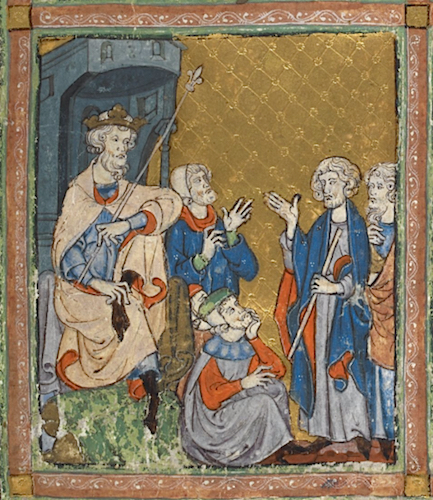
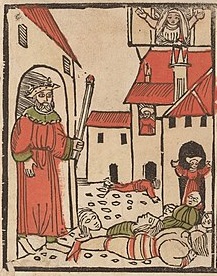
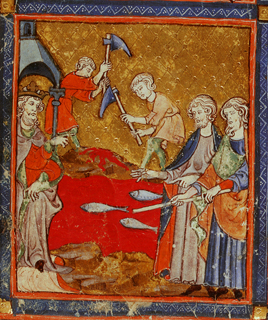
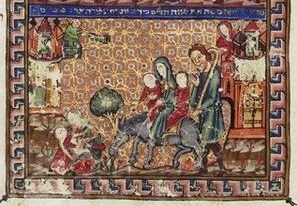
Moses and Aaron Come Before Pharaoh, Golden Haggadah, 14th century

And afterward Moses and Aaron came and said to Pharaoh: “Thus says Y-H-V-H, the god of Israel: ‘Let my people go, and they will observe a festival for me in the wilderness!’” (Exodus 5:1)

The text does not say which brother is doing the actual speaking. The pharaoh says no, and Moses and Aaron clarify their request:

“Please let us go a distance of three days into the wilderness, and we will make slaughter-offerings to Y-H-V-H, our God …” (Exodus 5:3)

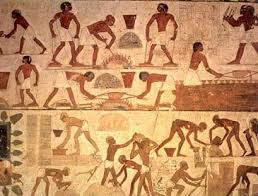
Instead, the pharaoh increases the workload of the Israelites, and they turn against Moses and Aaron.1

Then Moses returned to Y-H-V-H and said: “My lord, why have you done harm to this people? Why did you send me? Since I came to Pharaoh to speak in your name, he has done harm to this people. And you certainly have not rescued your people!” (Exodus 5:22-23)

Until now, Moses has only responded after God spoke to him. This is the first time Moses initiates a conversation with God.2

On Mount Sinai, God warned Moses that the pharaoh would not let the Israelites go until after God had inflicted some devastating miracles on Egypt.3 Has Moses forgotten? Or is he making a different point with his questions?

Eleventh-century rabbi Chananel viewed Moses’ question “Why have you done harm to this people?” as an enquiry about the problem of evil. “This is not to be understood as a complaint or insolence, but simply as a question. Moses wanted to know the use of the [divine] attribute which decrees sometimes afflictions on the just, and all kinds of advantages for the wicked …”4

In the 14th century Rabbeinu Bachya saw Moses’ first question as an acknowledgement that God does do harm to people God favors. “The Torah wanted to inform us that improvements or deteriorations in the fate of the Jewish nation are the result of God’s doing, not of someone else’s doing. By his very question, Moses wanted to make it clear that he understood this. After all, evil does originate with God, though in a more indirect manner than good.”5

Their explanations are theologically interesting, but Moses has not engaged in such abstract thinking yet in the storyline of Exodus, and his second question, “Why did you send me?”, shows he is taking the situation personally. Other commentators have offered a more likely explanation: that Moses thought God would move quickly once he has spoken to the pharaoh, and life would improve for the Israelites until the final miracle freed them altogether. Therefore he asks why God sent him before the divine deliverance was at hand.6

According to 16th-century rabbi Ovadiah Sforno, Moses’ second question means: “Why did You make me the one to be the immediate cause of [their suffering]?”7

Moses’ questions to God remind me of a child complaining, “It’s not fair!” To his credit, Moses points out that the unfairness to the Israelites (why have you done bad to this people?), as well as unfairness to himself (why did you send me?).

According 19th-century rabbi S.R. Hirsch, Moses is telling God: “You caused this new calamity. You did not just remain aloof when it happened; rather, You provoked it through my mission.” Then Hirsch explains: “His mission has been a complete failure. … Moshe, too, is doubting himself; indeed, who, if not Moshe, would now not have heightened misgivings about his own capability, would now not ask himself whether he had mishandled his mission?”8

He also goes so far as to accuse God by saying: “and you certainly have not rescued your people!”. It is human nature to assign the blame to someone else when you suspect you are partly responsible for a disaster.

Moses may feel as insecure as ever about speaking to other human beings, but he is much bolder now when he speaks to God. He treats God the way an adolescent might treat a reliable parent at a moment of crisis.

And God’s response is mild enough:

“Now you will see what I will do to Pharaoh.” (Exodus 6:1)

Va-eira: Moses trusts Godand himself

When God tells Moses to go speak to the pharaoh again, Moses replies:

“Here, the Israelites don’t listen to me. How will Pharaoh listen to me? And I have foreskin-covered lips!” Then God spoke Moses and to Aaron, and commanded them … (Exodus 6:12-13)

Moses may trust God to listen to him patiently, but he still does not trust himself to be a convincing speaker. He uses the biblical metaphor of the foreskin to indicate that his power to speak well is blocked.9

Perhaps God thinks that Moses’ ears are also foreskin-covered, since God switches back to addressing Moses and Aaron at the same time.

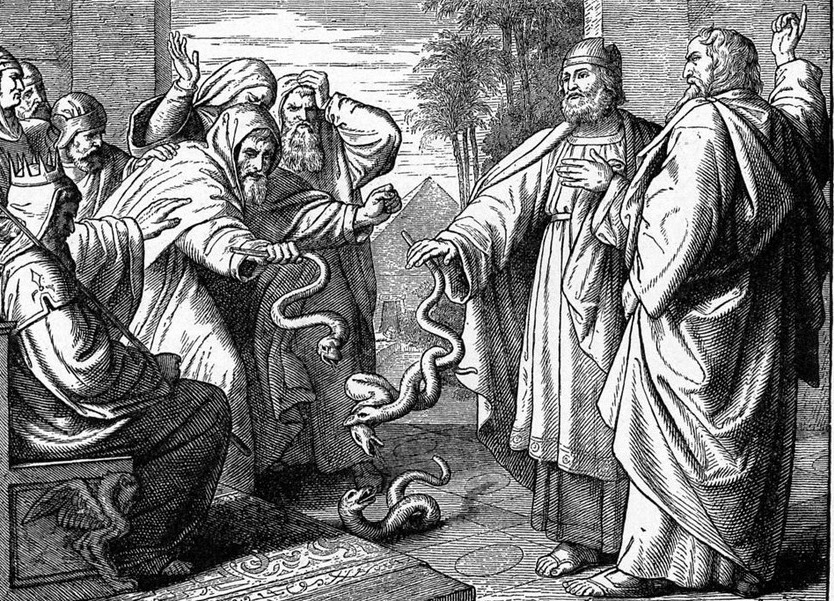
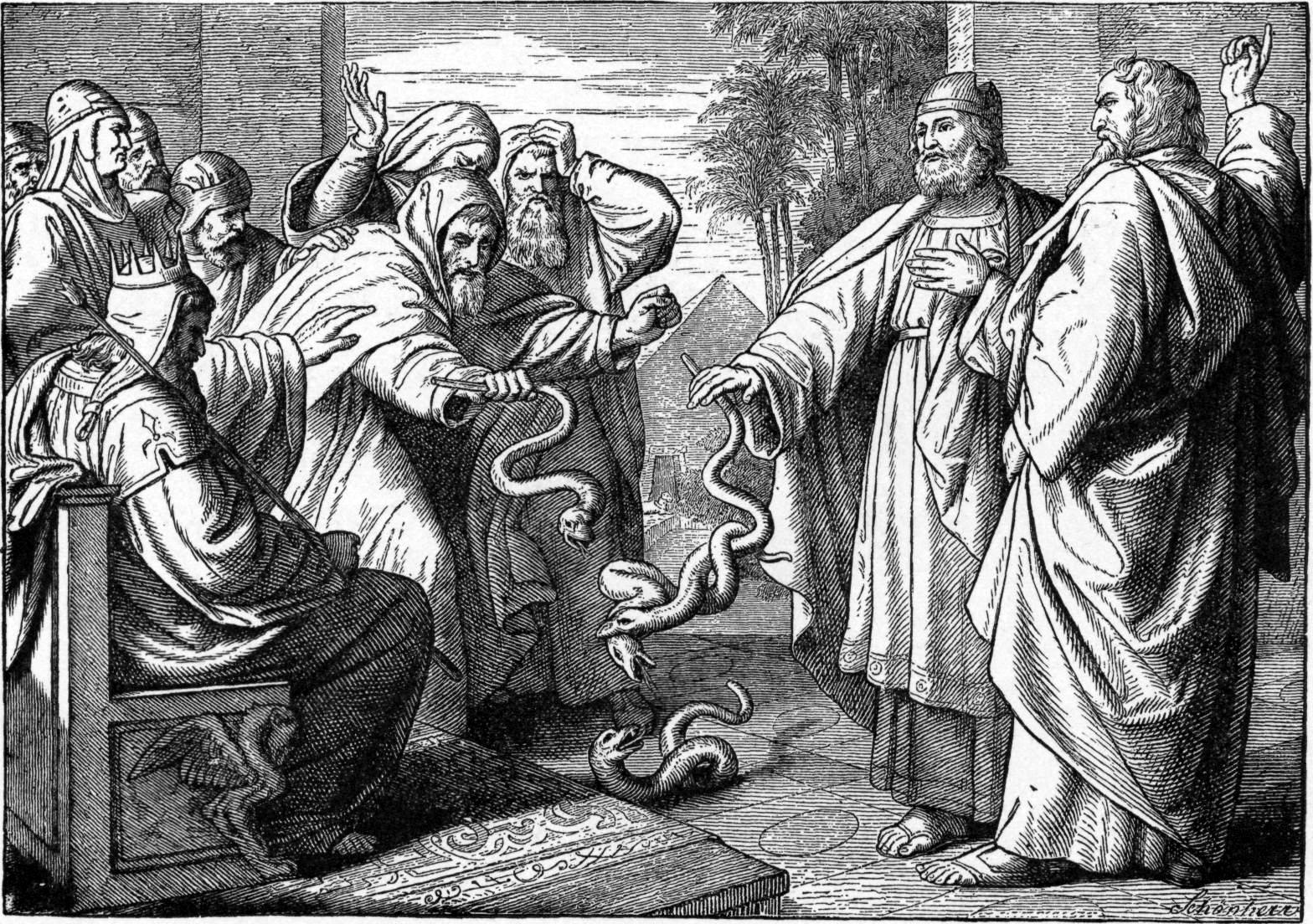
Aaron’s Rod Changed into a Serpent, by Julius Schnorr von Carolsfeld, Charles Foster Bible,1860

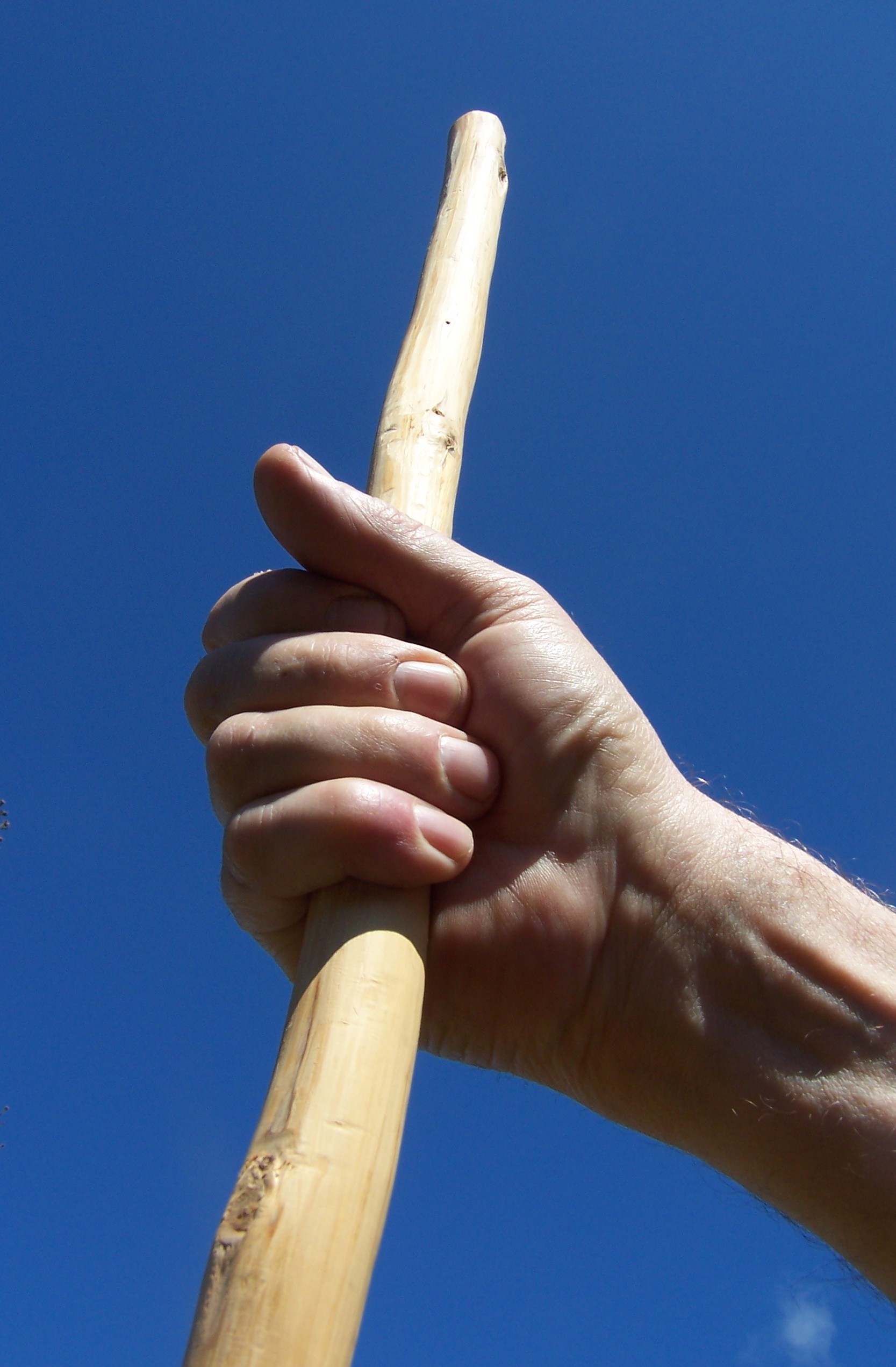
They obey God and return to the pharaoh to demonstrate the miraculous sign God gave Moses on Mount Sinai, in which his staff turned into a snake. This time Aaron is holding the staff.10

Then God dictates what Moses must say to the pharaoh the next morning at the Nile, and assigns Aaron to wield the staff to initiate the miracle of the water turning to blood.11 The miracles continue, with Moses repeating God’s words to the pharaoh, and Aaron making the gestures. Clearly Moses can speak upper-class Egyptian correctly. But if he is an insecure introvert, as I proposed in my post Shemot: Not a Man of Words, he needs to know ahead of time what to say, and God tells him.

Then Moses begins adding a few words of his own. After the miracle (or plague) of frogs, the pharaoh tells Moses and Aaron that if they beg God to remove the frogs, he will let the Israelites go make their offerings to God. Moses asks the pharaoh to choose the time for the divine frog extermination, “so that you will know there is none like Y-H-V-H, our God.” (Exodus 8:5-6)

He trusts God to back him up by killing the frogs on the day the pharaoh designates—and God does.

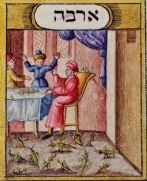
After the fourth plague (arov (עָרֺב) = swarms, mixtures of insects), the pharaoh tells Moses and Aaron that he will let the people make their offerings to God as long as they stay inside Egypt. Apparently on his own initiative, Moses replies:

“It would not be right to do thus, since we will slaughter for Y-H-V-H, our God, what is taboo for Egyptians. If we slaughtered what is taboo for Egyptians in front of their eyes, then wouldn’t they stone us? Let us go on a journey of three days into the wilderness …” (Exodus 8:22-23)

The pharaoh agrees this time, and Moses agrees to ask God to remove the swarms. But he adds:

“Only let Pharaoh not trifle with us again, by not letting the people go to make slaughter-offerings to Y-H-V-H!” (Exodus 8:25)

If Moses is an introvert, then he has probably spent days mulling over what he might say to the pharaoh in various situations. When one of those situations arises, he does not need to wait for either God or Aaron; he can simply deliver one of the replies he practiced. (This is how I have managed to speak up in difficult social situations despite my introversion.)

Moses is also getting used to being listened to. His trust in himself, as well as in God, is increasing.

Bo: Moses transcends himself

After the penultimate plague, three days of utter darkness for all the Egyptians, the pharaoh tells Moses that all the Israelites may go into the wilderness, even the women and children, as long as their livestock stays behind. Moses is now accustomed to the pharaoh bargaining in bad faith, and he has his answer ready.

And Moses said: “You, too, must give into our hand slaughter-offerings and burnt offerings, and we will make them for Y-H-V-H, our God. And also our own livestock will go with us; not a hoof will remain behind.  Because we will take from them to serve Y-H-V-H, our God, and we ourselves will not know what we will serve God [with] until we arrive there.” (Exodus 10:25-26)

The 18th-century commentary Or Hachayim noted: “At any rate, this answer of Moses to Pharaoh was obviously one that Moses invented and is not to be regarded as an instruction given to him by God.”10

The pharaoh loses his temper, possibly because Moses’ answer is obviously an excuse.

Then Pharaoh said to him: “Go away from me! Watch out against seeing my face again, because the moment you see my face you will die!” And Moses said: “You spoke the truth! I will not see your face again!” (Exodus 10:28-29)

Perhaps Moses forgets that God has saved one final plague to inflict upon Egypt. According to many commentators, God hurries to instruct Moses about it before he stalks  out of the pharaoh’s audience chamber.11

Moses then follows God’s new instructions by announcing that at midnight every Egyptian firstborn male, from the pharaoh’s oldest son to the firstborn of cattle, will die. Then he adds something God did not tell him to say.

“And then all these courtiers of yours will come down to me and prostrate themselves to me, saying: ‘Go! You and all the people who follow you!’ And after that I will go.” And he walked away from Pharaoh bahari af. (Exodus 11:8)

bahari af (בָּחֳרִי־אָף) = with the hot nose (an idiom for “in anger”).

Moses’ final words to the pharaoh do not sound like something an introvert rehearsed ahead of time. Carried away by his anger in the moment, Moses says the first thing that comes into his head.

It was standard procedure to prostrate oneself before a king in order to receive permission to speak; Moses and Aaron would have done it at every audience with the pharaoh. Now Moses says that the pharaoh’s courtiers will come to him and prostrate themselves, as if he were a king.12

Pharaoh and his Dead Son, by James Tissot, ca. 1900

It does not happen exactly the way Moses’ inflamed imagination pictures it. At midnight, when the firstborn Egyptians are dying and people are wailing in every Egyptian house, the pharaoh himself summons Moses and Aaron and commands the Israelites to leave Egypt and take their flocks and herds with them.

They march out of Egypt with everything they own, as well as some gold, silver, and clothing “borrowed” from Egyptians. They leave behind a country devastated by God’s ten miraculous plagues, a country in which everyone from pharaoh to commoner acknowledges that the God of Israel is the most powerful god.

The first stage of Moses’ mission, and God’s, has succeeded.

To be continued …


  1. Exodus 5:21.
  2. Rabbi Adin Even-Israel Steinsaltz, The Steinsaltz Tanakh, Koren Publishers, Jerusalem, 2019, quoted in www.sefaria.org.
  3. Exodus 3:19-20.
  4. Rabbeinu Chananel (Rabbi Chananel ben Chushiel), as quoted in other commentaries, translation in www.sefaria.org.
  5. Rabbeinu Bachya (Rabbi Bachya ben Asher, 1255–1340), translation in www.sefaria.org
  6. E.g. Rabbi Abraham ibn Ezra (12th century), Ramban (13th-century rabbi Moses ben Nachman), Chizkuni (a 13th-century compilation), Or Hachayim (by 18th-century Rabbi Chayim ben Moshe ibn Attar).
  7. Rabbi Ovadiah Sforno, translation in www.sefaria.org.
  8. Exodus 7:9-10.
  9. Leviticus 26:41 says that God will welcome the Israelites back “if their foreskin-covered heart humbles itself”. Jeremiah 6:10 says that the ears of the Judahites are “foreskin-covered, and they cannot listen”.
  10. Exodus 7:14-20.
  11. Or HaChayim, by Rabbi Chayim ben Moshe ibn Attar, translation in www.sefaria.org.
  12. E.g. Or HaChayim, ibid.
  13. Or HaChayim, ibid.

Bechukotai, Va-eria, & Isaiah: Redeeming a Pledge

“Redeeming” can mean exchanging something less important to you for something more important. Last week’s Torah portion, Behar, prescribed redemption for Israelites who had fallen into poverty and debt. If they were forced to sell the family farm, or if they had to sell themselves as slaves, the sale was never permanent; Israelite land was “sold” as a long-term lease, and Israelite persons were “sold” as indentured servants. Both land and human beings could be redeemed if a family member paid off the remainder of the contract. (See my post: Behar: Redeeming an Identity.)

“Redeeming” can also mean making good on a pledge, through either an exchange or a rescue. When a human being pledges a donation to God, they must give the donated item to the priests at the temple—or else redeem it by exchanging the pledged item for something more valuable. But when God makes a pledge to the Israelites, God makes good on the pledge by rescuing them from a foreign power. No exchange is necessary.

Bechukotai: When an Israelite redeems a pledge to God

A pledge to God is actually a pledge to support a religion’s service to God. Today someone who wants to make an extra donation to their congregation, over and above the membership dues, might send an electronic payment. But in ancient Judah, an extra donation, over and above the mandatory tithes, offerings, and contributions of firstborn animals and first fruits, could only be made by bringing an object of value to the priests at the temple in Jerusalem. So the donor would make a verbal pledge, and redeem it later by traveling to the temple and delivering either the item pledged or its value in silver.

The item pledged could even be a human being. The Talmud tractate Arakhin explains that a person often pledged his or her own value in silver to the temple in Jerusalem. But someone could also vow to donate the value of any person belonging to him or her at the time—i.e. someone the vower owned and could legally sell.  In that era, people could sell their slaves or their own underage sons and daughters.

This week’s Torah portion, Bechukotai (Leviticus 26:3-27:34), explains the rules for redeeming a person who has been pledged as a donation to God.

When anyone explicitly vows the assessment of persons to God, the assessment will be: the assessment of the male from twenty to sixty years old will be fifty shekels of silver … (Leviticus 27:2-3)

A list follows giving the assessment in silver for male and female human beings in four age categories. (See my post: Bechukotai: Gender, Age, and Personal Value.) The persons themselves are not being given to God; they stand in as pledges until the donor pays their assessed values in silver to the temple.

But if [the donor vowed] an animal that can be brought as an offering to God, anything that he gives to God becomes consecrated. One may not replace or exchange it, either a better one for a worse one, or a worse one for a better one. And if one actually does exchange one animal for another, both it and its substitute will become consecrated. (Leviticus 27:9-10)

This means that when anyone pledges an animal that can be legally offered at the altar, it becomes temple property at that instant. The donor no longer owns it, so he has no choice but to bring it in to its rightful owner, the temple. If he tries to substitute a different animal, then both the original and the substitute must be brought and slaughtered for God. I suspect the priests knew that people who felt moved to give more to God sometimes had second thoughts later, and tried to skimp when it was time to fulfill their pledges.

If someone pledges an animal that is kosher, but unfit for the altar because of some blemish, the priest assesses its equivalent value. Then the person who pledged the animal to God must donate that amount in silver to the temple—and also leave the blemished but edible animal with the priests.

If the donor prefers to keep the unfit animal, he can redeem it by making a larger payment in silver.

But if definitely yigalenah, then he must add one-fifth to its assessment. (Leviticus 27:13)

yigalenah (יִגְאָלֶנָּה) = “he would redeem it”. (From the root verb ga-al, גָּאַל = redeem, ransom, rescue.)

The same law applies when a donor—perhaps overcome by religious ecstasy or a generous impulse—pledges his house to God, thus making it consecrated property.

And if the consecrator yigal his house, then he must add one-fifth in silver to the assessment; then it will be his. (Leviticus 27:15)

yigal (יִגְאַל) = he would redeem. (Also from the root verb ga-al.)

The donation of a field to God is more complicated, since the procedure must also meet the rules in last week’s Torah portion about land reverting to its original owner in the yoveil year. (See my post: Behar: Redeeming an Identity.) But if the current owner wants the field back before the yoveil year, he must pay silver equal to the assessment for the remaining years plus one-fifth to redeem it.

Va-eira & Second Isaiah: When God redeems a pledge to the Israelites

Israelites redeem their pledges to God by exchanging silver for whatever they pledged. But when God redeems a pledge to the Israelites, God simply rescues them by arranging their liberation from a foreign power and sending them “home” to Canaan. In the book of Exodus, God rescues the Israelites from bondage in Egypt. In the book of Isaiah, God rescues them from exile in Babylon.

In Exodus, in the Torah portion Va-eira1, God tells Moses:

“And now I myself have listened to the moaning of the Israelites because the Egyptians are enslaving them, and I have remembered my covenant. Therefore say to the Israelites: I am Y-H-V-H, and I will bring you out from under the bondage of Egypt. And I will rescue you from your servitude, vega-alti you with an outstretched arm and with great punishments. And I will take you as my people, and I will be your God. … And I will bring you to the land that I raised my hand to give to Abraham, to Isaac, and to Jacob, and I will give it to you as a possession. I am Y-H-V-H.” (Exodus 6:5-6, 6:8)

vega-alti(וְגָאַלתִּי) = and I will redeem, and I will rescue. (Also from the root ga-al.)

Leading the Israelites
with a Pillar of Fire,
by John Jacob Scheuchzer,
1731

The pledge or covenant God made in the book of Genesis to Abraham, Isaac, and Jacob by “raising a hand” was that God would give their descendants the land of Canaan. Now God affirms that God will fulfill the pledge. Just as written proclamations in the Ancient Near East ended with the king identifying himself by name, God concludes this statement with I am Y-H-V-H, confirming it as a legal pledge.

Then God makes good on the divine pledge with an elaborate rescue operation. First God stages ten miracles to liberate those descendants, the Israelites, from Egypt. Then God leads them to a new home in Canaan.

Second Isaiah2 states that God created the Israelites for a unique role, which implies a pledge to make sure they continue to exist as a people on the land God chose for them.

And now thus said God:
Who created you, Jacob?
Who formed you, Israel?
Do not fear, because ge-altikha.
I have called by name;
You are mine. (Isaiah 43:1)

ge-altikha (גְאַלְתִּיךָ) = I have redeemed you, I have rescued you. (Also from the root ga-al.)

Therefore, the prophet says, God is in the process of rescuing the Israelites from Babylon by arranging the destruction of the Babylonian Empire.

Thus said God,
Your Go-eil, the Holy One of Israel:
For your sake I send to Babylon
And I bring down the bars, all of them,
And the Babylonians sing out in lamentations. (Isaiah 43:14)

go-eil (גֺּאֵל) = redeemer, rescuer. (Also from the root ga-al.)

This is one of eleven times that second Isaiah makes go-eil part of God’s title.3

The “bars” in this verse are either the bars of the gates of the city,4 or by extension, the borders of their whole territory.5 Second Isaiah credits God with sending Cyrus, the first king of the Persian Empire, to conquer Babylon6 (a feat Cyrus I achieved quickly in 539 B.C.E.).

Next the redemption of the Israelites from Babylon is connected with their redemption from Egypt. The prophet reminds us that God parted the Red Sea to arrange the escape of the Israelites from Pharaoh’s army of chariots.

Thus said God:
Who placed a road in the sea,
And a path through powerful waters?
Who met chariots and horses,
The mighty and the strong?
Together they lay down, never to rise;
They were extinguished, quenched like a wick. (Isaiah 43:16-17)

When second Isaiah is praying to God for redemption from Babylon, he reminds the exiled Israelites again about how God redeemed the Israelites from Egypt.7

Like other biblical prophets, second Isaiah says God let the Babylonians conquer Judah and Jerusalem because its citizens were disobeying God. But now, according to the book of Isaiah, God says:

I have wiped away your rebellions like fog,
And your misdeeds like cloud.
Return to me, because ge-altikha! (Isaiah 44:22)

Once God has redeemed the Israelites from their past sins, God can rescue them from Babylon. The book of Isaiah confirms that redemption by God is a rescue, not an exchange:

For no price you were sold,
And not for silver tiga-eilu. (Isaiah 52:3)

tiga-eilu (תִּגָּאֵלוּ) = you will be redeemed.

But being rescued and liberated is not enough. The Israelites must fall in with God’s plan by taking advantage of the opportunity to leave Babylon and return to Jerusalem.

Go forth from Babylon!
Flee from Chaldea!
Declare in a loud voice,
Make this heard,
Bring it out to the ends of the earth!
Say: God ga-al [God’s] servant Jacob! (Isaiah 48:20)

The kind of exchange outlined in this week’s Torah portion, Bechukotai, is good business practice: making a pledge, posting something as security, and then redeeming the security by handing over the required monetary payment. Both the donor and the priests who receive the silver know and follow the rules.

But sometimes we humans imitate God by pledging to do something that has no monetary value. One example is the traditional marriage vow to “forsake all others”.

And sometimes we help another person voluntarily, for no reward, with no expectation of tit-for-tat—not because we have formally pledged to do so, but just out of the goodness of our hearts.

All humans make moral errors. When we do something good, above and beyond what we have promised, we redeem ourselves. So helping someone out of the goodness of our hearts is a double redemption: we rescue the other person from distress, and we also redeem ourselves.

May we all aspire to be voluntary redeemers.


  1. The portion Va-eira is Exodus 6:2-9:34.
  2. The first 39 chapters of the book of Isaiah were written in the 8th century B.C.E., and are attributed in the first verse to the prophet Yesheyahu (Isaiah) son of Amotz. Chapters 40-55 were written in the 6th century B.C.E., after the Babylonians conquered Jerusalem and deported its leading citizens to Babylon; this section is often called Second Isaiah or Deutero-Isaiah. Chapters 56-66 were written after Babylon fell to the Persian Empire in 539 B.C.E. and the exiles living there were allowed to return to their old homes. Some scholars include this last section in Second Isaiah, while others call it Third Isaiah, or Trito-Isaiah.
  3. Go-eil is part of God’s title in Isaiah 41:14, 43:14, 44:6, 44:24, 47:4, 48:17, 49:7, 49:26, 54:8, 60:16, and 63:16.
  4. Ibn Ezra (12th century), citing Lamentations 2:9: Her gates have sunk into the ground, He has shattered to bits her bars.
  5. Adin Steinsaltz, The Steinsaltz Humash: Isaiah, Koren Publishers, 2019.
  6. See Isaiah 44:1.
  7. Isaiah 51:10-11.

Va-eira: Snake Staff, Part 2

The first time God changed Moses’ staff into a snake was on Mount Sinai, when God was giving him the signs he would use to convince the Israelites in Egypt that he was a genuine prophet. (See last week’s post, Shemot: Snake Staff, Part 1.)

The second time God transformed the staff was at the meeting Aaron set up between his brother Moses and elders of the Israelites in Egypt.

And Aaron spoke all the words that God had spoken to Moses, and he performed the signs in the sight of the people. And the people trusted him, and they heard that God had taken up the cause of the Israelites and had seen their misery and noticed them. And they bowed to the ground. (Exodus 4:30-31)

So far, so good. The next step was to persuade Pharaoh that God had sent them.

And afterward Moses and Aaron came and said to Pharaoh: “Thus says Y-H-V-H, the God of Israel: Let my people go so they will celebrate a festival for me in the wilderness.” But Pharaoh said: “Who is Y-H-V-H, that I should listen to his voice and let the Israelites go? I do not know Y-H-V-H, and furthermore, I will not let the Israelites go.” (Exodus 5:1-2)  

This might have been a good time for the brothers to use the magic staff to demonstrate that they are real emissaries of a real god. But God had not ordered it. Moses and Aaron merely talked a little longer, and then Pharoah decided to increase the workload of the Israelites instead.

The Israelites lost faith in Moses and in the promised rescue from Egypt. The Torah portion Shemot ends shortly after the Israelite foremen complain to Moses and Aaron:

“May God examine you and judge, since you made us smell loathsome in the eyes of Pharaoh and in the eyes of his courtiers, putting a sword in their hand to kill us!” (Exodus 5:21)

Marvel in the palace

This week’s Torah portion, Va-eria (Exodus 6:2-9:35), opens with some repetitions of the story line and a genealogy.1 Then God finally tells Moses and Aaron to demonstrate the transformation of the staff to Pharaoh.

And God said to Moses and to Aaron: “When Pharaoh speaks to you, saying: ‘Give me your marvel!’ then you will say to Aaron: ‘Take your staff and cast it down in front of Pharaoh!’ It will become a tanin.” Then Moses and Aaron came to Pharaoh, and they did just as God had commanded; Aaron cast down his staff in front of Pharaoh and his courtiers, and it became a tanin. (Exodus 7:8-10)

tanin (תַנִּין) = sea monster, crocodile, snake.2

When God transformed Moses’ staff on Mount Sinai (in a tale some scholars attribute to an E source), it became a nachash (נָחָשׁ) = snake, serpent. Now (in the tale from a P source) it becomes a tanin. Different source stories used somewhat different terminology.

And Pharaoh also summoned his wise men and his sorcerers, and they, also they, the chartumim of Egypt, did this with their spells. (Exodus 7:11)

chartumim (חַרְטֻמִּים) = literate Egyptian priests with occult knowledge.

The word chartumim is often translated as “magicians”, but these Egyptian dignitaries were not magicians in the modern sense: people who create illusions and trick their audiences. The ancient Egyptians believed that the gods created and maintained the universe with “heka”, a cosmic power that priests could also tap into and use to manipulate reality.)

Aaron’s Road Changed into a Serpent, by Julius Schnorr von Carolsfeld, Charles Foster Bible Pictures, 1860

Each one cast down his staff, and it became a tanin. But Aaron’s staff gulped down their staffs. (Exodus 7:12)

The Egyptian priests use “heka” to produce the same marvel that God makes: a staff turning into a tanin. But the magic of the God of Israel proves superior to the magic of the Egyptian priests, since God’s staff swallows their staffs.

This is a significant coup, considering the nature of the crocodile and snake gods in Egyptian theology.

The crocodile in Egyptian theology

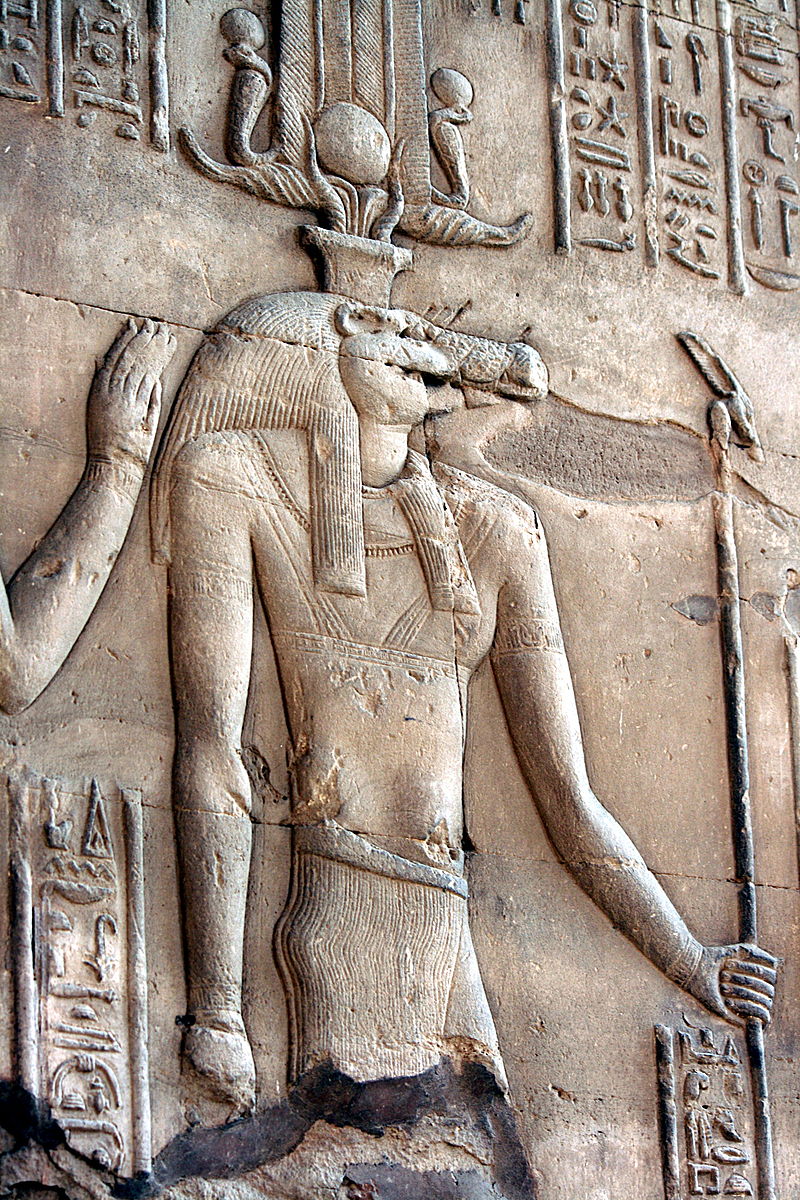
Egyptian god Sobek, Kom Ombo temple

The transformation of a staff into a crocodile would remind Egyptians of their crocodile god, Sobek, credited with both creating the Nile and giving strength to the pharaoh. If the God of Israel has power over Sobek, Pharaoh and the whole country are in danger.

The concept of a staff becoming a crocodile would not seem strange to the Egyptians. In an Egyptian tale written as early as 1600 B.C.E., the Egyptian priest Webaoner made a wax crocodile “seven fingers long”, and when his assistant threw it into a lake it became a real crocodile and swallowed up the priest’s enemy. When the king arrived, Webaoner caught the real crocodile, and it shrank and turned back into wax.3

The snake in Egyptian theology

Egyptian Priests Holding Serpent Staffs, Tomb of Sennufer, 15th c. BCE, photo by Scott B. Noegel, detail

The idea of a staff changing into a snake may have come from Egyptian rituals in which priests carried rods with heads shaped like snakes, as depicted in a 15th-century B.C.E. tomb painting.

The sudden appearance of a snake in Pharaoh’s audience chamber would remind the Egyptians of the snake god Apep. Apep was the god of chaos, evil, and darkness, the enemy of the sun god, Ra. Ra was the god of order and light, and crossed the sky from east to west every day. Every night the sun went down in the west and Ra traveled through the underworld to where the sun was due to rise again in the east. During this nightly underground crossing, Ra fought Apep, who lived in the underworld of the dead. For centuries Egyptian priests helped Ra in the battle by making wax models of Apep and spitting on them, mutilating them, or burning them while reciting spells to kill the evil god.4 

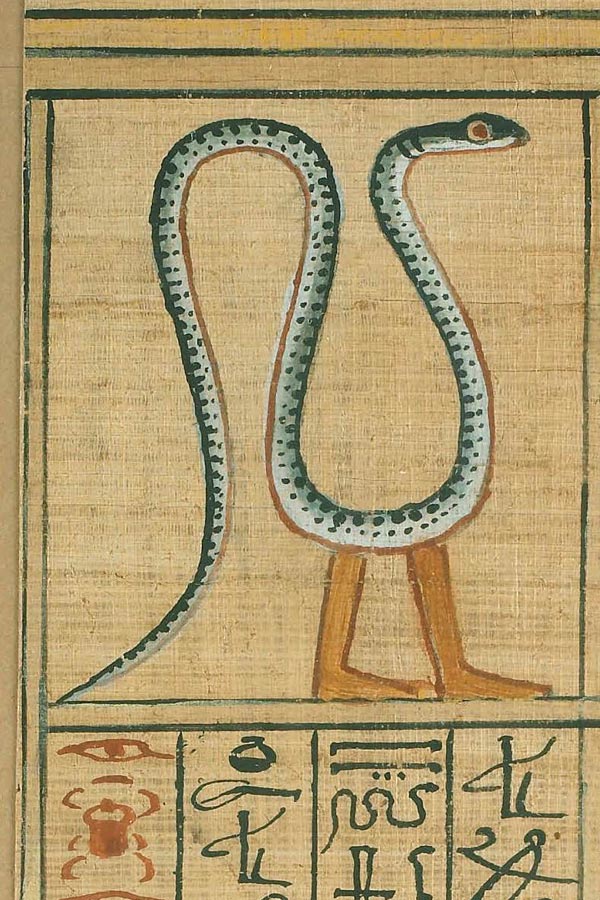
Nehebu-kau, Spell 87 of the Book of the Dead of Ani

Another Egyptian snake god was Nehebu-kau, a variant of Apep who had become a benign underworld god by the 13th century B.C.E., when the Exodus story was set. Nehebu-kau ws one of the 42 gods who judged the souls of the deceased. (Another was the crocodile god Sobek.) When souls of the dead passed the test for good behavior during life, Nehebu-kau gave them the life-force ka so they would have an afterlife. (Apep, on the other hand, was called “Eater of Souls”.)

When Aaron’s snake swallows the Egyptian priests’ snakes, it signals that the whole Egyptian cosmic order is in danger. Can Ra defeat a god even more powerful than Apep? Will there be any afterlife if Nehebu-kau is overthrown?

Pharaoh versus his priests

But Pharaoh’s mind hardened, and he did not listen to them, just as God had spoken. (Exodus 7: 13)

The next step is the first of the miraculous plagues that will destroy Egypt, just what God predicted to Moses in the Torah portion Shemot .

We can assume the Egyptian chartumim in the book of Exodus are shocked and alarmed when Aaron’s snake-staff gulps down all of theirs. It is an obvious omen that the God of Moses and Aaron will triumph over their pharaoh, and over all Egypt. But they do not want to believe this omen, so they return to do more magic for Pharaoh. They gamely use “heka” to reproduce God’s plagues of blood and frogs, at least in miniature.5 But they cannot replicate God’s third plague, lice.6 And at that point they acknowledge that the power behind the plagues is a serious danger to their world.

And the chartumim said to Pharoah: “It is a finger of a god!” But Pharaoh’s mind hardened, and did not listen to them. (Exodus 8:15)


Modern Torah readers are familiar with the idea that God is omnipotent. For us, the magic tricks that God arranges with a shepherd’s staff might seem like a sideshow before the main action of the ten plagues begins.

Yet it is necessary for Moses to prove to both the Israelites and the Egyptians that he really is speaking for a powerful god, and that his God is more powerful than any Egyptian god or Egyptian magic. Otherwise the Israelites will never follow him out of Egypt. And otherwise the pharaoh will attribute the plagues to other deities.

Some people are better than others at noticing signs and drawing long-term conclusions. Moses notices the subtle miracle of the bush that burns without being consumed, and walks right over to find out more.

The chartumim a a bit slower. They do not warn Pharaoh that Egypt is doomed right after the snake-staff demonstration; they are probably hoping to uncover an explanation consistent with their world-view. But when they cannot replicate God’s miraculous plague of lice, they give up. After that, the chartumim do not seem to be present at any other confrontational meetings between Moses and Pharaoh.7

But Pharaoh continues to assume that no matter what happens Egypt will go on, he will stay on the throne, and he must keep the Israelites as his slaves. Whenever Pharaoh’s faith is shaken, he recovers—until the final blow, the death of his own first-born son.

The longer you hold a belief, the harder it is to give up. What does it take before you admit you were wrong?

A single unexpected event, like the sight of a bush that burns but is not consumed?

Several demonstrations that the power structure you depend upon has been subverted?

The destruction of your world because of your failure to change?


  1. According to modern source criticism, a redactor of the book of Exodus patched in some material from a different account. The portion Shemot recorded mostly J and E traditions of the tale. Exodus 6:2-7:13 comes mostly from P sources, with some explanatory additions.
  2. The word tanin appears 14 timesin the Hebrew Bible. Half the time it means a sea-monster—or perhaps a crocodile (Genesis 1:21, Isaiah 27:1 and 51:9, Jeremiah 51:34,  Psalms 74:13 and 148:7, Job 7:12, and Nehemiah 2:13). Twice a tanin is a snake (Deuteronomy 32:33 and Psalm 91:13), and twice it is a misspelling of “jackals” (tanim, in Lamentations 4:3 and Nehemiah 2:13). The remaining three occurrences of the word tanin are in the P story about the meeting with Pharaoh. (The word tanim, תַּנִּים, also occurs 14 times in the Hebrew Bible. In 10 of those occurrences it means “jackals”. But it is used as an alternate spelling of tanin in Isaiah 13:22 (snakes), Ezekiel 29:3 and 32:2 (crocodiles or sea monsters), and Psalm 44:20 (sea monsters).
  3. Prof. Scott B. Noegel, “The Egyptian ‘Magicians”, www.thetorah.com.
  4. One of the rituals in The Book of Overthrowing Apep, circa 305 B.C.E.
  5. Exodus 7:22 and 8:3.
  6. Exodus 8:14.
  7. No chartumim are mentioned in the passages about the next two plagues. The story of the sixth plague, boils, says: The chartumim were not able to stand in front of Moses because of the boils. (Exodus 9:11) After that they are absent from the rest of the book of Exodus.

Va-eira: Hail That Failed

Is it ethical to harm or even kill innocent people? The liberal answer is no. Someone with more traditional morality might answer: no … unless you need to do it for the sake of your own people, whose welfare comes first.

In terms of either answer, the God of Israel and the pharaoh of Egypt are unethical in this week’s Torah portion, Va-eira (Exodus 6:2-9:35).

The God character wants the Israelites to walk out of Egypt and serve God as the new rulers of the land of Canaan. The pharaoh character wants the Israelites to stay in Egypt as forced labor making bricks and building cities for him. The God character also wants to be acknowledged as the most powerful force in the world, while the pharaoh wants to keep every iota of power he already has.1

Following God’s instructions, Moses repeatedly offers Pharaoh what sounds like a compromise: that Pharaoh give the Israelites a three-day vacation to hold a festival for their God in the wilderness.2 (Meanwhile Moses informs the Israelites that the real goal is a new life in a different country.) Pharaoh refuses, and the God character responds by devastating Egypt with a series of “plagues”: miraculous disasters. The plagues devastate the country and harm or kill human beings, including both the Israelite immigrants God has adopted, and Pharaoh’s native Egyptians.

The Ten Plagues, Erlangen Haggadah, by Judah Pinchas, 1747

Before the seventh plague, hail, God tells Moses to pass on this information to Pharaoh:

“For by now shalachti my hand, and you, you and your people, would be wiped off the earth by bubonic plague. However, on account of this I have let you stand: to show you my power, so that my name will be made known over all the earth.” (Exodus 9:15-16)

shalachti (שָׁלַחְתִּי) = I could have sent forth, I could have released. (A kal form of the verb shalach, שָׁלַח = sent, let go. Throughout this week’s Torah portion, forms of the verb shalach are used both when God releases a plague, and when Moses and Pharaoh talk about releasing, or not releasing, the Israelites.)

In other words, God is refraining from simply killing every native Egyptian. The purpose of sending one plague after another is to spread the word about God’s awesome power, and to eventually make Pharaoh so terrified that he gives in and lets the Israelites go out into the wilderness.

Pharaoh’s strategy is to keep refusing to give the Israelites permission to go. He assumes they would never leave Egypt without his permission, probably because then his army would kill them.3

Plague of Death of the Firstborn, Erlangen Haggadah, by Judah Pinchas, 1747

So much is at stake that neither of the God character nor the pharaoh is willing to stop them. Only after the tenth plague, the death of the firstborn, does Pharaoh concede defeat.

Yet these entrenched enemies soften their positions briefly in this week’s Torah portion, in the story of the seventh plague: hail.

Ethics of a god

The first three plagues in the book of Exodus/Shemot afflict everyone in Egypt indiscriminately. When God turns the Nile into blood, the Israelites as well as the native Egyptians are affected by the shortage of both drinking water and fish.4 The second plague, frogs, and the third, lice, also affect everyone in Egypt without exception.

Then the God-character seems to notice that his demonstrations of power are causing suffering to the people he plans to rescue. Before the fourth plague, swarms of mixed vermin, God declares that all the Egyptians will be affected, but the region occupied by Israelites, Goshen, will be vermin-free.5

The Israelites also get a divine exemption from the fifth plague, cattle disease; the ninth plague, darkness; and the tenth, death of the firstborn. (Through the oversight of either the narrator or the God character, no exception is mentioned for the sixth plague, boils, nor for the eighth plague, locusts.)

The seventh plague, hail, is a unique case. No hail falls on Goshen, where the Israelites live. But this time God gives some of the Egyptians a chance to reduce their losses ahead of time. God tells Moses to tell Pharaoh and his court:

“Here I will be, about this time tomorrow, raining down a very heavy hail, the like of which has never been in Egypt from the day it was founded until now. So now, shelach your livestock and everything in the field that is yours! Every human and beast that is found in the field and has not been gathered into [its] house, the hail will descend upon them and they will die.” (Exodus 9:18-19)

shelach (שְׁלַח) = Send! Send in! (Another kal form of shalach.)

Perhaps God is testing Pharaoh to see whether he rejects everything God says, not just the demand to give the Israelites a three-day leave of absence. Pharaoh is stubborn and does not issue any orders about his own livestock or field slaves.

Plague of Hail, Erlangen Haggadah, by Judah Pinchas, 1747

But everyone in the audience hall hears God’s advice regarding the coming hailstorm, and some of Pharaoh’s courtiers act on it.

Whoever feared the word of God among the servants of Pharaoh had his slaves and his beasts flee into the houses. But whoever did not pay attention to the word of God left his slaves and his beasts in the field. (Exodus 9:20-21)

The hail still destroys the barley and flax crops and shatters trees throughout all of Egypt—except Goshen, where the Israelites live.6 This means a loss for even the God-fearing landowners, since all Egyptians now face a future shortage of food (barley and fruit) and clothing (linen from flax). The hail also kills or injures the slaves of the Egyptian landowners who ignored God’s warning and left them out in their fields along with the livestock.

The God character must notice that some of Pharaoh’s courtiers now believe in the power of the God of Israel. This is progress on God’s agenda of becoming known as the supreme deity. An ethical and intelligent deity would now devise a way to exempt every Egyptian who fears the God of Israel from the suffering and death that will be caused by the last three plagues.

But God’s lenience preceding the seventh plague does not last. The three plagues in next week’s Torah portion, Bo, affect all Egyptians without exception. The tenth and final plague kills the firstborn son of everyone in Egypt who does not paint blood on the doorframe of their house—and God does not tell anyone but the Israelites about this sign.

And it was the middle of the night, and God struck down all the first-born in the land of Egypt, from the first-born of Pharaoh who sits on his throne to the first-born of the captive who was in the dungeon, to all the first-born of the livestock. (Exodus 12:29)

For the plague of hail, God experimented with mitigating the damage to Egyptians who feared God. But the final and most horrible plague punishes all Egyptians, even those who are eager to let the Israelites leave.

Ethics of a king

During the first six plagues, Pharaoh makes two false promises to let the Israelites go, but breaks them as soon as the plagues are removed.7 He does not express any guilt over the devastation to his country and its people.

But he appears to have a change of heart during the seventh plague, hail.

Then Pharaoh summoned Moses and Aaron and said to them: “I am guilty this time. God is the righteous one and I and my people are the wicked ones. Plead to God that there will be no more of God’s thunder and hail, va-ashalchah you, and you will not continue to stay.” (Exodus 9:27-28)

va-ashalchah (וַאֲשַׁלְּחָה) = and I will send away, let go, set free. (A piel form of the verb shalach.)

Plague of Hail, Golden Haggadah, Spanish, ca. 1320

Only here and during the eighth plague, locusts, does Pharaoh say he is guilty. When the hail is pummeling the land, he qualifies his confession in two telling ways. He classifies his people as well as himself as “wicked” even though so far, only Pharaoh and his taskmasters have harmed the Israelites. And he says he is guilty “this time”, ignoring the previous six times he refused to release the Israelites.

Does Pharaoh really believe he acted unethically? Or is he just saying so in the hope that a little groveling will help to get the plague of hail removed?

After all, Moses has not been frank with Pharaoh. So far he has kept repeating God’s request that the pharaoh give the Israelites three days off to worship their God in the wilderness. Pharaoh, by adding “and you will not continue to stay”, hints for the first time that he suspects the truth: if the Israelites got a three-day head start, they would not return to Egypt. Both Moses and Pharaoh hide their true agendas.

This week’s Torah portion ends:

And Pharaoh saw that the rain and the hail and the thunder had ended. Then he added to his guilt, and his heart was unmoved,8 his and his courtiers’. And Pharaoh’s heart hardened, and he did not shilach the Israelites, as Hashem had spoken through Moses. (Exodus 9:34-35)

shilach (שִׁלַּח) = let loose, let go, sent away. (Another piel form of the verb shalach.)

It is the narrator who says Pharaoh “added to his guilt” by being hard-hearted and refusing to let the Israelites go. Pharaoh himself is no longer talking about guilt. He has returned to his stubborn refusal to recognize that he cannot win against God. And Pharaoh’s courtiers stand with him this time.

By now Pharaoh knows that every time he refuses to release the Israelites another plague strikes Egypt. Perhaps during the hail he realizes that he, too, bears some responsibility and guilt for the damage the plagues have done. But then he returns to making  his own status as Egypt’s absolute ruler his top priority. He does not free the Israelites until the plague of the firstborn kills his own son and heir.


Both God and Pharaoh soften briefly during the story of the plague of hail. The God character enables the Egyptian landowners who take God seriously to protect some of their property. Pharaoh entertains the idea that he is wrong to prioritize his pride and his free labor over the health and safety of his own Egyptian citizens. Yet this softening quickly vanishes without leading to a moral improvement in either character.

It is easy to keep on angling to get what you want, regardless of the consequences for anyone else. I have acted that way myself, until I realized the damage I was doing and repented.

But some individuals are too narcissistic to feel compassion and repent. Occasionally a narcissist says or does something that appears to be kind and compassionate but, as I know from personal experience, this temporary kindness may be only a ploy to win favor. When push comes to shove, narcissists will harden again, because nothing is more important than their own agendas.

The book of Exodus paints the characters of both God and Pharaoh as narcissistic. Nevertheless, people still enjoy a story about a battle between two superpowers, regardless of the collateral damage in human lives.

But in our own lives, may we remember to look and see whether we are harming others as we pursue our own agendas. And may we protect ourselves, and others, from narcissists who cannot see the harm they do.

And may we not confuse God with the narcissistic God character in the book of Exodus.


  1. See my post Bo: Pride and Ethics.
  2. Exodus 5:1-3, 7:16, 8:21-24, 10:9-11, 10:24-26.
  3. Pharaoh and his charioteers do pursue the Israelites in Exodus 14:6-10 after Pharaoh changes his mind about letting them go.
  4. Exodus 7:20-24.
  5. Exodus 8:17-8:18.
  6. Exodus 9:16, 9:25, 9:31.
  7. Pharaoh promises to let the Israelites go during the plague of frogs in Exodus 8:4 and backs out in Exodus 8:11. He promises during the plague of vermin in Exodus 8:21 and 8:24 and backs out in Exodus 8:28.
  8. The Hebrew reads: vayakhebeid libo (וַיַּכְבֵּד לִבּוֹ) = and his heart was heavy. In English, the idiom “heavy heart” means sadness. But in Biblical Hebrew, a “heavy heart” is unmoved or immovable.

Bo: Pride and Ethics

Haggadah by Judah Pinḥas, Germany, 1747

Pharaoh wants the Israelites to stay in Egypt and serve him as corvée laborers making bricks and building cities. God wants the Israelites to walk out of Egypt, take over Canaan, and serve “him”.  In an effort to terrorize Pharaoh into letting the Israelites go, God afflicts Egypt with ten “plagues” or miraculous disasters: blood, frogs, lice, mixed vermin, cattle pestilence, boils, hail, locusts, utter darkness, and death of the firtborn.

The God-character reveals another divine agenda in last week’s Torah portion, Va-eira, just before the plague of hail.

Shalach my people so they can serve me! Because this time I myself sholeiach all my scourges into your heart and against your courtiers and against your people, so that you will see that there is none like me on all the earth. Indeed, by now shalachti my hand and struck you and your people with the pestilence, and you would have been effaced from the earth. However, for the sake of this I have let you stand: so that I can show you my power and make my name known throughout the earth.” (Exodus 9:14-16)

shalach (שַׁלַּח) = Send! Send forth! Send out! Let go! Release!

sholeiach (שֺׁלֵחַ) = am sending, am sending forth, am sending out, am letting go, am releasing.

shalachti (שָׁלַחְתִּי) = I sent, I could have sent, I could have stretched out, I could have released.

(Throughout the story of the ten plagues, forms of the verb shalach are used both when God releases a plague, and when anyone talks about Pharaoh releasing the Israelites.)

Before sending the hail, the God-character reveals that “his” other goal is to prove to the whole world that “he” is the most powerful god. Being recognized as the most powerful seems more important to the God depicted in the book of Exodus than any moral considerations.1

The ethical problem with the God-character’s actions is that the plagues afflict not only Pharaoh, but also the native Egyptians. Why should ordinary Egyptians suffer? Pharaoh is the one who keeps refusing to let the Israelites go; his people have no say in the matter.

Some commentators have claimed that all the Egyptian people are on Pharaoh’s side, so they deserve to be punished. But there is nothing in the text of the Torah to indicate this. Pharaoh issues a general order for “all his people” to throw male Israelite infants into the Nile in last week’s Torah portion, Shemot.2 But the Torah never reports an Egyptian actually doing so. The only Egyptians who act against Israelites in the book of Exodus are:

  • Pharaoh, who issues commands calling for their oppression and death.
  • Egyptian taskmasters supervising the corvée labor, who oppress and beat the Israelites.3
  • Pharaoh’s armed regiment of charioteers, who pursue them after they leave Egypt.4

Yet the other native Egyptians also suffer from God’s ten plagues. Is their suffering unavoidable collateral damage in the war between Pharaoh and God? Or does God choose miracles that harm the most people on purpose, in order to make a more dramatic display of power?

*

Plague of the Firstborn, Spanish haggadah c. 1490

The tenth and final plague, described in this week’s Torah portion, Bo, is death of the firstborn.

And it was the middle of the night, and God struck down all the first-born in the land of Egypt, from the first-born of Pharaoh who sits on his throne to the first-born of the captive who was in the dungeon, to all the first-born of the livestock. (Exodus 12:29)

Only the Israelites receive God’s instructions to paint blood on their door frames and stay inside overnight to avoid the death of any of their first-born.5

Is this extreme unethical measure necessary in order to make Pharaoh submit? Or does the God-character kill every first-born in every Egyptian family merely in order to make a more dramatic display of power?

A necessary evil

The mass murder does appear to achieve the liberation of hundreds of thousands of oppressed Israelites.

And Pharaoh got up in the night, he and all his courtiers and all the Egyptians. And there was a great wailing outcry in Egypt, because there was no house without someone dead. And he summoned Moses and Aaron in the night and he said: “Arise, go out from among my people, you and also the Israelites, and go serve God, as you spoke! Take even your flocks and your herds, as you spoke, and go! And may you also bless me.” (Exodus 12:30-32)

Only after the death of the first-born does Pharaoh capitulate and tell the Israelites to go with everything Moses asked for. He even lowers himself by asking for a blessing, acknowledging that he cannot prosper again without God’s help.

Pharaoh loses his own first-born son, a blow that would shatter the hardest heart. But the wailing all over his capital city would reinforce his new despair. He may suspect that if he does not let the Israelites go now, the Egyptian people will revolt against him. The authority conferred upon him by the gods of Egypt no longer holds when the God of Israel is obviously more powerful.

A dramatic display

On the other hand, after three of the plagues (boils, locusts, and darkness) the Torah says that God hardens Pharaoh’s heart.6 What does this mean?

Pharaoh hardens his own heart after the plague of frogs, and continues to harden it four more times.7 He is in the habit of hardening his heart, and once we get into a habit, it can seem as if an outside force makes us keep doing it again and again. But in the text of Exodus, there is an outside force, and it is God. Before the plagues begin, the God-character tells Moses:

“And I myself will harden the heart of Pharaoh, and I will multiply my signs and my omens in the land of Egypt.” (Exodus 7:3)

The God-character follows up on this promise by deliberately hardening Pharaoh’s heart three times when Pharaoh is softening and might give in. The God-character does not want Pharaoh to let the Israelites go before “he” is ready. And the God-character is only ready after “he” has a chance to commit the tenth and most emotionally devastating plague: the death of the firstborn.

Apparently the God-character is so fixated on the goal of demonstrating power that the full ten-step dramatic display, from blood to death, is worth postponing the liberation of the Israelites. Demonstrating power is also far more important to this God-character than minimizing the suffering of innocent Egyptians.


Red Sea in Golden Haggadah, c. 1320, Spain

After the final plague, the Israelites march into the wilderness, but Pharaoh changes his mind about letting them go. The God-character hardens Pharaoh’s heart one last time in next week’s Torah portion, Beshallach, and Pharaoh commands his charioteers to pursue the Israelites. This gives the God-character a chance to create another memorable miracle: the splitting of the Reed Sea, and the return of the waters in time to drown the Egyptian chariot regiment.8

And Israel saw the great power that God wielded against Egypt, and the people were awed by God, and they had faith in God and in [God’s] servant Moses. (Exodus 14:31)

This miracle impresses both the Egyptians and the Israelites with God’s power. The fact that it also avoids killing any innocent bystanders is probably incidental in the book of Exodus.

Although Exodus is based on older oral traditions, modern scholars estimate that it was written down in the 6th and 5th centuries B.C.E. About a thousand years later, the rabbis of the Talmud imagined a different sort of God responding to the death of the Egyptian soldiers.

At that time the ministering angels wanted to recite a song before the Holy One, Blessed be He. The Holy One, Blessed be He, said to them: “My creatures are drowning in the sea, and you are reciting a song before me?” (Talmud Bavli, Sanhedrin 39b and Megillah 10b)

As the ethics of the Israelites advanced, so did the ethics of their God.


  1. See Jerome M. Segal’s treatment of this theme in his book Joseph’s Bones: Understanding the Struggle Between God and Mankind in the Bible, Riverhead Books, Penguin Group, New York, 2007.
  2. Exodus 1:22.
  3. Exodus 1:13-14 reports unspecified ruthless oppression by the taskmasters; Exodus 2:11 and 5:15-16 report beatings.
  4. Pharaoh and his charioteers pursue the Israelites after Pharaoh changes his mind about letting them go in Exodus 14:6-10. The disciplined Egyptian charioteers advance at the Reed Sea in order to kill some Israelites and capture the rest, but God intervenes with a miracle.
  5. Exodus 12:6-7, 12:21-23.
  6. Exodus 9:12, 10:20, 10:27.
  7. Exodus 8:11, 8:15, 8:28, 9:7, 9:34.
  8. Exodus 14:5-30.

Repost: Va-eira

Moses never says “Let my people go!” in the book of Exodus without adding “to serve God” or “to slaughter offerings for God”.  Sometimes he adds more qualifiers.  Throughout this week’s Torah portion, which covers the first seven plagues, Moses’ demand is that the pharaoh give the Israelites a short leave of absence from their forced labor so they can travel for three days into the wilderness the midbar (מִּדְבָּר), and serve their god there with animal sacrifices.

Click here: Va-eira & Shemot: Request for Wilderness, to see a rewritten version of my 2013 essay on Moses’ demand.

Back in 2013 it seemed obvious to me that prayer in a midbar is different from prayer in inhabited places.  I have done very little wilderness hiking, but even a walk through the woods or on a beach beyond the houses and other people has let me pray more deeply.  And midbar means not only wilderness, but also includes any land that is uninhabited or uncultivated.

But this year, writing in our apartment in Split, Croatia, the idea of encountering God in the midbar seems intriguing but out of reach.

Maisel Synagogue in Prague; built 1592, rebuilt 1905

Since we left our home in Oregon four months ago, we have visited old synagogues in five European cities during the past four months, but we only managed to go to one service, at the Maisel Synagogue in Prague.  We pick which European spots we visit, whether for a day trip or for a month-long stay, based on their  history, art, and architecture.  We happily spend our days in cities that were already urban centers centuries ago, and are still packed with people.  I sing Jewish prayers inside our lodgings, and sometimes while I walk outside.   But my praying is neither communal nor in a midbar.

We are heading for Jerusalem at the end of February.  Until then, when we push our aging bodies into taking long walks, we pick routes with old buildings, museums, and an occasional café where we can rest and warm up.  In Oregon we had breathtaking midbar of all kinds: seashores, forests, waterfalls, deserts, mountains …  Why waste time going to those kinds of places in Europe when we can get the same or better at home?

Peacock and fallen oranges in a front yard, Split, Croatia

Now my memories of praying alone in the woods seem faded, as if it happened long ago.  Yet every day I sing  my morning prayers when I get up, and it still reminds me of God, still triggers gratitude for my life.  And when I see something that amazes and delights me, natural or man-made, I am moved to murmur another prayer of gratitude in Hebrew.

I daresay both communal prayer and wilderness prayer will both come back to me, maybe in Israel, certainly when we return to the United States.  Meanwhile, I savor not only my personal practice, but also continuing to study and write about the Torah.

Va-eira: Taking a Stand at the Nile

Aaron’s Rod Changed into a Serpent, Foster Bible Pictures, 1873

The pharaoh is not impressed when Aaron’s staff swallows the staffs of the Egyptian court magicians.  He will not listen to the request of the two men, Moses and Aaron, to let the Hebrew slaves go on a three-day journey to worship their god.  Probably he suspects they will never come back.  Certainly he does not believe their god has any power.1

It is time for the first plague to prove him wrong.  In this week’s Torah portion, Va-eira (“and he saw”) God tells Moses:

Go to Pharaoh in the morning.  Hey, he will be going out to the water, venitzavta on the shore of the Nile, and the staff that had changed into a snake you shall take in your hand.  And you shall say to him: “God, the god of the Hebrews, sent me to you to say: ‘Send out my people so they can serve me in the wilderness!  And hey, so far you have not listened.’”  (Exodus/Shemot 7:15-16)

venitzavta (וְנִצַּבְתָּ) = and you shall stand, take a stand, station yourself, stand firm.  (A form of the verb nitzav, נִצָּב = took a stand.)

Plague of Blood, Golden Haggadah, c. 1320, Spain

Moses does so, and then Aaron obeys God’s next order.

Then he raised the staff and he struck the water that was in the Nile, in the sight of Pharaoh and his courtiers, and all the water in the Nile changed into blood.  (Exodus 7:20)

Pharaoh and his advisers him see for themselves that the Nile is transformed exactly when the staff touches the water, so they cannot invent another explanation for the plague of blood.  But the Pharaoh still refuses to listen to Moses.

After two more plagues, God tells Moses to catch Pharaoh at the waterfront again.

Then God said to Moses: “Get up early in the morning vehityatzeiv in front of Pharaoh.  Hey, he is going out to the water, and you shall say to him: ‘Thus says God: “Send out my people and they will serve me!”  Because if you are not sending out my people, here I am sending out against you and your courtiers and your people and your houses mixed vermin2, and they will fill the houses of Egypt, and even the ground that they are on!’” (Exodus 8:16)

vehityatzeiv (וְהִתְיַצֵּב) = and station yourself, establish yourself.  (Another form of the verb nitzav.)

There is no obvious reason this time for Moses give his warning on the bank of the Nile.  God does not even tell him to use his staff.  It is certainly more dramatic to interrupt Pharaoh’s regular morning routine than to arrive at the palace with all the other petitioners of the day.  But why is the Pharaoh going to the shore of the Nile in the mornings?

Over the centuries commentators have generated a variety of answers.  According to Exodus Rabbah, Pharaoh always sneaked out to the river to relieve his bladder, so nobody would know he was not a god.3  Others proposed that in the morning Pharaoh went out to exercise.4  The Talmud suggested that Pharaoh was a magician and went to the Nile to do divination.5  Ibn Ezra wrote that the king of Egypt went to the Nile to check the water level during the summer flood season.6

Nilometer

Contemporary scholar Scott B. Noegel has argued that none of these explanations fit what we now know about the New Kingdom period in ancient Egypt.7  In fact, Pharaohs spent the whole morning indoors.  They bathed and performed their ritual duties indoors.  During flood season, officials in the Pharaoh’s bureaucracy measured the level of the Nile, not the Pharaoh himself.8

Noegel concludes that the Torah invented Pharaoh’s morning trips to the Nile in order to set up a literary structure dividing the ten plagues into three sets of three followed by the final catastrophe.  “The first plague in each of these series (1st, 4th, 7th) contains Yahweh’s commandment to Moses to “station himself” before pharaoh, each time employing the Hebrew root נצב.  Each also contains the phrase “in the morning.”9

But plagues #1, #4, and #7 do not agree on the location where Moses should intercept Pharaoh.  Only plagues #1 (blood) and #4 (mixed vermin) call for Moses to catch Pharaoh at the Nile.  Before plague #7 (hail) God instructs Moses to “Get up early in the morning vehityatzeiv in front of Pharaoh.”  But the Torah says nothing about Pharaoh going out to the water; the confrontation could happen anywhere.


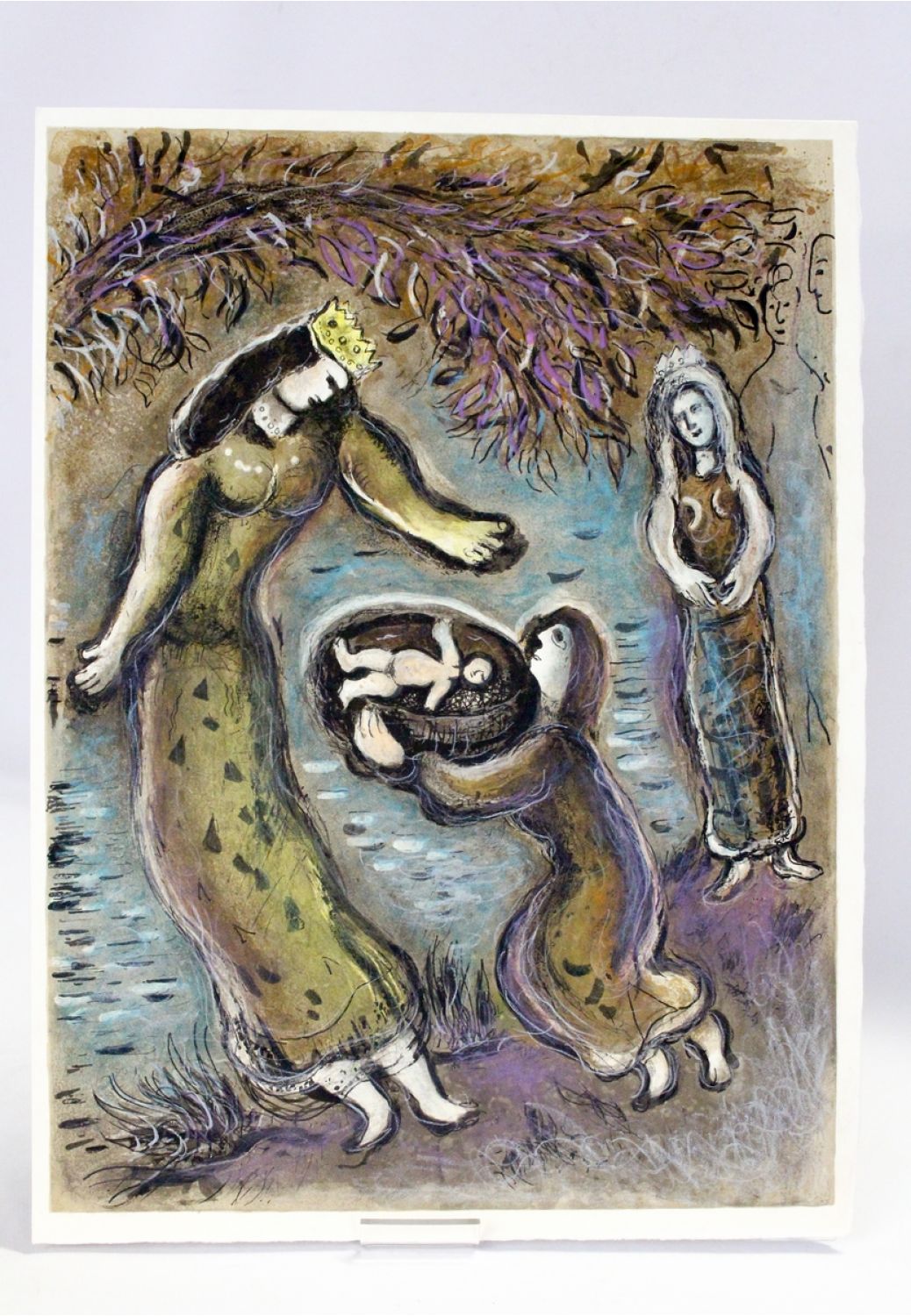
I think Moses intercepts the Pharaoh at the Nile because it dramatizes this Torah portion’s contrast with an earlier part of the Exodus story the part in which Moses’ sister stations herself at the Nile to intercept Egyptian royalty.

When Moses is only three months old his mother can no longer protect him from the previous Pharaoh’s command that all Hebrew infant boys must be drowned in the Nile.  So she puts him in a little ark among the reeds at the edge of the river.

Moses Saved, by Marc Chagall

Vateitatzav, his sister, at a distance to find out what would happen to him.  And the daughter of Pharaoh went down to bathe on the Nile, and her girls were walking at hand [along] the Nile.  And she saw the ark in the midst of the reeds, and she sent her slave-woman, who fetched it.  And she opened it, and she saw the child, and hey!—it was a boy, crying.  And she took pity on him and she said: “This is one of the Hebrews.”  (Exodus 2:4-6)

vateitatzav (וַתֵּתַצַּב) = she stationed herself.

Once the princess has expressed sympathy for the plight of the Hebrews, Moses’ older sister Miriam speaks up.

And his sister said to Pharaoh’s daughter: “Shall I go and summon for you a nursing woman from the Hebrews, so she can nurse the child for you?”  And Pharaoh’s daughter said to her: “Go.”  And the girl went and she summoned the child’s mother.  (Exodus 2:7-8)

The princess even pays Moses’ mother for the service.  When Moses is weaned, his mother brings him to the princess, and she adopts him.

Miriam stations herself where she knows Pharaoh’s daughter will come down to the water.  She asks the princess to rescue the Hebrew child, and it works.

Eighty years later9 Moses stations himself where he knows the current Pharaoh will come down to the water.  He asks the Pharaoh to rescue the whole Hebrew people, and—as God predicts—it does not work, not even when he confronts the Pharaoh at the Nile again after three plagues.

The difference is that Miriam, her mother, and Pharaoh’s daughter are collaborators, not competitors.  All three women want to save the baby’s life more than they want personal control over him.

Moses and the next Pharaoh cannot collaborate because the Pharaoh wants personal control over his kingdom at all costs, while Moses wants to free the population of Hebrews from any Egyptian control.  Both men were brought up in the Egyptian court, both order the death of both Hebrews and Egyptians without flinching,10 and both are the leaders of large populations.  When the two men face one another at the Nile, they stand as two alternatives for rulership.

Moses keeps taking a stand for the well-being of the Hebrew people, defying both Pharaoh and God.11  His goal is to change the status quo in Egypt through a revolutionary emigration to Canaan, at that time a distant part of the Egyptian empire.

Pharaoh takes a stand against any change in Egypt, or in his way of government.


We all know people who go into denial about the facts when they feel threatened by change.  We know people who are eager for changes that may be improvements, and willing to take the risk of moving forward.  And we  know people in the middle who recognize history in the making and adapt to it, like the courtiers who beg Pharaoh to let the Hebrews go before Egypt is  destroyed, or like the Hebrews who cannot take a stand against slavery until Moses shows up with an alternative.

The best outcome is when Pharaoh’s daughter can join Miriam and her mother on common ground, cooperating to save a child’s life.  But what about when the Pharaoh and Moses stand against one another at the Nile and find no common ground?

The Torah shows that in the long run slaves will be freed, and a kingdom devastated by its own ruler will recover and become great again.

May such a recovery happen to us, speedily and in our own time.


  1. Exodus 5:2.
  2. There is no consensus about how to translate the Hebrew word for plague #4, arov (עָרֺב). It is usually translated as “insect swarms” or “wild animals”.  Arov appears to be related to a root meaning “mixture”, which is also the root for arov spelled עֲרוֹב = becoming evening.  It is hard to imagine a plague of evenings.  Through another etymology, arov spelled עֵרוֹב = mortgaging.
  3. From Midrash Tanḥuma 2:2:14, 5thcentury E.  (Translation from Scott B. Noegel, “Why Pharaoh Went to the Nile”, www.thetorah.com/why-pharaoh-went-to-the-nile/, 04/07/2017.)   This explanation also appeared in Exodus Rabbah 9:8 and in the commentary of Rashi (Shlomoh Yitzchaki, 11th century C.E.).
  4. Rashbam (R. Shlomo ben Meir, 12th century) suggested Pharaoh went riding, Ramban (Moses men Nachman or Nachmanides, 12th century) that he played in the water, Bekhor Shor (12th century) that he went hawking, and Abarbanel (15th century) that he was strolling or playing ball. (Michael Carasik, editor and translator, The Commentators’ Bible; The Rubin JPS Miqra’ot Gedolot, Exodus, The Jewish Publication Society, Philadelphia, 2005, p. 48)
  5. Talmud Bavli, Mo-ed Katan 18a.
  6. Ibn Ezra (12th century) according to Noegel, ibid.
  7. The Exodus story is set in the New Kingdom period in Egypt, during the 16th-11th centuries B.C.E.
  8. Noegel, ibid.
  9. This week’s Torah portion reports Moses’ age as 80 and Aaron’s as 83 (Exodus 7:7).
  10. Moses kills an Egyptian (Exodus 2:11-12) and orders the killing of Hebrew golden calf worshippers (Exodus 32:26-28). The Pharaoh orders the execution of every male Hebrew infant (Exodus 1:15-22) and refuses to prevent the deaths of every firstborn Egyptian (Exodus 11:4-10).
  11. Moses talks God out of abandoning the Hebrew people in Exodus 32:9-12 and 31-32, after the golden calf episode, and in Numbers 14:11-17.

Bo & Va-eira: A Hard Habit

Plague of Blood, Golden Haggadah, c. 1320

Blood, frogs, lice or gnats, swarms of vermin, livestock disease, skin disease, hail, locusts, impenetrable darkness, death of the firstborn.  Why does it take ten miraculous plagues in the Torah portions Va-eira and Bo before Pharaoh lets the Israelite slaves go?1

When Moses first returns to Egypt, he and his brother Aaron simply ask the new pharaoh to give the Israelite slaves three days off to make animal sacrifices to their God in the wilderness.2  Pharaoh replies that he does not know this god.  Then he increases the workload of the Israelites, so they will not even think about taking a vacation.  Ruling through oppression is the model his father used, the only model he knows.

Moses and Aaron return to perform a small demonstration miracle: Aaron throws down a staff that turns into a crocodile.3  Pharaoh summons his wonder-workers, who perform a similar trick.  Even though Aaron’s magic crocodile eats the Egyptians’ magic crocodiles, Pharaoh refuses to be impressed.

Vayechezak, the leiv of Pharaoh, and he did not listen to them, as God had spoken.  And God said to Moses: “Kaveid is the leiv of Pharaoh; he refuses to let the people go”.  (Exodus 7:13-14)

vayechezak (וַיֶּחֶזַק) = and it hardened, became stronger, became unyielding.  (From the same root as chazak, חָזָק = strong, firm, resolute.)

leiv (לֵב) = heart; conscious mind, conscious thoughts and feelings.

kaveid (כָּבֵד) = heavy, dull and slow, immobilized; oppressive, impressive.

Pharaoh’s mind is already so heavy that it “hardens” itself; he dismisses questions before they arise, and continues to behave as he always has.

We are what we learn

Moses and the current pharaoh both grew up in the Egyptian court.  But Moses was the son of Israelite slaves before he was adopted by an Egyptian princess, and he never forgot his origins.  As a young man, he left Egypt and joined a Midianite clan east of Sinai.  Thus he learned how to adapt to novel situations with curiosity and an open mind.  When he saw the bush that burned but was not consumed he approached it, and when he heard God’s voice he believed it.

Nevertheless, Moses argued with God.  At the burning bush he tried five times to get out of returning to Egypt as God’s prophet before he finally accepted his mission and changed his life again.4

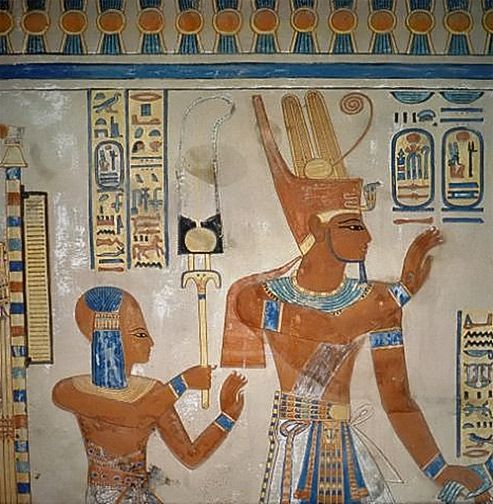
Pharaoh Ramses III followed by his son

The old pharaoh’s firstborn son, on the other hand, grew up knowing he would someday succeed his father as the god-like ruler of Egypt.  All he had to do was learn his predefined role.  He had no reason to question anything, no new situations to master.

After the staff-crocodile demonstration the miraculous plagues begin: seven in last week’s Torah portion, Va-eira, and three this week in Bo.  Several times Pharaoh promises Moses and Aaron that if they get God to end the current plague, he will let the Israelites go for three days.5  But as soon as the plague stops, Pharaoh goes back on his promise.  After each plague, Pharaoh’s leiv returns to being either chazak or kaveid.  He acts as if he can continue to depend on the labor of his Israelite slaves, and their God will not afflict the country with another miracle.

Pharaoh’s mind hardens on its own after six of the plagues. But after the plagues of skin disease, locusts, and darkness, God–or at least the character of God as portrayed in the book of Exodus–hardens Pharaoh’s heart.

Plague of Boils, Haggadah by Judah Pinchas, 1747

After the sixth plague, a skin rash with boils,

Vayechazeik, God, the leiv of Pharaoh, and he did not listen to them, as God had spoken to Moses.  (Exodus 9:12)

Vayechazeik (וַיְחַזֵּק) = and [God] hardened, strengthened, made rigid.  (Another verb form from the same root as chazak.)

Why does God intervene?  One possibility is that Pharaoh is finally wavering, wondering whether his refusal to listen to Moses is taking too a high toll on his country—or on his own body.  Is his “heart” softening, his mind becoming a little more flexible?  If so, God apparently wants to prevent Pharaoh from changing his mind too soon, before God has finished the whole demonstration.

Plague of Locusts, Haggadah by Judah Pinchas, 1747

During the plagues of locusts and darkness in this week’s Torah portion, Pharaoh switches from empty promises to genuine offers—with conditions.  While the locusts are devouring all the remaining crops, he offers to let the Israelite men go, as long as their children remain hostage in Egypt.  Moses refuses the condition.

Vayechazeik, God, the leiv of Pharaoh, and he did not let the Israelites go.  (Exodus 10:20)

During the plague of impenetrable darkness, Pharaoh offers to let all the Israelites go for three days, as long as they leave their flocks and herds behind.  Again Moses refuses.

Vayechazeik, God, the leiv of Pharaoh, so he was not willing to let them go.  (Exodus 10:27)

Pharaoh remains attached to being the all-powerful ruler of an economy based on slavery.  Is the God character or Pharaoh responsible for the king’s inability to imagine a new world order?

Free will

If God is deliberately hardening Pharaoh’s mind, then the king of Egypt has no free will.  God is depriving Pharaoh of the ability to make choices.

The idea that God can remove a human being’s free will has disturbed commentators through the ages.  The ability to make our own choices is part of being human, according to the book of Genesis; God gave Adam and Eve the ability to decide whether to eat from the Tree of Knowledge or not.  And we all prefer to believe that we are not automatons, that it is possible for us to choose and change.

Other commentators have argued that God hardens Pharaoh’s mind not by making him more stubborn, but by giving him the courage to bear the suffering caused by his bad choices.  God does not want Pharaoh to make a reasonable decision because he realizes that his country is collapsing into poverty and disease.  Instead, God wants Pharaoh to believe in the power of God and repent.  So instead of making Pharaoh more stubborn, God gives Pharaoh the courage to bear the suffering of Egypt.6

Yet the Torah describes God as making Pharaoh’s heart chazak and kaveid, the same two words it uses for what Pharaoh does to himself.  It does not use an alternate word or phrase to indicate strengthening by instilling courage.7

Another possible reading of God’s intervention is that Pharaoh’s mind is already so inflexible that God does not need to make it any more rigid.  He has developed an ingrained habit of hardening his heart the moment a disaster ends.

Some commentators have written that the book of Exodus gives God credit for the power of habit.  God made humans so that the longer someone persists in doing evil, the harder it becomes to switch to doing good.8

Modern neuroscience shows that the human brain cannot make an unaccustomed choice in the heat of the moment.  The choice happens and our words or actions are triggered before we become consciously aware of what we have already decided.  In order to make a free choice, we have to train ourselves to pause as soon as we become aware of our reaction, then give ourselves time to make a conscious decision.

One last time

Death of Firstborn, Haggadah by Judah Pinchas, 1747

When Moses announces the tenth plague, death of the firstborn, he storms out before Pharaoh can react.  Why should he listen to another empty promise, another unacceptable bargain?

In the middle of the night, death strikes the oldest son of everyone in Egypt, from the Pharaoh to the lowest slave—except for the Israelites who are safe inside the houses they have marked with lamb’s blood for that night.9  Only after his own son is killed does Pharaoh come to Moses and insist that all the Israelites must leave, without conditions.  In the morning, the exodus from Egypt begins.

Yet in next week’s Torah portion, Beshallach, Pharaoh reconsiders one more time.  The damage has been done, so why should he lose so many slaves whose labor could help rebuild Egypt?  He sends an army to pursue his ex-slaves across the wilderness.  Pharaoh has not truly broken his habit.

*

Some of us are like Pharaoh, and cannot break our bad habits for more than a day, even after life has hammered at us from every side.  Yet many of us are like Moses; although we may refuse to accept our calling five times, we then find the courage to change and do what really needs to be done.  What a blessing to know that Moses’ response is also possible!

May every mind that has become hard and heavy finally open, and receive the blessing of change.

  1. Psalm 78 lists seven plagues, and Psalm 105 lists eight. See my post Va-eira & Bo: Psalm 78 & Psalm 105: Responding to Miracles.
  2. Exodus 5:1.
  3. When God rehearses this demonstration with Moses in Exodus 4:1-5, Moses’ staff becomes a nachash (נָחָשׁ) = snake. Most modern scholars attribute this version of the demonstration miracle to a story from the northern kingdom of Israel, the “E” source. In the demonstration in 7:10, Aaron throws down the staff and it becomes a tannin (תַנִּין) = crocodile, cobra, or other large reptile.  This version  is considered a later addition from the “P” source, written by priests sometime after the first Israelite temple in Jerusalem was built.
  4. See my post last week, Ve-eira and Shemot: Uncircumcised, Part 2.
  5. Frogs (Exodus 8:4), swarms of vermin (Exodus 8:21-24), and hail (Exodus 9:27-28).
  6. Nehama Leibowitz cites 15th-century rabbi Joseph Albo and 16th-century rabbi Obadiah Sforno in New Studies in Shemot (Exodus), Part 1, translated by Aryeh Newman, Zion Ezra Production, Maor Wallach Press, Jerusalem, 1996, pp. 152-153.
  7. For example, Deuteronomy 2:30 uses the phrase imeitz et levavo (אִמֵּץ אֶת־לְבַבוֹ) to say that God had made King Sihon’s heart braver.
  8. Rambam (12th-century rabbi Mosheh ben Maimon, a.k.a. Maimonides), Mishneh Torah, chapter 5, cited in Nehama Leibowitz, New Studies in Shemot (Exodus), Part 1, pp. 155-156.
  9. Exodus 12:21-23.

Va-era & Shemot: Uncircumcised, Part 2

Moses flees Egypt in last week’s Torah portion, Shemot, because he killed an Egyptian who was beating a Hebrew man.1  He returns to Egypt as God’s prophet, but the new pharaoh responds to his request by increasing the work of the Israelite slaves.2

Egyptian brick-making

In this week’s Torah portion, Va-eira (“And I appeared”), Moses tries to convince the Israelite slaves that God really has sent him to liberate them.  But they are unable to listen, because they are short of breath (or spirit) from their hard labor.3  When God tells Moses to speak to Pharaoh again, he balks, saying:

“Hey!  The Israelites would not listen to me, so how would Pharaoh listen?  And my lips are aral!”  (Exodus 6:12)

aral (עָרַל) = uncircumcised, possessing a foreskin.

Power of Speech

Moses expresses the problem more literally in last week’s Torah portion, Shemot.  When he sees the burning bush, he notices something numinous that others might overlook—a fire that burns but does not consume—and he steps closer to it.  So God speaks to the potential prophet and orders him to return to Egypt and demand that the pharaoh let the Israelite slaves go free to worship their own god.

But Moses is unwilling to accept the job.  He tries to turn down his mission five times, and each time God answers his objection.4  For his fourth attempt to excuse himself, Moses says he is the wrong man for the job because he is not a good speaker.

And Moses said to God: “Excuse me, my lord, I have not been a man of words, yesterday, nor the day before, nor earlier than when you spoke to your servant; for I am kaveid of peh and kaveid of lashon.”  (Exodus/Shemot 4:10)

kaveid (כָּבֵד) = (When used as an adjective for a body part): heavy, dull, hard, insensitive, clumsy.  (When used as an adjective for a person): honored, impressive, oppressive.

peh (פֶּה) = mouth; statement, spoken command.

lashon (לָשׁוֹן) = tongue; language.

A kaveid mouth and tongue are like aral lips.  Some thickness, covering, or blockage prevents Moses from speaking effectively.

Moses could merely be making another desperate excuse to avoid the mission in Egypt.  But since he claims his lips are aral in the portion Va-eira, after he is already in Egypt, he must be truly blocked, either physically or psychologically.

Commentators have proposed that Moses has a speech impediment or stutter5, that he has forgotten the Egyptian language6, and that he lacks the enthusiastic dedication to be eloquent enough to persuade anyone.7

In the Torah, circumcision of the foreskin is not just the removal of a covering, but a sign of consecration to God’s covenant with the people of Israel.8  The symbol of a man’s power in the Torah is a staff.  Circumcision dedicates a male’s power to God.

I think Moses feels powerless in both Shemot and Va-eira because he has had no authority to speak.  When he is accused of murder in Egypt, he flees instead of defending himself.  Then he serves for decades as a shepherd under the Midianite priest Jethro/Yitro, and defers to his authority.  Moses has been silent so long that his mouth, tongue, and lips feel too heavy to move.

Furthermore, he has never spoken as a Hebrew or Israelite before.  Once he was weaned, he lived in the Egyptian court as the adopted son of a pharaoh’s daughter.  He arrived in Midianite territory as an Egyptian, and married the daughter of a Midianite priest.  Only at the burning bush does Moses discover the God of his ancestors.

When Moses pleads that his mouth and tongue are too kaveid to speak well, God replies:

“Who puts the peh in humankind, or who appoints the dumb or the deaf, the clear-sighted or the blind?  Is it not I, God?  Now go, and I myself will be with your peh and I will instruct you what you shall speak!”

But he said: “Excuse me, my lord, please send by the hand of whom you will send!”  And God burned in anger against Moses.  (Exodus 4:11-14)

After God overrides Moses’ fourth protest, he has no more excuses.  He merely begs God to send someone else.  God gets angry, but tells Moses he can use his brother Aaron as a go-between.  Finally Moses gives up.  He returns to his father-in-law and asks his permission to go to Egypt.

Power of Blood

Moses, Tzipporah, and sons,
Rylands Haggadah

On the way, at a lodging-place, God met him and sought to put him to death.  And Tzipporah took a flint, and she cut the foreskin of her son, and she touched it to his raglayim, and she said: “Because you are a bridegroom of bloodshed for me!”  And it/he desisted from him.  That was when she said: “A bridegroom of bloodshed for the circumcisions”.  (Exodus/Shemot 4:24-26)

raglayim (רַגְלַיִם) = pair of feet, pair of legs; a euphemism for genitals.

The only clear information in this brief ambiguous story is that the is that one of Tzipporah’s sons still has a foreskin, and she circumcises him.  Which son is uncircumcised?  Whom does God seek to put to death?  If it is Moses, why would God attack him?  Why does Tzipporah circumcise her son?  Whose raglayim does she touch with the bloody foreskin?  Why does this save him from death?

In last week’s post (Shemot: Uncircumcised, Part 1) I argued that the uncircumcised son is probably their firstborn, Geirshom, and that God seeks to put Moses to death.  The remaining enigmas in the “Bridegroom of Blood” passage can all be related to Moses’ feeling that he is incapable of serving as God’s prophet because his lips are aral.

Why would God attack Moses?

According to one Talmudic opinion, God wants to kill Moses because he had not circumcised his son, and therefore left the boy outside the covenant between God and the Israelites.  (See Shemot: Uncircumcised, Part 1.)

But there is a more psychologically compelling reason for God to attack Moses: God is still angry about Moses’ five attempts to reject his assignment.  (Three later prophets in the bible are initially reluctant, but accept their vocation after one demurral.9  Only Moses continues to argue with God.  Rashbam6 wrote that God’s anger over Moses’ rejection leads to the attack on the way to Egypt.)

In the 21st century, Avivah Gottlieb Zornberg wrote: “It is striking that when he complained about his speech problem at the Burning Bush, God made no move to heal him; he did not even promise him that his situation would change, for this problem is expressive of a radical resistance on Moses’ part, which arouses God’s anger and almost brings about his death …”10

It is Moses’ responsibility to rise to God’s challenge and remove his own impediment.  So far he has failed.

Why does Tzipporah circumcise her son?

The Hebrew Bible requires an Israelite father to circumcise each of his sons eight days after birth, in order to enroll the infant boy into the covenant between the Israelites and God.11  Although Moses knows his birth parents were Israelites12, he grew up in the Egyptian court, then joined the family of a Midianite priest.  Only at the burning bush does he discover the God of Israel.

After Moses finally accepts the job God gives him, it may not even occur to him to mark his firstborn son as a member of the Israelites’ covenant with God.

While Moses lies helpless under God’s attack, his Midianite wife, Tzipporah, takes action.  Her first thought might be to appease God through an animal sacrifice.  The Midianites as well as the Israelites shared the Canaanite custom of sacrificing animals to their gods.13  But the only animal they have with them is the donkey that Tzipporah and the boys need to travel through the desert.

Then Tzipporah has an inspiration.  She can sacrifice a small bit of blood and flesh from their own son to the God who has commandeered Moses.  She knows that this God approves of circumcision, since Moses is circumcised.14

Whose raglayim does she touch with the bloody foreskin?

The Torah says only that Tzipporah touches the foreskin to “his” raglayim—to someone’s feet, or legs, or genitals.  I believe she uses Geirshom’s foreskin to dab blood on Moses’ genitals as a symbolic second circumcision, a rededication to the God of Israel.  Her explanation “Because you are a bridegroom of bloodshed for me!” is an incantation that completes the sympathetic magic.

If circumcising Moses’ firstborn son is not enough to appease God, this additional ritual, she hopes, will do the trick.  And it works.

Why does this save Moses from death?

If God is angry at Moses, why would Tzipporah’s actions solve the problem?

The book of Exodus presents God in two different ways.  Usually God speaks like an intelligent but easily offended human being.  This anthropomorphic God is the character who talks with Moses at the burning bush, and gives him further instructions just before he sets off for Egypt.

Painting blood on the doorposts, Paris Bible c. 1390

This God-character also gets angry, and “his” anger sometimes releases a divine force which slaughters people indiscriminately.  Before the tenth plague strikes Egypt, Moses warns the Israelite slaves about the coming “death of the firstborn”, and tells them to daub lamb’s blood on their lintels and doorposts.

And God will pass through to strike Egypt, and “he” will see the blood on the lintel and on the two doorposts, and God will skip over the entrance, and “he” will not allow the Destroyer to come into your houses to strike.  (Exodus 12:23)

Here “the Destroyer” refers to God’s raging alter ego, which does not distinguish between the guilty and the innocent and cannot stop itself without a dramatic visible sign.15  The blood on Moses’ genitals proves as effective as the blood on the Israelite doorways in halting this primitive aspect of God, which does not distinguish between individuals.

Power of Dedication

Moses is not merely reluctant to become God’s prophet; he is afraid of speaking for God and getting it all wrong.  The anthropomorphic God-character becomes angry with Moses for trying to excuse himself from the job instead of trusting God’s assurances.  A silent, more primitive aspect of God seeks to kill Moses on the way to Egypt.

Tzipporah responds by physically circumcising their son.  Then she symbolically re-circumcises her husband, rededicating him to the covenant with God.  This act also serves to metaphorically circumcise Moses’ lips, removing the weight of his determined silence, making his mouth sensitive for God’s use.

At first Moses does not realize the full extent of what his wife has done.  He sends Tzipporah back to her father, along with their sons—perhaps for their own safety, now that he knows how deadly God can be.  (See my post Yitro: Rejected Wife.)  When he first arrives in Egypt, he uses Aaron to speak to the pharaoh for him, believing his lips are still aral.  Only when the ten miraculous plagues begin does Moses find his own voice.

*

What does it mean to be dedicated to God?  A Jewish ritual dedicating eight-day-old boys only shows how their parents identify them.  Adults might follow all the extant rules of a religion out of habit and to fit in with their community, but lack the personal and vitally serious dedication that Moses accepts after the “Bridegroom of Blood” episode.

Can that kind of dedication to God come only out of necessity, as a life-and-death choice?  What about those of us who are not threatened?  Can we at least choose to dedicate ourselves to seeking out God?

  1. Exodus 3:11-15.
  2. Exodus 5:1-9.
  3. Exodus 6:9. The Hebrew word ruach (רוּחַ) can mean wind, breath, or spirit.
  4. The first three times are in Exodus 3:11-12, Exodus 3:14-15, and Exodus 4:2-9.
  5. Exodus Rabbah 1:26 tells a story in which Moses burns his lips as a child. Rashi (11th-century rabbi Shlomoh ben Yitzchaki) wrote that Moses stammered and mumbled.
  6. Rashbam (12th-century rabbi Samuel ben Meir).
  7. g. 19th-century rabbi Samson Raphael Hirsch’s commentary on Exodus 4:10; and Avivah Gottlieb Zornberg, Bewilderments, Schocken Books, New York, 2015, p. 176.
  8. Genesis 17:9-15.
  9. Isaiah feels unworthy until an angel purifies his lips (Isaiah 6:1-8); Jeremiah protests a single time that he is too young to know how to speak (Jeremiah 1:4-9); and Jonah flees because he does not want to obey God and give his enemies a chance to repent (Jonah 1:1-3).
  10. Avivah Gottleib Zornberg, Bewilderments, Schocken Books, New York, 2015, p. 161.
  11. Genesis 17:10-14, Leviticus 12:1-3. By the fourth century C.E., there were also professional circumcisers called mohalim.
  12. Exodus 2:11.
  13. Tzipporah’s father, Yitro, demonstrates animal sacrifice when he comes to visit Moses and the liberated Israelites camping near Mount Sinai (Exodus 18:10-12).
  14. Moses would have undergone circumcision either as an infant with Hebrew parents, or at puberty as an upper-class Egyptian. Talmud tractate Nedarim 32a and Exodus Rabbah 5:8 imagine Tzipporah watching the angel of death swallow Moses from his head down to his genitals, where Moses’ circumcision stops the process.
  15. Besides Exodus 4:24-25 and 12:29, other examples of God as a mute, irrational force of destruction, unable to distinguish the innocent from the guilty without an obvious sign, appear in Numbers 11:1-3 (fire), Numbers 25:1-9 (plague after Baal Pe-or worship), and 1 Samuel 6:19 (the ark).

Va-eira & Bo; Psalm 78 & Psalm 105: Responding to Miracles

Pharaoh Merneptah subjugating Semites

(One of a series of posts comparing ideas in the book of Exodus/Shemot with related ideas in the book of Psalms.)

It takes two Torah portions (Va-eira this week and Bo next week) to describe the miraculous “plagues” that force the Pharaoh to let the enslaved Israelites walk out of Egypt. Two psalms, Psalm 78 and Psalm 105, offer briefer versions of the story. And the festival of Passover/Pesach tells the story of how God rescued the Israelites from Egypt in such detail that the seder (“order”;  ritual retelling of the story) can last half the night.

In the Torah portion Va-eira, God lays out the plan to Moses:

Therefore say to the children of Israel: “I am God, and I will bring you out from under the burden of Egypt, and I will rescue you from enslavement, and I will redeem you with an outstretched arm and with great acts of judgement. And I will take you to be My people, and I will be your god. And you will yada that I am God, your god, who is taking you out from under the burden of Egypt. (Exodus/Shemot 6:6-7)

yada (יָדַע) = know, realize, recognize, become acquainted, come to understand through direct experience. (Yada is the root verb. The Hebrew here uses the form viyda-etem (וִידַעְתֶּם) = and you will yada.)

Why does God inflict “great acts of judgement” on Egypt? The first reason given in this week’s Torah portion is so that the Israelites will yada God.

Pharaoh Mernptah, son of Ramses II
Pharaoh Merneptah, son of Ramses II

The second reason is so that the Pharaoh and the Egyptians will yada God, or at least recognize God’s existence and power:

And Egypt, they will yada that I am God when I stretch out my hand against Egypt and I bring out the children of Israel from their midst. (Exodus 7:5)

(The Hebrew in this verse uses form veyade-u (וְיָדְעוּ) = and they will yada.)

How many plagues does it take before both the Israelites and the Egyptians yada God?  Anyone who has participated in a Passover seder, spilling a drop of wine for each plague, knows the answer is ten. And in the book of Exodus/Shemot God does indeed inflict ten miracles on Egypt—the first seven in Va-eira (And I appeared), and the last three in Bo (Come).

However, the ten plagues are described in two different voices. Any close reader of  Va-eira and Bo, even in translation, notices points where the narrative suddenly stops and restarts, rephrasing a bit of the story that has already been told. Scholars examining the language itself have discovered that two stories of the plagues are woven together (but not seamlessly).

Both strands have something to say about the plagues of blood, frogs, and death of the firstborn. The other seven plagues are described by one strand or the other, not both. Maybe each of the two original stories had fewer than ten plagues. Or maybe the redactor(s) who combined the two stories decided to give both descriptions of three plagues, but chose only their favorite descriptions for the other seven.

Psalms 78 and 105 report fewer than ten plagues, and the order is different than in Exodus.

plagues-table

What accounts for these differences? We cannot identify any of these accounts as the original story. At least one strand in the composite story in Exodus was probably written in the 8th century B.C.E. Psalm 78 may have been written as early as the 10th century B.C.E., soon after the first Israelite temple was built in Jerusalem. Psalm 105 could have been written any time after that, maybe before the book of Exodus, maybe as late as the period of the second temple. Probably the story of God’s miracles in Egypt was familiar to all the authors before they began to write down their own versions.

The two psalms and the composite in Exodus borrow language from each other, not only using the same words for the plagues, but sharing pieces of description. For example, Exodus describes the plague of blood this way:

Plague of Blood, Golden Haggadah, c. 1320 Spain

…and he raised the staff and he struck the water that was in the Nile before the eyes of Pharaoh and his courtiers, and all the waters of the Nile turned into blood. And the fish that were in the Nile died. And the Nile stank and the Egyptians were not able to drink water from the Nile, and there was blood throughout the land of Egypt. (Exodus 7:20-21)

Psalm 78 focuses on the lack of drinking water:

And [God] turned into blood the Nile and its streams;

            They could not drink. (Psalm 78:34)

Psalm 105 focuses on the loss of an important food:

           [God] turned their waters into blood

                        And it made their fish die. (Psalm 105:39)

Whether the story is expanded in the book of Exodus, or contracted in a psalm, it is always offered as a decisive example of God’s miracles on behalf of the Israelites.

In the book of Exodus, the purpose of the plagues is to get both the Israelites and the Egyptians to yada God. But the Torah portion Bo also gives instructions several times for the earliest Passover rituals, which were conducted about 3,000 years ago. The purpose of these rituals is to remember the story of the exodus.

This day shall be for you for remembrance, and you shall celebrate it as a festival for God, through [all] your generations. It is a decree forever: you shall celebrate it. (Exodus 12:14)

While Exodus only calls for remembering the story of God’s miracles in Egypt, Psalms 78 and 105 tell the story in order to motivate the Israelites of Judah to action.

Psalms 78 hopes that if the Israelites remember the miracles God did for them, then they will stop backsliding, trust God, and obey God’s rules.

           What we have listened to, and we yada,

                      and our ancestors recounted to us,

           should not be concealed from their descendants,

                      to the last generation recounting

           praises of God and Its strength

                      and Its wonders that It did. (Psalm 78:3-4)

(The Hebrew in verse 3 uses form vaneida-eim (וַנֵּדָעֵם) = and we will yada.)

Why must God’s miracles be recounted to every generation?

           Then they will place their kesel in God,

                      and they will not forget the deeds of God,

                      and they will comply with Its commandments. (Psalm 78:7)

kesel (כֶּסֶל) = conviction, certitude, unwavering belief regardless of other evidence or arguments; folly, stupidity.

The section of Psalm 78 that tells about the miracles God inflicted on Egypt (78:42-51) is not designed to mention every single plague, but rather to bring the story to life in ten short verses. Psalm 78 leaves out the kinim, the shechin, and the darkness, but it adds a few details that are not in Exodus:

Plague of Hail, Haggadah by Judah Pinchas, 1747 Germany

—that the action happened at Tzoan, a specific place in the Nile Delta. (78:43)

—that the arov, the mixed hordes of vermin, ate the flesh of the Egyptians. (78:45)

—that when God sent hail, Egyptian flocks were hit by lightning. (78:48)

—that the hail killed grapevines and fig trees (important crops in Canaan, but not in Egypt). (78:47)

These additional details would make the story more vivid in the listener’s imagination.

Psalm 105 is less concerned than Psalm 78 about lack of faith and commitment among the people of Judah. I believe its purpose is to whip up enthusiasm for God and the religion among the worshipers at the temple.

           Thank God, call out Its name,

                      hodiyu among the peoples Its deeds!

           Sing to [God], make music to It,

                      consider all Its wonders!

           Revel in the name of Its holiness!

                      Let the heart of those who seek God rejoice! (Psalm 105:1-3)

hodiyu (הוֹדִיעוּ) = make known, inform, announce. (A different form of the root verb yada.)

Rylands Haggadah, 14th century Spain. Left: livestock pestilence. Right: Shechin.

Psalm 105 then tells the story of the people who became Jews, starting with God’s covenant with Abraham and ending with the Israelites’ conquest of part of Canaan. When it describes the plagues, it omits both livestock pestilence and shechin, perhaps because the thought of rashes and boils would depress the congregation.  Or, according to 19th-century rabbi Samson Raphael Hirsch, because diseases do not seem supernatural enough to count as miracles. But Psalm 105 uses some of same vivid details as Psalm 78.

*

Do the stories of God’s miracles in Egypt achieve their purpose?

Direct experience of miracles works in Exodus; both the Israelites and the Egyptians yada—know, realize, and recognize—a powerful god acting on behalf of the Israelites. The instruction to perform a ritual to remember what happened also worked; we have been celebrating Passover for about 3,000 years.

Does the account in Psalm 78 work, leading people to kesel, an unshakeable belief in God, and to a determination to obey God’s rules? I think it would depend on the listener. Some people believe any account that is vivid (like Psalm 78’s selection of details) and comes from an accepted source (such as the temple priests, or a particular news station, or a friend’s e-mail). Other people are skeptics by nature; they examine a story to see if it is logical and how it fits with personal experience and other information. This type of person would probably need direct experience, yada, to achieve kesel and commit themselves to obeying all the rules of the religion.

What about Psalm 105? I believe that an account of past miracles can inspire both kinds of people, especially when it is poetry set to uplifting music. Even natural skeptics can get caught up in singing joyful praise, and leave the temple (or synagogue) with a better attitude toward their God and their religion. And natural believers might be moved to proselytize, following the instruction hodiyu—make known, announce!

The singing of the psalms continued as part of both Jewish and Christian prayer after the fall of the second temple in Jerusalem in 70 C.E. It continues today. But Jewish liturgy concentrates on other psalms. It quotes only one verse from Psalm 78 and fifteen from Psalm 105, none of which are verses addressing the plagues in Egypt.

However, serious-minded Jews study the story of the plagues in the Torah portions Va-eira and Bo every winter, when we reach this time in the cycle of Torah readings. And in the spring many more Jews celebrate Passover, a festival of dramatic rituals, prayers, songs, and stories about how God freed the Israelites from slavery in Egypt.

The haggadah (“the telling”), the book that provides the texts and ritual instructions, includes many quotes from our two Torah portions in Exodus. Psalms 78 and 105 are not traditionally included. In a modern American haggadah, the song “Go Down Moses” usually is.

from an Iraqi haggadah, printed in Vienna 1930

Out of all the stories of God’s miracles in Egypt, I would say Passover is by far the most effective at getting Jews to remember the claim that God created miracles to rescue our people from Egypt. The ritual itself has changed and grown over the millennia, so it can speak to new generations. Even Jews who grew up in families that managed to conduct a boring seder  every year cannot help but remember the symbolic foods, the song that the youngest child must sing, the exodus story, spilling a drop of wine for each of the ten plagues, and hunting for the hidden piece of matzah.

Thus Passover still serves the purpose given in the book of Exodus: remembering the story. Whether we can go further and yada God (as in Exodus), or commit ourselves to kesel (as in Psalm 78), or be moved to joy and a desire to recommend the religion (as in Psalm 105) depends on the individual.

Personally, I have a skeptical nature, and I actively try to avoid kesel—while remaining committed to studying Torah and being a Jew in a liberal sense. But I remember the exodus story every winter when I study it in the Torah, as well as every spring when I participate in Passover. I do not yada the God of the ancient Israelites, but I do yada something I cannot describe that I call God. And when I sing psalms that have uplifting words and melodies, I am indeed moved to joy. I would recommend that to anyone!